




Abstract
To explore the strengthening role of influencer marketing agencies, this study turns its focus away from creators to the ‘backstage’ of feminised social media work. Using an algorithmic ethnographic approach informed by critical feminist inquiry, this study investigates how influencer marketing agencies’ data practices shape content creation. Through observation and content analysis of creator events, staff meetings, briefings, webinars and other educational material, as well as interviews with staff members, three distinct categories connected with data practices were recognised: anticipation, adaptation and negotiation. It is argued that while influencer agencies negotiate between creation and platform control, they only rarely resist the algorithmic logics of platforms or negotiate practices to fit their ideals instead of adapting to platforms and their business models. Situating agencies’ daily work within the larger historical tradition of advertising, commodification of audiences and feminised labour, this study offers pathways for understanding how influencer marketing shapes social media today.
Introduction
Advertisers have used paid endorsers for decades, and mass media industries have always measured audience preferences (see Smythe, 2006 [1981]). However, social media influencers have enabled connectivity and engagement between consumers and brands previously unavailable (Childers et al., 2019: 258). Through social media, the digital traces of audiences can be detected easier than, for example, with traditional media; therefore, the influencer industry measures, analyses and delivers social media audiences to advertisers more efficiently (Verdegem, 2021). As social media has become crucial for businesses, the role of influencer marketing agencies has become significant. These agencies specialise in managing efficient marketing strategies together with influencers (Cunningham and Craig, 2019; Guld, 2023; Hund, 2023) while cooperating with ‘algorithmic experts’ (Bishop, 2020) whose knowledge is based on theorisations and data-based experience with algorithms.
In the context of social media, the term influencer resulted from feminised forms of work in which people accumulate a following through sharing their personal lives for paid advertorials, products and services (Abidin, 2016; see also Marwick, 2013). Alongside influencers are creative cultural labourers who prefer the term content creator (Cunningham and Craig, 2021; Duffy and Sawey, 2021) to describe their work. This study focuses on influencer marketing agencies and therefore uses the term influencer when discussing social media work from the perspective of agencies and marketing; otherwise, the study uses the term content creator. Nevertheless, although this study is related to the growing body of research on content creators, platforms and algorithms (e.g. Bishop, 2018; Cotter, 2019; Duffy et al., 2021; Glatt, 2022), it does not directly focus on creators but investigates the intermediaries of social media production whose actions are shaped by communication technologies and political economies based on historical patterns of gender, race and class discrimination across the cultural media sector (e.g. Bustelo et al., 2019; Fuchs, 2018; Gioia and Morabito, 2025).
While advertising and management studies have focused on the efficiency and value of influencer marketing (e.g. Childers et al., 2019; Haenlein et al., 2020; Ye et al., 2021), and critical media and cultural studies have discussed creators and the inequalities of algorithmic operations, platforms and power imbalances (e.g. Bucher, 2018; Duffy and Sawey, 2021; Glatt, 2023a; Savolainen, 2022; Savolainen et al., 2022), as well as resistance (e.g. Bonini and Treré, 2024; Salamon, 2025; Salamon and Saunders, 2024), little is known about influencer marketing agencies’ daily work in the context of platformisation of cultural production. A major part of agencies’ profession is connected with new forms of promotion and data practices that determine how, when and where content is produced and shared. Thus, investigating the ‘backstage’ of content creation is crucial in understanding how intermediaries operate within an industry that is based on platformisation and the feminised nature of cultural labour (Caplan and Gillespie, 2020; Duffy and Schwartz, 2018; Verdegem, 2021).
This empirical case study draws from a larger ethnographic project in which, during the past 5 years, I observed, collected data and interviewed lifestyle content creators. In this article, I turn my focus away from creators to influencer marketing agencies. Using an algorithmic ethnographic approach (Seaver, 2017) informed by critical feminist inquiry on the role of algorithms (e.g. Bishop, 2019; Cotter, 2019; Glatt, 2023a), I investigate agencies’ daily work and algorithmic understanding. As algorithms are not closed but heterogeneous and sociotechnical systems, it is important to study the ways ‘algorithms as a culture’ (Seaver, 2017) shape ideals, practices and social media work. By observing creator events, staff meetings, briefings and webinars and by analysing the educational material and interviews of agency staff (e.g. chief executive officers [CEOs], account managers, coordinators and brand match makers), I try to understand the ways influencer agencies address and perceive advertising demands, platform economies and algorithmic visibility. In the analysis, I pay particular attention to data-driven practices, such as ways of measuring, analysing and reacting to social media data and algorithms. I also closely investigate material concerning client–audience relationships and influencer collaboration. To understand the role of intermediaries in platformised cultural media production, this study asks the following question: How do Finnish influencer marketing agencies’ data practices govern and shape feminised content creation on social media?
Situating influencer agencies’ daily work within a larger historical tradition of advertising (see Schmidt, 1995), commodification of audiences (see Meehan, 2002; Smythe, 2006) and feminised labour (see Arcy, 2016; McRobbie, 2010), this study offers pathways for understanding how influencer marketing and their data practices shape social media content today. This article contributes to the field of feminist media and cultural studies, platformisation and digital labour on social media.
Platformisation and influencer marketing
The first marketing agencies that focused solely on social media influence emerged at the turn of the 2010s, when advertising and marketing professionals imagined a social media environment where influencers and brands worked together to gain attention and deliver ‘authentic-but-sponsored content to niche audiences’ (Hund, 2023: 63; see also Guld, 2023). In the past decade or so, the means of monetising influencer work developed further, aiming at maximising efficiency and profit for brands and businesses (e.g. Childers et al., 2019; Haenlein et al., 2020; Ye et al., 2021). Branded content takes various forms, which have long histories, ranging from 19th-century reading notices and 20th-century advertorials in print to product placement on movies, entertainment, news and games, and influencer marketing by (micro) celebrities and artificial intelligence (AI) assistants (Hardy, 2022: 57).
Consequently, social media has greatly changed the nature of marketing (Kozinets et al., 2010; Ye et al., 2021) and rewritten the rules of media production, distribution and consumption as they now define the ways in which businesses communicate and interrelate with each other (Verdegem, 2021). The ‘networked database platforms that combine public with personal communication’ (Meikle, 2016: 6) mediate the actions of different types of users and rely on networks and infrastructures to deal with large amounts of user-generated data. As the digital traces of social media audiences allow industrial measurements and analyses more easily than, for example, traditional media, such as television and newspapers, the notion of audience engagement has become central to the way marketers, influencers and advertisers consider social media audiences (Hund, 2023: 46).
According to Nieborg and Poell (2018: 4276), platformisation is ‘the penetration of economic, governmental, and infrastructural extensions of digital platforms into the web and app ecosystems, fundamentally affecting the operations of the cultural industries’. Put differently, platformisation has changed the ways in which the media and cultural industry approach content creation and audiences, thus increasingly focusing strategies towards measuring and analysing data, such as views, likes, shares and recommendations (see Sadowski, 2019). Nevertheless, it must be noted that measuring audiences is not new and that debates about the commodification of audiences in the media have existed for decades (Meehan and Riordan, 2002; Smythe, 2006 [1981]). Moreover, feminist studies have pointed out how patriarchy and capitalism support the markets for commodity ratings and commodity audiences, which affect how we consider audiences – whether audiences as commodities sold to advertisers or audiences as people who actually consume media content (Meehan, 2002).
However, when social media platforms and brands operate in multi-sided markets in which different interest groups merge, the value of networks becomes crucial in catching the attention of users who are willing to share content and thus produce more data – the most important fuel for effective algorithms. This ‘network effect-driven data feedback loop’ (Verdegem, 2021: 308) creates a pattern in which few platforms have most of the users creating and sharing content (i.e. data) that affects how algorithms are built, thus shaping the ways in which content is created and shared (Glatt, 2022; Sadowski, 2019). The concentration of media content creation on a few platforms owned by a few large companies based in the US (i.e. ‘GAMMA’) or China (i.e. ‘BAT’ 1 ) has led to a situation in which only a small number of social media giants dominate the entire market, making these companies ‘the leading players in the winner-take-all economy’ (Verdegem, 2021: 309).
To respond to the increasing pressure of algorithmic visibility, audience engagement and ‘brand safety’, influencer marketing agencies lean towards expertise and management tools that structure and refine social media strategies in such a way that their clients’ brands, products and messages are ‘secured’ and appear high in search engines and other algorithmically organised platform ecologies (Bishop, 2020, 2021). However, these efforts of optimisation, management and platform governance (e.g. Bivens and Haimson, 2016; Caplan and Gillespie, 2020; Joseph and Bishop, 2024) have led to a situation in which content creators, whose work and audience relationship is the backbone of the whole industry, have to adapt their content to the needs of advertisers and marketers, thus structurally shaping social media work and cultural production. Furthermore, studies on feminised cultural outputs in the digital economy have shown that platforms such as YouTube and Instagram are strongly intertwined with racialised and gendered stereotypes as well as social norms that influence both content production and audience preferences (e.g. Bishop, 2018; Bustelo et al., 2019; Cotter, 2019; Glatt, 2023a; Soriano and Cabalquinto, 2022).
Social media and the feminisation of digital labour
As employment in the post-Fordist economy has become increasingly ‘service-oriented’ (see Duffy and Sawey, 2021), thus reliant upon gendered skills, such as networking and affective emotional labour, Jacquelyn Arcy (2016) argues (p. 365) that we should investigate the gendered forms of digital labour and new media participation through the theories of ‘women’s work’ if we want to understand how the ‘feminisation of work’ (e.g. Duffy and Schwartz, 2018; McRobbie, 2010) shapes the digital media economy. That is, we need to acknowledge that the feminisation of social media content creation has not emerged from thin air but from the historical background of women having to obtain certain professions while coinciding with a perceived decline in salaries and status within media industries (Meehan and Riordan, 2002).
For example, those who self-identify as influencers are often subjected to criticism and mockery, and their visual expertise, among others, is ill understood and arguably overlooked (Roivainen, 2024). In fact, woman influencers are often casually dismissed, under-visibilised and underestimated (Abidin, 2016; Hund, 2023). Furthermore, creators – particularly those belonging to cultural, racialised and regional minorities – face struggles for visibility and survival because the influencer industry is tied to diverse governance and regulatory frameworks, heterogeneous sociocultural contexts and technological differences affecting levels of access and participation in social media (e.g. Bidav and Mehta, 2024; Bucher, 2018; Caplan and Gillespie, 2020).
Therefore, the social and economic devaluation of certain professions has resulted in so-called feminisation, which is less about the actual demographics of an industry and more about the cultural value of certain forms of work (Duffy and Schwartz, 2018: 2976). Consequently, there is a historical continuum of gendered and racialised forms of labour, such as immaterial labour, emotional labour and relational labour, that also exist in the digital media economy. This continuum enables capital accumulation for social media platforms that benefit from unpaid user-generated content creation, which includes, for example, reacting, engaging and networking (Arcy, 2016; Fuchs, 2018). As audience engagement has become a central meter of success in the digital economy, the long-standing assumption on women’s natural expertise in emotion management, or ‘emotional labour’ (see Hochschild, 1983), has become crucial in maintaining this engagement. Professional social media content creators are expected to invest their emotional energy in engaging with their audiences while generating content and growing their networks.
Social media platforms have a considerable degree of control over the generation of broader categorisation systems, such as gender, in social media (Bivens and Haimson, 2016). That is, design decisions determine where gender appears as a category and how it is materialised within code and activated within software processes. Programming practices bake values and assumptions into technology that are far from neutral (Bivens and Haimson, 2016: 1). These baked values can be seen in the skewed user base and gendered forms of social media labour (e.g. Duffy and Schwartz, 2018; Gioia and Morabito, 2025) as well as in the term influencer and the negative assumptions connected to it. As previously discussed, the devaluation rests on the presumed feminisation of the influencer space in which creators’ content focuses on fashion, beauty and lifestyle instead of other types of categories and genres (Duffy and Sawey, 2021). Moreover, content creators often yield to repeating ‘authentic’ feminised content because their audiences, advertisers and intermediary third parties steer their creative process towards that (e.g. Banet-Weiser, 2012; Duffy and Pruchniewska, 2017; Roivainen, 2023; Shtern et al., 2019). This inevitably influences the ways content is produced, shared and circulated on social media.
Methodology and materials
In this article, I approach influencer marketing agencies’ data practices and algorithm management from an ethnographic point of view and consider algorithms to be a culture (Seaver, 2017). I pay attention to the interrelations between people and technologies, as well as the human sensemaking that diffuses algorithmic operations, and situate them within sociocultural contexts that are diverse and changing (Seaver, 2017: 6).
I started following lifestyle videos and vlogs in 2012 on YouTube, when the platform was very different from how it is now. Material was not as technologically developed as it is today, and there were fewer advertisements and professional YouTubers. As for Instagram, I became active on it much later in 2016, but soon saw how Instagram led the shift to image-centric mobile platforms and visual trends, which professional content creators quickly absorbed. In the past 5 years, I have shifted from a casual follower to a systematic and engaged researcher to better understand the emerging women’s roles that social media promote and enable. While my previous online ethnography focused on the identities, representations and practices of social media content creators on YouTube, Instagram and other related social media platforms (Roivainen, 2023, 2024), in this study I wanted to understand the role of regulating intermediaries in content creation. I decided to study influencer marketing agencies and their data practices, which play a key role in influencer work, as the agencies bring together businesses and brands, audiences and influencers through strategic planning, marketing and communication services, as well as following social media data used to optimise visibility and engagement.
Based on what Seaver (2017: 6–7) describes as ‘scavenging’, I traced data practices across multiple locations and networks (i.e. industry events, webinars, staff meetings, unofficial meetings and online observation) and tried to understand the cultural worlds they are part of. Due to my previous online ethnography of creators, the most recent access to influencer agencies came to me. A representative of Marketing Finland, a union for marketing and communication professionals, contacted me after seeing an interview in which I commented on creators’ interests and better payment policies and offered to discuss them. The union also granted me their educational material and shared my research invitation with their members.
I conducted my ethnography with three different influencer marketing agencies, which are among the best-known agencies in Finland. I also analysed Marketing Finland’s educational webinars presented by experts, varying from analytics directors, project managers and account managers to Canva specialists. In total, my data consisted of observations and unofficial discussions at an industry event in 2019; three online observations of three different influencer agency staff meetings in 2024; four in-depth interviews of influencer agency representatives, ranging from CEOs and account managers to influencer marketing experts (conducted in 2019, 2020 and 2024); and six educational webinars, including six sets of slides (published between 2021 and 2024). The agencies and interviewees were informed before participation, and all provided their written or orally recorded consent.
The interviews, online observations and webinar recordings were 36–75 minutes each and were turned into 5–14 pages of transcription data each. In addition, my observations and field notes from unofficial discussions at an industry event in 2019 included one handwritten notebook. I analysed the transcription data and field notes in parallel with the webinar slide data, first manually and then (apart from the handwritten notes), again, using the Atlas.ti.22 programme. I analysed the data through a data-driven strategy informed by Schreier (2012: 107). I used this strategy to create a coding frame from the themes that emerged. Keeping in mind my research question, first, I paid attention to the description of material or data-driven practices (i.e. ways of measuring, analysing and reacting to social media data and algorithms). Second, I focused on material concerning client–audience relationships and influencer collaboration (i.e. determining the social media strategies for ‘good’ content and ways to reach and engage with audiences). Finally, I identified three different categories that are connected to data practices and the ways influencer agencies govern and shape content creation on social media: anticipation, adaptation, and negotiation. I translated from Finnish into English the material I quoted and referenced in this study. Furthermore, I altered or reformatted and translated the educational material examples used in the analysis into English.
The ethical considerations in this study followed the ethical principles of the country 2 where the study was conducted. Due to business secrets and confidential client relationships, access to influencer marketing experts’ daily work was difficult to obtain. Therefore, to ensure open discussion and observation, all the agencies and interviewees in this study were pseudonymised by their request. However, it is important to keep in mind that when I discuss algorithmic ethnography and access, in practice, ‘access’ is ‘a protracted, textured practice that never really ends, and no social scene becomes simply available to an ethnographer because she has shown up. Rather, ordinary social interaction is marbled with secrecy’ (Seaver, 2017: 7).
Findings: anticipation, adaptation and negotiation
Based on the analysis of influencer marketing agencies’ daily work, influencer agencies, whose hired staff were mostly white women, had multiple data-driven practices that stemmed from advertiser demands, platform infrastructure and visibility management determined by algorithmic operations. For example, a typical commission for an influencer marketing agency could be planning a strategy to help a client, for example, reach a new demographic of customers on a new platform (usually Instagram or TikTok). In these types of commissions, agencies usually advise their clients to ‘optimise’ their content to increase reach and engagement. The optimisation strategy can include, for example, a series of ‘purposeful’ posts and videos with an influencer whose brand and content ‘match’ with the values of the client. To evaluate the success of the social media strategy, agencies use data analysis to show how, when and where the content spread; how many views, likes, reposts and clicks the content fostered; and in what ways the content profited the client.
These practices come from the intention of creating measurable profit but also from the interrelations between people and technologies situated within diverse and changing sociocultural contexts (see Seaver, 2017). To respond to the growing pressure of algorithmic visibility, audience engagement and ‘liability’ of influencer–brand relationships (Bishop, 2021), influencer agencies increasingly invoke external expertise and management tools, which are dominated by white men (Bishop, 2020, 2021), to improve their social media strategies. This can be seen as a continuation of favouring men in their skills in science, technology, engineering and mathematics (Bustelo et al., 2019; Fuchs, 2018), when women working in the media and cultural industries are often relegated to promotional roles and ‘creative service’ (Duffy et al., 2021; Duffy and Schwartz, 2018). Moreover, it must be mentioned that during the time this study was conducted, all the influencer agencies had quit representing influencers and instead utilised their expertise through tailored influencer pools and brand match makers, thus enforcing their service role in the industry.
Accordingly, the influencer agencies in this study had distinct ways of responding to algorithm-driven social media platforms and the expectations of their clients. (1) Anticipation, (2) adaptation and (3) negotiation were used to navigate and make profit within a media ecosystem in which the platformisation of cultural production dictates the ways in which media content is produced, distributed and regulated (e.g. Caplan and Gillespie, 2020; Cunningham and Craig, 2021; Verdegem, 2021). According to the data, influencer agencies negotiated between creation and platform control to produce engaging and purposeful content but only rarely resisted the algorithmic logics of platforms or negotiated practices to fit their own ideals instead of adapting to social media platforms and their business models. Furthermore, while agencies collaborated with influencers and considered their work vital for engagement and ‘authentic’ audience relationships, their main goal was to seek profit for their clients and for themselves at the ‘backstage’ of the social media industry, in which sociotechnical relations and digital infrastructures formulate an environment defined by an accumulating ‘array of automated extractions and transactions’ (Parks et al., 2023: 1).
In the following sections, I distinguish these three categories connected with data practices, elaborate how they overlap and interlink with each other and, finally, show how they shape feminised social media work.
Keeping up with the algorithms – optimising visibility with anticipation
As platformisation has directed the digital media industry increasingly towards measuring audiences and visibility with data (e.g. Nieborg and Poell, 2018; Sadowski, 2019), and advertisers and mass media industries have always been interested in measuring audience preferences (Meehan, 2002; Smythe, 2006 [1981]), it is not surprising that predicting and reacting to platforms and their algorithms is also important for influencer marketing agencies. In my data, anticipation is often entangled with the idea of optimisation, which, in turn, is connected with the assumption that there are processes and techniques that can be used to enhance content visibility and audience engagement on specific platforms.
That is, by ‘fetishising’ algorithms, social media marketing professionals give their clients and collaborating creators the impression that algorithms are something that can be figured out and harnessed with the right kind of knowledge and skills (Bishop, 2020, 2021; Bucher, 2018). However, optimisation is not a straightforward concept, practice or process with which influencer marketing agencies assure visibility and profit for their clients. Rather, according to my data, it means different things for different actors, and even the term optimisation is often used as a plausible buzzword related to both vague and specific understandings.
For example, in the educational material (EM), marketing professionals refer to ‘optimisation’ when they talk about social media marketing in relation to overall business strategies and better results. Conversely, optimisation can mean specific things, such as improving marketing efficiency with return on marketing investment modelling (ROMI), increasing social media engagement on a specific platform (e.g. Instagram likes, follows and comments), adding commitment to specific campaigns (e.g. reach and reactions) or creating more traffic on company websites (e.g. clicking direct links). Then again, optimisation is also related to trivial matters, such as ‘writing clearer description texts’ on social media images or ‘using emojis on Instagram biographies’ (EM1) to make social media profiles more appealing.
Furthermore, when discussing optimisation during webinars and influencer briefings (e.g. EM 2, EM 3 and Observation 1), marketing experts in this study referred to ‘independent’ third-party technologies and platforms, such as CreatorIQ (e.g. Figure 1) and Klear by Meltwater when planning strategies and content for their clients. Third-party media monitoring companies and their technologies, or ‘influencer management tools’ (Bishop, 2021), harness social media user data and turn them into numbers, which influencer marketing agencies use to justify specific social media strategies (e.g. follower demographics, engagement rate, reach, average follower counts, and views, likes and shares). These findings are in accordance with Bishop’s (2020: 9) study on algorithmic experts on YouTube, in which experts’ outputs were ‘informed by objectivity, signposting towards data and experiments, illustrated with graphs and charts’.

With the help of key figures, CreatorIQ offers performance analysis for each influencer, and enables channel optimisation for the influencer campaign.
However, what is interesting is that, while third-party technologies are referred to as ‘independent’, ‘objective’ and ‘trustworthy’ in the educational material (e.g. EM 1, EM 2, EM 3 and EM 6) in the interviews, agency representatives recognised that the data gathered by third parties came from social media users themselves and could therefore include, for example, troll accounts and bots that skew data. Moreover, all agency representatives admitted in the interviews that no matter how much ‘optimisation’ is involved, it is difficult, even impossible, to anticipate the logic of algorithms. As the CEO of Agency 3 put it, ‘to keep up’, the agency staff must consistently follow their campaign performances and share this information with others because Meta and TikTok never announce beforehand when they change their algorithms: We share a lot of information internally on how our campaigns’ performances change, and then we discuss with influencers and follow Meta’s press releases afterwards because they don’t inform people of the changes right away, for example. Basically, the only way to keep up is to follow actively and have conversations with each other. (Interviewee 4, Agency 3)
While influencer agencies and experts give their clients and content creators the impression that the influence, efficiency and success of social media marketing can be measured and then optimised to obtain better results (e.g. EM 1, EM 2 and EM 3), they also admit that ‘no one really knows how the algorithm works’ (Interviewee 4). This creates a fluctuating asymmetry between influencer marketing agencies, algorithmic experts and social media content creators and users. To avoid the ‘threat of invisibility’ (Cotter, 2019), everyone tries to keep up with platform owners’ visibility management by anticipating possible outcomes (e.g. Richter and Ye, 2024; Savolainen et al., 2022), but no one really has control over what will and will not work.
Another example of anticipation is the tendency to personify algorithms, which agencies and their collaborating influencers try to ‘please’ (see Haapoja et al., 2024) to reach strategic goals. For example, when I discussed this with the Account Manager of Agency 1, they explained that ‘the algorithm likes’ good content: Well, if you publish a reel on your Instagram account, and it is a good video that people are interested in, people will comment, like and so on, and then the algorithm will recommend it to the broader public. So, basically, it is how good your content is in the eyes of the algorithm. (Interviewee 3, Agency 1)
Therefore, agencies refer to algorithms as if they were people whose desires they were trying to determine based on their previous behaviour. However, when I asked Interviewee 3 to explain in detail what it means to create content that is good ‘in the eyes of the algorithm’ and why the ‘algorithm recommends’ it, the explanation was somewhat ambivalent. On the one hand, Interviewee 3 described that if someone would want new followers, for example, they should post Instagram reel videos because reels are usually visible to non-followers and can go viral, while image carousels are a good option if someone wants more engagement because images are usually visible for followers who are more committed than non-followers. On the other hand, Interviewee 3 explained that, in the end, it is up to the influencers to decide what good content is because they know their audience best. Paradoxically, these thoughts contradict several studies indicating that creators base their understanding of algorithms on ambiguous tactics, such as ‘gossip’, ‘folklore’ and ‘pleasing’ (e.g. Bishop, 2019; Glatt, 2023a; Savolainen, 2022), which are used to deal with the threat of invisibility and to determine what the algorithms and audience want.
‘Win, win, win’ – adapting to audience preferences with purposeful content
Audience is the most important asset for creating value for businesses on social media because its preferences and actions can be measured, turned into data and analysed more easily than, for example, with traditional media and thus utilised to make profit through content creators (e.g. Joseph and Bishop, 2024; Sadowski, 2019). However, it should be noted that critical feminist studies have already shown before social media that the concept of a media audience is not straightforward because it is laden with ideologies and political economies shaping the ways audiences are perceived and measured (Meehan, 2002). Nevertheless, influencer marketing agencies have become important intermediaries in helping clients, influencers and audiences come together. In my data, this intermediary role was present in the ways in which influencer agencies planned and executed marketing strategies for their clients through adaptation.
On the one hand, agencies measured audience preferences through harnessed user data (e.g. follower demographics, engagement rate, reach, average follower counts, and views, likes and shares) and then adapted clients’ business strategies to respond to them accordingly. On the other hand, agencies helped their clients adapt existing business strategies to audience preferences. That is, the overall strategies were turned into ‘meaningful, influential and helpful content’ (EM1) that could be ‘trickled down to the audience through social media’ ‘from macro to micro’ and then recycled and repeated (Figure 2).
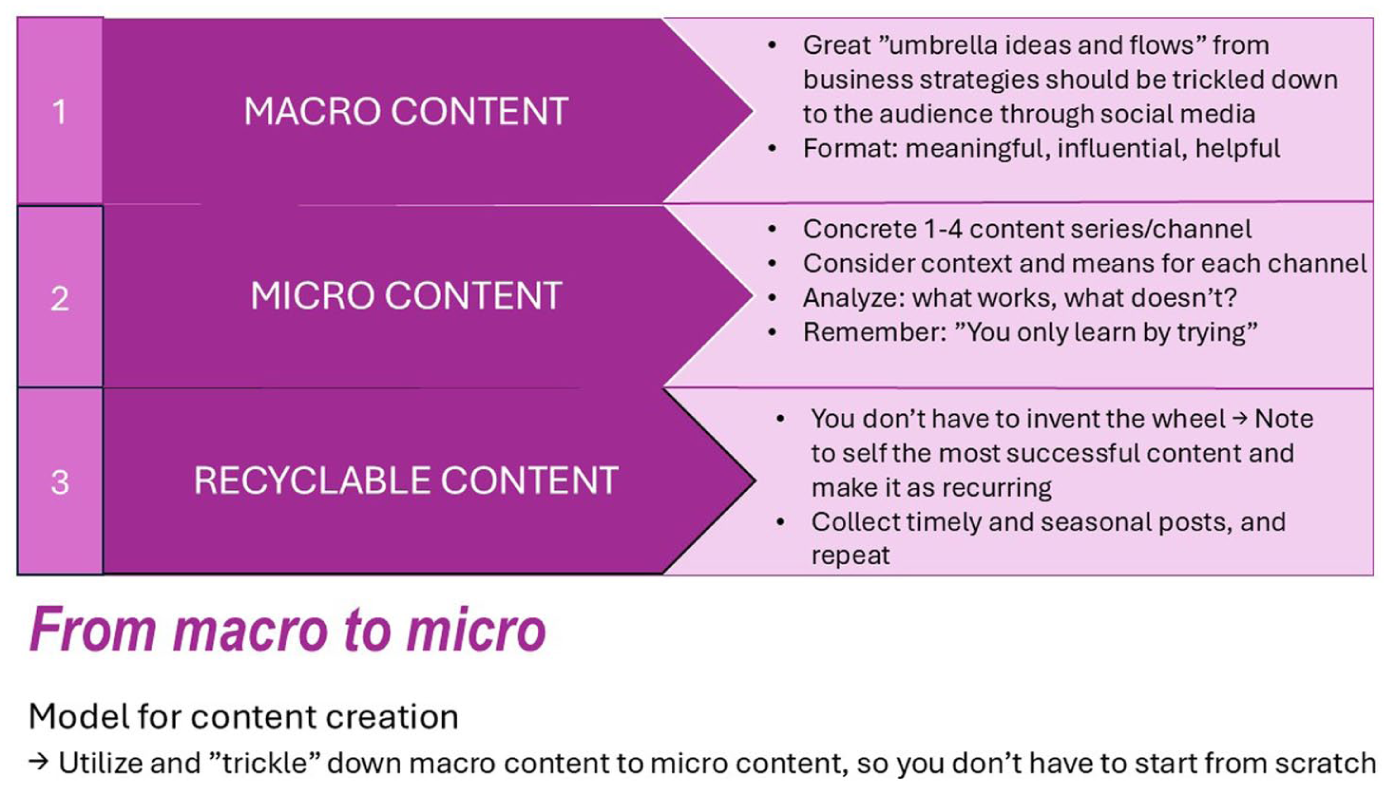
In the Model for content creation, business strategies are ‘trickled down’ to the audience through social media.
Conversely, as Agency 1 and Agency 2 interviewees explained, there is a triangular ‘win, win, win’ strategy in which clients, influencers and audience win when marketing is planned well. That is, first, content must align with influencers’ own terms because they know their audience best and have a direct connection with it; second, the business strategy of the client must come through loud and clear; and third, the content must always serve the audience. To ensure that the ‘win, win, win’ strategy would work, all agencies highlighted the importance of user data in verifying the success of their marketing strategies, which has already been a common tactic for legacy media for decades (Meehan, 2002).
Another way of adapting clients’ marketing strategies to influencers’ content was talking about purpose. That is, different ‘phenomena’, ‘purposes’ and ‘meanings’ recurred throughout the material, such as when experts taught multi-channel influencer marketing and audience engagement in webinars or when influencer marketing agencies discussed strategies with their clients and influencers in meetings and briefings, for example. Instead of selling individual brands or products, similar to what they did in the early 2010s (see Hund, 2023), today, influencer marketing agencies focus on larger aspirational purposes behind brands because in a world of limited resources and climate crisis, adapting to the logic of shareholder capitalism is no longer sustainable, and, therefore, businesses stress their societal role in creating economic growth and prosperity (e.g. Bowen, 2018; Kaplan, 2023; Ocasio et al., 2023).
Some of the ‘purposeful’ marketing strategies and ideas that stood out during observations and interviews were encouraging people to read more (a toilet paper company in collaboration with Agency 1), making an airport a compelling employer (an airport operator in collaboration with Agency 2) and creating a positive cultural image of a city district (a shopping centre in collaboration with Agency 3). To elaborate on one of these, when I observed Agency 3’s internal idea briefing for a shopping centre client, I quickly understood that the core strategy revolved not so much around advertising specific stores or products but around the idea of the shopping centre being a cultural phenomenon, a melting pot, which influencers share through social media. The briefing included brainstorming how a content creator, who lives in the district near the shopping centre, could embed the strategic message into their daily grocery shopping, recipes and cooking, which could then influence social media followers throughout the annual calendar. The ‘concept idea’ in this briefing was to associate the shopping centre with international examples of city districts, such as Brooklyn or East Berlin, that have had a shabby reputation turned into hip and cool:
Was the final [title] for the campaign ‘Like being abroad’ correct?
No, it was just an idea in the background . . .
It was the idea that I suggested when the client visited us [. . .] I suggested ‘Like being abroad’, and the client was like [. . .] they had thought about the same [. . .] So, the grounding idea could be this cultural melting pot [. . .] and the negative reputation could be turned into positive.
(An excerpt from a discussion during a meeting, observation with Agency 3)
To ensure that the messages, phenomena and purposes of clients adapt ‘naturally’ to the content that social media creators create, the agencies worked with brand matchmakers and account managers. Brand matchmakers are usually established influencers (either agency workers or freelancers) who use their networks to unite clients with creators whose brand is ‘liable, systematic and consistent’ (Interviewee 2) and ‘in line with’ (Interviewee 4) the needs of the client. These findings are similar to Kotzinets et al.’s (2010) study (p. 71) in which they found that social media marketing does not simply amplify marketing messages but that messages and meanings are systematically altered in the process of embedding them. According to my data, in some cases, influencer marketing agencies organise thorough recruiting processes to find influencers who can best adapt their clients’ messages to their own content.
For example, when I interviewed the CEO of Agency 1 in 2019, they told me about a lengthy recruiting process in which they wanted to find an influencer for a hotel chain client. As a result, one creator moved into the hotel for a year and systematically created content that engaged not only their own followers but also journalistic media, which conducted several reportages about the influencer in the hotel. For the influencer marketing agency, this ‘earned media’ was a perfect example of ‘purposeful’ marketing, which, when done right, not only spreads across social media but also across traditional media without the traditional media even realising it. As Interviewee 1 described, [. . .] We definitely didn’t choose the influencer with the biggest audience but rather focused on the value-based match, which yielded positive results. The best example is the three-page feature article in [newspaper X], in which the only person interviewed was the influencer and in which they repeated all the same words from our marketing strategy. (Interviewee 1, Agency 1)
These types of long-term strategies have been common in traditional marketing for decades (e.g. Schmidt, 1995), but now influencer marketing is following suit. For example, during the observation of Agency 2, the idea of ‘360 thinking’ recurred. In brief, 360 thinking means that social media marketing is not limited to its own platforms and individual postings but can spread across time and media, products and locations as ‘holistic and meaningful experiences’. These curated ‘experiences’ can be, for example, themed creator events, such as movie nights, cruises, podcast launch parties or brunches for meeting new friends. The events are structured in a way that they, almost imperceptibly, invite people (e.g. influencers, journalists and followers) to interact and engage with brands and produce user-generated content – thus, measurable data – on social media (e.g. specific poses with products and props and using filters, formats, hashtags and keywords). Conversely, as the example of Agency 1 demonstrates, due to the platformisation and datafication that intensify media circulation and attention economy (e.g. Banet and Weiser, 2018; Nieborg and Poell, 2018; Verdegem, 2021), effective influencer marketing spreads from social media and offline events to ‘earned’ traditional media, which multiplies the visibility for agencies and their clients.
‘Be tactical’ – negotiating between creation and platform control
As the algorithms and platform logics constantly change and thus regulate what type of content gets visibility, influencer agencies and creators must constantly negotiate between ‘purposeful’ and ‘successful’ content creation. For example, the influencer marketing agencies and experts in this study stressed the importance of ‘authentic interaction’ (EM 1), ‘creative work’ (EM 2 and EM 4) and ‘Gen Z values’ (EM 5) but, at the same time, emphasised attracting the attention of audiences with content that fuels effective algorithms, assures visibility and so on. My data show that agencies negotiate between creation and platform control in situations in which the ‘purpose’ of a marketing strategy contradicts how ‘machines interpret’ certain things, for example, ‘against good taste’ (observation with Agency 1).
That is, when I observed Agency 1’s influencer briefing about a campaign related to diversity and multiculturalism in working life, the negotiation between creation and platform control was clear. In the briefing, content creators were encouraged to discuss prejudice and to share personal experiences related to fears and assumptions in their own personal styles. However, at the same time, the agency gave strict directions on the format and length of videos (vertical, maximum of 59 seconds for TikTok and Instagram reels), the necessary tags (including labels telling the post is an ad) and hashtags related to the campaign. What made this briefing interesting was when the matchmaker of Agency 1 advised the creators not to use the word racism in content related to diversity and prejudice because the agency had faced promotion problems with the word during their previous campaign.
[. . .] this is very surprising, but last year we noticed we couldn’t promote publications with the word ‘racism’ in them [. . .]
What an interesting thing, I haven’t heard of it before.
This happened with TikTok and Instagram promotion, like Meta promotion [. . .] I don’t think any individuals go through the posts but rather their own machines, which interpret certain words as triggering or against good taste. I really don’t know the logic behind it. What a bummer. Of course, you can talk about things as they are. You don’t have to circle around it [. . .], but just with promotion, you must be tactical, unfortunately.
(an excerpt from a discussion during a briefing; observation with Agency 1)
Consequently, when ‘purposeful’ business ideas (see Ocasio et al., 2023) or content contradicts platform logic, usually, the ideas budge. This is also in accordance with Haapoja et al.’s (2024: 8) study, which found that ‘pleasing the algorithm’ and complying with platform logic are considered morally acceptable ‘part of the craft’. Conversely, studies have also shown that creators use algorithms in innovative ways to resist the power of those who programmed them (e.g. Bonini and Treré, 2024; Salamon, 2025; Salamon and Saunders, 2024). However, when complying with and pleasing the platforms and their algorithms are not challenged, the power relations and biases at the ‘backend’ (see Parks et al., 2023) of social media platforms remain. That is, if only a few have control over the platforms, it inevitably affects those who are allowed to know about the decisions made about them and the processes behind them. This grievance was articulated by Interviewee 4 when we discussed the ways in which algorithms affect their work: ‘[. . .] in a way the platforms force everyone to the same mould, which is kind of scary [. . .] like someone somewhere decides that this is how it is, and then everyone just complies with it [. . .] if algorithms don’t have the power, then of course the spectrum will be very different’.
When I started my ethnography in 2019, YouTube was still the most popular platform for lifestyle video content, and ‘successful’ lifestyle creators (i.e. those who attract followers, clicks and recommendations) could create videos, such as vlogs, tutorials, my days and Q&As, ranging from 5 to 60 minutes, usually to their liking. Today, the logic is quite different (e.g. Caplan and Gillespie, 2020; Joseph and Bishop, 2024). According to the influencer marketing agencies in this study, to be relevant, influencers must engage in multiplatform marketing with a focus on Instagram and TikTok because the audience that agencies try to attract (young adults aged 18–35) no longer watch long videos because of the average viewing time in TikTok, which is ‘6 seconds’ (Interviewee 3).
Therefore, instead of brands looking for content creators willing to boost their visibility and social media relevance, today, many creators are desperate to find paying clients increasingly through influencer marketing agencies and therefore adapt their ‘personal’ and ‘authentic’ content into what agencies, brands and audiences want (see Duffy and Sawey, 2021). Furthermore, creators must be ready and responsive to platform policies and algorithmic changes, follow industry trends and adapt their knowledge into practice if they want to gain and sustain visibility (Bishop, 2021: 3). There is a constant negotiation between creative ‘authentic’ content creation and platform control that determines social media visibility and audience engagement, often ‘embracing the neoliberal logics of hard data over softer feminised forms of social media labor’ (Glatt, 2022: 549).
Discussion and conclusion
To understand the role of intermediary actors, or ‘backstage’, in platformised cultural media production, this study investigated how Finnish influencer marketing agencies’ data practices govern and shape feminised content creation on social media. Whether it is relying on data tools and theorisations to anticipate content visibility, adapting business strategies to audience preferences with meaningful campaigns or negotiating whether to use the term racism when creating content on multiculturalism, the influencer agencies in this study had distinct ways of responding to algorithm-driven social media platforms and the expectations of their clients. Through (1) anticipation, (2) adaptation and (3) negotiation, agencies navigated and made profit within a media ecosystem in which the platformisation of cultural production dictates the ways in which media content is produced, distributed and regulated (e.g. Caplan and Gillespie, 2020; Cunningham and Craig, 2021; Verdegem, 2021).
While anticipation is a strategy for preventing problems and creating optimal and efficient social media content with the help of data, adaptation is a way to adjust marketing strategies into changing audience preferences (measured with data) and platform logics to increase visibility, engagement and profit. Negotiation is a way for influencer agencies to balance between creation and platform control to create purposeful yet engaging content, although most of the time complying ‘to the power of algorithms’ (Interviewee 4). Furthermore, when influencer marketing agencies plan ‘purposeful’ social media strategies for their clients, content creators are increasingly the ones who bear the risk on social media: Not only do creators adapt their ‘authentic’ content to the ideals of clients, agencies and audiences but also to the algorithmic logic of social media platforms (e.g. Bucher, 2018; Duffy et al., 2021; Glatt, 2023b; Scolere et al., 2018). As Hund (2023) describes (p. 53), there is a clear power struggle between content creators who, despite the threat of invisibility, often prefer interacting with their audience over metrics, and the marketing agencies that are ‘pushing influencers and brands to sign on for their metrics and management services’.
The constant anticipation of algorithms and ‘platforms’ activities’ (see Verdegem, 2021) inevitably affects, for example, content visuality (e.g. colours, filters and lighting), genre (e.g. lifestyle, humour and politics) and format (e.g. video, image and text), as agencies, experts and content creators try to reach audiences and keep them engaged. Similar findings have been identified in journalistic social media production, in which news producers must, for example, adapt to the logic and visuality of Instagram and its existing microformats (e.g. feed posts, stories, reels and live casts) if they want their content to reach their target (Kallio and Maenpaa, 2025). However, along with discussions over the platformisation of cultural production (e.g. Joseph and Bishop, 2024; Verdegem, 2021), there have also been critical debates over the power of algorithms and platform control. It has been argued that algorithms should not be seen through reductive binaries but through their complexity and fluidity, which can help to navigate and understand spaces that emerge between various temporalities and levels of analysis (e.g. Bonini and Treré, 2024; Siles et al., 2024).
Furthermore, researchers have pointed out a growing concern over ambiguous advertising, which can mislead social media audiences and diminish trust. These concerns include the question of transparency of sponsored content and how to distinguish different types of communication, such as marketing, advertising and journalism, from each other (e.g. Bochers and Enke, 2022; Ikonen et al., 2017; Nieborg and Poell, 2018; Poutanen et al., 2016). Moreover, there is a vast expansion and affective circulation of disinformation and hateful content, or ‘popular misogyny’ (Banet-Weiser, 2018), that feeds effective algorithms and poses a threat to women and minorities online (Glatt, 2023b; Jane, 2017).
As a result, efforts to regulate disinformation and advertising on social media have been made (e.g. the European GDPR 3 ). For example, in Finland, the new rules and regulations determined by the Competition and Consumer Authority 4 obligate creators to tag marketing content with clear labels (e.g. ad, PR gift and ad of own brand). Unsurprisingly, the new guidelines have raised concerns among influencer agencies and content creators, who, on the one hand, believe that transparent advertising can ensure ‘brand safety’ (Bishop, 2021; see also Borchers and Enke, 2022), thus attracting new followers and customers in the name of reliability, but, on the other, can also make content seem fake and alienate the most precious asset of social media work – the engaged and loyal audience.
Consequently, the audiences that are traced, measured and turned into numbers do not exist in a vacuum but in environments that are engineered and structured with algorithms influenced by extant social, cultural, economic and political forces (Cotter, 2019: 898). Moreover, based on my ethnography, I argue that while creators working with agencies have adapted to clients’ needs and platform logics, they have also become service providers to influencer marketing agencies that are situated at the ‘backstage’ or ‘backend’ (see Parks et al., 2023) of social media. Put differently, even though influencers are crucial collaborators for agencies, agencies’ main goal is not to put creators first but to seek profit for their clients and for themselves while benefitting from actors such as big tech companies, media system designers and corporations, which sustain the processes of conglomeration and digitalisation that reinforce current power structures and inequalities.
The influencer marketing agencies in this study not only benefit from and adapt to the power of platforms but also maintain it by accepting it as ‘part of the craft’ (see Haapoja et al., 2024) or, as one of the interviewees put it, ‘if the algorithms didn’t have the power, of course, the spectrum would be very different’ (Interviewee 4). Consequently, I argue that, most of the time, influencer agencies’ strategies are not objective data-based practices founded on trustworthy quantitative and qualitative methods taught by analytics experts but rather a craft that is developed through time with trial and error. Furthermore, even though influencer agencies are aware of platformisation, they rarely resist their algorithmic logics or negotiate practices to fit their own ideals instead of what is ideal ‘in the eyes of the algorithm’ (Interviewee 3). I argue that no matter how much experience influencer marketing agencies have on data analytics and optimisation, anticipating how the algorithms on social media work is, at best, a guessing game in which to ‘keep up’ is to comply with social media platforms and their business models, whatever they might be at a given moment.
Therefore, it is important to note that creators and influencers also show discontent towards the boundaryless industry, unpredictable ‘platform infrastructures’ (see Hesmondhalgh, 2021) and the logic of algorithms that benefit from their persona and labour (e.g. Caplan and Gillespie, 2020; Cotter, 2019; Nieborg and Poell, 2018). During the past few years, the industry has been, at least seemingly, shifting through unionisation and other professionalisation efforts. For example, in the United States, the American Influencer Council (AIC), launched in 2020, aims to address some of these issues by providing education and networking opportunities as well as developing professional standards. In the United Kingdom (Salamon, 2025; Salamon and Saunders, 2024), India, Ireland and Turkey (Bidav and Mehta, 2024), peripheral creator cultures have developed innovative survival strategies and resistance. In the Nordic countries, more creators have gained access to support systems through creator networks and entertainment industry unions and have gained significant political power (Arnesson and Reinikainen, 2024). In Finland, as of March 2024, Marketing Finland, a union for marketing and communication professionals, also opened its doors to creators. These changes show that there is interest in developing professional standards and support for protecting creators’ professional interests.
Accordingly, by focusing on a specific group of influencer marketing agencies and their data-driven working practices, this article has shined a light on a space relatively understudied in an industry based on platformisation and feminised nature of cultural labour (Bustelo et al., 2019; Caplan and Gillespie, 2020; Duffy and Schwartz, 2018; Verdegem, 2021). Furthermore, this study has shown that influencer marketing agencies usually adapt to the power of platforms as part of their work and only rarely negotiate or resist their algorithmic logics. However, there are also actors in the industry who resist the power of algorithms and those who programmed them (e.g. Bonini and Treré, 2024; Savolainen et al., 2022; Siles et al., 2024). Considering these aspects more closely is beyond the scope of this study and thus leaves space for future research that focuses on intermediaries’ role in unionisation efforts, resistance and professionalisation in the industry.
Finally, due to the limited number of agencies and analysed material, the findings from this study are not representative of the entirety of influencer marketing and what it can be. Studying the ‘backstage’ of feminised content creation is, nevertheless, crucial in understanding how intermediaries operate within a media ecosystem shaped by communication technologies, algorithmic processes and software, as well as political economies that influence the ways these processes and technologies are designed, imagined and communicated about and the hierarchies of power and knowledge that they constitute.
Footnotes
Data availability statement
The data that support the findings of this study are available from Marketing Finland, the influencer marketing agencies studied (and pseudonymised), as well as the author who has ethnographic observations and interviews of the studied agencies, but restrictions apply to the availability of these data, which were used under licence for the current study, and so are not publicly available. Data are however available from the author upon reasonable request and with permission of the third parties.
Ethical approval and informed consent statements
The ethical consideration in this study follows the ethical principles of Finnish National Board on Research Integrity TENK (Finnish National Board on Research Integrity TENK. 2019. The ethical principles of research with human participants and ethical review in the human sciences in Finland.  ). All the participants of this study gave either their written or orally recorded informed consent.
Funding
The author disclosed receipt of the following financial support for the research, authorship, and/or publication of this article: Parts of this research has been funded by the Finnish Cultural Foundation, Pirkanmaa Regional Fund (Grant number 50251226).