




Abstract
In this article, we examine Korean social media users’ anecdotes regarding social media algorithms, contextualized within the intricate dynamics of South Korea’s rape culture and the intensifying male pornographic fantasies for women’s flesh. Drawing on digital ethnography, we conceptualize their understandings of algorithms as pornographic algorithms—a set of imaginaries about how social media algorithms mediate the visibility of pornographic content in distinct ways and users’ social media engagement accordingly. Through case studies of the four most popular social media platforms—Instagram, TikTok, Twitter, and YouTube—we explore how these pornographic algorithms are perceived as the main key actors in pornification in concert with the country’s existing rape culture, and how users develop tactics to navigate porn-friendly social media. We argue that social media use for Korean women is an ongoing everyday fight against a new form of sexism that is now convolutedly processed, normalized, and facilitated by algorithmic governance in the digital realm.
Introduction
While searching for information and watching YouTube videos, adult webtoon ads pop up constantly, which makes me feel harassed even when I’m “alone” at home. Women in these ads are portrayed as sexual “objects” to satisfy men’s pleasure, and such messages are now reaching children as young as 8, thanks to YouTube Korea taking no actions.
-Twitter (now X)
1
post in 2023, poster anonymized
When logging onto social media in South Korea (hereafter Korea), one is likely to be immediately struck by the abundance of explicit sexual content. Despite the legal ban on “obscene” content (Park, 2019), this kind of content incessantly appears during users’ casual scrolling of social media feeds, disrupting their browsing experience. As noted above, the constant bombardment of unsolicited sexual content on social media, including porn advertisements, frequently makes users uncomfortable. The proliferation of porn-like sexual content on the Internet has been a persistent issue in Korea for over two decades (Kim, 2021b). Online news articles and blog posts often feature ads displaying images of naked women alongside links to porn websites or adult game sites, sometimes with explicit ad texts like “Yeah, please fxxx me” (Kim, 2021b).
Social media algorithms’ suggestion of unsolicited sexual content further exacerbates this issue. This is not confined to Korea. A few studies have examined how media algorithms promote sexually suggestive content featuring women’s bodies (Carah and Dobson, 2016; Noble, 2018), while codifying borderline content as sexual and even regulating it (Are and Paasonen, 2021). Some attribute this to inadequate content moderation policies on major global social media platforms, which fail to control harmful sexual content (e.g., Harmanci and Chafkin, 2024). Malicious users have taken advantage of these loopholes to share AI-generated, deepfake, or illicitly filmed sexual content of women and children (Mehta, 2024). Notably, however, issues around such algorithmically mediated sexual content manifest uniquely across different countries and regions, intersecting with local cultures. For instance, in China, the governance of social media algorithms aligns with the government’s nationalist and patriarchal ideology, depriving female users of opportunities to call out sexist and misogynistic experiences online and offline (Liao, 2023). In Australia, algorithmic content moderation practices of platforms like Facebook fail to understand aboriginality and tend to censor content about aboriginal traditions by sexualizing Indigenous bodies (Matamoros-Fernández, 2017).
Against this backdrop, we investigate how Korean social media users perceive and feel about the workings of social media algorithms that seemingly promote sexually suggestive content.
As we elaborate further in this article, despite their materiality in content moderation and recommendation, how social media algorithms are actually codified and work remain “black boxed” by platform companies and largely inaccessible to the public (Reviglio and Agosti, 2020). Consequently, many social media users navigate such constrained environments by circulating gossip and folklore about how they feel and imagine algorithms work (Bishop, 2019; Bucher, 2017; Savolainen, 2022).
This opacity and user speculation take on particular significance in the Korean context. Korea is frequently recognized as a leader in global social media trends, with a populace that is social media savvy (Evans, 2016). Simultaneously, the country grapples with burgeoning technology-facilitated sexual violence (TFSV) against women, such as cybersex trafficking, spycam, and the rapid circulation of spycam content of women on illegal porn websites (Kim, 2021a). In this climate, many social media users in Korea, particularly women, harbor deep-seated distrust toward the functioning of social media algorithms in relation to the growing prevalence of pornographic content on the Korean Internet, as evidenced in the vignette above (see Hankyoreh, n.d.).
In this article, we introduce the concept, pornographic algorithms—a set of imaginaries that people feel, think of, and imagine about how social media algorithms mediate—and even promote—the visibility of sexually suggestive content akin to pornography. It is not a descriptive term defining algorithms themselves as pornographic. Rather, our conceptualization demonstrates how these imaginaries subsequently shape the ways users engage with social media platforms and broader cultures. To do so, we first provide an overview of the dominant rape culture in Korea and situate the issue of pornographic algorithms within the growing prominence of TFSV in the country. Then we examine pornographic algorithms as imagined, described, and contested by Korean social media users within the specific Korean social contexts, shedding light on how they understand and mitigate the impact of algorithmically mediated sexual violence on their online experiences. Through this exploration, we provide insights into how users develop their strategies to make their media realities more positive, pleasant, and safe, navigating the complexities of social media intertwined with the technological materialities of algorithms and social structures.
Burgeoning pornification and rape culture in the digital space
Albeit difficult to define, pornography broadly refers to “sexually explicit materials intended to arouse” with cultural variances (McKee et al., 2020: 1088). With the Internet and the expansion of visual media culture, pornography has become more accessible (Paasonen, 2014) and has been instituted in various formats, including online vernaculars—for example, Not Safe For Work culture (Brown, 2017) and sexualized creative labor on digital platforms (Drenten et al., 2019; van der Nagel, 2021).
This “commonplaceness of iconography of porn” in popular culture (Kolemainen, 2010: 108) is often described as pornification (Drenten et al., 2019; Paasonen, 2014). While the term pornification often carries the negative connotations of pornography being everywhere (Paasonen, 2014: 4), even in non-pornographic forms of pop culture (Drenten et al., 2019), critical porn scholarship suggests a nuanced approach. For example, more accessible porn consumption and creation on social media can foster connection and community among sexual minorities (Jones, 2020) and empower women by allowing them to include their perspectives and assert their sexual agency (Attwood, 2011). However, the increasing integration of sexualized imagery into everyday digital life also manifests as new forms of sexual violence, contributing to the rise of TFSV. Defined as “a range of behaviors where digital technologies are used to facilitate both virtual and face-to-face sexually based harms” (Henry and Powell, 2018: 19), TFSV has now become a persistent threat for women in particular. Seen as pornographic objects, women frequently become victims of growing rape culture in digital space, targeted through nonconsensual deepfake porn (van der Nagel, 2020), revenge porn (Henry and Powell, 2018), and memeified content shared online on whether their appearance makes them “rapable” or not (Andreasen, 2021).
In this article, rather than taking the antiporn or anti-antiporn binary, we follow critical porn scholarship’s emphasis on a nuanced approach to the complexities of pornography, recognizing that its production, consumption, and distribution are not inherently empowering or disempowering to women but are uniquely shaped by cultural and contextual specificities (Attwood and Smith, 2014). We use the term pornification to examine how accessibility and visibility of porn-like content of women evoking sexual imagery become intertwined with the very specific context of digital rape culture in Korea, a context that predominantly influences male-centered porn cultures and practices in the country.
Rape culture refers to a culture where rape-supportive attitudes and behaviors, such as hostility toward women and gender violence, are implicitly and explicitly condoned, excused, and normalized (Johnson and Johnson, 2017). While rape culture exists globally (WHO, 2021), it has grown prominently in East Asia, paralleling the burgeoning porn industry of the region (Kim, 2021a; Molisso, 2023). Korea exhibits a stark duality in its approach to pornography, which has in turn amplified rape culture and generated antiporn sentiment.
On the one hand, pornography is strictly prohibited by law in the country (Cho, 2006). The production, circulation, and public posting of “obscene” content—though never clearly defined—is banned by law due to “potential societal harm” (Park, 2019), to protect the “morality” of Koreans and to protect Korean women and children from digital sex crimes (Lee, 2021). Overseas-based adult sites deemed “illegal” are censored and blocked through Korean IP addresses under the oversight of the Korea Communications Standards Commission (Kim, 2018), although this censorship is easily bypassed with the use of VPN software (Oh, 2017). Rooted in conservative values and the dominance of Christianity in politics, this legal stance has shaped a broader societal view that frames pornography as inherently harmful (Eun, 2025; Oh, 2017). As a result, calls to destigmatize and legalize pornography to promote healthier understandings of sex have often met with public backlash and been withdrawn from public debate altogether (Oh, 2017).
On the other hand, despite this legal prohibition grounded in sexual moralism, male-centered pornography is widely tolerated. Broadly called yadong (야동, online lingo and abbreviation of yahan dongyeongsang, trans, “obscene video”), porn has been seen as a male domain and outlet for men to fulfill their needs (Sun et al., 2015: 17). In this climate, even the production and sharing of nonconsensual sexual content on the Internet is often generously excused, with punishments for digital sexual crimes remaining minimal and the pornography ban almost serving no purpose (Won, 2024). The blanket ban on “obscenity” has been ineffective in curtailing the circulation of illicit porn content (e.g., nonconsensual and child pornography) and the prevalence of porn websites hosting such content (Kim, 2021a; Molisso, 2023)—due to authorities’ inadequate law enforcement of digital sex crimes (Won, 2024).
This leniency toward male-centered porn culture, despite the presence of the strict law, has been criticized as the primary cause of the rise of rape culture, enabling the normalization of pornographic violence against women in everyday life (Kang, 2020; Singdoo, 2020). Yet still pervasive sexual moralization manifests “harsh(ly)” on victims by blaming them for their own victimization and saying “You caused the crime yourself” (Choi and Kim, 2020). The duality contributed to the expansion of rape culture and TFSV in the digital space, including increasing instances of molka (몰카, spycam) crimes and cybersex trafficking (BBC Korea, 2024). The most notorious case is the Nth Room case, where male predators contacted young women, including minors, through social media and sexually exploited them in exclusive group chat rooms. The predators blackmailed them and distributed the exploitative content across various digital platforms, including online communities and the dark web (Hankyoreh, n.d.; see also Netflix’s Cyberhell, 2022). A subsequent rise in similar crimes using AI deepfake technology continues to occur (Mackenzie and Choi, 2024).
Despite regulatory efforts, molka crimes and rape culture persist, often escaping the radar of law enforcement (Mackenzie and Choi, 2024). Labeled as “porn,” such sexually violent content is easily and widely spread by social media algorithms, which normalizes rape culture and subjects women to unwanted TFSV in the digital space. Against this backdrop, public skepticism toward pornography only grows with a suspicion that social systems, including technologies, overwhelmingly cater to male desire (see Lee and Kim, 2025).
Gendered working of media algorithms
Media algorithms are a set of codified instructions and processes implemented on media platforms to mediate the visibility of content through specified calculations that convert input data into a desirable output (Gillespie, 2014). Social systems are implicitly embedded in the codification of algorithms that rank, categorize, and moderate the visibility of content on social media platforms (Bishop et al., 2020). Consequently, women’s bodies are frequently codified through the lens of sexism by media algorithms (Noble, 2018). When googling women of color, for example, the Google search algorithm presents pornographic images and pornographic sites over other content, mirroring the sexually codified content mediation program (Noble, 2018). Similarly, Jieun Lee (2020) posits that the working of Google search engine’s algorithm in Korea reflects Korean men’s sexual desire for female flesh. According to her study, the Google search query 길거리 (gilgeori, trans. “street”) generates numerous sexually coded images of women walking down the streets, often depicted in shorts and tight clothing, likely taken without their consent. These generated images of women are often accompanied by tags of “Do not click when there are people behind you,” indicating that the images are intended for sexual purposes (Lee, 2020). Through a case study of nightlife culture on social media platforms, Carah and Dobson (2016) also find how posts of “hot female bodies” (p. 1) circulate on social media, shaped by human and algorithmic decisions that promote sexualized images of women that adhere to the heterosexual male gaze.
Meanwhile, social media platforms’ algorithmic content moderation also appears to censor sexual content—but ironically also the type that challenges normative patriarchal sexism or even content that is not sexual. For instance, sex workers, activists, and creators of “borderline content,” such as pole dancers, experience their content being censored by algorithms and remain invisible to the public, in the name of “safety” and the public good of users (Are and Paasonen, 2021). Being perceived as “sexually suggestive” (Are and Paasonen, 2021), these posts are “shadowbanned”—a light censorship technique of social media platforms that hides or downranks content without notifying the user (Suzor et al., 2019). Through the example of Instagram’s co-moderation model, Duguay et al. (2020) also note how creators who produce content on nontraditional expressions of femininity (e.g., queer femininity) can face targeted flagging by malicious users, which triggers platforms’ automated content moderation mechanisms to censor their content. Algorithmic censorship on women’s agentic practice with their own bodies, regardless of whether it is sexual or not, indicates how the deeply gendered system and the culture of male-centered valuation of women’s bodies are reflected in the workings of social media algorithms.
Yet, social media algorithms are also proprietary to each platform, calculated based on confidential data accrued by each company. This opacity makes it difficult to comprehend how social media algorithms actually function—for example, what kinds of datasets are used in the codification, how codifications are calculated, and who is involved in the design, launching, and management of the algorithms. Thus, how algorithms work remains as “folklore” (Savolainen, 2022), “gossip” (Bishop, 2019), and “imaginaries” (Bucher, 2017), which are constructed around people’s perceptions and experiences, including affective registers toward algorithm-mediated social media interactions (Bucher, 2017). Moreover, social media algorithms are cultural artifacts in constant evolution and performance through interactions with various actors, including users, sociocultural events, and the architecture and vernaculars of platforms (Rieder et al., 2018). Yet, such perceived performativity is itself also imaginary as the power of algorithms is obscured “within black boxes” (Pasquale, 2015: 8). Nonetheless, these imaginaries are real as they are the narrated documentation of people’s lived experiences of social media, wherein algorithms shape their media lives and materialize the realities of social media interactions (Bucher, 2017: 40). In this vein of thought, we draw upon Bucher’s (2017) notion of algorithmic imaginary—the ways “in which people imagine, perceive, and experience algorithms, and what these imaginations make possible” (p. 31).
In this article, we situate Korean women’s experience of social media within these contexts of pornification, digitized rape culture, and socially structured algorithms that they problematize. We specifically focus on the cultural specificities of how gendered algorithmic governance plays out in the particular context of Korean social media culture. Crucially, this governance is less about the actuality of how it works and more about an imagined system that people presume how algorithms would work. By doing so, we show geo-cultural manifestations of globally prevalent gendered (yet imagined) working of pornographic algorithms and highlight the importance of locality in today’s globally connected digital mediascape. We are less concerned with uncovering the actual workings of social media algorithms but more focused on understanding how people think of and feel about pornographic algorithms regarding rape culture in the digital space and how algorithms are articulated in the form of discourses, folklore, gossip, and imaginaries reflecting their lived experiences.
In our Findings sections, we look into two aspects: (1) mapping pornographic algorithms in relation to each social media platform’s unique characteristics and (2) understanding people’s, especially women’s, media practices to navigate algorithm-driven pornification on social media. We discuss tensions around social media algorithms, social systems of gender and sexuality, and women’s agency in the midst of growing technology-mediated violence and pornification.
Methodology
We employed a multi-method approach, including longitudinal digital ethnography and in-depth interviews with content creators. While previous studies on social media algorithms in media studies often focused on single platforms (e.g., Bucher, 2017; on Facebook; O’meara, 2019, on Instagram; Schellewald, 2023, on TikTok), our methodology covered cross-platform experiences to offer a comprehensive map of social media pop cultures. We selected four main social media platforms—Instagram, Twitter, TikTok, and YouTube—for their popularity in Korea and worldwide and their roles as main points of everyday digital interactions for many people (Pew Research Center, 2024).
Digital ethnography is a holistic approach to understanding a “digital-material-sensory environment” by immersing researchers in digitally mediated fieldsites (Pink, 2014: 420). Among many field sites, social media pop cultures are crucial areas where interactions and dynamics between various actors, including users, platforms, industries, and texts, are instituted into new vernaculars within complicated social, cultural, political, and economic contexts (Abidin and Lee, 2022: 22). Thus, social media pop cultures serve as entry points for discussing and mapping emerging and pressing social issues (Abidin and Lee, 2022).
The first author conducted digital ethnography on digitally mediated gendered social media experiences in East Asia since 2020. While her primary research focus was on so-called “influencers,” animal activism, environmentalism, and K-pop for her other projects, during her digital ethnography for these projects on the four main platforms, she also noticed the constant, unsolicited suggestion of sexually suggestive content by algorithms. For instance, random phone numbers were suggested as trending on Twitter and, when clicked, linked to sexual content featuring women. She also observed that other social media users, including those who are often labeled as “influencers” or “content creators” based on the size of their followings, frequently complained about similar experiences, yet the four platforms remained largely unchanged, with no apparent efforts to regulate or moderate such content. These initial observations informed a need to further investigate algorithmic suggestions of sexual content and users’ perceptions of such algorithmic workings.
The first author then developed a more grounded approach to her digital ethnography, which involved regularly observing algorithmically recommended social media feeds. This was conducted in both incognito mode to avoid algorithmic tracking of her digital footprints and standard mode to see how algorithmic recommendations might differ when influenced by her other research topics and personal interests (animal activism, baseball, K-pop). Whenever posts on women’s sexual content were randomly recommended by algorithms, she made a note and collected data. Screen-grabbed posts were also submitted to visual and textual analysis to identify recurring themes in algorithmically mediated content, focusing on visual elements of women’s nudity that were highlighted in algorithmically mediated content, practices social media users employed to navigate pornographic algorithms, and keywords and emojis social media users frequently used in talking about algorithmic workings.
Complementing data on social media users’ algorithmic imaginaries, both the first and second authors conducted in-depth interviews with 38 Korean women whom we identify as “content creators”—those who actively produce content for a Korean audience and may therefore have greater experience of encountering algorithmic mediation. These interviews were conducted upon institutional review board (IRB) approval from the authors’ respective institutions. While content creators are often understood as a distinctive group of people who may be more incentivized to understand, test, and experiment with algorithms to manage their visibility to their audiences than ordinary social media users, we do not analytically separate them in this study. Instead, we focus on them as part of the broader user category, acknowledging their greater encounter with social media systems (i.e., algorithms) due to their active social media use, while examining their shared experiences of gendered algorithms as Korean women online. Unlike the common perception that influencers or content creators are likely to seek attention and make easy money from it (cf. Lee and Abidin, 2024), our ethnographic engagement with informants at various stages of media stardom showed a more complex reality. The line between content creators/influencers and ordinary social media users was more blurred as many experienced transitions between the two; some achieve viral fame with one single TikTok post, others remain everyday users despite years of trying to become “influencers,” and some with large followings neither see themselves as “content creators/influencers” nor intend to profit from their fame. Interviewees varied in genre (e.g., beauty, fashion, health), celebrity status (from a nano-influencer to a mega-influencer with over 1 million subscribers), and career status (from a layperson with less than 1 year of experience to a professional with an established career and years of experience). Interview questions were semi-structured to explore interviewees’ experiences with algorithmic visibility and their algorithmic imaginaries. To protect the anonymity of the research participants, their names are pseudonymized.
By connecting a set of different data sources, we examined social media users’ gendered experiences with algorithms in social media pop cultures and their imaginaries about algorithms in relation to existing social norms and contexts of gender and sexuality. By probing into their understandings of how algorithms function, we mapped out a broad landscape of social media pop culture, where individuals strive to make sense of their algorithmically mediated material realities and online lives.
In presenting our data, we followed the Internet Research: Ethical Guidelines 3.0 (Franzke et al., 2020). Given the significance of anecdotes shared on social media that were often accompanied by users’ own screenshots, we have included selected cases as figures in this article. For content-critiquing platforms and situations, we anonymized their social media handles and reconstructed the original posts, using free online software, replacing the original Korean text with English translations to minimize searchability and protect user identities. However, sexually suggestive content with commercial intent (e.g., ads) that was algorithmically recommended is presented without anonymization, to keep our critical standpoint.
Findings
Different manifestations of pornographic algorithms
Instagram, TikTok, Twitter, and YouTube have formal, public-facing community guidelines on restricting nudity and sexual content and prohibiting sexually violent content (e.g., nonconsensual sexual content). While each platform has specific content moderation systems that seek to reflect these guidelines, they commonly rely on users as voluntary moderators (e.g., inviting users to flag inappropriate content) and automated moderation systems with limited human oversight (Bennett, 2025). This often manifests as inconsistent, uneven, and contradictory enforcement of the guidelines—a process described as patchwork governance (Duguay et al., 2020). Our data corpus reflects the impact of this patchwork governance, as many social media users in Korea express dismay over the increasing visibility of sexually violent pornographic content on social media. The users of our data corpus accuse social media of surreptitiously promoting and normalizing the burgeoning culture of pornification through algorithms. Their algorithmic imaginaries illustrate how social media pop cultures are computationally codified and materialized by algorithms as spaces to sexualize women as sexual objects and promote rape culture. Yet, the experience of pornographic algorithms varies across platforms, reflecting platform-specific vernaculars.
As one of the most popular platforms where one’s visuality serves as the most valued capital in the economy of attention and visibility, Instagram has been reported to promote content that possesses sufficient visual capital through its algorithm (Salty, 2019). In particular, Instagram’s algorithm is reported to prioritize posts featuring nudity and sexually suggestive posts of “physically attractive” women in bikinis and undergarments on users’ feeds (Kayser-Bril, 2020). This has created an Instagram vernacular where influencers are encouraged to produce sexually suggestive content for attention and monetization (Drenten et al., 2019), a trend also observed in Korea. Notably, in our data, this way of promoting sexual content on Instagram appears to extend to other nonsexual content, which frustratingly confines Korean female content creators to the context of lust, reflecting the country’s dominant pornification on the Internet.
Nari, a beauty and fashion content creator, stated that the Instagram posts of her modeling, wearing slightly revealing clothes, garnered the most visibility and likes, leading to a surge in views and likes beyond her followers. Similarly, Jin-ah, who creates content on cooking and health on Instagram and YouTube, also experienced a spike in visibility from non-followers after posting pictures of her pole dancing on Instagram. Younji, a lifestyle influencer, attributed this visibility logic of the Instagram algorithm to privileging sexually coded content, thereby making “it easiest to get a few counts by sexualizing oneself.”
However, the algorithmic visibility of such content often attracts unwanted attention from users whom the creators identified either as seeking sexualized content of Korean women or attempting to solicit female Instagram users into sex industries in Korea. For instance, Min, a fashion creator on Instagram, shared that she began receiving “catcalling” direct messages from users after uploading a post of her doing yoga. While Min did not anticipate her content to be perceived as sexual, she felt that the algorithm recommended her content alongside sexualized images of women in fitness attire on user feeds, thereby attracting users who frequently like, save, and engage with such posts in a sexual context.
Nari also shared her thoughts about “ghost” Korean accounts prevalent on the platform. These accounts, characterized by anonymity (including no history of posts or profiles), message her to perform sexual acts and services in person and attempt to recruit her into the sex industry, including illegal porn sites. These accounts are part of Korea’s growing sextrafficking issue on the Internet, which lures young women via following and direct messaging, falsely promising significant compensation (Park, 2016). Interviewees indicated that Instagram’s direct message function creates an environment where they more frequently but privately encounter problematic users and experience higher levels of TFSV.
While algorithmic visibility is popularly discussed as being “selected, elevated, and given voice and legitimacy” by gaining attention in social media’s economic system of attention (O’Meara, 2019: 4), algorithmic visibility can also be experienced as unwelcome and harmful attention by exposing women to unwanted audiences (Lee, 2025), such as men who consume their visibility for pornographic means. According to the participants of our study, the Instagram algorithm is experienced as an amplifier of not only visibility but also pornographic assault, which connects a range of multiple actors with sexual craving to their posts.
TikTok
TikTok has a unique For Your Page (FYP) algorithm that suggests TikTok videos tailored to users’ digital footprints and current TikTok trends in the same region and area (TikDragons, 2020). Generally, TikTok users have reported randomly encountering porn-like TikTok videos recommended by its FYP algorithm (Kelly, 2022). The frequent appearance of TikTok videos featuring women’s nudity is often observed during users’ casual scrolling on TikTok, including on Korean TikTok.
TikTok has introduced its unique platform vernacular of audio-based meme culture, where users easily imitate, recreate, and circulate meme-like content by adopting audio-visual elements of viral content (Zulli and Zulli, 2022). Many users from our data find that this TikTok vernacular has been utilized as a template for porn content, allowing it to disguise itself as a kind of meme and to easily ride on “trends”, aiming to go viral with the virality-seeking popular hashtags like #fyp. Notably, many porn-like TikTok videos that randomly appeared during digital ethnography were employing viral elements of the moment, such as filters, songs, or choreographic movements of dance challenges (Figure 1).
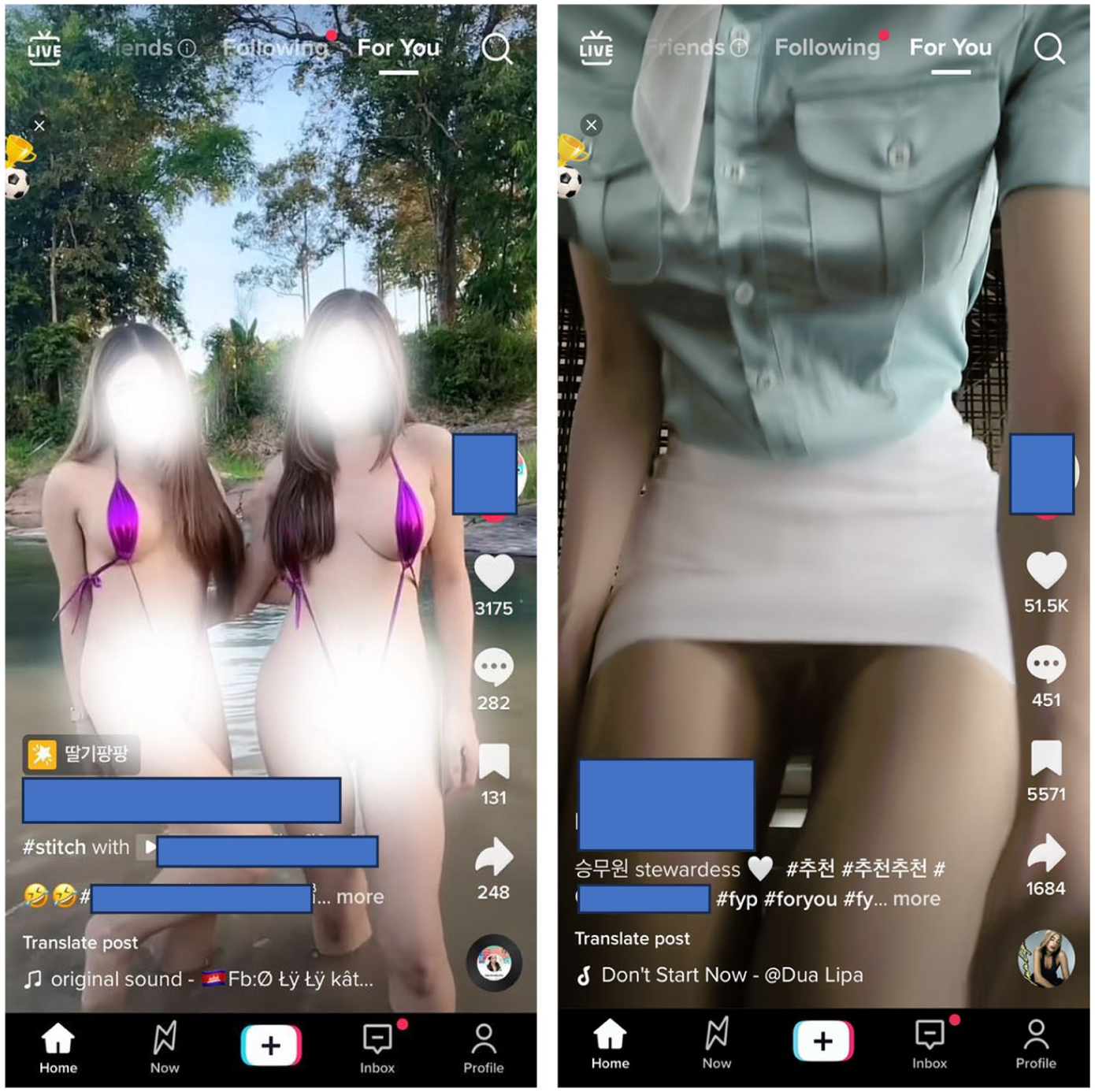
Author screengrab of For You page (FYP) content suggested by the TikTok algorithm during casual scrolling in Korea (incognito mode).
Many TikTok users accused the TikTok algorithm of popularizing porn content, arguing that it fails to differentiate whether it is a meme or not and instead suggests anything that is trending or eye-catching with meme elements. Below are some examples of users who encountered porn content via the TikTok FYP algorithm.
“I think I’m gonna go crazy watching TikTok. Please stop showing me the horror and porn stuff.” (Twitter post, anonymized) “Why does TikTok keep recommending porn stuff to me!!!! WHY???? So disturbing” (comment originally posted to online community, shared on Twitter, anonymized)
This kind of experience contributes to the dominant racist skepticism of TikTok as a “vulgar (Chinese) app” in Korea, a notoriety around the platform for hosting clickbait content (Abidin and Lee, 2023: 92–94). People build their imaginaries about the TikTok algorithm largely around this skepticism, subscribing to the discourse that the platform promotes “inappropriate, immoral, cheap” content, aligning with the racist image of China (Abidin and Lee, 2023). This differs slightly from other platforms, where people primarily explain algorithms through the unique Korean locality, not the platforms, as we explain in the remainder of the article. Yet, instead of the Korean specificity, in TikTok’s case, users attribute their algorithmically mediated experiences to their geo-cultural backgrounds, East Asia. By referring to cultural proximity of three East Asian countries (China, Korea, Japan), female social media users not only perceive the TikTok algorithm as “misogynistically working in Korea” but also read as a “reflection [of] the pornographic desires of East Asian brothers,” mentioning TikTok being owned by a Chinese company (comments posted to online communities, shared on Twitter). In addition, the popularity of racially identifying sexual hashtags, such as #koreangirl and #asiangirl, in the TikTok search engine makes Korean women feel that the platform is favorable toward men who are interested in sexually consuming content about East Asian women.
The algorithm of Twitter revolves around “trending keywords,” enticing users to stay updated with the latest news. Before Twitter was acquired by Elon Musk and changed its algorithm that curates feeds for each user based on their digital footprints (i.e., the For You tab) (Amrita, 2023), the Twitter algorithm facilitated the spread of content through following–follower networks (Fu, 2019). For this reason, Twitter feeds seemed less algorithmically curated compared to other social media platforms (Hase et al., 2023). Yet, as a platform for acquiring and spreading information, Twitter also has the “trends” feature, offering users a glimpse into real-time topics relevant to their locations beyond their follower networks (Zhang and Ng, 2023). In this way, Twitter allows users to stay engaged with real-time, noteworthy information in society.
However, on Twitter in Korea, keywords related to the porn industry and rape culture frequently trend and are suggested to users as popular topics. As shown in Figure 2, many Twitter users complain about the inadequate moderation of the keywords and lingos pertaining to rape culture, expressing concerns about teenagers’ easy access to these keywords on the platform. These concerns stem from the dark reality of Twitter being used for recruiting teenagers into prostitution in Korea via hashtags such as #조건만남 (jogeun mannam, trans. “compensated dating”) (Choi, 2021).
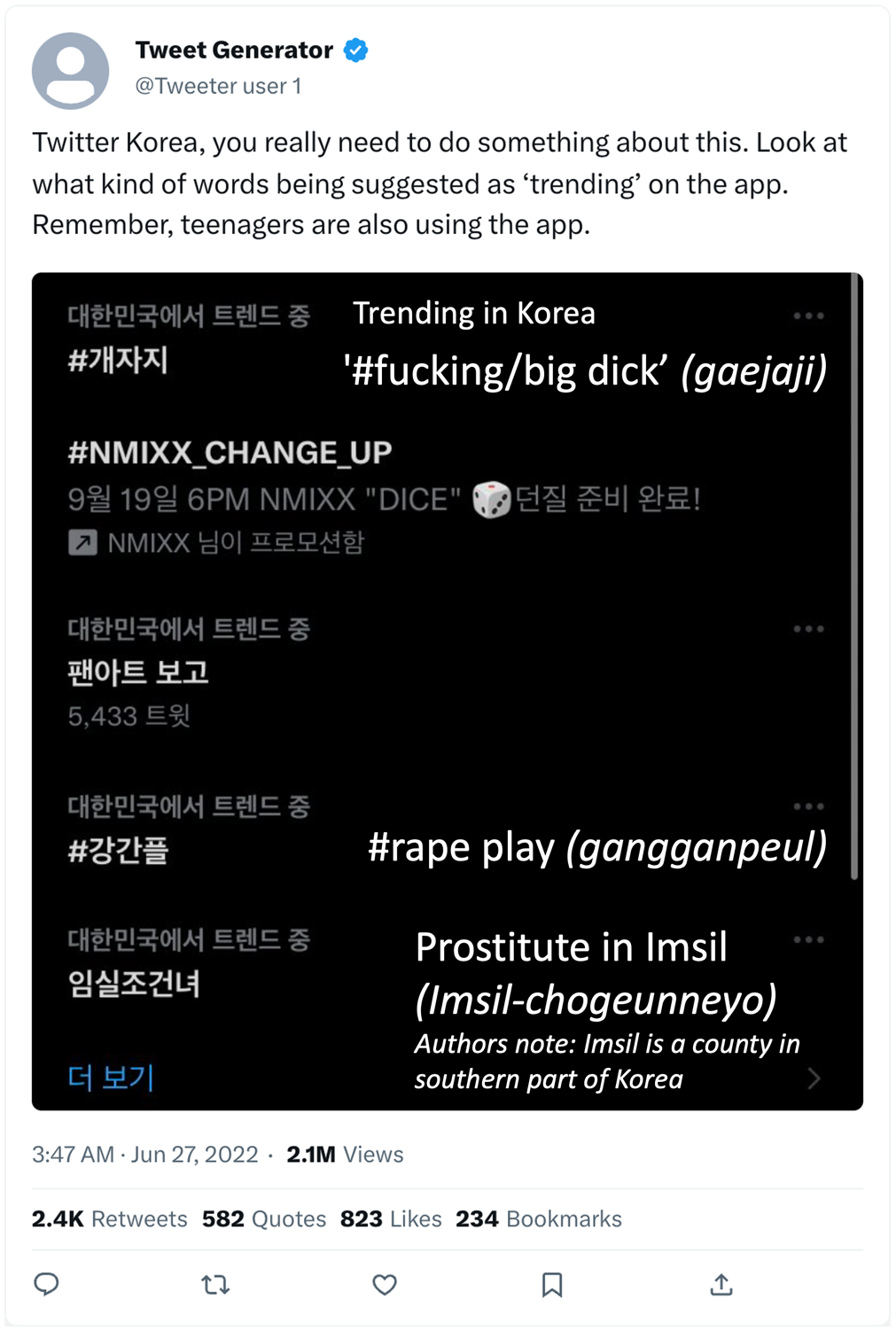
Author’s recreation of the Tweet asking for Twitter’s response to its algorithmic promotion of keywords about prostitution and rape practice (poster anonymized). Tweet Hunter’s Tweet Generator was used.
During ethnography, random phone numbers were also suggested as popular topics on the “trends” page, piquing curiosity, which, upon a click, led users to a pool of tweets that advertised prostitution services or porn websites with images of naked young women. Porn sites and online brothels also strategically hijacked trending or random keywords, such as “taekwondo school” and “pet adoption” alongside images of women’s naked bodies, to obtain visibility in user searches. The lack of moderation by Twitter on the manipulation of trending keywords by adult websites hinders users’ effective use of the search function. This is exacerbated by what many people call the “awful” Twitter search function, which the Twitter search algorithm is optimized to surface search results based on popularity and recency, not accuracy, and its inability to filter out spam content from the search: “Everytime I search something on Twitter, it gives me a full of these fucking porn tweets. I report them every time but it never ends. Twitter bastard, you do nothing here to monitor the accounts who make search keywords nasty, why?!” (Twitter post, 2022, anonymized)
This suspicion and mistrust of the Twitter algorithm are further reinforced by users’ folklore suggesting that Twitter in Korea selectively moderates content, particularly in favor of men. This narrative is shared alongside anecdotes of users whose accounts were banned after criticizing femicide using the keyword 한남 (hannam, trans. “Korean men” but used derogatorily in the context of Korean sexism) or calling out the far-right misogynistic messages. The folklore has become almost an accepted fact, as many users have shared similar experiences in which their accounts were immediately banned after calling out the sexist violence of hannam, yet changing the term to “Korean woman” in the same post does not trigger any ban, and reports of harassment, hate speech, and violent content, including pornography, to Twitter rarely lead to any action.
In short, Twitter users believe that the Twitter algorithm assists in spreading porn content as newsworthy information, while failing at its gatekeeping role to moderate harmful and spam content in relation to the insidious proliferation of the toxic sex cartel of the country. However, many users attribute this algorithmic violence specifically to Twitter Korea, rather than to the platform as a whole. They believe that local management of the platform’s algorithm is a reflection of misogynist attitudes of Twitter Korea’s male employees and a result of how “they want to play a power game with Korean women users” (Twitter post, anonymized). Viewing this as a local-specific problem deliberately caused by Korean men who are in favor of misogyny, some even encourage other users to report these issues directly to Twitter’s headquarters in the United States for the sake of their safety in Korea.
YouTube
From our data, many people find the YouTube algorithm ambiguous and incomprehensible, especially regarding its advertisement system that continuously suggests porn content to users while nonsexual content is being pornified and censored as sexual content.
According to YouTube policies, YouTube strictly restricts and carefully reviews advertisements and videos related to “racy or sexually suggestive topics,” using a combination of automatic review by its algorithm and manual review by human staff (YouTube, 2024a, 2024b). While these policies are applied globally, the platform also claims to have country-specific regulations; for instance, sexual content is strictly prohibited from display in Korea (YouTube, 2024a).
Yet in Korea, the YouTube algorithm is felt to frequently facilitate porn content. In Korea, many adult-only meet-up apps serve as a kind of online brothel service for men and have been problematic as sites of cybersex trafficking of women and children (Kim, 2023). Despite growing crime cases (Hankyoreh, n.d.), YouTube is prevalent with ads of such adult-only meet-up apps, even services that appear to promote prostitution, wherein women’s bodies are presented as pornographic materials (Figures 3 and 4).

Screengrab of the YouTube first page of the author when they were based in Korea. An ad for an adult-only online dating app (+18 years old) is recommended during casual scrolling, featuring a young woman with a curvy body, following the author’s subscribed content of elderly influencers.
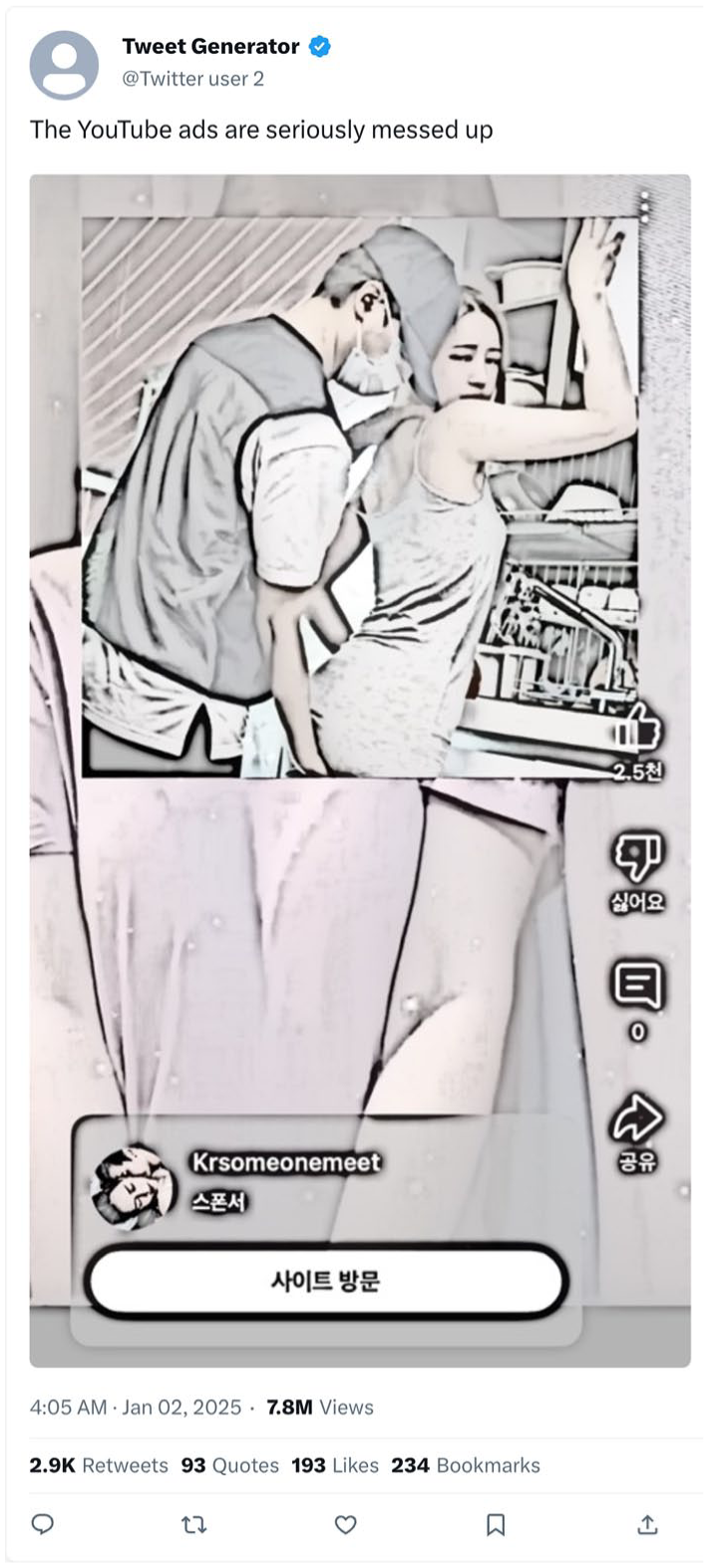
The author’s recreation of the Tweet criticizing YouTube or recommending an ad video suggestive of a rape scenario. For ethical reasons, an image effect was added by the author to the original screengrab posted by a Twitter user. Clicking the “Visit the site” button (bottom) leads to a prostitution-like service, which states: “Select the age range you want to meet, we will provide the most suitable service!” Tweet Hunter’s Tweet Generator was used for this creation.
Many users have criticized the increased pornographic portrayal of women’s bodies in ads on YouTube, which has been exacerbated by the introduction of YouTube Shorts, the platform’s short-form content section. For instance, according to them, some ads now even feature a young woman engaged in masturbation, filmed from a voyeuristic perspective, appearing in the midst of K-pop-related content as users scroll.
This pornographic recommendation appears most crystalized in its Movies & TV page, which introduces a range of legacy media content (see Figure 5). Despite YouTube’s official claim of “providing personalized selections” for users (Yeo, 2022), our data corpus indicates many have a similar or the same algorithmic experience of encountering algorithmic suggestions of porn videos, regardless of differences in their personal taste, demographic factors (i.e., age), and watch history: “Now my daughter is grown up and we watch YouTube together on TV. But on YouTube Movies & TV, it’s full of inappropriate content for her, from thumbnails to titles like ‘One night with my mother-in-law,’ ‘Hot bath in a motel room.’ [. . .] YouTube says it’s a personalized recommendation but I’ve never watched any adult content here. [. . .] It drives me nuts since I cannot remove this page or make changes to the recommendations, even though I set my age as 14 y.o.” (comment posted to online community, anonymized) “Never purchased and watched movies on YouTube, never watched any adult content either. But it keeps recommending porn stuff. Why is this algorithm so broken?” (comment posted to online community, anonymized)
These experiences evoke discomfort and distrust toward YouTube among many users. By accusing YouTube of their failure to “properly gatekeep content for users, including children” (Twitter post, anonymized), many find YouTube’s algorithm phallocentric for normalizing the culture of pornification in daily YouTube use. They also note it as “misogynistic” for its complicity in growing TFSV, mirroring the rape culture in Korea.
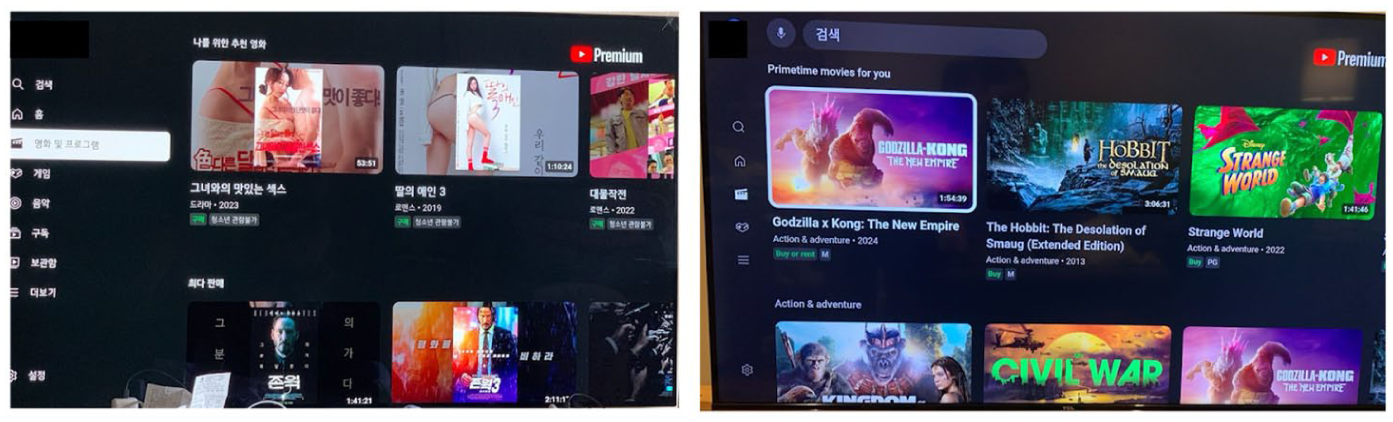
Photos of the YouTube Movies & TV page appearing on a smart TV in Korea (left, porn videos recommended on the “primetime shows For You” tab) and the same page in Australia (right, Hollywood blockbusters recommended on the same tab), taken by the author. Note: the author’s YouTube watching history is mostly the Korean baseball league and K-pop.
Distrust in the YouTube algorithm is further strengthened by notable machine detection failures in several famous YouTube channels. For example, the YouTube channel, @prisonGo (감빵인도자), that catches spycam crime scenes and criminals on streets, with an ethos of eradicating burgeoning spycam porn crimes, laments his videos constantly being “yellow-flagged”
2
and “delayed to be approved” by the YouTube algorithm: “Hi everyone, it’s not that I DON’T upload videos, but I CAN’T. As I mentioned before, the review process by YouTube Korea is seriously delayed. It used to take only 2-3 days, but nowadays it takes 8-10 days. [. . .] And even after investigation and multiple appeals from me and followers (thank you for this btw), some videos remain flagged or are taken down. [. . .] As this situation continues, [. . .] I’m also deeply contemplating whether I should continue to maintain this channel.” (@prisonGo on his YouTube community page, 2023)
As similar cases for other types of YouTubers accumulate, many YouTube users start to build and spread a conspiracy theory that “YouTube Korea must have hannam only, so their hobby must be molka, and have built an algorithm for themselves. That’s why the algorithm only regulates women-friendly content, while they constantly suggest porn content to everyone for their dirty desire” (comment posted on online community, anonymized). This suspicion has gained credibility among Korean social media users, particularly after one user’s observation about the stark contrast between their YouTube experience in Korea and other countries. According to them, in Korea, YouTube was flooded with “toxic porn content,” and the “report” function proved largely ineffective, whereas in other countries, the platform appeared much “cleaner.” Users even shared that searching for women-related terms like 할머니 (halmeoni, trans. “grandma”) on YouTube in Korea often returned pornographic content, while the same searches abroad showed benign results like songs about grandmas (see Figure 6). This led many to associate the discrepancy with Korean society’s lenient societal attitude toward men’s “toxic obsession with porn,” in contrast to the government’s legislation of the porn ban, which they believe is reflected in YouTube Korea’s platform management policies.
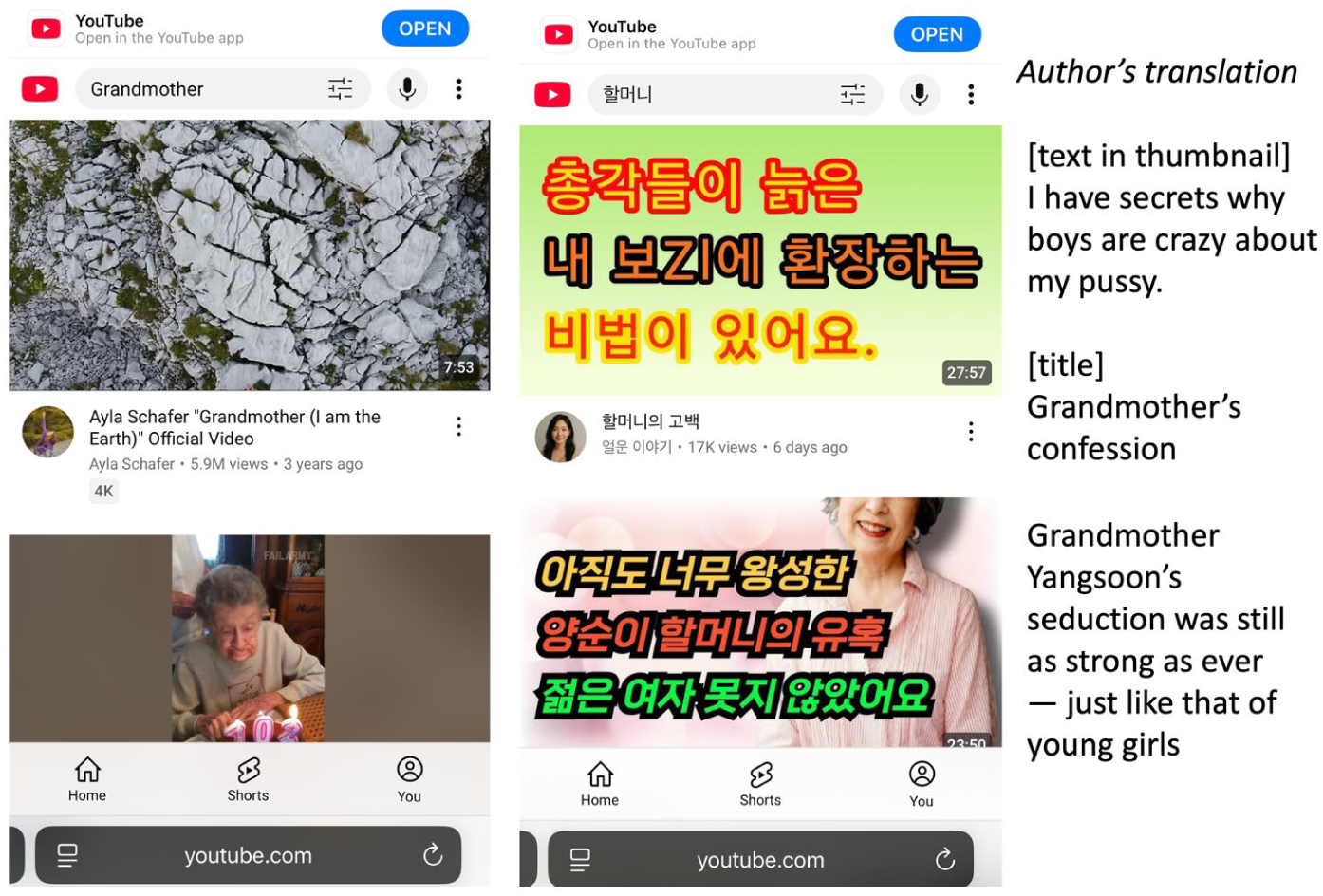
Author’s screengrabs of top YouTube search results for “grandmother” in English (left) and in Korean 할머니 (halmeoni, trans. “grandma”) (right) with authors’ translations. The left shows a music video titled Grandmother, followed by a clip of an elderly woman celebrating her birthday. The right shows two porn story videos about elderly women, with provocative texts in thumbnails. Searched in incognito mode on the same day.
As seen in the four cases above, all these platform-specific algorithm imaginaries suggest that porn-like sexual content is automatically recommended as content worth engaging by the algorithms, while women’s safety and unpleasant experiences are inadequately protected from the mechanisms. Whether or not elements of male sexual desires were actually factored into the coding of these algorithms, the accumulated folklore, anecdotal accounts, and gossip surrounding them continue to foster doubt and distrust among users. The next section turns to how social media users navigate these pornographic algorithms, including their agentic but laborious negotiation to make their online lives better and pleasant.
Everyday liminal resistance to pornographic algorithms
Victor Turner (1987) describes liminality as any object, situation, or being that is located in “betwixt and between” and thus is in a transitory state. The tactics and practices employed by Korean social media users to resist pornographic algorithms embody this concept, being “grey-zone kind,” though not necessarily seen as active resistance (Fröhlich and Jacobsson, 2019: 1151). These practices allow social media users to make use of “strategic ambiguity” (see Joseph, 2018) to enhance their social media experience in their own terms. We posit that such tactics developed by Korean users against pornographic algorithms indicate a form of liminal resistance that they need to undertake rigorously yet unconsciously to occupy their subject positions online, due to the unique characteristics of the digital space.
Feminist media scholars have discussed digital feminist activism as a sociocultural phenomenon wherein Internet users actively advocate for women’s agency and voice against social forces of discrimination, using different media practices in creating, sharing, and posting content to forge solidarity (Lee and Lee, 2023; Mendes et al., 2019). However, this agentic phenomenon is often offset by patriarchal forces materialized by social media algorithms, as discussed in the previous section. Algorithms not only continue to perpetuate the gender binary (Schroeder, 2021) but also amplify TFSV through machine learning functions by learning about gendered online behaviors and generating such gendered outcomes in their outputs (Mishra et al., 2019). While some actors with high social media literacy can leverage the gendered working of social media algorithms to obtain visibility, such as by strategically conforming to gender norms and presenting an ideal femininity as part of their self-branding tactics (Bishop, 2019), many women remain unequipped to such gendered working of algorithms, including pornographic algorithms (see Zhang and Chen, 2023). In addition, raising voices against algorithmic discrimination and building collective actions with others can be exhausting and challenging, as the algorithmic mechanisms are constantly at work every second of the day when people use social media.
Under this environment, being a woman on social media requires unrecognized, everyday, affective labor to navigate uncomfortable encounters mediated by algorithms while striving to curate their media space positively. Feminist media scholars point out the intense, affective, time-consuming, yet invisible and unpaid labor involved in digital feminist activism (Kanai and McGrane, 2021; Nakamura, 2015). Though it is not necessarily seen as activism, everyday social media use is part of digital feminist activism wherein women exercise time-consuming, ongoing affective labor to resist pornographic algorithms.
Amid the inconsistent moderation of pornographic content of women, many female social media users in our data have developed their liminal resistance by employing and sharing tactics to create their mediatized realities safer and more pleasant. They employ a range of different tactics to navigate this. Some users with advanced digital skills share their “expert knowledge” to help others have a better social media experience. For instance, when the Twitter search function does not work properly due to spamming of porn-related content, several Twitter users share “search tips” to use basic coding phrases to filter out such content (Figure 7).
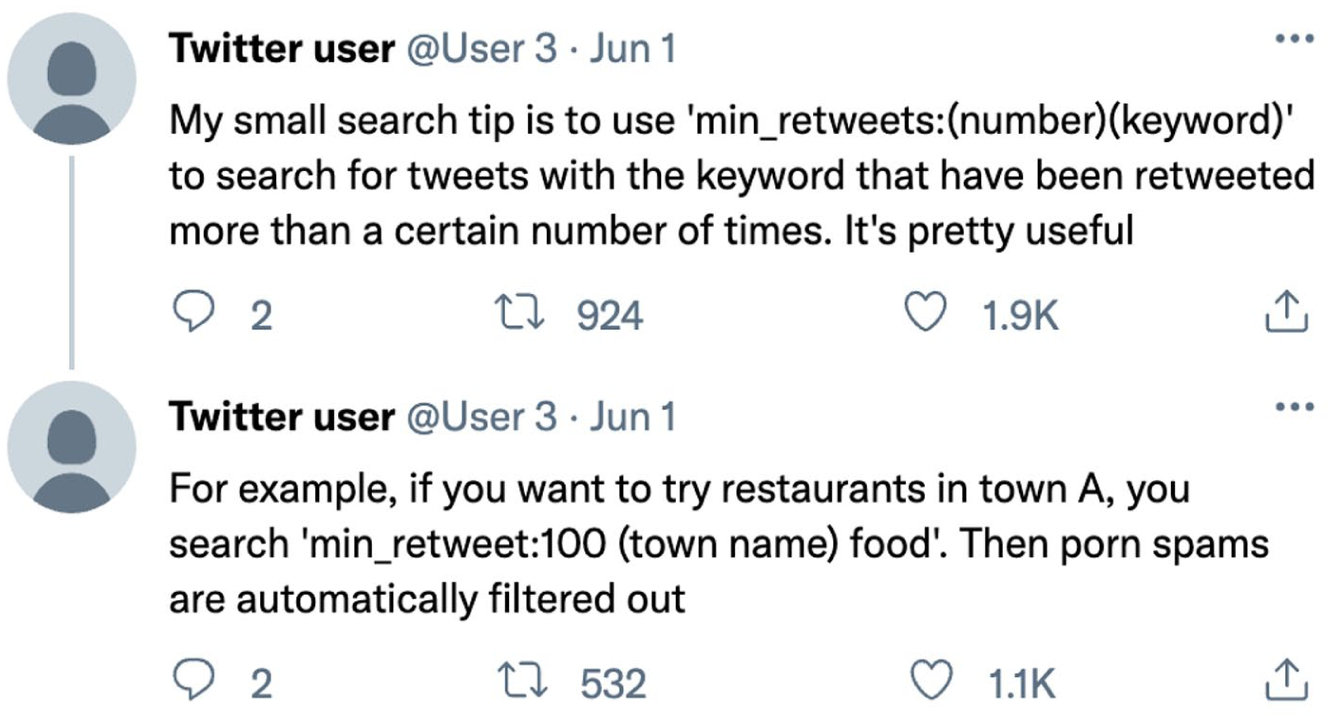
The author’s recreation of the Tweet, sharing a search tip to avoid porn-related spam content assuming such porn-related spam is less likely to be retweeted by other users. Tweetgen.com was used.
Other users actively utilize the “report” and “block” functions of social media to respond to, avoid, and deal with unsolicited discomforting images of women’s nudity, though this function remains largely ineffective, as many say. Despite differences in policies and content moderation systems, including reporting mechanisms, many informants note that none of these platforms appear to be effective in mitigating the algorithmic suggestion of pornographic violence. Across the different social media platforms, the “report and block” systems are “nominal rather than effective,” they note, regardless of which platforms are being referenced.
This is evidenced in our data of social media comments about porn content on different platforms: for example, “I’m blocking and reporting every porn account that I see on Instagram” (Instagram user, anonymized), “just sent a complaint to YouTube Korea about how their algorithms keep suggesting a library of porn videos to users. Let’s see what they say” (Twitter post, anonymized). Interestingly, unlike TikTok—which is notoriously discoursed as “Chinese app” with anti-Chinese sentiments (see Abidin and Lee, 2023: 92–94)—Silicon Valley-based apps, Instagram and YouTube, are often perceived as spaces where users can make some shifts and expect responsiveness aligned with “Western” values. In this vein of thought, some even encourage others to directly contact the headquarters of social media platforms, not the local branches in Korea, based on the common myth around the “West” as a safer place for women and suspicion and folklore that the local ones are, in fact, the active amplifiers of pornographic algorithms. For example, about YouTube’s algorithmic suggestion of inappropriate ads, one user resorted to directly contacting YouTube, not YouTube Korea, tagging YouTube’s Twitter account @TeamYouTube, after realizing that YouTube Korea remains unresponsive to repeated reports of its algorithmic suggestion of inappropriate content. When their English-language complaints received almost immediate responses from YouTube on Twitter, many began sharing pre-written English templates to help others escalate content moderation requests. To this, many borrow the folklore about the misogynistic working of algorithms in Korea and criticize the inaction of social media platforms in the country, remarking: “It feels like these assholes [YouTube Korea] have turned global platforms into their own incel palace in Korea. Now that we know how to escalate issues to the YouTube headquarter, I can’t help thinking they’re just pretending to act so they can shut us up.” (Twitter post, anonymized)
In this manner, social media users develop their tactics of liminal resistance shaped within the specific geo-cultural contexts they navigate, yet overlooking the universal functioning of algorithms designed at platform headquarters and implemented across regions.
Female content creators who run media businesses from their social media content also engage in both individual and collective endeavors to evade sexual categorization of their bodies by pornographic algorithms. Their strategies vary from changing their content genres to quitting their content creator jobs. Some switch to private mode despite losing opportunities for monetization and collectively call out intrusive male users. For example, fashion creator Min stopped posting about her gym routine on Instagram after her gym attire post led to unsolicited sexual messages from male users and decided to stick to fashion topics, which attracted less of that audience. Sunny, a travel content creator, stopped posting pictures of herself and eventually made her account private to avoid exposure to what she described as creepy users. While such tactics may be experienced as a hindrance to women’s cultural production, Younji, a lifestyle creator, described these tactics of resisting algorithmic promotion of sexual content as “sophisticating the algorithm” and “breaking the system.” In this way, creators attempt to discipline their algorithms using their function of accumulating knowledge. As Younji comments: “Algorithms are so powerful – you can’t completely control them, but you can piggyback on them – to make changes you have to know it and enter that space and do something different with that knowledge.”
Many content creators also have experience in training algorithms to identify acts of harassment and discrimination by collectively flagging users who sexually harass other female creators in the comment sections. Nakamura (2015) describes this collective type of social media labor by women as community-oriented and pedagogical labor, aimed at disciplining racist and misogynistic users on the Internet. Interestingly, our interviewees view collective call-outs not only as a means of addressing problematic users but also as a way of “disciplining” the algorithms. For instance, Na-rae, a sports news content creator, describes these collective call-outs as a way of “looking out for each other” and training the algorithm to be “anti-misogynistic.” Similarly, other interviewees share their experience of helping other female content creators report sexual harassment by re-directing algorithmic visibility and attention to the abusive accounts, revealing the user handle of the account, and encouraging their followers to “report” the accounts. Although these collective efforts are not always successful, content creators describe them as a way to make the algorithms more responsive to TFSV on social media.
The tactics outlined above are inherently political, with clear objectives of eschewing sexual violence mediated by pornographic algorithms and bringing about changes in the functioning of social media algorithms, undertaken through tacit, ongoing, affective, and unseen labor. However, not all tactics are neatly categorized as “political” or “resistant.” For example, Katy, who shares glimpses of her life in Europe on Instagram and YouTube with images of her “sexy” attire, such as bikinis at the beach, continues to post such content despite receiving sexual messages from men facilitated by algorithms. She does so because posting these images helps her gain attention from male viewers via algorithms, further leading to monetization opportunities. She distances this version of her “sexualized” media persona from her “self,” stating: “This is just a job, and I’m just doing my job to keep my business. It’s different from the real me.”
Similarly, many social media users do not take “actions” but fast-scroll the algorithmically curated pornographic content feeds with a sigh, choosing not to engage. These practices cannot be simply labeled as “giving up.” Instead, they are liminal, allowing users to cope with the dominant influence of pornographic algorithms at best, conserving their energy, while appearing complacent about the environment, especially given the inaction of platforms after numerous reports by others. Although they remain silent, these users may strategically take advantage of the opportunity of being categorized as sexual for monetization or save their time and energy by avoiding the laborious, unpaid work of countering pornographic algorithms and reporting seamlessly appearing porn accounts.
Social media users strategically leverage their understanding of pornographic algorithms, agentically reappropriate their functioning, and creatively develop subversive forms of everyday social media use. These practices are to balance the overt and covert, time-consuming and time-efficient forms of defiance against, compliance with, and avoidance of pornographic algorithms. When toxic pornification continues to prevail and is secretly sustained through the workings of these algorithms, social media becomes a space of liminal resistance. Users subversively and passively challenge the dominance of pornographic algorithms, hoping to correct the algorithms’ patriarchal working logic and mitigate violence for their safe and more enjoyable mediatized realities.
Conclusion
Our findings indicate that algorithmic mediation of content reflects, and even amplifies, Korean society’s sexism and rape culture in everyday social media spaces. We conceptualized social media users’ untrustworthy and antagonistic imaginaries of social media algorithms as pornographic algorithms. Through case studies of how pornographic algorithms are experienced by users across Instagram, TikTok, Twitter, and YouTube, we demonstrated that although the normalization and amplification of pornification and TFSV by social media algorithms may be a global issue, the actual experiences are still region-based and platform-specific. Although social media users seek to make changes to their mediated realities through individual and collective endeavors of flagging, reporting, moderating, and navigating social media spaces that are in favor of sexism, pornographic algorithms collectively construct a grim but familiar reality where women are objects of men’s voyeurism and sexual fantasies, influenced by both global and local contexts.
This study provides important insights into how algorithms govern our mediated realities and how social media users navigate the governance in their everyday lives. Korean social media users’ pushback against pornographic algorithms constitutes the broader landscape of social media politics where marginalized Internet users take on the labor and burden to challenge and dismantle algorithmic realities facilitated by social media platforms’ technical architecture (see Nakamura, 2015). However, as Nakamura (2015) notes, these efforts carry significance beyond under-appreciated, unpaid labor, as they push forward new ways of belonging online together, highlighting their important roles as strategic and active agents in social media pop cultures. Through the experiences of Korean users, we highlight that their labor of managing algorithms is their everyday politics, albeit slow and small, against the formidable force of techno-governance that normalizes violence against women.
Last but not least, we call for more studies to pay attention to how global social media platforms’ algorithmic design and content moderation interact uniquely with gender inequalities and the culture of different geographical contexts. It was beyond the scope of our study to delve specifically into platform-specific content moderation systems, but future studies can account for how specific moderation techniques interact with local cultural contexts. While major global social media platforms, such as Meta, are slowly moving away from universal global policies to being more localized and shaped by local governments’ interventions, they continue to have a “centralizing effect” by having control over the standards and design of their content moderation policies, reflecting US legal norms and cultures (Ahn et al., 2023: 2844). Many studies about algorithmic governance, in turn, adopt US-centric perspectives, overlooking how such algorithmic governance intersects with geo-cultural specificities and shapes global users’ mediated realities differently. Geographically diverse discussions will enrich our social media pop cultures with enhanced safety and inclusivity.
Footnotes
Funding
The authors disclosed receipt of the following financial support for the research, authorship, and/or publication of this article: Jin Lee would like to acknowledge Curtin University’s support for Open Access publication and Korea University’s K-Hub Program support for this article.
