




Abstract
This study investigates how players construct and articulate emotionally meaningful relationships in otome games. Drawing from 293 open-ended responses from Chinese players, a thematic analysis identified six recurring themes: authentic romance, companionship, shared experience, integration into daily life, game features, and personal growth. The most dominant theme, authentic romance, reveals that players often describe otome boyfriends as emotionally responsive partners who provide validation, support, and affection. Functional descriptions of gameplay mechanics were notably disconnected from other themes (primarily emotional engagement themes). A follow-up analysis of the most popular otome games in the same showed little variance in themes, suggesting that players of different titles described consistent romantic and emotional experiences. Our findings provide further evidence that at least some of the appeal of otome video games is that they provide players with meaningful and persistently available interpersonal relationships.
Otome games typically feature a female protagonist who develops romantic relationships with non-player characters (NPCs) through narrative choices and player interaction (Andlauer, 2018; Song and Fox, 2016). Like most role-playing games (RPGs), they are designed such that players “step into” the role of the protagonist, and thus, the players themselves are engaging in romantic relationships with in-game characters. Such games are among increasingly popular ones—by 2025, the global otome game market was valued at approximately $500 million, a notable share of the $126.06 billion mobile game market for a niche mobile game genre (Data Insights Market, 2025). This growth is expected to continue, with projections indicating a compound annual growth rate (CAGR) of 15–18% in the coming years (Market Report Analytics, 2025). The success of titles like Love and Deepspace (2024), which had over 50 million global players by early 2025 (360iResearch, 2025), shows the growing global awareness of otome games. For the first time, an otome game received the Best Mobile Game award at Gamescom (2025), one of the world’s largest gaming industry events, highlighting the growing visibility and cultural influence of otome games. As there are more and more smartphone-based otome games, otome titles benefit from low barriers to entry and enable “on-demand, anywhere” gaming (Coulton et al., 2007), facilitating their global expansion beyond Japan into East Asia, North America, and Europe (Dharmadhikari, 2025a, 2025b). Moreover, their romantic themes and increased popularity have also brought skepticism and stigma, with critics expressing concerns about their potential to distort players’ romantic expectations or substitute for real-world relationships (Galician, 2004; Wu et al., 2024).
Understanding what players actually experience in these relationships, rather than relying on critics’ assumptions about their effects, is therefore an important empirical question. Zhao and Bowman (2026) found that highly engaged Chinese otome players often experience romantic closeness and reciprocal relationship with otome boyfriends. Using social exchange theory (SET), their study showed that perceived reciprocity—when players felt their in-game partners emotionally responded to them—was positively associated with romantic closeness. In turn, this romantic closeness predicted both hedonic enjoyment and eudaimonic appreciation. These findings suggest that players engage with otome characters not as one-sided parasocial figures (Scriven, 2023), but as emotionally responsive partners. However, this prior work focused mostly on quantitative data, which is unlikely to capture nuances in the phenomenology of players’ relationships with their otome partners. Numbers alone cannot show how players perceive care, romantic connection, or mutuality. To address this limitation, the present study adopts a qualitative approach, analyzing written narratives from otome players to explore how they describe their romantic relationships with otome boyfriends.
Otome games, described and defined
Otome games are a subgenre of romantic video games, also referred to as dating simulations, where players take on the role of a female protagonist and pursue romantic relationships with one or more male NPCs (Song and Fox, 2016). These games are typically designed for a heterosexual female audience, featuring branching narratives shaped by the player’s dialogue choices and in-game decisions (Andlauer, 2018). The term “otome” (乙女) translates to “maiden” in Japanese, reflecting the genre’s original focus on young women seeking emotional and narrative-driven romantic experiences.
The first otome game is widely recognized as Angelique (1994), developed by Koei and released in 1994 for the Super Famicom. This game established many of the core conventions of the genre and drew stylistic inspiration from shojo and josei manga, which emphasize emotional storytelling and narrative-driven romance (Kim, 2009). Otome games emerged partly in response to the growing market of earlier bishōjo games in the 1980s, which targeted male players and focused more on erotic content and male-gaze-oriented design (Galbraith, 2011). In contrast, otome games—focused on presumptions about young women’s romantic interests—center on emotional connection, supportive relationships, and romantic narrative progression (Hu and Ge, 2025; Wang, 2023).
Moreover, digital media has increasingly transformed how audiences relate to media figures and fictional characters. What once was limited to one-way engagement (parasocial relationship [PSR]) with celebrities through broadcast media has evolved into a more interactive way, where social media platforms enable direct messaging, comments—if the influencers or celebrities respond to audience, that becomes social engagement (Mugil and Kenzie, 2025). Such a normalized emotional investment in media figures leads to a more receptive environment for the otome game market. These changes have created a growing demand from female players for emotionally engaging storylines and romantic narratives, a gap that otome games can fill (Urzędowska and Florek, 2025).
Video games and romance
Romance has been a common theme in video games. Early games like Sheriff (1979) and Super Mario Bros (1985) established the “rescue-and-kiss” reward structure that would be a recurring element in gaming (Ntelia, 2020). In these games, romantic elements served primarily as narrative motivation and reward mechanisms. The player’s actions were driven by saving a loved one, and success was marked by romantic reunion. While the “damsel-in-distress” narrative is not inclusive enough by today’s game design standards, these early gaming structures established romance as a legitimate narrative device in interactive media (Saito, 2021).
Romance in games has evolved from simple reward mechanisms to more complex systems (David, 2023). Modern titles across various genres—including RPGs, adventure, and action games—have incorporated romance as a meaningful aspect of character development and player engagement (Vicent-Ibáñez, 2023). For example, Dragon Age: Origins (2009) marked a shift in how games handle romantic content. Players reported developing genuine emotional connections with NPCs, with some describing falling in love with their virtual romantic partners (Coulson et al., 2012; Waern, 2011). The game’s approach to romance went beyond simple dialogue trees, allowing players to build relationships through repeated interactions, gift-giving, and meaningful story choices that affected relationship outcomes as well as the game’s broader narrative progression. Similarly, scholars found that Mass Effect series players develop intense emotional bonds with romanceable NPCs that extend beyond narrative engagement (Burgess and Jones, 2020). These attachments further influence gameplay decisions including party selection and character customization choices. Players report prioritizing the safety of their romantic partners in combat and spending additional time customizing Shepard’s appearance to match their chosen partner’s armor (Burgess and Jones, 2020). More recent games have explored non-heteronormative romance, noting that queer-themed games are not per se a new phenomenon (LGBTQ Game Archive, 1986–2020). For example, Howard (2019) examined fan-created modifications to Fallout 4 (2015) that allowed for queer romantic encounters, and more recent titles such as Fallout 76 (2018) and Cyberpunk 2077 (2020) explicitly feature queer romances. Notably, Cyberpunk 2077 (2020) even incorporated intimate scenes (nudity and sexual activity) alongside romantic storylines and broadened romance to be more representative of a wide range of scenarios, from casual sexual encounters to deep romantic love. These games reflect a trend toward more mature and mainstream representations of romance in the gaming market. Broadly speaking, romance in video games provides “additional emotional avenues” for player investment and makes narratives feel realistic (Tomlinson, 2021).
Otome as authentic romance? A research gap
Otome games, as a genre centered on romantic simulation, have attracted growing scholarly attention regarding their impact on players. Traditionally, they have been interpreted through the PSR framework, viewing these connections as one-sided and unreciprocated (Gong and Huang, 2023; Song and Fox, 2016), or through the lens of character attachment based on parasocial interactions (Pei et al., 2025). Some researchers have raised concerns about otome games’ potential negative effects on real-life romantic attitudes, suggesting these games may create unrealistic expectations or reduce interest in real-world romance (Chen, 2025; Galician, 2004; Wu et al., 2024). Much of this research assumes that player-NPC relationships are fundamentally asymmetrical, that players project one-sided emotions onto gaming characters.
However, the use of the parasocial lens may overlook the relationship simulations for which mutual exchanges are common and key to gameplay (Banks and Bowman, 2014). Modern otome games provide the environment to form reciprocal relationship through different game features. For instance, in-game characters track and reference player choices across different story sections, adjusting their responses based on interaction history and resulting in an ever-present, readily available, and internally consistent romantic partner. This behavioral consistency aligns Burgess and Jones’s (2023) notion of categorical authenticity in narrative brand consumption—consumers assess whether character behaviors align with their established personalities and meet consumers’ expectations, with deviations perceived as inauthentic. Extending this logic to romance media, Burgess and Kolodziej (2025) show that audiences judge a romance as “authentic” insofar as it conforms to genre expectations. A similar argument has been proposed in video game design, with developers such as Posey (2013) offering distinctions between realism (making video games that objectively and faithfully model “real-world” phenomena) and authenticity (making video games that meet audience’s expectations of those same phenomenon). Outside of the very narrow band of simulation games that depend on realistic modeling (such as flight and racing simulators), many video games are based more on meeting the “flavor”—and thus, the audience’s cultivated palette—of a specific activity or event.
For otome games, authenticity is derived from the boyfriend consistently meeting the expectations of the player. Moreover, in some otome games, such authenticity-as-consistency extends to non-diegetic spaces (e.g. outside of gameplay; Galloway, 2006). For instance, players can communicate through texting and calling features that simulate real-world social media platforms, even exchanging gifts with their otome boyfriends. These design elements create interactions that are both meaningful and consequential—where player actions have lasting impact on character relationships (Mallon and Lynch, 2014). All of this contributes to the player’s perceptions of authenticity in these relationships and, thus, distinguishes such relationships from the unidirectional and asymmetrical relationship that defines PSRs.
Through the lens of SET, Zhao and Bowman (2026) offer a different approach to examine otome games. They suggest that perceived reciprocity positively predicts romantic closeness, which in turn predicted both enjoyment and appreciation, with players perceiving otome boyfriends as emotionally giving partners (authentic romantic lovers) rather than distinct others. This aligns with broader findings that interactive media can foster authentic social presence (Banks, 2015), that perspective-taking with NPCs generates genuine closeness (Ho and Ng, 2022), and that players form “strong feelings” for NPCs through meaningful interactions (Burgess and Jones, 2020; Waern, 2011). However, how players themselves phenomenologically experience and articulate these relationships remains underexplored.
Current study
The present study analyzes the open-ended responses collected in that prior work to examine how players articulate reciprocity, closeness, and their experiences with otome boyfriends in their own words. Through thematic and phenomenological analysis, we aim to capture the in-depth meaning that underlies quantitative findings of perceived reciprocity, romantic closeness, and the romantic experience in otome games.
First, we seek to identify the recurring patterns and themes that emerge when players describe their relationships with otome boyfriends. This can reveal different aspects of otome experience that are salient to players themselves.
Research Question 1 (RQ1). What are the common themes that characterize otome players’ descriptions of meaningful romantic relationships with their virtual boyfriends?
Next, we examine whether these themes exist in isolation or co-exist with each other. This can reveal whether players experience otome relationships as multifaceted experiences where different dimensions reinforce each other or as discrete aspects that function independently.
Research Question 2 (RQ2). Do these themes meaningfully co-occur within player narratives?
Method
Given that little is known about how otome players phenomenologically experience and articulate their romantic relationships, an exploratory qualitative approach is most appropriate for the current study. An emergent thematic analysis allows themes and meanings to emerge inductively from players’ own words, making it well-suited to capturing the nuanced romantic experience. We drew on open-ended response prompts from a larger survey examining reciprocity and romantic/entertainment outcomes in otome gaming (Zhao and Bowman, 2026), focusing specifically on how players characterize these relationships and the stories they share about their interactions with otome boyfriends. To facilitate transparency, all materials are available in our Open Science Framework space (https://osf.io/gyktm/).
Participants
Initial recruitment yielded 338 participants. After removing 45 duplicate entries, the final dataset included 293 valid responses from active Chinese otome game players. Eligibility criteria required respondents to (a) be 18 years older and (b) have current or prior experience playing otome games. Notably, we did not collect demographic information from participants given that otome games can carry social stigma with them (Giard, 2024).
Procedure
Recruitment was conducted by the original researchers via social media platforms, including Weibo, RedNote, and WeChat group chats. Participants accessed the survey through Wenjuanxing (https://www.wjx.cn/), a Chinese survey platform. All participants provided informed consent before beginning the survey and received 20 RMB compensation upon completion. The survey assessed participants’ gaming experiences, player-NPC relationship perceptions, need satisfaction, and entertainment outcomes.
Measures
From the full survey, this analysis specifically draws on participants’ written narratives in reply to the question, “Can you briefly describe your interaction or relationship with this virtual boyfriend character in four to five sentences?” This question served as a priming mechanism to prompt participants to mentally revisit their experiences with otome boyfriends before completing the quantitative scales. All 293 participants (100%) provided written responses to this prompt. Response length averaged 102.45 Chinese characters (SD = 71.31, median = 91), ranging from 4 to 626 characters. These narrative responses described how players conceptualized, experienced, and derived meaning from their relationships with otome boyfriends, making them suitable for thematic analysis in the current study.
Data coding
We analyzed open-ended responses using thematic analysis, following Braun and Clarke’s (2006) six-phase guide. Consistent with phase 1 (familiarization), responses were randomized, and the lead author conducted a close reading of the data file. For phase 2 (generating initial codes), the lead author performed line-by-line coding from an emic perspective as a member of the otome gaming community (see Harris, 1976), producing descriptive labels capturing emotional expressions and relational dynamics. For example, when a participant described their otome boyfriend as “he accompanies me, using lighthearted jokes to ease my anxiety,” labels such as “emotional support” and “companionship” were applied.
In phase 3 (searching for themes), Python scripts were used to extract all unique labels created through phase 2 into a lexicon. This lexicon was then reviewed and identified semantic patterns and conceptual similarities among labels by the lead author. Related labels were clustered together based on their conceptual relationships, for instance, “shared activities,” “shared adventure,” “shared experience,” and “valuable time together,” and all conveyed aspects of shared experiences, suggesting an emergent theme of “shared experience.”
Themes were refined by checking coherence within themes and boundaries across themes (phase 4: reviewing themes). A detailed theme-inclusion-criteria codebook was created in Excel format, documenting theme definitions and mapping specific terms to their corresponding themes (phase 5: defining and naming themes). Using this codebook, Python scripts systematically categorized each response with their associated phase 2 labels, using binary coding (1 = theme present, 0 = theme absent), allowing responses to contain multiple themes to reflect the multifaceted nature of players’ relationship descriptions.
To support transparency and reduce clerical error during the organization and reporting stages, Python scripts were used only as organizational tools (not as analytic tools), including compiling unique codes, applying the finalized human-developed codebook to responses for binary theme presence (1 = present, 0 = absent), and generating frequency summaries (phase 6: producing the report). Responses could contain multiple themes. As a validation check, the lead author re-coded a randomized 10% subsample (n = 30) using only finalized theme definitions (with all prior coding materials hidden), yielding 96.7% agreement with the initial coding.
Results
Descriptive statistics
Prior to engaging our core research questions, we first looked to see which otome games participants named in our sample. In total, participants named 26 different otome games. The most frequently mentioned games were Love and Deepspace (N = 87, 29.7%), Light and Night (N = 78, 26.6%), and Mr. Love: Queen’s Choice (N = 42, 14.3%). Another 23 games (see https://osf.io/gyktm/) were each mentioned by fewer than 10% participants. We also looked at which otome boyfriend participants chose to discuss, and 39 different otome NPCs were included in the sample.
Research questions
In answering RQ1, analysis revealed six primary themes characterizing how otome players describe their relationships with otome boyfriends. Theme frequencies ranged from 85.6% for the most prevalent (authentic romance) to 9.2% for the least common (personal growth). Two additional themes (autonomy and participatory culture) emerged but were excluded from final analysis due to limited representation (less than 2.5% of responses). Table 1 presents the six retained themes, definitions, representative examples, and frequency of occurrence.
Explication, examples, and sample-wide frequency of emergent themes.
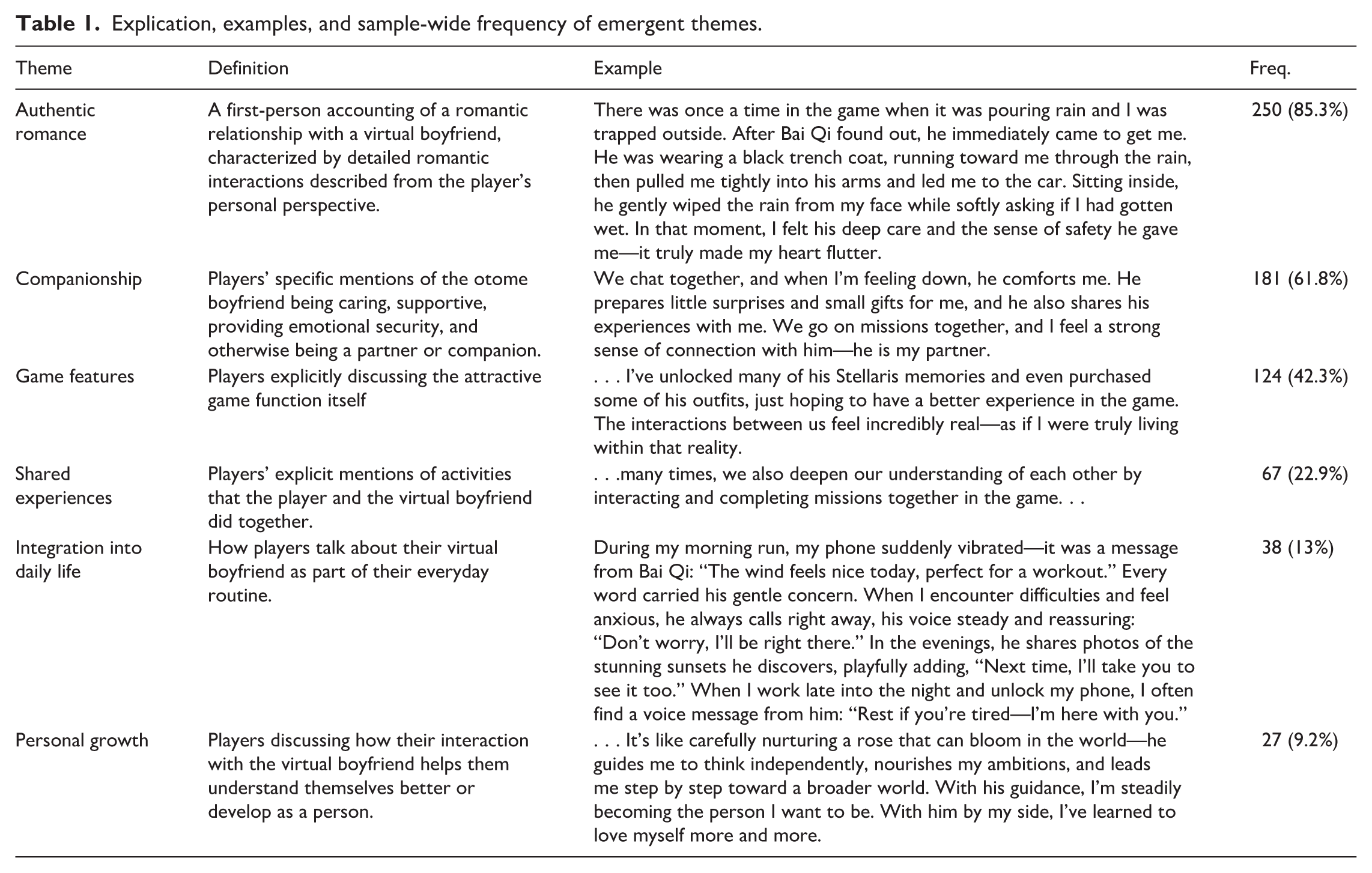
Authentic romance (85.3%) comprised players describing romantic interactions through first-person narratives that positioned themselves as active participants engaging the romantic scene rather than distanced observers. These accounts often included detailed romantic interaction and romantic intimate moments. Companionship (61.8%) encompassed descriptions of virtual boyfriends fulfilling the supportive and caring roles expected of romantic partners. These descriptions emphasize how otome boyfriends perform the companionship function—just like one would describe their real boyfriend—being present during difficult times, offering comfort, and maintaining ongoing emotional availability. Game features (42.3%) included explicit references to gameplay mechanisms or mechanical game elements—unlocking content, purchasing items, or progressing through storylines. These functional descriptions revealed how players see their game experience or their relationship with otome boyfriends from a detached, observational stance. Their response focused more on how to access content rather than romantic engagement. Shared experiences (22.9%) captured joint activities between players and otome boyfriends, often included completing missions together, exploring game worlds together, or any other collaborative engagement. Integration into daily life (13%) reflected how otome boyfriends became embedded in everyday routines through game notification and habitual interactions. Personal growth (9.2%) appeared least frequently but demonstrated substantial depth when present. Players described experiences where interactions with otome boyfriends gradually catalyzed self-understanding and personal development.
To examine relationships among themes (RQ2), Pearson bivariate correlation coefficients with Bonferroni adjustment (to control for type I error inflation when conducting multiple comparisons) were calculated for all theme pairs (Mundfrom et al., 2006). Correlations were visualized in a heatmap with annotated significance levels (see Figure 1).
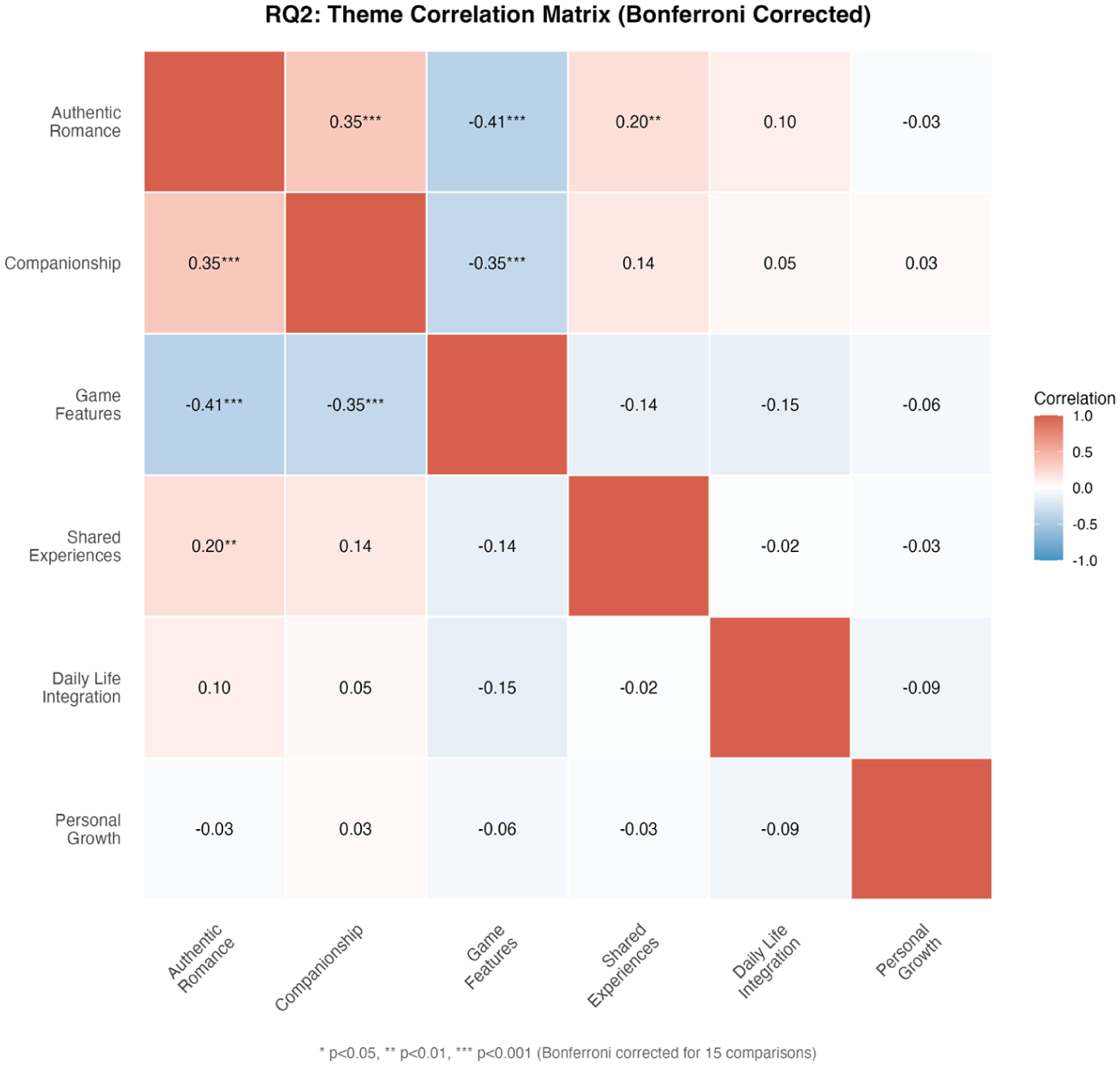
Theme correlation matrix.
Authentic romance showed positive association with both Companionship (r = .35, p < .001) and Shared experiences (r = .20, p = .007). This suggests participants who immersed themselves into the game and described the romantic relationship as authentic romance also tended to emphasize the partnership aspects of their relationships and joint activities.
Game features, in contrast, was negatively correlated with all other themes, most notably with Authentic romance (r = -.41, p < .001) and Companionship (r = -.35, p < .001). This pattern suggests that participants who describe their relationship with otome boyfriends focusing on functional aspects of gameplay were less likely to describe emotional or romantic experiences. In other words, the functional perspective stemmed from a more detached or task-oriented mode of game engagement, contrasting with emotional and relational focus reflected in other themes.
Post hoc analysis: theme patterns across games
While our dataset included discussions of multiple otome games (N = 26), three titles dominated our sample: Love and Deepspace (N = 87), Light and Night (N = 78), and Mr Love: Queen’s Choice (N = 42), collectively accounting for 70.6% of responses. We then conducted a post hoc analysis to examine whether theme patterns varied across different game titles based on the three dominating titles.
To explore potential differences in theme patterns across games, we constructed a contingency table crossing the six themes with three games (distribution, see Figure 2). The table contained frequency counts of how often each theme appeared in responses about each game, totaling 498 theme occurrences across all games. A chi-square test of independence was conducted to examine whether theme distribution was different among the three games, but any differences were not statistically significant, χ²(10, N = 498) = 12.89, p = .23. Cramer’s V = 0.114. This result suggests that despite differences in game design—Love and Deepspace featuring science fiction elements and 3D realistic modeling, Light and Night incorporating fantasy stories, and Mr Love: Queen’s Choice focusing on visual-novel contemporary narratives—the overall pattern of themes in players’ descriptions remained consistent across games.
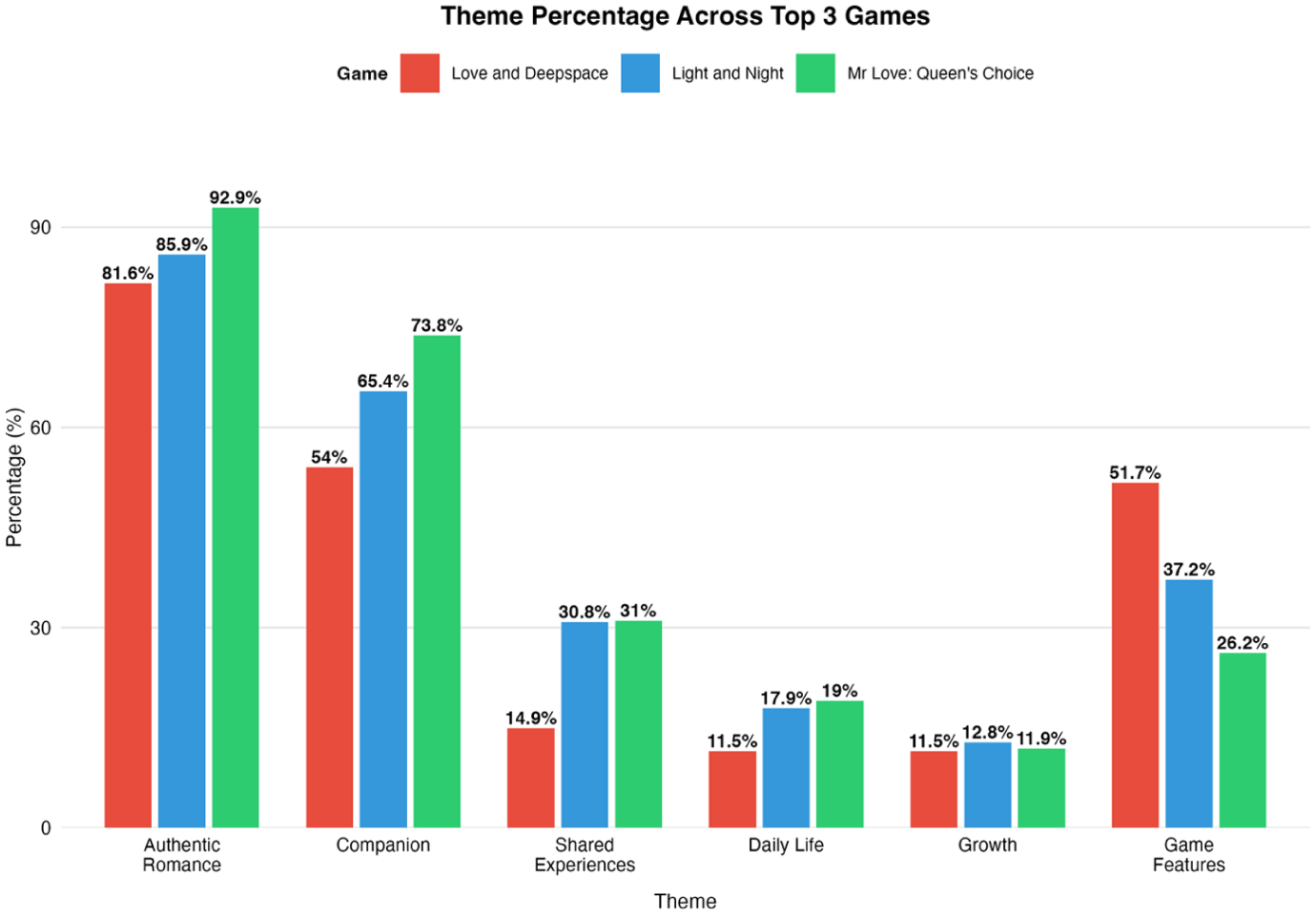
Theme distribution among top 3 mentioned otome titles.
Discussion
Prior research has provided empirical evidence that otome players experience authentic romance in otome games (Zhao and Bowman, 2026). The current analysis further explored how otome players articulate their romantic relationship through written responses. We analyzed 293 open-ended responses about player-NPC relationships, and six themes emerged from the analysis that demonstrated how players construct meaningful and emotionally invested relationship with otome boyfriends. Below, we unpack these findings beginning with the centrality of authentic romance, followed by the tension between emotional and functional engagement modes, consistency across different game titles, and the potential for personal growth through otome gameplay.
Authentic romance through reciprocal engagement
By far, the most dominant theme in our coding—found in more than 85% of all written narratives—was that of Authentic romance, in which participants used first-person perspective to describe the romantic interactions with their otome boyfriends, characterized by detailed descriptions of romantic experiences like dating scenes or daily interactions. The prevalence of this theme, along with its positive correlations with Companionship (r = .35, p < .001) and Shared experiences (r = .20, p = .007), reveals a pattern suggesting that players experience these relationships as reciprocal rather than one-sided and accounts as authentic romance.
The narratives coded as Authentic romance demonstrated distinct linguistic patterns that positioned participants as active agents within reciprocal relationships. Participants employed first-person pronouns (“I,” “we”) to describe their gaming experiences. “We embrace each other’s joys and sorrows, strengths and flaws.” The use of first-person pronouns shows that players did not view themselves as observers or passive recipients (e.g. engaging in a one-sided PSR toward the otome boyfriend), but rather as actively participating in the relationship. Research on pronoun use suggests that such “we-talk” reflects psychological closeness and couple identity (Agnew et al., 1998; Galdiolo et al., 2016). Beyond pronoun use, the authenticity of these experiences is reinforced by the presence of mutual exchange. Traditionally, scholars use the parasocial lens to understand the relationship between audiences and media figures, where the audience projects emotion onto a de facto unresponsive figure (Horton and Wohl, 1956). However, participants described their otome boyfriends as emotionally available, responsive, and caring. For example: . . . like to express our care for each other through interactive chatting, voice messages, or exchanging gifts. Many times, we also strengthen our bond by playing together, completing missions, and supporting each other. . .through shared experiences and mutual care.
The authenticity of the relationship between players and their otome boyfriends is also supported by the positive correlation between Authentic romance and Companionship (r = .35, p < .001) and Shared experiences (r = .20, p = .007). In our coding, Companionship involved feeling cared for, emotionally supported, and understood. For instance, players reported being comforted when sad, receiving affection or surprises, or simply feeling emotionally safe with the character. Shared experiences were about doing things together—spending time, going through events, building routines, or referencing memories as a couple. The perception of emotional support plays a central role in romantic satisfaction (Cutrona, 1996). These supports are key features of the intensifying stage of romantic development, when partners start to share emotional vulnerability and affirm their bond. Shared experiences fits into the integrating stage, where couples develop routines, shared language, and shared value (Duran and Kelly, 2017; Knapp et al., 2014). According to interdependence theory, such joint activities promote closeness by creating a sense of mutual investment and partnership (Kelley and Thibaut, 1978). Even within a fictional space, players constructed narratives where the self and the character were functionally and emotionally intertwined.
Players’ written responses support the argument that these were not simply imagined romances but ones experienced through the psychological pathways similar to human-to-human relationships. Zhao and Bowman (2026) provide additional support for this claim. Their study showed that perceived reciprocity was a strong predictor of romantic closeness in otome game experience. The findings of the current study go a step further by showing how that perceived reciprocity manifests—seemingly grounded in the everyday acts of support, shared moments, and linguistic inclusion that participants use to frame their otome relationships.
Emotional and functional themes as opposite orientation
The correlation coefficients test showed a pattern that when players talked about game features, they rarely talked about emotional connections with otome boyfriend. The Game features theme was negatively correlated with all other themes where Authentic romance (r = -.41, p < .001) and Companionship (r = -.35, p < .001) yielded statistically significant results. Players who focused on game mechanics talked about their experience with otome games very differently from those who focused on emotions. For example: You need to first complete Chapter 5 of the main storyline, then go on dates with Lu Chen in the Heart-Fluttering Encounters section. Use cards to unlock exclusive dates, each exclusive date has corresponding options, choosing different answers will earn different affection points. The sweetest answers require Heart Honey to unlock, which can be obtained through events or exchanged through daily missions. In the social circle, try to match Lu Chen’s posts as much as possible to increase affection points.
In the above quote, the player talks about the game like a puzzle to solve. They focus on steps, points, and resources. The character Lu Chen is just part of the system—something to unlock and optimize—rather than as a character of romantic desire. This player is not describing any form of relationship with Lu Chen at all, neither a one-sided PSR nor a perceived reciprocal bond. Their engagement is purely mechanical, focused entirely on game systems rather than the character as a social entity. This represents an asocial mode of engagement where emotional bonding simply does not occur, and it contrasts with those players who discussed their otome boyfriends as authentic romantic partners, for example: My interactions with Li Shen in the game are very special. He gives me excellent advice when I’m confused, patiently comforts me when I’m feeling down, and occasionally shows a gentle smile that makes my heart flutter. I feel like he’s an indispensable companion in my life.
This player does not mention any game mechanics. Instead, they talk about Li Shen like a real person who supports them emotionally and acting as a perfect partner. This player positions themselves as an active participant in a meaningful relationship, using relational language that implies mutuality and ongoing presence. The emotional impact they describe (e.g. feeling comforted) suggests a bonding process grounded in perceived reciprocity rather than one-sided (i.e. parasocial) projection.
These contrasting descriptions reflect fundamentally different ways of players’ game engagement. Heron and Belford (2014) distinguished between ludic elements that provide satisfaction through achievement and skill and narrative elements that create emotional connections through story and character relationships. For some players, emotional connection emerges from immersion in the story, feeling seen, cared for, and loved by the otome boyfriends; they are the one experiencing the relationship as a participant. While for others, the connection is structured through the game design of the game itself—the core of otome gameplay—making strategic in-game choices, maximizing affection stats, unlocking unique dating scenes for higher achievement in game. In terms of our findings, not all otome players are forming relationships with NPCs, as some explicitly state that they are playing a game. Those who engage mechanically show no evidence of bonding at all, meaning they are mainly enjoying the ludic elements of the game. Meanwhile, those who engage narratively—or at least, engaged emotionally with game characters within their narrative (referred to as a story world in Busselle and Bilandzic, 2008)—describe experiences consistent with perceived reciprocal relationships (mutual care, shared experiences, ongoing companionship) rather than the asymmetrical devotion characteristic of parasocial bonds. Again here, our data reveal two dominant modes: asocial engagement with no attachment whatsoever, and emotional engagement characterized by perceived reciprocity.
Similar findings were reported from gamer motivation studies, for example, Sherry et al. (2006) and Yee (2006) found stable categories of players driven toward social integration and role-playing as well as challenge and competition motivations—Bowman and Chang (2023) found motivation clusters, for example, that distinguished “role-players” and “fun-seekers,” and these distinctions could be relevant for unpacking our findings. Drawing on this motivation literature helps explain our observed pattern. Players driven by challenge and competition motivations would likely approach otome games as optimization puzzles, focusing on maximizing stats and unlocking content, exactly what we see in our Game features theme. These players would be unlikely to form any emotional bonds with NPCs because their engagement is fundamentally mechanical in nature. Such players are unlikely to attend deeply to dialogue choices or social interactions of any kind, likely making random or satisficing decisions simply to end such interactions as quickly as possible (Joeckel et al., 2012). In contrast, players motivated by social interaction and emotional connection would be more likely to immerse themselves in the narrative (Smith and Carette, 2019), engage with characters as social entities (Ochs et al., 2009), and perceive reciprocity in their interactions, consistent with our Authentic romance, Companionship, and Shared experiences themes. From this perspective, the negative correlation between Game features and emotional themes reflects two fundamentally different modes of play that lead to fundamentally different psychological outcomes. That said, these aforementioned studies did not specifically examine otome gamers, and thus, the relationship between gaming motivations and the divergent playstyles in our study would be a fruitful area of replication and extension.
Post hoc comparison among the top three popular otome games
To examine whether different titles shape players’ romantic experiences in distinct ways, we conducted a post hoc comparison among the three most frequently mentioned otome games in our dataset: Love and Deepspace, Mr. Love: Queen’s Choice, and Light and Night. Love and Deepspace blends otome romance with sci-fi action elements and RPG-style mechanics, featuring 3D realistic modeling and combat sequences (Huakaifugui811, 2024). Mr. Love, in contrast, adopts a visual-novel format with a more grounded and narrative-driven tone, emphasizing emotional storytelling over spectacle (Xiao, 2018). Light and Night, also a visual novel, leans into fantasy aesthetics and is the only one among the three with an 18+ age restriction, suggesting more mature content (TapTap, 2021). Our chi-square test revealed no statistically significant differences in theme distribution across them, suggesting that yet across these stylistic and structural differences, players articulated similar emotional themes—authentic romance, companionship, shared experience—regardless of which game they played. This consistency resonates with affect-based theorizations of game genre emphasizing experiential atmosphere over formal features (Andiloro, 2023). Drawing on the understanding of diagram and assemblages (Deleuze, 1988 [1986], as cited in Andiloro, 2023), we might understand different otome games as varied actualizations of the same emotional diagram—they generate a stable affective atmosphere characterized by care, connection, and romantic responsivity. Following Böhme’s (2017) concept of atmosphere as an affective “in-between” arising from assembled elements, the boyfriend character appears to serve as the stable affective component that transcends medium-specific implementations, whether delivered through sci-fi RPG or visual-novel formats.
Personal growth and meaningful game experience in otome games
Although only a small portion of players (9.2%) explicitly described personal growth, their narratives show high emotional intensity. One player wrote: He made me believe that no matter how lonely the world is, he will always love me. When I was hurt at work and confided in him, he didn’t lecture me—he just said, “You’ve been wronged, my girl. You’re doing well. I’m here, and I love you.”
Another player reflected on how the game supported them during a burnout: My grades dropped 300 places, I heard him say, “If you’re tired, rest. If you’re sleepy, sleep. You’re not just an investment that must generate profit.” That felt like salvation.
These quotes illustrate how the emotional presence of the boyfriend can extend beyond mere romantic gameplay into meaningful support, suggesting a deeper, eudaimonic appreciation of the game—what Oliver and Bartsch (2010) define as meaningful engagement that leads to reflection and personal insight. This aligns with Zhao and Bowman’s (2026) findings, which demonstrated that perceived reciprocity from otome boyfriends predicts romantic closeness and, in turn, eudaimonic appreciation. Although rare in frequency, these narratives may represent the most personally significant outcomes of otome gameplay.
Importantly, cultural norms may explain why such reflections are relatively rare in the dataset. Prior research shows that Chinese adults often show more emotional restraint and are less likely to discuss romantic feelings openly (Jiao et al., 2024; Seepersad et al., 2008). This suggests that players may only share in-depth personal stories when the experience is deeply impactful—when the emotional shift is strong enough to override cultural norms of self-containment. As a result, these stories deserve careful attention as evidence of the genre’s potential for meaningful engagement, perhaps following broader suggestions for how to study eudaimonia and meaningfulness in video games (Daneels et al., 2021; Possler et al., 2023).
Limitations and future research
Along with future research areas discussed earlier, we should consider limitations of the current study that hazard caution. For example, we actively solicited participants among otome game communities, which likely skewed our data toward highly engaged players who are both (a) more likely to have the romantic relationships found in our data and (b) more willing to discuss it in detail, as they already participate in online otome fan cultures (Ganzon, 2019). Data here are also limited to Chinese (or at least, Mandarin-speaking) otome players whose cultural norms around self-expression may shape how these relationships are described (previously mentioned) and who are engaged in a culture for which otome is more established (e.g. in comparison to Western markets, where the genre is comparatively new, Jiao et al., 2024; Seepersad et al., 2008). Moreover, as our data are based on a cross-sectional study design, we cannot capture the evolution of player-otome relationships across time, or in relation to (a) specific in-game events or (b) out-of-game life events. Future research could use longitudinal methods to examine how the relationship develops and changes and whether these changes also parallel with real-life romantic relationship’s development.
Closing the research gap
Prior research on otome games has predominantly examined in-game relationships through parasocial frameworks, which conceptualize player-NPC connections as one-sided attachments. While these quantitative studies establish that players form attachments to characters, they rely on researcher-defined constructs and cannot capture how players themselves experience and make meaning from these relationships. This study fills this gap by analyzing players’ own narrative descriptions, revealing the phenomenology of otome experiences in players’ own words.
Our findings show that players describe otome relationships using first-person, relational language, similar to how people discuss real-world romantic relationships, consistent with reciprocal partnerships rather than one-sided parasocial attachment. The dominant theme, authentic romance, present in over 85% of responses, reveals players describing mutual exchanges, emotional responsiveness, and shared experiences. This challenges the default application of parasocial frameworks to otome gaming by showing that players perceive these relationships as mutual rather than merely feeling attached to unresponsive characters.
Importantly, relationship formation is not universal across all players. Players who focused on game mechanics described experiences in purely functional terms, with no evidence of emotional connection, neither parasocial nor reciprocal. These players were not forming one-sided attachments; they were not forming relationships at all. This distinction suggests that relationship formation with NPCs is not automatic but depends on how players approach the game and what motivates their play. Our post hoc analysis found no significant differences in relationship descriptions across the three most popular games in our dataset despite substantial differences in their gameplay mechanics and visual styles, suggesting that the emotional core of otome experiences—authentic romance with responsive, caring partners—remains consistent across diverse genre implementations.
These findings also contribute to a broader understanding of sociality in interactive media. Our data demonstrate that human-NPC relationships in otome games can generate genuinely reciprocal, socially meaningful experiences. This resonates with emerging evidence across interactive media contexts that human-NPC and human-AI interactions can foster mutual emotional exchange (Manoli et al., 2025; Pan and De Graaf, 2025), suggesting that applying parasocial frameworks to such interactions risks misidentifying the phenomenon (Liu, 2025). By centering players’ own narratives, this study demonstrates that interactive media affording behavioral consistency and responsiveness can foster experiences of genuine reciprocity deserving further empirical and theoretical attention.
Conclusion
Our findings contribute to both otome gaming research and broader understandings of player-NPC relationships in interactive media. By centering players’ own voices and narrative descriptions, we demonstrate that the parasocial framework is not capable of capturing the phenomenology of otome experiences. Our inductive approach reveals that players perceive and describe these relationships as authentically reciprocal, suggesting that game design features enabling behavioral consistency and responsiveness create experiences qualitatively different from traditional one-way media consumption. Our work provides essential groundwork for future investigations of authentic romance, motivation, and meaningful engagement in romantic gaming and broader interactive media contexts.
Footnotes
Acknowledgements
An earlier version of this paper has been submitted to the 76th Annual International Communication Association Conference (Cape Town, South Africa, 2026); the conference does not publish formal proceedings.
Author contributions
Elena Yifei Zhao, writing – original draft, writing – review & editing, data curation, formal analysis, methodology, project administration, visualization.
Nicholas D Bowman, supervision, writing – review & editing, formal analysis, methodology. All authors approved the final version of the article.
Declaration of conflicting interests
The authors declared no potential conflicts of interest with respect to the research, authorship, and/or publication of this article.
Funding
The authors received no financial support for the research, authorship, and/or publication of this article.
Ethical considerations
Informed consent was obtained from all participants included in the study. All procedures involving human participants were conducted in accordance with the ethical standards of the institution’s Human Research Ethics Committee (IRB#25-087).
Consent to participate
Informed consent was obtained electronically from all participants included in the study. Participants reviewed the consent form on the first page of the online survey and indicated their consent by clicking to proceed with the study.
Consent for publication
Not applicable. This study does not contain any individual person’s data in a form that requires consent for publication (no individual details, images, or videos are included).
