



Abstract
In an era of digital ubiquity, organizations increasingly face challenges of capturing, managing, and channeling the limited attention of workers. This study examines interdependent patterns of attention allocation on a social technology platform. We collected digital traces and personnel records from a European aviation company and analyzed 56,502 time-stamped communicative events of 3346 workers using bipartite relational event models. The findings show that structural and temporal mechanisms of attention dynamics collectively shape worker engagement on the platform: popular threads are more likely to attract additional attention; workers tend to engage in threads where their colleagues are active; workers revisit threads they have previously participated in; and highly active workers are inclined to contribute to less popular threads. This study offers a conceptual and analytic frame that demonstrates the value of viewing social technology platforms as an interdependent network of workers making decisions as to how to allocate limited attention resources.
Introduction
“What information consumes is rather obvious: it consumes the attention of its recipients. Hence, a wealth of information creates a poverty of attention and a need to allocate that attention efficiently among the overabundance of information sources that might consume it.” (Simon, 1957, p. 40)
This passage, written by the Nobel-Prize-winning economist, political scientist, and computer scientist Herbert Simon, was addressing the challenges organizations and individuals face in grappling with an overwhelming amount of available information. The observation was made more than half a century ago, before the advent of the personal computer or the Internet, decades before the availability of email or Wikipedia, and long before the proliferation of smartphones and social technology platforms. While the challenges of information abundance are not new to organizations, technological advances have created an ongoing reality in which information proliferates faster than attention can scale (van Knippenberg et al., 2015).
With workers facing overwhelming information demands, attention has become an increasingly valuable commodity in modern organizations (Haas et al., 2015; O’Reilly, 1980; Sullivan, 2010; van Knippenberg et al., 2015). This raises critical questions about how and why individuals allocate their attention. Attention allocation refers to the ways workers notice, encode, interpret, and focus their time and effort on issues and information in their respective organizational environments (Sullivan, 2010). In dispersed organizations and multilocational work environments, social technology platforms, such as online communities, collaboration tools, and enterprise social media, often provide technological infrastructures for information sharing and facilitate access to knowledge providers (Haas et al., 2015; Leonardi et al., 2013).
Yet attention is not a finite individual resource. Rather, it operates as an emergent, networked property of communicative ecosystems where attention and meaning combine to amplify, bury, or distort key messages (Bennett et al., 2018). Attention becomes networked through the interdependent nature of social interactions: individuals influence one another’s attention allocation patterns, and these reciprocal relationships collectively shape what becomes visible, salient, and actionable across the broader media ecosystem. The networked nature of attention means that frameworks that center on the processes of individual workers’ adoption or use of communication media tell an incomplete story regarding the choices workers make regarding organizational engagement. In this study, we argue that how workers engage with message threads is both amplified and transformed in networked attention flows, a macro-level phenomenon concerned with how attention is directed to media content.
We conceptualize social technology platforms in organizations not merely as communication media but as attention marketplaces where technological artifacts compete for workers’ limited cognitive resources, which are guided by prevailing institutional logics (Thornton and Ocasio, 2008; Webster, 2014). These marketplaces organize networked, sequential, unfolding processes where workers notice, interpret, and act upon information, and through these activities, connect with other workers. This frame allows us to treat social technology platforms in organizations as a communicative ecosystem where attention operates as the scarce resource in a high-choice environment.
Building on the marketplace of attention (Webster, 2014; Wu et al., 2021), visibility in communication (Treem et al., 2024), and the attention allocation mechanisms in organization science (Tonellato et al., 2024), we conceptualize attention allocation on social technology platforms as observable sequential and discrete interactions that connect workers to messages and, through them, to one another. We define those interactions as relational events. Each interaction both responds to prior activities and reshapes overall engagement patterns, such that micro-level exchanges accumulate into macro-level patterns. That is to say, networks are not treated as static sets of ties but as evolving structures that emerge from sequences of interdependent engagement. Modeling relational events therefore allows us to trace how moment-to-moment attention and engagement coalesces into emergent networked structures of attention.
This research extends communication scholarship in two ways. First, we propose a conceptual and analytic framework of attention dynamics that accounts for both individual workers’ engagement behaviors and message attributes. We do this by invoking the concept of a marketplace of attention, extending it to explain engagement patterns on enterprise social networking platforms. Second, by employing a unique dataset and analytical methods, our study yields empirical findings that provide clarity and reveal nuances regarding how workers engage with the abundance of information on social technology platforms. The scope of analysis and conceptualization is relevant to a wide range of contemporary work contexts which often involve geographically dispersed work, distributed teams, or remote and hybrid work.
Literature review and hypotheses
Structural and temporal mechanisms of attention on social technology platforms
Individuals consistently experience information asymmetry when making decisions because they have a limited capacity to acquire, process, and absorb information (Simon, 1957). While this notion is not new, technological advances, including social technology platforms, have increased the demands for attention by substantially scaling the amount of information available to workers at any time and increasing the pace of work (van Knippenberg et al., 2015). This view parallels the arguments made by scholars investigating audiences of digital media use. Webster (2014) argues that in a high-choice environment, individuals have limited attention to make choices on what to consume from media ecosystems, and their choice is systematically dominated by the structural organization of media environments. Webster (2014) noted that most theories of media use are tilted in favor of individual agents, which underestimates structural factors. The structural factors specifically refer to material features of media technologies and institutional logics of media organizations that build, design, maintain, and monitor those technologies. The media organizations compete to capture and retain attention, design features and metrics to monitor audiences, and build infrastructure that stabilizes audience flow.
Similar structural forces operate within organizational settings. For enterprise social networking platforms, attention allocation processes are mediated by adopting organizations’ institutional logics. In organizations, workers are strategic actors who distinctly focus their limited time, effort, and energy on a set of issues (Ocasio, 1997). However, this allocation is shaped by two interrelated sources of organizational logics. One, as Webster (2014) pointed out, lies with the organizations that design and maintain the social technologies whose commercial and governance priorities shape platform designs. The second source arises from the adopting organizations that embed those technologies within their own institutional logics. Specifically, adopting organizations repurpose those social technology platforms to support local objectives such as coordination, knowledge sharing, and performance oversight (Ellison et al., 2015). The attention dynamics are further mediated by internal structural factors within organizations, such as hierarchy, role expectations, organizational routines, and norms.
We view dynamic communication networks on social technology platforms as representations of organizing processes of attention allocation, where individual attention is finite and competed over (Haas et al., 2015; Leonardi et al., 2013; Tonellato et al., 2024; Webster, 2014). Social technology platforms in organizations provide action possibilities for attention allocation behaviors and how workers perceive, utilize, and interpret social technology platforms shape attention allocation dynamics. In the following section, we will unpack the different roles of social technology platforms in relation to structural and temporal mechanisms of attention.
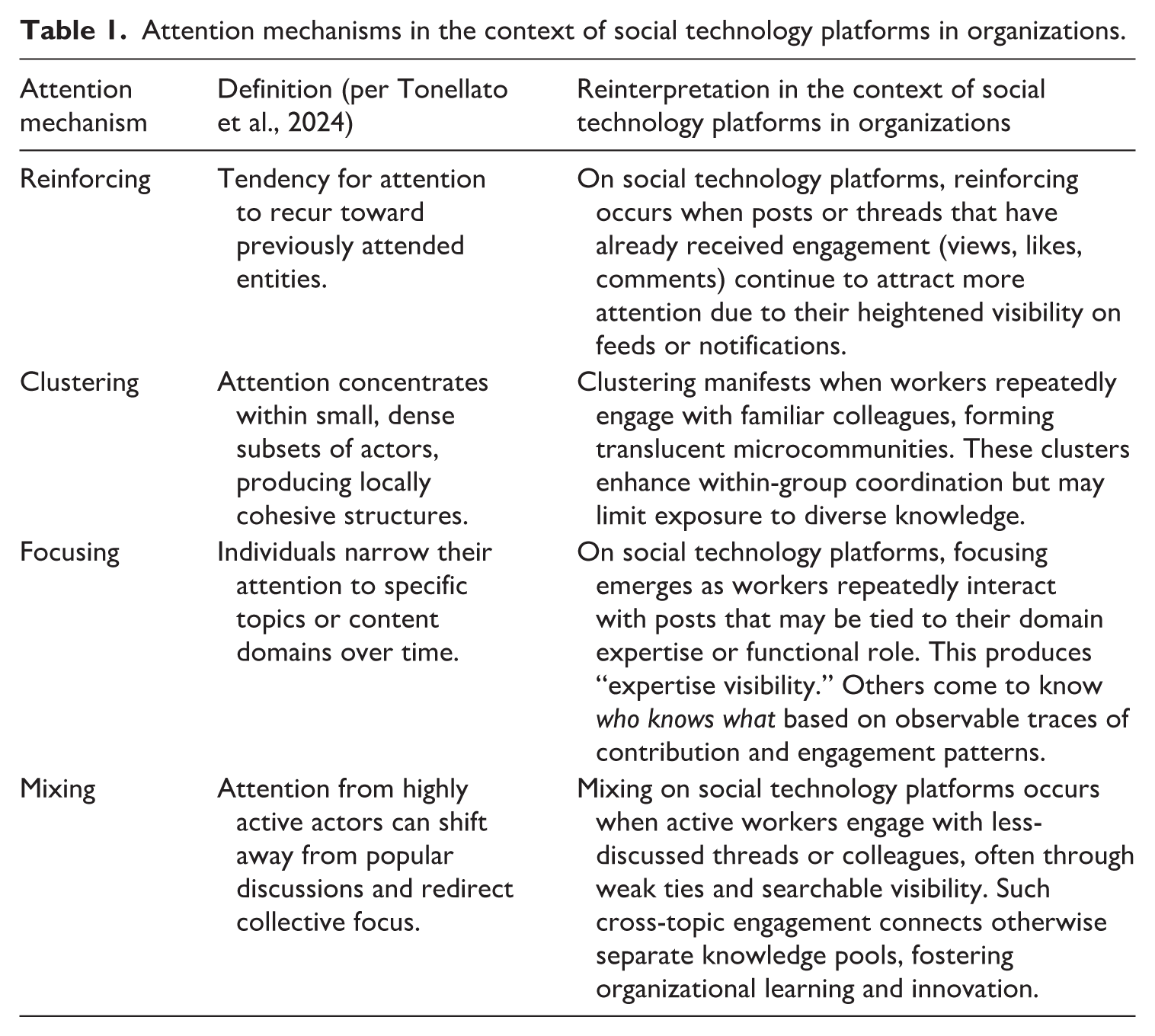
In Table 1, we summarize how the attention allocation framework can be interpreted in the context of social technology platforms in organizations.
Attention mechanisms in the context of social technology platforms in organizations.
Attention reinforcing
Digital communication technologies enable information to travel across organizational boundaries more fluidly than ever before (Kane, 2017). And the sheer number of different kinds of digital communication technologies adopted by organizations is higher than ever. In such high-choice digital environments, many messages, interactions, and reactions are visible, meaning they were made available, accessible, and noticeable to workers (Stohl et al., 2016). It allows workers to access knowledge that was not originally directed toward them (Leonardi, 2014; Treem et al., 2020). This visibility affordance expands the set of potential stimuli that organizational members can attend to, creating conditions under which attention becomes unevenly distributed—that is, people see and attend to different communication. For visibility to translate into organizational value, however, workers must actively allocate attention to the information that becomes visible (Engelbrecht et al., 2019; Leonardi, 2014).
Social technology platforms present opportunities for attention reinforcing in organizations by making information more widely and frequently visible (Treem et al., 2020). From the attention marketplace perspective, Webster (2014) argues that in a high-choice environment, structural affordances, such as popularity metrics and social signals, create a “winner-take-all” landscape where attention is highly concentrated. Social technology platforms may disproportionately amplify popularity, meaning that the visible signals of engagement such as message threads, replies, and likes direct attention.
This reinforcing process operates through three interrelated dynamics. First, workers may interpret issues that have already garnered substantial engagement as inherently important or valuable, directing their own attention toward them based on perceived collective relevance (bandwagon effect). Second, more popular threads usually appear more salient on the platforms because the likes are highlighted with noticeable colors (e.g., red), and replies are nested, with one or two recent replies immediately visible. Visible reactions can signal expertise and social recognition, motivating others to engage to increase their own visibility or contribute to a recognized knowledge domain (Leonardi, 2014; Treem et al., 2020). Third, attending to widely discussed content allows workers to access a broader, more diverse knowledge base, thereby facilitating exposure to perspectives or actors beyond their usual communication circles (Kane, 2017).
Collectively, these processes illustrate how visible engagement structures guide the self-reinforcing allocation of organizational attention. As information becomes more visible and socially endorsed, it attracts additional engagement, amplifying the salience of certain issues and shaping the collective focus of communication over time.
Attention-clustering
Attention clustering captures how individuals’ engagement behaviors converge around familiar people, creating locally dense attention structures within organizations. We conceptualize clustering as the outcome of workers’ selective attention to socially and cognitively proximate content. Prior research shows that individuals tend to gravitate toward others who share similar characteristics or perspectives, a phenomenon known as homophily (Ingram and Morris, 2007; McPherson et al., 2001). In organizational communication, such preferences manifest as recurrent engagement with colleagues or message threads that align with one’s role, expertise, or existing relationships (Di Tommaso et al., 2020).
Social technology platforms in organizations also make the patterns of clustered engagement increasingly observable to individuals (Treem et al., 2024). Workers can see who participates in which conversations (i.e., network translucence) and which types of issues attract their peers’ attention (i.e., message transparency) (Leonardi, 2014). The visibility of others’ communication behaviors not only enables coordination but also reinforces familiarity: workers are more likely to interact with people and content that they recognize as relevant, reliable, or aligned with their interests (i.e., affinity bias). In this way, attention becomes localized within subnetworks of shared visibility and understanding, rather than evenly distributed across the organization. Over time, this produces stable clusters of attention, which enhance within-group coherence but may also limit exposure to diverse expertise or novel perspectives.
Hence, attention clustering reflects a structural tendency of communication networks to concentrate engagement around familiar knowledge domains and visible peer communities, shaping both the inclusiveness and boundaries of organizational learning and collaboration. Thus, we hypothesize:
Attention-focusing
While attention clustering captures the tendency to extend attention to issues or problems that are indirectly connected through shared collaborators, it does not capture the repeated engagement between a worker and one message thread. Attention focusing reflects the tendency for workers to return to the same problems or issues over time. In other words, it captures the process through which individuals repeatedly direct attention toward the same set of topics or issues.
Within social technology platforms in organizations, attention focusing can be understood through the lens of visibility and expertise awareness (Leonardi, 2014; Leonardi and Meyer, 2015). As workers observe ongoing discussions, reactions, and contributions, they gain ambient awareness of metaknowledge (e.g., “who knows what,” “who is working on what,” and “who communicates with whom”) across the organization (Treem et al., 2024). This visibility allows them to identify relevant information sources and areas of expertise, thereby reducing ambiguity and uncertainty in knowledge-seeking activities. Rather than distributing attention evenly across available content, individuals tend to focus their engagement on familiar threads or knowledge domains, where prior participation or recognized expertise provides both cognitive comfort and social validation.
This dynamic might also be at play in organizational media ecosystems. As workers continue to allocate attention to specific issues, their subsequent attention becomes increasingly concentrated in those areas. The public traceability of knowledge transfer and contributions on social technology platforms in organizations shape workers’ perceptions of relevance. When individuals can see how others interpret and apply knowledge, they are more likely to engage in conversations where their own knowledge is applicable or recognized. As a result, attention focusing becomes both a cognitive and social organizing mechanism. We therefore hypothesize that:
Attention mixing and the alternative engager
Attention mixing captures the process through which individuals redirect their attention across previously unpopular domains. This means that workers who post and respond more frequently than average on social technology platforms can redistribute focus away from highly trafficked communication spaces toward less visible or peripheral ones. In contrast to attention reinforcing and focusing, which amplify or stabilize engagement within familiar areas, attention mixing reflects a form of exploratory attention that exposes workers to novel ideas, collaborators, and information (Tonellato et al., 2024).
Despite proclamations that the ease with which we can distribute content will result in the creation of a higher prevalence of smaller, niche markets of consumers—the so-called long tail effect (Anderson, 2008)—this has largely been disproven in the context of media use (Elberse, 2008). Instead, scholars have demonstrated that what emerges is a form of “double jeopardy” where light media consumers favor more popular media and are not aware of less popular options; whereas heavy media users consume both popular and unpopular media but represent a minority of consumers (Nelson and Taneja, 2018; Taneja, 2020). As a result, more popular media is likely to engender a loyal, consistent audience, in large part because a significant portion of media consumers do not know what they are not seeing.
Likewise, individual engagement activities on social technology platforms in organizations are interdependent and influenced by the visible activities of others. When particular threads or issues accumulate extensive attention, highly active workers diversify their attention to avoid informational redundancy and gain a relative advantage in accessing new knowledge (Tonellato et al., 2024). This disassortative allocation of attention counterbalances the concentration effects created by reinforcing dynamics.
From a network perspective, attention mixing parallels the role of weak ties in facilitating access to nonredundant information (Granovetter, 1973). Whereas strong ties foster efficiency and cohesion, weak ties enable the discovery of new ideas and connections by linking otherwise disconnected clusters. The affordances of communication visibility and network translucence (Treem et al., 2024; Treem and Leonardi, 2013) enable these bridging behaviors: active workers can observe distant conversations, identify underattended knowledge domains, and selectively reallocate their attention to them (Kane, 2017; Leonardi and Vaast, 2017). Through these mechanisms, attention mixing expands the reach of workers’ informational networks, enabling knowledge recombination and cross-domain learning.
Methods
Research site
We study attention dynamics on social technology platforms at a large European aviation company. The organization employs around 35,000 workers divided into functional units, including Cargo, Leisure, and Engineering and Maintenance. Our study focuses on the In-flight Services division. The division is responsible for the customer experience on board the aircraft. Within this division, the organization employs roughly 9000 cabin crew members. These workers are supported by ground services and office personnel. The In-flight Service division is geographically dispersed and difficult to reach. Therefore, workers in this organization routinely use social technology platforms to communicate and coordinate both within the unit and across other functional units.
In addition to formal communication channels, such as flight-specific applications and devices, workers rely on a social technology platform called Viva Engage to facilitate communication and social interaction. Viva Engage, previously known as Yammer, is an enterprise social technology platform that enables personal and group chats, group blogging, worker recognitions, polls and surveys, storytelling through storylines, task integration, and data-driven insights.
The platform plays a particularly important role in the organization where cabin crew are dispersed, hard to reach, rarely fly in the same team, and have limited contact with ground and office personnel. The success of their operations is highly dependent on team dynamics onboard as well as support from ground and office personnel. In addition, the in-flight crew relies on many different systems and needs to sort through a wide array of pre- and post-flight information, making questions about attention dynamics on the platform particularly relevant.
Data
We aim to uncover the mechanisms that explain how attention is organized and how this, in turn, shapes patterns of engagement on social technology platforms. Thus, we extracted two sets of data from the organization’s messaging server. One set of data includes the time-stamped sequence of attention allocation events connecting workers to message threads. During the 3-month observation period from 12 January to 11 April 2021, a total of 56,502 communicative events by 3,346 unique workers on 4,236 message threads were recorded. After eliminating events like notifications that do not connect workers and threads, we included 49,173 communicative events in the sample. The communication dataset records each event with second-level precision, thereby providing a detailed account of real-time attention allocation. The second set of data we collected contains team affiliation information and workers’ roles or job titles in our sample. We also collected data on the organizational chart and coded each job title to organizational rank.
Variables
Dependent variable
An attention allocation event is observed when worker i interacts with message thread m at time t by posting, liking, or replying. The full set of the observed interactions forms what we refer to as the attention network. We use the term “network” because the sequence of events reflects an aggregate pattern of dependencies that link individual attention behaviors. Although ties are instantiated through engagement behaviors, we conceptualize these behaviors as observable allocations of attention. As such, the resulting structure is interpreted as an attention network. Our analysis focuses on modeling the timing of the next attention allocation event, conditioned on the prior sequence of events. The dependent variable is the instantaneous probability that a worker interacts with a message thread given (1) worker attributes (such as role, rank, and team affiliation), (2) characteristics of the message threads, and (3) the history of interactions between workers and threads on the social technology platform.
Independent variables
We define Cumulative attention as a default mechanism of attention allocation to identify the effect of theory-informed mechanisms that correspond to our hypotheses. It represents a feedback mechanism explaining attention allocation acts. Cumulative attention serves as the baseline mechanism that operates within a social system characterized by growing inequality in participation and outcomes. Specifically, it reflects a worker’s average tendency to adjust their level of attention to a message thread based on the prior engagement events on social technology platforms. A positive effect indicates that workers who have already invested considerable attention in certain threads are more likely to continue doing so in the future.
The Attention reinforcing hypothesis posits that message threads that have already garnered significant attention—measured by replies and likes—are more likely to continue attracting additional attention over time. This self-reinforcing mechanism implies a “rich-get-richer” dynamic, whereby previously popular threads become even more prominent in the future. A positive coefficient on this effect would indicate that higher prior attention increases the likelihood of subsequent engagement.
The Attention-clustering hypothesis suggests that attention tends to stabilize within localized worker-thread clusters, effectively “locking in” patterns of engagement. We operationalize this mechanism using the count of bipartite four cycles (Figure 1), which reflect repeated co-engagement patterns between workers and message threads. A positive effect would indicate that workers tend to concentrate their attention on threads where they observe participation from colleagues with whom they have previously interacted, suggesting that attention is socially patterned and contextually anchored.
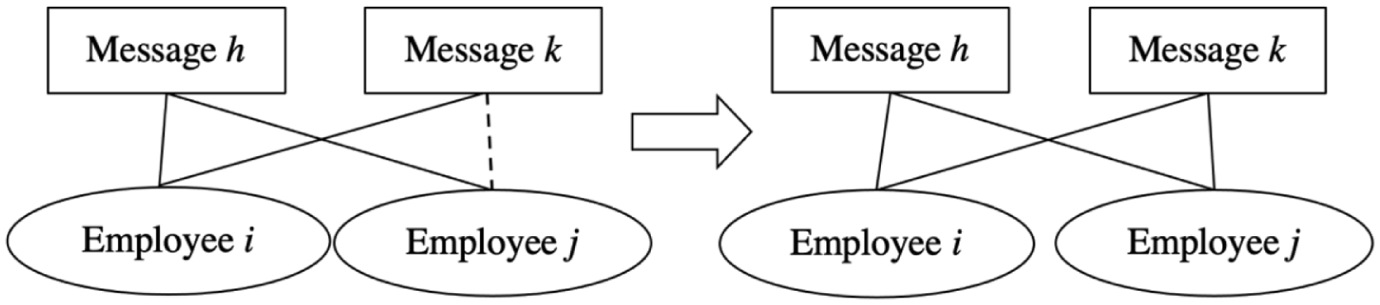
Attention-clustering illustration.
The Attention-focusing hypothesis posits that workers are more likely to return to threads they have previously engaged with. A positive effect here would imply that the more often a worker interacts with a specific thread, the greater the probability of further interaction with that same thread over time. This indicates sustained focus on particular content.
Finally, the Attention-mixing hypothesis involves a negative interaction between cumulative attention (i.e., user activity) and attention reinforcing. A negative effect would suggest that more active workers are less inclined to engage with already popular threads. In the context of social technology platforms, this mechanism implies that high-engagement users may intentionally diversify their attention, shifting it away from widely-followed threads toward less prominent ones, thereby promoting a redistribution of attention across the platform.
Control variables
We include control variables that involve the characteristics of workers and message threads. Is Question is an indicator variable representing whether or not the original post of a message thread is a question. The variable was automatically coded by the Viva Engage platform. Message length is the number of characters in the original posts of a message thread. Message visibility is a binary variable representing whether or not the message threads were posted in the public domain. We note that the private domains could include a large number of workers in large units, and the public domain means the message threads are visible to all workers on the social technology platforms. The main difference between the private and public domain is that private channels require an active opt-in, while public domains are based on opt-out. Worker rank is the rank of workers in the organization. The rank is coded on a range of 1 to 7 based on job titles and an organizational chart. The role divisions within the in-flight services are clearly distinguishable based on hierarchy, for example, cabin attendant vs purser.
Analytical approach: Bipartite relational event models
In an effort to better account for the structured, emergent, and self-organizing processes that shape attention allocation within digital work environments (Bianchi et al., 2024; Tonellato et al., 2024), we adopt a bipartite relational event modeling (REM) approach to treat attention allocation as a dynamic process that unfolds over time by leveraging the high-resolution, time-stamped sequence of attention allocation events. REM reveals how attention flows are systematically structured by prior interactions, network dependencies, and individual behavioral tendencies (Bianchi et al., 2024). We specifically implement bipartite REMs (Butts, 2008; Lerner et al., 2024; Lerner and Lomi, 2020; Vu et al., 2015) that connect two distinct node types (i.e., workers and message threads) so that they preserve the precise temporal ordering of individual actions.
The mechanisms hypothesized in the model are operationalized through sequences of temporally ordered engagement events on social technology platforms. To estimate these dynamics, we use a Cox proportional hazards model that incorporates both static covariates and time-varying, history-dependent effects. Parameter estimation is carried out via partial likelihood inference, implemented using the eventnet software (v0.5.6) and the survival R package (v3.5.5; Therneau and Grambsch, 2010).
To construct the time-varying statistics or “effects” we draw on the full historical sequence of observed attention allocation events. We define a risk set that includes all workers and all message threads present in the dataset, and from this, we sample non-realized events to support estimation. 1
The estimated effects capture how the likelihood of the next attention allocation event is shaped by the temporal structure of prior interactions. The resulting parameter estimates provide insights into the direction, magnitude, and statistical significance of the theory-informed mechanisms, as well as the effect of control variables.
Results
Descriptive analysis
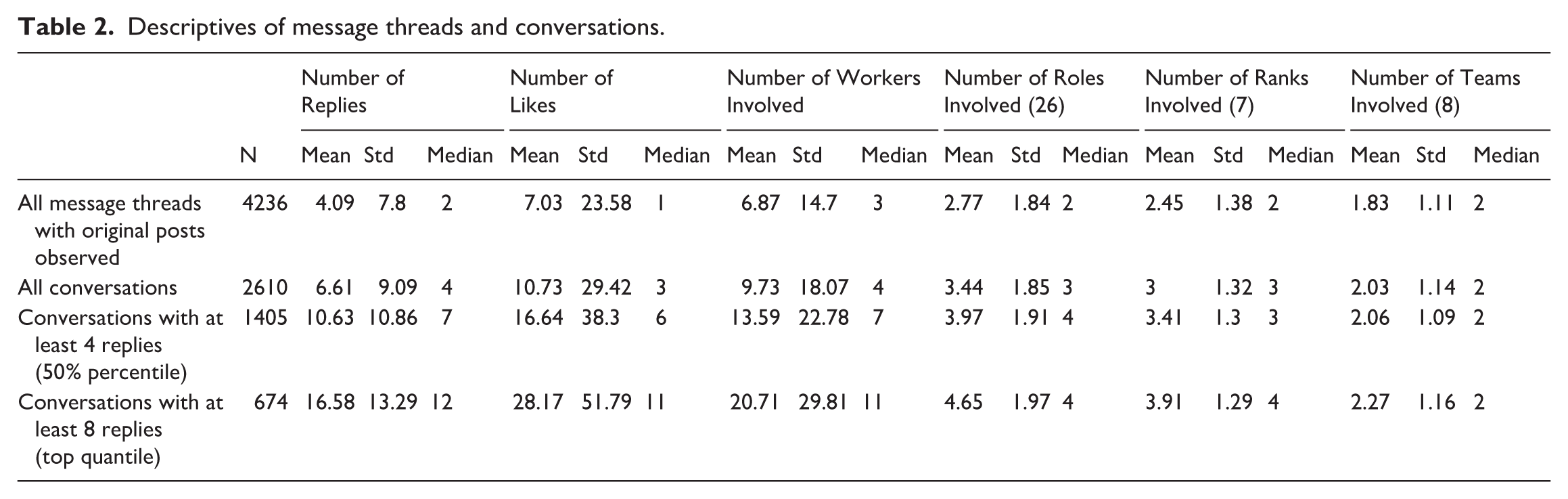
Among all the 4,236 message threads with original posts observed, 3,545 (83.7%) of them received at least one reaction (i.e., reply, like), and 2,610 (61.6%) of them were “conversations” that received at least one reply and involved at least two workers. Of the total 1,749 (41.3%) message threads started with their original posts as questions. Table 2 presents descriptives of message threads and, more specifically, conversations on the social technology platform within the organization. The descriptives of conversations suggest that longer conversations (i.e., conversations with the number of replies in the top quantile) may not involve more teams or more ranks in the organization.
Descriptives of message threads and conversations.
Hypothesis testing
Table 3 presents the results of the hypotheses testing analyses. Model 0 serves as the benchmark model and accounts solely for the cumulative attention received by each worker. In this specification, the likelihood of a subsequent attention allocation event is determined exclusively by the historical sequence of prior events. Model 1 serves as the baseline model, incorporating control variables for worker and message thread attributes. In model 1, attention allocation events are treated as independent, influenced only by these static attributes. Model 2 introduces the theory-informed attention allocation effects and is the primary model for testing the hypotheses.
Partial likelihood estimates of bipartite relational event models.
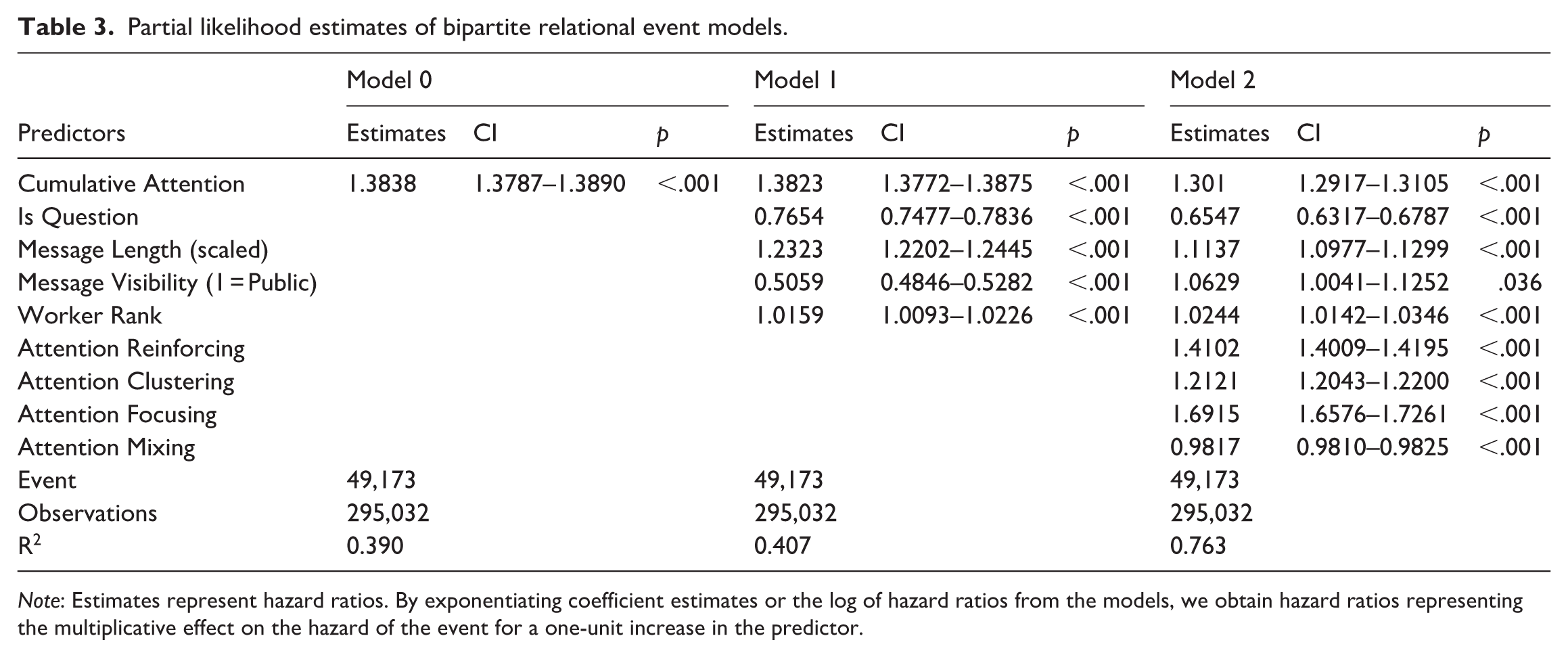
Note: Estimates represent hazard ratios. By exponentiating coefficient estimates or the log of hazard ratios from the models, we obtain hazard ratios representing the multiplicative effect on the hazard of the event for a one-unit increase in the predictor.
The results presented in model 1 indicate that the estimated effects of the control variables remain numerically consistent across different models. We interpret the network-related effects using hazard ratios. These hazard ratios are estimated by exponentiating the maximum likelihood estimates of the parameters corresponding to the network statistics. Message threads that start with a question are 24% less likely to attract attention than threads starting with a nonquestion. A reply or a reaction to a question may signal the resolution of the question or the closure of the topic; hence, no further input is necessary (Lindsay, 2021). Messages with more characters to start threads are 23% more likely to attract attention than shorter messages. Longer messages may be interpreted as a signal of something particularly complex and worthy of discussion (Flanagin, 2017; Ridings & Gefen, 2004). Message threads in the public domains are 50% less likely to attract attention than those in the private domains. However, the hazard ratio is flipped in model 2. Higher rank workers are 1% more likely to contribute to message threads on social technology platforms than lower rank workers.
Model 2 incorporates the theory-informed effects. We interpret statistically significant positive or negative coefficients as indicating an increase or decrease, respectively, in the rate at which workers engage with message threads, consistent with the hypothesized mechanisms underlying the event sequences. Since the network-dependent effects are standardized, the magnitude of each effect reflects the change in event rate associated with a one standard deviation shift from the mean.
Attention reinforcing (H1)
H1 posits that message threads that have already attracted attention from a large number of workers are more likely to continue receiving additional engagement. This dynamic reflects an attention-reinforcing process, which may stem from the nature of social technology platforms enabling broader knowledge exposure through participation in widely attended discussions. Moreover, popular threads may act as signals of relevance or importance. H1 is supported: a one standard deviation increase in a thread’s prior attention received within the organization is associated with a 41% increase in the odds that it will receive further engagement.
Attention clustering (H2)
We hypothesized that workers are more likely to allocate attention to a message thread when their colleagues, who have previously attended the same thread as them, have attended this thread. The mechanism reflects workers’ tendency to build on prior interactions by engaging in future message threads that connect them indirectly to familiar colleagues. H2 is supported: a one standard deviation increase in the number of indirect connections (three-paths) linking a worker to a message thread is associated with a 21% increase in the odds that the worker will directly engage with that thread in the future, effectively closing the open triad and forming a bipartite four-cycle (Figure 1).
Attention focusing (H3)
H3 posits workers who previously react to specific message threads would be more likely to focus their attention on those same threads in the future. The basis of the hypothesis lies in the threaded and temporally structured nature of social technology platforms that facilitates re-entry into familiar conversations and enables focused engagement. The attentional inertia supports specialization and allows workers to repeatedly contribute to domains where they hold expertise. This, in turn, helps stabilize organizational attention by concentrating knowledge sharing within consistent conversational spaces, promoting rapid learning from peers. H3 is supported: a one standard deviation increase in prior attention to a given thread increases the odds of recurring attention to that thread by 69%.
Attention mixing (H4)
H4 posits that highly active workers are more likely to direct their attention toward less popular message threads. The hypothesis is grounded on the nature of social technology platforms, which exposes even low-engagement threads to active users. The estimated hazard ratios reveal a disassortative pattern: the likelihood that active workers engage with popular threads decreases. Specifically, for a worker who is one standard deviation more active than average, the attention-reinforcing effect is reduced by 2%. In other words, while a highly popular thread (with one standard deviation above-average attention) typically sees a 41% increase in the odds of further engagement, this drops to 39% for more active workers. H4 is supported. The results indicate that, ceteris paribus, active users demonstrate a systematic preference for less popular threads.
Discussion
This study contributes to a deeper understanding of how social technology platforms direct individuals’ attention in organizations where individuals have limited capacity to engage with each other and available content. Our research shows the interdependence of individuals’ engagement on social technology platforms by demonstrating the dual importance of informational cues and message structure in shaping attention allocation. We speak to two conceptual and theoretical streams.
First, in centering members’ attention we better represent the differential communicative acts of individual users and avoid privileging the material agency of social technology platforms as facilitating uniform, or collective, outcomes for individuals or organizations. In other words, though existing perspectives on the organizational outcomes associated with social technology platforms are useful, they risk framing changes in communication as inevitable outcomes of using a technology that affords greater communication visibility. Not only does this risk a somewhat deterministic view of social technology platforms (at least in terms of the effects of adoption), it also obscures the ways individuals might make varied decisions and have different experiences based on the ways situated communication networks–of individuals, engagement behaviors, and messages–evolve.
Second, the attention perspective highlights how interdependent mechanisms emerge to shape subsequent patterns of engagement on social technology platforms. Engagement on social technology platforms in organizations is neither uniform nor random but rather reflects relational patterns seen in other communicative actions. By utilizing relational event models, we specifically focus on how worker attributes, message thread attributes, and historical records of interactions collectively shape engagement on social technology platforms. The findings highlight four attention mechanisms in the context of social technology platforms in organizations. Specifically, the findings demonstrate workers are more likely to engage in popular threads, in threads where similar others have already contributed, and in threads that they have engaged in previously. Finally, we found that highly active workers are more likely to engage in less popular threads. These results show that engagement on social technology platforms in organizations follows the law of double jeopardy: engagement in popular threads is the norm for the average worker while engagement in less popular threads is a “niche” behavior restricted to highly active workers whose high volume of activity brings them into contact with the long tail of platform content. This pattern suggests a common scaffolding of communicative behavior across both organizational media platforms and public media ecosystems such as movie rentals (Elberse, 2008), website popularity (Taneja, 2020), and fact checkers (Ray et al., 2025).
Our findings underscore that early patterns of attention allocation in digital communication environments can have disproportionate and path-dependent effects on what becomes salient within an organization. Because initial engagement with content may be driven by chance, convenience, or the limited set of messages visible at the outset, early attention can snowball into stable popularity hierarchies that shape others’ attention (Salganik et al., 2006). This dynamic aligns with findings from agent-based models of engagement on social technology platforms, which show that initial contribution behaviors meaningfully influence whether workers continue to participate and how communication networks evolve (Foote et al., 2023). By foregrounding these temporal interdependencies, an attention perspective 2 highlights how the use of networked communication technologies (e.g., enterprise social media, collaboration platforms, knowledge management systems) is not merely a collection of discrete actions but an unfolding process in which past engagement patterns shape future organizational communication.
Our study focuses on a single core functional unit within one organization. The In-flight Service Unit is geographically dispersed and not easily supported by in-person interactions. As a result, workers routinely use social technology platforms to communicate and coordinate both within the unit and across other functional units. Although this empirical context is specific, we believe the findings are broadly applicable to work environments in which remote or distributed work is the norm and employees rely heavily on digital communication technologies for coordination. As digital collaboration technologies become deeply embedded in the workplace, particularly after the COVID-19 pandemic, even co-located employees increasingly use them to connect and collaborate with remote team members. Communication visibility, persistent interaction records, and strategic self-presentation enabled by those digital tools that drive attention dynamics are therefore relevant across a wide range of digitally mediated work settings. We acknowledge that communication events may also occur outside the observed communication channel through other digital tools or occasional face-to-face interactions. In addition, organizational policies and culture may further shape patterns of attention and communication. Future research should test the reproducibility of these findings across different digital communication technologies and organizational contexts.
We also acknowledge that the pandemic context likely shaped baseline activity levels and participation fluctuations. Crisis conditions may disproportionately heighten information-seeking behavior for workers with different engagement levels on the platform. Future research should link event-level shocks to attention dynamics by combining communication data with exposure and event-timing information.
Our findings showed that message threads that start with a question are less likely to attract attention than threads starting with a nonquestion. However, types of questions asked in threads vary (e.g., open-ended vs closed), and this may play a role in how attention is allocated accordingly. Certain types of questions (e.g., open-ended or provocative) can trigger more attention or different organizing processes than others. Future research should examine the relationship between different types of questions and users’ attention allocation.
In our study, we collected anonymized data and reported results at an aggregated level. We did not have access to identifiable individual-level data. Nevertheless, we recognize that organizations may deploy similar analytics tools for monitoring or surveillance purposes. We therefore emphasize the importance of transparency in communicating how worker behavioral data are collected and used, as well as for practices that foster psychological safety in data-informed workplaces.
We cannot disentangle social influence from potential algorithmic amplification with the empirical data in this study. The default home feed on the platform incorporates ranking mechanisms based on past engagement, recency, and network proximity, yet we do not have access to the data speaking to how content was surfaced to individual users during the study period. Therefore, the observed attention dynamics reflect a socio-technical interaction between user behavior and platform-level algorithms. This means our findings represent behaviors relative to what was visible and available to workers in situ, and therefore retain ecological validity that is more likely to represent the dynamics among workers using similar technologies in other organizational settings.
Our analytical approach is in line with recent theorizing on algorithms as mechanisms of attentional control (Ocasio, 2025) and considers that ranking systems may function as top-down visibility structures that amplify or dampen bottom-up interactional patterns. Future research should combine interaction data with platform configuration data, or experimental manipulation of feed ordering could more precisely isolate the relative contribution of algorithmic versus relational mechanisms in shaping organizational attention.
In conclusion, our study offers a conceptual and analytic framework to understand the engagement patterns on social technology platforms in organizations and an analytically precise account of how attention becomes organized within those platforms. We clarify when and why certain issues attract sustained focus while others remain peripheral. As such, our study addresses challenges, such as information overload and competing demands on worker attention, particularly how individuals navigate information abundance and how attention becomes disproportionally distributed across spaces within digitally mediated communication environments.
Supplemental Material
sj-doc-1-nms-10.1177_14614448261456236 – Supplemental material for Attention dynamics on social technology platforms in organizations: An empirical study of structural and temporal mechanisms
Supplemental material, sj-doc-1-nms-10.1177_14614448261456236 for Attention dynamics on social technology platforms in organizations: An empirical study of structural and temporal mechanisms by Y. Jasmine Wu, Ward van Zoonen, Jeffrey W. Treem and Anu E. Sivunen in New Media & Society
Footnotes
Acknowledgements
The authors would like to thank Andrew Pilny, three anonymous reviewers, and audiences of the Network Dynamics session at the 2024 Sunbelt Conference of the International Network for Social Network Analysis and the Organizational Communication Division at the 2025 Annual Conference of the International Communication Association for their thoughtful comments.

Funding
The authors received no financial support for the research, authorship, and/or publication of this article.
Declaration of conflicting interests
The authors declared no potential conflicts of interest with respect to the research, authorship, and/or publication of this article.
Data availability statement
The data used in this study are part of a confidentiality agreement with the organization and cannot be publicly shared. Access to the data may be available upon reasonable request and subject to approval from the organization.
Supplemental material
Supplemental material for this article is available online.
Notes
Author biographies
References
Supplementary Material
Please find the following supplemental material available below.
For Open Access articles published under a Creative Commons License, all supplemental material carries the same license as the article it is associated with.
For non-Open Access articles published, all supplemental material carries a non-exclusive license, and permission requests for re-use of supplemental material or any part of supplemental material shall be sent directly to the copyright owner as specified in the copyright notice associated with the article.
