



Abstract
Little is known about how resilience to disinformation develops and manifests in people’s daily lives. Addressing this gap, our study investigates young adults’ tactics for navigating disinformation and the resources they draw from throughout this process. Based on 29 semi-structured interviews with young adults (aged 18–32) in Germany and the Netherlands, we develop a taxonomy of tactics for navigating disinformation. Our comparative analysis reveals that the same tactics are employed in both countries despite different contexts, suggesting transnational mechanisms of how citizens deal with disinformation. We find that young adults’ economic, cultural, social, and personal resources profoundly shape the extent and efficacy of employed tactics. Structural inequalities, resulting in fewer resources, negatively impact the development of resilience to disinformation. Demonstrating how tactics connect to resources, our study provides a contextual perspective to the over-individualized debate on resilience to disinformation, which mainly focuses on literacies and places responsibility on the individual.
Introduction
Although the need for resilience to disinformation is frequently stressed in public and scientific discourse, it remains an underdeveloped concept. Current definitions and studies primarily conceptualize resilience as an individual’s ability to detect disinformation, focusing on cognitive abilities (Cernicova-Buca and Ciurel, 2022; Roozenbeek et al., 2022). Yet little is known about how resilience develops and manifests in people’s daily lives. We address this gap by inductively investigating young adults’ tactics for navigating disinformation and the economic, cultural, social, and personal resources they draw from throughout this process. This allows us to identify resilience-promoting and resilience-inhibiting elements, not only from an individual but also from a structural perspective. Herewith, we respond to the growing calls to investigate resilience to disinformation by integrating structural contexts (Humprecht et al., 2020; Lenoir and Anderson, 2023; Zhu et al., 2025).
Research on individuals’ resilience to disinformation can be divided into three strands. One body of work investigates the influence of individual factors, such as political ideology, knowledge, and worldviews, on disinformation beliefs and sharing (Bowyer and Kahne, 2019; Su, 2021). The second tests interventions to increase resilience, for example, through media literacy or inoculation techniques (Hameleers, 2022; Roozenbeek et al., 2022). The third strand proposes frameworks to operationalize and compare levels of resilience and connected factors. These studies investigate the role of variables such as social media use, trust in media, education, and economic environments (Humprecht et al., 2023; Humprecht et al., 2020; Zhu et al., 2025). While they address crucial individual- and structural-level components, they do not explain how, when, and where resilience is expressed in citizens’ daily lives.
To gain in-depth insight, we conducted 29 semi-structured interviews with young adults (aged 18–32) from diverse backgrounds in Germany and the Netherlands. Young adults especially engage with digital information environments, showing greater social media use and reliance on it for news. As online platforms are key sites for the circulation of disinformation, this age group is more embedded in disinformation-rich environments and is, therefore, often presumed to be more vulnerable (Matsa et al., 2018; Nelson and Taneja, 2018).
Resilience to disinformation: Harnessing resources
Resilience, at its core, refers to bouncing back, adapting, and mitigating adverse effects when confronted with a threat (Bracke, 2016). In public discourse, individuals or systems are often discussed in terms of being (made) resilient or not (Crabtree, 2017), but resilience, especially in humans, is not a binary state. It develops or regresses throughout different phases of life, depending on external and internal circumstances (Shafi et al., 2020). Especially for disinformation, people’s discernment may depend heavily on the social, political, or emotional context (Duan and He, 2026; Na et al., 2018). Similarly, resilience is not one specific trait but relies on a combination of abilities and characteristics (Bracke, 2016; Lyons and Schatzberg, 2020).
We define resilience as a process of harnessing resources (Southwick et al., 2014), the ‘available means that are used as a source of supply or support in accomplishing particular aims’ (Van Dijk, 2005: 36). This definition allows for the consideration of abilities, external influences, and different contexts. Within this process, some of the employed protective mechanisms can be learned (Masten, 2001). We refer to disinformation as a hypernym, encompassing different formats, degrees of veracity, and potential harmfulness (Kapantai et al., 2021). This includes clickbait, conspiracy theories, fabricated, manipulated, or decontextualized content, and flawed reporting. In the context of disinformation, we view resilience as a process of harnessing resources when encountering disinformation, supporting the mitigation of potential negative effects, for example, deception or impacts on (mental) health (Bastick, 2021; Richard, 2020).
Our conceptualization of resources draws on Helsper’s corresponding fields model, which distinguishes four fields of resources to explain how social and digital inequalities are connected: economic, cultural, social, and personal (Helsper, 2012). Applied to the context of resilience to disinformation, we view economic resources as financial wealth, income, and access to (higher) education. These determine, for example, access to technological equipment, newspapers, and information literacy education, thus influencing people’s experience with media and technologies. Cultural resources refer to the sociocultural groups individuals are part of or born into, which shape their identity, worldviews, and ambitions. Young adults’ socialization may impact relevant elements for developing resilience, such as news consumption and levels of trust toward (public) media or political institutions.
Social resources manifest through a person’s access to and size of their private and professional networks, from which they can draw support and knowledge (Sallaz and Zavisca, 2007). The composition and heterogeneity of young adults’ social networks may substantially influence the type, diversity, and quality of information and expertise they can access. Closely related to this, we consider the personal resources of young adults, which may impact their development of resilience to disinformation. This includes psychological well-being, personality, and coping mechanisms.
While we conceptually differentiate between different forms of resources, in reality they interact and reinforce each other. For example, strong professional networks or personal resources can lead to economic opportunities, whereas a lack of economic resources can influence access to distinct parts of society, ergo cultural resources (Sallaz and Zavisca, 2007). The amplification may disproportionately increase the benefits and opportunities for individuals with higher resources, intensifying pre-existing inequalities. This underscores the importance of examining multiple levels of influence, including micro-psychological, meso-social, and economic factors (Helsper, 2012). However, most studies on resilience to disinformation do not examine the interconnections between different levels of influence (Kont et al., 2024; Zhu et al., 2025). Our study addresses this gap and contributes to an inductive conceptualization of resilience to disinformation by demonstrating which tactics people adopt to deal with disinformation and how these tactics relate to resources that shape people’s action possibilities.
Over-rationalization and over-individualization of disinformation research
Most discussions about increasing individuals’ resilience to disinformation lead to media and digital literacies (Cernicova-Buca and Ciurel, 2022; Peng et al., 2023). These pedagogical approaches aim to increase people’s ability to effectively navigate their information environment, identify disinformation, and strengthen critical thinking (Jones-Jang et al., 2021; Pangrazio et al., 2020).
While equipping audiences with the knowledge and abilities to navigate disinformation is important, the overwhelming focus on literacies and critical thinking reveals two underlying assumptions informing the definition, conceptualization, and study of resilience to disinformation: (1) resilience is a matter of cognition, and (2) it should be addressed on an individual level. The cognitive component of resilience to disinformation has received the most scholarly attention, for example, investigating the link between disinformation beliefs and thinking patterns like analytical versus intuitive thinking (Kont et al., 2024; Nurse et al., 2022). However, cognition is only one of many factors affecting behavior (Heimlich and Ardoin, 2008; Strecher et al., 1985). Marwick (2018) accurately captures the shortcomings of this logic in disinformation research, as it is built upon a series of premises: first, that when confronted with ‘correct’ information, people will change their [. . .] opinions; second, that what is ‘correct’ and what is ‘incorrect’ are objective truths; and third, that people share [. . .] viewpoints [. . .] in an attempt to inform others. (p. 475)
This over-rationalized conceptualization of resilience to disinformation contrasts with research confirming that more variables are at play. For example, studies on the evaluation and sharing intentions of online (dis-)information found that other users’ comments play a crucial role, highlighting the role of (online) social environments (Duan and He, 2026; Duffy et al., 2020). By investigating resilience to disinformation at the nexus of tactics and resources, we expand the analytical scope, including individuals’ social networks.
While solutions for issues related to disinformation are sought on multiple levels, among others through regulations and content moderation, resilience to disinformation is discussed more unidimensionally, centering on the individual who is to be activated, educated, and ultimately made responsible (Chomintra, 2023). This over-individualized perspective overlooks contextual influences, such as cultural, social, and economic backgrounds, which shape opportunities, beliefs, and trust. For example, people from communities experiencing social or economic exclusion may, as a result, be less likely to trust (political and journalistic) institutions and gravitate toward other sources of information (Jaiswal et al., 2020). Scheerder et al. (2019) found that higher-educated participants’ awareness of potentially deceptive online content led to proactive approaches, whereas lower-educated groups felt powerless and gave up due to a lack of tactics at their disposal.
This raises a crucial question: How do people navigate disinformation in their daily lives? Most research revolves around what people should do, whereas the situated practices and tactics used to express resilience are underexplored. Drawing on De Certeau (2005), we define tactics as pragmatic, ‘calculated actions’ to overcome challenges, offering ways for people to practice their agency within systems over which they have limited control. These tactics are shaped by tacit and explicit knowledge and are applied with varying degrees of deliberation on a continuum from intentional to intuitive (Polanyi, 1966; Swart and Broersma, 2022). The adaptive nature of tactics characteristically relies on using limited resources to achieve a desired outcome. The concept contributes to the contextual perspective of this study, as tactics are context-dependent by default, varying contingent on opportunities, costs, and timing in a given moment. As such, their exploration reveals available resources and underlying structures that can contribute to a better understanding of how resilience to disinformation is shaped in specific contexts. Adopting de Certeau’s definition of tactics and Helsper’s conceptualization of resources, we ask,
Which tactics do young adults apply for navigating disinformation in daily media practices and conversations?
How do the resources young adults draw from shape this process and contribute to resilience to disinformation?
Method
While existing research on resilience to disinformation has predominantly relied on quantitative methods, this study employs qualitative, semi-structured interviews to capture participants’ lived experiences and meaning-making processes when navigating their information environments. The data was collected through 29 semi-structured interviews with young adults aged 18–32. The selected age range was informed by prevailing conceptualizations of young adulthood in prior research (Borah et al., 2022). For the cross-national comparison, we conducted interviews in Germany (n = 15) and the Netherlands (n = 14). The two countries were selected because they share key structural characteristics, having similar political systems and media landscapes, but differ in levels of digitalization, citizens’ digital skills, and trust in institutions (Edelman Trust Institute, 2024; Eurostat, 2023). The former renders them comparable, while the latter two may lead to differences in how people respond to disinformation. The comparison allows us to explore potential transnational mechanisms affecting young adults’ resilience to disinformation.
To avoid over-representing more privileged segments of society (Erba et al., 2022), we used snowball sampling in combination with quota sampling to ensure a diverse sample across age, gender, cultural, and educational backgrounds. This non-probability sampling method allows us to gather rich data suitable for generating inductive theory (Leavy, 2014). Recruitment began through two vocational schools and two universities, where staff shared study information and interested individuals contacted the research team. Subsequent participants were recruited via quota-guided snowball sampling. Our sample comprises participants from different regions within their respective countries; eight participants have a migration background. Occupations vary greatly, from student, content creator, mechanic, lawyer, chemist, and kindergartener to ‘full-time’ parent (Table 1).
Sample demographics.
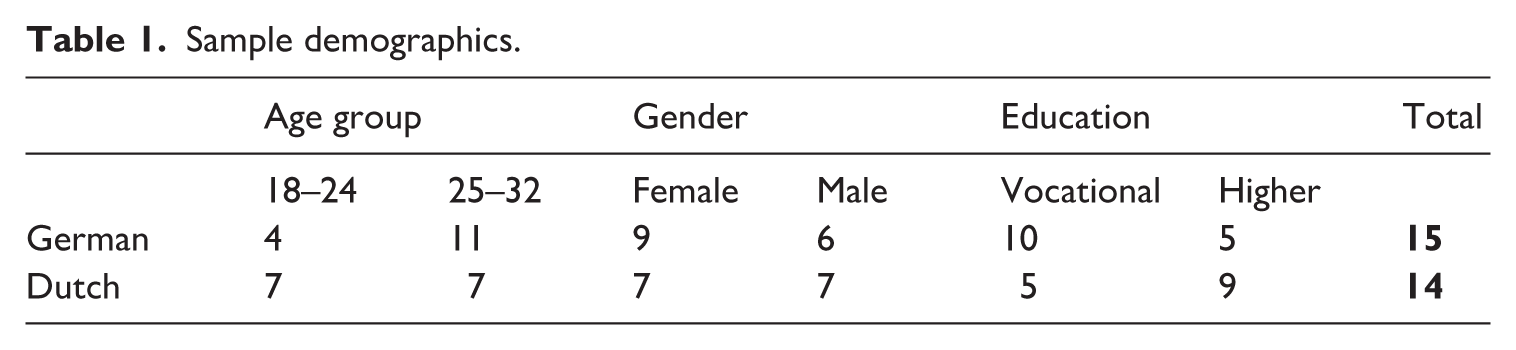
Interviews took place from November 2022 to April 2023 and, on average, lasted 60 min. All interviews were conducted face-to-face via video conferencing (n = 21) or in person (n = 8), depending on the participant’s location and preference. In line with research on video chat use and online interviews (Lobe et al., 2022), all participants were familiar and comfortable with video calls, and we found no substantial differences in length and depth between online and in-person interviews. A German and a Dutch native speaker conducted the interviews to avoid potential language barriers.
All interviews started with a day-in-the-life narration, during which respondents recounted their media and news use from morning to night. We asked them: ‘Could you walk me through a typical day and describe when and how you use [news, social (media)]?’ This was followed by an in situ exploration of media use, applying think-aloud and walkthrough methods (Charters, 2003; Ritter, 2022). We asked, ‘Could you walk me through your [social media/news] feed and describe what you see and what you do?’ Participants then moved through their social media and news apps, sharing encountered content, thoughts, and actions, such as swiping, liking, or skipping content. These parts of the interview provided contextual insight into participants’ cross-media habits, information environments, interests, and news consumption. Probing questions about reading, skipping, or sharing specific content yielded initial insights into how participants navigate information.
The second part of the interview explicitly addressed disinformation through questions about familiarity with the term and what they regard as disinformation. We also asked them for a recent example of content they would describe as disinformation and their experiences with others sharing information that made them question its accuracy or reliability. Probing questions, such as ‘what made you think’, ‘how did this impact’, or ‘how did you react’, revealed underlying knowledge and tactics to navigate disinformation. In addition, participants were invited to reflect on how they assess information, for example, through questions, such as ‘What makes [this source/content/information] feel trustworthy to you?’ or ‘How do you evaluate [. . .]?’ We investigated participants’ resources through accounts of their cultural and economic backgrounds, social networks, and educational trajectories. These insights often emerged naturally; for example, participants would refer to their education when discussing how they evaluate (dis-)information.
We recorded, transcribed, and pseudonymized all interviews and analyzed the data in ATLAS.ti. Consequently, the names used in this article are pseudonyms. To gather rich data that captures participants’ realities in depth while safeguarding reflexivity (Charmaz, 2014), we created detailed field notes for each interview. These also include follow-up comments and thoughts participants shared (at times days) after the interview. Adopting a bottom-up grounded theory approach (Charmaz, 2014; Thornberg, 2012), the analysis began with line-by-line coding, producing preliminary codes based on participants’ encounters with disinformation and evaluation. In subsequent iterations, coding focused on the practices participants adopt to navigate disinformation. From 13 codes, we created a taxonomy of 7 tactics through repeated grouping, recoding, and reviewing. Resources were initially coded using demographic information and later extended to include relevant passages from across the dataset. In the final step of the analysis, we compared emergent themes to existing resilience and media theories. This late-stage iterative engagement with theory allowed us to contextualize our findings and led us to adopt the corresponding fields model as a theoretical lens (Helsper, 2012).
Results
In this section, we first focus on the identified tactics participants use to navigate disinformation and then outline their relation to the participants’ resources and resilience to disinformation. Since the analysis did not reveal significant cross-national differences in the resilience processes described by Dutch and German participants, their accounts are presented together (Figure 1).
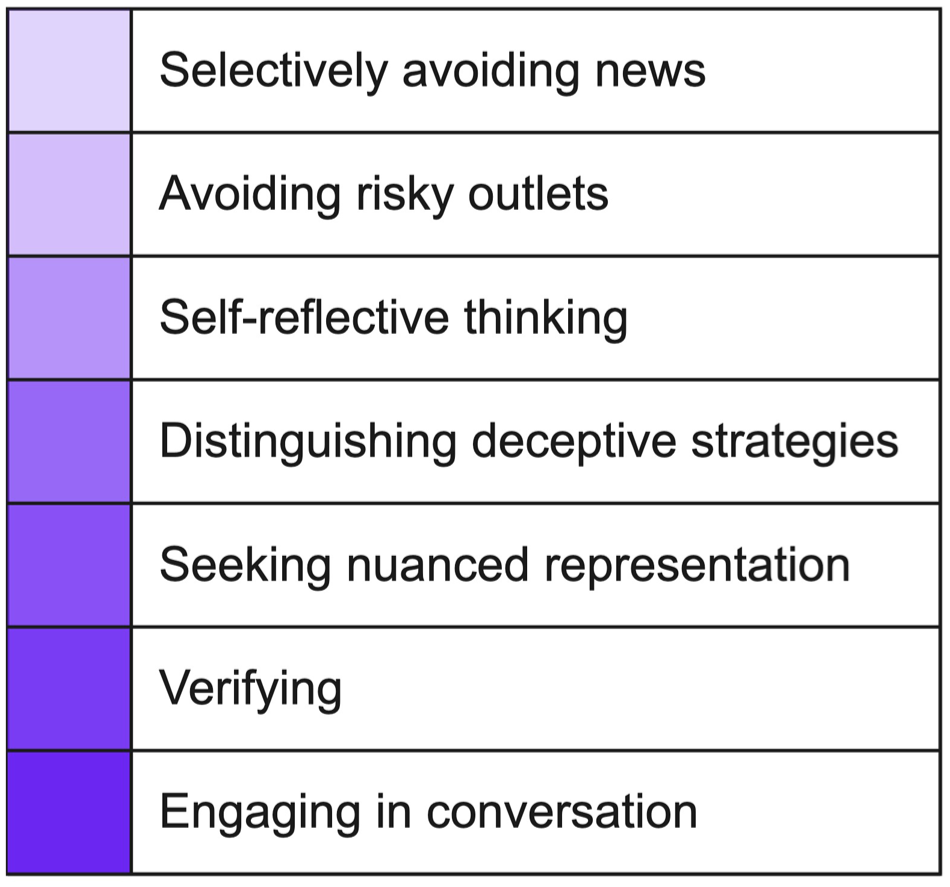
Taxonomy of tactics to navigate disinformation, in order of perceived effort (low to high).
Tactics for navigating disinformation
The taxonomy comprises seven categories of actions participants take when encountering potential disinformation, structured in order of perceived effort. While they can complement and build upon each other, participants do not necessarily conduct these steps consecutively, entirely, or deliberately.
Selectively avoiding news
A commonly relied-upon tactic is selectively avoiding ‘hard news’ (Lehman-Wilzig and Seletzky, 2010), especially concerning politics and (international) conflicts. While previous research suggests that news avoidance can be a reaction to information overload (Tandoc and Kim, 2023), our evidence indicates that selectively avoiding news is also a tactic for navigating and reducing exposure to disinformation. In practice, these dimensions are often intertwined. Not wanting to be disinformed but also lacking the ability, willingness, or resources to inform themselves to the desired standard in a convoluted information environment, participants avoid selected news topics that could expose them to disinformation. For example, Anja (21, Germany) ‘at first’ avoided news about Iran because she ‘wasn’t entirely sure what was actually true’. Bram (24, Netherlands) explains that the information provided by ‘most media’ is not ‘enough to make a judgment’; therefore, he avoids certain topics. Participants often ‘don’t have the time to take a close look at everything’ (Luise, 21, Germany) or comment that ‘it’s just too much work’ (Bram).
The statements exemplify how the risks of being disinformed relative to the cognitive costs of forming a nuanced opinion are perceived as too high. As a result, they are rather passively informed, relying more on their social (media) environment for information. Hence, social resources can determine whether participants who rely heavily on this tactic end up disinformed.
Carefully navigating or avoiding ‘risky’ outlets
Employing this preventive tactic, participants aim to minimize their exposure to disinformation. Following an initial quality assessment, low-quality sources are avoided or navigated with caution. This applies to social media, such as X, TikTok, or YouTube, ‘where you find true fake news’ (Bram, 24, Netherlands) and ‘have to be cautious’ (Elias, 19, Germany), as well as sensationalist media outlets or individuals. Consistent with previous research (Elvestad et al., 2018; Swart, 2023), many young adults view social media as a less trustworthy source of information. Kim (18, Netherlands), for example, is ‘not really worried about getting disinformation’ because ‘social media is not where [she gets her] facts from’. Where young adults ‘get their facts’ from and what is perceived as ‘risky’ versus trustworthy, in turn, appear to be linked to their cultural and social resources, as outlined below.
Self-reflective thinking
Another tactic involves participants critically examining how their motivations and preferences may affect their truth discernment. This requires a certain intellectual self-awareness and a critical assessment of one’s limitations when detecting disinformation. For example, during the social media walkthrough, Bram (24, Netherlands) notes that a particular subreddit ‘just caters to people with that opinion’. Simultaneously, he remarks, ‘I also have my own bias into what I like to see, obviously’ and adds, ‘who knows, I might be misinformed, too’.
Participants who take this introspective stance comment that emotions and preferences might guide their judgments. When asked about his ability to identify factually accurate information, Lukas (25, Germany), explains, ‘I am often perceived as a very rational person, but then when I reflect on myself, I realize that I’m also very emotionally driven’. Realizing the emotional dimensions of reactions to information, he critically examines his ability to recognize misinformation. Others question their information intake and acknowledge their lack of knowledge to form an opinion. The benefit of reflecting on one’s vulnerability to disinformation becomes especially apparent in cases like Amelia’s (25, Germany). ‘As time passed’, she realized that her skepticism toward COVID-19 vaccines made her susceptible to related conspiracy theories and concluded ‘well, actually, that’s bullshit’.
Such reflective approaches enhance participants’ judgments and fuel the employment of other tactics. Recognizing the challenge and their potential vulnerability, these participants navigate their information environments more carefully, paying more attention to, for example, verifying and nuanced representation.
Distinguishing deceptive strategies
Applying this tactic, participants look for deceptive elements in encountered content. They consider how reality might be distorted, inquiring ‘what’s their bias’ (Niek, 24, Netherlands) or ‘political slant’ (Hannes, 30, Germany), and whether there are ‘things left out’ (Koen, 25, Netherlands) or exaggerated to ‘have a great headline’ (Lotta, 27, Germany). These participants know the monetary incentives behind content creation and connect it to attention grabbing, sensationalist reporting, or as Anna (22, Netherlands) puts it, ‘making things interesting’. They refer not only to social media and search engines but also to sensationalist content from established journalistic outlets. Participants display algorithmic awareness and understand its role in disinformation. Jim (26, Netherlands), a content creator himself, explains, You just have to know that people are doing everything to get your watch time. And that includes misleading or false information as well.
Refined understandings, as such, allow the participants to navigate and evaluate content more effectively. However, in line with existing research (Powers, 2017; Swart, 2023), most participants do not make this connection, despite having an implicit understanding of algorithms and describing their (algorithmically curated) social media feeds during the interview.
Seeking nuanced representation
Participants who actively seek nuanced representations look for ‘different perspectives’ (Frieda, 25, Germany) to evaluate content. For some, that entails consuming news from different outlets and countries, or evaluating platforms and articles based on the level of nuance they provide. Others actively seek conversations with people from contrasting viewpoints to ‘listen to both sides’ (Daniel, 26, Netherlands). In their efforts, they try to consider that ‘most of the things are not as black and white’ (Koen, 25, Netherlands) and are more accepting, albeit not necessarily convinced, of differing opinions. Applying this tactic allows them to put information into perspective and gain a differentiated view.
Verifying
This tactic encompasses multiple actions that require more time and effort from participants and is thus employed less. They actively examine the reliability of a source, cross-reference, and evaluate the substantiation of claims only if a topic is of greater interest to them. While participants mention the importance of sources, they rarely specify what constitutes a good source. Instead, they use more general statements, such as ‘I know I have to fact-check everything I see’ on social media platforms. This entails comparing the information encountered to reports from other platforms and outlets, statements from friends and family, or a Google search. While participants rely on conventional methods of verification, they also consider checking their trusted sources a form of verification and fact-checking.
Engaging in conversation
This tactic is only applied in one specific context: when someone they know personally shares disinformation during a conversation. Some pose questions to understand the logic or motivations behind their counterpart’s disinformed beliefs or to counter-argue. For example, when acquaintances shared dubious information during the pandemic, Lisa (20, Netherlands) aimed for ‘conversations instead of discussions’ to ‘see where people come from’. Frieda (25, Germany) also believes one should ‘always seek a conversation’. The goal is not necessarily to change the other person’s mind or verify information, but to stay connected and engaged, despite differing viewpoints. Participants who use this approach share an open, inquisitive attitude, drawing from their personal resources.
The role of resources for tactics and resilience to disinformation
Viewing these tactics in the context of resilience to disinformation, it is tempting to make value judgments, associating some with resilience and others with vulnerability. Our results deny such mental shortcuts, as we find that tactics, viewed in isolation, do not indicate whether a person ends up disinformed. Instead, we must consider the context under which the participants apply these tactics. What do they draw from, and which elements support their resilience when encountering disinformation? (Figure 2).
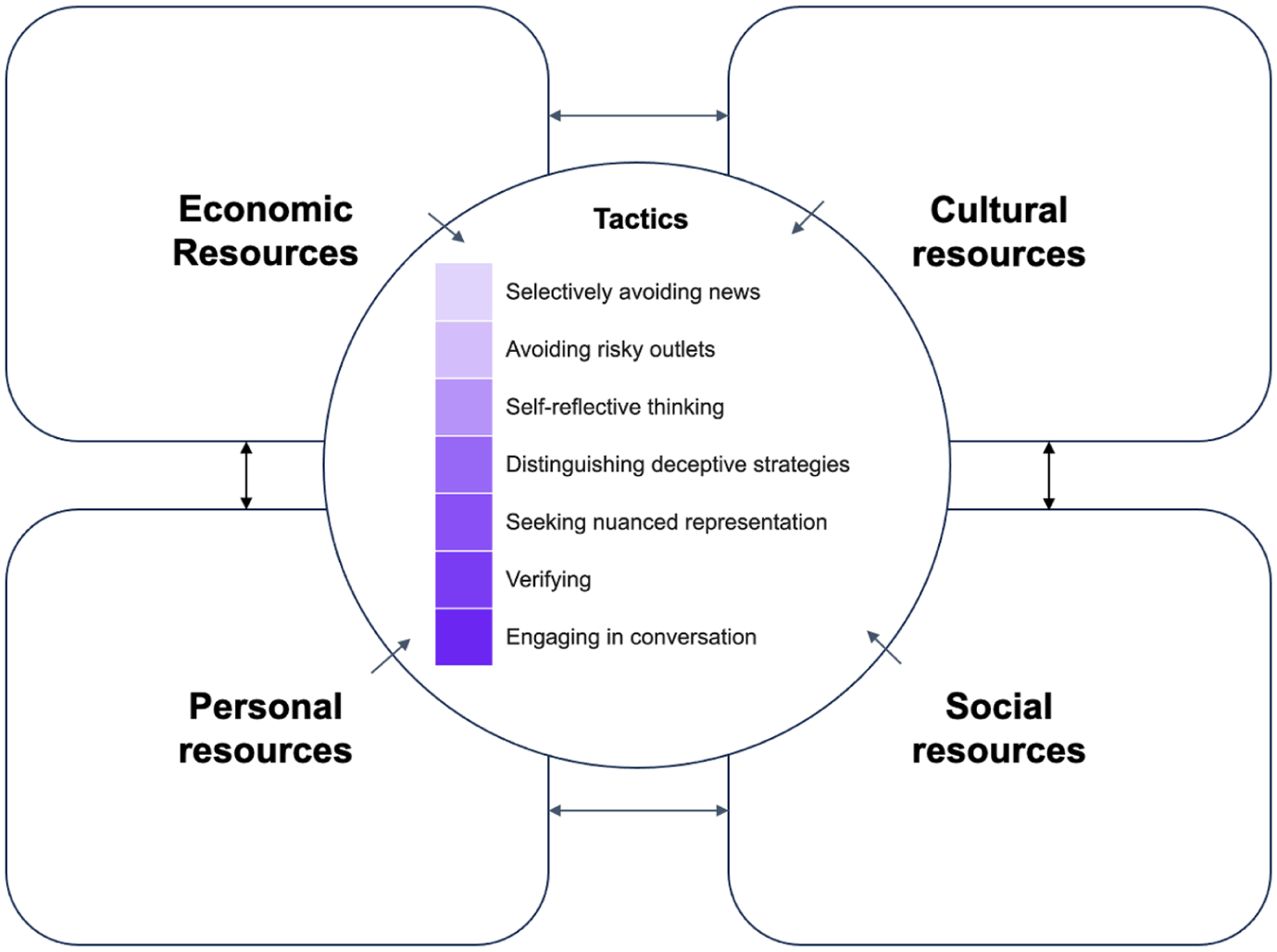
Interaction of young adults’ resources and tactics to navigate disinformation.
Economic resources
Research shows that socioeconomic resources influence educational trajectories and opportunities (Rouse and Barrow, 2006; Zimmermann and Seiler, 2019). Participants from higher socioeconomic backgrounds have or had access to higher education, while those with lower socioeconomic resources mostly complete(d) vocational education. The potential gravity of this for resilience to disinformation becomes apparent when comparing young adults’ educational backgrounds to their employed tactics.
Participants from higher-educated backgrounds refer to a broader range of tactics to navigate disinformation, including distinguishing between deceptive strategies, verifying information, and engaging in self-reflective thinking. They often trace their more explicit knowledge of using reliable sources, identifying framing, and critically questioning articles or claims to their schooling. For example, when asked about finding trustworthy information, Ellen and Lisa both refer to their education: Ellen (19, Netherlands): ‘So in that program, we’re really trained on evaluating and we have to do for every source an OPVL, so origin, purpose, value, and limitation. [. . .] So I think that got me automatically thinking about what is good, what isn’t’.
Lisa (20, Netherlands) also mentions that her high school ‘was really strict’, teaching her to ‘use proper websites’ and check sources and adding that ‘university makes it even better’ because they have ‘classes about it, too’. Both had the economic and educational resources to attend schools where they learned about verification and disinformation, and they continue to apply this knowledge. These resources may also explain the differences we found in algorithmic awareness, as described in the previous section, and its significance for disinformation. The most knowledgeable participants all have or had the financial and educational means to access technology and invest in their digital skills. Following the definition of resilience as a process of harnessing resources, these participants have more resources to draw on, supporting their resilience to disinformation.
Participants with fewer economic and educational resources have to rely more on other resources, such as their social environments, to develop their tactics and navigate disinformation. Mia (26, Germany) reflects on her vocational education, where she ‘didn’t have a single lesson at school’ that taught her ‘how to evaluate [her] sources’, which would have ‘immensely helped’. Instead, she is more dependent on her parents and friends to ‘try to inform each other about where to find information’. Not only does it require greater effort for her to remain informed at the level she desires, but she also needs to rely more heavily on her social resources. Kim (18, Netherlands) says in school, ‘the main thing about disinformation was like, ohh know your sources’, but nobody ‘ever really explained how’. Incidentally encountering content about disinformation from an educational ‘creator on TikTok’ proved more useful. It showed her not to trust ‘everything you see on the Internet’ and was an ‘eye-opener’. Their cases illustrate the structural barriers encountered by participants with limited resources as they build resilience to disinformation.
Notably, some participants who reported not having received literacy training still had a good understanding of disinformation-related issues. Displaying tacit knowledge based on intuition, personal experience, and observation (Polanyi, 1966), these participants explain clickbait, algorithms, and motivated reasoning without referring to them as such. In line with existing research (Swart and Broersma, 2022), these tacit forms of knowing, partly gained from experience, appear regularly in our data.
Cultural resources
These refer to the sociocultural groups that shape people’s identities and worldviews. Relying on educational levels and ethnic backgrounds as indicators of socioeconomic and cultural status (Scheerder et al., 2019), we analyzed patterns of trust. Highly educated, almost exclusively white young adults in our sample display higher trust in public media and governmental institutions, often sharing that they do not have a reason not to, or as Koen (25, Dutch) puts it: ‘there’s no big reason for them to fuck us all over’.
The opposite holds for participants with experiences of racial or economic discrimination, whose disillusionment and resulting distrust in public media and politics manifest threefold: steering them toward alternative sources of information (e.g. Facebook groups), refraining from actively informing themselves on matters of no immediate relevance to their lives, or only believing what they can see or experience themselves. Finn (29, Germany), for example, does not follow legacy media, considering them ‘fake’, ‘hyped up’, and showing only ‘what they want us to hear’. When asked where his doubt comes from, he refers to his Albanian roots, making him ‘disadvantaged from the outset’: If a foreigner has done something, then it’s amped up so much that you simply . . . then people form an opinion about such people through the television. [. . .] Nobody shows it on TV when, God forbid, a German rapes someone. [. . .] I don’t give a shit what people think of me, whether they tell me I’m trash or a stupid foreigner. I know that I’ve been paying my taxes for 15 years, I’ve been working for 15 years, I haven’t collected a cent from the state, I haven’t been unemployed for a day, and then I have to listen to shit like that, no.
His experiences of racism, misrepresentation in the media, the resulting distrust, and consequences for his resilience to disinformation are rooted in his cultural resources, the sociocultural group he is associated with. Following these patterns of disadvantage, (dis)trust, and their consequences may explain why, in our sample, distrust and conspiracy theory beliefs appeared more prominent in the accounts of people of color and participants with (second-generation) migration backgrounds, for example, from Russia, Egypt, and Kosovo. These differences in trust, shaped by cultural resources, ways of knowing and seeing the world, do not necessarily impact the choice but rather the interpretation of tactics used to navigate disinformation. Finn, for example, avoids and carefully navigates ‘risky’ outlets just like many of his peers. However, he regards mainstream media as unreliable or fake. Sophie (32, Netherlands) had similar experiences of discrimination and disappointment with authorities, which decreased her trust in the government and public broadcasting. Thus, when verifying and seeking nuanced representation during the pandemic, her efforts led to ‘alternative news’. Her open and inquisitive attitude, which we also observed in other participants, raised her interest in conspiracy theories. These cases, first, exemplify how tactics, including those learned through media literacy initiatives, have limited explanatory value when viewed separately from the sociocultural context. Second, they illustrate how cultural resources affect resilience to disinformation by shaping whom individuals recognize as credible.
In addition, we find accounts of multilingual participants who compare information from different countries when applying tactics such as verifying or seeking nuanced representation. Lukas (25, Germany), for example, follows news from German and English media outlets, and Amelia (25, Germany) has compared narratives in German versus Russian media. Having more (cultural) resources to draw on when navigating and evaluating information benefits their resilience to disinformation.
Social resources
Social resources comprise the networks from which individuals can draw support and knowledge. Participants name peers, family, and co-workers as important sources of information. Consequently, young adults’ social resources are decisive for the type of information and expertise they have access to. For example, what participants regard as trustworthy, quality content is, in most cases, guided by value judgments from their parents, school, or peers. This influences, among others, the interpretation and outcome of applying tactics such as ‘avoiding risky outlets’ and ‘verifying’. Participants with higher economic resources and higher education also tended to have more social resources and access to relevant expertise, contributing to their resilience to disinformation. For Lisa and Ellen, who learned about verification in school and have close relatives in science and journalism, navigating (dis)information during the pandemic was easier. Lisa ‘just asked’ her father, a medical researcher, while Ellen turned to the public broadcaster where her uncle worked.
We also find inter-relationships with cultural resources. Participants with culturally diverse networks place greater value on ‘seeking nuanced representation’. We assume that, by being aware of and accustomed to diverse perspectives, these participants are more likely to seek them when evaluating information. Lukas (25, Germany), for example, explains how he developed a pluralistic outlook and the ability to embrace ambiguity through his job, which involves facilitating discussions among people from diverse ethnic, religious, and political backgrounds. He states that it is important ‘to have people around who disagree with [him] [. . .] because that’s the only way to keep other opinions human’. Lukas’ case illustrates how the choice and preference of tactics to navigate disinformation, in this case ‘seeking nuanced representation’, emerge in relation to social resources.
The inclination to engage with diverse viewpoints, also known as discussion heterogeneity, has been associated with lower disinformation beliefs (Su, 2021). Since disinformation, particularly conspiracy theories, tends to offer simpler explanations, capitalizes on motivated reasoning, and thrives in echo chambers (Bowyer and Kahne, 2019; Tumber and Waisbord, 2021), discussion heterogeneity can be an antidote. Our data suggest it is fostered and reinforced through social resources. Thus, social resources can translate into resilience to disinformation by facilitating access to expertise and (willingness to engage with) diverse viewpoints.
Personal resources
For this section, we investigate the resources participants draw from within themselves that facilitate their employed tactics and potentially increase their resilience to disinformation. For example, ‘engaging in conversation’ when encountering disinformation and exploring motivations behind beliefs can benefit both participants and their environments. However, not all ‘have energy to discuss’ (Frieda, 25, Germany). Whether this tactic is experienced as draining and is applied depends on the situation, but also on how the young adults experience opposing opinions. Participants who describe it as ‘extremely unpleasant’, making them feel ‘angry’ or ‘a bit tired’, rely less on this tactic than those who find it ‘fun’ and ‘interesting’. This illustrates how young adults’ mindset, which in turn is shaped by their sociocultural background and resources, can determine the cost and value of investing (personal) resources to counter disinformation, potentially impacting resilience more on a societal than personal level.
As outlined earlier, many participants are overwhelmed and unsure of what to believe. However, some participants feel less afflicted or cope well with these feelings. While they differ in background, access to resources, and information intake, they all exhibit a degree of confidence in their ability to navigate disinformation. Acknowledging that they ‘can never fully escape’ it (Lisa, 20, Netherlands), they perceive themselves as ‘competent enough’ (Elias, 19, Germany) to filter ‘what information is relevant’ (Anna, 22, Netherlands) and build their ‘own opinion’ (Noah, 29, Germany).
Our results affirm existing quantitative evidence on the potential of self-efficacy for increasing resilience to disinformation (Zhu et al., 2025). Participants who believe they can cope are more open to learning about and employing constructive tactics to navigate disinformation. Perceived impossibility, on the other hand, leads to paralysis and avoidance, as also shown in existing research (Edgerly, 2022). While our findings point to self-efficacy as beneficial, it does not automatically translate to resilience. Three young adults who handle uncertainty and overwhelm well admit to believing in conventionally labeled conspiracy theories. Once more, our data demonstrates the pitfall of basing assumptions about resilience to disinformation on singular factors.
Discussion and conclusion
Highlighting the underlying structures affecting behavior, our study offers a structural and contextual perspective to the over-individualized debate on resilience to disinformation, which mainly focuses on literacies and places responsibility on the individual. Drawing on rich interview data, we outline how participants employ and interpret tactics to navigate disinformation in light of their daily media practices, environments, lived experiences, and beliefs. By providing an inductive, multi-level conceptualization of resilience to disinformation that highlights the influence of resources, we contribute to theory and complement existing quantitative research on the role of structural contexts (Humprecht et al., 2020; Zhu et al., 2025). This also allows for more nuanced explanations of common questions in the field, such as why (media literacy) tactics do not always lead to resilience.
The taxonomy of tactics we present is an inductively developed repertoire of how people navigate disinformation in their daily life, extending existing normative understandings of what they should do. It demonstrates different levels of engagement and agency, from efforts to verify information to more subtle behavior, such as reflective thinking or coping through selective news avoidance. While analytically distinct, in real-world contexts these tactics are likely enacted as part of a continuous, pragmatic, habitual, and often tacit process of judgment rather than as explicit, deliberative decisions. We did not find differences between national contexts. However, our results indicate that young adults’ backgrounds and resources profoundly shape their approach and employed tactics, suggesting transnational mechanisms in how resilience to disinformation develops. First, social resources manifesting through personal networks prove vital for participants’ access to information and expertise. Second, young adults with higher economic resources receive(d) higher education and employ a larger range of tactics for navigating disinformation. This discrepancy in coping mechanisms aligns with prior research on digital inequalities (Scheerder et al., 2019). Third, we find patterns connecting cultural and socioeconomic backgrounds to trust in political and journalistic institutions, confirming prior research (Daas et al., 2023; Jaiswal et al., 2020). Whether this trust benefits people’s resilience to disinformation depends on the political context and the quality of the democratic institutions, but who or what participants regard as trustworthy certainly influences their interpretation of tactics such as ‘verifying’ and the outcomes of their efforts. This exemplifies how context-dependent and ambivalent tactics are in their potential and how employing the same (media literate) tactics can result in vastly different outcomes. The findings provide another possible explanation for inconsistent results on the effectiveness of literacy interventions for increasing resilience to disinformation (Jones-Jang et al., 2021).
Most concerningly, our research shows how structural inequalities resulting in limited resources can negatively impact the development of resilience to disinformation. In line with the corresponding fields model (Helsper, 2012), we find that resources interact and reinforce each other. Young adults with more economic resources often also have higher social resources and education, manifesting in, for example, access to expertise, benefiting the development of tactics and knowledge to navigate disinformation. Having more resources to draw from benefits their process of building resilience to disinformation. On the other end of the spectrum, young adults face a combination of barriers. For example, participants with fewer economic and cultural resources have less access to high-quality journalism, paired with distrust in democratic institutions due to experiences of racial or economic discrimination. While also observing established media outlets, they seek alternative sources of information, such as (closed) social media groups, where they encounter counter-narratives, including but not limited to conspiracy theories. Alternative media use, as such, has been linked to increased disinformation endorsement (Humprecht et al., 2023). These participants display agency and resilience in various forms, but a systemically rooted lack of resources impacts their efforts to build resilience to disinformation.
Notably, resources may vary with context. For example, a person might have more resources to navigate disinformation about one topic due to their social environment, personal interests, or expertise, and fewer for others. Nevertheless, the mechanisms through which resources shape tactics and approaches to disinformation likely operate similarly. Policies and interventions to increase resilience to disinformation need to consider these dynamics and address structural issues. In other words, ‘historical, structural, and political inequality—and especially race, ethnicity, and social differences—needs to be at the forefront of our understanding of politics and, indeed, disinformation’ (Lenoir and Anderson, 2023: 10).
Existing literacy models and initiatives may benefit from our findings on the role of self-efficacy. This personal resource can promote the development of tactics for navigating disinformation. It has been proven crucial for performance and success in tasks, independent of skills, and beneficial for behavior change, especially when combined with perceived vulnerability to a threat (Bandura, 1997; Strecher et al., 1985). Instead of mainly emphasizing the dangers of disinformation, which may cause adverse effects (Hameleers, 2023; Swart and Broersma, 2022), we recommend a setup that fosters confidence in addressing disinformation challenges.
While our interviews prompted in-depth reflection on experiences with disinformation, some implicit tactics to navigate disinformation might not have surfaced. This may be the case when participants were unknowingly exposed to disinformation, had trouble remembering, or acted unconsciously. It should also be noted that the study findings are not statistically generalizable, but may offer transferable insights into how resilience to disinformation develops in interaction with available resources.
Future quantitative research can utilize our inductive data and taxonomy for more representative results, as larger-scale research is required to support our findings. It would be particularly insightful to understand how resources and tactics are utilized and shape people’s resilience to disinformation in countries with different political and media landscapes. What also remains underexplored is the affective component of resilience (Kont et al., 2026). Given the amount of information young adults have to process within a limited time, affective drivers may be crucial for forming beliefs, trust, and actions. In general, the undercurrents of resilience to disinformation have received little attention thus far. Based on in-depth interview data, this study captures the complexities of how people navigate and build resilience to disinformation in their daily lives and helps uncover the subtle yet critical undertones of the subject.
Footnotes
Acknowledgements
We thank Cor Schoonbeek from the Hanze University of Applied Sciences for his support during the data collection process and Dr. Ansgard Heinrich, Emillie de Keulenaar, Jim Kroezen, Marije Miedema, Dr. Welmoed Wagenaar, Maud Rebergen, and Dr. Alexander Smit from the University of Groningen for their sharp observations.

Ethical considerations
This research was approved by the Research Ethics Committee (CETO) of the Faculty of Arts, University of Groningen [CETO ID 91926630].
Consent to participate
Written informed consent to participate in this study was obtained from all participants prior to data collection.
Funding
The authors disclosed receipt of the following financial support for the research, authorship, and/or publication of this article: This research was funded by the Hanze University of Applied Sciences, the University of Groningen, and the Dutch Research Council (HAICu Grant No. NWA.1518.22.105).
Declaration of conflicting interests
The authors declared no potential conflicts of interest with respect to the research, authorship, and/or publication of this article.
Data availability statement
The data that support the findings of this study are not publicly available due to privacy restrictions but are available from the corresponding author upon reasonable request.