



Abstract
Meetings differ from ordinary conversation in that they have an agenda that specifies in advance the topics to be addressed during the meeting. However, the introduction of these topics needs to be locally accomplished and recognized by the participants as agenda items. This article presents some characteristic practices used for introducing agenda-based topics. It shows that they rely on the known-in-advance status of the items, and are presented by the chair as unilateral announcements. They exploit and invoke the written agenda in several ways. The announcements are often short phrasal constructions, just citing the written title of the agenda point. Furthermore, a gaze down at the written document is used as a public display that the introduction is related to the agenda. In contrast to this practice of introducing agenda items, topics not specified by the agenda are introduced by suggestions and questions that present the introduction as contingent on acceptance by the co-participants. The analysis sheds light on the ways in which institutional talk-in-interaction is permeated by the formulations and logic of written documents.
Introduction
Topics introduced in meetings are most often planned in advance by being included in the meeting agenda and made available to the participants prior to or at the beginning of the meeting (see Asmuß and Svennevig, 2009; Boden, 1994). As such, the agenda provides the participants with a ‘template’ for the topics to be addressed and the activities to engage in during the meeting. This provides for the topics a known-in-advance status as businesss-at-hand, as noted by Button and Casey (1988/1989). Such topics have a special status for participants in that they may be introduced by reference to this pre-established scheduling. In their words:
[. . .] the problem of providing for the warranted and legitimate initiation of talk on business-at-hand is solved by achieving for it a known-in-advance status which is then invoked and traded in at locally organised junctures within the talk. (Button and Casey, 1988/1989: 87)
However, the scheduling of a topic does not determine its deployment in the meeting in itself. The agenda has to be invoked and attended to by the participants in local turns at talk, and thus, topic progression is also a matter of local and contingent emergence (see Button and Casey, 1988/1989).
The emergent character of meeting structure has been noted by other researchers as well. An early study by Atkinson et al. (1978) showed how a meeting was recommenced by local initiatives taken by the participants. Deppermann et al. (2010) show in a similar vein how meeting participants negotiate a break in the middle of a meeting by means of local initiatives, in spite of the fact that the pause had been explicitly scheduled for later by the meeting chair.
It will primarily be the chair who has the responsibility to invoke and attend to the agenda (Pomerantz and Denvir, 2009), but also other meeting participants will in various ways display an orientation to the normative requirement of ‘sticking to the agenda’. These different practices for showing an orientation to the meeting agenda in initiating new topics is the focus of analysis in this article.
The data come from two corpora of videotaped business meetings. The first is a corpus of management meetings in international subsidiaries of a large Norwegian manufacturing company, located in Dubai, Malaysia and Spain. The participants are Norwegian ex-pats in senior executive positions and locally employed middle managers, and they use English as their working language (see Svennevig, 2011). The second is a collection of various management and team meetings in an inter-Scandinavian bank, held in various locations in Scandinavia. The data were collected as part of a research project on internal communication in newly merged corporations, carried out at the Helsinki School of Economics (for more details, see Charles, 2007; Kangasharju, 2007). Most of these meetings are conducted in lingua franca English, whereas some are national team meetings conducted in a Scandinavian language.
Introducing the agenda
One way agendas are made interactionally relevant is by being introduced or summarized in the introductory part of a meeting. In the following excerpt, the manager of an IT section introduces the agenda in the following way:
(1) Team meeting in bank, Norway

By presenting the main items on the agenda, the chair creates a common frame of reference and a ‘known-in-advance’ state of the topics to be addressed in the meeting. The agenda is presented both with reference to content of the items, such as sales and customer communication (l. 3), and the type of communicative activity involved in the agenda point, such as reporting (l. 2) and planning (l. 5).
Having presented the plan for the meeting one would perhaps expect the following talk to follow this plan. However, the first thing the chair does is to deviate from the agenda, as can be seen from the continuation of the extract:
(2) Team meeting in bank, Norway
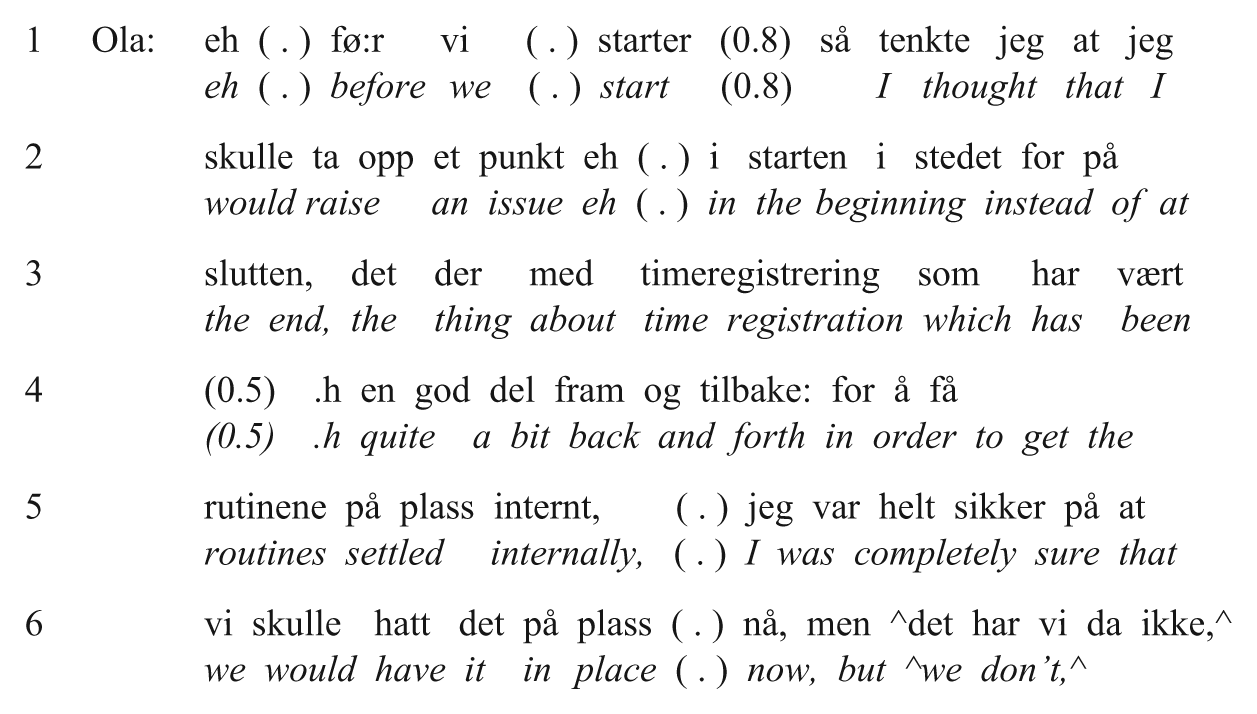
This extract also shows the participants’ orientation to the agenda as both normative and at the same time flexible. The first thing the chair does after having presented the agenda is to depart from it. In this way, the excerpt shows that the topic is not determined solely by the agenda, but also by local initiatives by the participants. However, the way this topic is introduced also displays the speaker’s orientation to the normative character of the agenda. In introducing a topic outside the agenda, he comments on the fact that it is ‘misplaced’, being otherwise considered as belonging ‘at the end’ (l. 3), probably referring to the final agenda item, ‘miscellaneous’. Furthermore, he says something that might serve as an account for why he chooses to introduce it here anyway, namely the fact that there has been ‘quite a bit back and forth’ (l. 4), implying that it is an issue associated with a certain controversy or confusion, and thus potentially requiring an extraordinary treatment outside the designated slot on the agenda (which is considered a slot for low priority issues, given that time constraints often limits the room for discussion of matters raised there). It might also be noted that the introduction is made in a hypothetical manner: ‘I thought that I would raise an issue’ (ll. 1–2), thus treating the actual realization of it as contingent upon acceptance by his co-participants.
Introducing new topics by invoking the agenda
When agenda items are introduced as new topics in the conversation, the speaker will recurrently present them by invoking the agenda in various ways. We will here start by looking at some such practices.
Continuing to look at the meeting analysed above, we will consider how the first regular agenda item is introduced. When the issue of time registration has been dealt with and brought to a potential conclusion (by presenting a plan for solving the problem of time registration), the chair introduces the first item on the agenda in the following way:
(3) Team meeting in bank, Norway
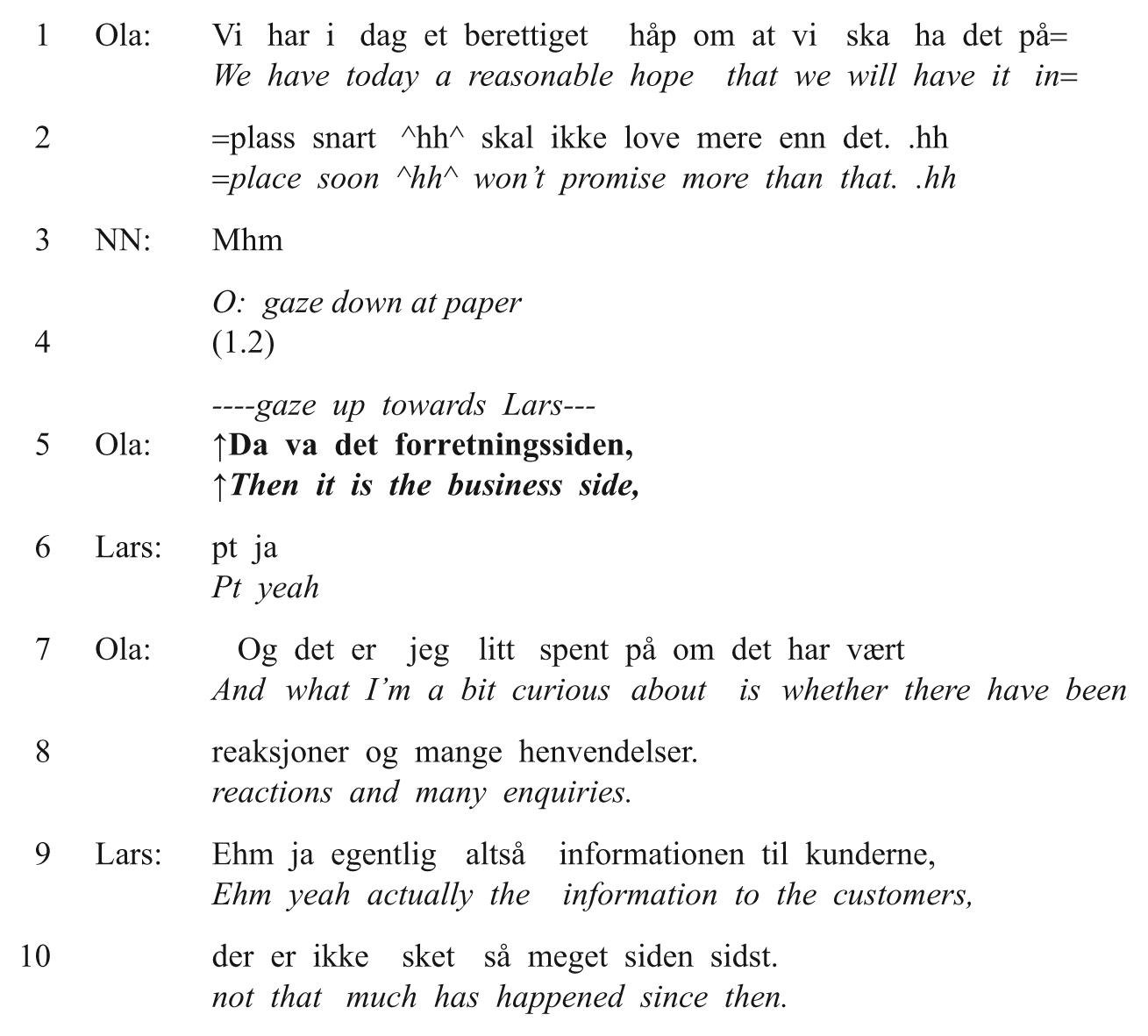
Before introducing the next topic, the chair looks down at the paper lying in front of him for more than a second (l. 4). The ensuing pause contributes to marking the topic transition (Maynard, 1980) and furthermore draws attention to the chair’s activity of consulting the agenda. In the following topic introduction (l. 5), the chair’s reference to the temporal progression (‘then’) indicates an orientation to the planned character of the talk and thus indexes the agenda-bound character of the upcoming topic. The introduction of the topic is ‘elliptical’ if compared to the original formulation of the agenda item in the introduction (‘a report from the business side, and customer communication’), yet it uses an identical term (business side), which is appropriate for referring back to the agenda. It is thus not merely that an agenda item is being introduced, but that it is being introduced in a way that makes it recognizable as an agenda item.
We can also note how the introduction of the topic contributes to addressing a participant in the meeting and selecting him as the next speaker. Ola turns his gaze towards Lars while introducing the topic, but in addition, the content of the announcement constitutes a tacit form of addressing in that it limits the number of eligible responders to the person in charge of this area (see Lerner, 2003). Lars displays his readiness to respond by immediately producing an acknowledgement token (l. 6).
A practice that invokes the agenda in an even more explicit fashion is introducing the new topic with metacomments that refer to the agenda. Here is an example:
(4) Management meeting in bank, Sweden

The previous topic is here closed by the chair performing several non-verbal displays of closure, such as tapping the table with his pen (l. 5) and performing a hand movement that constitutes a classic case of an open hand prone gesture (l. 7), a gesture family conventionally associated with termination (Kendon, 2004). Finally, he pronounces the word ‘okay’ with rising intonation (l. 8), which is also a conventional topic boundary marker (Barske, 2009). By producing all these closing markers, the chair prepares the co-participants for the introduction of a new topic. The topic shift is then made by the reference to ‘next item’ (l. 8), which refers to the order of the agenda items. This constitutes a metacommunicative comment in that it refers to the talk they are about to engage in (conveying something like ‘next item we will discuss’).
It is also interesting that the announcement is not made by means of a full clause including a finite verb, but by two juxtaposed noun phrases – first, the number and the type of feature (‘next item’) and then, after a pause, the actual instance of it (‘stock options scheme’). This formulation may be associated with a conventional format for reading items from a list (and thus for reproducing orally written material without clause structure). This format is, for example, also observable when train conductors announce the next station (‘Next station – Sandvika’) or when sports commentators read football match results (‘Arsenal Liverpool – Two one’). Thus, by the fact that the agenda actually has the form of a list, the format of the topic announcement implicitly invokes the agenda also by instantiating the activity of reading items from a list.
A more implicit way of referring to the agenda is by simply pronouncing the title of the agenda item, thereby announcing the next topic in the form of a ‘headline’.
(5) Management meeting in bank, Sweden

After a recognizable topic closing assessment (ll. 1–2) and an extended pause (l. 3), the chair of the meeting here introduces a new topic by simply announcing the title of the agenda item in an independent intonation unit (‘HR HR Sweden’). 1 He does not use a clause to introduce the item, but just a free-standing noun phrase. Neither does he do anything else to present the new topic to the interlocutors, such as giving background information or making metacomments about the topic to be addressed. Instead he immediately goes into a presentation of the substance of the business at hand, displaying an expectation that the other participants are sufficiently informed about the topic shift and the new topical item introduced.
The fact that this short and rather ‘elliptical’ way of introducing the topic works without any signs of trouble may indicate that it is a conventional practice for introducing certain types of agenda items (Nikko, 2009). This is supported by the fact that this type of topic announcement is common in the data. A compelling example of the routine character of this introduction format can be found a bit later in the same meeting. As can be seen, Göran’s new topic is aborted quite early when he notices Arto’s raised hand (line 5), constituting a bid for a turn (Ford, 2008). Arto wants to add something concerning the previous topic and they return to this topic for a while. When this has been dealt with, the relevance of re-initiating the new topic is actualized. And interestingly, Göran uses exactly the same format this time:
(6) Management meeting in bank, Sweden

After producing a ‘right hand parenthesis marker’ (Schegloff, 2007: 98) – ‘anyhow’ – with markedly raised pitch and volume, and subsequently a topic boundary marker ‘okay’, Göran reintroduces the topic of human resources. This is done by means of exactly the same format as the last time.
In the cases analysed above, the chair himself pursues the topic. But the same format may also be used when another speaker is nominated as the first speaker on the subject. The next extract is from the same meeting as (1), where a ‘status report’ was announced as an agenda item. In the current extract, the chair is going around the table to get status reports from the different sections:
(7) Team meeting in bank, Norway

The status reports concern the progress of an IT project and ‘ProMatch’ refers to a software program being implemented by Arne’s section. The chair’s announcement of this brand name (l. 4) is merely followed by an address term, while he turns his gaze from the screen at the end of the table towards Arne. Arne does not display any trouble understanding the topic nomination, the speaker selection or the activity being introduced; he simply starts reporting. The activity of reporting on the progress is predictable here to a certain extent, due to the fact that the chair is taking a ‘round’ of status reports. And the bare announcement of a topic by means of a title is most frequent and typical when the activity engaged in is repetitive in this way. The short form thus indexes the routine and repetitive character of each new item introduced.
The form of the topic introductions seems to be highly conventionalized. The conventional character is evidenced by a deviant case, where the announcement is not followed by topic elaboration by the participant in charge. The chair here requests a report about the progress of a project for implementing a new technology for tinting paint (referred to as ‘MCI tinting test’):
(8) Management meeting in manufacturing company, Malaysia

The topic introduction is first made as an independent announcement of the agenda item, but after a short pause Nils adds some background information about the time elapsed since the testing project was launched. A long pause ensues (ll. 4–6), in which only brief, soft laughter from an unidentified participant is hearable. Nils’s subsequent prompt in line 7 specifies the nature of the request as a request for ‘news’. Yet another elongated pause occurs before Nils displays his interpretation of this lack of uptake, namely as indicating trouble with the progress of the testing (l. 10). Nils does not explicitly select a next speaker, and, as transpires from the following talk (not shown here), two meeting participants present are both involved in the project. Thus, one might suspect that they are expecting the other to both take the floor and give the report (for a more extensive analysis of this extract, see Svennevig, 2011). But the important thing for us to note here is that Nils does not treat the lack of uptake as related to the comprehensibility of the topic introduction, but merely as a problem of producing a (preferred) response. The topic introduction is thus not treated as ambiguous, incomplete or problematic in itself.
Gaze and gesture in topic announcements
Invoking the agenda is not just performed verbally, but crucially involves gaze and gesture. This is especially clear in the following extract:
(9) Management meeting in manufacturing company, Dubai

The question to Vijay is recognizably a part of a topic closing sequence, where the participants make arrangements for follow-up actions. During Vijay’s answer Jon withdraws his gaze and looks down towards a paper that he holds lifted from the table, and also keeps it there during the ensuing elongated pause (l. 3; see Figure 1). As he introduces the next agenda item in line 4 (again in the form of a title announcement), he lifts his gaze and looks around the table. After a short pause he fixes his gaze on Raoul and addresses him by name (l. 8). Raoul starts reporting about the progress of the installation of the software Lotus Notes in various branches of the company. Jon’s holding the paper and gazing down at it here contributes to displaying the return to the agenda and to understanding the topic introduction as the reproduction of a written agenda item.

Jon looking down at paper
Gesture is also involved in this topic introduction. As the chair says Raoul (line 8), he lifts his hand, holding the sheet of paper, slightly in his direction (see Figure 2). This is a way of performing a pointing gesture, further contributing to appointing Raoul as the next speaker (Kendon, 2004).

Jon lifting paper towards Raoul
The introduction of non-agenda-based topics
The practices reviewed above display an orientation to the agenda as a necessary and sufficient warrant for introducing a topic. For the meeting chair, the agenda provides the legitimacy of starting to talk on a new topic at a given juncture in the meeting, and for the remaining participants it provides for the intelligibility of the topic introductions, given their often short and inexplicit formulations. The procedural consequentiality of the participants’ orientation to the agenda becomes clear if we compare it with topic introductions that do not address some item of business-at-hand.
Topic introductions in ordinary conversation generally take a very different form. Fundamentally, they involve contributions by both parties, so that the topic is established in an interactional process. Topic proffering sequences are based on questions that give the interlocutor the opportunity to accept the topical bid, for instance by producing an expanded response, or decline it, for instance by producing a negative or minimal answer (Schegloff, 2007). Even more self-oriented topics, such as news announcements, are introduced in a more interactional way. News announcements are typically presented as compressed and incomplete reports, constituted by a ‘headline’ presenting a piece of news as available to be told (Button and Casey, 1985). The floor is then handed over to the interlocutor, who thereby gets the opportunity to give the news announcer a green or red light for expanding the news delivery. These practices have in common that the appropriateness and legitimacy of initiating talk on a topic is locally and interactionally established on a turn-by-turn basis by the participants involved.
That the specific form of topic introductions is related to the agenda, and not just a general feature of meeting interaction, can be demonstrated by considering how the meeting participants introduce topics that are not based on the agenda. As noted, some topics are introduced as local and emergent initiatives taken by the chair or other participants. In (2) we have already considered one such instance, when the chair introduced a topic outside of the agenda using the words: ‘I thought I would raise an issue.’ As we see, this type of topic introduction takes a very different form, presenting the topic as hypothetical and contingent on acceptance by the co-participants.
In the next fragment, the chair proposes to address an agenda item that is scheduled for later:
(10) Management meeting in bank, Sweden

The agenda item is introduced by the chair, and it is referred to as a known-in-advance item (‘the matter of management salary increases’), but still, the introduction takes the form of a request or a suggestion to introduce it rather than as an announcement. The reason is, as is explicitly indicated, that it is literally misplaced, having been scheduled for later.
Interestingly, this topic introduction is interrupted by another participant, who introduces a question related to the prior topic (a strike among a group of employees). This introduction takes the form of a metacommunicative preface announcing the wish to raise an issue. It is furthermore mitigated by the word ‘only’, which is probably intended as the hedge ‘just’. 2 This corresponds quite closely to the other instance of the introduction of a misplaced topic introduction, namely extract (5), where Arto says: ‘I I only wanted to to add that . . .’. These examples are both attempts to reopen a topic that is potentially closed by the fact that the chair has proceeded to introduce a new topic. Thus, topics introduced as not in accordance with the agenda take forms that are tentative and are presented as contingent on acceptance by the interlocutors. They include metacommunicative prefaces, requests for permission and hypothetical constructions. The practice of seeking acceptance from the interlocutors makes these instances more like topic introductions in everyday (non-institutional) conversation.
As we have seen, introductions of agenda items do not include such processes of negotiation. The chairs do not seek co-participants’ acceptance of initiating talk on the topic, but merely invoke the agenda as a sufficient warrant for introducing it. Sometimes the topic introduction involves the chairs themselves as first speaker (as in [6] above), and in these cases they start speaking on the topic without any conferring with their interlocutors. In other cases another participant is appointed as the first speaker (as in [7] and [9] above), and even in these cases the topic may be announced without any checking whether the person involved is prepared to address it or has the sufficient knowledge to give an account. The legitimacy of both the topic and the participants’ obligation to address it are thus taken for granted by their common access to the pre-formulated agenda.
Discussion
The analysis has identified some characteristic features of a class of topic introductions that address an agenda item. First, they take the form of unilateral announcements by the chair rather than proposals presented for the interlocutors to accept or decline. Second, they invoke the agenda in more or less explicit ways. In some cases the chairs explicitly refer to the agenda and the progress of the meeting relative to the schedule, whereas in others they invoke the agenda more implicitly by reproducing formulations contained in it. Gaze and gesture are also used to index the reliance on a written document. Third, the known-in-advance status of the topics is exploited in that the topic introductions are short and ‘elliptical’, frequently taking the form of a simple announcement of a ‘headline’ or title.
The short announcements of agenda titles are typical and characteristic of meetings as a specific institutional genre. Furthermore, they seem to be associated with rounds of reports or status updates, thereby indexing also a specific activity type characteristic of meeting interaction. It may be tempting to characterize this type of topic introduction as a purely institutional practice. However, Button and Casey (1988/1989) show that pre-scheduled topics constituting business-at-hand may also be present in ordinary conversation, for instance in the presentation of a reason-for-call or in informal ‘scheduling’ of a topic for later in the conversation. Thus, the reference to some piece of business-at-hand as a warrant for topic introduction may be a generic practice usable in many different types of talk-in-interaction.
Although the practice of scheduling topics may not be specific to meeting interaction, the form they take is clearly so. It seems to be based both on a practice of reading the headline of an agenda item, and on a practice associated with written communication, namely the use of titles. This practice may thus have features in common with other types of institutional genres that are based on a written schedule, such as for instance televised news programmes, where the news announcer may announce a transition to a different section of the programme (‘and now sports’). The characteristic elliptical form of the introductions is not to be considered as just a more or less automatic consequence of the written formulation on the agenda. It is also a constitutive feature of the oral, interactional practice of introducing new agenda items in meetings, and as such it has the function of legitimizing the topic introduction and displaying to the participants that the meeting is progressing ‘on schedule’.
The practice investigated here thus does not just deal with spoken interaction between meeting participants, but also with the interplay between written documents and talk- in-interaction. Institutional activities are frequently carried out by reference to written guidelines, regulations, templates, etc. and are thereby permeated by the logic and style of these written materials. However, the relationship between such documents and the day-to-day actions and conversations is seldom analyzed in its own right. As noted by Whalen et al. (2009: 44):
[. . .] we insist on recognizing and analyzing the documentary materials or textual phenomena not for their uses per se or even, as some researchers would have it, for how their sense may be constituted in a course of reading, but for how they enter into and are integral to the organization of sequences of action and thus to the constituting of the relations of organizational and institutional life.
The current study contributes to such an objective by starting to uncover the organizing qualities of a specific type of organizational document and its relationship to a form of institutional practice. It shows the constitutional work that the agenda does, how it ‘makes things work’. In this sense, the agenda constitutes both a constraint and a resource for action. It constrains the participants by making them accountable for introducing and developing topics in accordance with the topics specified in the agenda (and thereby for marking deviations from it as misplaced or potentially illegitimate). On the other hand, it constitutes a resource for the chair in providing an authoritative basis for introducing new topics and thereby managing the topic progression of the meeting.
Footnotes
Acknowledgements
This article has profited from valuable comments and suggestions by Birte Asmuß, Trini Stickle, Olga Djordjilovic and an anonymous reviewer. Thanks also to Helena Kangasharju for letting me use the Helsinki corpus of meeting interaction.