



Abstract
This study pragmatically makes a descriptive analysis of metadiscourse in academic lectures from the perspective of the relevance-adaptation theory. Based on the relevance theory and the adaptation theory, the relevance-adaptation model is constructed to explore the occurrence, the pragmatic description and the role of metadiscourse in academic lectures. The data is collected from George Lakoff’s 10 academic lectures on cognitive linguistics at Beijing University of Aeronautics and Astronautics in 2004 and some academic lectures audio-taped in classrooms. The results of the study show that 1) the occurrence of metadiscourse in academic lectures is pervasive; 2) the process of choosing appropriate metadiscourse is dynamic and the result of searching for relevance and making contextual adaptations – the process of searching for relevance of metadiscourse is measured in terms of three pairs of the distinctions, namely, contextual effect and processing effort, explicature and implicature, and conceptual meaning and procedural meaning, and contextual adaptations of metadiscourse are constrained by such factors as linguistic reality, psychological motivations and social conventions; 3) the role of metadiscourse in academic lectures is an active discourse constructor.
Introduction
Metadiscourse is defined as the linguistic resources used to organise a discourse or the writer’s stance towards either its content or the reader (Hyland, 2000: 109). It is used as a general term to include a heterogeneous array of cohesive and interpersonal features which help to relate a text to its context by assigning readers to connect, organise and interpret material in a way preferred by the writer and with regard to the understandings and values of a particular discourse community (Hyland, 1998). While some researchers have narrowed the focus of metadiscourse to the features of textual organization (Bunton, 1999; Mauranen, 1993a, 1993b; Valero-Garces, 1996) or explicit illocutionary predicates (Beauvais, 1989), metadiscourse is more generally seen as the author’s linguistic and rhetorical manifestation in the text in order to ‘bracket the discourse organization and the expressive implications of what is being said’ (Schiffrin, 1980: 231).
With the judicious addition of metadiscourse, the writer can not only transform a dry, difficult text into a coherent, reader-friendly prose, but also relate it to a given context and convey his/her personality, credibility, reader-sensitivity and relationship to the message (Hyland, 2000). Metadiscourse is therefore a functional category and can be realized through a range of linguistic units, from exclamatory punctuation and scare quotes in (1), to whole clauses in (2), and even sequences of several sentences in (3): (1) I admit that the term ‘ (2) (3)
These varied functional realisations of metadiscourse mean that there are no simple linguistic criteria for identifying it. Metadiscourse is an open category to which new items can be added to fit the writer’s needs, and the same items function as metadiscourse in some parts of the text and do not function as metadiscourse in other parts of the text. Generally, metadiscourse is argued to have two functions: textual and interpersonal. The first kind is to organise the discourse by pointing out topic shift, signaling sequences, crossing references, connecting ideas and previewing materials. The second kind is to modify and highlight interpersonal aspects of the text and give the writer’s attitude to the text with hedges, boosters, self-reference and features of evaluation (Hunston and Thompson, 2001) or appraisal (Martin, 2001). Broad functions can also be divided into more specific functions through which the writer regulates the ongoing interaction and helps to make the text comprehensible to a particular readership.
Metadiscourse has been a concern in a range of previous studies in text analysis. These studies have informed literature on the properties of texts, participant interactions, historical linguistics, cross-cultural variations and writing pedagogy. They have suggested the importance of metadiscourse in casual conversation (Schiffrin, 1980), in school text books (Crismore, 1989), in science popularizations (Crismore and Farnsworth, 1990), in undergraduate text books (Hyland, 2000), in postgraduate dissertations (Bunton, 1999; Swales, 1990) and in Darwin’s Origin of Species (Crismore and Fansworth, 1989). Metadiscourse has also appeared to be a characteristic of a range of languages and genres and has been used to investigate rhetorical differences in the texts written by different cultural groups (Crismore et al., 1993; Mauranen, 1993b; Valero-Garces, 1996). It has been shown to be a quality of scientific discourse from the late 17th century (Atkinson, 1999), to be a feature of English as a Second Language (ESL) and native speaker student writing (Cheng and Steffensen, 1996; Intraprawat and Steffensen, 1995) and to be an essential element of persuasive and argumentative discourse (Crismore and Farnsworth, 1990; Hyland, 1998).
Although these studies on metadiscourse have focused their attention on written texts in terms of its linguistic and rhetorical functions, few of them have dealt with metadiscourse in oral communication, especially in academic lectures, and even fewer of them have treated metadiscourse in academic lectures from the perspective of pragmatics. These studies can offer neither a satisfactory account of why metadiscourse is used and how it works in utterance production as well as in utterance interpretation, nor a suitable explanation of the internal mechanisms underlying the occurrence and the role of metadiscourse in academic lectures. Therefore a study is needed to explore the occurrence and the role of metadiscourse in academic lectures and to provide a relatively systematic theoretical description of metadiscourse from the perspective of pragmatics, particularly from the perspective of the relevance-adaptation model in order to further our understanding of its nature in academic lectures.
Previous research on written and spoken academic metadiscourse
Previous studies on academic metadiscourse have been made in different fields. One of these fields is the models of academic metadiscourse. Thompson (2001) studies an academic metadiscourse model in terms of interaction. He argues that interaction can draw on both interactive and interactional resources. Interactive resources help to guide the reader through the text, while interactional resources involve the reader collaboratively in the development of the text. Hyland’s model takes a slightly wider focus than Thompson’s model by including both stance and engagement features of interaction (Hyland, 2001) and by building earlier models of metadiscourse (Hyland, 1998, 2000). Based on these views of interaction, Hyland develops a model of metadiscourse in academic writing. In Hyland’s model, interactive resources refer to features which set out an argument to explicitly establish the writer’s preferred interpretations. They are concerned with ways of organizing discourse, the anticipation of the readers’ knowledge and the reflection of the writer’s assessment of what needs to be made explicit to constrain and guide what can be recovered from the text. These resources include transitions, mainly conjunctions, which consist of the rich set of internal devices to mark additive, contrastive and consequential steps in the discourse. Interactional resources, on the other hand, involve the readers in the argument by alerting them to the author’s perspective towards both propositional information and the readers. Metadiscourse here is evaluative and engaging, and influences the degree of intimacy, the expression of attitude, the epistemic judgment and the degree of the readers’ involvement. This aspect of metadiscourse relates to the tenor of discourse and is concerned with controlling the level of personality in the text.
A few studies on metadiscourse have been made in terms of linguistic expressions in spoken language. Keller (1979) and Schiffrin (1980) examine metadiscourse in academic spoken conversation. Keller (1979) makes a study on conversation discourse in the form of semi-fixed expressions called ‘gambits’. Typical examples of gambits are ‘The main point is’, ‘I have something to add to that’, or ‘What I really said is this’. On the basis of some 500 such gambits, this study illustrates the four main functions of semantic framing, social signaling, state-of-consciousness signaling and communicative signaling of gambits with a stretch of discourse recorded from a television talk show. Schiffrin (1980) studies such metalinguistic expressions as ‘that’s what I mean’, ‘I’ll tell you’, ‘I’ll put it this way’. His studies see these metalinguistic expressions as metadiscourse and their function as the expressive implications of what is being said. Swales (2001) offers a discussion of metadiscursive expressions involving discussive ‘point’ and ‘thing’ in The Michigan Corpus of Academic Speech in English (hereafter referred to as MICASE). This study provides a clear picture of a preliminary ‘mapping’ of these items at various levels ranging from the lexical company they keep to their variable distribution in speech-events in the MICASE data. Ilie (2003) studies metadiscourse in parliamentary debates. In her study, oral metadiscourse is envisaged as a set of rhetorically structured communicative and interactional strategies used by speakers to signal, highlight, mitigate or cancel parts of their ongoing discourse and their varying relevance to different addressees and/or audience members.Thompson’s (2003) study deals exclusively with text-structuring markers in spoken lectures. Pérez-Llantada (2006) also compares metadiscourse in academic speech and writing, but her focus is primarily on form rather than function.
The existing previous studies on taxonomy of spoken metadiscourse in terms of linguistic function in academic English have been represented by Luukka (1994) and Mauranen (2001). The spoken genres which have been studied include academic conference talks (Luukka, 1994) and academic lectures (Mauranen, 2001). These two studies comment on both spoken and written metadiscourse. Luukka (1994) takes a lumping approach and applies the same functions of metadiscourse to both spoken and written data. Luukka does not explicitly comment on her lumping strategy. However, it is possible that the material used (spoken and written versions of the same five papers delivered at a conference) may have appeared relatively uniform, due to the fact that she a) considers highly monological spoken data and b) adopts the interactive model, which includes expressions of stance. Mauranen (2001) presents a splitting approach, stressing the differences between spoken and written metadiscourse. She explicitly comments on the desirability of splitting, and states that it seems ‘more appropriate to try out other bases for categorisation than have been found relevant to the written mode’ (Mauranen, 2001: 210). The material used by Mauranen, by contrast, is quite diverse. Not only does it include both monological and dialogical types of spoken discourse in academic contexts, but it also takes into consideration a much larger number of speakers, ranging from senior lecturers to undergraduate students.
Based on the comparison of the taxonomies used by Mauranen and Luukka, it is found that they both consider three subtypes of metadiscourse, which are summarized in Table 1.
Taxonomies used in Luukka (1994) and Mauranen (2001).

In Luukka’s taxonomy, the conventional distinction is found as the guiding principle between text-organizing expressions and interpersonal expressions as well as an additional category of contextual metadiscourse, which primarily seems to cover cases in which the speaker refers to audiovisual materials. Luukka presents further subcategories of metadiscourse as part of her taxonomy, for example, signals of interactional attitudes in interpersonal metadiscourse, which is further split into presence of author (I), presence of audience (you) and presence of author and audience (we). In Mauranen’s taxonomy, which applies to speech only, the point of departure is that whose talk is being commented on, organized or elicited. It is who takes the discourse initiative that is of primary interest. Mauranen does not present any further subcategories as part of her taxonomy.
Neither the models of metadiscourse nor the taxonomies of metadiscourse discussed so far will be applied in this study because these studies mainly focus on general subtypes of metadiscourse, and they cannot meet the needs of explaining metadiscourse in academic lectures from the perspective of pragmatics. Therefore it is necessary to construct a more systematic taxonomy and a more comprehensive model of academic metadiscourse in terms of pragmatics in order to explore the occurrence and the role of metadiscourse and describe it in academic lectures from the perspective of therelevance-adaptation model and to grasp its nature and characteristics in academic lectures.
Methodology
Research questions
Based on the research objectives discussed earlier, this study aims to answer the following three questions:
What is the occurrence of metadiscourse in academic lectures?
How is metadiscourse in academic lectures described from the perspective of the relevance-adaptation model?
What is the role of metadiscourse in academic lectures?
Taxonomy of metadiscourse for this study
The taxonomy of metadiscourse used for this study is based on the classification system proposed by Rahman (2004). Rahman’s classification system of metadiscourse is used for this study because it is based on textual and pragmatic functions and therefore meets the needs of this study. This system adopts the term ‘metalanguage’ to cover both metatext and metadiscourse. According to Rahman’s classification system, ‘metalanguage’ refers to a language whose sole function is to describe a language, metatext is concerned with text-about-text management and metadiscourse is concerned with text-about-discourse management. This reflects multifunctions of metalanguage. It should be emphasized here that the term ‘metalanguage’ in Rahman’s classification system is equivalent to that of ‘metadiscourse’ in this study. In other words, metadiscourse in this study covers metatext and metadiscourse in Rahman’s classification system of metalanguage. The taxonomy of metadiscourse used for this study is shown in Table 2.
Taxonomy of metadiscourse proposed by Rahman (2004).

This taxonomy of metadiscourse is adopted as the basis for the description of the occurrence of metadiscourse in academic lectures.
Relevance-adaptation model for this study
Based on the relevance theory (Sperber and Wilson, 1985/1986) and the adaptation theory (Verschueren, 1999), a relevance-adaptation model is constructed to explore the occurrence and the role of metadiscourse and describe it in academic lectures. In order to take into account metadiscourse in academic lectures, essential elements in the process of verbal communication in academic lectures should be identified. It is believed that the process of producing utterance involves searching for relevance and making adaptations on the part of the lecturer. Therefore searching for relevance and making adaptations are essential to the success of verbal communication in academic lectures. Here reference refers to cognitive presumption of context formed in choosing a certain metadiscourse device and information to be processed. Adaptation here refers to choosing or creating appropriate contextual conditions to confirm, adjust or adapt to the existing presumption of cognitive context leading to the lecturer’s appropriate choice of metadiscourse and strategies in academic lecturers.
The relationship between searching for relevance and making adaptations is that making adaptations is based on searching for relevance. What the lecturer is expected to do is to adapt to different contextual correlates through searching for relevance, and the lecturer effects his/her speech by searching for relevance and making adaptations at the same time.
This relevance-adaptation model is a lecturer-centred theoretical framework, within which an academic lecture is regarded as an ostensive-inferential process of searching for relevance as well as making adaptations on the part of the lecturer. Although this model is lecturer-centred in nature, the audience is involved in two processes of searching for relevance and making adaptations. This theoretical model considers both the relevance-searching factors and the contextual adaptation factors in academic lectures, sees the lecturer’s choice of metadiscourse as strategies of obtaining optimal relevance on the part of the audience, and regards the audience’s successful interpretation of information in academic lectures as the fulfillment of communicative goals. The relevance-adaptation model is shown in Figure 1.
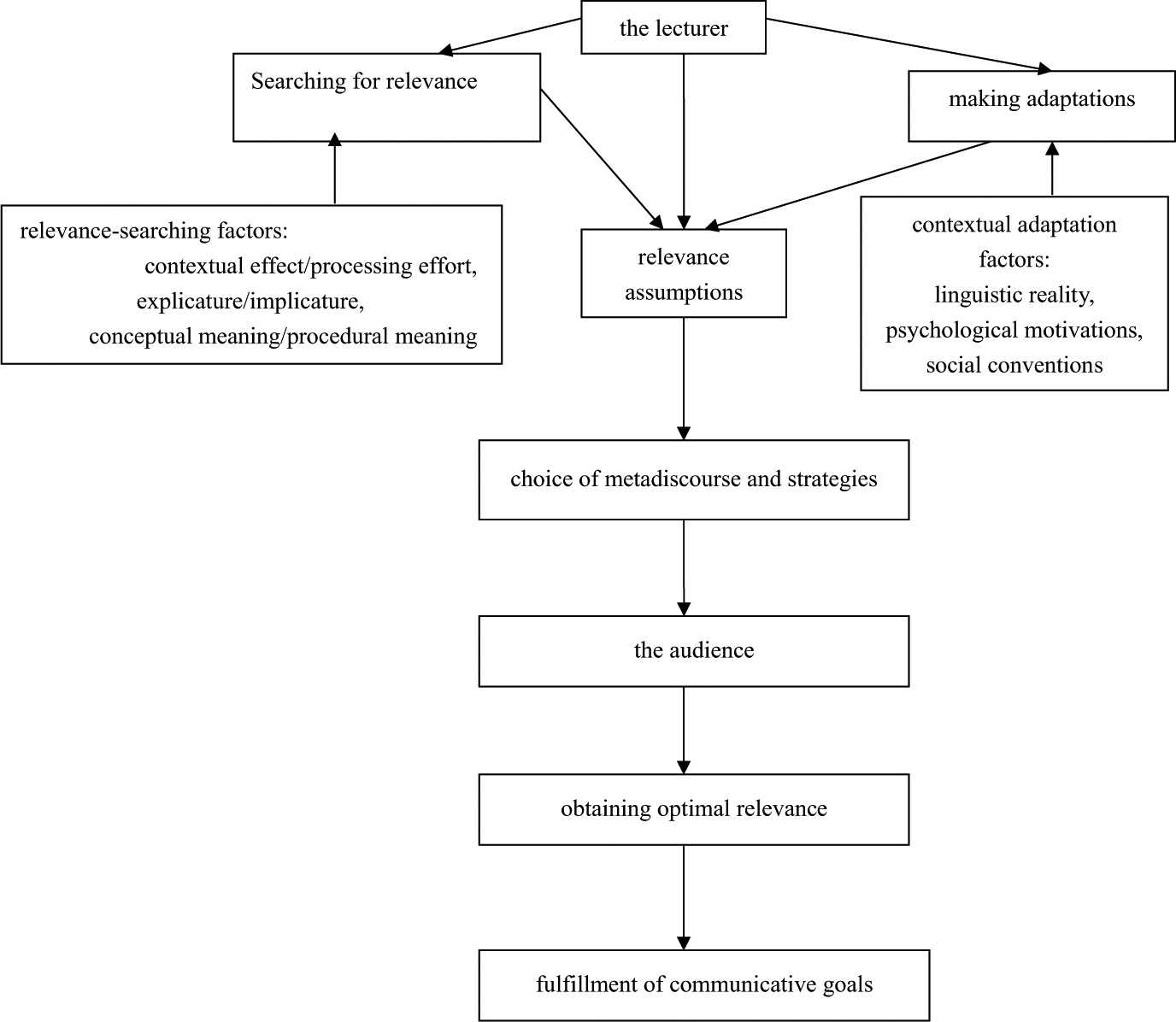
Relevance-adaptation model.
In order to make adaptations to choose appropriate metadiscourse devices, relevance is searched for on the part of the lecturer by his/her considering contextual correlates and his/her making relevance assumptions about lexical information, logical information, encyclopedic information and audience’s cognitive states. At the same time, the expected contextual effects are measured in the mind of the lecturer before his/her adaptations are made based on the variability, negotiability and adaptability of language. Here variability refers to the range of possibilities in the smooth conduct of language choice. Negotiability means that language choice can be negotiable on the basis of highly flexible strategies. Adaptability means that language can allow its users to make negotiable language choice and flexible modification from its selectable items to meet the needs of communication.
According to this model, in the process of the presentation of academic lectures, relevance assumptions should be first made about the contextual correlates and the audience’s cognitive environment and inferential ability on the part of the lecturer. Based on these assumptions, appropriate metadiscourse devices should be chosen by the lecturer by his/her assuming and adapting to the contextual correlates and the audience’s cognitive environment, so that the utterance can be relevant enough to be worthy of the audience’s process effort and can be in conformity with the audience’s cognitive ability and preference so as to achieve optimal relevance. In order to achieve optimal relevance on the part of the audience and fulfill the communicative goals, the lecturer is expected to consider a variety of factors concerning relevance-searching factors of contextual effect, processing effort, explicature, implicature, conceptual meaning and procedural meaning, and contextual adaptation factors of linguistic reality, psychological motivations and social conventions. Only when optimal relevance is achieved in communicative situations on the part of the audience can the intended communicative goals be realised.
Data collection
The data used for this study are academic lectures collected from different sources. One of the sources is the video tape of George Lakoff’s 10 academic lectures on cognitive linguistics at Beijing University of Aeronautics and Astronautics in 2004. In addition, some academic lectures audio-taped in classrooms add to the authenticity and vividness of the data for this study.
In choosing data to meet the requirements of this study, the two principles of being exhaustive and being manageable are adhered to. Being exhaustive means that it is necessary to collect sufficient data in order to provide a good reliability and validity for this study. Being manageable means that it is possible to collect data with limited time and limited personal capacity. By so doing, the data collected for this study will provide a comprehensive picture of metadiscourse in academic lectures and will add to the reliability and the validity for this study.
Data description
This study is primarily qualitative and theory-driven. In this descriptive and explanatory study, a qualitative contextual analysis of metadiscourse in academic lectures is made, and an relevance-adaptation model based on the relevance theory and the adaptation theory is adopted as the theoretical framework for the exploration of both the occurrence and the role of metadiscourse in academic lectures and for the pragmatic description of metadiscourse in academic lectures. The selected data are analysed qualitatively in order to explore 1) the occurrence of metadiscourse in academic lectures, 2) the relevance-adaptation description of metadiscourse in academic lectures and 3) the role of metadiscourse in academic lectures.
Results and discussion
Occurrence of metadiscourse in academic lectures
In order to answer the first question of what the occurrence of metadiscourse is in academic lectures, the detailed corresponding categories of metadiscourse occurring in academic lectures are described according to the taxonomy of metadiscourse shown in Table 2.
Metatext in academic lectures
Metatext is defined by Rahman as ‘text-about-text management’, which applies explicit reference to the text managing acts (introduction, discussion, argument, question). It can help the readers better understand the whole writing process. This is also true of academic lectures and can help the audience better understand the whole lecturing process. In the process of giving academic lectures, the following metatext devices are used to engage the audience.
Reference to discourse entities.
A discourse entity refers to the referent of alleged words in the discourse and is introduced into academic lectures by the lecturer to present his/her alleged reference, alleged owner reference, and comparative reference of discourse elements in academic lectures. These discourse elements include entire lecture, individual section, tables and figures. In order to contribute to the audience’s better understanding of the lecture as a whole, reference can be made to the entire lecture, individual section, tables and figures by the lecturer. Extracts (4) and (5) illustrate the lecturer’s reference to his/her retrospective lectures and his/her prospective lectures, respectively.
(4) (5) What I am going to do
The discourse entity of In the previous lectures in (4) indicates a clue to previous lectures made by the lecturer to the audience, which is used in the beginning of academic lectures to provide background schemas for the audience for the incoming information. Similarly, the discourse entity of in the next lectures in (5) is used to draw the audience’s attention to lectures which will come. These two discourse entities assist the audience in theguidance of their better understanding of academic lectures as a whole.
Reference to discourse acts
A discourse act refers to an act that the speaker performs when he/she makes a discourse in a concrete situation and is used by the lecturer to perform his/her act of academic information presentation. By the lecturer’s mentioning what has been talked about, the audience’s attention can be drawn to the academic information and therefore the progression of the lecture is facilitated. Extracts (6) and (7) display the lecturer’s reference to his discourse acts.
(6) At very beginning, (7)
Discourse acts of I’ve mentioned in (6) and we’ve discovered in (7) are illocutionary force indicators which identify expository illocutionary acts of mentioning and discovering just performed by the lecturer. By indicating such kinds of discourse acts, the audience’s attention can be attracted to the progression of the academic information presentation in order to give the audience a general picture of academic lectures.
Reference to discourse labels
A discourse label refers to a concise abstraction of the intentional discourse act of the lecturer. In the process of giving academic lectures, reference can be made to a discourse act just performed by giving it a discourse label. For example: (8) So if you try to understand language acquisition in terms of an abstract mathematical system, you will never reach (9) And
The discourse label of this conclusion in (8) refers to the audience’s previously-made conclusion. Similarly, the discourse labels of that logic and that assumption in (9) also indicate the lecturer’s retrospective discourses of logic and assumption in academic lectures. Such a concise abstraction of previous discourse acts can reduce the audience’s cognitive burden on their processing of academic information.
Metadiscourse in academic lectures
Metadiscourse is defined by Rahman as ‘text-about-discourse management’ and can be understood as texts that refer to their execution and their relations. In the process of giving academic lectures, the following metadiscourse devices are employed by the lecturer to help the audience in their understanding ofacademic lectures.
Executing illocutionary acts
Illocutionary acts in lectures show the audience that the lecturer has made or will make a statement about the topic. Thus the audience can easily catch the main points of the lecture. For example: (10) What (11) What
The metadiscourse device of I claim in (10) performs the illocutionary act of claiming in the present academic lectures. Similarly, the metadiscourse device of I argued in (11) expresses the illocutionary act of arguing in a previous lecture. These two metadiscourse devices can guide the audience to focus their attention on the main claims presented by the lecturer in academic lectures.
Topic shifting
In the process of giving an academic lecture, a clue is often given to the audience by the lecturer when he/she wants to change the topic. Such a clue is what is referred to as topic shifting. For example: (12) And (13) Now
The metadiscourse devices of as for in (12) and there is another in (13) provide information that the lecturer is going to change a topic, which can make the audience prepare psychologically for the coming of a new topic. Therefore, by means of the metadiscourse devices of topic shifting, the lecturer can put the audience in a better position to receive new information.
Code glossing
Code glossing, such as for example, for instance, helps the audience to interpret the meaning of some statements or arguments. For example: (14) Now, can a metaphor be true? And the answer is yes. (15) In terms of selection, verb selects the meaning of the head, it selects the head that will go compatibly with it.
For example in (14) further demonstrates the meaning of the statement a metaphor can be true. Similarly, For example in (15) also shows an example of verb selection. Such metadiscourse devices of code glossing signal the restatement of difficult concepts, statements or arguments in academic lectures in other ways and therefore help the audience to interpret their meaning.
Executing interactive acts
Interactive acts in academic lectures reveal that the lecturer keeps the audience in mind and the interaction between the participants in communication. For example: (16) Now (17)
The metadiscourse device of notice is used to direct the audience’s attention to a simple thing in (16) and an underlying structure in (17) and influences their interpretation of ongoing discourse; it therefore performs the function of interactions between the lecturer and the audience during academic lectures.
Text connectives
By the lecturer’s using text connectives, his/her lecture can be made coherent. Words like first, second, next help to organise the lecture in a logical way. As for the lecturer, he/she is expected to present what he/she wants to say in a coherent way to avoid confusing the audience. For example: (18) Now, why is important? (19)
The metadiscourse devices of First and Next in (18) are employed to organise discourse in a sequential order, and First and in addition in (19) are used to indicate additive relation between main clauses. The metadiscourse devices of text connectives are able to transform dry and difficult discourse into coherent and audience-friendly academic lectures, and can guide the audience in their pragmatic inference of information in academic lectures.
Relevance-adaptation description of metadiscourse in academic lectures
In order to answer the second question of how metadiscourse in academic lectures is described from the perspective of the relevance-adaptation model, mechanisms ofmetadiscourse underlying its occurrence in academic lectures are explored in terms of relevance-searching and contextual adaptation.
Relevance-searching of metadiscourse in academic lectures
According to the relevance-adaptation model, the production of academic lectures can be considered to be the outcome of the lecturer’s searching for relevance. In the process of giving academic lectures, the effects of relevance-searching of metadiscourse are measured by three such pairs of the distinctions of relevance-searching factors as the distinction of contextual effect and processing effort, the distinction of explicature and implicature, and the distinction of conceptual meaning and procedural meaning. This aspect of metadiscourse use is described in terms of three pairs of the distinctions of contextual effect and processing effort, explicature and implicature, and conceptual meaning and procedural meaning.
Distinction of contextual effect and processing effort and metadiscourse in academic lectures
The concept of relevance in the relevance theory is defined in terms of contextual effect and processing effort. The relevance of utterance depends both on the size of contextual effect achieved and the amount of mental effort required for deriving them. Under the condition of other things being equal, the smaller the processing effort required, the greater contextual effect achieved, the greater the relevance of utterance will be. Human beings have the natural tendency to maximize relevance because our perceptual mechanisms tend to pick out potential relevance stimuli and our memory retrieval systems tend automatically to activate potentially relevant assumptions. Contextual effect, also known as cognitive effect in recent studies, is achieved when newly-presented information interacts with a context of existing assumption to make a worthwhile difference to the hearer’s representation of the world, and therefore the newly-presented information in a context of available assumptions achieves relevance.
The processing effort needed to achieve contextual effect of an utterance is determined by such factors as the linguistic complexity of the utterance, the logical complexity of the utterance, the accessibility of the context, and the size of the context and the inferential effort needed to compute the contextual effect of the utterance in the chosen context (Ifantidou, 2001: 63). In the process of giving academic lectures, a balance between the contextual effect and the processing effort should be kept in the process of choosing appropriate metadiscourse devices to achieve his/her communicative goals. To realise such a balance, various contextual correlates and linguistic factors should be considered to search for relevance on the part of the lecturer in order to make the audience obtain optimal relevance. In other words, appropriate metadiscourse devices should be chosen in such a way as to spare the audience gratuitous processing effort so that the first acceptable interpretation to occur to the audience is the one that the lecture intends to convey. For example: (20) Now, (21)
In (20) the topic about model of clusters of neurons is difficult for the audience to understand, and three metadiscourse devices of that doesn’t mean, what we intended to do is to and we will talk about the clusters momentarily are used to relieve the processing burden on the part of the audience. The metadiscourse in (21) also serves to relieve the processing burden and spare the audience’s gratuitous processing effort, such as How do you say a word you say? That is, This is, In other words and or. As a result, the audience benefits from the ostensive effort made by the lecturer in achieving optimal relevance with minimal processing effort in the interpretation of academic information.
Distinction of explicature and implicature and metadiscourse in academic lectures
As far as the distinction between explicature and implicature is concerned, the concept of explicitness should first be investigated. The definition of explicitness, offered by Sperber and Wilson (1985/1986: 182), is that if an assumption communicated by an utterance is explicit if and only it is a development of logical form encoded by this utterance. According to this definition, an explicitly communicated assumption is explicature and an implicitly communicated assumption is implicature. Explicature is the result of decoding and inference. The explicitly communicated content of an utterance is either the basic proposition expressed by the utterance or any high-level explicatures obtained by embedding the proposition under a speech-act verb or a propositional attitude description. Explicatures are understood in a broader sense in this study. Any explicit use of language to state the structure and the lecturer’s attitude towards the proposition is the explicit aspect of communication. Metadiscourse devices are used to encode information about the explicatures of the utterance. If information is encoded implicitly, the contextual assumptions required for the recovery of this interpretation are required to be immediately accessible. Therefore the excellent lecturer is expected to make his/her intentions explicit by considering the cognitive environment of the audience to achieve better contextual effects. In other words, appropriate metadiscourse devices should be chosen to express lecture information explicitly so that the audience can interpret information with minimal effort. For example: (22) That is a list of properties and that everything is either in a category or out of a category. And that the defining features are what are called the essence of this category. This is a classical category. It has been around over 2500 years and it doesn’t work. (23) But it took 1600 years for such a great dead body, dead but showing no signs of rigor mortis, to be put in the coffin from its death, this lasted until the times of Roman Empire, and it took 1600 years for Roman Empire to make Egypt become one of its provinces, but actually Egypt hadn’t existed before.
The adverbial Unfortunately in (22) indicates explicitly the lecturer’s attitude towards classical categorization theory and therefore saves the audience’s gratuitous processing effort. Similarly, the metadiscourse devices of So I think the irony and symbolized significance is in (23) is also an explicit way of showing the lecturer’s attitude towards pyramids and mummies in Egypt. Otherwise it may take the audience much more processing effort to realize the lecturer’s communicative intention, or it may even lead to communication failure.
Distinction of conceptual meaning and procedural meaning and metadiscourse in academic lectures
The distinction between conceptual meaning and procedural meaning is proposed by Blakemore (1987). Here conceptual meaning refers to the meaning which encodes conceptual representations and procedure meaning refers to the meaning which encodes a specification of how to manipulate conceptual representations. Metadiscourse devices in academic lectures can be analysed in terms of conceptual meaning or procedural meaning. In other words, metadiscourse devices encode not only the constituents of conceptual representations which enter into inferential computations, but also information which constrains the computations in which these communications are involved in academic lectures. The meaning of metadiscourse in academic lectures is conceptual if it semantically determines the audience’s decoding of conceptual meaning by encoding conceptual representations which the audience is required to decode in order to understand their meaning. The meaning of metadiscourse in academic lectures is procedural if it pragmatically constrains the audience’s inferential phrase of comprehension by indicating the type of inference which the audience is expected to make in order to satisfy the lecturer’s expectation of relevance and adaptation.
Different kinds of metadiscourse in academic lectures encode different kinds of procedural meanings. For example, but and however encode contrastive procedural meaning, in addition and and encode additive procedural meaning, or encodes alternative procedural meaning, so and therefore encode resultative procedural meaning, because and since encode reasoning procedural meaning, although and even if encode concessive procedural meaning, and frankly and fortunately encode modal procedural meaning. These metadiscourse devices indicate to the audience the type of pragmatic inference which the audience is required to make in their interpretation of information in an academic lecture. For example: (24) And a modifier can modify the object or what’s measured, no problem, either one depending on the semantics. (25) The oriental murmurs about this matter, because the oriental thinks abduction of women is not a good thing, of course, is not an honorary thing. But if women don’t agree to be abducted, they won’t probably be abducted.
Metadiscourses So in (24) and Therefore in (25) do not encode concepts or do not contribute to the truth conditions of the utterances, but indicate to the audience the pragmatic inference of resultative procedural meaning which they are required to make in their interpretations of these two utterances. These metadiscourse devices show the pragmatic ways of searching for relevance and making adaptations to achieve contextual effect. On the one hand, appropriate metadiscourse should be chosen on the part of the lecturer in order to make the audience achieve optimal relevance and convey his/her expected contextual effect. On the other hand, the audience is expected to give their attention to the metadiscourse devices relevant to their cognitive environment in order to interpret the lecturer’s communicative intention.
Contextual adaptation of metadiscourse in academic lectures
The production of academic lecture discourse is the process of dynamic contextual adaptation on the part of the lecturer. In this dynamic adaptation process, choices of appropriate metadiscourse are constrained by such contextual adaptation factors as linguistic reality, psychological motivations and social conventions. Therefore the lecturer is expected to adapt to these contextual factors so that appropriate metadiscourse is chosen to convey his/her informative intention and communicative intention and to fulfill the intended communicative purposes. A description of contextual adaptation of metadiscourse in academic lectures is made in terms of linguistic reality, psychological motivations and social conventions.
Adaptation to linguistic reality
Linguistic reality is the linguistic elements and the linguistic structures of language, which reflect the nature of rules of that language and concern the way the elements of language are organised together in a certain language. Therefore linguistic reality constrains what words or expressions should be chosen and how words or expressions should be organised in the discourse in order to produce coherent discourse.
Linguistic reality in this study is considered to be linguistic elements in a broader sense, which includes not only the grammatical rules of a language, but also the relationship between the use of metadiscourse and its linguistic contexts in academic lectures. Linguistic context, a factor influencing the choice of metadiscourse in academic lectures, mainly refers to the concrete environment in which linguistic communication takes place, and adaptation to linguistic reality here refers to the occurrence of metadiscourse in academic lectures for linguistic reasons or language usage, such as coherence of discourse.
Based on the linguistic reality, adaptation to the contents in the whole discourse is made in order to choose appropriate metadiscourse. Although metapragmatic awareness varies from one lecturer to another, the lecturer is expected to adjust his/her communicative strategies consciously or unconsciously to make his/her chosen metadiscourse appropriate. The reason is that the process of communicating through language is that of interaction between utterance and its linguistic context. As a result, the choice of appropriate metadiscourse through making adaptations to linguistic reality on the part of the lecturer can lead to the successful communication between the lecturer and the audience. Two examples from George Lakoff’s lecture series in (26) and academic lecturersaudio-taped in classrooms in (27) illustrate this point of view.
(26) (27) So we can now sum up in this way. What is scientific thought?
Coherence of discourse can be realised in a number of ways. In (26), the whole discourse of George Lakoff centres around the logic about the human mind and the world, which is the assumption made by the lecturer. The use of discourse labels And that logic and And that assumption meets the requirements of the discourse, without which the whole discourse will sound incoherent. Similarly, in (27), text connectives First, Second and Third help the lecturer to illustrate his scientific thought in a logical way. The employment of these three metadiscourse devices also contributes to the coherence of the discourse.
Adaptation to psychological motivations
Psychological motivation refers to the forces acting either on or within a person to initiate behavior and reveals activating properties in doing something or saying something in academic lectures. Academic lectures are, in essence, a cognitive activity involving decoding and inferring. In this kind of cognitive activity, adaptation to the cognitive and psychological state of the audience is needed to achieve optimal relevance.
Viewing academic lectures as a process of adapting to psychological motivations means examining discourse features and making assumptions in terms of the lecturer’s projection of the perceptions, the interests and the needs of the audience. Academic lectures communicate effectively only when the audience’s resources for interpreting and responding to them are correctly assured. This can be achieved in part through the employment of metadiscourse, which can take a variety of linguistic forms constrained by many contextual adaptation factors.
Among them, psychological motivations of the audience have their part to play in the process of their interpretation of academic lectures. The reason is that psychological motivations of the audience are crucial to his/her processing capacity and the application of metadiscourse in academic lectures can help the audience to catch and follow the logical order of the presentation, and therefore relieve the processing burden. For example: (28) Now those properties form a frame for bachelor. But now there are tricky cases. Suppose you think of an Arab sheikh, who has only three wives and can have four. Is he an eligible bachelor? (29)
The main function of code glossing such as for example, for instance, take another example is to help the lecturer to illustrate ideas, concepts or propositions in detail and guide the audience in the interpretation of academic information. In (28) the metadiscourse device Take another example can be regarded as the result of the process of searching for relevance and making adaptations. Before the metadiscourse device Take another example is chosen, searching for relevance and making adaptations are conducted on the part of the lecturer. The audience may be assumed to have little knowledge about what bachelor really means, and more examples are needed in order to offer a clear picture of the concept of bachelor in detail. As a result, adaptations to the cognitive state of the audience are made and the code glossing take another example is chosen to illustrate the issue in detail. Therefore the use of the metadiscourse device Take another example in (28) can be viewed as the result of adapting to the psychological state of the audience, and the metadiscourse device Take another example is chosen to connect the example of Arab sheikh and the pope with the concept of bachelor. This facilitates the understanding of the concept of bachelor on the part of the audience.
Similarly, a general introduction or reminding the audience of the ongoing lecture is necessary when the lecture is relatively long and complicated. As shown in (29), this often happens at the beginning of an academic lecture because this act can provide the audience with a clear idea of the logical sequence and the main content of the ongoing academic lecture. The metadiscourse devices What we are going to do is and What we claim is that are the result of searching for relevance and adapting to the psychological motivations of the audience.
The existence of this kind of metadiscourse can help the audience to get a clear idea of the main structure of the ongoing academic lecture and assist in catching the real intention the lecturer wants to convey. This is because the execution of the illocutionary act of metadiscourse is the act of explaining to the audience the main points under discussion in the academic lecture. In addition, the future tense and imperative mood are often used for such metadiscourse devices to illustrate the main content of the academic lecture.
Example (29) shows the lecturer’s high degree of sensitivity to the linguistic needs of the audience as a result of making adaptations to the psychological motivations of the audience. This is evidenced not only by his/her explaining the word ‘infinity’ which has a specific meaning in the subject, but also by his/her linking it with words that the audience might be more familiar with and even by his/her providing an etymological and linguistic explanation.
In the process of giving academic lectures, the lecturer is required to adapt to the psychological motivations of the audience, and linguistic manifestation of this adaptation constitutes one of the characteristic features of academic lectures as a genre. Among these linguistic features, metadiscourse devices are most frequently used to cater to the psychological motivations of the audience in academic lectures.
Adaptation to social conventions
Social convention refers to the ways of behaving that are considered to be correct and polite by most people in a society. Although there may exist differences in social conventions in different social communities, some common human rules set by social conventions must be abided by, and any violation of these common rules can possibly cause damage to the society and the relationships between people. These common rules include solidarity and politeness, and due attention should be paid to them that constrain human verbal communication in order to guarantee the successful interaction between participants.
As a kind of human verbal communication, academic lectures are also constrained by social conventions and the application of metadiscourse makes the audience clearer about the interactional features of metadiscourse in academic lectures. Therefore the lecturer is expected to search for relevance and adapt to social conventions in which appropriate metadiscourse devices are chosen to communicate with the audience. In so doing, the audience is involved in the process of academic lectures and the solidarity between the lecturer and the audience is strengthened. For example: (30) (31) The first relation,
Metadiscourse of interactive act Notice in (30) conforms to social conventions because it makes the audience believe that the lecturer keeps them in his mind and therefore meets the face needs of the audience. This is also true of metadiscourse devices acting as hedges in academic lectures, such as I think, kind of, sort of, a little bit. They can be regarded as the result of searching for relevance and making contextual adaptations to social conventions on the part of the lecturer. The metadiscourse device I think in (31) presents the lecturer’s modest attitude towards academic research, and is used to help the lecturer to express his/her points of view in a mild way and thus maintain the face needs of the other scholars in the same research field, which is considered to be the necessary virtue possessed by a scholar to strengthen solidarity in an academic circle.
As an essential element in social conventions, politeness helps to build up solidarity between the lecturer and the audience and can be achieved by using such metadiscourse devices as generally, might, perhaps, probably, it seems that. These typical forms of metadiscourse are used to tone down their points of view by mitigating the force of the verb or prediction so as to make them socially more acceptable, and negotiate meaning in face-to-face interaction in academic lectures. For example: (32) You (33)
The topic in (32) makes requests in some situations. In the process of presenting his/her point of view, adaptations to the norms of social conventions are made by the lecturer through employing the metadiscourse devices of generally, might. This is because making adaptations to social conventions and presenting viewpoints in a mild way are considered to be appropriate behaviour. Otherwise it leaves the audience with the impression that the lecturer is a little arrogant and therefore impolite.
Similarly, in (33) a precise definition of the concept of immigrant is offered to the audience by the lecturer. In order to present the academic information in an appropriate way, the use of the metadiscourse devices Perhaps, I think, might plays an essential part in coating the lecturer’s viewpoints. Adaptations to moderateness of social conventions are made to choose appropriate metadiscourse devices of perhaps, I think, might to show politeness accordingly.
It should be noted that metadiscourse is often found to be used with modal verbs to tone down statements, which suggests the politeness concern on the part of the lecturer and reflects the cautions calculated in the mind of the lecturer, and therefore can be regarded as the result of making adaptations to social conventions. For example: (34) There is a great Shakespeare poem, sonnet 73, and it’s about death . . . Now a lot of complicated English. (35) With regard to life, world, history, and how you should lead your lives. These issues are reflected by a variety of different films. If you are going to enjoy these kinds of films, you don’t have to pay homage to them. They give you something, to say in a dark room, watching films, crying together, laughing together, which brings you that kind of things. These things
In (34), a Shakespeare sonnet is quoted and used to explain to the audience the complicated nature of the poem and metaphors. The use of metadiscourse I think with modal verb would helps the lecturer to express his/her viewpoint in an appropriate way. In (35), how to appreciate films is discussed. The employment of metadiscourse I think with modal verb should assists the lecturer in presenting his/her idea in a polite way. They can be reviewed as the result of making adaptations to the politeness of social conventions.
Role of metadiscourse in academic lectures
In order to answer the third question of what the role of metadiscourse is in academic lectures, the role of metadiscourse is explored in terms of functions that metadiscourse performs within the relevance-adaptation model in academic lectures.
Role of metadiscourse as active discourse constructor in academic lectures
From the perspective of the relevance-adaptation model, the role of metadiscourse in academic lectures is related to the process of constructing discourse by searching for relevance and making adaptations on the part of the lecturer. The role of metadiscourse is also relevant to the inference process of discourse on the part of the audience. For the lecturer, metadiscourse helps him/her to construct coherent and effective academic discourse based on his/her searching for relevance and making adaptations to the contextual correlates and the audience’s cognitive environment. For the audience, metadiscourse directs them to their inference of the lecturer’s discourse. Therefore, appropriately chosen metadiscourse devices are the result of construction of discourse on the part of the lecturer and interpretation of discourse on the part of the audience. These two aspects in the process of seeking appropriate metadiscourse devices interact with each other and form an integrated whole.
According to the relevance-adaptation model, metadiscourse in academic lectures adds explicitness of and relevance to academic discourse produced by the lecturer. In addition, metadiscourse indicates the lecturer’s assessment of the cognitive demands which the lecturer may possibly pose to the audience by searching for relevance and making adaptations to contextual correlates and the audience’s cognitive environment in order to achieve optimal relevance. What is more, the significance of metadiscourse in academic lectures lies in its role in explicating a context for interpretation and suggesting a way in which acts of communication define academic lectures as a genre. In this genre, based on the process of searching for relevance and making adaptations, metadiscourse devices are employed to dynamically construct academic discourse on the part of the lecturer. Therefore, the role of metadiscourse in academic lectures is a discourse constructor which constructs discourse through searching for relevance and making adaptations to the contextual correlates and the audience’s cognitive environment. And the role of metadiscourse in academic lectures is an active discourse constructor in essence because it actively involves the lecturer in constructing academic discourse. For example: (36) (37)
The topic in (36) is the premotor cortex, which seems to be difficult for the audience. Several metadiscourse devices are used to construct coherent and effective academic discourse on the part of the lecturer by searching for relevance and making adaptations to contextual correlates. For example, metadiscourse So is used to construct a discourse which may suggest what can be concluded by the previous discussion. The resultative procedural meaning employed by the lecturer guides the audience to interpret the utterance and achieve maximal contextual effect by minimal processing effort. Meanwhile, this metadiscourse device So also shows the lecturer’s adaptations to contextual correlates of the topic premotor cortex because the audience may lack profound knowledge about this topic to a certain degree. The topic in (37) discusses humanistic conception in comparison to scientific conception. Similarly, metadiscourse devices in this discourse also serve to construct the discourse based on searching for relevance and making adaptations. For example, first, the use of metadiscourse Next, I describe what a humanistic idea is frames the main structure of the whole discourse by indicating what is to follow in the discourse. Second, it reflects the lecturer’s explicit way of organising the discourse so as to relieve the processing effort on the part of the audience. Third, it indicates that the lecturer is creating adaptations through making assumptions about the audience’s cognitive state.
Therefore the role of metadiscourse can be regarded as an active discourse constructor through searching for relevance and making adaptations to contextual correlates and the audience’s cognitive environment. Realising the essential role of metadiscourse as the active discourse constructor in academic lectures can result in the effective use of metadiscourse both in the production process and in the interpretation process of academic lectures in order to contribute to successful communication between the lecturer and the audience.
Conclusions
This study contributes to literature on pragmatic analysis of metadiscourse in academic lectures. First, based on the relevance theory (Sperber and Wilson, 1985/1986) and the adaptation theory (Verschueren, 1999), the relevance-adaptation model is constructed to theoretically explore the occurrence and the role of metadiscourse and pragmatically describe metadiscourse in academic lectures. In order to meet the requirements of this study, the relevance-searching factors and the contextual adaptation factors in academic lectures are identified and added to the relevance-adaptation model to make it applicable to this study. Second, the detailed corresponding categories of metadiscourse occurring in academic lectures are described according to the taxonomy of metadiscourse. The result of the description shows that the occurrence of metadiscourse in academic lectures is pervasive. Third, the pragmatic description of metadiscourse in academic lectures is also made in terms of the relevance-searching factors and the contextual adaptation factors from the perspective of the relevance-adaptation model. This study finds that contextual adaptations to linguistic reality, psychological motivations and social conventions are made by the lecturer in order to choose appropriate metadiscourse. This study also suggests that searching for relevance is conducted on the part of the lecturer in the process of his/her choosing appropriate metadiscourse by integrating his/her contextual assumptions about lexical information, logical information, encyclopedic information and the audience’s cognitive states in the aspects of the distinctions of contextual effect and processing effort, implicature and explicature, and conceptual meaning and procedural meaning in order to guide the audience toward achieving the expected contextual effect and optimal relevance in the process of interpreting lecture information. This study shows that the process of choosing appropriate metadiscourse is dynamic and the result of searching for relevance and making adaptations. Fourth, the role of metadiscourse in academic lectures is explored both in the production and the interpretation of academic lectures and is proved to be an active discourse constructor.
This study provides a pragmatic analysis of metadiscourse in academic lectures in terms of linguistic form. A prosodic aspect of metadiscourse in academic lectures is needed to be investigated pragmatically in order to get a more comprehensive understanding of the nature of metadiscourse in academic lectures.
Footnotes
Funding
This research received no specific grant from any funding agency in the public, commercial or not-for-profit sectors.