



Abstract
Spontaneous play, important for forming the basis of friendships and peer relations, is a complex activity involving the management and production of talk-in-interaction. This article focuses on the intricacies of social interaction, emphasizing the link between alignment and affiliation, and the range and importance of verbal and nonverbal interactive devices available to children. Analysis of the way in which two girls, one of whom has been diagnosed with Asperger’s Syndrome, engage in spontaneous activities demonstrates the potential for interactional difficulty due to the unscripted nature of the interaction. The article argues for further research into how improvised, unscripted interactions are initiated within moment-by-moment talk, how they unfold, and how they are brought to a close in everyday contexts in order to understand how children create their social worlds.
Keywords
Spontaneous activity in children’s everyday interactions
Spontaneous play among children is a complex activity involving the management and production of talk-in-interaction. Understanding the features and properties of social structure and the pragmatics of language presupposes a kind of fast talking, fast acting interactional approach to propel and maintain the ‘in role’ element of the activity at hand. When one member is learning how to talk and act in culturally and socially recognized ways, not visibly and hearably as competent as others (Corsaro, 1985; Danby, 1998; Danby and Baker, 1998; Kyratzis, 2007; Macintosh and Dissanayake, 2006; Sawyer, 1997), or when one member displays different understandings of the activity to the others, then there is potential for interactional trouble in relation to the continuance of the activity and, consequently, of the social order. For individual participants, their own competences as performing members of the locally assembled and practised culture are available for display to, and possible assessment by, others, with implications for social relationships. As Danby and Baker (1998, 2000) show in an investigation of boys’ activities in the block area in a preschool, how children manage their own and their peers’ trajectories of interaction in situ effectively demonstrates their practical competency.
Children’s activities present opportunities to prepare for and practise everyday social life (Goodwin, 1990; Sacks, 1995). In children’s arenas of social action (Hutchby and Moran-Ellis, 1998; Speier, 1973), children can learn about and practise features of culture-in-action (Baker, 2000; Hester and Eglin, 1997) in games and spontaneous activity, such as how one presents oneself and how one engages in emotional displays. Sacks (1995, vol. 1: 501) points out that ‘play then becomes an environment for learning and demonstrating criterial matters in real world action’. In this way, children’s games and spontaneous activities can be understood as social life in action, and can give insights into the realities of central components of culture.
The task for children engaging in spontaneous activities is to work out what are appropriate types of behaviour, and what are not, in these locally assembled and occasioned contexts (Baker, 2000; Butler, 2008; Hester and Eglin, 1997), and the consequences of not getting their interpretations or actions ‘right’. When one participant responds with a specific kind of action, ‘some analysis, understanding or appreciation of the prior turn will be displayed in the recipient’s next turn of talk’ (Heritage, 1984: 255). The participants’ interpretations are publically available and are an analytical resource to determine how they were understood. Heritage points out that ‘linked actions . . . are the basic building-blocks of intersubjectivity’ (p. 256), that is, mutual understanding. The employment of sequential analysis shows how participants display their understandings of what is happening. In peer interactions, particularly where spontaneous activities are underway, it is possible to suggest that there is no hierarchy of social order established and that relationships are experienced as symmetrical practices. Empirical research, however, shows that there are always issues of control and dominance in play in children’s interactions (Butler, 2008; Corsaro, 1985; Danby and Baker, 2000; Garvey, 1990; Griswold, 2007). In spontaneous activities, children display their competencies and the strategies they use to organize their social worlds.
Spontaneous activity as improvisation
In the examples analysed in this article, we show how two girls orient to each other’s talk-in-interaction as they display to each other their interpretations of the activity underway. These episodes of spontaneous activity can be further categorized as doing improvisation. Sawyer (1997) describes improvisational performances as characterized as ‘(a) . . . [having] no script, thus they are created in the moment; (b) nonetheless, there are loose outlines of structure that guide the performance . . .; (c) they are collective – no person decides what will happen . . . . improvisational creativity is a collective social process’ (p. xix). In spontaneous play, where there is no set of procedural conditions as in a board game, the task for participants is to work out what is going on and how their next turns can show shared meaning of the activity and, at the same time, propel the activity along. There is typically no script to this activity, just as there is no script for how to successfully initiate entry into a shared activity, or how to bring to a close the activity at hand. The nature of the activity attests to the collectivity of the process and, at the same time, the individual contributions of the participants. As Cicourel (1970) points out, participants and observers judge performance as ‘the interaction of competence and performance that is essential for understanding everyday activities’ (p. 138). Social positions are always being tested, never safe and never taken-for-granted as ‘alliance[s] of interests’ (Maynard, 1985: 210), and displays of mutual understandings are essential features of peer engagement.
With no script, preplanning or meta-narrative about what to do next, children display high awareness of the dynamics of the improvised situation as the activity unfolds. Setting up a meta-narrative is often seen when children explicitly talk about the pretend scenario and characters of play (Kyratzis, 2007); however, an absence of meta-narrative and marked changes is quite common in spontaneous play, with improvised interactions often being guided by build-up and release of tension (Evaldsson and Corsaro, 1998). Such improvisation requires close observation and monitoring of each other’s behaviour, especially when shifting in and out of the activity itself as even spontaneous activities have a clear beginning and end of each episode. Such transition points require interactive work to make the shift a reality. The ability to improvise through monitoring of each other’s behaviour provides important practices for building and maintaining relationships.
Collaboratively achieving alignment
As children construct relationships with peers, displaying alignment is a key interactive practice used to build rapport. Alignment refers to supporting the structure of the interaction or activity in progress (Stivers, 2008). For example, alignment may be demonstrated through appropriate responses to questions, or through the use of continuers (such as mmm, mmhh, yeah) to display attentiveness when the conversational partner is telling a story. On the other hand, disalignment occurs when actions are produced that disrupt the activity in progress, when disjunctions in the sequence of the talk can be seen (Butler et al., 2011; Stivers, 2008). For example, an abrupt change of topic or an inappropriate comment may undermine the activity, resulting in conversational troubles that may require participants to engage in conversational repair, such as repeating themselves or seeking clarification.
The research question guiding this analysis is: How do children align through interaction to build and maintain peer relationships? We investigate three transcribed extracts of naturally occurring interaction between two young girls to focus on how they get into and out of spontaneous activities, with a particular focus on what happens at the transition point or shift in activity. Extract 1 shows a situation in which the girls collaboratively achieve the transition into, and then the transition out of, an improvised moonwalk episode. Extract 2 shows a more vulnerable transition at the start of a spontaneous activity – a clapping game this time. In this instance, both participants initiate a competing activity, requiring accomplishment and negotiation to resolve the situation in terms of which of the competing activities will successfully transition to an actual game. Extract 3 shows what can happen when the other participant does not display awareness that the activity is being drawn to a close. An added dimension is that one of the girls has a communication diagnosis of Asperger’s Syndrome.
Naturally occurring interaction: A rich source of evidence for investigating communication difficulties
Overwhelmingly, as indicated in the diagnostic criteria (DSM-IV-TR; American Psychiatric Association, 2000) and as described in the literature, children with Asperger’s Syndrome find social interaction more difficult than their typically developing peers. Attwood (2000: 85–86) lists the most conspicuous characteristics of social difficulty, including lack of reciprocity; little appreciation of social cues; failure to share enjoyment, interests or achievements with other people; an inability or lack of desire to interact with their peers or a failure to develop peer relationships appropriate to the child’s developmental level; a failure to adequately use eye gaze, facial expressions, body posture and gesture to regulate social interaction; socially and emotionally inappropriate behaviour; and difficulty reading emotion from facial expressions.
In spite of their pragmatic and communicative difficulties, very little analysis has focused on the specific social behaviour of children with Asperger’s Syndrome (see, however, Geils and Knoetze, 2008; Kremer-Sadlik, 2004; Muskett et al., 2010; Ochs et al., 2004; Rendle-Short, 2003, in press; Sterponi and Fasulo, 2010; Stribling et al., 2007, 2009; Wootton, 2003). In addition, most research focuses on communicative deficits, or problems; yet, by focusing primarily on interactive troubles, it can mean that other aspects of interaction are overlooked. For example, Geils and Knoetze (2008) focus on the collaborative moves used by a six-year-old with Asperger’s Syndrome, finding that interactions that were activity-based and playful, consisting of short turns and non-verbal cues, resulted in smoother interactions. Rather than focusing on a specific communicative deficit trait, by taking a non-deviant analytic approach, they highlighted the role that all participants played in producing successful interaction. Stribling et al.’s (2009) study of repetitive talk, a communicative difficulty commonly manifested in Autistic Spectrum Disorder, found that rather than resulting from the boy’s fixation with a particular interest, topic re-occurrence was a collaborative and complex activity embedded in interaction. Similarly, Muskett et al. (2010) found that displays of inflexibility by a child with Asperger’s Syndrome were being used strategically with the aim of regaining control of the interaction. These studies highlight the need for a more nuanced understanding of how children with communication difficulties carry out everyday interaction, as evidenced by recent calls for finer micro-level analysis of social behaviours of children with high functioning autism and Asperger disorder in naturalistic settings with familiar peers (Macintosh and Dissanayake, 2006).
One difficulty inherent in accounting for the communicative abilities of children, including those with Asperger’s Syndrome, is that it is very difficult to pinpoint, with precision and with clear evidence, what counts as a ‘social interaction difficulty’ due to the context-specific nature of interaction. In examining the way in which the two girls under analysis in this article get into and out of the spontaneous activities, our aim is to focus on what it is that both girls, including the child with Asperger’s Syndrome, achieve in this very fluid situation that requires close observation and monitoring of each other’s behaviour.
The data and methodology
The data used in this study are drawn from a larger corpus of interactions of children with Asperger’s Syndrome aged 8 to 12 years collected as part of a study focusing on children with communication difficulties. In total, 81 minutes of video interactions were recorded between Sarah and Ellie, both 10 years old, in Sarah’s home. The collected video interactions were characterized by spontaneous activities that were loosely structured through improvisation. Sarah was diagnosed with Asperger’s Syndrome (according to the Diagnostic and Statistical Manual of Mental Disorders, 4th edn; DSM-IV) by the University of Canberra Centre for Applied Psychology. Captured on camera were interactions between Ellie and Sarah that occurred while they were in the family room (Extract 1 and 3) and in Sarah’s bedroom (Extract 2). Sometimes Sarah’s mother and brother were present. The extracts chosen for analysis were representative of the type of spontaneous interaction between the two girls.
Both children were friends and had given consent. They were aware that they were being video-recorded. Steps were taken to minimize possible impact on the interactions. The video-camera had been given to Sarah’s family for a period of time. Tripods for the camera were set up in different rooms of the home and the mother turned the camera on when interactions began. Sarah was very involved in this process, even at times asking her mother to turn on the camera. In having the video-camera set up in this way, it was hoped that there would be less impact on the interactions than if an unfamiliar researcher filmed the girls, which could seem intrusive in a home setting.
Using conversation analysis (CA), this study seeks to understand the analytic process of how people organize and manage social interaction and activity. Guided by the assumption that no detail of interaction can be ‘dismissed as disorderly, accidental or irrelevant’ (Heritage, 1984: 241), it encourages close examination of verbal and nonverbal everyday interaction made visible through highly detailed transcriptions (see Appendix for transcription conventions). Additional nonverbal information is provided in italics immediately below the line of talk in the transcripts. Images have also been included to characterize what is occurring nonverbally. The image is placed immediately above the relevant bit of talk.
The aim of this case study analysis is not to generalize to all spontaneous activities of this type. The aim is to focus on the process of how children manage activities that might involve improvisation for the activity to continue; ways in which they might start them and close them down; ways in which they might understand what they need to do next. Understanding the parameters around such activities is important, given that children diagnosed with Asperger’s Syndrome find unstructured interaction more challenging than structured interaction (Rendle-Short, in press). In other words, then, the aim of this analysis is not to hold up a mirror of what counts as ‘good’ or ‘bad’ interaction. This article takes a competence model rather than a deficit model. Interaction is a jointly constructed activity and children diagnosed with Asperger’s Syndrome constantly have to negotiate their way through interactions that may seem difficult at times, just as for neuro-typical children. The aim of this analysis is not to show that what Sarah does is ‘not right’, but to demonstrate how these children get into and out of spontaneous activities requiring improvised talk and action that have not been planned in advance.
Getting into and out of spontaneous activity
The data illustrate the interactional complexities inherent in ‘getting into’ and ‘out of’ a spontaneous activity. The spontaneous activities under investigation are only brief, with the shortest one lasting less than a minute. They are improvised, with no explicit instruction as to what they might consist of, how long they might last, what form they might take, what is required by either of the girls in terms of starting the activity, or what will happen when it draws to a close. Such fluidity, where neither of the girls knows what is going to happen, is interactionally challenging for any child and particularly for a child such as Sarah who has a diagnosis of Asperger’s Syndrome. Of particular interest in this article is how the children navigate the moving into and out of such activities. These transitions, shifts from one activity to another, are particularly worthy of attention as they are the sites where alignment will be most obvious and the possibility of interactional trouble most precarious. The moment-by-moment nature of the unfolding interaction is most acute at the point of making an activity proffer, especially when the child, as the invitee, might not be quite sure of the form the activity will take, given its unscripted nature. In the data under consideration, the activity proffer is not in the form of a verbal marker such as ‘Now let’s do this’ with a clear meta-narrative about what to do next; rather, the improvised activity unfolds in an unscripted manner.
Three extracts have been chosen for analysis. Extract 1 shows the two children successfully navigating a challenging entry into, and exit from, an improvised activity. Sarah is the one who initiates the new unscripted activity. It is presented at the beginning of this analysis section in order to provide a contrast with Extracts 2 and 3. In Extract 2, Sarah again initiates the activity, although starting it off or ‘getting it going’ requires multiple initiating attempts. This extract is included to demonstrate how difficult this ‘getting into an activity’ can be. In Extract 3, the activity is initiated by Ellie, who is also the one who draws it to a close. It is included to show how difficult it can be to ‘get out of an activity’. In this instance Sarah does not affiliatively respond to this move into closure.
Successful transition: ‘Getting into’ and ‘out of’ a spontaneous activity (Extract 1)
In Extract 1, the two girls are downstairs in the family room, with the video-camera positioned in the corner of the room. The extract starts with Sarah (on the left of the image) initiating a new improvised activity. She says, ‘OOH LOOK it’s a WALL to bang in to <dum dum¿>’ (lines 42–43). Sarah gazes at Ellie (who is sitting on the mat in the middle of the room) and gestures towards the wall; Ellie, who is looking at her teddy bear, turns to gaze at Sarah.


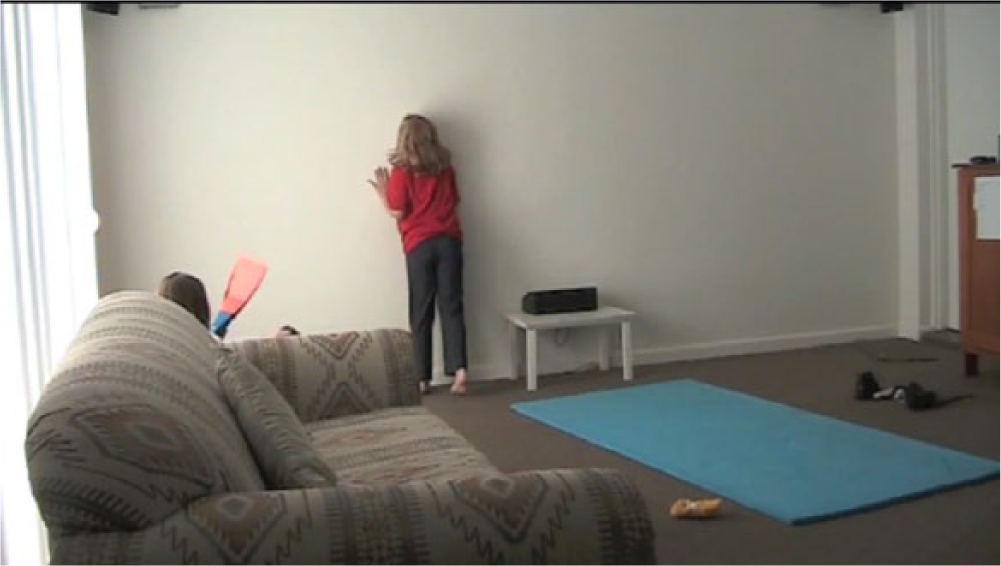
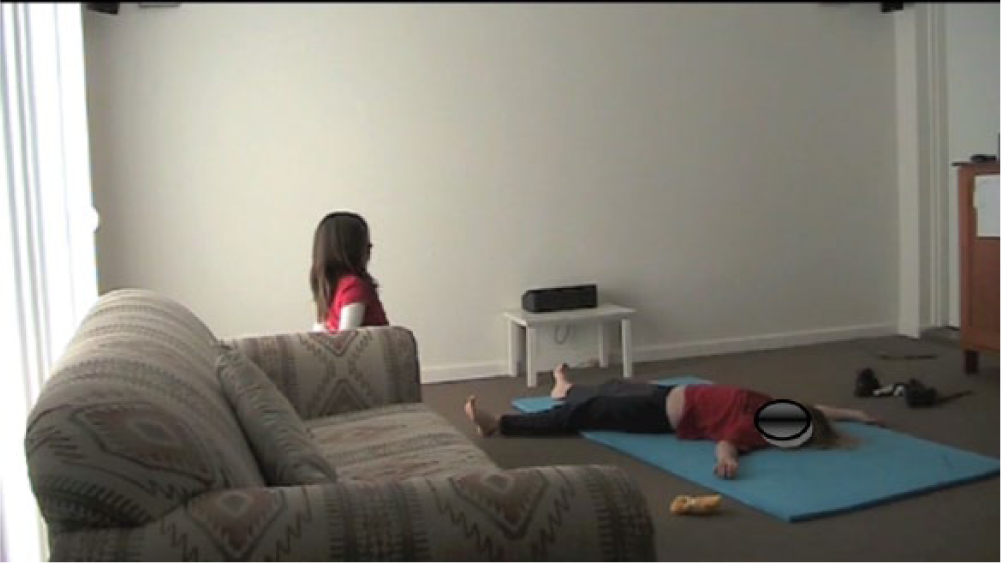
In inviting her co-participant to start a new activity, Sarah prefaces her first pair part (FPP) with an attention getter ‘OOH LOOK’ (line 42), followed by a suggestion that the new activity will involve banging into the wall, followed by an address term ‘dum dum’ (line 43). Although the address term might seem derogatory, the girls have previously been playing around with this name (not shown on the transcript). Certainly Ellie does not treat the address term as offensive; instead, following a 1.0-second pause during which Sarah watches her co-participant, Ellie puts her toy aside, smiles, gets to her feet and starts to walk towards the wall. Thus the activity proffer is responded to nonverbally through gaze and the action of getting up from the floor, and verbally with laughter (line 45). The successful transition means that they can move immediately to the improvised activity itself of walking, or moonwalking, into the wall accompanied by mutual gaze and joint affiliative laughter (lines 52–54). Although Sarah has a diagnosis of Asperger’s Syndrome, there is no evidence in this interaction to potentially indicate ‘social interaction difficulty’. This lack of identifiable interactional difficulty highlights the problem of taking a deficit model rather than focusing on the children’s competencies and what they can actually do.
Getting out of the activity is similarly achieved in a collaborative manner. Although Sarah initiated the improvised activity, Ellie is the one who draws it to a close. As with any closing, her close proposal functions as an FPP that must be accepted in order to successfully bring the activity to an end (Schegloff and Sacks, 1973). Ellie’s close proposal is verbal and nonverbal. Verbally she makes a sound that may represent the feeling one gets when walking into a wall (line 55); nonverbally, she turns away, falls back onto the mat, puts her legs in the air. Sarah nonverbally accepts the close proposal by moving forward, sitting up on her heals, while still gazing at Ellie. She then asks, slowly and with emphasis ‘<Ws th
This extract shows how a spontaneous activity does not just start and finish by itself; it is a collaborative achievement. Due to the improvised nature of the activity, with neither child being quite sure what will happen, their actions are potentially fraught with misunderstanding of what is being proposed, what will eventuate, and when the activity (that may only be a few seconds long) will be brought to a close. Through the use of the ‘dum dum’ address term to frame the activity and through joint laughter, the girls demonstrate the collaborative accomplishment of this unscripted moonwalk activity. The next extract highlights the difficulty inherent in getting into a spontaneous activity.
Vulnerable transition: ‘Getting into’ a spontaneous activity (Extract 2)
Extract 2 occurs in Sarah’s bedroom. Sarah is sitting at the head end of the bed; Ellie is holding a toy that makes a noise when it is moved. The extract begins soon after Sarah’s mother enters the bedroom and Sarah inquires as to whether they are being recorded. The mother asks if Sarah would like to be recorded and Sarah says OK. Extract 2 commences with Sarah burping.

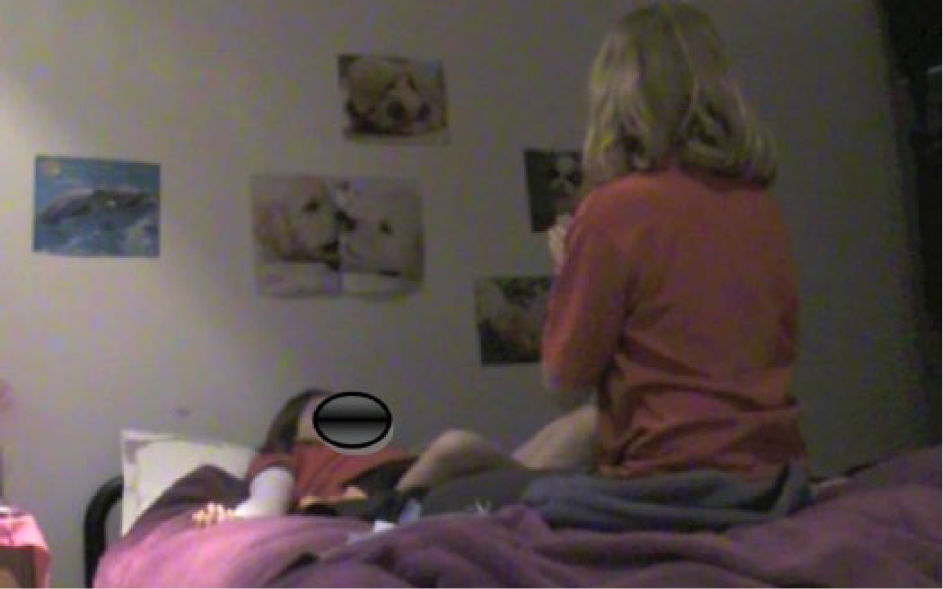
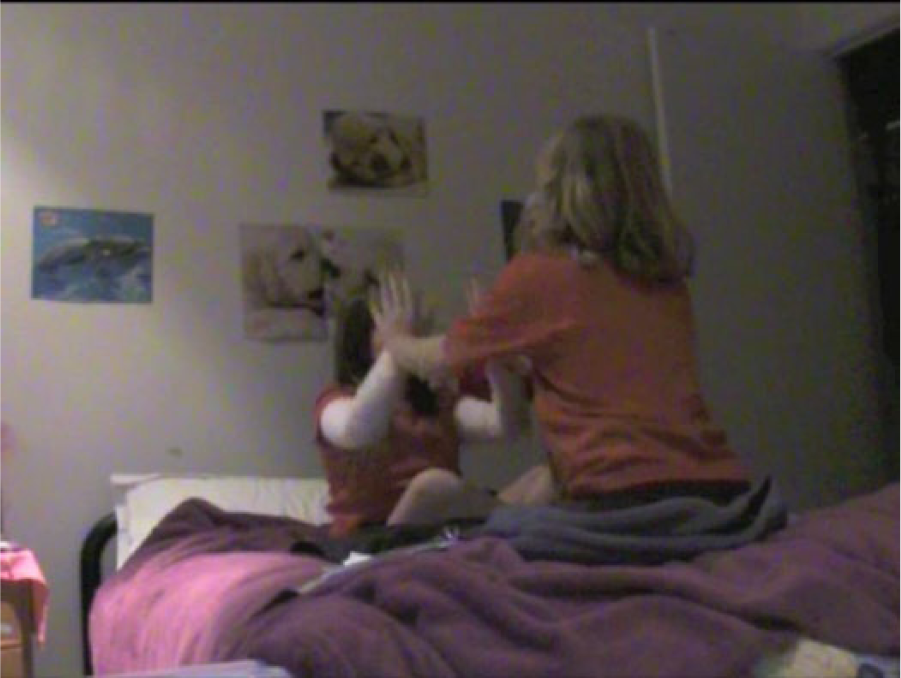
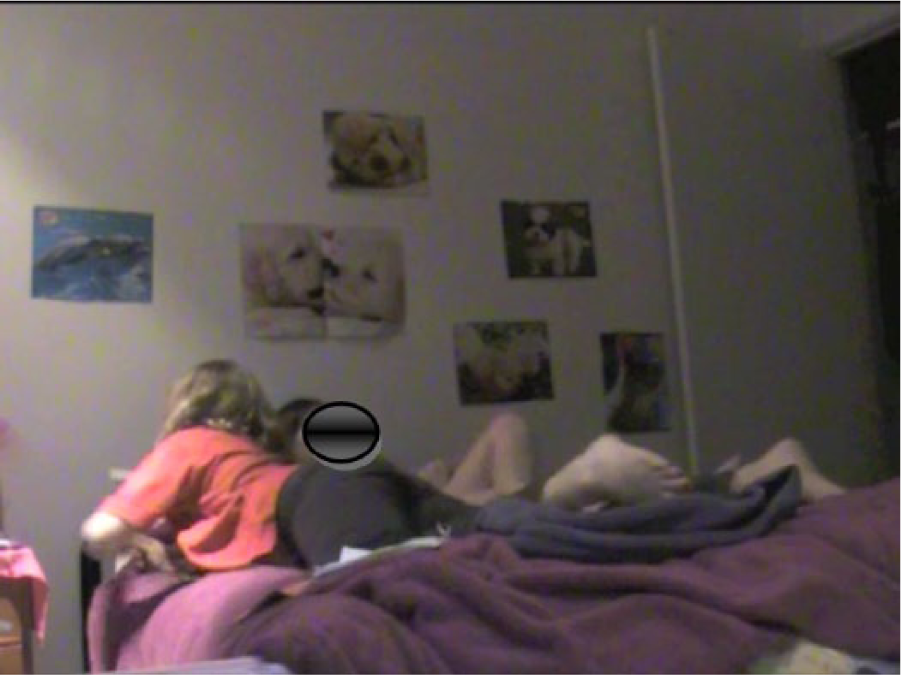
As in Extract 1, Sarah again initiates a joint improvised activity, by saying in a loud voice, ‘LESS DO DOUBLE DOUBLE KIT KIT ELLIE.’ (line 8). This time she does not succeed in gaining Ellie’s gaze in spite of addressing her by name, and her initial activity proffer is unsuccessful. Following a 3.0-second pause (line 9) during which Sarah tries to nonverbally engage Ellie, Sarah says ‘come on’ (line 12) and she again says ‘l
Instead of responding, Ellie proposes a different activity, that of pushing a toy into Sarah’s face. Although the pushing action could possibly be interpreted as confrontational, Sarah accepts this as a different activity, as demonstrated by pulling a face, making a noise and then falling backwards slowly onto the bed, perhaps acting as if struck by the toy. Ellie then drops the toy and claps (lines 18–19), holding her hands together after the clap and remaining in that position. Perhaps the clap and Ellie’s body position signal to Sarah that Ellie is now ready to engage in the game. Sarah rises to sitting position, takes an in-breath (line 21), and raises her hands into position for the clapping game. As Sarah does this, Ellie separates her hands and the rhythmic game begins. Again, it would be difficult to definitively say that the difficulty in the transition is ‘due to’ Sarah’s diagnosis with Asperger’s Syndrome. Certainly it was a difficult transition into the spontaneous activity in that there was no uptake of the activity proffer, but it was eventually successful. Both children collaboratively ensured that they were able to ‘get into’ the new game.
The girls recite the words together, accompanied by a clapping pattern (lines 22–25). Here, the girls coordinate their words and movements, as they engage in this aligning and affiliative activity. The fluidity and assuredness of the girls’ shared activity suggest that it has happened over a period of time, perhaps on multiple occasions. On completion of the clapping game, Sarah smiles and continues to gaze towards Ellie. She then says an affiliative ‘↑WO::W’ and claps (line 28), perhaps highlighting the co-ordinated success of their game. In response, Ellie moves forward onto her stomach. She makes a sound (line 30) that echoes the pitch contour of Sarah’s ‘wow’. As Ellie lies down, Sarah lies down on her back beside Ellie. This affiliative collaborative closure contrasts with the non-affiliative beginning to the same activity.
The clapping activity nearly did not happen because Ellie did not take up the initial activity proffers. Instead, Ellie initiated a different activity of pushing a toy towards Sarah’s face, to which Sarah responded by falling backwards. As a result, Ellie is no longer positioned as the recipient of Sarah’s clapping game proffer. Instead Ellie, by opening her hands and giving a single clap, and keeping her hands in a clapping game position, takes the initiative in terms of starting the clapping game. This puts her in the turn initial position. Sarah is now in the recipient role of accepting this activity proffer (line 19), an activity which she had originally initiated. So although the girls eventually managed to transition into the clapping game, it was at first disaffiliative and had the potential to make it socially awkward for each other while they were on the bed together.
The next extract highlights what can happen when the co-participant does not recognize that the spontaneous activity is being drawn to a close.
Showing disaffiliation: ‘Getting out of’ a spontaneous activity (Extract 3)
In this extract, Ellie initiates an idea for a spontaneous activity. Mutual gaze and close monitoring, a feature of the high awareness required when engaged in spontaneous activities, is evident during this successful transition to the dancing activity. Sarah accepts the activity nonverbally by dancing and clapping, even though it is slightly out of time (line 122).
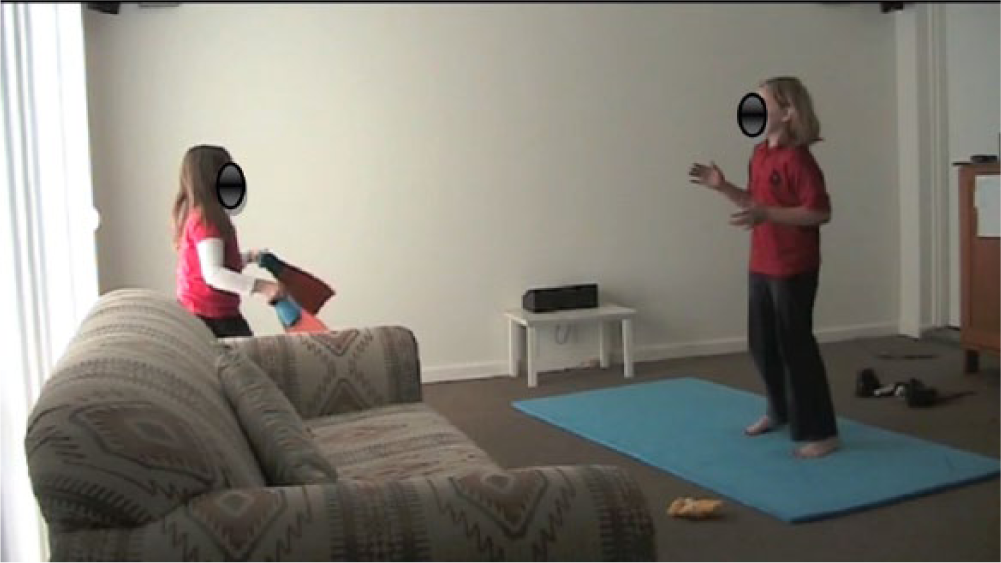
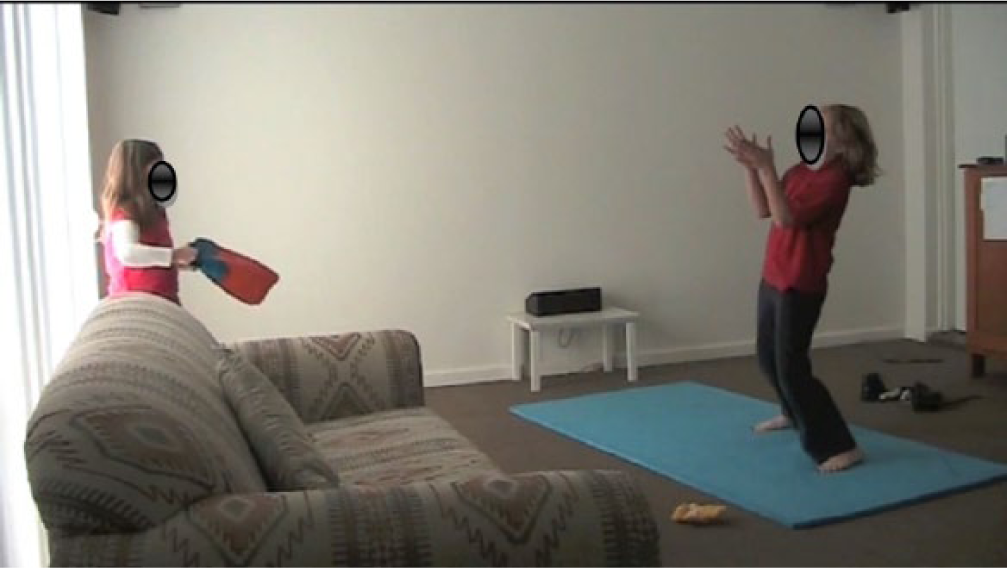


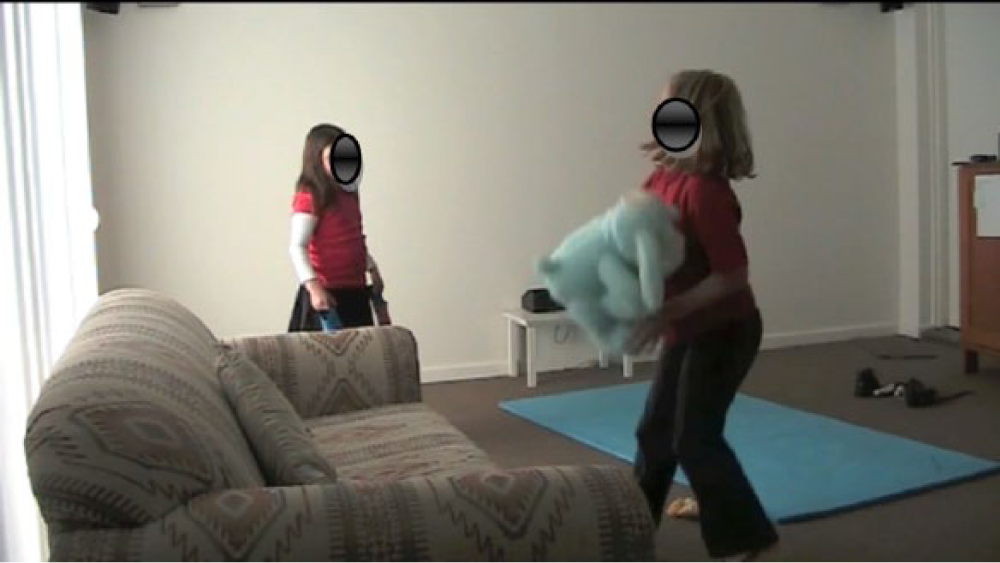
The dancing and clapping activity continues (lines 122–126) with continuing mutual gaze and collaborative attention to clapping in time. By line 127, Sarah’s claps are in time with Ellie’s dancing and clapping. Ellie suddenly, and without warning, ends the activity. Her claps miss each other and she stumbles. Regardless of whether the stumble is real or imaginary, it functions as an abrupt cue to end the activity. As such, it needs to be responded to. However, Sarah does not align to possible closure and she claps once more and stands with flippers ready to clap again. She does not demonstrate an understanding that the clapping activity is over, even though Ellie makes it clear in multiple ways by saying, ‘whoa’ (line 127) and ‘urrgh’ (line 128), falling down (line 128), gazing at Sarah for 1.0 second (line 129), giving an assessment ‘°that hurt°’ (line 130), clutching her stomach and rolling towards Sarah (line 130). Sarah just continues to gaze at Ellie and gives a slight clap of her flippers (line 130), and in line 131, they look intently at each other for a long 5.0 seconds. In this extract, Sarah did not display the appropriate affiliative behaviour – she tried to continue the improvised game, and she did not display sympathy and care (or any other response) when her friend cried out in pain, rolling onto the floor and holding her stomach.
How could Sarah have responded to Ellie’s stumble and subsequent indication that she had hurt herself? She could have given an acknowledgement token (e.g. oh), a second assessment (e.g. you poor thing), asked for confirmation (e.g. what happened?), checked that Ellie was alright (e.g. are you ok?), gone over to her to see for herself what had happened. Instead, Sarah did not engage in any activity that demonstrated alignment to Ellie’s displays that the activity was over. Possibly, due to her Asperger’s Syndrome diagnosis, she may not have known how to respond or she may not have realized what had happened. It is difficult to show alignment and affiliation if you do not know what you are affiliating with. As Evaldsson (2005: 764) highlights, ‘pre-adolescent girls and boys are overtly playful, risky, assertive, aggressive and even threatening’. But understanding the transformation from one mode to another, for example from playful to serious, is not always easy. For Sarah, it may have been difficult to recognize the type of experience that Ellie was going through. The issue for Sarah is that an affiliative response is missing, disrupting the social order.
Regardless of the cause, it is clear that responding with a slight clap of the flippers (line 130) was not appropriate and demonstrated misunderstanding of the elaborate work Ellie did to invite an appropriate response, including falling down, gasping, saying it hurt. Eventually Sarah burps (line 132), and, possibly recognizing that the activity is over, she drops her hands to her side and says ‘h
This move towards closure of the spontaneous activity is disaffiliative. Sarah does not align to the structure of the talk; she does not endorse or sympathize with Ellie’s displays of discomfort; her laughter in line 135 is disaffiliative; there is no mutual gaze. Ellie does not give a positive assessment of the activity; instead she says ‘°how cn you keep on doing (sm)
This extract demonstrates how precarious it can be when there are no predetermined rules for what counts as the new spontaneous activity, what it means to get into an activity and how participants know when it is over. There is always a potential for disaffiliation. This can be challenging for children diagnosed with Asperger’s Syndrome who respond to structure in all facets of their life, including conversationally (Rendle-Short, in press). Understanding spontaneous activities would be much easier if it was clear what to do next and how to keep it light and playful.
Discussion
The above three extracts focused on how the children under analysis got into and out of spontaneous unscripted play activities. Extract 1 showed successful transitions into and out of a ‘walking into a wall’ activity; Extract 2 showed a difficult transition into a ‘clapping’ activity on the bed; Extract 3 showed a difficult disaffiliative transition out of a ‘flippers’ activity.
Stance refers to the speaker’s ‘affective treatment of the events he or she is describing whether that is communicated explicitly or implicitly’ (Stivers, 2008: 37). Speakers can convey stance in numerous ways, such as through the use of prefaces to stories, tone of voice, and contextual information (Goodwin, 2007; Jefferson, 1978; Sacks, 1974; Stivers, 2008). The preferred response is that the listeners match with the speaker’s stance in order to show affiliation. For example, the listener may endorse or sympathize with the speaker’s talk by agreeing with it, perhaps even making comments to demonstrate this. In the clapping game (extract 2), although it was difficult to ‘get into’ or start the game, the girls demonstrated through their actions, verbal and nonverbal, their joint understanding of the spontaneous activity they were engaged in, what it consisted of and how to bring it to a close. Such affiliative responses lay the groundwork for forming and maintaining friendships with peers.
As previously indicated, while affiliation and alignment may go hand in hand, this is not always the case. A participant may display affiliation (support the other’s position or stance), but may not produce interactional features that align with the structure of the conversation. For example, the participant may produce an affiliative utterance that acts to disrupt the structure of the conversation, perhaps interrupting the speaker to enthusiastically agree before the speaker has finished, inadvertently derailing the conversation, requiring the speaker to engage in repair work to steer the conversation back to topic. Likewise, alignment, or the supporting of the structure of the activity, may be demonstrated by the listener producing actions appropriate to the ongoing interaction; however, the listener may do this while disagreeing with the speaker, therefore showing disaffiliation.
For all children, getting into and out of spontaneous, unscripted activities requires complex interactional skills. Yet for a child such as Sarah, who has communication difficulties, it may be even more challenging. In extract 2, for example, in which there is a predictability and assuredness around the double double kit kat game, the two children know how and when to clap, how long the game lasts, and how to combine rhyme and clapping actions. At the end, they both positively assess their performance: Sarah smiles and says ‘↑WO::W.’ (line 28); Ellie lies down on the bed beside Sarah and says ‘↑dhoooo.’ with the same pitch contour (line 30). This collaborative completion, perfectly timed and assessed, demonstrates the ease and comfort around a scripted game. Sequentially, they show alignment (Stivers, 2008) through Sarah’s production of a first assessment, followed by Ellie’s second assessment. Together, they display an attentiveness, through sounds, prosody, gaze and nonverbal action, to the unfolding interaction, including an understanding of how to bring a game or sequence to a close. By aligning their talk and action, the girls display support or endorsement for the other’s stance or affiliation.
In contrast, the unscripted flippers clapping activity (extract 3) demonstrates an instance of disalignment and disaffiliation. Ellie, as instigator of the game, instructed Sarah as to what to do. However, Sarah did not display an understanding of when to clap according to Ellie’s instructions. Disalignment is evident through Sarah’s uncertainty around how the activity should unfold and, in particular, how and when it should end. Ongoing disalignment is evident following Ellie’s stumble on the mat, leading to the closing sequence. In spite of Ellie’s repeated informings, verbal and nonverbal, to let Sarah know that she had hurt herself and that the game was over (regardless of whether Ellie was actually hurt or not), Sarah did not appear to understand the shift that was occurring. As Sarah stood frozen, holding Ellie’s gaze for more than 5.0 seconds, she used a quiet single clap as a ‘reality analysis’ (Hester and Francis, 1997) to test whether the game was really over or not.
Disruptions within the activity and its non-collaborative closure in the third extract resulted in a disaffiliative stance between the two girls. Further evidence of their disaffiliation can be shown through their attitude towards each other, in which there is no display of enjoyment or fun. This is in direct contrast to the other two extracts where the closing sequence is accompanied by toe wiggling, smiles, laughter and direct reference to ‘having fun’ (extract 1) and joint positive assessments and smiles (extract 2). Although Sarah did not directly and explicitly challenge Ellie’s movement into closure (extract 3), her frozen action and single clap presented an alternative to closure, that of continuing the game. She did a burp (line 132) and ‘h
Conclusion
Spontaneous activities are complex sites of interactional negotiation, requiring children to keep track of fast-paced talk and action. There is no script as to what happens next and no meta-discussion of how the activity might progress. Instead, as shown in the above analysis, the children need to be on constant alert to new possibilities, to the activity moving in a direction that could not have been anticipated or planned for. Understanding the link between alignment and affiliation, or disalignment and disaffiliation, is important in providing a more nuanced analysis of how interactive strategies are used in everyday interaction. Demonstrating an affiliative stance towards another person relies on fine-grained interactional manoeuvering with constant monitoring, through mutual gaze, of what the other person is saying and doing, and what their actions might mean for the spontaneous activity underway.
Difficulty in displaying affiliation has implications for forming friendships with peers. For any child, displays of disalignment and disaffiliation can impact on peer relationships. For a child with Asperger’s Syndrome, such as Sarah, who might find it difficult to generate ideas needed for creative play (Lewis and Boucher, 1988) or who might have a rigid behaviour towards toys and objects (Libby et al., 1998), the implications are greater. Although this analysis does not rely on Sarah’s diagnosis of Asperger’s Syndrome as an explanation for her lack of alignment, it does show interactional complexities for any child engaged in spontaneous activity. For children who do not fully understand the more nuanced social norms inherent in interaction (e.g. Attwood, 2000; Carrington and Graham, 2001; Hart and Whalon, 2011; Macintosh and Dissanayake, 2006; Paul et al., 2009; Rendle-Short, 2003; Stichter et al., 2012; Wootton, 2003), the impact of these complexities is that displays of affiliation and disaffiliation and how they impact on the other person are important in developing peer relationships.
Friendship is widely accepted as fundamentally important for social, emotional and mental health (Diehl et al., 1998; Dunn, 2004; Erwin, 1993; Margalit, 1994), and this article shows how one child, Sarah, with Asperger’s Syndrome, experienced some difficulty when engaging in friendship practices. As Macintosh and Dissanayake (2006) show in their playground study of spontaneous social interactions, just as for typically developing children, children with Asperger’s disorder want to engage in free play, particularly with familiar friends. But they may find it difficult to understand social interaction and so are less likely to have enduring reciprocal social interaction (p. 214). This analysis adds to our understanding of how children in general, as well as children with Asperger’s Syndrome, construct peer relationships. Given that children with Asperger’s Syndrome find it difficult to make and keep friends (Attwood, 2000; Humphrey and Symes, 2011; Macintosh and Dissanayake, 2006), we need a better understanding of children’s interactional practices, particularly in order to provide appropriate interventions as a way of assisting such children to become more adept at building peer relationships. This is not to take a deficit view and to highlight their difficulties rather than their competencies, but to better understand how spontaneous activities can challenge any child, particularly one with Asperger’s Syndrome. It is essential that we are aware of the interactional processes in which the child is currently engaging, including strategies they are using successfully and those they are not. Fine-grained analysis of naturally occurring episodes of interaction can be utilized to shed light on children’s everyday practices as they interact with peers.
Understanding how children, and particularly those with communication difficulties, carry out spontaneous play or improvised activities – something that they do on a regular basis in the playground or after school – sheds light on the intricacies of social interaction, how alignment and affiliation are linked, and the range and importance of verbal and nonverbal interactive devices available to children. Spontaneous activities form the basis of friendships and peer relations. There is a need for further research into how these improvised, unscripted interactions are initiated within moment-by-moment talk, how they unfold, and how they are brought to a close in everyday contexts in order to understand how children create their social worlds.
Footnotes
Appendix: Transcript conventions
Conversational data were transcribed using the system developed by Gail Jefferson (2004).
hello. falling terminal intonation
hello, slight rising intonation
hello¿ rising intonation
hello? questioning intonation
hel- talk that is cut off
<hello> talk is slower than surrounding talk
HELLO talk is louder than surrounding talk
°hello° talk is quieter than surrounding talk
he::llo an extension of a sound or syllable
h
↑ hello raised pitch
[ ] overlapping talk
(1.0) timed intervals
.hh audible inhalations
♫ singing
( ) transcriber uncertainty
Funding
The study was funded by The Trust Company 2010 Philanthropic Funding Round: Fred P Archer, with ethical approval by the Australian National University Human Research Ethics Office (Protocol: 2009/513).