



Abstract
Words like well, oh, and you know have long been observed and studied in spontaneous speech. With the proliferation of on-line dialogues, such as instant messaging between friends or back-and-forth postings at websites, there are increasing opportunities to observe them in spontaneous writing. In Experiment 1, the interpretation of discourse markers in on-line debates was compared to proposed functions of those markers identified in other settings. In Experiment 2, the use of discourse markers in spontaneous speech was compared to their uses in spontaneous writing. Results support the conclusion that although they vary in frequency in spoken versus written domains, discourse markers are used similarly across domains, but with particular communicative functions that make them non-interchangeable.
Introduction
Discourse markers in spontaneous speech are words like well, oh, and you know. Along with the related words um and uh, discourse markers are solutions to problems of spontaneous talk (Clark, 1996; Fox Tree, 2000, 2010). Tested here is the hypothesis that the functions of discourse markers in spontaneous writing are similar to their functions in spontaneous speaking. In addition, discourse markers can be broken down into whether they are (1) attitudinal, (2) tailored, (3) temporally sensitive, or (4) cohesive. These four dimensions predict the frequency with which discourse markers occur in spoken versus written formats. Attitudinal markers such actually, really, and oh (in its attitudinal form) were predicted to occur in spontaneous written settings with functions similar to those observed in speaking (Experiment 1). Tailored and temporally sensitive markers, such as like, you know, and the fillers um and uh, were predicted to occur in spontaneous written settings, but to a lesser degree than in speaking (Experiment 2). Cohesive markers, such as well and some ohs, were predicted in both settings, with similar functions to spoken uses (as tested here, the function highlighted was the property of being non-attitudinal; Experiment 1) and in similar quantities (Experiment 2). In this article, the term fillers refers exclusively to ums and uhs.
Four types of discourse markers
Discourse markers affect spoken communication in a variety of ways (Flowerdew and Tauroza, 1995; Fox Tree, 1995, 2001, 2002, 2006, 2007; Fox Tree and Schrock, 1999, 2002; Galley et al., 2004; Groen et al., 2010; Liu and Fox Tree, 2012). Discourse markers in spontaneous writing may play similar roles to those observed in speaking (Fox Tree, 2010; Fox Tree et al., 2011). Although others have cast a wider net (e.g. Louwerse and Mitchell, 2003), the focus in the current report is on markers typically observed in speaking, and how they may or may not translate to informal written communication, rather than markers that are rarely used in speaking such as whilst and whereupon (cf. Louwerse and Mitchell, 2003). The discourse markers looked at here were not specifically addressed in an earlier comprehensive examination of taxonomies (Louwerse and Mitchell, 2003). Only four (you know, well, oh, actually) were addressed in another study of discourse marker meaning, from which list well received the most attention (Groen et al., 2010).
Attitudinal markers
Discourse markers have been associated with speakers’ expressions of emotions or attitudes (Diani, 2010; Heritage, 1984). Not only would attitudes be expected in all forms of communication, there is reason to predict that attitude expression would be even more likely in written communication to make up for the lack of audiovisual information. In one study, written communicators used words to make up for information normally available nonverbally (Walther et al., 2005). In another study, emoticons with opposite valences to their messages conveyed sarcasm (Derks et al., 2008). In a third study, sarcastic email exchanges included verbal indicators of sarcastic intent (Whalen et al., 2009). Although the discourse markers studied in this report were not among those listed as sarcasm markers in Whalen et al.’s (2009) study, really marked irony in about 9% of ironic instant messaging samples (Hancock, 2004). Sarcasm may be especially likely in on-line debate sites such as those tested in Experiment 1. A study of product reviews found that writers used sarcasm as a tool for ‘“enlightening” the mass that are “treading the wrong path”’ (Tsur et al., 2010: 169). Functions proposed through analyses of spoken uses, reviewed next, are predicted to be similar to those used in spontaneous writing, assessed in Experiment 1 with on-line debates among strangers.
Actually
In spoken dialogue and prepared written prose, the basic meaning of actually can be summed up as ‘unexpectedness’ (Oh, 2000: 266; see also Aijmer, 2002), as observed in the following pair of instant messaging turns (numbered examples in the current report are from corpora collected in the author’s laboratory; written dialogues are presented exactly as typed by communicators):
(1) A: Hey, so have you been to any parties lately? B: actually i haven’t
Functions ascribed to actually include that it is a contrastive marker, a mitigating marker, a marker of surprising information, and a marker of a speaker’s emotional attitude to the information following actually (Aijmer, 1986, 2002; Smith and Jucker, 2000). An important distinction for actually is whether communication is spontaneous or prepared. In prepared written prose, actually at the beginning of a turn was found to serve a contrastive function (Oh, 2000). But actually at the beginning of spontaneous spoken utterances was found to mitigate face-threatening acts (Oh, 2000). This difference may be related to the amount of back-and-forth in dialogue versus prose (Oh, 2000). With more interaction, there is more possibility of disagreement (Oh, 2000). Another analysis of actually is that it can be used ‘to counter a claim whose basis appeared to come from outside the conversation’ (Smith and Jucker, 2000: 231), that is, to coordinate implied common ground. For both the mitigating function and the outside-claim-countering function, actually might be useful in stranger debates, and more so the greater the disagreement. In addition, because of its use in marking unexpectedness, actually may be especially informative for conveying irony or sarcasm, or ‘the use of words to convey a meaning that is something other than, and especially the opposite of, the literal meaning of the words’ (Bryant and Fox Tree, 2002: 100). The other than implication can be read as unexpected. As a further test of this hypothesis, actually’s use in debates was compared to but’s, with the prediction that the two function similarly.
Oh
In spoken dialogue, the basic meaning of oh is to mark a speaker’s change of state (Heritage, 1984). For example, in the environment of a repair, oh indicates that information has suddenly been remembered (change of state from not knowing to knowing); accordingly, listeners interpret the upcoming utterance as disjointed from the prior utterance (Fox Tree and Schrock, 1999). In other contexts, ohs can be used to indicate a ‘counterinforming’ (Heritage, 1984: 312), or the acceptance of alternative information from an interlocutor. The change of state indicated by oh can lead to positive and negative emotional inferences (Aijmer, 1987). For example, by suggesting newsworthiness, a reply headed with oh might be perceived as more polite than one headed by yes (Fox Tree and Schrock, 1999). But it could also be considered ruder if the oh were used to sarcastically imply newsworthiness for something the speaker did not really think was newsworthy. Repair use would be less frequent in writing as writers have more time to correct messages, resulting in fewer errors and fewer consequent repairs. But emotional uses would still exist in writing, as in the following instant messaging sequence: (2) A: where does ur boyfriend live B: back in l.a A: ohhh A: that must be tough
Debates may be even more likely to contain ohs than other communicative settings as ohs can be used ‘as a signal of a potentially argumentative stance’ (Schiffrin, 1987: 100). The attitudinal implications of oh were assessed in the debate corpus.
Really
In spoken and written academic communication, the basic meaning of really is to comment on the propositional truth of the upcoming information (Diani, 2010), which can be seen as orthogonal to attitudes toward the information. As a pure ‘veracity confirmer’ (Diani, 2010: 52), really should not be related to attitudinal judgments. Instead, its use might be similar to other veracity-related markers, such as turn-initial yes. As a further test of this hypothesis in spontaneous written contexts, really’s use in debates was compared to yes’s, with the prediction that the two function similarly.
There is reason to suspect that really does convey attitude, however. Really occurred more frequently in academic review articles than academic research articles (Diani, 2010), perhaps because of the ‘argumentative structure of the genre’ (Diani, 2010: 38). In fact, when Diani (2010) described really as a veracity confirmer, she clarified that really ‘says “yes. I’m telling the truth in spite of what you might think”’ (Diani, 2010: 52). Perhaps the potentially argumentative ‘in spite of what you might think’ is an important component of the meaning of really. The following instant messaging sequence provides an example of this: (3) A: yea, jobs off campus are hard to come by, everyone i know who’s actually found a job got it from the school B: really, i had like 2 interviews from oncampus jobs and n ever got hired
Really might occur more often with critical discourse, such as those in the strangers’ debates. The reactive function may be to highlight emotional, negative reaction. There has been no test of how really is interpreted in spontaneous communication; thus, whether really acts like a non-emotional yes or whether really implies emotion is unknown.
Tailored markers
Tailored markers are those that speakers choose when they are able to make predictions about the potential knowledge states of addressees, such as like and you know. Like is used to indicate that upcoming information is loosely related to speakers’ concepts (Andersen, 1998, 2000; Fox Tree, 2006; Jucker et al., 2003). You know is used to indicate the presence of off-record information (Fox Tree and Schrock, 2002; Jucker and Smith, 1998). For like and you know to serve these functions, however, it must be potentially possible for addressees to figure out the relationship between upcoming information and the speaker’s unexpressed concepts. For example, a joke about violists might merit you know when told in an orchestra but not when told to a general audience. Saying ‘there was a violist, you know’ alludes to the off-record information that violists are frequently the butt of orchestral jokes, implying the additional off-record information that an allusion to poor musical skills would follow, a fact that general audiences may not know. Like, on the other hand, requires even more tailoring. When a speaker says, ‘there was like a violist at the party’, the speaker could mean numerous things, such as that this is good news, or that this is bad news. As Liu and Fox Tree (2012) write, ‘When a speaker says “it’s like a 2 h drive”, [it can mean] “a 2 h drive is too long for something unimportant”, or the opposite, “that’s a short drive for something important”’ (p. 897).
Both like and you know do occur in writing with tailored uses. In the following example, Instant Messager B qualifies ‘stuck on campus’ with a turn beginning with like: (4) A: i live off-campus and its a real B**** to get up here B: at least you arent stuck on campus B: like i have been downtown i think 3 times
In the next example, Instant Messager A uses like a number of times in describing a campus club: (5) A: i think like the only big parties around here are like.. A: the ski and snowboard club ones.. B: Really? A: yah B: Weird, why’s that? A: i dunno A: but like you need tobe a member A: and itslike 20 bucks A: but you get a shirt B: must be big clubs >_>
In the following two examples of you know in writing, the Instant Messager provides additional information explaining the off-record information: (6) A: well in a trial the lawyers ideally want a panel of jury that would be more inclined to give a verdict you know one way or the other so when they choose potential jurors they ask like a profiling type questions to see which way they would say on certain issues (7) A: I would probably focus on creating sustainable housing, you know housing that needs little or no outside resources for power or water.
Although they have potential use in writing, there is reason to expect likes and you knows to be less common in writing than speaking. In prepared writing, concepts are typically worked out more precisely, obviating the need for like to mark a loose relationship between the words expressed and the concepts they reflect, or you know to indicate off-record information. Spontaneous writing may follow some of these constraints. When answering trivia questions verbally or in writing, people wrote more correct, unchanged answers than they spoke, possibly because they took more care with their writing (Chevalier and Fox Tree, 2012). In addition, because like requires more specific tailoring, the difference between its use in speaking and writing may be greater than the difference in use between you know’s use in speaking and writing. A speaker may need more immediate feedback, both in terms of timeliness and in terms of seeing or hearing an addressee’s responses, when using a like than a you know.
Alternative hypotheses for the function of like and you know are that they are meaningless tics without functions or that they are products of speaker’s speech styles or registers (see Fox Tree, 2006, 2007, for reviews of these approaches). These approaches would predict similar rates of like and you know in speaking as in writing, as long as the register is the same, such as communicating to friends. A contrasting proposal is that discourse markers in general, including like and you know, are exclusively products of spontaneous talk (as implied by labels like vocal hiccup; Croucher, 2004) and therefore should not be found in writing at all, including spontaneous writing. Both of these alternatives will be tested.
Cohesive markers
Cohesive markers provide information about how to relate information before and after markers. For example, oh can be used in the environment of repairs to indicate that upcoming information is disjointed from prior information, and listeners’ processing does indeed change depending on whether or not an oh is present (Fox Tree and Schrock, 1999). An example from written communication follows: (8) A: i like going to museums and art exhibits A: occasionally shopping A: and i love concerts A: oh the beach too. what about you?
Well is used to indicate that seemingly irrelevant subsequent information is actually relevant to the discourse (Blakemore, 2002), and well does affect listeners’ and readers’ interpretations of discourse (Groen et al., 2010). An example from written communication follows: (9) A: find any good parties while they were up here? B: ya we basically walked around campus and hung out with people A: well on friday my friend and i decided to go to LA because we were so bored here
Cohesive functions are potentially useful in both spontaneous speech and spontaneous writing. Although oh has both attitudinal and cohesive functions, in the corpus of friend’s interactions the cohesive functions are predicted to be more prominent as people are less likely to be arguing. Oh is expected to serve attitudinal functions in the debates. Well is the only non-attitudinal marker tested in the debates. The prediction is that well will not display attitudinal information. Furthermore, well is predicted to be equally likely in spoken and written settings in the friend’s interactions.
An alternative prediction for the use of well is that it serves an attitudinal or emotional function such as warning of upcoming frustration or disagreement (Hale, 1999). This alternative will be tested. Another alternative is that wells function like fillers (Van Lancker Sidtis and Postman, 2006). In this case, they should also be temporally sensitive, as discussed later. This alternative will be tested.
Temporally sensitive markers
Temporally sensitive markers are those that are linked to the temporal pressures of communicating with a waiting addressee. When there is a waiting addressee, even a fraction of a second of pause can have meaning. Speakers can be thought of as unintelligent, inattentive, or even dishonest (Fox Tree, 2002; Smith and Clark, 1993). The premium on fluency has fostered a number of spontaneous speech phenomena. For example, spontaneously spoken repetitions are a solution to the problem of speaking in a timely manner when production problems arise (Clark and Wasow, 1998). The repetition allows the speaker to regain fluency after a disruption. Ums and uhs warn of upcoming delays in speech (Clark and Fox Tree, 2002; Smith and Clark, 1993). They allow speakers to show that they are aware of the upcoming delay, in an effort to avoid potential negative attributions from an unannounced delay (Fox Tree, 2002; Smith and Clark, 1993).
These helpful spontaneous speech phenomena may not be useful in spontaneous asynchronous writing. For example, because instant messaging conveys messages in prepared message units, written repetitions are meaningless. A pause between typed words in a message unit can simply be continued with the next word as it is available rather than recycling from the beginning of the phrase, as communicators do in speaking (Clark and Wasow, 1998). Similarly, false starts might be corrected within the message window before being sent to an addressee. In a split-screen form of text chat, however, where each keystroke is visible to an addressee, false starts would be expected, although techniques for dealing with them may vary, such as erasing words rather than saying I mean and continuing. Repetitions, on the other hand, would still not be expected as fluency can be regained by simply continuing to type; text reads fluently even if it is not produced in a fluent chunk. Ums and uhs would not be expected because there is no need to indicate a delay when messages are sent in packaged bits, although fillers may be used to suggest that responses required thought (Fox Tree et al., 2011), as in the following instant messaging exchange where the first um suggests thinking about the answer to the question and the second um suggests either thinking about an additional list item or building up tension before producing the word batman, depending on whether badass is used as a noun or an adjective: (10) A: so…been to any good parties lately? B: um, i guess… lately ish. you?\ A: i went to an interesting one a while ago … the theme was ‘b’ … i showed up in bubble wrap A: not just bubble wrap …. B: see, that’s an important part of that description. A: hahahaha B: were there any banannas? or buffalo or whatnot? A: bananas! thats a good one! no, there were lots of bondage, boobs, beatniks, there was a badass … umm …. A: batman A: he was clearly the best A: gotta have a batman at a party
Other theories about the use of ums and uhs are that they are used to indicate various things about the speaker or the speech, such as nervousness (Christenfeld and Creager, 1996; Lalljee and Cook, 1973) or discourse complexity (Christenfeld, 1994; Swerts, 1998), rather than being tightly linked to time sensitivity. These approaches might predict similar uses of fillers in spontaneous speech and spontaneous writing. This will be tested.
Current experiments
Seven markers were studied. Interpretations of oh, well, actually, and really in a large on-line debate corpus were compared to predictions about their uses proposed in the research literature (Experiment 1). Oh, well, fillers, like, and you know were studied in a comparison of friends’ spoken and written communication (Experiment 2). Following Louwerse and Mitchell (2003) and Groen et al. (2010), the written markers tested occurred turn-initially. Because neither fillers (Fox Tree, 2006) nor likes (informal observation) occur frequently in turn-initial writing, these markers were not tested in the stranger debate study (neither were they tested in Górska’s (2007) study of discourse markers in instant messaging). You know was not tested in the stranger debates because the sample selection was made by a computer, and thus propositional you know could not be distinguished from discourse marker you know.
Experiment 1
Judgments of the emotional characteristics of posts to an on-line debate website were compared depending on the marker used at the beginning of the post. Posters were presumed to be strangers.
Method
Materials
Materials were selected from a corpus of debates taken from the website 4forums.com (see Abbott et al., 2011 and Walker et al., 2012, for details). Each quote–response sequence involved a quotation from a prior writer’s contribution plus a new contribution responding to that quotation. A subset of this corpus was used for the current analyses. This subset included all response posts that contained turn-initial discourse markers. The turn-initial position was intended to ensure salience of the markers when readers evaluated the posts (cf. Fox Tree and Schrock, 2002; Groen et al., 2010). A total of 17 discourse markers were represented in turn-initial position (the number of posts beginning with that marker is in parentheses): well (605), and (582), so (583), actually (322), but (265), oh (228), I think (182), because (162), just (113), really (100), I believe (69), I know (59), you know (49), you mean (50), I see (47), I dunno (10), and you think (7). In addition, 233 items beginning with yes were selected, and 220 items beginning with no were selected. A sample of 2576 items without any of these markers among the first 10 words was also included as an unmarked control. Because items were selected via a computer program (see Abbott et al., 2011 and Walker et al., 2012, for details), some items may represent propositional rather than discourse marker uses.
The definition of discourse marker was kept deliberately broad in order to assess ratings of the markers of interest – oh, well, actually, and really – against the backdrop of markers in general (see Fox Tree, 2010, or Louwerse and Mitchell, 2003, for discussion of defining discourse markers). The broad testing of markers also allowed testing of two supplemental hypotheses, that actually was related to but and that really was related to yes.
For each of the 6462 items, between five and seven anonymous Amazon Mechanical Turk annotators (henceforth Turkers; Snow et al., 2008) answered five questions (see Abbott et al., 2011 and Walker et al., 2012, for more details). This number of judgments per item has been shown to be sufficient to mimic experts’ ratings in various linguistic tasks including affective labeling (Callison-Burch, 2009; Snow et al., 2008). Four questions were responded to using a slider tool with endpoints labeled −5 and 5 through a midpoint labeled 0:
Question 1. Does the respondent agree or disagree with the prior post? −5 = strong disagreement, +5 = strong agreement
Question 2. Is the respondent being supportive/respectful or are they attacking/insulting in their writing? −5 = strong attack, +5 = strong support
Question 3. Is the respondent attempting to make a fact-based argument or appealing to feelings and emotions? −5 = feeling, +5 = fact
Question 4. Is the respondent attempting to be nice or is their attitude fairly nasty? −5 = nasty, +5 = nice
In addition, Turkers responded to the yes–no question, Is the respondent using sarcasm? This question was not represented by a slider because it was difficult to instruct Turkers in how to quantify sarcasm. For example, sarcasm could be interpreted as more or less biting, or more or less prevalent in the sentences of a post, or both.
For all of these questions, respondents had the option of clicking a button marked unsure. Unsure answers were removed from analysis.
Results
As can be expected from a public debate site, unmarked posts were more disagreeing than agreeing (see Table 1; to ensure accuracy, unequal variances methods were used for all response variables). However, they also were more supportive than attacking, more fact-based than feeling-based, and nicer rather than nastier. On average, only 15% of respondents agreed that an unmarked post was sarcastic. This could be because sarcasm was infrequent in postings, as was found with emails (Whalen et al., 2009), or because sarcasm is something that is hard for people to identify or agree on. Sarcasm may be more common on debate websites than in other venues (cf. Tsur et al., 2010), but may be infrequent in general – the majority of respondents tested here did not identify the posts as sarcastic.
Average ratings across marker-initial posts and unmarked posts followed by test statistics comparing the marker cell to the unmarked cell.
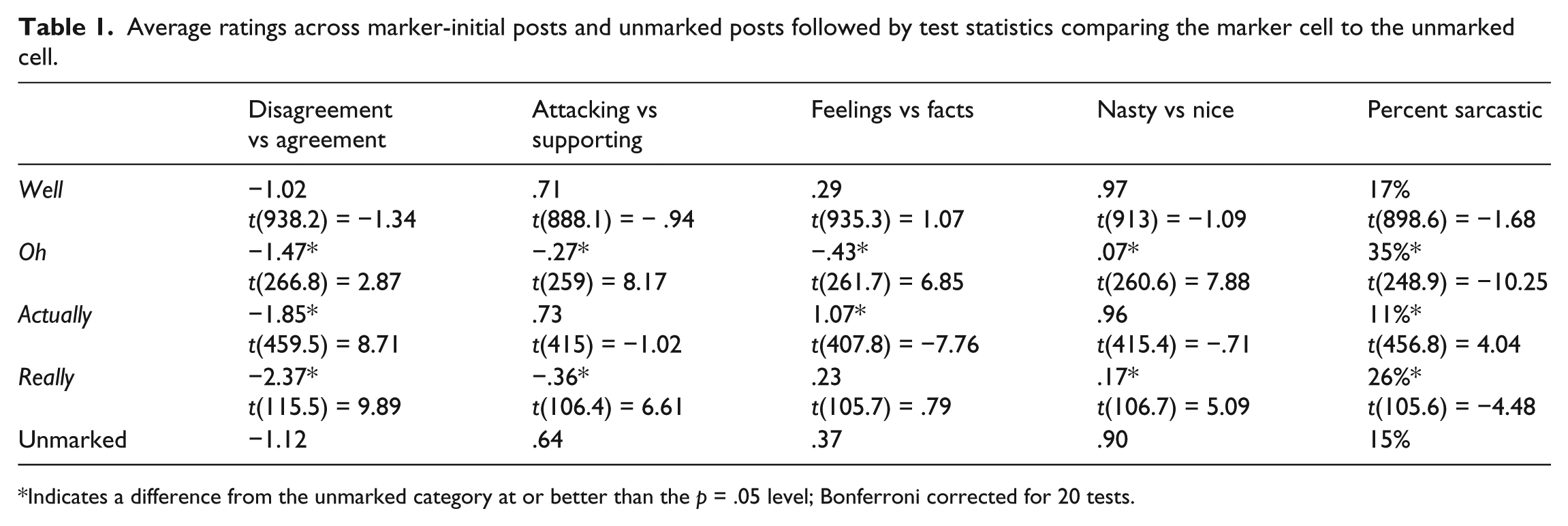
Indicates a difference from the unmarked category at or better than the p = .05 level; Bonferroni corrected for 20 tests.
The cohesive marker tested, well, was predicted to be unrelated to attitudinal or emotional judgments. The judgments of the posts headed by well support this prediction. Well was neither more disagreeing, more attacking, more feeling-oriented, more nasty, nor more likely to be identified as sarcastic than unmarked posts (see Table 1). In fact, it was the only critical discourse marker that was not linked to attitudinal or emotional judgments. These results go against the prediction that well warns of upcoming frustration or disagreement (Hale, 1999).
All three of the attitudinal markers tested – oh, actually, and really – were related to attitudinal judgments, but not necessarily emotional expression. Actually was related to disagreeing, but not feelings or sarcasm. Although both oh and really were related to sarcasm, they differed on feeling versus fact. As shown below, each attitudinal marker is interpreted differently.
The attitudinal marker oh was more disagreeing, attacking, feeling-based, and nasty than unmarked posts, as well as being more likely to be identified as sarcastic (see Table 1). In fact, oh stood out as preceding some of the most feeling-oriented, nasty, and sarcasm-identified posts. Of all the 17 discourse markers studied, the only marker preceding more feeling-oriented posts was I dunno (average rating of −.80). The only marker preceding more nasty-leaning posts was you mean (average rating of −.13). Only I dunno and you mean preceded posts with more agreement on sarcasm (I dunno = 37%; you mean = 38%). When oh is read at the beginning of a post, the upcoming information is likely to be emotional and expressing a negative, sarcastic attitude. This supports observations that oh is used in emotional inferences (Aijmer, 1987; Schiffrin, 1987), as well as the hypothesis that oh-initial turns will be judged as emotional communication.
The attitudinal marker really was more disagreeing, attacking, and nasty than unmarked posts, as well as being more likely to be identified as sarcastic (see Table 1). Unlike oh, it was not more likely to be feeling-based than unmarked posts. Really was the next-highest marker to oh in terms of percentage of respondents labeling the posts as sarcastic. This supports the claim that really is used to mark irony (Hancock, 2004). Posts beginning with really were rated as more disagreeing than all but one other marker (you think = −2.46) and more attacking than all but one other marker (you mean = −.48). Really followed oh in preceding nasty-leaning posts. These data support the hypothesis that really co-occurs with critical discourse, highlighting negative emotional reaction.
Comparison to yes reveals that really precedes posts that are more disagreeable (yes = −.02, t(280.6) = −13.6, p < .001), more attacking (yes = 1.16, t(181.2) = −8.6, p < .001), nastier (yes = 1.34, t(173.8) = −7.08, p < .001), and more likely to be identified as sarcastic (yes = 15%, t(180.6) = 4.04, p < .001) than yes-initial posts. Really is not more likely to be based on feeling over fact (yes = .54, t(163.6) = −1.57, p = .12). These findings go against the hypothesis that really is mainly a veracity marker similar to yes (cf. Diani, 2010).
Actually was the fourth most frequent discourse marker, after well, and, and so. This supports the usefulness of actually in mitigating disagreements and coordinating common ground (Oh, 2000; Smith and Jucker, 2000). While actually was related to the attitude of disagreeing (actually preceded more disagreeing posts than unmarked posts), it headed posts that were less likely to be feeling-based than unmarked posts, with fewer identifications as sarcastic than unmarked posts (see Table 1). These data do not support the prediction that actually is especially informative for conveying sarcasm; in fact, actually was the marker with the lowest percentage of respondents labeling the posts as sarcastic of all 17 markers tested.
The data do, however, support the claim that actually marks unexpectedness (Oh, 2000). Respondents’ ratings for actually were similar to ratings for but for disagreement (but = −1.64, t(578.1) = −1.91, p = .06; p-level of .01 needed for five tests), supportiveness (but = .68, t(570.6) = .45, p = .75), niceness (but = .99, t(573.3) = −.24, p = .81), and sarcasm agreement (but = 12%, t(543.1) = −.27, p = .80). Actually was much more likely to precede a fact-based post than but was, however (but = .26, t(578.7) = 6.72, p < .001). Taken as a whole, actually can be seen as expressing the attitude of disagreement, but not further emotional attitude (cf. Aijmer, 1986, 2002; Smith and Jucker, 2000).
Across attitudinal markers, both oh and really anticipated disagreement and sarcasm, but only oh anticipated feelings over facts. Actually anticipated disagreement but not sarcasm, and went in the opposite direction from oh and really with respect to feelings versus facts: it was more likely to anticipate facts. Although it may seem that disagreement and sarcasm should be positively correlated, in fact they were not. There was no relationship between the degree of disagreement and the percentage of people who identified the post as sarcastic, r(18) = −.11, p = .64 (tested on 17 discourse markers plus the yes, no, and unmarked categories; see also Abbott et al., 2011). There was also no relationship between the degree of disagreement and whether the post leaned toward feeling or toward fact, r(18) = −.06, p = .81. There was, however, a relationship between fact-feeling and sarcasm. The more a post leaned toward fact, the less likely it was to be identified as sarcastic, r(18) = −.67, p = .001.
Discussion
The most prevalent of the turn-initial discourse markers of interest was well. Next most common was actually, which occurred about half as frequently as well. Ohs were about a third the rate of well. Really was about one-sixth the rate of well.
With the exception of well, each of the markers shows a distinct pattern when compared to posts with no marker among the first 10 words. Oh was associated with disagreement, feeling over fact, and sarcasm. Really was associated with disagreement and sarcasm. Actually was associated with disagreement but not sarcasm. Although an attitudinal function has been proposed for well (Hale, 1999), the evidence suggests that well has a non-attitudinal, cohesive function (Blakemore, 2002; Groen et al., 2010). As such, the pattern for well should have been similar to the pattern for the unmarked posts, and it was.
Experiment 2
Discourse marker use in spontaneous conversation was compared to discourse marker use in instant messaging. Communicators in each dialogue were friends. Speakers and writers were cotemporaneous with each other.
Method
Participants
Participants were college students at the University of California, Santa Cruz (UCSC) or friends of college students at UCSC. Data were collected anonymously.
Procedure
Students in two seminar courses, taught in 2006 and 2008, collected 5 to 10 minutes of conversational dialogue among friends (mostly two-party) and 5 to 10 minutes of instant messaging communication. The seminar was designed to allow students to test hypotheses about the use of spontaneously produced phenomena using a communal dataset. Overall, 44 samples of spoken dialogue and 44 samples of text communication were evaluated. Because transcripts were created before hypotheses were developed, and because students worked on different hypotheses, it is unlikely that transcripts were biased to support a particular hypothesis.
Recorded conversations were transcribed following a standardized scheme developed in class, including anonymizing names. Coding and counting of spontaneously produced elements was accomplished by each student for the transcripts that student collected. Only discourse marker uses of words were evaluated. So, for example, the like in I like that was not counted. Across the two iterations of the course, the use of five common discourse markers was evaluated: (1) ums and uhs, (2) you knows, (3) likes, (4) wells, and (5) ohs.
Results
The average number of words spoken in the spontaneous dialogues was 994 (standard error (SE) = 48). The average number of words in the written dialogues was 580 (SE = 70). Treating student, setting (spoken or written), and discourse markers as within variables, and the course a student was in as a between variable, there was no effect of course on the discourse markers rate, F(1, 42) = .01, p = .91, nor was there an interaction between (1) marker rate and course, F(2, 85.1) = .93, p = .40 (here and elsewhere, when Mauchly’s test of sphericity was significant, the Greenhouse–Geisser correction was used), (2) setting and course, F(1, 42) = .49, p = .49, or (3) marker rate, setting, and course, F(2.1, 87.5) = .51, p = .61.
See Table 2 for mean rates and standard errors of the discourse markers across spoken and written conditions. Collapsed across conditions, the rate of use of different discourse markers varied, F(2, 85.1) = 38.85, p < .001. Collapsed across discourse markers, markers were used less frequently in instant messaging than in spontaneous speech, F(1, 42) = 182.2, p < .001. Most important, the rate of marker use interacted with condition, F(2.1, 87.5) = 40.37, p < .001. Likes, fillers, and you knows differed more across spoken versus written conditions than wells and ohs, t(43) = 9.6, p < .001 for likes, t(43) = 9.1, p < .001 for fillers, and t(43) = 5.3, p < .001 for you knows, versus t(43) = 2.4, p = .02 for wells and t(43) = 2.0, p = .06 for ohs, with a Bonferroni correction to .01 for five tests. Collapsing across the temporally sensitive and tailored markers and comparing them to cohesive markers reveals that temporally sensitive and tailored markers are less likely in spontaneous writing than cohesive markers, t(43) = 4.42, p < .001.
Spoken and written marker use expressed as mean percentages of total number of words (SE).

SE: standard error.
The most common discourse marker in spontaneous speech was like, representing 2% of all words spoken. Almost 1% of all words spoken were the fillers um and uh. Next most common were oh, well, and you know. In spontaneous writing, the most common discourse marker was oh (half of 1%), followed by well, like, you know, and fillers.
Discussion
In the settings of friends’ interactions where addressee-tailoring should be high, both likes and you knows were used in spontaneous writing, although both were more frequently spoken. Their written use suggests that even in writing, some information is well-served by being marked as loose or off-record. This goes against the hypothesis that likes and you knows are exclusively products of spontaneous speech. At the same time, their diminished use suggests that the planning time available in the message boxes was sufficient for communicators to clarify concepts enough that likes and you knows were not as useful as in spontaneous speech. This goes against the hypothesis that likes and you knows are a product of style or friend–stranger register choices, which were held constant in the spoken and written settings. Finally, the presence of like and you know in writing suggests that they are neither meaningless tics nor the exclusive purview of spoken dialogue (cf. Croucher, 2004).
The fact that likes and you knows were much less common in writing suggests that these discourse markers may also be temporally sensitive. Written likes were a tenth as common as spoken likes and written you knows were a quarter as common as spoken you knows. Fillers showed similar proportion disparities. These data hint that the pressure of a waiting addressee may drive speakers to speak more loosely while leaving more information off-record than they might otherwise, although it is still clear that there are times when loosely expressed utterances and off-record utterances can be desirable (Fox Tree, 2006; Fox Tree and Schrock, 2002).
Wells and ohs were used at similar rates in spontaneous speech and spontaneous writing. This supports the hypothesis that wells are not temporally sensitive and therefore not a type of filler. The cohesive function of wells and ohs was highlighted by the observation that wells and ohs were more common in writing than the temporally sensitive and tailored markers, fillers, likes, and you knows. Cohesion is important across sentences no matter what the mode of communication. Temporally sensitive markers, on the other hand, will be more common when the pressure of a waiting addressee is the primary motivation for their use. Tailored markers appear to also rely more on the immediacy of a speaking partner.
As predicted, ums and uhs were more common in talk than in writing. This supports the hypothesis that fillers are temporally sensitive, and disconfirms the hypothesis that fillers are a product of speaker personality or speaker nervousness, as the populations of friends speaking and friends writing were similar. The data also support the hypothesis that earlier findings of fewer fillers in writing (Fox Tree et al., 2011) were not a result of decreased familiarity between communicators. The hypothesis that fillers are linked solely to discourse complexity could only be sustained with the additional hypotheses that instant messaging text is radically less complex than speaking (nine times fewer fillers in instant messaging).
General discussion
Spontaneously written discourse markers have similar functions to spoken discourse markers. In addition, discourse markers can be broken down into whether they are (1) attitudinal, (2) tailored, (3) temporally sensitive, or (4) cohesive, and their membership in a category is predictive of the likelihood that they will be used in speaking or writing.
With respect to attitudinal markers, results support the hypothesis that turn-initial really is a marker of attitudinal stance, more specifically negative attitude. For actually, results support the hypothesis that turn-initial actually mitigates face-threatening acts; actually is used for non-sarcastic disagreement. In addition, the similarity between actually and but supports the argument that actually conveys unexpected information (Oh, 2000). Turn-initial oh was the discourse marker with the highest ratings of feeling over fact, supporting its hypothesized role as a marker of emotion (Aijmer, 1987). The role of oh in indicating sarcasm, observed in Experiment 1, may also be related to its role in expressing emotion.
With respect to the tailored and temporally sensitive markers, like, you know, and um and uh, there was evidence that these markers were much more useful in speech than writing. This can be understood as a result of the pressing presence of a cotemporal, simultaneous addressee, which makes it necessary for speakers to warn of upcoming delays with ums and uhs and to speak before concepts are fully fleshed out, resulting in marking looseness with like or off-record information with you know. However, it was not predicted a priori that like and you know would necessarily be less useful in writing.
Finally, the cohesive markers oh and well were used at similar rates in writing and speech. They were the most useful elements in spontaneous writing and were common among both instant messages between friends and turn-initial posts to strangers. While it is not clear exactly how the oh was used in friends’ writing, it is more likely to have served its change of state function (Heritage, 1984) in instant messaging than at the beginning of turns in debates, as in the following examples from instant messaging (names changed from original): (11) A: amy is going to be here this weekend … she is gonna be here tomorrow actually B: oh thats cool is she still friends with becky? (12) A: i failed bio 20c twice and got dropped from the department B: oh
Well did not express emotions in debates, which fits with its predicted use as a marker of highlighting the relevance of seemingly irrelevant subsequent information (Blakemore, 2002).
In addition to the support found in the current experiments for existing and new hypotheses about discourse marker use, evidence was also found against some hypotheses proposed in the literature. The hypothesis that discourse markers would not be observed in spontaneous writing was not supported, although discourse markers were much less common in spontaneous, asynchronous writing than spontaneous speech. At the same time, the hypothesis that some discourse markers might be more common in spontaneous writing, as they may be used to overcome the lack of audiovisual cues, was also not supported. There were no markers that were more common in writing than in speech.
Some specific hypotheses about markers were not supported either. Comparison to yes suggests that really is not simply a veracity confirmer. There was also no evidence that actually was especially informative for conveying sarcasm, or that well warns of upcoming frustration or disagreement. Although more common in speaking, likes and you knows were not exclusively products of spontaneous speech; they were found in spontaneous writing as well. Differences in rates of use across the two spontaneous settings suggest that using like and you know is not merely a friend–stranger register choice, because both settings involved conversations with friends. Similarly, a strong hypothesis that fillers are mostly a product of speaker personality or speaker nervousness is not supported, because these characteristics are presumably stable over spoken and written spontaneous contexts, and yet they are not expressed to a similar degree in the two settings. The lesser role of fillers in instant messaging can also be seen as going against a strong prediction that fillers are used only for discourse complexity, unless writing is argued to be less complex. Finally, there was no evidence that wells were a kind of filler.
The conversational data have some advantages, but also some failings. The data collected were far broader and more naturalistic than that typically collected in a lab. Students could record interactions that took place anywhere, at any time, on any topic. But the cost of this breadth was that many details of each student’s choices were not recorded, details that may have further elucidated how discourse markers were used. Also, although the students were serious seniors fulfilling capstone requirements with the seminar courses, there may have been systematic failures in identification of discourse markers. The similarity in responses across courses, however, suggests that this is unlikely.
Potential avenues for further research include comparing the spontaneous spoken and written interactions of friends and strangers, in both genial and argumentative circumstances, and with both synchronous and asynchronous written communication. The work done here suggests that friends will also use attitudinal markers in the ways observed in the stranger debates, and that the markers may be more likely to show up in argumentative circumstances. In addition, tailored markers are predicted to be more likely in friends’ communications than strangers, because friends have the common ground advantage that allows tailored markers’ meanings to be interpreted successfully. Time-sensitive markers would be much more likely in synchronous communication than asynchronous. In synchronous writing, fraction-of-a-second delays likely carry similar consequences to delays in face-to-face speaking. Cohesive markers are likely to vary based on communicators’ needs for them. Communicating details quickly may result in more ohs, for example, as speakers may face an increasing risk of forgetting information with subsequent need to repair.
More broadly, research like this can be used to inform a wide variety of fields, from second language instruction to how to use these common communicative devices to technological applications geared toward designing more human-like interactive communication, including determining what people mean by what they say and write. Experimental testing of how discourse markers are produced and understood is essential for an accurate picture of how these ubiquitous phenomena influence human communication.
Footnotes
Acknowledgements
I thank the students from the Conversations seminar course who made the analysis in Experiment 2 possible. I also thank Marilyn Walker for comments on an earlier draft of this manuscript. Some of the data presented in Experiment 1 were presented in a different form at the ACL HLT Workshop on Language in Social Media (Abbott et al., 2011).
Funding
Part of the work presented here was funded by grants NSF IIS-1302668, NPS-BAA-03, and an Intelligence Advanced Research Projects Activity (IARPA) grant through the Army Research Laboratory.