




Abstract
The concept of topos(oi) has received considerable attention from both argumentation and discourse studies, although its usage and meaning remain obscure. In this article, I argue that the rediscovery of Aristotelian thought might provide a comprehensible explication of topos. Despite the discourse historical approach’s (DHA) emphasis on topos, its context is found to be limited and this exposes the argumentation strategies of the DHA to criticism. To overcome any shortcomings and provide a better understanding of topos, a classical approach to the concept is suggested, derived from Aristotle’s rhetoric and dialectic. By focusing on Greek media discourses on ‘Islamist terrorism’, I seek to illustrate the synthesis between the DHA’s argumentation strategies and Aristotelian topos as a fruitful analytical and theoretical tool.
Keywords
Introduction: Why study topos?
The concept of topos is not monopolised by argumentation and rhetorical studies, quite the contrary; it has attracted much attention within discourse studies. The discourse historical approach (DHA) to critical discourse studies has particularly emphasised topos as a main concept of its argumentation strategies (Reisigl and Wodak, 2001, 2009, 2016; Wodak, 2001; Wodak and Boukala, 2015). The DHA emphasises five types of discursive strategies, 1 which are all involved in positive ‘self’ and negative ‘other’ presentation and reveal the main elements establishing the discursive opposition between ‘us’ and ‘them’ (Reisigl and Wodak, 2001: 44–45). Within the fields of argumentation and discourse studies, I build on the argumentation strategies of the DHA and seek to illustrate the importance of argumentation schemes in the systematic analysis of representations of the ‘other’.
The main aim of this article is to reintroduce the complicated concept of Aristotle’s topos and the classification of topoi in the Rhetoric via a linguistic approach. It draws on Aristotle’s rhetoric and dialectic and aligns with argumentation theory regarding the meaning of topos (Kienpointner, 1992, 2001, 2011; Wengeler, in press). Moreover, it focuses on the coexistence of argumentation and the DHA (Ihnen and Richardson, 2011; Reisigl, 2014) and argues that the rediscovery of the Aristotelian tradition within the DHA could constitute a dynamic procedure in the study of argumentation strategies.
In this article, I first briefly review the links between argumentation theory and the DHA via the presentation of some argumentation tools, such as Toulmin’s model. To that end, I summarise Aristotle’s dialectic and rhetoric in order to examine the meaning of topos, and finally I synthesise the Aristotelian tradition of topos with the DHA via the analysis of ‘Islamist terrorism’ representations in the Greek media. The data analysed in this research are taken from a sample of editorials (opinion and leader articles) in two Greek newspapers with different ideological perspectives – the conservative Kathimerini and centre-left Ta Nea – as well as introductory texts to Greek public television news bulletins (ON texts), which refer to the terrorist attacks in Madrid and London. The DHA’s argumentation strategies are investigated in the selected media texts to illustrate the discursive constructions of ‘self’ and ‘other’ and the mechanisms of inclusion and exclusion. Furthermore, the implications of other linguistic analytical categories, such as recontextualisation in media discourse, are also examined.
Argumentation, topos and the DHA
The argumentation strategies of the DHA and especially the rediscovery of the Aristotelian notion of topos have been criticised by various scholars. In particular, Zagar (2009), Ietcu-Fairclough (2010) and Fairclough and Fairclough (2011, 2012) argue that the DHA applies the notion of topos in a way that leads to misuse of its classical context, although they themselves do not proceed to clarify the meaning of topos. Some main points of the critiques regarding the DHA’s approach to argumentation analysis have been commented on by Reisigl (2014), who exemplifies the use of topos in the DHA and illustrates that the polemical critique on DHA is partly based on misreading and misunderstanding (pp. 81–91). Ihnen and Richardson (2011) have also contributed to strengthening the dialogue between pragma-dialectics and critical discourse studies. Finally, Charteris-Black (2014) has attempted to explicate the difference between Wodak’s topoi and Toulmin’s warrants (pp. 133–136). One of the main aims of this article is to present Aristotelian syllogisms and illustrate that the notion of topos has an interdisciplinary character and is not restricted to modern argumentation scholarship.
According to Toulmin (2003 [1958]), argumentation is considered to be an attempt by a speaker to justify a statement: the validity of the argument remains a main para-meter in Toulmin’s view and leads to the development of his model. Toulmin (2003 [1958]) reformulates Aristotle’s analysis of arguments, which is based on three elements (minor premise, major premise and conclusion), and refers to data and warrant that purport to establish a claim (conclusion). Indeed, in his extended model, he speaks of backings, qualifiers and rebuttals (conditions of exception), which add an authoritative dimension to the argument and contribute to its acceptance (pp. 87–134). Thus, as Kienpointner (2001) points out, Toulmin provides a model that represents complex rather than simple argumentation that is relevant to Cicero’s ratiocination (επιχείρημα) argument scheme (pp. 23–25). According to various scholars, argumentation is equipped with an everyday life dimension: they claim that both oral and written argumentation are integral parts of our daily routine (Kienpointner, 1992; Van Eemeren, 2009; Van Eemeren et al., 2009). Indeed, according to Van Eemeren et al. (2009), argumentation is defined as
a verbal and social activity of reason aimed at increasing (or decreasing) the acceptability of a controversial standpoint for the listener or reader, by putting forward a constellation of propositions intended to justify (or refute) the standpoint before a rational judge. (p. 5)
Pragma-dialectics shares an interest in argumentation strategies and discourse with the DHA (Ihnen and Richardson, 2011: 235). The pragma-dialectic theory of argumentation ‘enables the analyst of argumentative discourse to make a normative reconstruction of the discourse that results in an analytic overview of all elements that are pertinent to a critical evaluation’ (Van Eemeren and Houtlosser, 2006: 381). More specifically, pragma-dialectics is defined pragmatically as a method for dealing with critical exchanges in verbal communication and interaction in a systematic way (p. 383). Following Aristotle’s thoughts and classical argumentation theory in general, the authors introduce the concept of strategic manoeuvring and present its three aspects (the strategic manoeuvring triangle): topical potential, audience orientation and presentational devices (Van Eemeren, 2010).
As Amossy (2009) maintains, ‘argumentation is defined as the use of verbal means to ensure a partial and fragile consensus on what can be considered reasonable by a group of people, or by what a society would define as a reasonable person’ (p. 317). As she further explicates, ‘the analysis of arguments deals with the ways in which an agreement is achieved in discourse in a communicative framework’ (p. 317). Thus, argumentation exists in social activities and communication, and it could be a part of media or political discourse regarding the ‘other’, insofar as it aims to persuade the audience of the validity of a statement and can distinguish in-groups and out-groups. For this reason, the DHA cannot ignore argumentation strategies, which are manifested via the use of topoi.
According to Kienpointner (2011), ‘the main instrument of “heuresis” is the topos’ (p. 265); as he further explains, ‘topoi are search formulas which tell you how and where to look for arguments. At the same time, topoi are warrants which guarantee the transition from argument to conclusion’ (Kienpointner, 1997: 226). Moreover, he explicates that
the Aristotelian topos has two functions, a selective function and a probative function. Hence topoi are devices for finding relevant arguments within the set of possible arguments and on the other hand probative formulas which grant the plausibility of the step from the argument to the conclusion. (Kienpointner, 2001: 17–18)
Walton (1996) also claims that a topos ‘is a device to find arguments that can be used to prioritize their strategic strength’ (p. 5), while Wengeler (in press) outlines that topos is relevant to argumentation pattern. Finally, Rubinelli (2009) considers that ‘topos refers to a dynamic and pragmatic concept; indeed topoi are, in terms of their genus, strategies of argumentation for gaining the upper hand and producing successful speeches’ (p. 13).
Various scholars approach topos as the place in which an argument is developed. Indeed, the ordinary use of the word topos pertains to Plato’s and Isocrates’ thoughts and is frequently conjoined with place (χώρoς) (Grimaldi, 1974: 179). The aforementioned approaches could, however, lead to a complicated interpretation of the concept of topos because they usually combine Aristotle’s topoi with Cicero’s loci. Here, I focus on Aristotle’s topoi because I think that study of the original concept of topos could be an important tool for better comprehension and further use of topoi within the DHA. Starting from this hypothesis, I first intend to answer the following question: How does Aristotle define topos?
Rediscovering Aristotelian syllogism: The concept of topos in Aristotelian dialectic and rhetoric
Central to Aristotle’s dialectics are endoxon(a) and syllogisms. In Topics A, 1 Aristotle (1992) defines a syllogism as ‘an argument in which, when certain things are laid down, something different from these things follows necessarily by means of the things laid down’ (100a, pp. 25–27). Following Wengeler’s approach to topos, the DHA focuses on strategies of argumentation and endeavours to analyse discourse or examine syllogisms critically. Although Wengeler (in press) does not refer to fallacies in his approach, Reisigl and Wodak (2001, 2009, 2016) claim that a clear line between reasonable or fallacious argumentation cannot be drawn in every case. Fallacies are important argumentation schemes that serve to justify discrimination. In the course of this article, I have decided to focus mainly on topoi as they ‘can be described as parts of argumentation that belong to obligatory, either explicit or inferable, premises’ (Reisigl and Wodak, 2001: 74). Topoi are those ‘search formulas’ that examine endoxon, or common knowledge, and comprise fallacious reasoning (topoi of fallacious enthymemes). Hence, from my perspective, topoi can facilitate an in-depth analysis of Greek media discourses on the ‘other’.
Thus, topoi are integrated into the subject of dialectic, which Aristotle calls ‘endoxon’. Endoxon refers to a previous, commonly accepted opinion, whose validity is examined by dialectic syllogism. It belongs to the realm of doxa (common opinion) that, as Castoriadis (1990) explicates, is a main feature of Aristotelian democracy. According to Amossy (2002),
doxa can be at the same time defined as the criterion of rationality and as the mark of a specific culture: what seems reasonable to anyone according to the particular idea of rationality that the orator builds in a given social and cultural framework. (p. 476)
Aristotle (1992) mentions that ‘endoxa are accepted opinions which commend themselves to all or to the majority or to the wise, that is to all of the wise or to the majority or to the most famous and distinguished of them’ (A, 100b). Aristotle uses the concept of ‘endoxon’ to describe an opinion that can be accepted by the majority of people because it represents traditional ‘knowledge’. 2 For this reason, he claims that ‘endoxon’ is the source of dialectic syllogism, given that Aristotelian dialectic seeks to examine the validity of accepted opinions that are presented as ‘knowledge’. Thus, Aristotle underlines the fact that endoxon is the subject of dialectic syllogism and can always be challenged. Moreover, Braet (2005) argues that endoxa ‘are principles which, while they are accepted by a more or less expert, or quite large group of people, are not necessarily true or universally valid’ (p. 75), and Kienpointner (1997) notes that Aristotelian endoxa ‘are not conceived as axioms or absolute truths’. Finally, Van Eemeren (2010) claims that endoxa are commonly held beliefs or general accepted commitments, which are linked to normal beliefs and acceptable to the audience (p. 111).
According to Aristotle, endoxon should be challenged in order to reach the ‘truth’ (a truth that is also questioned in terms of dialectic). Moreover, Aristotle (1992) emphasises the ‘opinion of the majority’ when he refers to endoxon, rather than the ‘opinion of the wise’ or ‘previous acceptable knowledge’ (A, 100b). In this way, he illustrates his democratic point of view and the fact that endoxon represents a common opinion, a ‘tradition’ that has been imposed on majorities, usually by wise elites, and has to be challenged via dialectic syllogism and especially through the use of topoi. Thus, in Topics, Aristotle emphasises dialectic syllogism (διαλεκτικός συλλογισμός) that is related to human thought, and its expression on the level of a ‘dialectical horizon’, which consists of a number of dialectic elements that Aristotle calls ‘predicables’. 3
Aristotle focuses on the logical coherence that exists between the subject and predicate of a proposition and claims that there are four predicables that are related to the development of dialectic syllogism. These are as follows: definition (ορισμός), genus (γένος), property (ίδιον) and accident (συμβεβηκόν) (Aristotle, 1992: A, 102). In Topics, these four predicables shape the dialectical syllogism and different categories of topoi, which are necessary to dialectics. In particular, topoi that are related to problems of accident (τόποι του συμβεβηκούς) are presented in books B and Γ. Book Δ contains topoi about problems of genus (τόποι του γένους). Topoi that are related to problems of properties (τόποι του ιδίου) are mentioned in book E, and topoi that deal with problems of definition (τόποι του όρου) are presented in book H (Aristotle, 1992: A–H). As Kienpointner (2001) notes, Aristotle
established a complex typology of topoi with four major classes and hundreds of particular topoi (about 400) that can be criticised because they rest on the problematic distinction between essential and accidental properties of persons and objects and are not carried through consistently. (p. 18)
Here, I should mention that the concept of topos in the Aristotelian dialectic is polysemous and is developed through the prism of a complicated classification.
The criterion of Aristotle’s dialectic is topos. Topoi are the arguments that humans use when they argue for the ‘truth’, and they are related to endoxa and predicables. In Topics, Aristotle does not define topos. However, he explains that topos is a special extension of the general meaning of place or an analogy between a natural place and an intellectual/dialectic place (Aristotle, 1992: A, 100b). Topoi are the means and places for the development of dialectic syllogisms; they are the means by which dialectician verifies endoxa and solves a dialectic problem through predicables. Consequently, Aristotelian dialectic topoi examine endoxa and select those accepted opinions that can develop dialectic arguments and lead to the solution of a dialectical problem and the pursuit of a ‘truth’ that can always be challenged, while topoi in Aristotle’s Rhetoric are means of persuasion.
One other logical subject that is mentioned in Topics, mainly in Rhetoric, and which divides scholars of Aristotle’s thought, is the concept of enthymeme (ενθύμημα). In Topics, Aristotle (1992) maintains that an enthymeme is a syllogism that is based on a valid argument where the ‘truth’ of the conclusion is transferred from the ‘truth’ of the premise(s) (A, 100a). In Rhetoric, he elaborates the use of enthymemes and maintains that enthymemes are based on premises which, in terms of their truth value, may be either universally true or, more often, true only for a majority (Aristotle, 2004: A2, 1357a). Focusing on Aristotle’s thought, Kienpointner (2011) states that an ‘enthymeme is a rhetorical argument that starts from merely plausible assumptions which are accepted by almost everybody in the audience, which need not be completely explicit and which sometimes are not logically valid’ (p. 265) Moreover, Aristotle (2004) maintains that an enthymeme is an argument that is stated in a particular way, a deductive argument that can be accepted as right in the domain of public speech (A2, 1357a). Hence, as a deductive argument, an enthymeme has to include a statement that is usually expressed by the conditional ‘if … then …’. 4 Examples of the former conditional type are as follows: ‘If not even the gods know everything, human beings can hardly do so’, and ‘If the war is the cause of present evils, things should be set right by making peace’ (Aristotle, 2004: B23).
Hence, the construction of an enthymeme is primarily a matter of deducing from an accepted opinion – endoxon – and this relates to the concept of topos, which is interlinked to endoxon and seeks ‘knowledge’. In particular, in the first book of Rhetoric, Aristotle (2004) explains the use of enthymemes and their relation to topoi, and introduces the concept of species 5 (είδη) (A, 1358a). Aristotle (2004) illustrates that species, like topoi, are necessary for rhetorical argumentation, and he explains that they correspond to the three genres of rhetoric – judicial, deliberative and epideictic (A, 1358–1359). Thus, Aristotle does not identify topoi with species and does not refer to specific topoi. He explains that species differ from topoi because they refer to special occasions and arguments, for example the concept of good and the definition of what is good (Aristotle, 2004: A6, 1362a–b), while topoi guide the orator in how to organise an argument.
Having introduced dialectical topoi in Topics and the first book of Rhetoric, Aristotle then, in Rhetoric B23, proceeds to a categorisation of topoi that applies to all subjects in common. According to Rubinelli (2009), these topoi are as follows:
… argument schemes, they are all devices for arriving at a certain conclusion about a case. While they are not all of universal applicability, they can be applied to every rhetorical case. In other words, they are universal in the field of rhetoric. (p. 84)
Aristotle not only lists these topoi, but also explains them in depth and distinguishes between ‘topoi of probative/real enthymemes’ and ‘topoi of fallacious enthymemes’.
Moreover, as Aristotle explains via a number of examples, topoi are usually expressed by the proposition: ‘if one … then the other’ (Rubinelli, 2009). A topos is indeed not only an argumentation scheme, but also a syllogism that leads the orator to a ‘conclusion’ that can always be rejected or defended. Indeed, as Kienpointner (2001) notes,
topoi are on the one hand search formulas, that is, devices for finding relevant arguments within the set of possible arguments that are called endoxa, and on the other hand probative formulas which grant the plausibility of the step from the argument(s) to the conclusion. (p. 18)
Consequently, in Rhetoric, Aristotle establishes the concept of ‘topos’ as a rhetorical and dialectical scheme, a universal persuasion device. According to Toulmin (2003 [1958]), ‘warrants can be observed, correspond to the practical standards or canons of argument’ (p. 91). As Charteris-Black (2014) notes, ‘warrant is a term which refers to that part of an argument structure that enables a transition to be made from evidence or data to a conclusion or claim’ (p. 133). Following Toulmin’s model and the concept of ‘warrant’, Wengeler (1997, in press) argues that an enthymeme is a prototypical part of argumentation within the scheme of argument – warrant and conclusion. Hence, general topoi are patterns of conclusion from cause to result. As Kienpointner (1997) also maintains, ‘topoi are warrants which guarantee the transition from argument to conclusion’ (p. 226).
Following the Aristotelian tradition, various scholars attempted to classify topoi. Amossy (2002) divides topoi into two major categories: ‘those that rely on logico-discursive patterns believed to be universal and those built on social and cultural beliefs pertaining to a given ideology. The first correspond to Aristotle’s rhetorical topoi (topoi koinoi); the second, rooted in specific topoi’ (p. 475). However, as Amossy (2002: 476) concedes, ‘in most cases it is difficult, if not impossible to draw a clear-cut difference between the two’. Wengeler (1997, in press) differentiates special topoi, or context-specific patterns, which are applicable only within a specific content-related area from general topoi or context-abstract patterns of conclusion. Kienpointner (1992) proceeded to a classification of the general formal patterns of everyday argumentation. According to Rubinelli (2009), Rhetoric B23 presents four different types of argument schemes that vary in their level of applicability. These are as follows: (1) topoi that are of universal applicability and also appear in Topics; (2) topoi that are still of universal applicability, although they are not found in Topics; (3) less abstract versions of the topos of the more and the less; and (4) topoi that focus mainly on emotional aspects of human relationships or on considerations valid in rhetorical contexts only 6 (pp. 73–75).
Drawing upon Rubinelli’s typology, Figure 1 presents some of the most common Aristotelian topoi on the basis of the distinction between ‘topoi of probative/real enthymemes’ and ‘topoi of fallacious enthymemes’. I decided to present these topoi insofar as in my view, they are connected to the DHA topoi and at the same time illustrate the applicability of Aristotle’s rhetorical topoi. A new typology of Aristotle’s rhetorical topoi is beyond the scope of this article and could lead to arbitrary classifications of the complicated notion of Aristotelian topos. Hence, the article is restricted to the presentation of a very limited number of Aristotle’s rhetorical topoi.
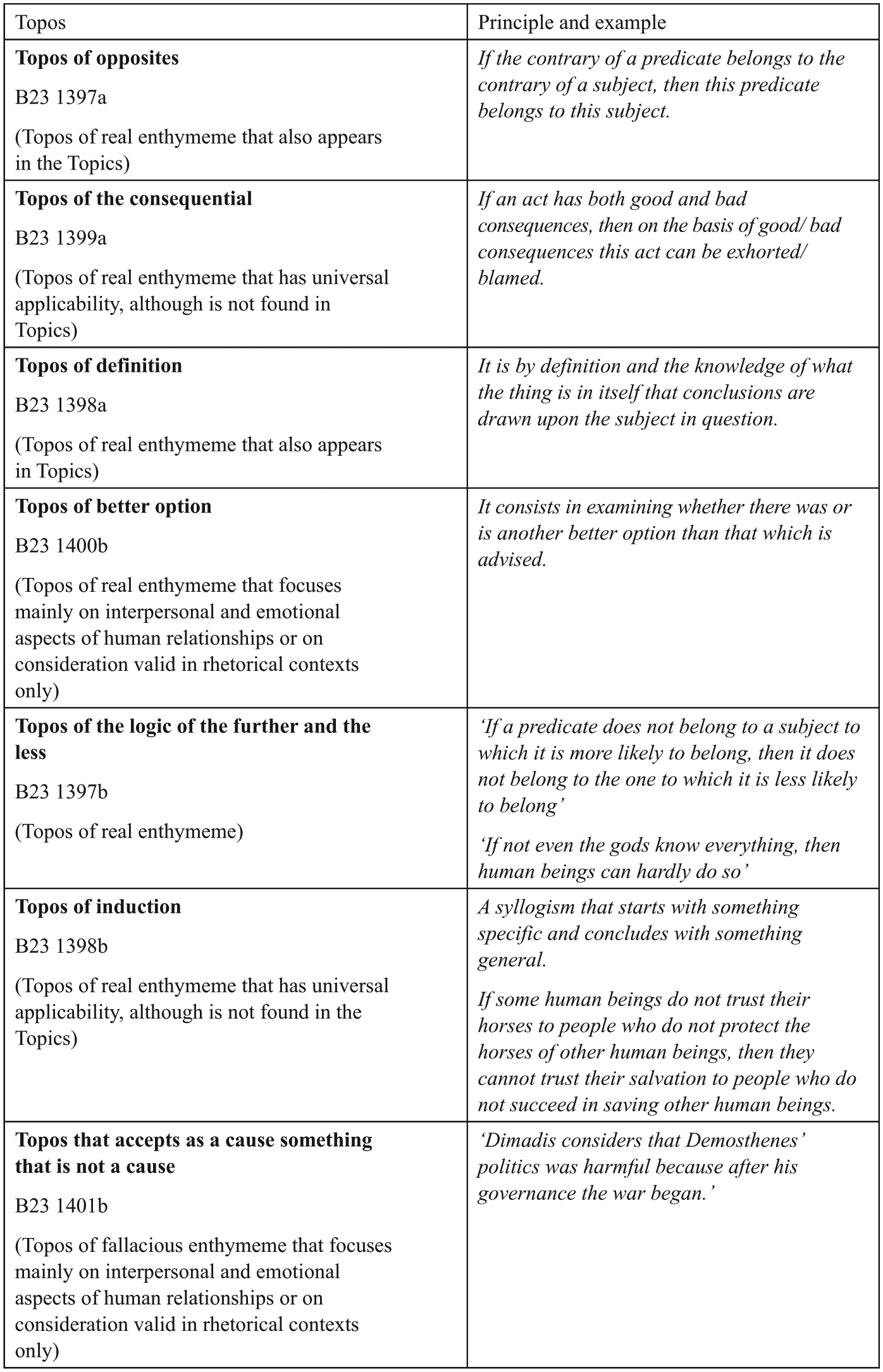
Selected topoi of Aristotle’s Rhetoric.
Perelman and Olbrecht-Tyteca (1969) draw on and elaborate Aristotelian Rhetoric and develop so-called New Rhetoric. Following Aristotle, Perelman and Olbrecht-Tyteca (1969) distinguish between the loci of quantity and the loci of quality; loci of quantity justify why a particular action is to be preferred because most people would benefit from it; loci of quality explain why an action should be done because it is the best course (pp. 85–93). Hence, according to Perelman and Olbrecht-Tyteca, loci are argumentation schemes that are based on value hierarchies and are used as justification for statements insofar as they express the preferences of a particular audience. From my viewpoint, the adoption of Cicero’s definition of locus/loci in New Rhetoric combined with Aristotle’s syllogisms of topoi creates an ambiguous view of the concept of topoi that is extended from Aristotle’s endoxon to Roman law, which seems to be dominated by Cicero’s loci.
Meaning of topos in the DHA: Clarification and perspectives
As aforementioned, various scholars who focus on Toulmin’s argumentation theory claim that a warrant is a crucial element in determining the validity of argumentation, for the warrant explicitly indicates that the step from data to claim is justified and why this is so.
7
Following Wengeler’s (2003) work, and Kienpointner’s (1997: 226, 2001: 18) argumentation approach as well as his view of topoi as warrants that are related to Toulmin’s model, Reisigl and Wodak (2009) describe topoi as
… parts of argumentation which belong to the required premises. They are the formal or content-related warrants or ‘conclusion rules’ which connect the argument with the conclusion, the claim. As such, they justify the transition from the argument to the conclusion. Topoi are not always expressed explicitly, but can always be made explicit as conditional or causal paraphrases such as ‘if x, then y or y, because x’. (p. 110)
The concept of topos within the DHA is defined as a warrant that connects the argument with the conclusion. Furthermore, there is no distinction between topoi and loci in the DHA. According to Kienpointner (2001), Cicero’s topos is relevant to Toulmin’s model (p. 20). As Rubinelli (2009) notes,
Cicero applies the topos by means of a rule of Roman law. It is what Aristotle in Rhetoric A2, 1358a would call a principle. Cicero’s premise is not an endoxon, it is part of the established body of knowledge of Roman law and his argument is not rhetorical, but belongs to the law. (p. 72)
Indeed, she proceeds to a comparison of Cicero’s locus with Aristotle’s topos in order to prove her argument. Hence, the locus ‘if someone has not been freed by either having his name entered in the census roll or by being touched with the rod or by a provision in a will, then he is not free’ illustrates Cicero’s emphasis on Roman law and the fact that Cicero approached topoi as warrants. In contrast, the topos ‘if not even the gods know everything, human beings can hardly do so’ is applied by means of an endoxon, that the ‘gods do not know everything’, which challenges tradition (Rubinelli, 2009).
Following Rubinelli’s viewpoint, I argue that there is a differentiation between Aristotle’s and Cicero’s forms of argumentation schemes, which stems not only from different philosophical schools but also from different historical and political eras. More specifically, Aristotle evolved his dialectical syllogism and argumentation theory through the prism of Athenian democracy. Here, I should clarify that I do not refer to democracy as a regime and do not aim to idealise the Athenian form of democracy; drawing upon Castoriadis’ (1990) work I mention the Athenian democracy as the terrain where philosophy had been developed to challenge tradition and ‘Truth’. Hence, Aristotle emphasised endoxon and the value of the majority’s opinion and claimed that endoxa have to be challenged, whereas Cicero’s loci were developed in the era of the Roman Empire with its autocratic form of governance and on the basis of Roman Law.
Drawing upon Wengeler’s (1997) approach to topos, Reisigl and Wodak (2001) present a list of topoi that were used by the two authors for the analysis of arguments regarding discrimination. 8 Figure 2 introduces the most frequently used DHA topoi.
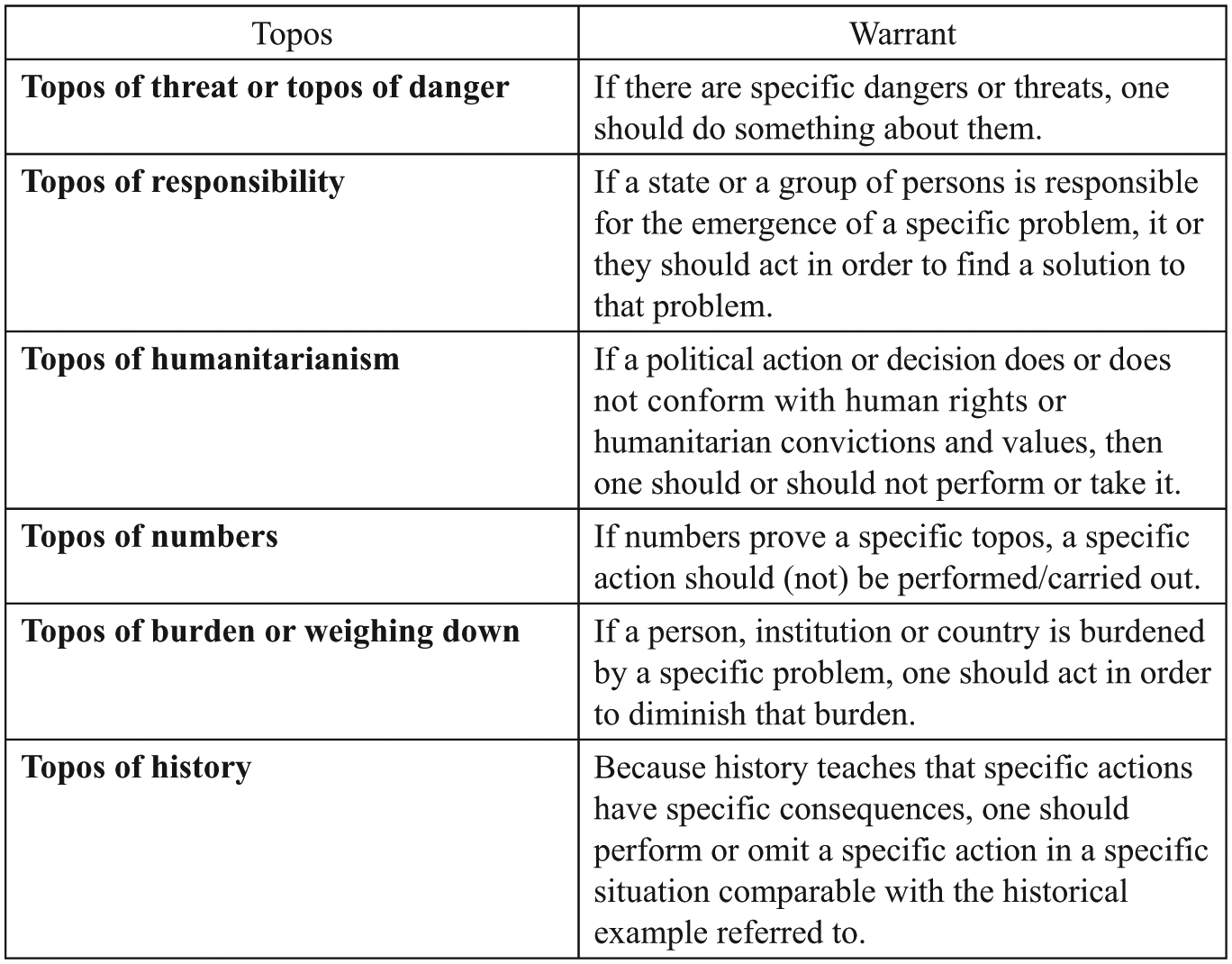
Selected DHA topoi.
A first look at the two figures reveals an analogy between the two classifications of topoi. But the DHA’s topoi are more specific and most of them seem to relate to the Aristotelian topos of consequential. From my perspective, topoi can offer the scholar the opportunity to recognise and systemise arguments. As Rubinelli (2009) comments, ‘what is more appropriate in a specific context is still a matter of [a] scholar’s creativity and understanding of the interlocutor. Clearly the selection of the scheme is influenced by the questioner’s general knowledge of the subject’ (p. 23). Thus, topoi are not always labelled with the same nominations and not limited to unique classifications; in each case, they emerge from the arguments that the interlocutor or the author uses, and the researcher usually has to construct his or her own topoi in order to finalise his or her analysis. In other words, I assume that Aristotelian topoi (Aristotle, 2004) provide a holistic classification of topoi that can be used by interlocutors to persuade the audience, but might be named differently, in relation to their arguments. For this reason, topoi can be useful in a systematic analysis of various discourses, insofar as they provide the researcher with an opportunity to examine accepted stereotypes or ‘knowledge’ of the ‘other’. I would like to present an example of the function of the Aristotelian topos in the DHA’s argumentation strategies in the next section.
Case study: Greek media discourses about Islam in relation to the terrorist attacks in Madrid and London
Anatomy of the terrorist attacks in Madrid (11 March 2004) and London (7 July 2005)
In 2004, the political status quo in Greece changed after the victory of the conservative party, New Democracy, in the elections of 7 March and the defeat at the polls of the socialists (Panhellenic Socialist Movement (PASOK)) who had ruled the country for almost 20 years. Furthermore, the preparations for the forthcoming Olympic Games in Athens (August 2004) were a top priority issue on the Greek political agenda at the time. Thus, the Greek media, and especially newspaper editorials, emphasised both the political changes in the country and the cultural and political importance of Athens’ Olympic Games.
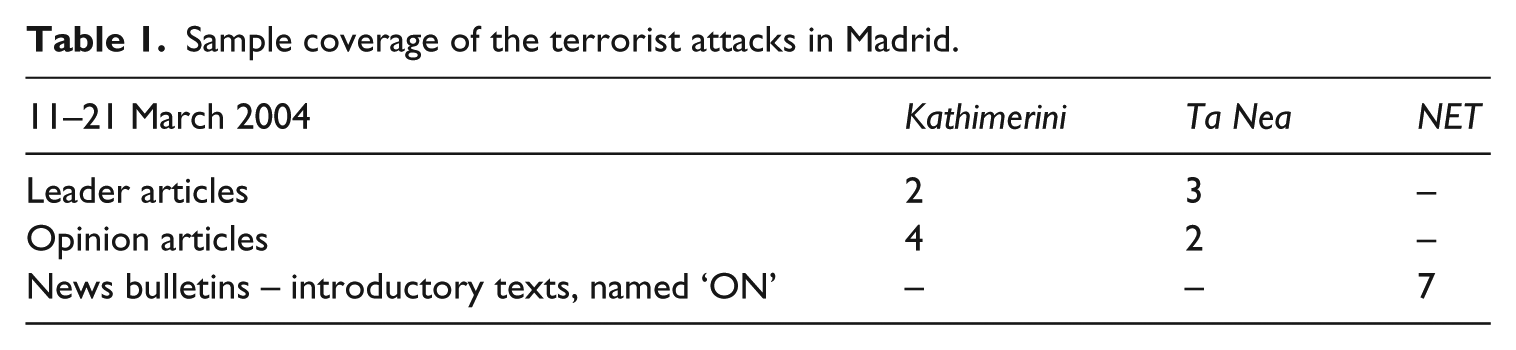
The terrorist attacks in Madrid (11 March 2004) were covered by the Greek media, particularly by two newspapers – the conservative Kathimerini and the centre-left Ta Nea – and in the main news bulletins of Greek public television, although the two newspapers did not give an in-depth commentary of the topic. Hence, there were not many editorials regarding those terrorist attacks in Madrid. The sample for this topic is provided in Table 1.
Sample coverage of the terrorist attacks in Madrid.
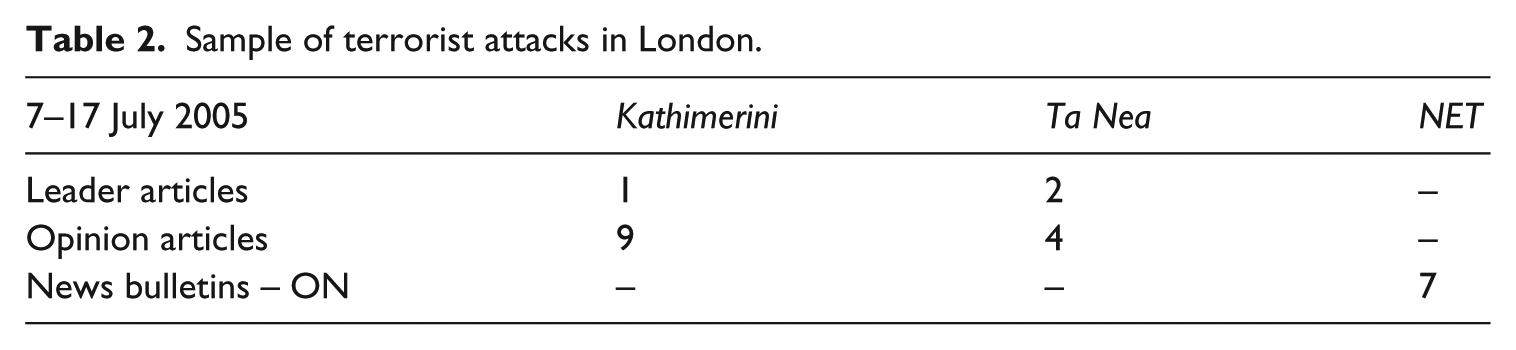
More than a year after the terrorist attacks in Madrid, further attacks took place in London on 7 July 2005. At that time, the United Kingdom was hosting the annual G8 Summit in Gleneagles, Scotland. The majority of the Greek mass media linked the summit in Scotland with the terrorist attacks in London. Moreover, the same media presented the attacks as a result of Britain’s participation in the ‘war on terror’ and the invasion of Iraq (March 2003). The newspapers adopted these arguments and the editors analysed the same arguments, in detail, in their articles. In addition, some references to these events were included in the news bulletins on Greek public television. The sample for this topic is presented in Table 2.
Sample of terrorist attacks in London.
Representations of ‘Islamist 9 terrorists’
In the cases of the Madrid bombings and the London attacks, both newspapers and public television focused on representations of the perpetrators of the terrorist attacks, and they presented the suspects in similar ways. In particular, the metonymic nominalisation ‘Islamist terrorism’ dominates the rhetoric of the three media. The use of this metonymy emphasises the suspects’ links to extremism and anonymity and is a generalisation of them:
Example 1 Despite its causes Example 2 … How can you react against an Example 3 The Islamist mindless violence has shown its heinous face again … This is the most bloody terrorist attack ever perpetrated in Europe. (NET, 11 March 2004)
Here, metaphors such as ‘Islamist terrorism is blind’, ‘European scene’, ‘the face of paranoia’, the ‘Islamist mindless violence has shown its heinous face’ dominate the editors’ and news directors’ rhetoric which intends to highlight violence as Islamist terrorism’s main methodology and also its causes. Metaphors are based on the value system of a society and play an important role in the development of specific ideological frames in a text. As Charteris-Black (2014) mentions,
metaphor is effective in public communication because it draws on the unconscious emotional associations of words and assumed values that are rooted in cultural and historical knowledge. For this reason it is potentially a highly persuasive force and activates unconscious, often mythic, knowledge to influence our intellectual and emotional responses by evaluating actions, actors and issues. (p. 160)
Hence, metaphors can often be used as an effective persuasive tool by politicians or the mass media. Moreover, using the concept an ‘invisible enemy’, the editor of Ta Nea proceeds to a recontextualisation, a transformation of the concept from a political genre to a journalistic one, as she or he adopts a characterisation that was used by the then American President Bush and dominated the American rhetoric during the Cold War.
Thereafter, the editors of Kathimerini compare the Basque terrorist group ETA with ‘Islamist terrorists’. The editors of the newspaper mention ETA as a ‘separatist organisation’ and not a ‘terrorist group’. In other words, they use specific categorisation devices in order to dissociate ETA from ‘Islamist terrorists’, which is disclosed by nomination strategies of the DHA (Reisigl and Wodak, 2009: 93–94). In this way, they create a discursive distinction between these two forms of terrorism and illustrate that they have a rather idealistic-positive attitude to ETA’s aims, but not to those of ‘Islamist terrorists’.
Example 4 The Basque separatist group, ETA, acts only against specific Spanish ‘targets’ and has not adopted slaughterous methods. In contrast, the
The above extract reveals that the editor of Kathimerini focuses on the ‘methodology’ of ETA in order to differentiate it from ‘Islamist terrorism’ and develops a distinction between the two groups via the Aristotelian topos
In the few days following the terrorist attacks in London, the Greek media focused on representations of the suspects:
Example 5 The perpetrators of the terrorist attacks in London were not inhabitants of Afghanistan. Their children would not have had to grow up in Kabul without water and at risk from bullets. Their parents would not have had to face the army in occupied Palestine or the totalitarian and authoritarian regimes of the Arab world. Theoretically, they did not have any reason to act in the way that they acted … (Kathimerini, opinion article, 16 July 2005)
This extract from a Kathimerini article reveals the stereotypes that dominate Greek media discourse on the Middle East and the ‘Arab world’. Indeed, the editor of the article seems implicitly to justify the terrorist acts that derive from people who live under authoritarian regimes or in occupied territories, but at the same time renounces the terrorism that comes from people who have been integrated into Western societies and notes that the specific perpetrators ‘did not have any reason to act in the way that they acted’. This argument is further developed via the Aristotelian
The editor of Kathimerini represents the Arab world and its links to Islamist terrorism in a general and false way. In particular, she or he presents terrorism that has its source in the Middle East and the Arab world as a defence against repression and abjection and this leads to a generalisation about Islam and the Middle East and to victimisation of Arabs who live in the ‘Arab world’. Finally, his or her rhetoric reaches the conclusion that all ‘Muslims’ are different from ‘Westerners’ and that they are also inclined to terrorism. Thus, the editor discursively differentiates between ‘us’ and ‘them’, although this time the dichotomy is not based on a contrast between ‘Islamist fanatic terrorists’ and ‘Western innocent victims’, but on an antithesis between ‘uncivilized, miserable Arabs’ and ‘civilized Westerns’, a common binary opposition (Lévi-Strauss, 1962). In particular, the binary oppositions between good and evil, civilised and uncivilised, and poor and rich seem to be useful in the rhetoric of Kathimerini’s editors, insofar as these oppositions simplify the distinction between ‘us’ and ‘them’ and cultivate a conviction about the inferiority of the ‘Islamist other’ (Richardson, 2004; Tekin, 2010).
The same form of binary opposition is also used in other articles in the newspaper:
Example 6 Instead of the division between the ‘kingdom of good’ and the ‘kingdom of evil’ one other division will be more useful, the division between the ‘kingdom of wealth’ and the ‘kingdom of poverty and misery’. The source of terrorism exists in the second kingdom. No other division [cultural or religious] can exceed the division of the planet between countries which have wealth and countries or continents that have not. This division contradicts the meaning of our epoch and causes phenomena of blindness and nihilistic fanaticism, such as terrorism. (Kathimerini, opinion article, 9 July 2005)
Thus, concerning the binary oppositions between poverty and wealth, misery and prosperity, although they simplify the global social structure, they also seem to support the polarisation of ‘us’ and ‘them’, and this time they victimise the ‘other’, who is represented as inferior to the ‘Westerner’. According to Said (1991), Orientalism, which means the official construction of Western knowledge about the East, is an ineradicable distinction between Western superiority and Oriental inferiority (p. 42). It is a political vision of reality whose structure polarises the distinction between the familiar (Europe, the West, ‘us’) and the strange (the Orient, the West, ‘them’) (Said, 1991: 43). Binary oppositions are also used to establish a dichotomy between Christian Europe and any religious ‘Other’ (Richardson and Wodak, 2009) and they are usual in news concerning Islam (Richardson, 2004, 2009). Hence, the editor of Kathimerini adopts a binary opposition between the superior West and the inferior Orient and represents Islam as an inferior and miserable ‘other’, which includes ‘Islamist terrorists’, on the basis of the dichotomy between ‘us’ – wealthy Europeans, and ‘them’ – miserable Arabs and potential Islamist terrorists.
Islamist terrorism as a topos of threat
The aforementioned Greek media representations of ‘Islamist terrorism’ lead to the construction of an in-group (‘us’, Europeans and Greeks, superiors, innocents and potential victims) and an out-group (‘them’, terrorists, fanatics, inferiors and enemies). The construction of this discursive contrast is served by the Aristotelian
The three media use an almost picaresque representation of ‘Islamist terrorism’ which is based on several metaphors, metonymies and hyperboles:
Example 7 The terrorist attack in Madrid verifies that no one can believe that the problem [Islamist terrorism] will not knock on their door … These terrorist groups have no regard for human life and there are no technologies or safety measures that can guarantee civilians’ safety across Europe … (Ta Nea, leader article, 12 March 2004) Example 8 Title: Terror across Europe An ‘inflation of fear’ … dominates Europe after the heinous attacks in Madrid. The threat that Al Qaeda will attack again … has raised the alarm with governments and security authorities [across Europe] … (NET, 15 March 2004) Example 9 The enemy – Islamist terrorism – is invisible. It appears suddenly; it attacks and disappears in the dark and thereafter reappears in the same or a different city, or country … (Kathimerini, opinion article, 12 July 2005) Example 10 Fear is hovering over Britain and other European countries … (NET, 11 July 2005) News Titles: ‘Terrorphobia’, ‘The threat is close’, ‘Europe alarmed’. (NET, 11 July 2005)
The result of using metaphors such as ‘the problem will not knock on their door’, ‘The enemy … is invisible’, ‘it appears suddenly’, ‘it attacks and disappears in the dark and thereafter reappears’ and hyperboles such as ‘fear is hovering over Britain …’, ‘an inflation of fear dominates Europe’, ‘fear across Europe’ and the neologism ‘Terrorphobia’ (τρομοφοβία) is that the editors and news directors imbue impersonal nominations, ‘Islamist terrorism’ and ‘Europe’ or ‘European countries’ with anthropomorphical features that highlight the roles of the two actors (perpetrators and victims). In this way, they establish in their readers’ and audiences’ minds the concept of Islamist terrorism as an ‘enemy’ that threatens the whole of Europe. Moreover, these metaphors and hyperboles introduce a metaphoric scenario of horror (Musolff, 2006), based on an ‘obscure enemy’, that is, Islamist terrorism. In other words, metaphors that emphasise the threat and add an emotional tone to the consequences of Islamist terrorism create a metaphoric scenario of a common, dangerous enemy that imposes horror on Europeans.
Stereotype of a ‘native terrorist’: Topos of internal threat
In the days after the terrorist attack on 7 July (7/7), the editors of Kathimerini, like the editors and news directors of the other two media, proceeded to represent those who were suspected of the London bombings and focused on their ‘European’ way of life:
Example 11 According to the British Authorities the four suicide bombers were British citizens born of Pakistani parents who were born, studied and lived all their years in the UK. Among them, was a 22-year-old well-educated man who played cricket and drove a Mercedes and a 30-year-old father of a child. There are people who know the ‘civilised West’ … (Kathimerini, opinion article, 14 July 2005) Example 12 The four Islamist terrorists who attacked London were British citizens. They were born and grew up in England and led an absolutely normal life. They were interested in cricket … They are humans that live among us and they are determined to kill themselves in the name of their beliefs … These terrorists are wealthy, well educated and integrated into the Western way of life … (Ta Nea, leader article, 14 July 2005) Example 13 A British citizen of Pakistani origin is the brain behind the massacre attack in London … The British authorities announced today the name of the fourth terrorist, who is also the man next-door. (NET, 14 July 2005)
Here, the editors and news directors underline the fact that the terrorists were ‘British citizens’ ‘humans, who lived among us’, and lived an ‘absolutely normal life’. These representations of the suspects lead to the construction of a new stereotypical, metonymic nominalisation, that of ‘
Conclusion: Topos of the consequential or topos of threat – why topoi matter
Argumentation strategies are one of the main features of the DHA and together with other discursive strategies lead to a systematic analysis of the discursive dichotomy between ‘us’ and ‘them’. The usage of argumentation strategies, and especially the introduction of the concept of topos by the DHA, has, however, been challenged by various scholars. In this article, I argue that for a more comprehensive understanding of the concept of topos, more work needs to focus on Aristotelian thought. By reintroducing the context of topos in Aristotelian dialectic and rhetoric, the aim of this article is to emphasise the complicated concept of Aristotle’s topos and the classification of topoi in the Rhetoric debunk misunderstanding related to topos usage by the DHA and illustrate its significance in the study of political and media discourse.
By examining Greek media representations of ‘Islamist terrorism’ and emphasising the topos of threat, which I argue is relevant to Aristotle’s topos of the consequential, this article attempts to illustrate the role of Aristotelian thought in DHA through the Greek media representations of ‘Islamist terrorism’. Thus, I argue that the usage of topoi highlights the manifold context and practices of the DHA that are linked to the systematic analysis of biased discourses and the discursive construction of in-groups and out-groups. Moreover, the reintroduction of Aristotle’s rhetorical topoi surpasses misunderstandings and misreading regarding the links between DHA and argumentation strategies and can provide new insights into the analysis of the discursive distinction between ‘us’ and ‘them’.
Footnotes
Acknowledgements
The author would like to thank Dr Christos Boukalas and Professors Ruth Wodak and Dimitra Dimitrakopoulou for the encouragement and advice they provided during the writing of this article. She would also like to thank the reviewers for their constructive comments, which contribute to the elaboration of this article.
Declaration of conflicting interests
The author(s) declared no potential conflicts of interest with respect to the research, authorship, and/or publication of this article.
Funding
The author(s) received no financial support for the research, authorship and/or publication of this article.