



Abstract
This study examines the characteristics of request sequences in Chinese public service calls. The data analysis indicates that a prominent characteristic of Chinese public service calls is the frequent appearance of insert expansions and non-minimal post-expansions, with the latter occurring after both preferred response and dispreferred response. This is closely related to participants’ institutional identities and epistemic asymmetry; operators handling such service calls should pay due attention to this asymmetry to ensure mutual understanding in conversation.
Introduction
Requesting is a ubiquitous activity in our daily social lives. People make requests to get services, for information and/or an object in various contexts. Since the 1970s, the notion of requests has been studied from the perspective of speech act theory, politeness theory, and conversation analysis (CA). Searle examined requests as illocutionary acts in terms of their ‘felicity conditions’. He classified them as members of directives, which were defined as ‘attempts by the speaker to get the hearer to do something’ (Searle, 1976: 11). However, his study was based on invented and isolated utterances rather than naturally occurring conversations.
Brown and Levinson (1987) studied requests as face-threatening acts and proposed politeness strategies on the basis of three variables, namely social dominance, social distance and imposition. Various studies following this framework have examined request strategies in a variety of indigenous languages (e.g. Felix-Brasdefer, 2005; Shahrokhi, 2012), including comparative studies of request strategies across different languages (Blum-Kulka and Olshtain, 1984; Lee, 2005; Lin, 2009; Vacsi, 2011), using data collected from role-play or discourse completion test. However, ‘the use of decontextualized scenarios to elicit the data meant that they neglected the sequential environments in which requests occur’ (Ogiermann, 2015: 1).
Recently, a growing number of studies have investigated requests in naturally occurring conversations. These studies have been mainly conducted in terms of the following three dimensions: overall structure (Lee, 2006; Zimmerman, 1992), sequence organization (Goodwin and Cekaite, 2013; Kent, 2012; Kuroshima, 2010; Lee, 2009; Rauniomaa and Keisanen, 2012; Ronneberg and Svennevig, 2010; Schegloff, 2007), and turn design of requests (Curl and Drew, 2008; Drew, 2013; Heinemann, 2006; Lindstrom, 2005; Zinken, 2015). However, most of these studies investigate requests and responses in Indo-European languages (for an overview, see Drew and Couper-Kuhlen, 2014), whereas to the best of our knowledge no study has empirically examined request sequences in Chinese institutional talk.
Previous studies have pointed out that specific goals, institutional identities, and epistemic status of participants have consequences for the trajectory, content, and character of the interaction that parties conduct in institutional talk (Drew and Heritage, 1992). This study is an attempt to explore how these characteristics of institutional talk influence request sequences in 12345 public service calls. 1 As Hepburn et al. (2014) pointed out, the goal of CA is also ‘to further specify helpline practices and to improve helpline effectiveness’ (p. 240). This study will therefore identify problems in the Chinese public service calls, look for possible causes, and propose suggestions for practical solutions.
Organization of request sequence
A central tenet of CA is that people perform an action through talk. It is critical that utterances are not examined as isolated sentences. Rather they should be ‘in the first instance contextually understood by reference to their placement and participation within sequences of actions’ (Atkinson and Heritage, 1985: 5). The minimal form of a sequence is an adjacency pair, consisting of the first pair part and the second pair part. The first pair part initiates an action trajectory, whereas the second pair part responds to that action (Schegloff, 2006). The adjacency relationship is both prospective and retrospective; a sequentially initial turn mobilizes a co-participant to perform a type-fitted response (Stivers and Rossano, 2010) and the response displays its speaker’s understanding of the prior turn (Sacks et al., 1974). In request sequences, a request is the first pair part and response to the request is the second pair part. The initiation of a request projects the relevance of a response and the response displays its speaker’s understanding of the request.
Responses to sequentially initiated actions show asymmetries: responses that are aligned with the course of action are preferred, whereas responses that are not aligned with it are dispreferred (Raymond, 2003). In most cases, alignment, confirmation, and acceptance are maximized, and disalignment, disconfirmation, and rejection are minimized (Pomerantz and Heritage, 2013). In request sequences, granting the request is the preferred response, whereas rejection is the dispreferred one.
Many sequences involve expansions of the minimal adjacency pair. ‘Such expansions involve additional participation by the parties through additional turns, over and above the two which compose the minimal version of the sequence’ (Schegloff, 2007: 26). Expansions occur in three sequential positions: pre-expansions occur before the first pair part; insert expansions occur between the first pair part and the second pair part, including post-first insert expansions and pre-second insert expansions; post-expansions occur after the second pair part, including minimal post-expansions and non-minimal post-expansions (Schegloff, 2007). Figure 1 displays the basic format of sequence organization in conversation.
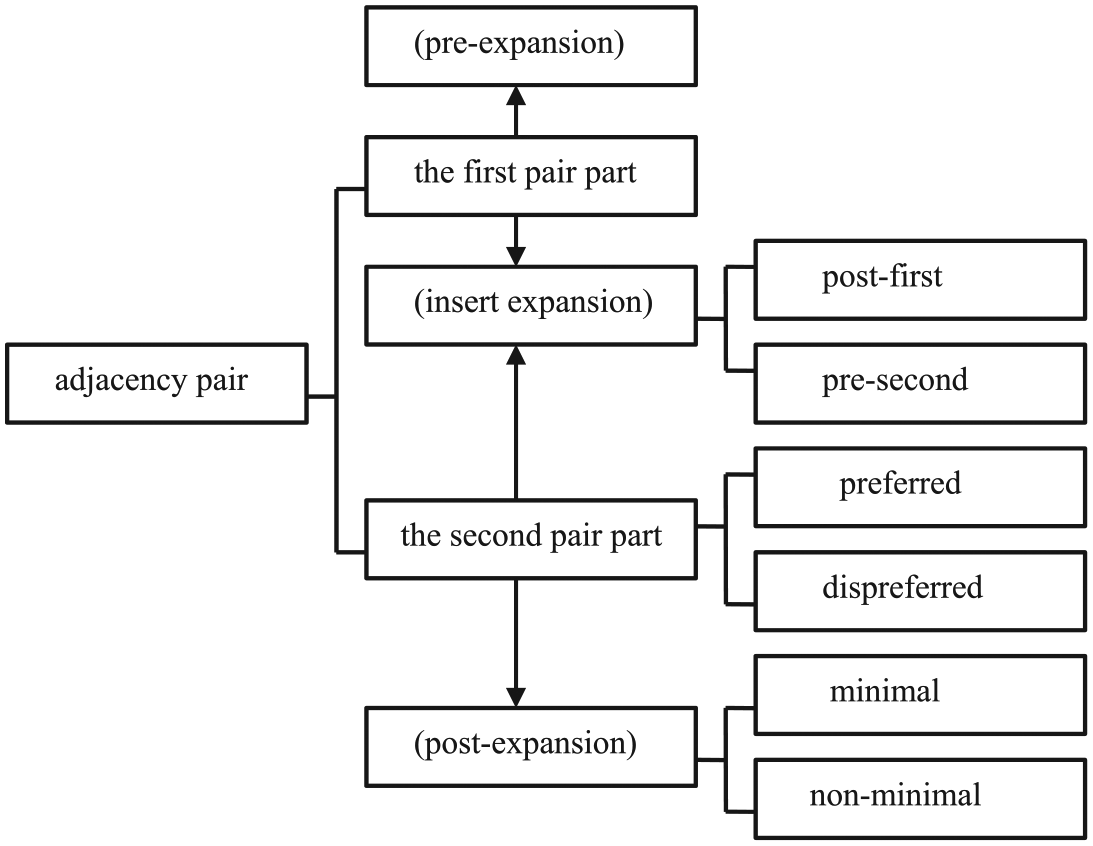
Sequence organization in conversation.
Data
The data corpus comprises 150 audio-recorded public service calls made in 2012–2013 to a helpline established by the Chinese government in various cities with the aim of solving citizens’ problems and concerns in their daily lives. Citizens dial the telephone number 12345 to reach this helpline. Data collection was approved by the relevant departments. During these calls, citizens ask questions, express their dissatisfaction with public services, and/or ask for assistance if they encounter troubles. Operators, on the other hand, provide required information and advice and offer immediate help, in accordance with specific regulations. Should they be unable to provide immediate services, operators forward callers’ problems to their supervisors, who will negotiate with relevant departments to deal with them within a certain period. More importantly, operators collect detailed information regarding callers’ problems, evaluate their nature, and determine whether some assistance is warranted. Since this helpline is an official service call, the procedures of which are strictly regulated by the government, it provides a useful data set for the study of Chinese public service calls.
In total, our database consists of 154 request sequences, which were transcribed following Jefferson’s transcription system (see Atkinson and Heritage, 1985). Personal identifiable information, including callers’ names, addresses, and telephone numbers, has been coded in double parentheses or renamed to protect callers’ privacy. Data analysis draws on CA methods, entailing an empirical investigation of request sequence organization in this institutional setting and close examination of the characteristics of turns associated with participants’ institutional identities.
Analysis of request sequence in Chinese public service calls
The detailed analysis of the request sequences revealed that minimal sequences are expanded in a variety of ways.
As shown in Table 1, around the core part (‘A’ and ‘B’), expansions occur in all request sequences. Of all these expansions, insert expansions occur most frequently (86.36%), followed by non-minimal post-expansions (59.74%) and minimal post-expansions (40.26%), whereas pre-expansions occur much less frequently (1.30%). These results indicate that insert expansions and non-minimal expansions play important roles in the request sequences explored in this study.
Variations of request sequence in public service calls.
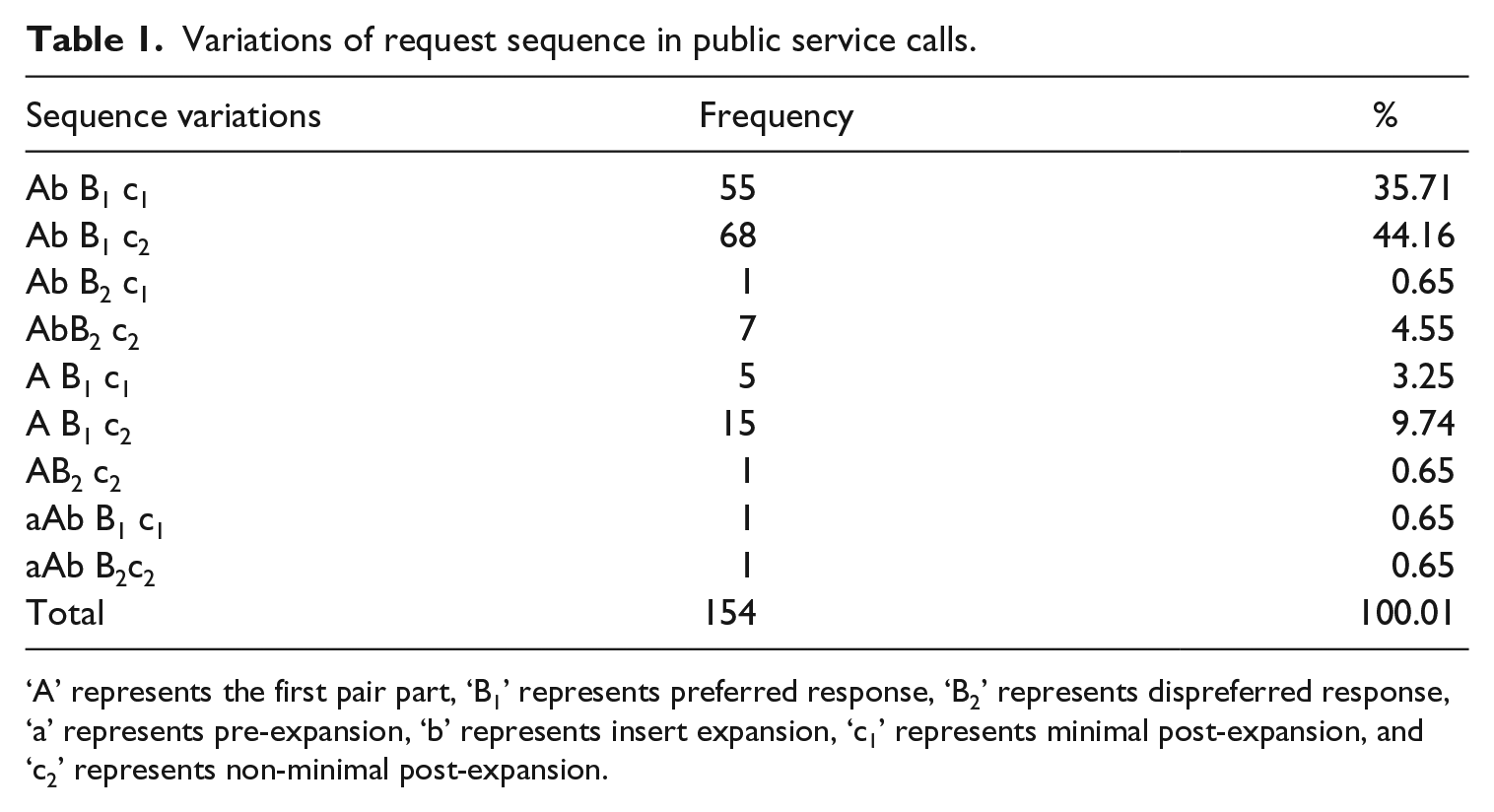
‘A’ represents the first pair part, ‘B1’ represents preferred response, ‘B2’ represents dispreferred response, ‘a’ represents pre-expansion, ‘b’ represents insert expansion, ‘c1’ represents minimal post-expansion, and ‘c2’ represents non-minimal post-expansion.
Post-expansions occur after both preferred responses and dispreferred responses. One minimal post-expansion and nine non-minimal post-expansions occur after dispreferred responses. In total, 61 minimal post-expansions and 83 non-minimal post-expansions occur after preferred responses. In other words, non-minimal post-expansions occur more frequently than minimal post-expansions after both preferred and dispreferred responses.
This finding is inconsistent with Schegloff’s findings regarding post-expansions of sequence organization. Specifically, Schegloff (2007) states that
Preferred responses tend to lead to closing the sequence, while dispreferred responses regularly lead to expansion of the sequence. We have already seen that much (though not all) pre-expansion and insert expansion is oriented to (the possibility of) dispreferred responses, and we shall see that the same holds true for post-expansion. And not only does this hold for the occurrence of any expansion at all, but also for the degree of expansion. (p. 117)
Our analysis, however, indicates that minimal post-expansions and non-minimal post-expansions occur after both preferred responses and dispreferred responses, while non-minimal post-expansions occur more frequently than minimal post-expansions. Accordingly, preferred responses are closely associated with expanding rather than closing sequences. This difference may be accounted for by differences in the data sets: Schegloff’s study mainly investigates daily conversations, while our study focuses on Chinese public service calls, which constitute a kind of institutional talk. Thus, the different finding of our data analysis may be closely related to characteristics of this specific type of institutional talk. To sum up, it is clear that the frequent appearance of insert expansions and post-expansions (especially non-minimal post-expansions) is a prominent characteristic of request sequences in this institutional setting.
During the calls under investigation in this study, callers make requests by reporting an event, whereas operators collect detailed information of the event to evaluate its nature. If the caller accepts the operator’s response, request sequences come to a closure. In contrast, if the operator’s response is questioned or challenged, request sequences are expanded. Accordingly, in request sequences in this institutional setting, the frequent appearance of insert expansion and non-minimal post-expansion indicates the importance of achieving mutual understanding between participants in the process of accomplishing institutional tasks.
Request–response adjacency pair
The adjacency relationship of request and response obeys the relevance rule of sequence organization. The first pair part makes the occurrence of the second pair part relevant. Note that ‘“first” and “second” do not refer merely to the order in which these turns happen to occur; they refer to design features of these turn types and sequential positions’ (Schegloff, 2007: 20). In Chinese public service calls, callers’ requests and descriptions of their problems elicit various responses from the operators. Preferred responses are delivered in three ways: providing immediate help, giving a reasonable explanation, or promising to report to their supervisors events they cannot take care of themselves. Non-preferred responses are associated with providing no help at all and occur in three kinds of cases: callers’ problems are not within the scope of the helpline’s responsibility; callers’ problems concern events or conduct that does not contravene official regulations; or callers could not provide essential information regarding their problems. What follows is an example of request sequence:
Extract 1
2
1 Caller: nage: wo shi ((diming)) de jumin. e:: wo you yi ge anzi, uh 1SG COP place name NOM resident uh 1SG have one C case Uh:: I am a resident in ((place name)). Uh:: I have a case. 2 ya le delay ASP ten year ASP until now still N for deal with The trial of it has been delayed for 3 Operator: nvshi, nin ting wo shuo a, nin zhege e: shefa anjian women madam 2SG listen 1SG say PTC 2SG this uh: legal case 1PL Madam, please listen to me. 4 zhuanxian shi wu quan ganshe de. hotline COP N right deal with NOM Our hotline has no right to deal with uh: legal case. 5 (2.0) 6 Caller: na wo shang shiwei zhao qu ya? then 1SG to municipal council seek help go PTC Then should I seek help from municipal council? 7 Operator: jianyi nin jixu zou sifa tujing. advice 2SG continue take legal route I advise you to continue taking the legal route.
As shown in Extract 1, some callers make a request by reporting an event. Heritage and Clayman (2010: 65) studied requests in emergency calls and analyzed various formulations callers employed. They took ‘Someone just vandalized my car’ as an example and pointed out that this utterance might be heard in various ways depending on different identities of its hearer. It might be an account for canceling an appointment if the hearer is a doctor. It might be an unloading of personal trouble if the hearer is a good friend. It is routinely treated as a request for help due to the institutional identities of participants in a service helpline. Drew and Walker (2010: 98) also pointed out that most requests in police emergency calls are quite implicit or indirect, and callers report an incident rather than overtly making a direct request. Similarly, in Chinese public service calls, call takers also treat callers’ description of events as seeking assistance and deliver an appropriate response.
In Extract 1, the caller describes the trouble she has encountered in seeking help from the government. She emphasizes the word ‘ten’ to indicate that this event is a breach of the rules. By constructing the reported event as a breach of social norm, the caller tries to make her request reasonable. Knowing that the caller’s trouble is a legal problem, the operator delivers a dispreferred response, namely, that this helpline could not deal with a legal problem. This account indicates that the operator’s refusal to help is due to the fact that the caller’s request does not accord with institutional guidelines – hence, the operator’s response is delivered according to institutional guidelines and regulations.
Extract 2 shows an example where the caller makes a request (lines 1–10) by describing an event. The operator delivers a response (line 12) after collecting more information regarding this event (line 11):
Extract 2
1 Caller: wo- wo shi nage: jiushi ((qu ming)) de 1SG 1SG COP uh uh district name NOM I- I live in uh: uh ((apartment building name)) 2 ((xiaoqiu ming)). apartment building name. of ((district name)). 3 Operator: en. hmm Hmm. 4 Caller: nage women zhege danyuan ba nage shui biao dong le, uh 1PL this unit PTC that water meter frozen ASP Uh- the water meter of our unit got frozen. 5 mei you shui chi. N have water drink. We don’t have water to drink. 6 (2.5) 7 Caller: wanle shang nage: jiushi nage zilaishui gongsi qu then go uh I mean uh running water company go Then I went to uh- I mean uh- water supply company 8 zhao qu, nage jingli zhi women yi ge libai. seek help go that manager postpone 1PL one C week to seek help. That manager postponed the solution of our event for a 9 women yi ge libai dou mei you shui chi a. women shizai 1PL one C week all N have water drink PTC 1PL indeed week. We have been short of water for a week. We indeed 10 mei you banfa la, jiu gei ni dadianhua qiu zhu. N have solution PTC just to 2SG phone ask for help don’t have a solution, so we phone you to ask for help. 11 (The operator asks details of this event in the omitted part) 12 Operator: wo gei ni huibao yixiazi a. 1SG for 2SG report once PTC I will report this problem for you.
In Extract 2, the caller describes the whole process of the event in detail, including the reason for its occurrence, how the caller tried to solve it, and why he failed. This description constitutes the caller’s reason for making a direct request (line 10). In a similar study, Edwards and Stokoe (2007) pointed out that ‘Given that asking for help is an accountable matter, one account is that one cannot help oneself, or have tried and failed to help oneself, when helping oneself is a normatively expectable first thing to do’ (p. 10). Calling the helpline is regarded as the last resort, after all attempts by citizens to solve problems by themselves have failed. After requiring more details of the event (line 11), the operator promises to report this event to her supervisor (line 12), following the procedures of this institutional setting, since the operator is unable to solve this problem herself. It can be inferred that the operator’s response is constrained by her institutional identity.
To sum up, in the adjacency pair of request sequences in this institutional setting, the caller makes a request by describing an event and rhetorically constructing it as a breach of regulations. The operator delivers a response based on the collected information of the event. The operator’s response is constrained by institutional policy and his institutional identity.
Insert expansion
The sequential position of insert expansions is between the first pair part and the second pair part. It can be divided into post-first insert expansion and pre-second insert expansion. In post-first insert expansion, conversational repair is a strategy for solving problems in hearing or understanding the preceding talk (Schegloff, 2007: 100). Conversational repair is often initiated by operators to ensure an accurate understanding of key information in callers’ requests, as in Extract 3:
Extract 3
1 Caller: wei, nihao. wo xiang zixun yixiazi jiushi wo xiang wen yixia hey hello 1SG want consult briefly I mean 1SG want ask briefly Hey, hello. I want to consult- I mean I want to consult 2 ((shi ming)) de jiu shi zhexie chaiqian de zhexie buchang city name NOM just COP these demolish NOM these compensation something about compensatory payment for demolishing houses 3 shi zenmo buchang de ya? COP how compensation NOM PTC in ((city name)). 4 (2.3) 5 Operator: chaiqian buchang shi zenmo buchang de? demolish compensation COP how compensation NOM Compensatory payment for demolishing houses? 6 Caller: dui, jiu chaiqian buchang biaozhun. yes I mean demolish compensation standard Yes, I mean standard of compensatory payment for demolishing houses. 7 (The omitted part is more information of this event) 8 Operator: ni dao jianshe ju qu jiu xing 2SG to construction bureau go just could You could go to construction bureau.
In Extract 3, the caller makes a request for information about compensatory payment for demolishing houses (the first pair part, lines 1–3). The operator advises the caller to go to the construction bureau to get the relevant information (the second pair part, line 8). Between this request and response, the operator inserts an expansion through which they initiate a conversational repair aimed at ensuring an accurate understanding of the caller’s request. Schegloff et al. (1977) define conversational repairs as a linguistic strategy to address problems in speaking, hearing, and understanding in conversations. In this institutional setting, operators initiate repair to address problems in understanding or hearing key information in callers’ requests before responding. In this extract, since ‘compensatory payment for demolishing houses’ is the key information of the caller’s request, the operator initiates a repair at line 5 to ask what the caller is actually referring to by this expression. This is helpful for the operator to judge the nature of the caller’s problem and respond to this appropriately.
Pre-second insert expansions are prospective. They are used to check whether conditions on granting the request have been met. The operator asks questions to collect more information about the caller’s problem according to his professional knowledge, as in Extract 4:
Extract 4
1 Caller: wo zai ((diming)) de gongdi ganhuo shou shang, 1SG at place name NOM building site work BEI hurt I got hurt at a building site in ((place name)). 2 xianzai wo zai yiyuan zhuyuan, mei ren guan Now 1SG in hospital in hospital N people take responsibility I am in hospital now, but no one takes responsibility for this event. 3 wo xianzai. zhe shi wo gai zenmo ban? 1SG now this event 1SG should how deal with How should I deal with it? 4 Operator: en, ni zhege dangshi qu deshihou ni qian mei qian zhege hmm 2SG uh then go when 2SG sign N sign uh Hmm. You uh- when you go there did you sign uh- 5 laowu hetong huozhe shenmo de ya? service contract or something NOM PTC a service contract or something else? 6 Caller: zhege- zhege mei you, women: mei you zhege. this this N have 1PL N have this We didn’t have this, we: didn’t have this. 7 Operator: shenmo dou mei you? anything all N have Didn’t you sign anything? 8 Caller: en. hmm Hmm. 9 Operator: na ni zhege zixunxia lvshi ba, kan dao fayuan qisu ba. then you this consult lawyer PTC consider to court sue PTC Then you could consult a lawyer or consider suing in court.
In Extract 4, the caller makes a request for information (base first pair part, lines 1–3). He first claims that no-one takes responsibility for his accident and then asks how he should deal with this problem. The operator advises him to take legal action (base second pair part, line 9). This request and its response constitute the minimal adjacency pair of this request sequence.
Between the first pair part and the second pair part, there are two question–answer sequences (lines 4–8). The operator asks these questions to collect more information regarding the caller’s problem. Although the caller is more accessible to his own problem, he does not know what information should be emphasized to indicate the nature of his problem, so some important information is not included in his description. The operator, on the other hand, being more experienced, knows what to ask to get the caller to provide information necessary for the evaluation of the event. Based on acquired information in the insert expansion, the operator delivers a response to the caller’s request at line 9.
It can be inferred from this analysis that the knowledge asymmetry between the caller and the operator causes the frequent appearance of insert expansions of request sequences. Insert expansions are therefore generally operator-directed and task-oriented in this institutional setting.
Post-expansion
Post-expansions of request sequences can be divided into minimal post-expansions and non-minimal post-expansions. In cases of minimal post-expansions, there is only one turn following the second pair part of the base adjacency pair. ‘Non-minimal post-expansions are different in that the turn following that second pair part is itself a first pair part, and thereby projects at least one further turn – its responsive second pair part – and thereby its non-minimality’ (Schegloff, 2007: 148–149), as happens in Extract 1 earlier.
In minimal post-expansions, callers accept operators’ responses, indicating the closure of the request sequence. In non-minimal post-expansions, callers initiate a further negotiation about operators’ responses by conversational repair, proposing challenges, making further requests for assistance, or asking for more information. In Extract 1, after the operator’s non-preferred response (lines 3–4), the caller asks for more information on the solution of her problem (line 6). The operator advises the caller according to her professional knowledge (line 7). This question–answer sequence constitutes the non-minimal post-expansion after a dispreferred response. Non-minimal post-expansions occur not only after dispreferred responses, but also after preferred responses. Extract 5 is taken from the same telephone call as Extract 4. The caller initiates repair after the operator’s advice:
Extract 5
9 Operator: na ni zhege zixunxia lvshi ba, kan dao fayuan qisu ba. then you this consult lawyer PTC consider to court sue PTC Then you could consult a lawyer or consider suing in court. 10 Caller: a, zhege jiu dei zhao-zhao lvshi a? ah this just have to find find lawyer PTC Ah, do I have to find-find a lawyer? 11 Operator: dui, dui dui dui dui. yinwei xiang ni zhe zhong right right right right right because like 2SG this sort Right, that’s right. Because we don’t have ways of dealing with this 12 qingkuang women mei you banfa shouli. yinwei zhege case 1PL N have ways deal with because uh sort of case like yours. Because uh- in our country, 13 zanmen guojia you falv tiaowenguiding. jiushi xiang nin zhe 1PL country have legal provision I mean like 2SG this there are relevant legal provisions. I mean as to this sort of case like 14 zhong qingkuang, zanmen gongdi yinggai gei nin peichang sort case 1PL building site should to 2SG compensate yours, we do not have ways I mean- I mean 15 duoshao qian huozhe zenmo chuli, zhe women mei you how much money or how deal with this 1PL N have to identify and confirm how much the building site should 16 banfa jiushi jiushishuo ba zhege rending, heshi zhe ge shi. way I mean I mean BA this identify confirm this C thing compensate you or how they should deal with this event.
At line 9, the operator suggests that the caller consult a lawyer or sue in court. The caller initiates repair to ask for an explanation of this suggestion at line 10. The operator accounts for his suggestion according to the institutional policy (lines 11–16). As a representative of this institution, he emphasizes their inability rather than unwillingness to provide some help. This example indicates that due to a lack of professional knowledge, callers sometimes cannot fully understand the operators’ advice. So it is necessary for the operator to provide an explanation to avoid the caller’s misunderstanding of his response and therefore achieve the government’s aim of serving citizens to the maximum.
Frequently, callers initiate non-minimal post-expansions to ask for more information about the operators’ way of solving their problems in the future, as in Extract 6. Extract 6 is taken from the same telephone call as Extract 2. The caller asks questions after the operator promises to take some action:
Extract 6
12 Operator: wo gei ni huibao yixiazi a. 1SG for 2SG report once PTC I will report this problem for you. 13 Caller: a, dei duobantian na? ah need how long PTC Ah, how long will it take? 14 Operator: women huibao shi you liucheng de. huibao gei lingdao, 1PL report COP have procedure NOM report to leader We have a procedure of reporting an event. I report it to our leader, 15 lingdao ranhou zai chuli. wo ye bu zhidao duobantian leader after that then deal with 1SG also N know how long and then the leader will deal with it. I don’t know how long it will 16 ne. zhengchang shi ni jintian dadianhua jintian PTC normally COP 2SG today phone up today take either. Normally, if you phone up today, 17 shi jiejue bu liao. COP solve N could your problem could not be solved within today. 18 Caller: na wo- na wo- na wo zhe ye bu dong. na zenmo then 1SG then 1SG then 1SG this also N know then how Then I- then I- then I do not have any idea about this. 19 neng gei women jiejue ya? women hai zenmo ban na? could for 1PL solve PTC 1PL still how do PTC Then how could our problem be solved? What else could we do? 20 Operator: wo shuo guo le, wo zhe gei ni huibao. qita de wo 1SG say ASP ASP 1SG this for 2SG report other NOM 1SG I have said that I will report this event for you. 21 bu qingchu. you jieguo hui you xiangguan bumen gen N know have result ASP have relevant department with I do not know other things. The relevant department will contact you 22 ni qude lianxi. 2SG get contact when there is a result.
In Extract 6, the operator promises to report the caller’s problem to her supervisor, which apparently does not satisfy the caller who in turn wants to know when and how her problem will be solved (line 13 and lines 18–19). This example indicates that the caller makes a request with an expectation of solving her problem. Sometimes this expectation is not met since the operator cannot provide an immediate solution. What the operator can do instead is record details of the caller’s problem and report these to her supervisor, in which case the problem will be handled in a few days. However, the caller is not knowledgeable about this procedure and is evidently not satisfied by the operator’s account of the procedure.
At several points in this extract, the operator fails to co-operate by responding more directly to the caller’s enquiries about how long it will take to resolve the problem. The caller presses for more information about when and how their problem will be handled, through a non-minimal post-expansion aimed to know more about the helpline’s procedure for helping. When answering the caller’s questions, the operator continually fails to provide information about how and when the caller’s problem will be handled/resolved. The operator’s expressions, ‘I do not know how long it will take either’ and ‘I do not know other things’, seem to generate the caller’s evident dissatisfaction with this service call – dissatisfaction that is inconsistent with the government’s aim in setting up this helpline to improve public services.
To sum up the above analysis, needing to know more about the agency’s procedures and the urgency with which those procedures might be implemented, the caller initiates the non-minimal post-expansion after the operator’s dispreferred response and preferred response. The non-minimal post-expansion is generally caller-directed. Since the aim of this helpline is to meet citizens’ needs to the maximum, it is crucial for the operator to provide clear and detailed information in order to alleviate the caller’s perplexity and misunderstanding of the operator’s response.
Discussion
The study presented in this article examines the characteristics of request sequences in Chinese public service calls. In this institutional setting, callers make a request by describing events and constructing them as anomalous, and operators respond following regulations and considering their institutional responsibilities and remit. Around the adjacency pair, insert expansions and post-expansions frequently appear. In cases of insert expansions, operators collect information that will help them to evaluate the nature of the reported events. In cases of minimal post-expansions, the request sequences come to a closure. In non-minimal post-expansions, callers open up further negotiations about the operators’ response. Request sequences are therefore co-constructed by both participants, and the course of accomplishing this action is closely related to their institutional identities.
These characteristics of request sequences in this institutional setting are associated with participants’ knowledge asymmetries. Heritage (2012: 32) argues that the imbalance of knowledge between speakers and hearers motivates and warrants a sequence of interaction and that the interaction will be closed when the imbalance is acknowledged as equalized.
As shown in Figure 2, operators are more knowledgeable about how the helpline operates compared to the callers. Callers, on the other hand, are more knowledgeable about their personal experience compared to the operators. Based on this asymmetry, Heritage (2013) proposes the concept of epistemic status, which includes the following three aspects: (1) participants’ relative epistemic access to some domain of knowledge (more knowledgeable (K+) or less knowledgeable (K−)); (2) participants’ means of acquiring some domain of knowledge (through what method; degree of definiteness, certainty, etc.); and (3) participants’ rights, responsibilities, and obligations to gain some domain of knowledge. This asymmetry could account for the frequent appearance of insert expansions and post-expansions and the directorship of interaction in this institutional setting.
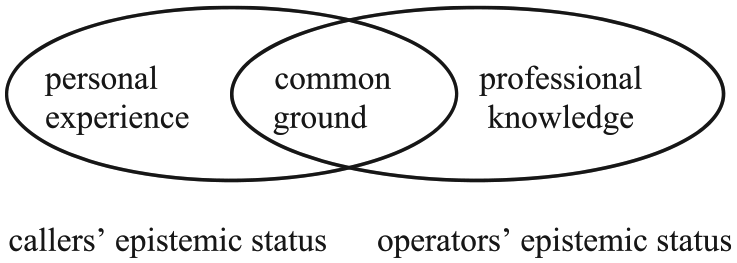
Epistemic status of participants in service calls.
Callers make a request implicitly through reporting an event. But the information they provide is often insufficiently detailed for the operator to act upon. Therefore, operators may be obliged to collect more information that is necessary for evaluating the nature of the reported event and respond appropriately. Because of dissatisfaction with or misunderstanding of operators’ responses, callers initiate non-minimal post-expansions, the purpose of which is to request more information about the solution of the reported problems and the procedures of this institution. Operators elaborate their responses and explain the procedures according to their professional knowledge. In this course, the imbalance of participants’ information on the reported event and institutional knowledge tends to be equalized.
The epistemic asymmetry also causes different directorship of interaction in insert expansions and post-expansions of request sequences: insert expansions are operator-directed, whereas post-expansions are caller-directed. In insert expansions, operators collect information about reported events according to their professional knowledge. In non-minimal post-expansions, callers initiate further negotiation about operators’ responses. The request sequence will not be closed until callers accept the operators’ responses. The large number of post-expansions and callers’ directorship indicate that one main characteristic of service calls is to meet callers’ needs to the maximum.
Another reason for the frequent appearance of non-minimal post-expansions is that some request sequences in this institutional setting are future-oriented. Rauniomaa and Keisanen (2012: 830) point out the difference between immediate and future-oriented request sequences. In future-oriented request sequences, actions (i.e. solving citizens’ problems in this setting) are carried out after the conversation. In this helpline, some of the reported events could not be dealt with over the phone. After the telephone call, the operator reports the event to his supervisor, who in turn will approach the relevant departments to solve it. In some calls, however (such as Extract 6), the caller expects immediate assistance or a means of resolving the problem, while the operator’s response is constrained by the regulations associated with his or her institutional responsibilities and duties. This mismatch is one reason for the non-minimal post-expansions after the operator’s preferred response.
Based on our analysis of the characteristics of request sequences, three implications can be highlighted. First, after callers make a request, it is crucial for operators to get detailed and accurate understanding of callers’ problems before delivering a response. Callers usually give a rough description of their problem. It is necessary for operators to ensure a correct understanding of key information by initiating a conversational repair, and to collect more information by asking questions. This is beneficial for the evaluation of the nature of the caller’s problem and the appropriate response by the operator. Second, operators should take callers’ epistemic status into consideration while delivering a response. Since the operators’ responses are constrained by their institutional role and responsibilities and institutional policies, sometimes operators cannot provide an immediate solution to the callers’ problem. In such cases, operators should be careful to do everything possible to alleviate callers’ misunderstanding and possible confusion. Third, when callers initiate non-minimal post-expansions after the operators’ responses, operators should give a clear explanation of the response and show willingness to provide help. The operators’ vague explanations and indifference to the callers’ perplexity may cause the callers’ distrust of this helpline and the government. This goes against the government’s aim of setting up this helpline to serve citizens.
Conclusion
Based on detailed data analysis of 150 Chinese public service calls, this article has examined the characteristics of request sequences in this institutional setting. We have found that the appearance of sequence expansions causes variations of the request sequence organization and that the frequent appearance of insert expansions and post-expansions (especially non-minimal post-expansions) is the prominent characteristic of request sequences in this setting. Non-minimal post-expansions occur not only after dispreferred responses, but also after preferred ones. This is closely related to epistemic asymmetry between participants in institutional talk, so operators should pay due attention to this asymmetry to ensure mutual understanding in communication. This study not only enriches studies of request sequences and institutional talk but also helps to improve operators’ service quality. This is a preliminary investigation of request sequences in Chinese public service calls, and thorough data analysis could be conducted in future studies.
Footnotes
Appendix 1
Acknowledgements
We would like to thank the reviewer for his insightful comments and for carefully editing the language. Our great gratitude also goes to Dr Maria Varkanitsa in Massachusetts General Hospital (Harvard Medical School) for her help in language editing.
Declaration of conflicting interests
The author(s) declared no potential conflicts of interest with respect to the research, authorship, and/or publication of this article.
Funding
The author(s) disclosed receipt of the following financial support for the research, authorship, and/or publication of this article: This research was supported by The Referential Establishment and Continuity in Chinese and English Conversation project, funded by the National Social Science Foundation of China, and the Young Talent Team Discursive Perspective of Diagnosis and Therapy program, funded by Shandong University.