



Abstract
The article deals with larger stretches of talk-in-interaction and argues in favor of a descriptive approach, which integrates the structural requirements of global organization, the special type of sequential orderliness within larger units as well as the genre-orientation of these units. Drawing on previous work in conversation analysis, discourse analysis and the sociological genre analysis, the article introduces GLOBE as an analytical tool which functionally links discourse units to conventionalized communicative purposes. GLOBE reconstructs the interactive achievement of genre-oriented discourse units in a three-branch analysis of jobs, devices and forms. The analytical potential of GLOBE is demonstrated in the exemplary genre-contrastive analysis of a narrative, an explanative and an argumentative excerpt. On the basis of the analyses of the three genres, the overarching constitution of genre-oriented global units is then explicated.
Keywords
Introduction
Larger, coherent stretches of talk in conversation are constitutive of large parts of verbal interaction (Robinson, 2013). For instance, when people tell stories, provide explanations or resolve a dissent, they usually accomplish such larger stretches of talk. Different notions have been deployed to capture the above-the-sentence-level nature of such talk as opposed to single turns or moves, for instance ‘big packages’ (Sacks, 1995: II, 354), ‘large projects’ (Selting, 2000), ‘projects of activity’ (Robinson, 2013), ‘extended sequences’ (Mondada, 2012; Psathas, 1992), ‘coherent conversational units’ (Jefferson 1978: 219), ‘activity types’ (Levinson, 1979) or ‘discourse units’ (Houtkoop and Mazeland, 1985; Wald, 1978).
In this article, we outline an analytic framework within Interactional Discourse Analysis (IDA; cf. Morek et al., in press) that – taking up the notion of ‘discourse units’ (Wald, 1978) – synthesizes key work on such global practices in discourse analysis (DA), conversation analysis (CA) and genre analysis (GA). Taking a sequential approach to the participants’ orientations and their joint activities in terms of different practices, we analyze different types of discourse units. We tie together CA’s central insights into the mechanisms of sequential organization, the notion of discourse structures above the sentence level as discovered by DA, and the functional view on genres as pre-patterned solutions to communicative problems as put forward by GA.
Our ideas are thus indebted to a wide array of work in the aforementioned traditions, while at the same time they represent a particular research program. Our work has been largely concerned with children’s acquisition of the discursive skills to participate in discourse units, such as stories, explanations or arguments (Hausendorf and Quasthoff, 1996; Heller 2012, 2014; Morek 2012, 2015; Morek et al., in press; Quasthoff, 1997a). Our empirical, mostly comparative investigation into large corpora (see ‘Data and method’ section) of children’s interactions in adult–child settings, peer talk and classroom discourse called – and allowed – for the inductive development of an analytic framework fit to describe the different shares in the joint accomplishment of different global units.
In the following section we sketch the key ideas of previous work in DA, CA and GA that are pertinent to our notion of ‘discourse units’ and their analysis. Next we introduce the kind of data we drew on to develop our methodology and outline the analytic format. We then demonstrate how our GLOBE framework can be employed in the analysis of narratives, explanations and argumentations in conversation, focusing on one level of our framework, the organizational tasks or ‘jobs’, respectively. Following this we discuss conclusions as to the structural commonalities among discourse units of different genres as revealed by the analyses. Taking the task of ‘closing a discourse unit’ as an example, we finally demonstrate, how ‘devices’ and ‘forms’ as resources are used to accomplish a ‘job’ and how they differ in genre-specific ways.
Different insights into ‘coherent stretches of talk’
Among the different research traditions that have considered ‘coherent stretches of talk’, DA (e.g. Schiffrin et al., 2015), CA (e.g. Drew and Heritage, 2013; Sidnell and Stivers, 2013) and GA (e.g. Bauman, 2001; Bawarshi and Reiff, 2010; Luckmann, 1985) represent especially influential ones. While DA has contributed tremendously to our knowledge on how certain discourse units are structured (e.g. Labov and Waletzy, 1967; Sinclair and Coulthard, 1975) and marked linguistically (e.g. Schiffrin, 1987), CA has shed particular light on the local sequential accomplishment of ‘big packages’, such as stories (Jefferson, 1978; Mandelbaum, 2013; Sacks, 1974b), jokes (Sacks, 1974a) or trouble-telling (Jefferson, 1984). From a more anthropological and sociological perspective, approaches to genre as discursive practice have underlined the pre-patterned nature of such units and their goal-directedness with regard to recurrent communicative problems within a society (Bauman, 2001; Bergmann and Luckmann, 1995; Günthner and Knoblauch, 1995; Hanks, 1987; Luckmann, 1985, 1986).
In the following brief literature survey, we turn to the questions of how DA, CA and GA have systematically tackled the description of larger stretches of talk and how we take up some of these approaches’ basic theoretical and analytical tenets.
DA in a certain sense derives its raison d’etre from studying global units in different kinds of verbal encounters. Often following a sociolinguistic or ethnographic interest in understanding naturally occurring verbal exchanges in different fields, DA exceeded sound, word and sentence as the traditional linguistic units of analysis as well as the preoccupation with the single speech acts in early pragmatics. In terms of global linguistic structures, DA established an early notion of discourse units and their substructures (Sinclair and Coulthard, 1975; Van Dijk, 1980) and yielded insights into the internal structuring and the marking of discourse functions (Schiffrin, 1987).
Among the latter, narratives received by far the most analytical attention. Labov and Waletzky (1967) in particular have been pioneers in describing how these units are organized along the structural elements abstract, orientation, complicating action, resolution, evaluation and coda. These elements, however, do not capture how narratives are interactionally brought about. Subsequently, the discourse analytic description of narratives has been refined not only to grasp different realizations of narratives (Ochs and Capps, 2001), but also to acknowledge the interactional basis of storytelling (e.g. Bamberg, 1997; De Fina and Georgakopoulou, 2012). Among the rich stock of conceptions and findings of DA, its early insight – especially in contrast to the majority of early research topics in CA (see later) – is that there indeed is a level of global structuring prominent in spoken interaction that can be observed in different discourse types and activities. The term ‘global’ here does not refer to the overall structural organization (Schegloff, 2010; see later) of whole interactions (e.g. a lesson in school or a doctor–patient consultation), but to coherent units in such interactions that are ‘larger’ than adjacency pairs and exhibit a specific sequential organization.
This insight into globality as an orderly mechanism of interaction is most prominently explicated by Wald (1978). While most discourse analytic studies examine particular types of global discourse structures, Wald focuses on global discourse structures as such by examining how participants interactively and sequentially organize the production of ‘discourse units such as narratives, jokes, explanations etc’. According to Wald, discourse units are produced and recognized as coherent building blocks in conversation because participants themselves mark off their beginning and ending from the surrounding turn-by-turn talk. Their internal sequential realization follows a particular structural pattern for each type of discourse unit. Furthermore, when producing a discourse unit, participants establish special rules for turn-taking (Sacks et al., 1974): one participant is assigned the role of a ‘principal speaker’ and holds the right to the floor until the closing of the multi-unit turn is interactively established (for diverging management of speaker roles in argumentative discourse units, see ‘Dealing with divergent validity claims – argumentations’ later). In demonstrating how participants orient themselves to the production of these global discourse units, Wald took a perspective that is very similar to that of CA (cf. Houtkoop and Mazeland, 1985). Following Wald, we henceforth use the term ‘discourse unit’ to denote the entire conversational unit in which a narrative (or joke, explanation, etc.) is interactively prepared, produced and closed. With ‘multi-unit-turn’, we refer to the larger turn that is produced by the principal speaker within a discourse unit.
While the vast majority of conversation analytic studies have been focusing on ‘very small, crystalline bits of the conversational machinery’ (Jefferson, 1988: 418), recent work in CA more and more directs attention to activities in action formation and ascription (Levinson, 2013) and to ‘larger’ phenomena such as ‘interactional projects’ (Schegloff, 2007), ‘extended sequences’ (Mondada, 2012; Psathas, 1992) or ‘overall structural organization’ (Robinson, 2013; Schegloff, 2010). Early on, it was Sacks (1995: 3–31, 222–281, 354–359) who already pointed to the relevance of ‘big packages’, namely ‘more-than-a-sentence-long-coherent-bit-of-talk’ (p. 225).
As in most studies on larger units below entire conversations, stories have gained by far the most attention also in CA (Jefferson, 1978; Mandelbaum, 2013; Sacks, 1974b). Sacks (1995: II, 3–31, 222–228) demonstrated that telling a story in conversation requires the teller to employ methods to keep possession of the floor for an extended turn-at-talk (or ‘multi-unit-turn’) and to display to the recipients what kind of activity they are to expect and react to (Sacks, 1995: II, 21). The most typical method to project stories is a story preface (e.g. I heard something wonderful today, Sacks, 1995: II, 18). Houtkoop and Mazeland (1985), as well as Psathas (1992), take into account that there are other activities (e.g. direction-giving) that require participants to interactively tackle an ‘entry’ and a ‘closing problem’. Altogether, CA’s insights into conditional relevance as a basic organizational mechanism of interactions are of central importance for understanding the interactive and sequential realization of discourse units. With respect to multi-unit turns as such, CA has also pointed to the fact that extended sequences have their ‘parts interconnected by virtue of the problem to be solved’ (Psathas, 1992: 119).
This is where the notion of genre comes in. Among the various frameworks which make central use of a concept of genre (for reviews, see e.g. Günthner and Knoblauch, 1995), only those that explicitly base ‘genre’ on interactive practices are relevant for our argument. Bakhtin and Emerson (1986) were among the first to point out that language manifests itself in the form of speech genres, which are available as routinized resources for interlocutors to coordinate and interpret their joint activities. Their rationale is reflected in more recent approaches as developed in linguistic anthropology (e.g. Bauman, 2001; Hanks, 1987), the sociology of knowledge (Bergmann and Luckmann, 1995; Luckmann, 1985, 1986) including its linguistic extensions (Günthner and Knoblauch, 1995; Kotthoff, 2007; Linell, 2009), and in the New Rhetoric (Miller, 1984). In this sense, genres can be seen as routinized communicative solutions to recurrent communicative problems of a speech community (Bergmann and Luckmann, 1995: 291). As such, they are resources for mutual sense-making in discursive practices, drawing on the fact that the type of these problems is functionally reflected in the pattern-like generic structure of each corresponding actual verbal exchange. For example, narratives present a generic solution to the recurrent communicative problem of sharing experiences and aligning moral evaluations (Bergmann, 1987). The particular generic features of narrating are derived from this basic function (see ‘Sharing personal experiences – narratives’ later). In this view, each patterned multi-unit turn is the communicative solution to a specific recurrent task in societies. Thus, globality and genre-orientation are different tasks that have to be dealt with at the same time.
The approach of communicative genres has acknowledged not only the internal and external structure of genres, but also their situated realization (Günthner and Knoblauch, 1995). In terms of these structural differentiations, the term ‘discourse unit’ (Wald, 1978) can be considered as encompassing the internal structure and the situated realization: while genre has been used to refer to conversational activities of a very different scope (e.g. sequences of reproaches and justifications as well as job interviews), ‘discourse units’ clearly specify a specific structural range marked-off by the participants in situating them. It thus underlines the sequential orderliness such units require, so that explicating the association between discourse units and genres adds insights into the interplay of sequential structures and communicative functions.
The notion of genre needs to be distinguished from another neighboring concept, that of ‘activity types’ (Levinson, 1992). With the latter notion Levinson (1992) refers to ‘goal-defined, socially constituted, bounded, events with constraints on participants, setting […] and the kind of allowable contributions’ (p. 69). Like genres, activity types are more or less ‘prepackaged’ and ‘culturally recognized activities’ (Levinson, 1992). Yet in contrast to genres, activity types do not necessarily involve talk; paradigm examples are lessons and job interviews on the one hand, and football games and tasks in a workshop on the other. Another difference between the two notions concerns functional aspects. Although both approaches assume that genres and activities are built on structural elements that serve particular functions, the functions are conceptualized differently. While from Luckmann’s perspective genres have evolved to solve recurrent societal problems, Levinson (1992) rather emphasizes the individual character of goals (p. 71). Since we are especially interested in verbal interaction, we use the term ‘genre’. In binding it to discourse units, we also address a smaller scope in comparison to the examples given by Levinson.
To sum up, the insights contributed by DA, CA and GA have informed the development of an analytical framework that allows describing the (1) interactional organization, (2) pragmatic function of participants’ genre-specific moves and (3) linguistic and embodied resources they use when producing a discourse unit.
Accordingly, the questions we would like to ask are as follows: How do participants jointly organize the accomplishment of discourse units? How do they display to each other that a multi-unit turn is to be produced and what kind of unit is underway? How do discourse units with different genres differ from each other, and what organizational features do they share?
The analytic framework – GLOBE 1 – is used to tackle analytically the global sequential organization and genre orientation in an integrated methodological procedure.
Data and method
We draw on a variety of corpora that contain video and audio recordings of naturally occurring interactions in diverse settings. These recordings have been collected as part of different research projects, all of which investigated how differently aged children participate in the interactive accomplishment of discourse units. 2 These data include 168 hours of family talk, peer talk among friends and classroom discourse (see Quasthoff and Kern, 2007; Heller, 2012; Morek, 2012). Table 1 gives an overview of the recordings used here.
Data.
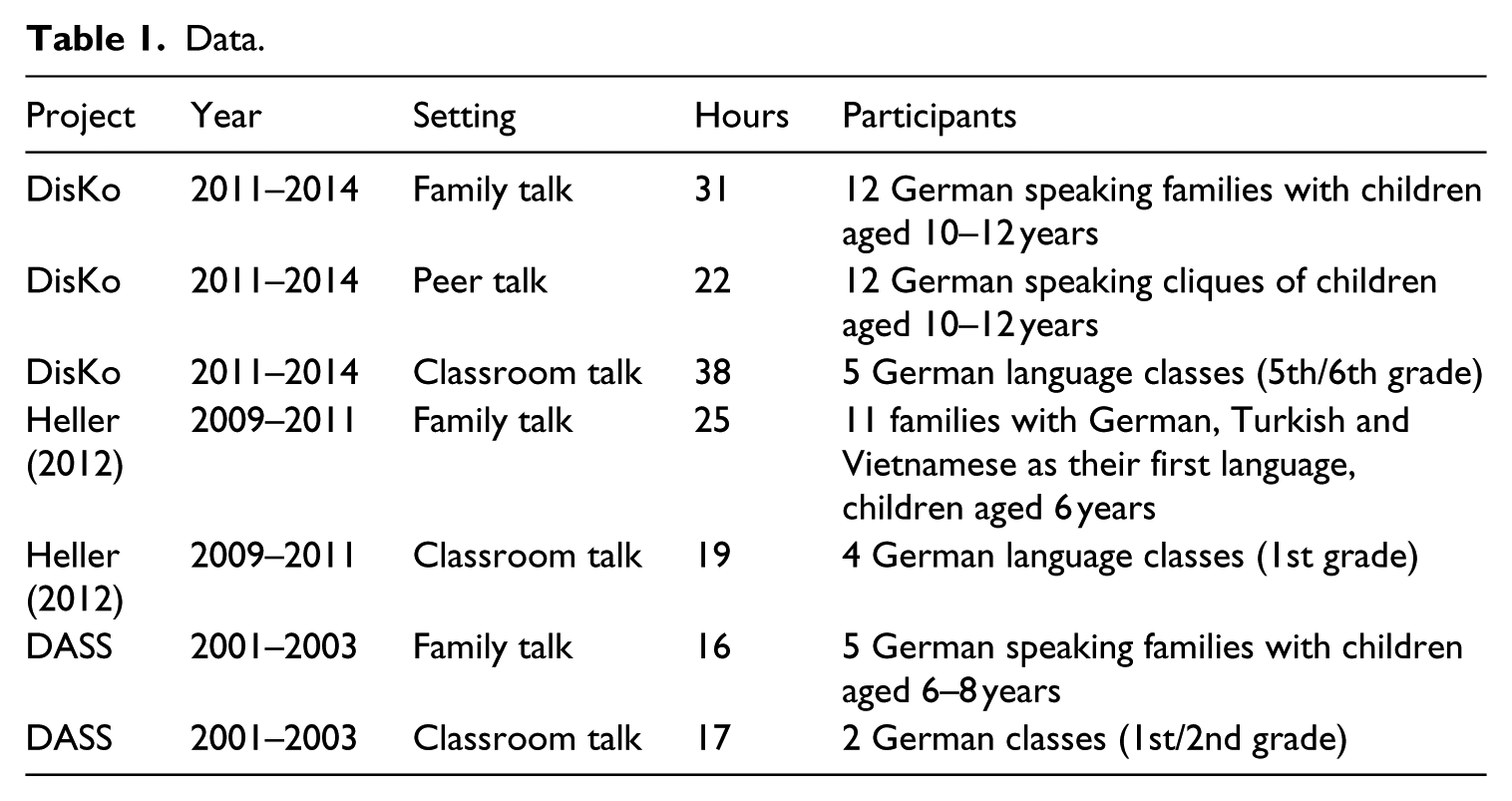
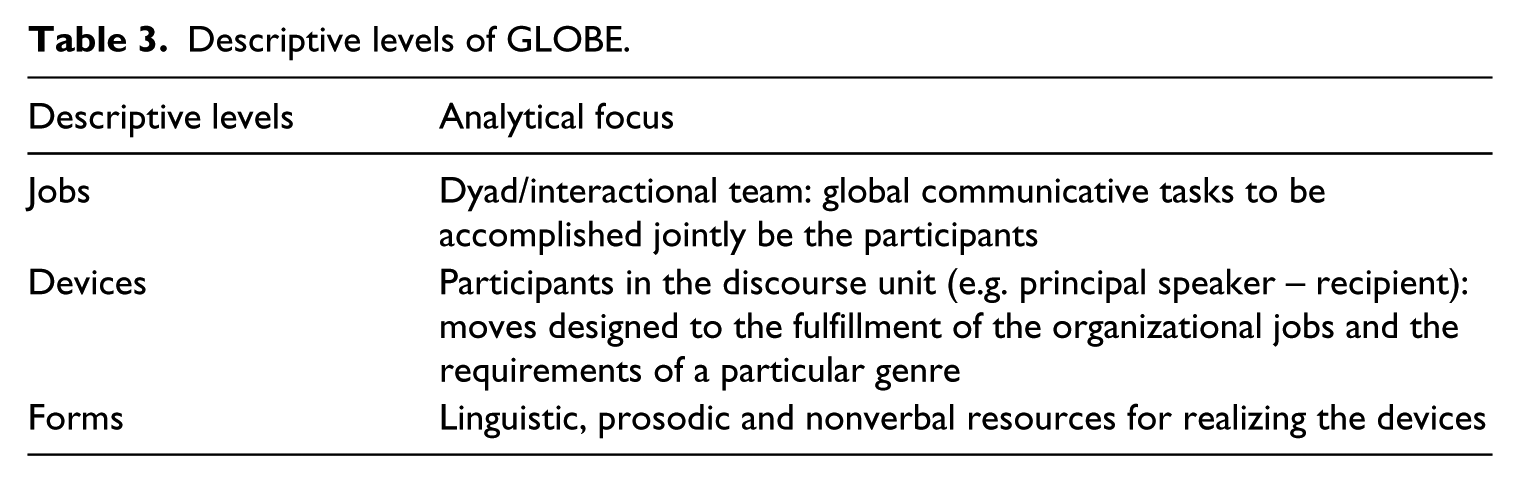
Transcription followed the conventions GAT 2 proposed by Selting et al. (2011). Sequences were selected for transcription according to our interest in narrative, explanatory and argumentative talk. Starting from a collection of similar sequences in which participants deal with comparable communicative problems, we inductively uncovered from the data how different participants sequentially organize the solution of the respective generic problem. Comparing in detail a huge number of cases finally allowed for the extraction of constitutive series of organizational tasks that participants deal with in narrative, explanatory or argumentative discourse units. Drawing on a first version of GLOBE (Hausendorf and Quasthoff, 1996), we call these organizational tasks ‘jobs’ (Psathas, 1992; Quasthoff, 1997a; Sacks, 1995: II). The analytic level of ‘devices’ describes the kind of conversational activities by which participants fulfill these jobs, while the level of ‘forms’ refers to the linguistic and multimodal surface realizations of the semantic-pragmatic devices (see Table 3).
Jobs
Jobs represent organizational tasks that have to be interactively fulfilled by the participants in the joint achievement of a discourse unit (cf. Psathas, 1991, 1992). In accordance with Wald (1978; see the previous section), discourse units are defined in terms of their unity, brought about – among other features – by their being delimited from the surrounding turn-by-turn talk (see also Quasthoff, 1997a, 1997b). Since the organizing jobs explicate the steps that are derived from the particular genre’s communicative function, the jobs vary according to the respective genre. Due to their genre-orientation, the jobs are assumed to be applicable for all instances of the particular genre and are thus context-free: if a discourse unit was successfully performed, these tasks must have been fulfilled, no matter how or by whom.
Table 2 sums up which jobs could be inductively identified on the basis of a multitude of narrative, explanatory and argumentative global sequences within the aforementioned corpora. The horizontal level indicates the sequential order of jobs.
Organizational jobs in different genres.
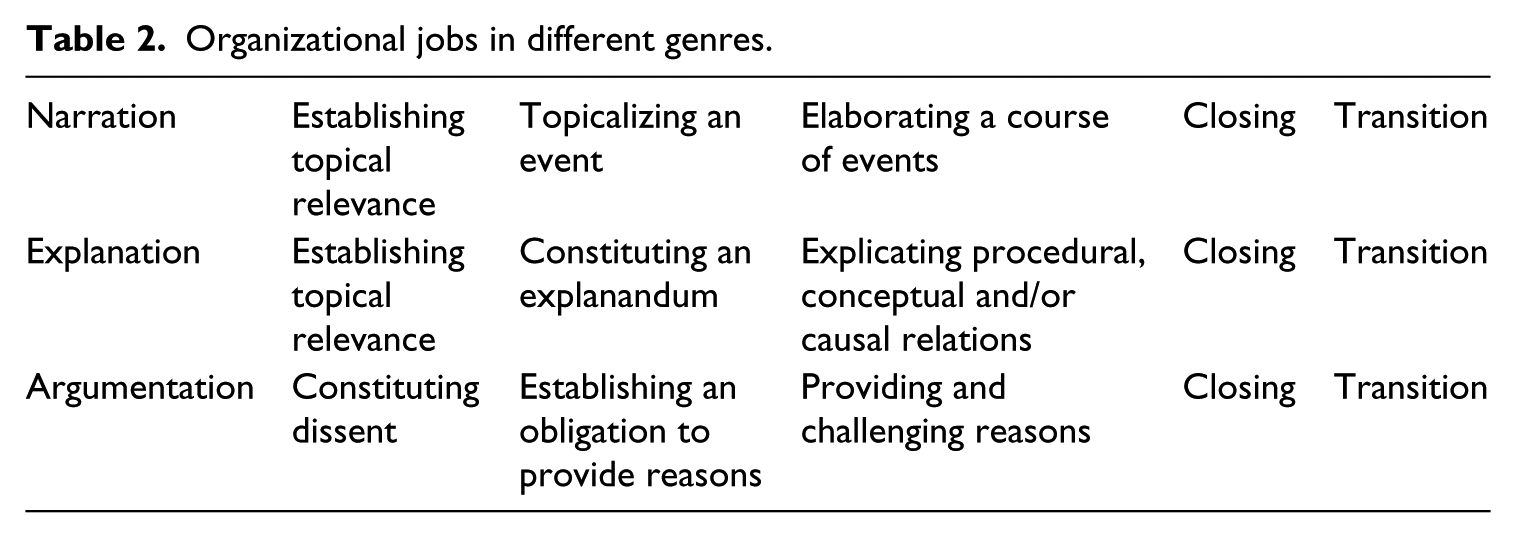
In each of the genres, the series of jobs represents an orienting framework of globality and genre-orientation that participants in our data observably mutually address when treating the respective communicative problems. They always handle these genre-specific jobs; however, they do this in a locally occasioned and context-sensitive way. For example, we find instances where participants seemingly ‘skip’ a job and/or fulfill two distinct jobs conjointly at one go, that is, by means of one utterance (see our examples in ‘Sharing personal experiences – narratives’ and ‘Explicating knowledge – explanations’ later). Such seemingly deviant cases do not undermine our finding that narrative, explanatory and argumentative discourse units are constituted by the aforementioned series of five jobs. Rather, they demonstrate the mechanism of context-specific realization of context-free resources (Sacks et al. 1974): the ways the jobs of a particular genre are interactively accomplished by specific participants in a particular conversational context, that is, the devices and forms, serve as a contextualizing resource for the ongoing interaction. 3
Devices
As opposed to jobs, the devices address each participant’s moves in their pragmatic and semantic function with regard to the overarching interactional jobs of the discourse unit. In other words, ‘devices’ address the single, mostly ‘sentence-level’ contributions made by each participant in the joint endeavor to tackle the jobs. However, by virtue of their constituting the complex unit, devices in this framework are not ‘recognizable actions’ by themselves but derive their particular quality as building blocks from the overarching discourse unit and its genre. ‘Assessments’, for example, can have the character of claims to be warranted in argumentations, references to single events in the course of narration or explicating a cause in explanations. The problem of granularity of actions (Levinson, 2013), that is, the determination of which is the main ‘business’ of the utterance, is resolved by the devices’ global attachment to jobs and genres. Devices in terms of their contributing parts to the whole of the discourse unit also establish the genre-specific interactional roles such as narrator, listener, explainer, proponent and opponent. Devices are sequentially ordered not only by virtue of the local sequential orderliness of all interactions, but also according to the requirements of the genre’s pattern.
Forms
The forms refer to the linguistic and embodied resources for realizing the functional role of the particular device. They constitute the unit’s audible and visible production and can be seen analytically as the level on which participants mark structures and functions and thus help the co-participant to identify the sort of discourse unit being underway. Achieving recognizability (Levinson, 2013) is done by forms. As devices and forms are different for different genres as well as for the different interactional roles, specific forms for establishing topical relevance or dissent are also resources for projecting the particular type of discourse unit: ‘This morning I had a row’ is heard as initiating a story (see excerpt 1) due to the reference to a tellable event; ‘Why are you making the dumpling wet?’ (see excerpt 2) states the lack of relevant knowledge and thus asks for an explanation; and ‘But they also need fully qualified grooms’ (see excerpt 3) contradicts an assumed claim and thus opens argumentation (see ‘Interactional jobs across genres and across contexts’ later for a necessarily short sample analysis of closing-devices and forms).
It is on the levels of devices and forms, then, where participants contextualize the generic pattern, relying on the recognizability of the genre but shaping it linguistically according to the immediate communicative and social demands.
Table 3 sums up the three descriptive levels. Due to space reasons, in the analyses in the following section we focus analytically on explicating the jobs. The devices and forms, however, being the material basis of how the jobs are accomplished, are actually addressed to, albeit not systematically in a technical sense (but see ‘Interactional jobs across genres and across contexts’ later). We present one excerpt each for narrative (excerpt 1), explanatory (excerpt 2) and argumentative (excerpt 3) discourse activities and show how the participants orient to and sequentially deal with the jobs constituting genre-specific globality. For reasons of comparison, all examples have been taken from family dinner talk between children and their parents.
Descriptive levels of GLOBE.
Discourse units of different genres: An analysis with GLOBE
Sharing personal experiences – narratives
In terms of communicative problems to be solved by genres, narratives present a generic solution to the communicative problem of sharing experiences and aligning evaluations. Excerpt 1 is an example for a conversational narrative of personal experience taken from a German dinner-table conversation between the parents (V: father, M: mother) and their two sons, Bernhard (B, 4 years old) and Christian (C, 7 years old):
Excerpt 1: Large truck
have some noodles
blow vigorously
it’s not that hot anymore
not if you take it from the edge
now I have one (.) .h
this morning I had a row with one of the residents there
hm:?
komischen ES-kurve da;> he grumped at me because at the bend (.) from this odd S-bend there
where there’s this hump I told you of
hm::-
where it gets tricky
from there I drove in backwards this morning
grumped at me
no banksman and no guard
and it should be announced in advance
when such a large truck must pass through there
h to begin with I asked him where he finds the large truck
((laughs))
but a huge truck doesn’t exist
((laughs))
yes, it does
Establishing topical relevance
In the immediate context of food-related activities and after a pause in the flow of conversation, the father refers to an incident that happened that morning (‘this morning I had a row with one of the residents there’, line 10). Thereby, he opens up a new topic as relevant for the interaction. While introducing topics is a common practice of talk-in-interaction, establishing relevance for a particular topic that might provide the ground for launching a narrative (Kern and Quasthoff, 2005) is a sequential prerequisite for ‘hooking up’ a story and thus a preparatory job of embedding narrative discourse units in conversation.
Topicalizing an event
Further scrutiny reveals that the father’s utterance (‘this morning I had a row with one of the residents there’, line 10) is a device that does not simply introduce a topic. By means of referring to an ‘unusual’ (Quasthoff, 1980) experience, the device establishes tellability (‘a row’) and functions as a ‘story preface’ (Sacks, 1974b) or ‘abstract’ (Labov and Waletzky, 1967) that calls for elaboration. Thus, it sets up a global sequential implication; it displays to all interlocutors that a multi-unit turn is to be expected and that this big package will be a story. In other words, globality is projected as well as the genre. We call this job of making a succeeding story expectable ‘topicalization’ (Quasthoff, 1997a).
The fact that this topicalization is ratified by the mother’s continuer (‘hm:?’, line 13) demonstrates that the job has to be dealt with interactively. The actual elaboration of the story at this point is a matter of teller–listener negotiation. In this case, the continuer gives the license to launch into the actual telling. The father is confirmed in the role of the ‘principal speaker’ (Wald, 1978) who has rights to hold the floor as long as it takes to deliver his story. In other cases, the lack of any ratification by a projected addressee of a story may bring the storytelling to an end before it has actually begun. The job of topicalizing also provides Wald’s initial delimitation of the discourse unit.
Elaborating a course of events
In line 14 the father proceeds to fulfill the global sequential obligation set by him and starts the job of elaborating the event to be told. Elaborating a course of events represents the core job of narrating. It usually requires a multi-unit turn by the narrator (or co-constructing such a turn in case of multiple tellers). The elaboration usually realizes genre-specific expectations as to the selection and sequencing of information, reconstructing a past event such as the sequencing along the temporal order of the incidents and the organization around the ‘complication’ (Labov and Waletzky, 1967). The father, for instance, starts the genre-specific recapitulation of chronologically ordered instances by ‘he grumped at me’ (line 14), thereby steering immediately into the ‘breaking of a plan’ (see Quasthoff, 1980), the unusual quality that makes a story reportable (Labov and Waletzky, 1967) or tellable (Sacks, 1995: II, 233).
He then inserts a description of the exact location of the event and the circumstances preceding the break of the plan (lines 15–18). This again is acknowledged by the mother, who thereby takes over the role of the listener in this multi-party conversation (line 16). Since the same utterance ‘he grumped at me’ is resumed verbatim in line 19, the inserted sequence is clearly marked as a side-sequence, in this case adding some orientation before reverting to the verbalizations of steps in the event.
From lines 19 to 23 the father goes on to elaborate the unexpected event breaking some kind of a plan (Quasthoff, 1980): using reported dialogue and multi-voicing (Bakhtin and Emerson, 1986; Günthner, 1999) as devices, he replays (Goffman, 1974: 504) the protagonists’ row. The laughter he produces in conjunction with re-voicing his own reaction (‘to begin with I asked him where he finds the large truck’, line 23) serves the purpose of evaluating: the protagonists are portrayed in a certain light and the neighbor’s question is ridiculed. According to the contextual requirements of conversational embedding (Ohlhus, 2014), the elaboration in this case ends with the detailing of the complication. 4
Closing
The storytelling is brought to an end once the participants signal to each other that the story’s communicative purpose of sharing and evaluating an experience has been accomplished. As the other jobs, this job of closing the story is achieved interactively: father and mother produce laughter (lines 24 and 26) and one of the sons explicates what is wrong and naive about the neighbor’s angry question (line 25). By the devices of explicating the evaluative ‘point’ of the story (line 25) and giving resonance (line 26), the interlocutors establish agreement as to the (moral) evaluation of the reported events; closing is achieved among the contributing participants, since nothing more can be told after that.
Transition
The other son’s counterclaim (‘yes, it does’, line 27) opens up a discussion on the proportions of trucks. Thereby, it carries out the job of transition in that it links the story told to a new discursive activity (cf. Jefferson, 1978).
Following GLOBE, the sequential chain of single utterances of the storytelling, viewed as forms and devices to accomplish these jobs, were presented as the ways in which narrator and listener successively handle the narrative jobs. Thus, it should have become clear how the inherent ‘communicative problem’ ‘sharing experiences and aligning evaluations’ (see earlier) are generically dealt with by the narrative jobs.
Explicating knowledge – explanations
Whereas narratives serve to share personally significant experiences, explanations in mundane talk-in-interaction serve to construct knowledge on the part of an addressee who has or is assumed to have a particular knowledge deficit (Antaki, 1994; Goldberg, 1975; Keppler and Luckmann, 1991); the respective knowledge is explicated with regard to procedural, conceptual or causal relations (Beals, 1993; Blum-Kulka, 2002; Morek, 2012). The following example of an explanation is taken from a dinner-table conversation between a mother (M) and her 7-year-old daughter Lea (L). The mother is preparing a special dessert, namely steamed yeast dumplings (‘Dampfnudeln’). She is moistening one of the dumplings under the water tap, while Lea is watching her:
Excerpt 2: Yeast dumplings
why are you making the dumpling wet?
well one has to first before one heats them one has to
make them a little damp
the dumplings
all damp
so that water vapour develops
since these yeast dumplings they proof (-) without water vapour
well when the water gets very hot
that is on top of the dumpling
then the water becomes vapour.
and without vapour the dumplings cannot get as nice
as they always get.
that is why one also calls these dumplings steam noodles.
those are no noodles at all
but one calls them
that is hilarious
steam noodles
oh stupid me
I put that on the hot plate
Establishing topical relevance
As holds for narratives (see excerpt 1), providing an explanation of a certain concept or issue also has to be coherently linked with the topic underway. In the above excerpt, Lea makes an aspect of the situational context, that is, the cooking activity that is visibly being carried out by her mother, a topic of talk, using the device of a question (‘why are you making the dumpling wet?’, line 108). Thereby, as the father did in excerpt 1 (the ‘row with one of the residents’), she establishes topical relevance.
Constituting an explanandum
Lea’s utterance does not only establish the ‘dumplings’ as a topic of talk, it also makes it an explanandum, that is, a topic of an explanation to follow: by asking a why-question addressing the cause behind ‘making the dumpling wet’, Lea indicates a lack of the respective knowledge on her part and attributes the epistemic position (Heritage, 2012) of a knowing person to the mother. The communicative problem that is set up with the why-question is a complex – and potentially ambiguous – one: if one is to explicate the cause and effects of a specific cooking method for others to understand it, one needs more than one utterance to do so. The mother, however, only invokes the obligatory nature of this procedure (‘well one has to first before one heats them one has to make them a little damp’, lines 109–110). Thereby, she addresses Lea’s question in the sense of a local sequential implication calling for a simple account. While in principle the sequence might end at this point, Lea’s follow-up question (‘all damp’, line 112), however, retrospectively indicates that a global sequential implication calling for a multi-unit turn of the explanatory genre is expected. By focusing a fine-grained detail of the wetting procedure (‘all damp’, line 112), the daughter displays her actual desire to learn about the cooking method and its cause.
Thus, this sequence demonstrates neatly that jobs as organizational tasks usually cannot be fulfilled by one participant alone, but need the participants to interactively work upon them. The organizational job of constituting an explanandum constitutes the entry point into an explanation proper. It represents the genre-specific equivalent of ‘topicalizing’ in narrating (see excerpt 1).
Explicating procedural, causal and conceptual relations
After Lea and her mother have constituted an explanandum, they enter the job of performing the actual explanation (here: why-explanation). The mother takes on the role of the principal speaker of an explanation by producing an extended explanatory turn (lines 113–126): she explicates the general physical cause–effect relations behind the moistening of the dumplings (lines 113–117) and sketches a counterfactual condition (‘without vapour’, line 118) concerning the preparation of yeast dumplings (lines 118–119). Thereby, she ties the explication of procedural and physical principles back to Lea’s explanatory request concerning the cooking of the dumplings.
This explication of logical relations represents the core job of explaining within talk-in-interaction. Though the explainer does most of the work during this job, the previous example demonstrates that the recipient of an explanation also contributes to the co-construction of explanations: for instance, the mother pauses after moves that particularly take account of the listener’s perspective (e.g. line 115: specification of reference; line 118f.: references to shared experience) and thereby opens up potential slots for recipient responses to be produced by Lea. 5
Closing
Just as in narration where the significance of the told event has to be shared in order to end an explanation, the interlocutors have to display to each other that a satisfactory degree of comprehension and thus a successful knowledge transfer has been accomplished. Closing an explanation represents the counterpart of the introductory job of constituting an explanandum in that it marks the boundary of the explanatory discourse unit.
In the latter example, the mother invites a closing: she provides a conclusion (‘that is why …’) which ties the dish’s name (literally: ‘steam noodles’) back to the preparation technique (‘steaming’) that has just been explicated. Also, the repetition of the explanandum (‘these dumplings’, line 121) and the reference to its technical term (‘steam noodles’, line 126) place final emphasis on the explanandum. The addressee of the explanation, Lea, acknowledges this closure: She implicitly demonstrates her comprehension of the explanation by displaying amusement (lines 122, 125) in view of the misleading term ‘noodles’ for dumplings. Thus, both participants ratify the end of the explanatory discourse unit.
Transition
After the explanation is interactively and successfully brought to an end, the participants can work on the final job (transition), that is, they can proceed with a different (discourse) activity, in this case the mother’s commenting on her accidental placing of something on the hotplate (lines 127–128).
Dealing with divergent validity claims – argumentations
The communicative problem argumentations designed to overcome are the interactive management of divergent validity claims as well as the articulation and exploration of (potential) problems (Heller, 2012, 2014). Our data show that argumentations can start out either from disagreements or from questions. This is why argumentations, in contrast to the former two genres, are much more varied in their forms and functions (e.g. persuasive vs explorative; Ehlich, 2014). Furthermore, there is usually not just one participant established as the principal speaker. Nevertheless, participants have been found to recognizably orient to a series of conversational jobs.
The following excerpt 3 stems from a dinner table conversation between 11-year-old Nele and her father about school and occupational choices. When the father talks about Nele having to work hard at school in order to have occupational choices (not in the transcript), Nele changes the topical focus: she asks if one could intern at a racecourse (line 72):
Excerpt 3: Jockey
could one do an internship at the race course?
I don’t know
depends we could ask
I don’t want to become a jockey
that is terrible
well but they also need fully qualified grooms
the horses
or or grooms or
yes I know but I feel dreadfully sorry for them
for the race horses?
ge!SCHLA!gen; yes (boy) they are always beaten with these whips
immer,= they don’t do it like we do just once a light smack
they always do it like this
well
they are used to it
after all they are expected to run
so then it does not hurt anymore
then then then it doesn’t hurt less
yes right
because just imagine (levi) sits on your shoulders
and beats you with a cane all the time
then you would freak out sometime
yes but then you can also say I feel sorry for the horses
because somebody sits on their back all the time
they neither like that
no
that is their purpose
horses they are working animals
well I think you have to wash yourself now right?
and I think for the horses it is still better
if somebody sits on their back and rides them normally
than if they there
yes
with each move
yeah but they are not beaten up though
but only spurred
but they won’t get any faster because of that
and then they are geschlagen man. beaten even more man
Constituting dissent
In line with the genre’s basic function, it is the interactive manifestation of diverging claims that usually precedes argumentations in terms of the job ‘constituting dissent/problematizing’. This job does not imply, however, that every dissent surfacing in interaction is sequentially resolved by means of argumentation (cf. Goodwin and Goodwin, 1987; Knoblauch, 1991; Spranz-Fogasy, 2003). Yet it opens up the possibility for participants to proceed with argumentative jobs and devices.
As excerpt 3 shows, establishing dissent – just like establishing an explanandum (see excerpt 2) – requires the participants to locally negotiate what exactly constitutes the subject in question. Again, it takes Nele and her father several turns to achieve this. First, Nele produces the statement ‘I don’t want to become a jockey’ (line 76), followed by a strong assessment (line 77: ‘that’s terrible’), which calls for the production of a second assessment by the co-participant (Pomerantz, 1984). Projecting doubts by means of the interjection ‘naja’ (line 79), her father assumes the role of an opponent. Pointing out other professions connected with race courses (‘fully qualified grooms’, ‘grooms’, line 79/81), he treats her statement as an argument against an internship at the racecourse. Thus, he ‘constitutes a dissent’ concerning the question of whether an internship makes sense only if one aspires to become a jockey.
Nele, however, treats this attributed meaning as not relevant by interrupting and signaling shared knowledge (line 82: ‘yes I know’). She re-introduces her initial assessment concerning the ‘pitiful’ horses (‘but I feel dreadfully sorry for them’, line 82). Subsequently, her father’s request for clarification (line 83: ‘for the race horses?’) 6 is treated as an oppositional move against Nele’s claim that horses are to be pitied. Thereby, in jointly working on the job ‘constituting a dissent’, Nele and her father shift the dissent before they agree on what their actual dissent is.
Establishing an obligation to provide reasons
Since argumentation represents but one possibility of dealing with dissent in conversation, that is, a possibility that entails backing up one’s validity claims, participants somehow need to come to an agreement on how to continue. By turning to a second job, ‘establishing an obligation to provide reasons’ (Heller, 2012, 2014), participants display to each other that divergent validity claims should be dealt with argumentatively. More precisely, they establish a special case of ‘epistemic responsibility’ (Stivers et al., 2011: 17); they mutually commit themselves to the discursive norm of justifying their positions.
In excerpt 3 it is the father’s question (‘for the race horses?’, line 83) and his withholding consent with her assessment that sets up a conditional relevance for Nele to back up her claim. 7 In this way, the communicative problem established is neither one of sharing personal experience nor one of knowledge transfer (see excerpts 1 and 2), but one of handling diverging opinions by giving reasons. Just like in narrative and explanatory discourse units, however, argumentatively negotiating and backing up claims entails a global sequential organization. In most cases, this requires multi-unit turns.
Providing and challenging reasons
Indeed, the subsequent moves predominantly encompass extended turns with which the participants successively fulfill the global sequential implication of providing reasons. First, however, Nele produces a local move: she states that the horses are beaten with a whip (line 84). By leaving the floor to Nele (see the gap in line 85), the father signals that the statement is not sufficient and prompts her to expand her turn. He thus assigns her the role of the principal speaker. Now Nele produces an argumentative multi-unit turn: she states a contrast between different uses of the whip (lines 86–87) and supports her point by referring to shared knowledge (indicated by the modal particle ‘ja’). Her argument is first objected to by her father (lines 89–90) and then defended by a (self-repaired) rebuttal (lines 91–92). After the father agrees with her argument (line 93), Nele expands her turn, providing an example (lines 94–95) and drawing a conclusion (line 98). Employing a concessive pattern (Couper-Kuhlen and Thompson, 2000), the father again objects to her argument (lines 99–101).
In analogy to the first two examples, the core job is carried out interactively. The participants, assuming the roles of proponent and opponent, use devices such as providing reasons or justifications, challenging claims or reasons, producing counterarguments, signaling consent (on the part of the opponents). The core job takes at least two moves but more often an extended sequence. As opposed to the genres of narrating and explaining, participants can alternate in taking the role of the principal speaker and producing argumentative discourse units as proponent or opponent, respectively.
Closing
The job of reasoning is accomplished when the participants mutually display that from their perspective, the controversial question is sufficiently dealt with, not necessarily resolved in consent. In the case of excerpt 3, the father projects the end of the argumentation: he first signals agreement (line 106) and then switches to another activity by suggesting that Nele should go and have a wash (line 107). Nele, however, resumes the core job and draws a conclusion (lines 108–113), which again takes a multi-unit turn. The argumentation continues (lines 115–119) until the father signals his agreement with laughter (line 122) and produces no further objections. Thus, the ‘closing’ is also an organizational problem that has to be dealt with interactively. It constitutes the counterpart to the preparatory job, ‘establishing an obligation to provide reasons’.
Transition
The ‘transition’ to the subsequent turn-by-turn talk can be managed by remaining silent, as in this example (lines 121–122).
The analyses demonstrated how each individual turn is a device contributing to the achievement of a particular argumentative job. Each job – and each turn – play its specific part in accomplishing the general purpose of narrations, explanations or argumentations, respectively. Thus, the sequential organization of the discourse unit, that is, the order of genre-specific jobs, is designed to solve a specific recurrent communicative problem. This will be further explicated in the following section.
Interactional jobs across genres and across contexts
Our analyses in the previous sections have treated discourse units as they come in the real communicative world, namely in the given manifestation of a particular genre. 8 However, in our theoretical considerations in ‘Different insights into “coherent stretches of talk”’ earlier, we have argued, in line with Wald (1978), that globality, organizing a multi-unit structure as such, poses its own sequential problems and thus calls for its own conversational resources. Consequently, an analytically transparent access to the reconstruction of members’ practices also has to provide a descriptive format, allowing for this more general global sequential organization beyond the particular requirements of each genre, but still in light of the genre-orientation. Taking a comparative look at the three genres (cf. Table 2) makes it obvious that these jobs solve similar organizational problems across genres, thus shedding light on their quality as resources to deal with globality in general.
The first job participants have to tackle in order to embed a discourse unit of any kind into the ongoing talk is to direct each other’s attention to a particular topic or problem. This is done by establishing topical relevance or establishing a dissent.
As was pointed out in the analyses, all genres then include a job which establishes a global sequential implication triggering the multi-unit turn. Due to the concurrence of globality and genre-orientation in actual discourse units, this projecting task is accomplished by genre-specific variations: ‘topicalizing’ a tellable event, ‘establishing an explanandum’ or ‘establishing an obligation to give reasons’. This comes as no surprise since it is always a particular communicative problem and as such a specific activity that has to be projected.
Once a discursive activity has been organizationally prepared, performing the actual activity can begin. Depending on the kind of sequential implication, the accomplishment of the core job also differs. It depends on the type of communicative problem what interactive roles are established and what procedures are employed (see Table 3). The analyses demonstrated that a principal speaker was only regularly installed in narrative and explanatory activities. Thus, establishing a principal speaker is not a resource that organizes globality in general, but rather depends on the specific roles of participants determined by the particular genre drawn upon. A narrator and an explainer appear as principal speakers due to their epistemic tasks in fulfilling the genre’s purpose: the narrator normally is the only participant who has access to the event (‘entitlement to experience’, cf. Sacks, 1995: 242–248) or the story to be told as well as to its particular significance. The explainer claims to possess the relevant knowledge to be transferred in the process of explaining. It is this particular epistemic status that gives them the special right to the floor. In contrast, in argumentation the communicative problem solved by argumentative patterns does not allocate such a specific role to one of the participants in that it – in clear distinction from explaining – implies more or less epistemically equal roles of proponent and opponent.
Closing refers to the task of interactively displaying that the genre’s communicative purpose has been accomplished. Organizing the transition into the succeeding turn-by-turn-talk (or the next discourse unit) mirrors the global sequential tasks of the first job ‘establishing topical relevance’ in that it organizes the return to the locally organized turn-by-turn talk.
A schematic representation of the organizational jobs in establishing globality, overarching specific genres, is given in Figure 1.

Organizational jobs establishing globality.
In our analytical approach, the jobs account for the integration of the sequential and genre-oriented aspects of discourse units. The same organizational jobs in their genre-specific shape have proven to be applicable for all instances of the genres discussed here (Heller, 2012; Morek, 2012; Ohlhus, 2014). They pertain to different types of stories (e.g. stories of personal experience, fantasy stories, big stories and small stories; Bamberg and Georgakopoulou, 2008), explanations (e.g. why, what, how) and argumentations (e.g. persuasive vs explorative; Ehlich, 2014). Thus, they are ‘context-free’ resources (Sacks et al., 1974: 699). At the same time, these jobs are ‘capable of extraordinary context-sensitivity’ (Sacks et al., 1974): participants realize the jobs in context-specific ways and thus constitute particular contexts.
These genre-specific and context-specific realizations of the global interactional jobs become visible on the levels of devices and forms (see the ‘Data and method’ section). While our analyses in ‘Discourse units of different genres: An analysis with GLOBE’ foregrounded the level of jobs, they already included descriptions of the ways the respective participants dealt with the jobs, namely the devices and the linguistic forms each of the interlocutors made use of. In order to fully demonstrate the analytic power of GLOBE, we will now turn to showing systematically how genre-specific devices and forms make up the difference among narrative, explanatory and argumentative discourse units. Due to space restrictions we cannot do so for each of the five jobs, but will choose ‘closing’ a discourse unit to illustrate our point.
For all of the three genres discussed in this article, closing refers to the task of bringing the globally structured sequence to a jointly ratified ending by interactively displaying that the genre’s communicative purpose has been accomplished. The shares that the involved participants have in this job as well as the devices and forms they use necessarily differ:
The narrative discourse unit (excerpt 1) is closed by the
In contrast, the explanatory discourse unit (excerpt 2) is closed by reference to the genre’s purpose of transferring general knowledge in order to resolve an epistemic asymmetry among the participants. Conclusions and repetitions of the explanandum as deployed by the mother in excerpt 2 represent typical explainer’s
The closing of the argumentative discourse unit (excerpt 3) reflects the genre’s purpose of dealing with diverging viewpoints. The
In this way, it should become clear that the job-related devices and forms borrow essentially from the pre-patterned solutions for certain problem types. They provide the orientation framework (Günthner and Knoblauch, 1995) for the participants in view of all possible contextualized realizations of a genre and at the same time allow for the particular contextualization at hand.
Conclusion
We hope to have shown that our analytic approach explicating globality, genre-orientation and sequential orderliness of single moves presents a suitable tool for describing how participants co-construct discourse units and display their particular kind in interaction. The global character of discursive activities is revealed in two respects: (1) by virtue of their being a complex interactive format fulfilling particular communicative functions with the aid of patterns available to the speech community (genres), and (2) by virtue of their fulfilling special sequential tasks in organizing multi-turn units as opposed to sequences of single turns.
The fact that a prominent way of accomplishing more complex communicative tasks implies the format of discourse units makes a strong case for integrating central insights into sequence- and genre analyses. This is why Interactional Discourse Analysis applies the three-level descriptive format GLOBE that has been demonstrated in its descriptive potential.
There is a surplus of this integrated heuristics in its context-free and context-sensitive dimensions with respect to applied research questions: due to its defining functional equivalences on the level of jobs, it allows for comparing how participants of, for example, different competence levels accomplish narrative, explanatory and argumentative activities. Likewise, in its full-fledged form, it has been shown to provide a suitable format to grasp different contextual realizations of global discursive activities (e.g. classroom discourse, peer talk).
Footnotes
Appendix 1
Declaration of conflicting interests
The author(s) declared no potential conflicts of interest with respect to the research, authorship, and/or publication of this article.
Funding
The author(s) received no financial support for the research, authorship and/or publication of this article.