




Abstract
Taste is a central sense for humans and animals, and it has been largely studied either from physiological and neurological approaches or from socio-cultural ones. This paper adopts another view, focused on the activity of tasting rather than on the sense of taste, approached within the perspective of ethnomethodology and multimodal conversation analysis. This view addresses the activity of tasting as it is interactionally organized in specific social settings, observed in a naturalistic way, on the basis of video recordings. Focusing on video recorded improvised tastings of cheese in gourmet shop encounters, the paper offers a systematic analysis of the way in which tasting is orderly achieved in an intersubjective way. It follows the various steps characterizing tasting, from the invitation to taste, to the grasping of a bit to taste, which is put in the mouth, chewed, and swallowed; it details how an interactional moment offering the taster a priviledged, individual, focused space in which to devote exclusive attention to the object tasted is actively tailored by all parties. By contrast, the completion of tasting is marked by a return to mutual gaze, the animation of facial expressions and nods, and the final production of a judgment of taste. By offering a systematic reconstruction of how these tasting moments are organized, the paper invites to a multimodal approach of sensoriality in social interaction.
Introduction
Taste is a sense that characterizes humans and animals alike and that is central not only to survival but also more generally to the sensory access and appreciation of all kinds of edible materials. Tasting has been the focus of various approaches, from neuro-physiological ones to historical and anthropological ones. The former have described the role of dedicated taste receptor cells situated on the tongue and the palate epithelium, which transmit taste information to higher neural centers (e.g. Barretto et al., 2015). The latter have investigated the role of culture in shaping taste (Hennion, 2007; Korsmeyer, 2002; Ochs et al., 1996; Shapin, 2011). Both focus on different factors shaping and even determining taste: the former on the physiology of the individuum, the latter on the culture of ethnically and sociologically stratified groups. In this article, I address another way in which taste can be related both to body and to culture, its individual as well as social dimensions, by focusing less on taste itself than on the tasting activity as it is locally and sequentially organized. More specifically, I focus on tasting in and as a social activity in human interaction, on how it is meaningfully and intersubjectively organized by the participants, as well as how it relies on embodied and linguistic practices that are built in a mutually intelligible way – even when participants engage in apparently individual actions and silent moments.
Thus, this article addresses the activity of tasting as it is interactionally organized in situ, observed in a naturalistic way – on the basis of video recordings studied within the perspective and methodology of ethnomethodology and multimodal conversation analysis. This approach enables examination of how language and the body are mobilized and shaped by the participants as they engage in meaningful conduct in interaction, that is, in ways that are made publicly accountable for all the parties.
Language has been investigated in relation to taste, but it has largely been reduced to the outcomes of tasting. The issue of how the lexical system can name distinct tastes in particular languages has been largely favored. But naming occurs only at the end of the tasting activity; moreover, in actual social settings, often the appreciation of taste does not use an extended and specialized vocabulary – contrary to activities exclusively dedicated to tasting (especially wine, Lawless, 1984; Lehrer, 2009) – and is rather limited to minimal tokens. Experimental set ups have elicited the lexical potential of a language for naming taste – also in a comparative perspective (Croijmans and Majid, 2016; O’Mahony and Ishii, 1986) but for studying everyday settings in which people actually engage in tasting and produce a final assessment that is relevant to that setting, another qualitative and situated methodology is needed. Within interactional studies, the analysis of dinner conversations from a naturalistic perspective reveals the organization of locally situated practices of assessing dishes (Mondada, 2009; Wiggins, 2001), including sounds (like the gustatory ‘mmm’, Wiggins, 2002). These studies are important in pointing at the global importance of eating – and not only talking – activities in dinner conversations. Nonetheless, these studies do not address the detailed embodied action of tasting per se as grounding the assessments of dishes. Likewise, activities entirely devoted to tasting, like tasting sessions, remain largely understudied, with a few exceptions in EMCA studies. For instance, Streeck (1996) shows how cookies can be treated as a material object, a representative of a commercial line, or a sample of food to be tasted. Fele (2016) shows how among amateurs tasting honey in a training workshop, judgments of taste are elaborated through social interaction, evolving through sequences of disagreements and building intersubjective agreement. Studying professional coffee tasters, Liberman (2013) explores how forms of shared objectivity of taste (‘objective methodologies’) are elaborated, thanks to the use of and reference to standardized descriptors and tasting sheets (see also Fele and Giglioli, 2016, on professional wine tasters). Mondada (2018a, in press-c) shows how amateurs tasting beer actually manipulate the glass and liquid to be tasted and mobilize artifacts supporting taste in order to establish an intersubjective agreement. These practices go beyond the initial individual intuitive assessment and guide the collective search for the right description and shared evidence of it.
This article focuses on the embodied silent actions that make these judgments possible. In order to go beyond the study of assessments and descriptors of taste, a detailed multimodal analysis is needed. Despite advances in multimodal conversation analysis which have enabled us to better consider the role of the body in social activities (Goodwin, 2017; Heath et al., 2010; Nevile, 2015), a multimodal analysis of sensory practices has not yet been offered (see Mondada, 2018a, in press-c, in press-d). This article aims to fill this gap by focusing explicitly on the systematic interactional organization of silent moments in which people engage in tasting with their bodies.
More generally, the article proposes an approach of the body in social interaction that expands multimodality into multisensoriality; it focuses on the body used to sense the material world and not only to engage in communicating with other bodies. Participants do not only gesture, arrange their bodies and move in visibly intelligible ways to communicate, but they also use their bodies to feel the environment and use multimodal resources to express, manifest and display their sensory access to the world. Visible and audible practices have been largely grounded in multimodal approaches, treating, for example, talk, as audible or not (see the large literature on repair (Jefferson, 2017)) and gesture as visible cues. Interestingly, these features are often tacitly assumed and are not systematically grounded on analyses of practices of seeing, looking, and gazing: with the exception of Nishizaka’s (2011, 2017) studies of how seeing and touching are mutually informing each other, visual practices are generally rather studied per se and in relation to the organization of talk or social action (see Goodwin (1981) and Rossano (2012) on gaze in conversation; Sudnow (1972) on different types of glances; Kidwell (2005) on the normativity of gaze among children; and Mondada (2014a) on showing and looking at objects). Likewise, practices of hearing are often presupposed but not topicalized as such (but see Egbert and Deppermann, 2012, on hearing loss). More importantly, the emphasis on talk and visual cues has neglected sensory practices of tasting, touching and smelling. This corresponds to a general indifference to the ‘lower’ senses in the Western tradition (Classen, 1993) but also to the fact that these sensory practices are often assumed to involve individual physiologies and to be private sensations, rather than intersubjectively and intercorporeally organized accountable practices.
The aim of this article is to explore the publicly intelligible and intersubjective achievement of sensorial practices as they happen moment by moment and as they sequentially unfold in situated activities made accountable by multimodal resources.
Data
In order to investigate tasting as both a systematic methodic practice and as a situated embodied activity adjusted to the specific relevance of the social setting in which it occurs, I focus on a particular context in which ordinary people engage in tasting and in which the progression into the overall activity depends very much on tasting – although the latter is not the exclusive aim of the participants (as in tasting sessions). The setting studied consists in locally emergent offers to taste in gourmet shops, uttered by sellers in the midst of the customer purchase, typically when the customer hesitated between various options (Mondada, in press-b). In this setting, the activity of tasting emerges as socially and institutionally relevant for the progression of the activity – typically in service of a decision to buy (or not) the tasted item. Although the article focuses on these occasioned tastings in food shops, their analysis is more widely inspired by a broader data collection in which tasting activities are documented via video: chefs tasting new dishes created for their restaurant, specialists exploring flavors in molecular gastronomy, amateurs cooking in their home kitchen, amateurs learning to taste beer and cheese, experts testing and enhancing the quality of wine with wine producers, hunters producing traditional charcuterie, and so on. In order to sketch a systematic analysis of tasting practices and their sequential environments, the article focuses on a recurrent participation framework found across these contexts: a person engages in tasting while others look at him or her and wait for his or her judgment, which is a crucial step in moving forward in the activity. This happens, for example, when somebody tastes the sauce in collective cooking, when a cook is considering adding new spices, when the winemaker looks at the expert tasting the wine before deciding how to increase tannin or decrease acidity, when the restaurant manager tastes a new dish before deciding to have it on the menu or not, and so on. In order to demonstrate the systematicity of these practices, my analysis will focus on a specific setting (cheese tasting in gourmet shops). In order to show the generality of these practices, one instance from another setting (restaurant cooks at work) will also be used to confirm the results.
The core analysis is based on an extensive sub-corpus of video-recorded encounters in gourmet shops specialized in cheese products, gathered across Europe in 12 languages and 15 cities. This diversity is not exploited within a comparative perspective searching for differences across countries and languages; rather, the analysis reveals a systematic organization of tasting moments across the corpus. Ordinary encounters between sellers and customers selling and buying cheese have been recorded, with the collaboration of the shop owners and the informed consent of all of the participants. Data have been collected during extensive fieldwork, using two cameras documenting the ecology of the shop, and additional microphones on the seller and the counter. They have been transcribed using Jefferson’s (2004) conventions for talk and Mondada’s (2018b) conventions for multimodality (see Conventions).
The setting and sequential environment of tasting
Tasting is constituted by a set of embodied practices that co-occur at specific moments within the sequential organization of the encounter. These moments emerge as the interaction unfolds and tasting is made relevant. This is typically when participants are confronted with options and decisions; some examples are when a customer is given several options to choose from, when there is doubt about the taste of what is being cooked, when restaurant kitchen staff discuss variations of a dish to be proposed to clients. Generally, the person who is responsible for or creates the tasted object (the cheese seller, the cook) invites tasting in a context in which a decision (e.g. to choose and buy that particular product) is left to the co-participant. Tasting is necessary for the choice to be made. Thus, sensoriality is locally recognized as the ultimate criteria for choosing and deciding, since it provides for direct access to the object and its sensorial qualities.
This article focuses on the moment of tasting itself, in order to offer a systematic analysis of its multimodal, multisensorial, interactional features. In order to situate this moment, the analysis starts with a series of excerpts from encounters in cheese shops in different countries (the language is always indicated after the excerpt’s code). They all begin with the seller offering the client to taste something (for a systematic study of the previous sequential environment, see Mondada, in press-b). The following fragments show the systematicity of the emergence and organization of tasting in the context of gourmet shops.
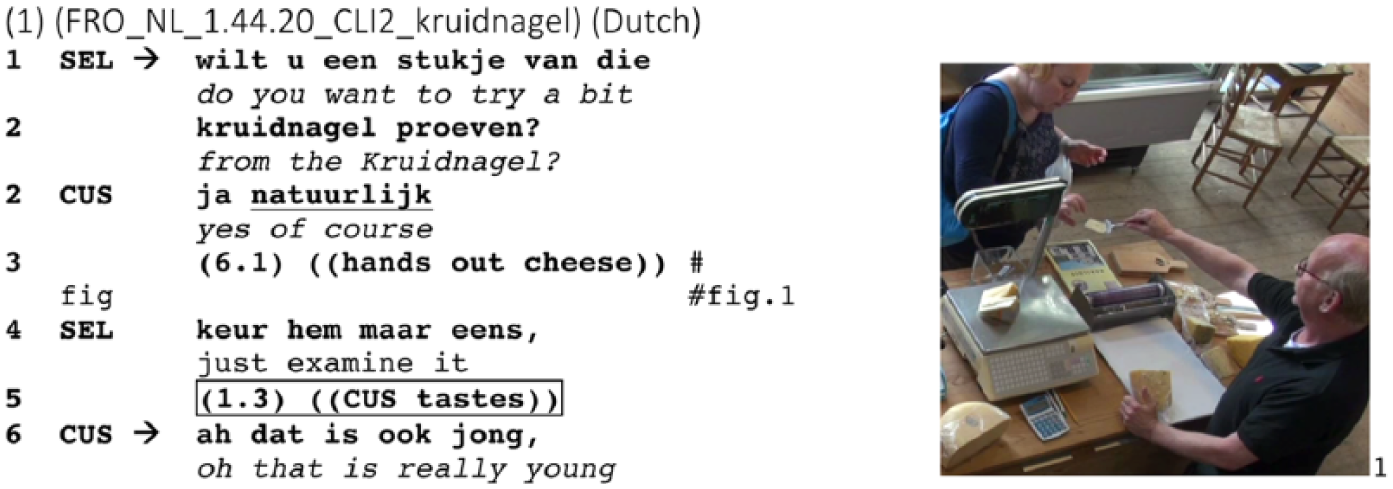


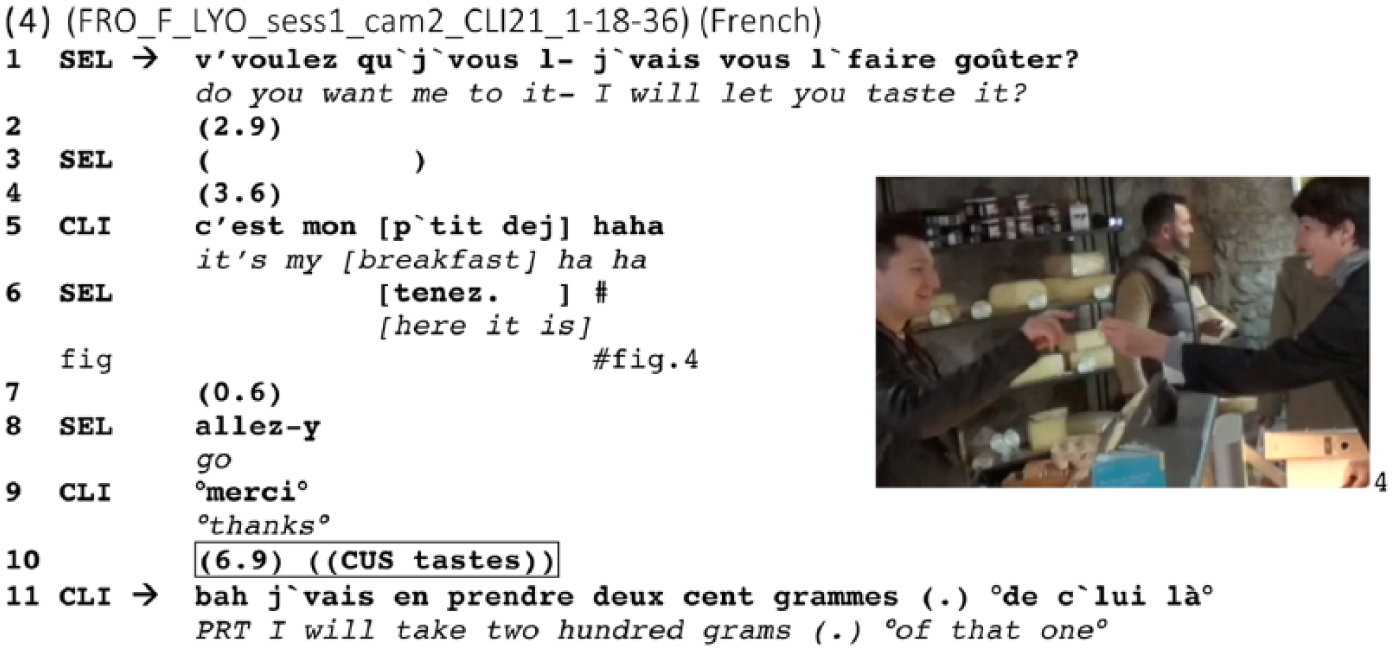
Some recurrent features are observable in these four excerpts and suggest an overall systematic sequential organization:
The sequence begins with an offer or invitation to taste by the seller (see the first arrow in the margins).
The offer is accepted by the customer (for cases of rejection, see Mondada, in press-b).
Consequently, the seller gives a bit of cheese to taste. The seller hands it over, most often on a knife (Figures 1 to 3), but in some cases with his or her hand (Figure 4).
This leads to the tasting moment proper, in which the customer tastes in silence (see the boxed silent pauses in the verbal transcript).
The tasting outcome is an assessment and/or a positive token, understood as manifesting the decision to buy (see the second arrow in the margins).
This pattern is consistent across shops and countries. It is also observable in other settings – here illustrated by an exchange between two cooks and their manager tasting a new dish they have created.
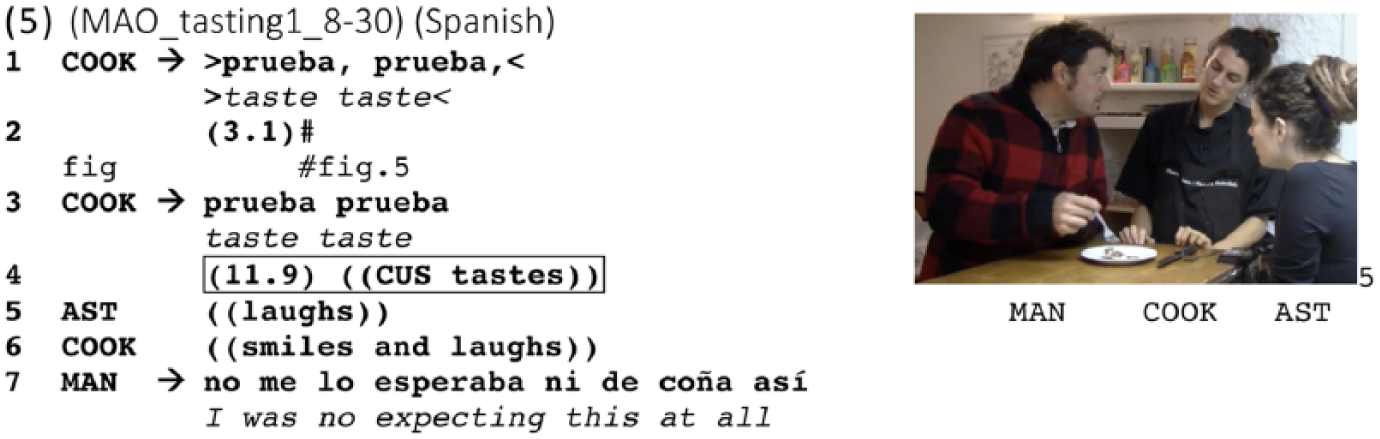
The cook invites the manager to taste (1, 3). The manager engages in the tasting by taking a bit of filling from the dish. He tastes in silence for almost 12 seconds (4). Even before he says anything, the assistant (5) and the cook (6) laugh, anticipating a positive answer, which is then expressed explicitly (7). The judgment is positive, which leads to the validation of the filling for the dish under creation.
The transcripts above focus on talk. Figures 1 to 4 show the recurring moment in which the sample to taste is passed to the taster (in Figure 5, the taster is about to take the bite himself). This enables characterization of the overall sequential environment in which tasting occurs. But this kind of representation misses tasting itself; tasting silently escapes linguistic analysis. In order to open the black box of these silent moments, a multimodal analysis is needed (see Mondada, 2014b, 2016, 2018b). This article investigates how the embodied process of tasting unfolds sequentially, interactively and intersubjectively, even though it happens without a word and concerns an ‘individual’ activity such as ingesting food.
In order to carry out this investigation, the analysis follows the sequential trajectory of the tasting activity. First, the analysis shows how tasting is initiated by both the customer and the seller withdrawing their mutual gaze and establishing an interactional space that allows the customer to concentrate on tasting. Second, it highlights the organization of the core moment of tasting, which is centered on chewing and is completed by swallowing. Third, it shows how both parties re-engage in the interaction which leads to the verbalization of the outcome of tasting. These features are consistent with and also observable in tastings in a restaurant kitchen. Their analysis shows how sensorial activities are indeed interactionally organized. The privileged moments of tasting are actively secured by both participants in a specific way; the taster’s activity is visibly available and actively monitored by the co-participant. In this way, the article shows how silent moments focused on sensory practices are made publicly accountable and constitute a condition of possibility for further talk and progression of the activity.
Engaging in tasting
When the cheese is handed out, either on a knife, another instrument, or by the hand, the seller and customer are co-oriented and face each other. Although they often do not engage in mutual gaze, they display joint attention toward the cheese and coordinate their gestures of giving and taking. This coordination stands in marked contrast to what happens next, when the customer has grasped the sample and the seller begins to withdraw her hand. At this point, I will show that a form of mutual withdrawal is achieved by both participants establishing an ‘individual’ space where the customer can fully focus on the sensory experience of cheese tasting. By doing so, the participants orient in situ toward tasting as an activity that requires silence and concentration, and they secure these conditions as a joint accomplishment. This section demonstrates how this is tacitly done.
We join the following case recorded in Lyon (France) in which the client was requesting a gouda with basil, but because the shop had none, the client is being offered a gouda with nettles (see extract 4 supra for the wider context). The multimodal transcription (see Appendix) annotates each embodied conduct by delimiting it between two equal symbols (e.g. +chews+) which are also positioned and synchronized within either the ongoing talk or the measured silences.
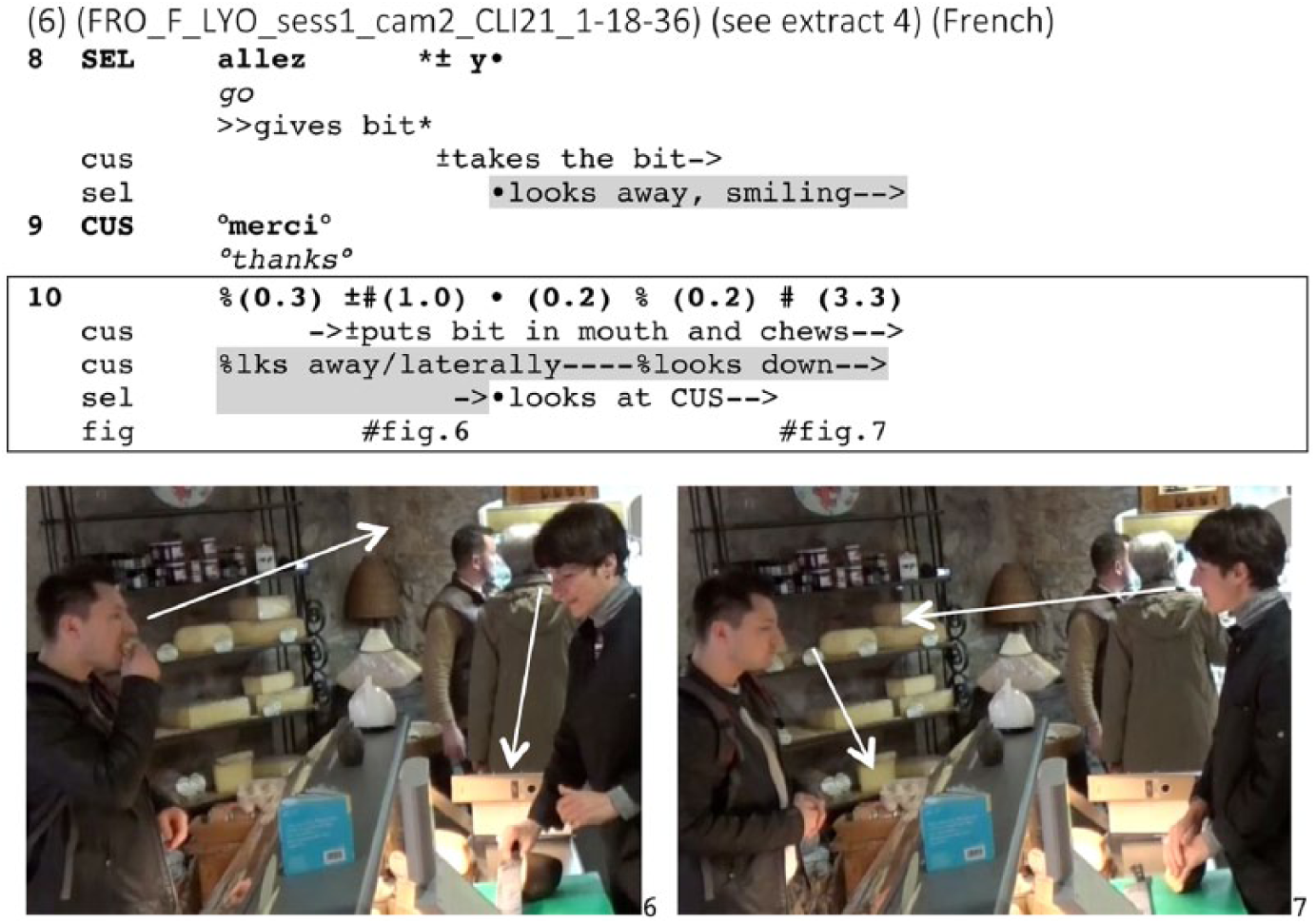
As soon as the seller has handed over the piece of cheese and the customer has grasped it (8), the seller withdraws her gaze and looks down at the corresponding cheese slab (Figure 6). The customer withdraws his gaze at the beginning of the silence (10); he first looks away (Figure 6), then down (Figure 7). He changes the direction of his gaze when the seller looks back at him and avoids her gaze as she monitors his response (Figure 7). These gaze adjustments show that both participants are careful in not engaging in mutual gaze and work to distribute their gaze in a complementary way. In this manner, they both withdraw from the ‘eye-to-eye ecological huddle’ (Goffman, 1961: 17). They both actively create a specific interactional space (Mondada, 2009), in which, although being co-present, they do not mutually gaze at each other. In particular, the customer bodily withdraws from any mutual contact with the seller (gaze avoidance, no talk, often reinforced by turning away). First, the seller also looks away, but then she looks at the client in silence. So, the interactional space they create is asymmetric; the seller does not taste, and although she does not speak with the client, she monitors him. I consider this interactional space as a way to create an ‘individual’ space for the taster. However, this does not mean the ongoing interaction has ceased, since the gaze of the co-participant makes the body (and especially the face) of the customer available for visual scrutiny, which gives it a public, available, visible and intelligible character. In this sense, the individual sensory experience of the customer is not merely a private one, since it is interactively created and remains deeply embedded within this asymmetric silent interaction and its organization.
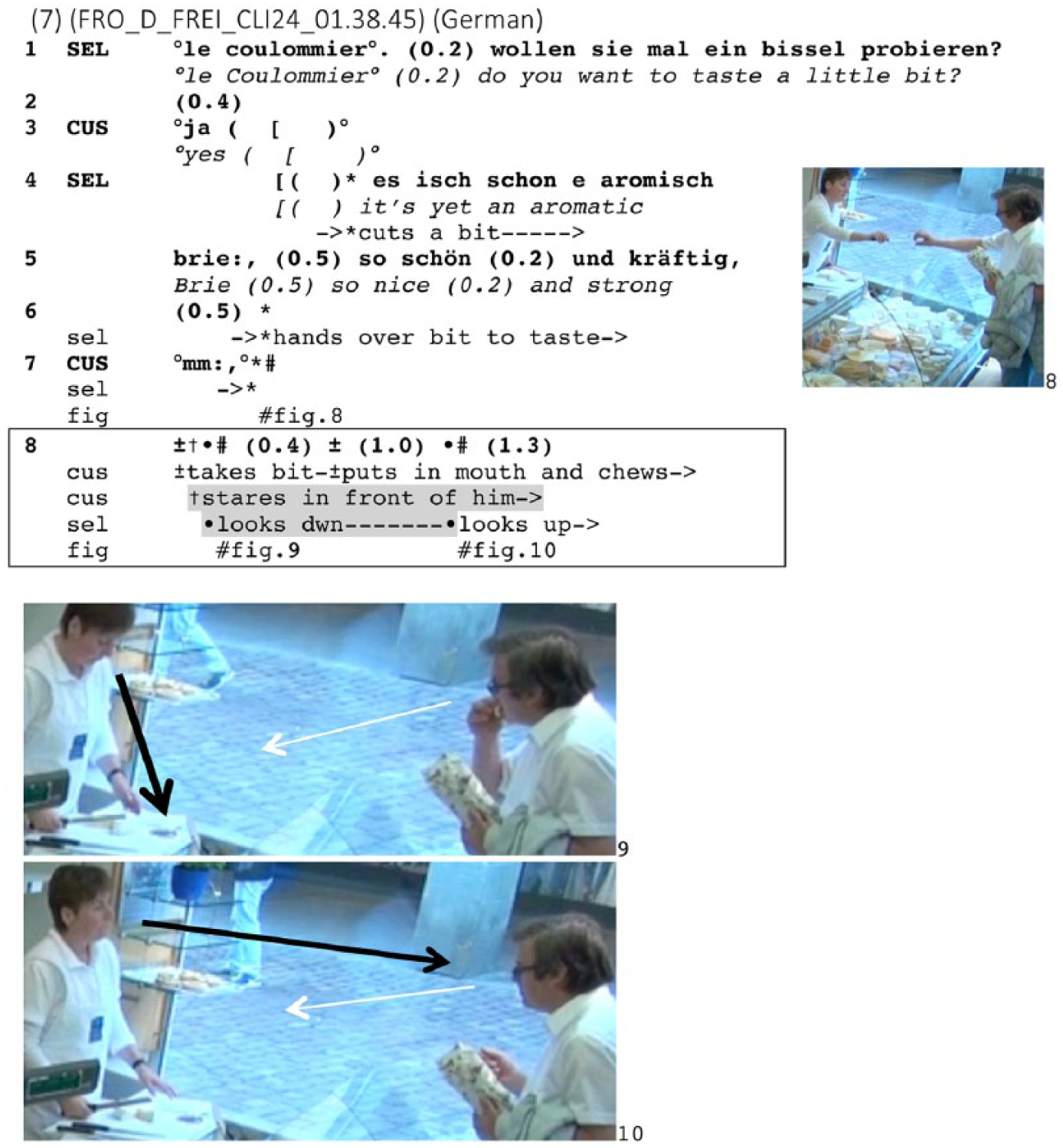
A very similar pattern is observable in the following case, recorded in Freiburg (Germany).
As in the previous case, as soon as the seller hands over the sample of cheese to taste (Figure 8) and the customer takes it, the former withdraws her gaze and the latter begins to stare into space in front of him (Figure 9). But just after he puts the piece in his mouth, the seller looks up at him again and observes him (Figure 10) so that she can see him chewing vigorously.
The direction of the customer’s gaze is sometimes difficult to determine precisely on the basis of the video views, but it is clear that he is not looking at the seller. Rather than looking at something (e.g. the cheese), his gaze stares off in a vague way. It is an absent gaze that displays unavailability to the other and a focus one’s own sensory experience. The necessity of the suspension of other activities in order to fully focus on the esthetic object and evaluate it has been recognized in sociological and philosophical studies of taste as an esthetic judgment (Hennion, 2007). However, how it happens in its praxeological, embodied situated details has not yet been examined. The systematic gaze trajectories described in the cheese tasting pave the way to the tasting experience and show how the tasting experience is interactionally organized, not only by the taster but also cooperatively, by the co-participant aligning with it and contributing to create the interactional withdrawal of the taster.
Contrasting with the taster’s gaze, the seller adopts a monitoring, surveilling and controlling gaze, although formatted in a distant and discrete manner. This way of monitoring also displays that the completion of the silence is left to the taster, although the seller displays her waiting for it and her continuous availability. Thus, the specific interactional space they create confers special rights and obligations to both parties.
In some cases, this interactional space is stepwise achieved with an intermittent gaze and also intermittent talk, as in the following extract from Madrid (Spain). The seller alternatively gazes away/at the customer, while he adds more information about the cheese. But even if he continues to explain, he clearly bodily withdraws from the face-to-face huddle and also steps away.

The seller hands over the sample of cheese (1) offered to taste and looks at the customer (3–4) (Figure 11). He looks away (4) just after the customer takes the sample (Figure 12). The customer looks at the sample just before putting it into his mouth. Then he looks continuously into the distance, in front of him. The seller gazes at the customer briefly as he begins to chew, and then gazes away. While the seller adds a new piece of information, he still looks away and is even steps away, bodily distancing and moving away from a face-to-face position relative to the customer (Figure 13), as the customer looks at the second remaining piece of cheese to taste. So, even if the seller gives some information, this is done without looking at the customer or establishing a mutual gaze or prompting for a response. The customer is focused on chewing and tasting the cheese and does not respond to the explanation.
In sum, in the beginning of the interaction, the taster and the co-participant both orient to the tasting as a moment where they organize a specific, individual interactional space for the taster. In that space, the other person actively monitors the taster, but avoids establishing a mutual gaze. This interactional space is asymmetric, designed by a complementary and non-mutual distribution of gaze. This enables us to define the ‘individual’ character of this moment, which allows for the taster to withdraw, although the co-participant maintains a surveilling gaze, inspecting and projecting the possible outcome of the tasting experience.
Tasting proper
In the previous section, I described how the conditions for tasting were interactionally established by both parties. These conditions are characterized by specific rights and obligations of both customer and seller, taster and observer. They are implemented by an asymmetric distribution of gaze that defines the ‘individual’ character of the taster’s experience. The withdrawal of the taster from a mutual engagement in interaction – achieved through gaze withdrawal and the taster’s (as well as often the observer’s) silence – does not mean privacy or absence of interaction, given that the co-participant scrutinizes, examines and surveils the taster’s actions, which are displayed for him.
Once this particular interactional space for tasting is created, the taster engages in the tasting experience. A fundamental activity characterizing this moment is chewing. In this section, I show that the customer engages in chewing in a particular way, a way that maximizes the sensorial experience he or she is having with the piece of cheese he or she has received. Tasting is a form of touch where the tongue, the palate and the entire mouth haptically explore the consistency, texture and taste of the product, maximizing its sensorial appropriation. This produces a specific way of chewing that is very different than merely eating. This way of chewing is not only relevant for the taster’s sensoriality, it is also a movement of the mouth and the cheeks visibly accountable for the seller. Tasting is not only a physiological activity of an individual but is also an activity that can be seen and observed by others, and that in turn, can be displayed for others. In this sense, tasting is profoundly intersubjective; it is visibly intelligible to a co-participant or an observer and is oriented to and treated as such by the seller while monitoring the customer, in a discrete but often persistent manner. In this sense, tasting is not a private experience, but an individual experience that has a public, witnessable, accountable and intersubjective dimension.
Thus, tasting involves a complex array of multimodal conducts that are intertwined and mutually adjusted, even in the absence of talk and eye contact. The following excerpt, filmed in Helsinki, Finland, shows how a customer engages in silent tasting and is intermittently gazed at by the seller. In this case, the chewing is so vigorous that it is possible to document it in a series of figures (whereas in other cases, this might be visible on video, but difficult to render in screen shots).
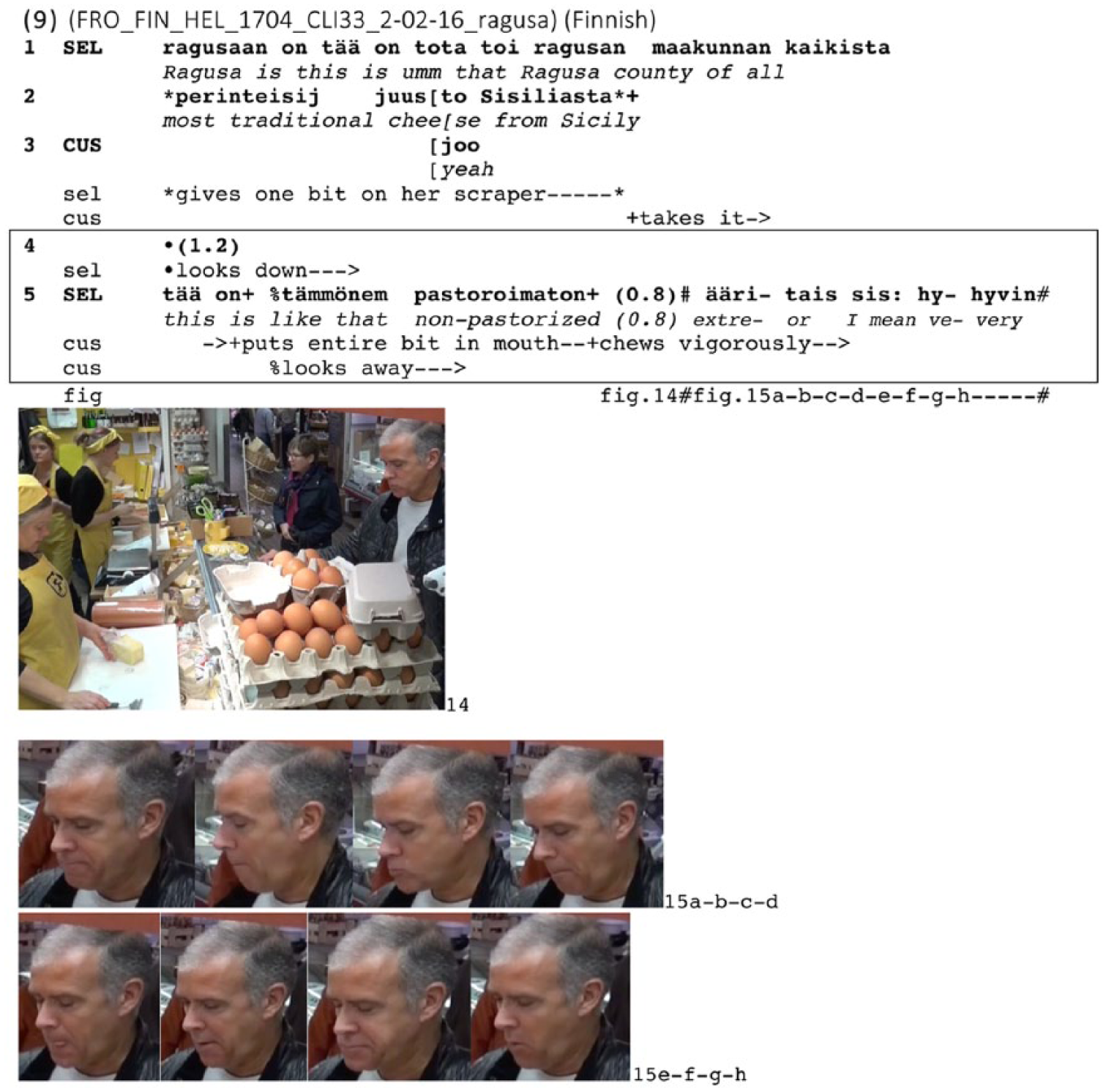
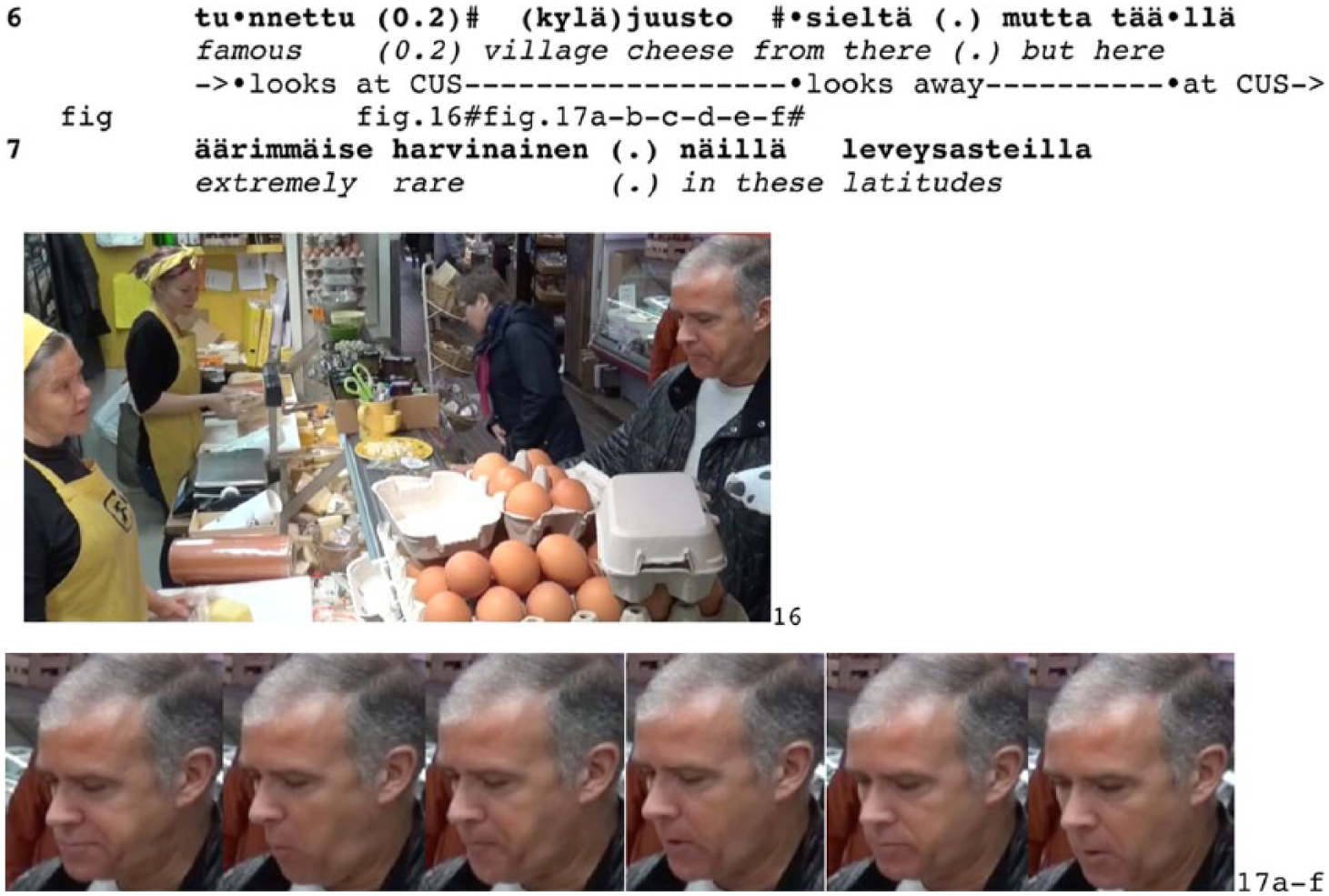
This fragment clearly shows how, as soon as the customer has taken the cheese from the seller’s scraper (end of line 2), both withdraw their mutual gaze (beginning of line 4, see Figure 14) even though the seller continues to explain. The customer begins to chew vigorously (5, Figure 15(a) to (h), covering less than 2 seconds) and continues to do so when the seller looks at him again (Figure 16). She can see him chewing (Figure 17(a) to (f), covering approximately 1 second), and she continues her explanation, promoting the exceptionality of the cheese. Only then she stops talking, and the customer continues to chew in silence (8).
Moreover, the customer can engage not only in chewing but in other sensorial activities, which are equally available to the gaze of the seller who monitors him intermittingly. This is the case of the next fragment, recorded in London (UK). For each moment documented by Figures 18 to 20, two camera views are given (a–b), adopting the perspective of the seller on the customer (a) or the opposite view (b).

The seller proposes a Chevreau to the customer and gives a brief description, which is completed (3) just before handing over the sample to taste (4, Figure 18). The customer takes the cheese and both participants immediately look away from each other (Figure 19). The customer brings the piece closer to his mouth and, before eating it, he smells it (Figure 19). Then he begins to chew the first bite while he holds the remaining bit in his hand. At this point, he also steps away, increasing the distance between himself and the seller (Figure 20) and adopts a diverted posture. The seller, who reoriented to his task at the counter just after the first withdrawal, now looks back at the customer, in a sort of body torque (Schegloff, 1998); that is, his main orientation is at the counter, where he is wrapping another cheese, but his head is turned toward the customer (Figure 20(a)). The customer stares in front of him, toward the fridge, but without looking at any particular cheese (Figure 20(b)). From then on, the seller regularly checks what the customer is doing (5) by alternating his gaze between the counter and the customer. The customer puts the remaining piece into his mouth and continues to chew.
This way of tasting recurs in the data, especially among more expert customers. It involves not only tasting but before tasting, smelling. Moreover, it often involves segmenting the piece of cheese into two bites. This splitting affects the sequential organization of the tasting; by preparing a second bite to taste, the sensory experience is expanded, and more time is legitimately required before to utter a final assessment. At this point, the customer (see extract 8, l.6) might also examine the remaining piece in his hand and engages not only in a visual inspection but also in some haptic feeling with the fingers. By organizing the silent moment in this way, the customer engages in a silent multisensorial tasting experience, which claims time for the senses (except in 10, this lasts for more than 11 seconds).
The normative organization of this individually shaped moment of tasting is also confirmed by a deviant case (Schegloff, 1968), that is, a case presenting some departure from a recurrent pattern, which is treated as a departure from the norm by the participants. In the following encounter, the seller asks a question unrelated to the product (building upon previous small talk concerning the customer’s holidays in Austria) precisely at the moment in which the customer has just engaged in silent tasting. The question projects an answer, which suspends and jeopardizes the tasting, and the customer orients to that with a microexpression of surprise (Ekman and Friesen, 1975):
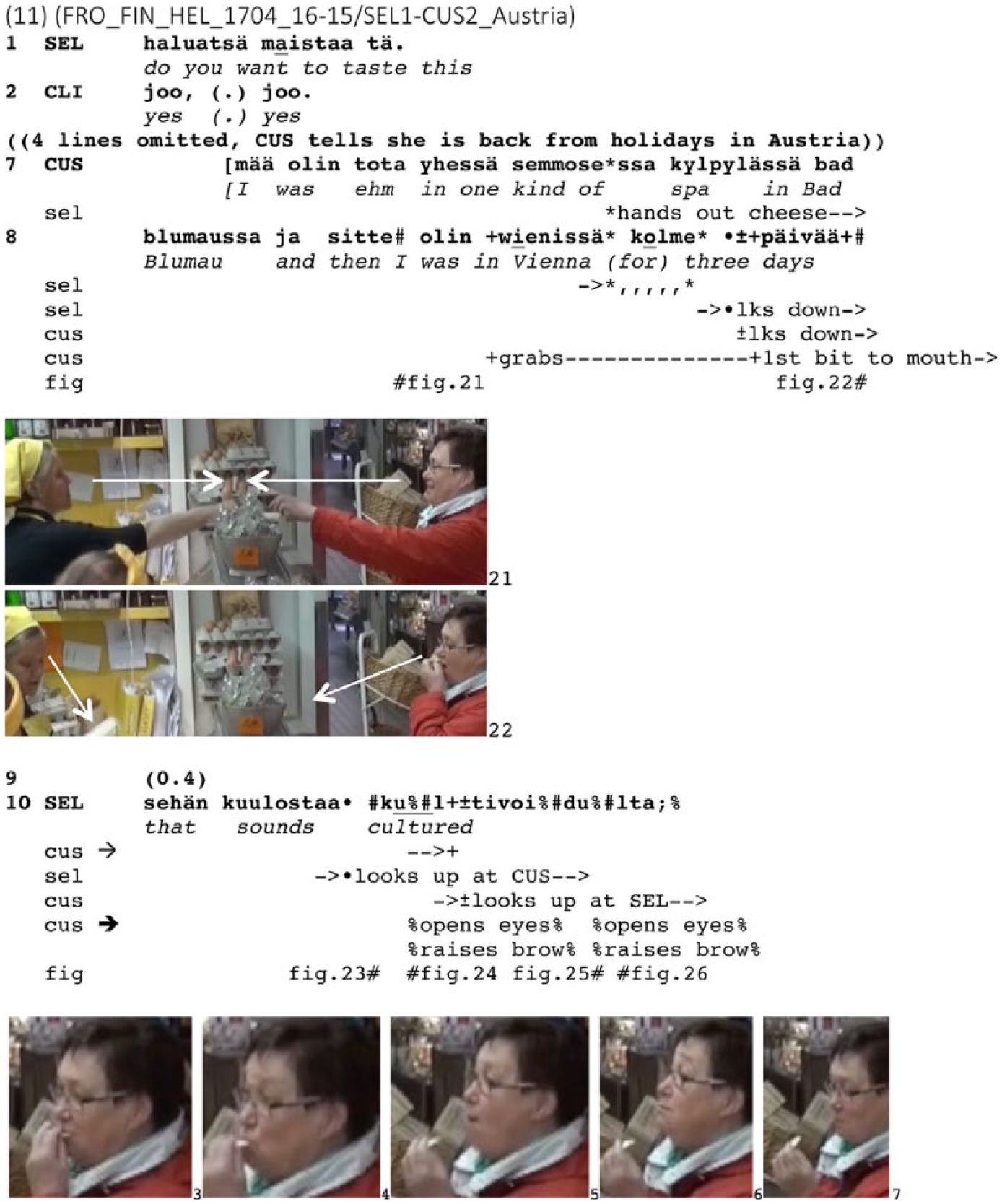

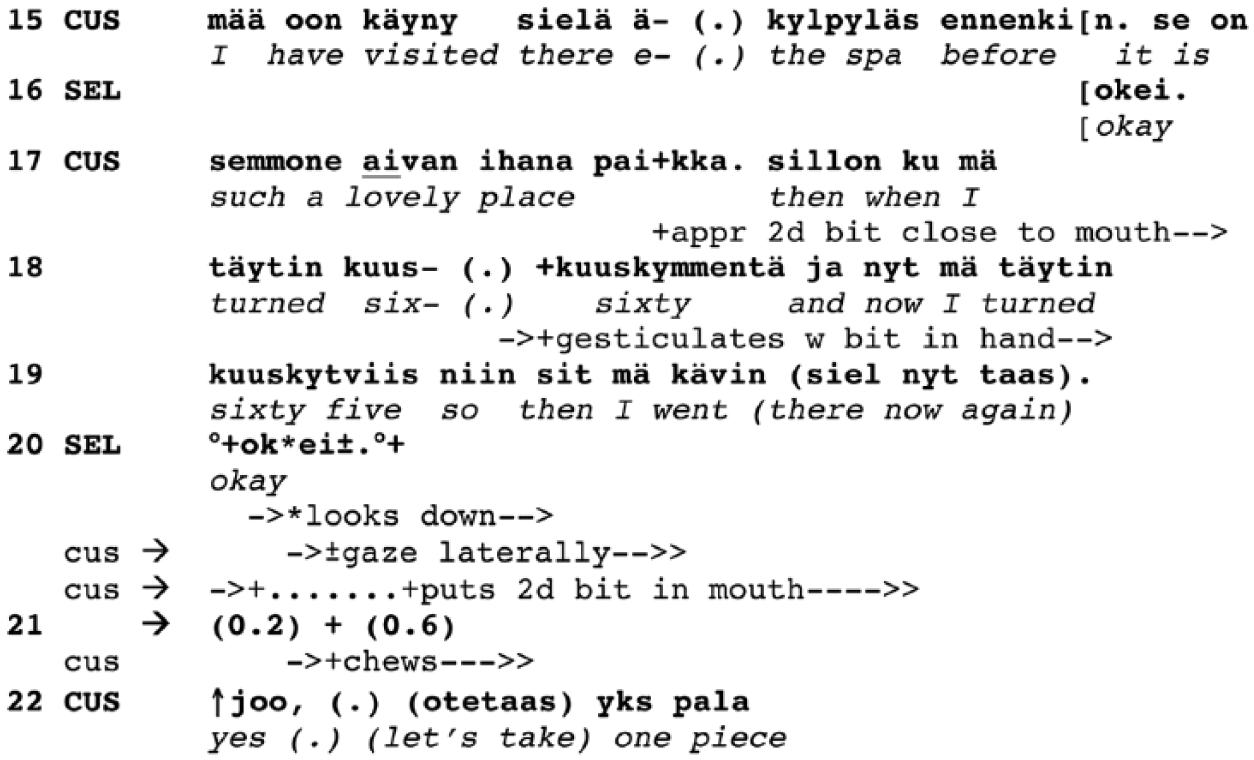
The seller offers to taste (1) and the customer accepts (2). While the former prepares and hands over (7, Figure 21) the cheese to taste, the latter initiates a story about her holidays in Austria (3–8). The completion of the customer’s turn is the locus where she takes the piece of cheese and puts it in her mouth, then looks down, as the seller looks down too (end of line 8, Figure 22). So, as in the previous cases, they both shift from mutual gaze (Figure 21) to gaze aversion (Figure 22).
But in this case, the silent moment dedicated to tasting (which begins in line 9) is suspended by the seller’s comment about the holidays (10), minimally responded to (11), but further extended (12). This comment reinstates the mutual gaze, even though the client has just put the piece in her mouth. The way the customer looks back at the seller in this position is marked and displays typical microexpressions – here of surprise – which flash on and off the face in a fraction of a second, but are quite recognizable (Ekman and Friesen, 1975). She opens her eyes widely and raises her brows quickly, twice. The first time she is still looking at the bit of cheese (Figure 24); the second time, she has begun (Figure 25) to gaze at the seller (Figure 26). This way of staring wide-eyed, eyebrows abruptly raised and curved, displays surprise. The way of responding, with a minimal ‘mm’ (11) both responds to the comment and minimizes such response. As soon as the customer has produced her ‘mm’ with falling final intonation, she looks back at the piece of cheese (Figure 27), projecting the resumption of the tasting (Figure 28).
But the seller now asks a question (14) still related to the Austrian destination. The customer looks again at the seller. The customer’s eyes are wide again (Figure 29), raised in an abrupt way, highlighting the contrast with her previous silent tasting, made while gazing down. Again, the customer’s first embodied response displays the deviant character of the seller’s turn. Nevertheless, she answers (15–19), quickly readjusting to the circumstances. Answering makes her mouth unavailable for tasting; moreover, while she was intensively looking at the remaining piece of cheese in her hand (14), she is now looking at the seller and is using her hand, still holding the cheese, to gesticulate (18–19). This embodied Gestalt, characteristic of speakership, deeply contrasts with the Gestalt characterizing tasting.
It is significant that as soon as the answer is completed and acknowledged by a brief ‘°okei°’ (20), the customer and the seller go back to the initial pre-tasting posture: they both look away from each other, and the customer puts the remaining bit of cheese in her mouth (20). But this tasting does not last very long. After only 0.6 seconds, the customer announces her decision to buy the cheese. At that point, she has not yet finished chewing, and she continues to do so in a more casual way as the interaction continues. She is not really tasting anymore, but rather eating the remaining cheese.
This last fragment shows the taster’s normative orientation to the conditions for tasting. Contrary to previous cases in which the seller was adding some information about the cheese without looking at the customer and without expecting any response, in this case, the seller initiates small talk in a way that not only addresses the customer but makes her answer relevant. The customer treats this as competing with the ongoing tasting activity and as precluding it. This deviant case further confirms the local normative orientations toward the specificity of the embodied Gestalt and interactional space that not only characterize tasting but make it possible.
Finishing tasting
Completion of tasting is collectively achieved by the participants in a projectable way. The seller might be gazing intermittently at the beginning of the tasting, but as time passes he or she looks more and more continuously at the tasting customer. The customer’s visible mastication is brought to a close by swallowing the last piece. Whereas during chewing the face is immobile (except for the cheeks), the head becomes increasingly animated (e.g. with nods and raised eyebrows) when he or she turns back to face the seller and re-engages in a mutual gaze. All this projects that the customer is speaking again.
In most of the cases, the customer initiates the re-engagement, while the seller monitors him (the seller initiates it only in rare and significant cases, see below extract 17). The seller looks at the customer and waits for him to finish the tasting; in this way, the seller leaves the client to initiate talking, although after some time, he or she systematically looks at the client.

The simplest form of re-engagement is achieved by the customer looking again at the seller, before self-selecting and talking again. This happens in the next segment, recorded in Freiburg, Germany, in which the seller looks continuously at the customer during the tasting.
In this case, the nod is produced at the same time as the customer resumes talking. Nodding is a form of positive assessment. It either co-occurs with a positive assessment, like in extract 12, or just before a positive token is produced, as in the next cases.
As a matter of fact, nodding is often what precedes and projects the re-engagement in talk, as in the following fragments, constituting the continuation of extracts 9 and 6.
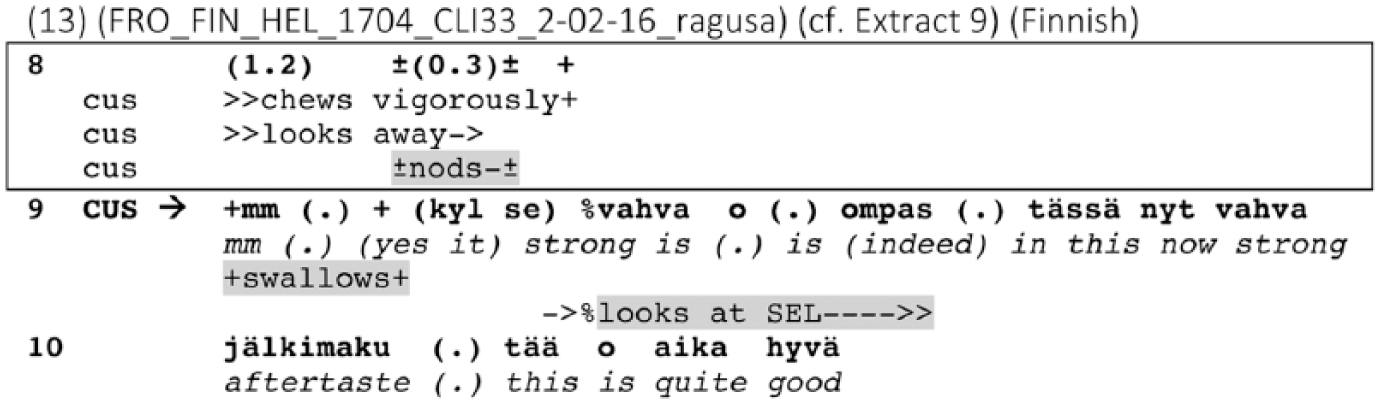
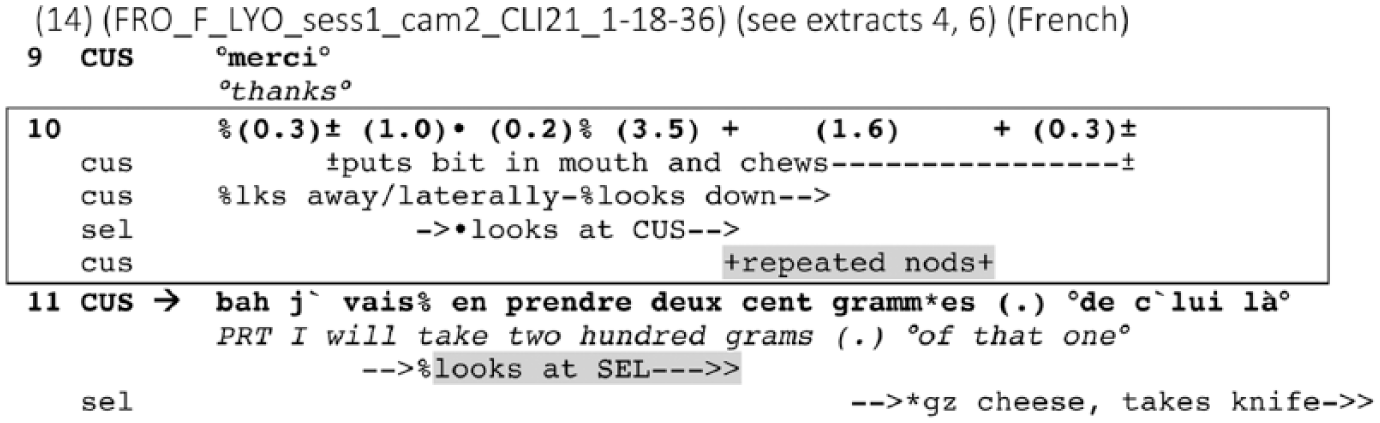
In both cases, the customer nods toward the end of the long silence during which he or she has tasted the cheese. In both cases, the gaze of the customer moves back toward the seller only when he or she has begun to talk; the nod is what projects the resumption of talk.
However, in other cases, nodding is not the only projective element; other embodied conducts also project the re-engagement in talk, as in the following case (continuing extract 10).
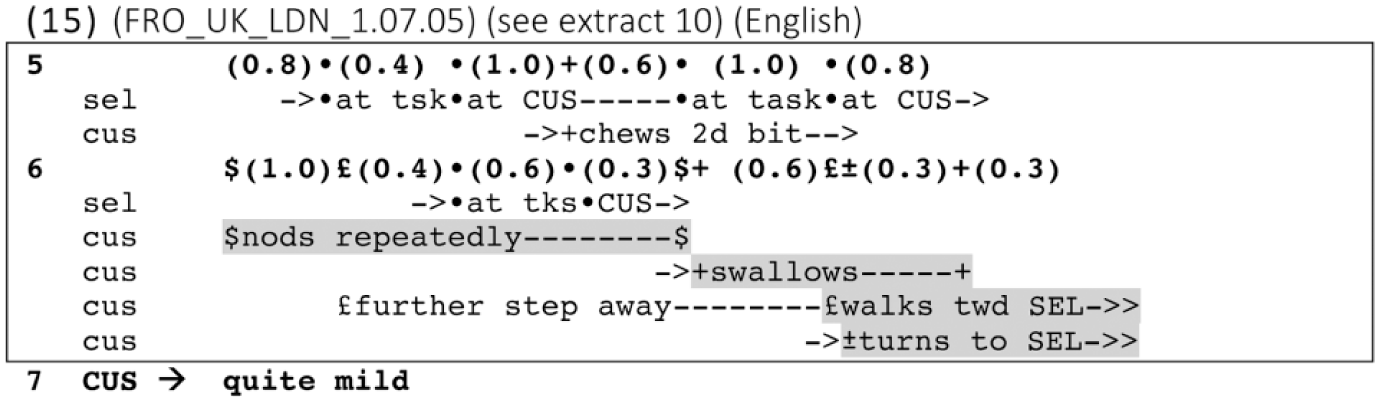
In this case, the customer begins to nod repeatedly and for quite a long time (6). The seller notices and intermittently monitors him. He can probably also see the client swallowing, which displays the completion of the chewing. Moreover, the customer once again ends up stepping closer to the seller and turning back to him. All these changes in the taster’s body posture project the resumption of talk and a positive assessment, which is indeed proffered next (7) (in the case of a negative assessment, the customer’s body is rather immobile, see extract 17).
The silent projection of a positive assessment by the nod can not only be noticed but also exploited by the seller, who in certain cases verbalizes the assessment and requests a confirmation from the customer, as in this fragment recorded in France.
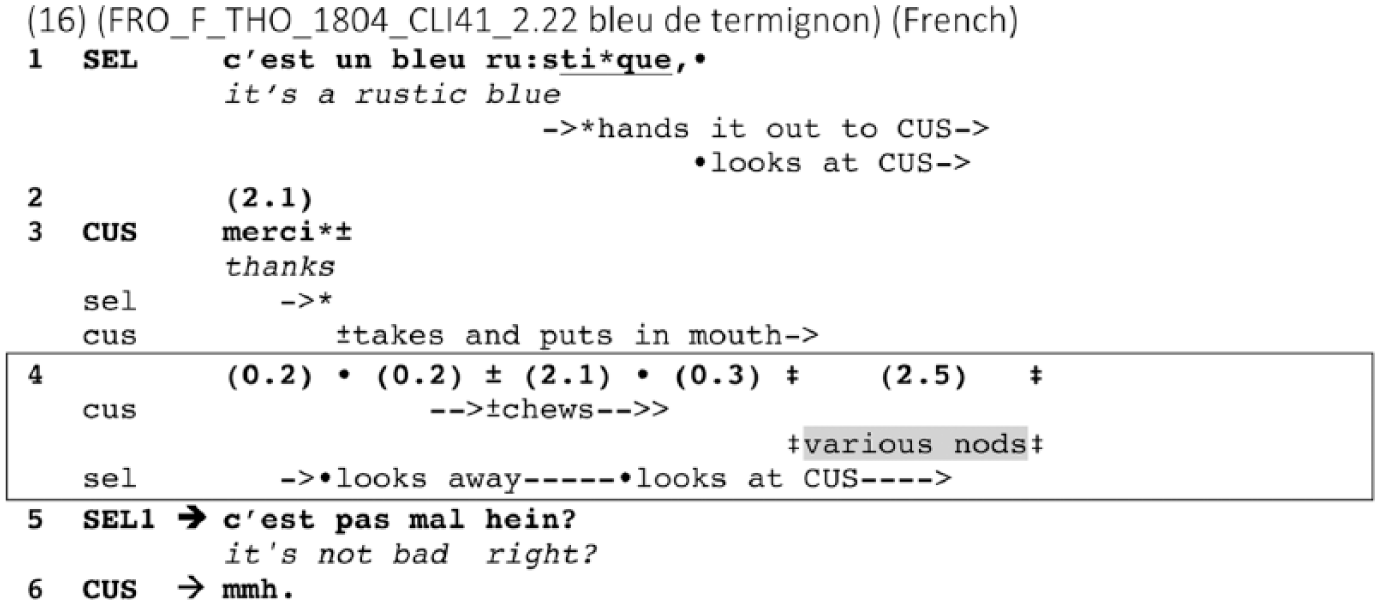
In this case, the customer’s repeated silent nods are interpreted as a positive assessment by the seller (5), who seeks a confirmation from the customer (by using an interrogative and the final particle ‘hein’). This further confirms the relevance for the seller of monitoring and inspecting possible hints anticipating the final assessment, which is important for the next action: deciding to buy versus refusing that product and searching for another one.
Thus, nods and other resources conveying a positive assessment, like eyebrows, smiles, pointing gestures, shrugged shoulders and so on, constitute a response of the client, which brings to a close not only the tasting proper but also the sequence initiated by the proposal of a specific cheese by the seller. This response – when positive – is understood as a decision to buy and projects a further sequence, which concerns the negotiation of the quantity the customer will buy. This next sequence is visibly projected by the re-orientation of the seller’s gaze and knife toward the form of cheese, ready to cut a piece. In this sense, a positive sign is immediately understood by the seller as a decision to buy (Mondada, in press-a).
In sum, there is a marked contrast between the central, concentrated, individual phase of the tasting proper and its completion. Even before any word is uttered, the customer re-engages in the interaction with the seller in different ways: (a) by shifting his gaze back to the seller, (b) by becoming more expressive with a more animated face and head (nods and other facial expressions), (c) by using these embodied movements to foreshadow the resumption of talk and (d) by using these movements to foreshadow a positive assessment of the tasted product.
Whereas in the previous phase (tasting proper) the body movements are all concentrated on the sensorial experience of tasting (the face remains very static with the exception of the cheeks while chewing), shaped as an individual – albeit publicly witnessable – moment, now the body is animated in a way that becomes communicative again, monitored by the seller, and is re-engaged in a focused interaction with him. The previous phase was characterized by an exclusive focus on the tasting activity in which tasting excludes talking and tasting is a specific activity very different than eating; in contrast, this final phase is characterized by a return to some kind of multi-activity (from an exclusive to a parallel or embedded mode, Mondada, 2014c), in which completion of tasting (when the customer is still having some cheese in the mouth and continues to chew) continues in parallel with the resumption of embodied and verbal interaction with the seller. In this latter case, finishing chewing does not constitute tasting anymore, but rather fades into mere eating (cf. Hennion, 2007 for a similar opposition between tasting wine and just drinking it).
As suggested above, the seller generally does not initiate the return to the ‘interactional huddle’. Both participants orient to the specific interactional space of tasting as grounded on the right of the customer to extend his individual experience as long as needed (see Oshima, in press, for similar distribution of rights and obligations in a service encounter dealing with the right of the client to inspect the haircut). Nevertheless, there are cases in which the seller resumes talking and prompts the end of the tasting session, as in the following segment, recorded in Madrid (Spain):
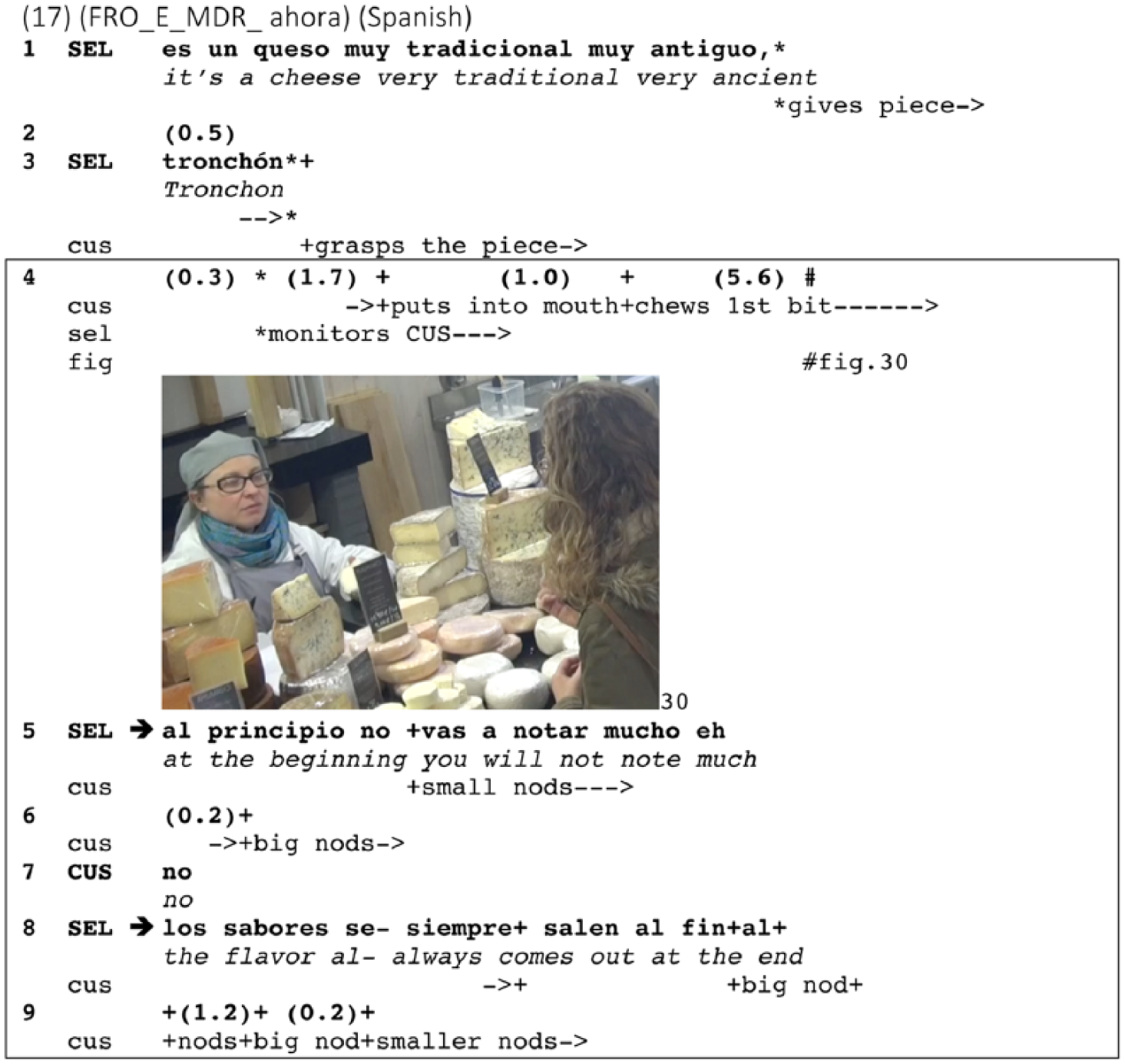
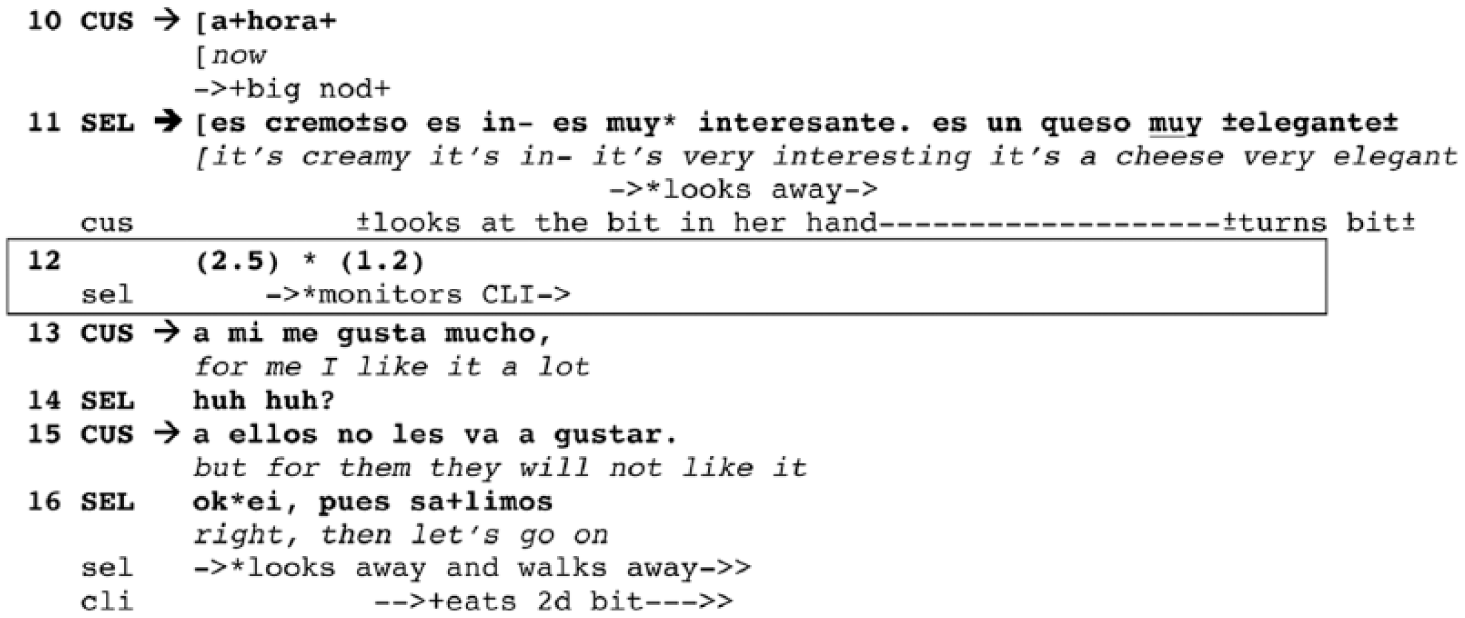
After having handed over the cheese and announced its name (1–3), the seller monitors the customer who puts a first bite in her mouth (4). The customer chews in silence for more than 5 seconds. Unfortunately, for this encounter, the face and gaze of the customer are not available because the recording camera is on her back. The available view shows in detail the seller waiting (Figure 30) and continuously monitoring the customer, with the notable exception of lines 11–12. After 5.6 seconds (4), during which the customer has been engaged in chewing and has maintained a rather stiff and immobile posture, the seller self-selects and produces a comment, which clearly orients to the absence of a projectable assessment by the customer. Contrary to other cases, in which the seller is talking during the tasting and offering some information about the cheese, here the seller comments on the expected taste (5) engaging in the sensory territory of the customer. Not only is tasting addressed, but also its emergent temporality, by distinguishing what happens at the ‘beginning’ (5) which is ‘not much’ (accounting for an absence of response by the customer) and, implicitly, what should happen next. In this way, the seller treats the customer as not yet experiencing any taste. This is further elaborated in a generalization about flavor (8) which topicalizes the ‘end’ of tasting. This projects, informs and prompts the customer’s experience. The latter indeed responds, first, by aligning with the absence of taste (5–7) then with the upcoming taste (8–10). The body of the customer is increasingly animated by visible nods shaking the head and the entire torso.
This is not yet treated as a final response. It is the seller who predicates the qualities of the cheese (11); however, the customer does not align with the seller’s assessment, but re-engages in tasting while visibly looking at her second piece of cheese and manipulating it (11). The seller adjusts to this posture by looking away (11–12) before monitoring the customer again.
Finally, the customer expresses her judgment (13–15), which combines a positive assessment with a reason to reject that cheese – a verbal format often used in the corpus to refuse a tasted item. The seller seems to have anticipated some trouble by treating the length of the customer silence (4) not as an active engagement with tasting sensations, but as foreshadowing a problem (as a form of embodied dispreference). In this sense, the quite infrequent fact that it is the seller who brings the first silent tasting moment to an end orients to a specific problematic trajectory of tasting.
Conclusion
In this article, I have offered a systematic analysis of the sequential and normative organization of tasting based on the way customers are invited by sellers in gourmet shops to engage in a tasting experience with cheese. The data show a remarkably systematic format in which the order of tasting is interactively accomplished across countries and languages. This does not only concern cheese shops but is widely observable in other settings. In order to substantiate this generalizable claim, we return to extract 5 above, in which the restaurant manager was tasting a bit of filling, we observe the same order of tasting, albeit in a different ecology.
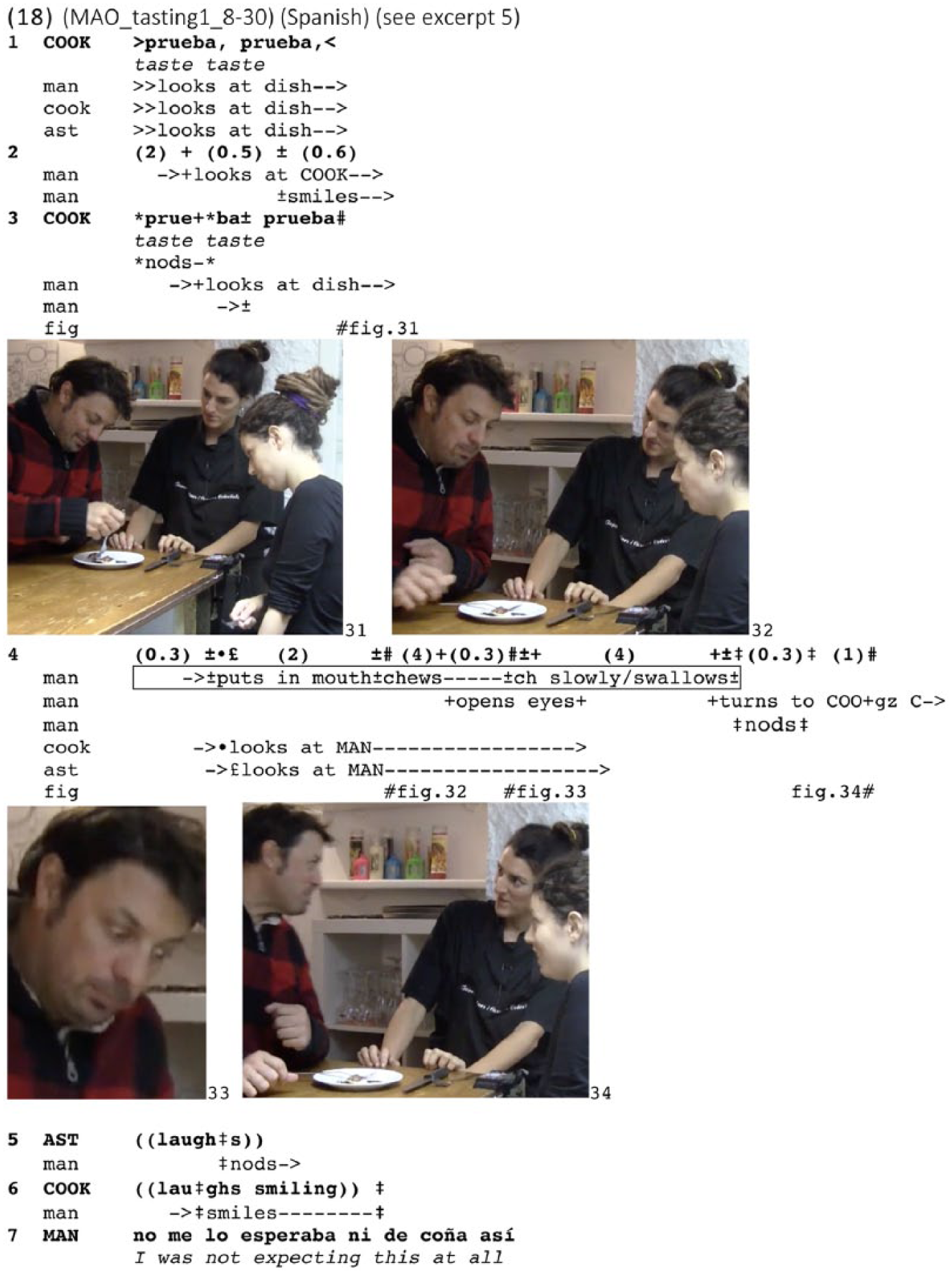
As the invitation to taste is repeated, all participants look down at the dish (3, Figure 31). But as soon as he has grabbed a bit of filling to put in his mouth, the two cooks look at him and closely monitor his face (4, Figure 32). His gaze remains directed at the remaining bit in the plate, and he engages in chewing within the individual space created by his withdrawal from mutual gaze. The chewing lasts for a few seconds during which he maintains a quite immobile face. But when he swallows, he opens his eyes in an exaggerated, stylized way (Figure 33), albeit not yet looking at the co-participants. He then nods while turning to the cook and staring at her (Figure 34). These animated facial expressions, monitored by the co-participants, not only projects an imminent response, and a positive assessment, but makes it anticipable by them. The laughter of both cooks anticipates the final compliment (7). This instance of taste in the restaurant reveals a very similar organization as the tastings in the cheese shops, showing the general character of the findings exposed here.
The taster and the co-participant jointly establish a specific interactional space, thereby creating the conditions for the individual silent sensorial experience of the taster. This individual space is not a private space, however: it is a social accomplishment of both parties, and it is characterized by asymmetric rights and obligations – the right of the taster to silently engage in a sensory experience and access the sensory characteristics of the tasted product, and the right of the co-participant to monitor the taster, thus creating a space of intersubjectivity in which individual sensory practices are given to see and can be visibly observed by another party. This activity is also characterized by specific obligations of the observer, who respects the individual experience of the taster. The former might be either silent or engage in some informative talk, but without requiring the latter to respond or to engage in a conversation. The normative character of this asymmetry is visible in the deviant case studied (excerpt 11), where the customer visibly orients to a question asked by the seller in the midst of the tasting as not respecting their specific normatively expected postures.
These pre-conditions create a space for the sensorial experience of tasting which is focused on chewing in a distinct way and which locally and normatively establishes the distinction between mere eating versus tasting. Tasting involves a silent exclusive focus on the multisensorial experience, whereas eating is characterized by multi-activity and embedded in talk. Tasting is primarily based on chewing as a form of active haptic exploration of the mouth, which is also visible and thus intersubjectively accessible for witnessing. But chewing is not the only sensorial practice of the taster: before putting the tasted piece in the mouth, he or she might smell it, and while having one piece in his or her mouth, he or she can further look at and touch the remaining bit held between the fingers. This constitutes tasting as a multisensorial experience. Although involving individual and sometimes intimate parts of the body, this multisensorial experience is publicly witnessable and thus possibly produced and displayed for its visible character.
Tasting is brought to a close by resuming the face-to-face engagement in talk and mutual gaze of both parties, with the final assessment by the taster. This resumption is generally initiated by the taster, but it is projectable for the observer through a gradual re-animation of the taster’s body, nodding and beginning to express and foreshadow the outcome of the tasting. This moment of interactional re-engagement is foreshadowed by the observer monitoring the customer and is possibly pre-empted in the case in which the public displays of tasting are problematic or absent (as in excerpt 17) or anticipated when facial expressions are clearly projecting a positive outcome (as in excerpt 18). Like the stepwise entering into the tasting practice, exiting it is socially ordered and generates normative expectations.
This systematic analysis is based on tasting practices in gourmet cheese shops. It makes sense of the relevances locally established in this setting but also deploys a more generic form of organization, as shown by the last example, that reveals general features of multisensoriality in multimodally organized social interactions. The study reveals how sensory practices are embedded in a more global activity (such as buying or cooking) and are relevant and consequential for its organization and progressivity. It also reveals how sensory practices are interactively and intersubjectively organized, even when they are designed by all parties to be individual and as withdrawing from face-to-face interaction within a diversity of collective arrangements, which evolve during the temporally and sequentially emerging, culminating and terminating sensorial experience. This interactional organization is based on an ordered distribution of multimodal resources: talk alternates with silence, and silence is characterized by an exclusive focus on body conducts – sensing body of the taster and observing body of the co-participant. This reveals the finely tuned organization of silent embodied moments in which the intersubjectivity of sensing is made possible by its visible (and possibly auditory) dimension, achieving its public and witnessable character.
The study thus offers an ethnomethodological and conversation analytic approach to multisensoriality through the multimodal analysis of video data. It proposes to go beyond the analysis of visible-audible details of body and language as resources for the organization of human communication. It suggests investigating the embodied details of practices sensing the material world and showing how sensoriality can be understood as an intersubjective phenomenon which is interactionally achieved and characterized by a systematic sequential organization.
Conventions
Talk has been transcribed using Jefferson’s (2004) conventions and multimodality with Mondada’s conventions (2018b).
Footnotes
Acknowledgements
Data used for this study have been collected within the project Multimodality: reconsidering language and action through embodiment funded by the Academy of Finland (2015–2017).
Declaration of conflicting interests
The author(s) declared no potential conflicts of interest with respect to the research, authorship, and/or publication of this article.
Funding
The author(s) disclosed receipt of the following financial support for the research, authorship, and/or publication of this article: Further analyses have been done within the project From multimodality to multisensoriality: language, body, and sensoriality in social interaction (intSenses) funded by the Swiss National Science Foundation (2018–2022).