



Abstract
This article presents a study of how co-present individuals work out the nature of embodied engagement and disengagement displays by individuals with dementia in a Danish public care facility. Research has found that moderate to severe dementia may result, for example, in a lack of social engagement, apathy and problems in maintaining conversations. Research has, however, also found that co-present individuals indicate their right to unavailability for social interaction. This is accomplished through details of embodied and multimodal conduct such as gaze behavior, which includes practices of glancing and gazing at co-present individuals or practices of gazing into space. These practices may coincide with indications of ‘lack of social engagement’ and ‘apathy’. This study falls within the framework of ethnomethodology (EM) and employs multimodal conversation analytic (CA) methods to show how co-present individuals monitor residents’ displays of engagement and disengagement, primarily gaze behavior and how they respond to them. The study is based on 20 hours of video-recordings.
Keywords
Introduction
Participants in everyday social life work to recognize and understand witnessed human behavior and social conduct without great difficulty. According to ethnomethodology (EM) (Maynard and Clayman, 1991), the basis of the ease with which routine business is accomplished is that participants trust that all individuals present will comply with certain common expectancies of the ‘attitude of daily life’ (Garfinkel, 1967). So, for instance, participants rely on and act upon everybody making mutual assumptions that they all experience a particular situation in essentially the same way for all practical purposes. They also assume and trust (Garfinkel, 1963) that they all adhere to so-called relevance rules. Moreover, EM holds, participants rely on and act upon everybody orienting to compliance as a matter of moral necessity.
This study is conducted within the EM framework. However, it investigates human behavior and social conduct when common trust does not operate as a vehicle for the organization of social conduct. It aims to analyze how staff and visitors (including visiting researchers) in a care facility seek order and work to achieve order of the conduct and actions by residents with dementia, even though staff and visitors, as they convey to the visiting researchers, sometimes ‘doubt’ that the residents ‘know what they do’ (cp. Rasmussen, 2018). As a consequence, they do not take the organization and seeming recognizability of the witnessed conduct for granted and do not treat it unproblematically, for example, as the basis for further developing the course of social interaction (Schegloff, 2007). Finally and importantly, they do not presume that the residents can be considered responsible for it (McHugh, 1970).
As previous literature has pointed out, dementia symptoms include not only memory problems, but also, for example, disorientation (Benjamin, 1995), agnosia (Reilly and Hung, 2014), apathy, lack of initiative and loss of interest in the surroundings (Shinagawa et al., 2006). Also, language and communicative difficulties are common symptoms of dementia (Lubinski et al., 1995), mostly in moderate to severe stages of the disease, and so persons with dementia may experience difficulties with expressing themselves and in following and maintaining a conversation (Dijkstra et al., 2004; Laine et al., 1998).
This article focuses on staff’s and visitors’ attempts to understand and recognize residents’ conduct as indications of availability and unavailability for social face-to-face interaction. Moreover, it describes staff’s and visitors’ practices for dealing with this conduct as indications of staff’s and visitors’ understanding and recognition of the nature of it.
(Un)availability in everyday social encounters
The study investigates encounters that take place in a common room in a dementia unit of a Danish public care facility. The room is a semi-public place in the sense that it is freely accessible to all residents who each in addition have a private single-room apartment. It also serves as a common living/dining room and is a pass-through room for every person entering the unit.
As described by Goffman (1963), in gatherings, individuals ordinarily orient toward the co-presence of others and the fact that their conduct is available for all to monitor. By virtue of merely being co-present, individuals are potentially also available for social interaction, and multimodal interaction research (De Stefani and Mondada, 2010; Hausendorf and Schmitt, 2010; Heath, 1986) and Context Analysis (Birdwhistell, 1970; Kendon, 1973, 1990, Scheflen, 1972) have shown how participants regulate visual conduct prior to opening a conversation, as well as how conversations are opened through actions that rely on an interplay between visible conduct and talk. This research has demonstrated that gaze direction is crucial for establishing that a common encounter can be initiated and maintained (Goodwin, 1981; Kendon, 1973; Rossano, 2013). For instance, Goffman (1963) noticed that an individual typically gazes at a co-present acquainted or unacquainted other individual prior to the actual beginning of an encounter, and Heath (1984) found that an individual may elicit the co-present individual’s gaze through body movements. If the recipient looks back into the eyes of the other, it will typically be understood as an indication of willingness to engage in talk, that is, as a display of recipiency (Heath 1984). In addition, individuals may use strategies such as pauses in and restarts of speaking to obtain the gaze of the recipient (Goodwin, 1981) and produce the first turn-at-talk (Sacks et al., 1974) in a particular/special tone of voice (Reed, 2010). The vast literature on social face-to-face interaction has shown how individuals, upon display of recipiency, maintain the initiated conversation (Button and Casey, 1984; Jefferson 1984a, 1984b) as they, according to Goffman (1963) orient toward a normative obligation to be and stay involved until they disengage by structuring their actions in socially recognizable ways (Broth and Mondada, 2013; Button, 1990; Tuncer, 2015). Conduct of disengagement includes co-participants’ withdrawal of the gaze (Rossano, 2013) and change of bodily position (Mondada, 2015; Schegloff, 1998), for example, upon the completion of a sequentially organized topic of talk (Hoey, 2017).
If individuals are potentially available for social interaction in the co-presence of others, they are of course also potentially not available and may maintain the right not to be (Goffman, 1963). Ethnographic research has described how not being available is an achievement as much as being available is. For instance, Ayass (2014) describes individuals’ practices of using books, mobile phones and other media to shield themselves from getting involved with other individuals in public places, and Hirschauer (1999), as part of his investigation of lift rides in Germany, describes individuals’ practices of minimizing their presence during the ride. Through, for example, coordination of gazes, they indicate availability for social interaction and by avoiding eye contact as well as gazing at something specificlift users develop what Hirschauer calls a specific lift gaze (‘Kabinenblick’) ‘der weder erlebt noch kommuniziert’ (p. 234; that neither experiences (perceives) nor communicates). A similar kind of gaze was described and analyzed photographically by Bateson and Mead (1942) as part of an anthropological account of Balinese culture. The authors found that in a variety of contexts, the Balinese would withdraw from social interaction, ‘letting themselves suddenly slip into a state of mind where they are, for the moment, no longer subject to the impact of inter-personal relations’ (p. 68). The type of gaze that Bateson and Mead (1942) associated with a trance-like kind of ‘awayness’ (p. 68) may in plain words be described as ‘gazing into space’.
This study aims to investigate how the delicacy of being available and unavailable – as indicated primarily through gaze behavior–is dealt with in interactions with residents diagnosed with dementia (henceforth, residents): On one hand, they have the right not to engage in social interaction even in the semi-public room in the public facility. On the other hand, they have moved to the care facility due to dementia, which may be an obstacle to participating in social activities which they might otherwise choose to be part of.
EM and conversation analytic research interests in ordinariness and (in)competences
‘Establishing’, ‘maintaining’, ‘disentangling from’, ‘being available for’ and ‘being unavailable for’ social interaction are interactional achievements which, according to much of the literature mentioned above, are subject to ordinary social regulation. EM research is interested in the question of how members achieve ordinariness (Sacks, 1984) through accountable organization of accountable actions, for example, for face-to-face interaction (Maynard, 2003), and describes how ordinary members of society achieve this as they (re)order social conduct (Maynard and Clayman, 1991). Research in face-to-face interaction within the framework of EM concerns the micro-level of actions and of embodied and multimodal resources (Mondada, 2015) at which ordinary recognizable order may be achieved. The orderliness concerns, for example, how actions are recognizably formatted and designed for specific recipients in specific situations (Sacks et al., 1974) and how and when they are recognizably positioned as responses to prior actions that make a recognizable range of next actions relevant (Schegloff, 1990). With these foci, EM-influenced studies of ordinary face-to-face interaction investigate the social and interactional competence of members of society (Psathas, 1989).
As mentioned, this study concerns social encounters in which staff and visitors do not always assume reciprocity and thus do not always assume that an intersubjective understanding of conduct is established. Prior EM research has studied ‘deviant conduct’ with the purpose of describing the (ordinary) norms from which the conduct deferred (Douglas, 1970). 1 Conversation analytic (CA) research, rooted in EM, has also taken an interest in examining how norms that regulate deviance are oriented to and in analyzing the practical ways in which a possible social and interactional order occurs in encounters involving individuals who are diagnosed with different kinds of cognitive and intellectual disorders (Maynard and Marlaire, 1992), including persons with dementia (Lindholm, 2013). Whereas research in dementia has traditionally focused on the deficits and thus incompetences that are found to result from the disease (Lubinski et al., 1995), recent research in interaction influenced by multimodal EM and CA or functional linguistics counters this, describing what persons with dementia do do, what they can do, and thus what their remaining abilities and competences are (Andersen et al., 2018; Majlesi and Ekström, 2016; Mikesell, 2010a, 2010b; Schrauf and Müller, 2014).
This study falls within the latter line of investigations. Using CA methods, it describes staff’s and visitors’ practices for dealing with instances in which staff and visitors do not (or cannot) trust that an intersubjective understanding is established of conduct that is, in ordinary everyday interaction, usually recognizable (a) as initial displays of engagement prior to the actual beginning of an interaction and (b) as displays of disengagement as part of (pre)closings of topics and interaction (Button, 1990). The focus of the study is on practices for dealing with instances in which (a) conduct that is recognized as displays of engagement in everyday ordinary interaction in terms of mutual gaze and co-participants’ subsequent greeting turns are not responded to by the residents and in which (b) conduct that is recognized as displays of disengagement in everyday ordinary interaction in terms of gazing into space are produced by residents in atypical sequential positions.
Data and data collection and method
The data used for the study are drawn from a corpus of about 20 hours of video-recordings of interactions between visiting researchers, staff and residents in two units in a Danish care facility. Three researchers visited the units on a weekly basis over the course of 9 months in 2015/2016. The interactions emerged in a physical space that was also the setting for other activities, for example, staff preparing lunch, writing reports, residents watching television and having their afternoon coffee or staff picking up residents to go to the gym or a singing activity. As already mentioned, the space was also a pass-through between the entrance doors to the unit and any other room in it.
The study was designed as an ethnographic study in terms of participant observation (Kawulich, 2005). Eventually, it changed partly in character in that the visiting researchers, though busy ‘fitting in’ as visitors, constructed a new event in the public place, that is, a possible visit to any residents gathering in the common room. In time, this event became a social occasion (Goffman, 1963).
The aims of the encounters were twofold: they were meant for residents to participate in for the pleasure of doing so, and the objective of the encounters was ordinary small-talk. But they were also, for the researchers, staff and relatives, a means to other ends: when a visitor was present, relatives or staff might accompany the residents to the common room to join a gathering or to occasion it. For staff, this was a way of ‘gaining time for doing other things’ (translated quote by staff person) and for the relatives a nice opportunity for their relative (the residents) ‘to have someone to a nice time with (“hygge sig med”)’ (translated quote by a relative), which was otherwise not or rarely an option due to the strictly organized instrumental care work of staff (Kristiansen et al., 2019). For the researchers, it was of course an opportunity to have or find ways of having a conversation with the residents for the purpose of the study. No interaction was initiated with the purpose of investigating a specific interactional practice.
The data were collected and analyzed using EM and (multimodal) CA methods (Mondada and Schmitt, 2010). The interactions were video-recorded and transcribed using conventions for multimodal transcription as developed by Mondada (2014): *—————— > the action described continues across subsequent lines ——–>* until the same symbol is reached. ->> the action described continues beyond the end of the fragment #fig indicates a picture’s place vis a vis verbal/vocal action ∆ co-occurrence of some non-verbal/vocal or non-verbal/non-verbal action, e.g. gesture, nod, gaze, body movement » Gaze towards/at »« mutual gaze ° softly produced ~ creaky voice → arrows in the figures indicate (head/eye) gaze direction Talk is indicated through italics. Where two embodied actions by two different participants occur, a number is provided for each embodied action, e.g.: 13 Doris turns head to the left, ∆redirects gaze towards knitwear∆ 14 ∆*smiles1 ∆–> 15 Gyda *Gyda leans slightly across the table2–> 16 Doris »Gyda, *redirects gaze towards knit wear3–> 17 –>1* 18 Gyda ->2*leans back in the chair
In line 14, Doris smiles (∆*smiles1) simultaneously with gazing at her knitwear, and she continues doing so across subsequent lines (->) till line 17 (–> 1*∆) as she gazes at Gyda before she redirects her gaze to the knitwear again. In line 15, Gyda leans slightly across the table and continues (table2–>) doing so across subsequent actions (16–17) until line 18 (->2*) in which she leans back in the chair.
Since the residents were not capable of giving their informed consent to participate, their relatives did so on their behalf. The data are managed in accordance with Danish Law and EU regulations as sanctioned and monitored by University of Southern Denmark’s (SDU) Data Protection Office.
A cartoon-filter was applied to the video-recordings to anonymize the participants, and therefore, for example, close-ups of faces are not provided, also not in cases of ‘awayness’, that is, gazing into space. Furthermore, names and places have been pseudonymized.
The phenomenon of interest to this paper emerged out of working on the recordings as well as the transcriptions. Based on the analysis of a few examples, the researchers went through the data materials and found the phenomenon recurrently across participants and situations. This article is based on detailed analysis of 12 instances.
Analysis
The organization of gaze and greeting between residents and entering staff and visitors
When entering the common room, residents, visitors, staff arriving at work or staff from other units may or may not greet. The (lack of) greeting is situated behavior that is tied to the gaze behavior (Haddington, 2006) of residents present and the nature of staff’s or visitors’ entrance. In all cases, the entering person may monitor the room to see whether residents gaze at them to greet. If he or she is just passing through to carry out a task in some other space in the unit, she or he may continue without greeting a resident whose gaze she or he does not meet. Conversely, if he or she enters to establish the purpose of being in the unit, he or she may walk up to a resident whose gaze he or she did not meet. In any case, the entering persons orient to the fact that engaging in a conversation is tied to collaborative efforts to enter it. Hence, for example, initial mutual gaze followed by a greeting exchange may serve to initiate a conversation and may also account for the fact that co-present individuals avoid greeting (Goffman, 1963; Hirschauer, 1999).
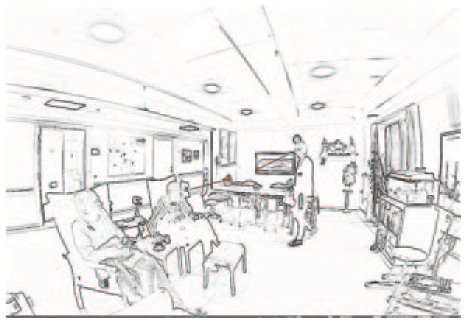
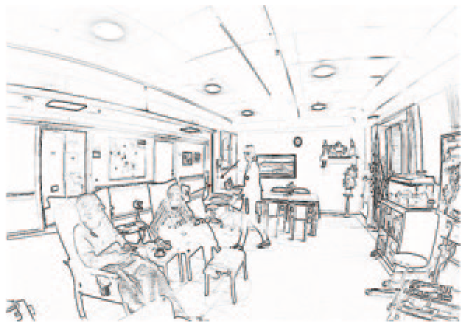
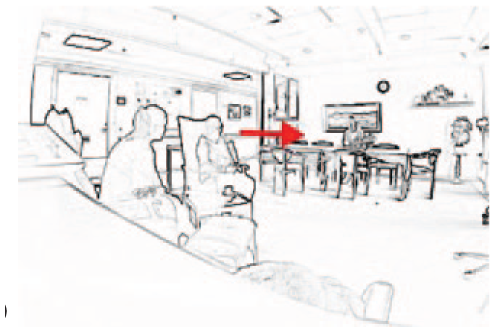
Examples 1 (#fig 1 and #fig 2) and 2 (#fig 3 and #fig 4) are instances of a visitor and a staff member, respectively, passing through without greeting: Example 1 #fig1
#fig1 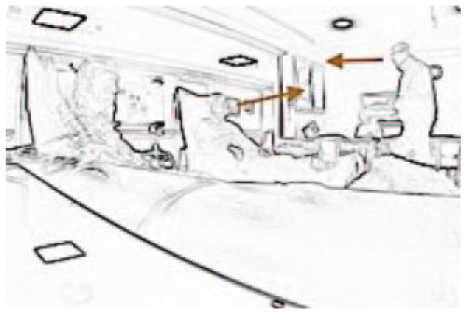 #fig2
#fig2
In example 1, it is visiting hour in the care facility. Two residents are seated in the lounge section of the common room. A passageway leads from the entrance door to the apartments of the residents between the lounge and a dining section in the room. They have arranged themselves (or have been arranged by staff) in parallel to one another to see and observe who enters the door. The upper and lower parts of the entering visitor’s body are directed toward the end of the passageway and remain in that position as he walks by the resident who sits closest to the passageway. The resident directs his gaze to the visitor and continues gazing at him, while the visitor passes by him. The visitor gazes past the resident and turns his head and gaze back and forth behind, above or next to the resident. Their eyes do not meet at any point, and no other embodied behavior is conducted through which an axis of interaction can be established (Kendon, 1973). The visitor walks to his wife’s apartment, and the residents continue gazing at other entering visitors without, by the way, engaging in focused encounters among themselves, for example, talk related to the categorization or identification of the visitors (compare to De Stefani and Mondada, 2010) or in any other way indicating engagement in what is momentarily happening through, for example, facial expressions. No movement can be registered in their faces (cp. Frijda, 1973), which remain in repose (Russell and Fernández-Dols, 1997). In other words, they seem to observe.
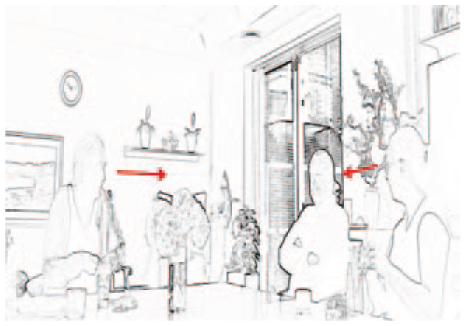
Systematically, however, individuals entering may seek for mutual gaze with the potential for a greeting exchange, which may then develop into further interaction. In example 2, a staff member monitors the room and gazes at the seated residents and a visitor (#fig 3). The resident closest to the passageway looks downward, and the other resident is having a conversation with the visitor. The staff member continues on her way, now gazing past the individuals present who lift their gaze toward her (#fig 4).
Example 2 #fig3
#fig3 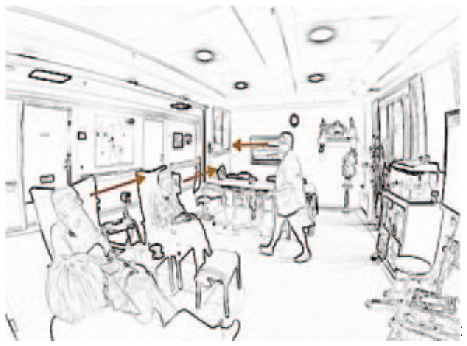 #fig4
#fig4
In this case as well, no greeting exchange is developed, and no conversation or any verbal exchange is initiated. Instead, the staff member walks past the residents and engages in instrumental caring tasks, and the residents resume their activity.
Individuals present in the unit do occasionally exchange greetings when mutual gaze is achieved between them. For this to happen, individuals work to achieve mutual involvement by repeatedly turning their heads and eyes toward the others in the room. In the examples above, however, there seems to be either no common work for this purpose (example 1) or the moment has passed (example 2) of the timely detailed coordination of conduct by the staff member and the resident and the visitor. The conduct is, respectively, staff enters the room, closes the door and takes the first steps on her way toward the section behind the present others (compare to Oloff, 2010) and the resident and the visitor turn head and gaze toward her at one point, modifying the configuration of their encounter (Goodwin, 1981), maybe too late.
The achievement of mutual gaze and the presence or absence of greeting exchanges
When individuals enter and achieve mutual gaze with the residents, one of two different behavioral patterns develop: a greeting sequence, eventually followed by other small interactional sequences (example 3 in the following), or a greeting from the individual entering which receives no greeting from the resident and is followed by no subsequent follow-up or pursuing talk or action for interaction by the individual entering (example 4 in the following).
In example 3, the residents Erling (E) and Gyda (G) are sitting in front of the television which is turned on, when the staff member Sanne (S) enters the room: Example 3 1 E »television 2 G »television 3 S opens the door, enters the room and ∆closes the door behind her ∆ 4 ∆turns head towards television∆ 5 E »S 6 S turns head towards E 7 *»«E1 –> 8 S ∆hej Erling ∆ 9 hi Erling 10 ∆*upper and lower body parts directed towards the end of the path, past E2∆ –> #fig 5 #fig 5 11 E *lifts left arm towards S3–> #fig 6 #fig 6 12 S ———————-2 13 E ———————-3 14 S –>2*turns body parts towards E, walks up to E, grasps his hand 15 –>3* 16 –>1*turns body in the direction of the television 17 »television #fig 7 #fig 7 

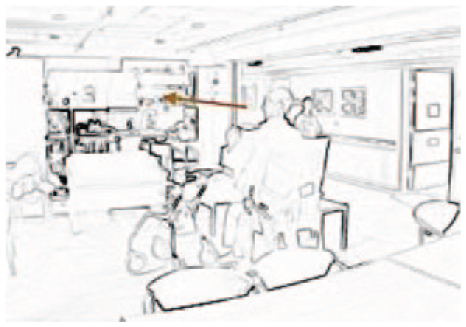
As shown in #fig 5, Sanne enters the unit (the camera is positioned in the other corner of the room as compared to examples 1 and 2). She has taken a few steps forward when she achieves mutual gaze with the resident closest to the pathway, upon which she greets. The greeting is accompanied by no change in her body posture, which is directed toward a point behind Erling, thus indicating a greeting on the pass, that is, on her way to something else. Erling responds by raising his hand while mutual gaze is maintained. She continues the trajectory of her walking direction; however, his hand and arm remain in the lifted position (lines 13–15), which Sanne then treats as an invitation to interact in ways that go beyond a greeting exchange. Thus, she walks toward him, grasps his hand and turns toward the television and engages in watching television with him for a short while before disengaging and resuming her walk (compare to Broth and Mondada, 2013; Tuncer, 2015) toward rooms behind him. During the sequence, no words apart from her greeting items (line 8) are uttered. In this way, she engages with the activity that he was engaged in when she entered without disturbing it and thus extends what her greeting while passing by accomplished, that is, it recognized Erling’s presence without disturbing him watching television.
Together the fragments illustrate three points that can be made concerning one of the two mentioned types of behavioral conduct of residents and entering staff or visitors on the pass: (a) entering individuals as well as residents may monitor for mutual gaze; (b) if mutual gaze is achieved, entering individuals initiate a greeting sequence as they pass by, continuing their main business, and orient toward letting the residents continue their activities (unless other initiatives are taken as in example 4 below) and (c) residents return the greeting through talk or other embodied conduct (e.g. nodding). Through this exchange of mutual greeting behavior while being occupied with other activities, the co-present individuals recognize the presence of each other without indicating availability for further interaction.
Interestingly, another pattern may occur. The residents may not return the greeting by the entering person, but, as described in example 2 above, restrict themselves to gazing at him or her with a face in repose. The gaze behavior referred to here is not a glance at the entering person before returning to ongoing activities. The residents’ eyes rest on the individuals entering, while the latter continue their walking trajectory after the residents have had mutual gaze with them and after the residents have not responded to their smiles, nods or verbal behavior that indicate greeting or recognition of the presence of the residents. Example 4 is an instance of this. The staff member, Pernille (P), enters the common room in which Erling and Gyda are seated, having a cup of coffee.
Example 4 1 P enters the room, closes the door behind her, gazes towards aquarium 2 on desk next to the door, takes two steps forward on passage between 3 lounge and dinner section in the room 4 *»E–> 5 E »coffee cup 6 G »door #fig 8 #fig 8 7 P ∆°hej°Erling ∆ 8 hi Erling 9 ∆upper and lower body parts in direction of end of path behind E’s chair∆ 10 E ∆turns head ∆ 11 –>*∆*»«P1 ∆ –> 12 ∆holds on to the coffee cup ∆ #fig 9 #fig 9 13 (/1.9) 14 P /∆walks along the passage ∆ 15 ∆nods ∆ 16 ∆*smiles2 ∆ –> #10 #fig 10 17 P –>1* »G 18 G head direction towards P 19 P passes E 20 S ∆he:j Pernille ∆ 21 hi Pernille 22 ∆S stands in the kitchen section behind the camera ∆ 23 P turns upper body part slightly towards kitchen section 24 hej 25 hi 26 –>2*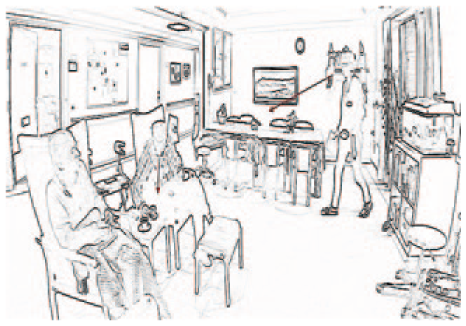
As in the previous examples, Pernille greets Erling after a few steps into the room (line 7), on the pass to use the scanner at the unit. Erling is drinking his coffee and looks up at Pernille upon her greeting turn. Through this, they achieve mutual gaze (line 11). Erling does not respond with any behavior that is recognizable as a greeting. For 1.9 seconds, the mutual gaze is sustained, while the staff member walks past him, pursuing a greeting response from him by nodding and smiling (lines 15–16), which he does not respond to either. In line 20, another staff member, Sissel, greets Pernille which may be understood in two ways: either she is hidden behind the camera in the kitchen section and initiates a greeting sequence through which she makes Pernille aware of her presence and potential availability for interaction or she delivers the second pair part that Erling did not do (Pomerantz and Heritage, 2013).
For the point made in this article, it is noteworthy that Erling does not respond to Pernille’s two greeting actions by greeting himself in spite of their sustained mutual gaze. Also, Pernille indicates that they know one another, or at least that she knows him, by addressing Erling by his name. Still, he does not respond by greeting, by indicating recognition or in any other way acknowledging her presence. Neither does he in any way indicate that he is engaged in another activity. Instead, his behavior comes off as the activity ‘observation’. Doing observation may be the situated behavior of a resident who does not recognize the entering individual (Reilly and Hung, 2014) or who does not engage in greetings that might lead to attempts at further interaction though the greeting may be done in passing. In the latter case, the resident may demonstrate resistance of recipiency (compare to Heath, 1984), that is, he is not available for interaction of any kind.
In the unit, individuals entering deal systematically with the two assumptions as they either (a) walk up to the resident to identify themselves and to repeat the initial greeting or (b) orient to the resident’s unavailability by diverting from a greeting exchange. In the former cases, they may achieve a responding greeting or they may learn that the resident heard them the first time and did not respond on purpose in order to avoid interaction. This may be illustrated with a quote from Nancy, another resident in the unit who responded as follows to a second first greeting by a person entering ‘ja det har du sagt to gange nu’ (yeah you have said that twice now). In such cases, the resident insists on unavailability for interaction despite being present. In the latter cases, pursuits of a greeting action may achieve what Pernille achieved with her pursuit of a greeting response on the pass, that is, mutual gaze without any recognizable indication of recognition or acknowledgment. In this case, individuals entering may deal with the situation, as does Pernille, by diverting from the greeting exchange, thus indicating the understanding that the resident is unavailable. Her second first greeting (lines 15-16) is accomplished through a coordination of a nod and a smile. She then continues smiling as she continues walking and sustaining mutual gaze with Erling. The smile continues and is carried over in a smile at the other resident Gyda, whose head is turned in Pernille’s direction. Gyda, who is almost blind, does not respond to the smiling either. The smile on Pernille’s face is sustained during Sissel’s greeting (line 20) until after Pernille has responded with a greeting in line 24. Pernille, in other words, incrementally carries over one of the resources for action construction addressed to one recipient into a resource for possible interaction with someone else. The smile finally becomes a response that is fitted to the local interactional environments in terms of a greeting by Sissel. With her smile, Pernille thus constructs a transition from one possible focused encounter to another, and the behavior seems to work to resist being ‘left with nothing’ or being ‘left hanging’. As we shall see in the following, this way of dealing with a lack of responses is also seen in instances of discontinuous conversation. In these cases, however, there may be no other possible recipient and no other possible focused encounter.
Practices for dealing with unavailability and awayness during conversation
Issues pertaining to the nature of residents’ availability and unavailability are also, significantly, dealt with during established conversations. This section focuses on such occurrences. Of special interest here are the practices co-participants employ to establish an understanding of residents’ act of ‘gazing into space’ and how they deal with the occurrence of ‘gazing into space’ in atypical positions.
According to research, co-participants ordinarily coordinate the details of their talk and their bodily behavior in ways that make their behavior recognizable as entering disengagement (Goodwin, 1981; Mondada, 2015), that is, as moving into disengagement. Moreover, they interactively establish and sustain mutual disengagement as they collaborate in organizing disengagement displays, for example, attending to other activities. They make such collaboration on disengagement (and reengagement) possible by continuously scanning each other and taking account of what the other person is doing. In the analysis undertaken of the other, Goodwin (1981) suggests, co-participants may distinguish actions ‘that provide the possibility of co-participation in them (such as noticing) from actions (such as “staring into space”) that do not permit such possibility’ (p. 100). In Goodwin’s work, co-participants may start staring into space after having noticed something, for example, in the environment in which the interaction takes place.
The four pictures below (examples 5–8) illustrate four instances from four different settings involving nine different individuals. They differ from instances that have been described in prior research as referred to above, as they are instances of residents looking off into space though a mutual understanding of entering disengagement has not been established with the co-participants. The pictures aim to show how the co-participants respond by observing the residents. Neither the residents nor the co-participants change their bodily orientation to one another or the space between them during their different head/gaze orientations.
Example 5 #fig12 Example 6 #fig 13
Example 7 #14 Example 8 #15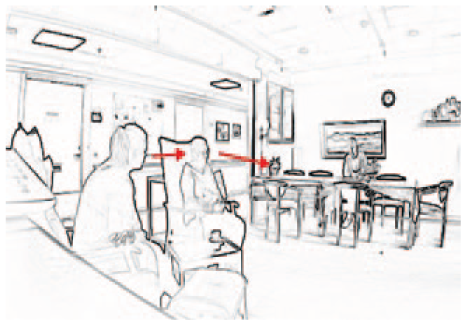

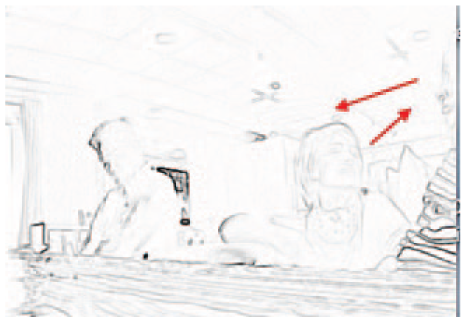
A closer look at examples 5 and 6 will bring to the fore the pre-conditions that render the residents’ disengagement and unavailability meaningful to the co-participants as ‘straying away’ or ‘being away’, that is, withdrawing from interaction and being engaged with nobody. Looking away may be recognizable as, for example, being ‘unwilling to’ or ‘reluctant to’ further engagement with current co-participants. The analyses will show, however, how the co-conversationalists search for possibilities for reengagement in spite of the resident being ‘away’, thus indicating the possibility that the resident’s conduct is a symptom of the disease, rather than a choice for which she or he can be considered responsible.
Example 5 is an instance of an interaction between a resident, Lily, and a staff member, Winnie. Prior to where the transcript starts, the two of them have talked about Lily’s husband.
Example 5 1 Li °hvor er han henne° 2 where is he 3 *»«W-> 4 Ps (1.3) 5 ->* 6 W ∆↑det ved jeg faktisk ik lige ∆ hvad det er han laver↑ 7 that I don’t really know what he is doing 8 ∆»to the right ∆ *»«Li-> 9 Ps (0.4) 10 W det ka være [han er ude og handle eller så noget ] 11 maybe he is out shopping or something 12 Li [->*rotates head slowly and slightly to the left, *»straight ahead] -> 13 W *»Li1-> 14 Ps (1.0) 15 W men han komme:r o:m: ∆ja om ∆ en times tid tror jeg 16 but he’ll come in well in about an hour I think 17 ∆shakes head∆ 18 Ps (2.6) #fig 18 #fig 18 19 W ik o′ 20 right 21 Ps (0.8) 22 Li °~jo~° 23 yes #fig 19 #fig 19 24 W jo 25 yes 26 Ps (17.8) 27 W nå (.) jeg skal ned og lægge noget rent sengetøj på din seng Lily 28 well I’ll go and put clean linen on your bed Lily 29 Ps (1.7) 30 W ∆lyder det ik som en god ide∆ 31 does that sound like a good idea 32 ∆stands up ∆ 33 Li jo 34 yes 35 W ->1* 36 W walks away 37 Li ->>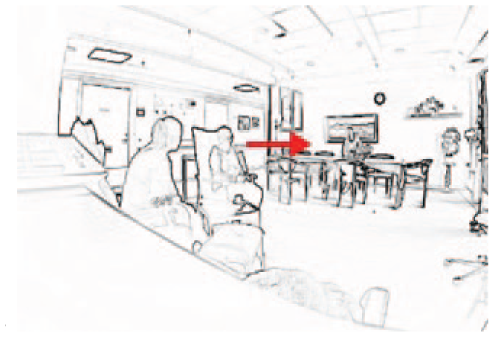
Upon Lily’s question about her husband’s whereabouts, a gap emerges before Winnie responds, in high pitch, by saying that she does not really know what he’s doing (line 6). During the first part of her turn (that I don’t really know), Winnie gazes to the right, which all together is understandable as a search or reflection on possibilities. The TCU (Sacks et al., 1974) is expanded through a pivot construction (that I don’t really know what he is doing), while Winnie redirects her gaze toward Lily and obtains mutual gaze with her. They continue gazing at each other across the small (0.4) gap (in line 9) and during Winnie’s initial talk that indicates an upcoming suggestion as to the husband’s whereabouts (‘det ka være’/‘maybe; line 10). As Winnie finishes her turn (line 10) providing a suggestion, Lily turns her head and immediately gazes into space with her facial muscles in repose, which is understandable as indicating no engagement, interest or understanding (cp. Frijda, 1973; Russell and Fernández-Dols, 1997). She continues doing so while Winnie develops her talk, guessing when the husband may come visit Lily (line 15). Lily, in other words, modifies her participation (Goodwin, 1981) mid-turn (Jefferson, 1984a) and displays disengagement and does so without indicating that her attention and possible engagement are directed to other activities. Note that Winnie does not, for instance, attempt to gaze in the same direction as Lily, which would indicate a search for what Lily might be gazing at and thus establish the intelligibility of Lily’s disengagement by reference to other activities (Goodwin, 1981). From a closure of the talk in terms of an activity-occupied withdraw, Lily’s gaze might relevantly have developed ‘going into space’, displaying that a resumption of the conversation was not possible. But in fact, while both parties remain in the same spatial position to each other and continue being bodily oriented such that the axis of the encounter remains, Lily seems to have withdrawn herself from it – and, moreover, to have done so without having made any recognizable efforts to collaborate in disengagement.
While Lily looks straight ahead, Winnie remains in the same position with her head and eyes turned toward Lily, obviously gazing at her across a 1.0 second pause (line 14), Winnie’s own talk (line 15) and yet another (2.6) second long gap that occurs in line 18. Winnie’s talk has received no acknowledgment or the like which would close the sequence, and so Winnie’s continued gaze during Lily’s silences and gazes into space (lines 9 and 14) indicates that she is waiting for Lily to do something. Simultaneously, she seems to monitor Lily’s behavior to establish the nature of it.
Upon the third gap (2.6 seconds) in line 18, Winnie elicits a response from Lily through a tag question. Lily does not oppose to the initiative, instead, she responds with a type conforming (Raymond, 2013) and aligning (Stivers, 2008) ‘°~jo~°’ (yes). However, she produces her response softly and creakily after a gap (0.8 seconds, line 21), while continuing to gaze into space with ‘expressionless face’. Altogether, one may relevantly categorize her ‘°~jo~°’ (yes) as an ‘absent-minded response’. She sustains the posture, the gaze and the ‘expressionless face’ during Winnie’s subsequent sequence closing (Schegloff, 2007) ‘jo’ (yes) in line 24 and during the following 17.8 seconds lapse (line 25) until the end of and beyond the fragment. Lily’s conduct seems to come off as ‘being away’.
Interestingly, Winnie’s head and eyes remain turned toward Lily, obviously monitoring her during the long lapse (17.8 seconds), rather than, for example, developing the encounter into something that does not require talk (cp. Hoey, 2015). In this way, Winnie treats Lily as available for observation and possible co-participation without making any pursuit of response in terms of, for example, addressing Lily to procure gaze as display of recipiency (Kidwell, 2013). She orients in other words toward Lily ‘being away’, while she displays availability herself. The resumption of talk is then up to Lily – and since Lily does not monitor Winnie, upcoming talk cannot be expected to fit the micro-details of whatever the co-conversationalist is doing.
Winnie finally ends the long lapse by taking initiative to dissolve the encounter, accounting (Robinson, 2016) for the closure (well I’ll go and put clean linen on your bed, Lily, line 26) before finally leaving the room.
Example 6 is another instance of ‘awayness’. In this instance, however, Jimmy is already ‘away’ when the co-present visitor, Doris, addresses him. The encounter is a multi-party conversation, and apart from Jimmy and Doris, who sit in parallel to each other, two other residents with dementia, Gyda and Karin, take part in it. Prior to where the fragment starts, Doris and Gyda have talked about how they live and have lived, upon which a silence occurs. In line 1, Doris attempts to include Jimmy (again) 2 by asking What about you Jimmy. Did you live in a house or in an apartment. Jimmy does not answer the question, and so a gap occurs. It may be worth noticing that talk is not resumed until 45.2 seconds later when Gyda initiates talk (line 19).
Example 6 1 Doris ∆hvad med dig Jimmy boede du i hus eller (.) i en lejlighed∆ 2 What about you Jimmy. Did you live in a house or in an apartment 3 ∆*»Jimmy ∆–> 4 Jimmy *»straight ahead1–> #fig 16 #fig 16 5 Ps (7.3) 6 Doris –>*, *redirects gaze towards knitting wear–> 7 Ps (2.0) #fig 17 #fig 17 8 Doris –>*, »Jimmy, *redirects gaze towards knitwear–> 9 Ps (3.5) 10 Doris –>*, *»Jimmy–> 11 (2.0) 12 Doris –>*, turns head to the left, ∆redirects gaze towards knitwear∆ 13 ∆*smiles2 ∆–> 14 Gyda *Gyda leans slightly across the table3–> 15 Doris »Gyda, *redirects gaze towards knit wear4–> 16 –>2* 17 Gyda ->3*leans back in the chair 18 Ps (17.1) 19 Gyda hvad skal du nu 20 What are you going to do now –>4* –>>1
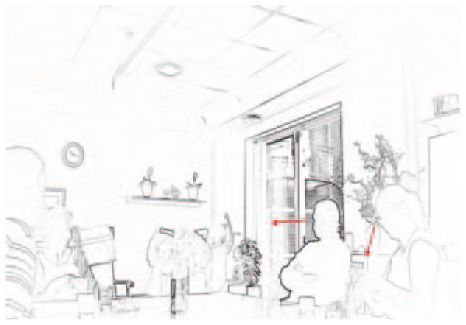
Jimmy seems already to be deeply absorbed by something else when Doris turns her head toward him, addresses him and asks him about his housing earlier in life (what about you Jimmy) (line 1). Jimmy gazes in another direction, as did Lily in example 5, without recognizably attending to a material object or any other activity in the room, and he does so with an ‘expressionless face’. Doris makes no attempt to follow his gaze direction to figure out what he is gazing at or what the object of his attention is, neither before nor after her talk. She thus seems to orient to it as being un-accessible to her or not relevant for a possible conversation between them. In other words, she treats his behavior as ‘being away’. Still, she invites him to have a conversation.
Jimmy does not respond to her invitation and continues gazing into space. Not making use of any techniques to procure Jimmy’s attention, Doris accepts him ‘being away’, as she continues gazing at him. Her gaze rests on him for about 7.3 seconds before she redirects it toward her knitwear while knitting. Knitting does not require talk, but from behind the knitwear shield (Goffman, 1963), she glances at him (line 8) after 2.0 seconds obviously monitoring his behavior and staying available for conversation, as did Winnie in example 5 above. She repeats this gazing behavior (lines 8–10) and keeps gazing at him for another 2.0 seconds (line 11). As also illustrated through example 5, Doris then seems to incrementally reestablish and accept that Jimmy is and stays ‘away’ before abandoning the invitation to take part in the conversation and starting to scan Gyda’s behavior for the possibility of resuming conversation with her.
As we saw in the instances of residents not responding to greetings while gazing at staff with ‘expressionless faces’, Doris withdraws from the encounter while she smiles. With the smile, the co-participants seem to enter a transition space between the prior and future activity. As the prior activity has not been closed collaboratively, but has been abandoned by the smiling co-participant due to the other ‘being away’, the smiles seem to indicate an accepting stance (Stivers, 2008) to the residents’ ‘straying away’.
Conclusion and discussion
Human social activity is an ongoing process through which co-participants typify behavior and order it according to recognizable, and sometimes normative, standards. Decades of research have shown how the details of behavior are decisive for how the behavior is understood as well as whether it is categorized as atypical or deviant. As this study shows, co-present others are faced with practical problems concerning categorizing and ordering conduct and actions that indicate availability and unavailability for social interaction in encounters involving persons with moderate to severe dementia. Not only may engagement and disengagement displays fluctuate, sometimes on a moment-to-moment basis, they may also be categorizable as atypical engagement and disengagement displays or (un)availability, as when a resident gazes at an entering person who greets, without returning the greeting while their face is in repose. Moreover, as the paper has shown, disengagement may occur without prior recognizable incremental collaboration on moving into disengagement, as when the residents ‘stray away’ and gaze into space with their face in repose while the co-participant is talking.
Typical practices of handling indications of unavailability, whether in terms of engaging in a new or continuing an ongoing conversation, consist of either pursuing a response or abandoning the project, often with a smile through which a transition from one activity to another may be accomplished. The practices and actions are accomplished incrementally as co-present staff and visitors continuously monitor the residents so that pursuits of response work to further investigate the possibility for interaction, rather than to attempt to procure attention or even initiate repair with reference to a lack of understanding, hearing or agreement. In effect, staff members and visitors orient to a social norm according to which (dis)engagement is achieved collaboratively through social interactional means.
As this study has also indicated, ‘straying away’ is a recurrent and recognizable phenomenon in situations involving residents with dementia. Goodwin (1981) suggests that gazing into space does not make (re)engagement possible (see also Bateson and Mead, 1942). In situations involving residents with dementia, however, co-present others employ practices to attempt to (re)engage the residents in conversation though they are recognizably ‘away’. The attempts are, as mentioned, accomplished with a careful orientation toward the embodied behavior of the resident. In this way, co-present others seem to orient to the medical condition of the resident which may include apathy as the disease progresses. That is, they seem to orient to the lack of engagement as involuntary, and when they cease their endeavor, accepting the ‘awayness’ by reference to minimal responses and engagement displays by the resident, they seem to deal with an assumed (in)capability. This may, however, change on a moment-to-moment basis, and the lack of engagement may turn out to be the resident’s moral choice and so may the means through which disengagement and unavailability are displayed. The practices described in this article indicate that co-present others continuously work to balance off the social needs of the residents with dementia, to which the disease may be an obstacle, and their right not to engage in or disengage from social interaction.
Footnotes
Declaration of conflicting interests
The author(s) declared no potential conflicts of interest with respect to the research, authorship and/or publication of this article.
Funding
The author(s) received no financial support for the research, authorship and/or publication of this article.