



Abstract
Digital communication technologies led to a revolution in how people interact at work: relying on computer-mediated communication technologies is now a must, rather than an alternative. This empirical study investigates how colleagues in a virtual team use synchronous online communication platform in the workplace. Inspired by the conceptualisation of web-based communication platforms as tool, place or context of social construction, we explore the discursive strategies that contribute to the construction of the team’s shared sense of purpose and identity, a collegial atmosphere and consequently lead to effective collaboration. The close analyses of real-life data from a multinational workplace provide insights into the everyday communication practices of virtual team members. Our findings supplement organisational literature based on etic observations of the effectiveness of virtual work and provide a basis for further theorisations about how communication technologies affect the ecology of and discourse practices in computer-mediated communication at work.
Keywords
Introduction
Using computer-mediated communication technologies is now ubiquitous in almost all workplace environments: to a greater or lesser extent most people are engaged in some form of ‘virtual’ work. In fact, an increasing number of organisations now invest in technologies that enable online collaboration with an aim to improve communication within their organisations locally as well as globally (El Tayeh et al., 2008). In their recent market survey, The Radicati Group, Inc. (2017) has found that the reliance on digital communication technologies continues to grow with business organisations of all sizes. The reasons for such strong adoption and in particular the popularity of text-based online interaction platforms are well documented both in popular media (The Economist, 2016) and in scholarship (Anders, 2016).
The popularity of the digitally mediated communication platforms and the collaboration that they enable bring to the fore fundamental questions about teamwork and communication, in particular how virtuality affects interaction and consequently the effectiveness of a team. In this article, we aim to explore this question by providing an insight into the everyday discourse practices used by colleagues in a virtual work environment.
We believe that insights based on the observation of naturally occurring data from a real workplace are much needed, for two reasons. First, scholarship related to communication in virtual teams has traditionally relied on participant interviews, surveys or laboratory experiments (for a comprehensive review, see Purvanova, 2014), paying only fleeting attention to what actually takes place in a real workplace. Gilson et al. (2014) in their review of virtual team research make a strong point of this gap and highlight the discrepancies between the findings based on self-accounts in interview data and real life. Second, although the literature of discourse analytic and pragmatic studies of real-life language in the workplace is growing, scholarship addressing naturally occurring digitally mediated interactions from within workplaces is limited (see Bargiela-Chiappini et al., 2013). The paucity in scholarship is thought to be the result of two factors: on the one hand, due to confidentiality reasons, data from workplaces are not easily and readily accessible for research, as opposed to data from public corporate or social domains (see, for example, Paulus et al., 2016). On the other hand, the study of digitally mediated workplace interactions is a complex field of enquiry, where the complexities inherent in workplace discourse are combined with the emergent, continuously evolving contexts of digital discourse (Darics, 2016). Consequently, the insights into the everyday communication practices of virtual team members presented in this study can provide both empirical evidence to supplement organisational literature based on etic observations and a basis for further theorisations about how communication technologies affect the ecology of and discourse practices within work teams.
Background to the study
Defining virtual teams
In organisational studies, virtual teams have traditionally been described with attributes that are used for the description of teams in general. However, computer-mediated communication technologies have so profoundly changed the dynamics between organisational members that the very notions of team and teamwork have been challenged. Unlike the traditional notion of a team based on stable membership and clear boundaries, virtual teams may span multiple contexts, including multiple cultural, geographical or organisational ones, they may have undefined or very complex goals, lifespan and membership (Wageman et al., 2012). To address this complexity somewhat, Hackman (2012) proposes that teams should be viewed as social systems: small, temporary, with a changing membership. But, as the author notes, teams should be ‘perceived as entities by both members and nonmembers, they create and redefine internal and external realities, and they have transactions with external entities that can be legitimately attributed to the group as a unit’ (2012: 430). Thus, for a group of people to function effectively in a virtual working environment as a team, they have to have a shared sense of purpose and perceive themselves as an ‘entity’, with a unique team identity. They have to, as Bjørn and Ngwenyama (2009) found, establish shared meaning about their professional norms and work practices as well as their new team context, online and off. And such meanings are inevitably created in and through communicative encounters.
Communication in computer-mediated work contexts
Since communication plays a crucial role in virtual work, it is unsurprising that it has received great attention in scholarly literature (for a review, see Marlow et al., 2017). Communication, or to be more specific, success in communication, is often depicted as a key predictor of virtual team effectiveness. Organisational literature suggests that there are three interrelated factors that are thought to considerably affect communication and consequently the degree of successful functioning of a virtual team: (a) the fact that colleagues are not physically present, and as a result miss out on audio-visual cues that would convey crucial information about emotions, tone of voice and interpersonal intentions (Purvanova, 2014; White, 2014), which leads to (b) limited or reduced social interactions (Johnson et al., 2009; Olaniran, 2007), which, consequently affects processes like the (c) establishment of a sense of belonging, collegiality and trust within the group (Crossman and Lee-Kelley, 2004; Gilson et al., 2014).
Accepting the above points, we can pose the question: if digitally mediated communication environments do not allow for, or even hinder, the conveyance of socio-emotional information, how exactly do colleagues working in these online environments develop a sense of belonging, a shared team identity and sense of purpose? How do they ‘do’ collegiality and trust that are thought to be prerequisites for successful cooperation? (Suh and Shin, 2010) This article aims to shed light on the discursive strategies that achieve just this. Specifically, we explore the ways discourse provides the framework within which team members create shared knowledge and draw their sense of belonging and perception of membership.
Discourse and group identity
Discourse being the site of identity construction and negotiation is the basic tenet of social constructivism. This school of thought posits that our social realities are jointly constructed, and that language is a prime site of this ‘construction’ in that it allows us to formulate, negotiate, contest models of phenomena that are highly abstract. Viewed from this perspective, identity can be seen as a discursive construct that emerges through the use of linguistic strategies, interactional negotiation and contestation (Bucholtz and Hall, 2005).
The discursive construction and negotiation of personal and group identities have been extensively researched in the workplace (e.g. Angouri and Marra, 2011). However, the exploration of how people negotiate their individual and social identities in digitally mediated environments tended to focus on social digital spaces and groups (see Baxter, 2018; Graham, 2016) and much less is known about the virtual workplace (for a few exceptions, see Bjørn and Ngwenyama, 2009; Darics, 2010; Laitinen and Valo, 2018). In this article, we go some way to address this gap: we set out to explore, through closely observing naturally occurring interactions in a virtual team, how team members discursively bring their team to life. Our main aim is to explore in what ways do virtual team members create shared knowledge about their team identity and their working practices. To explore these questions, first we provide an overview of the specific context and our respective roles, then we explain our theoretical basis for the analysis and the resulting analytical approach. Finally, we provide our analysis and discuss our findings.
Methodology
Background to the work
This research takes place in a multinational food manufacturer that employs close to 1500 people globally. One of the authors joined the project at the time when the company had just expanded overseas, and the chief communication officer was exploring different communication systems which could unify the new geographies and keep the conversation flowing across different time zones. A major concern for the top management at that time was how to overcome the needs of immediacy in communication with workers or staff members, whose location was not necessarily known on the other side of the ocean. Thus far, within the company premises, everyday communication had been conducted through emails, telephone calls and face-to-face. But the typical in-house communication system was becoming dangerously slow for the new multinational reality. Against this backdrop, the company chose to adopt a unifying communication system that combines a mix of communication modes for team collaboration and connects to virtual meeting spaces: Cisco Sparks. The Cisco Sparks platform allows people to connect on wireless screens, whiteboard, have video and audio calls, instant message and access the virtual spaces on all sorts of mobile devices. However, although Cisco Sparks was originally chosen to bridge physical distances, it also proved to be a preferred tool for employees located in the same location because it fostered communication across several communication channels. A trial team was then set up aiming to test the effectiveness of the new communication platform, and the authors were invited to join in and ‘observe’ this trial period.
Data
During our observation period (March 2017–July 2017), we collected 3572 exchanges. The majority of these exchanges are instant message transmissions among the members of the Cisco Sparks trial team. The number of participants varied as members were added or left the group according to the task they had to accomplish. It is important to know, however, that the core (permanent) unit is composed of four participants: the CIO Manager, two business analysts (Bella and Jill – please note that individuals’ names have been changed for privacy reasons) and one communication manager who is also an IT technician (Raymond). The gender component has been balanced: two women and two men, all of them located in the United States, but one member – the CIO manager – being from a different nationality and often on the road. Our main focus concerned this core team.
Theoretical and methodological framework
Our methodology was, in the first instance, inspired by the project, namely, to find evidence for how the virtual working environment contributes or not to the effectiveness of the team. Not having received a precise brief as to what constitutes ‘effectiveness’ per se, we started off our work using what could be considered in traditional conversational analytic sense, unmotivated looking (see Paulus et al., 2016). What became apparent during the course of the first manual processing of the data is that the team members had developed and were increasingly engaged in discursive practices that indeed contributed to their perceived sense of belonging and the maintenance of a collegial, friendly atmosphere. At an impressionistic level, this behaviour seemed to support what we have learned about the importance of social interaction and group identity in the literature However, the analytical approaches we identified in the literature did not enable us to systematically account for the discourse that contributes to the creation, negotiation and maintenance of shared meanings. Previous studies which examined empirical data from digital workplace interactions drew on conversation analysis (Markman, 2005), discursive construals of trust (Gatti, 2016), cognitive framing of technology (Laitinen and Valo, 2018) and linguistic politeness (Darics, 2010; Mak et al., 2012), but these analytical foci seemed to limit our scope to understand the complex relationship between discursive construction of identity and digital working practices.
Thus, inspired by the call of Jones et al. (2015: 1) to both draw upon the rich store of theories and methods developed over the years for the analysis of ‘analogue’ discourse, and to formulate new concepts and new methodologies to address the unique combination of affordances and constraints introduced by digital media
we drafted an analytical tool based on the conceptual framework proposed by Internet research theorist, Markham (1998, 2004, 2017). Markham posits that people may experience web-based communication technologies as a tool, a place or a context of social construction. Although originally developed for ethnographic research, we found that the three conceptualisations of the online world provide a useful framework for exploring the different uses and interactions with the technology and through the technology.
Tool
The conceptualisation as a tool or medium sheds the spotlight on the communication technology’s function to transmit or retrieve information online (Markham, 2004). As we explained earlier, the team we studied had been provided with a new (and rather costly) communication platform, and so unsurprisingly the interactions contained numerous reflections on the platform itself. Considering its importance as a means to complete work, and consequently a key to the team’s effectiveness, we set out to explore how the team members orient to and make sense of the platform as a tool. To expose these perceptions, we were looking for explicit linguistic references (such as chat, Spark, email) as well as interactional episodes related to communication technologies and their use.
Space/place
When conceptualised as ‘space’ or ‘place’, the virtual environment is not only a structure for the interaction but also a shared cultural space. This conceptualisation is of high relevance to virtual work. The team we observed is not geographically dispersed – its members all work at the same overseas (US) factory of the Italian multinational, all but one are American, and live locally. The only exception is the CIO, who bridges between the Italian headquarters and the US subsidiary and keeps contact with the team while travelling. In the analysis, we focussed on ways in which the constituents of virtual spatiality/referential spaces were instantiated in the team’s discursive practices to see how other spaces were included and textured in relation to the ‘virtual space’ and if this affected, and in what way, cohesion and interpersonal relations. We expected these to reveal not only where participants thought they were but also how those places relate to what they thought they were doing and who they thought they were being (cf. Jones, 2005: 145). To identify these instances, we utilised the lexical identification of place references and deictic terms.
Context of social construction
In order to be able to identify the ways in which members of the team refer to collective identities and action, and to see how these references are transported into text, we drew on Bucholtz and Hall’s (2005) principle of indexicality, which posits that identity relations are discursively constructed through several related indexical processes whose meaning depends on the interactional context, for example, explicit mentions of labels and identity categories, as well as ‘displayed evaluative and epistemic orientations to ongoing talk, interactional footings and participant roles’ (p. 594) emerging in interactions by means of positioning processes such as adequation. The latter refers to adjusting strategies aiming at reaching similarity between the interactants. This typically implies that differences are downplayed and similarities, which are seen as supportive to the identity-building work, are foregrounded. To gain a deeper understanding of the referencing system underpinning the interactional strategies and the meanings exchanged through it, we looked at the ‘socio-systematic inventory of how social actors can be represented’ (Van Leeuwen, 1995: 32). Thus, we focussed on the relational processes and constructs of identification of human social actors in discourse, like indexes of inclusiveness and identity relations.
Our prompts based on the three conceptualisations for the analysis are summarised in Table 1.
Conceptual framework and references to each concept.

Method of data processing
Although we used the above conceptualisations as a guiding tool, the analysis itself was data-driven and inductive. This means that in the first reading we allowed for the specific linguistic references to emerge during the manual processing of the data. In consequent readings, we explored the data set with each of the conceptualisations in mind, guided by the prompts of the analytical framework established above. In the section below, we present selected extracts that are representative of the patterns of phenomena we identified – unfortunately, due to space considerations, the number and length of these extracts had to be limited. Our approach had been based on the double reading perspective made possible by complete accessibility to data during the unfolding of the communication events of the trial team group.
Analysis
In business discourse, the notions of discourse as situated action and of language as work are closely intertwined (Bargiela-Chiappini et al., 2013). Zooming in on the three conceptualisations of virtual collaboration exposed this double helix: (a) how team members get things done through interactions and (b) concurrently establish a shared meaning context.
Tool
The adoption of the new communication platform is an excellent example of the above-described double helix: colleagues use the technology not only to complete work but also as a frame that enables them to make sense of and negotiate the norms of both the use of technology and teamwork in general. Laitinen and Valo (2018) have identified four ways in which colleagues orient to technology in work-related computer-mediated communication: (a) in a practical sense, focussing on technologies’ properties, discussing challenges and offering guidance on the use; (b) in a collaboration sense where technology is seen as an object that facilitates work; (c) focussing on their relationship to the technology, for example, practices, habits or users’ technical competence; and (d) as a means to facilitate interpersonal relationships, for example, as a means of expressing affection or creating a shared sense of space (see section ‘Space/place’). Our data, however, did not lend itself to such neat categorisations: we found that the various orientations to technology co-occur, and colleagues draw on multiple frames concurrently in specific interactional instances.
Note, for instance, the team’s very first encounter with the technology in Extract 1.
Extract 1.
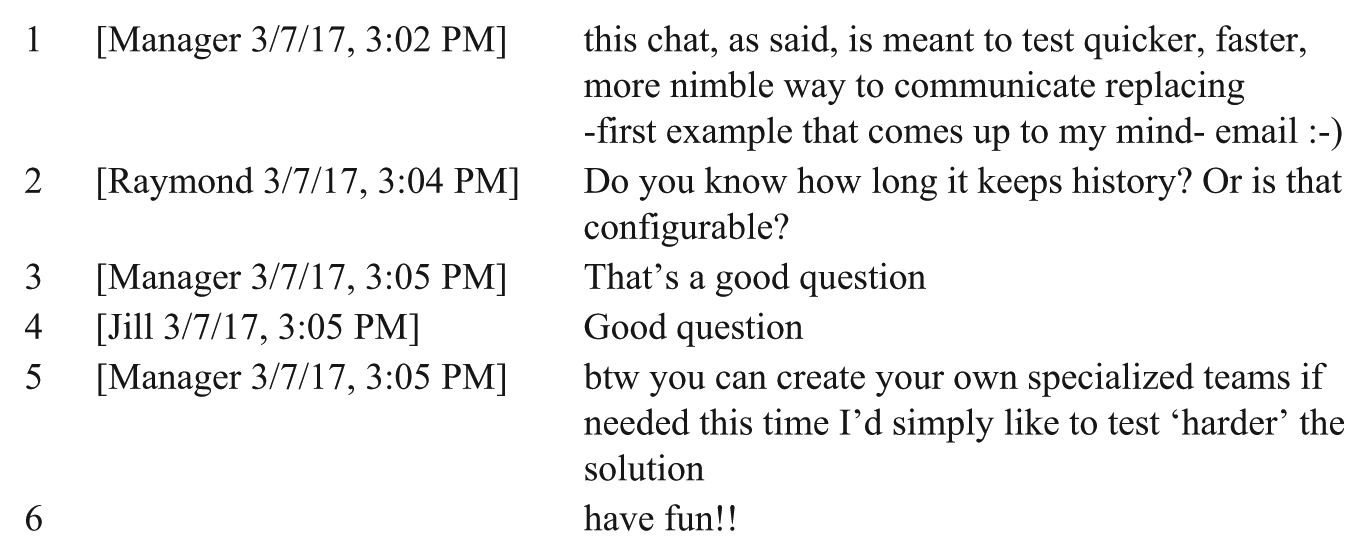
While in this interaction the main orientation towards technology is clearly that of a practical tool, with specific questions related to the platform’s affordances (lines 2 and 5), the manager’s evaluative discourse (line 1) sets the tone for the group’s initial stance and attitude to the new technology. Specifically, through the emotive cue use (lines 1 and 6) and drawing on previously shared knowledge of emails as a basis to establish a shared understanding of the team’s interpretations of the Spark platform (line 1), the manager orients to the platform as a means that facilitates positive affect (‘have fun!!’).
Meta-comments
Instead of the categorisations proposed by Laitinen and Valo (2018), we observed how colleagues conceptualise the communication platform as a tool relative to the time span they used it for. Unsurprisingly, in the early stages of adoption, colleagues have been more conscious of the practical aspect of the novel technological/communicative environment and on several occasions commented on their experiences in forms of meta-comments. These comments were not integral part of the conversation but rather commentary-type additions. Resembling the ‘emotes’ of the early synchronous computer-mediated chats (Cherny, 1999), meta-comments reveal the speaker’s beliefs, attitudes to or evaluations. Embedded in a not directly relevant conversational episode, comments like ‘I love spark tons of email AVOIDED’, ‘I can see why this will be very useful – very much like skpe messanger and MUCH better than google hangouts’ ‘I love Google Mail. !’ show that colleagues do not only share emotional/affective information but they do so in a marked way, by juxtaposing such personal comments against the ongoing flow of mostly task-related interactions.
Technological affordances and challenges
As the team increasingly got used to using Cisco Sparks, the heuristic meta-comments were replaced by interactional episodes focussing on the technological properties, affordances and challenges. These interactional episodes were crucial because, as Laitinen and Valo (2018) found, they brought out ‘emergent negotiations of the meanings’ not only related to technology use (p. 20) but also related to collegiality, norms of collaboration and teamwork. Technological issues were discussed in terms of the problems they caused, with team members sharing experiences and giving advice to each other. As such, these interactional episodes were opportunities to express social support and empathy – these processes have previously been found to foster relationship-building and collegiality online (Crider and Ganesh, 2004). Problems related to the platform were also exploited as sources of humour on several occasions, and at times such humour was used as critical contestation of some of the working practices of the team.
Extract 2.
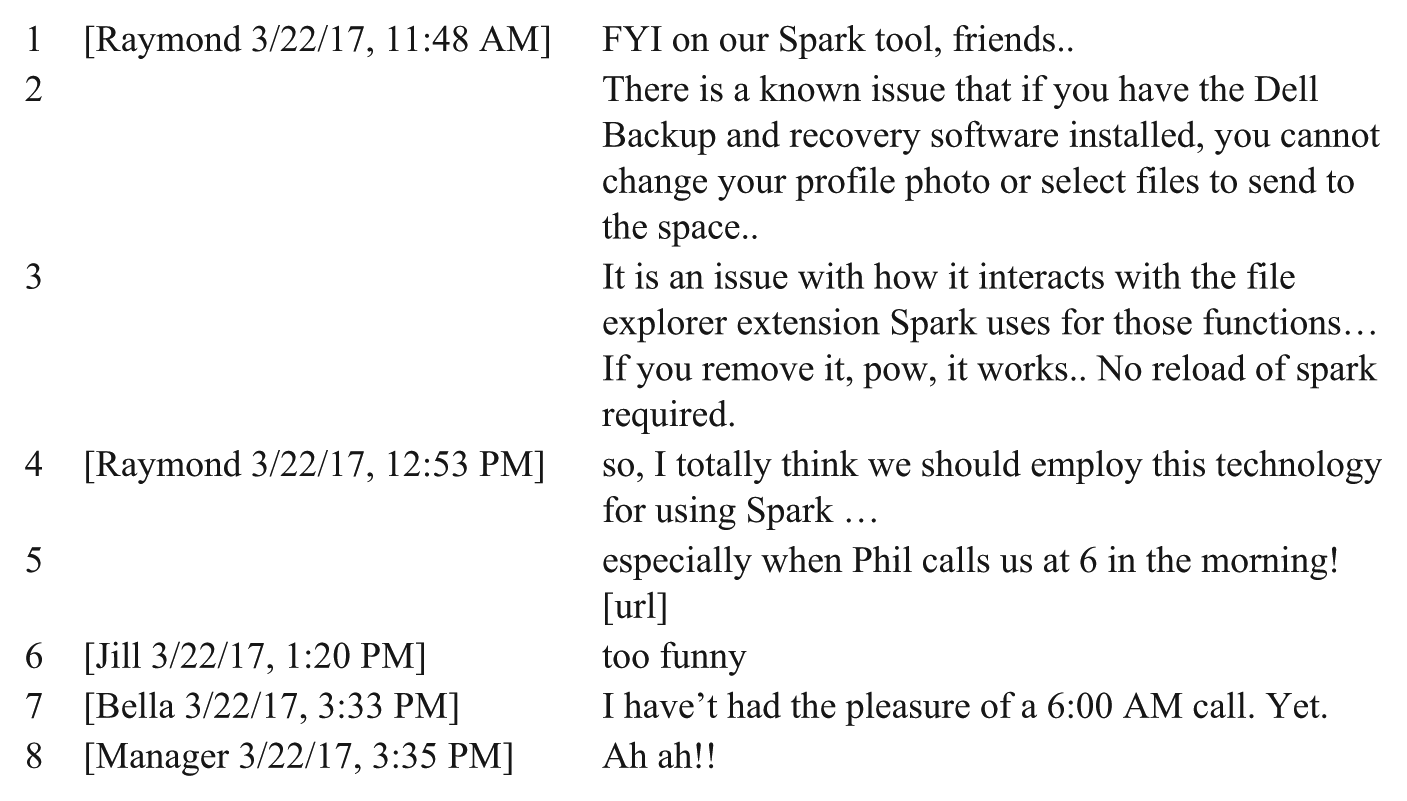
In Extract 2, we can observe the shifting orientations to the ‘platform as tool’ from practical means to a collaborative frame, which allows colleagues to articulate criticism. First, in line 1, Raymond calls the ‘Spark’ tool ‘ours’, linguistically creating a shared sense of ownership. He goes on to discuss related practical issues, and then, in lines 2–4, he suggests a solution to the problem. In line 5, he reframes the technological problem so that it becomes a teasing challenge of the practices of their manager (who is also present in this discussion, see line 8). The ‘technological problem discourse’ thus becomes a source of humour – specifically contestive humour directed ‘upwards’ – which, as Holmes and Stubbe (2003) note, serves as a ‘cloak for the expression of “socially risky” opinions by subordinates’ (p. 120). Although the humorous element is acknowledged by a team member (line 6) and the manager himself (line 10), Bella’s ironic response serves as a confirmation of the validity of the criticism articulated by Raymond.
Facilitating work and/or constant connectivity
As the reliance on the Spark platform increased and team members established ways of working with and through it, their growing familiarity has become clear in the way they (re)appropriated technology-related terminology. The use of ‘Spark’ as a verb (‘spark me when you are done tonight’), for instance, is an example of the group’s developing shared linguistic repertoire, and so is the metonymic use of ‘Spark’ to mean connectivity or online availability (see Extract 9). The following extract provides an interesting insight into the negotiation of such metonymic meaning: Extract 3.

Here, Raymond’s orientation to technology as a means of collaboration is also a metaphoric extension of the platform to mean being connected and available for work. However, the meaning of the idiomatic ‘close to heart’ in line 1 may be read as suggestive of a high status Raymond assigns to the platform – and by extension to being connected and ready to work. It is precisely this reading that is challenged by Bella in line 2, when she expresses her disapproval of the connection of Spark to heart. The short interaction is finished by Bella’s textual laughter which serves as an attenuating force to the earlier expressed disagreement.
Discussion
The above analysis has shown that the discourse related to the ‘platform as tool’ exposes orientations to different meanings of the technology. We have seen that these orientations are complex, the ‘technology as a practical device’ is intertwined or infused with interpersonal and socio-emotional content. The meta-comments of the early stages of adoption serve as a way for colleagues to share thoughts and impressions: these types of socio-emotional interactions have been found to increase group members’ emotional closeness and trust (Suh and Shin, 2010). Similarly, the accounts of team members regarding their positive and negative experiences related to the technology use combine orientations to technology as challenge and personal evaluations and competencies. Importantly, these provide opportunities for ‘bonding’ (cf. Crider and Ganesh, 2004: 148), for instance, through the identification with each others’ problems or through offering help. The conceptualisation of the platform as a tool also provided colleagues with an opportunity to use technology-related discourse for humour, either for entertainment purposes or as a device for subtle criticism, that allows for the transmission of information which could be interpersonally sensitive (Mak et al., 2012). Finally, the adoption of the new technology allowed team members to establish and negotiate new meanings about terminology related to the new technology, which lead to the expansion of a shared repertoire of linguistic resources. The process of the development of such shared repertoire has previously been found to contribute to the development of a shared group identity and help members affiliate with it (Lave and Wenger, 1991). We can thus agree with Laitinen and Valo (2018) in that when conceptualised as a tool, the communication technology is not simply an entity of technical properties nor simply a tool for completing tasks, but rather ‘a way for teams to experience and express togetherness’ (p. 20). These aspects are more clearly articulated in the next two conceptualisations below.
Space/place
References to place in interaction have complex functions. In virtual workplace, colleagues inhibit impacts on what they experience around them, the amount of background noise that may prevent them from concentrating or whether they can work with confidential data when overheard by strangers (White, 2014). But when place is made relevant in an interaction, team members have to design their reference with the recipient(s) and the situation in mind: they draw on a (hypothetical) shared knowledge that the recipients will be able to identify the place they refer to and an understanding that the reference to place will make sense in the activity that takes place in/through the interaction. This is particularly interesting in the case of online spaces or ‘cyberspace’, because, as Jones (2005) notes, people may refer to intertwined spatial aspects, such as the (a) physical space of the interaction the speaker is located at; (b) perceptual online space, like the Spark ‘room’; (c) relational space; (d) screen space; and (e) external spaces which are not inhabited by the participant, but referred to.
The blurring of personal, professional, physical and virtual
This complexity and intertwined nature of spatial references is clearly palpable in the use of the term ‘here’ in our data set. While the word ‘here’ can take on several meanings, in spoken interaction all meanings establish a connection between the context and the utterance (Hanks, 1993). In our data set, ‘here’ has been used by team members 37 times and their close examination has shown a wide variety in their actual referent base. On a few occasions, team members used ‘here’ to signal their relational space and their availability for interaction, in what Holmes (1995) calls a state of attention towards the interaction: ‘I’m here’. ‘Here’ is also used as a reference to the physical space the speakers inhabit. It is used to clearly signal the place of work, as in ‘looks like we had network performance issue today. Both here in Greendale and Franklin’, ‘I have power here in the server room’ or to identify a personal space ‘it’s raining cats and dogs here’. At times, however, the reference to the place of physical being overlaps with the notion of the shared virtual work environment, in particular in comments referring to availability ‘I am finishing here at 3’, ‘I’m all set up with my laptop at the hockey rink!!! Waiting for tasks. I will be here until 6’, ‘Well, Mark cannot take it all on himself, so we are here to roll our sleeve up and get to work’. These examples that lack a clear relational structure to physicality or virtuality show how the orientation towards the real and online space of work can converge in language and consequently centre around the availability for interaction and collaboration, rather than the location of the team members.
Naturally, referring to one’s personal space can also be done using other strategies than the proximal deixis ‘here’, and we found a surprisingly high number of examples of these in the data set. By describing their location (real or imagined, see below), team members offer windows into their personal and family life – thus blurring the boundaries between the private with professional worlds. In Extract 4, we see a relational episode of a manager posting a selfie image taken at an airport as way of reporting his whereabouts (his face has been pixelated due to confidentiality reasons).
Extract 4
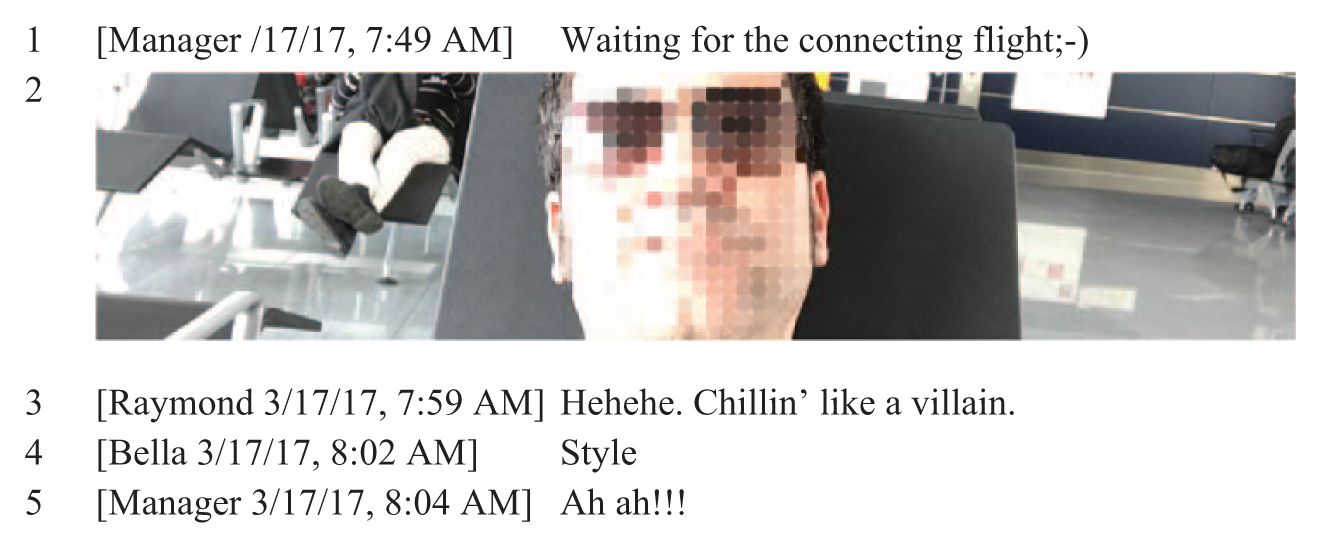
By posting an image of himself, laid back at an airport lounge, smiling, in his sunglasses, the manager visually brings into the workplace his offline, private self, and also does so at an early hour, presumably outside working hours. Although responded to by his subordinates in a supportive, jocular manner (lines 3 and 4), instances like this have important functions in virtual collaboration. They communicate an ‘always-on’ attitude and contribute to the creation of an interactive presence which necessarily conflates their ‘online’, that is, work-related and ‘offline’, that is, private personas.
Place reference as discursive resource of identity
Another type of reference to ‘here’ points to another physical/conceptual place, referring to the group’s wider working environment and the organisation: ‘Fabio is one that has been here for a couple of years’ and ‘XX is a person that everyone told me no longer works here’. On one occasion, a technician is discussing a technical problem and describes the technology ‘that serves the community here’. In these references, the group uses the deictic term symbolically, to discursively create a broader organisational context. As a way of signalling contrast, team members also use the distal deictic ‘there’ in this boundary setting sense, for example, in Extract 5, where we see two American colleagues discuss an issue they needed to sort out with colleagues at the Italian headquarters.
Extract 5
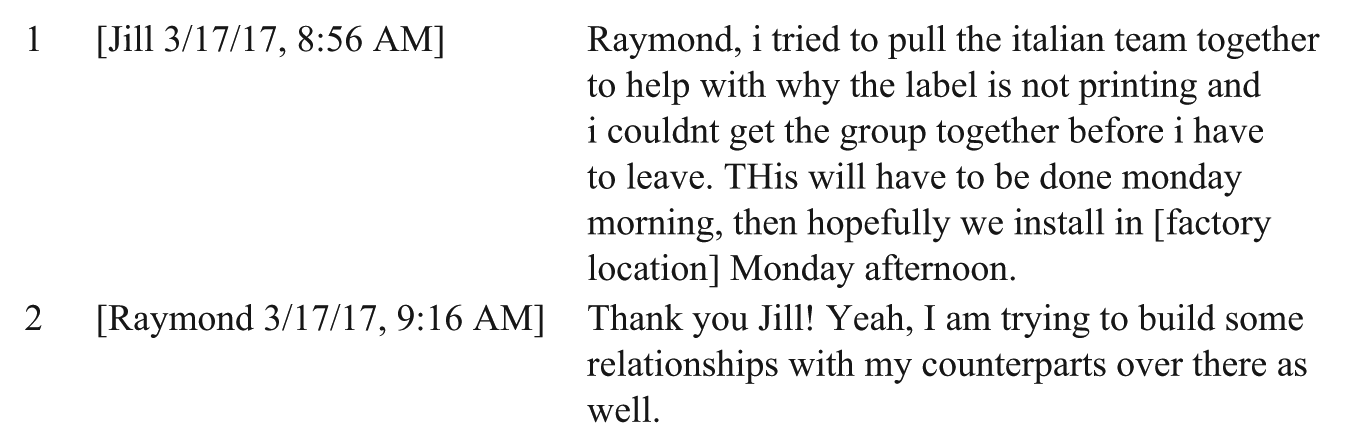
In line 2, ‘over there’ is a resource for making sense of their own distinct organisational identity, vis-à-vis the team in Italy. What this shows is that although the platform was commissioned by the company as a way of ‘breaking down boundaries’ between the two plants, clearly for the team to be able to make sense of their organisational selves they need to draw distinctions between the broader organisational contexts and their own unit of work. This example supports theorisations in organisational disciplines – such as the work of Hackman (2012) we discussed earlier – that call for a greater focus on the role of how people create and redefine their realities within a team, and importantly, how they draw on these to have transactions with external entities as a legitimate entity.
The metaphorical space
A distinctive use of ‘here’ in digital discourse, and perhaps the most relevant to the three conceptualisations of the online world as tool-place-ways of being, is when it functions as reference to the conceptual space or specific identification of screen space. Instances like ‘I’ll keep a running report here’, ‘i’ll keep folks posted here’, ‘I’ll keep a running dialogue here’ evoke the notion of a virtual space (room?). An overlapping but perhaps even more specific reference to the virtual space is the concrete identification of screen elements where actions happen, such as ‘I wanted to share my number here in case anyone needs it: 11111111’, ‘here’s the spreadsheet (attached)’ or ‘I sent an email late last night and just pasted it here to make sure I communicated widely’. These references enforce the idea of a shared working environment and contribute to the creation of a notion of a shared deictic centre (Holmes, 1995). It is also interesting to observe how the team members shift their orientation towards the various spaces, and how then, these orientations encapsulate the social and working practices.
Extract 6
In this interaction we see the first ever log on of the team members to the platform.

In lines 1 and 2, the team members make sense of the place references based on a common presupposed knowledge of ‘here’ as a part - presence signal in the virtual space and part attention signal, and ‘out in the plant’ as a physical location familiar to everyone who works there. The manager in his first message uses a demonstrative (this) and metaphorical reference to the platform (place) almost as a contrast to the first two place references of ‘being ready for interaction’ and ‘being physically at work’. By doing so not only does he (re)define how the team should orient to and conceptualise the virtual environment, but uses the place reference as an anchor point for the activities that will take place or are allowable here.
Discussion
In this section, we examined how the various manifestations of the conceptualisation of space/place are used as discursive resource to negotiate the boundaries between personal and professional identities, as well as the identity of the team vis-à-vis the broader organisational context. What emerged from the analysis above is that the orientation of the team members towards the various aspects of online and offline spaces converge in the key aspect of signalling the availability and readiness for interaction, and more generally signalling the affiliation with the team. References to place(s) – whether shared or individual, real or conceptual – do evoke shared physical experiences because they ‘create a scheme of reference against which participants can interpret the actions of others’ (Bjørn and Ngwenyama, 2009: 249). This shared meaning, argues Baxter (2018), can be seen as ‘warrant for immediate intimacy’(p. 15). Although the ethics of the practice (or requirement?) of constant connectivity is doubtful (cf. Bargiela-Chiappini, 2015), it may be argued that these strategies create a sense of open conversational context, enhancing team members’ sense of belonging, and consequently trust and a more successful team cooperation.
Context of social construction: ‘Ways of being’
Linguistic manifestations of team awareness
Naming
Being aware of their own team as a stand-alone ‘entity’ (Hackman, 2012) creates a sense of cohesion and the feeling of belonging to a group. Linguistically, such awareness can be realised through identity categories, for instance, naming and the use of inclusive pronouns. Indeed, the word ‘team’ as self-reference occurs 46 times in the data set. Similar to the shifts in technological expressions observed in section ‘Tool’, the way colleagues use the ‘team’ term marks a temporal trajectory of a relationship building process. In the early exchanges, the label ‘team’ is used only by the manager in adjectival position to define action-oriented purposes, for example, ‘let’s have a team meeting’, or ‘we will use this place to exchange quick, team-related messages’, thus building a sense of goal-oriented connectivity (see section ‘The metaphorical space’). The first assessment of team’s self-awareness is expressed by a teammate a month into their virtual team work, in the closure step of dealing with a difficult problem. Extract 7 shows the final leave exchanges of an episode concerning a problem, which may cause serious damage to the production chain. The manager sends the team an urgent summon on the platform and, through 72 collaborative exchanges in less than 2 hours, team manages to solve the problem.
Extract 7

In line 2, Raymond, the member who had a major role in the successful ending of the operation, and is praised for his intervention by the CIO (line 1), shares the praise acknowledging the other members’ contribution. In doing so he shows he is conscious of the importance of workgroup interdependance in accomplishing the goal. The statement of identity conflates Raymond’s awareness of the group with his identification with the virtual team. It is interesting to note that after this instance the word team is found more often in opening salutations as addressee or supra-individual referent, for example, ‘Hello team, i am having an issue with JDE excessive time to open, FYI, in case we start getting complaints’, ‘Team, I’m going to test a webex/spark integration …’ or ‘It’s an entirely different fire, my friend. I just wanted to give the team a heads up’.
In a similar way, team as a social actor that refers to a collective identity and a shared sense of belonging is referred to through the pervasive use of ‘inclusive we’ (178 occurrences). Interestingly, even the manager’s reference to ‘we’ is predominantly a genuine signal of inclusivity and group cognition, referring to the listeners as well as the speaker (Extract 8), as opposed to the ‘managerial’ we that refers to addressees only Extract 8

‘Strong ties’ for collaborative involvement and team commitment
As discussed earlier, previous scholarship has been dismissive in their stance on whether computer-mediated communication channels enable a high level of emotional commitment (Johnson et al., 2009); our data suggest a different picture. In their interactions, when addressing the team as a whole or other team members, members often add grading qualifiers and emphatic markers like, for example, ‘Team Awesome!!’, ‘YAY Team!’ or ‘Dream team!’. Such discourse devices generally act as emotional boosters. In the exchanges, they are frequently used in salutation openings or in conversational ‘coalition’ cues with a double effect. Whereas in the former instance those empathic cues add a friendly tone to conventional greetings, in the latter one they suggest emotive evaluation especially in interactional contexts of agreement with the group, like ‘I think we got a great team!’, ‘One other thing, team awesome!!’ or support of people in the group: ‘you really did do an awesome job on these panels’.
Those expressions signal engagement, sense of togetherness defined through a we-are-an-efficient-community individual footing towards the group. At the same time, they are indexes of the group’s ability to create strong in-group interpersonal relationships. With a similar effect, nouns charged with connotations of closeness and familiarity like ‘friends’, ‘buddy’, ‘guys’, ‘kids’, ‘folks’ are used in openings, like ‘Hey kids!!!’, ‘Good morning My Friends!!’ or in exchanges in which cooperation and alliance are needed to overcome difficulties, for example, ‘Don’t worry buddy, I’ll get t figured’, ‘Just to remind folks …’, ‘I’ll keep folks posted here …’, ‘Thanks buddy. I appreciate it. It’s an important one, and I don’t want them waiting on me …’. Extract 9 provides an example of how not only do these expressions act as promoters of affective and epistemic meanings but they also label the interactive footing.
Extract 9
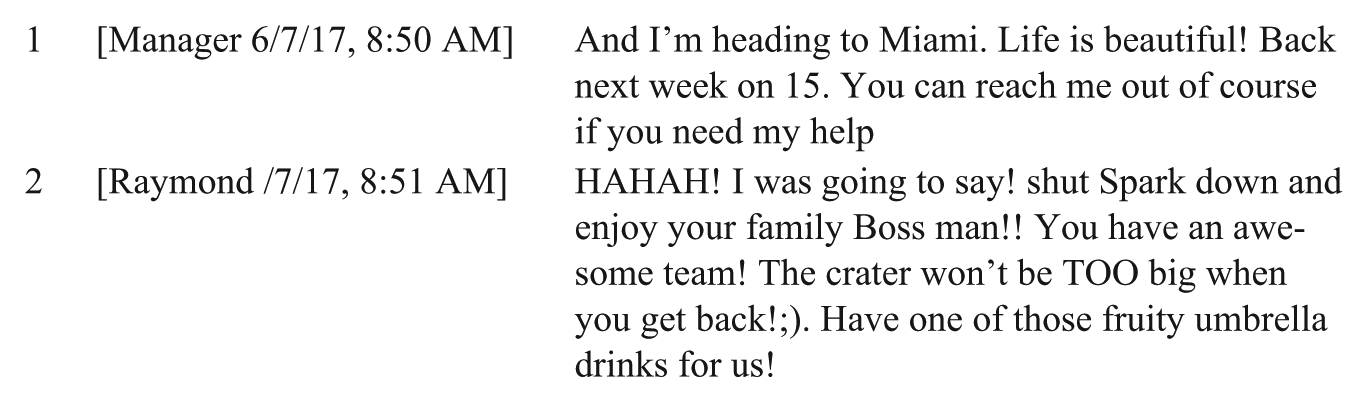
In line 1, the marked expression ‘Life is beautiful!’ functions as a hedge with the effect of lessening the vacation notification to the group, thus avoiding possible hierarchical orientations to talk. The prompt reply in line 2 shows the intersubjective negotiation of identity categories that follow, that is, Raymond takes the hint and, in a jocular tone, immediately establishes the team’s position on an equal footing with Manager.
According to Bucholtz and Hall (2005), identities ‘acquire social meaning in relation to other available identity positions and other social actors’ (p. 598) and sameness is the pivot around which identity relations revolve. Adequation is a strategy of foregrounding similarities. In the case of managing virtual work, it refers to the positioning of individuals so that they are understood as sufficiently similar, for instance, in a bid to emphasise equality and downplay status differences among team members. Extract 10 offers an example of such adequation.
Extract 10
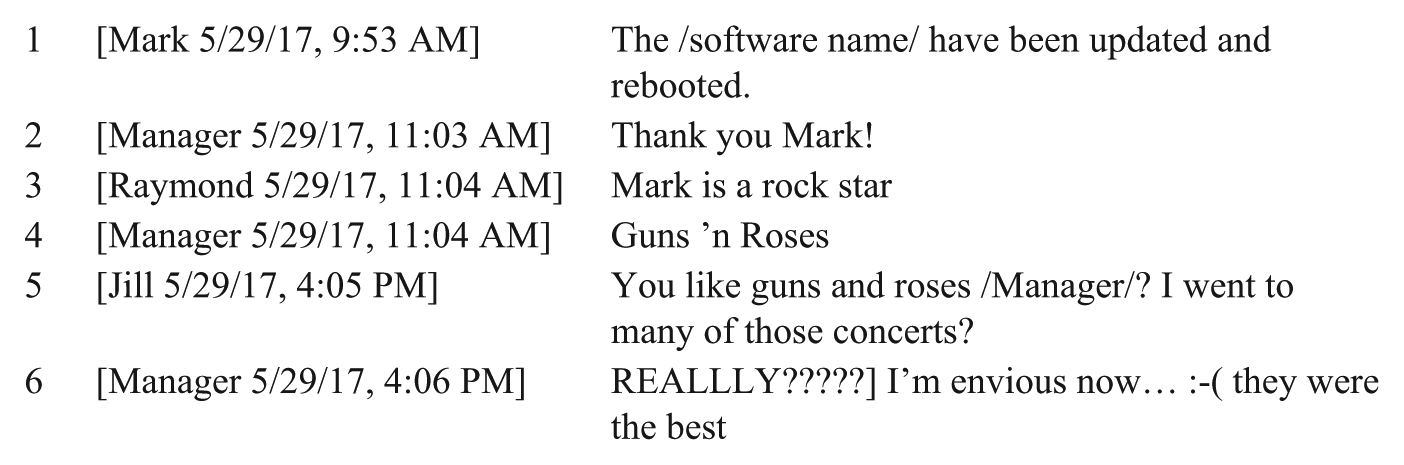
We join a conversation in which the manager thanks Mark for completing the work (line 2) and co-worker Raymond expresses his appreciation by comparing Mark to a rock star (line 3). In line 4, the Manager plays on this comment by mentioning the name of a well-known rock band, as a way of joining in the affective praise of a co-worker, revealing a personal shared interest, and by extension downplaying the hierarchical status differences. This effort is clearly appreciated by Jill, who reacts 5 hours later, revealing her own preferences and personal experiences. This discussion about music preferences and concert-going draws on personal – rather than work-related – circumstances, diminishing the hierarchical status differences they experience at work. The adequation is clearly evident in the manager’s response in line 6, where he uses a range of cues to express heightened emotional involvement (all caps, repeated question marks, evaluative language) and reveals his envy towards a colleague who is inferior in terms of organisational status. Such effort to emphasise relational equality within ongoing team discourse mitigates the tension that arises from hierarchical differences and leads to the establishment of a common ground as well as a friendly, collegial atmosphere among teammates (Holmes and Stubbe, 2003)
Discussion
In this section, we focussed on the ways colleagues conceptualise the online platform as a ‘way of being’. The epistemological assumption behind this focus has been that the virtual work environment is a site of social construction, discourse is social cognition (i.e. shared social relations of group members) and the platform is a mediator that shapes the performance of social action. We have found a wide range of indices – specific linguistic labels, pronouns as well as metaphorical expressions – that provided a convincing insight into creation and maintenance of a shared sense of belonging and collectivity. Considering the crucial role of such sense of belonging for the development or commitment, trust and consequently successful cooperation (Crossman and Lee-Kelley, 2004), these findings demonstrate the importance of the constructive power of discourse.
Similarly, emotional involvement has also been found to be very important in virtual teams: it develops empathy and contributes to the construction of strong ties, which are an important prerequisite in achieving productive cooperation and commitment based upon the shared belief that the team can succeed (Marlow et al., 2017). The discursive strategies we found in the data, namely, the abundance of humorous episodes, the emotional boosters that frame the openings and closing of interactions as well as the adequation strategies have shown the interactional work team members invest in to communicate affect. The lens of ‘Internet as a way of being’ exposed the ways team members ‘construct and experience themselves and others because of or through Internet communication’ (Markham, 2004: 100), providing evidence that seems to contradict observations that posit that the reliance on computer-mediated communication negatively affects employees’ emotional attachment (Johnson et al., 2009).
Conclusion and implications
In the introduction, we have shown that organisational scholarship has a generally dismissive attitude to digitally mediated communication at work, highlighting its limited affordances, mainly the lack of nonverbal communication and reduced social cues (Johnson et al., 2009; Olaniran, 2007). In this article, we challenged this dismissive view. We argued that the examination of what really goes on in virtual teams (as opposed to what interviewees think they do) will shed light on the discursive practices – or the lack of thereof – that team members employ to discursively bring their team to life: how exactly they develop a sense of belonging, a shared team identity and sense of purpose; how do they ‘do’ collegiality and establish trust.
To explore these processes, we focussed on how members of an actual workplace team perceive their online work/communication environment. We adopted a tridimensional lens to expose how members conceptualise the platform as a tool, as a place/space and as a way of being. Our analyses have shown that these conceptualisations enable team members to orient to their abstract, virtual collaboration through (a) the instrument, which provides the team with a technology to complete work; (b) the place of work and place of meeting each other; and (c) the relational space where relationships among individuals and the closer team culture develop. The specific ways in which team members creatively shift between different interpretations of the online platform as tool/space/way of being enables them to negotiate ways of working and norms of the group (see Extracts 1, 2 and 7), the boundaries between online and offline/working (see Extracts 3, 4, 9 and 10) and the organisational realities in their broader (Extract 5) and closer context of work (Extracts 8, 9 and 10) – aspects that have been found to be essential in the creation of a shared sense of meaning for successful online collaborations (Bjørn and Ngwenyama, 2009).
However, the most important realisation of the analyses is that these conceptualisations do not function separately, but are closely intertwined and concurrently infused with work-related and interpersonal meanings. This realisation contradicts the highly instrumental approach of virtual work research to communication technology and views that tend to treat interpersonal and work-related communication as separate entities (cf. Marlow et al., 2017). The analyses have shown that the team draws on a wide range of strategies that establish the unique team identity through fostering a sense of belonging and camaraderie. And, as virtual team research attests, these interpersonal connections, emotional attachment and the resulting trust are fundamental for the effective functioning of a virtual team (Boros et al., 2010; Crossman and Lee-Kelley, 2004; Gatti, 2016).
When effective teamwork is at stake, it is unsurprising that much work is concerned with how to enhance the success of virtual collaborations. Advice for team members and managers to create a sense of equality and connectedness (Boros et al., 2010), enhance personal relationships (Johnson et al., 2009) focussing more on social interactions (Suh and Shin, 2010) or maintaining a close working relationship (White, 2014) is aplenty. What seems to be missing from such literature, however, is the operationalisation of, for instance, how exactly connectedness, equality, collegiality or trust can be created or achieved. We agree with Lockwood and Forey (2016) who argue that findings from linguistic studies can, indeed, provide insights into such operationalisations through empirical evidence from the analysis of naturally occurring data – as we have also shown in our analyses above.
Apart from the lessons for organisational and management practice, this study has important research implications. It underscores the importance of interdisciplinary dialogue between organisational and discourse/language-focussed scholarship, in particular when it concerns digital communication practices. While the role of language as used in virtual collaborations has long been found to be of crucial importance (see Adkins and Brashers, 1995), organisational scholarship is yet to fully utilise the insights linguistically focussed discourse analysis has to offer. Such collaboration will not only contribute to the understanding of some of the inconsistencies of virtual team research (cf. Gilson et al., 2014) but also importantly provide empirical evidence to supplement findings based on interview data and self-accounts. Finally, for the field of discourse analysis, such interdisciplinary work can provide a solid basis for further theorisations about how communication technologies affect the ecology of and discourse practices at work – both online and off.
Footnotes
Declaration of conflicting interests
The author(s) declared no potential conflicts of interest with respect to the research, authorship, and/or publication of this article
Funding
The author(s) received no financial support for the research, authorship and/or publication of this article.