



Abstract
This research aims to describe how practicing lawyers perceive ‘plain writing’ in the legal field and to conceptualize this notion through the discourse analysis of these specialists. To do so, a qualitative research framed in the interpretive paradigm has been developed. Specifically, 18 practicing lawyers, from different countries and with different specializations in the practicing of Law, were surveyed. After analyzing the discourse of the interviewed lawyers, eight macro categories accounting for plain language both generally and particularly were identified. The audience was identified as a key element in the production of legal texts which facilitate justice to citizens. Based on our analysis, we conclude with a definition of plain writing.
Keywords
Introduction
Producing and understanding specialized texts is a very complex task as it implies mastering a conventionalized discourse, with specific textual and discursive characteristics that depend on factors, such as gender and the environment in which they occur (Da Cunha and Montané, 2019; Gotti, 2011; Gunnarsson, 2009). The producers of these texts are experts in their fields, but their addressees sometimes are not. In the legal field, several efforts labeled as ‘plain language’ have been provided to solve the problems that non-expert readers have when trying to understand specialized documents.
Although plain language has gained great interest recently (Alsina, 2018; Blank and Osofsky, 2017; Carretero, 2015; Castellón, 2009; Songa, 2013; among many others), knowledge about its development is dispersed (Schriver, 2017). In addition, plain language and legal writing have seemingly followed independent paths so far. The few studies on legal writing mainly respond to two trends: an approach aiming at a comparison among legal practices in different cultures (Mattila, 2011, 2012) and a characterization of the common discursive genres in this field (Agüero, 2014; Aguilar, 2017; Garofalo, 2009; Taranilla, 2015). Research on plain language, however, has been focused on delimitating the concept (Mazur, 2000), describing the general panoramas on the subject (Alsina, 2018; Montolío and López Samaniego, 2008) and recommending certain uses (Lauchman, 2008; Montolío and Tascón, 2017; Poder Judicial Chile, 2018). To this division, it should be added that most of the works on plain language come from language specialists, who, usually, fail to know the scope of law or the legal practice in detail. Furthermore, a significant number of proposals is based on normative approaches lacking empirical data, that is, indications on what should be done to write clearly in the legal field. All studies consulted tend to overlook the perception of lawyers for researching plain language and for understanding what ‘plain language’ means for the specialists in the field of law.
Given these gaps, in this investigation, we integrate legal writing and plain language with the aim of describing the vision that lawyers have of plain writing in Law. This has allowed us to conceptualize the notion of plain writing in this area and, thus, recognize its key properties. This integration is developed on the basis of an empirical investigation that includes the analysis of descriptions provided by practicing lawyers. To meet our objective, we developed a qualitative research framed in an interpretive paradigm.
Our proposal has the value of being interdisciplinary as includes two experts in language and writing, one expert in education and writing, and a lawyer. In addition, this is an empirical work in which we have collected the contributions of lawyers to understand the construction of legal knowledge and, consequently, their form of written communication. In order to go from legal knowledge to written communication, we have collected perceptions on plain language from lawyers who practice and teach Law so that their assessments can be incorporated to improve the linguistic proposals.
In the theoretical background section, we provide some starting points about plain language, which will allow us to understand, from theory, what is meant by plain language in legal texts. Then, in the ‘Results’ section, after presenting the corresponding methodological aspects, we focus on revealing how the protagonists of the legal acts, that is, the practicing lawyers, conceive plain language and writing. Finally, we provide some conclusions.
Plain language: Delimitation of the concept
The plain language movement finds its origin in the proposals promoted by consumer defense organizations in the United States and United Kingdom (Díaz, 2017). This movement seeks to solve the problem of citizens when reading and understanding specialized documents in communicative practices that are realized in stereotyped discursive genres, written in a very formal and specialized register and far from the standard register shared by the average citizen. In this context, it is understood that ‘a communication is in plain language if its wording, structure, and design are so clear that the intended readers can easily find what they need, understand what they find, and use that information’ (International Plain Language Federation, 2019). From this point of view, a communication with simple language should meet the needs of its audience, when using language, structure and format (design) (Cheek, 2010). The purpose of this movement is, therefore, to ensure that readable texts are written in specialized contexts.
In this line, the concept of readability has to do, above all, with quantitative measures (e.g. punctuation, capital letters, number of words and phrases, etc.) used to calculate text readability; thus, a text with a high readability has short phrases, strong punctuation, short and basic words, concrete nouns, metadiscursive resources, thematic paragraphs, discourse markers, few incidental clauses and low orthographic variation (Cassany, 1995; Sanz and Fraser, 1998). These features, in fact, correspond to those recommended by Montolío (2012b), who, in her proposal for the modernization of legal discourse, suggests, for example, (a) to be succinct to prevent citizens from feeling legal prose as strange, outdated, far-fetched and dark, (b) to avoid anacoluthons and, therefore, to facilitate the understanding of legal texts, and (c) to apply legibility measures, such as short paragraphs and sentences, using periods or full stops (so that reading and comprehension does not become complex, considering that short-term memory does not retain the content read beyond three lines).
In the various proposals developed in relation to plain language, we observe the following assumptions: (a) simple and easy texts are regarded as clear (Cassany, 1995), (b) the lexicon is one of the linguistic components to be simplified to achieve readability in specialized texts (Etxebarría, 1997), although this point is controversial, since there are works that give greater importance to syntax, when assessing the accessibility to a legal text (Carretero, 2015), (c) frequently, the terms language and texts are used as synonyms (Aguirre and Hernández, 1997), blurring any specific variability among the discursive genres involved in the legal fields (e.g. administrative, legal, judicial; Castellón, 2001), and d) the focus is placed on a single reader of legal texts, that is, the layperson reader (Montolío, 2012b).
As Schriver (2017) concludes, in the last 75 years the studies on plain language have converted from a sentence-based activity focused on readability to a full-text-based activity that has emphasized the principles of writing and visual design. In addition, the concern has been expanded from how people understand the content to whether people rely on it. This development is also present in the Ibero-American context, where there are multiple advances to modernize and clarify legal language with remarkable initiatives in Spain, Mexico, Argentina, Colombia and Chile (Arenas, 2018).
Methods
The objective of this investigation is to describe the notion of plain writing in the field of Law based on the analysis of the discourse of lawyers. This will allow us to approach the concept of plain writing considered by specialists and, thus, identify its core properties. With this purpose, we have developed a qualitative investigation, framed in an interpretive paradigm, which allow us to understand how the interviewed lawyers perceive plain writing. Consequently, the participants’ statements have been interpreted so that the value granted by them prevails and, thus, reveals the meaning of what is not evident (Bautista, 2011). Thus, we identify the properties that, from the point of view of lawyers, are associated with the concept of plain writing in the legal field, this is, our research construct.
To collect data, we used an online self-administered questionnaire whose topics emerged from the gaps recognized in previous research on the topic (Díaz, 2017; Gidi and Weihofen, 2018 among others) and the features of the studied construct (Table 1). Thus, the questionnaire was made up of three sections. In the first section, we present four short-answer questions, aimed at collecting personal and academic information from the interviewees (name, institution, degrees and academic degrees, and area of expertise). The second section, consisting of six open-ended questions, aimed to obtain the informants’ perception of plain language, in general, and plain writing, in particular (see Table 1). In the third section, we included a question to know whether the participants would like to be informed of the results obtained. This questionnaire was created by an interdisciplinary team (a lawyer, a specialist in evaluation and two linguists) and was validated in a triangulation process in which specialists from different areas participated: Law, writing and education. For greater accuracy, Table 1 shows the correspondence between the dimensions of the research construct and the questions comprising the questionnaire.
Correspondence between the dimensions of the construct and the questionnaire questions.

As for data collection, an intentional or non-probabilistic sampling was chosen since the selection of the participants responded to the objectives of the study. Specifically, a casual or incidental sampling was selected since the selection of individuals depended on their availability, that is, we worked with volunteers who agreed to participate on their own initiative (Bisquerra, 2009). Thus, 18 practicing lawyers, all of them Spanish speakers, whose characteristics are specified in Figure 1, were interviewed.

Characteristics of the sample.
The information analysis was carried out manually using content analysis, conceived as the process of interpretation of the collected data through its reduction and categorization (Bautista, 2011). This technique applied to the lawyers’ responses allowed us to demonstrate the latent sense of the participants’ representations about the phenomenon discussed here. Our objective, systematic and qualitative technique (Krippendorff, 2019) allowed us to formulate exhaustive, reproducible and valid inferences (Porta and Silva, 2003). More specifically, from the analysis of the questionnaires, we proposed a series of categories, corresponding to the properties of plain legal writing, defined by the corresponding disciplinary community. Subsequently, we grouped these categories into eight macro categories of pragmatic and discursive nature. In Figure 2, we show how this type of analysis was carried out.

Example of content analysis.
Finally, in Figure 3, we synthesize all the methodological procedures described.

Synthesis of methodological procedures.
Results and discussion
In this section, we present the results obtained from the analysis of the questionnaires applied to lawyers, from which 47 categories related to the concept of plain writing were identified. Each category contains specific information about the aspects involved in plain writing that are of most interest to the legal community. To systematize the information, these categories were organized into eight macro categories, using a thematic affinity criterion (see Appendix 1). The results are presented through a series of charts. For a clearer presentation, the results are provided together with examples that were coded with the number of the question (P) and the participating lawyer (A). Thus, a fragment obtained from question 3 by the lawyer 7 is labeled as (P3, A7). Chart 1 illustrates the eight macro categories.

Macro categories identified in the discourse of lawyers referring to plain writing.
As shown in Figure 1, macro categories were identified around the subject of plain language, in general, and plain writing, in particular, in the discourse of the participating lawyers. Among them, the following five areas predominate: Linguistic and discursive resources (19.21%), Concept of plain writing in Law (17.22%), Contributions of the plain language movement to the legal field (14.57%), Variability of discursive strategies (12.58%), and Communicative contexts demanding plain writing (12.58%).
First, the macro category ‘Contributions of the plain language movement to the legal field’ (14.57%) is made up of four specific categories, presented in Chart 2.

Contributions of the plain language movement to the legal field.
In relation to this macro category, although specialists recognize the contribution of the plain language movement, they admit its value for accessing legal knowledge (7.28%), but not for constructing it (2.65%). The following statements illustrate this fact:

Even more drastically, some interviewees consider the contribution of plain language not only as null but also as an inconvenience, as noted in the following example:

This last statement is in accordance with the opinion of those academics, who have openly rejected the tendency to reduce legal language to common language. Cazorla (2007: 75) points out the special nature of legal language: Despite much of the social circumstances that prevail today tend to disfigure the legal language with the ultimate intention, unconfessed but latent, of diluting it, mixing it with the common language until losing any identifying feature, and despite the current society favors these extremes, the legal language, to fulfill its mission, must continue to remain a special language with the necessary scaffolding to support its scientific condition.
The reason why specialists consider that the plain language movement only contributes to accessing legal knowledge, but not to constructing it could be because they maintain the thesis that the construction of knowledge in the area should follow the tradition of Law, that is, the use of specialized terminology without simplification. See the following fragment:

For the interviewees, the terminology plays a fundamental role in the management of specialized knowledge, in both production and reception. In this line, text clarity would be conceptually achieved by means of precise vocabulary related to specific legal concepts. In research on legibility, the specific or unknown lexicon is not considered an insurmountable obstacle if it is used appropriately in the structure of the text and in a clear syntactic context that makes reading accessible, such as clarity and order, which are substantial to narration in the legal discourses (Carretero, 2015). Consequently, terminological precision, as a manifestation of the proper use of language, would contribute to readability and thus avoid simplification for the sake of lexical richness.
Here are some examples of the perception that the use of plain language encourages access to knowledge about Law to those who are not specialists in the area:

The concept of citizen accessibility referred to by the specialist above lies in the origins of the plain language movement after the creation of the ‘Plain English Campaign’, whose purpose was to make technical English become more accessible to citizens (Díaz, 2017). This idea of citizen accessibility is acknowledged by some researchers, who claim that clear language is an instrument of democratic construction, regardless of any ideology or government (Cassany, 2005), and that an understandable writing corresponds to a citizen claim as well as to one of the central pillars of public policies (Carretero, 2015).
Access to legal knowledge also appears in the conceptualization of the purposes of plain writing.
Chart 3 represents the purpose of plain writing.

Purpose of plain writing.
As can be seen in the chart above, interviewees declare four purposes associated with plain writing. Among them, the one with the greatest presence is the one that attributes to plain writing the purpose of guaranteeing effective access to justice for all citizens (1.99%). The other purposes declared have an identical presence (0.66%) and correspond to three objectives: offer security in the legal field, declare a certain position and avoid ambiguities in the practicing of Law. See the following example:

While the absence of ambiguities is a recurring topic in the information collected about plain writing in this research, the revised literature allowed us to recognize ambiguity as a strategy to develop a good legal writing. For example, Gidi and Weihofen (2018), in their guidelines, consider the strategic use of ambiguity as one of the concrete strategies to achieve quality legal writing. From this, we infer that ambiguity is a strategy used by authors either to provide texts with greater persuasive force, decrease the possibilities of incurring dilemmas or conflicts or to construe texts according to the convenience of the interested party, since, as indicated Hobbs (2011), in case of ambiguity, courts apply interpretive rules or canons of construction.
As we pointed out, the most prominent purpose of plain writing indicated by the interviewees is to guarantee effective access to justice for all citizens (1.99%), which is visualized in the following fragment:

This use of Latin formulas, acknowledged by the lawyer in the example, would be characteristic of the conservatism of the specialized discourse, in general, and of Law, in particular (Gotti, 2011). From our point of view, this devotion to the tradition observed in legal language would be due to the principle of economy of language as well as the marked ritualism of Roman law, whose institutions and teachings have greatly influenced the Western legal systems. In early times, the production of legal consequences was subordinated to the observance of special formulas in order to make oaths, propose designations, write edicts and statutes, issue laws, grant honors or assign properties, among others. In this context, according to Gotti (2011), the formulaic language would be used to guarantee the validity of the action. Following Corral (2018: 194), it is usual to invoke adages, aphorisms or rules of Law that have been forged with the development of the legal culture and that have a strong relevance as norms that abbreviate a sophisticated reasoning and that are used in legal discourse as topics that have been widely or universally accepted.
According to some of the participants in our study, such attributes of legal language would hamper effective access to justice for citizens. Another example for the category in question is,

Following the idea of the example earlier, we believe that the double solution recommended by González (2009) may facilitate citizen access to justice. The author suggests, on the one hand, the need for legal training as part of the education of citizens, and, on the other hand, training in legal writing as part of the university curriculum of those who are preparing to practice as judges and lawyers. This recommendation is as follows: The only way to solve the problems of legal language (to modernize it and bring it closer to the citizen) is by means of a dual training: linguistic training for the lawyer, so that his/her texts are more understandable and elegant; and legal training for the citizen, so that the fundamental concepts are not perceived as strange. While these two aspects are not addressed seriously, we will continue talking about the modernization of the administrative language, but without results or with very partial results. (González, 2009: 245)
Thus, in order to guarantee effective access to justice through plain writing, the participating lawyers point out that some fundamental aspects must be taken into account. These aspects are included in the adaptation to the communicative context dimension (Chart 4).

Adaptation to the communicative context.
In this dimension, one of the aspects regarding the suitability to the communicative context is related to the need to integrate the differences associated with the knowledge of the audience or the legal field (5.3%), which corresponds to the category of greatest presence in the referred dimension. Therefore, for the interviewees, one of the fundamental elements when integrating plain writing in the legal field – which, at the same time, marks a first step in this process – is related to the ability to recognize the characteristics of the audience, identifying, specifically, the level of knowledge about the subject. In this regard, the distinction between (a) highly or moderately specialized discourse intended for specialists, (b) didactics or learning discourse intended for apprentices, and (c) informative discourse intended for the general public is particularly useful in the context of specialized communication (Cabré, 1999). Thus, a terminological selection process can be developed to help addressees understand the message and decide which discursive strategies are most appropriate according to the attributes identified. In this sense, it may be necessary to take into account the identity of the issuer and the addressee of legal texts, that is, what is expected of them in each communicative situation, what relationship they have, what legal authority they hold.
This idea of considering the characteristics of the audience has been discussed in the context of plain language, in which plain language implies ‘considering the reader first: discovering what s/he wants to know, what information s/he needs and helping him or her achieve his or her goals. The goal is to make the reader understand a written document the first time s/he reads it’ (Plain Language Association International, 2019). This concern for the audience is also evidenced in the list of recommendations for a good legal writing provided by Gidi and Weihofen (2018). In such list, the authors refer to simplicity, depending on the addressee, stating that jargon should be avoided when writing for people who are not specialized in the area (Gidi and Weihofen, 2018). The suitability for the audience was a central issue in both what has been indicated by our interviewees and the literature on plain language. In this sense, it should be a central dimension in any conceptualization of plain legal writing.
An example of such category is present in the following fragments:


As shown in the examples, first, both the importance of the audience and the fact that the specialized terminology would vary according to such audience are considered by some lawyers. Second, the differences among audiences would be given by different factors (age, language, nationality, social class) that should be considered when writing clearly. Third, other elements, such as the legal field, the field of specialization (professional or academic) and the specific area of Law should also be taken into account.
However, the suitability for the audience flagged by the interviewees is even more complex if we consider, as a general rule, that a double addressee may be involved when writing a discursive genre in the context of Law. For instance, the sentence, which, although is prepared by and for Law specialists, is supposed to have binding effects, generally mandatory, for the parties. From our point of view, the use of plain language in the legal field is not unique, but rather diverse or multiple, so that it meets the needs of all the agents involved and the different communicative situations.
For the respondents, another relevant aspect to fulfill the purposes associated with plain writing in Law is to establish a balance between common and legal languages. Therefore, the suitability of writing to the communicative context will be ensured, as we have already mentioned, recognizing the characteristics of the audience and, consequently, weighing the appropriate use of common and legal languages. This is what the compatibility between legal and common languages dimension is about (Chart 5).

Compatibility between legal and common languages.
The category that stands out in such dimension is the one that recognizes the possibility of coexistence between legal and common languages (5.3%). Here are some examples:


As noted in these examples, the idea of considering the audience persists among the interviewees, but, this time, to stress the compatibility between legal and common languages, since lawyers should have the ability to write clearly without sacrificing precision, and to approach audiences with different features. Consequently, informants do not only value that their peers can write clearly for different audiences, but also that they can do it accurately. The value of precision is also mentioned by authors involved in the characterization of legal writing, as they refer to the particularities of the ‘hostile reader’ of legal texts: the lawyer must write more precisely than almost anyone else. Most writers can expect their work to be read in good faith, with an honest desire to understand what was intended. But the lawyer must write constantly aware of a hostile reader: the party who wants the contract to have contradictions or loopholes; the disappointed heir who wants the will read to defeat the testator’s intention; the criminal defendant who wants the statute interpreted so as not to cover a certain act; and all the others who want to twist the meaning of words for their own ends. (Gidi and Weihofen, 2018: 9)
In this sense, for lawyers, precision would not only be a feature of their writing, but, rather, a fundamental strategy in their professional performance.
However, if both the categories that deny the need for compatibility between legal and common languages and the categories that subordinate such compatibility to certain conditions are considered in conjunction with the categories that highlight a complexity in it, the percentage obtained exceeds the category that recognizes the compatibility between legal and common languages (5.95% vs 5.3%). This shows that the lawyers interviewed are rather reluctant to openly and unconditionally accept the compatibility between legal and common languages, as noted in the following statements:


This compatibility between legal and common languages will be determined, according to the interviewees, by the characteristics of the context in which the process of legal communication takes place. In this regard, specialists mention that there will be areas in which it will be more necessary to use plain writing. Chart 6 shows the elements identified around the communicative contexts demanding plain writing dimension.

Communicative contexts demanding plain writing.
As can be observed, the longest bar represents the idea that plain writing is a tool that should be applied in all communicative contexts of legal nature (5.96%). Here there are some examples:


These examples reinforce the statements of lawyers who claim that the various legal texts should be understandable to those who will be reached by their consequences. Therefore, for them, plain writing should be used in all legal communicative fields, an idea shared by the supporters of plain language (Barranca, 2017; Cheek, 2010). However, if we consider all the categories that indicate that the application of plain writing should be restricted only to specific areas (6.61%), such addition exceeds the idea that puts forward the transversal application of plain writing to any communicative context. Examples accounting for these restrictions are:


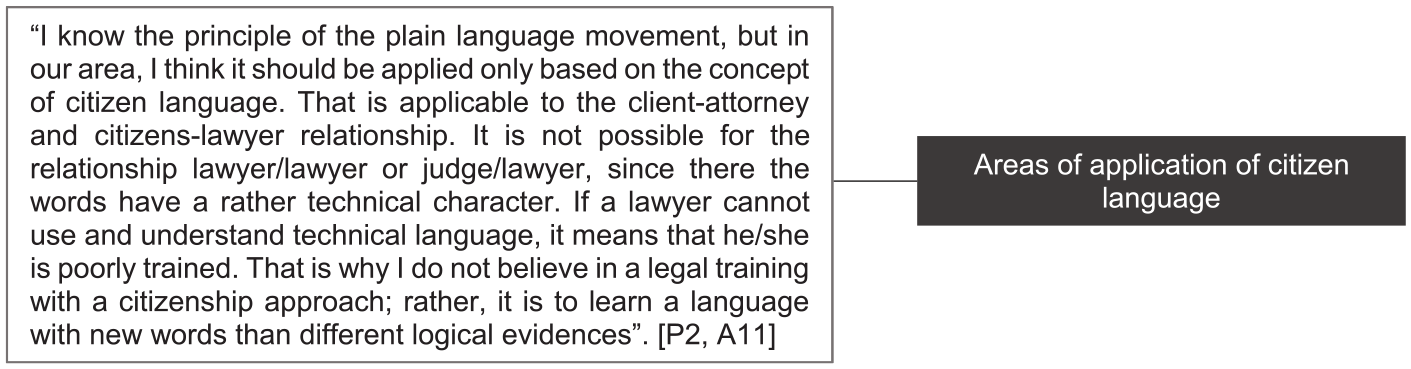

The majority of the respondents restrict the application of plain writing to certain areas, particularly the lawyer-client relationship, due presumably to their asymmetry regarding the knowledge of technical information and the need for the client to understand the practical scope of his or her legal situation. In accordance with this idea, Coloma and Agüero (2012) suggest that lawyers should be able to communicate with other colleagues, professionals from other disciplines and lay people as well as to address legal problems with clients moderating his or her linguistic uses so that his or her interlocutor can fully understand. In this sense, according to these authors, in certain contexts a good lawyer is like a good translator, an idea that underlies what our respondents have affirmed.
Applying plain writing to certain communicative contexts of a legal nature will imply that specific linguistic-discursive features are considered and integrated in the text production process. These features will allow the message to be clearly transmitted to the different participants in the communicative situation. In this line, according to our respondents, the linguistic and discursive elements that should be considered when writing a clear text in the legal field are the following: Use of precise legal technical language (6.62%), application of grammar rules in the production of texts (2.65%), explanations using simple language (2.65%), and use of the legal technical language (2.65%). These features can be seen in Chart 7.

Linguistic and discursive features.
As noted in the chart, when addressing the issue of linguistic and discursive features of plain legal writing, the category most referred to by specialists is the use of precise legal language (6.62%). This is consistent with the idea previously discussed that the construction of knowledge in Law should maintain the tradition of the field, this is, respecting specialized scientific knowledge and technical terminology, with no need for simplification. Likewise, it is consistent with the result that shows that most of the specialists do not recognize a total compatibility between legal and common languages nor endorse the idea of a transversal application of plain writing in any communicative context.
In addition, this result suggests an important concern among the interviewees for maintaining the specialized discursive characteristics of their discipline by using specific linguistic-discursive features. Thus, the use of precise legal technical language would make it possible to comply with the precision and mono-referentiality of the specialized discourse, in which ‘every term must point immediately to its own concept’, and ‘every term signals a concept and effectively condenses the semantic value contributed by the defining process which generated it’ (Gotti, 2011: 25). Then, from our point of view, the use of precise terminology, which should not be at odds with clarity, would strengthen the accuracy that must necessarily prevail in legal texts.
In this sense, the use of specialized terms might be justified by the principle of economy of language, because of the high degree of precision and conciseness, which avoids or diminishes the multiple interpretations and their consequences. In the same vein, it has been affirmed that, in Law, the possibility that the introduction of new terms will lead to ambiguity favors the presence of traditional linguistic features, which are preserved even when they vanish from general language. Thus, old formulas would be preferred to newly coined words due to their centennial history and their highly codified and universal interpretations (Gotti, 2011).
The following fragments illustrate the concern for technical terminology as a central linguistic-discursive feature of a plain legal writing:


The different co-occurrences of these linguistic-discursive features are manifested in the variability of discursive strategies recognized by the specialists. This information has been systematized in Chart 8.

Variability of discursive strategies.
The longest bar in the chart indicates that there are no differences in plain writing according to the topic, type of text or information processing (4.64%). See an example in the following fragment:

However, as in previous cases, if we add up the remaining bars, which indicate that there are differences in the areas in which plain writing is needed, the result far exceeds the claims denying differences (7.93%). Specifically, the lawyers interviewed recognize distinctions associated with factors such as, treatment of concepts or information specific to the legal field (3.31%), treatment of an issue in different genres (0.66%), the scope of law (1.32%), the form of writing in the texts associated with different discourse genres (0.66%), the particularities of the institutions (0.66%), the context of the legal act or procedure (0.66%) and the reference of the facts (0.66%). This variability in the legal plain writing is illustrated in the following examples:


Based on these results, the criteria for plain language, in general, and plain writing, in particular, should be presented in a more concrete way, that is, by classes of texts or genres of discourse, instead of a decontextualized and abstract form. With these results, we can affirm that, for the interviewees, the concept of plain writing is not unique but subject to the aforementioned variations. Consequently, the attributes of a plain legal text will be determined by the legal communicative situation, which will be instantiated in the discursive genres as pragmatic and communicative units, so that this discursive variation will also reflect the linguistic variation and the discursive strategies used.
Finally, the last chart functions as a type of synthesis of the concept of plain legal writing from the point of view of the specialists interviewed (Chart 9).

Plain writing concept.
As noted, among the interviewed lawyers, the prevailing perception is that plain legal writing is related to the expression of ideas in a clear and understandable way for the audience involved (5.96%). See the next example:

Other frequent elements referred to in this dimension, already mentioned above, were the correct use of technical language, the use of simple language, and the omission of ambiguities. The grammatical and normative aspects were also regarded as relevant characteristics of plain writing. Thus, the use of technical language (P1, A1), the absence of spelling, grammar and writing mistakes (P1, A18) were emphasized. These ideas are synthesized in the following fragment:

This idea of complying with the writing conventions is interesting since, in general, it was not present in the literature, for example, on legal writing style (Alcaraz et al., 2014; Gidi and Weihofen, 2018) or legal discourse modernization (Montolío, 2012a, 2012b). This absence could be due to the fact that good spelling, punctuation or compliance with grammatical norms are basic aspects of any type of writing, not only of specialized writing, so mentioning them might be considered unnecessary in specialized manuscripts on legal discourse. In any case, if the practicing lawyers highlighted these aspects related to plain writing, then such aspects would not be as obvious or frequent as one would expect.
Conclusion
In order to achieve our research objectives, based on our analysis we can identify some central features of plain writing in the legal field according to the perception of the lawyers interviewed. Thus, plain writing in Law would aim to guarantee effective access to justice for all citizens, avoid ambiguities, offer security in the legal field and evidence a position. Some characteristics of this type of writing are (a) proper use of the legal technical language, (b) expression of ideas in an organized and precise way by means of simple language and without ambiguity, (c) use of argument, application and persuasive conclusion to convince the addressee, (d) absence of errors associated with the writing norms, (e) application of grammar rules, and (f) logical and coherent textual structure. To make the message understandable to all, interviewees claim that a clear definition of the topic and purpose of the text, as well as of the legal area, must be considered. In this way, the complexity of the language used may be determined by these variables.
While our characterization provides invaluable information on how plain writing is conceived by practicing lawyers, some aspects may be open to debate. First, regarding the objectives of plain writing, the fact that it guarantees access to justice for all citizens is questionable since it exceeds the limits of plain writing. Instead, we believe that the purpose of this type of writing is to ensure the intelligibility of the different legal institutions to the greatest extent possible, given their effects in the context of life in society. Second, we question argumentative elements as attributes of plain writing because the argumentative nature is restrictive only to some legal texts. Thus, plain legal writing cannot be subject to this characteristic.
On the basis of the characterization and discussion presented, we offer a definition of plain writing in the legal field. We understand plain writing in Law as the process of constructing legal discourses aimed at promoting the intelligibility of the various legal institutions or institutions of Law, such as sentences, regulations, contracts, and so on, in order to offer or strengthen security in the legal field. From the general to the particular, the features of this type of writing are: a logical and coherent textual structure; the expression of ideas in an organized way through simple language or frequently used language; precision, that is, the absence of ambiguities and the use of precise technical terminology in the legal field; the use of correct and legible grammar structures; and the absence of errors associated with the writing norms. As for the message, it should be understandable to all participants of the legal communicative situation, an achievement that is subordinate to both a clear definition of the subject and its purpose and to the considerations of the legal field.
As a synthesis, the following figure illustrates the elements comprising the definition of plain writing (Figure 4).

Synthesis of the plain writing definition.
Our definition includes a broad spectrum of elements ranging from those of a global type, such as textual structure, to those of a local type, such as terminology and grammar. From our point of view, both the definition and the figure of synthesis above can be a contribution to work with plain writing in Law. For example, characterization of the attributes could be guiding criteria for assessing plain writing in the legal field. The conceptualization of the notion of plain writing from a pragmatic and communicative perspective, based on the discourse of specialists, may be a contribution as well. Our proposal differs from previous research in which plain writing, in particular, has not been defined (only plain language in general, Mazur, 2000). It also differs from normative guidelines lacking substantial empirical investigation that involves specialists referring to the central elements of plain language in general (Carretero, 2015; Poder Judicial Chile, 2018) or the legal style in particular (Alcaraz et al., 2014; Gidi and Weihofen, 2018; Muñoz, 2017). Thus, on the basis of our proposal, we offer clear writing guidelines that take into account the linguistic and disciplinary specificity as they consider the perception of the Law specialists themselves.
As the rise of this movement in Hispanic countries has occurred is recent, an interesting projection of the present research would be to contrast our results with the data collected from novice lawyers. We believe that these participants would show a more open and favorable attitude toward plain language movement than the experienced lawyers, as the ones who participated in our research.
Footnotes
Appendix
Categories and macro categories.

| Category | Macrocategory |
|---|---|
| Plain language movement contribute to the access of legal knowledge | A: Contribution of the plain language movement to the legal field |
| Plain language movement does not contribute to access to legal knowledge | |
| Plain language movement does not contribute to the construction of legal knowledge | |
| Plain language movement contributes to the construction of legal knowledge | |
| Integration of actions that ensure the understanding of the legal text by any citizen | B: Adaptation to the communicative context |
| Integration of the differences associated with the knowledge of the audience or the legal field of the text | |
| Clear definition of the topic and purpose of the text | |
| Complexity of the language determined by the participants of the legal situation | |
| Proper use of the technical language of the legal field | C: Plain writing concept |
| Organized expression of ideas by means of simple language | |
| Absence of plain writing | |
| Legal discourse has specificities that should not be ignored | |
| Clear and understandable expression of ideas for the audience involved | |
| Precise expression of ideas without ambiguities | |
| Use of persuasive argument, application and conclusion to convince the addressee | |
| Clear expression of ideas without errors associated with writing rules | |
| Areas of legal communication between client and lawyer | D: Communicative contexts demanding plain writing |
| Areas of legal communication between judge and justiciable | |
| All areas of law communication | |
| Areas of application of citizen language | |
| Areas of relation between lawyer and people without disciplinary knowledge in the legal area | |
| Complexity in the task of linking legal and common languages | E: Compatibility between legal and common language |
| Need by legal operators to write clearly without giving up on technical accuracy | |
| Possibility of making common and legal languages compatible while respecting the scientific and technical nature of the latter | |
| Compatibility between common and legal languages is not necessary | |
| Linking common and legal languages determined by the situation in which communication is framed | |
| There is compatibility between common and legal languages | |
| Plain writing to avoid ambiguities in the practicing of law | F: Purpose of plain writing |
| Plain writing to ensure effective access to justice for all citizens | |
| Use of language to offer security in the legal field | |
| Valuative writing to understand a given position | |
| Use of legal technical language | G: Linguistic and discursive features |
| Explanations using the language often used by the addressee | |
| Use of precise legal technical language | |
| Application of grammar rules in the production of texts | |
| Use of technical language in the legal field without simplifications | |
| Application of disciplinary knowledge and information synthesis | |
| Application of a logical and coherent structure in the production of the text | |
| Differences associated with the technical language used in the various legal texts | |
| No differences in plain writing according to the subject, type of text or information processing | H: Variability of discursive strategies |
| Differences associated with the treatment of concepts or information of the legal field | |
| Differences associated with the type of discursive strategy used for the treatment of an issue in the different legal texts | |
| Differences associated with the scope of law in which there are predefined forms or structures | |
| Differences associated with the requirements of each type of legal text | |
| Differences between the types of texts according to the particularities of the institutions in which the production of a legal text is framed | |
| Differences associated with the formality of the text depending on the context in which legal act or procedure is framed | |
| Differences associated with the reference of the facts (past or future) in the various legal texts |
Declaration of conflicting interests
The author(s) declared no potential conflicts of interest with respect to the research, authorship, and/or publication of this article.
Funding
The author(s) disclosed receipt of the following financial support for the research, authorship, and/or publication of this article: This research was funded by the FONDECYT Project No. 11170128, entitled ‘Discursive characterization of genres produced by students of Law and Medicine: their relationship with the perception of self-efficacy in writing, the general quality of the text and disciplinary evaluation’. In addition, the research was partially funded by the Research Unit of the Universidad de La Serena
Author biographies

.