



Abstract
Using conversation analysis as its research method, this article investigates the interactional function of the particle ba in Mandarin Chinese conversation. It is argued that ba is frequently employed by its speakers to adjust deontic gradients in action sequences of directives in mundane conversation besides its function of adjusting epistemic gradients in certain action sequences. The present study claims that the agent and beneficiary of future action can only distinguish one category of directive actions from another, but each category still constitutes several member actions which contrast with one another in terms of social power. The member actions of each category form a continuum, one end of which is the action with the highest level of social power and the other end of which is the action with the lowest level of social power. There exists a normative relation between each member action of a category and the speaker’s deontic status in the real world. The particle ba is a practice of minutely adjusting the speaker’s deontic stance from a higher position to a lower one.
Introduction
Social power has long been a research focus of various disciplines. Psychology is interested in the antecedents and consequences of power (Guinote and Vescio, 2010). Sociology mainly concerns the power structures in macro social institutions, such as politics and economy (Poggi, 2006). Sociolinguistics and pragmatics treat social power as a variable which exerts influence on language use (Brown and Levinson, 1987; Fairclough, 2001). We can see that social power has been mainly interpreted as an exogenous variable rather than an endogenous feature of human social interaction. The newly developed view of social deontics provides a fresh perspective on the analysis of power enacted in and through social encounters (Stevanovic, 2015; Stevanovic and Peräkylä, 2012; Stevanovic and Svennevig, 2015). Social power is understood to be endowed by social institutions, but what is more crucial is that it is dynamically achieved in a moment-by-moment fashion in social interaction (cf. Schegloff, 1986, 1995). Since social interaction is the primordial locus of social life (Drew, 2005) and power is omnirelevant in social life, social power is demonstrably exercised in and through social interaction (Stevanovic, 2018). On the one hand, power is constructed in the design of turns at talk and is displayed by the action that a turn performs; on the other hand, power can be acknowledged, challenged, even denied by the recipient of the turn. Therefore, power play is a delicate issue in social interactions, and it is negotiated between participants. When power is not recognized or acknowledged by its recipient, not only the face of the power player is threatened (Brown and Levinson, 1987), the social action done by the power player also would suffer from breakdowns. As a consequence, people seldom claim absolute power, even when they have that entitlement in reality, especially in mundane conversations (This may be a distinctive feature between ordinary conversation and institutional talk, such as courtroom interactions, in which the power asymmetry (Passmore, 2015) between the participants is a constitutive feature of the institution and it is normatively unnegotiable.). They would rather give a share of power to their addressee in the coordination of action implementation. Specific languages provide their users with multi-dimensional resources, from prosody to lexico-syntactic format, to construct different levels of social power in and through talk. In Mandarin Chinese, the TCU-final particle ba (吧) is a frequently-used practice to downgrade its speaker’s social power, by means of which the coercive effect of the action would be mitigated. Inspired by interpreting the final particle ba as a practice of adjusting epistemic gradients by Kendrick (2018) and facilitated by the conceptual framework of social deontic approach to social interaction developed by Stevanovic (2018), we will discuss the final particle ba as a language resource to adjust the speakers’ deontic gradients in Mandarin Chinese conversation. Before the detailed analysis of the particle ba in three action sequences of directives (Searle, 1975) is presented, a general picture of the particle ba is delineated in the following part.
The particle ba in Mandarin Chinese
The particle ba is one of the modal particles in Mandarin Chinese (Chao, 2011; Li and Thompson, 1981). Modal particles are bound morphemes, which are mainly attached to sentences, occasionally to words or phrases; the functions of modal particles in Chinese grammar are to enhance the expression of a certain mood (Xing, 2016: 216). The existing studies on ba have been thoroughly reviewed in Kendrick (2018), in which two general functions of ba are identified, namely agreement solicitation (Li and Thompson, 1981) and a display of speaker uncertainty (Chu, 1998, 2009). As suggested in Kendrick (2018), the complication of the usage of ba may be better explored with the guidance of the principles of conversation analysis (CA hereafter) due to the position-sensitive nature of CA as a research method. Like many conversation analytic studies on different particles in Mandarin Chinese, such as a, ou (Wu, 2004, 2005, 2006), only the fine-grained analysis from the perspectives of both the position, namely where the particles are specifically located in a turn and a sequence, and the composition, with which the particles co-occur in a TCU, can make particles interactionally analyzable instead of being ‘notoriously resistant to analysis’ (Kendrick, 2018).
The past research on the particle ba mainly observes its usage in isolated sentences and overlooks the contexts in which it is employed. The use of constructed examples in the majority of the existing literature on particles may be a possible cause for failing to provide high-resolution pictures of their interactional functions. The meanings or functions of ba found out are their resultant effects drawn from the etic perspective of researchers or their intuition as a native speaker. The findings are insightful but lack a systemic account of the meaning- or function-generating process when ba is attached to a specific TCU in a specific sequential position. The conversation analytic approach to particles (Heritage and Sorjonen, 2018) offers us an empirical and rigorous method to clarify the minute distinctions among the uses of ba in various action sequences. Kendrick (2018) explores the particle ba in three types of social actions, namely, answers to questions, informings, and assessments, and concludes that ba ‘serves as a turn-constructional resource for the adjustment of the epistemic gradient invoked in the sequence, downgrading the speaker’s epistemic position’ (p.5). A close observation of our data of mundane Mandarin conversation shows that ba is also an interactional resource for its speaker to lower his or her entitlement of determining the recipient’s future action. The particle ba in three types of directive actions: requests, proposals and suggestions, is examined.
Using CA as its research method, this article argues that the final particle ba in those sequences serves to adjust the deontic gradient among co-participants, so that the action implemented by the ba-attached TCU can be finely tuned to a less-imposing action compared with the equivalent turn design (Drew, 2013) but without ba. The granularity in action formation and action ascription (Levinson, 2013; Schegloff, 2000) can be clearly demonstrated by the turn design with versus without the particle ba. The description of the social action before and after attaching the particle ba to the TCU can be delicately tuned from order to request, from my-side decision making to proposal, and from instruction to suggestion, and all these three cases share a common adjustment from an action that displays a high deontic right to an action displaying a relatively lower deontic right, or in power-related terms, from an action demonstrating high entitlement to one with low entitlement. In so doing, the speaker may pose less imposition on the recipient and thus invite the recipient to decide whether the relevant future action should be performed or not. In this way, the likelihood for the future action to be accomplished (Yu and Wu, 2018) may be enhanced.
The data are drawn from naturally occurring mundane telephone conversations of Mandarin Chinese and transcribed according to the conventions proposed by Jefferson (1984). The total length of the recording is about 10 hours. The relations between the participants are mainly friends, classmates, or other types of peers. Occasionally, there may be conversations between teachers and students or children and their parents. All the participants are informed of and also approve of being recorded.
Power differences in action formation in Mandarin Chinese
As in many other languages, the distribution of social power can be instantiated through language resources from the phonological and morphological levels to the syntactic ones in the language of Mandarin Chinese. The proposal and development of the conception of deontics provides a tool for the analysis of human social power demonstrated in social interaction. Deontics is defined as ‘the capacity of an individual to determine action’, including the speaker’s own future action and the recipient’s (Stevanovic, 2018: 7). In social life, the social power that people have is relative and mutable in different interactional settings. Participants in interaction mutually assume their relative positions on the slope of a power gradient, which is termed as deontic status. These assumptions are latent until they are publicly displayed by means of verbal or non-verbal communicative resources. What is publicly claimed is conceptualized as deontic stance for the convenience of analysis (Stevanovic and Peräkylä, 2014). People have a common assumption of the power distribution or the deontic status between each other in the real world. In mundane conversation, people seldom bring their power into full play, but downgrade their power embodiment through language resources instead. The minute modification of the turn design, such as attaching the particle ba, may change the social action carried out by the turn from one displaying higher entitlement to one displaying lower entitlement (from order to request, for example). While there may or may not be a vernacular term to distinguish the hearably different actions after the deontic adjustment through language resources, the degree of imposition and negotiation invoked by different versions of action formation can be clearly perceivable and intelligible to interactants. The calibration of power expression or deontic stance is not dispensable but consequential in interaction. Thus, the nuance of turn design (such as incremented by the particle ba) is crucial both to the interactants and to conversation analysts as well. Data analyses show that the Chinese particle ba is employed by interactants not only to adjust the epistemic gradients as illustrated by Kendrick (2018) but also to adjust the deontic gradients, which will be demonstrated in this article. The sequential environments to be discussed, in which ba-attached TCU occurs, are sequences of request, proposal, and suggestion.
The particle ba in the formation of social actions
Like epistemics, deontics may also be a ubiquitous feature of talk-in-interaction in the sense that a response is mobilized by the participants whenever a conversation is set in motion. Conversationalists have to make decisions about what to say and how to say what he or she wants to say in the unfolding conversation. Directives are a major category of social actions from the viewpoint of speech act theory (Searle, 1975). The common feature of this type of social actions is the demonstration of ‘an attempt to induce the recipient to perform (or not to perform) some action’ (Stevanovic and Svennevig, 2015: 2). What differentiates one directive from another is the necessity and desirability of the future action and the speaker’s claim of high or low entitlement to make the future action happen (ibid.) Highly entitled actions leave the recipient no room to reject or dismiss the future action, such as commands, orders, assignments, prohibitions. Comparatively, moderately entitled actions like requests, proposals, suggestions/advices solicit the action recipient’s decision in carrying out the future action or not. As afore-mentioned, the Chinese particle ba mitigates the imposition of the action, and lowers the speaker’s entitlement to perform the action. Therefore, the directives with high entitlement are unlikely to be performed with ba-ending TCUs. This might be the reason for our observation that the directives done with ba-suffixed TCUs are mainly requests, proposals, suggestions in our data set. Otherwise, the directives designed without the TCU-final particle ba would be ascribed as actions with high entitlement.
The particle ba in the action of request
Normally the action of request involves the speaker’s asking for some information, an object or a service from the recipient. No matter what the speaker asks for, the action entails the recipient’s doing something. The turn design of a request demonstrates the requester’s publicly claimed deontic right in asking the recipient to carry out the requested action. As illustrated by Curl and Drew (2008), syntactic formats of request in English conversation display the requester’s various degrees of entitlement in making the request and the contingency of accomplishing the requested action. Normally, different syntactic forms in a language could be used to embody different deontic claims, for example, the declarative statement may display a minimal claim to deontic rights (Stevanovic, 2011). This finding is also applicable in Mandarin Chinese conversation. What’s more, lexical resources, such as particles, are also frequently employed in Mandarin Chinese to embody various degrees of entitlement in making a request. In this category, the particle ba is an outstanding example. This could be observed in the following case, where the co-participants are students of the same major and Fei is calling to ask Dong to help send him the thesis proposal drafted by someone else.
(1)[DIG-LS-WPF]
Well, you- I have to bother you again.
What’s up?
you help send a copy of it to me once more ba,
the one I: have received is already overdue.
Oh, oh: Okay.
In this example, the pre-pre (Schegloff, 2007) in line 05 already shows Fei’s orientation of his deontic right to the coming request. The word hai (in line 5, literally, ‘again’), which indicates this is not the first time that Fei asks Dong for the same favor, together with the turn initial delays (na sha) and the non-fluency of the turn (the cut-off after ni-), may indicate Fei’s estimation of his low deontic right to the request. Given the go-ahead response (line 06), Fei puts forward his request (line 07). Fei initiates his turn directly with ‘you help-’(ni bang) and then abandons this TCU. Subsequently Fei restarts this turn with a deferring practice (na sha), a 0.4-second pause, the requested item, and then the request proper (line 08), which is in the syntactic form of an imperative ended with the particle ba. Compared with the abandoned TCU, the word ‘once more’ (zai) is inserted, without which the request would be interpreted as a first-time request. Though an account is given to legitimize the request (line 09), it still can be seen that it is due to the requester Fei’s own fault that Dong is asked to do Fei the same favor again. Although the word ‘help’ (bang) has already demonstrated the beneficiary-benefactor relation (Clayman and Heritage, 2014) between the current speaker and his recipient, the TCU would be ascribed or recognized as a command or an order if the particle ba is omitted due to the high deontic right thus displayed. The common core of a request and a command/order is the speaker’s orientation to making the recipient do something as a fulfillment of the speaker’s will. What makes a request and a command/order hearably distinctive is the speaker’s deontic claim: when the speaker in his/her turn claims limited right in asking the recipient to accomplish a task and leaves room for the recipient to negotiate, the speaker’s turn would be more likely interpreted as a request, otherwise, when the speaker in his/her turn claims absolute right in determining the recipient’s (as a benefactor) doing something for the speaker as a beneficiary and the recipient has no right to reject it, the turn would be ascribed as a command/order. This in some sense explains why command or order is considered as an unfavorable action which is often avoided by interactants in mundane interaction, and different languages have their own resources to milden the power play of the action to transform a command or order into a request (Li and Thompson, 1981: 451). The particle ba is only one of the practices in Mandarin Chinese which have such an interactional function. In addition, syntactic formats can also display various degrees of entitlement (Curl and Drew, 2008), and interrogatives are frequently employed in Mandarin to make a request. Due to the constraint set by the syntactic format, an answer is mobilized by an interrogative, and a grant or rejection of the request performed through the vehicle of the interrogative is simultaneously set in motion interactionally. Compared with requests in the syntactic form of ba-ending imperatives, interrogative-formatted requests claim less entitlement by the speaker. Syntactically, commands/orders can only be carried out by imperatives, which have the full force of imposing the recipient to do the speaker-interested action and display the speaker’s absolute entitlement in doing so. Incremented to an imperative, the particle ba is one of the lexical resorts which can help the speaker to calibrate his deontic right from the highest position to a lower one on the slope of deontic gradient. The interactional consequence thus achieved is to transform a command/order into a request.
The final particle ba occurs in interactions not only between co-participants who have just an equal relationship, like classmates in example (1), but also between people who may have a deontically asymmetric relation, like in the next example where one of the participants is a teacher and the other a student of hers. They are talking about the homework (line 87–89) which a certain group of students should have handed in, but the teacher has not seen their homework so far. The student in this example is the class monitor who helps the teacher handle the relevant issues.
(2)[DIG-ZYH-XWBZ]
According to the record, the pictorials should have been handed in,
but I haven’t seen them.
Oh:
Are they in the group of your calss?
Ask them about that ba.
I’ll ask them about this matter. Okay.
Oh, okay.
Ask them.
And tell them to contact me.
This is my phone number.
Oh, okay okay.
In line 87–88, the teacher reports a problem to the class monitor, who responds with the information receipt Oh (ao) in line 89, which overlaps with the start of the teacher’s second TCU in line 90, which is an enquiry, asking relevant information about the problem reported. As has been discovered, asking for information is frequently used as a practice of eliciting an offer of help (Gill, 2005). Upon hearing this enquiry, the monitor responds to it with an offer (the first TCU in line 92) which clashes with the teacher’s request proper (line 91). The student’s offer is exactly what the teacher requests him to do. Normally a teacher is entitled to ask his/her students, especially a monitor of a class, to do something that’s relevant to the schoolwork like helping teachers collect homework, and this means that the teacher has the deontic rights to request the students to do something in the domain of school affairs. While showing her high entitlement by employing the imperative form in making the request, the teacher here, downgrades her deontic rights by using the final particle ba (line 91), which displays the teacher’s orientation to avoiding claiming full deontic right. The monitor accepts the teacher’s request with xing (‘okay’) at the end of his turn after his offer. Upon hearing the monitor’s offer and his grant of the prior request, the teacher subsequently accepts the offer in the following turn (line 93) (‘okay’), and then, possibly occasioned by the overlap of the request and the offer, the teacher re-produces her request in the form of an imperative but without the particle ba (line 94). The omission of ba in the re-doing of the request may be based on both the monitor’s offering to do the request already and his acceptance of the first-time issued request, which further upgrade the teacher’s entitlement to make the request and annul the contingency of the request to be turned down. In the meantime, the re-working of the request, which is exactly a repetition of the student’s offer, is not only a request but also an acceptance of or showing agreement to the student to do the offer. Under this condition when the grant of the request has been secured, the re-working of the request by omitting the particle ba does not display more imposition on the student to do the requested thing, rather it shows more congruence with the student’s offer and grant of the first-time request.
In short, the analysis suggests that in requests the particle ba serves to downgrade the speaker’s deontic rights and make an adjustment of the current action from an order (or action close to an order) to request. And this could be observed either in conversations where the participants are peers or in conversations where the participants’ relationship is socially hierarchical, which may itself invoke an asymmetric distribution of power or uneven deontic status between them.
The particle ba in the action of proposal
Although the beneficiary of a proposal is both the speaker of the proposal and his/her recipient in terms of benefit and cost (Couper-Kuhlen, 2014), a proposal may still influence the freedom of the recipient’s future action. Therefore, the action of proposal also involves power play between the speaker of the proposal and his/her recipient. In order to alleviate the imposition on the recipient to do the proposed action, the proposal speaker usually leaves some room for the recipient to decide whether to do the proposed action or not by means of various linguistic devices, among which the particle ba is a possible choice in Mandarin Chinese. Though a proposal conveys its speaker’s own judgments of its feasibility (Stevanovic, 2015), it does not mean that the speaker would have more deontic right over the recipient. Whether the proposed action or event will be carried out by the co-participant depends on the negotiation between the participants. Along with the development of the proposal sequence, both participants would show their understandings of and orientations to the relative deontic rights on the currently-relevant issue, by, for example, the recipient producing a congruent or incongruent response to the proposal. In fact, the speaker of the proposal may also show his/her own orientation to the relative deontic right by, for example, producing a ‘post-proposal displays of uncertainty’ (Stevanovic, 2015), or through the turn design of the proposal, which could be observed in the following conversation between two classmates. Si proposes having lunch (line 8), while it seems a little bit too early for Tian. Possibly for this reason, Tian, before giving any response to Si’s proposal, initiates an insert expansion to check the ground behind the proposal (line 9).
(3)[DIG-LS-TYQ]
Are you in the library?
Yeah, I’m.
Let’s go for lunch ba? ((laughter))
Uhm no- I’m not hungry,
but I’m extremely sleepy. ((laughter))
Okay.
Before the proposal (line 08), Si initiates a pre-sequence (line 05), probing into the whereabouts of the recipient Tian and the possibility of Tian going for lunch with her. Hearing Tian is at the assumed place (in the library), Si issues her proposal after a 0.4-second pause, which observably defers the occurrence of the proposal. What’s more, the proposal is produced with the final particle ba, which downgrades Si’s deontic rights and invites the recipient (Tian) to decide whether this proposal could be carried out. Instead of giving the second pair part of the proposal sequence right away, Tian investigates the account for Si’s unlooked-for proposal through the insert sequence (lines 09–12). After getting the justified account, Tian accepts Si’s proposal willingly (indicated by the turn-final particle lei). Without the particle ba, the proposal turn (line 08) would be interpreted as my-side decision-making of the joint future action. It is the use of the particle ba that allocates a share of the deontic right or power to the recipient in deciding whether to do the proposed activity or not. The particle ba is not only employed in the circumstance of an unnegotiated proposal like the one in this example, but also is resorted to when a potential proposal has already been under discussion in the conversation prior to the proposal turn. The following example is such a case.
The wife issues her first proposal in line 67, using the syntactic construction of ‘how about we do X’ prefaced with ‘I mean’. Making a proposal via an interrogative format demonstrates the speaker’s orientation to letting the recipient make the final decision about whether to do the proposed action or not. After a gap (line 68), the husband illegitimizes the proposal by indicating the untimeliness to carry out the proposed activity at that moment. The wife agrees with the husband and puts forth another schedule (line 71). Again the husband responds minimally (‘okay’) with delay (line 72 and the turn initial ‘en::’ in line 73). After a side-sequence (line 76–82), the wife further pursues the proposed activity being carried out right then (line 83) while still using the interrogative form. This time the husband directly turns down the proposal (‘Forget it’ in line 84 and 85). In line 186 the wife puts forward the proposal the third time in the syntactic format of an imperative suffixed with the particle ba. Compared with the interrogative format, the ba-suffixed imperative displays more deontic right and higher entitlement in determining the accomplishment of the proposed activity. But if the wife employs an imperative without the particle ba, the turn would become a my-side decision-making instead of a proposal. In this datum, although the husband has accepted doing the proposed activity in the afternoon (line 73, 88), the acceptance does not sound fully committed due to the delay and the minimal response. This explains why the wife still avoids bringing the power into full play by means of the employment of the particle ba in her turn design and also interestingly increments the turn by another particle ha (哈), which is an affiliation-inviting device in Mandarin Chinese, after the possible turn completion (line 186). Incrementing the particle ha publicly demonstrates the wife’s worries about being rejected and her strong will in getting an affiliative response.
(4)[DIG-HQX-QSFY]
I mean how about we take her to the Shengfuyou (name of a hospital)?
It’s nearly twelve o’clock right now.
Yes, I know. I mean this afternoon.
Well, okay.
Oh.
(7 lines omitted, during which they talk about taking the baby to have a physical examination)
Do you think we still can make it if we go right now? It’s half past eleven now.
Forget it. (The doctors there) are going for lunch soon.
(Let-) Forget it.
Oh, then (let’s go there) this afternoon.
Okay.
(97 lines omitted, during which the wife continues to complain to the husband about the unprofessional checkup that the baby has in a community hospital)
Then this afternoon let’s go and pick up our baby and go to that hospital ba. Okay?
Yeah, okay.
Yeah.
Since both party of the couple have mentioned the proposed activity in the previous part of the conversation and this is also indexed by the turn-initial adverb ‘then’ (na), which indicates the coming proposal is not made out of blue but is based on the shared idea talked about in the previous part of their conversation, the wife actually is highly entitled to re-issue the already agreed-upon proposal, or say, the already agreed-upon proposal would very unlikely be turned down by the husband. Even in this circumstance the wife still reduces her own power in deciding their joint future action by attaching the particle ba to the end of the proposal turn. Without the particle ba, the action done in line 186 would be very probably ascribed as an action of my-side decision-making, due to the high deontic claim embodied in the turn constructional components before the particle ba. Instead, the wife produces the turn with a TCU-ending particle ba, which indicates that the wife still orients the consideration to that the final decision should be made also by the husband, even though the proposed activity is not produced the first time and has been kind of settled before. Proposal generally involves a job of joint decision making, but here by using the particle ba, the speaker downgrades her own deontic right to decide the related matter and invites the husband to make the final decision instead. In congruence with his wife’s turn, the husband accepts the proposal (line 187), and at the same time acknowledges the distribution of deontic rights suggested in line 186. The particle ba helps the speaker adjust her deontic right from a higher position to a lower one, and simultaneously transforms the social action of the turn from a my-side decision-making to a proposal.
The analyses above show that the particle ba helps the speaker form a low-entitled and power-mitigated action and avoid producing a high-entitled and power-entrenched action. This interactional function of ba can also be demonstrated in suggestion sequences.
The particle ba in the action of suggestion
Similar to the actions of request and proposal, suggestion also involves an intrinsic asymmetry of deontic rights between the suggestion-giver and suggestion-receiver. The suggestion-giver, who is usually more knowledgeable and more experienced in the relevant field (K+ in terms of epistemics) (Heritage, 2012) unavoidably determines the future action of the suggestion-receiver to various extents whenever the suggestion is given in whatever linguistic forms. In order to form an action as a suggestion and make the recipient ascribe the action as a suggestion rather than any other action, the speaker frequently resorts to linguistic devices to calibrate the expression of his/her power or deontic right in determining the recipient’s future action. If the speaker claims too much power in his/her turn design, the action carried out by the turn would hearably be an instruction instead of a suggestion. Suffixing the turn with the particle ba is a method to lower the speaker’s deontic stance and make the action less imposing, so as to ensure that it is interpreted and ascribed as a suggestion instead of other types of more decisive directives.
The following example is an extract of the closing section of a telephone conversation. Feng and Ying are friends.
(5) [DIG-DBY-SJSH]
You- Take care of your health ba.
Don’t-don’t push yourself too much.
Oh, right. Exactly about my cervical vertebrae,
.hh I need to- (pay attention to that). Yeah.
You need to- Yeah, right.
I need to uhm- keep on doing more exercise.
You (need to)-lie down a little sometimes.
Keep on exercising, uhm.
Right.
If you want to read books or files,
you can just lie down to read ba,
I usually do it this way.=
Yeah, you’re right.
Ying opens this section by a solicitude (lines 464–465) to the recipient Feng, which is frequently used as a practice of pre-closing (Button, 1990). When accepting the solicitude (lines 466–467), Feng mentions the trouble (cervical vertebra problems) she has been suffering from and gives her forthcoming self-treatment to her bodily trouble (line 467) which overlaps with Ying’s turn (line 468). Both of them abandon their ongoing TCUs (wo dei- in line 467 and ni dei- in line 468). After a 0.3-second pause, Feng resumes her abandoned turn framed with ‘I need’ (line 470), which re-does her unfinished self-treatment. Unfortunately, this turn again clashes with Ying’s turn, which is an instruction, invoked by Feng’s trouble, to relieve her agony. This time both of them finish their own turn although they overlap with each other. Ying’s instruction is performed by an imperative incremented by a frequency adverbial (‘sometimes’) but without the particle ba. Feng acknowledges Ying’s instruction with an acknowledgment token ‘Uhm’ (line 472) and repeats the overlapped part of her turn (line 474) after a pause. What is interesting is that Feng’s self-treatment (‘doing more exercises’) conflicts with Ying’s instruction (‘lie down in bed’). This may explain why Ying designs her turn (lines 476–478) with an if-conditional followed by an imperative suffixed with the particle ba. This formulation dismisses the instructive tone of the turn and makes the turn more like a suggestion rather than an instruction for the reason that the if-conditional narrows down the circumstances when the suggestion is applicable and the particle ba downgrades the speaker’s demonstrated power in determining whether the recipient would carry out the suggested action. What is more, this suggestion is further legitimized with the speaker’s own experience in dealing with her cervical vertebra problem as an account (line 478). The speaker Ying here reformulates the same content which results in transforming an instruction into a suggestion. What makes the difference in action formation is the speaker’s displayed power in determining the recipient’s future action.
The next conversation happens between two relatives. They once planned to take Dong’s kid to Xiao’s home and let their kids play together. However, Xiao’s kid gets ill now and the illness is badly contagious and will last for several days. Under such a circumstance, Xiao suggests that the original plan should be canceled and the two kids had better not play together.
(6) [DIG-DBY-XHRB]
These days she has not been to school, has she
.hh No. She has to rest for a week.
.hh Anyway, do not bring XX(Dong’s kid) here this week ba,
(for) this disease is rather contagious.
Oh, okay.
She- about her situation, the doctor says it needs at least ten days to be fully recovered.
Okay.
and in ten days, she needs to go to hospital again for a re-examination.
Xiao answers Dong’s inquiry (line 12) at first in line 13, and then initiates her next TCU by the pragmatic marker ‘anyway’ (fanzheng) and abandons this TCU after the agent pronoun ‘you’ (ni). Invoked by the word ‘anyway’, this abandoned TCU projects a possible directive with strong imposition and high deontic right to determine the recipient’s future action. This may be the reason for Xiao to give up this turn design and makes a self-initiated self-repair, which re-formulates the TCU as less imposing and suggestive, which is deferred with the demonstrative word ‘that’ (nage), ended with the particle ba (line 14) and followed by an account (i.e. the contagious nature of the illness) (line 16). Although the suggestion is legitimized and also done for the benefit of the recipient (keeping the recipient’s kid from getting ill), the suggestion-giver still reduces the demonstration of power in her turn design through the employment of the particle ba, which helps the speaker share some deontic right with the recipient to let him make his own decision in carrying out the suggested future action. The delicacy of this example may lie in the fact that the previous invitation was issued by Xiao to Dong and Xiao’s suggestion now is actually canceling her own previously-made invitation. Adjusting the power played by the speaker on the recipient, the particle ba acts as a downgrading practice, alleviating the imposition on and leaving some room for the recipient to decide whether to carry out the future action or not.
Suggestion/advice demonstrates the epistemic asymmetry (Heritage and Sefi, 1992 ) between the suggestion/advice giver and its receiver. The particle ba suffixed to the imperative-formatted suggestion/advice turn reduces both the knowledge disparity between the two parties and the imposition on the recipient to accept the suggestion. Epistemics and deontics are interwoven in the action formation of suggestion/advice.
Discussion
The social power claimed by a speaker or the deontic stance of a speaker in performing an action is both an important indicator of the action produced and a reliable reference for the recipient to interpret the action. In terms of social actions of directives, the power distribution between the speaker and the recipient is like the two sides of a scale. The speaker can display the symmetrical or asymmetrical distribution of power between them through minute adjustment of the turn design. When the agent and the beneficiary of future action (Couper-Kuhlen, 2014) remain the same as shown in Table 1, the dynamic adjustment of the power distribution between the interactants may transform the action of the turn from an action with high deontic status to one with low deontic status, such as from a command or order to a request, from a my-side decision-making to a proposal, or from an instruction to a suggestion, as discussed in the article. In this sense, the social power displayed in the turn design can independently influence action formation and action ascription as well, that is to say, the agent and the beneficiary of future action can determine a certain set of actions, which constitutes a continuum with the upgrading or downgrading social power displayed in the turn design. In other words, request is only one member of the set of actions which satisfy the conditions that the agent of future action is Other and the beneficiary of future action is Self. Other actions like command, order, and plea also belong to this category. What differentiates them from one another is the leverage of social power displayed by the speaker in determining the future action as what is shown in Figure 1. Similarly, what makes a proposal and a my-side decision-making, an instruction and a suggestion hearably different is also the deontic stance demonstrated by the speaker through his/her turn design, which can be shown as Figures 2 and 3. In each continuum, although there may not be a ready-made vernacular word for the description of a particular directive, the adjusted deontic stance can still make the recipient ascribe a proper action to the turn and display their understanding in his/her responsive turn. Therefore, it is evident that the distribution of social power between the interlocutors plays a key role in both forming and comprehending certain deontics-sensitive actions. On the basis of the same agent and beneficiary of future action, the linguistic construction of the different deontic disparity between the speaker and the recipient would produce different directive action, which may be graphically shown as in Figures 4 to 6. The actions listed are only some examples, between which there may be other unnamable actions. Conversationalists resort to various linguistic resources to adjust the social power to conduct an intended directive action. In Mandarin Chinese, the TCU-final particle ba is a practice to help the speaker downgrade the displayed social power, thus making the recipient also being involved in determining the future action.
Agents and beneficiaries of future actions related to various action types.


Continuum of power displays of request-type 1 actions.

Continuum of power displays of proposal-type actions.

Continuum of power displays of suggestion-type actions.
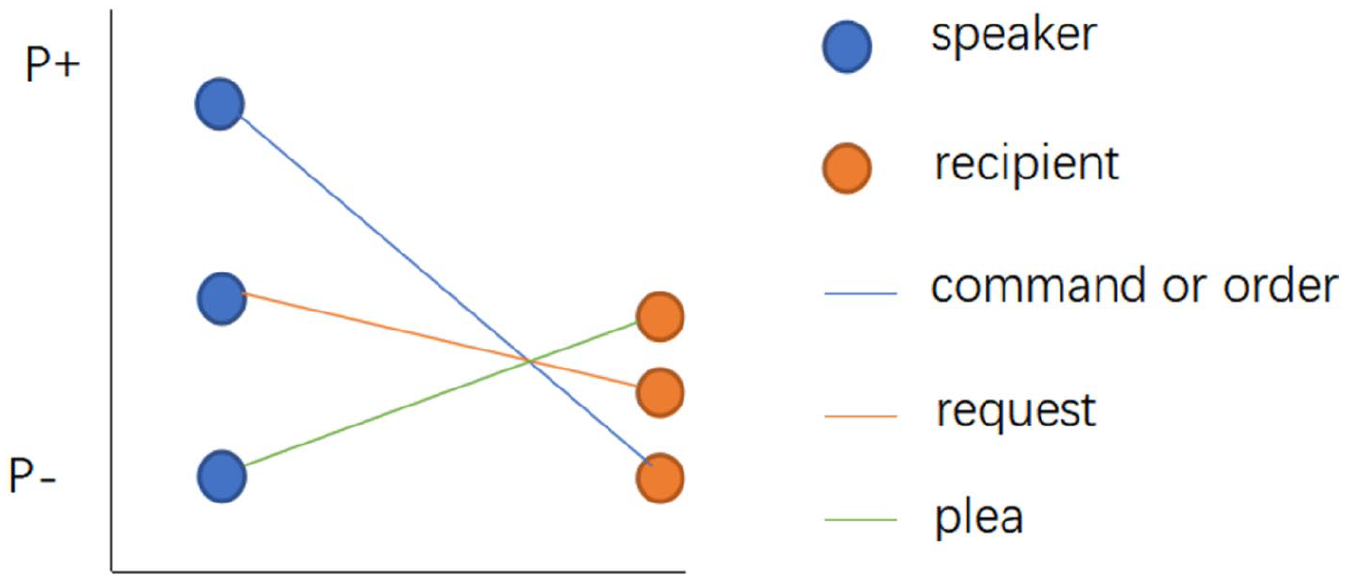
Power contrast between speaker and recipient in request-type actions.
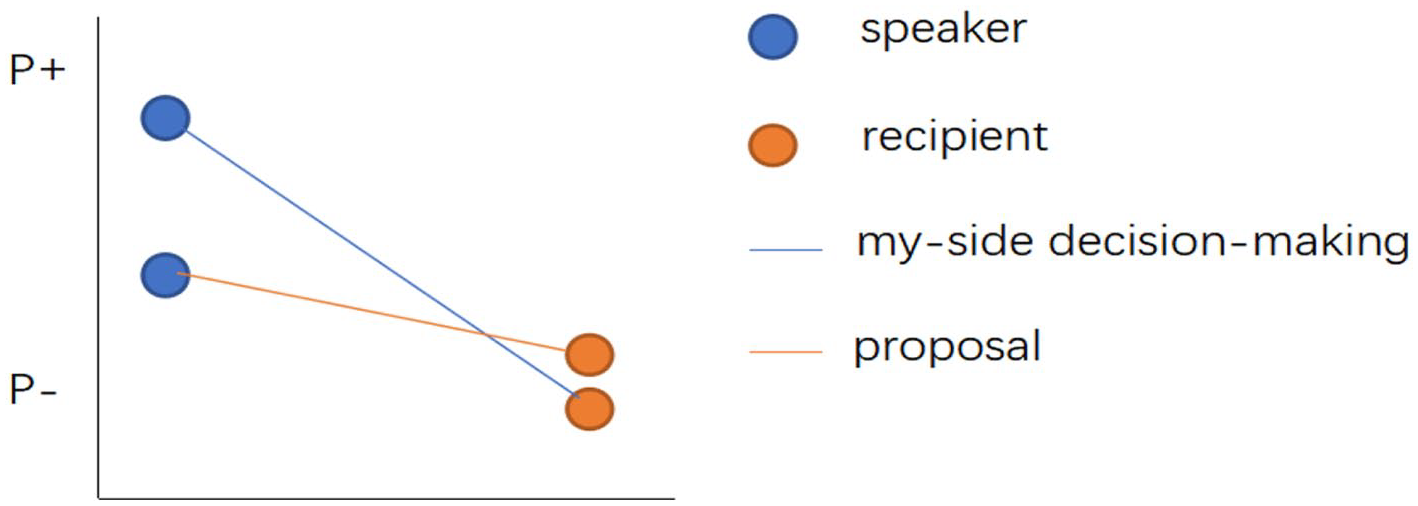
Power contrast between speaker and recipient in proposal-type actions.
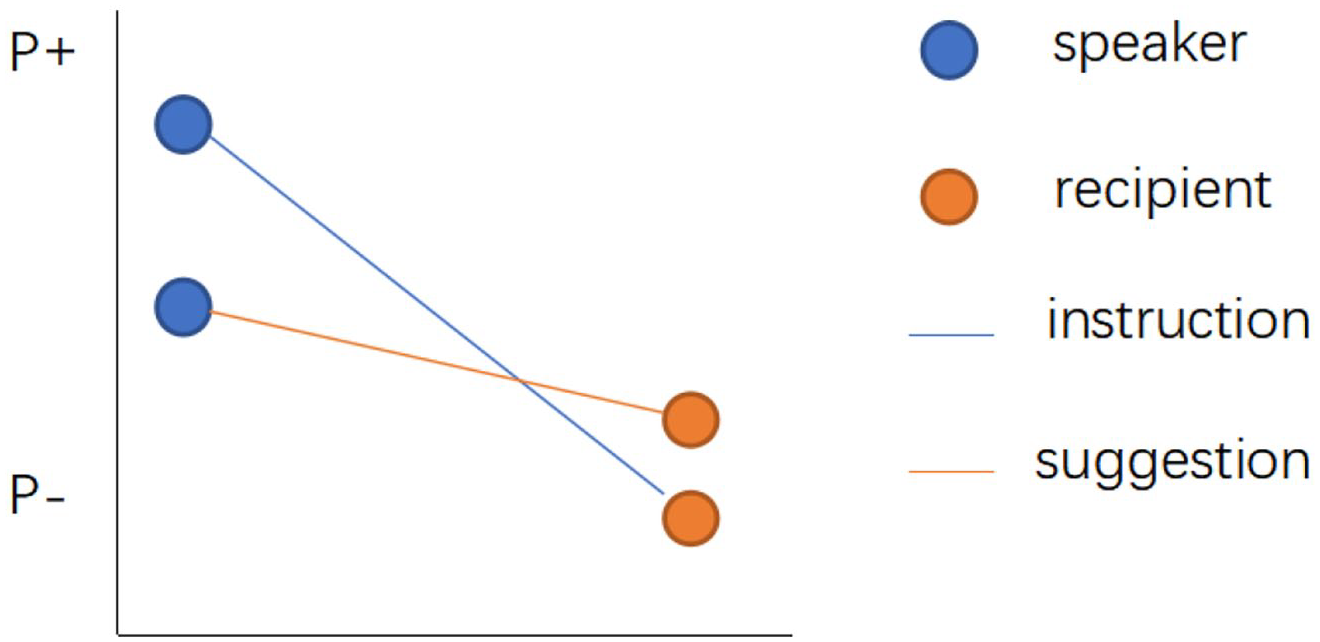
Power contrast between speaker and recipient in suggestion-type actions.
Data show that directives are frequently done by ba-ending TCUs in mundane conversation, but in institutional talks in which the participants have an intrinsic power hierarchy, such as the doctor-patient’s talk, the turns of directives are seldom ended with the particle ba. As afore-mentioned, the particle ba is employed to downgrade the speaker’s own social power and simultaneously upgrades the recipient’s in determining the future action, that is to say, the speaker, by means of the TCU-final ba, makes the recipient being involved in deciding whether the future action will be carried out or not. While in institutional talks the interactants usually have asymmetrical power relation, which is usually caused by the asymmetrical epistemic relation between the interactants, the power the P+ party has is justified by the tacit acknowledgment of his/her K+ status. Therefore, the P+ party usually does not involve the recipient in determining the future action. That is why the particle ba is seldom used by doctors in doctor-patient communication when they carry out the directive actions. The amplification of the social power displays the doctor’s epistemic and deontic authoritative status in this specific institutional setting, and thus the doctor is legitimated to determine the patient’s future action. The following examples are excerpts from doctor-patient communication.
(7) [DIG-YS-GDZ]
2
Come on, bulge your belly. Make some efforts.
[((The doctor looks up at the patient’s face.))
try hard to bulge your belly.
Okay, relax.
(3)((The doctor examines the patient’s genital))
Now, bulge your belly again.
In example (7), the doctor is gathering data through physical examination. The doctor is the beneficiary of the immediate actions done by the patient, considering the patient’s alignment can facilitate the doctor’s collecting relevant data. Lines 54, 55, 59 can be described as request-type actions shown by the continuum in Figure 1. What is different from requests in mundane conversation is that they are done by imperatives without the particle ba. In the phase of physical examination, patients are required to do some immediate actions for the convenience of doctors to gather data for the diagnosis phase. The medically authoritative status of the doctor assumed by both the doctor and the patient endows the doctor with full entitlement to require the patient to do the action. The institutional obligations of the patient and the locally assumed contingency of the requested action constrain the second pair part of the doctor’s directive, making acceptance the only conditionally relevant next in this specific sequential environment. While the use of the particle ba may mislead the patient to think that the required action would be negotiable and rejecting the doctor’s directives would also be allowable, this may be the reason why the doctor does not use the particle ba, which makes his first pair part here hearably more like an order than a request.
(8) [DIG-JYJJ]
Quit alcohol and spicy food.
They have much to do with your problem.
Quit alcohol and spicy food, okay?
(27 lines omitted, during which the doctor tells the patient how to take the prescribed medicine.)
But the most important things are cigarette, alcohol and spicy food.
Smoking has much to do with your problem.
I-$The cigarette and alcohol$ heh heh heh
You do both?
Yes, I do both.
So you may have more problems in the future.
You have to quit all of those first.
It is still not too late.
You have got the point, have you?
Similarly, example (8) is an excerpt from the phase of treatment recommendation after the phase of diagnosis, the doctor’s first turn (lines 1–4) constitutes a suggestion-type action (line 1), an account (line 2), and the re-doing of the prior suggestion-type action (line 4). The suggestion-type action concerns the patient’s life style and is also produced in the syntactic format of an imperative without the particle ba. The reason to name line 1 and 4 as suggestion-type actions is that both the agent and the beneficiary of the future action are the recipient of the turn, namely the patient (Couper-Kuhlen, 2014) while, at the meantime, they are more imposing than the stereotypical suggestion in the syntactic format of an imperative ending with the particle ba. What is more, the doctor uses the ba-construction in lines 1 and 4, which expresses a strong sense of disposal of the objects (here alcohol and spicy food) (Li and Thompson, 1981: 490). In the context of doctor-patient communication, the doctor’s treatment is actually not a ‘recommendation’ or suggestion/advice, but an ‘instruction’ in terms of the epistemic disparity between the doctor and the patient. In other words, a recommendation/suggestion/advice is a possible way to solve the recipient’s problem, thus the recipient has the freedom to accept or reject it according to his own judgment, while an instruction is usually given by an epistemic authority to one who has little access to the related knowledge, then the instruction-recipient could only behave as instructed. Therefore, if the doctor employs the particle ba when the treatment is given, his authoritative status of medicine would be shaken and the treatment given would be hearably unsound. It is the institutional responsibility of the doctor that makes the action of ‘order’ in the phase of physical examination and the action of ‘instruction’ in the phase of treatment recommendation fit with the social identity of being a doctor (at least in the Chinese culture).
Both the distribution of knowledge (epistemics) and the distribution of power (deontics) play an essential role in social interaction. Although epistemics and deontics are two distinctive parameters in analyzing the dynamic progress of interaction, they are not separated but interrelated, especially in the formation of those actions whose demonstration of the speaker’s deontic rights is interwoven with his/her epistemic primacy in the relevant issue, such as the action formation of suggestions/advice. It is argued that there usually exits knowledge asymmetry between the givers of suggestions/advices and their recipients (Heritage and Sefi, 1992). The wider the epistemic disparity between the suggestion/advice-giver and the suggestion/advice-receiver, the more assertive the turn design of the action would be (Shaw, 2012). In turn, the more assertive the turn design is, the more imposing the action would be and the more like an instruction than a suggestion/advice the action would hearably be. As far as the particle ba is concerned, no matter it is deployed to adjust the epistemic or the deontic gradients, it is an adapter monitoring the gradients from the higher position to a lower one on both the epistemic and deontic slopes.
Conclusion
Turn design, action formation and action ascription are the major themes of conversation analytic research. This article has investigated the role social power plays in action formation and action ascription. Inspired by Kendrick (2018), this article claims that the particle ba in Mandarin Chinese conversation can also help the speaker adjust, or downgrade more specifically, his/her deontic gradients in the action sequences of directives. Meanwhile, based on both the conceptual framework of deontics (Stevanovic, 2011, 2015, 2018) and the thought of benefactor-beneficiary relations in action sequences of directives (Clayman and Heritage, 2014; Couper-Kuhlen, 2014), this article further proposes that social power itself may play the role of differentiating one directive action from another when the agent and beneficiary of future action remain the same. Directives may be classified into various categories according to their different features in agent and beneficiary of future action. Each category constitutes different member actions which contrast with each other only in terms of the social power or deontic rights displayed by the speaker. There may or may not be ready-made vernacular terms which can be used to describe the actions in each category, but the adjustment of social power made by the speaker through various linguistic resources can be captured by the recipient and demonstrated in his/her action ascription. There is a normative relation between the action type and the deontic status of the speaker in the real world.
Footnotes
Declaration of conflicting interests
The author(s) declared no potential conflicts of interest with respect to the research, authorship, and/or publication of this article.
Funding
The author(s) disclosed receipt of the following financial support for the research, authorship, and/or publication of this article: This work was supported by the Ministry of Education of the People’s Republic of China [grant number 19YJA740063].