



Abstract
This article explores the way in which death metaphors written in the urban mural for David Bowie in London contribute to creatively reframing the artist’s death. While research on death metaphors has focussed on traditional written genres such as obituaries and epitaphs, studies of urban memorials and shrines have focussed on the creation of fandom identities, downplaying the role played by figurativity, creativity and emotional connotation. The present article aims to bridge the gap between these two areas of study by presenting a corpus-based study of 585 items written on the mural for David Bowie. The research questions are: (1) How is Bowie’s death (metaphorically) conceptualised? (2) To what extent are death metaphors in Bowie’s mural creative? and (3) What is the relationship between the metaphorical framing of Bowie’s death and the projection of emotional connotations? The findings of our study reveal that Bowie’s songs emerge as a highly productive metaphorical source domain to understand the artist’s death, in which fans recontextualise lines from Bowie’s lyrics in creative and positive ways.
Keywords
Introduction
Previous research on the conceptualisation of death has focussed on the description of the types of metaphors found in English and in other languages (Benczes and Burridge, 2018; Bultnik, 1998; Lakoff and Turner, 1989; Sexton, 1998; Wachowski and Sullivan, 2021), typically in obituaries and epitaphs (Bultnik, 1998; Crespo Fernández, 2006, 2011, 2013; Marín-Arrese, 1996; Sexton, 1998) but also in other genres and linguistic forms of expression, such as poetry (Lakoff and Turner, 1989), fairy tales (Herrero Ruiz, 2007), idioms (Lu, 2017) and participants responses in questionnaires (Gathigia et al., 2018). However, within Conceptual Metaphor Theory, little attention has been paid to the creative potentiality of death metaphors in everyday discourse or to how such metaphors are expressed in less traditional genres such as the mural discussed in this article.
It has been argued that death metaphors are euphemistic strategies which speakers/writers use to deal with death, a social taboo which arises from fear and the difficulty of coping with the grief felt on the death of a loved person, typically a relative or friend (Crespo Fernández, 2006, 2013; Gathigia et al., 2018; Marín-Arrese, 1996). However, public shrines display different characteristics from obituaries and epitaphs, mostly because the nature of the socio-cultural activity is very different from other more traditional genres. For example, shrines, like memorials, often focus on the deceased celebrity’s life and not only on their death (Allan and Burridge, 2006: 225), so that visiting a shrine may be partly motivated by the need to express mourning and grief on the loss of the celebrity but also because of the wish to pay them tribute.
Studies of urban memorials and shrines have focussed on the creation of fandom identities and on the nature of the affective relation with the celebrity (Harju, 2015; Helmers, 2001), but have paid little attention to the role of figurativity. In the case of David Bowie’s death, recent research has focussed on interactional stance strategies in Instagram posts (Matley, 2020) and on Bowie’s fandom (Cinque and Redmond, 2019), but the role of figurativity is only marginally mentioned in these studies. The present study aims to bridge this gap by presenting the first corpus study of death metaphors on an urban mural which contains 585 messages. The messages written on Bowie’s mural offer an extraordinary opportunity to study how death is creatively framed through metaphor in this new discourse type. We have formulated three research questions to drive our study:
RQ1. How is Bowie’s death (metaphorically) conceptualised? This research question investigates the presence of metaphorical messages (vs literal ones) in the mural, as well as the most salient source domains used to frame Bowie’s death.
RQ2. To what extent are death metaphors in Bowie’s mural creative? Here we investigate if (and if so, how) the metaphorical target domain
RQ3. What are the most frequent emotional connotations of the metaphorical framings for Bowie’s death? Mourning involves a complex array of feelings, but in this study we focus on two broad categories: metaphors that evoke positive connotations, where the person wishes a better life for the deceased, and those with negative connotations, where sadness for the passing of the deceased is expressed. We discuss whether there are any visible links between the projection of such emotional connotations and the choice of metaphorical source domains (RQ1) and creativity (RQ2).
The remainder of this paper is structured as follows: we first describe David Bowie’s mural as discourse type, followed by an overview of research on death metaphors and creative metaphoricity; this is followed by the data and methodology, the results and discussion. The article closes with a summary of the main findings and suggestions for further research.
Bowie’s mural and shrine in London
The shrine for David Bowie (see Figures 1 and 2 below) is an urban site which originated on 10th January 2016 (the day of his death), when fans spontaneously started gathering to pay him tribute and express mourning at the site of his mural in Brixton, the London suburb where he used to live as a child (Holt, 2016). Fans deposited flowers, letters and objects in front of the mural and started writing messages on the surrounding walls.

Photo taken by Laura Hidalgo-Downing on 17 February 2016.

Photo taken by Laura Hidalgo-Downing on 17 February 2016.
The mural features David Bowie’s face in his persona of Aladdin Sane/Ziggy Stardust, with a thunderbolt crossing his face as in the twin photograph shot by Brian Duffy for the album cover Alladin Sane (see Figure 1). The mural was painted by street artist James Chocran (Jimmy C) as a commission for the Victoria and Albert (V&A) exhibition David Bowie is in 2013. It was exhibited on the external wall of the department store Morley’s and should have been removed after the exhibition ended, but it remained. Given the immense attraction the mural had on fans on the day of his death and subsequent days, it was quickly declared officially protected and the originally ephemeral creation became permanent.
The year following Bowie’s death, 2017, there was a new gathering of fans again on 8th January, who then celebrated what would have been the artist’s 70th birthday. The mural then acquires a new more positive meaning, it becomes a site to preserve memory alive, for fans to enact a fictional encounter with the star, ‘as if’ he were still there. This combination of mourning and the expression of tribute and positive feelings can be observed in the messages written by the fans.
David Bowie’s mural and shrine are examples of what has been termed ‘vernacular creativity’, that is, the display of unauthorised unsanctioned texts in public spaces creating complex creative layers of meaning (Carrington and Dowdall, 2016: 425). Some shrines are temporary, but others, such as the one arising on the site of Bowie’s mural, have become permanent, in a way transcending their original nature as ephemeral expressions of collective action.
The nature of the celebrity shrine as an urban unofficial genre with very specific spatial affordances makes it different from other more traditional genres which typically contain death metaphors, such as epitaphs and obituaries, or online blogs and memorials on the death of celebrities. Thus, writing on an urban mural imposes restrictions in terms of time and place which are different from those of other genres such as epitaphs and obituaries: the messages are prototypically short and concise, they are typically more informal and often imaginative and creative and, in principle, they have an ephemeral nature, though this has not been the case in Bowie’s mural. Urban shrines are created spontaneously, typically in locations which are significant for the celebrity’s life, such as their home, a recording studio or a location which appears on the cover of an album. As a form of transgressive urban discourse (Carrington and Dowdall, 2016: 416) urban shrines have a changing nature, as they are the result of the collective action of fans who visit the shrine over time, so that they are never exactly the same. Thus, although the posts on the mural are individual items written by different people, the mural itself is a collective product of social action which needs to be understood as a form of collaborative discursive and social practice (Jones, 2016; Van Dijk, 2009) closely linked to socio-cultural practices of Bowie’s fandom community. As such, Bowie’s mural is an example of how creativity is a powerful and complex cognitive, socio-cultural phenomenon which is grounded on individual acts of everyday creativity (the fans’ writings on the mural) that have the potential to change a given reality (the mural becomes an officially protected piece of urban art).
Visiting a shrine, like writing online posts in fandom websites, plays an important social function, as it allows fans to enact a ritual collective practice which enables them to cope with the loss of the celebrity (see Matley, 2020: 7). However, unlike online posts in fandom websites and social media in which fans typically write longer comments on their feelings on Bowie’s death (e.g. ‘I can’t believe Ziggy Stardust died’) (Matley, 2020) numerous messages on the mural show a tendency for fans to interact directly with the artist or his personas (e.g. ‘Rest in space Starman’).
The numerous messages written by fans on the mural and the adjacent walls since the artist’s death make this site a valuable source of linguistic data to study how death is conceptualised in a highly specific cultural context. More specifically, the metaphors written on the mural provide interesting insights into the study of creative figurativity, given the potential of the target domain
Creative metaphorical framing of death and its emotional connotations
The conceptualisation of death and its creative manifestations in poetry is discussed in detail by Lakoff and Turner (1989: 14–31), who illustrate the uses of entrenched source domains in English, such as
Regarding the types of death metaphors, previous research on Western cultures has discussed the following source domains with variations:
Death metaphors are often grounded on metonymies, Image schemas and primary metaphors, which play important roles in the way we understand the metaphoric conceptualisations of death (Crespo Fernández, 2006, 2013; Marín-Arrese, 1996; Wachowski and Sullivan, 2021). Thus, for example,
Following recent research on the framing function of metaphors in discourse (Pérez-Sobrino et al., 2022; Semino et al., 2018), it can be argued that each of these metaphor types provides a different frame for understanding death, and, as such, they enable us to understand it from different experiential domains, each of which may also have different emotional connotations. It has been argued that of the six conceptualisations of death mentioned above, in the Western Christian tradition the first four (
Turning to cross-cultural variation of death metaphors, research has revealed tendencies across cultures which point at the (near-)universality of some death metaphors such as
Finally, regarding the consolatory and euphemistic nature of death metaphors, previous research has argued that death metaphors are euphemistic strategies used by speakers to communicate and cope with the emotions of fear and grief associated to death in genres such as epitaphs and obituaries (Crespo Fernández, 2006, 2013; Marín-Arrese, 1996). As such, metaphors enable language users to deal with the difficult experience of death without addressing it explicitly, thus making the process more bearable and allowing for a healing process (Crespo Fernández, 2013: 100). As argued by Crespo Fernández (2013: 193), as euphemistic expressions, death metaphors should not be understood as mere lexical substitution strategies, but, following the tenets of Conceptual Metaphor Theory, as conceptual categories which help ‘to understand how taboos are conceived in cultural groups and what beliefs are accepted or rejected’. More specifically, the idiosyncratic and creative manifestations of death metaphors in Bowie’s mural highlight the need to understand creative death metaphors not only as determined by conventional social norms of interaction but as culturally motivated and linked to very specific communities of language users (Crespo Fernández, 2013; Kövecses, 2005; Sharifian, 2015; Van Dijk, 2009).
The creative nature of numerous messages in Bowie’s mural makes it necessary to focus on the creative potentiality of death metaphors, an issue that has not received sufficient attention in previous research. In this sense, our present study takes as a point of departure recent research on (metaphoric) creativity which has focussed on its contextual motivations (Fuoli et al., 2022; Hidalgo-Downing, 2020; Kövecses, 2010; Pérez-Sobrino et al., 2021) and on its connection with specific socio-cultural practices (Carrington and Dowdall, 2016; Jones, 2016). As examples of vernacular creativity, the metaphorical expressions found in the messages written on David Bowie’s mural require an approach to metaphoric creativity both as cognitive and socio-cultural (Van Dijk, 2009), conceptual and performative, embodied and contextually motivated. Indeed, the specific characteristics and affordances of an urban mural make it particularly adequate for the conception of metaphor as an emergent, dynamic phenomenon which arises in context as an online, ongoing process (Gibbs and Cameron, 2008; Jensen and Cuffari, 2014). Following this approach, we established three categories of death metaphors according to degrees of conventionality-creativity. These are explained in detail in the section on corpus and methodology below.
Corpus and methodology
Corpus compilation
Our corpus consists of 585 messages written during the days following David Bowie’s death on his mural in London. The messages were photographed by Author 1 on 17 February 2016, just after Bowie’s death, 2 and were transcribed by a research assistant.
Two hundred and twenty three of these 585 messages (35%) reproduced literal messages, such as ‘Love you’ or ‘I will miss you’. As our goal was to study messages with potential for metaphorical interpretation on the target domain
Corpus annotation
Both researchers were involved in the annotation and classification of the metaphors in the corpus in three subsequent stages. In the first stage, both researchers jointly annotated a small sample of messages to identify relevant categories for the analysis, agree on the set of criteria for the annotation, identify golden examples to guide the annotation and discuss and clarify conflicting examples.
The categories that were selected for this study were the following:
Figuration: messages were coded as having potential for literal or metaphorical interpretation. An adaptation of MIPVU (Steen et al., 2010) was adopted to identify expressions with potential for metaphorical interpretation that had to do with Bowie’s death (and discarded other figurative expressions present in the messages).
Metaphorical source domains: Six metaphorical source domains were identified in the initial sample of the corpus:
Continuity: invoking the presence of Bowie after death by means of star-related metaphors (‘Starman always shining’), continuity through his music (‘your music will live on’) and his fans’ memory (‘always in our hearts’). Journey: focussing either on the departure (‘I can’t believe you are gone’), the path (‘Safe journey, Major Tom’) or the destination (‘Have fun on Mars!’) Loss: highlighting the void left after Bowie’s death (‘The Earth is poorer for losing you’) Rest or sleep: conceptualising Bowie’s death as rest or sleep (‘Rest in peace’, ‘Good night Ziggy’). Second life: highlighting the cultural assumption that there is another life after death, and illustrating Bowie or his personas carrying out everyday activities in this new life after death, both in the religious sense of the metaphor (‘God has the master to conduct heavens choir’), and the culturally based metaphor inspired in Bowie’s universe (‘Hope you are duetting with Kurt [Cobain]’) Song: taking a given line or title of a song, verbatim or with a twist, to structure the reasoning of Bowie’s death (‘Planet Earth is blue and there’s nothing I can do’, ‘Ashes to ashes, funk to funky’)
Creativity: An initial distinction was established between conventional and ad hoc, novel metaphorical source domains. For this, we relied on the previous literature on the topic, taking source domains present in Lakoff et al.’s (1991) Master Metaphor List as conventional, for example,
Emotional connotations: here we annotated the main connotation projected by the source domain in its context onto the target domain of Bowie’s death. To avoid the proliferation of labels, we kept it to the basic divide between positive connotations, having to do with feelings of hope understood in terms of the continuity of the artist’s presence after his death, and negative connotations, primarily featuring sadness for the loss of the artist. We also coded messages for mixed connotations, as we found unclear cases where the feelings of the person were both positive and negative (‘You changed my life. Why did you have to go?’).
In the second stage of annotation, the corpus was split in two and each part was annotated independently by each of the authors. After the annotation, both authors met to revise annotations and unify criteria. In the third stage, both authors revised the full dataset independently.
As a result, from the 338 messages that were originally identified with potential for metaphorical interpretation, 393 source domains were annotated, as some messages featured two metaphors, such as death as
Statistical tests
Statistical tests were carried out in R 4.0.2 (R Core Team, 2020). We used the package ‘ggplot2’ for barplots (v. 3.3.3, Wickham, 2016) and ‘lattice’ for levelplots (v. 0.20.44, Sarkar, 2008). The annotated corpus, the datasets and the full reproducible R script is available in: https://osf.io/6zunb/
Results and discussion
This section provides the most relevant quantitative results, together with a qualitative discussion of representative examples from the corpus. The section is divided in subsections that address each of the research questions outlined in the Introduction.
How is Bowie’s death (figuratively) conceptualised?
Figure 3 provides a graphical overview of the frequency of the metaphorical source domains used to frame Bowie’s death in decreasing order of importance.

Frequency of metaphorical source domains for Bowie’s death.
It is worth noting that the specification of the
A closer look at the least prominent source domains also sheds light on
These results show that while Bowie’s death is partly conceptualised in terms of source domains which have traditionally been observed in other death related genres, such as
To what extent are death metaphors in Bowie’s mural creative?
In other words, to what extent are the metaphors creative, conventional or creatively used? As shown in Figure 4, most metaphorical source domains are exploited in conventional ways (N = 240, 62%), with very few conventional source domains that explore secondary or novel connections between source and target domains (N = 43, 11%). Interestingly, novel source domains are somewhere in between (N = 107, 28%), thus supporting our original interest in investigating the creative make-up of the metaphors in Bowie’s mural.
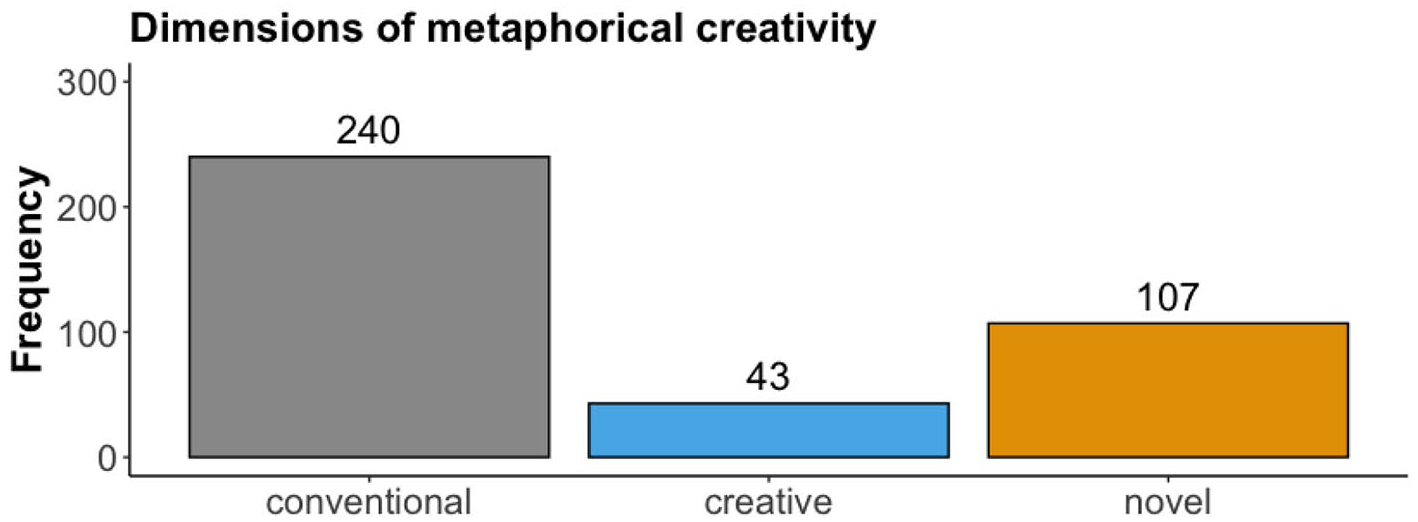
Distribution of metaphors in the corpus by dimension of creativity.
Considering these three dimensions of creativity from the point of view of the metaphorical source domains (Figure 5), we find that novel metaphors fully overlap with those that rely on songs as metaphorical source domains. This is so because, even though some of the songs feature highly conventional metaphors, their occurrence in a highly specific context (the mural) makes them cast a new light on Bowie’s death, making them qualitatively more creative than recurrent death metaphors found in cemeteries. The rest of the metaphors in the corpus were classified as conventional and were further divided between conventionally or creatively deployed. Most source domains were developed in highly expectable ways, with a minimal share of examples featuring creative twists that projected new light on otherwise highly conventional sources. Interestingly, exceptions are

Distribution of metaphorical source domains in the corpus by dimension of creativity.
A Chi-square Test for Independence confirmed that there were significant patterns in the choice of the metaphorical source domain and the degree of creativity with which they were developed (X2(2) = 583.9, p < 0.001). The levelplot in Figure 6 below visualises Pearson’s residuals, a statistical test that shows the degree of creativity that is most likely to be associated with each metaphorical source domain, in a statistically significant way. In order to interpret the plot, green cells (which represent values over 2, with dark green representing values over 4, and therefore, stronger associations) mean there are more observations in the cell than what would be expected if there was a balanced distribution between dimensions of creativity and metaphorical source domain (i.e. null model, grey cells), and therefore constitute an over-represented combination of both source domain and creativity. Red cells (values under −2) mean there are fewer observations than would be expected, and therefore show an under-represented combination of a metaphorical domain and a given dimension of creativity in the corpus.

Pearson residuals from the Chi-square test showing the distribution of associations between metaphorical source domains and each dimension of creativity (green = stronger than chance).
The plot shows that there are two metaphorical domains that are statistically very likely to be developed in conventional ways:
Examples below illustrate the use of the conventional metaphorical source domains (1) RIP Starman (2) Good night. Sleep well David (3) Goodbye Starman (4) See you later Ziggy. . .
Other typical uses of conventional metaphors in the corpus involve the source domains of (5) You are the light of the world (6) RIP the brightest star (7) Ziggy Stardust - You live forever in our hearts (8) Your body may have gone but your music will live on forever, you Legend (9) May God be with you (10) Dear Mr Bowie, you can sing to my beautiful sister now!
As can be observed in the examples above, the metaphor
The scenario changes when we look closely into the ways in which conventional source domains are creatively deployed: in this case, the most likely source domain to feature a conceptual twist that departs from what would have been expected is a journey with a focus on the destination. As mentioned above, this may be because fans usually refer to Mars as the destination for such an afterlife trip, in line with the impersonation of Bowie in his persona Ziggy Stardust. This is illustrated in examples (11)–(13) below:
(11) Enjoy life on Mars, Starman (12) If there wasn’t life on Mars, there sure is now. Thank you. . . Ziggy. (13) You went back to the stars. Love you forever, Goblin King
As commented above, these
To a lesser extent, but still statistically significant, we find strong associations between (14) You will always be my ‘star’ man (15) You can sing Under Pressure with Freddie again! (16) I hope you are duetting with Kurt . . .. In space xxx
While example (14) creatively elaborates on the conventional
While most of (17) Rest in space you amazing inspirational man!
Finally, and as advanced above, the re-use of Bowie’s songs is expected to project novel, one-off source mappings onto the artist’s death. As argued above, Bowie’s songs acquire a totally new meaning by being embedded in a highly contextualised shrine that commemorates the artist’s death. Novel mappings can be broken down into two further types: lines from songs reproduced verbatim (where new meaning comes from the context, i.e. shrine) and modified lyrics (adapted to the situation). Examples of the latter are numerous variations which are made of the theme from the song Starman which says literally ‘There’s a Starman waiting in the sky’, as in examples (18) and (19) below:
(18) The Starman really is waiting in the sky (19) Starman high in the sky shining brightly down on us xxx
Other themes from songs are taken up as a point of departure for a message, such as the song Changes, mentioned in example (20) and the song Heroes in (21):
(20) “Changes” happen, memories & music stay! (21) You were a hero for more than one day. Thank you Starman
In the cases in which the extracts from lyrics are reproduced verbatim, it can be argued that a process of recontextualisation takes place, in such a way that the line from the song is appropriated by the fan community in the new context of Bowie’s death as talked about at the shrine, potentially endowing it with a new meaning. The meaning of these lines from lyrics is ambiguous, in the sense that they can be taken to be, on the one hand, verbatim reproductions of lines from Bowie’s songs which fans are particularly fond of, and on the other, a potential metaphoric conceptualisation of Bowie’s death by borrowing source domains from his own songs. Good examples of this are illustrated in examples (22)–(27) below. The titles of the songs from which the lines are extracted are included in brackets:
(22) Planet earth is blue and there’s nothing I can do (Space Oddity) (23) The stars look very different today (Space Oddity) (24) Put on my red shoes and dance the blues (Let’s dance) (25) We can be heroes (Heroes) (26) Oh no love, you’re not alone (Rock ‘n roll suicide) (27) Hot tramp, I love you so (Rebel Rebel)
By reproducing these lines or titles from songs, it can be argued that fans are creatively reframing Bowie’s death by conceptualising it in terms of themes from his songs. The repetition of the lyrics thus functions both as a tribute to the artist’s music and as a creative euphemistic strategy to deal with the artist’s death by appealing to his fictional universe as if this were a source for consolation. Some of the lyrics highlight the concept of
The process of appropriation and recontextualisation of the lyrics can be said to take place by means of a deictic shift which enables a move from the fictional universe of Bowie’s songs to the real world where the imagined interaction between the fans and Bowie at the shrine takes place. The new interpretation is possible given that most noun phrases used in the lyrics can be interpreted as referring to different entities and locations in different contexts (Hidalgo-Downing and Filardo-Llamas, 2020: 92–93). In this way, for example, the lines in (22) ‘planet earth is blue and there’s nothing I can do’ and in (23) ‘the stars look very different today’ which were uttered by astronaut Major Tom on his space journey in the song Space Oddity, can be interpreted as acquiring a different meaning when reused by the fans in the shrine, who seem to use the lines to reflect on how they feel about Bowie’s death. Similarly, lines from his songs such as (2) ‘we can be heroes’, (26) ‘oh no love, you’re not alone’ and (27) ‘hot tramp I love you so’, are taken up by the fans to address Bowie himself or one of his personas.
What is the most frequent emotional connotation of the metaphorical framings for Bowie’s death?
In this research question, we explore the extent to which the conceptualisation of death in the metaphors identified in Bowie’s mural evokes positive or negative connotations. Positive connotations (e.g. feelings of hope), which perform a euphemistic and consolatory function, were across the board the most prevalent ones (N = 361, 93%), with negative connotations (e.g. feelings of sadness, N = 25, 6%) and mixed connotations (N = 4, 1%) playing a residual role (see Figure 7).

Distribution of emotional connotations in the metaphors in the corpus.
Figure 8 shows a breakdown of connotations projected by metaphorical source domain. In consonance with the results seen above, all metaphorical source domains (except that of loss) evoke positive connotations, endowing the mural with an overall aura of hope, gratitude and optimism. Naturally, the highest frequency of positive messages coincides with the metaphorical source domain

Distribution types of feelings by metaphorical source domain in the corpus.
As observed above and illustrated by most of the examples discussed so far, the positive connotations of metaphors with the source domains (28) So sad you left the planet
The proportion of positive, negative and mixed connotations differed with respect to the metaphorical source domain involved in a statistically significant way (X2(2) = 95.352, p < .001). A closer look at the Pearson residuals shown in the levelplot in Figure 9 reveals that the differences did not apply to positive feelings, as they were the most salient ones for all the metaphorical source domains under scrutiny. The significant differences had to do with the ways in which negative feelings were strongly associated with the metaphorical source domain of

Pearson residuals from the Chi-square test showing the distribution of associations between metaphorical source domains and types of feelings (green = stronger than chance).
A final aspect of interest is the connection between the positivity/negativity of the connotations expressed in the mural and the creativity of the metaphorical messages.
Much in line with the findings reported in this section, Figure 10 confirms that positive connotations are the most frequent in conventional, creative and novel metaphors, and also in similar proportions (conventional, N = 229, 95%; creative, N = 43, 100%; novel, N = 89, 83%). Novel and conventional metaphors also projected some negative connotations, although in a residual way (N = 15, 14%, and N = 10, 4%, respectively). Mixed connotations were found in conventional metaphors (N = 1, 0.5%) and novel metaphors (N = 19, 9%; recall here that these are mostly metaphors involving some song as source domain).

Distribution types of feelings by each dimension of creativity in the corpus.
Novel metaphors, all of which had the source domain (29) There’s a Starman waiting in the sky (30) Ground control to Major Tom (31) The stars look very different today. Shine forever, Starman xx
Novel metaphors were interpreted as expressing negative connotations and sadness in lines and titles from songs about death, such as those from the album Blackstar, in which Bowie reflects on his own death and mortality (example 32), and others which expressed negative feelings and sadness as in (33) and (34):
(32) Blackstar (Blackstar) (33) All the nightmares came today - And it looks as though they’re here to stay (Oh you pretty things) (34) Put on your red shoes and dance the blues (Let’s Dance)
Connotations were coded as mixed in messages which were open to more than one interpretation in terms of the potential feelings, as in examples (35) and (36):
(35) The stars look very different today (Space Oddity) (36) Ashes to ashes, funk to funky (Ashes to Ashes)
We interpreted (35) as evoking mixed connotations, depending on whether it could be understood that Bowie is now back in the stars (hope) or as reflecting on the artist’s absence (sadness). Similarly, example (36) was interpreted as potentially expressing mixed emotions by invoking death through the metonymic expression ‘ashes to ashes’ and at the same time hope, in the expression ‘funk to funky’, which seemed to point at the continuity of Bowie’s music after his death. In this sense, the lines from the songs in these two examples are recontextualised in order to refer to Bowie’s death and music and not to the situations described in the songs, which refer to Major Tom’s travels in space, or, allegorically, to drug trips.
All in all, our enquiry into the relationship between creativity and emotional connotation consolidates our findings on the relationship between emotional connotation and metaphorical source domains: positive feelings were the most pervasive ones across the board, and therefore we could not establish a type of creativity that is more likely than another in projecting positive connotations. Positive feelings were manifested conventionally, creatively, and through one-off mappings. However, as can be seen in Figure 11, there were significant associations between creativity and connotation that once again, had to do with the likelihood of novel metaphors to project negative connotations, in a way that was significantly different from conventional and creative mappings (X2(2) = 25.243, p < .001).

Pearson residuals from the Chi-square test showing the distribution of associations between dimensions of creativity and types of feelings (green = stronger than chance).
Conclusions
This article has studied the creative metaphorical framing of death in the messages written on David Bowie’s mural in London. Results show that regarding RQ1, the most frequent source domains are
Some limitations can be observed in the present study, which may serve as a point of departure for future research. It is obviously not possible to prove whether the lines from the songs which we interpreted as activating
Footnotes
All authors contributed equally to this research paper, and therefore should be both considered joint first authors.
Declaration of conflicting interests
The author(s) declared no potential conflicts of interest with respect to the research, authorship, and/or publication of this article.
Funding
The author(s) disclosed receipt of the following financial support for the research, authorship, and/or publication of this article: Funding for this study has been granted by the Ministry of Science, Innovation and Universities/FEDER (projects with references PID2020-118349GB-I00 and PGC2018-095798-B-I00) and the Government of Aragón (LMP143_21).