



Abstract
Intermediate labour markets (ILMs) provide fixed-term work opportunities and coaching for people in disadvantaged positions in labour markets. We study 46 sequences from six audio-recorded recruitment interviews for an ILM job targetted at people who have been unemployed for a prolonged period. Using an ethnomethodological approach to identity, membership categorisation analysis and conversation analysis, we study how interviewers and candidates construct and negotiate who is fit for the ILM job. We present interactional moves through which the participants jointly construct the ‘fit for the ILM job’ category and treat the candidate’s membership in it as a positive matter. Further, we demonstrate how the candidates are put in an interactionally difficult position in the interview as there are contradictory and ambiguous expectations about the ideal candidate. We discuss the results in relation to the interactional and institutional logics of a recruitment interview and suggest that enhancing the transparency might reinforce ethics of recruitment in ILMs.
Keywords
Introduction
Paid work is a significant source of both financial and psycho-social well-being, and social exclusion is a particular threat for unemployed individuals (Pohlan, 2019). One of the societal measures to tackle long-term unemployment and its negative consequences is intermediate labour markets (Marshall and Macfarlane, 2000; Terävä et al., 2011). With the term ‘intermediate labour markets’ (ILMs) we refer to programmes and organisational models that seek to provide pathways from unemployment to non-supported labour markets by offering fixed-term work opportunities and personalised support that is, coaching and education. ILMs support people who are in disadvantaged positions in labour markets. The disadvantage may be due to, for example, a lack of education, immigration background or history of having been unemployed for prolonged periods (Marshall and Macfarlane, 2000; Terävä et al., 2011).
In this paper, we study recruitment interviews for jobs in ILMs. A recruitment interview is an essential gatekeeping encounter for recruitment in the workplace (Kirilova, 2013; Komter, 1991). It is an inherently complex encounter, since the participants’ interests are contradictory: the interviewer wants to hire the best possible candidate, and each candidate supposedly wants to be hired (Komter, 1991). When it comes to recruitment for an ILM job, the starting points are even more complex than in customary workplaces (cf. Kirilova, 2013, 2017; Tranekjær, 2009). On the one hand, ILMs have the social aim of empowering disadvantaged individuals; on the other, organisations that provide ILM jobs need to secure their entrepreneurial activities to be able to provide jobs in the first place (Lempiälä et al., forthcoming; Nyssens, 2014). The combination of social and entrepreneurial aims leads to the first contradictory point in recruitment for ILMs. In line with the social aim, those who are the most disadvantaged in the labour market should be prioritised in recruitment. However, from the viewpoint of entrepreneurial aims, recruitment should favour those who have the skills to ensure profitability. Thus, recruiting organisations struggle with the question of ‘who to hire’ (Smith et al., 2013). The second contradictory point is related to ILMs being part of active labour market policies (see Nyssens, 2014). Employment offices may offer jobs in ILM programmes to candidates who are not particularly interested in the job or do not consider themselves to be in a sufficiently disadvantaged position to need it. Thus, in a recruitment interview, the interviewer might face a candidate with no interest in securing the job.
Questions of fairness and transparency are always relevant in recruitment interviews (Alder and Gilbert, 2006), and high ethical standards are particularly accentuated for ILM actors due to their social mission. However, due to the above-mentioned complexities, recruitment interviews for ILM jobs can be seen as particularly vulnerable to challenges in fairness and transparency. Despite the particularly complex and potentially problematic nature of this context, we have little knowledge about what actually happens in the recruitment interviews for ILM jobs.
We seek to contribute to this understanding by investigating the following research question: How do interviewers and candidates construct and negotiate who is fit (or unfit) for the job within ILMs? We analyse the question within an ethnomethodological framework and see the categories of being fit or unfit as potential identities that the candidates may be cast into (see Antaki and Widdicombe, 1998; Benwell and Stokoe, 2006; Widdicombe, 1998). To form a detailed understanding of how identity construction happens in this particular setting, close analysis of recorded authentic recruitment interviews is crucial. A few discursive studies have previously analysed this kind of data and described specific challenges in recruitment for programmes targetted at people with immigration backgrounds (Kirilova, 2013, 2017; Tranekjær, 2009). Our study focuses on an ILM setting targetted at people who have been unemployed for a prolonged period due to various reasons. Thus, by focussing on a new type of a setting, our paper widens the understanding of the discursive practices of identity construction in ILM recruitment interviews and the potential challenges related to it. In addition, by utilising an ethnomethodological approach to identity and methods of membership categorisation analysis and conversation analysis, we strengthen the understanding of identity construction in recruitment interviews as it happens turn-by-turn in social interaction. Thus, we contribute also more generally to the understanding of recruitment interviews as significant gatekeeping encounters in society.
Identities as social accomplishments in recruitment interviews
Within the field of discursive studies, the recruitment interview can be approached as an encounter in which the candidate and the interviewer make relevant, construct and negotiate various identities for the candidate – none of which is essentially more ‘real’ than the other (see Benwell and Stokoe, 2006; Juhila and Abrams, 2011). Studying recruitment interviews with the focus on ‘identities as action’ (Juhila and Abrams, 2011: 278) enables seeing the categories of being fit (or not) for the job as not fixed entities but constantly constructed by participants – the candidates along with the interviewers. This is important especially in the context of ILMs, where stigmatised identities (e.g. being long-term unemployed and needing special support) are inherently embedded in the policy context of the setting (see Juhila and Abrams, 2011).
Previous discursive studies have described some successful – from the perspective of securing the job – ways in which candidates may construct their identities. For example, Campbell and Roberts (2007), Roberts (2011), and Kuśmierczyk-O’Conner (2017) have shown the importance of forming a ‘synthetic personality’ that is, discursively integrating personal and institutional/professional sides of oneself (Campbell and Roberts, 2007). Further, Zhang and Li (2014) have pointed out the significance of constructing an identity that is relevant to the applied job. In their data, recently graduated applicants were interviewed for a journalist’s position; those who succeeded in the interview managed to categorise themselves as journalists rather than as students (Zhang and Li, 2014).
Importantly, previous studies have demonstrated the essential role of the interviewer in constructing the candidate’s identity – and how the interviewer’s actions may sometimes create unfair situations for the candidate. For example, Roberts and Campbell (2005) analysed a setting in which the interviewers were instructed to utilise a particular style of invoking detailed narratives from the candidates. The interviewers ended up interrupting the candidates’ narratives with their model-based requests for details but still interpreted the candidate’s struggles in presenting a coherent narrative as a sign of lacking competence (Roberts and Campbell, 2005).
Roberts and Campbell’s (2005) study, as well as numerous others, emphasises the relevance of interviewers’ actions and interpretations in cases in which the candidate and the interviewer have different linguistic and cultural backgrounds. First, a candidate with an immigration background may be positioned as a ‘foreigner’ or ‘different’ by the interviewer’s subtle discursive actions (Kirilova, 2017; Tranekjær, 2009). Second, when interviewers explicitly topicalise candidates’ foreign national origin, they treat it as an essential part of the candidate and highlight the difference between themselves and the candidate (Van De Mieroop and De Dijn, 2021). Third, it has been pointed out that the recruitment interview norms and ‘ideals’ are cultural matters, and candidates with immigration backgrounds may not have been socialised into similar norms and ideals (Campbell and Roberts, 2007; Kirilova, 2013, 2017; Roberts, 2011; Roberts and Campbell, 2005). Roberts and Campbell call the marginalising practices that stem from culture-specific interview rituals a ‘linguistic penalty’ and call into question the need for interviewing altogether in cases where the needed discursive competence is not related to the job (Campbell and Roberts, 2007; Roberts, 2011; Roberts and Campbell, 2005).
This study joins a broad line of discursive research focussing on the interviewers’ and candidates’ construction and negotiation of candidates’ identities in recruitment interviews. More particularly, we build upon the ethnomethodological approach and the methods of conversation analysis and membership categorisation analysis (Sacks, 2003; Schegloff, 2007) to study an identity as one’s ‘display of, or ascription to, membership of some feature-rich category’ (Antaki and Widdicombe, 1998: 2). To be cast into a category implies having certain features, activities, or characteristics, and vice versa, being described with certain features, activities, or characteristics implies membership in a category. Thus, invoking an identity can be done with an explicit mention of the category but does not require it (Antaki and Widdicombe, 1998; Sacks, 2003; Schegloff, 2007). In line with ethnomethodological perspective, we approach ‘fit for the ILM job’ as an identity category that can be constructed in subtle ways without mentioning the category, and straightforwardly negotiated among participants in a recruitment interview.
When compared to other discursive approaches to identity, ethnomethodological approaches and methods are unique in several ways. First, they highlight the importance of participants’ own orientations to the categories (Antaki and Widdicombe, 1998; Benwell and Stokoe, 2006; Widdicombe, 1998). It is seen as the participants’ – not primarily the analysts’– task to make the connection between the category-implicative features and the category or in some other way to treat a particular identity as relevant in a certain moment. Second, the description of the category as such is not the focus; the analytical interest lies in how the categorial work plays out in the structures of social interaction, what kinds of social actions are accomplished by it, and what interactional consequences follow (Antaki and Widdicombe, 1998; Benwell and Stokoe, 2006; Widdicombe, 1998). The third contrastive point with some discursive approaches to identity is the viewpoint towards utilising political or historical theories. The ethnomethodological approaches avoid explaining the construction of identities with political or historical structures. (Benwell and Stokoe, 2006; Widdicombe, 1998.) Nevertheless, for example, asymmetries of power in invoking and negotiating identities can be recognised and analysed at the level of turn-by-turn interaction (Widdicombe, 1998; see also Juhila and Abrams, 2011).
As we utilise the ethnomethodological approach, we see that the construction and negotiation of who is fit for the ILM job happens in the intersection of the interactional and institutional logics of a recruitment interview (see Juhila and Abrams, 2011). Previously, Button (1987) has provided a powerful demonstration of the importance of understanding recruitment interviews as a social encounter (not only in research but also in practice). He has described how interviewers avoided correcting candidates’ misunderstandings regarding the interview questions and blocked the candidates’ opportunities to revise their answers later. Although the motivation behind these actions was the ideal of objectivity, by playing against the logics of social interaction, the interviewers created a misleading situation (Button, 1987). On the other hand, Llewellyn (2010) has pointed out how the candidates are able to utilise the understanding of recruitment interviews as institutional encounters with particular social logics as a resource to handle a situation in which they do not receive clarifications from interviewers. It is important to understand the recruitment interview as having flexible ‘rules’ that are negotiated along the interaction (Van De Mieroop et al., 2019).
The context, data, and process of analysis
The studied recruitment interviews were conducted by a non-profit organisation that offers fixed-term working opportunities for people who have been unemployed for a prolonged period. The interviewed position is for a cook who will work in a lunch cafeteria. As typical in ILMs, the hired person will receive coaching for daily work tasks as well as for life-management and future employment or education plans. Coaching is an essential part of the ILM job.
All candidates have applied for the position based on an invitation by the employment office. The invitation is binding: if the person does not apply for the job, it will affect their unemployment benefits. The salaries are covered partly by the organisation and partly by the state in the form of a pay subsidy. The ideal is that during the subsidised work period of 1 year, the employee would find a job in the non-supported labour market or be accepted into an educational programme.
The data used in this paper is part of a large fieldwork conducted in Finland during 2014–2016 (see Lempiälä et al., forthcoming). The data includes audio-recordings and observation notes (by the first author) of six recruitment interviews. One candidate was present at a time, and all interviews were conducted by two interviewers who were staff-members of the non-profit organisation. All the participants gave written informed consent. To reduce recognisability, we refer to all participants with person pronouns she/her.
The interviews started with the candidates filling out a form on their contact information. Otherwise, the interviews did not share a particular structure: the interviewers asked questions and talked about the organisation, work tasks and coaching in no particular order. One interview lasted approximately 20–60 minutes, and the recordings total 203 minutes. The interviews were transcribed verbatim; the extracts are provided with detailed transcripts following conversation analytic conventions (Jefferson, 2004).
In line with our ethnomethodological approach to identities, the data were analysed using the methods of membership categorisation analysis and conversation analysis. The process of analysis followed the one proposed by Stokoe (2012). It began with making a collection (n = 46) of all sequences in which the interviewers responded to what the candidates had told about themselves by evaluating it explicitly or making a link between the candidate’s skills, attitudes, and characteristics and the demands or opportunities of the ILM job (including the work tasks and coaching). Thus, the collection sought to include descriptions that would be resonant with the categories of being fit or unfit for the ILM job. The sequences were first analysed one by one, paying close attention to (a) the sequential position of the categorial instances and (b) the design of the interviewer’s turn in which category-resonant talk appeared. Then, further analyses focussed on the participants’ orientations to the categories: how the categories of being fit for the ILM job were made relevant, constructed and negotiated by both the interviewers and candidates.
Analysis
The analysis is presented in three sections. First, we present how the participants jointly construct a candidate as fit for the ILM job and treat it as a positive matter. In the latter two sections, we demonstrate the difficulties the candidate faces in constructing their identities in relation to the ILM job. In the second section, we show how the interviewer utilises the ‘fit for being coached’ category in two very different actions and this way creates contradicting expectations about the fit identity. The third section illustrates how the participants negotiate whether or not the candidate is fit for the ILM job. The interviewer constructs the candidate as unfit for the ILM job and the candidate resists it. Although invoking the ‘unfit for the ILM job’ category makes the expectations related to the ILM job visible, it can also create an interactionally difficult position for the candidate.
Jointly constructing the ‘fit for the ILM job’ category
In this section, we show how the participants jointly construct the ‘fit for the ILM job’ category for the candidate through the following interactional moves: (1) the interviewer makes the category available by describing the work tasks as undemanding, (2) the candidate makes the category relevant by describing their skills, attitudes or expectations related to the job and (3) the interviewer constructs the category either by presenting the candidate’s skills as sufficient in relation to the job’s demands or by positively evaluating the candidate. Hence, there were two qualities of candidates that were linked to being fit for the ILM job: (1) having a positive attitude and expectations related to the ILM job and (2) having sufficient skills and knowledge for the work tasks. We present an extract where the category is constructed in relation to the latter qualities.
We join Extract 1 (see Figure 1) at a point where the interviewer is starting to describe the work tasks: ‘so it would be the lunch’ (line 1). Before the beginning of the extract, during the first minutes of the interview, the candidate has answered a couple of background questions and told, for example, about her education, which is suitable for the cook’s job, and about her work experiences, which are in fields other than cooking.
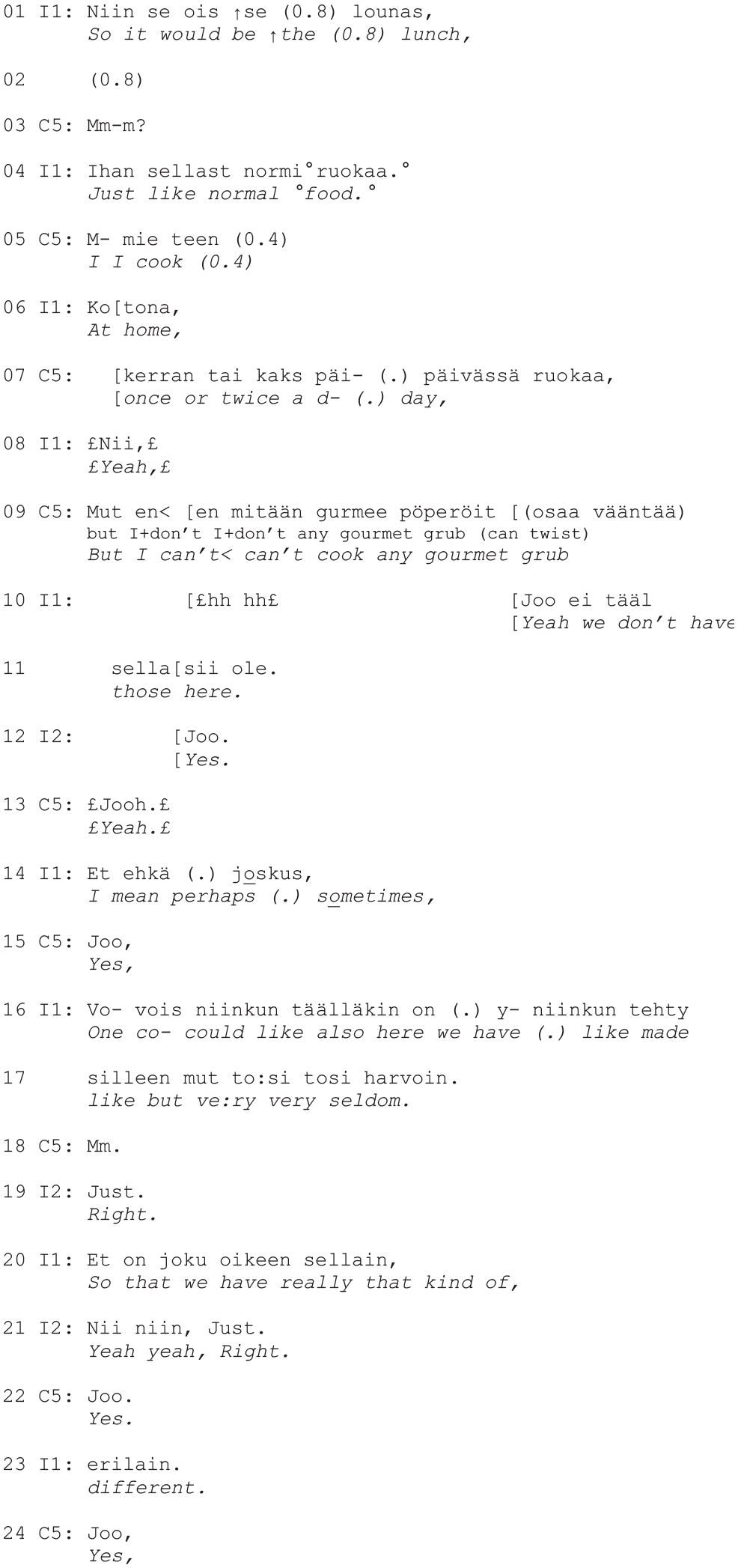
Extract 1 (clip 40, interview 5).
First, let us point out how the interviewer makes the ‘fit for the ILM job’ category available already when describing the work tasks. In line 4, she describes the cooking tasks involving ‘just like normal food’. The attribute ‘normal’ indicates that the work is not particularly demanding.
As a response to the interviewer’s description of the work tasks, the candidate takes the turn to reflect upon her experiences in relation to the tasks: she first mentions an experience that qualifies her for the job (cooking once or twice a day at home, lines 5–7) then continues with a contrastive marker ‘but’ to mention her lack of specific skills (line 9). On the one hand, the contrastive marker and the negative formulation imply that the lack of skills is something that might be considered as disadvantage in the job. On the other hand, the lack of skills is presented in such a way that the relevance of the skills is unclear and thus, the ‘fit for the ILM job’ category remains available for the candidate: as the interviewer has already described the cooking focussing on ‘just like normal food’ (line 4), the lack of skill in preparing ‘gourmet grub’ (line 9) is not in a likely contrast with it.
From line 10 onwards, the interviewer implicitly casts the candidate into the ‘fit for the ILM job’ category by describing the work tasks in relation to the candidate’s self-description. Right after the candidate mentions ‘gourmet grub’, the interviewer overlaps by responding that they ‘don’t have those’ (lines 10–11). Only after this, she slightly retracts her comment by saying that some special food may be included on the menu, ‘perhaps sometimes’ (line 14), ‘but very very seldom’ (line 17), and when that happens, it is ‘really that kind of different’ (lines 20 and 23). Overall, the interviewer presents the candidate’s lack of skills as having minimal relevance for the applied job and thus implicitly describes the candidate having sufficient skills for the ILM job. Importantly, by downplaying the relevance of a potential category feature that the candidate has presented as lacking, the interviewer continues to construct membership in the ‘fit for the ILM job’ category as a positive matter. The candidate aligns with minimal responses (lines 13, 15, 18, 22 and 24).
All in all, the extract illustrates how the interviewers make the ‘fit for the ILM job’ category available for the candidates when describing the work as undemanding and cast the candidates into the category in their responses to the candidates’ self-descriptions of their skills, attitudes, or expectations. What is also important is that the candidates themselves participate in constructing the category membership. Furthermore, as the participants treat the ‘fit for the ILM job’ category as a positive one – something whose membership is beneficial for the candidate, the interviewers may use it to provide affiliation in a situation in which the candidate has brought up challenges related to their fit with the job.
Creating contradictory expectations with the ‘fit for being coached’ category
In this section, we focus on cases in which the interviewers construct the ‘fit for being coached’ category. In these cases, the candidates have explicitly mentioned challenges in their skillset, position in the labour market or self-presentation in the interview situation. The interviewers treat the challenges as belonging to the purview of coaching and thus, construct the ‘fit for being coached’ category. Typically, in our data, the interviewers do this as part of affiliating with the candidate. We present this kind of a typical case together with a rare one to demonstrate how the contradictory expectations (underlying the ILM institution as the intermediate of working life and societal support) are ‘talked into being’ (Heritage and Clayman, 2010) and create an interactionally difficult position for the candidate. This happens, when the interviewers utilise the ‘fit for being coached’ category as part of different actions.
We demonstrate this point with two successive cases, Extracts 2 and 3. In both extracts, the candidate struggles in describing the skills that the interviewers ask about. In Extract 2, the interviewers encourage the candidate to answer and interpret the struggles in a positive frame: the candidate is constructed as fit for being coached. In Extract 3, in contrast, the interviewers sanction the candidate for struggling in the interview situation and utilise the ‘fit for being coached’ category as a justification for asking a question that leads to the problematic situation for the interviewee.
In Extract 2 (see Figure 2), in line 1, the interviewer asks a rather typical recruitment interview question ‘what you would contribute to this work community’. She downgrades the presupposition that the candidate would have an answer to the question by beginning the question with ‘can you envision’ and by continuing after the slight laughter of the candidate ‘have you thoug(ht)’ (line 3). The candidate answers through laughter that she is ‘bad at blowing her own horn’ (line 4). Both interviewers start to encourage the candidate to answer, and as part of this, I2 constructs the ‘fit for the ILM job’ category: she says that they ‘teach the boasting’ (line 7), that ‘it is one of the things here’ (in coaching) (line 11). Thus, the inability of the candidate to answer a typical recruitment interview question is constructed to be in line with the agenda of coaching and thus not a barrier to getting the ILM job.
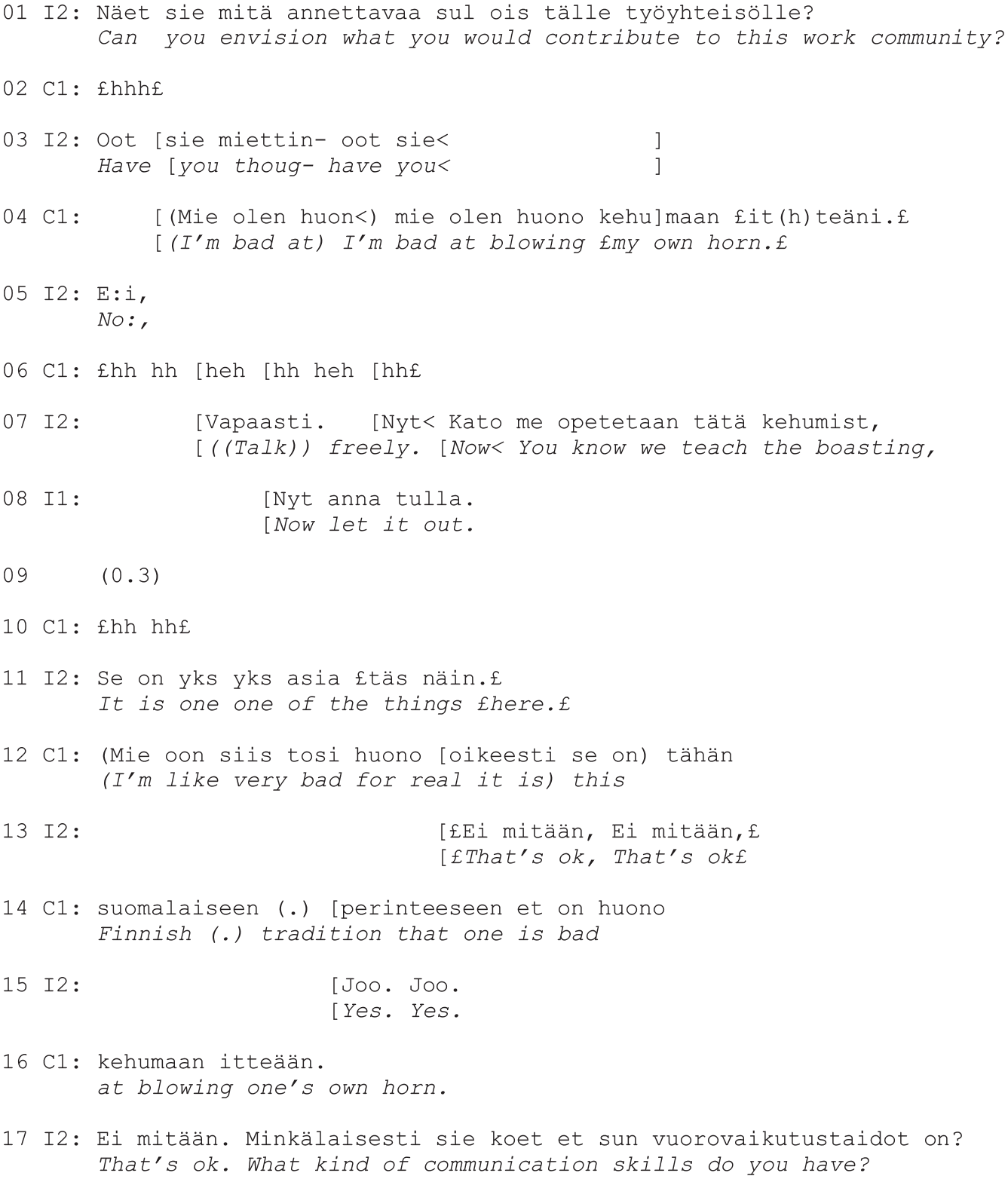
Extract 2 (clip 6, interview 1).
Nevertheless, the candidate continues to give an account of why it is difficult for her to boast. She does not present the difficulty as something that could be solved with coaching but rather links it with a fixed quality – that is, being a Finn (lines 12–16). She presents the quality of being bad at blowing one’s own horn as jointly recognised by referring to it with the pronoun ‘this’ (line 12). The interviewer aligns with the account with minimal responses in line 15 and treats the candidate’s turn as an apology by repeating ‘that’s ok’ (lines 13 and 17). All in all, although the interviewer offers the ‘fit for being coached’ category for the candidate, the candidate does not grasp it. However, the interviewers affiliate and align with the candidate’s actions and self-categorisation.
In Extract 3 (see Figure 3), on the contrary, about 1 minute after the end of Extract 2, the interviewers disaffiliate with the candidate when she again points out her challenges in answering the interview question.
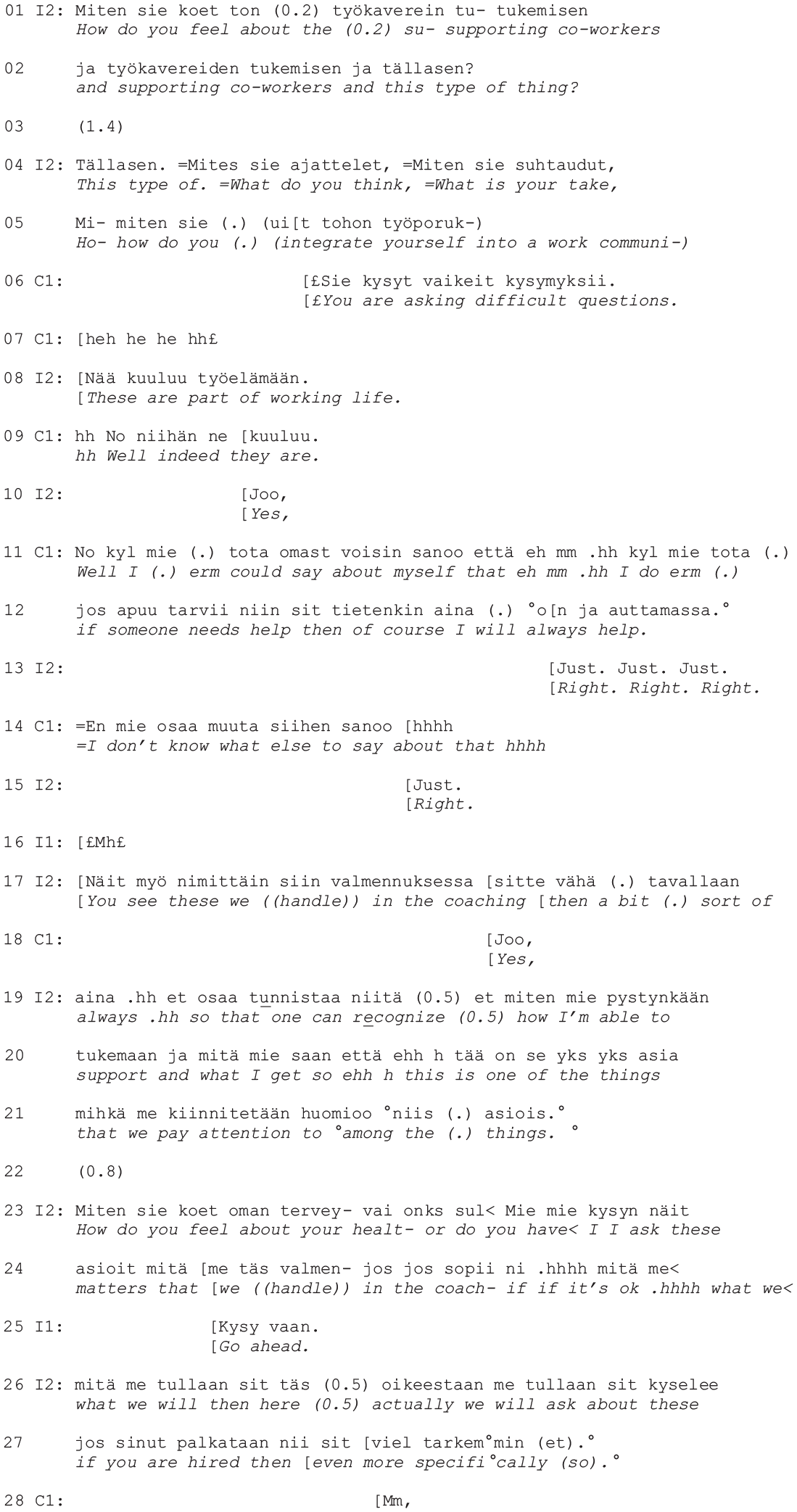
Extract 3 (clip 8, interview 1).
In line 1, the interviewer continues the series of questions we saw in Extract 2. Now, the question focuses on supporting co-workers. First, the question is formulated to be about how the candidate ‘feels about’ the topic, then, after a long silence in the possible transition relevance place (Clayman, 2013) – that is, the slot for answering (line 3) – the interviewer re-formulates it to be about what the candidate ‘thinks’ or what her ‘take’ is (line 4) and how she integrates herself into a work community (line 5). Although the question is reformulated several times, the actual focal point of the question is not very clear.
As in Extract 2, the candidate also struggles with answering the interviewer’s question. She orients to the difficulty of the question by first withholding from answering (line 3) then by explicitly stating the difficulty (line 6). With the plural ‘questions’, the candidate treats the difficulty not being linked to only this question but also the previous ones by the interviewer. In Extract 2, we saw how the interviewers encouraged the candidate to answer when she had stated the difficulty in answering and utilised the ‘fit for being coached’ category to do this. Here, however, the interviewers do not affiliate with the candidate’s struggles but account for the relevance of the questions with ‘these are part of working life’ (line 8). Thus, here the candidate’s turn becomes treated as not reporting her personal struggles but as a negative assessment of the questions. The turn design of ‘these are part of working life’ as a straightforward claim with no indication of this being shared knowledge between the candidate and the interviewers, also suggests that the interviewer has superior knowledge about the matter than the candidate. She is now explicating rules of working life to the candidate, rather than affiliating with the struggles.
The candidate agrees with the interviewer’s statement (line 9) then answers the question from the perspective of when she helps her co-workers (lines 11–12). Nevertheless, at the end of her answer, she restates the difficulty of the question, now linking the difficulty more explicitly to her personal struggles with ‘I don’t know what else to say about that’ (line 14).
In Extract 2, the interviewer constructed the ‘fit for being coached’ category right after the candidate had stated her difficulty in answering the interview question. In Extract 3, in contrast, the interviewer first disaffiliates with the candidate’s difficulties, and only after the second time the candidate has topicalised her difficulty does the interviewer start to build the category (from line 17 onwards). The construction of the category is part of a post hoc account for the question. Earlier, in line 8, the relevance of the questions has been accounted for with them being part of working life; now, the account stems from the questions presenting matters relevant for coaching.
The category membership for the candidate is now more obscure than in Extract 2. By utilising vague person references (the zero-person construction translated here with one and person reference I, lines 19–20) as well as the conditional formulation ‘if you are hired’ (line 27), the category is built as available to anyone who is being hired – thus, also for the candidate, but not for her more than for others.
Overall, Extracts 2 and 3 together have shown how the ‘fit for being coached’ category is utilised for different actions during one interview. First, membership in the category is suggested for the candidate as part of affiliating with the candidate to convince her that it is satisfactory if the candidate does not know how to answer a typical recruitment interview question. Then, just a moment later, the interviewer sanctions the candidate for struggling with her answer and utilises the ‘fit for being coached’ category as a justification for the difficult questions; now, the candidate’s membership in the category is obscure. Thus, the extracts suggest that utilising the ‘fit for being coached’ category as part of these different actions creates contradictory expectations of what is accepted and ideal identity construction in the recruitment interview. This puts the candidate in a difficult position.
Negotiation over being fit for the ILM job
This last section further illustrates the difficulties of identity construction in the ILM recruitment interview. We show how the participants negotiate over being fit (or not) for the ILM job: the interviewer invokes the ‘unfit for the ILM job’ category membership for the candidate, and the candidate resists it. In our data, the ‘unfit for the ILM job’ category was constructed with the attributes of being too good and/or having unfit expectations for the job. The candidates resisted the category membership by either presenting the situation as complex or by describing attributes that went against being unfit. We suggest that although explicitly constructing the ‘unfit for the ILM job’ category may help in creating understanding about the everyday reality of the job, it can also create an interactionally difficult position for the candidate. Extracts 4 and 5 are cases in point.
Extract 4 (see Figure 4) begins with a typical recruitment interview question about how the candidate could contribute to the applied work. However, the way in which the question is formulated already implies that the expectations in the ILM might not be very high. Instead of asking, for example, ‘how you will contribute’, the question is designed as a yes/no-question (line 2). Thus, the presupposition of the candidate’s potential contributions is downgraded. When the candidate does not start answering at the first possible transition relevance place (Clayman, 2013) (line 4), the interviewer further downgrades the expectations for the answer with the claim ‘you probably haven’t thought about it’ (line 5) and formulates the question as seeking thoughts that ‘quickly come to mind’ (line 7).
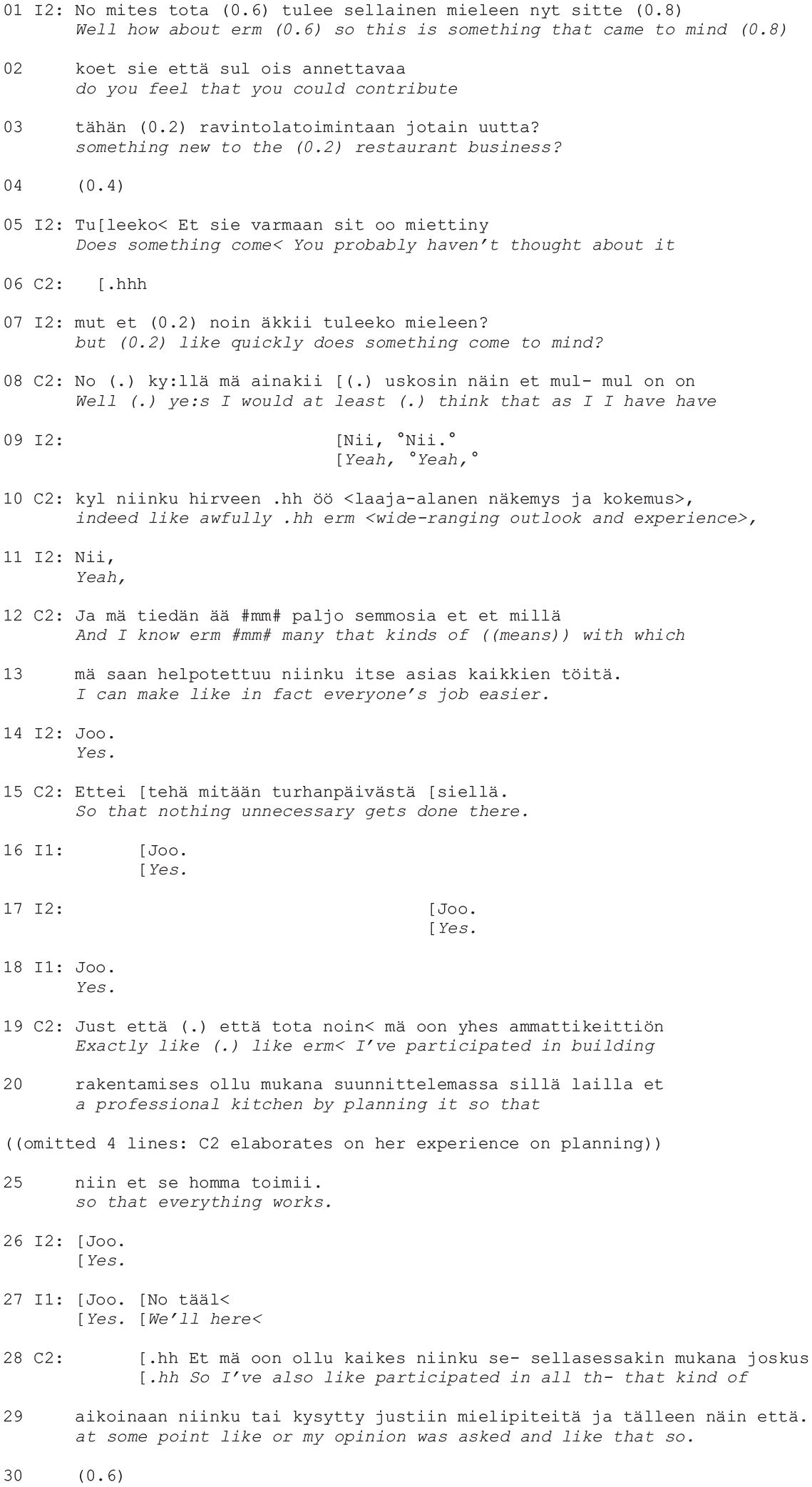
Extract 4a (clip 17, interview 2).
Although the question is very carefully designed not to construct demands on the candidate, the candidate’s answer makes visible the orientation to the institutional norms of a recruitment interview as an encounter in which describing one’s contributions is a preferred action. First, the candidate talks about her contributions with extreme case formulations (Pomerantz, 1986): her outlook and experience are ‘awfully wide-ranging’ (line 10), she knows how to make ‘everyone’s’ job easier (line 13), and how to make sure that ‘nothing’ unnecessary is done in a kitchen (line 15). Second, she provides a detailed example as evidence of her potential contributions (lines 19–29). Third, the response includes assertive elements, that is, the turn-beginning ‘no’ (translated here in English as ‘well’; Hakulinen et al., 2004) (line 8) and the particle ‘kyl(lä)’ (translated here in English as ‘indeed’; Hakulinen et al., 2004) (line 10).
Overall, Extract 4a shows how the candidate treats having contributions to the field as an expected and positive matter for recruitment. Thus, by describing her contributions, she implicitly casts herself into the ‘fit for the ILM job’ category. The continuation presented in Extract 4b (see Figure 5), however, shows how the interviewer resists the relevance of the candidate’s contributions, treating them even as ‘too good’ for the ILM job.
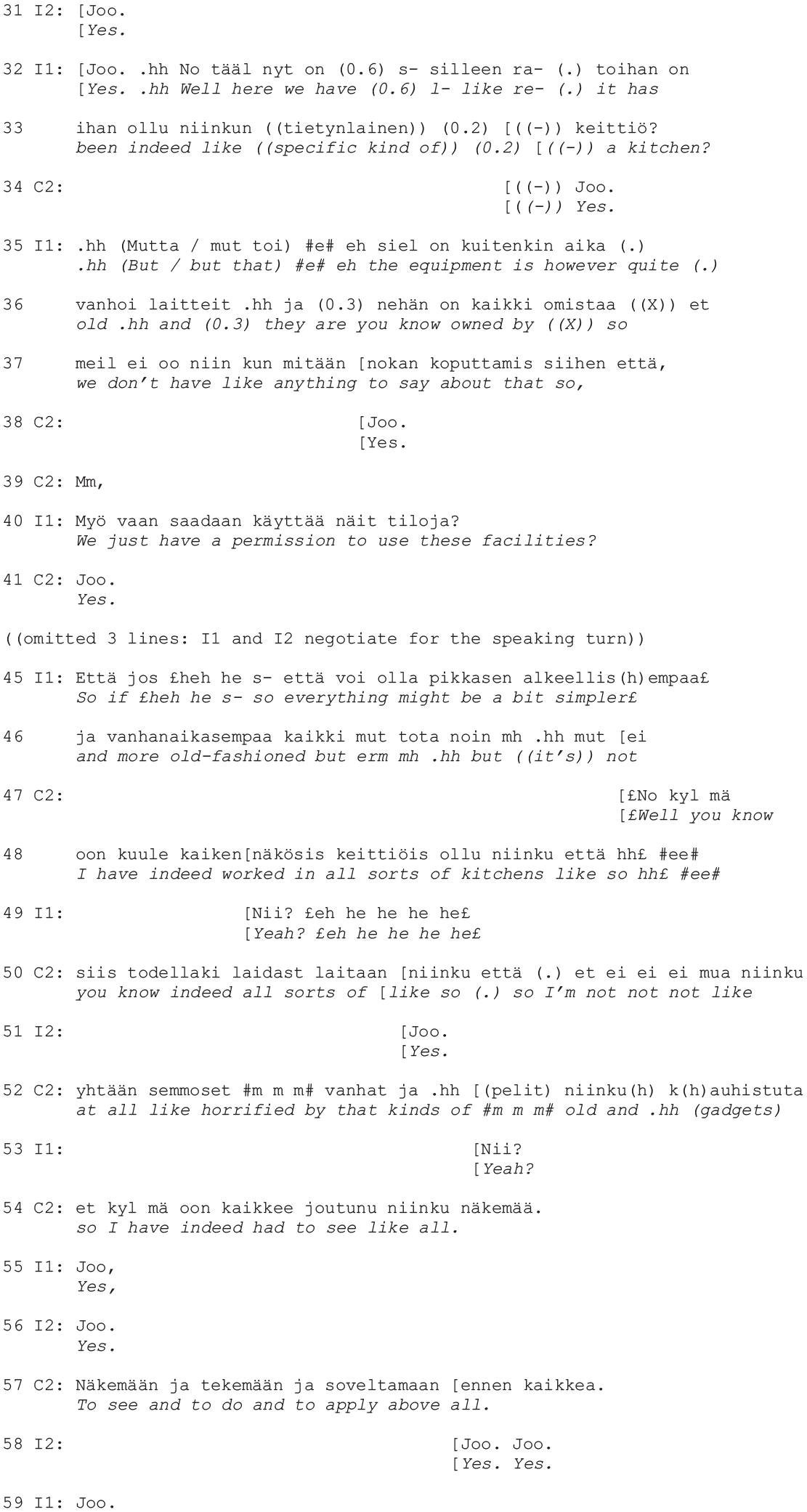
Extract 4b (clip 17, interview 2).
In line 32, the interviewer starts to describe the facilities of the kitchen. She does this in such a way that suggests that the facilities are not what might be expected and wished for. First, she utilises the contrastive ‘but’ (line 35) to mark the difference between a typical kitchen and their facilities. Second, she highlights the minor agency of the kitchen staff as having an impact on their facilities (lines 37 and 40). Third, the interviewer formulates the contrast between their facilities and the candidate’s expectations explicitly (lines 45–46). This way, the interviewer suggests that the candidate has unfit expectations for the ILM job.
Having experience from more complicated and modern kitchens than the job can offer might be regarded as a positive matter: the candidate already has such advanced experience that she does not need the ILM job to get employed. (In fact, this viewpoint is explicated by the interviewers later during the interview.) Nevertheless, the candidate resists membership in the ‘unfit for the ILM job’ category by continuing to present her earlier experiences as also including kitchens that match the interviewer’s descriptions. By arguing that she is not ‘at all horrified by’ old kitchen facilities (line 52), as she has seen ‘all sorts of’ kitchens (lines 50 and 54), she treats the membership in the ‘unfit for the ILM job’ category as implying that she would be demotivated by the job.
Let us present another example. While in Extract 4 the candidate resisted the membership in the ‘unfit for the ILM job’ category by describing her attributes that went against it, in Extract 5 (see Figures 6 and 7) the candidate resists by presenting the situation as more complex than what the interviewers imply. Earlier during this interview, the participants have jointly constructed the candidate as fit for the ILM job in the same way as illustrated in Extract 1: although the candidate lacks suitable education and working experience, her skills were constructed as sufficient for the undemanding and supported job. What is more, the candidate has been surprised to hear that the ILM job at hand has fewer working hours than a standard job and the salary is quite low. We join the interview at the point where the interviewer explains the coaching aspect of the job.
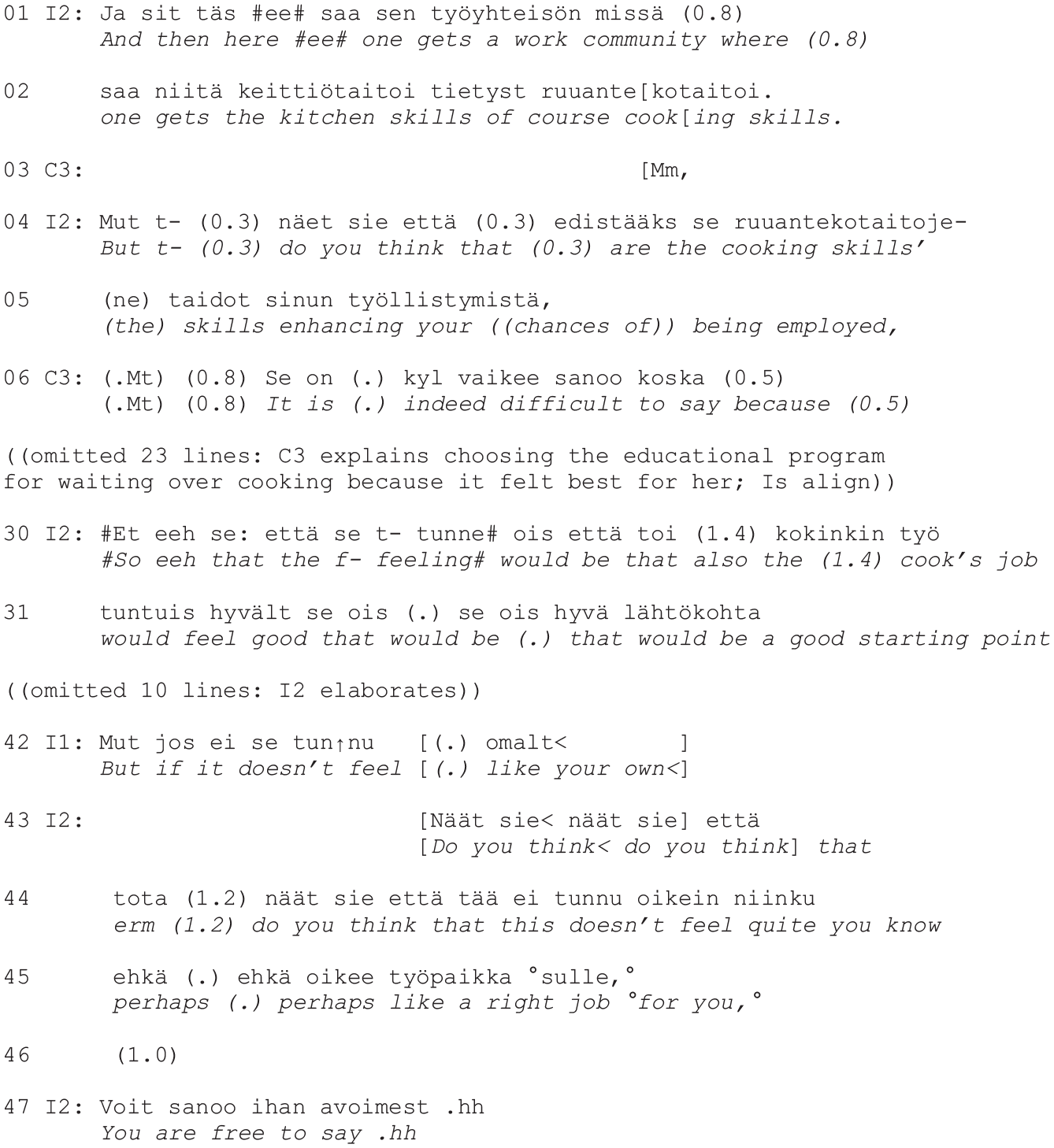
Extract 5a (clip 33, interview 3).
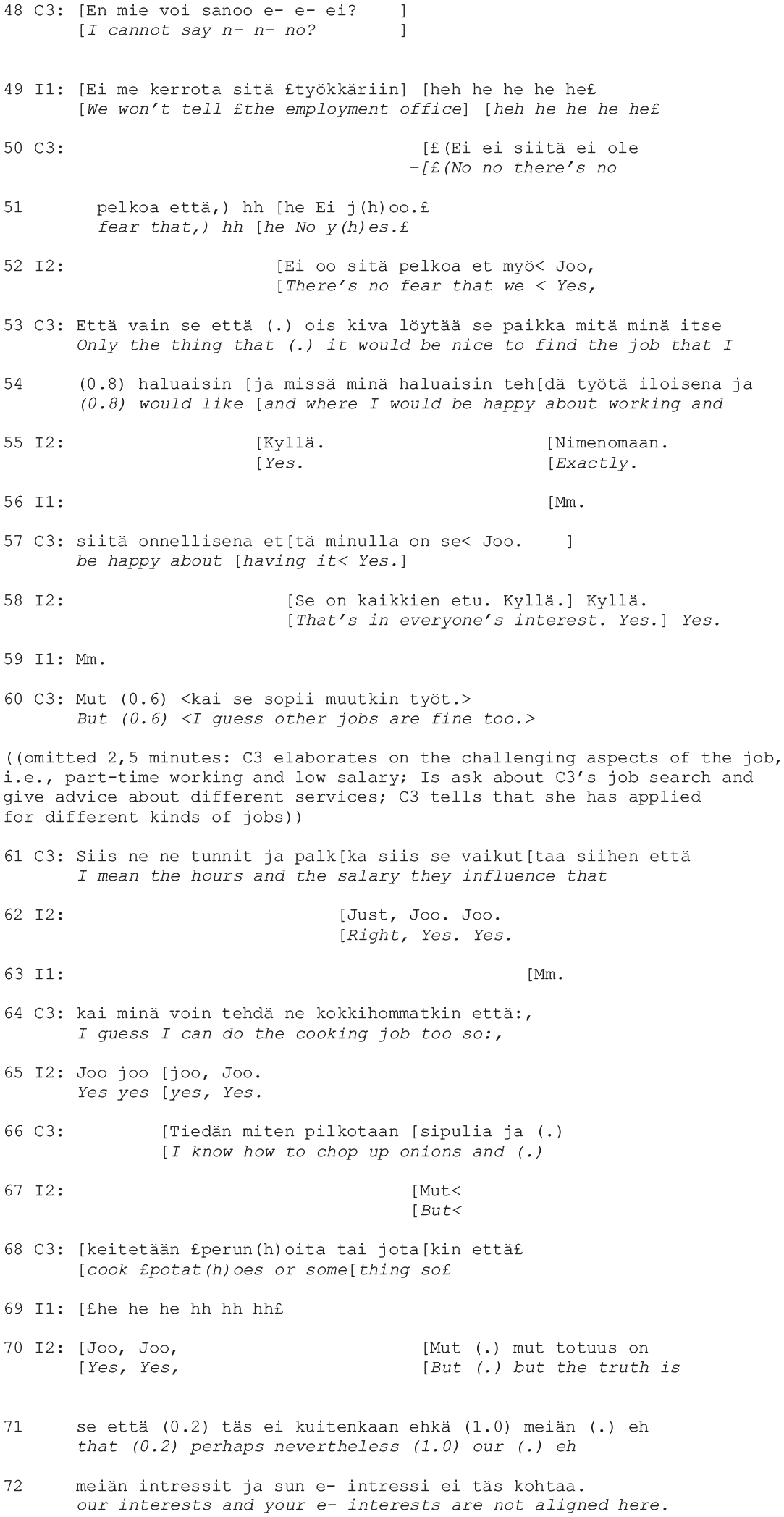
Extract 5b (clip 34, interview 3).
At the beginning of Extract 5a (see Figure 6), the interviewer describes the cooking skills as something that are gained at the work. Thus, the ‘fit for being coached’ category is presented as available for the candidate who lacks substantial education and work experience on cooking. In line 4, however, the interviewer starts to cast the candidate into the ‘unfit for the ILM job’ category. She asks if cooking skills would enhance the candidate’s chances of being employed (somewhere other than in ILMs). By beginning with a contrastive marker ‘but’ and using a yes/no question (rather than, e.g. ‘How would cooking skills enhance your chances of being employed’), the interviewer implies that it might be the case that the ILM job is not useful for the candidate.
The candidate explicitly points out the difficulty of answering the question (line 6) and continues to account for her choice of specialising in waiting (not in cooking) in her studies of restaurant services (not shown in the transcript). Importantly, she does not take a direct stand on whether the ILM job would enhance her chances of being employed.
Nevertheless, the interviewers continue to cast the candidate into the ‘unfit for the ILM job’ category. First, I2 points out the importance of feeling good about the cooking job, and by utilising ‘if’ and verbs in their conditional form, I2 and I1 imply that this might not be the case when it comes to the candidate (from line 30 onwards). Second, I2 poses a question which invokes very strongly the presupposition (see Heritage, 2010) that the job is not right for the candidate (lines 43–45). When the candidate does not start answering right away, I2 encourages her by claiming that she is free to answer – this way also acknowledging that it might be difficult to be honest about these kinds of matters in a recruitment interview. Now, Figure 7 shows the second part of the extract.
In the latter part of Extract 5 (see Figure 7), we see that the candidate negotiates what it means to be fit for the ILM job and constructs the category as still available for herself. First, the candidate explicitly resists the presupposition invoked by the interviewer’s question (see Heritage, 2010) and encouragement that she would say no to the job (line 48). Second, the candidate also disagrees with the interviewer’s suggested source of her resistance (the fear of employment office) (lines 50–51). Third, she presents the situation as more complex and accounts for her resistance as not due to her lack of skills nor her attitude of not accepting a job. She starts with a similar point presented earlier by the interviewers – it is important that she is happy about the job (lines 53–54 and 57); but then, she states that even jobs other than those she would primarily like to do are fine for her (line 60). She retopicalises the low salary and the fewer number of working hours offered by the ILM (e.g. line 61) and restates her skills (lines 66 and 68) that were earlier in the interview jointly constructed as sufficient for the undemanding job. Thus, although the interviewers’ turns would make it possible to align with the suggestion that the ILM job does not feel right, the candidate’s answer makes visible the orientation to a common expectation of employment services that one should be prepared to accept any job when being unemployed. This way the candidate treats the suggested membership in the ‘unfit for the ILM job’ category as implying that she would be demotivated to work.
Nevertheless, the interviewer presents a conclusion that their interests are not aligned (lines 70–72). By beginning with ‘but’ (lines 67 and 70), she constructs the conclusion as being in contrast with what the candidate is presenting. In the end (not show in the transcript), the candidate agrees that the ILM job is not for her, but still, she continues to give accounts.
In sum, Extracts 4 and 5 demonstrate how the ‘unfit for the ILM job’ category is invoked by the interviewer and resisted by the candidate. While such negotiations might also happen in regular labour markets when a candidate is perceived as being overqualified for a job or having excessive expectations, this negotiation in our case further suggests that the expectations (constructed by the participants during the interview) related to an appropriate identity in an ILM recruitment interview are ambiguous. This ambiguity puts the candidates in an interactionally difficult position in the interview because they need to disalign with the category offered to them by the interviewers to align with the expectations of regular labour markets and employment services.
Discussion and conclusions
In this paper, we have studied recruitment interviews for an ILM job that includes working as a cook and participating in coaching. With an ethnomethodological approach to identities and methodological tools from membership categorisation analysis and conversation analysis, we demonstrated how the interviewers and candidates constructed and negotiated the candidate’s fit for the ILM job.
The analysis illustrated that both interviewers and candidates play a vital role in constructing the candidate’s identity in the interview situation. This is in line with previous studies on interaction in recruitment interviews (e.g. Roberts and Campbell, 2005). However, our analysis further demonstrated how the candidates are in a difficult position to negotiate over their identity when there is no shared understanding of the ideals and expectations. Previous studies have pointed out similar difficulties in recruitment interviews with people who have immigration backgrounds and do not operate with similar linguistic and cultural resources to the interviewers (Campbell and Roberts, 2007; Kirilova, 2013, 2017; Roberts, 2011; Roberts and Campbell, 2005). In our study, however, the difficulties could be attributed to contradictory expectations created during the interview and from the expectations that were in contrast with typical expectations regarding labour markets and employment services. While the format of the interview draws from that of regular labour markets, the evaluation criteria for the candidates are different; while the institution is tightly linked to employment services, the evaluation criteria for the candidates are again different. Our study shows how the fundamentally contradictory expectations of the ILM institution as the intermediate of working life and societal support are ‘talked into being’ (Heritage and Clayman, 2010) and create an interactionally difficult position for the candidate.
Overall, the pursuit of attainability through presenting the work as predominantly undemanding presents a distinctive context for identity negotiations compared with regular labour markets. The work itself becomes constructed as plain and simple, which is reflected in the identity categories that are available to the candidates. The candidates are put in a position where they need to balance between being seen as skilled enough to fulfil the requirements of the job while not too skilled to be fit for the coaching involved. As Extract 4 illustrates, the interviewers could construct the candidate as ‘too good’ for the job and thus unfit for the position. This balancing act is challenging for the candidate as the ideal – the balanced entity of being good but not too good – is ambiguous (as illustrated in Extracts 2 and 3). Necessitating interviewees to construct themselves as not too skilled and presenting the job as something humble may not be in line with the empowerment goals of ILM organisations. What makes the situation even more ambiguous is that although the interviewers constantly construct the humbleness of the job, there are limits to how the candidates may use it as a resource in casting themselves into the ‘fit’ category (as illustrated in Extract 6).
These ambiguous expectations challenge an interview as an ethical tool for recruitment in ILMs (cf., Roberts, 2011). We began this article by pointing out the complexities of recruitment for ILMs. Our study contributes to the previous understanding of these complexities by showing how being fit for the ILM job is constructed and negotiated in authentic recruitment interviews. Previous studies have highlighted the recruiter’s viewpoint on the dilemma – that is, the different aspects of the question of who to hire (Smith et al., 2013). We have demonstrated that it is also the candidate who encounters the dilemma – from their perspective, the crucial question is how to present oneself as someone fit for the job, and there is no transparent answer to this question. While the interview draws clearly from the regular labour market interview, the interviewees are unaware of how the evaluation criteria is different in this context.
On the other hand, it should be noted that the categories that we have discussed are not strict, on/off ones. Being fit or not was typically constructed implicitly by comparing the candidate’s skills, expectations, or characteristics with the demands or opportunities of the ILM job. This implicitness of the categories leaves room for candidates’ agency. For example, we saw in Extracts 4 and 5 how the candidates did not accept being ‘unfit’ but negotiated the meaning of the category and their membership in it. Being able to negotiate one’s identity has been recognised as important in different settings with disadvantaged individuals (see Juhila and Abrams, 2011: 286–287).
Overall, since the candidates include individuals in disadvantaged positions, recruitment interviews for ILM jobs should be treated as emphasising the importance of being positive encounters for the candidates no matter what the recruitment decision is. One key for reinforcing ethics in recruitment interviews for ILM jobs could be to see the setting being not so much about making a recruitment decision but as guidance – that is, promoting ‘processes that are meaningful . . . in such a way that the participants’ agency and participatory sense are strengthened’ (Vehviläinen and Souto, 2021). To enable this, it is important to recognise different norms related to these two institutional activities, guidance and recruiting, and that way to avoid challenges described in mock or simulated recruitment interviews in which unclear framing of actions makes it difficult for the candidates to operate meaningfully (see Linell and Thunqvist, 2003; Reissner-Roubicek, 2017). Transparency about the agenda of the encounter (see Vehviläinen and Souto, 2021) and what is expected from a fitting candidate are crucial.
Footnotes
Acknowledgements
The authors would like to thank Liz Stokoe for her helpful comments to an earlier version of the paper.
Declaration of conflicting interests
The author(s) declared no potential conflicts of interest with respect to the research, authorship, and/or publication of this article.
Funding
The author(s) disclosed receipt of the following financial support for the research, authorship, and/or publication of this article: This work was supported by the Academy of Finland [grant no. 317046]. The data was collected during a research project that received funding from the Emil Aaltonen Foundation.