



Abstract
Drawing on video-recorded data from pre-climbing route mapping with visually impaired climbers and a sight guide, this study uses conversation analysis to investigate the situated deployment of the Italian presentative (e) hai ‘(and) you have’ within locally routinized multimodal Gestalts. The study shows that the guide uses (e) hai to progress route mapping and engage the athlete in tactile actions that target specific features of the route. In this context, (e) hai is packaged with noun phrases, silent pauses, bodily movements, and touch. The arrangement of such syntactic and embodied components is shown to follow a recurrent trajectory in which, between (e) hai and its grammatical completion, syntactic suspension creates a dedicated slot for guide and athlete to physically attain the target object. Routine embeddedness of (e) hai within such arrangement is shown to provide specific affordances to the athletes to anticipate subsequent action and engage in its embodied implementation.
Keywords
Introduction
In paraclimbing, 1 athletes with visual impairments rely substantially on multisensory resources provided by sight guides to access environmental features, such as the layout of holds within a selected route, that are designed assuming able-sighted climbers as default users (Simone, 2021). Based on videorecorded data in Italian documenting several paraclimbing sessions, this article uses conversation analysis (Sidnell and Stivers, 2013) to analyze how a sight guide engages with visually impaired athletes in the tactile mapping of routes preliminary to climbing. The article is concerned with reconstructing the cooperative accomplishment of route mapping actions organized as complex multimodal Gestalts (Mondada, 2014) in which diverse materials, including presentative utterances, syntactic suspension, joint bodily movements, and touch, are assembled in an emergent and incremental way. It specifically analyses multimodal action packages that are initiated by the guide by using the presentative construction e hai ‘and you have’ as illustrated in Extract 1.
Extract 1_Rossa_Ga
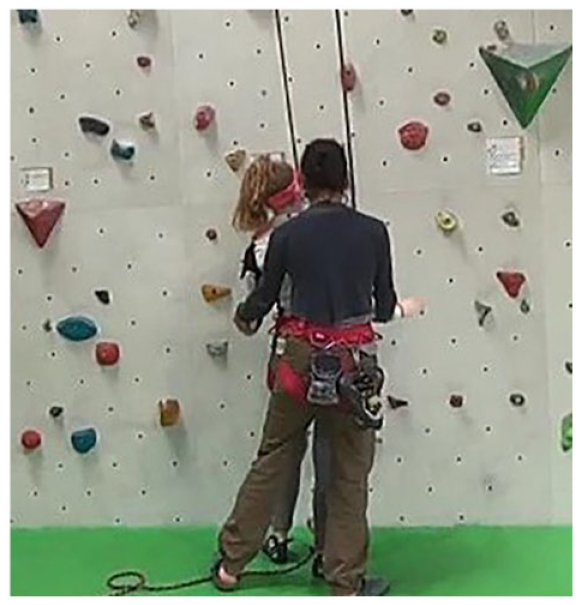

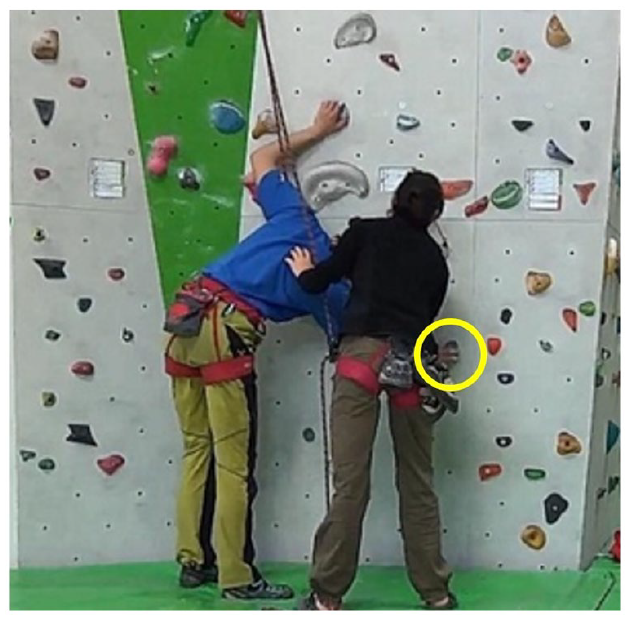
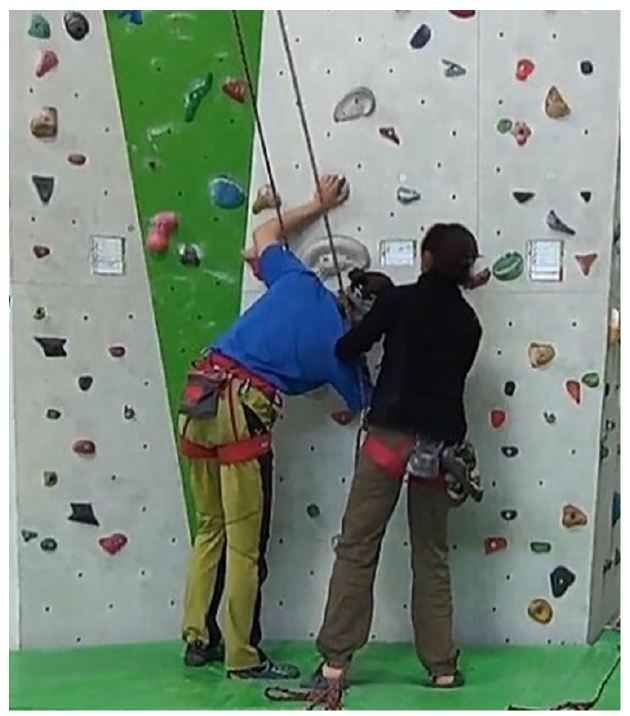
The target phenomenon occurs between lines 13 and 15, following the mapping of a series of handholds (lines 7–11). In l. 13, by saying e hai ‘and you have’, the guide advances the activity to the next phase, that is, the mapping of footholds located at the base of the wall. This phase of route mapping poses specific constraints to the participants. It particularly requires that the athlete, in addition to let the guide to physically direct her hand toward the next hold, also joins in coordinated bodily movement with the guide (Figure 1a and b). Such activity therefore entails the active contribution of the athlete. In this context, by using the second-person presentative construction e hai ‘and you have’ 2 (l. 13), instead of the impersonal ‘there is. . .’ (Cf. l. 11: ‘there’s a horizontal pinch’), the guide addresses the athlete, foregrounding her involvement in the projected embodied action. Furthermore, and crucially, after uttering e hai (l. 13), the guide pauses (l. 14) leaving ongoing syntax momentarily suspended. The silent pause creates a dedicated slot for the participants to move their joined bodies by simultaneously bending over and reaching out to the place where the foothold is located. Once this is achieved and the athlete can touch it, the guide eventually resumes the previously suspended clause by saying ‘the same large foothold as before’ (l. 15).
So far, Italian presentative utterances with avere ‘to have’ have been neglected, while most attention has been paid in linguistics to those with c’è / ci sono ‘there is / are’ (e.g. Berruto and Cerruti, 2015; Venier, 2002). To our knowledge, have-presentative constructions have been systematically investigated only with reference to English (Brůhová and Malá, 2019), moreover based on textual corpora rather than on data from naturally occurring social interactions. As far as conversation analytic literature is concerned, a few studies consider how presentative constructions with the verb ‘to have’ are employed in the context of practical activities, such as in guided tours in French (Traverso and Ravazzolo, 2016) and in dance classes in Swedish (Keevallik, 2015). However, the just mentioned studies are not centrally concerned with the functioning of have-presentatives and only consider isolated occurrences of such constructions. Drawing on a collection of several extracts in which the same guide interacts with three different climbers, the present study shows how have-presentative constructions occurring in the form of e hai plus noun phrase, are deployed by participants in a specific ecology of embodied action. The analysis focuses on the deployment of such constructions within multimodal Gestalts that exhibit the trajectory previously illustrated with reference to Extract 1, in which, following e hai, embodied and syntactic components are integrated in an orderly manner.
The results of our analysis show that, in the particular community of participants under consideration, e hai ‘and you have’ forms part of a locally routinized (Stukenbrock, 2021) multimodal Gestalt that participants observably recognize as such. Previous literature has investigated ways in which sensoriality permeates syntax in interaction (Mondada, 2021). Our study adds to such literature with an analysis focusing specifically on how intercorporeality (Meyer et al., 2015; Merleau-Ponty, 1960/1964) figures in the organization of syntactic resources that participants use to structure joint perceptual actions. Also, this study expands current knowledge of practices adopted by sight guides in inclusive sport settings by showing how syntax is employed in systematic ways to provide the visually impaired athletes with affordances for anticipating next actions and join in cooperative accomplishments with their sight guides.
The interface between grammar, the body, and intercorporeality
The background of this article brings together two areas of research. The first area includes studies in conversation analysis (CA) and interactional linguistics (IL) (Couper-Kuhlen and Selting, 2017) concerned with exploring what has been defined the grammar-body interface (Keevallik, 2018). The second one relates to social interactional studies addressing the notion of intercorporeality (Meyer et al., 2015).
Research in CA and IL increasingly shows that grammar is an inherently temporal, on-line process (Auer, 2009) that is shaped by interactional circumstances and by being interfaced with multimodal (embodied and material) resources for sense-making (Goodwin, 2000, 2018; Keevallik, 2018; Mondada, 2014, 2018; Streeck, 2009; Streeck et al., 2011). An important contribution to exploring how linguistic structures are constantly being elaborated in and by embodied interaction is currently coming from studies on instructed physical activities, in which language is at the service of teaching and training the body (e.g. on boxing sparring sessions: Okada, 2018; dance classes: Broth and Keevallik (2014), Ehmer (2021), Keevallik (2013, 2014); pilates: Keevallik, 2020; budo classes: Råman, 2019; self-defense training: Stukenbrock, 2014). Along this line of research, previous analysis of paraclimbing with visually impaired athletes (Simone and Galatolo, 2020, 2021) shows that embodied involvements play a driving role in the sequential and moment-by-moment shaping of verbal instructions which the guide uses to assist the athlete’s ongoing climbing. The present article adds to previous studies on guide-athlete interaction in paraclimbing with the analysis of how footholds are made available to the athlete’s perception within complex multimodal Gestalts (Mondada, 2014) by assembling e hai-initiated presentative utterances and joint bodily movements.
Guiding others’ perception of material objects located in the environment requires organizing the multiple temporalities of talk, displacement in space (e.g. Mondada, 2012) and of the sensory modality that is employed to gain access to the referred objects. Each sensory modality poses specific constraints to the achievement of accountable and publicly organized sensing activities. For instance, guiding a co-participant in experiencing an object through touch requires tailoring the delivery of instructions to the timing of bodily movements needed to gain direct contact with the object and progress in tactile exploration (Kreplak and Mondeme, 2014; Nishizaka, 2007). The practical constraints associated with guiding others’ perception may be reflected in the choice of specific syntactic formats that speakers use to invite the audience to physically orient themselves toward a target phenomenon. For example, drawing on data from guided tours, De Stefani (2021) investigates how guides resort to if-clauses such as ‘if you look at the ground’ to solicit visitors to bodily and visually reorient toward an object of interest, adjusting the progressivity of their ongoing turn-construction (i.e. the delivery of the consequent then-clause such as ‘you see that there is. . .’) to the visitors’ embodied rearrangement. The author shows that the functionality of if-clauses builds on a ‘twofold projection potential: a vocal-grammatical projection enabling the guide [. . .] to achieve a grammatically adequate turn-continuation, and an embodied-action projection, which solicits visitors to accomplish a situationally relevant action’ (De Stefani, 2021: 1). Similarly, the present article focuses on how the guide employs e hai ‘and you have’ both to initiate a presentative construction that introduces an object of interest (i.e. a target foothold) and to achieve the athlete’s embodied cooperation to the attainment of such object. However, in our case the relevance that a given embodied action is accomplished is projected by a partial clause (i.e. ‘and you have’) rather than by a syntactically complete clause (e.g. ‘if you look at the ground’).
The multimodal Gestalt investigated in this article is indeed characterized by syntactic suspension occurring systematically between hai ‘you have’ and its syntactic completion. Previous studies show that syntactic suspension may be employed to project a continuation that is realized by the body. For instance, Olsher (2004) shows how conversationalists assemble sequential actions by combining partial verbal turns with embodied components such as gestures and material actions. Drawing on data from instructed activities, Keevallik (2013) and Stukenbrock (2014) show how instructors produce demonstrations by assembling verbal projecting components and embodied materials such as enactments. The present study illustrates a different case, in which the embodied component following the syntactic suspension does not complement the suspended turn grammatically, as is the case for embodied completions (Olsher, 2004) and syntactic-bodily units (Keevallik, 2013); rather, such embodied component is seen as progressing the action to some point upon which the syntactic completion of the pending presentative construction is eventually provided by the speaker, typically in the form of a noun phrase expressing the target foothold. In this context, syntactic suspension appears to be designedly employed to prioritize bodily movement. However, unlike the cases analyzed by Hofstetter et al. (2021) in which speakers momentarily halt ongoing utterances in favor of carrying out physically demanding embodied actions, in our data syntactic suspension does not appear to be contingently occasioned by physical exertion; rather, it is designed in routine, and therefore predictable, ways to create a dedicated slot in which bodily movement and touching of the target foothold can be achieved. Systematicity in the suspension of ongoing syntax to prioritize embodied, perceptive actions is also shown by Mondada (2021) with reference to cheese-tasting training sessions where trainers suspend the delivery of descriptors related to the qualities of the cheese being examined to allow time to visual inspection and tasting before they resume the description. What distinguishes our analysis is that the embodied component following syntactic suspension is jointly realized by both speaker (the guide) and recipient (the athlete) rather than by the speaker alone. Our analysis is therefore aimed at showing how syntactic suspension is employed within multimodal and distributed action packages to invite the recipient, although not straightforwardly (i.e. through requests or instructions), to contribute relevant components. In this respect, the phenomenon investigated in the present article shares some similarity with Iwasaki’s (2018) previous analysis of speakers’ use of syntactic suspension to create a space for co-participants’ contributions to ongoing units of talk. Compared to this study, which draws on conversational episodes, our own is indeed focused on a context of practical embodied activity.
By analyzing the functionality of e hai as a device for projecting collaborative embodied actions, this article puts language in relation to intercorporeality. Following Merleau-Ponty (1960/1964), intercorporeality is used to highlight that intersubjectivity is grounded in embodiment (Csordas, 2008). While many authors place intercorporeality in the realm of pre-reflexive/pre-linguistic interactions (e.g. Tanaka, 2015), in this study we adopt an alternative approach exploring the relationship between intercorporeality and communicative resources (Katila et al., 2020).
Intercorporeality is particularly useful to understand sense-making in interactional contexts where participants are involved in joint embodied tasks and co-engaged with the material environment, such as in sports (Meyer and Wedelstaedt, 2017). Also, previous literature shows that intercorporeality is crucial to practices of co-operative perception (Due, 2021) with participants with vision impairment especially in the context of mobile activities such as hiking (Macpherson, 2012) and paraclimbing (Simone, 2021). As illustrated by earlier analysis of this setting, sensory cooperation between the visually impaired athletes and their guides rests particularly on the participants tuning into each other’s multimodal actions. For instance, Simone and Galatolo (2021) analyze the guide’s use of lexical repetition to calibrate the athlete’s climbing. The analysis shows that the duration and prosodic format of the guide’s lexical repetitions shapes the athlete’s bodily movements and are in turn shaped by details regarding the production of those movements over time.
The present article expands the analysis of the interface between language and intercorporeality by focusing on the role that the verbal construction e hai plays in simultaneously inviting the recipient (the visually impaired athlete) to engage in a joint movement with the speaker (the guide) and to relinquish (Cf. Guo et al., 2020: 14) to the latter the control of such movement in terms of both visual and physical guidance. Unlike in parent-child interactions where directing the child’s bodily movements is seen as displaying the parents’ deontic right to manage interactional projects (see Cekaite, 2010), in the case this article deals with, physical guidance is embedded in a professional relationship that sees guide and athlete as sporting partners who cooperate to achieve shared practical goals.
Setting, data, and methods
This article focuses on pre-climbing route preview, a routine activity for expert athletes which is considered to play a critical role both in physical and in cognitive preparation to climbing (Sanchez et al., 2019; Sánchez García et al., 2019). The activity consists in examining the route from the ground to identify the available footholds and handholds and plan possible moves between them. Previous research on rock climbing emphasizes that route preview is all about seizing the affordances for climbing provided by the rock face through direct corporeal engagement (Jenkings, 2017; Lewis, 2000). In indoor climbing it is different because routes are pre-set and made recognizable through color marks (Figure 2). In this context, visual information plays a primary role in enabling the climber to follow the route.

A sequence of green colored holds forming part of a climbing route (white highlights added by the authors for the readers’ convenience).
In paraclimbing, athletes with vision impairments are helped by their sight guides who ‘translate’ visual information into auditory and tactile practices, that is, by employing verbal descriptions and touching to map the climbing holds. Route preview is therefore configured as a tactile mapping and accomplished by the participants by arranging their bodies in a front-to-back embodied formation (C-formation in Cekaite, 2010) that allows the guide to simultaneously monitor the route visually and physically guide the athlete’s bodily movements (Figure 3).

Guide and athlete arranged front-to-back during route mapping.
This article is based on data from 12 hours of video-recorded indoor paraclimbing training sessions involving a coach and three élite-level athletes with visual impairments (one blind athlete and two athletes with severe vision loss). The recordings took place in 2016 in two climbing gyms in Italy upon obtaining the participants’ consent and approval by the University Ethics Committee. The recorded materials include 53 climbs on different routes, that are performed in turn by one athlete at a time under the guidance of the coach. Out of the total number of climbs, only those involving new or unfamiliar routes for the athletes (N = 27) are preceded by route mapping. The duration of the route mapping is variable, but no longer than about 6 minutes. Overall, the mapping is mostly limited to the start of the route to allow the athlete to get an idea of what the route they are about to climb looks like. Also, as illustrated in Extract 1, the mapping is routinely organized in two phases, the first one being the mapping of the handholds the athlete will use at the start of the climb; the second, the mapping of the footholds available at the base of the wall to detach themselves from the ground and push upwards.
A total number of 14 sequences were gathered in which the guide uses e hai ‘and you have’ (N = 10), or, less frequently, only hai ‘you have’ (N = 4) to initiate the mapping of footholds. Another common feature across the sequences is that (e) hai is delivered as a stand-alone component, followed by a silence, despite being grammatically incomplete.
The data are analyzed using conversation-analytic methods (Sidnell and Stivers, 2013). Detailed annotation was done with the ELAN software (Wittenburg et al., 2006). Transcripts follow Jeffersonian conventions (Jefferson, 2004). Multimodal transcription mostly follows Mondada’s (2019) conventions, except for Extracts 1 and 7, in which case we opted for a simplified representation of embodied behavior to preserve the readability of the transcript target lines.
Analysis
The analysis is organized as follows. Section 4.1. considers the interactional distribution (Peng et al., 2021: 34) of (e) hai ‘(and) you have’ in the data, to identify the sequential environment in which such practice occurs and its functions within such environment. The following subsections report on analysis of details of guide’s and athlete’s behavior displaying their orientation to (e) hai as a practice that anticipate intercorporeality as a relevant aspect of subsequent embodied action. More specifically, section 4.2. analyzes athletes’ responses to (e) hai occurring in the form of embodied adjustments that display the athletes’ readiness to be led by the guide and engage in joint body movement. Section 4.3 analyzes two episodes in which the guide’s reception of the athlete’s embodied response to (e) hai orients to the legitimacy and delicacy of touching and moving the athlete’s body.
Sequential environment of (e) hai ‘(and) you have’ within ongoing route preview
The sequential environment in which foothold mapping is initiated by the guide by uttering e hai is following the completion of the prior phase (the mapping of handholds), as shown in the extract below.
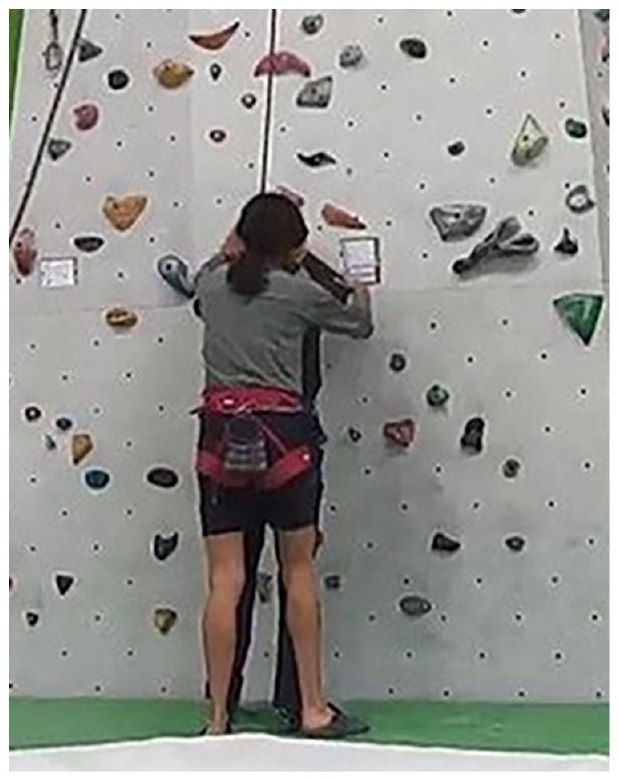

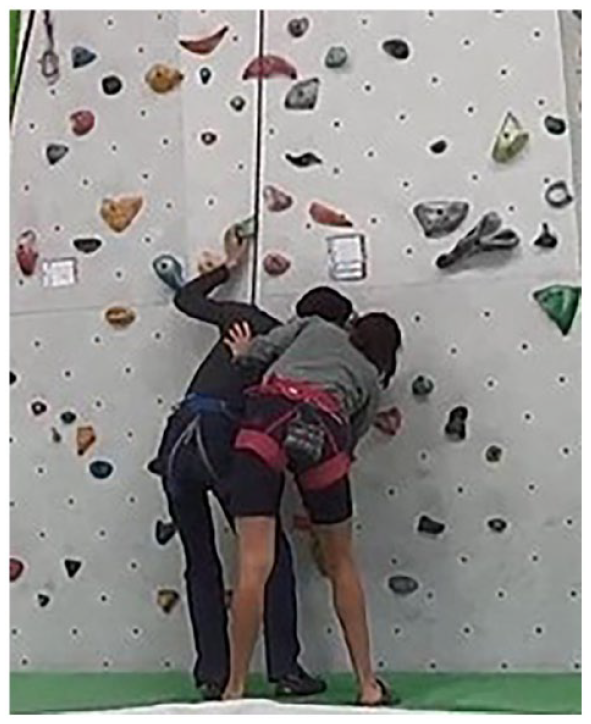
At the beginning of the extract, G introduces the first handhold of the route by saying partenza qua ‘start here’ (l. 1) and simultaneously placing A’s right hand over it (l. 2) (Figure 4). Following a pause (l. 3), G advances the activity by saying e devi andare, ‘and you must go’ (l. 4); she pauses to draw A’s right hand upwards (l. 5), and then resumes the instruction (l. 6) by saying là, sopra di un buco, ‘there, above this hole’ (literally, ‘one hole up’) while simultaneously pressing A’s hand over a hole in the wall 3 (l. 7) (Figure 5). This segment is delivered with falling intonation, which provides for the projectability of the completion of the overall action (by contrast, previous verbal segments are delivered with continuing intonation projecting the continuation of the current trajectory of action); also, the completion of current action is projected by the athlete who says ‘okay’ (l. 8) in overlap with the last syllable of G’s prior turn. In l. 10, G increments her prior instruction by adding con la mano destra ‘with your right hand’ with falling intonation. Toward the end of this utterance, G starts drawing A’s hand downwards (l. 11), which is seen as projecting a next tactile mapping action, this time orienting to a lower section of the route. Then G says e ha:i. ‘and you have’ (l. 12) to introduce the target foothold and draws A’s hand further downwards to where the foothold is located (1. 14). Again, as in (l. 4), and-prefacing makes the sequentiality between the upcoming action and the previous one salient (Nevile, 2006). Also, G suspends ongoing syntactic construction to prioritize bodily movement. Both suspensions in l. 4 and l. 12 are followed by a pause, which, however, in the second case (l. 13) is almost twice as long (0.9 seconds) as in the first case (0.5 seconds). The longer pause occurring before G completes the previously suspended presentative construction by articulating the noun phrase piede destro,’right foot’ (l. 16) is possibly linked to increased physical work required to attain the target-foothold, that include leaning over jointly in addition to reaching out with the hand. In this context, the athlete is required to cooperate not only by relinquishing the control (Cf. Guo et al., 2020: 14) of his right hand to the guide as he did previously (l. 5), but also by joining in coordinated movement with the guide. This is evident between lines 14 and 15, where the guide leans forward, and the athlete leans forward in turn (Figure 6).
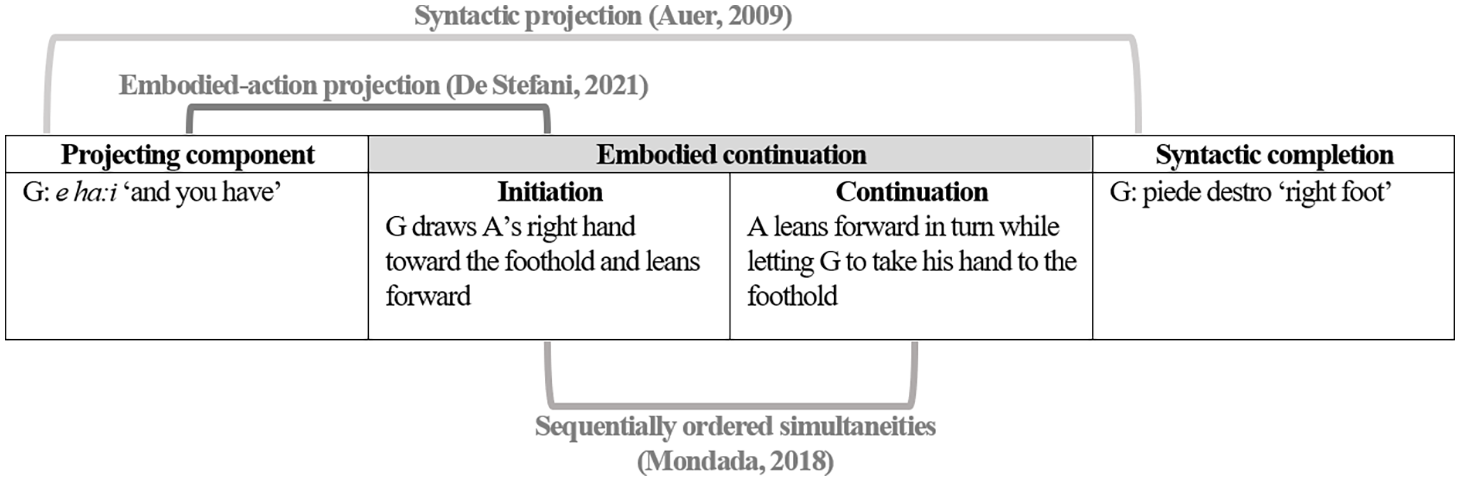
The analysis of Extract 2 shows that e hai, in addition to prefacing the introduction of a new referent, projects an embodied continuation which requires that guide and athlete join and coordinate their bodily movements. The syntactic suspension following e hai creates a dedicated slot for the embodied continuation to take place. As illustrated in Table 1, this embodied continuation is nested between the projecting component e ha:i ‘and you have’ and its syntactic completion piede destro ‘right foot’ emerging as the target-foothold is reached. Within the embodied continuation, the participants’ actions are at the same time simultaneous (they unfold in parallel) and sequential (the athlete’s action is adjusted to and cooperative with the action initiated by the guide) configuring sequentially ordered simultaneities (Mondada, 2018: 94). This configuration is supported by intercorporeality which allows participants to directly grasp, and tune to, each other’s bodily action. Also, it entails distributed motor control between the guide and the athlete and between different body parts, with some parts ‘moved’ by the guide, and others by the athlete himself.
The mutual organization of verbal and embodied components of e hai-initiated actions within multimodal Gestalts

This structure is often expanded since the mapping of footholds typically includes multiple items that are mapped stepwise and in succession. Therefore, following the projecting component, embodied continuation may consist of a series of tactile mapping movements necessary to locate each individual item; also, syntactic completion may occur in a multi-unit form and be organized as a list, as shown in Extract 3.
As in the previous extracts, in this extract as well, G employs the have-presentative construction distinctively to initiate the mapping of footholds. Unlike the previous cases, however, there is no and-prefacing signaling the sequentiality of the hai-initiated action with respect to the previous one. In this case, the two segments of the activity are indeed not equally configured as a mapping, the first sequence (l. 1–8) being rather focused on checking the mutual recognition of the route at hand, although using the same tactile procedures as a mapping; while the following one starting in l. 10 is structured as a foothold mapping which extends across multiple turns formatted as a list of items. The unfolding of the list (l. 13–22) is cadenced by recycled lexical components (i.e. the term piedino ‘small foot’ which the guide employs to describe all the three footholds) and woven together with patterned embodied actions (i.e. the guide grabs one hand of the athlete at a time and draws it to the next foothold). Each named item in the list is delivered following physical guidance and before the guide releases the athlete’s hand on top of the named foothold. Also, the prosodic delivery of the items contributes to project the continuation of the list, as is especially the case for the stretching and continuing intonation characterizing the delivery of the second piedi:no, ‘small foothold’ in l. 17.
The list structure enables the guide to retain control on the athlete’s body over the production of the entire sequence without the need to re-establish such control again and again to map each individual foothold unless the progression of the intended list is disrupted, as illustrated in Extract 4.
In this extract, the athlete produces two continuers (Schegloff, 1982) that display his monitoring of the progress of the mapping. The first one occurs after G has articulated the first item (l. 4: un piedino ‘one small foothold’) and placed A’s hand on top of the corresponding foothold (l. 5). The second continuer (l. 12) is produced in a similar environment, that is, following the verbal formulation of the second foothold by the guide (l. 9: un altro piedi::no? ‘another small foothold’) and its tactile attainment (l. 10). Both continuers produced by A appear to orient to the just mapped foothold as well as to the continuing prosody characterizing the delivery of the items by G. However, in l. 9 the syllable stretching and rising intonation toward the end of piedii::no together with G’s looking around (l. 11) project a problematic achievement of the intended next list-item which seems not to be seized by A. G then asks A to wait (13: ‘spetta? ‘wait’) and continues visual search while keeping A’s hand anchored to the prior foothold (Cf. Figures 7 and 8). Eventually, G produces the list completer (Jefferson, 1990) e bon ‘and that’s all’ (l. 16) bringing A’s right hand back to the starting handhold (1.17); A produces a sequence-ending okay (l. 19).
Up to this point, we have illustrated the sequential environment of (e) hai. The analysis has shown that such construction emerges upon completion of the initial phase of the route mapping to initiate the mapping of footholds available at the bottom of the route. In this sequential location, (e) hai invites the athlete to cooperate in the accomplishment of foothold mapping by at the same time moving their body jointly with the guide and continuously allowing the guide to move their hands toward the target foothold(s), at times for extended sequences of mapping. The analysis has illustrated that the guide employs (e) hai in a way that configures it as a syntactically suspended construction. The format of syntactic suspension appears consistent among the analyzed extracts as well as its function of creating a dedicated slot for the joint bodily movement of guide and athlete. The mapping of footholds is also distinguished by being recurrently structured as a list-like activity. Both the initiating component (e) hai and the list-like structuring of the foothold mapping enhance the projectability of this segment of the activity for the athlete.
Athletes’ embodied responses to e hai: making own body available to intercorporeal engagement
By virtue of its being routinely embedded in the multimodal Gestalt illustrated in the previous section, (e) hai provides a ‘cue’ to athletes that a distinct segment of ongoing activity is forthcoming which requires engaging in joint bodily movement with the guide. In this section, we analyze athlete’s embodied responses to e hai which take the form of offering a hand to the guide and engaging in joint movement with her. In these embodied responses we see evidence that e hai is understood by the athlete as soliciting their cooperation and that sharing control on their own body with the guide is treated by the athlete as the primary way to provide such cooperation.
Extract 5 exemplifies a case in which the athlete’s embodied display occurs in the form of a micro-adjustment, consisting in a minimal movement of the hand to allow the guide to take it.
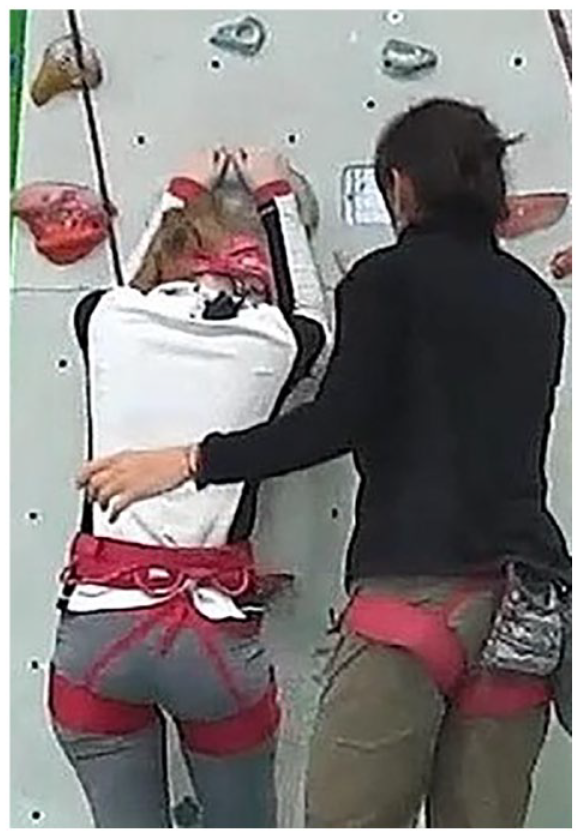
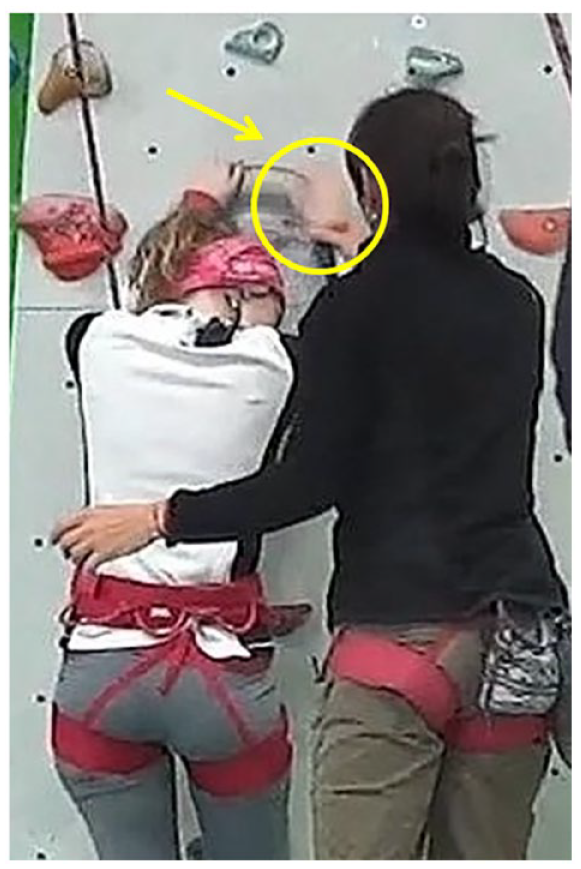
After saying e ha:i ‘and you have’ (l. 1), G approaches A’s right hand (l. 3). A turns her head in the direction G is approaching from (1.4), displaying her ongoing monitoring of G’s embodied conduct (l. 3). Then, once G is sufficiently close to her to grab her wrist (Figure 9), A slides her right hand to the right (l. 4) enabling G to catch her wrist (1.5) (Figure 10). The timing with which the athlete lets the guide grab her hand is finely tuned to the moment-by-moment progression of the guide’s embodied action. In this synchrony and mutual responsiveness of bodily behaviors (Tanaka, 2015) we see a phenomenal aspect of the intercorporeality between guide and athlete.
Extract 5 shows that, following e hai, the embodied continuation (i.e. joint bodily movement toward the next foothold) is not always initiated by the guide, as shown previously in Table 1, but can also be initiated by the athlete by offering their hand to the guide so that the latter can subsequently take it to the foothold.
Extract 6 provides an even clearer illustration of this configuration. Before the beginning of the extract, the guide has verbally indicated the position of the starting handhold to the athlete who has reached it with his right hand. At the beginning of the extract, the guide approaches the athlete from behind and says e hai ‘and you have’ to project the mapping of footholds.


Following e hai ‘and you have’ (l. 1), A releases current hold (Figure 11) and lowers his hand. G catches A’s hand (1.4) (Figure 12) and takes it to the foothold. The athlete’s previous bodily movement is therefore turned into a joint bodily movement smoothly and in an emergent way.
To sum, the analysis of Extracts 5 and 6 has shown that athletes understand e hai as soliciting them to engage in joint bodily movement with the guide. Athletes respond to e hai by adjusting their posture so as to make their body available to the guide. Such adjustments reveal the athlete’s orientation to the embodied-action projection of e hai and highlight that visually impaired athletes’ are in this setting relying on the sensory guidance provided by the guide. Therefore, the analysis of athletes’ responses to (e) hai allows for empirical observation of the intercorporeality between athlete and guide in terms of emerging reciprocity and interdependence of their embodied actions.
Assessing the contingent legitimacy of intercorporeality affects the progressivity of the suspended (e) hai
Despite intercorporeality is inherently part of the cooperation between guide and athlete in route-mapping, the contingent legitimacy of touching and moving the athlete’s body is nonetheless monitored by the participants. This last section looks at how the guide’s concern about the sensitivity of engaging in intercorporeal contact with the athlete affects the progressivity of the suspended (e) hai resulting in a halting (Extract 7) or a delaying (Extract 8) of its projected trajectory.
In the extract below, the absence of the expected embodied response from the athlete following the guide’s allora, hai ‘so, you have’ (l. 1) leads the guide to check whether her guidance is still needed.
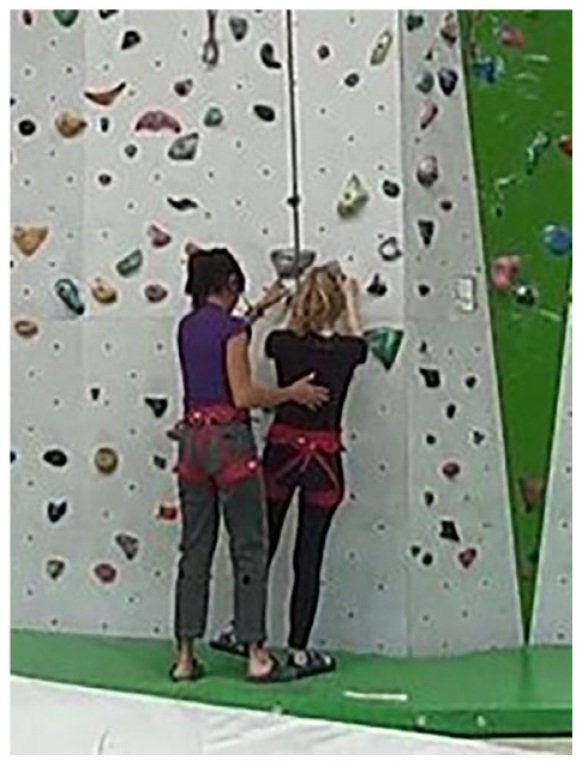
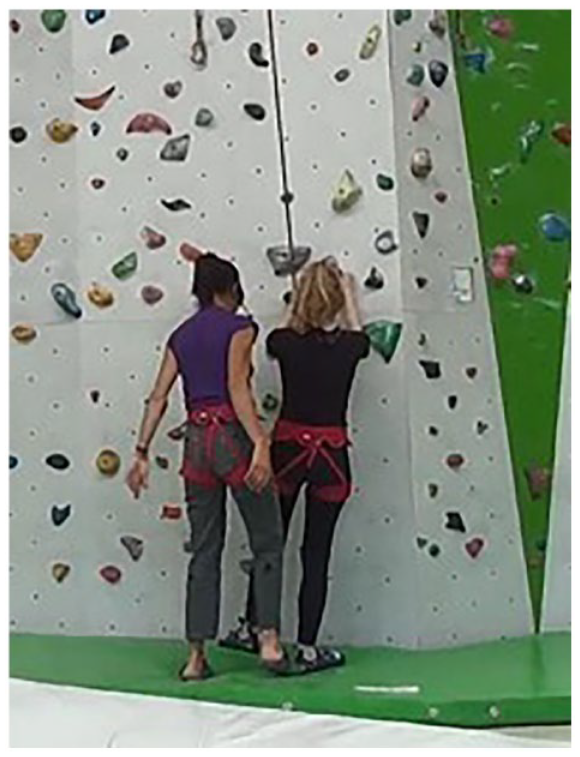
Before the beginning of the extract, the athlete has autonomously located the starting handhold with her hands. In l. 1 G advances the activity by saying allora, hai ‘so, you have’. 4 She then positions herself behind A (l. 2), ready to haptically guide A and accomplish the footholds mapping. However, unlike in Extracts 5 and 6, in this case, A does not provide any embodied display which could be interpreted as complying with the projected trajectory of action, as she remains firmly anchored to the starting handhold with both her hands (Figure 13). G registers this lack of embodied response and formulates an offer of sensory assistance (l. 3: te li faccio rivedere?, ‘shall I make you see them again’). 5 In l. 5, A declines the offer (no=no) claiming that she recalls the route (mi ricordo, ‘I remember’). In so doing, she displays that she does not need assistance. Promptly following A’s response, G says okay (l. 6) and simultaneously detaches her hands from the athlete’s body (Figure 14). The guide’s prompt embodied disengagement displays her commitment not to persist in touching the athlete unless necessary, orienting to touching as strictly contingent on the activity requirements.
In addition to monitoring the contingent legitimacy of touching the athlete’s body, the guide also monitors the possible unpleasantness of touch. This is observable in the next extract, in which the guide apologizes to the athlete for her hands are cold.
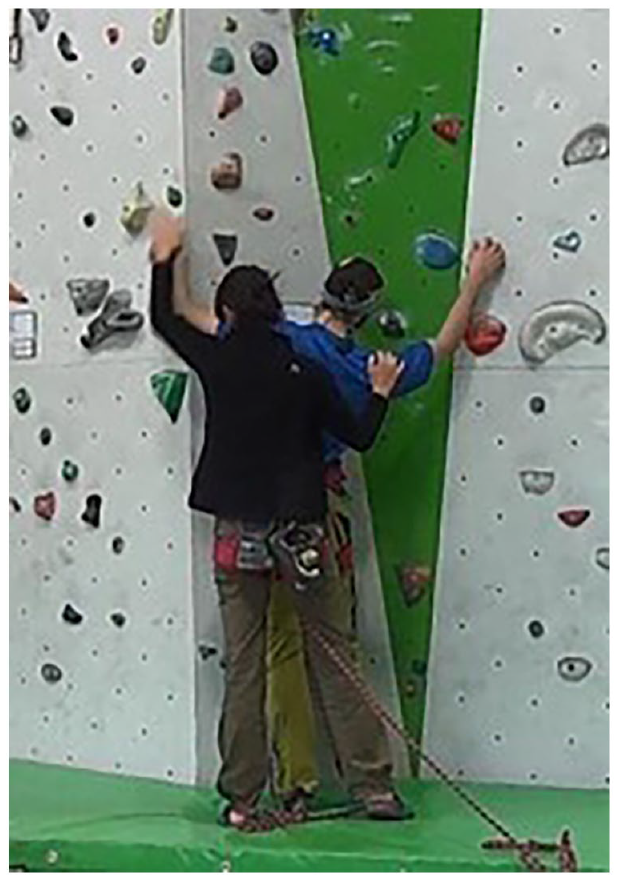
In l. 1, G says e ha:i, ‘and you have’ to project the initiation of the footholds mapping. A promptly lowers his left hand (l. 2) enabling G to grab his wrist and starts guiding his hand toward the base of the wall (l. 5) (Figure 15). While performing this action, G apologizes for having cold hands (l. 6: scusa, ‘sorry’). G’s apology is positionally sensitive, following and acknowledging the just established hand-wrist grip necessary to guide the athlete toward the next foothold. Of particular interest for our analysis is also G’s account (ho le mani fredde lo so, ‘my hands are cold I know’) bringing to the foreground the reciprocity inherent in intercorporeality, because G’s feeling of her own cold hands is reflexively constituted in touching and feeling A’s wrist.
A’s response in l. 7 comes in the preferred format (Cf. Robinson, 2004; see also Drew et al., 2016) as regards both its sequential positioning (it is placed immediately following G’s apology, partly in overlap with it) and its format. A indeed denies the need to apologize (no) encouraging G to keep doing the action for which she has apologized (vai tranquilla, ‘that’s okay’).
Overall, the apology sequence in Extract 8 occurs incidentally, while the participants remain oriented to the main activity and continue moving in unison until they attain the target-foothold (l. 8). Nevertheless, it shows that, despite touching is a pervasive component of route mapping, bodily contact and intercorporeality are nonetheless carefully monitored by the participants.
Conclusion
This article has provided a systematic analysis of Italian presentative constructions with (e) hai ‘(and) you have’ based on naturally occurring social interactions in pre-climbing route mapping involving a sight guide and three visually impaired athletes. By adopting the methods of conversation analysis, this study has proposed a novel approach to have-presentative constructions, illuminating their situated and emergent realization within complex multimodal Gestalts (Mondada, 2014).
The analysis has shown that the guide routinely employs the presentative (e) hai to initiate the mapping of footholds. This phase of the activity requires that both guide and athlete collaborate in an embodied way and move their bodies jointly to map footholds located in the lower sections of the route. Unlike other types of presentative constructions that are used to introduce handholds, such as ‘there is a X’ (Cf. Extract 1, l. 11), hai-presentative constructions explicitly address the recipient (the athlete) and invite them to accomplish relevant embodied actions. As a projecting component, (e) hai is shown to exhibit a twofold projection potential (De Stefani, 2021): a syntactic projection enabling the guide to produce a grammatically adequate turn-continuation, and an embodied-action projection, which invites the athlete to join in coordinated embodied action with the guide. The organization of these syntactic and embodied components follows a systematic trajectory which we have illustrated in Table 1. Following (e) hai, ongoing turn-construction is systematically suspended creating a silent slot in which guide and athlete jointly provide embodied components to progress current action. This suspension is systematic rather than contingent to locally emerging circumstances and is methodically employed to prioritize the physical attainment of the target foothold upon which the guide is eventually able to also complete the pending presentative construction syntactically, that is, by linguistically formulating the foothold. Unlike embodied completions (Olsher, 2004) and syntactic-body units (Keevallik, 2013) analyzed by previous studies, in which embodied components are shown to complete previously suspended utterances, within the multimodal Gestalt of foothold mapping, embodied components produced upon the delivery of (e) hai are indeed shown to progress the overall trajectory of action to the point in which syntactic completion of the pending utterance can be also achieved. Most importantly, such embodied components are provided by both parties moving their bodies jointly rather than by either the speaker (Keevallik, 2013; Olsher, 2004) or the recipient (Iwasaki, 2018).
Overall, this patterning highlights the priority that touching takes as a sensory modality for structuring relevant perceptions of the material environment in which climbing takes place. It also testifies of the interactional importance that in this ecology of action is given to sharing perceptual access to the material environment through mutual engagement and intercorporeality. More specifically, it shows that the guide shapes presentative utterances in a way that prioritizes the athlete’s gaining tactile access to the presented features while at the same time physically assisting the athlete in such embodied accomplishment. Also, the routine organization of (e) hai provides specific affordances to the athlete to project what comes next in terms of bodily involvement in the joint trajectory of action, enabling the athlete to be constantly aligned with the progress of the activity and to actively engage in its implementation. A limitation to this study is that it does not capture the routinization of (e) hai-initiated tactile mapping sequences in a longitudinal perspective (Cf. Pekarek Doehler and Balaman, 2021). However, the study provides evidence of the local routinization (Stukenbrock, 2021) of have-presentative constructions within multimodal Gestalts that participants in paraclimbing employ for recognizable and quite specific purposes.
Footnotes
Declaration of conflicting interests
The author(s) declared no potential conflicts of interest with respect to the research, authorship, and/or publication of this article.
Funding
The author(s) received no financial support for the research, authorship, and/or publication of this article.