



Abstract
Advice-giving is not only a crucial pedagogic activity in student supervision but also responsive conduct to students’ expressions of trouble in talk in-interaction. However, we know little about how advice-giving arrives in such sequences. This study uses conversation analysis to examine supervisory advice-giving in responding turns after students express their trouble. It is demonstrated that students’ reports of trouble make supervisors’ advice-giving normatively relevant. But there may be additional work before the arrival of advice: (1) rephrasing students’ formulations of trouble, (2) using follow-up exploratory questions, and (3) sharing parallel experiences. They are considered to be moves that achieve epistemic symmetries on the advisable issues so the chance of advice resistance is minimized. When delivering the advice proper, two practices are discovered: the construction of It is not X but Y is aimed to mitigate the critical element; the just-formulation reflects supervisors’ orientation to the workability of the trouble. Overall, this set of findings provides that the elimination of epistemic asymmetry is key in the enactment of advice acceptance. The study draws on 67 episodes of responsive advice-giving sequences, found in 12 hours of video recordings of authentic supervision meetings in a UK institution.
Introduction
Advice-giving is a social activity that involves the telling or recommending of what to do for the benefit of the advice recipient (e.g. Searle, 1969). In university student supervision, advice is regularly given by supervisors based on students’ study results in the forms of written work and assessments, or in response to students’ presentations of concerns and confusion in here-and-now supervision meetings (Vehviläinen, 2009a), being one of the major communicative formats between students and their supervisors. Due to the influence/constraint the advice will have on future actions, the matter of acceptance/resistance of advice is key to the accomplishment of advice-giving.
As a crucial supervisory task, advice-giving has attracted a growing number of investigations in recent years, which have largely focused on supervisory management of advice resistance by students. Filipi et al. (2022) report that storytelling of hypothetical scenarios is used to mitigate the potential disaffiliation of supervisory advice and to pre-empt students’ resistance. In addition, West (2021) underlines the significance of humor plus the attendance to the student’s interest in managing resistance. Drawing from this line of literature, research has been more interested in supervisory advice-giving as a pedagogic practice that requires strategies in response to advice resistance.
Nonetheless, systematic practices of organizing responsive advice-giving are neglected. Some have focused on the linguistic practices of advice-giving alone in relation to the exercise of power, but without rigid consultation of its sequential contexts (Zhang and Hyland, 2021). This study attempts to understand how advice-giving is carried out responsively to students’ reports of trouble. Specifically, the present study aims to describe and account for how it is organized regarding the practices and sequential organization in orienting to advice acceptance.
Interactional challenges of advice-giving
Findings show that offering advice to be accepted can be a tricky task interactionally, considering, for one, Brown and Levinson’s (1987) face-threatening act framework. The act of advising threatens the recipient’s positive face (of wanting to be appreciated or liked) as advice-giving involves the pointing out of problems or wrongdoings, as well as the recipient’s negative face of wanting to be left alone. More specifically, in interaction, advice-giving involves one party suggesting a course of action to the others. Hence, it essentially assumes inherent epistemic asymmetry between the participants and even sometimes challenges the recipient’s knowledge, which is treated as problematic (Heritage and Lindstrom, 1998; Heritage and Sefi, 1992; Hutchby, 1995; Jefferson and Lee, 1981; Silverman, 1997; Waring, 2005). On the other hand, the recipient of advice may also challenge the right of the advice giver in terms of knowledge. In a troubles-telling sequence, advice faces rejection when it is delivered prematurely. In other words, before the full disposition of the trouble, the recipient of troubles-telling will not be able to arrive at the position of offering advice (Jefferson and Lee, 1981). Similarly, in health visits, advice-giving poses problems because of the epistemic tension between parents of the children, who claim to have the best knowledge about the children, and health visitors who assert expertise in child care (Heritage and Sefi, 1992). Another possible cause of advice resistance relates to morality. As Pilnick and Coleman (2003) discover, patients show rejection when their GPs link illness to their smoking behavior and suggest quitting smoking for the advice undermines the legitimacy of requiring medical assistance. In these kinds of cases, the advisee is not only assumed less knowledgeable but also at fault before being helped.
Apart from epistemics, power and institutional roles are at play. While epistemic asymmetry might be more influential in professional-and-lay interactions (Hepburn and Potter, 2011; Heritage and Sefi, 1992; Pilnick and Coleman, 2003), participants of supervision interaction need to negotiate between the authority, the ownership of knowledge, and other interests at stake. A widely recognized fact is that supervisory relationships undergo the changing of identities as students and advisors – when students reach the end of the study and have acquired a greater sense of ownership of their research projects, their roles will transit from students to early career researchers (Björkman, 2015; Nguyen, 2016). In a nutshell, student resistance of advice is quite a characteristics of student supervision (see also West, 2021), and is also an expected result of training, marking students’ development and maturation. In response, supervisors are found to constantly balance between filling the epistemic gap and supporting student autonomy, especially in research degrees (Nguyen, 2016; Vehviläinen, 2003, 2009b, 2012). Therefore, it is manifested that advice-giving is systematically delivered in dispreferred manners by, for example, using epistemic downgrades (e.g. I think) and mitigating qualifications (e.g. kinda, as far as; Park, 2014 p.367).
Overall, one of the attributes of the dilemma of advice-giving is deemed to be epistemic and identity-related. But essentially, advice resistance or rejection takes place because the epistemic and identity status of both parties has not been sufficiently exchanged, understood, and negotiated through clear displays of their stances through talk (Kinnell and Maynard, 1996; Silverman, 1997). Either the advisor has not well grasped the advisee’s problematic situation or the extent of knowledge, or that the advisee has not understood the advisor’s position could lead to advice resistance or rejection. So, the discussion will continue with how advice resistance can be managed in the next section. The later analytic part will also focus on how responsive advice-giving is established to address the balance between the student and supervisor dyads to pre-empt advice resistance.
Handling advice resistance
Due to the ubiquitous nature of advice resistance, much research has been dedicated to conversational strategies for handling advice resistance to generate insights into practice. Personalization has been introduced as a tactic. In HIV consultations, patients are more likely to display acknowledgment of advice that centralizes the problem raised by them (Silverman, 1997). Notably, however, Pilnick and Coleman (2003) find cases against the effectiveness of personalized advice-giving. In their cases, when doctors suggest patients stop smoking for the sake of their medical condition, they resist the advice due to the concern that it might potentially undermine the opportunity of getting adequate medical attention apart from cutting off the harm of tobacco (Pilnick and Coleman, 2003). Waring (2017), furthermore, raises evidence supporting the effectiveness of depersonalization with cases of how mentors offer advice to candidate teachers about their teaching methods.
Although the replicability of personalized advice-giving remains debatable, the merit of personalization has made an impact on the management of advice resistance in supervisions in a way that demonstrates the advisory role’s full understanding of the advisee’s position. This, again, relates to the importance of epistemic (a)symmetry. In this line of research, personalization is realized by a ‘stepwise entry’ approach to giving advice (Locher, 2006; Park, 2014; Vehviläinen, 2001). Specifically, supervisors elicit students’ perspectives via a question (see also in Vehviläinen, 2012), after which supervisors ground their advice in the responses to the prior turn (Vehviläinen, 2001). In the current study, we will see how supervisors use questions in a similar way, however, not to enact students’ stances so the advice accommodates, but more to establish the relevance of the forthcoming advice. In Park (2014), a more granularly described sequential shape provides that supervisors handle advice resistance by acknowledging the student’s concern, using a contrastive conjunction, and addressing their specific problem. In short, supervisory advice tends to be accepted when tailored.
Another way of securing advice acceptance in supervision interaction is the supervisors’ establishment of expertise or authority. This can be done through story-telling about another student of the supervisor (Ta, 2021; Ta and Filipi, 2020). This can be compared to one of the findings of the present study, where supervisors share their own experiences in response to student turns as advice in its own right, rather than resolving advice resistance. So far, we have discussed two ways of handling advice resistance – stepwise entry and storytelling to address the needs to negotiate epistemic common ground and to establish legitimacy. However, these are to address advice resistance when it is explicitly displayed by students. What we have not known is how responsive advice-giving is organized while attending to the potential resistance during the delivery, assuming supervisors deliver advice toward acceptance, which motivates the current study.
The expression of trouble soliciting advice-giving
As implied by the last section, the key to advice acceptance is the exclusiveness of the advice in response to the advised matter, which is oftentimes a problematic situation or trouble. The relevance between the expression of trouble (taking different forms such as questions, trouble announcements, and troubles-telling, see below) and advice-giving has been discussed and confirmed in a range of interactions. Jefferson and Lee (1981) argue that advice given prematurely in ordinary interaction is likely to be rejected, unlike in service encounters. Furthermore, later in studies on professional settings, scholars take an interest in how trouble can be conveyed by open-ended questions that acknowledge ignorance (Heritage and Sefi, 1992; Vehviläinen, 2009a). Particularly in supervision interaction, students employ open-ended questions like ‘in WHAT way can I use THEM (here)’ (Vehviläinen, 2009a:169) to display the lack of knowledge. In return, extensive production of advice will be proffered in the supervisory response. Alternatively, yes/no questions are utilized in the form of seeking confirmation by the advisory role to demonstrate what is known by the student (Vehviläinen, 2009a).
Apart from being explicitly requested, advice can also be initiated more subtly. In a range of healthcare settings, the announcement of trouble makes professional conduct in response relevant, for example, midwives’ further examination in pre-natal checkup sessions (Nishizaka, 2010) and health visitors’ advice (Heritage and Sefi, 1992). Similarly, in higher education interactions, advice-giving frequently occurs in sequences of students’ presentations of problems (Vehviläinen, 2009b, 2012; Waring, 2007; Zama and Robinson, 2016). Overall, in such contexts, the teller of trouble assumes ‘full recipientship’ of solution-oriented actions, which is more straightforward than in informal interactions, where advice might face rejection (Jefferson and Lee, 1981).
Now the relevance of advice-giving to the expression of trouble in many professional settings is established. However, how responsive advice is designed to address students’ expressions of trouble remains unclear. Therefore, this question will be pursued in the remaining part of the paper.
Method and data
This study adopts the methodology of conversation analysis (CA; Fox et al., 2013; Sacks et al., 1974). As an inductive and qualitative approach, CA aims to describe and justify social orderliness on a micro level (Schegloff, 1996). The employment of methodology influences the aspects of data collection and data analysis. For data collection, the data were collected in English-mediated supervision meetings at a British university, which was approved by the Ethics Committee of the affiliated department. The data set for this study consists of 12 hours of video-recorded naturally occurring undergraduate and postgraduate supervision sessions (N = 20), held by 24 students and 12 supervisors. The participating students have come from various backgrounds in terms of their majors and first language. For this study, the demographic information of the participants is provided in Table 1 to offer some prior knowledge about the data.
Participating students’ backgrounds.
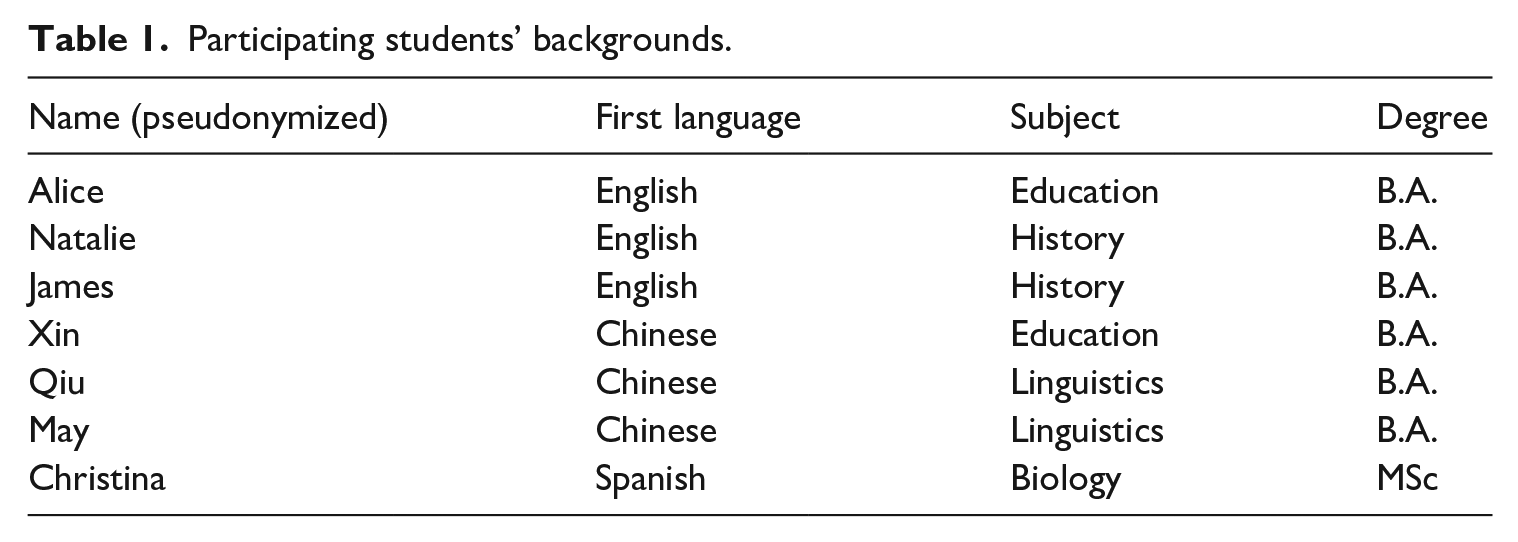
Regardless of differing linguistic/communicative skills and academic background, patterns yielded from students’ and supervisors’ practices of delivering and handling advice are of interests. For the purpose of this study, the analysis systematically draws on sequences of students’ expressions of trouble and supervisors’ advice-giving in response to acceptance (N = 67).
The data extracts are transcribed using Jeffersonian conventions to offer the fine-grained temporal and prosodic details of the talk and the surrounding behaviors (Jefferson, 2004). Under the guidance of the fundamental principles of CA (Drew, 2013; Levinson, 2013; Sacks et al., 1974; Schegloff, 2006), the present study will analyze the patterns in the responses or utterances supervisors produce following students’ completions of trouble reports, not including minimal uptakes like ‘mm hmm’ and ‘yeah’. Specifically, the study proposes research questions as follows:
RQ1: How is supervisory advice-giving organized sequentially?
RQ2: What works are done before and during the advice-giving turns?
RQ3: How are advice-giving turns designed?
Sequential organization of responsive advice-giving to students’ troubles
This section aims to show how responsive advice-giving takes the route following students’ expressions of trouble. Briefly, two routes are adopted to deliver advice (see Figure 1).
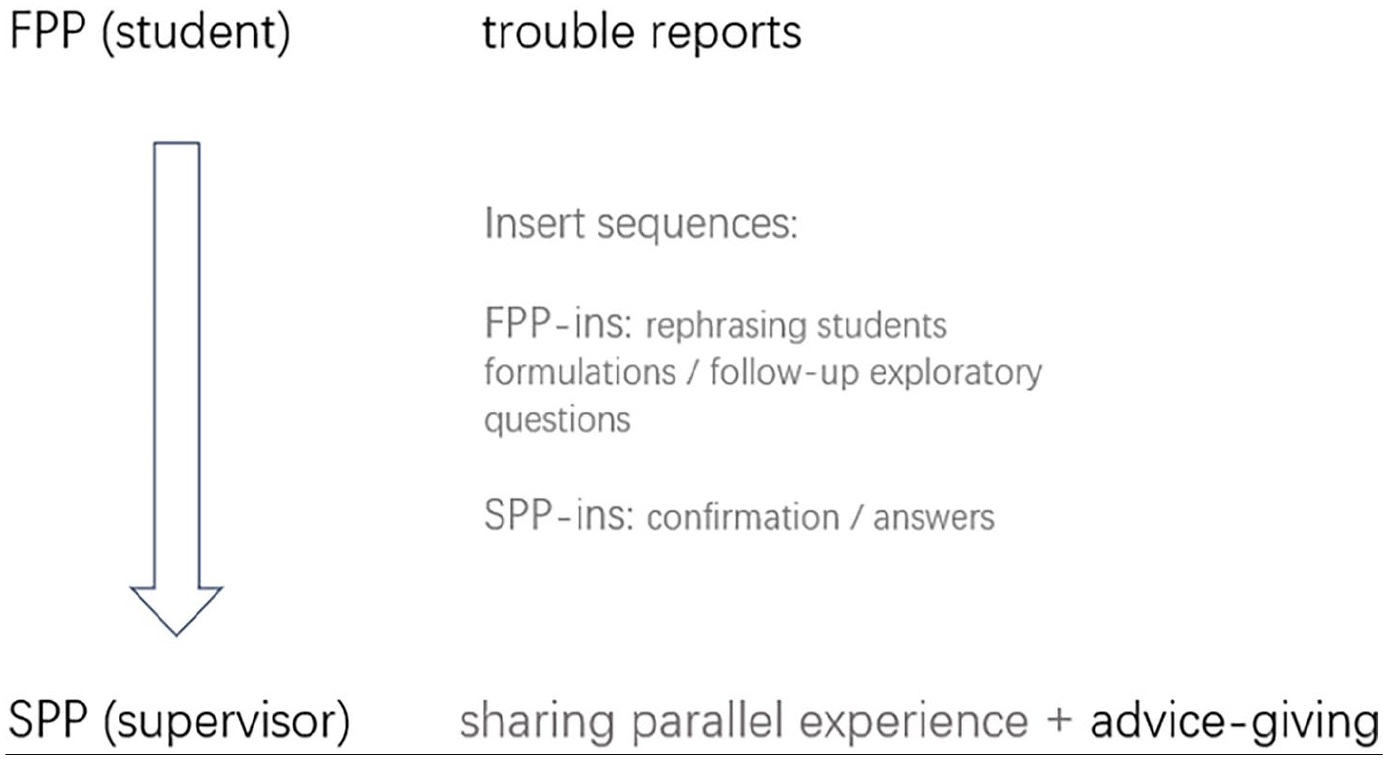
How advice-giving arrives on two routes.
That is, when a student’s first-pair part (FPP) is recognized as a trouble report, the supervisor may offer pertinent advice in the second-pair part (SPP) with or without insert sequences (i.e. to rephrase students’ formulations or follow up with exploratory questions, which are responded to with a confirmation or answer by students); they may also respond with telling of similar trouble before advice-giving in SPPs. All these variations of sequences will be unpacked in the following sections.
But I will first illustrate how advice can be offered in the first utterances of the responding turns following students’ trouble reports. In (1), the student Alice tells the supervisor about her struggle to be productive with the literature review for her dissertation on children’s books. Before the extract, the supervisor started her oral feedback on Alice’s draft by acknowledging the challenge of engaging in a large quantity of text, to which Alice agreed. At the start of the extract, she extends the reporting of her trouble by starting from her work procedure as the background (lines 1–6).
(1) UG010 0230 ‘Grow the theory’
In these lines, Alice introduces her dilemma – to write down anything that was ‘directly’ relevant to her topic given the limited reflections or materials (what she meant by ‘stuff’ in line 3). Up until line 6, Alice’s turn is recognizably unfinished given she has not reached the completion of her trouble report, so she continues to explicate that her conduct is contributing to her difficulty in having a more in-depth review (lines 8–13). Specifically, ‘so I think that’s part of what’s making (0.3) difficult for me tuh::: um::: (0.9) write about anything <at length right now::,>’ is recognizably the TCU that constitute a trouble report, after which she marks the ongoing effort ‘I’m ↑I’m ↑working on that’ (line 14). However, the supervisor does not take the turn timely (line 15), which leads Alice to mobilize a response more explicitly – to ask for the supervisor’s thoughts (line 16). In return, the supervisor takes a noticeable in-breath that projects an incoming turn and confirms her availability to offer some insight (line 17). Then she begins advice-giving, adopting an imperative voice of what Alice ‘should avoid’ doing (lines 17–18 and 20). Alice briefly acknowledges what has been advised so far but does not necessarily display an understanding of it (line 21). Hence, the supervisor carries on giving an account of what she said by unpacking what the ‘text’ should aim to achieve instead (lines 22–23 and 25–26). This extract exemplifies that both participants orient to the relevance of offering advice in response to the expression of trouble: as the student finishes the telling and does not get a timely response, she explicitly solicits it by requesting the supervisor’s uptake. In the supervisor’s turn, she addresses the request by displaying the readiness to do so and does end up offering extended advice.
Some might suspect that the production of advice-giving in (1) is only a result of the explicit advice request ‘um, do you have any thoughts about that, or’, rather than an orientation to the generic relevance of advice-giving. In light of this concern, (2) will further demonstrate the sequence of trouble expression-and-advice-giving is not due to the constraint of students’ prior turn but normality. At the beginning of (2), the supervisor brings up general feedback on her dissertation that Natalie should think about the representativeness of the historical materials used for her research project 1 (lines 1–5 and 7–8). As the supervisor continues to expand her advice in the lines omitted, Natalie accounts for the material with the trouble that she could not find any better material. As lines 59–60 show, Natalie uses I wanted to do X construction to indicate the unfulfillment of her attempt to convey the trouble (cf. Fox and Heinemann, 2019).
(2) UGH001 0018 sources
The incomplete grammar of the report ending with ‘more::’, however, suggests Natalie’s struggle with completing the turn. Thus, the supervisor produces ‘yeah’. with a falling intonation as a continuer displays an encouraging mood considering the projectability of a trouble with that I-want construction (line 61). In line 63, Natalie proceeds with the report, but it is cut off very quickly, which leads the supervisor to acknowledge, again, what she is trying to say and to provide collaborative completion ‘>which is hard.<’(line 65), in recognizing Natalie’s turn as reporting the trouble. Meanwhile, Natalie continues to finish the formulation ‘in the lower cla::ss’ continuing line 60 and agrees with the supervisor’s assessment in line with ‘yeah::’. Subsequently, she declares her continuous effort to work on this issue (to find a more suitable source about the lower class; lines 66–67). To continue with line 68, the supervisor defuses Natalie’s worry with ‘don’- I mean don’t worry about it’. Then she begins to clarify her advice-giving with her perception ‘I think’ that the main issue is not about the sufficiency of the ‘material’ but the coherence depending on the available source (lines 69–73). In response, Natalie demonstrates her acceptance of the advice with ‘yeah, certainly?’ (line 74). More will follow regarding how the advice is constructed (lines 69–73); so far we are only concerned with the sequential organization of advice-giving.
The extracts above show that advice-giving is relevantly next to trouble expression in supervision interaction, and thus is proffered in the responding turn in some cases. The section will show that, however, additional work might be needed.
What can come before advice-giving
This section will demonstrate that supervisors routinely do other things before the arrival of advice: rephrasing students’ formulations of trouble to different versions or using follow-up questions around the trouble, leading up to the fitted advice via insert sequences (Schegloff, 2007). Alternatively, supervisors respond to the student on SPP, with a telling of experiences that are similar to the student’s trouble before more explicit advice-giving.
Rephrasing students’ formulations
When students have expressed a trouble, supervisors may ‘repeat’ it but with a slightly different formulation, which makes it relevant for the student to confirm before moving on to advice-giving, or otherwise. Through this rephrasing, supervisors adjust students’ ways of looking at the trouble to serve the forthcoming correspondent advice. In (3), in an undergraduate dissertation meeting, James talks about his difficulty addressing the supervisor’s comment, which is to explain what he is ‘doing’ clearly in the introduction (as lines 44–47 and 48–49 show).
(3) UGH011 0010 unclear methods
From lines 44 to 46, the report of trouble is filled with in-breaths, hesitation markers, pauses, and fillers ‘like’, suggesting an articulatory struggle. Given the lack of uptake (line 47), James rephrases the question in lines 48–49. Nonetheless, the expressions of the objectives, like ‘explain what I’m doing’, and ‘lay that out in the introduction’ remain quite general and vague. Hence, when it is the supervisor’s turn, he launches an attempt to rephrase the nature of the trouble (line 52) after the delay of the intersecting action of eating (line 50). In a more academic formulation – ‘to talk about your sources’, the supervisor starts with an understanding check ‘you mean’. The declarative form (‘you mean to talk about your sources’.) also implies the supervisor’s relatively high epistemic stance (Heritage, 2012). After the rephrased is confirmed (line 52), the supervisor (while he is engaging in the action of lunching) carries on giving the advice: ‘I think jus do as a (3.0) as:, as a sort of a paragraph or: (0.8) a subsection’. This is only, of course, a small part of the advice. But this TCU has adopted a form that is recognized as recommending a course of action, using an imperative ‘jus do as . . ’. and giving guidance on what to do – to use ‘a paragraph’ or a ‘subsection’ that focuses on the sources. Hence, we see how the way of seeking clarity on an alternative account of trouble not only enhances the supervisor’s understanding. But also, ‘you mean to talk about your sources’ tacitly switches how James approaches the trouble from being about explaining what he is doing to talking about sources, which specifies the problem before giving concrete advice. In this sense, the rephrasing does have some advisory value. Also importantly, it foreshadows the advice of allocating a slot or paragraph for the introduction about the ‘sources’; so upon the confirmation of the candidate understanding, the advice (lines 55–56) is legitimately given. This is how the reformulation not only remedies James’s FPP but also the definition of the source of the trouble, which foregrounds the advice to come.
(4) provides another example of the same method that benefits the later delivery of forthcoming advice.
(4) UGC003 0345 fulfilling the brief
In this extract, Xin attempts to account for a poor exam result by referring to the brief 2 of the assignment (to write an essay on math education; lines 1–2). Considering the disfluent production like in the last extract (the pauses and ‘uh:::’) and the adoption of the exact term ‘systematic literature review’, Xin is hearable as accounting for the trouble with the exam requirement, which is potentially a complaint and thus delicate. While the telling of trouble is still in progress, the supervisor displays her understanding (line 6) owing to the projectability of the turn. Meanwhile, she starts to take notes on the computer to record the problem Xin reports, treating it as something to act on (lines 7 and 11). Then the supervisor re-formulates the trouble as not ‘correspondent (0.2) to the brief’, from Xin’s version that she was not sure how to write a systematic literature review. Comparing these two formulations, we can see how the participants orient to the trouble distinctively. By formulating it as not knowing how to write the literature review, Xin orients to the trouble as a lack of knowledge that needs to be addressed by the supervisor’s teaching action. In the supervisor’s version, she pins the trouble down as a technical, instead of an intellectual, one – to correspond to the brief. Having been endorsed by the student, the supervisor moves on to the advice-giving, before which she stresses the importance of doing so, and switches (with ‘↑I mean’) to justify the course of action that it makes the ‘quite easy to fix’.
From the data extracts above, one of the uses of insert sequences is not just conducting genuine other-initiated repair, simply dealing with trouble with hearing or understanding. They should be viewed as more supervisory moves that specify trouble such that concrete advice can be possible. These questions guide students to ‘revisit’ and approach the trouble as the supervisor would. In other words, the insert sequences are implicative of problematizing the perspectives students adopt as contributing to the trouble. Hence, supervisors use this range of insert sequences for remedy in a rather mitigated way.
Follow-up exploratory questions
Using insert question-and-answer sequences before advice is common across multiple settings for being productive in testing the advisee’s knowledge and topicalizing the advisable subject (Heritage and Sefi, 1992; Vehviläinen, 2001). Vehviläinen (2001) has documented ‘stepwise entry’ advice-giving in university career consultation, where counselors ground their advice on students’ answers to questions regarding their opinions about a certain career option. This ensures the advice fits well with the recipient’s orientation. Here we see a resembling sequential (question(s)-and-response(s)-and-advice) shape in this section. But in this dataset, in the environments of students’ trouble reports, supervisors use one or multiple follow-up questions to explore the cause(s) of the trouble or issues around it before the arrival of advice.
What we will see is that these follow-up questions are not only to do information-seeking but also to carry out advisory work. (5) is a clear illustration of follow-up questions that serve advice. In this fragment, Qiu expressed her enjoyment of a module (before the extract) in response to the supervisor’s inquiry about her experience of the last semester. After that, Qiu reported that she was having difficulty with the assignment of the module – to transcribe conversational data, as shown in line 1.
(5) UGC001 0333 transcription
Without any further description of the difficulty following the supervisor’s continuer (lines 2–3), the supervisor offers a diagnostic assumption as to what makes Qiu, a non-native speaker of English, find it hard to transcribe: that the speech is produced by native speakers. After Qiu has confirmed, the supervisor marks a receipt and a stance of seeking a potential solution in response to Qiu’s problem (line 8). Because the question is not designed for an answer, she continues with a yes/no question about the source of the data (lines 9–10), indicating the solution is to find data that are more friendly to Qiu. However, this route is seeing a blockage given the negative response (line 12) and a confirmation that the data is selected from the class corpus, leaving Qiu with limited options. The receipt of the information that the data is from a corpus sheds some light on the forthcoming advice relating to the course tutor, who is responsible and able to help (line 16). Hence, the supervisor initiates another round of a question, regarding whether Qiu has let the module tutor know about her trouble (line 18), leading up to the advice that she seeks expert help. She self-repairs to modify the question by specifying the name of the tutor to ensure Qiu gets help most productively (Schegloff et al., 1974). As we see in lines 20 and onwards, Qiu offers a negative answer to the question so the supervisor arrives at the advice-giving turn that Qiu shares this with the lecturer as a startup to a solution.
Because of the exploratory value of the follow-up questions, they have been used in sequences where students display resistance to the given advice. Like in 6) from an undergraduate module-choice meeting, May declares the struggle of deciding on the modules offered in the course of English Language and she presents greater interest in modules offered in Linguistics instead; nonetheless, she prefers to stay in the English Language to obtain the particular degree. Therefore, even though the supervisor had recommended she switch the course, May felt reluctant to do so. In response, at the beginning of the extract, the supervisor reminds May of the ability to take the module May previously showed interest in (in the Linguistics course) while staying in the English Language course with a stretch on ‘still:’, in strengthening her recommendation. While lines 8–9 stand as a recommendation and makes the acceptance or rejection relevant, May does not display a clear stance with a passive recipiency marker ‘mm hmm?’ in line 11 (Jefferson, 1984). Then a lengthy lapse follows, where May freeze-looks at the screen, and the supervisor waits for her. The unmarked ‘mm hmm?’ and the long silence progressively show May’s resistance to the advice suggested in lines 8–9, just like what Heritage and Sefi (1992) and Stivers (2005) found that ‘unmarked acknowledgment’ develops into ‘more overt expression of resistance’ (Heritage and Sefi, 1992:402).
(6) UGC002 2157 which major
Subsequent to the 12.6-second-long silence in line 12, May admits the difficulty of making the decision (line 13). The report is accompanied by brief laughter, which is considered to be trouble-resistant (Jefferson, 1988). Even though the supervisor is suggesting a reasonable option (to switch to another course), she is resisting it by claiming the decision is hard, which would remind us of, in doctor-and-patient interaction, how patients use laughter when they challenge the doctor’s instruction (Haakana, 2001). In line 14, the supervisor reciprocates the laughter to make light of the dilemma. Up to this point, May’s trouble has given rise to an interactional one as the module-choice procedure needs to progress within the given time frame. Therefore, the supervisor embarks on solving the dilemma by carrying out some questions to find out May’s unspoken reasoning for staying in the English Language program even though she is not keen on a sufficient number of modules (lines 18–20). Significantly, the supervisor self-repairs multiple times to formulate the follow-up question (Schegloff et al., 1974). She first starts with a wh-question that is projectably a solicitation of reason. However, the supervisor abandons it, re-starts with a ‘so::’, to suggest a coherence with May’s trouble report, and frames the question ‘wha’ w- would hold-‘ as an investigation of what would be the concern of switching to Linguistics that holds May back. In line 19, the supervisor re-launches a why-question ‘why::: (0.2) I guess are you still thinking:::’; but it sounds quite accusative with ‘still’ even with the softener ‘I guess’ as it seems to emphasize May’s persistence. Therefore, she comes back to the original question to unpack May’s reasoning for staying in a course that she does not like enough. Moreover, this question does more than solicit the reason; it orients to the English Language as an inferior option for May that she needs to think about. Thus, these attempts at follow-up questions are quite advice-implicative. Through these self-repairs (lines 18–20), we also see the supervisor has negotiated the ways of formulating the questions in soliciting positive answers.
After the 2.6-second gap (line 21), May gives her answer that the English degree offers a wider range of job opportunities in the future (lines 22–31). The turn-initial ‘maybe::#::#’ with the sound stretch and ‘#I# think’ engender her response as hesitant. She also uses a comparative form when talking about the benefit of staying in the English Language as a ‘bigger square’ (line 23), indicating that the English Language is preferable in some respects. However, considering the comparative form and the hesitating voice (line 22), the overall response shows that May is not entirely confirmative when she unpacks her insistence on the EnglisWesth Language. Here the supervisor claims her understanding with ‘yeah’. but she also intends to keep May talking. Indeed, May in overlaps continues to give another side of the comparison, that Linguistics is a more narrowed subject (lines 28 and 31). In overlap, the supervisor marks the understanding of May’s rationale for choosing the English Language over the Linguistics (line 30). With ‘so’, and the silence and sniff (lines 34–36), May signals the termination of her floor and passes the turn to the supervisor (line 36).
In line 37, the supervisor produces the second round of follow-up questions. She abandons a let’s-imperative and turns to ask whether May has a specific professional aspiration after graduation. Having not waited for the response, the supervisor continues to offer her assumption based on the previous discussion: ‘it sounds like maybe something like teaching English: (.) or::,’. Ending the turn with ‘or’ in this question is considered to be one way to solicit potentially sensitive information in a less intrusive way (in this case the supervisor treats the student’s career plan as something personal) in the form of seeking confirmation or otherwise correction (Stokoe, 2010). However, this receives a considerable gap (line 40), which suggests a dispreferred response that would disaffirm teaching English as May’s desired job. But it could also be May’s failing to recognize the completion of the supervisor’s turn, treating there was more to come after ‘or::,’. Hence, the supervisor adds the phrase ‘not necessarily’ as a candidate answer (line 42). May’s response indeed proves that teaching English is not the desired job for her: although she acknowledges the possibility (lines 43–48), she again adopts ‘maybe’ to stress that becoming a teacher is only conditional. The description of a scenario ‘and teaching in the univer↑sity?’, especially with an emphasis on the work environment of ‘the univer↑sity’, portrays the job as a desirable one. In effect, it accounts for her insisting on staying in the course that would assist with the pursuit of ‘teaching in the univer↑sity’. Nonetheless, she adds that she is not sure about this (lines 50 and 53) and accounts that what she truly wants to do instead is to ‘translate’ (lines 54 and 57). The supervisor initiates repair on the job type as ‘translation?’. This not only modifies the grammar but also underpins translation as a proper, legitimate professional choice. As May confirms the repaired version and the supervisor’s overlapping marker of knowledge, the supervisor closes the insert expansions with a sequence-closing third (line 63) and begins the advice-giving starting from line 65.
In line 65, the supervisor begins her turn with ‘↑u::m:::’, a long pause, and ‘↑honestly’ that deal with the delicacy nature of offering countering advice (given May has been showing rejection to transferring to the Linguistic course). While the advice is still in progress, May produces laughter and ‘yeah’ at the supervisor’s yet-to-come suggestion that Linguistics is the more suitable course for the pursuit of doing translation (line 67). In other words, through the follow-up questions, May is enabled to anticipate the advice of transferring to Linguistics as a promising option. As May herself informs, translation is more tempting than teaching for her personally (as solicited by the supervisor), and translation would be better supported by doing the Linguistics program. Her laughter and ‘yeah’, being a sort of recognizable uptake, manifests that she predicts the forthcoming advice of switching to Linguistics. Indeed, the advice is given that taking Linguistics would be ‘better’ for the pursuit of doing the translation: the wul- the Linguistics might actually be:::: (0.3) better::? The advice is not done via an imperative or instructive, but more of a conclusion (that poses little obligation of implementing the advice) based on the question-and-answer sequences above. This again addresses the delicacy of retaining the attitude toward resisted advice.
Throughout the whole extract, the supervisor uses two follow-up questions to obtain May’s reasoning for staying in a course that she does not enjoy personally. The insistence is simply due to a more utilitarian consideration that the English degree would make it easier for her to find a desirable job (teaching English). Through the follow-up questions, the supervisor transforms the tension between student autonomy and supervisor influence into one about learning motivation and professional interest. This is to help May see that what she really wants to be is a translator. Consequently, the supervisor becomes able to fit what May just revealed about her interest (‘translation’) to the supervisor’s proposal of transferring to the course of Linguistics. Therefore, we see that these follow-up questions are not only to understand the nature of the trouble, but they are also pedagogically important for supervisors to steer toward their proposals. Equally, they help students to see the justifications for the advised action. In this sense, these follow-up questions are advisory in their own rights in the way that foregrounds the advice.
Sharing parallel experience
We have just described a type of sequential organization of how advice would follow other supervisory moves in responding to students’ trouble reports, that is, insert expansions for reformulations or follow-up questions. This section will introduce another type of response that comes before advice-giving (without any insert sequences) in the same turn. That is, supervisors respond to students in SPPs with parallel experiences, that is, comparable trouble they experienced, after which they offer advice. Through the sharing of parallel experiences, supervisors show empathy as well as convey an advisory stance although it is not yet made explicit. As shown in (7), in a postgraduate pastoral supervision, the Biology student Christina reflects on the feedback given to her introductory part of an essay.
(7) PGTH001 1855 the essay
In lines 40–42, she reports her insecurity about the quality of her essay overall because the feedback is only on the introduction. In the lines omitted, Christina details her current version of the introduction entails a summary of different theories. But she is worried that they might end up not being relevant. Hence, in line 83, the supervisor de-problematizes Christina’s concern that ‘and n don’t forget that you’re selecting your own question so if you end up writing your essay it’s ended up-’. But this advice-giving unit is abandoned underway. Instead, the supervisor resumes the advice by mentioning his experience – ‘it ha- happens to me’ to explicitly mark the sharing of his parallel experience of yielding conclusions different from what he planned at first, considering how common it is in experiment-based fields. The comparison between Christina’s and the supervisor’s troubles displays the supervisor’s full understanding of a typically experienced obstacle in producing academic work. Curiously, he does not continue using the first-person voice but switches the pronoun to ‘you’ when he details the experience (line 87). This second person pronoun can be used to indicate the collectivity of the phenomenon, which accomplishes the giving of general advice in response to a common issue with essays. However, another account of the change to the pronoun can be revealed in line 92, where the supervisor moves onto the advice: ‘you can change your question’, after which Christina marks an acknowledgment with a smiley delivery (line 94). It is, then, apparent that the pronoun ‘you’ is directed at Christina and is not in a broad term. The sharing of parallel experience serves arguably a smooth transition to advice, supported by the supervisor’s personal experience.
As we see from this example, the enactment of the supervisor’s own relevant experience before the concrete advice not only manifests their comprehension of students’ trouble but also foregrounds the advice for acceptance. We can see the significance of epistemic symmetry at play: supervisors favorably demonstrate their understanding of the trouble, so their advice would be more likely to be accepted by the student.
The design features of advice-giving turns
When supervisors reach the base turn constructional units (TCU) of advice, two constructions are found to be common. When supervisors offer advice immediately in SPPs, they tend to adopt a contrast made between two schemes of approaching the trouble. In this formulation, supervisors set aside what the student has done or indicated doing and promote a more favorable idea or course of action. Consider extract (1), in response to Alice’s solicitation of advice, the supervisor begins the advice with ‘I think’ to downgrade her epistemic claim, which is also presented elsewhere (Park, 2014).
(1) UG010 0230 ‘Grow the theory’
Then the supervisor accounts for her claim of ‘what to avoid’ by informing that the purpose of ‘the text’ is not to X (be an illustration of the theory) but to Y (grow the theory; lines 23–24 and 25–26). This component (of it is not X) reduces the degree of criticism by avoiding attributing to the student herself. More importantly, it carries out the work of teaching by telling the student what is more favorable in the but Y part. In so doing, Alice responds with an acknowledgement without further question.
In (2), the supervisor uses a similar construction of ‘it’s less about X but more about Y’.
(2) UGH001 0018 sources
Following the supervisor’s de-problematization (line 68), the supervisor points out the core issue by adopting the contrast between what Natalie has assumed (‘finding out more material’) and a better solution. Comparing to (1), this variation of the construction is more general and avoids overtly telling students what to do (Vehviläinen, 2003), constituting evidence of supervisors assuming students’ partial knowledge on the solution. In response, Natalie proffers her acceptance in a preferred manner (line 74; Clayman, 2002).
In a distinctive sequential environment, that is, where advice is conveyed following the insert sequences, the workability of the problem seems to be quite systematic in the advising turns. Take (4) for an example, when the supervisor has been confirmed that Xin’s trouble relates to not being able to address the criteria of the assignment (the ‘brief’), the supervisor reinforces the importance (line 12) and continues to assert her optimism that the trouble can be easily fixed on a technical level (lines 12–14).
(4) UGC003 0345 fulfilling the brief
In lines 14–15, she continues to account for her positivity and provokes the idea of fulfilling the brief with a downgrade of challenge ‘it just means. . .’ in orienting to a sense of ‘doing nothing more but so’. This is argued to re-emphasize the accessibility of overcoming Xin’s challenge. Hence, Xin orients to no further questions and closes the sequence. The format of just + action is a more recurrent feature. Again, in (2), line 72, in the second part of the contrast she provides advice with ‘just’, subsequent to which she tells Natalie to ‘be more careful about’ her claims given the available sources.
(2) UGH001 0018 sources
To briefly mention,another example of the just-usage is in (3), line 55, ‘I think jus do as a (3.0) as:, as a sort of (0.7) a paragraph or: (0.8) a subsection’. This practice manifests an orientation to the simplification of the action in reaction to the issue at hand.
Overall, supervisors actively pertain to two concerns: when the advice is given directly, the mitigation of the critical element; after insert expansions, supervisors focus more on the workability of the trouble. Despite distinctive practices, the advising TCUs demonstrate supervisors’ orientations to invoke students’ positive epistemic status, that is, their capacities to resolve the trouble and to enact students’ acceptance.
Discussion and conclusion
Supervisory advice-giving, although extensively studied as a pedagogic practice, has been rarely studied as a responsive behavior. In this paper, I aimed to describe supervisory advice-giving as an interactional phenomenon on the sequential and constructional dimensions. Drawing from the first part of the analysis, supervisors can choose between two paths when delivering advice: to offer advice in the immediate responding turn and subsequently to insert sequences or the sharing of parallel experience. This finding consolidates the normativity of offering advice to trouble expression in parties with epistemic asymmetry (e.g. Heritage and Sefi, 1992; Vehviläinen, 2009b).
Students’ resistance to advice is a long concerned interactional challenge in supervision interaction. A considerable body of research has explored supervisory practices to mitigate it (Ta, 2021; Vehviläinen, 2009b; West, 2021). This study shows that supervisors carry on a range of work around epistemic (a)symmetry, preliminary to, and during the advice to prevent potential resistance. By rephrasing students’ trouble, supervisors attempt to introduce (new) perspectives that students should be favorably taking so they reach a common understanding of the nature of the trouble before the production of advice. Supervisors may also use follow-up questions to foster the students to gain a sense of what they have not done/thought about/known. In this way, the student would be able to anticipate the direction in terms of the recommended action so the chance of advice resistance is lowered. Considering these, sufficient exchange and negotiation of epistemic status and the reaching of epistemic common ground are crucial for the achievement of supervisory advice-giving. Relating to the literature, the study adds to current research on conversational strategies for handling advice resistance (Ta, 2021; Vehviläinen, 2009b; West, 2021). The study also acknowledges the advisory values of preliminary moves in foreshadowing the advice, which resonates with the variety of advice-implicative utterance types (Shaw et al., 2015).
Another insight is on the base TCU(s) of advice. In the last analytic section, supervisors employ the contrasting construction It is not X but Y to avoid being overly dismissive or critical while addressing the student’s problematic behavior or mindset. Moreover, supervisors’ advising turns tend to frame the trouble as workable (Svinhufvud et al., 2017) by using the just-formulation. Both practices show supervisors’ attentiveness to being supportive and recognizing students’ abilities or knowledge. These two features are proven crucial in enacting students’ acceptance of advice. This set of findings extends what we know about how supervisors give advice, which can adopt more typical forms like ‘So you need to be able to show that you have read enough’ (Zhang and Hyland, 2021:40). Although we have discussed practices leading up to advice acceptance, we should remain aware and critical that advice-giving and acceptance do not necessarily indicate the effectiveness, or represent the ultimate goal of supervision. After all, students should be given the opportunity to negotiate the next course of action with the supervisor. As for the next possible query, what has been left undone by the present study is how supervisors opt for different methods among direct advice-giving, insert sequence, and sharing parallel experience, when offering advice is an interactional product of distinctive sequential environments and students’ designs of trouble reports.
Footnotes
Declaration of conflicting interests
The author declared no potential conflicts of interest with respect to the research, authorship, and/or publication of this article.
Funding
The author received no financial support for the research, authorship, and/or publication of this article.