



Abstract

EDITORIAL
The G7 summit, the Queen's Speech and the Environment Bill all made appearances this quarter. The UK welcomed leaders from across the G7 countries together with ministers from Australia, India, the Republic of Korea and South Africa. The collective held discussions on ways to address the dual crises of climate change and biodiversity loss; the aim was to show leadership on achieving net zero by 2050 at the latest and to protect the planet's biodiversity. The leaders all committed to ‘urgent action’ to mitigate further temperature rises, species loss and decline and destruction of the environment. A communiqué released by the ministers following the summit suggested that there had been real progress in sectoral planning to keep the 1.5 degrees target in reach. It remains well known that there are unprecedented and interdependent crises of climate change and biodiversity loss, and it is hoped many legislative changes will follow, both domestically and internationally, to ensure these crises are tackled.
What's more, the Queen announced during the state opening of Parliament that the government would invest in new green industries. The Speech also reiterated a commitment to achieving net zero greenhouse gas emissions by 2050, including through the Environment Bill which will set binding environmental targets. The Bill seeks to set targets, plans and policies for improving the natural environment. The Bill also makes provision for statements and reports about environmental protection, for the Office for Environmental Protection, about waste and resource efficiency, water, biodiversity, air quality and for the recall of products that fail to meet environmental standards or conservation covenants. The Environment Bill continues its journey through Parliament and is now situated in the ‘report stage’ of the House of Lords – providing a further opportunity for the Lords to examine and make amendments to the Bill. This is addressed in more detail in this update.
UPDATE
NEWCASTLE UNIVERSITY
Jennifer Wardle and Anna McClean
TRINITY CHAMBERS
Matthew R Crowe, Parissa Najah, Matthew Hopkins and Patience Abladey (pupil)

EU LEGISLATION AND TEXTS
Commission guidelines on single-use plastic products in accordance with Directive (EU) 2019/904 of the European Parliament and of the Council of 5 June 2019 on the reduction of the impact of certain plastic products on the environment
This European Commission publication provides guidance on the EU rules on single-use plastics. From 3 July 2021 Member States have to ensure that certain single-use plastic products are no longer placed on the EU market. The guidance further discusses the adoption of an Implementing Decision on the monitoring and reporting of fishing gear placed on the market and waste fishing gear collected, which aims to incentivise the bringing of all fishing gear ashore and improve its handling through extended producer responsibility schemes.
https://ec.europa.eu/environment/pdf/plastics/guidelines_single-use_plastics_products.pdf
DOMESTIC CASE LAW
Environmental Impact Assessment
Swire v Ashford BC [2021] EWHC 702 (Admin)
This case involved an application for judicial review of a local authority's decision to grant planning permission for a winery. The grounds for the application were that the local authority should have reviewed its screening decision that the development did not require an Environmental Impact Assessment after it received objections from a statutory consultee. The application was refused and the court held that although regulation 3 of the Town and Country Planning (Environmental Impact Assessment) Regulations 2017 prohibits granting planning permission for EIA development without an EIA, there had to be a change of circumstances that was rationally capable of leading to a change in the view that the development was not EIA development in order for the local authority to be required to review a negative screening decision. There is no requirement on keep the screening opinion under constant review.
Waste
Customs and Excise Commissioners v (1) Devon Waste Management Ltd (2) Biffa Waste Services Ltd (3) Veolia Es Landfill Ltd (4) Veolia Cleanaway (UK) Ltd [2021] 4 EWCA Civ 584
Waste material used in landfill sites to protect the lining membrane of landfill cells was subject to landfill tax as it constituted a ‘disposal of material as waste’ under section 40 of the Finance Act 1996. The relevant question in determining whether there had been a disposal of waste was whether it was disposed of with the intention of discarding it, not whether the owners of the landfill sites used the material.
Protected species
R (on the application of Keir) v Natural England [2021] EWHC 1059 (Admin)
An interim injunction preventing certain works, including the felling of 19 trees, from being carried out in connection with the construction of the High Speed Rail 2 project under a derogation licence issued by Natural England under the Conservation of Habitats and Species Regulations 2017 regulation 55 was discharged by the court. The court held that the claimant's submission that Natural England's decision to grant the licence had not properly considered and mitigates the detrimental impact of the tree felling on barbastelle bats was not arguable.
Planning
R (on the application of Cross) v Cornwall Council [2021] EWHC 1323 (Admin)
The claimant's application for judicial review of a local authority planning committee's decision to grant planning permission for an agricultural dwelling in an Area of Outstanding Natural Beauty against the recommendation of the planning officer was granted. The court held that although there was no statutory duty to give reasons for the grant of planning permission, a common law duty to give reasons arose due to the fact that the planning permission was granted for development within an AONB, was against the recommendation of the planning officer and the AONB officer, was contrary to the local development plan, and there was extensive public opposition to the proposed development.
Water
Manchester Ship Canal Co Ltd v United Utilities Water Ltd [2021] EWHC 1571 (Ch)
The court held that the owner of Manchester Ship Canal had no private law action in trespass or nuisance against a statutory sewerage undertaker in relation to inadequately treated effluent discharged into the canal. The discharges were involuntary as they resulted from heavy rainfall that caused the sewerage system's capacity to be temporarily exceeded and were therefore not in breach of the statutory undertaker's obligations not to use an outfall to convey foul water into a watercourse under sections 117(5) or 186(3) of the Water Industry Act 1991. In relation to the question of whether the claimant had a private law action, the court held that in the absence of an allegation of negligence or deliberate wrongdoing, the claimant had no private law action in trespass or nuisance.
R (on the application of WWF-UK) v Secretary of State for Environment, Food and Rural Affairs [2021] EWHC 1870 (Admin)
The claimants sought a declaration that the defendants were in breach of obligations in a consent order made in judicial review proceedings, in particular the obligation that the results of their evaluations of individual sites would be ‘set out as soon as reasonably practicable’ in Diffuse Water Pollution Plans and/or Site Improvement Plans. The court held that the defendants were not in breach of the obligation as it contained no time limits or time estimates and in considering whether the defendants had acted ‘as soon as reasonably practicable’ the fact that the scale and complexity of the task was greater than expected and the resource constraints could be taken into account. The evidence indicated a genuine commitment by the defendant to undertake the programme of work in the schedule and they had complied with the obligations in the schedule.
William MacBean v Scottish Water [2021] CSIH 36
This case concerned a waste water treatment plant operated by the respondent that was located down the embankment from the reclaimer's property. The reclaimer had raised an action for declarator of nuisance, interdict and damages in relation to noxious fumes from the treatment plant. The Lord Ordinary made a declaration of nuisance but did not grant interdict, it having been agreed that the respondent should have a further opportunity to remedy matters. The reclaimer subsequently claimed that the problem had not been resolved and sought a further declarator of continuing nuisance, which the Lord Ordinary declined to grant. This case concerned the reclaimer's challenge of the Lord Ordinary's decision on the ground that he did not take advantage of seeing and hearing the witnesses before him and did not provide a reasoned judgment. The court held that the Lord Ordinary had resolved all the live issues and was justified in granting decree of absolvitor. It commended the Lord Ordinary for the economical style of his opinion and held that the fact that a particular piece of evident is not recorded or specifically mentioned does not mean that it was ignored or not taken into account.
https://www.bailii.org/scot/cases/ScotCS/2021/2021_CSIH_36.html
UK Oil and Gas v Persons Unknown [2021] 6 WLUK 455
The claimant sought a final injunction against five named environmental protestors to prevent them from trespassing at the site where the claimants were drilling for oil and gas, from climbing onto vehicles, and from obstructing access to and from the site. The court granted the application. It held that the acts complained of and for which there was evidence clearly disclosed actionable wrongs, including trespass by incursion onto the claimant's property and locking themselves to gates, which justified an injunction restraining the trespass and the obstruction of the access was a nuisance actionable and remediable by injunction. The court held there was an obvious risk that the defendants would continue to engage in such activities unless restrained by injunction. The defendants’ rights of freedom of expression and freedom of assembly were engaged under articles 10 and 11 of the European Convention on Human Rights, but the court held that the interference with those rights was in accordance with the law, pursuant to legitimate aims and necessary in a democratic society.
Climate change & pollution
Elliot-Smith v Secretary of State for Business, Energy and Industrial Strategy [2021] EWHC 1633 (Admin)
The claimant applied for judicial review of the defendant's decision to create the UK Emissions Trading Scheme (UK ETS) as a replacement for the UK's participation in the EU Emissions Trading Scheme. The grounds for the claim were that in approving the UK ETS with the proposed cap and auction reserve price the defendant had failed to have regard to the requirement in art.2 and art.4(1) of the Paris Agreement on climate change to take urgent action to limit greenhouse gases and that the UK ETS did not fulfil the requirement of Climate Change Act 2008s.44 to limit or encourage the limitation of activities causing or contributing to greenhouse gas emissions. The court refused the application and held that the defendant had acknowledged and taken account of art.2 and art.4(1) of the Paris Agreement and its approach had been tenable and entirely appropriate. The court also held that compliance with Climate Change Act s.44 required that the scheme be designed to limit or encourage the limitation of activities causing or contributing to greenhouse gas emissions. It did not require the scheme to necessarily achieve a reduction in those activities.
London Steam-Ship Mutual Insurance Association Ltd v Spain [2021] EWHC 1247 (Comm)
A protection and indemnity club failed to show that a Spanish judgment holding it liable for pollution damage up to a policy limit of $1 billion following the loss of an oil tanker should not be recognised by the English court as contrary to English public policy pursuant to article 34(1) of Regulation 44/2001. The court further referred questions to the European Court of Justice for a preliminary ruling on whether an English judgment entered pursuant to the Arbitration Act 1996 in favour of the club making declarations of non-liability was a judgment for the purposes of article 34, and on the assumption that article 34 did not apply, whether recognition could be refused under article 34(1) on public policy grounds on the basis of res judicata and irreconcilability.
Public law
Heathrow Airport Ltd v Information Commissioner [2021] UKFTT 2020_0101 (GRC)
The operator of Heathrow Airport appealed against the respondent's decision that it was a public authority for the purpose of regulation 2(2)(c) of the Environmental Information Regulations 2004 in respect of a request for information. The court held that in order for a body to be deemed a public authority, it had to be entrusted with the performance of public interest services and be vested by legislative or executive measures with special powers beyond those resulting from the normal rules applicable in relation to persons governed by private law. It held that although Heathrow Airport had operated as a function of the state prior to its privatisation and was closely regulated by the Civil Aviation Authority, it was a commercial enterprise competing with similar businesses and its operation was not akin to the provision of a public service.
https://www.bailii.org/uk/cases/UKFTT/GRC/2021/2020_0101.html
Personal injury
McManus v Scott Wilson Scotland Ltd [2021] CSIH 37
This case concerned action for damages for personal injury allegedly caused by exposure to contaminated vapours from harmful substances on the land on which development had been built. The pursuers were reclaiming against the Lord Ordinary's decision to absolve a civil engineering company of liability for personal injury said to have been caused by exposure to contaminated vapours from harmful substances alleged to be present in the land. The court held that the Lord Ordinary had provided clear and convincing reasons for having rejected the pursuer's expert evidence and had not erred in his treatment of it. Nor had the Lord Ordinary erred in his finding regarding the scope of the defender's duty of care to future residents of the development site.
https://www.bailii.org/scot/cases/ScotCS/2021/2021_CSIH_37.html
Nuisance
Nouchin v Ara [2021] 7 WLUK 155
The appellants appealed against a decision dismissing their claim in negligence and/or nuisance against the respondent, their neighbour. The respondent cut some of the roots of a tree that was on the appellant's land but close to the boundary with the respondent's land. The appellants had claimed that this had caused the tree to fall on their shed, damaging it and its contents. The judge had taken into account expert evidence for both sides and rejected the claim. The appellants contended that the judge had misunderstood and misinterpreted their case. The court in this instance dismissed the appeal and held that in order to allow the appeal the court would have to find that the judge had been plainly wrong. The court held that the judge had based his decision on the evidence and had been entitled to make the finding he did.
City of London Corp v Persons Unknown [2021] EWHC 1378 (QB)
The claimant's application for an interim injunction to restrain anti-social behaviour in parts of Epping Forest was refused. Parts of the forest were designated as a special area of conservation and a site of special scientific interest. Visitor numbers had increased significantly due to the Covid-19 pandemic and constables were struggling to control incidents of anti-social behaviour. The claimant sought orders dispensing with the requirement to serve the application on the defendants and permitting it to serve the claim by an alternative method. It proposed placing the claim form and particulars of claim around the forest on posts, gates, fences and hedges and/or posting a notice at various locations in the forest, on the claimant's website and on the Epping Forest website. The High Court held that there was not a sufficiently imminent risk of public nuisance to justify quia timet relief. The terms of the injunction would restrain acts that were unlikely to amount to a public nuisance. The court also held that the proposed methods of serving the claim form could not reasonably be expected to bring the proceedings to the attention of those sought to be made defendants and it was doubtful whether there were any defendants over whom the court could exercise jurisdiction where no-one was currently doing the relevant act or threatening to do so.
Allen v Ealing LBC [2021] EWHC 948 (Admin)
This case concerned an appeal against a district judge's decision that a notice under section 82(6) of the Environmental Protection Act 1990 had not been validly served. The appellant wanted to bring a private prosecution against the respondent in relation to an alleged infestation of mice at the property she rented from it. Before such a prosecution can be brought, section 82(6) required a notice of intention to be given. The appellant's solicitor sent a notice addressed to ‘the London Borough of Ealing’, but not to the ‘secretary or clerk’, who were the individuals identified in section 106(3) of the Environmental Protection Act (which applies to the giving and serving of such notices). The district judge held that the notice had not been validly served and therefore the magistrates’ court had no jurisdiction to issue the summons. The court in this instance allowed the appeal and held that the requirements of section 106(3) were permissive not mandatory; a notice served under section 82(6) did not have to be served on or given to the clerk or secretary of a body corporate or an identified person or department. A notice complied with section 106 and was validly served if delivered or posted to the registered or principal place to the body corporate without further identification of addressee.
EU CASE LAW
Hauptzollamt B v XY, Case C-87/20, 12 May 2021
This request for a preliminary ruling under Article 267 concerned the interpretation of Article 7(3) of Council Regulation (EC) No 338/97 of 9 December 1996 on the protection of wild fauna. The Convention on International trade in Endangered Species of Wild Fauna and Flora, signed in 3 March 1973 seeks to ensure that international trade in species listed in its appendices does not damage the conservation of biodiversity and is based on a sustainable use of wild species. The Court found that pursuant to Article 57(5)(a) of Regulation No 865/2006, the introduction into the customs territory of the Union of sturgeon caviar up to a limit of 125 g per person is not subject to the obligation for the importer to present an import permit to the competent customs authority – and on that basis, the wording of Article 57(5)(a) of Regulation No 865/2006 does not make it possible to determine the consequences of exceeding a 125 g limit for the determination of the quantity of sturgeon caviar to be confiscated by the competent customs authority. The Court found that Article 57(5)(a) of Regulation No 865/2006 must be interpreted as meaning that where the quantity of sturgeon caviar brought into the customs territory of the Union exceeds the limit of 125 g per person and the importer is not in possession of a permit issued for the purpose of the importation effected, the entire quantity of sturgeon caviar so imported must be confiscated by the competent customs authority.
Friends of the Irish Environment Ltd v Commissioner for Environmental Information, C-470/19, 15 April 2021
A request for a preliminary ruling was made in proceedings between Friends of the Irish Environment Ltd and the Commissioner for Environmental Information (Ireland) concerning access to the file of the court proceedings in a closed case. The request concerned the interpretation of Article 2, point 2, of Directive 2003/4/EC on public access to environmental information and repealing Council Directive 90/313/EEC. The Court found that Article 2, point 2, of Directive 2003/4 must be interpreted as meaning that it does not govern access to environmental information contained in court files where neither the courts nor the bodies or institutions under their control, which, therefore, have close links with those courts, constitute ‘public authorities’ within the meaning of that provision and therefore do not fall within the scope of that directive.
https://eur-lex.europa.eu/legal-content/en/TXT/?uri=CELEX:62019CJ0470
Granarolo SpA v Ministero dell’Ambiente e della Tutela del Territorio e del Mare and Others, C-617/19, 29 April 2021
This request for a preliminary ruling concerned the interpretation of Article 3(e) of, and Annex I to, Directive 2003/87/EC establishing a scheme for greenhouse gas emission allowance trading within the Community (‘Directive 2003/87’). The request was made in proceedings between Granarolo SpA and the Italian Ministry of the Environment and the Protection of Land and Sea, the Italian Ministry of Economic Development and the Italian National Committee for the Management of Directive 2003/87/EC and for Support of the Management of Projects relating to the Kyoto Protocol. The referral concerned the rejection of a request for the updating of the greenhouse gas emissions permit held by Granarolo for one of its installations under the greenhouse gas emission allowance trading scheme at EU level. The Court ruled that Article 3(e) and (f) of Directive 2003/87, read in conjunction with points 2 and 3 of Annex I to that directive, must be interpreted as not precluding an owner of a production facility which has a thermal power facility from being able to obtain the updating of its greenhouse gas emissions permit within the meaning of Article 7 of that directive – where it has transferred a cogeneration unit situated on the same industrial site as that production facility, implementing an activity the capacity of which is below the threshold provided for in Annex I, to an undertaking specialising in the energy sector, while at the same time concluding with that undertaking a contract providing, inter alia, that the energy produced by that cogeneration unit will be provided to that production facility in the event that the thermal power facility and the cogeneration unit do not constitute a single installation within the meaning of Article 3(e) of that directive – and where, in any event, the owner of the production facility is no longer the operator of the cogeneration unit within the meaning of Article 3(f) of that directive.
https://eur-lex.europa.eu/legal-content/en/TXT/?uri=CELEX:62019CJ0617
Federazione nazionale delle imprese elettrotecniche ed elettroniche (Anie) and Others and Athesia Energy Srl and Others v Ministero dello Sviluppo Economico and Gestore dei servizi energetici (GSE) SpA, C-798/18 and C-799/18, 15 April 2021
These requests for a preliminary ruling concerned the interpretation of Article 216(2) TFEU, read in conjunction with the Energy Charter Treaty, Articles 16 and 17 of the Charter of Fundamental Rights of the European Union (‘the Charter’), and Directive 2009/28/EC on the promotion of the use of energy from renewable sources, read in the light of the principles of legal certainty, the protection of legitimate expectations, sincere cooperation, and effectiveness. The Court found that subject to verifications to be carried out by the referring court taking into account all the relevant factors, Article 3(3)(a) of Directive 2009/28 and Articles 16 and 17 of the Charter, read in the light of the principles of legal certainty and of the protection of legitimate expectations, must be interpreted as not precluding national legislation which provides for the reduction or delay of the payment of incentives for energy produced by solar photovoltaic installations which were previously granted by administrative decisions and confirmed by special agreements concluded between the operators of those installations and a public company, where that legislation concerns incentives for which provision has previously been made but which are not yet due.
https://eur-lex.europa.eu/legal-content/en/TXT/?uri=CELEX:62018CJ0798
Additional cases
During this period the CJEU gave judgments on environmental law issues in the below cases. At the time of publication, English translations of the relevant judgments were unavailable:
Wacker Chemie AG v Bundesrepublik Deutschland vertreten durch das Umweltbundesamt, C-76/21, 14 June 2021 UAB ‘Sanresa’ v Aplinkos apsaugos departamentas prie Aplinkos ministerijos, C-295/20, 8 July 2021 European Commission v Federal Republic of Germany, C-635/18, 3 June 2021 Krajowa Izba Gospodarcza Chłodnictwa i Klimatyzacji v European Commission, 16 June 2021, C-126/19
CONSULTATIONS
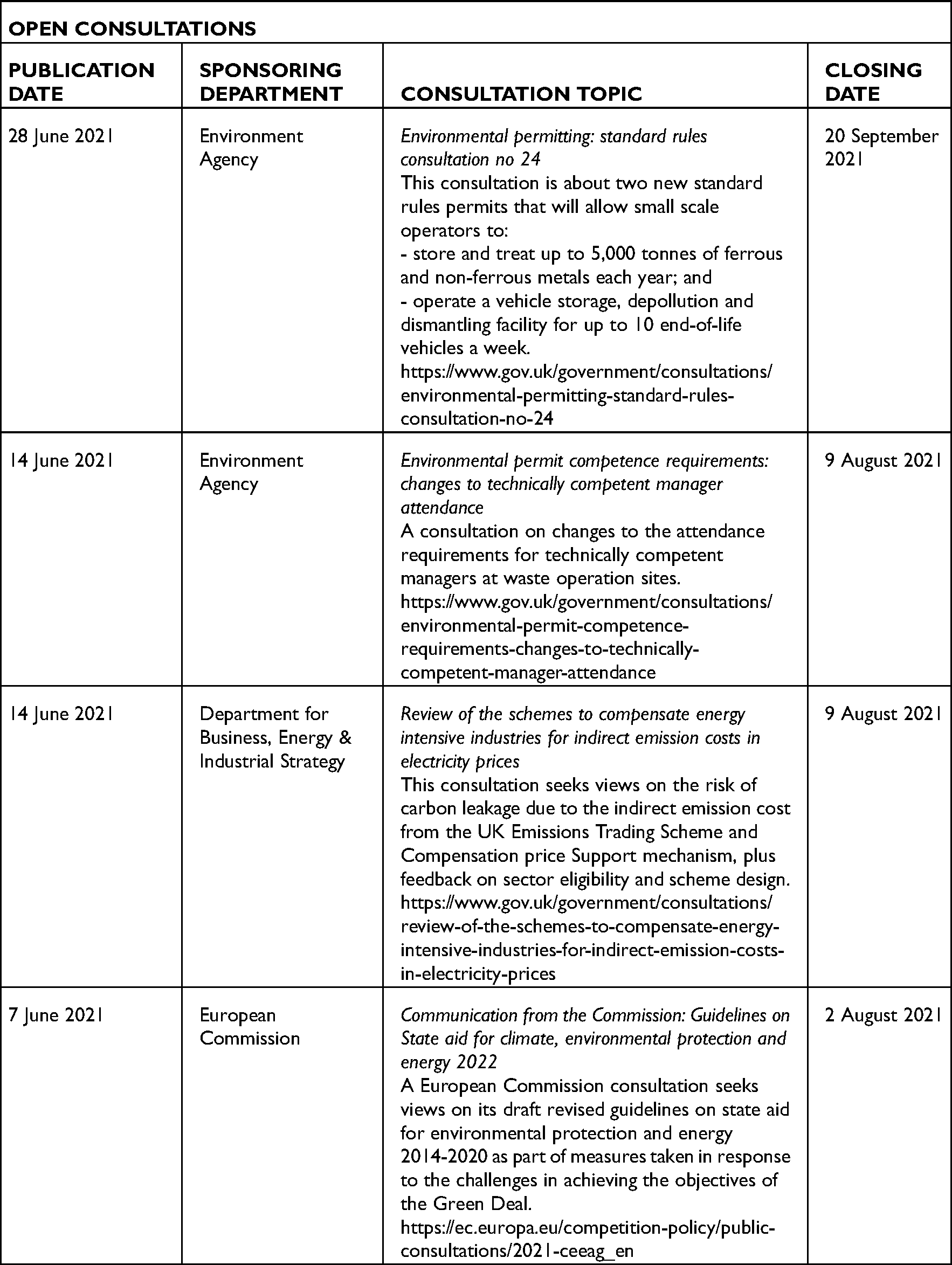
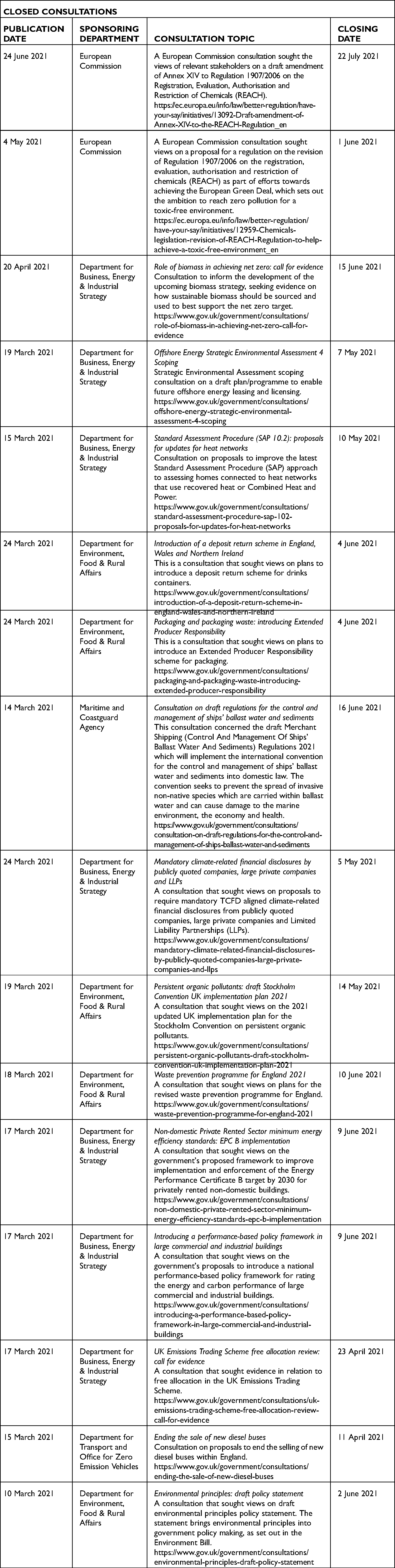
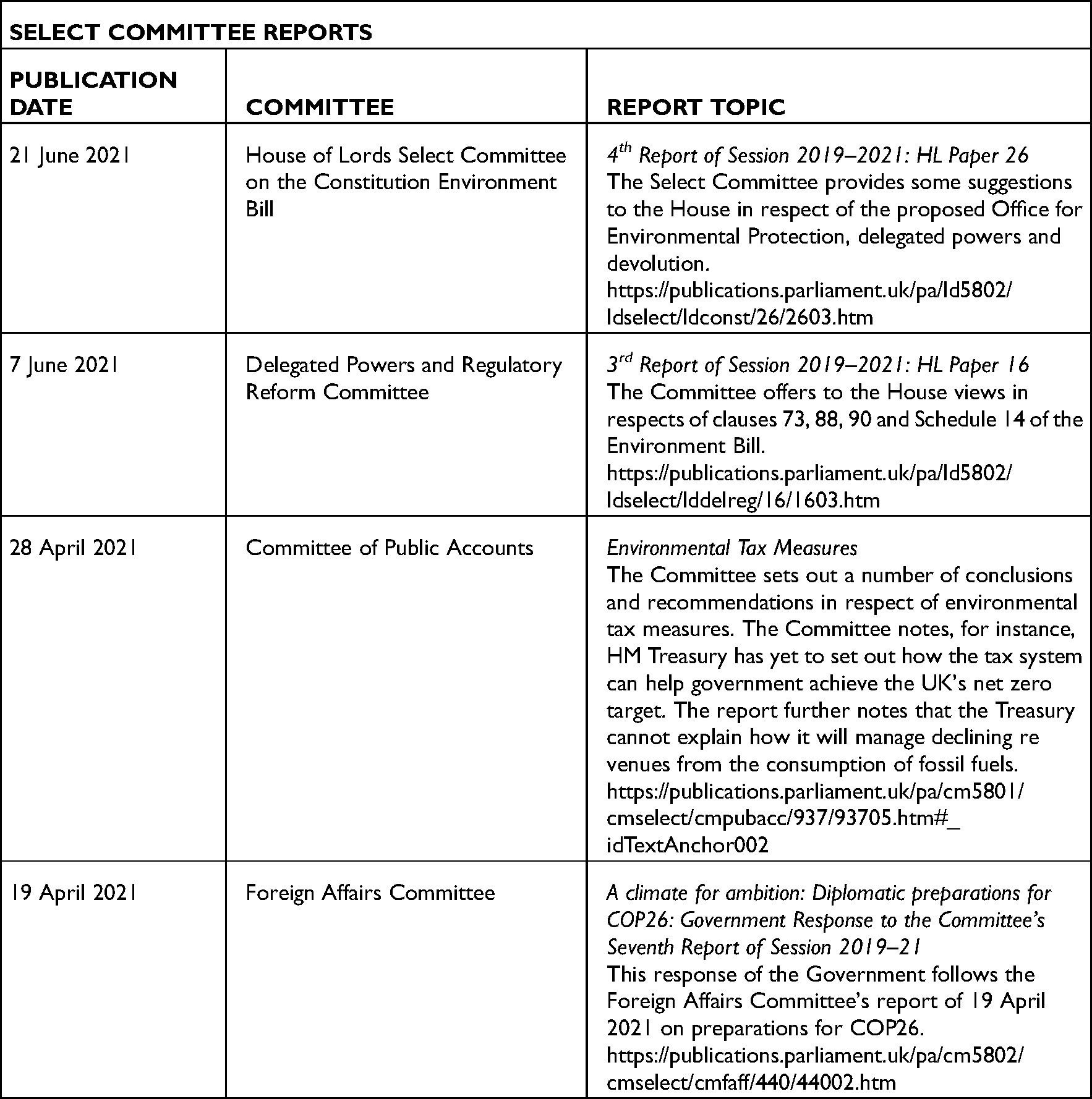
NEWS AND MISCELLANEOUS
Environment Agency: reaching net zero by 2030
The Environment Agency's road map for cutting carbon emissions and reaching net zero by 2030. The road map is set out in the link below.
https://www.gov.uk/government/publications/environment-agency-reaching-net-zero-by-2030
Environment Agency launches new flooding Action Plan
The Environment Agency states that its new FCERM Strategy Action Plan will ‘[…] help to better protect over hundreds of thousands more homes and businesses in the years ahead.’ The plan is detailed within the link below.
https://www.gov.uk/government/news/environment-agency-launches-new-flooding-action-plan
Queen's Speech 2021
The Queen's Speech addressed key environmental issues. The Speech noted that the government would invest in new green industries. The Speech also reiterated a commitment to achieving net zero greenhouse gas emissions by 2050, including through the Environment Bill which will set binding environmental targets.
G7 Climate and Environment: Ministers’ Communiqué, London, 21 May 2021
This communiqué was published following a meeting of the G7 Ministers responsible for Climate and Environment on 20 and 21 May 2021. It acknowledged the ‘grave concern’ that unprecedented and interdependent crises of climate change and biodiversity loss pose an existential threat to nature, people, prosperity and security. The document promises to ‘build back better’ from the pandemic. The document further sets out a wealth of measures addresses the ways by which the Ministers and their respective governments will seek to address climate change.
Environment Secretary to set out plans to restore nature and build back greener from the pandemic, 18 May 2021
The Environment Secretary has set out plans that are aimed at protecting and restoring nature, tackling the climate and biodiversity crises and to help deliver net zero by 2050.
Special report 12/2021: The Polluter Pays Principle: Inconsistent application across EU environmental policies and actions
A European Court of Auditors special report on the Polluter Pays Principle (PPP) finds that the PPP is reflected and applied to varying degrees in the different EU environmental policies and its coverage and application was incomplete. The report further found that the EU budget is sometimes used to fund clean-up actions that should, under the PPP, have been borne by polluters. The report recommends there be strengthening of the integration of the PPP into environmental legislation, reinforcement of the environmental liability regime at EU level and better protection of EU funds from being used to finance projects that should be funded by a polluter.
https://www.eca.europa.eu/en/Pages/DocItem.aspx?did=58811
https://www.eca.europa.eu/Lists/ECADocuments/SR21_12/SR_polluter_pays_principle_EN.pdf
Rishi Sunak to announce £15bn green finance plan
Chancellor of the Exchequer Rishi Sunak is to announce plans for £15 billion of green savings bonds, which is expected to be one of the biggest issues of green bonds in the world, that will allow people to invest in renewable energy projects such as wind and solar power. They will be available through National Savings and Investments, the Treasury-backed savings organisation that also offers Premium Bonds.
https://www.theguardian.com/politics/2021/jul/01/rishi-sunak-to-announce-15bn-green-finance-plan
End to coal power brought forward to October 2024
The Minister of State for Business, Energy and Clean Growth has announced that the deadline to phase out coal from Great Britain's energy system has been brought forward to 1 October 2024, highlighting the UK's leadership to go further in driving down emissions and tackling climate change. The UK Government is to introduce new legislation to accelerate the phase out of coal power at the earliest opportunity.
https://www.gov.uk/government/news/end-to-coal-power-brought-forward-to-october-2024
Council agrees on new rules for cross-border energy infrastructure
The European Council has reached a general approach on the revision of Regulation 347/2013 – the Trans-European Networks for Energy (TEN-E) Regulation – which aims to modernise the EU's cross-border energy infrastructure in order to help the EU achieve its 2050 climate neutrality objectives. The revision identifies 11 priority corridors and three priority thematic areas to develop and interconnect. The revised Regulation updates the infrastructure categories eligible for support with an emphasis on decarbonisation and adds a new focus on offshore electricity grids, hydrogen infrastructure and smart grids.
EEA's latest annual environmental performance assessment shows lower impacts on environment due to pandemic, 27 May 2021
The European Environment Agency's (EEA) latest environmental performance data shows that the Agency's work and operations in 2020 led to considerably lower impacts on the environment due mostly to restrictions imposed by the COVID-19 pandemic.
https://www.eea.europa.eu/highlights/eeas-latest-annual-environmental-performance