



Abstract
This article sets out to examine the degree to which democratic transition in Serbia after 2000 has brought about a democratic mode of crime governance in the country. It is shown that while penal norms and policies have undergone a significant degree of democratization in that their outlook has tended not to be punitive, the judiciary (and, to some degree, other actors in the penal field) has been increasingly inclined towards punitive practices. Taking an institutional approach to explain this discrepancy, the article argues that pockets of authoritarianism in the executive have survived the transition to democracy and have continued to exert pressure on the judiciary in ways that have influenced judicial decision-making towards greater punitiveness.
Introduction
Crime appears to have been figuring significantly more prominently in Serbia’s public domain over recent years. Both mainstream and tabloid media outlets, for example, have increasingly devoted attention to sensational crime stories that are likely to evoke emotional reactions amongst the public, a trend also observed in political discourse in the country. The aim of this article is, first, to identify the ways in which Serbian state authorities have been dealing with issues of crime and crime control, especially as concerns related developments in the penal field, and second, to discern the ways in which penal developments themselves have been influenced by the general process of democratization in the country since 2000. The article, in other words, aims to assess whether, and the extent to which, the general process of democratization in Serbia has led to a more democratic governance of crime; that is, a mode of crime governance that adheres to norms and promotes policies and practices that are conducive to balanced, parsimonious and dignified punishment.
Chronologically, the focus of the article is on penal transformations that have occurred in Serbia since the end of the Second World War. In particular, the article compares penal norms, policies and practices that have characterized the Serbian penal field since the coming of democracy in the country in 2000, to those prevalent under the two previous post-war regimes: communism (1945–1989) and post-communist authoritarianism (1990–1999). The descriptive part of the analysis shows that, although penal norms and policies have undergone a significant degree of democratization in that their outlook has tended not to be punitive, the judiciary (and, to some degree, other actors in the penal field) has been increasingly inclined towards punitive practices. To account for this discrepancy, the article takes an institutional approach, interrogating the degree to which separation of powers, itself an essential component of democracy, has been achieved in Serbia since 2000. It is argued that pockets of authoritarianism in the executive have survived the transition to democracy and have continued to exert pressure on the judiciary in ways that have tipped the balance of judicial decision-making towards punitiveness. What has thus emerged is what may be termed ‘authoritarian governance of crime within democracy’.
Democratic transformations of the Serbian penal field
The ‘punishment and society’ literature which put ‘the changing nature of punishment at the centre of an inquiry into the question of social order’ (Simon and Sparks, 2013: 4) gained prominence in late 1970s. At the beginning of the 21st century, there is no shortage of accounts of the role of punishment in contemporary society, especially in the US and the UK. For instance, Garland (2001) identifies the ways in which social, political and cultural changes since the 1970s (what he terms ‘the coming of late modernity’) caused a shift from a rehabilitative and inclusive penal system (‘penal welfarism’) towards a repressive and exclusionary one. Simon (2007) demonstrates how the ‘new’ regulation of crime became a ‘model’ for dealing with problems pertaining to other areas of social life – the family, the school and the workplace. And Wacquant (2009) highlights state transformations that render punitiveness a means by which lower social classes are kept in check.
These accounts have been challenged in two main ways. First, there are examples of countries that have experienced similar social, political, economic or cultural circumstances but different penal outcomes (Cavadino and Dignan, 2006; Snacken and Durmortier, 2012; Tonry, 2007). And second, similar penal trends have been observed in countries undergoing different trajectories in terms of their social, political, economic or cultural conditions. Findings in this latter respect have primarily concerned certain ex-communist countries in Central and Southeastern Europe. Following a period during which criminal legislation that served ideological purposes was substituted by human rights-based legislation, a shift mostly prompted by the conditions of membership of the Council of Europe, these countries have more recently witnessed punitive trends in terms of penal politics, policies and public opinion (Kossowska et al., 2012). Whether realistic or not, fear of rising crime rates in the immediate post-democratization era (Karstedt, 2003; Levay, 2000; Šelih, 2012) cannot explain all such trends, from the rise of populist law-and-order rhetoric in Estonia and Poland (Krajewski, 2004; Saar, 2004), to the surge of public punitiveness in Slovenia (Meško and Jere, 2012), to the ascendance of punitive policies in Lithuania and Hungary (Dobryninas and Sakalauskas, 2011; Levay, 2012).
Serbia was among the last ex-communist states in Europe to undergo democratic transition. Already in 1948, Yugoslavia replaced hard line, ‘Soviet-type’ communism with state socialism, thereby presumably increasing its potential to democratize swiftly. Yet the road to democracy turned out to be long and hard. Although the country subscribed to a moderate version of communism, over the next 40 years it found itself mired in internal political strife and harsh oppression – which often relied on criminal law – against the ruling elite’s political opponents. The destructive civil wars of the 1990s, which eventually led to the dissolution of the Socialist Federal Republic of Yugoslavia, further slowed down the transition. The first Serbian multi-party elections of 1990 brought Slobodan Milošević to power, thus postponing ‘real’ democracy until his removal from office in 2000. Although Milošević won the 1990 elections, the next 10 years of his rule were marked by clear authoritarian tendencies and doubtful popular support (Goati, 2001). Apart from being responsible, at least in part, for the break-up of former Yugoslavia and accused of committing war crimes and crimes against humanity (for which he was indicted and prosecuted before the International Criminal Tribunal for Former Yugoslavia (ICTY)), his rule also led to the international isolation of Serbia, the imposition of economic sanctions and NATO bombing in 1999.
Throughout this period, Milošević used state media and censorship to silence political opposition. For example, the 1998 Public Information Law (Zakon o javnom informisanju) undermined the freedom of independent media and imposed draconian fines on journalists writing against the regime (see more in Lilić et al. (1998)). A number of journalists (such as Slavko Ćuruvija and Dada Vujasinović), as well as a prominent political opponent of Milošević (Ivan Stambolić), were murdered, while the assassination of an oppositional leader, Vuk Drašković, was attempted on a number of occasions. Additionally, the success of Milošević’s party in each election held since 1990 has been disputed in light of allegations of electoral fraud. On at least two occasions, efforts to distort electoral outcomes succumbed to political protest: in 1997, after 96 days of protests, Milošević finally admitted that the opposition parties had won the local elections, and in 2000, after a two-week stalemate, he recognized he had lost the Presidential elections to the opposition candidate Vojislav Koštunica. 1 He was extradited to ICTY in 2001, where he died in 2006. Post-2000, Serbia has seemingly picked up democratic pace, gaining membership of the Council of Europe in 2003 and European Union candidateship status in 2012. The country’s ‘level of freedom’ – an indicator the US-based organization Freedom House uses to measure access to political rights and civil liberties internationally – has increased from 6 (7 being the lowest) in 1998 to 2 in 2014 (Freedom House, 2014).
Undeniable post-2000 improvements notwithstanding, academic commentators have nevertheless warned of certain negative trends occurring in the field of punishment during the same period, including, for example, ‘populism’ (Ignjatović, 2010), ‘vindictiveness’ (Soković, 2011) and ‘expansionism’ (Stojanović, 2011a). Unfortunately, such claims are usually only substantiated by reference to anecdotal evidence, and a more thorough analysis is needed to establish the characteristics of the Serbian penal field. To assess the level of penal democratization in Serbia, the article focuses on three issues: (a) the dominant penal philosophy; (b) penal policies pertaining to substantive, procedural and executive criminal law and (c) penal practices and the behaviour of specific actors in the penal field. This exploration of penal democratization will aim to determine the extent to which the existing penal approach in Serbia is conducive to the protection of offenders’ human rights, penal moderation and a sober reaction to crime which avoids not only ideological, but also populist, hostile and over-reactive uses of criminal punishment.
‘Protective’ punishment as the dominant penal philosophy
In contemporary Serbia, the dominant official penal goal is ‘the suppression of acts that harm … values protected by criminal legislation’ (Krivični zakonik, article 4). Usually termed by Serbian penal theorists ‘the protective goal of punishment’ (Stojanović, 2011b), this objective is meant to be achieved through proportional punishment for the guilty offender, which aims both at retribution towards her and general prevention as concerns the broader public. The imposition of criminal sanctions is based on strict sentencing ranges, while additional rules (regarding, for instance, aggravating and mitigating circumstances) allow for fine-tuning of the sanction.
Unlike criminal law that applies to adult offenders, juvenile criminal law is explicitly welfarist, often stipulating measures aimed at ‘influencing appropriate development’, ‘strengthening personal responsibility’, ‘providing supervision, protection and help’, ‘securing general and specific training’ and ‘reintegrating into society’. To this end, a more lenient system of sanctions, unobtrusive procedural rules and specialized criminal justice agencies were introduced in 2005. With the exception of juvenile imprisonment, all other sanctions are explicitly of a welfarist orientation. Juvenile imprisonment is an extraordinary measure that can last between six months and five years (exceptionally up to 10 years) and may only be imposed upon ‘older minors’ (16–18 years of age). It is rare in practice, with less than 1% of the overall prison population being juveniles (ICPS, 2015; MPRS, 2014). Even when it comes to imprisonment, the law repeatedly makes reference to minors’ ‘interests’, ‘needs’ and ‘special circumstances’ and provides for substantial post-release assistance.
More generally, prisoners’ status has been greatly influenced by the ‘human rights’ agenda and is consequently constituted by legally entrenched rights. Restrictions of rights are justified only inasmuch as they are absolutely necessary. The formal goal of imprisonment is to help the prisoner ‘adopt socially acceptable values’, so as to promote reintegration and prevent future offending (Zakon o izvršenju krivičnih sankcija, Article 8, 31–32). To achieve this, the law grants prisoners substantial rights; amongst others, to work, communicate with the outside world, receive visits (including conjugal visits), vote, receive legal aid and education, and practice religion.
The Serbian protective approach is not to be confused with the rehabilitative philosophy of punishment that has often been criticized for its coerciveness (Von Hirsch, 1976). It focuses less on intervention and treatment and more on providing the tools – such as primary and secondary education or vocational training – which facilitate prisoners’ reintegration post-release. Furthermore, owing to an extensive set of rights and a firm desire to make the prison experience as ‘normal’ as possible, prisoners are removed from political and social life only insofar as institutional circumstances make this necessary.
Transformative penal policies
Penal transformation in Serbia started well before 2000. Already in 1951, the then new penal code moved away from ‘notoriously punitive’ communist penal tendencies (Krajewski, 2004) and towards a ‘legalistic’, ‘German’ model (Srzentić et al., 1998). From 1951 to 2005, the year that the first ‘democratic’ Serbian Criminal code was introduced, Yugoslavia abolished the use of analogy (a principle which allowed prosecution not only of acts prescribed as crimes but also of acts merely resembling crimes), the material definition of crime (according to which a key element of crime is its ‘socially dangerous’ nature, thereby allowing prosecutors to drop charges at will even if all other, formal conditions to prosecute cases were met), as well as ideological sanctions and ‘socialist self-management’ as the incrimination rationale (while some sanctions were openly aimed against ideological opponents, the broader purpose of criminal law was explicitly the protection of the specific type of communist order which existed in Yugoslavia at the time).
Post-2000 modifications sought to codify criminal law and implement European human rights standards (Pihler, 2006; Vlada Republike Srbije, 2005). The ‘human rights’ agenda presented a new paradigm within which criminal law was further to develop, and transformative changes have since taken place in substantive, procedural and executive criminal legislation. In terms of substantive criminal law, the most important changes have concerned the system of criminal sanctions. The death penalty was abolished in 2002, with around half of the public being supportive of this development (Nikolić and Žarevac, 2002; Srbija protiv smrtne kazne, 2013). Although the death penalty was last imposed in 2001, no offender had been executed since 1992 (Politika, 2007), which is reflective of the ambivalence towards its use long before it was abolished. Indeed, the range of crimes for which the death penalty could be imposed had already been reduced to only two by the time of its abolition. Two sanctions remained (imprisonment and fine), and two were added (community service and driving license revocation).
There is no life imprisonment in Serbia. The maximum term of imprisonment is 20 years, though custodial sentences can exceptionally range from 30 to 40 years for particularly grave offences; a measure applied only rarely, with fewer than 20 such sentences being meted out annually (RZZS, 2013b). The duration of imprisonment is practically shortened through the use of parole for which adults are eligible after serving two-thirds of their sentence and juveniles after serving one-third of theirs. There are four alternatives to imprisonment: (1) ‘house arrest’ (introduced in 2009); (2) ‘community service’, that is, ‘socially beneficial labour’ explicitly aimed at diverting the offender away from imprisonment; (3) probation (or suspended imprisonment), a long-standing alternative that accounts for 50–60% of all sanctions in Serbia (RZZS, 2013a) and (4) ‘judicial warning’, a preferred sanction for first-time perpetrators of non-serious crimes. An income-based system of daily fines was also introduced in 2005, which substituted legislatively fixed fines.
Furthermore, the Code of Criminal Procedure (Zakonik o krivičnom postupku) of 2001 predominantly sought to adopt the principles enshrined in the European Convention on Human Rights and other relevant treaties. Amongst others, it introduced: the ne bis in idem principle (which prohibits prosecution and punishment for the same act more than once); the prohibition of torture, degrading or manipulative acts against the accused; additional alternatives to remand custody; the determination of the maximum duration of remand both before and after indictment; the right to an attorney from the initial contact of the suspect with the police and extensive communication rights between the accused and her attorney; obligatory defence in specific cases (e.g. for serious crimes, offenders in remand custody, offenders with psychological disabilities); the right of the accused to withhold her statement; the abolition of police-imposed remand and the limitation of ‘police detention’ to 48 h during which the suspect has the same rights as the accused (see for more details Grubač and Beljanski, 2002).
Additionally, victim rights in contemporary Serbia have also improved. Victims have always had the ‘damaged party’ status, which allows them to file a compensation claim during the criminal trial and have (since 1929) also had an opportunity to become ‘subsidiary prosecutors’ in crimes prosecuted ex officio – i.e. to become the principal prosecutor when the public prosecutor drops the case. More recently, however, additional rights were granted to victims of particular crimes (sex and family-related crimes, organized and war crimes, and crimes involving victims under the age of 18). Particular emphasis was placed on tackling offences targeting women and children, and from the 1980s onwards, a steady commitment on the part of women’s rights organizations led to the drafting of legislative proposals and the introduction of victim assistance programmes (hotlines, shelters and safe houses) (see Ćopić and Nikolić, 2004; Nikolić-Ristanović, 2007).
Finally, the 2005 Law on the Execution of Criminal Sanctions (Zakon o izvršenju krivičnih sankcija) extended and fortified offender rights, particularly those pertaining to prisoners, so as to bring them in line with the European Prison Rules. For example, the law adopted the principle of ultima ratio regarding the limitations of prisoners’ rights (whereby rights are restricted as little as necessary to achieve the desired goal), forbade torture and demeaning acts, embraced dignity and non-discrimination of prisoners, and provided judicial safeguards. Furthermore, the law secured a wider spectrum of rights than before, pertaining not only to food, shelter and health provisions, but also to rights to education, work, information and religion. Finally, measures concerning the administration of order and discipline were strictly regulated – here again the principle of ultima ratio has been applied – while sanctions such as solitary confinement were reserved for exceptional cases (see further Pihler, 2006).
Moving towards the opposite direction has been legislation regarding sex offences. In particular, a law informally known as Marija’s Law (named after an eight-year-old girl who was raped and murdered) and resembling Megan’s Law in the US was adopted in Serbia in 2013, henceforth providing for a range of ‘special measures’ for sex offenders, including, for example, elimination of the statute of limitations and ineligibility for parole.
Practices and behaviour of specific actors in the penal field
Notwithstanding the importance of norms and policies as indicators of democratization in the penal field, their usefulness is limited if they are not explored in conjunction with practices on the ground. With this in mind, below I continue my exploration of Serbia’s penal domain by looking at practices followed by the police and the judiciary. 2
With regard to policing, the system in Serbia operates rather ‘traditionally’. That is to say, policing occurs ex post facto and follows the slow bureaucratic route; criminal events are treated as something to react to, not prevent. 3 Police over-reaction to crime has been apparent in so-called police ‘campaigns’ that are aimed at enhancing the ‘tough-on-crime’ image of the police in the eyes of the public (Ignjatović, 2003). Campaigns follow a preordained pattern: a particular problem, such as child pornography or drug trafficking, is identified and exploited by the media, the police then launch an operation under a pompous code name (e.g. Armageddon, Thunder, Balkan Warrior, Shredder, Cleaner), performing mass arrests within short periods of time, before the outcomes of the campaign are ultimately circulated by the media.
Turning to sentencing practices and particularly the use of imprisonment in Serbia, currently the harshest penal sanction available to the country’s judges, Figure 1 presents trends between 1979 and 2012 in the annual absolute number of prison sentences passed, the annual absolute number of all types of sentence passed and the annual absolute number of offences recorded by the police. Whilst the annual volume of all sentences passed underwent notable fluctuations over time, the annual volume of prison sentences remained remarkably stable. Importantly, neither trend appears to have been traceable to crime rates. Increases in the occurrence of serious crimes and recidivism rates go some way towards explaining the stability in the use of imprisonment in Serbia, yet judges have also been unwilling to make use of alternative sanctions for less serious offences.
Trends in prison sentences passed, all types of sentences passed and police-recorded offences in Serbia, 1979–2012 (absolute numbers, per year).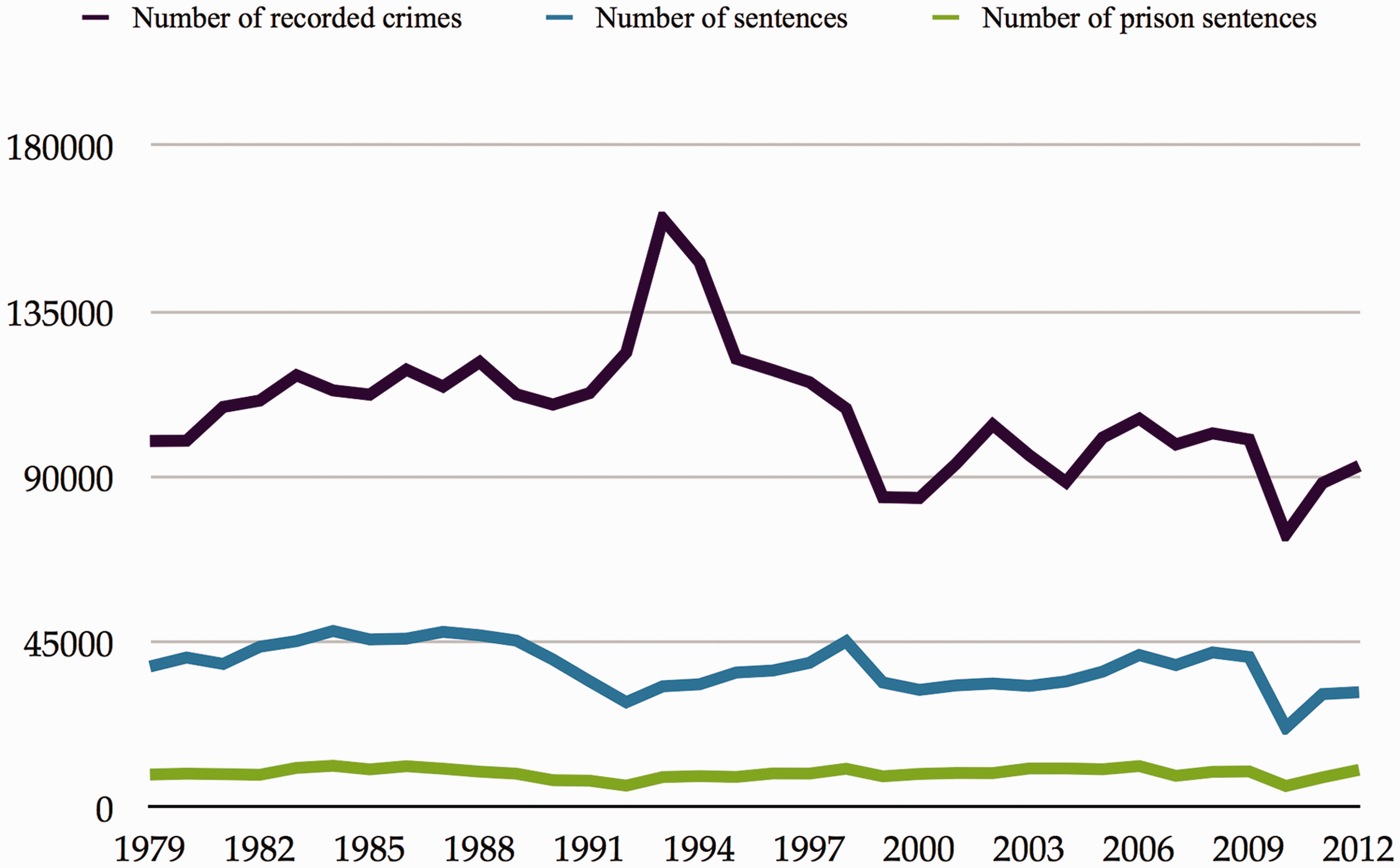
As shown in Figure 2, between 1993 and 2012, the annual total of prisoners rose steadily (with the exception of a slight drop in 2012 due to amnesty). This rise stands out both historically and internationally: although imprisonment rates have also risen in other transitional societies, over the last 20 years Serbia has had the fastest rising prison population in Europe (Tripković, 2010). Since 1993, Serbia’s prison population has nearly quadrupled, from 37 prisoners per 100,000 inhabitants in 1993, to 140 in 2013 (ICPS, 2015). In good part as a result of this, Serbian prisons are overcrowded, their occupancy currently standing at 109% (ICPS, 2015).
Convicted, remand and paroled prisoners in Serbia, 1993–2012 (absolute numbers, per year).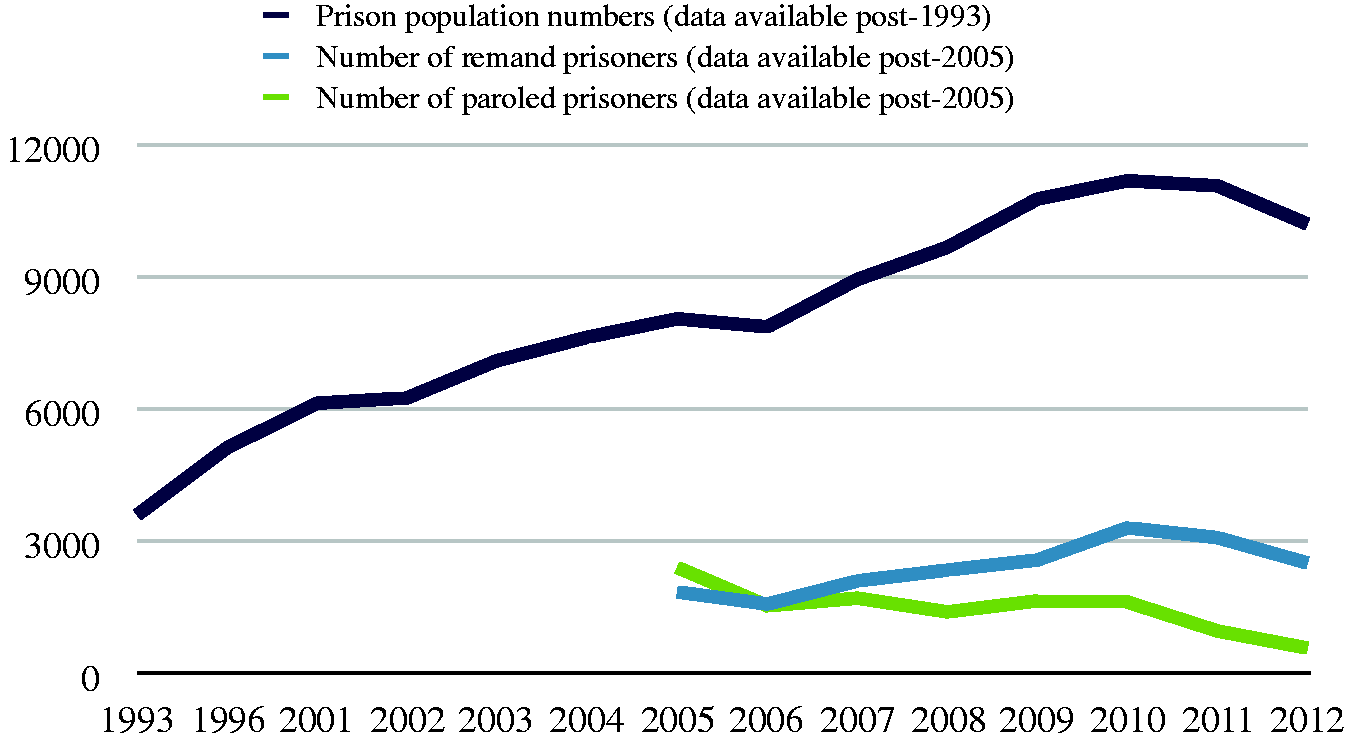
The surge of Serbia’s prison population has been due to an overall increase in the length of custodial sentences passed by courts, combined with a decrease in the use of parole, as well as a rise in the use of remand imprisonment. As demonstrated in Figure 3, the most common length of custodial sentences meted out by Serbian courts does not exceed one year. Since 2006, however, the annual volume of sentences up to one year has dropped, whilst the corresponding volume of sentences for a term between one and five years has been rising. What has caused this development is not immediately clear. Legislative changes have not been punitive; if anything, many behaviours have been decriminalized and sentencing maximums have been reduced. Even if one were to accept that more serious crimes that warrant longer terms of imprisonment have been perpetrated in Serbia over recent years, the degree to which long sentences have become more prevalent would still appear disproportionate. To this extent, it seems fair to suggest that the increasing use of longer sentences since the mid-2000s has largely been reflective of a change in judges’ own decision-making practices.
The length of prison sentences in Serbia, 1993–2012 (absolute numbers, per year). [For colour version of this figure please see online].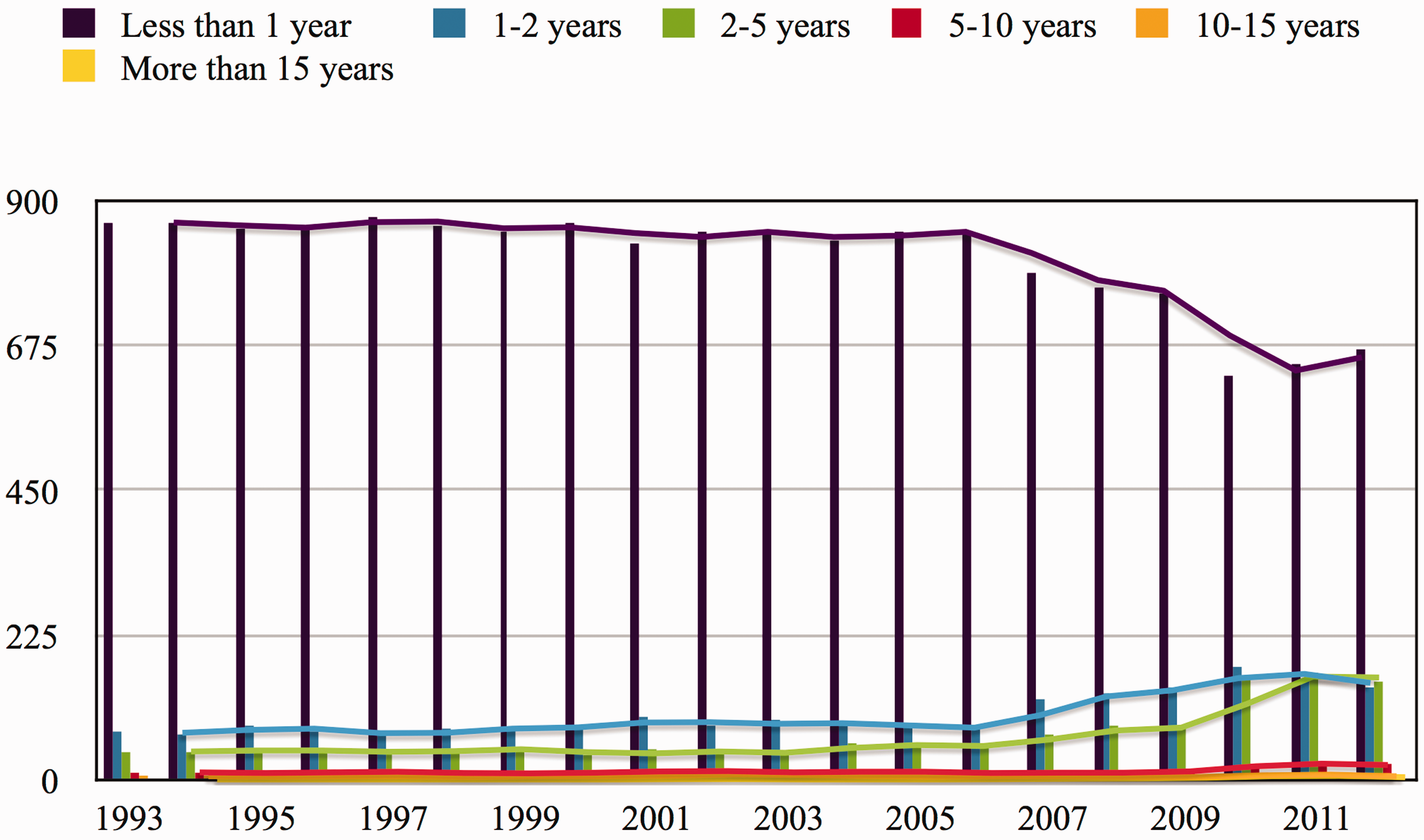
Meanwhile, the eligibility criteria for release on parole were tightened twice: the time required to be served before a prisoner becomes eligible for parole was increased from one-third to one-half of the sentence in 2005, and subsequently from one-half to two-thirds of the sentence in 2009. Additionally, in 2005, prison-based parole boards were substituted by judicial committees, which may have been less likely to grant parole to eligible prisoners. One way or another, as shown in Figure 2, the annual total of paroled prisoners has undergone an overall drop since the mid-2000s. During the same period, moreover, the annual number of pre-trial detainees also rose (see Figure 2), despite the fact that pertinent statutory rules did not become tougher and, indeed, a range of alternatives to remand imprisonment had already been introduced since 2001. Once again, judicial punitiveness appears to have played a significant part.
Whilst both penal philosophy and most legislative changes in contemporary Serbia have been oriented towards penal moderation, crime has nevertheless been subject to politicization, particularly by populist political elites. Indeed, all Prime Ministers post-2000 placed the ‘fight on crime’ high up on their government’s agenda (there have been six governments of diverse political orientations during this time frame; see further Vlada Republike Srbije, 2014). Furthermore, politicians have frequently drawn public attention to rare and shocking violent criminal incidents in order to arouse anxieties over security. In 2010, for instance, the then Minister of Interior Ivica Dačić warned that ‘crime is the biggest evil which tears apart and kills a nation’ (B92, 2010a), while the President of Serbia Boris Tadić proclaimed that fighting crime ‘is not only about the security of the state, but also about the future of generations, the future of every child in Serbia’ (B92, 2010b). The degree to which such discourse has in fact led to higher rates of fear of crime is debatable, though it has certainly allowed those in power to demonstrate their uncompromising stance towards crime, as well as their decisiveness in dealing with social problems more generally.
Blurring the line that separates powers: Authoritarian tendencies within democratic crime control
To recap, there are signs that the Serbian penal domain has undergone a significant degree of democratization both in terms of norms and various (though not all) policies introduced after 2000. Indeed, unlike other former communist states whose penal systems changed quite abruptly, the long process of democratization of the penal field in Yugoslavia (including Serbia) began more than 60 years ago and followed a slow (and bumpy) road of progress since then. As concerns judicial practices, however, these have grown stricter in recent years, despite relatively constant crime rates. This finding begs an exploration of the institutional arrangements that facilitate or otherwise contribute to the manifestation of such practices in the first instance.
By contrast with the US and the UK, where the penal field has apparently become ‘reconfigured entirely’ (Garland, 2001: 23), a point also raised by Levay (2012) in relation to the more comparable case of post-2009 Hungary, state punitiveness in Serbia appears to have been limited mainly (albeit not solely) to judicial practices. But why would Serbia’s judiciary engage in punitive practices when penal policy itself has moved towards moderation? In the case of the US, as Tonry (2007) reminds us, judges are elected directly by the public, which implies they may pursue punitive sentencing practices to placate popular sentiment and secure electoral support. In the Serbian case, although judges are appointed by an independent judicial body and are therefore more likely to be insulated from punitive sentiments amongst the public, they have long been dependent on the executive, not just before democratization but also since it began.
The new constitution adopted in Serbia in 2006 explicitly provided for the separation of powers (a principle already introduced in the constitution passed in 1990). Yet judges were essentially brought under the direct influence of the executive, forced as they were to reapply for the very position to which they had been appointed, supposedly permanently, under the previous constitution of 1990. The High Judicial Council (Visoki savet sudstva), the body in charge of the re-appointment process, was constituted in a way which allowed for political influence as one-third of its 11 members did not come from the judiciary, and some of them were members of the executive (apart from seven judges, the rest of the membership included: the minister of justice, the head of the judicial parliamentary committee, one attorney and one law professor). Indeed, during the process of re-appointments, two of the seven judges sitting on the Council spoke publicly about the political pressures that they were experiencing, which subsequently led one of them to resign (Rakić-Vodinelić et al., 2012). A series of further impediments were in place, including, amongst others, lack of clarity in the criteria for re-appointment, which made it difficult to establish who had the ‘expertise’, ‘competence’ and ‘worthiness’ to be a judge; exclusion of the public from the proceedings; lack of reasoning in decisions not to reappoint and lack of independence in the complaint procedure, given that the very same body that was responsible for re-appointment decisions was also entrusted with the task of judging complaints against them (see further Rakić-Vodinelić et al., 2012).
The re-appointment process, which was presented as part of a reform aimed at satisfying ‘European standards’, resulted in 26% of judges losing their position. Had the executive wished to remove those judges who consistently violated citizens’ human rights acting as tools of Milošević’s regime, they could have initiated individual proceedings in line with the Law on Responsibility for Human Rights Violations (Zakon o odgovornosti za kršenje ljudskih prava), which was adopted in 2003 and valid for 10 years thereafter. This law, however, was never actually used (Danas, 2013). At the same time, the executive subjugated remaining judges to its political whim, destabilizing their position and instilling in them a fear that the constitutionally guaranteed permanence of their judicial appointment could be just as easily ignored in the future.
These problems did not go unnoticed internationally. The European Commission, for instance, opined that the re-appointment process put ‘at risk the principle of judicial independence’, with the composition of the allegedly ‘independent and impartial’ High Judicial Council generating ‘a high risk of political influence’ (European Commission, 2010: 10). Around 800 appeals against decisions not to reappoint were eventually submitted to Serbia’s Constitutional Court, and 577 judges eventually were reinstated in office (Blic, 2013), although this only occurred after the change of government in 2012, thus giving rise to a new round of accusations of political influence.
It was not the first time that institutional arrangements were put in place with the aim to create a politically obedient judicial body that would serve the ‘omnipotent executive’ (Rakić-Vodinelić et al., 2012: 114). This strategy had been used in Yugoslavia since the 1960s, as each new constitution triggered the restructuring of courts and promoted the appointment of ‘loyal’ judges (Rakić-Vodinelić et al., 2012) who functioned as a ‘tool in the hands of the [Communist] party’ (Šelih, 2012). That the strategy has survived democratic transition goes a long way towards explaining why only a small minority of Serbians today – less than 20%, according to research – trust the country’s courts (Milošević-Đorđević, 2012), and, indeed, raises questions as to how successful democratic transition itself has actually been.
Having little democratic legitimacy and aiming to secure their own survival, judges are inclined towards practices they believe are valued by populist politicians. Recently, the President of the Association of Judges of Serbia stated that out of fear for political reprisals, judges postpone resolving ‘hot’ cases that are likely to arouse intense media and public attention until a statute of limitations sets in. She additionally emphasized that politicians effectively often ‘reach verdicts’ on arrested individuals by informing the public that the police has completed its investigative work and established guilt (Radio 021, 2014), thereby ultimately reducing the role of the judiciary to declaring the ‘truth’ already produced by police authorities.
The executive is also known to have put pressure on judges to place arrestees on remand. It was under such pressure, for example, that 2697 individuals were remanded in custody in the context of a police campaign that resulted in 11,000 arrests following the assassination of the first democratically elected Prime Minister Zoran Đinđić by an organized criminal group in 2003 (BCLJP, 2004), at a time when the country’s prison population was around 7000. Whilst judges have the final say on the use of remand, their independence is constrained by fear of removal from office were they to contradict mainstream political and public preferences in favour of keeping suspected criminals behind bars.
Although the executive cannot impose custodial sentences, it has been able to influence their length through the use of amnesties. In October 2012, the most extensive amnesty law in Serbian (and, indeed, Yugoslav) history was adopted through an urgent procedure. Without any prior public discussion, the Government proposed and the Parliament adopted, if by a narrow majority, amnesty legislation that reduced all custodial sentences by 10–100%, depending on the sentence length originally determined in court (RTS, 2012). The express purpose of this legislation was to resolve the problem of prison overcrowding for which Serbia had been repeatedly criticized by the Council of Europe (see, for example, CPT, 2014). Large-scale amnesty, in other words, lent itself as an exceptional quick-fix solution to a practical problem of the moment, rather than being a gesture of leniency or a permanent measure that would fundamentally contradict the general trend towards increasing state punitiveness.
The Government itself spoke of the new legislation as ‘the best amnesty law in Serbia’s history’. Yet the opposition fiercely criticized it for lacking clarity and ‘undermining the whole legal order’ by setting free a high number of offenders who did not deserve to be released from prison (B92, 2012). Similarly, one of the most prominent Serbian NGOs noted what it viewed as the lack of arguments for amnestying prisoners (Helsinški odbor za ljudska prava, 2012), while the Serbian Police Union stated that the law in question had a negative effect on citizens’ trust in state institutions (Radio Slobodna Evropa, 2012). While amnesties have commonly been used to alleviate prison overcrowding both in ex-communist countries and in developed democracies (see, for example, Krajewski, 2004; Nelken, 2010), the scope of Serbia’s latest amnesty law was so wide it assumed the form of yet another obtrusive interference into the judicial domain, undermining not only judicial authority as such, but also, arguably, the principles of legality and equality before the law more generally.
Concluding remarks
The executive’s siege of judicial functions has been a foreseeable consequence of the survival of the political elite that governed Serbia after the fall of communism and during the 1990s. Although the democratic opposition assumed power in 2000, it proceeded to coalesce with ex-regime parties only four years later. As of 2012, moreover, the ‘old regime’ again comprised the entire government. The current Prime Minister Aleksandar Vučić, for instance, was a radical nationalist during the 1990s and the Minister of Information from 1998 to 2000, whilst the current Minister of Foreign Affairs and previous Prime Minister Ivica Dačić was for a long time the spokesman for Milošević’s party and one of his closest associates. This elite was never permanently ousted from power and it has – by changing ‘form’ and ‘formula’ (Tripković, 2007) – paradoxically re-established itself as a ‘pro-European’ force.
The authoritarian past of Serbia’s dominant political elites has informed their actions beyond the penal field as well. In particular, the executive has been culpable of systematically silencing dissenting voices and manipulating public opinion. In May 2014, the Organisation for Security and Co-operation in Europe warned of a persistent trend of censorship of online content in Serbia, mostly through blocked access to websites critical of the government (OSCE, 2014). The Serbian Prime Minister responded himself, claiming these remarks were ‘lies’, accusing the Organization of having launched ‘the dirtiest possible campaign’, and eventually demanding an apology (Reuters, 2014). Yet concerns that the government has been promoting a ‘strictly controlled freedom’ (Ilić, 2014) have also been voiced by the Serbian Ombudsman (B92, 2014) and the Belgrade Centre for Human Rights, the most prominent domestic human rights organization (BCLJP, 2014), whilst the European Commission’s 2014 Progress Report on Serbia made reference to ‘deteriorating conditions’ for the freedom of expression in the country (European Commission, 2014: 13).
All things considered, even though Serbia (and its ancestor Yugoslavia) experienced a relatively moderate form of communism, its subsequent transition to democracy appears to have been neither complete nor entirely successful. In this vein, authors such as Bunce and Wolchik (2011) consider Serbia as having a ‘semi-authoritarian mixed regime’, which combines elements of both democracy and dictatorship. But Serbia is not alone in this regard. There is an emerging body of literature which suggests that some of Europe’s ‘young democracies’ (e.g. Hungary, Latvia, Bulgaria, Romania) have been ‘backsliding’ into their authoritarian past for at least a decade now (see further Bruszt, 2015; Greskovits, 2015; Plattner and Diamond, 2007), in addition to facing problems also found in parts of Western Europe; most notably, receding levels of public trust in state institutions and declining rates of political participation, trends which Peter Mair (2013) has described as comprising what he terms the ‘hollowing’ of democracy.
This article has highlighted the usefulness of punitiveness in the penal field as a key criterion for better assessing the scope and level of democratization in post-authoritarian contexts. In so doing, the article has shown further, one needs to draw an analytic distinction between, on one hand, developments on the levels of penal norms and policy, and, on the other hand, penal practices as these occur on the ground, thus allowing for the possibility of what I termed earlier ‘authoritarian governance of crime within democracy’. As the Serbian case illustrates, moreover, the spread and degree of penal democratization itself cannot be fully explained without taking into account the specific institutional arrangements that either directly or indirectly influence penal matters, including notably the relationship between the executive and the judiciary.
Footnotes
Acknowledgment
I would like to thank Bosko Tripkovic, anonymous reviewers and the participants of the panel 'Democratisation and punishment in Central and Eastern Europe' held during the European Society of Criminology's annual conference in Budapest (2013) for their comments on earlier drafts of this article.