



Abstract
Japanese officials commonly claim that their country retains and uses capital punishment because it deters homicide. Although this claim is contested, few empirical studies have been done to assess the empirical reality. This paper uses data not previously available (monthly homicide statistics obtained from Japan’s National Police Agency) to examine whether Japan’s death penalty deters homicide or robbery-homicide. Using vector autoregression models, it concludes that neither death sentences nor executions deter homicide or robbery-homicide.
Keywords
Introduction
Does the death penalty deter homicide? In the United States, more than 100 studies have been published about this question, and they “have reached widely varying conclusions” (National Research Council, 2012: ix). In Japan, fewer people believe in the deterrent value of criminal sanctions than in most other societies (Unnever, 2010), but many believe the death penalty deters homicide, which in practice is the only crime for which prosecutors seek a sentence of death (Jiang et al., 2010). The Japanese public’s faith in capital punishment reflects the views of their public officials, who stress two reasons for the country’s continued use of the ultimate penalty: that it deters homicide, and that the public supports it (Sato, 2014). 1 But unlike the United States, there has been little research about the death penalty and deterrence in Japan, though the paucity of studies has not discouraged citizens and officials from making confident claims about the issue. Indeed, deterrence has been called “the core of argumentation for and against” the death penalty in Japan (Schmidt, 2002: 102), even though research on the subject has been all but impossible because of difficulties obtaining decent crime data from the Japanese government (Schmidt, 2002: 110).
This article uses monthly homicide and robbery-homicide statistics that were previously unavailable to examine whether death sentences and executions in Japan deterred these crimes from 1990 to 2010. Our main finding is that the death penalty did not deter homicide or robbery-homicide. Of course, findings about the death penalty and deterrence may be marginally relevant to the ultimate question of whether or not to retain the institution. As the grandfather of death penalty and deterrence studies observed, “When a people no longer likes the death penalty for murders it will be removed no matter what happens to homicide rates” (Sellin, 1951: 656). Yet because of the secrecy and silence that surround capital punishment in Japan (Johnson, 2006), the Japanese public is uninformed and misinformed about many issues related to it, including deterrence (Sato, 2014: 183; Schmidt, 2002: 194–195). In this context, our research not only contributes to general debates about deterrence (Goertzel, 2004). It also informs public and political opinion about the death penalty in Japan (Kita and Johnson, 2014).
The rest of this article proceeds as follows. The next section summarizes what is known about the death penalty and homicide deterrence in the United States, which has long been the main focus of research on this subject. Then we summarize results from a handful of prior studies of the death penalty and deterrence in Japan. The following section describes empirical patterns in Japanese homicide, robbery-homicide, and capital punishment. Then we describe our variables, method (vector autoregression (VAR)), and the strengths and limitations of our study. The results section presents our main findings: (1) death sentences and executions did not deter homicide or robbery-homicide in Japan from 1990 to 2010; (2) legal reforms to “get tougher” on crime by increasing maximum terms of imprisonment and extending statutes of limitation did have a deterrent effect on robbery-homicide in Japan during this period; and (3) higher rates of unemployment increased robbery-homicide in Japan. The final section discusses the significance of our findings and makes recommendations for future studies. More research is needed, but at present the Japanese government has no sound basis for continuing to claim that the country needs to retain the death penalty because it deters heinous crime.
The death penalty and deterrence in the United States
Almost all studies of the deterrent effects of the death penalty have focused on homicide rates in the United States (Hood and Hoyle, 2008: 320). 2 The first serious studies were done in the 1950s and did not find deterrent effects (Sellin, 1951). Subsequent studies claimed that, on the average, each execution (from 1933 to 1967) saved the lives of eight potential murder victims (Ehrlich, 1975a, 1975b). Thereafter, more than a hundred studies of the death penalty and homicide deterrence have been published about America. This literature is large and hard to summarize, but in the last 40 years two reviews have been done by blue ribbon panels of the National Research Council whose members were chosen for their competence in the area and with due regard for disciplinary and ideological balance.
The original NRC review reached two main conclusions. First, the deterrent effect of capital punishment was “definitely not a settled matter,” and since experimental research in this field is impossible, research was deemed “not likely to produce findings that will or should have much influence on policy makers” (National Research Council, 1978: 359). Second, available studies provided “no useful evidence on the deterrent effect of capital punishment” (National Research Council, 1978: 9).
Following publication of this review, many economists turned their attention to the issue, and some found that the death penalty does deter homicide, though estimates of the number of lives saved by each execution varied widely, from 3 to 32 (Fagan and West, 2009: 341; Hood and Hoyle, 2008: 342). By the mid-2000s, the deterrence question had captured the attention of so many scholars in various fields that it sparked an “intense new debate about one of the central justifications for capital punishment” (Liptak, 2007), including a claim that if the death penalty does save lives, its use is “morally required” (Sunstein and Vermeule, 2005; see also Sunstein and Wolfers, 2008).
The second blue ribbon review of American death penalty and deterrence research focused on studies that had been done after the NRC’s first report (National Research Council, 2012). Echoing the first review, this one concluded that “research to date on the effect of capital punishment on homicide is not informative about whether capital punishment decreases, increases, or has no effect on homicide rates,” and it advocated that “these studies not be used to inform deliberations requiring judgments about the effects of the death penalty on homicide” (National Research Council, 2012: 2). Thus, two reviews separated by a third of a century have reached agnostic conclusions about whether the death penalty deters homicide in the United States.
Other reviews of the American research have reached pessimistic conclusions about the death penalty and homicide deterrence. For example, Berk (2005) found that claims of deterrence are a “statistical artifact” of death penalties in a small number of “anomalous” jurisdictions (especially Texas). Fagan (2006: 315) concluded that “it is impossible to tell whether deterrent effects are strong or weak or whether they exist at all.” Fagan and West (2009: 315) found that “the new deterrence literature [written mainly by economists]… is unreliable as a basis for law or policy that generate life-or-death decisions.” Donohue and Wolfers (2006, 2009) show that empirical evidence has often been “abused” in debates about the death penalty and deterrence. Kovandic et al. (2009) conclude that “our results provide no empirical support for the argument that the existence or application of the death penalty deters prospective offenders from committing homicide.” And the Brief of Amici Curiae Empirical Scholars Concerning Deterrence and the Death Penalty (2015: 16) found that “a large and growing number of academic articles conclude that no credible statistical evidence of a deterrent effect exists.”
There also is growing doubt among the American public about the deterrent utility of capital punishment. In one national poll, 61 percent of American adults said that the death penalty does not deter people from committing serious crimes, and 35 percent said it does (Pew Research Center, 2015). Other recent polls document a decline in public belief in the death penalty’s deterrent value (Death Penalty Information Center, 2017). At present, retribution, not deterrence, is the primary justification for capital punishment in the United States (Radelet, 2016).
In research to date, the author’s profession may be the best predictor of whether or not a study finds that the death penalty deters homicide in the United States. Two economists surveyed more than 40 reviews of published studies of the death penalty and deterrence and performed their own meta-analysis of 109 studies published between 1975 and 2013. They found that “the only statistically significant explanatory variable in these studies turned out to be the profession of the author,” with economists claiming “significantly more often than members of legal or other social science departments to have found a significant deterrent effect” (Gerritzen and Kirchgassner, 2016: 178). Conversely, “the consensus among criminologists is that the death penalty does not add any significant deterrent effect above that of long-term imprisonment” (Radelet and Akers, 1996; Radelet and Lacock, 2009: 504).
In sum, belief in the deterrent effect of capital punishment persists in some quarters. As the founding father of death penalty and deterrence studies observed, commitment to capital punishment as the supreme deterrent to homicide “remains a hardy perennial deeply planted in the human mind and nourished by emotions” (Sellin, 2013: 78). In this sense, beliefs about the death penalty and deterrence—like beliefs about many other crime and criminal justice issues—are rooted as much in faith as in fact (Walker, 2014: 26) and may be impervious to change even when contradicted by empirical evidence (Lord et al., 1979).
Prior studies of the death penalty and deterrence in Japan
In contrast to the United States, there have been few studies of the death penalty and deterrence in Japan (Miyazawa, 1991). One study of 1959–1990 found that media coverage of death sentences and executions did not have a deterrent effect on homicide, robbery, arson, or rape (Sakamoto et al., 2001). Another study found no deterrent effect of capital punishment on homicide from 1953 to 1987 (Matsumura and Takeuchi, 1990). And two subsequent studies analyzed homicide in Japan from 1960 to 1986 and concluded that the death penalty did have a deterrent effect (Akiba, 1991, 1993). But all of these studies are seriously flawed. In Akiba’s studies (1991, 1993), it is unclear how the probability of capital punishment was calculated, and a more robust reanalysis of his data found no deterrent effect (Mori, 2016). Moreover, all of these studies relied on annual crime statistics, not monthly statistics of the kind employed in our study.
Executions in Japan are shrouded in secrecy (Johnson, 2006), as are deliberations by judges and lay judges about life and death sentencing decisions (Johnson, 2013: 180). But these are not large obstacles to doing research about the death penalty and homicide deterrence because some information about executions and death sentences (including dates) is made public after the fact. In Japan, the main data difficulty is obtaining detailed homicide statistics, and similar problems plague other areas of social research (Brinton, 2003). Most importantly, Japan’s National Police Agency and Ministry of Justice do not release the monthly homicide statistics that would enable researchers to conduct sound time-series studies, which proceed from the premise that the presence of an effect of executions or death sentences on homicide rates “can be seen from the association of fluctuations of executions over time with fluctuations of homicides over time” (National Research Council, 2012: 75). Without monthly homicide data, associations between these fluctuations cannot be reliably discerned. Without monthly homicide figures, the annual homicide total (one number per year) provides too few data points to satisfy the assumptions of many statistical models. And without monthly homicide data, statistical models of the death penalty and deterrence can only generate crude annual estimates.
Homicide, robbery-homicide, and capital punishment in Japan
In 2011, we were able to obtain monthly homicide figures from the Japanese police, 3 which enabled us to employ a time-series method (VAR) that previous researchers could not use and that is explained in the next section of this article. We also obtained monthly figures for robbery-homicide, 4 which in Japanese law is a separate crime from homicide. This enabled us to make distinctions in our analysis between homicide and robbery-homicide, which are different crimes in real life too, as our first three tables show.
Death and life sentencing rates for homicide and robbery-homicide in Japan, 1990–2010.

Source: Japanese Ministry of Justice, Hanzai Hakusho.
Victim–suspect relationships in cleared homicide and robbery cases in Japan, 2011.

Note: “Other” means there was no victim or the victim was a corporate person.
Source: Japanese Ministry of Justice, Hanzai Hakusho (2012, Figure 5-1-5-1).
More broadly, there are large differences in the social context of homicide and in homicide clearance rates between the United States and Japan. In the United States from 1980 to 2008, 21.9 percent of all homicides with known victim-offender relationships occurred between strangers (Cooper and Smith, 2011: 16). This is nearly double the “no prior relationship” percentage for homicides in Japan. Since the early 1990s, homicides for which the victim-offender relationships were “unknown” constituted the largest category of homicides in the United States (36 percent in 1980 and 44 percent in 2008), whereas the parallel percentage for Japan is less than 6 percent for every year from 1990 to 2010 (Cooper and Smith, 2011: 31). The higher percentage of “unknown” relationships in American homicide reflects the fact that the country’s clearance rate for homicide (72 percent in 1980 and 64 percent in 2008) is much lower than the homicide clearance rate for Japan (96.7 percent in 1990, 95.0 percent in 2000, and 96.4 percent in 2010). In the United States, a person has better than a one-in-three chance of “getting away with murder,” while in Japan the odds are less than one-in-twenty. Roberts (2008) argues that Japan’s high clearance rate for homicide does not necessarily reflect high levels of police effectiveness or citizen-police cooperation, for two reasons: because Japan’s homicide category includes a high proportion of “easy-to-clear” cases (such as attempted homicide, which leaves live witnesses), and because Japan’s homicide category excludes cases unfavorable to clearance, such as robbery-homicide, which usually occurs between strangers. Many theories of deterrence stress that the certainty of punishment matters more than its severity or celerity (Zimring and Hawkins, 1973). In Japan, the high probability of being arrested for homicide may well do more to deter that crime than the sanctions imposed at trial, but we are unable to include this dimension of deterrence in our models because the Japanese police do not release data about monthly clearance rates, partly out of fear that public knowledge of the information would undermine their “monthly crackdowns” (torishimari kyoka gekkan), the crime focus of which changes from month to month.
Motives for homicide, robbery-homicide, and robbery in Japan, 2011.

Source: National Police Agency of Japan, Heisei 23nen no Hanzai (Criminal Statistics in 2011), Table 39.
In sum, our research employs monthly homicide data that were unavailable to previous researchers and that enable us to distinguish between two types of homicide (homicide and robbery-homicide) which differ in motivation, context, and severity of punishment. Much research about the death penalty and deterrence in the United States has not made distinctions between types of homicide (Fagan et al., 2006). Our research also examines the effect of death sentences issued in first instance trials (by Japan’s 50 District Courts), which often has not been done in American research on this subject. In these ways, our approach advances understanding of the death penalty’s effects on homicide.
But our study is far from perfect. The National Research Council (2012) has identified three main flaws in research on the deterrent effects of the death penalty in the United States (summarized in Nagin, 2012). Our research is flawed in all three ways.
First, many studies do not account for the influence of noncapital punishments. In our research about Japan, we cannot account for the influence of noncapital sanctions on homicide and robbery-homicide because we could not obtain monthly data on terms of imprisonment. Any effects that noncapital sanctions have on homicide or robbery-homicide might alter the estimated marginal deterrent effects of capital punishment that we calculate in this study. However, the exclusion of life sentences from our analysis probably causes our models to overstate the deterrent effect of the death penalty because (as Figure 3 illustrates) the number of death sentences and the number of life sentences are closely correlated.
The second problem in American research is that previous studies often used incomplete or implausible models of potential murderers’ perceptions of the threat of capital punishment. This problem may also be present in our research, for potential murderers in Japan might not respond to the objective risk of being sentenced to death or executed since their subjective perception of the risk could be higher or lower. On the other hand, prior research about the death penalty and deterrence in Japan suggests that media coverage has little effect on the risk perceptions of potential offenders (Sakamoto et al., 2001). We want to explore this issue in future research.
Third, some American studies have employed estimates of the effect of capital punishment derived from statistical models that make implausible assumptions, such as the premise that the effect of capital punishment on homicide rates is the same across all states and years. As described in the next section, our study uses the method of VAR. The assumptions underlying this approach are not rock solid, but the National Research Council (2012: 82) has called it “the methodological state of the art in time-series approaches to deterrence.”
Our study focuses on homicide and robbery-homicide in the two decades from January 1990 through June 2010. Japan experienced a steep decline in reported crime from 1988 to 1989, from 315,568 people arrested for violations of the Criminal Code in the former year, to 246,487 people arrested in the latter, a decrease of 22 percent. Over the same period, Japan’s clearance rate for Criminal Code offenses fell, from 59.8 percent to 46.2 percent. The first year in our analysis is 1990 because these large declines in crime and clearance rates may have influenced Japan’s homicide and robbery-homicides rates. The end point of our analysis is the middle of 2010 because Japan’s lay judge reform took effect in 2009, and because the first death sentence imposed by a lay judge panel occurred near the end of 2010. Hence, all of the death sentences examined in this article were originally imposed by panels of three professional judges. In Japan’s new trial system, lay judge panels are mixed tribunals composed of three professional judges and six ordinary citizens. It is too early to tell what effects the lay judge system will have on capital punishment, but caution should be exercised in extrapolating our death sentencing findings from the old trial system to the new one (Johnson, 2016).
Japan has been called a “low-crime nation” (Leonardsen, 2004) and a country of “vanishing killers” (Johnson, 2006b). From the mid-1990s to the mid-2000s, there was a modest increase in persons cleared for homicide (+17 percent) and a large increase in persons cleared for robbery (+116 percent) and robbery-homicide (+262 percent). But by 2010, all three of these crimes had fallen to levels not seen for 15 years. Throughout this two-decade period, the clearance rate for homicide remained stable between 94 and 98 percent, while the clearance rate for robbery-homicide rose and fell with no clear trend, from 77 to 111 percent, and the clearance rate for robbery declined significantly after 1995 before rebounding partially after 2001. In Japan, increases and decreases in official crime rates have partly been caused by changes in reporting practices by police and prosecutors and by the spread of mobile phones in society, but for serious crimes such as homicide and robbery-homicide, these changes in reporting and technology have probably had little effect (Hamai, 2006).
District court death sentences, life sentences, and executions in Japan, 1990–2010.

Source: Japanese Ministry of Justice, Hanzai Hakusho.
Table 4 also shows that following a 40-month moratorium on executions that ended in 1993, executions in Japan fluctuated between lows of 1 in 2003 and 2006 and a high of 15 in 2008, with an average of 4 executions per year for the period 1990–2010. 6 By these measures, Japan, a nation with 130 million people, may seem to be “relatively sparing” in its use of capital punishment compared with the United States (Garland, 2010: 319), which has more than twice as many people but which performed (during the same period) about 13 times more executions. But per capita rates of capital punishment can be misleading because persons are not selected randomly for death; they are condemned and executed from a pool of potentially capital cases. In the United States and Japan, this pool consists almost entirely of homicide crimes. 7 Thus, to discern the scale of execution in these two countries, one must consider the sizes of their capital-crime pools. By this measure (executions per homicide instead of executions per capita), the probability of a known murderer being sentenced to death and executed in Japan is not much different than in American jurisdictions such as Texas, Virginia, and Ohio (Johnson, 2011: 1052).
Figure 1 graphs homicide cases known to the police and District Court death sentences for homicide in Japan from 1990 to 2010. While the number of homicides remains flat throughout this period, the number of death sentences for homicide surges from the late 1990s through the late 2000s. In contrast, Figure 2, which graphs robbery-homicide cases known to the police and District Court death sentences for robbery-homicide from 1990 to 2010, shows that death sentences for robbery-homicide did not surge in any sustained way during this two-decade period, perhaps because (as explained above) robbery-homicide has long been punished severely in Japan.
Homicide and death sentences for homicide in Japan, 1990–2010. Robbery-homicide and death sentences for robbery-homicide in Japan, 1990–2010.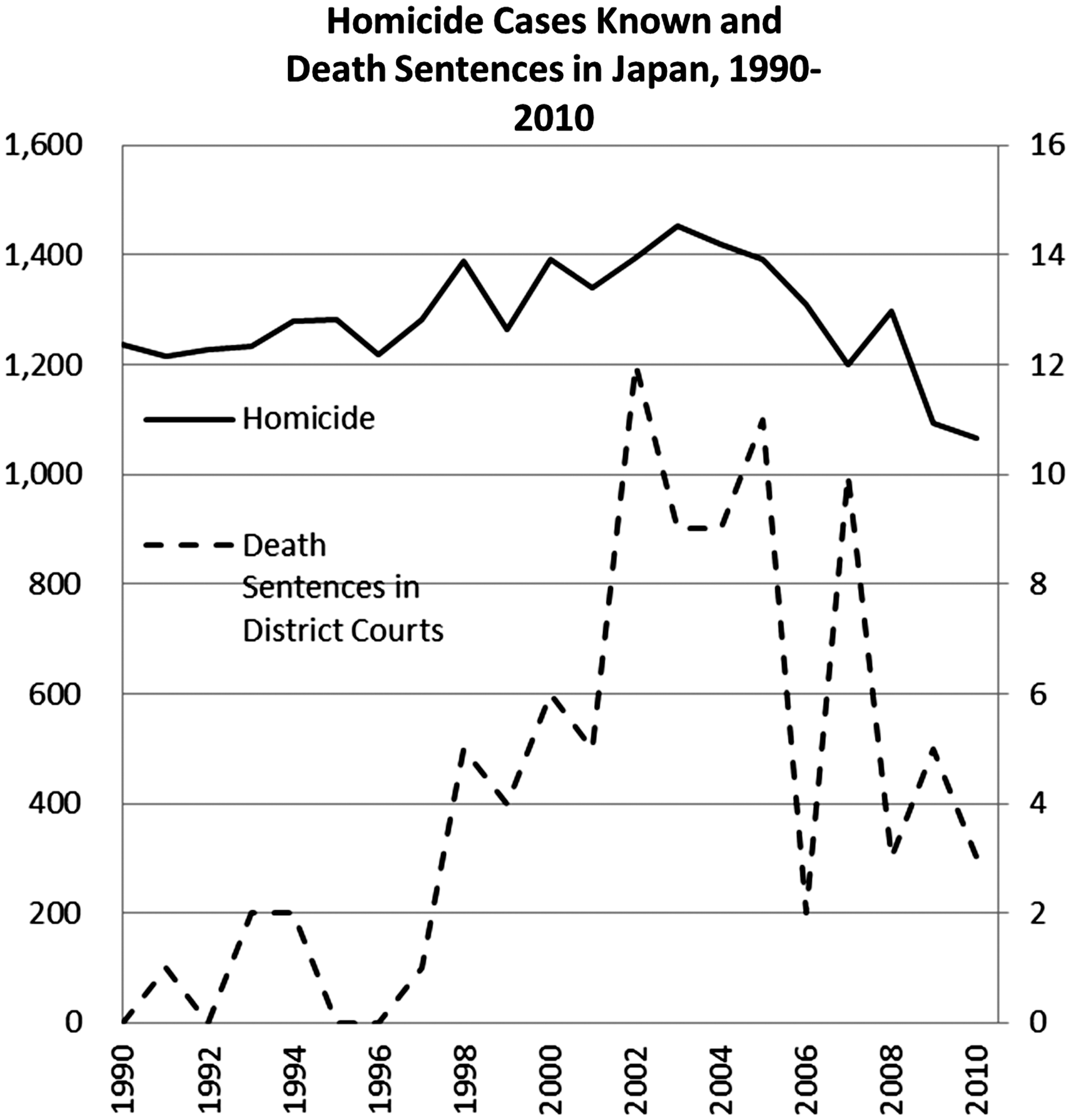

Figure 3 shows that throughout the period 1990 to 2010, the number of District Court death sentences and the number of District Court life sentences tracked each other closely, with the numbers increasing from the early 1990s until the early 2000s and then decreasing significantly until 2010. The mountain-like shape of the lines in Figure 3 reflects the fact that Japan experienced a decade-long “get tough on crime” (genbatsuka) trend that was shorter and less intense than the punishment increases which occurred in the United States after the 1970s (Miyazawa, 2008).
Variables and methods
This article asks whether the death penalty in Japan deterred homicide and robbery-homicide between 1990 and 2010. Hence, our main explanatory variables relate to capital punishment. They are: (1) the number of persons sentenced to death by Japan’s 50 District Courts; (2) the number of persons sentenced to death by Japan’s 8 High Courts; (3) the number of persons sentenced to death by Japan’s Supreme Court; (4) the total number of persons sentenced to death by all of these courts; and (5) the total number of persons executed in Japan, where the only method of execution is hanging. All of these variables are measured per month.
In Japan, a person sentenced to death has the right to appeal to a High Court and then to the Supreme Court, although these rights can be waived. Prosecutors may also appeal acquittals and sentences, and sometimes through appeal they convert a District Court acquittal or prison sentence into a death sentence (Japan Times, 2015; Masuda, 2009). By law, a person sentenced to death cannot be hanged until his or her death sentence has been “finalized” (kakutei sareta). From 1993 to 2012, one-third of the persons executed in Japan (30/91) had their death sentences finalized without review by the Supreme Court, either because they did not file an appeal or because they withdrew their appeal (Death Penalty Project, 2013: 27). The remaining two-thirds (61/91) had their death sentences reviewed and finalized by the Supreme Court. We include appellate death sentences in our analysis because the large majority of death sentences are reviewed and affirmed by appellate courts and because appellate court death sentence decisions receive considerable publicity in Japan.
In addition to the five death penalty variables described above, our models include two other independent variables. The first is the unemployment rate (shitsugyoritsu), which captures some of the economic circumstances that shape human behavior. For many years in the postwar period, Japan had one of the most equal income distributions in the world (Park, 2006: 11). But since 1990, the country has experienced two “lost decades” characterized by recession, deflation, and other economic stresses, including rises in unemployment and temporary employment. During the period of our study (1990–2010), two economic shocks were especially notable: the “restructuring” (risutora) by business enterprises that started in the mid-1990s in response to Japan’s prolonged recession, and the great recession in the United States, which was precipitated by the financial collapse of 2008 and which depressed Japan’s economy, causing the country’s unemployment rate to rise to 5.5 percent in July 2009—the highest unemployment rate in Japanese history (Kawai and Takagi, 2009). Chen et al. (2012) report that between 1990 and 2010 the suicide rate in Japan was highly correlated with the unemployment rate, and they argue that this connection is partly explained by the weak public and private safety nets for unemployed workers. We employ analogous logic to hypothesize that unemployment also causes homicide.
The final explanatory variable in our model is Japan’s “get tough on crime” (genbatsuka) movement, which was described at the end of the preceding section and is represented by a composite of two dummy variables. The first dummy variable captures a legal change in 2005 that increased the “maximum fixed term of punishment” (yuki choekikei no jogen) for a single crime from 15 years to 20, and for multiple crimes from 20 years to 30. In Japan, the crime of homicide may be punished by a death sentence, a life sentence, or a fixed term of imprisonment of 5 years or more. If potential offenders consider an array of possible consequences before deciding how to act (as most theories of deterrence suppose), then the increase in maximum fixed term of imprisonment could have an effect on homicide rates, though it should not influence robbery-homicide rates because in Japanese law this crime must be punished by either a death sentence or a life sentence—not by a fixed term of imprisonment. The increase in the maximum fixed term of imprisonment may also have altered potential offenders’ perceptions of the possibility of being released on parole. The other “get tough” dummy variable captures a legal change in 2005 which raised the statute of limitations for homicide and robbery-homicide from 15 years to 25 (Japan abolished the statute of limitations altogether in 2010). Since the changes in the statute of limitations and in the maximum fixed term of punishment occurred simultaneously, it is impossible for us to distinguish between the effects of these two reforms. We therefore refer to these two variables together as “increased punishment based on law reform,” or “law reform” for short.
In addition to these explanatory variables, there may well be other influences on homicide and robbery-homicide in Japan, including clearance rates (Roberts, 2008), perceptions of the legitimacy of government (LaFree, 1998), the age structure of the population (Hasegawa, 2005), and informal social controls (Leonardsen, 2010). We hope more of these factors can be taken into account in future research. Here, we emphasize that we were unable to obtain monthly figures for the number of life sentences (muki choeki) imposed by Japanese courts and hence could not examine the marginal deterrent effect of capital punishment compared with the next most serious criminal sanction. But as mentioned above, since the number of death sentences and the number of life sentences rose and fell together from 1990 to 2010, the omission of life sentences from our analysis probably causes us to overstate the deterrent effect of Japan’s death penalty. In this sense, our conclusions about Japanese capital punishment can be considered conservative because they are biased in favor of finding a deterrent effect.
Time-series studies of the effect of capital punishment on homicide examine the statistical association of executions (or death sentences) and homicides (or robbery-homicides) over time. The main premise of time-series research is that the presence of an effect of executions (or death sentences) on homicide rates (or robbery-homicide rates) can be seen from the association of fluctuations of executions (or death sentences) over time with fluctuations of homicides (or robbery-homicides) over time (National Research Council, 2012: 75). In the United States, a variety of time-series models have been used to study the death penalty and homicide deterrence. Among them, VAR has been called “the methodological state of the art,” though this method has limitations too (National Research Council, 2012: 82). One common problem is that the findings about deterrence that come from VAR “can be very sensitive to the choice of models and details as to how data are transformed prior to estimation” (National Research Council, 2012: 85). We have examined our data with different models and different data transformation methods, and the results have been stable. A second common problem with VAR is that sometimes it pays “insufficient attention to the choice of variables in the systems under study” (National Research Council, 2012: 88), an issue we discussed in the previous paragraph. Finally, a third challenge in efforts to model the death penalty’s deterrent effects is the problem of inter-correlation between variables (multicollinearity). VAR addresses this problem by explaining each variable in terms of its own lagged values plus current and past values of the remaining variables. Although this is not a perfect solution to the problem of multicollinearity, it is one of the best available. 8
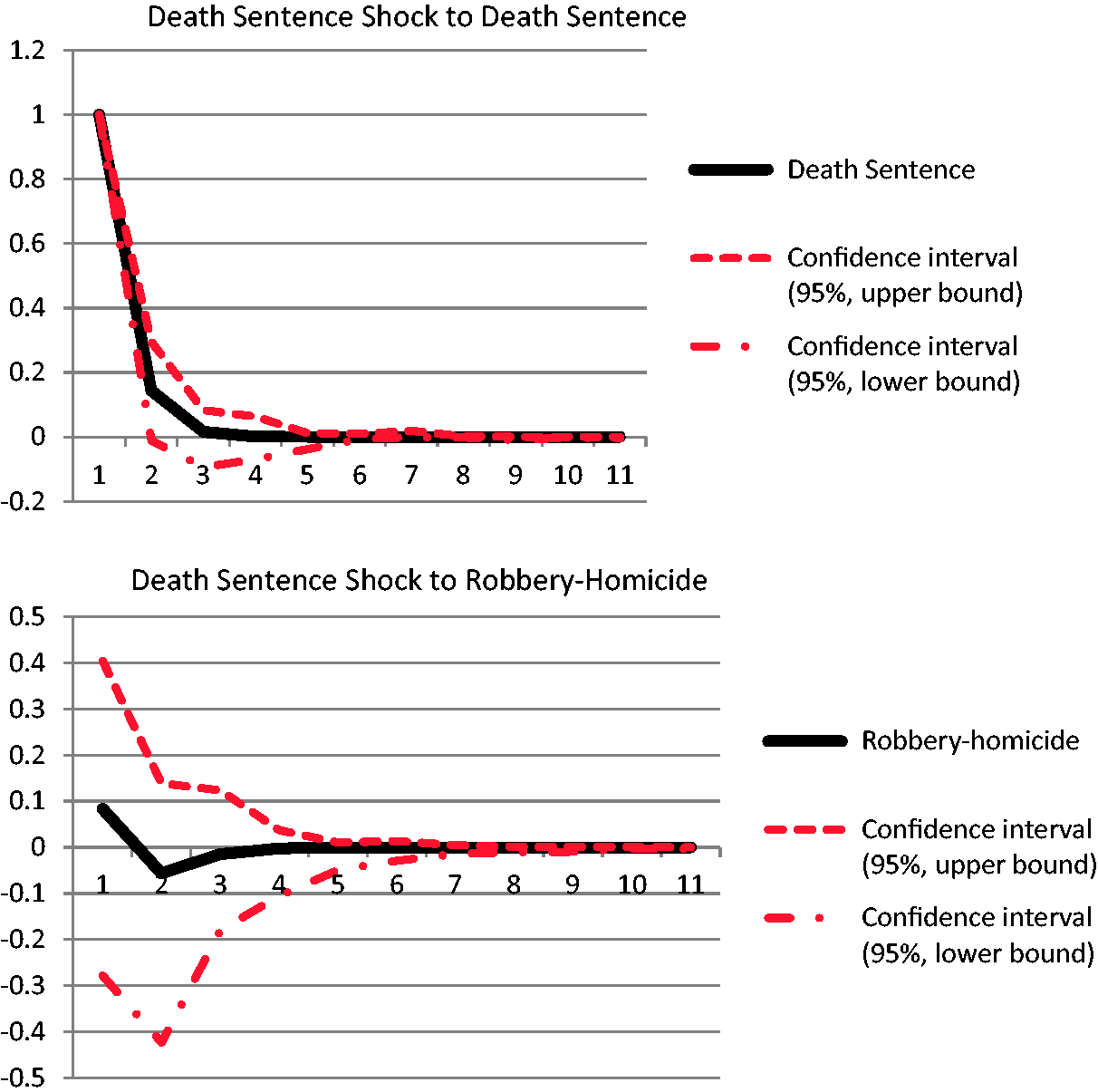
With the VAR method, impulse response functions are used to trace the response of current and future values of each variable to an increase in the current value of one of the VAR error terms. This represents the response of the dependent variable (homicide or robbery-homicide) over time to changes in the vector of independent variables (capital punishment, unemployment, and law reform). The two panels in Figure 4 explain impulse response functions by representing the effect of sentencing one person to death in district court.
9
In the top panel, the horizontal axis represents months and the vertical axis represents the number of persons sentenced to death by district courts. In the bottom panel, the horizontal axis represents months and the vertical axis represents the number of robbery-homicide cases known to the police. In the top panel, the null hypothesis that a district court death sentence in the first month causes other district court death sentences after the first month is rejected because the 95 percent confidence interval (indicated by the dashed and dotted lines) contains 0. In the bottom panel, the null hypothesis that a district court death sentence has a deterrent effect on robbery-homicide is rejected because the 95 percent confidence interval contains 0.
10
Death sentences and life sentences in Japanese district courts, 1990–2010. Impulse responses for death sentences and robbery-homicide in Japanese district courts.
Results
The influence of death sentences, executions, criminal law reform, and unemployment on homicide in Japan.

Note: “No influence” means within a 95 percent confidence interval.
The influence of death sentences, executions, criminal law reform, and unemployment on robbery-homicide in Japan.

Note: “No influence” means within a 95 percent confidence interval.
Table 5 presents our results for homicide. In our VAR models, none of the death penalty variables—executions or death sentences—has an influence on homicide. In contrast, Japan’s “get tough” law reforms (raising the maximum fixed term of punishment and extending the statute of limitations) do have a significant influence on homicide in three of the four models. Conversely, the unemployment rate does not have a significant influence on homicide in three of the four models.
Table 6 presents our results for robbery-homicide. Here, too, none of the death penalty variables has a significant influence on robbery-homicide, but the “get tough” law reforms of 2005 do have a significant influence on robbery homicide in all of the VAR models, and so does the unemployment rate.
We also performed VAR tests to determine whether Japan’s death penalty deterred homicide or robbery-homicide during the 26-month surge in executions that occurred between December 2006 and January 2009. Our conclusions remain unchanged. Even during a period in which Japan carried out executions more aggressively than it had since the mid-1970s, there is no evidence of a deterrent effect on homicide or robbery-homicide.
Discussion
This research examined the deterrent effects of the death penalty in Japan from 1990 to 2010. There are two main findings.
First, the death penalty deterred neither homicide nor robbery-homicide. This double negative is striking because Japan’s criminal justice system punishes robbery-homicide offenders more harshly than ordinary homicide offenders, and because robbery-homicide tends to be a crime of calculation. In Japan, robbery-homicide is the best crime candidate for finding a deterrent effect of capital punishment, yet even for this thin slice of murder we found no evidence of that influence.
Our second finding is that punitive law reform did deter robbery-homicide in Japan, while the evidence for homicide is mixed. This suggests that “getting tougher” on crime in noncapital ways may prevent some kinds of killing. So might macroeconomic policies that reduce unemployment, though in our models the evidence for this conclusion is stronger for robbery-homicide than for homicide.
What explains the contrasting effects of capital punishment and punitive law reform in Japan? The large majority of cleared homicide cases do not result in a death sentence; they result in a term of imprisonment, the most severe of which is life with the (remote) possibility of parole. Legal reforms to lengthen terms of imprisonment may affect the calculations of more potential offenders than changes in death penalty practice do. Similarly, extending the statute of limitations could have increased potential offenders’ perception of their likelihood of being arrested. And since sentencing standards in Japan’s judiciary have been relatively stable over time and consistent across jurisdictions, changes in the number of death sentences may affect the calculations of potential offenders less than legislative changes in sentencing maxima do.
We do not claim that our study decisively answers questions about the death penalty and homicide deterrence in Japan. More research is needed. Our data cover a period of only two decades, and our results might change if we focused on a different time period or if our models were specified differently. But we do claim that our study is the best available about the death penalty and homicide deterrence in Japan. And we emphasize: there is little competition.
Our main finding for Japan is consistent with the findings from studies that have been done about the death penalty and homicide deterrence in the United States, which “do not establish a deterrent effect of the death penalty” (Sunstein and Wolfers, 2008). Our finding for Japan is also consistent with findings from recent peer-reviewed studies of the death penalty and deterrence in Singapore (Zimring et al., 2010) and Trinidad and Tobago (Greenberg and Agozino, 2011) and with findings from previous studies of criminal deterrence in Japan (Matsumura and Takeuchi, 1990; Mori, 2016; Sakamoto et al., 2001). There might be good reasons to challenge our conclusion that the death penalty does not deter homicide or robbery-homicide in Japan, but inconsistency with the results of previous research is not one of them.
Our main finding is also consistent with crime and capital punishment patterns in Japan in the postwar period. Japan’s homicide rate has declined by more than 80 percent since the 1950s (Johnson, 2006). Over the same period, Japan’s annual execution average has dropped from 24.6 hangings per year in the decade of the 1950s to 4.6 per year in the 2000s—a decline of more than 80 percent during a period in which the country’s population grew more than 50 percent. Killers have been vanishing in Japan (Johnson, 2008), especially among young males, who currently commit (per capita) approximately one-tenth as many homicides as their counterparts did in the 1950s. In fact, Japan’s homicide rate is now higher among men in their 50s than among men aged 20 to 24—an age-crime distribution seldom seen in other societies (Hasegawa, 2005). It may be possible to construct an explanation for Japan’s “vanishing killer” that posits capital punishment as a signal to which young males are especially sensitive, but such an explanation would seem to contradict general criminological truths about age and orientations to risk (Gottfredson and Hirschi, 1990).
Executions in Japan are shrouded in secrecy to an extent seldom seen in other societies (Johnson, 2006). This raises the question of whether our “no deterrence” finding results from residents receiving insufficient information about how the death penalty is deployed. In the period under study, all executions were publicized after the fact, and all death sentences were announced by the media on the same day they were imposed or on the day after. Moreover, the only published study of the death penalty, media coverage, and deterrence in Japan (using annual crime statistics) concluded that more reporting about capital punishment did not produce more deterrence of homicide, robbery, rape, or arson (Sakamoto et al., 2001). In our view, the secrecy that surrounds capital punishment cannot account for our “no deterrence” finding, though we encourage additional studies in this field. We also hope Japan’s government will provide more of the data that researchers need (including monthly crime figures) to do sound studies.
There are four priorities for future research about the death penalty and homicide deterrence in Japan. First, future studies should take media coverage into account. In this article, we have analyzed the influence of death sentences and executions on homicide, but how the media handle murder cases varies from case to case. In deterrence studies, understanding the decision-making of potential offenders requires discovering whether they “know and understand the implications of the law” (Fagan and West, 2009: 335). In modern societies such as Japan and the United States, most people learn about law through the media (Sacco, 1995).
Second, future research should search for variation in capital punishment’s effects in different parts of Japan. In this study, our unit of analysis is the Japanese nation, but the deterrent effect of capital punishment in one prefecture could be cancelled out by the brutalization effect of capital punishment in another or by “no effect” results in several (Shepherd, 2005; Zimring, 2008). There is great variation within the United States in how death penalties are administered (Zimring, 2003). There are large variations within the People’s Republic of China too (Johnson and Zimring, 2009: 242). Nobody knows how much death penalty variation exists within Japan, though we do know that noncapital sanctions tend to be more severe in Tokyo than in Osaka (Johnson, 2002: 66–71).
Third, future studies should try to capture the effects of noncapital sanctions on homicide and robbery-homicide in Japan. Potential offenders consider an array of possible consequences, not just those which are capital. In the United States, many studies of the death penalty and deterrence have been plagued by failures to adequately specify the relevant “sanction regime” (National Research Council, 2012: 32). Research about the death penalty and deterrence in Japan should try to avoid this mistake, though future studies may be impeded by the difficulty of obtaining monthly data from Japan’s government and by the fact that some statistics about noncapital sanctions are not collected at all.
Fourth, future research should examine the administration of capital punishment in Japan’s lay judge system. Citizen participation in death sentence decision-making may be altering potential offenders’ perceptions of the sanction regime. It may also influence how state officials (prosecutors especially) make decisions about when to seek a sentence of death and whether and when to execute. Because the lay judge system is new, it will take several more years to generate enough data to do a decent time-series study of the death penalty and deterrence after 2010, when a lay judge panel first imposed a sentence of death. And the first execution of a person sentenced to death by a lay judge panel occurred only in 2015.
Scholars have been studying the death penalty and deterrence in the United States for decades, and much of the research is seriously flawed. There is also evidence that research findings in this field “fuel rather than calm the fires of debate” (Lord et al., 1979: 2108). The National Research Council (2012) has made several recommendations for improving the quality of future research, but considering its critical view of extant studies, it is difficult to see the basis for its optimism. Our own view of the American research is expressed by analogy: “It is impossible to prove that there are no unicorns. All we can prove is that we have found none so far” (Trefil, 1978: 21). Scholars have been searching for the unicorn of deterrence in the United States for more than half a century. When the net result is a statement that deterrence claims cannot be proved or disproved (National Research Council, 2012: 2), perhaps it is safe to put belief in the deterrent value of the death penalty in the same category as belief in unicorns (Sellin, 2013: 178).
In our view, the United States does not need much more research about the death penalty and homicide deterrence. Japan does, and Japanese officials should encourage and enable it. In many countries, evidence about deterrence has been largely irrelevant to the ultimate decision about whether to retain the death penalty (Zimring, 2013: x). In Europe (Temkin, 2015), the United States (Garland, 2010), and Asia (Johnson and Zimring, 2009), death penalty policy has been determined mainly by moral sentiments, political developments, and leadership-from-the-front, not by utilitarian considerations. Nonetheless, Japanese officials frequently invoke deterrence as a reason for retaining the death penalty and for carrying out executions. After publication of this study, they cannot credibly claim there is good empirical evidence to support that view, though they might contend that “common sense” leads to the conclusion that the death penalty deters. Once upon a time, common sense also held that the earth is flat.