




Abstract
This paper asks how punitive forms of non-state punishment play out on the margins of the state, in informal (shack) settlements in South Africa. My focus is on the practice of forcing those who are suspected of certain offences to leave their homes in informal settlements. I refer to this as ‘banishment’ and argue that it is a ‘penal phenomenon’ which is intimately tied to the general precarity that residents experience on a daily basis. The paper examines the ways in which these formally illegal, but nonetheless legitimate practices, draw on and reconfigure liberal state punishment. I use my study to make a broader theoretical point about the interplay between lawful state punishment and unlawful punishment on the periphery of the state. The blurred boundaries between legal (state) violence and illegal (but nonetheless legitimate) violence are particularly ‘visible’ in situations of ‘precarious penality’ – a term that I use to describe the unstable, violent and exclusionary penality that manifests in situations of socio-economic precarity, particularly in contexts of inequality, high rates of violent crime and a delegitimated rule of law. In these circumstances ‘non-state’ punishment contributes to the construction and maintenance of group boundaries and fulfils a similar function to ‘formal’ punishment. Thus, I ask whether it makes sense to exclude ‘non-state’ public authorities which act against ‘criminality’, when asking what or who constitutes the penal field and, when measuring state punitiveness?
We give 3 warnings. After that the whole community tells them to move – the whole community breaks the shack. You just shake it and it’s down. We call the trouble maker – we ask what’s happening. We won’t banish someone for a trivial offence, e.g. playing music too loudly, kids fighting or drunkenness. If she or he doesn’t want to hear the people – if you don’t like living here you must move. If your child steals – we just order you to leave the area – after we have given three warnings. (Chair of section committee, 9 November 2015)
Introduction
This paper takes up the challenge laid down by Hannah-Moffat and Lynch (2012: 119) in the pathbreaking 2012 Special Edition of Theoretical Criminology to study punishment in ‘diverse settings’ and pay attention to ‘localized on-the-ground processes’ (Hannah-Moffat and Lynch, 2012: 119--120). Like them, I ask ‘what counts as punishment?’ However, instead of asking how the state expands its punitive power through ‘ostensibly non-punitive means’ (Hannah Moffat and Lynch: 119--20) I ask how punitive forms of non-state punishment play out on the margins of the state, in informal (shack) settlements in South Africa.
The paper draws on, and adds to, the work of Carrington et al. (2016: 3) who argue that the focus on the state and the Global North in mainstream criminology has resulted in a lack of attention to ‘alternative forms of justice, conflict resolution and punishment beyond the state’. I argue that those ‘non-state’ punishments that take place outside of the formal state but, with its tacit consent, should be included in the ‘continuum of punishment techniques and their varied effects’ (Hannah-Moffat and Maurutto, 2012: 202). My focus is on the practice of forcing those who are suspected of certain offences to leave their homes in informal settlements in South Africa. I refer to this as ‘banishment’ and argue that it is a ‘penal phenomenon’ (Hannah-Moffat and Lynch, 2012) which is intimately tied to the general precarity that residents experience on a day-to-day basis. Whereas Hannah-Moffat and Lynch (2012: 120) use the term ‘penal phenomenon’ to include other exercises of state power, apart from that which is imposed following a formal criminal trial in the term ‘penal’ (Zedner, 2016), I argue that certain ‘non-state’ practices are also penal phenomena.
Analytical frameworks
The term ‘banishment’ in the Punishment and Society literature (see, e.g. Badcock, 2016; Beckett and Herbert, 2010; Bowker, 1980; Coy, 2008; Laitinen, 2013; Morgan and Rushton, 2013) generally refers to state policy. 1 I use it as an analytical category to refer to the punitive technologies deployed by non-state actors when residents in South Africa’s shack settlements force alleged criminals to leave the area in which they reside.
Like the ancient penal institution of banishment, the phenomena that I describe are punitive ‘spatial practices’ (Laitinen, 2013: 550), entailing physical and symbolic exclusion from the ‘community’. They are aimed at ‘making a good community’ (Laitinen, 2013: 550) via processes of ‘social cleansing’ (Laitinen, 2013: 560). I use the term banishment, as opposed to exclusion (Beckett and Herbert, 2010), because as I argue, these are penal phenomena. They are meted out against those considered deviant – as a substitute for imprisonment or some other form of ‘penal control’ (Garland, 2017: 18) and involve ‘public shaming’ and stigmatization. Whilst unlawful, banishments are mostly ignored by the state and thus, as I argue, are tacitly accepted.
Drawing on Lund’s (2006: 685) idea of ‘public authority’, I argue that when ‘local institutions’ – such as street committees or looser formations of residents – banish individuals from informal settlements they act in a ‘semi-public’ (Valverde, 2011: 292) capacity, assuming the mantle of a ‘public authority’. Lund, drawing on Jessop (1990: 342), refers to an ‘ensemble of institutions exercising public authority’, rather than some fixed, objective entity called The State. This ensemble includes institutions which appear to be the opposite of the state, but, in practice, exercise state-like functions – such as meting out punishment against suspected criminals.
I argue that banishment is a ‘collective criminal punishment’ (Garland, 2005: 795) which does not overtly challenge the state’s monopoly over legitimate violence. It is imposed after communal deliberations, in terms of certain procedures, some of which mimic and distort elements of official law. As is the case with legal punishment, banishment is triggered by offending conduct (usually in response to an allegation of a serious crime). It targets the individual offender as well as his or her family and, as a collective penal ritual which ‘draws on norms of retributive justice’ (Garland, 2005: 799), is largely tolerated by both state and non-state actors (being only weakly policed or punished). As such, it enjoys a degree of legitimacy, albeit unstable and contested, in terms of which a ‘hostile solidarity’ (Carvalho and Chamberlen, 2018: 217) is engendered against ‘wrongdoers’ (Carvalho and Chamberlen, 2018: 225; Garland, 2005; Mead, 1918; Super, 2016b).
My empirical data draws on South Africa, which, because of its history of state toleration of informal policing and punishment, provides an excellent site for analysing the multiple relationships between state law and local forms of punitive justice. However, my argument about the need to include coercive forms of ‘non-state’ punishment under the rubric of punishment is applicable to other marginal spaces. It is here, where day to day existence is characterized by ‘uncertainty and illegality’ (Jensen et al., 2017: 30) that the collective punishments meted out give us a glimpse of the frailties of liberal discourse which presents punishment as a sanction imposed by the state. Indeed, although liberal political theory presents the state as having a monopoly over the legitimate use of violence (and hence punishment), as Das and Poole (2004: 7) note, this is a ‘fiction’. In practice, non-state punishment is tolerated (and sometimes encouraged) by the state (Fourchard, 2008; Garland, 2005; Jensen et al., 2017) and ‘The State’ itself is ‘pluricentered, multileveled and decentralized’ (Gupta 2012, cited in Oldfield and Greyling, 2015: 1109).
Whilst I am by no means arguing that extra-legal non-state punishments do not also occur in affluent areas (see, e.g. Comaroff and Comaroff, 2016; Loader, 1997) they are not the focus of this paper. It is precisely because of the ‘fragility of context’ (Das, 2004: 244) – grinding poverty, a largely absent state and complex social problems, including high rates of violent crime, endemic unemployment and deep inequality, that violent reconfigurations of state law are more ‘visible’ in marginalized resource strapped areas where residents lack the technologies that the more well off have to ‘secure [ their ] political and economic survival’ (Das and Poole, 2004: 8).
I use the term ‘precarious penality’ (Super, 2017) to depict an unstable, violent and exclusionary penality that manifests in contexts of socio-economic precarity. The illegal penal phenomena that are central to precarious penality – such as banishment, corporal punishment and ‘mob justice’ 2 – are labile, ephemeral and unstable. In other words, they are precarious, slipping from one form into another, appearing and disappearing. They sometimes emerge out of lawful crime prevention initiatives, such as neighbourhood watches (Super, 2016a) and, as such, are the point at which practices of crime prevention and punishment collapse into each other. They are, mostly, tolerated by an underperforming state (of which poorly functioning legal institutions are but one facet). In contexts of precarious penality a generalized distrust of the state – particularly the police and criminal justice system – is coupled with a call for harsher punishments in order to solve a daunting array of complex social problems (Caldeira and Holsten, 1999; Godoy, 2006; Goldstein, 2003; Hornberger, 2013). The result is a punitive and exclusionary form of ‘abnormal justice’ (Aas, 2014: 520) that flows out of the precarious, fragile and fragmented (Godoy, 2006) solidarity experienced on the margins.
Methodology
This article is based on research conducted as part of a broader project, on crime prevention and punishment in three former black townships in Cape Town (Khayelitsha, Philippi and Masiphumelele) for which I have, in addition to other modalities, interviewed more than 80 people between 2013 and 2018. My argument is based on a subset of 36 interviews with current and former street, section and area committee members who were involved in banishment decisions and/or in carrying them out 3 ; with residents who had knowledge of these practices 4 ; and with members of informal crime prevention committees and/or community patrol groups. 5
I also observed the proceedings of a magistrate’s court trial where three community leaders were charged with theft and malicious damage to property for participating in a purported banishment of two sisters. I interviewed the chairperson of the section committee, the defence attorney, the victims of the banishment, various community members who knew about the case and the prosecutor involved in the subsequent mediation proceedings. In order to protect the identity of my interviewees, I have not used the names of the magistrate’s court, or the specific informal settlements where I conducted my fieldwork. Given that banishment is a subterranean form of punishment that occurs under the radar and, for the most part, does not end up in the criminal justice system, this extended case-study was a useful opportunity to highlight what happens, in those (rare) instances where a banishment case proceeds to court.
Finally, I conducted a content analysis of 60 newspaper articles on banishment. I extracted these from the 6563 articles on shack destructions in South Africa, between 1999 and 2018, which I located on Factiva – an online database of South African newspapers.
The article unfolds in three parts: ‘Street committees and shack allocation’ ‘An alternative to mob justice’ and ‘A penal phenomenon legitimated by its collective character’. In the first section, I describe the precarity that characterizes life in informal settlements and the way that street committees act as ‘public authorities’, specifically as regards living arrangements. In ‘An alternative to mob justice’ I discuss two broad categories of banishment – ‘voluntary’ relocation to the Eastern Cape (a rural former apartheid homeland) and the more violent shack evictions and demolitions that are front and centre of my case study. I discuss how banishment is implemented in reaction to an allegedly ‘lenient’ criminal justice system and, as such, is a ‘preferred alternative to official justice’ (Garland, 2005: 798). I argue that banishment can quite easily collapse into collective violence but that my interviewees always presented it as a humane alternative to ‘mob justice’. Finally, in ‘A penal phenomenon legitimated by its collective character’ I discuss my case study under two sub-headings: ‘The banishment of N and T’ and ‘Lost in translation’. Drawing on Godoy (2006) I argue that banishment, like lynching, also functions as a Durkheimian attempt to ‘build solidarity’ in a context of precarity. In the ‘Conclusion’, I return to the concept of precarious penality and argue that, as a descriptive term, it should not be limited to contexts of socio-economic precarity in the Global South and that further research needs to be done to see how it can apply in other contexts.
Street committees and shack allocation
A type of ‘permanent temporariness’ (Yiftachel in Oldfield and Greyling, 2015: 1103) shapes daily life in informal settlements in South Africa where more than 1.2 million households live in shacks that are erected on unsurveyed non-residential land, unapproved by a local authority and, ‘not intended as a permanent dwelling’ (Housing Development Agency, 2013). The destruction of a shack (an activity that can be carried out in under 30 minutes); evictions (both lawful and unlawful); 6 and other forms of forced relocation contribute to a precarious existence where impermanence and lack of security are the order of the day. Since 2004 extralegal forms of collective (and often violent) mobilization against poor service delivery, inefficient policing, criminals, foreign nationals and state evictions have been central features of the political landscape in these spaces (Kynoch, 2016; Makhulu, 2015).
Living conditions are cramped and services, such as the provision of potable water, adequate sanitation, electricity, garbage collection and policing are severely lacking (McFarlane and Silver, 2017; Oldfield and Greyling, 2015; O’Regan and Pikoli, 2014; Sacks, 2014). Crime rates are far higher than in the middle class formerly white areas. Thus, for example, in 2016–2017, the murder rate for Khayelitsha was 100.7, almost double the provincial rate of 51.76, and three times higher than the 34.1/100,000 national murder rate (Department of Community Safety, 2016). As residents wait for the state to provide formal housing – some having waited for longer than 20 years, others having died waiting (Ntongana, 2017) – they live in a ‘grey’ zone in ‘spaces of informality and illegality’ (Oldfield and Greyling, 2015: 1102) on land that was once vacant and rubble-filled and is either owned by the state (usually the provincial or local government) or by private owners.
Street committees play an important leadership role which stems from long-standing historical practices of informal (non-state) governance in black townships and what used to be known as ‘squatter settlements’ (Burman and Schärf, 1990; Drivdal, 2016; Makhulu, 2015; Sapire, 1992; Seekings, 2000; Super, 2016a). During the mid to late 80s, at the height of the struggle against apartheid, the African National Congress (ANC), together with the United Democratic Front (UDF), sought to deploy the street committees to unite ‘disparate localized struggles’ under the banner of the national liberation struggle (Seekings, 2000: 170). While the ANC cannot claim credit for their formation it promoted street committees as a means of implementing ‘people’s power’ and ‘grassroots’ democracy while simultaneously calling on activists to make the townships ‘ungovernable’ (Seekings, 2000). The idea was that street committees would take the place of the hated apartheid municipal structures and oversee important tasks – such as street cleaning, the allocation of housing, and administration of justice. Ideally there would be a street committee on each street, with an area committee (comprised of the streets in a specific area) forming the second leadership tier, and the local civic constituting the township’s highest representative body (Adler and Steinberg, 2000). Yet, as is the case today, the establishment of street committees was uneven and the practices perpetrated in their names did not always live up to expectations (Adler and Steinberg, 2000; Sapire, 1992).
In 1992, on the eve of becoming the governing party, the ANC, in a type of ‘demobilization’ (Gillespie, 2014: 7) process which had limited success, sought to unite all street committees under the umbrella of the South African National Civic Association (SANCO). More recently, it has attempted to harness the ideology of ‘community’ and grassroots democracy to that of ‘community based crime prevention’ and ‘community policing’, encouraging street committees to play a central role in neighbourhood watches and community police fora (Fourchard, 2012; Super, 2016a, 2016b). Unlike in the pre-1994 period, in modern day South Africa many street committees have constitutions; no longer openly mete out corporal punishment; and have female members (including as chairpersons). As was the case during the 1980s they consist of between 7 and 15 ‘executive’ members who meet weekly and hold a weekly ‘general meeting’ with the residents in an area in order to deal with local issues, such as shack allocation and crime (branch secretary of SANCO, 23 October 2014; area committee chair, 27 December 2014; Super, 2016a). In practice, these meetings are not always well attended and street committees struggle to have their decisions enforced in the ‘new’ South Africa (Super, 2016a), having to continuously construct (and reconstruct) their political legitimacy both vis a vis the state and the ‘community’ (Bénit-Gbaffou and Katsaura, 2014 cited in Drivdal, 2016).
In terms of unofficial ‘rules’ prospective residents are required to furnish the local street committee with a formal letter (written on a letterhead), which states the reason for leaving their previous residence and, the contact details of two referees. Where a resident wishes to sell his or her shack the rule is that it should be done through these committees and first be offered to ‘locals’ (people living in the area). Only after it has been on offer for 3 months can it be ‘sold’ to an outsider, provided that the required credentials are furnished (Super, 2016a). One of the reasons given to me was because ‘we don’t want criminals living in our area’ (street committee member, 4 October 2014; see also Drivdal, 2016). Even when a sale is authorized by a street committee it can revoke the ‘right’ to reside in the shack as well as in the area over which it has jurisdiction. This revocation may take the form of eviction and/or demolition. Thus, despite the fact that money changes hands the legal consequences are blurry and shack occupants have no security of tenure. This insecurity is graphically foregrounded when extra-legal evictions occur. As one interviewee explained: these evictions could not occur if a suspected criminal owned a regular home: they only occur when occupants have no formal ‘rights’ to the space that they occupy (area committee chair, 16 June 2014).
An alternative to ‘mob justice’
Banishment to the Eastern Cape
My interviewees justified banishment to the Eastern Cape, particularly in the case of those under the age of 35, as an attempt to remove wrongdoers from their criminogenic surroundings and to give them the benefit of a rural and traditional setting (community counsellor, 9 July 2018; civic association chair, 18 June 2018; section committee chair, 18 June 2018; resident, 13 July 2018). In this sense, then banishment draws on a reformative discourse which seeks to ‘remedy deviance with distance’ (Coy, 2008: 53). Although euphemistically referred to as ‘voluntary’ banishment is underpinned by the threat of violence against both the wrongdoer and his or her family.
The Eastern Cape is one of South Africa’s nine provinces. It consists of a combination of two impoverished former Xhosa homelands – the Ciskei and Transkei – to which African households were forcefully relocated during apartheid and which served as a pool of migrant labour for those (men) who had permits to work in the white urban areas. The fact that most residents in Cape Town’s informal settlements still have familial ties with the Eastern Cape makes it a convenient repository for those who are no longer wanted in the community. However, the ironies of this new forced relocation, to a space that still bears the stigma (and structural consequences) of apartheid’s policies of underdevelopment, are plain to see. As a government official explained to me: In the last 20 years the Western Cape has doubled its population. If you understand what the Eastern Cape looks like you can see why people come to Cape Town. Service delivery has gone to the dogs in Butterworth. There are less than 100 ambulances working for whole province, the roads are potholed, people share waterholes with animals, children are dying in pit latrines. (5 July 2018)
This punishment is targeted at the family as well as the wrongdoer, thus, when the members of a street committee called a meeting with the mother of a child who was using tik (a highly addictive metamphetamine) and ordered her to send him to the Eastern Cape because he had been stealing, she had no choice but to obey. Reporting him to the police had not been a solution because they had ‘just arrested and released him’ (resident, 21 June 2014). In another case, a street committee member explained that when a community member was robbed by a youth he was not ‘chased away but his parents sent him back to the Eastern Cape’ because they knew the consequences: ‘we can beat the kid or chase both the kid and the parents away’ (16 August 2014).
The police are aware of these punishments but, because the street committee is in a sense fulfilling an important order maintenance role, these actions are tolerated. Thus, when two brothers, aged 22 and 27, were suspected of breaking into shacks the section committee called the parents and wrongdoers to a meeting where, according to my interviewee: we sat down and tried to talk to convince them that if they kept on doing that … we’ll chase away the whole family…. At the first meeting with their parents we said we would work together and the kids promised to behave, we agreed at the meeting that if anything happened again they would have to move. We agreed on a period of 6 months. (Chairperson of area committee, 21 June 2018). we told them we are removing these people because they are causing a problem to us. We told the police because we didn’t want anyone to beat them. [The police] helped us to push them out. (Chairperson of area committee, 21 June 2018)
Thus, sending someone to the Eastern Cape is a form of exile (punishment) – to a place that most people are migrating from; a form of crime prevention; and an alternative to death, because it is justified as a means to prevent ‘mob justice’. It is also a substitute for incarceration.
A substitute for incarceration
Although the technologies of banishment are not new, the rationale underpinning their use is a new development – adopted in response to the post 1994 legislation on bail and the perceived inefficiency and leniency of the criminal justice system.
Ironically, although the demise of apartheid and repeal of the death penalty was accompanied by a marked increase in long-term prison sentences (Ballard, 2014; Super, 2013) and, despite the existence of an overall ‘punitive environment around sentencing’ (Redpath, 2012: 37), admissions to prison dropped 25 per cent during the period 2003–2008 and sentenced (as opposed to pre-trial) prison admissions dropped by 45 per cent (Redpath, 2012: 37). In 2014, sentenced admissions were only slightly higher than in 2013, when they were at their lowest (Ballard, 2014). This decline in the rate of sentenced admissions is not because the state is becoming more lenient but because proportionally fewer cases are placed on the court roll each year and fewer still are brought to trial (Redpath, 2012). Thus, imprisonment in South Africa is considered a ‘luxury’, both in terms of a populist discourse of ‘less eligibility’ which presents prisons as ‘five star hotels’ (focus group discussion, 6 March 2013), and also because of the demand for more imprisonment. My interviewees were unanimous in their perception that ‘criminals’ were released when they should not be (both pre- and post-conviction).
Protests outside court during bail applications are common: they highlight residents’ anger and frustration about certain crimes; demonstrate support for the victim and; most importantly, demonstrate to the court and the accused that release on bail might result in ‘mob justice’ or death (Matlapeng, 2017; Super, 2016b). These protests should be seen in the context of both the Constitutional provisions on bail 7 and the Criminal Procedure Act which provides that a court may, when making a bail decision, take into account the perspectives of crime victims and/or the community in which the crime occurred. It is precisely because a court may refuse bail if the release ‘will disturb the public order or undermine the public sense of peace or security’ 8 that affected communities use protests as a means to send a strong political message to the state – ‘listen to us or else’. In this way then the law itself opens the door for an ambiguous and vengeful community to influence the supposedly unemotive criminal justice system.
In those instances, where a person is released on bail, against the wishes of the community, it is not uncommon for them to be banished and to have their shack destroyed. A street committee member told me how, as a crime prevention coordinator, he and other men destroyed the shack of two alleged robbers after they were released on bail: ‘we broke the house, beat the person and called the police to tell them to take the person. They never came back’ (16 August 2014). As an area committee member explained to me: it is better to ‘chase’ people away because ‘if you take the person to the police station he stays for a few days and then he’s back’ (16 June 2014). In another case, a community leader is quoted as stating that if a man, arrested for the kidnapping, rape and murder of a 5-year old girl, was granted bail ‘the community would want to take action’, and that he was ‘banned from staying in Strand, otherwise the community could take the law into their own hands’. He blamed the ‘national tendency of killing women and children’ on a justice system that was ‘overly lenient on offenders’ (Phaliso, 2017).
Thus, banishment enables community members to express ‘socially sanctioned fury’ and to ‘act out communal outrage’ (Garland, 2005: 820). It is not only an instrumental action seeking to deter future offending but is also a response to the state’s perceived failure to punish in a context of ‘conflicting powers and multiple authorities’ (Garland, 2005: 810), where due process is not universally accepted.
Residents also protest outside court when the police arrest those who have participated in demolitions pursuant to banishment decisions. Thus, when a Philippi community leader, accused by residents of unilaterally selling unoccupied pieces of land, had her shack destroyed – with the police watching as she was ‘forced to pack her belongings’ and ordered to leave the area – the subsequent arrest of two of the community leaders resulted in 50 residents protesting outside the Magistrates’ Court demanding their release on bail. A member of the ‘community leader committee’ (Chiguvare, 2017), referred to a 2009 ‘community constitution’ and stated that if a community leader is corrupt we destroy his or her shack and ask her to leave the area and this is exactly what we are doing…. We will not accept such behaviour in our community (Chiguvare, 2017).
‘It’s just punishment, not mob justice’ 9
Interviewees counterposed banishment to ‘taking the law into your own hands’ (synonymous with murder or ‘mob justice’). Thus, the chairperson of a street committee distinguished between ‘negotiating’ to get stolen property back; ‘taking the law into your own hands’ (killing) and sending someone ‘back to the Eastern Cape’ (banishment) (1 February 2014). The defence attorney in the case study also distinguished banishment, which he regarded as a form of ‘justice’, from ‘mob justice’. He argued that when someone contaminated the ethos of the community [and] transgressed [its ] ‘moral boundaries’ the street committee should have the same power as the courts ‘to send people away’ (22 October 2015). In reply to my question of whether it was constitutional he replied that since the courts had the power to send people away (to prison) when someone had committed an offence so too should the street committee have the power to curtail an offender’s right to live in a community. According to him, it did not conflict with freedom of movement because the ‘culprits are given many chances before they are finally kicked out’. Thus, if the law ‘empowered’ street committees and gave them more authority to enforce their decisions, there would be less ‘mob justice’ (ibid. Defence attorney, 22 October 2015). This point of view was echoed by other street and section committee members who were frustrated by their lack of ability to enforce decisions and also their inability to mete out violence against ‘criminals’ in the face of a state that seemingly does not care about the high crime rates in informal settlements (O’Regan and Pikoli, 2014; area committee chair, 7 December 2014; section committee chair, 1 February 2014).
In one instance, an interviewee showed me an empty space and explained that 3 weeks ago the ‘community people’ had asked four people to leave their shacks because they were selling drugs. They had been instructed to ‘take their material and clothes’ and move out (16 June 2014). A Branch Secretary of SANCO told me about a case where a man’s neighbours complained to the street committee because his shack caught fire every month – when he cooked while drunk. The committee gave him three warnings, as they were obliged to do (in terms of their constitution) but he ignored them so they called a general meeting where he was told to ‘take his materials and leave the space’ (23 October 2014).
A high ranking police witness admitted knowing about these ‘formal meetings’ and the collective sentences imposed when people were ‘evicted from their homes with regards to a crime that’s committed’ As he stated: It might be a child molestation case or it might be a housebreaking cases where these formal meetings have taken place but none of these were accompanied by violence. These people were just motivated to leave, which they then did. (Nel, in O'Regan and Pikoli, 2014: 4635)
As a magistrate’s court prosecutor explained, a constitution is ‘like a church – everyone abides by it because it’s an independent entity therefore it’s difficult to challenge and change’ (4 November 2015). In this way then, the (liberal) South African state – via its Constitution which is imbued with the same magic as church doctrine – ‘penetrates’ community life while simultaneously remaining ‘elusive’ (Das, 2004: 245) because its fundamental precepts are not really adhered to. The idea of the ‘Law’ is used ‘out of context’ (Das, 2004: 245) to clothe unlawful actions with a veneer of legality.
As is apparent in the case study, while formally unlawful, banishment is nonetheless ‘licit’ (Roitman, 2006: 249) by virtue of its’ collective character. The act of demolition (or eviction) is a powerful ‘penal performance’ (Coy, 2008: 134) involving a ritual of dishonoring, degradation and purification with an ‘accompanying normative discourse’ (Garland, 2005: 798) that affirms a ‘hostile solidarity’ against the transgressors of community norms.
A penal phenomenon legitimated by its collective character
The banishment of N and T
N and T were two sisters who lived in an informal settlement. N was a member of a local stokvel 10 and was responsible for depositing the monthly contributions of members at a grocery store. At a certain point, she stopped doing this, confessed to the other members (three of whom were also section committee members), and was ordered to attend a meeting convened by the chairperson of the committee – to discuss repayment. At this meeting, attended by N, her two brothers, and 12 stokvel and section committee members, there was a dispute about the amount owing. N alleged that she had taken 5000 ZAR (390$) whereas the stokvel members, having refused to show N the books, claimed that it was 10,100 (800$) (N, 8 August 2015).
Since the stokvel’s constitution provided for the immediate eviction and sale of a shack and its contents in instances where a member failed to contribute his or her share and/or unauthorisedly took money the stokvel, in conjunction with the section committee, dispossessed N of her shack. They padlocked the door, sold her possessions, and ordered her to move out of the area. N and her brother reported the matter to the police where there was some confusion as to how to proceed. According to a ‘senior Detective woman’ there was ‘no case’ because ‘the stokvels people were right’. She advised N to repay the money because otherwise ‘these people would kill her’ (brother, 2 November 2015). However, according to another police officer there was a case of ‘theft and illegal eviction’ (brother, 2 November 2015). A police officer then accompanied N to the chairperson’s shack, where she offered to pay 10,000 ZAR in return for her shack and goods. This offer was refused: the stokvel members opened the shack to show N and the police officer that it was empty and said that she was ‘not welcome in the area’ (N, 8 August 2015).
N then moved in with T, who lived in a shack nearby, at which point the section committee instructed T to attend a general meeting, in an open area near some outside toilets (Figure 1). Residents were notified by loudhailer that a meeting would be held in order to decide what to do about the ‘thief’ in their midst. At this meeting, T was surrounded by a crowd of people who shouted at her and called her sister a thief who should ‘stay outside under the bridge’ on the grounds of her ‘criminality’ (T, 20 February 2018). T denied that her sister was a thief, arguing that she had offered to pay the money back. Because of her refusal to evict N she was ordered to leave the area and given 48 hours to vacate her shack.
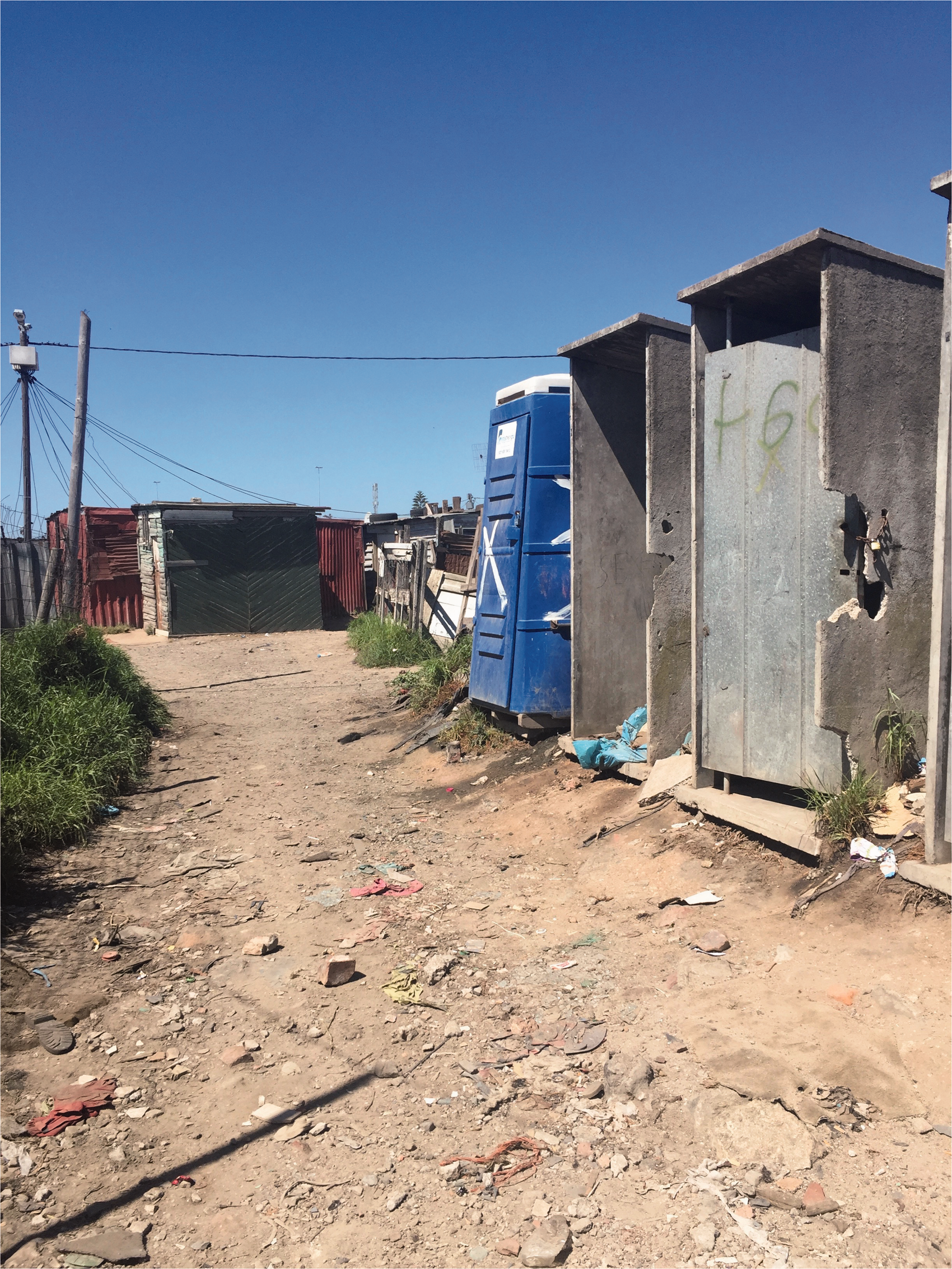
The meeting place (taken by author on 20 February 2018).
T sought help from the police who said that she should ‘relax and that the court would do whatever it takes’ (T, 8 August 2015). Two days later, after giving T 30 minutes notice, the section committee instructed her to attend another general meeting, where she ‘stood in the middle of more than 100 people’ (T, 8 August 2015), was accused of disrespect and informed by the stokvel chairperson that ‘we’ve decided that we are going to destroy your house because you are keeping a criminal’ (20 February 2018). T described the demolition as follows: After the meeting everyone went to my shack, V [the chairperson of the stokvel] threw the first stone at a window…. They bashed my shack down in 30 minutes. I had no money and nowhere to sleep. I sat outside the whole night, alone. I was 26 weeks pregnant. No-one around helped me because they had been told by V that if anyone tried to help me ‘I’ll see that your home is also destroyed’. (T, 20 February 2018).
During the theft trial the defence attorney depicted N and T as ‘morally repugnant’ (notes taken at the trial, 21 August 2015). The thrust of his cross examination was that N had stolen money from the stokvel and T had used some of the money for her business. He also asked N why she only laid charges against three people when his clients were helped by others to ‘carry the television out of the house’. Although N’s response was that she had acted in accordance with the police instructions, to only identify three people, the court granted the defence application for a section 174 discharge, 11 finding that it was unfair that only three people were arrested and charged for theft when in fact the ‘whole community’ had participated in removing N’s goods from her shack and selling them (notes taken at trial, 21 August 2015). After their acquittal the stokvel members laid a charge of theft against N which resulted in her being arrested and spending the weekend in the police cells.
Lost in translation
Although the members of the stokvel and section committee were (eventually) arrested their actions, which had ruptured N and T’s lives, were translated into the relatively innocuous legal categories of ‘theft’ and ‘malicious damage to property’. It was precisely because they were not charged with the more serious charge of ‘intimidation’ that their lawyer was able to successfully request that the case be diverted. Thus, because they enjoyed “linking social capital” (Van Steden et al., 2011: 446), by virtue of having appointed an attorney to assist them in ‘playing’ the criminal justice system, they were able to avoid being punished.
The court’s acceptance and recording of the defence lawyer’s aggressive cross examination of N was in a sense a ‘reversal of justice’ in terms of which the magistrate incorporated and partially legitimated the ‘reciprocal acts of self-made justice’ (Poole, 2004: 49) engaged in by the accused. Thus, even though the defence lawyer acknowledged, during his cross examination of T, that his clients had participated in evicting N and selling her goods, they were found not guilty – without having to lead any evidence at all. In this way, then the court implicitly accepted the moral framework underlying the forceful taking of N's property – it was not a theft but a ‘sale in execution’– albeit without a court process; based on an unlawful constitution; and in terms of a procedure that was punitive, rather than fair. As such the evictors became the victims. This highlights how, in situations of precarious penality, the ‘usual categories are blurred … and inhabited in unexpected ways’ (Stevenson, 2007: 142).
Although T’s shack was rebuilt the ‘new’ shack was inferior to the old one. Whereas T used to live in two rooms, with windows, the new structure had only one room, ‘windows’ made out of cardboard, and ‘rubbish in the walls’ (T, 18 August 2015). I recall interviewing N and T in August 2015, sitting on one of their two double beds, inside a small, cold room in the shack that they shared. The ‘windows’ consisted of cardboard and bare lightbulbs flickered until a power failure left us sitting in the dull light of a Cape Town winter’s day. As a result of missing work due to the demolition T also lost her job as a cleaner and the impression I was left with was that these sisters really had nothing (field-notes, 18 August 2015). N’s banishment was still in place when I met her again in February 2018 and, although T still lived there, having spent an additional 6000 ZAR (473$) to rebuild her shack ‘like before’, she was ostracized by the section committee.
Yet, T’s shack was rebuilt, she still lives in the area, and N, although no longer permitted to reside there, still visits (T, 20 February 2018). This highlights the instability that is one of the defining characteristics of precarious penality: although the section committee and stokvel members could act as ‘sovereigns’ (Cooper-Knock, 2018: 8), their sovereignty was unstable and, in order to secure their legitimacy, they had to claim to be acting on behalf of ‘the community’. As the section committee chairperson put it: ‘We are the community and we acted as the community, not the committee’ (9 November 2015). This is consistent with my other data: interviewees consistently explained that the decision to banish is made by the ‘whole community’ 12 when ‘it’ can no longer live ‘peacefully’ with ‘these people’ due to their ‘criminality’ (area committee chair, 2 September 2014).
However, given the precarity of existence and general insecurity in informal settlements the notion of ‘community’ that committee leaders (and indeed also the state (Super, 2016a, 2016b)) draw on to legitimate their actions (or inactions) belies a fragmented solidarity. The fact that residents attend meetings does not mean that they necessarily agree with the decisions that are taken and thus the idea of ‘the community’ is more of a discursive legitimating device than a reality. One interviewee told me that she feels compelled to attend general meetings because she wants to be seen as being part of the community, rather than outside of it (resident, 9 July 2018). Another said that there is always a ‘lot of fighting’ (resident, 16 June 2014) at these meetings and although decisions are mostly made by a show of hands sometimes the person who has the loudhailer and speaks persuasively is the one whose suggestion will be followed (civic association secretary, 18 June 2018).
Thus, the act of banishment, like the lynching described by Godoy (2006) in her work on Guatemala, is not just a form of punishment or crime prevention but is crucial in ‘affirming’ the idea of ‘community’ (Godoy, 2006:115). In this sense, it represents a Durkheimian attempt to ‘build solidarity’ in a context of precarity (Godoy, 2006: 114).
Conclusion
This paper has linked the phenomenon of banishment with the general precarity that residents living in informal settlements experience on a daily basis. I have argued that banishment is a penal phenomenon which is legitimated by the idea of the collective. Like state punishment, it has latent and manifest functions. It serves a utilitarian function of deterrence and retribution (similar to the justifying discourse on imprisonment); a political function (by sending a clear message to the courts to act harshly); and is a public display of penal power (intended for both the wrongdoer and onlookers) which demonstrates the strength of ‘communal norms’ in situations of instability and insecurity. Banishment is not imposed because communities are cohesive, united and punitive (by nature) but because they are fractured, vulnerable and desperate for state support to solve complex social problems. It is precisely because of obscene inequality, high rates of violent crime, and a delegitimated rule of law that the boundaries between legal (state) violence and illegal (but nonetheless legitimate) violence collapse in on each other. Furthermore the line between ‘community’ and ‘mob’ is a porous one and, what starts out as banishment can morph into more spectacular forms of collective violence, resulting in death or serious injury. This instability is central to precarious penality.
When local institutions impose banishments they wear the mantle of a ‘public authority’ and engage in practices which, to a certain extent, both reflect and reconfigure the processes and outcomes of official (state) punishment. By ignoring these phenomena the state is simultaneously exercising its authority to set the boundaries of what constitutes acceptable behaviour and, in a sense, delegating its own power to act punitively. As such, we need to ask whether it makes sense to exclude non-state public authorities, which act against ‘criminality’, when asking what and who constitutes the penal field and when measuring state punitiveness. Whilst banishment is formally unlawful it is legitimated by virtue of being tolerated. Thus, like Das and Poole (2004), one might ask whether the limit is, or is not, part of the very thing it limits: whilst in theory non-state punishment is the constitutive outside of state punishment it is also part of it – it is its messy and contested everyday underside.
The particular penal form of banishment in South Africa is obviously different from specific forms of extrajudicial punishment in other places but in general these practices are more visible in marginalized areas where non-state actors call on the state to act against crime and/or act in its place. In these spaces – where the clash between liberal penal values and punitive community attitudes is patently obvious – ‘non-state’ punishment contributes to the construction and maintenance of group boundaries. In this sense, it fulfils a similar function to ‘formal’ punishment, with the ‘margin’ taking on the centre’s punishment role (Nelson, 2004: 136) and, in the process, reconfiguring liberal punishment.
This is not only a Global South phenomenon, nor only one that occurs in poor neighbourhoods. As Carrington et al. (2016: 6) put it: there are ‘enclaves of the South within the North and unresolved North/South tensions within many societies’. The concept of precarious penality is not only applicable to peripheral spaces but also to ‘sites of practice’ on which state law (in my case punishment) is reconfigured by extra-state ‘forms of regulation’ (Das and Poole, 2004: 8). There is more research to be done on how, where and when this occurs.
Instead of viewing punishment as being either state imposed (and lawful) or non-state (and unlawful) we should instead view it as being constituted by an assemblage of penal phenomena which occupy shifting spaces on a punishment continuum. At one end, we have court imposed punishments and at the other are the unlawful (but still legitimate) ‘non-state’ punishments which are, to varying degrees, tacitly tolerated by ‘state’ and ‘non-state’ actors. The positions that the various penal phenomena occupy on the continuum are not fixed but shift, depending on the context: the greater the precarity the less the stability.
Thus, instead of viewing exclusionary and abnormal justice as being outside of official (state) punishment perhaps we should, in certain clearly defined circumstances, which I have begun to identify in this paper, view it as being an unstable and contested part of it. It is precisely because traditional notions of punishment as a constitutionally protected state function break down in practice that we should reassess liberal penal theory in light of what actually happens, and precarious penality is a theoretical concept that assists us in doing so.
Footnotes
Acknowledgements
I would like to thank Dr Mona Lynch and the anonymous reviewers for their insightful comments. Thanks are also due to Hae Yeon-Choo, Sarah-Jane Cooper Knock, Paula Maurutto, Phil Goodman and Ashley Rubin for commenting on earlier drafts. Isra Saghir assisted with the content analysis of the newspaper articles. This research would not have been possible without the incredible generosity and kindness demonstrated towards me by the people that I interviewed. All remaining errors are mine.
Funding
This research was partially supported by funding from the Connaught Program at the University of Toronto.