



Abstract
In this paper, we undertake a case study of the National Hockey League’s supplementary discipline regime to reflect on the ways in which discourses about social harm are configured, taken up and used in the sporting landscape and how they reflect and reify narrow understandings of crime and punishment. We find that the hockey world employs predictable crime and justice metaphors when discussing on-ice violence and suggest this breeds fear and legitimates governance strategies. The National Hockey League’s supplemental discipline process itself—much like penality away from the rink—is characterized by multiple, sometimes contradictory, objectives. Notably, the league responsibilizes players, long endorsing or accepting vigilantism, refusing to enact structural changes, and compelling players themselves to create a safe workplace. This regime has contributed to financial struggles, chronic physical and mental health issues, and the early deaths of a host of former players.
In recent decades, scholars have documented the emergence of a host of punitive practices—from carceral expansion in a variety of settings (e.g. Lamble, 2013; Schept, 2015) and increased severity (Christie, 1996) to the rise of instrumental reason and rational judgements at the expense of value-rational, humanizing judgement within our criminal justice systems (e.g. Feeley and Simon, 1992, 1994; Hallsworth, 2000). The supposedly transformational shifts in penality those in the West have witnessed and experienced are founded on neoliberal principles of governance and proliferate throughout society, increasingly extending beyond courtrooms and prisons (see Simon, 2007). These developments have been the basis of considerable debate. Much less discussed are the genealogies, developments, fissures, and contradictions in penal modernity that occur in areas of popular culture.
In this paper, we undertake a case study of the National Hockey League’s (NHL) supplementary discipline regime—the internal network of individuals, policies, and practices wherein offenses are defined and penalties issued to players by league officials for on-ice conduct—to explore how we understand, rationalize, and justify punishment in professional sport. In short, this manuscript exposes the ways in which the governing through crime model has become entrenched in popular culture, particularly in the sporting world, as well as some of its consequences for athletic laborers. Specifically, our analysis reveals that NHL punishment mirrors what we observe in the criminal justice system in three important ways. First, the league, players, fans, and news media employ crime and justice metaphors when describing on-ice violence. Second, NHL supplemental discipline is complex and contradictory; despite some emphasis on rehabilitation and repairing harm, more antiquated notions of punishment based primarily on deterrence and incapacitation remain the primary foci of punishment for hockey “offenders.” Third, the NHL supplemental discipline regime responsibilizes players by refusing to enact structural changes that would eliminate the possibility of serious injury, enabling vigilantism by aggrieved players, and compelling players to create a safe workplace. Notably, we argue that this regime—and the punitive logics underpinning it—has led to the temporary (and sometimes permanent) exclusion of undisciplined bodies from the league and, in helping to foster unsafe working conditions, has contributed to a host of troubling issues impacting the lives of many former players.
Rethinking the punitive turn?
The sociology of punishment is rife with accounts of the shift to neoliberal penality that regulates marginalized and racialized populations (e.g. Wacquant, 2009a, 2009b), rise of a “culture of control” (Garland, 2001), and emergence of a “new punitiveness” (Pratt et al., 2005). Regardless of the terminology used, this scholarship has documented the significant growth in imprisonment rates, purported move from prioritizing the rehabilitation of individual offenders to the management of risky groups, and increasing prominence accorded to expressive punishments designed to signal and release anger, frustration, and other emotions that characterize U.S. penal policy over the last half century (e.g. Feeley and Simon, 1992; Pratt, 2000).
Along these lines, Simon (2007) argues that the problem of violent crime has infested numerous elements of social life in recent decades and shaped the way individuals think and act in various domains, including those not ostensibly related to crime and justice. Here, individuals are encouraged to fear victimization and to conceive of others as potential offenders. Whether at school, the workplace or the family home, this fear has been manipulated and used to legitimate disparate crime control discourses, technologies, and practices. In other words, crime has become the lens through which we view the world and “new forms of power [have been] institutionalized and embraced” (Simon, 2007: 4). In Simon’s (2007) wake, others have explored how we “govern through crime” in response to sex work in England and Wales (Graham, 2017), in relation to school discipline in U.S. high schools (Brent, 2019), and during Serbia’s tenuous transition from authoritarianism to democracy (Tripkovic, 2016). Together, this body of work highlights the range of spaces and places characterized by punitive logics and crime control practices and helps us understand how they “infuse into society and extend beyond criminal justice systems” (Brent, 2019: 96). Elsewhere, Xenakis and Cheliotis (2019: 192) call for scholars to be more “attentive to the array of institutions that may have punitive effects.” We take up this call in this manuscript by contributing to the growing criminological scholarship on how punitive logics extend far beyond the criminal justice system and into areas of popular culture—in this case professional sport.
The sociology of punishment is also home to a plethora of studies that complicate the narrative that there has been a wholesale transformation in U.S. penal policy and practice. Some suggest taking the longer view of penal history exposes numerous parallels between past and present. For instance, in Harcourt’s (2010) view, the confinement of hundreds of thousands of individuals in mental hospitals earlier in the 20th century illustrates that the state institutionalized marginalized and supposedly troublesome populations decades before “mass incarceration.” Similarly, Matthews (2005: 195) argues that punitive sanctions have been an “endemic feature” of criminal justice policy. This urges a re-evaluation of the narrative that a massive paradigm shift from penal-welfarism to a culture of control has occurred and prompts scholars to interrogate what exactly is new in criminal justice (Matthews, 2005). There is no swinging pendulum, in other words, but rather constant struggle over penal policy (Goodman et al., 2015, 2017). In fact, the tendency to think in these binary terms fails to “do justice to the diversity, contradictions, reversions and tensions in current crime control policy” (Matthews, 2005: 195). Indeed, correctional philosophy, programs, and practices are contested and the notion that broad consensus or “coherence” characterizes any era of penal policy has been mostly debunked (Goodman et al., 2015; Hutchinson, 2006). Hutchinson (2006: 443), for instance, suggests that despite documented ruptures in approaches to punishment over the past several decades, such transformations are best understood as complex and “braided” interrelations between penality and reform rather than shifts from one general punishment epoch to another. Empirically, Phelps (2012: 348) finds that correctional staff levels assigned to “inmate services” varied from state to state and that the “punitive turn was more variegated and partial” than typically believed. In addition, scholars have explored subnational variation in punishment trajectories as well as how changes in penal policy impact the experiences of incarcerated persons (e.g. Kennedy, 2013; Kruttschnitt and Gartner, 2005). Collectively, this expanding body of work illustrates that local concerns, state or regional politics, and national trends inform penal policy and that there is often a disjuncture between policy and practice. In short, penality is actually quite opaque, complex, and, at least in some ways, unpredictable. We engage with these theoretical perspectives in our work by highlighting the incoherent nature of penal discourses in the NHL. In particular, we focus on illuminating the objectives, rationales, and logics of penality that are represented by media in the context of the NHL supplemental discipline apparatus to better understand which penal discourses are most influential in our cultural representations of crime and justice in sport. We maintain that representations of crime and punishment in sports matter because professional sport is one of the most influential areas of popular culture that communicates directly with attentive viewers. Other cultural mediums often fail to deliver such real-time communication to large voluntary audiences. Since narratives within sport often dovetail political, social, and cultural changes occurring elsewhere in society, sport remains a useful entry point to explore the diffusion of criminal justice discourse.
Penality in professional hockey
Much of the criminological and legal scholarship examining the intersections between sport and punishment has focused on incidents that occur away from the game (see Atkinson and Young, 2008; Brickman, 1977; Kim and Parlow, 2009), or on the role of law and policy in deterring the use of performance enhancing drugs and other forms of unfair play (Dunn et al., 2010; see Haberfeld and Sheehan, 2013).There also exists a growing focus on the role that discourses of punishment play in responses to athlete criminality. Piquero and colleagues(2011), for instance, highlight the important effects of race on public perceptions of criminal punishment following Michael Vick’s conviction related to an illegal dog-fighting ring. In hockey, Côté (2017) examines media coverage of the suspension of the University of Ottawa men’s team after two players were charged with sexual assault in 2014 and finds that media privileged the narratives of young male hockey players. General consensus among this work is that patterned trends of deviance and social control delineated along lines of race, class, gender, and sexuality exist and can be empirically traced in the sporting world—mirroring much of what exists elsewhere in society—and reinforce the idea that the primary scholarly concern should be on deviance away from the playing surface.
On the topic of on-ice violence, scholarly focus has centered on the framing employed by the NHL and news media. For instance, Atkinson and Young (2008: 171) suggest that the NHL utilizes techniques of neutralization to frame on-ice violence as “noncriminal and socially unthreatening.” In so doing, these authors contend, the experiences of those affected by these incidences of violence are ignored and players are often blamed for their own victimization. One reading of this proffered by Atkinson and Young (2008) is that the league’s framing enables it to maintain total control over violence in the game and the bodies of the men who play it. Others shed light on this as they explore how media construct specific instances of on-ice violence. Gibbs and Dallaire (2013), for example, find that coverage of Patrice Cormier’s elbow to the head of Mikael Tam during a Quebec Major Junior Hockey League game in 2010 threatened a Canadian national identity tied, in part, to participation in aggressive—but not “dirty”—hockey. The coverage of this incident follows the pattern identified by Atkinson and Young (2008) in that Tam’s injuries are deemphasized and blame is laid squarely at the feet (or skates) of individual players, while hockey culture more generally is left unexamined. Extreme violence in the sport has long been rationalized and tolerated, as Lorenz and Osborne (2017) demonstrate in their analysis of media coverage of the 1905 and 1907 trials of two players involved in deaths following on-ice altercations. This study also illustrates how embedded questions of masculinity and Canadian national identity are in conversations about hockey violence and aggression. Similarly, Ellexis Boyle (2014) documents how popular culture reinforces a “crisis of masculinity” narrative that perpetuates dominant ideologies about violence and labor in the hockey world.
As others (e.g. Brayton et al., 2019) have observed, discourses regarding injury—specifically concussions—tend to disregard the exploitation of athlete laborers. Individual players make an informed choice to accept the risk of bodily injury in exchange for extreme wealth, the thinking goes. Framing athletes as “ultrarich” knowing risk-takers distances them from regular fans who have trouble recognizing them as exploited workers and consequently obscures the broader “organizing structure” of the sporting world (Brayton et al., 2019: 125, 126; Kalman-Lamb, 2018). For Kalman-Lamb (2018: 5), unsafe and unhealthy working conditions are “inherent” attributes of athletic labor. Indeed, theirs is social reproductive labor that provides fans with a sense of meaning as well as community, revitalizing them both physically and emotionally so as to ensure that fans themselves remain productive workers in the capitalist system (Kalman-Lamb, 2018). This labor comes with a physical and emotional toll for athletes (Kalman-Lamb, 2018). In other words, we cannot disentangle the harms athletes and former athletes experience from their working conditions under a capitalist system.
Our project builds on this body of work. Notably, we expose the ways the NHL’s approach to supplemental discipline—the way it governs its workplace through crime—puts the onus on individual athlete workers to create a safe work environment and obscures the league’s role in creating and tolerating unsafe working conditions, thereby leading to a host of troubles for current and former players.
Data and methods
Our study is based primarily on data gathered from mass media searches in the Factiva database for the longest suspensions administered by the NHL. While an imperfect method, our analysis reveals that media discourse and the league’s disciplinary apparatus work, to at least some degree, in synchronicity to contribute to public understandings of violence, crime, and punishment within hockey. We selected the five longest suspensions in each of the 1980s, 1990s, 2000s, and 2010s for analysis (see Kennedy and Silva, 2019). The search for the longest suspensions in NHL history in this timeframe returned only four suspensions during the 1980s. As such, our final sample is 4418 articles relating to 19 incidents (see Table 1 for descriptions). This sample was drawn from a search for the full names of each suspended player in our compiled list. All news stories from the date of the incident to 30 days past each incident were collected. Irrelevant articles were excluded from our analysis. The suspensions range from 10 games to 41 games. There is a general upward trend over time in terms of both amount of media attention given to suspensions as well as severity of the punishment administered. This suggests a change over time in the disciplinary dynamics of the league over time—a characteristic that is indeed worth examining but beyond the scope of the current study. 1
Description of Incidents.

The authors input all news media articles into the qualitative software package NVivo and coded line-by-line based on principles of open coding and grounded theory (Glaser, 1992; Glaser and Strauss, 1967; Strauss and Corbin, 1990). Each article was read in detail by the authors and several themes emerged which we in turn operationalize as codes. Since our main focus in this paper is on narratives related to the objectives and rationales of NHL supplemental discipline, our coding scheme includes, but is not limited to, retribution, incapacitation, deterrence, rehabilitation, intent, and criminal justice discourses. All articles were then coded on the basis of this open-coding process.
The research was conducted on the basis of critical discourse analysis (CDA), which has a longstanding history of use within the fields of criminology and sociology and enables researchers to explore how power relations are reflected in textual documents (Fairclough, 1992, 2013). Proponents posit that one can study the ways in which discourses are structured and situated in such a way as to reflect certain organizing and structuring forces in social life. Close textual analysis, then, can be conducted to highlight some of the ways in which language works to structure social realities. To accomplish these objectives, the authors coded central themes and noted the discursive and socio-linguistic strategies used by authors to give meaning to those themes. The resulting coding schema highlights not only the themes that are most centrally discussed amongst news media, but also how the environments of those themes are approached through the text. We then analyzed the patterned text associated with each theme on the basis of understanding the cultural messages being adopted by readers through the tenets of CDA.
Findings
Muggings, assaults, and repeat offenders: Crime metaphors and governance
Across these data, we find that incidences of on-ice violence are likened to specific criminal offences and viewed through a criminal justice lens more generally. We argue that crime and justice metaphors and discourses have infiltrated the sporting world similarly to developments in other social institutions (see Simon, 2007). Several examples are illustrative. Namely, Ron Hextall’s attack on Chris Chelios was characterized as a “blatant mugging” (Associated Press, 1989: A17), while Dale Hunter’s attack on Turgeon was referred to as a “brutal assault” (Brennan, 1993: B01) as well as “assault and battery” (Felser, 1993). Along these lines, athlete perpetrators were labeled criminals for their infractions on the ice. Most notably, Dale Hunter was labeled a “street mugger” (Felser, 1993) and “would-be felon” (Kelley, 1993a) whose hit was “the type of criminal act that can result in permanent damage to a person’s spine” (Taylor, 1993). If this type of physical contact had occurred between two individuals off the ice, Kelley (1993b) observed, then jail time would be warranted. Likewise, Chris Simon would “most probably be behind bars by now” (National Post, 2007: A14) if he behaved as though a member of a “street gang” (Kitchener-Waterloo Record, 2007: A12) away from the hockey rink.
Recidivism similarly became an important concept amongst the media imagination of punishment, most notably following the suspensions of Matt Cooke in 2011 (see Cole, 2011) and Raffi Torres in 2012. Torres was branded “a recidivist of modest talent whose absence wouldn’t be missed; a disposable miscreant not worth much fuss” in response to his bodycheck on forward Marian Hossa (Blair, 2012: S1). In total, 281 references to recidivism were made by the news media in our sample (see Table 2). The “repeat offender” category was widely used to describe different suspensions and justify more severe punishments. Matt Johnson, for instance, was labeled a “repeat offender” (Ross, 1998) for his documented history of infractions, while Marty McSorley had a long “rap sheet” (Toronto Star, 2000a: SP01) and “deserved to be put in a jail cell” (Youngman, 2000). For Kernaghan (1998: E2), in the hockey world, “just as in real society, there is a subgroup of career badniks” that are “responsible for all this mayhem.” That journalists employ this kind of rhetoric stands in contrast to Atkinson and Young’s (2008: 171) finding that the NHL frames on-ice violence as “noncriminal and socially unthreatening.” That this is not echoed in media accounts suggests that journalists contribute to a different understanding of some excessive forms of on-ice violence that is connected with broader themes of crime and punishment.
Number of references by theme.
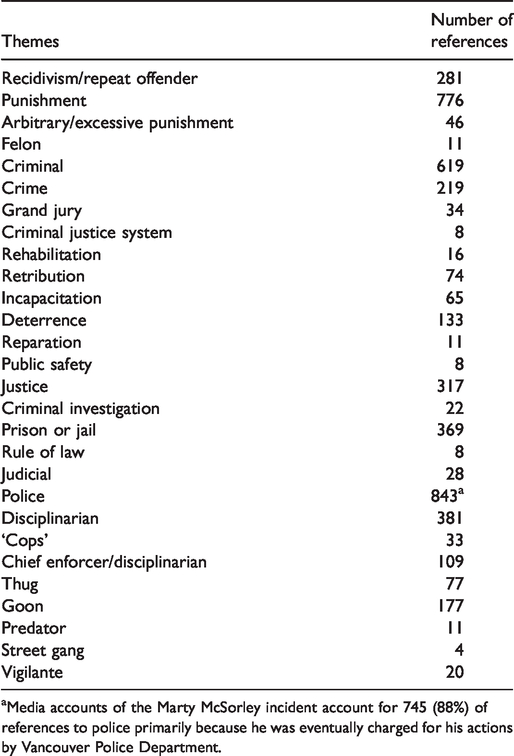
aMedia accounts of the Marty McSorley incident account for 745 (88%) of references to police primarily because he was eventually charged for his actions by Vancouver Police Department.
Numerous other themes traditionally associated with discourses from and within the criminal justice system (CJS) were central to news media coverage of hockey violence (see Table 2).For instance, there was discussion of criminal investigations and “grand jury trials,” particularly in the cases of Dale Hunter (Associated Press, 1993: 8 C) and Marty McSorley (Stoda, 2000: 2C). Perhaps more interesting, however, is the apparent focus on issues of constitutionality and fundamental principles of justice that mirror debates in the criminal justice system—most notably in relation to the rule of law and arbitrary or excessive punishment. Numerous journalists questioned the place of rule of law in sport, thus illustrating the uptake of concepts fundamental to the criminal justice system. As one article put it: “hockey is a contact sport, but that doesn’t mean anything goes. The rink should not be exempt from rule of law” (Postmedia Network, 2016: A4). Moreover, some journalists compared members of the NHL supplemental discipline apparatus to agents of social control. The label of “chief disciplinarian” was applied to both former Director of Hockey Operations Colin Campbell and Brendan Shanahan during his tenure as the Director of Player Safety (see Allen, 2012; Lapointe, 1998b: 6). Campbell was even referred to as the league’s “chief justice” (Fitz-Gerald, 2007: B1; emphasis added), while Shanahan’s sometimes arbitrary “judicial rulings” were noted (Johnson, 2012: E1). Interestingly, one article published by The Boston Globe (2000: A22) reads like a criminal justice textbook: “as in the criminal justice system, the purposes of any sanction include punishment, rehabilitation, deterrence, and public safety. In extreme cases, the authorities must take action severe enough to prevent repetition.” We contend that such references demonstrate that ideas and concepts from within the criminal justice system have become so embedded in our cultural sphere that they—intentionally or not—inform the way that journalists understand and represent supplementary discipline in the field of sport. These developments are indicative of the diffusion of criminal justice discourse into other spheres of social life (see Simon, 2007). This way of thinking and talking about hockey violence may stoke fear among fans and advertisers and legitimates new forms of governance, in this case, the disciplining of players. We explore the objectives of NHL supplemental discipline in the next section.
“This will make a guy think twice” 2 —Sentencing objectives and debates about intent
Retribution figures prominently in the NHL disciplinary landscape. Tony Granato’s slash (see St. Petersburg Times, 1994), Matt Johnson’s punch (see Lapointe, 1998a: 4), and Ron Hextall’s attack on Chris Chelios (see Rosa, 1989: 34), for example, were all supposedly retaliatory measures, with players avenging perceived injustices committed against themselves or their teammates. When asked about his attack, for instance, Ron Hextall remarked that Chelios “nearly took [a teammate]’s head off. Isn’t that a good reason?” (Allen, 1989: 10C). In Orr’s (1989b) view, Hextall’s logic makes sense given hockey’s “eye for an eye” tradition. Indeed, “frontier justice”—players taking on the role of vigilante and avenging their teammates or seeking retribution for (perceived) injustices—is common in the sport, despite concerns that this jeopardizes player safety (Mason, 2000: 1B). As Gruneau and Whitson (1993: 181) contend, the league’s “unofficial” “theory of violence” has long been that fighting is a “safety valve” that permits the release of aggression, thereby inhibiting more dangerous and abhorrent forms of violence. Current NHL Commissioner, Gary Bettman echoes this logic, noting that fighting serves as a “thermostat,” regulating the temperatures of players when the tension threatens to boil over. Indeed, Bettman admits he would “rather [players] be punching each other than swinging sticks at each other” (Canadian Press, 2013). Bettman also noted that there remains a place for the NHL enforcer in the modern game by suggesting that “eliminating fighting would mean eliminating the jobs of the “fighters,” meaning these guys would not have NHL careers” (Zucker, 2016) and that banning on-ice violence would rid the game of something that players and fans feel is an “exciting, appealing, entertaining” part of the game (Canadian Press, 2019). In other words, the league’s longtime Commissioner suggests that creating a safer work environment by abolishing fighting would actually negatively impact athlete workers and the bottom line. The capitalist concern with profit margins appears to be a key motivating factor in the NHL’s approach to violence and punishment objectives. As NHL Senior Vice-President of Communications, Gary Meagher observes: the NHL has never been in the business of trying to make the game safer at all levels and we have never tried to sell the fact that this is who we are … The question is: should we be in that business and if we were, what could we possibly achieve without throwing millions of dollars at education. (Westhead, 2016)
NHL representatives have long contributed to a narrative that players must “police themselves” (Brough, 2013; Bernstein, 2006). Indeed, our analysis reveals calls for players to “police themselves” and to ensure the purity of the game by keeping “‘outsiders’ from interfering in the league’s policing mechanism” (Cole, 2007). While some journalists (e.g. Mason, 2000: 1B) consider this approach to punishment “mediaeval” and league official Colin Campbell denied the existence of an “Old Testament-style of justice” in the sport (James, 2007: B1), others (e.g. Blatchford, 1993: 47) claim that “a good public pounding” sustained during a legal (on-ice) fight is the only form of discipline that might be effective for a “maniacal” player. Player-on-player retaliation appeared to be at least partially grounded in the league’s lenient punishment of “hockey criminals,” failure to discourage on-ice violence, and inability to protect its players (Gordon, 1988: 1D; Strachan, 1987: E5). Both prominent players and commentators expressed the need for “adequate” (Toronto Star, 2000b: SP03) or “severe” “retribution” from the NHL (Gildea, 1993: B09).
Such vocal support for the role of the “fighter” in the NHL points to the league’s implicit acknowledgement of its inability to protect its laborers from serious injury. As Gray (2009) has shown, workers have been made increasingly responsible for ensuring their own health and safety in the workplace. In this case, the league governs-at-a-distance, tacitly encouraging players to employ informal social control efforts—the threat of physical violence—so as to dissuade would-be offenders and prevent the escalation of on-ice violence, and this strategy is echoed by some media members as the appropriate response. However, when this responsibilizing strategy is ineffective, media articulate popular attitudes related to how the NHL must act swiftly to inflict harsh punishment on “thugs” and “goons”—hockey “others” considered incapable of reform (e.g. Gordon, 1988: 1D; Wilbon, 1993: C01). In this way, media employ both the criminologies of everyday life and the alien other (Garland, 1996, 2001). This highlights a key contradiction in popular imaginaries of the NHL’s approach to discipline. On the one hand, the NHL supplemental discipline apparatus “asks police to stay on the sideline” in cases of player violence (Allen, 2000: 06C). On the other hand, the players must “police each other” (Blackistone, 1999: H4) thereby setting the stage for the extreme forms of a “vigilante” style of justice that they condemn and ultimately punish (James, 2007: B1; Ross, 2000).
For officials and observers, certain and severe punishments send the message that specific on-ice behaviors are unacceptable and illustrate that “something is being done” by the NHL (see Garland, 1996: 461). Across our data, deterrence—both specific and general—emerges as perhaps the primary objective when administering supplemental discipline. The editorial staff of the Globe and Mail (1987: A6), for instance, feared that a lenient sentence for Dave Brown would send the “wrong signal to players, team owners, fans and the children who emulate the actions of the hockey stars” and would mean the NHL had failed in its obligation to “discourage” inappropriate behavior. Following David Shaw’s slash of star Mario Lemieux, others called for “severe sentences” like yearlong suspensions to address the issue of “goon tactics” and “frontier justice” (Gordon, 1988: 1D). For some players (Pap, 2007: G2), too, lengthy suspensions—“discipline that hurts”—was the only way to get “cheap” shots and hits to the head removed from the sport. Vancouver Canucks forward Brendan Morrison, for instance, maintained that “the only way we are going to get rid of this type of thing [Boulerice’s cross-check on Ryan Kesler] is if we implement severe penalties” (Davidi, 2007). The league seemingly adopted this logic, as the commissioner himself noted that “severe” punishments were the key to deterrence (Ginsburg, 1993: C8). For Gary Bettman, “you have to be sure, in each incident, that you are bringing out a deterring effect” (Dupont, 1993: 38) and the league’s intention is to “send a clear message” that “unwarranted, unsportsmanlike and excessive conduct” would not be permitted (Anderson, 1993: 7). If players are not receiving the message, former league disciplinarian Colin Campbell notes, “there’s only one thing to do: increase it” (Wilbon, 1998: B01). In Campbell’s view, the NHL’s decision to suspend Marty McSorley for the remainder of the 1999–2000 season sent a “strong message” that “you can’t strike another player with your stick” and if you do, the “repercussions will be severe” (Czerwinski, 2000). When asked if teams should be disciplined for their deployment of players, Campbell remarked “the player is the individual being punished here and always has been” (MacLeod, 2000: A1). In our view, this illustrates the tendency to individualize the problem of violence in hockey rather than address the sport’s culture.
Recalling the proliferation of mandatory minimum sentences, the certainty of hockey punishment was also key in the minds of some commentators. For example, Luecking (1988: 11D) called for the league to “standardize” its approach to supplemental discipline. Adopting this approach, which in Luecking’s (1988) view would create a more effective deterrent, meant each offence would carry an automatic penalty and the length of the suspension would increase with each subsequent offence. Others called for the rules to be “hard and fast” and suggested this was the only sure-fire way to deal with violence in the sport (George, 2000: 1C).
League officials and journalists covering the sport displayed a limited understanding of the circumstances under which deterrence might be effective.The argument that longer suspensions discourage would-be wrongdoers is premised on the erroneous belief that there is much overlap between subjective perceptions (how likely a would-be offender thinks detection and punishment is) and the objective risk (the actual likelihood of sanction) of punishment (e.g. Kleck, 2016; Paternoster, 2010; Pickett and Roche, 2016). Moreover, while much remains unknown about deterrence, scholars seem to agree that increasing the certainty of detection or apprehension is a more effective deterrent than making the subsequent punishment harsher (e.g. Nagin, 2013). On this topic, De Haan and Vos (2003) argue that the effectiveness of the deterrence model of justice is predicated on an “over-rationalized conception” of individuals and disregards the expressive and affective elements of criminal offending. Some economists (Allen, 2002, 2005; Heckelman and Yates, 2003; Wilson, 2005) have examined whether NHL players are rational economic actors whose “criminal” behavior—measured through penalties assigned to on-ice rule infractions—is impacted when the league increases the presence of officials (here akin to police officers) or by changes in team “culture.”Findings are mixed, though Heckelman and Yates (2003: 711) posit that “committing a sports infraction may be more analogous to a crime of passion rather than a calculated benefit-cost analysis performed by a rational criminal” because “many sports infractions” could be “accidental or retaliatory in nature” or occur during the heat of the moment.
Our data reflect (and, we contend, contribute to) much of this debate regarding the deterrence model of justice. Specifically, news media coverage of hockey violence contains discussion of the deliberate intent of players to violate a rule or injure another player. With David Shaw, the league deemed he “deliberately swung his stick” (Associated Press, 1988: A25), while in Ron Hextall’s case, they determined it was a “blatant and premeditated attack” on Chris Chelios (Canadian Press, 1989: A22). However, questions remained about Hextall’s “erratic” behavior and capacity for rational thought (Orr, 1989b). For Orr (1989a: B3), Hextall’s image as a “nut, a hot-tempered blowtop who loses it and commits acts of violence while out of control mentally” was inaccurate as Hextall’s acts of violence were “done from reason” similar to a “gangland contract killing.” Debates about the intent of these athlete “offenders” were present elsewhere, notably following Dennis Wideman’s 2016 cross-check of an official.
For some (e.g. Bieler, 2016), Wideman appeared to “deliberately” make contact with linesman Don Henderson. Others (e.g. Duhatschek, 2016) observed that Wideman, who had just been cross-checked himself, appeared “dazed” and a “little confused” prior to shoving Henderson. Notably, and perhaps predictably given the league’s well-documented resistance to claims that on-ice violence may lead to head injuries (Pollock, 2019), the NHL did not accept Wideman’s post-game concussion diagnosis as a mitigating factor, claiming that “Wideman did not merely bump into or collide with the linesman” but rather “delivered a forceful blow that was no accident” and therefore “must remain accountable for his own actions” (Gilbertson, 2016). Some journalists agreed with this assessment. For example, Francis (2016: S30) argued that it is irrelevant if a player is “dinged, dazed, dazzled or just dumb—you are responsible for your own actions” and contact with an official is against the rules. Following adjudication, Bettman expressed concern that an institutional recognition of Wideman’s “loss of impulse control” could absolve other concussed players of violent behavior in the future, a fact that “could be easily manipulated” by players and make hockey “more dangerous” (Shinzawa, 2016: C7). Thus, the NHL has adopted a deterrence model of justice built on the notion that hockey players employ economic rationality despite criticism that this approach is ill-equipped to understand individual motivations and takes “too superficial a view of human nature” (De Haan and Vos, 2003; Garland, 1997).We contend the Wideman case illustrates some clear limits in the NHL’s conception of rational offenders and its deterrence model of justice: there are numerous factors influencing players’ on-ice behavior, including, but not limited to, the potential symptoms of brain trauma.
We also find that there are consistent calls to remove potentially dangerous players from the game. In the wake of David Shaw’s slash on star player Mario Lemieux in 1988, for example, former executive director of the NHL Players’ Association, Alan Eagleson, voiced support for lengthy, automatic suspensions and to “get rid of the goon” from the sport entirely (National Post, 2007: A14; St. Louis Post-Dispatch, 1988) while journalists like Jeff Gordon (1988: 1D) contended that “the NHL has no place for those who injure opponents with cowardly stick attacks.” Calls to incapacitate were particularly common for repeat offenders thought to be incapable of change. These are the “thugs,” “predators,” and “Neanderthals” who possess little natural talent, rely on violence, and look little like “us” (see also Garland, 1996, 2001). Following Marty McSorley’s slash to Donald Brashear’s head in 2000, for instance, some fans (see Matas, 2000: S2) clamoured for a longer suspension that would essentially end his NHL career, while other players (see, for example, Luecking, 2000: D3) called for a lifetime ban. Journalists echoed these sentiments, with the Boston Globe (2000: A22) suggesting the “‘Bruins’ hit-man should be barred from hockey forever” and Cohn (2000: C1) remarking the “thug should have been banned for life because what he did was a criminal attack, pure and simple.” Indeed, the league’s decision not to issue a lifetime ban was considered by some (e.g. Miksis, 2000) another failure in the NHL’s supplemental discipline regime. Kelley (2000), for instance, wondered if McSorley even deserved the chance for redemption, while Dowbiggin (2007: E2), referencing Chris Simon’s two suspensions in 2007, suggested it would be folly and require “a spectacular leap of faith in human nature” to think that Chris Simon’s eighth suspension would be his turning point. For their part, Lawless (2007: C1) likened Simon to a “habitual offender” who needs to be stopped for the protection of all other players and banished from the league. Given “ample opportunity to change his ways, [Simon] has repeatedly proved himself a menace” and should be considered “a danger to society” (National Post, 2007: A14). Finally, in light of Raffi Torres’ 41 game suspension in 2015 being his 10th offence, in Duhatschek’s (2015) view, the time to “ponder any extenuating circumstances or root causes” had passed. Thus, the sporting world is also home to ways of thinking and talking about crime that “strip away the sociological and psychological layers” of criminal offending and focus on identifying and managing risk (see also Feeley and Simon, 1992; Garland, 1996: 185).
In some cases we reviewed, however, teams were willing to support players who had been repeatedly suspended. For instance, the New York Islanders took a “compassionate” approach (Adami, 2007: B2) with Chris Simon, with team officials declaring they would “support” Simon and welcome him back if he dealt with his “anger-management” problems through counseling (Matheson, 2007: E3). Similarly, following his stick attack on Donald Brashear, Marty McSorley’s team (Podell, 2000) offered assistance and some opponents, like player Garry Valk, advocated for his eventual return to the league and an opportunity for McSorley to “redeem himself” (Shoalts, 2000: S3). Moreover, forfeited salaries of suspended NHLers go to assist “unfortunate” former players and their families (Shinzawa, 2014: C1). Thus, the ways in which media, fans, players, and teams think about punishment is characterized by inconsistencies and contradictions. Punitive logics and practices have not entirely overtaken a welfarist justice model emphasizing the rehabilitative potential of treatment and in some cases supplementary discipline provides an opportunity for the offender to reflect on their behavior, receive some form of treatment, and redemption. Again, however, neoliberal responsibilization is embedded in these punishment discourses and practices (see also Garland, 1996). When discussing Ron Hextall’s attack on Chris Chelios, for example, Proudfoot (1989: B1) proclaimed that Hextall needed to learn “self-control.” Brantt Myhres, meanwhile, was suspended for 12 games “to think about his role” in an altercation (St. Petersburg Times, 1999: 6C). In short, the NHL remains largely unwilling to proactively address structural issues that underpin violence. Instead, the hockey world puts the onus on players to account for their behavior, provide assistance to their peers, and to take advantage of the rehabilitative opportunities afforded them.
Discussion and conclusion
If we accept that modern neoliberal punishment continues to extend throughout the social system, we must focus on the spaces and places in which that extension manifests. What does the NHL’s approach to supplementary discipline tell us about punishment and society (and vice versa)? In many ways, the hockey world’s approach to “crime” and punishment is based on the overarching logics of deterrence and incapacitation and fits with the main tenets of neoliberal crime control. Perhaps most interesting are the anachronistic ways in which objectives and rationales of punishment are represented by the NHL and news media. Despite well-documented critiques, deterrence, incapacitation, and retribution remain the overwhelming modalities of punishment rendered intelligible by those within the hockey world. While certainly rehabilitation and reparation exist in the imaginary, they are not nearly as influential as out-dated ideas on the effectiveness of deterrence and incapacitation. These contradictions and tensions are in sync with broader crime control policy.
This project builds on existing scholarship regarding the exploitation of athletes in a neoliberal capitalist system (e.g. Brayton et al., 2019; Kalman-Lamb, 2018). Notably, it illuminates the integral roles the NHL’s supplemental discipline regime—the way league officials govern the workplace through crime—as well as media discourses play in creating and fostering unsafe working conditions for players. In contrast to how the NHL typically frames on ice-violence (Atkinson and Young, 2008), we find that journalists covering the sport explicitly adopt crime and justice metaphors to render on-ice violence intelligible. We argue the use of crime rhetoric and crime control metaphors contributes to cultures of control, risk, and fear that generate and legitimate more entrenched neoliberal governance strategies (see Simon, 2007). Notably, the NHL responsibilizes its labor as agents of control, who are punished severely at the hands of the regime when that “frontier justice” fails to create a safe workplace. Simultaneously, NHL officials resist “outside” interference in the form of criminal investigation or prosecution and maintain the league is able to effectively handle on-ice deviance. This is inherently contradictory and mirrors the paradoxical foundations of modern penality. Moreover, the league has continued to assert that the very hockey violence that is indirectly condoned through this responsibilizing process is not a conclusive cause of the numerous injuries, mental and emotional health issues faced by retired laborers (Canadian Press, 2019). Indeed, the NHL supplemental discipline regime remains committed to its contradictory and archaic approach to punishment as both the solution to, and proof that it is addressing, on-ice violence and ensuing issues. In 2011 Deputy Commissioner Bill Daly recognized a link between fighting and mental and physical health issues, stating “fighting raises the incidence of head injuries/concussion, which raises the incidence of depression onset, which raises the incidence of personal tragedies” (Westhead, 2016). The “personal tragedies” Daly was referring to were the deaths of three NHL “enforcers” -- Derek Boogaard, Rick Rypien, and Wade Belak -- who died tragically in a span of four months. Two months after Boogaard’s death, Dr. Anne McKee of Boston University’' Center for the Study of Traumatic Encephalopathy concluded that he suffered from neurodegenerative disease Chronic Traumatic Encephalopathy (CTE) -- a condition caused by repeated head trauma. Despite this, a number of current and former players have resisted the NHL’s approach to, and understanding of, the game’s role in hockey-related health issues manifesting later in life for former players. At least seven NHL players have been found to have suffered from CTE—Stan Mikita, Bob Probert, Derek Boogaard, Reggie Fleming, Rick Martin, Larry Zeidel, and Steve Montador—and numerous others former-NHLers have been vocal critics of the league’s understanding and handling of mental and physical health issues faced by current and former players (including Daniel Carcillo, Todd Ewen, and over 300 retired players who in 2016 sued the league for failing to protect them from head injuries or warn them of the risks involved) (Arnold, 2018; Branch, 2018; Kilgore, 2016).
But why do representations of crime and punishment in sports matter? Professional sport is one of the most influential areas of popular culture that enables direct communication to large numbers of focused, voluntary, and purposeful viewers. Few other cultural mediums offer such elective, and often real-time, communication to large populations. Narratives surrounding sport also often dovetail or reflect political, social, and cultural changes occurring in society at large. As Susan Birrell (1982: 354) highlighted long ago, athletes and athletic figures are “significant social figures because they are capable of representing important social values.” Our responses to social figures’ actions and behavior, both “good” and “bad,” are therefore of keen interest for scholars seeking to understand how we make sense of those behaviors, the individuals behind them, and the structural causes and consequences of those actions. In exposing the inconsistencies as well as (dis)continuities implicit in modern approaches to crime and punishment—in both predictable and unpredictable spaces—we can move beyond sweeping “criminologies of catastrophe” and towards accounting for the less coherent, mundane, and complex shifts in penal discourse (Hutchinson, 2006; O’Malley, 2000: 164) that are found in increasingly specific contexts.
As we have highlighted, hockey adopts criminal justice rhetoric to both imagine and understand crime and deviance that occurs on the ice. Even in the wake of a recent wave of (inconsistent and complicated) penal reform (e.g. Beckett et al., 2016; Green, 2015; Seeds, 2017), we must focus on the ways in which such narrow representations are used to justify increasingly severe and invasive forms of punishment. In our view, the NHL’s supplementary discipline regime—in particular, its tolerance of so-called “frontier justice” and its harsh punishments of “offenders” when this fails—has contributed to well-documented financial struggles, chronic physical and mental health issues, and the early deaths of a host of former players. 3
