




Abstract
The San Diego Family Justice Center (FJC) model seeks to lessen the burden on domestic violence victims by co-locating social service agencies, law enforcement, and prosecution at one site. Shortly following the inception of the model in 2002, it gained widespread acclaim (and federal funding), spreading the model across the country. Using visual and textual discourse analysis, this paper examines the promotional and procedural material produced by proponents of the San Diego FJC model. FJC materials construct victimhood using discourses of crime control and therapeutic intervention. The resulting discursive formation is that of the passive, dependent battered woman, curable only through robustly punitive state intervention. In this way, FJC materials not only advance a distinct construction of victimhood but also a particular agenda for punishment policy. Extending Jonathan Simon’s contentions regarding the resonance of victim discourse within American society, I argue that therapeutic discourse can bolster the effectiveness of punitive campaigns.
Introduction
The Family Justice Center (FJC) is a domestic violence response model that co-locates social service agencies (domestic violence counseling and advocacy groups, housing services, medical care, immigration legal aid, chaplaincy, etc.) with prosecutors and law enforcement. This “one-stop shop” aims to foster connections between these groups and alleviate the burden a victim experiences when seeking help from multiple sources. During the 1990s, domestic violence coalitions across the country began co-locating social services and law enforcement, and in 2002, the San Diego Family Justice Center opened its doors (Gwinn et al., 2007). Similar models appeared around this time in Minnesota and Indiana (U.S. Department of Justice, 2004).
However, neither the Minnesota nor the Indianapolis model garnered the institutional traction, national attention, or funding of the San Diego FJC. Shortly after the model’s inception, San Diego experienced a 95% reduction in domestic violence homicides. Advocates of the FJC attributed the drop to the model, earning it a feature on the Oprah Winfrey Show. By the end of 2003, Attorney General John Ashcroft announced President Bush’s Family Justice Center Initiative, which allocated $20 million dollars to the opening of FJCs across the country. The San Diego FJC received the largest award of any of locality and was designated an “expert” technical assistance provider for the others (U.S. Department of Justice, 2004). Mary Beth Buchanan, former Acting Director of the Office on Violence Against Women, described the FJC as the “common sense” model for domestic violence services (U.S. Department of Justice, 2007). Eventually, San Diego FJC founder Casey Gwinn helped export the model internationally, consulting on the opening of FJCs in Jordan, South Africa, and England (Gwinn and Strack, 2010). All told, these developments enshrined the model as the best way to combat domestic violence.
At the core of this success was a promotion machine, driven by social actors deploying salient narratives of victimhood. In doing so, they engaged with the politics of “governing through crime,” mobilizing the threat of victimization to channel state intervention (Simon, 2007). Domestic violence victimhood, however, requires a distinct set of discursive practices to gain political traction. Accordingly, in garnering the resources and legitimacy needed to propagate the model, its advocates combined two dominant discourses about domestic violence victims: first, the therapeutic governance discourse, emphasizing the psychological dependency (“learned helplessness”) that victims acquire during violent relationships; and second, the crime control discourse, emphasizing the violent criminal nature of domestic abuse. This paper examines what happens when these two discourses intertwine. What construction of victimhood results, and further, what punishment practices are proposed in response to this construction?
I argue that the FJC promotional materials “braid” (Hutchinson, 2006) together therapeutic and crime control discourses, achieving two outcomes: first, the victim subject, dependent on her abuser, justifies swift criminal justice intervention; and second, the therapeutic discourse submerges tensions inherent to prosecution, including its disparate impact on marginalized communities and its conflictual reception by feminist anti-violence activists. The trope of empowerment, as a curative to deviant dependency, functions much like rehabilitation in punishment discourses – a “rhetorical shell,” available to be filled with criminal justice practices (Goodman, 2012).
The FJC campaign demonstrates that victim discourse is more differentiated than Simon’s work shows, and its effects more wide-ranging. The FJC victim construction, and her roadmap to empowerment, becomes institutionalized, shaping policy efforts, procedural blueprints, and even the physical spaces of FJC locations. All told, this discursive formation centralizes law enforcement, with the effect of materially and socially entrenching the criminal justice institutions that take part. Using Critical Discourse Analysis (Fairclough, 1993), this paper traces the emergence of these constitutive discourses and their role in reinforcing criminal justice primacy.
Discourse analysis methodology
Uniting constructionist epistemology with tools for textual analysis, discourse analysis methodology regards patterns of communication as social action (Jørgensen and Phillips, 2002). Accordingly, discourse analysts argue that these patterns “construct” – rather than “reflect” – social reality (Phillips and Hardy, 2002). In short, the FJC model is not, as its promoters suggest, the natural outcome of evolving views on gendered violence. Instead, to understand how FJC policy shapes the domestic violence field, I use Critical Discourse Analysis (CDA) to contextualize these discourses within the historical, political, and social conditions that shape them (Fairclough, 1993). CDA helps to identify how identities (victim, prosecutor), bodies of knowledge (the development of Battered Woman Syndrome), and “common sense” policy and procedure (the workings of the FJC) result from the interplay of social structures, power relations, and the discourses that legitimize them (Phillips and Hardy, 2002).
Image and video are evocative components of the FJC discourse, conveying urgency and severity in ways that text is incapable of doing explicitly. Depictions of victimized women perform much of this labor, reflecting an aesthetic preoccupation in wider Western post-Enlightenment culture (Bronfen, 1992). These representations counterpose the irrationality and weakness of women against masculine rationality and progress. Further, as forerunners of visual criminology argue, media imagery plays a powerful role in telling the “story” of contemporary crime, constructing categories of deviance and victimization and positioning viewers to promote identification with particular standpoints (Hayward and Presdee, 2010; Young, 2010). FJC materials leverage this aesthetic history, juxtaposing images of victimized women with rationalized notions of domestic violence and its solutions.
Importantly, image is expansive and “unruly,” and when deployed for strategic political ends, must be “spoken for” to achieve desired goals (Sekula, 1981; Tagg, 2009). This analysis therefore examines the way text, context, and visual language work together to produce discourses of victimization. Prosecutors, operating within a context of deepening criminalization of gendered violence, are the primary curators of this catalogue. The necessity of anonymity in these images allows curators to construct a narrative of domestic violence that fits their strategic ends.
The materials I analyzed are wide-ranging, but entirely available from FJC-affiliated sources and mostly directly linked on the Family Justice Center official website (the Oprah segment is available on YouTube). I focused on materials produced during the launch and widest proliferation of the model, roughly the years of 2003 to 2012. Within this group, I built a data set from media and web resources focused on training, mission-building, and public image work. I excluded materials that I could not properly contextualize, for instance, leaving out training slide shows that had sparse wording and no accompanying audio. Using data analysis software Atlas Ti, I examined each document for of discourses pertaining to feminism, victimization, therapeutic logics, prosecutorial initiatives, and discourses on collaboration.
Altogether, these diverse public-facing materials demonstrate how FJC advocates sought to shape perceptions of the model across different domains of social action. I examine FJC materials aimed at three key groups: first, the general public; second, individuals tasked with operating FJCs (who I refer to as Practice-Level Stakeholders); and finally, those responsible at a local level for making FJCs possible within their jurisdictions (who I refer to as Policy-Level Stakeholders). Table 1 summarizes documents analyzed by audience type.
Documents analyzed by audience type.
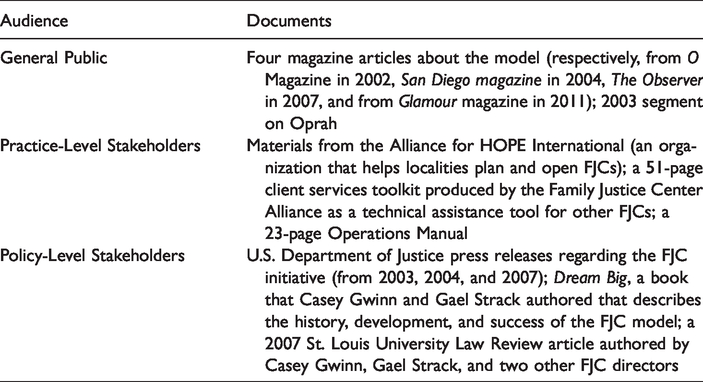
Communication of criminal justice practices must “create recognition” in its audience to be effective, using the languages and concepts these groups will be most receptive to (Garland, 2012: 260). Accordingly, FJC advocates emphasize different priorities and utilize different signifying practices across these groups. General public-facing materials stress the FJCs role in reducing crime in communities (the crime control strand of the braid). Materials for practice-level stakeholders outline the “right” way to process a victim through the FJC (the therapeutic governance strand of the braid), while policy-level discourse accentuates the smooth integration of two large, complex systems (the strength of the braid).
Across these different sources, however, a discourse of victimization and its eradication coheres. The FJC campaign does not invent this narrative of victimization, but instead strategically brings to the fore currents shaping the legal, social, and psychological understandings of domestic violence. Emphasizing the importance of crime control and the scourge of feminine dependence, these discourses coalesce during the 1980s and 1990s.
Discourses of victimization
The crime control discourse
The FJC designates domestic violence as a crime and works to eradicate its existence. This effort, which Jonathan Simon describes as governing through crime, makes crime control the dominant frame for understanding social problems in the U.S. (2007). The figure of the victim is central to this new mode of governance, becoming the “idealized political subject” of our time. From the rise of victims’ rights groups to the organization of legislation around the presumed needs and experiences of victims, the U.S. makes an “investment of power” in the victim identity (Simon, 2007: 79).
Specifying the nature of this “investment” is more complex, however, as it did little to directly benefit the conditions of people experiencing violence. Instead, the material and political commitment to victimhood primarily manifested in increased funding for law enforcement institutions, government support for specific types of research, and a proliferation of laws expanding law enforcement reach (Suk, 2009). These actions occurred at both federal and state levels, creating a somewhat inconsistent – but ever-present – patchwork of criminal justice-based response (Gruber, 2020). From a broader social provision perspective, victimhood became the main way the government organized its responsibility to the people (Simon, 2007). This generates, for instance, the rise of hate crime laws to combat racial violence, as well as increased criminalization of domestic violence and sexual assault. All told, these trends empowered police and prosecutors to commandeer a new, criminal justice-oriented form of American social provision, making the victim the rhetorical interface at which social vulnerability met government action.
Under the victim paradigm, legislation sought redress for victims through the punitive process, setting up those accused of crime as their monstrous inverse. This dynamic makes domestic violence a politically complex claim to victimhood. Historically, domestic violence has been treated as family pathology, with the mother who chooses to remain with an abusive partner at the center of the disorder (Gordon, 1988; Pleck, 2004). From this understanding, domestic violence victims carry a unique “complicity” in the abusive act (Simon, 2007: 200). This complicity confuses the victim/perpetrator binary, casting those who experience domestic violence as both accomplice and injured party.
In the early 1970s, gendered violence became an important site for early feminist activists, who critiqued law enforcement’s widespread indifference to violence in the home. 1 Early formulations of domestic violence also implicated public/private dichotomies, structural racism, and the actions of the state in the entrapment of women in violent relationships (see MacKinnon, 1989). Domestic violence was not a singular, spectacular crime but part of a “larger continuum of socially inflicted violence” (Davis, 2011: 38). The earliest organizations associated with this critique were grassroots shelters with non-hierarchical structures and consciousness-raising groups.
In the 1980s, these ideas entered institutional and legal spheres. The institutionalization and professionalization that mainstream feminisms underwent in the 1980s and early 1990s is beyond the scope of this article and well-articulated by critical race and feminist scholars (Bumiller, 2010; Crenshaw, 2011; Gruber, 2020; Kim, 2020; Richie, 2012). However, as feminists of all stripes highlighted the pervasiveness of gender-based violence (Roth, 2004), liberal feminists pursued legislation at state and federal levels. They found the most success, by far, in reforming criminal statutes (Corrigan, 2013). The 1994 Violence Against Women Act (VAWA), part of the much larger Violent Crime Control and Law Enforcement Act, is the apex of these efforts.
VAWA was model legislation for the governing-through-crime era. Originally authored by Senator Joe Biden, the bill was supported by democrats and several staunch conservatives alike. As VAWA garnered “cross-ideological support” (Whittier, 2016: 791), its rhetoric and funding model advanced the “carceral creep” pervading the feminist anti-violence movement (Kim, 2020). 2 “Carceral creep” refers to the gradual process by which criminal justice actors have occupied the feminist anti-violence movement since the late 1970s, influencing myriad policy changes and forging organizational ties. The Act allocated money to law enforcement and prosecutorial bodies, incentivized the expansion of state-level criminalization, and created avenues for prosecuting interstate domestic violence. Its patchwork approach to criminal justice-based social provision, by diffusing block grant funds across multiple institutions and select interest groups, encouraged the growth of a “non-profit industrial complex” in which many service providers vied for the same, relatively small, pot of money (INCITE! Women of Color Against Violence, 2017). This competitive, resource-sparse atmosphere only exacerbated the problem of “runaround” that FJC advocates identify as the impetus for a co-located center.
FJC’s materials leverage the benefits of feminist empowerment discourses and avoid their critiques of the state by presenting the model as a feminist achievement. Drawing on the crime control discourse, FJC promotional and procedural materials redefine empowerment as earned through criminal justice participation. However, they do so in concert with an ostensibly gentler therapeutic discourse of victimization.
Therapeutic governance discourse: the victim of “learned helplessness”
The domestic violence victim has long been the target of governing rationalities not expressly related to crime. Indeed, the therapeutic construction of the domestic violence victim experienced a remaking in the 1980s, as a tremendous amount of knowledge production centering the battered woman entered professional feminist anti-violence spheres (Bumiller, 2010; Ferraro, 1996; Richie, 2012). These knowledges often supported state intervention in domestic violence cases. The most prominent in this field was the diagnostic of “Battered Woman Syndrome” (BWS), developed by psychologist Lenore Walker in 1977.
BWS is a type of Post-Traumatic Stress Disorder that one develops by experiencing repeated intimate partner abuse. BWS sought to explain why people remain in abusive relationships, resting on two major theoretical pillars: that abusive relationships demonstrated a cycle of violence; and that, through the experience of abuse, victims developed a “learned helplessness” that inhibited their capacity to leave their partners (Walker, 1980). Walker’s argument, at times, indicted structural and cultural norms for their complicity in trapping women in violent relationships (Rothenberg, 2003). Despite this recognition, however, helplessness was the centerpiece. BWS helped solidify feminine dependency as the medical diagnosis for continued domestic violence, making the victim the site for its solution. 3 Despite some prominent critiques of Walker’s work, BWS has enjoyed considerable success as an explanation for domestic violence. In a wide-ranging examination of legal decisions, social science publications, and news articles, Bess Rothenberg concludes that BWS “has become the most recognized explanation for why abusive relationships continue” (2003: 778).
By evoking this highly resonant trope of feminine helplessness, FJC materials play into the “cultural panic about dependency” that Nancy Fraser and Linda Gordon observe in discussions of women of color in poverty (1994: 326). Dependency tropes conjure notions of individualized pathology similar to Walker’s helplessness framework. Moving the behaviors of domestic violence victims into the psycho-therapeutic register is consequential in many ways that support paternalist criminal justice intervention. Psychological intervention, through diagnosis and treatment, individualizes problems which have strong socio-structural determinants. The individualizing tendency intensifies in postindustrial capitalism, especially as dependency narratives become more popular explanations for welfare use: The moral/psychological register is expanding … with new psychological and therapeutic idioms displacing the explicitly racist and misogynist idioms of the industrial era … the new psychological meanings have strong feminine associations, while currents once associated with the native and the slave are increasingly inflecting the discourse about welfare (Fraser and Gordon, 1994: 323).
At the same time, the battered woman subject becomes more sympathetic through her classification as a sick deviant (Gusfield, 1967). Unlike the enemy deviant, who challenges norms through conscious deviance, the sick deviant flouts them involuntarily. Thus, the “symbolic import” of this deviance is distinct, no longer requiring the hostile response given to the enemy deviant (Gusfield, 1967: 175). The abusive party, producer of the dependent pathology, becomes the enemy deviant. Creating this opposition between sick and enemy deviant clears victims’ cultural complicity.
Ultimately, therapeutic concepts can support criminal justice goals, serving, in this case, to justify prosecutorial practices. Indeed, in her analysis of sexual violence court cases, Kristin Bumiller finds that when expert testimony about Battered Woman Syndrome conflicts with the woman’s own descriptions of her actions, experts claim that this incongruity is a result of the woman’s pathologized minimization of events (2008: 91). Accordingly, FJC materials redefine empowerment as successful criminal justice adjudication. The resulting victim-subject is characterized by a feminine and deviant dependence, curable under the punitive aegis.
Signaling dependency, narrating (criminal justice) empowerment
The Oprah segment promoting the FJC opens in dramatic fashion, visually placing domestic violence within a larger field of crime control. Cast in night vision video, the camera positions viewers in the passenger seat of a police squad car, watching as Officer “James G” rattles off a list of codes into his CB radio. Oprah narrates: “Domestic violence happens in every city, at any time of the day.” The camera pans outward jarringly, giving us James G’s perspective of a dark street pierced by blinding headlights. The darkness, the glaring lights, the frantic camera movements scanning an unidentifiable city street all combine to suggest significant (if unclear) danger, unbalancing and disorienting viewers.
These visual cues set the stage for a crime control discourse of domestic violence victimization. In “true crime” fashion, this discourse draws audience members in with an ambivalent mix of fascination and repulsion (Biressi, 2001). Yet, while showcasing acts of violence alongside accounts of ostensibly confounding victim behavior, FJC materials create their own distinctive discourse of domestic violence victimization, highlighting victims’ dependencies on their abusers. Drawing on this therapeutic register positions the FJC model – the “one-stop shop” combination of law enforcement and social services – as the unique solution to domestic violence.
Most of the pieces included in this analysis highlight the story of a victim experiencing physical domestic violence. While not referencing Battered Woman Syndrome explicitly, these stories use Walker’s cycle of violence as a structure, describing victims caught in perpetual patterns of abuse, shock, and quiescence. The Oprah segment provides an exemplar of this narrative. Viewers are transported from the dark squad car to a brightly lit office, as Jim Arthur, a sergeant in the domestic violence unit at San Diego Police Department, describes the allegations in a recent case: “Now, here’s a picture of a women who was, uh, hit with a frying pan.” Arthur casually tosses a series of polaroid pictures onto the table, and the camera zooms in to reveal depictions of a woman with several bruises. Arthur narrates this visual catalogue: “And one of the things we see is, the next day, they’re denying everything to my detectives. They say, ‘no, it didn’t happen, I still love them.’ And they do. They really do love these people.” The woman in these photographs is entirely composed of injury, fragmented and objectified across a series of photographs. The anonymizing effect of this segment, surely intentional to protect victim confidentiality, simultaneously allows Arthur and FJC advocates to control the plotline of her victimization.
Such representations of “learned helplessness” become a fixture across FJC promotional materials, depicting victims as incapable of leaving abusive relationships without outside intervention. Take, for example, the story of Rachel Carson, featured in the San Diego piece. Carson experiences a severe incident of abuse from her boyfriend, involving strangulation. After recounting a prior incident, the text describes her as “lucky to be alive … for the second time”: “This time, Carson’s mother refused to help until her daughter agreed to take action. Thus began a journey that changed the 27-year-old’s life” (Zimmerman, 2004: 76). Here, the brutalities of shocking violence intermingle with Carson’s eventual transformation. Tough love and coercion are the necessary ingredients, implying she does not have it in her to make the decision on her own. This “empowered” person is quite passive, existing in the text as the recipient of action rather than its creator.
FJC materials then contrast this passive victim with criminal justice state intervention. The state steps in to “break the cycle.” The state’s representatives are agentic—they are actively involved in material processes, doing the work of justice. Carson’s journey through the FJC, from the San Diego text, reinforces this dynamic: Carson was examined in the forensic medical unit, in a bright, well-ordered, private room. She wore a linen dressing gown while Amy Carney, a registered nurse and the medical unit’s assistant director, took photos of her neck and lifted fingerprints from it. Carney confirmed Carson was pregnant and gave her numbers and addresses for healthcare services. A victim’s domestic violence advocate at the center led Carson to the legal clinic, where she got help obtaining a restraining order (Zimmerman, 2004: 76).
The National Family Justice Center Alliance’s Client Services Toolkit outlines an organized, technocratic process reinforcing this intermingling. The FJC does not propose an open service center that welcomes and works with whomever enters. Rather, the proposed intake process is careful and regimented. Intake staff run a criminal background check on every person seeking services, engaging in a protracted screening of the “guest.” In keeping with their promise of security, the manual instructs staff to accompany victims to each office in the FJC, and not allow them to walk on their own. The Client Services Toolkit describes the physical manifestation of these meeting discourses in one FJC screening area: a screening window, surrounded by a wood construction intending to resemble the front porch of a home, partitions intake worker from guest with a thick layer of bulletproof glass.
FJC proponents do not explicitly pull upon Walker’s formations of learned helplessness. Instead, their presentation uses survivor stories, visual fragments and textual patterns to evoke an underlying narrative of the helpless, wrong-headed woman in danger. A coherent visual language communicates this victim characterization across the San Diego piece and the Oprah segment, characterized by off-color lighting, overhead shots looking down on victims, and seated poses. Despite its dour visual language, the Oprah segment ends on a more positive note, as a victim herself describes her own transformation at the hands of the FJC. Her words, combined with the accompanying video, communicate how FJC materials promote their own version of victim empowerment. As the camera zooms in for a closeup of a woman with an injury on her face, we hear her say, “They always tell you, ‘yeah, love you I won’t do it again. And it’s different for me, because he gotta stay away this time.” Audience members see a man taking pictures of woman’s back, her shirt pulled up, and then taking pictures from another angle. In a teary voice the woman continues, “Now I feel like I can breathe and I can be with friends. I can have friends again.” Narrating scenes of forensic evidence collection with the language of empowerment, this closing segment offers its clearest articulation of empowerment through prosecution.
The first page of the San Diego Operations Manual declares the FJC a place “Where Families Come First and Professionals Come Together.” While discussions of “blending” cultures and working together abound in the documents, FJC institutional commitments demonstrate the role of criminal justice authorities in shaping the victims’ experiences. Through its structural control of the screening process, its focus on prosecution, and its discursive representation of dependence, FJC materials assert a punitive solution to the psychological ill of domestic violence. These materials advance a process of empowerment composed of the victim’s will to prosecute. In doing so, they present FJC empowerment as the apex of the feminist anti-violence movement.
The submersion of race and state-critical feminisms
“I’m a product of the women’s movement … three feminists invested their lives in me when I became a prosecutor 17 years ago. They educated me about domestic violence and built a relationship that continues today.”
-Casey Gwinn, Glamour Magazine (Brody, 2011)
FJC proponents tell a version of the emergence of the FJC model that places it neatly within feminist history. This history winnows out strands of anti-violence organizing that indict the state itself in the production of gendered violence (Thuma, 2019). While it is certainly the case that early feminist organizing rebuked law enforcement for their casting of domestic violence as a personal, rather than criminal, matter, FJC materials take further steps to naturalize the role of law enforcement in the state response to domestic violence. In their guidance for setting up FJCs, these materials characterize critiques as interpersonal rather than political, diminishing meaningful dissent and alternative viewpoints on the responses to domestic violence.
In a law review article, Gwinn pays homage to the shelter movement, even crediting these early feminist organizations with the idea of co-location. In Gwinn’s retelling, feminist activists do not criticize criminal justice institutions for their indifference, but rather “recruit” them: By the early 1980s, leaders of the national domestic violence movement sought support and assistance from the criminal and civil justice systems to protect victims and holding abusers accountable. Once recruited into this powerful feminist social movement to stop violence against women, the criminal and civil justice systems began to engage and mobilize through legislative initiatives and mandates, policy and protocol changes, participation in coordinated community response efforts, and a variety of other initiatives advocated by domestic violence movement leaders (emphasis mine, Gwinn et al., 2007: 80–81).
Guidance for starting FJCs offers a similar subordination of critique. For instance, when discussing the struggles of initiating the Tacoma-Pierce FJC, the article mentions that its directors were hired from within the government, generating skepticism amongst community partners. The article frames this as a problem of “how to move past the perceptions and begin working on the realities of the situation” (109). The article then reiterates its value to critical groups in its concluding paragraphs: “Far from being a threat, Family Justice Centers offer the opportunity for the domestic violence advocacy community to have another ally in the social change effort …” (119).
In Dream Big, Gwinn emphasizes that the FJC model only works in communities where there is a friendly relationship between law enforcement and community partners. Recounting the success of the San Diego FJC, Gwinn states, “It had its roots in the decision of feminist advocates to build relationships with criminal and civil justice professionals. It grew because of the decision of feminists in San Diego to include men … seeking alliances instead of engendering conflict” (Gwinn and Strack, 2010: 76). These partnerships were successful because participants agreed to eschew criticism: “At times there was finger pointing and blaming, but we made a conscious effort to realize and stop it whenever it started” (2010: 76).
FJC materials also sidestep another important critique by avoiding discussions of race. While the FJC victim-subject is conspicuously gendered— such as through the exclusive use of the feminine pronoun to refer to victims in the abstract— race does not surface explicitly. FJC materials speak in decidedly colorblind registers (Bonilla-Silva, 2013; Van Cleve and Mayes, 2015), referencing the “culturally-competent services” they provide. While individuals who appear to be women of color are featured in the Oprah segment, the anonymizing effects of blurred videos stymie any efforts to confirm these racial identities. This elision helps to sidestep a discussion of the possible effects of the FJC’s agenda in communities of color.
The silence on race signals a broader erasure of race in mainstream liberal feminist anti-violence movements. As critical race feminists have argued, mainstream anti-violence voices have ignored the social and structural contexts that poor victims of color face, promoting a trope of victimhood that is distinctly white (Crenshaw, 2011; Richie, 2012). These critiques highlight how increasing criminalization negatively impacts survivors of color. Indeed, Black women in particular have faced a more authoritarian and punitive face of the state than white women (Freedman, 1984; Haley, 2016; LeFlouria, 2015). Here the therapeutic re-casting of dependence does significant work in paving over this social fragmentation, using the psychological register to “displace” the explicitly racist connotations dependency narratives have traditionally held (Fraser and Gordon, 1994). Submerging these and other critiques of the FJC model helps to foreclose other ways of addressing domestic violence, smoothing the pathway for the FJC’s larger policy agenda for punishment.
The FJC policy agenda
“Ultimately we have taken the decision away from the victim. Because when the victim had the decision, we were drawing a target on her chest.”
-Casey Gwinn, during Oprah segment, describing the importance of mandatory arrest and evidence-based prosecution practices.
While FJC proponents will not win the support of more critical feminists, they have forged enough instrumental connections to maintain a high level of success across the country, generating federal and local buy-in. The FJC victim discourse selectively highlights elements of BWS to affirm the necessity of extensive law enforcement involvement in domestic violence. Its promotion of this discourse of victimization matters for the exercise of punishment. This policy agenda advances primarily by a series of levers that manage and control the input of those victimized in the prosecutorial process, increasing the speed and conviction rate of domestic violence cases.
Across FJC materials, FJC architect Casey Gwinn’s commentary calls for swift, expansive criminal justice intervention: “Time is our enemy. The reality is, the longer it takes to intervene in a family, the worse it gets. The sooner we can intervene the less likely we are to have serious injuries or death.” Gwinn is a strong supporter of mandatory-arrest policies. These mandate officers responding to a domestic violence call to make an arrest if they find probable cause that a battering incident occurred, even if the victim opposes it. During the Oprah segment, Gwinn argues that this policy is integral to protecting the domestic violence victim, to remove the “target from her chest.” This push is not just rhetoric, but a vital component of what FJC materials call “best practices.” In the law review article, Gwinn and co-authors explain the ten “fundamental elements” of the President’s Initiative; that host communities have a “Pro-Arrest/Mandatory Arrest” is the second element.
Mandatory arrest has a storied history. In 1984, Lawrence Sherman and Richard Berk conducted the “Minneapolis Domestic Violence Experiment,” examining the effects that mandatory arrest policies had on recidivism rates for domestic violence (Sherman and Berk, 1984). They concluded that mandatory arrests reduced recidivism. Resultantly, several state legislatures incorporated mandatory arrest components into their domestic violence statutes (Mills, 1998). While subsequent experiments failed to replicate these results, and even produced contradictory findings, mandatory arrest legislation remained in place for some time, with some jurisdictions still maintaining the practice (Mills, 1998). Some scholars argue that mandatory arrest and dual arrest policies have put poor women of color in more precarious positions with respect to the violence they experience (Buzawa and Buzawa, 1996). Increased police involvement can expose victims’ unrelated criminal offenses, bring their immigration status to the attention of police, or facilitate intervention from child welfare departments (Coker, 2004). Despite the research done in the 1990s discussing the harms it inflicts on women experiencing interpersonal violence, the FJC Alliance continued to support mandatory arrest policies throughout the President’s Family Justice Center Initiative process.
While FJC promotional materials discuss the minimization of victim input as a safety measure, there is no doubt that it also streamlines prosecution. Indeed, swifter prosecution is part of the appeal of the FJC. In Dream Big, a San Diego District Attorney is quoted on the effects of the FJC on prosecution: “Once we were operational, we went to trial less. Trials dropped by more than 50%. Less victims recanted. More defendants pled guilty” (2010: 82). The book boasts that FJCs across the country have these same outcomes.
These policy changes deepen prosecutorial control over the criminal justice process. As such, they are part of a larger power shift that has been happening in American courtrooms since the early 1980s. Scholars have detailed the scope and history of this trend and repeatedly noted its racially disparate effects (Davis, 2007; Freed, 1992). This prosecutorial dominance permeates FJC materials, even in the physical spaces promoted by the FJC Alliance. Figure 1 is the floor plan of a large FJC in Brooklyn, New York. Police and prosecutors, represented in red, visually dominate the space, while social and civil legal services occupy a significantly smaller portion at the bottom.

Floor plan of FJC in Brooklyn, New York (Family Justice Center Alliance 2020).
This arrangement symbolizes the larger discursive and institutional power differentials at play in the FJC policy braid. Rather than an even-handed collaboration, this layout suggests a law enforcement-organized space in which advocates, civil attorneys, and other social service providers are invited guests. Indeed, it reflects an institution “driven by law enforcement under the guise of a friendly and convenient commercial center” (Kim, 2014).
Justifying and institutionalizing prosecutorial control over domestic violence response greatly limits how this social problem can be understood and addressed. For instance, in 2011, Honolulu Prosecutor Keith Kaneshiro jailed a woman on the evening of her graduation party to ensure her testimony against her ex-boyfriend (Daranciang, 2011). Ensuing media coverage revealed this practice was not limited to Honolulu, and even reflected the “status quo” in some large jurisdictions such as New Orleans (McCray, 2017). Even a relatively progressive prosecutor opposed banning the practice, if only to maintain it as a “last resort” (McCray, 2017). This perspective equates convictions with victim safety (and empowerment), opening the door to practices clearly harmful to those experiencing domestic violence.
Discussion
FJC accounts construct domestic violence as a two-part problem – of criminal abusers and wrong-headed women – that the model uniquely can solve. The FJC victim discourse, embedded in the history and politics of domestic violence, demonstrates one of the varied ways that the victim valorization Simon identifies can be used to secure legitimation and expansion. This expansion has implications for punishment. Offering procedural blueprints that bolster prosecution, FJC promotional materials redraw empowerment as a criminal justice mandate. In fronting prosecution, FJC promoters set aside the opportunity to push for other policies critical to surviving domestic violence—such as affordable housing, expansive healthcare, and robust welfare provision. Indeed, advocates working with people who experience domestic violence confront this complex of needs on a daily basis.
Centering discourse and policy response around law enforcement has serious consequences that we must reckon with as we address police violence and mass incarceration. Domestic violence is a serious and pervasive problem that places contemporary victims in an institutional bind. While rates of domestic violence reports to the police are the highest they have been in decades (especially among Black women), people who experience violence still encounter high levels of police hostility, racial bias, and dismissiveness in their interactions with law enforcement (ACLU Staff, 2015). Accepting that aggressive criminal justice response is the only way for the state to take domestic violence seriously means accepting – indeed, mandating – that police play an integral role in the well-being of our communities and families. Black and Indigenous communities bear the brunt of the violence of these encounters, while the larger structural determinants of family violence remain unindicted. Importantly, as critical anti-violence activists and scholars have observed, the focus on law enforcement has sidelined vital conversations around building community-based safety and accountability structures (Bhattacharjee, 2001; Bierria et al., 2012).
This analysis has focused on institutional public-facing discourse, on the understandings and policy agendas that FJC stakeholders promote along with their model. It is one dimension of an institution that has been functioning for nearly 20 years. American criminal justice practices, however, are notoriously varied across state and jurisdiction. In practice, FJCs are subject to local control, and host a collection of individuals with diverse aims, experiences, and perspectives on criminal justice. Institutional discourse, even at its most pervasive, cannot forecast or fully determine this social action, embedded as it is within the complex circumstances of those navigating abuse within interlocking systems of oppression. Additionally, domestic violence advocates are active meaning-makers themselves, who struggle with notions of choice and vulnerability as they serve clients experiencing abuse (Dunn and Powell-Williams, 2007).
The discursive braiding in FJC promotional materials therefore raises questions that future, localized case studies are best suited to examine: how do practice-level stakeholders understand and interact with the procedural guidance from the FJC Alliance? How do those who have experienced domestic violence understand their own agency as they utilize their local FJC? How do different institutional arrangements – such as those privileging social services instead of law enforcement – promote different outcomes and beliefs about domestic violence? Such studies can clarify how these discourses hold up to everyday practice and contestation.
Conclusion
FJC model proponents braid together therapeutic and crime control discourses. This “holistic” approach constitutes a form of governance that makes crime control its organizing principle. This discourse has material effects. The FJC brings with it a set of best practices and organizational arrangements supporting the use of mandatory arrest policies and the expansion of prosecutorial power.
Therapeutic discourses deserve significant credit for the success of this campaign. The construction of the FJC victim-subject is mired in logics that exceed crime control frameworks. It presents a domestic violence victim construct that is a sick deviant and docile subject for state intervention. Not only is the promise of eradicating dependence the implicit project of the FJC, the language of the campaign is buoyed by continual references to the scourge of dependency for society at large.
Therapeutic and punitive idioms can work together to bolster governance over disorderly subjects (Gowan and Whetstone, 2012; McKim, 2017). These discourses construct specific understandings of crime, vulnerability, and victimization through subtle, but resonant, signifiers. Disentangling these strands is important for understanding how each contributes to increasing crime control governance, and indeed, how the marriage between the two must be actively constructed.
Footnotes
Acknowledgements
I would like to thank Teresa Gowan, Josh Page, Michelle Phelps and Anuradha Sajjanhar for their thoughtful comments on earlier drafts of this paper.
