



Abstract
Several state prisons have provided tablets to imprisoned people which appears to be indicative of a larger trend to increase access to technology for imprisoned people. However, access to and the use of technology in prison has not been evaluated by social scientists. This study surveyed 70 prison officials from six states to report their attitudes toward access to and the use of tablets in prison for imprisoned people and for the prisons themselves. Survey results show that prison officials who work in prisons with more access to technology are more likely to believe technology to be a positive contribution for imprisoned people.
Introduction
This study is focused on correction officials’ perception of tablets in the U.S. While the use of tablets in prison occurs both within and outside of the U.S., the U.S. has one of the highest incarceration rates in the world (Wagner and Sawyer, 2018), and 95% of all state prisoners will be released from prison and will reenter into society (Hughes and Wilson, 2020). As such, understanding imprisoned people’s access to technology for the purpose of communication, education, and increasing digital literacy overall in preparation for release, is important. Furthermore, access to technology in prisons, particularly access to tablets in prison, the newest technological advancement in U.S. state prisons, is understudied by social scientists. According to journalistic accounts, nine state prisons 1 have adopted tablets to be used by imprisoned people since 2017 (Finkel and Bertram, 2019). Four major technology companies have filled in the technology gap in prisons by building “corrections-grade tablets” for imprisoned people, such as JPay, GTL, Edovo, and American Prison Data Systems (APDS, n.d.; Edovo, n.d.; GTL, n.d.; JPay, Inc., n.d.). Both JPay and GTL provide tablets for imprisoned people to communicate with people outside of prison by email, ecards, videogram, or video calls (GTL, n.d.;; JPay, Inc., n.d.). Tablets can also be used to listen to music, play games, view educational content, watch news and movies, conduct legal research, file grievances, and/or to make requests to correctional staff. On the other hand, Edovo and American Prison Data Systems provide tablets with educational, job training, and rehabilitative courses for imprisoned people (APDS, n.d.; Edovo, n.d.).
Generally speaking, tablets provided by Edovo and American Prison Data Systems are purchased by the prisons and provided to imprisoned people by correction officers for the duration of an educational, job training, or rehabilitative courses (APDS, n.d.; Edovo, n.d.). In contrast, tablets provided by JPay may be provided to imprisoned people by the prison and are shared at kiosks in housing areas in prisons, and GTL tablets can be purchased by an imprisoned person’s family members and loved ones for individual use (GTL, n.d.; JPay, Inc., n.d.).
As mentioned, there is the potential that tablets can be positive for imprisoned people. However, they can be abused. In July 2018, Idaho state prisons revoked tablets from imprisoned people because 364 of those who were particularly tech savvy hacked into them and stole hundreds of thousands of dollars’ worth of credits to be used for music, games, and other activities (Mitchell, 2018). Colorado state prisons provided imprisoned people with tablets in 2016 and then revoked them in 2018, as a result of other security concerns (Mitchell, 2018). In addition, journalistic accounts address possible cost-prohibitive problems with the tablets in which imprisoned people pay above-market in order to utilize basic recreational services (i.e. listening to music, reading e-books, etc.) and to send messages to loved ones (Finkel and Bertram, 2019).
It is important to understand the perceptions of prison officials on this new development since prison officials may have insight as to whether tablets are positive or negative for imprisoned people and for the prisons themselves. Furthermore, the perception of correction officials towards the adoption of digital technology in prison may be indicative of underlying penal ideologies endorsed by the state prison, the facility, and the correction officers themselves. Opinions concerning the purpose of prison – to rehabilitate, to punish, to make society more secure – are external factors which may impact correction officers’ perceptions.
Literature review
Overview of the approaches to technology in prison
McDougall et al. (2017) posit that governments (particularly those with higher rates of imprisonment) should reform prisons to become more rehabilitation oriented, and work to change prison culture. The authors developed a self-directed rehabilitation model called “Theory of Change for Imprisoned People” which encourages the use of kiosks in prison to increase imprisoned people’s digital skills, contact with correction officers, access to educational programs, responsibility, and contact with loved ones (McDougall et al., 2017). The implementation of kiosks and self-directed rehabilitation would produce better re-entry outcomes in terms of employment, mental health, housing, attitudes towards offending, and family relations (McDougall et al., 2017). Similarly, Reisdorf and Rikard (2018) developed a model called “digital rehabilitation” which describes how digital technology can be an important part of the re-entry process, since digital technology can be used to communicate with loved ones outside of prison, learning, commerce/finance, and entertainment. Morris and Knight (2018) argue that digital technology can be used to increase desistance from crime by developing programs to help imprisoned people therapeutically.
While theories concerning imprisoned people’s access to digital technology in prison are encouraging, in practice, it is difficult to achieve because prisons generally lack opportunities for imprisoned people to communicate with those outside of prison. Jewkes and Johnston (2009) and Jewkes and Reisdorf (2016) discuss the digital inequalities and the digital divide, respectively, that imprisoned people experience due to their inability to communicate using the same methods, devices, and applications as those outside of prison. The “rise of the network society,” as coined by Castells (1996), reinforces social inequalities for those who are unable to access technology (such as imprisoned people) resulting in digital illiteracy. Furthermore, Van De Steene and Knight (2017) point out that the implementation of digital technology is not particularly innovative since digital technology is part of everyday life for persons outside of prison.
Access to technology may be viewed as a privilege by prison officials, and thus imprisoned people believe technology is an additional method used to control and punish (Jewkes and Johnston, 2009). Furthermore, Jewkes and Reisdorf (2016) assert that some technological advancements are accessible to only some to imprisoned people as “incentives and earned privileges.” A United Kingdom public attitude survey on imprisoned people’s access to digital technology found that 57% of respondents acknowledged that access to technology should be earned since it is a luxury, and should not be free (Knight and Hadlington, 2018). However, half of respondents noted that access to digital technology may improve digital skills, educational opportunities, and assist in securing employment (Knight and Hadlington, 2018). Most respondents appeared to be concerned about security with allowing imprisoned people to use the internet and email, and 84% believed that emails should be screened for sensitive information (Knight and Hadlington, 2018). These U.K. public opinion survey findings are notable in light of penal populism, the political approach which attempts to appeal to ordinary citizen’s punitive attitude towards prison (Pratt, 2007), as this attitude may be aligned with correction officers’ attitude towards access to technology in prison.
Technology in prison
Research on the implementation of technology in the prison environment, whether as a means of security or to improve offender outcomes, is relatively limited. While prisons are generally “communication poor environments” (Knight, 2015, p. 3), globally, some prisons offer email, video conferencing, e-learning, access to kiosks and/or handheld tablet devices. In the context of improving prison security, various technologies have been designed for and marketed towards corrections (Bulman, 2009; Tewksbury, 2010). For example, some prison facilities began to use the SafeView scanners, which are typically used by airports, to scan individuals entering the prison for hidden contraband items (Bulman, 2009). Meanwhile, other examples of technological security enhancement include the development of biometric scanners such as fingerprint readers and face recognition software to control who enters and leaves different areas within the prison (Tewksbury, 2010). Finally, further research into RFID tracking equipment has begun in order to use such technology to track the location of imprisoned people at any given time (Bulman, 2009; Tewksbury, 2010).
In regard to technology use by imprisoned people themselves, some research has shown that computer use for education and legal planning (as well as personal self-service (PSS) kiosks which allow inmates to submit requests themselves) have helped to advance rehabilitation goals and reduce recidivism (Kerr and Willis, 2018; McDougall et al., 2017). As described by Kerr and Willis (2018), many prison systems across the world, including those in Canada, the U.K., the U.S., the Netherlands, and Australia, allow imprisoned people to access educational and legal materials on shared computers, but many of these prison systems do not allow (or they heavily restrict) internet access. In some countries, email service has also been provided, often at a cost for the imprisoned person, so that they can communicate electronically with approved contacts (Kerr and Willis, 2018). The introduction of PSS kiosks in mostly private prisons in the U.K. has also been shown to decrease the number of infractions by incarcerated individuals (McDougall et al., 2017). These kiosks help imprisoned people to keep up to date with technological advancements and allow them to complete a range of activities including ordering from the prison commissary, scheduling visits with those on the outside, and applying for education, rehabilitation programming, and healthcare appointments, among other activities (McDougall et al., 2017). McDougall et al. (2017) also note that there is a statistically significant decrease in recidivism within the first year of release for those using that technology, indicating the benefits of implementing PSS kiosks. The authors theorize that PSS kiosks in prison will help to rehabilitate imprisoned people by providing them with the opportunity to become familiar with digital technology, to function independently from correction officers, and have more control as to how they spend their time in prison (McDougall et al., 2017).
Additionally, since 1996 the use of video conferencing and visitation has begun to increase (Digard et al., 2016; Kerr and Willis, 2018; Tartaro and Levy, 2017). Kerr and Willis (2018) indicate that in New South Wales Australia, video conferencing is relied upon for legal proceedings and consultations as well as for family visitation. Digard et al. (2016), in their study on the rise of video calling within the U.S., indicate that 15 states have implemented video calls, with an additional 16 states indicating that they are in the process of (or plan to), implement a video calling system. Many families and friends are unable to visit incarcerated loved ones due to the distance they must travel or the costs associated with visitation; thus, video calling is an important addition to the technological landscape of prisons in order to allow individuals to more easily connect with one another (Digard et al., 2016). Visitation and keeping families connected can be integral in the rehabilitation process and help to reduce the likelihood of recidivism upon release.
Negative components of tablet implementation in prisons
While providing imprisoned persons with tablets is expected to have various benefits, there are some negative outcomes associated with such devices. For example, a journalistic account which analyzed the contracts between tablet providers and nine state prisons stated that in six of the nine contracts between tablet providers and Department of Correction agencies, the Department of Correction received a commission on the revenue produced by the tablets (Finkel and Bertram, 2019). Although imprisoned people were provided the tablets “free of charge,” they were then charged for each of the tablet’s functions, including sending emails, listening to music or podcasts, reading the news or e-books, or watching movies (Finkel and Bertram, 2019; Waters, 2018).
Additionally, tablet providers are able to exploit imprisoned persons by expecting them to pay to replace the cheaply made tablets if they break (Finkel and Bertram, 2019). This is particularly problematic because imprisoned people lack an income, with most prison jobs paying on average between $0.14 and $0.63 an hour and some jobs having no wage at all (Sawyer, 2017). Without income themselves, the costs of imprisoned persons using tablets often falls on their loved ones, who are also unlikely to be able to afford repeated charges (Diallo, 2015). Another problematic outcome of providing “free” tablets is that some prisons are working towards eliminating law libraries, physical books, and postal mail, which are truly free of charge to imprisoned people (Finkel and Bertram, 2019). Not only are these resources no longer free on the tablets, but the software is often outdated, thus making meaningful access to the law library nearly impossible (Finkel and Bertram, 2019).
Further, while providing tablets to imprisoned people to enhance their ability to communicate with loved ones is meant to have positive outcomes, there is nevertheless the potential that in-person visits may be replaced by video calls. For example, after the implementation of video calling in prisons in the UK, staff members began to reduce in-person visits if the imprisoned individuals chose to have video calls, despite the initial intent of video calls as a supplemental service (Jewkes and Reisdorf, 2016). As a result of having their in-person visits reduced, video calls in effect limited imprisoned individuals’ ability to improve and increase contact with loved ones. Moreover, the staff monitoring of these video calls made many imprisoned individuals feel as if their privacy was being invaded, leading them to choose regular phone calls instead (Jewkes and Reisdorf, 2016). Thus, the negative components of access to tablets may influence the way in which imprisoned persons perceive technological advancement, which in turn influences the perceptions of the prison officials themselves.
Correctional officer culture and its effect on change
When implementing new programs, such as introducing tablets into the prison system, it is important to consider the effect which individual and institutional culture has on attitudes towards such a change. This is important because prison officials serve as gatekeepers. As already stated, some of the tablets are kept by the prison and provided to imprisoned people to partake in educational or job training courses. In addition, imprisoned people who either have personal tablets or who have access to tablets in kiosks can have their access restricted or revoked by prison officials based upon their behavior. Understanding the culture of prisons and prison officials is important considering their direct impact to imprisoned people’s access to tablets.
Stohr et al. (2012) developed the Organizational Culture Instrument with seven dimensions to measure culture in criminal justice institutions based upon prior research. The dimensions include: 1) participatory management or lack thereof; 2) satisfaction with pay, training, promotions and personnel decisions; 3) ethics; 4) job enrichment, including task significance, task identity, skill variety, autonomy and feedback; 5) learning organization; 6) respect and acceptance, and lastly, 7) public perception of the work/pride in their work (pp.366–367). In their research on the culture of one U.S. jail, Stohr et al. (2012), found that low-level officers reported their contentment with most of the work and organizational culture dimensions, but reported less contentment with their pay, training, and promotional opportunities. In a comparison of quality of life for both correctional officers and inmates in public and private facilities in the U.K., it was found that staff at public facilities were often not satisfied with management and often believed the well-being of inmates was placed over their own (Crewe et al., 2011). The mixed findings on correctional officer satisfaction with the organizational culture indicate that individual differences among different institutions may influence the specific culture amongst correctional officers.
Although the general organizational culture of corrections may be perceived as favorable in some prisons, studies have shown that a perceived lack of support for innovation on the institutional level reduces the support for change on the individual level (Decelles et al., 2013; Lambert and Hogan, 2010; Rudes et al., 2011). As described by Decelles et al. (2013), in one mid-Atlantic state prison system, the organization had a climate which was seen as cynical to change. As a result, individual officers were often not only more reluctant to change but also more likely to commit acts of insubordination. Transformational leadership, which involves encouraging followers to be innovative and also challenges them intellectually, was found to limit levels of cynicism towards change indicating the importance of this leadership style when seeking to implement change (Decelles et al., 2013). The relationship between both organizational attitudes and individual attitudes is also represented by Lerman and Page (2012). In their research, Lerman and Page (2012) found that Minnesota correctional officers were more likely to believe rehabilitation should be the main goal of corrections than correctional officers in California, which was consistent with the Minnesota’s less punitive ideology of imprisonment. This is particularly relevant to this study because prison officials with a less punitive ideology of imprisonment may be more supportive of increasing access to technology to imprisoned people for rehabilitative purposes.
Furthermore, findings by Lambert and Hogan (2010), indicate that when a correctional institution lacks openness to change, correctional officers experience an increase of job stress and a decrease in job satisfaction. Yet, when Rudes et al. (2011) evaluated correctional officers (as the facility in which they worked transitioned from a work release facility to a reentry facility), they found that the officers were resistant to the change, with some believing that the imprisoned people did not deserve to be treated any better than before. Although the transition from prison officials working in a work release facility to a re-entry facility represents a more drastic change than the implementation of tablets within the prison system, the general resistance to making changes in corrections may represent an obstacle for tablet implementation throughout corrections and may influence prison officials’ attitudes toward access to tablets in prison by imprisoned people.
Knight and Van De Steene (2017) point out that implementing the use of digital technology in prison must meet the needs of all stakeholders, including imprisoned people and their families, staff, policymakers, service providers, and the general public, in order for the implantation to be “holistically embedded” in the institution. The authors define the governance of the institution to refer to stakeholder needs and agreed upon objectives, whereas management is focused on monitoring activities to ensure they are aligned with the direction proposed by the governance body (Knight and Van De Steene, 2017). The described needs-based approach may address the aforementioned prison culture and change management challenges.
Surveying prison officials
This study surveys 70 prison officials and focuses on the impact of the prison officials’ years of experience and existing technology landscape of the prison on their attitudes towards the adoption of technology in prison to be used by imprisoned people. As such, a review of prior surveys of prison officials in which these variables are assessed is important. Misis et al. (2013) surveyed 501 housing unit correction officers in a Southern prison to assess the impact of officers’ perception of imprisoned people on their own job stress and found that officers who view imprisoned people as “manageable,” meaning they appear to be humble and non-manipulative, reported less job stress; however, officers who viewed imprisoned people as friendly reported higher levels of job stress. The authors discussed that officers’ stress may be related to their fear of being assaulted or manipulated, hence their lower levels of stress when reporting imprisoned people are manageable. Some officers may be rehabilitation-oriented, and thus may have a higher level of stress due to their competing role as a law enforcement officer (Tewksbury and Higgins, 2006). Prison officials may be more supportive of imprisoned people’s access to tablets if tablets are found to make incarcerated people more manageable.
Another study surveyed correction officers on their attitudes toward imprisoned people and found that older officers, likely with more experience working in corrections, have more positive attitudes toward imprisoned people (Jurik, 1985). A similar study found that older officers were more likely to support rehabilitative treatment rather than punishment than younger officers (Lambert et al., 2011). Lambert et al. (2018) studied prison officials’ perception of danger while working in Florida jail facilities and found that the longer an individual worked at the jail, the less they perceived danger. Perceptions of danger are best predicted by workplace demands and resources (i.e.: supervisor support, handling of infectious disease, etc.) rather than personal characteristics (i.e.: age and tenure) (Lambert et al., 2018). As such, it is likely that officers with more years of experience will have more positive attitudes towards imprisoned people, and thus be more likely to support and allow them access to tablets.
Another important factor may be familiarity with technology. Correction officials who are more familiar with using technology, and the positive effects of technology, may be more inclined to support imprisoned people’s access to technology. It is possible that younger correction officials may have more experience using technology due to the “rise of the network society” (Castells, 1996). Further, understanding the possible impact of a correction officer’s characteristics or demographics, may help practitioners to adapt digital technology implementation procedures and change management strategies.
Prison official perceptions
While prison officials overwhelmingly report the lack of support for institutional change (Decelles et al., 2013; Lambert and Hogan, 2010; Rudes et al., 2011), prison officials who have more experience perceive less danger when working in jail (Lambert et al., 2018) and have more positive attitudes towards imprisoned people (Jurik, 1985). Thus, in the context of a prison adopting new technology for imprisoned people, it is hypothesized that prison officials who have more years of experience working in prison will be supportive of imprisoned people’s access to tablets.
Furthermore, it is hypothesized that prison officials who work in prisons in which imprisoned people have more access to technology may be accustomed to the latter's access to technology in prison and feel that it is normal, whereas prison officials who work in prisons with less technology may feel that the adoption of tablets in prison is risky and unnecessary. In addition, those who work in more technologically sophisticated prisons may be more open to technology and not believe it to be a hindrance or security concern. The perception of prison officials is crucial because their attitude towards the adoption of a new technology may be indicative of the perceived benefits of tablets and of the potential for consensus regarding institutional change.
Research questions and hypotheses
To add to the limited literature on this topic, prison officials were surveyed on their knowledge of access to and the use of tablets and other technology in prison and their opinion on whether access to tablets is positive or negative for imprisoned people and for the prisons themselves. As such, the aim of this study is to understand the impact of years of experience and access to technology in prison on prison officials’ attitudes toward access to tablets by imprisoned people and for the prisons themselves.
We tested four hypotheses concerning what may predict a prison officials’ opinion on whether access to tablets in prison is positive or negative for imprisoned people and for the prisons themselves. We hypothesize that: a) H1: Prison officials who have more years of experience working in corrections will be more likely to have positive opinions on access to tablets for imprisoned people; b) H2: Prison officials who have more years of experience working in corrections will be more likely to have positive opinions on access to tablets for the prisons themselves; c) H3: Prison officials from prisons in which imprisoned people have more access to technology will have a positive opinion on access to tablets for imprisoned people, and d) H4: Prison officials from prisons in which imprisoned people have more access to technology will have a positive opinion on access to tablets for the prisons themselves.
Data and methods
Forty-nine U.S. state prisons were contacted because all of them likely provide imprisoned people with some access to technology and several had provided imprisoned people with access to tablets. The Institutional Review Board (IRB) was consulted for this study. Six state prisons, namely Colorado, Michigan, Montana, Pennsylvania, South Dakota, and West Virginia, agreed to participate in the online survey. SurveyMonkey, an online survey tool, was used to survey prison officials between July to October 2019; SurveyMonkey generated a link, which was provided to a point-of-contact at each prison, and the link was disseminated by the point-of-contact to prison officials to participate in the survey. Because the link was disseminated by the point-of-contact to various prison officials to participation in the survey (and we are not aware of how many individuals received the link), we were unable to calculate a facility level response rate.
A total of 70 prison officials, including those in leadership positions (i.e.: wardens, captains) and correction officers were surveyed regarding their understanding of access to technology – particularly tablets – in prison. Slightly more than seventy four percent (74.2%; n = 52) of all respondents, indicated that Global Tel Link (GTL) tablets were the tablet service used in prison. Most of these respondents, 71.1% (n = 37) indicated that imprisoned people have access to personal access (as opposed to shared access) GTL tablets. In addition, prior to the study, we were aware that some prisons currently had access to tablets in prison and that other prisons previously allowed imprisoned people access to tablets in prison but had later rescinded access due to security concerns. As such, after answering the demographic questions and general questions about the technology in prison, the survey asked respondents if imprisoned people either had access to tablets in prison at the time of the survey or had previously had access to tablets in prison prior to the prison rescinding tablets from imprisoned people. The respondents’ responses prompted SurveyMonkey to provide them with relevant questions about imprisoned people’s current or previous access to tablets in prison.
The questions for respondents in both groups (those with current access to tablets and those with previous access to tablets) were essentially the same except for the tense of the question. For example, a question posed to respondents who indicated that imprisoned people currently had access to tablets asked, “What inmates are eligible for access to tablets?” and a question posted to respondents who indicated that imprisoned people previously had access to tablets asked, “What inmates were eligible for access to tablets?”. The responses for both groups were combined in order to make general conclusions. This methodology was used to code the dependent variables. Furthermore, some survey questions had several response categories, and some responses were collapsed together due to the small sample size.
The two dependent variables were comprised of two survey questions. These two survey questions asked prison officials their opinion on the effect of access to tablets in prison to be positive or negative for imprisoned people and their opinion on the effect of access to tablets in prison to be positive or negative for the prisons themselves. The data collected originally had dichotomous responses in which the possible responses were “Positive” (1) or “Negative” (0). Table 1 below shows the summary statistics.
Summary statistics of the two dependent variables.a
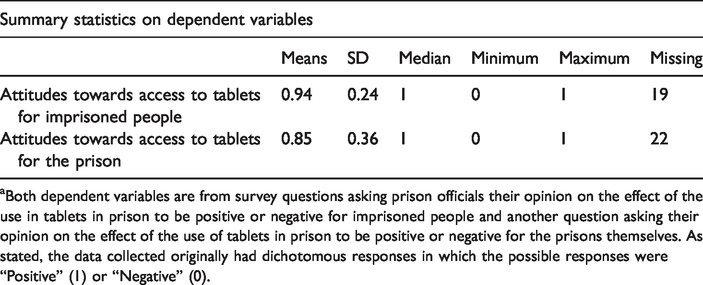
aBoth dependent variables are from survey questions asking prison officials their opinion on the effect of the use in tablets in prison to be positive or negative for imprisoned people and another question asking their opinion on the effect of the use of tablets in prison to be positive or negative for the prisons themselves. As stated, the data collected originally had dichotomous responses in which the possible responses were “Positive” (1) or “Negative” (0).
The independent variables for the four hypotheses were years working in corrections and access to technology. The years working in corrections variable is an ordinal-level variable which gave the following ranges of years working in corrections: under 5 years, 5–10 years, 11–15 years, 16–20 years, and 20+ years. For the purpose of analysis, categories were combined so that people who have worked under and over 16+ years were compared. The access to technology variable was coded as a continuous variable based on the number of technology items that imprisoned people have access to including personal TV, shared TV, personal phone, shared phone, personal computer, and shared computer. 2
A control variable used in the analysis is the age variable, which is an ordinal-level variable with the following age ranges: 18–29 years old, 30–39 years old, 40–49 years old, 50–59 years old, 60–69 years old, and 70–79 years old. For the purpose of analysis, categories were combined so that people who were under and over 50+ years old were compared. Another control variable used in the analysis is the education variable which is an ordinal-level variable with the following categories: high school or GED, associate degree, bachelor’s degree, master’s degree or MBA, or some college. For the purpose of analysis, categories were combined so that people who have a 4-year degree or higher degree were compared to the remainder. In addition, region, a nominal variable, was used in the analysis as a control variable, including the midwestern, western, and southeastern regions. The final control variable used in the analysis is the job title variable, which is a nominal variable which includes prison officials in leadership and prison officials in non-leadership positions. 3
In order to account for possible outliers, regression results for every state excluding Colorado will be discussed. Colorado, the one state that previously (but not at the time of the survey) allowed imprisoned people access to tablets to test the effect of Colorado was tested as a possible outlier. The reported results also discuss regression results excluding two states (Michigan and Montana) in which n = 1 in order to rule out the possibility of outliers driving the results.
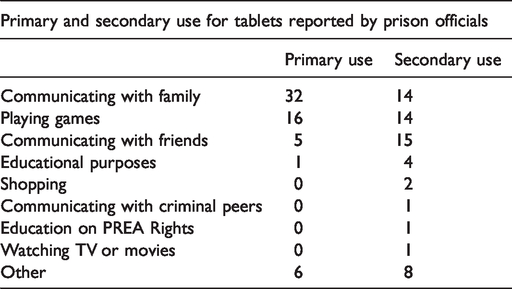
Lastly, prison officials were asked their perception as to the primary and secondary uses for tablets by imprisoned people. Despite the lack of statistical inference in the report of mere frequencies, knowledge of possible primary and secondary uses of tablets is substantively significant for future researchers to consider. As such, these survey findings are also reported.
Summary statistics and demographics
Table 1 shows the summary statistics for the dependent variables “Attitudes Towards Access to Tablets for Imprisoned People” and “Attitudes Towards Access to Tablets for the Prison.”
Table 2 shows the summary statistics (demographic information) of prison official respondents; most respondents were male, Caucasian, between 40 and 59 years old, attended some form of higher education after high school, have been working in corrections for 16+ years, and were in leadership positions.
Summary statistics of prison official respondents.

Note: Missing data is due to prison official respondents declining to answer some of the demographic questions.
aLeadership positions include: Chief of Department, Warden, Deputy Warden, Deputy Warden in Command, Assistant Deputy Warden. Non-leadership positions include Correction Officers and Correction Captain.
Generalized linear model (logistic regression) results for the dependent variable “Attitudes Towards Access to Tablets for Imprisoned People”.

Signif. codes: 0 ‘***’; 0.001 ‘**’; 0.01 ‘*’; 0.05 ‘.’; 0.1 ‘·’ 1.
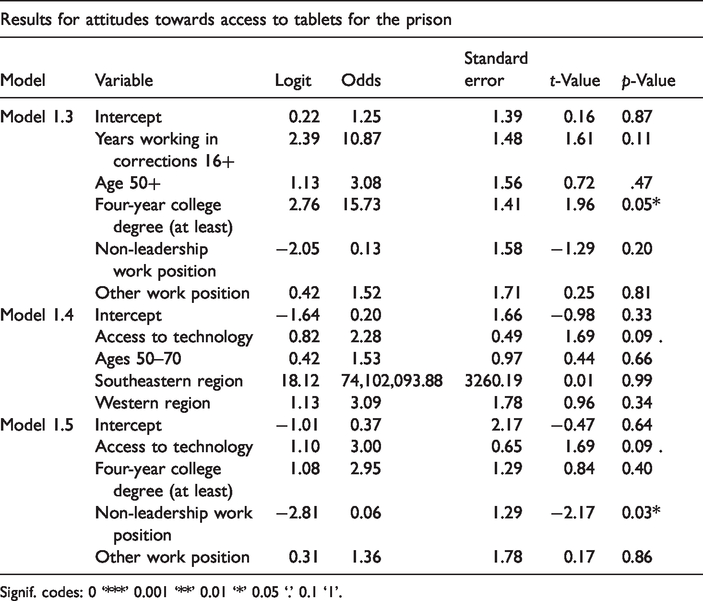
Generalized linear model (logistic regression) results for the dependent variable “Attitudes Towards Access to Tablets for the Prison”.
Signif. codes: 0 ‘***’ 0.001 ‘**’ 0.01 ‘*’ 0.05 ‘.’ 0.1 ‘1’.
Analysis
All analyses were conducted using R statistical software. Analytical diagnostics of the variable show that both dependent variables (attitudes towards access to tablets for imprisoned people and attitudes towards access to tablets for the prison), were not normally distributed and were negatively skewed. Therefore, a generalized linear model (logistic regression) was used to conduct this analysis at the individual level rather than ordinary linear regression (OLS). Generalized variance inflation factor tests were used to address multicollinearity issues among variables. Omnibus tests were also conducted.
Results
As stated, 70 prison officials from a total of six states and three regions responded to this survey during July to October 2019. The four hypotheses predict the views of prison officials’ positive or negative opinion on the access to tablets for imprisoned people and the prisons themselves using chi-square tests and logistic regressions. Chi-square tests indicate that both main predictors were significant (p < .05) on all four outcomes, specifically the predictors years working in corrections on attitudes towards access to tablets for imprisoned people and attitudes towards access to tablets for the prison, and the variable access to technology on attitudes towards access to tablets for imprisoned people and attitudes towards access to tablets for the prison. However, when conducting a logistic regression and adding other predictors, the variable, years of experience working in corrections, did not have any significant effects on either outcome variable. On the other hand, the predictor variable, access to technology, had significant effects on both outcome variables. In addition, the control variables education and work position had significant effects on the outcome attitude towards access to tablets for the prison.
Table 3 shows the results of the generalized linear model (logistic regression) for the dependent variable “Attitudes towards Access to Tablets for Imprisoned People”. Model 1.1 tested the impact of the variables, access to technology, age, and region on prison officials’ attitudes towards access to tablets for imprisoned people. The variable, access to technology, was positively significant (p ≤ 0.05). In other words, when controlling for age and region in Model 1.1, prison officials who worked in prisons with more access to technology were 81% more likely to have a positive attitude towards access to tablets for imprisoned people. 4
Prison officials in leadership positions may be more inclined to hold positive views of the prison policy to provide access to tablets to imprisoned people. As such, Model 1.2 removed the variable age and added the variable of job title, in order to determine the possible impact of the job title variable on prison officials’ attitudes towards access to tablets for imprisoned people. The logits in both Model 1.1 and Model 1.2 were both similar, and the variable remained positively significant (p < .05). In Model 1.2, when controlling for age and work title, prison officials who worked in prisons with more access to technology were 91% more likely to have a positive attitude towards tablets for imprisoned people. 5
Table 4 shows the results of the generalized linear model (logistic regression) for the dependent variable “Attitudes Towards Access to Tablets for the Prison”. Model 1.3 tested the impact of the variables, years working in corrections, age, education, and job title on prison officials’ attitudes towards access to tablets for the prison. While the main predictor, years working in corrections, did not garner statistical significance, the predictor education was significant (p < .05). In Model 1.3, prison officials with at least a four-year college degree (including those with master’s degrees or MBAs) were 94% more likely to have a positive attitude towards access to tablets for the prison.
Model 1.4 tested the impact of the variables, access to technology, age, and region on prison officials’ attitudes towards access to tablets for the prison. The variable, access to technology, was positively significant (p < .1). Prison officials who worked in prisons with more access to technology were 70% more likely to have a positive attitude towards tablets for imprisoned people in Model 1.4, when controlling for age and region. 6
Model 1.5 tested the impact of the variables access to technology, education, and job title on prison officials’ attitudes towards access to tablets for the prison. The variable access to technology was positively significant (p < 0.1) and the non-leadership work position category was negatively significant (p < .05).
All of the models (1.1–1.5) were re-run, excluding the state of Colorado, the state which at the time of the survey, did not currently provide access to tablets for imprisoned people. In Models 1.1 and 1.2, the variable, access to technology, remained significant. However, in Model 1.3–1.5, the variables access to technology, education, and job title did not remain significant after excluding Colorado. Thus, the significance in models 1.3–1.5 appear to be driven by the state of Colorado and should be understood with caution. In addition to re-running the models excluding Colorado, all models (1.1–1.5) were re-run, excluding Michigan and Montana, the states with a sample size of one. In most models (1.1, 1.2, and 1.5), all predictors remained significant after excluding states with small sample sizes. In Model 1.3, the education variable remained significant but the job title variable lost significance, and lastly, in Model 1.4, no variables remained significant when excluding states with small samples.
The variable, access to technology, remained significant in Models 1.1 and 1.2, and indicates that prison officials were more likely to have positive views of access to tablets in prison for imprisoned people and for the prison itself when the prison has more access to technology in general. It is also worth noting, that though insignificant in most models and with large standard errors, the job title variable, particularly the non-leadership position category, has a negatively skewed (See Model 1.2). This finding may indicate that prison officials in non-leadership positions were more likely to have a negative attitude towards access to tablets for imprisoned people.
To build on the logistic analysis, respondents were asked to indicate their perception of the primary use and secondary use of tablets for imprisoned people. Table 5 shows that most respondents indicated that the most common uses for tablets is communicating with family and playing games according to prison officials. While the survey did not include “music” as an option, many respondents indicated in a write-in section of the survey that music is also a popular use of tablets. This finding is important because prison officials’ attitude/opinion on the use of technology in prison is likely related to what they believe technology (and in this case, tablets) were being used for.
Prison officials' perception of how tablets are used by imprisoned people.
Limitations
While this pilot study is a start to this research, there are limitations. The main limitation of this study is the small sample size. While we were able to run logistic analysis with a sample size of 70, there were missing responses. The small sample size decreases the power and increases the possibility of a significant response. Many prisons were not interested in participating in the study, which made it difficult to achieve a larger sample size. Some prisons were not interested in participating because they do not provide imprisoned people with access to tablets. In addition, some prisons lacked the staffing resources to dedicate their employees’ time to take the survey. Relatedly, some states are overrepresented in the study due to their higher response rate, in comparison to other states. For example, two states only had one respondent – Michigan and Montana, whereas thirty-seven respondents from South Dakota state prison participated. We addressed this by re-running the regression excluding Michigan and Montana to determine any effects, but a larger sample size would have been more ideal.
In addition to the aforementioned limitations to this study, there are omitted variables that may influence prison officials’ perceptions as to the positive or negative impact of tablets for imprisoned people and for the prison itself. For example, while the survey asked correction officers if they had a positive or negative opinion on access to technology in prison, the survey did not ask correction officers about their penal ideology (i.e.: punitive, rehabilitative, etc.) or their opinion on the primary purpose of prison, which may have shed light on opinion on access to technology in prison. Similarly, a variable concerning the dominant penal ideology in certain states was not included in this analysis.
Another omitted variable may be the type of unit the prison official oversees. For example, an officer overseeing a maximum security prison may be less inclined to have a positive view of access to tablets in prison due to security concerns.
Furthermore, this study reports merely on correlations between variables due to the lack of the time order component necessary to claim causality. Relatedly, the survey asked prison officials whether they perceive access to tablets to be a positive or negative for imprisoned people and for the prisons themselves, which does not allow for a variety of responses. Future surveys should include a Likert scale in order to increase the variance in response from prison officials.
Lastly, while prison officials have a rare and important perspective due to their oversight of imprisoned people, future studies should survey imprisoned people on their access to and use of technology in prison. Imprisoned people are a vulnerable population and their experience in prison may be significantly changed, either positively or negatively, due to access to tablets in prison. Understanding their perspective on the benefits and pitfalls of technology in prison is necessary to assess whether prisons should increase access to tablets in prison.
Discussion
A deeper understanding of access to and the use of technology, namely tablets, in prison is important in order to determine if they are beneficial for imprisoned people and the prisons themselves. Previously, popular programs which have not yet been evaluated have become widely adopted; some of these programs have failed, yet have been deemed “too big to fail,” making it difficult to reverse funding decisions and public opinion (Papachristos, 2011). In addition, there is also the possibility that policies which appear to be beneficial might be harmful (McCord, 2003). In this case, it is possible that the tablets are being used maliciously, or that connection with family members may cause dissatisfaction and behavioral outbursts (Casey-Acevedo, 2004). As such, while the implementation of digital technology may have positive effects, it is important to continually assess any digital technology program in U.S. prisons. This may include surveying correction officers, imprisoned people, and their families concerning their experience using digital technology and/or monitoring the use of digital technology.
The results of the logistic model indicate that prison officials who work in prisons with more access to technology are more likely to believe tablets to be a positive contribution for imprisoned people and the prison itself. This aligns with two of the hypotheses (H3 and H4). However, there were no significant findings concerning H1 and H2. Further investigation as to the impact of years of experience is necessary because as shown, research indicates (in addition to the finding in this study) the substantive and statistical significance of the tenure of prison officials in addition to the finding in this study that officials in non-leadership positions is more likely to have a negative attitude towards access to tablets for imprisoned people. While this finding was not statistically significant, it may be substantively significant as prison officials who have a longer tenure, may be more likely to have leadership positions, and thus more likely to support increased access to technology in prison due to their part in the decision-making process concerning technology.
The findings presented here are important not only as a pilot study on access to new technologies within prison, but also because they provide some insight as to what prison facilities must do to improve support for the implementation of digital technology. As mentioned, prison officials in leadership positions tend to have a more positive attitude towards access to technology than prison officials in non-leadership work positions. This may be because prison officials in leadership positions have a big picture understanding of the benefits of implementing digital technology in prison, which can be shared with prison officials in non-leadership positions. On the other hand, this may be because prison officials in non-leadership positions have more day-to-day contact with imprisoned people and thus have had bad experiences have more day-to-day contact with imprisoned people and understand that access to digital technology may create more responsibilities for themselves, in which case it would be important for prison officials in leadership positions to clearly outline the responsibilities and expectations associated with implementing digital technology in prison.
Furthermore, the findings indicate that prison officials in leadership positions must do more to garner support for technology amongst their subordinate officers to help ensure a smooth transition to the implementation of digital technology in prison. In addition, prison facilities may wish to implement training which educates prison officials on the benefits which access to technology can have for both the imprisoned persons and the facility itself in order to garner more support for improving technology within prisons. The presented here also indicate that prison staff that work in prisons that have more access to technology are generally more supportive of the implementation of digital technology, which may be because they have adapted to the use of digital technology in prison. Thus, while prison staff may not be initially supportive of technological advancements in prison, they may become supportive of the advancements over time, and as the prison continues to technologically evolve.
Finally (and while not the subject of this paper), “correction-grade tablets” appear to be a potentially profitable industry, and investigation into the predatory pricing and cost-prohibitive nature of these tablet companies is necessary. Further research on the incentives of the correction-grade tablet industry and their relationship with state prisons is warranted. These findings are important, but as shown, there is much more research to be completed on the topic of access to and the use of technology in prison.
Footnotes
Acknowledgements
The authors are grateful for the advice and insight from Victor St. John. In addition, the authors received Institutional Review Board (IRB) approval in order to survey prison officials.
Data availability statement
The data that support the findings of this study are available on request from the corresponding author (AM).
Declaration of Interest Statement
The author(s) declared no potential conflicts of interest with respect to the research, authorship, and/or publication of this article.
Funding
The author(s) disclosed receipt of the following financial support for the research, authorship, and/or publication of this article: The authors, part of a research team led by principle investigator Demis Glasford, received a grant from the Department of Homeland Security, the Disciplinary Theory and Advanced Social-Behavioral Sciences Research-Methods Training (DART) Fellowship to support the research, authorship, and publication of this article.
