




Abstract
This essay is about meaning and measurement, with particular emphasis on the relation between semiotic technologies and temporal reckoning. It begins by theorizing four ways of framing time. Temporality as metricality focuses on the repetition of tokens of common types. Temporality as performativity focuses on the roots and fruits of a given event. Temporality as reckoning focuses on how one determines when an event occurred or how long an event lasted. And temporality as worldview focuses on the ways a given community (genre, public, discipline, philosophy, register, etc.) frames the nature of time. Temporality as reckoning is then used to question some entrenched claims about temporality as worldview. In particular, the claim that modern modes of temporality are ‘abstract’ (in comparison to so-called premodern, traditional, or everyday modes of temporality) is called into question. In place of pre-theoretical notions like abstraction (and similarly inadequate concepts, such as ‘commensuration’, ‘quantification’, and ‘objectification’) a set of fine-grained analytic distinctions is introduced. These may be used to theorize the conditions for and consequences of a technology being relatively portable: its meaningfulness being widely applicable and/or contextually independent. Reflexively, while this essay draws its examples and methods from the domain of time, its general claims are meant to be portable to other domains – from velocity and price to temperature and information.
The winter evening settles down With smell of steaks in passageways. Six o’clock. (T.S. Eliot, Preludes) Today, Tomorrow, Toyota. (Car advertisement, magazine)
Overview
Section 1 describes four ways of framing the nature of time: temporality as metricality, temporality as performativity, temporality as reckoning, and temporality as worldview. Section 2 reviews the underlying logic of reckoning time that is relevant to any analysis of the semiotics of temporal expressions, focusing on points of orientation and periods of repetition, as well as logics of order and hierarchies of size. Section 3 uses this logic to offer a typology of linguistic constructions used to reckon time, and thereby provides an analytic for characterizing the semiosis of temporality across different systems of signs and communities of signers. Section 4 characterizes the relation between those who hold the power to determine which periods and points are reckoned with, and those who constitute the publics that reckon with these periods and points. Section 5 focuses on who has the ability to reckon time in ways that are considered relatively exact, and who determines the criteria of exactitude. Section 6 examines how the systemic properties of semiotic technologies can make a technology more or less amenable to use across historical and geographical contexts, and how reference to these properties can legitimate its use. And section 7 focuses on a variety of ways in which the concept of time gets structured in terms of the properties of the semiotic technologies used to reckon it.
The conclusion treats the oft-invoked distinction between abstract and concrete temporality (and related concepts). It discusses the inadequacy of these concepts, showing how they obscure rather than illuminate the complex of transformations that underlies modern modes of temporality. In place of them, it introduces the multidimensional and graded notion of portability – which may be initially and loosely defined as: 1) a way of characterizing the degree to which the meaningfulness and (means-ends-fullness) of a semiotic technology is (or at least seems to be) widely applicable and/or contextually independent; and 2) a theory of some of the key conditions for and consequences of this (appearance of) applicability and independence. And thus, while the focus is on the semiotic technologies involved in temporality, the general claims are applicable to other semiotic technologies (such as money, and media more generally) and the infrastructures, institutions, and imaginaries on which they depend.
Four ways of framing temporality
Temporality as metricality foregrounds the repetition of tokens of a common event type. It has a long history in classical poetics and musicology, but was especially foregrounded in the work of Roman Jakobson (1990a). In the poem by T.S. Eliot with which this essay began, this frame is evident in at least two ways. The first two lines have four feet apiece, where each foot consists of two syllables. Moreover, in each of these feet, the first syllable is unstressed and the second is stressed. Technically speaking, we can say the first two lines are of the type iambic tetrameter. The third line breaks both these patterns: it has an odd number of syllables, and only three of them rather than eight. And the stress pattern of its first two syllables is stressed-unstressed. In short, the first two lines set up a pattern which is broken by the last line. More generally, the repetition of replicas (qua tokens of a common type) foregrounds the singularity (qua unique and surprising tokens). Putting all of this in a temporal idiom, prior experience structures future expectation, which may subsequently be experienced as frustration or satisfaction.
Such a way of framing temporality does not just turn on features of signs (qua words, utterances, or signifiers). As is evident in the magazine advertisement, it may also turn on features of objects (qua referents, states of affairs, or signifieds). In particular, not only do each of the three words begin with ‘to’ (as the formal repetition of tokens of a common orthographic type), but the first two words are also members of a particular semantic domain. Their meaning may be loosely specifiable as follows: ‘today’ is that solar-centric period centered around the speech event (the time at which the utterance is said); and ‘tomorrow’ is the solar-centric period that occurs after this period. Finally, by reference to its common orthography, as well as its place in this series, the word ‘Toyota’ is thereby framed as being the next likely member of this semantic domain: it is projected to have a meaning like ‘the day after tomorrow’ or, perhaps, the near future more generally. Notice, then, that while this third line could be a singularity (i.e. its usual referent is a brand of automobile rather than a period in time), it may nonetheless be experienced as a replica (in particular, we have just been set up to expect one). That is, we may assimilate future experience to past experience, thereby treating a singularity as a replica. Here both frames are applicable at once.
The poetic framing of temporality may be extended from stereotypic signs and objects (such as the foot or stanza, word or sentence, concept or referent) to events more generally. In particular, any sequencing of events, whether or not it be framed in semiotic terms, may involve the repetition of tokens of common types, and thus prior experiences structuring future expectations. From the dripping of a faucet to the twisting of a screw, from weather patterns to dynastic succession, from turn-taking in conversation to streaks of luck in gambling, from the ticking of a clock to the regularity of migraines, from the oscillations of a yo-yo to the mood swings of manic depression. Sign events are just one kind of event among many, any string of which could be used to ground a series of replicas or to figure a singularity.
Temporality as performativity foregrounds the roots and fruits of any event. For example, in regards to the stanza by T.S. Eliot, we may treat the writing of the poem as a sign event, and examine the range of interpretations that this event gave rise to: from readings of his work, through doctoral dissertations on its meaning, to the mini-exegesis being undertaken in this essay. That is, we may examine the interpretive fruits of that event. Moreover, we may examine the range of prior events that led up to Eliot’s writing of the poem: from experiences he had as a teenager, through books he read as a boy, to conversations he had with his contemporaries. That is, we may also examine the significant roots of that event. In short, most events in which one expresses a sign may be framed as having roots and fruits: they are simultaneously an interpretation of prior events and an event that will be lead to subsequent interpretations. 1
The term performativity may be used in a more narrow fashion. For John Austin (2003), the felicity of an utterance turned on its being simultaneously appropriate in context and effective on context. For example, a wedding vow is only normatively (and legally) appropriate so far as the participants in the ceremony already have certain social statuses (e.g. unmarried, adult man and woman); and a wedding vow is only effective so far as the participants come to have certain social statuses (e.g. husband and wife). More generally, even the most simple of sentences has such a temporal structure. For example, an utterance like the dog died has two parts: the subject or topic (the dog) is prototypically old information (the speaker assumes the addressee can identify the referent of the word ‘dog’); and the predicate or focus (died) is prototypically new information (the speaker assumes the addressee did not already know this fact, but will subsequently know it). Utterances of all sorts, then, simultaneously point backwards and forewords in time: they have roots and fruits.
The wedding vows are illustrative for several reasons. As just described, the focus was on the roots and fruits of a particular ceremony as an event token. We could also have focused on the felicity conditions of the ceremony as an event type. In the first case, we focus on how participants enter and leave such ceremonies with different ensembles of social statuses and mental states (loosely speaking); or different ensembles of normatively regimented commitments and entitlements, more generally. In the second case, we focus on transformations of the institution per se: the historical roots and fruits, for example, of the actual legal categories and affective values that underlie such events. This might be grounded in the passing of laws on who is allowed to take part in such a ceremony (e.g. gay or straight, young or old, citizen or alien). Or it might involve changing conventions regarding what behavior is normative for a husband and wife (e.g. the weakening of norms of cohabitation, or the tolerability of adultery). In the first case, we focus on the roots and fruits of an event in an individual biography, or an interactional unfolding; in the second case, we focus on the roots and fruits of an institution in a community’s history, or even in a species’ phylogeny. Temporality as performativity, then, has roots and fruits at different levels of scale. Kockelman (2007a) uses this lens to examine the putative transition from status to contract.
But temporality as performativity is much more general than speech act theory, or semiosis more broadly. The underlying logic of roots and fruits may be extended to causal, instrumental, phenomenological, and cognitive processes. For example, just as any event may be understood as a cause with subsequent effects, any event may be understood as an effect with prior causes. Or just as any action may be understood as a means towards some future end, any action may be understood as the ends of some past means. Philosophers from Augustine to William James, and from Husserl to Heidegger, had this intuition. For example, James (1975) spoke of the present as a saddleback on which we sit perched, looking into two directions at once. Husserl (1999) spoke of each moment of consciousness being simultaneously protentive and retentive. Heidegger (1982) spoke of being simultaneously thrown (onto a scene, or into a context) and projecting (the next scene, or the upcoming context). More generally, there is Piagetian accommodation and assimilation: the organism simultaneously assimilates a future environment to its present schemata, just as its present schemata were accommodations to a past environment.
Temporality as reckoning foregrounds the ‘when’ and ‘how long’ of an event. It focuses on the social, semiotic, and material resources we have for telling the time. To go back to our examples, the first poem makes reference to time in several ways: by phases of the periods of various solar-centric phenomena (winter, evening); by events that routinely occur at certain times of day, or in certain seasons of year (the smell of steaks); and by clock time in its seemingly brute abstraction (six o’clock). By there are other ways this poem makes reference to time: through construction like unmarked tense and aspect (the winter evening settles down) in contrast to other possible combinations: future tense (will settle down); past tense (settled down); perfect aspect (has settled down); progressive aspect (has settled down); or some combination of the two (has been settling down, will have settled down, etc.). This way of framing temporality will be the focus of what follows. 2
Finally, there is temporality as worldview, which is the usual focus of anthropologists. In the first two lines of the poem by T.S. Eliot, we have the contrast between natural solar-centric periods turning on season of year (winter) or phase of day (evening). And in the last line we have the seemingly empty clock-time of a putative capitalist modernity (six o’clock, qua end of workday). As paralleled by the shift in poetic meter, clock-time is the singularity that irrevocably disturbs prior natural rhythms. In short, Eliot’s poem aesthetically encloses a widespread view of what happened to time: a movement from concreteness to abstraction.
Temporality as worldview is partially captured by Bakhtin’s notion of the chronotope, in which ‘Time, as it were, thickens, takes on flesh, becomes aesthetically visible’ (Bakhtin 1981). But temporality as worldview is about cultural understandings or, more generally, ontological assumptions – framed in philosophy as much as poetry, farming as much as gambling, science as much as history – as to what is time, what kinds of time are there (such as propitious birthdays, bad times to harvest, and so forth), and what has happened to time. Such worldviews can be present in Mayan myths and Aztec calendars as much as relativist theories of physics and modernists formulations in literature. Indeed, it should be emphasized that the set of frames offered here is itself a particular worldview: our own particular aestheticization of temporality for the sake of argumentation.
The underlying logic of reckoning time
Events are of fundamental importance in reckoning time (Bull 1960). The duration between two similar events may be used to mark a privileged period of repetition. For example, depending on whether the event being repeated is sometime like high noon, a full moon, or the vernal equinox, we have periods such as days, months, and years. Other periods may then be sized relative to privileged periods as multiples and fractions. For example, one day equals 24 hours, ten years equals one decade, and so forth.
The occurrence of any particular event may be used to mark a privileged point of orientation. For example, we may orient to the time of the speech event when we use a word like ‘now’; we may orient to the time of another narrated event when we use a sentence like ‘before he left the house’; and we may orient to the time of a calendric event when we use a construction like ‘on July 5th, 1973’. Other points may then be ordered relative to privileged points as prior, simultaneous, and subsequent. For example, if the privileged point is the speech event, there are constructions such as yesterday, today, and tomorrow.
Such privileged points and privileged periods (and any non-privileged points or periods sized and ordered relative to them) may be used to reckon the when and how long of other events. For example, the battle started on June 3rd, 1431, and it lasted 20 years; or, in three days they’ll arrive. Moreover, the when and how long of events may themselves be involved in other modes of measurement. For example, we may ask how often (frequency/duration), how fast (distance/duration), and how powerful (energy/duration).
The foregoing ideas may be used to understand calendars and clocks (compare Bull 1960). In particular, such semiotic technologies involve a set of relatively privileged periods (e.g. years, months, weeks, days; or hours, minutes, seconds), and a set of relatively privileged points (e.g. the birth of Christ; or midnight). Some of the privileged periods are ordered relative to each other (e.g. the months of each year and the days of each week; or the seconds of each minute and the minutes of each hour). And some of the privileged points are ordered relative to each other and to a privileged point (e.g. the days of the year; or the hours of the day). Indeed, clocks and calendars are intimately related at different levels of scale: our stereotypic calendar could be further divided to give clock time; and our stereotypic clock could be further multiplied to give calendric time.
To understand the quirky nature of calendars and clocks – and of temporal reckoning more generally – one may turn to maps. To read a map, say, of city streets, one needs to position the map relative to the city (e.g. using the compass points: north, south, east, west); and one needs to position oneself relative to the map (e.g. using a you-are-here spot). Calendars are no different: one needs to position the calendar relative to events in the world, and oneself relative to the calendar. For example, one not only needs to know that the event to be reckoned happened on 23 February 1980, but also that today (the event of reckoning) is 5 March 2005. In short, for calendars to be of any use requires triangulation (Bull 1960).
This fact is also true for modes of temporal reckoning in which the privileged point is not a calendric event, but the speech event or another narrated event. For example, to say David died two days before the battle began requires that we position David’s death relative to the beginning of the battle, and that we position the beginning of the battle relative to the time we are speaking. In short, for the purposes of the semiotic expression of temporality, triangulation requires orienting a narrated event (or event to be reckoned) relative to a privileged point, and orienting the privileged point relative to the speech event (or event of reckoning) (see Figure 1). In this way, the practice of ‘telling the time’ is often just a mode of reckoning in which the event to be reckoned is identical with the event of reckoning: at the sound of the tone the time will be 6:32, exactly.
Triangulation.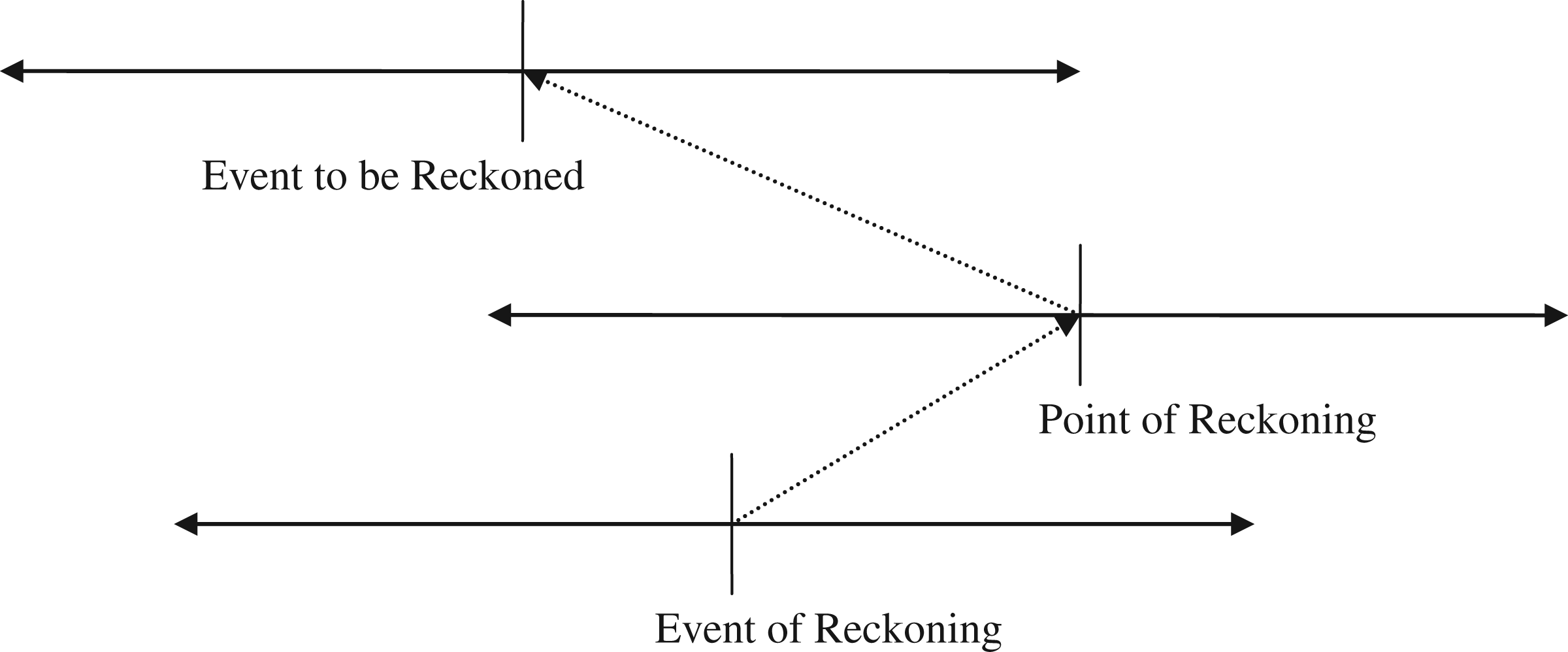
This understanding of the underlying logic of temporal reckoning leads to the first dimension of portability: the fewer privileged periods, points, sizings or orderings a semiotic technology has, the more portable it is relative to other semiotic technologies. In this way, it turns on the relation between any two semiotic technologies. Indeed, Benjamin’s (1968) elusive notion of empty homogeneous time may be redefined in these terms: a mode of temporality in which there are no privileged periods, points, sizings, or orderings. This mode of temporality may be conceived as a one-dimensional continuum stretching infinitely far into the future and into the past, with any point equivalent to any other for the purpose of reckoning, and with each segment infinitely divisible into smaller segments or infinitely multipliable into larger segments. What is crucial about such a portable mode of temporality is that the semiotic technology that underlies it can ‘translate’ any other semiotic technology into its own terms, but cannot necessarily be translated into the terms of every other semiotic technology. Such a mode of temporality easily becomes the independent variable relative to which dependent variables such as the time of some event, or the duration of some process, are assessed. A semiotic technology with no privileged periods, points, sizes or orders is the temporal analog of Marx’s (1967 [1867]) universal equivalent: the one commodity that may be used to represent the value of all other commodities. Or, somewhat metaphorically, but well within Benjamin’s imaginary, it is the temporal analog of a universal language: the one language that may be used to translate the meaning of all other languages (Kockelman 2006: 100).
The linguistic resources used to reckon time
When reckoning time, the relation (R) between a relative focal event (F) and a relatively background event (G) is key (see Figure 2, which adapts this notation and framework from Jakobson (1990a; and see Hanks 1991 and Talmy 2000)). For example, in an utterance like ‘two days after my wedding, my dog died’, the relatively focal event is the dog’s dying. It is the event whose time we are reckoning. The relatively background event is the day of my wedding. It is a privileged point we are reckoning relative to. (It may itself be reckoned relative to another even more background event, such as the speech event.) And the relation is a vector turning on both a direction (after) and a magnitude (two days). In effect, the construction says that the focal event (whose time is unknown to the addressee) occurred two days after the background event (whose time is known to the addressee). Crucially, what is a focal event in one utterance can become a background event in the next utterance. For example, the speaker might continue: ‘and a week after my dog died, my husband left me’. Such symmetrically known background events thereby provide privileged points for the temporal reckoning of asymmetrically known foreground events. In this example, such background events turned on a narrated event. But they may also turn on a speech event (my dog died yesterday) or a calendric event (my husband left me on September 5th, 1970). It should be emphasized that spatial reckoning can be similar to temporal reckoning in these ways. For example, we may reckon the position of one entity relative to the speech event (it is over here), relative to a narrated event (it is in front of the shed), or relative to a geocentric event (it is at latitude 40.801301 and longitude −73.959133).
Relational notation.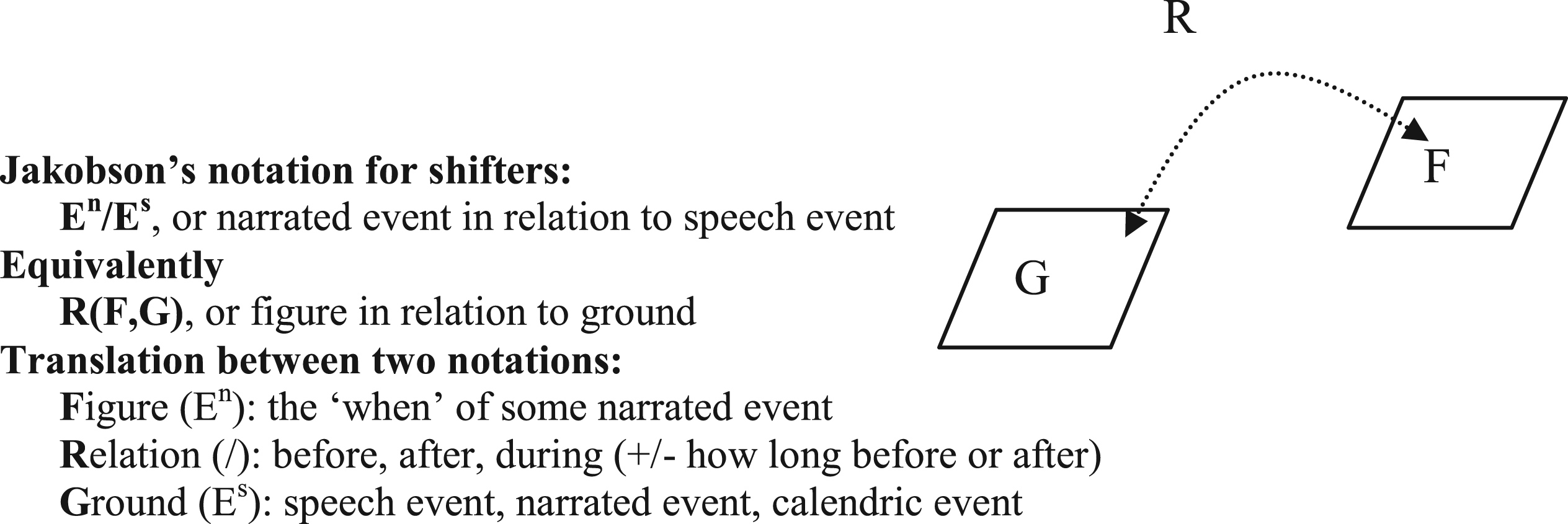
It is worthwhile demonstrating the range of linguistic constructions used for reckoning time (Bull 1960; Klein 1994; Kockelman 2009). Not only are such constructions important in themselves as the most widespread of semiotic technologies, but they are also involved in our interpretation of any other semiotic technology: in particular, other semiotic means of reckoning time are often analyzed in terms of, and regimented by, such constructions. And thus, even if an analyst in not interested in the linguistic encoding of time per se, she will very likely have to rely on such a metalanguage to explicate any system in its full detail. While a full account of such constructions is beyond the scope of this essay, some examples from English are presented below to give the reader a sense of the patterns involved.
A range of linguistic constructions used to reckon time
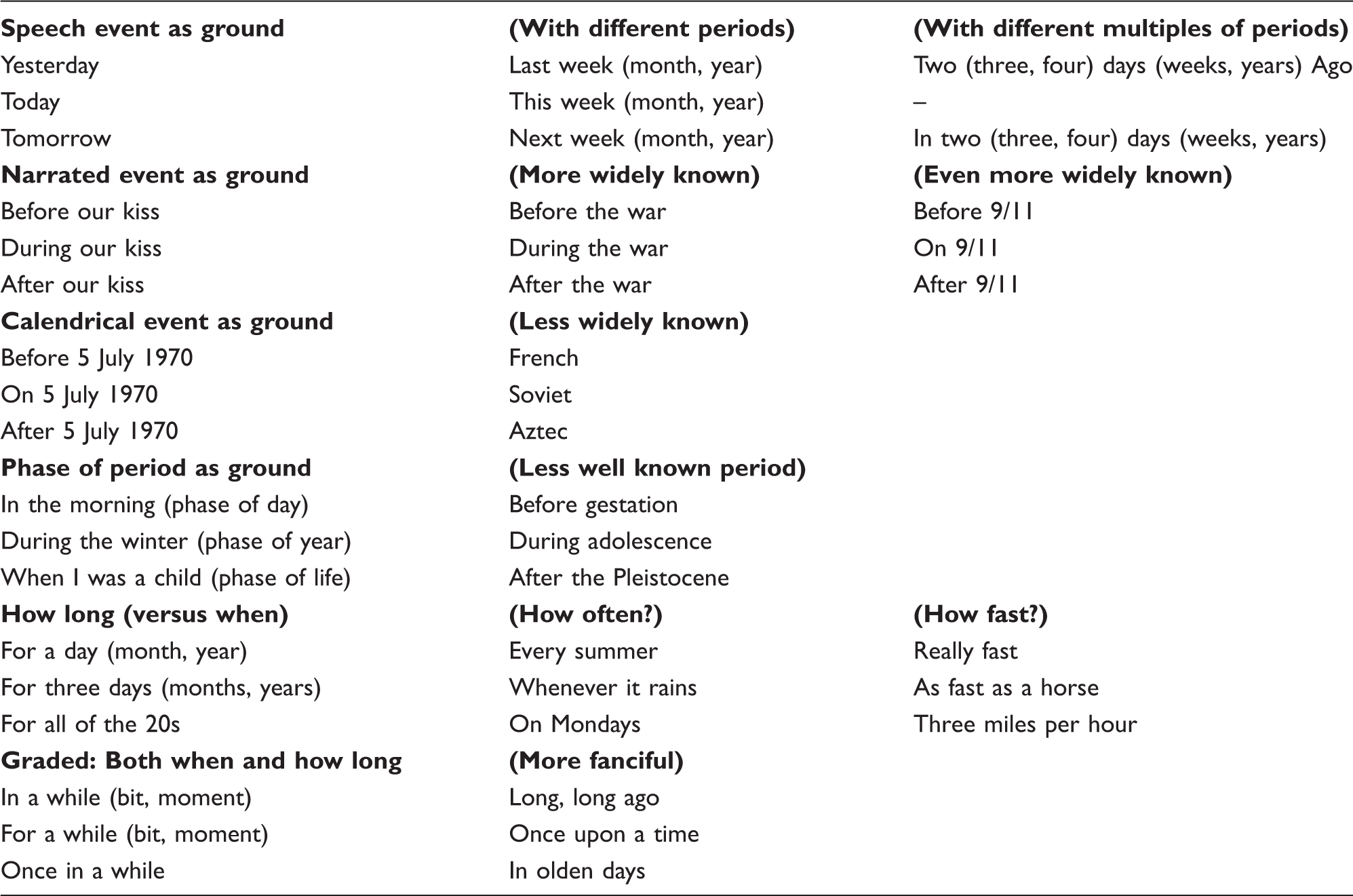
The second row of Table 1 shows constructions whose background event is a narrated event. Again, in addition to the relation of simultaneity, there are two kinds of directions: before, after. And with these directions there may be different magnitudes: two days before we kissed; ten years after the war. From left to right, they have been ordered as a function of how widely known the narrated event is. In particular, if the time of the background event used in such a construction is known to the addressee, then some background events are more widely known and some are less widely known. (Notice that 9/11 is not being treated as a calendric event but as a narrated event.)
And the third row of Table 1 shows constructions whose background event is a calendric event. For calendar specialists, it could be filled out with dates in more or less widely known calendars: from the Gregorian system that is widely used at present to other systems that had their heyday. In short, as with narrated events, calendric events (and calendars more generally) can be more or less symmetrically known to participants.
The fourth row of Table 1 shows constructions whose background event is a particular phase of a well-known period. There are phases of the solar day (dawn, dusk, night, day, morning, evening). There are phases of the human life-cycle (as a child, during adolescence, in my 20s, in the twilight of my days). In certain cases, what matters is only the phase per se; but in other cases what matters is both the phase within the period and the time of the period per se. Depending on the speaker and addressee, more widely known or less widely known periods and phases might be used. Note that some periods are periodic (day), with the onset and offset of the period being determined by a particular event (say, high noon). Other periods are one of a kind (Pleistocene), and are best thought of as historical or geological eras.
The final rows in Table 1 show a variety of other types of constructions that might be judged temporal. Some turn on duration (e.g. for three months): these reckon the ‘how long’ of a foregrounded process relative to the ‘how long’ of a background process. Some turn on frequency (e.g. every morning, whenever it rains). Some turn on speed (e.g. three miles per hour, as fast as a horse, really fast). And some reckon features of temporality with units that are not quantified but only graded (Sapir 1949). For example, for a while (as compared to for ten minutes); or long, long ago (as compared to in 3000 BC).
Most of the constructions just described might occur in the context of another construction, and thereby be caught up in processes of triangulation. For example, a word like ‘tomorrow’ can occur as a temporal adverb in a sentence like ‘the explosion will occur tomorrow’. In this way, three events are being brought into relation: the explosion (as a narrated event) is to be simultaneous with tomorrow, as a temporal event; and tomorrow is one day after the speech event. We may say that tomorrow is a reference event that is figured relative to the speech event as an event of reckoning, and used to figure the narrated event (or explosion) as an event to be reckoned. 3
This analytic framework may be used to characterize a second dimension of portability: the less a speaker and addressee must know in common for successful communication to occur, the more portable the semiotic technology they use (see Figure 3). For instance, the more amenable a lexical form, or sign more generally, is to decontextualized and recontextualized usage (what Goffman (1981 [1976]: 34) would have called its ‘excerptibility’),
4
the more portable it is. Because of the nature of triangulation, this parameter is crucial for temporal reckoning. It is a way of assessing the degree to which a sign is interpretable across contexts: what must be known to position the event to be reckoned relative to the privileged point, and to position the privileged point relative to the event of reckoning. The mutual knowledge in question may be phenomenological (turning on features available from the speech event), discursive (turning on features available from prior narrated events), or calendric (turning on features available from a particular calendar). For example, linguistic constructions which use a speech event as a privileged point are (with many caveats) generally less portable than those that use a narrated event, which are generally less portable than those that use a calendric event. The second dimension of portability, then, turns on the sharedness of the knowledge needed to reckon with the semiotic technology in question. It thereby foregrounds the relation between the signer and the interpreter in relation to the relation between the sign and object.
Portability of interpretation.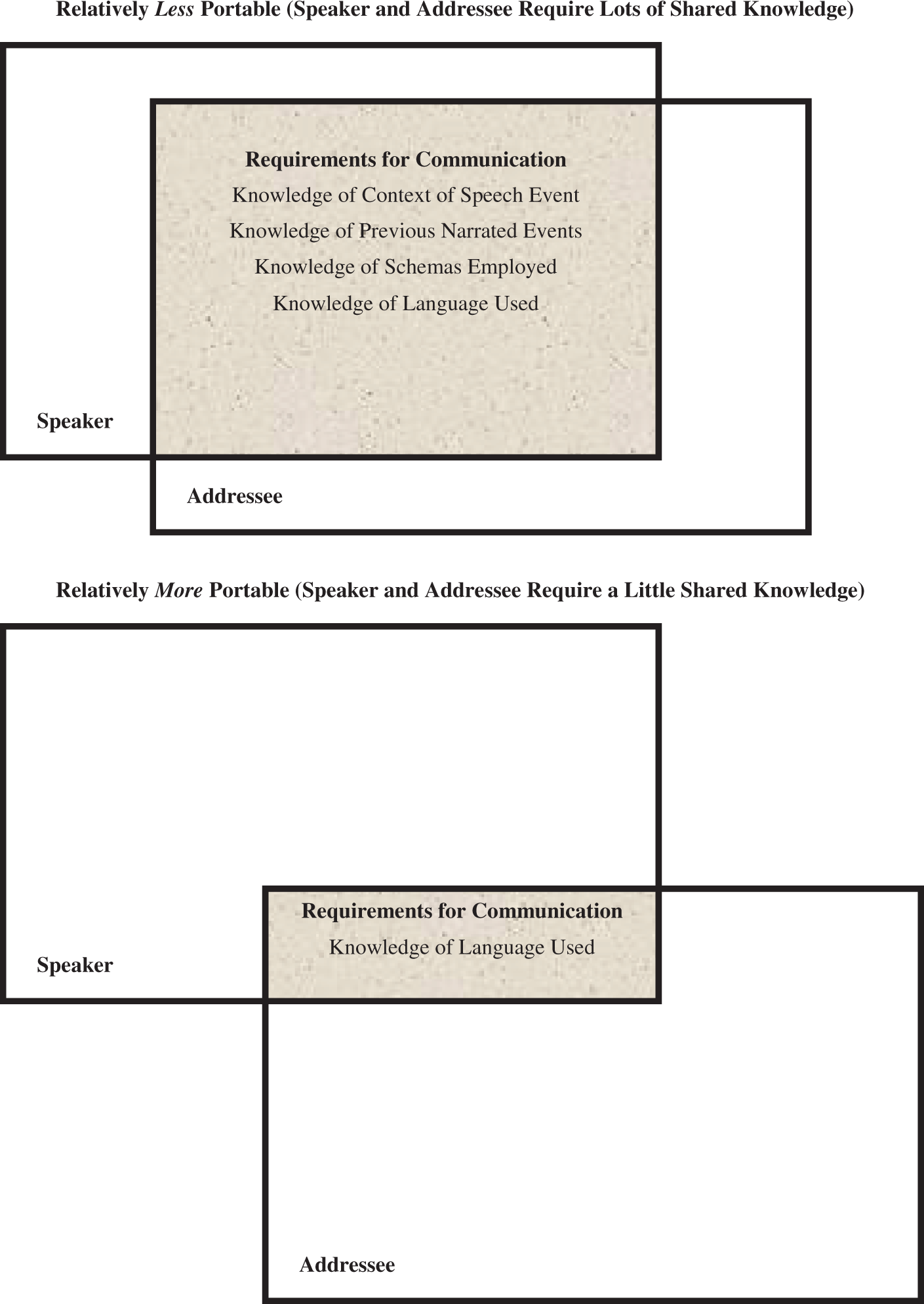
This framework provides a useful basis on which to ask questions about specific instances of these features and constructions. For example, it allows us to compare the linguistic encoding of temporal qualities across languages and communities, asking how certain languages (registers, speech communities, etc.) privilege certain types of units (say, graded versus quantified), sizes (say, days versus minutes), points (say, speech event versus narrated event), or orders (say, anterior versus posterior). Does such semiotic privileging have consequences for social and psychological processes; and is it conditioned by them? How do different genres of speaking – from poetry and news reporting to office pleasantries and scientific papers – privilege certain units, periods, points, or orders? Moreover, in any instance of reckoning time, the use of particular units, periods, points, or orders can index any number of contextual variables: gender, class, nationality, education, religion, or occupation; anger, peevishness, hope, or anxiety; respect, intimacy, distance or formality; time of day, season of year, era of history. How, then, do such privileged sizes, periods, points, and orders change over the history of a community or the biography of an individual or the sequential time of an interaction? How do such changes relate to ongoing transformations in science and technology, politics and economy, media and advertising, morality and religion? And finally, how do all such differences in privileged units, periods, points, and orders strategically relate to the relative portability of a linguistic construction, and how does this relate to the other kinds of portability that we will now describe? Note that while we can now pose these questions precisely, 100 years of scholarship on temporality has barely begun to answer them.
Events used in reckoning time
Directly related to symmetry is the relative size and openness of the community that has access to, and uses, the knowledge in question. In this section, we examine another dimension of portability that is grounded in the previous one: the larger the public that reckons with a given semiotic technology (or any of its privileged points, periods, sizings and orderings), the more portable it is. Thus, it is not just the case that calendric events may be more portable than narrated events which may be more portable than speech events. It is also the case that certain calendric events are used by larger publics than others; certain narrated events are used by larger publics than others; and certain speech events are used by larger publics than others. In particular, linguistic constructions that use a relatively private speech event are generally less portable than those that use a relatively public speech event; constructions that use a relatively obscure narrated event are generally less portable than those that use a relatively well-known narrated event; and constructions that use a relatively specialized calendar are generally less portable than those that a relatively widespread calendar; and so forth. As will be seen, these issues relate to powers and publics, and our agency over events more generally.
Events are crucial to establishing the periods and points of temporal reckoning. Given their importance, it is useful to map out some salient distinctions that characterize them. First, relatively speaking, an event may be a replica or a singularity. That is, it may be a token of a type or a unique, one of a kind, occurrence. For example, sunrises and equinoxes are replicas, whereas the birth of Christ and 9/11 are singularities. A replica, in turn, may be framed as relatively periodic or merely recurrent. That is, it may occur at fixed intervals (within some potentially infinite interval) or sporadically every now and then. For example, my wife’s drunken rages, and my own migraines, are recurrent, but not periodic; whereas the decay rate of a cesium atom, and the swing of a pendulum, are periodic. The point at which an event takes place, as well as the duration between periodic events, falls along a scale from controllable to uncontrollable, with both points and periods subject to different degrees of control. For example, one can set the privileged point of when a clock begins, but not how long its period lasts. One can set both the points and periods of a metronome, but neither the points nor periods of sunrise and sunset. The points and periods of past events (the death of Gandhi, the Sepoy Rebellion) cannot be controlled; but those of future events (the coronation of a king, the term of a presidency) sometimes, to some extent, can. Finally, the events that determine points and periods may be more or less sensibly accessible without instrumental mediation or nonsensible (requiring instrumental mediation). For example, one can see the rise and setting of the sun with the naked eye, but one cannot see the decay of an atom or the death of a distant star without some artificial extension of the human sensorium.
This relatively abstract typology offers a framework for more concrete questions about the nature of semiotic technologies. This framework allows us to ask about the relation of semiotic technologies to those who have control over them and those who are controlled by them – and hence power and publics more generally. The fact that triangulation requires privileged periods and points raises two key questions: who holds the power to determine which periods and points are reckoned with; and who constitutes the public that reckons with these periods and points? Needless to say, power and publics are interrelated: determining the points and periods with which time is to be reckoned delimits the publics that possess the shared knowledge necessary to do the reckoning. Moreover, various publics allow their members different degrees of control in determining the periods and points of time reckoning.
In particular, the third dimension of portability turns on whether relatively many or relatively few people hold such powers or constitute such publics. Very often, the larger the relative size of the population determining the periods and points of time reckoning, the smaller the absolute number of the population constituting the reckoning public. Participants in a speech event, for instance, together set one point of temporal triangulation at the speech event itself; but such a reckoning public is necessarily quite limited. A calendar produced through expert understandings of periodic, potentially nonsensible events, however, can be used by a population that far exceeds the number of people who made the calendar.
The event typology, with its implications for the relations between those who determine how time is reckoned and those who reckon it in that way, raises questions about the power to set such determinations. This power involves not only questions about the social positions from which points and periods can be privileged, but also issues of access to knowledge and the instruments that extend it. For example, who has access to the instruments that extend the human sensorium, allowing us to experience otherwise nonsensible time-reckoning events (telescopes, satellites, computers, observatories, stopwatches, calendars, sundials)? This access may include use-right, possession of the money to purchase, training in the skills to use, entitlement to information procured, and so forth. Even when the relevant events are visible to the naked eye, not everyone’s eyes are positioned to see them. For example, who has access to the narrated events that set points (newspapers, history books, insider gossip), the vantage points for witnessing events (balconies, mountain tops, private rooms), or the social networks through which one hears about them (private conversations, public gatherings, strategic side rooms)? In any given instance of time reckoning, who determines which events are used as the relevant points or periods – be it for use in a widespread calendar or clock, or in some particular conversation; be it a narrated event used to reckon historical time or the onset of the speech event that is also the event of reckoning?
The typology also allows us to ask about the publics that use various forms of time reckoning. We can ask, for instance, who has access to the point used to reckon time, whether it is a speech event (only its participants), a narrated event (readers of a certain periodical), a solar event (only visible from one hemisphere), a historical event (occurring only before a certain crowd or known only to a certain set of scholars), a financial event (a decision to merge that will affect stock prices), and so on. The types of events used to reckon time index the social relations among participants in the reckoning event: family members may reckon time relative to family history (the trip to Yosemite); lovers may reckon time relative to relationship history (when we first kissed); lineages may reckon time relative to ancestry (in the Yuk age set); nations and religions may reckon time by a formal calendar (18th Brumaire, 1200 BC); and so forth. Indeed, as Evans-Pritchard (1969 [1940]) showed, the events used in time reckoning are often key signs of group solidarity. By using events that are shared among members of the group (and that exclude others) as the points of triangulation with which to determine the time of other points, the act of time reckoning itself can demonstrate and strengthen group bonds. Think, for example, of the identities created and revealed by the following types of reckoning: before the British arrived; after we crossed the Red Sea; on our next raid of the Dinka; when we lied about being too sick for work and stayed home drinking sherry all day. This fourth dimension of portability, then, is directly related to that discussed in the last section: horizons of intelligibility (via degrees of symmetry), and hence the boundaries of various identities, may be built up or torn down with a choice of temporal parameters – period or point, sizing or ordering.
The relative exactitude of reckoning time
It should be clear from the foregoing points that, from the standpoint of the most common semiotic technologies of temporal reckoning, time is full and heterogeneous rather than empty and homogeneous, concrete rather than abstract, and dependent rather than independent. That is, despite what some theories of modernity claim, for the purposes of human communication, there continue to be privileged points (the speech event, the hour of lead, the day of independence); privileged periods (not just days and years, but also happy hours and holidays); privileged orders (present, past, and future); privileged positions (e.g. weekends and summers); and so forth. Not only do we reckon the time of most events relative to the speech event or other narrated events (which are maximally ‘concrete’), but even our calendars and clocks are grounded in specific events, both relatively natural (the rotation of the earth) and relatively historical (the birth of Christ). Moreover, although the most public – and therefore the most salient – modes of temporal reckoning are highly portable, most modes remain minimally so: they are grounded in relatively fleeting speech events and relatively private narrated events. The pervasive theoretical insistence on independent, abstract, empty, homogeneity thus obscures the dependent, concrete, full, heterogeneity of our actual everyday situated modes of temporal being. That critical theorists from Lukacs (1994) to Postone (1993) have so often stressed the former over the latter is part of a larger lacuna: focusing on abstract conceptualizations of ‘time’ and rarified discourses about ‘temporality’, rather than concrete practices of temporal reckoning. So now we may turn from the most widespread of semiotic technologies (language per se, and everyday practices of reckoning) to less and less widespread semiotic technologies – such as clocks, calendars, and scientific calculations.
The types of events at issue in any reckoning practice, along with the technologies employed and the techniques embodied, set constraints on the relative precision, accuracy, reliability, and repeatability of that practice. Precision has to do with the size of the units of the measuring instrument relative to the size of the measured object: if the smallest unit of a clock is the minute, it is difficult to measure features of events that occur on the order of a second. Accuracy has to do with the correspondence between the measurement and the object measured: holding precision constant, it is the question of whether a one-second-long event is judged to be one second long or not. Reliability has to do with whether a single measurer (i.e. a single person) can consistently get the same measurement across acts of measuring: it asks about the consistency of a person’s reckoning (regardless of its precision or accuracy). And repeatability has to do with whether different measurers (i.e. multiple people) can consistently get the same measurement: it asks about the consistency of reckoning among members of a community (regardless of their precision, accuracy, or reliability).
Precision, accuracy, reliability, and repeatability are different dimensions underlying the question of whether we have made the correct measurement, and how exact that measurement is. More generally, a measurement is a knowledge claim: it represents the when of an event, or the how-long of a process, as relatively justified (the speaker can offer a reason for it) and relatively true (the addressee can use it as a reason). It is thereby caught up in inferential and indexical chains, whose contributing actors have various degrees of practical and theoretical agency (Kockelman 2007b). In their simplest and shortest form, such chains are really just a link: by whose clock do I set my clock; and whose clock will be set by my clock. But these may extended indefinitely in both directions, producing a kind of measurement-setting hierarchy: whose clock is used to set whose clock is used to set whose clock is used to… (see Figure 4). Such hierarchies are embodied in long chains of responsibility and right, truth and justification, evidence and inference, technologies and techniques, everydayness and expertise, as well as modes of theoretical and practical agency. Focusing on the social relations implicit in such hierarchies allows us to ask, for example, about the relatively central or peripheral status of various people and publics as a function of their position in these measurement-setting chains, and the conditions and consequences of such more or less powerful positions. Indeed, as per the last section, a key way to have power over the privileged points and periods of others, and thus to influence the when and how long of their reckonings, is to be higher on such a chain.
Portability of calibration.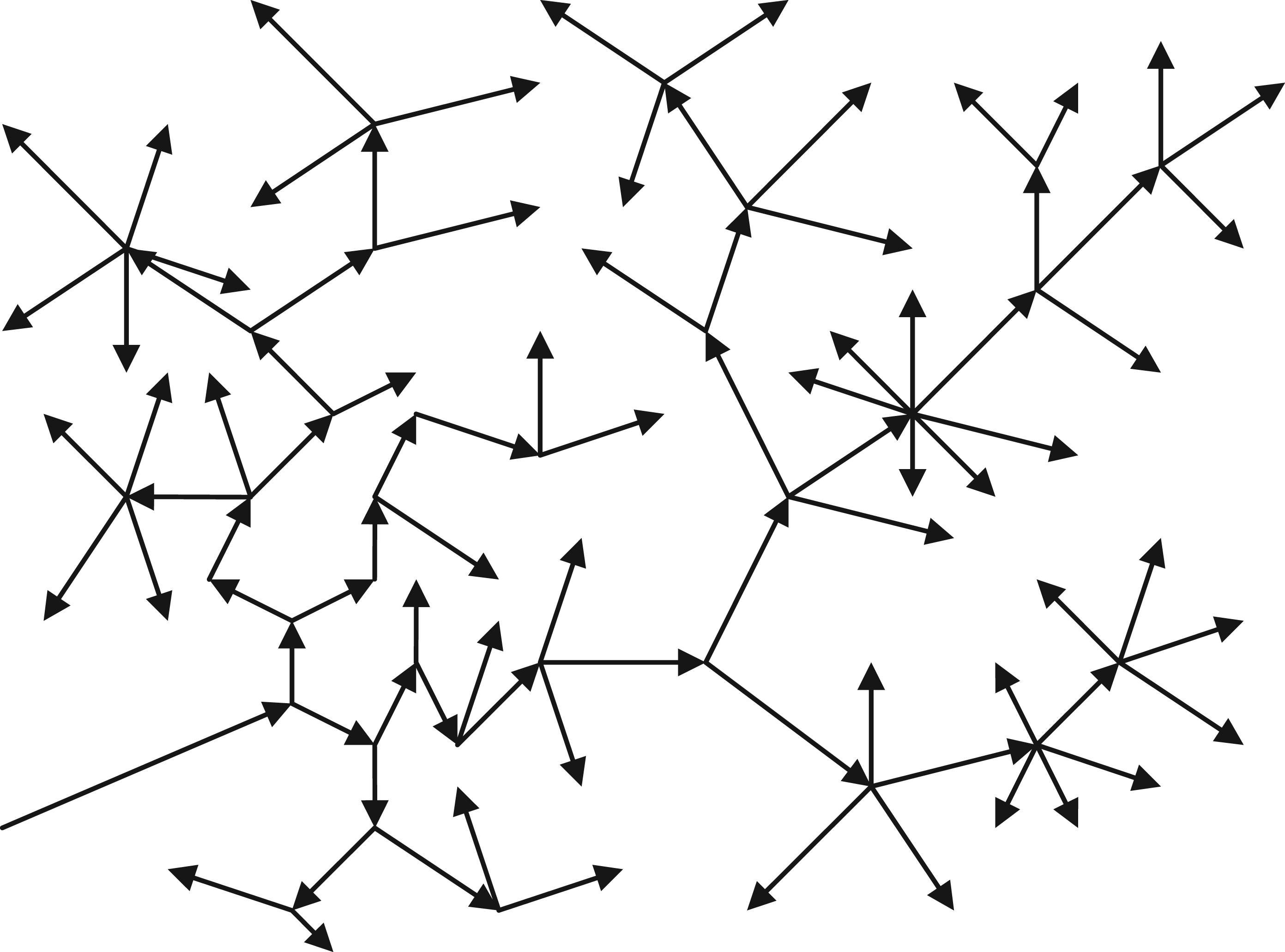
With these ideas in mind, we may characterize a fourth aspect of portability. On the one hand, we may inquire into the relative precision, accuracy, reliability and repeatability of the measurements taken by any reckoning technology. On the other hand, we may inquire into ‘height’ or centrality of a clock, calendar, or temporal claim more generally, in a hierarchy such that a larger number of other such semiotic technologies are calibrated in terms of it. These dimensions are clearly related: usually, the more exact the measurement, the higher it is in a chain of measurement, and thus the more transported it is across measurements. For example, there may be one laboratory that measures events relatively exactly and then communicates its measurements to all others communities. Or every community may be given the resources to establish its own laboratories for measuring relatively exactly. Ideally, there is either a single point from which all measures emanate, or each institution is given the tools to calibrate its own clocks. Actor-network theorists, such as Latour (1988) and Callon (1986), have been at the forefront of efforts to detail and conceptualize such processes.
This aspect of portability thereby raises the question of who determines what is considered a precise, accurate, reliable, or repeatable measurement. Who is considered skilled in the techniques, and equipped with the technologies, to make measurements? Who reckons with units set by expert definitions (say, one second as set by the decay-rate of an atom) versus common-sense stereotypes (say, the time it takes to say ‘one-one-thousand’)? How are different communities (and registers) delimited, or at least delimitable, as a function of their criteria for exactitude? And how do all these powers, methods, and delimitations relate to where the relevant individuals and communities fall within the measurement-setting chain? Finally, it is also tied to our first dimension of portability: the higher a semiotic technology is in such a chain of measurement, the more likely it may be used to represent the measurements of lower technologies (but not be represented in terms of them). If there is one thing the history of science and technology has shown, it is the concreteness of abstraction: all the little micro-practices, engineering triumphs, overthrows of convention, and upheavals of social relations that go into producing and maintaining any centralized – and thus widely ported – semiotic technology.
Systemic properties of reckoning technologies
The points and periods used for reckoning – and, indeed, the units used in any technology of measurement – have systemic properties. That is, units are related to other units via particular schemas; such schemas are imagined and invented with various rationales; and these rationales often serve as legitimating discourses that provide reasons for why such a system should be adapted (say, by a nation, and therefore taught to its citizens). In this section we focus on the portability of systematicity: how widely a system is adopted, both geographically and historically, as well as how widely spread are the values that legitimate its adoption. Such systematicity is easily seen in the context of calendars and clocks, as well as weights and measures more generally.
Several criteria are crucial for understanding the systemic properties of any reckoning technology: quantification, conventionalization, standardization, numericalization, intra-unit conversion, and inter-unit comparability (see Figure 5). First, does the technology employ quantifiable, or merely gradable, units of time? For example, bits and whiles are gradable (e.g. a little bit, a long while), whereas seconds and years are quantifiable and therefore can be related to one another in more precise ways (e.g. three years is one year longer than two years). Second, are the units relatively arbitrary (symbolic, conventional), or relatively motivated (iconic-indexical, natural)? For example, periods like days and years are relatively motivated when compared to periods like seconds and weeks; and a point like the big bang is relatively motivated when compared to a point like the birth of Christ (see Kockelman 2006). Third, are the quantified units employed standardized – do they depend on a centralized or official standard setting the correct unit size (e.g. an expert designation that is legally articulated and politically enforced)? For example, rather than any individual’s sense of ‘noon’ providing a good enough definition for a point in time, a standard provides an incontrovertible, unique, and precise point for determining when exactly 12:00 pm really is. Fourth, are the quantified units employed numericalized? Numericalization allows one not only to count and specify units, but also to apply arithmetic operations to them (division, addition, etc.), and hence calculate with them in relatively complicated ways. For example, the days of the week, while standardized, are not numericalized, whereas the years are both standardized and numericalized. Fifth, if the quantification of units is numericalized, what is the ease of conversion between units within a domain? For instance, within the domain of length, the metric system is relatively convertible (each unit is related to other units by a factor of ten), whereas in the British system, units of length are more difficult to convert to one another (because they are related to one another by different factors). Lastly, again if the quantification of units is numericalized, what is the ease of comparison across units from different measurable domains? For example, across the domains of length, mass and volume, the metric system employs relatively comparable units (milligram and millimeter; kilogram and kiloliter), whereas the British system has relatively non-comparable units (pounds, cups, and feet). (This list is not meant to be exhaustive, but rather to illustrate the kinds of factors involved in the systematization of a set of units.)
Systemic properties of reckoning technologies.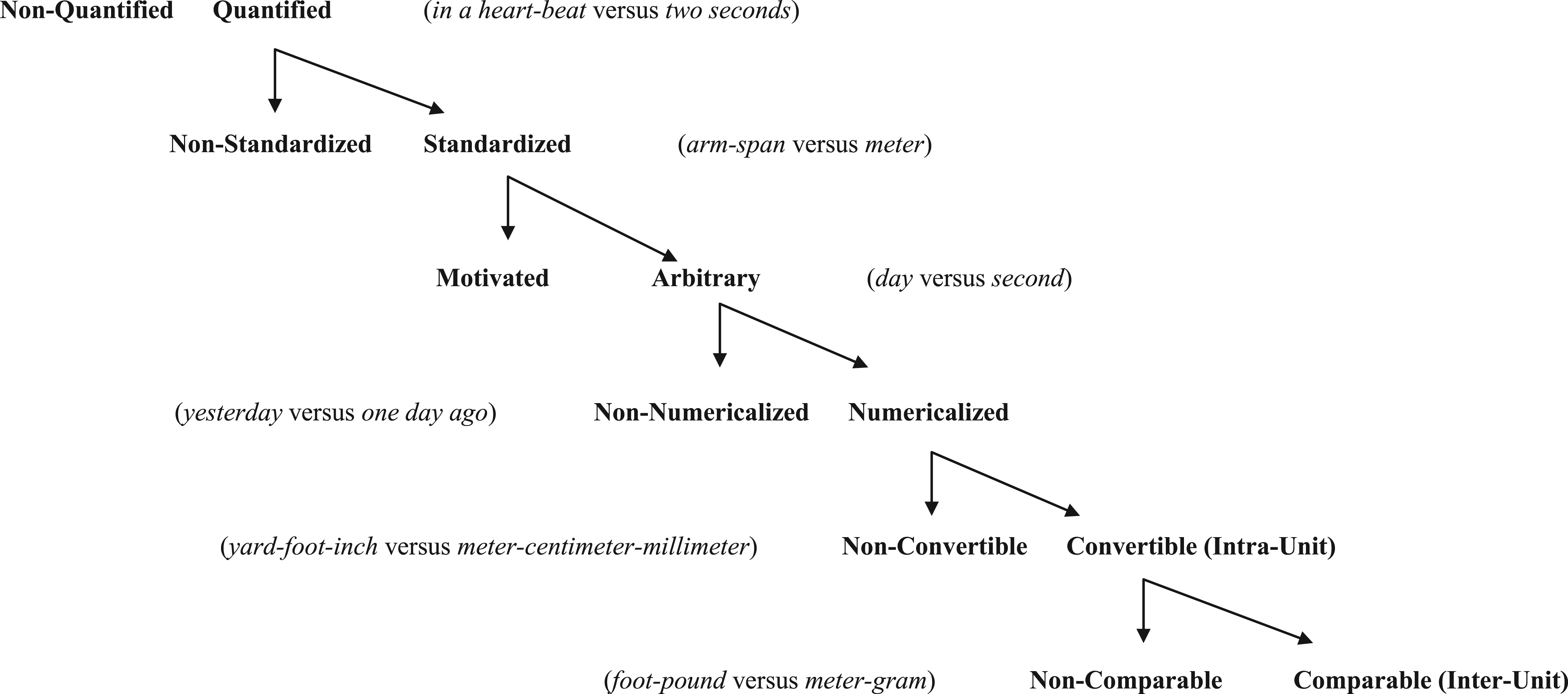
Systemic properties of reckoning technologies enter into judgments about, and justifications for, those technologies. In other words, the kinds of systemic properties just described may not only serve to characterize an actually existing reckoning technology. They may also be used to raise questions about what kinds of properties are valued in a particular context – and thus what kinds of arguments may be made to valorize or deprecate, adopt or abolish, a given system. For instance, from the standpoint of modern science and technology, the more the units of a measuring system are quantified, (scientifically) motivated, standardized, numericalized, convertible, and comparable, the more rational that system is – and hence the more worthy of adoption. Such a system might also be more likely to constitute a universal equivalent, in the sense introduced above in our discussion of Benjamin: while any other system can be interpreted (or rendered) in its terms, most other systems are not powerful enough to interpret it.
But the valorization or justification of a system can be grounded in a variety of other values besides rationality or completeness. In a Weberian tradition, there may be aesthetic values (e.g. symmetry, simplicity); economic values (e.g. efficiency, savings); religious values (conforming to holy writ); political values (organized by reference to dynastic succession or revolution); pedagogical values (e.g. ease of learning); or simply the value of tradition (e.g. that is the way it has always been done).
Crisscrossing such systemic properties and evaluative standards is a host of other processes, sometimes in line and sometimes at odds. For example, even the most conventional distinctions are easily and frequently naturalized. As will be discussed in the following section, people often take the properties of their reckoning technologies to be properties of the domains reckoned. Moreover, the widespread adoption of a standardized system usually overrides the distinction between natural and conventional: for the real value of many semiotic technologies is directly tied to the size of the population that reckons with them, rather than any intrinsic properties of the standards used per se. Indeed, such measuring systems may be promoted or denounced purely because of their emblematic role in marking group identity or historical era. For example, a system of measurement can serve as a symbol of a way of life or of a place in history – witness the adoption of the metric system as a sign of modernization, an icon of development; and contrast the retention of the British system as an insistence on the importance of local history and national difference. Measuring systems may be historical icons of, for instance, colonial rule, with former colonies retaining the semiotic technologies of their colonizers. And measuring systems may be indices of register, a sign of belonging to a particular occupational or skill group: for example, the Troy system for measuring precious metals, or the cgs system used by many physicists.
In short, the portability of systematicity has two interrelated dimensions: on the one hand, it turns on the historical and geographical scope of the usage of a particular semiotic technology; on the other hand, it turns on the historical and geographical scope of the evaluative standards that justify such usage.
Projection and the transposability of properties
When a reckoning technology is used to characterize the temporal features of some process, qualities of the technology may be projected onto the process. This projection is a kind of ontological transposability, a way of treating one domain as if it were constituted by the same principles, or contained the same features, as another domain. If we focus on the semiotic nature of reckoning technologies, projection may also be described as taking the features of a sign to be features of the object it stands for (Kockelman 2007b; and compare Sapir 1949 [1927]: 549). Phrased another way, whenever two domains are correlated with each other, or at least imagined to be, features (or qualia, more generally) of one domain may be used to characterize features of the other domain. Insofar as any kind of quality, contiguity, or convention may link a sign to its object, there are many possible modes of projection, any number of which may be at play in a given context. Here we describe some of the kinds of projection that often occur in temporal reckoning (see Figure 6).
Ontological portability.
Equational projections relate two variables mediated by their occurrence in the same equation. For example, speed measures change in position relative to change in time. At a known speed, changes in position directly correlate with changes in time, such that any description of such a system can use position in place of time. Indeed, a unit like the light-year, which is the distance light travels within one year, relates time and space by presuming the constant speed of light. More generally, once time and space are equationally related in some way, one can use spatial positions to talk about temporal points, or spatial extents to talk about temporal periods. In short, features of the domain of space can be projected onto the domain of time.
Metrical projections relate the systemic properties of a reckoning technology to the substance it measures. As discussed in the last section, any reckoning technology may involve a more or less rationalized system of relatively standardized units applicable to a range of distinct substances. In metrical projection, the substance seems to take on the organizational characteristics of the system itself. For instance, when we talk about time in terms of hours and seconds, we use a terminology drawn from the measurement of angles. Through metrical projection, time may seem to take on the organizational characteristics of the geometry of circles.
Numerical projections arise from the relationship between a numerical system and a numericalized substance. For example, when numbers are used to measure the number or duration of periods, properties inherent to a number may be projected onto time. For example, imagining infinitely large numbers facilitates imagining infinitely long stretches of time. The ability to divide a number indefinitely facilitates the imagination of infinitely short durations. And the ability to imagine a first number facilitates imagining a privileged origin point for, and perhaps a beginning to, time.
Grammatical projections turn on the relationship between the grammatical categories of a given language and the events or processes denoted by those categories. This mode of projection was most famously addressed by Whorf (1956 [1939]; and see Lucy 1992) in his discussion of the ways in which properties such as quantity and form become ascribable to the otherwise nonquantified and formless substance of time. For example, insofar as noun phrases such as ‘ten hours (of time)’ are grammatically analogous to noun phrases like ‘ten bushels of wheat’, properties of the relatively perceptible referents of noun phrases involving words like wheat may become projected onto the imperceptible substance of time. In particular, for formless substances like wheat and water, speakers of English have a set of substanceless forms (bushel and cup); and by giving a formless substance to a substanceless form they may thereby unitize and count the substance (three cups, ten bushels). Time then becomes treated in similar terms as butter, whiskey, and cloth.
Many types of projection involve combinations of more basic kinds. Metaphorical projections occur when features of a relatively concrete domain are used to characterize features of a relatively abstract domain. For example, Lakoff and Johnson (2003) argue that time is considered a resource for speakers of English – where a resource is a kind of substance that can be quantified, given a value per unit quantity, serve a particular function, and have its quantity diminished as it serves that function. That is, features of resources (such as money and gasoline) are treated as features of time. Compare six gallons (of gasoline), $10 (of money), and three hours (of time).
Needless to say, linguistic accounts of grammatical and metaphorical projections involving a word like time do not in themselves explain the reasons for such projections. A metaphorical projection could be grounded in (or motivated by) a grammatical projection, a technological projection, or an evaluative projection (see below). Indeed, those who contend that economic value is ultimately grounded in socially necessary labor time might argue that these are not projections at all, but rather that time is the fundamental resource within a particular social formation.
Technological projections turn on the relationship between a semiotic technology and the substance it measures, and thereby involve other kinds of projections – simultaneously turning on equations, numbers, systems, grammars and metaphors. For example, an analog clock depends on a simple harmonic oscillator whose equations of motion tell the position of that which is oscillating as a function of time. As discussed above, equations of motion allow position and time to be written in terms of one another (e.g. θ(t) = Asinωt). A clock face, then, is a way of directly uniting these equational relations between space and time by projecting them onto the numerically ordered perimeter of a circle. All this is in the service of making numerical relations iconic to temporal relations, and these in turn iconic to spatial relations, for the benefit of users who can then speak of the qualities of time in terms of the qualities of the clock face. Grammar and metaphor, finally, also enter in – usually through the types of constructions that we use to tell time and to talk about it. Indeed, we often reckon time by treating such technologies as speakers, and hence the signs that such technologies produce as reported speech: John said it was 5:30, but my watch says it’s 5:15.
Evaluative projections relate a value system with a valued substance. Qualities of value may get projected onto objects that are valued; and, conversely (and perhaps more frequently), properties of valuable objects are taken to be properties of value per se. For example, just as properties of gold (or cowry shells) might be taken to be properties of value more generally, properties of pecuniary value might be taken to be properties of moral value. Think, for example, of our symbol of justice – the scale. Or, as famously framed by Marx-inspired critical theory, in an industrial capitalist economy, if socially necessary labor time is the ground of the exchange-value of any use-value, then properties of use-values from any ontological domain may be spoken of in terms of properties of temporality: three axes are worth the same as ten machetes so far as they took the same time to make.
Rather than looking further at the means by which temporal qualities are assessed, this section has examined some conditions for widespread understandings of what time itself is. For example, what is the structure of the concept underlying the term time, and what kinds of discourses is the term time (and temporality more generally) implicated in? This is a key way to relate the two sometimes contradictory processes discussed at the end of section 3: abstract conceptualizations of ‘time’ and concrete practices of temporal reckoning. Focusing on common projections allows us to ask how the semiotic properties of different reckoning technologies can lead to various temporal imaginaries; and how temporal imaginaries can motivate the semiotic properties of various reckoning technologies.
Projection is a process involved in any semiotic technology, but it is particularly prevalent in the case of temporality. One can ask why, all relations being equal, some substances are more prone to projection than others. The formlessness of time – its sheer intangibility – may facilitate its particularly promiscuous participation in projections. In other words, time – spineless substance that it is – is particularly susceptible to ontological portability: properties from domains as seemingly disparate as space, shape, money, number, and geometry may all be projected onto it. Conversely, if a certain mode of temporality underlies economic value, then any use-value with an exchange-value may have the properties of temporality projected onto it. And if use-values may belong to any ontological domain, then features of temporality may be projected onto any ontological domain.
Conclusion: Portability as the enclosure of temporality
Scholars often postulate that, with the rise of a capitalist mode of production, or with the onset of what is broadly called modernity, temporality (and potentially quantifiable qualities more generally) changed radically. Theorists have described this transformation in various ways: time went from being full and heterogeneous to empty and homogeneous, from concrete to abstract, from sacred to profane, from religious to scientific, from qualitative to quantitative, from circular to linear, from motivated to arbitrary, from local to global, from church-based to merchant-based (Benjamin 1968; Heidegger 1992; Kula 1986; Le Goff 1980; Lukacs 1994; Postone 1993; Thompson 1967 inter alia; and see Munn 1992 for a classic and critical review of similar contributions from cultural anthropology). As this list shows, most such distinctions have a number of properties in common. They all purport to name the single key set of distinctions (rather than potential elements in a multidimensional matrix), and they figure these distinctions as positions in an opposition. Moreover, they tend to place one side of their opposition in some form of ‘capitalist modernity’ and the other in some form of non-capitalist pre-modernity. These similarities are no accident: in terms of intellectual genealogy, most of them are grounded in Maine’s (2002) classic status/contract distinction or Aristotle’s use-value/exchange-value distinction – and hence in the dichotomies of community/society and quality/quantity.
Why would such relatively simple, similar, and overlapping dichotomies appear again and again to characterize such a complex phenomenon as a historical shift in temporality? It is possible that these theories do capture an essential aspect of some vision of capitalist modernity (qua temporality as worldview). Given our foregoing discussion, however, it seems more likely that these theories participate in a widespread narrative of ‘capitalist modernity’ that unfortunately neglects its most interesting aspects – the specifics of its differentiation from, and its underlying similarities to, what came before and what happened elsewhere: its very complexity, messiness, and heterogeneity. In other words, these theories are witness both to the wily nature of temporality itself, and to a blind spot of critical theory.
In the preceding sections, many of the most useful of these distinctions were defined in a precise way, using an analytic framework grounded in the underlying logic of temporal reckoning, the cross-linguistic features of temporal constructions, and the relation between meaning and measurement more generally. Moreover, it has been argued that while such distinctions may sometimes capture salient features of various conceptualizations of time, and various discourses of temporality, they all too often elide the actual properties of reckoning practices. Indeed, the irony of using a term like ‘abstract’ to characterize modern modes of temporality is that it elides the very social, semiotic, and material practices it was meant to illuminate.
To a certain degree, such an elision is endemic to Marx-inspired critical theory. On the first page of Capital, Marx relegates ‘the various uses of things’ as well as ‘the establishment of socially-recognized standards of measure for the quantities of these useful objects’ to ‘the work of history’. In other words, he casts both utility and measure outside the purview of political economy and critical theory – and not just bushels and yards, but also days and hours. Moreover, both the celebrated Theses on Feuerbach and its latter-day emulations like practice theory often focus on sensual (Sinnlich) human praxis to the exclusion of meaningful (Sinnhaft) human praxis.
In place of such limited theoretical and methodological imaginaries, this essay has introduced six interrelated dimensions of portability, all of which are implicated in any instance of temporal reckoning. There is the portability of translation: the fewer privileged points, periods, sizes and orders a semiotic technology has, the more portable it is (relative to other semiotic technologies). There is the portability of interpretation: the less a signer and interpreter must mutually know for communication to occur with a given semiotic technology (or the more such knowledge is widely available), the more portable it is. There is the portability of publics: the larger the size of the public that reckons with a semiotic technology (or any of its privileged points, orders and periods), the more portable it is. There is the portability of exactitude: the more a semiotic technology (or a practice involving it) is framed as precise, accurate, reliable and repeatable (and the more its measurements are deemed justified and true), the more portable it is. There is the dimension of calibration: the more central one’s clock (or calendar) is in a hierarchical chain of temporal calibration, the more portable it is, insofar as a greater number of other clocks (or calendars) are set by it. There is the portability of systematicity: the more the units (and conversions) of a semiotic technology are distributed geographically and historically (and the more the evaluative standards that justify such units and conversions are distributed), the more portable it is. And there is transposability: when features of other domains are projected onto the temporal domain (or vice-versa), insofar as the domains are correlated in some way. These dimensions of portability characterize the relative contextual independence and scope of applicability of any semiotic technology. They are the temporal instantiation of the more general phenomenon of enclosure (Kockelman 2007c, 2011).
With this idiom of portability – providing a carefully defined, multi-dimensional, continuously gradable, ideal-typic conceptual framework – we may finally ask what is special about modern modes of temporal reckoning. The short answer is obviously portability itself: along any one of these six dimensions, modes of temporal reckoning have become relatively more independent of context and relatively more applicable in scope. However, as discussed in each of the above sections, the caveats to this claim are more important than the claim itself. Indeed, rather than focusing on such simplistic understandings of sociohistorical transformation, our emphasis has been on the analytic complexity and contextual variability of the factors underlying portability. This is one of the benefits of providing a systematic account of the relation between a particular domain to be measured, the technologies and techniques used to measure it, and the social and semiotic nature of these technologies and techniques.
Footnotes
Acknowledgements
Much of this essay was presented at the 2000 meeting of the American Anthropological Association. A subsequent version of it was presented in the Department of Anthropology at the University of California, Irvine in 2009. I want to thank Tom Boellstorff, Michael Burton, Julia Elyachar, George Marcus, and especially Bill Maurer (who also came up with the subtitle) for their transformative comments. And I want to thank two anonymous reviewers, and especially Paul Manning, for their helpful feedback.