




Abstract
Building on the author’s participant observation in academic leadership roles over the last two decades, this article reviews four areas of engagement for anthropology within the larger context of US higher education: a) fundraising; b) training and placing of students; c) the so-called ‘corporate turn’ and its alleged effects on current evaluation measures; and d) the popularity of anthropology among college students in the context of a highly self-critical discourse among professional anthropologists and a challenging academic job market. On the basis of the data presented, I argue that (1) fundraising activities are nothing new in anthropology and might play a role in continuing to support a holistic view of anthropology, (2) programs in anthropology should embrace rather than be skeptical of the potential for the employment of anthropologists in other fields or non-academic professions, (3) being students of society, anthropologists should be more engaged in the running of the university including its financial aspects and should teach their students to be more entrepreneurial, and (4) the applied and public aspects of anthropological research should be foregrounded and rewarded.
Introduction
Over the last 15 years or so, op-ed pieces, news reports, and a rapidly increasing body of historical, polemical, and critical essays, many in book form, have presented bleak predictions of the unavoidable doom of the ‘great American university’ (Cole 2009). Signs of the current crisis include: diminishing support of public universities and public colleges by state and municipal administrations; recently proposed cuts in federal funds for such important sources of research support as the National Science Foundation (NSF) and the National Institute of Health (NIH); and increased cost of tuition – between 1981 and 2008, the cost of college education increased 202 percent, in comparison with the 80 percent increase in the consumer price index (Taylor 2010: 101).
Against this complex and troublesome background, I will review some past and current trends within US anthropology as a way of speculating about where we are heading and what we need to pay attention to if we want to exert some control over institutional changes that are having or will have a lasting effect on the ways a university is run.
It is possible that some of the observations, suggestions, and predictions that I make in this article regarding the profession of anthropology and the funding of its programs in the United States may be relevant or appropriate for programs in other parts of the world. Since I have not, however, carried out systematic or extensive participant observation of the profession of anthropology in other countries, everything I write in this article about fundraising practices, job market, and the success of courses and degrees should be taken to be restricted to anthropology in the US.
My thesis is that we cannot think about the future of anthropology, or any other academic discipline, without taking into consideration domains and concerns that did not use to be – and to a large extent are not yet – part of the everyday preoccupations of most faculty members. These domains include fundraising, job markets for our graduates, the so-called ‘corporate turn’ in academia, and the popularity of anthropology among students in its contemporary diversification of subdisciplines and interest groups.
The empirical question is not whether dramatic changes in US academia will take place in the near future but how the academic establishment will be able to successfully communicate its goals and aspirations to the world outside of academia. With this in mind, in addition to briefly discussing private funding of anthropology and other fields, I will review some national trends in the marketability of an anthropology degree and the popularity of anthropology among students at the national level as well as at my own university. In my concluding remarks I will offer a few recommendations on each of these areas.
Contextualization of the information given
In the rest of this article I will provide data from a variety of sources, including national surveys of anthropology degrees and employment of anthropologists. In addition, I will rely on my own participant observation in two institutional contexts: the American Anthropological Association (AAA) and the University of California, Los Angeles. Between 1997 and 2001 I held a number of offices within the American Anthropological Association (AAA) that gave me the opportunity to learn about past and current academic practices, especially in the US. 1 In these roles, I was expected to discuss with colleagues future directions of anthropological research and education, not only of students but also of the public at large. My interest in the future of anthropology and of the institutions that have supported it over the last century continued to grow when I was appointed chair of my department in 2007 and then, in 2009, dean of social sciences at the University of California, Los Angeles. Given the current financial crisis and political climate in California, any dean, provost, or chancellor in the University of California system is confronted, on a daily basis, with the challenge of planning for a future that threatens the quality of research and teaching that we have been able to enjoy and promote for decades.
The discussion to follow draws from my professional experience and builds on data currently available to me about fundraising, the job market, and anthropology programs. My goal has been to construct a case study that can help us reflect on challenges and possibilities for anthropology in the context of higher education in the US.
A culture of giving: Fundraising
In the US, fundraising has always been an important source of financing higher education. In 2011, US universities and colleges received a total of $30.3 billion in donations.
In the current climate, there is a widespread belief in academia that fundraising is becoming (a) more widespread, (b) more competitive, (c) more expensive, and (d) a required activity not only for fundraising staff and for administrators like presidents or chancellors, provosts, and deans, but also for the faculty at large and even for the students – not to mention staff, who are always called to play a key supporting and organizational role in all of our enterprises.
One of the visible consequences of the recent reduction of state funding for public universities like those that are part of the University of California system is an increased effort to solicit financial support from private donors, including alumni as well as other groups. Universities like UCLA that used to rely heavily on state support have had to become much more active and effective in fundraising. In some cases, these efforts have paid off. For example, in 2011, UCLA emerged as No. 8 in the nation and the first of the ‘public’ universities in fundraising, with a total of $409.03 million.
In reviewing these numbers we need to consider the broad variation in fundraising ability and activity across specializations and departments. Federal and private funding for research is highly skewed towards disciplines like medicine, biology, genetics, physics, and astronomy, which are more expensive in terms of running labs and purchasing and maintaining equipment. Transferred to the social sciences, these differentiated opportunities mean that the disciplines that are more successful at obtaining research grants tend to be those that employ large data sets and sophisticated statistical methods. At the same time, some of the programs in the social sciences are particularly attractive to undergraduate students and therefore bring in more money through tuition, while the cost of hiring faculty in the social sciences tends to be lower than the cost of hiring faculty in the physical and life sciences due to the need to provide lab space and equipment.
Private financing through donation is an area that also shows considerable variation. For example, in the division of social sciences at UCLA, the three departments that have been the most successful in receiving funds from private donors are, in decreasing order, history, economics, and political science. This ordering does not match the success of departments in the division in getting federal funding (e.g. NSF), where currently anthropology leads, followed by political science, and geography. The extent to which the variation in fundraising and number of majors at UCLA is idiosyncratic needs to be examined through a systematic comparison with corresponding departments in other universities.
The current emphasis on financing higher education with private donations is by no means a new trend. It is indigenous to the American university and almost unheard of in Europe and other countries (Europe does have a tradition of private financing of research institutes and centers, such as the Max Planck Institute in Germany and The Netherlands, which supports research in the natural and social sciences, including cognitive and evolutionary anthropology). The oldest privately funded universities in the US (e.g. Harvard, Yale, Columbia, and Princeton) have been engaged in fundraising for centuries and have been very successful at it, accumulating large endowments. To be admitted to a private university or college in the US means also to enter a ‘culture of giving’. This did not use to be the case at public universities, but the situation is rapidly changing largely due to the reduction of state contributions to higher education all over the US.
In public universities, engaging in these fundraising activities feels like a new and unfair burden for most faculty. If we review our own history, however, we realize that all of this is not really new in anthropology, particularly in California.
The role of private donors in the birth of anthropology at the University of California
The first Department of Anthropology at the University of California was established on 7 September 1901 at Berkeley, with a private donation from Mrs Phoebe Apperson Hearst. She was then a University of California regent (the first woman to be appointed to such a position) and the wealthy widow of George Hearst, who had made money after the Gold Rush. The funds provided by Mrs Hearst were to be used to pay the salaries of Alfred L. Kroeber ($1200), Pliny E. Goddard ($900) and their research budget for one year (not to exceed $1800 and $600 respectively). They would also support ‘geological and paleontological research of the gravel formation of California’, which was to be directed by Frederic Ward Putnam and John Campbell Merriam. Following a suggestion by Zelia Maria Magdalena Nuttall – a San Francisco native who had become an important archaeologist working in Mexico – Franz Boas, co-founder and future president (1907–8) of the American Anthropological Association, had also written to Mrs Hearst in 1901. Contingent on his appointment, Boas’s offer to engage in fundraising did not materialize once the then president of the University of California, Benjamin I. Wheeler, chose Putnam over Boas to chair the new department.
One other aspect of this story is worth noting. Mrs Hearst showed a strong interest and commitment to provide funds to collect or purchase objects to be gathered in a museum (much was later renamed ‘Phoebe A Hearst Museum of Anthropology’). Even after the university assumed the financial responsibility for the museum, in 1908, Mrs Hearst ‘continued to provide funds and collections. By the time of her death in 1919, she had given or purchased about 64,000 objects’.
Friends of archaeology
Based on my own experience at UCLA, an interest, or even a passion, for material culture among alumni and the public at large is today as strong as ever. The living proof of this enthusiasm is the high level of activity and commitment shown at UCLA by the Friends of Archaeology and by Lloyd Cotsen’s generous endowment that made it possible to support and expand the UCLA Institute of Archaeology, renamed in 1999 the UCLA Cotsen Institute of Archaeology, after its major benefactor. This particular situation has shown two important consequences of success in fundraising. The first is that development offices in universities are likely to (continue to) devote more time and resources to raising money for archaeological or historical research than for other anthropological specializations simply because their efforts are likely to yield a higher return. Second, the success of philanthropy on behalf of a particular field or subfield (in this case archaeology, but I imagine that it could be another subfield elsewhere) might affect the future of at least some anthropology departments in terms of the type of hires they want to make and the type of students they want to train. We already know that it is not uncommon for universities to tweak their hiring priorities when a donor offers the funds for an endowed chair in an area that had not been a top priority for the campus.
Another general lesson is that even though the outcomes of fundraising efforts are always hard to predict, there are areas of scientific research that are more attractive to people outside of academia (e.g. medical research). Within the field of anthropology, today, just as at the beginning of the 20th century, laypeople still seem to be fascinated by material objects that can be traced to ancient civilizations. An important question is whether all subfields of anthropology can tell their stories in equally compelling ways or if it is harder for some specializations to be attractive to those outside of academia.
Job markets and anthropology degrees
Recent studies of the job market in the social sciences and anthropology in particular are not limited to exposing current problems; they also hint at how to change existing PhD programs to make graduates more employable.
Academic institutions in the US are currently able to employ only about half of the people graduating with a PhD in one of the social sciences. In a survey done in 2005–6 by Nerad et al. (2007), less than 20 percent of PhDs in anthropology had a tenure-track job right after graduation, and the percentage reached 50 percent only after five years. According to the same survey, other disciplines in the social sciences (communication, geography, history, political science and sociology) did a little better, with an average slightly higher than 60 percent. Other surveys show lower percentages. In the November 2010 NSF Info Brief (NSF 11-305), the percentage of PhD recipients in social sciences with an academic position from 2004 to 2009 is shown to go from 40.4 percent to 39.3 percent. (The NSF report includes psychology, which is not included in Nerad et al. 2007.) The NSF report also shows an increase in the proportion of postdoctoral positions in the same period. From 2004 to 2009, postdoctoral employment in the social sciences went from 31.9 percent to 35.3 percent (a similar increase, but with smaller numbers, was reported for the humanities, i.e. from 9.3% to 12.1%). The NSF data support the finding mentioned above that in the years immediately after graduation, the great majority of PhD recipients either do not have access to or do not try to obtain tenure track positions (current surveys usually do not distinguish between graduating students who seek and those who do not seek academic employment). We might be moving toward a model in which the best scenario in the social sciences resembles the one in the physical sciences, namely, from graduate school to postdoctoral fellowships. A variation of this model is the Mellon/ACLS Recent Doctoral Recipients Fellowships Program that ‘provides support for a year following the completion of the doctorate for scholars to advance their research’ (http://www.acls.org/grants/Default.aspx?id=514).
The situation in the job market in academia invites some reflections regarding the preparation that our PhDs have for employment outside of academia. Nerad et al. (2007: 10) report that the great majority of 371 respondents who had earned a PhD in anthropology within a five-year period (1995–99) had jobs, with the following distribution: 52.3 percent were ladder faculty, 13.5 percent were non-tenure-track faculty, 11.9 percent had other kinds of academic employment, and 22.4 percent were employed in business, government, or the non-profit sector (see also Rudd et al. 2008). The same survey suggests that some of the skills learned while getting a PhD in anthropology and other social sciences are useful for non-academic jobs and some are not. Nerad et al. (2007) report that PhD recipients in the social sciences who work outside of academia are able to put to use what they learned in terms of critical thinking and data analysis/synthesis, but need more professional training in areas such as writing (and especially grant writing), publishing, presenting, and team-work. Rudd et al. (2008: 25) make the same point about anthropology training in particular.
More can be learned about potentially useful professional skills if we take into consideration that the federal government is ‘the largest employer of anthropologists outside of universities’ (Fiske 2008: 110), especially at the US Census Bureau, the National Park Service, National Marine Fisheries, Centers for Disease Control and Prevention, USAID, and Cabinet-level agencies like the Department of Defense, the Department of Agriculture, the Department of Homeland Security, 2 and the Department of Interior.
Just as in the case of fundraising, employment of anthropologists by the federal government is nothing new. WJ McGee, the first president of the American Anthropological Association (1902–4), worked for the Bureau of Soils in the US Department of Agriculture and ‘considered his conservation work to be applied anthropology in the interdisciplinary tradition of the BAE [Bureau of American Ethnology] – that is, science in service of the public good’ (Darnell 2002a: 3). What is different in the current job market is that employment in the federal government and other non-academic institutions is not so much a vocational choice ‘in service of the public good’ as the only possibility for about half of the PhD recipients.
The fact that the highest numbers of anthropologists hired by the federal government are archaeologists – 1553 compared with 144 ‘general anthropologists’ (Fiske 2008: 117) – suggests that certain specializations within anthropology are more likely to be marketable outside of academia. This is confirmed by Rudd et al. (2008: 7).
This job market does not seem to have had an impact on the popularity of anthropology degrees. According to data provided by the Office of the American Anthropological Association (AAA), the number of people receiving anthropology degrees (BA, MA, and PhD) steadily increased from 1948 until 2006 (see Figure 1).
BAs, MAs, and PhDs in Anthropology, 1948–2006.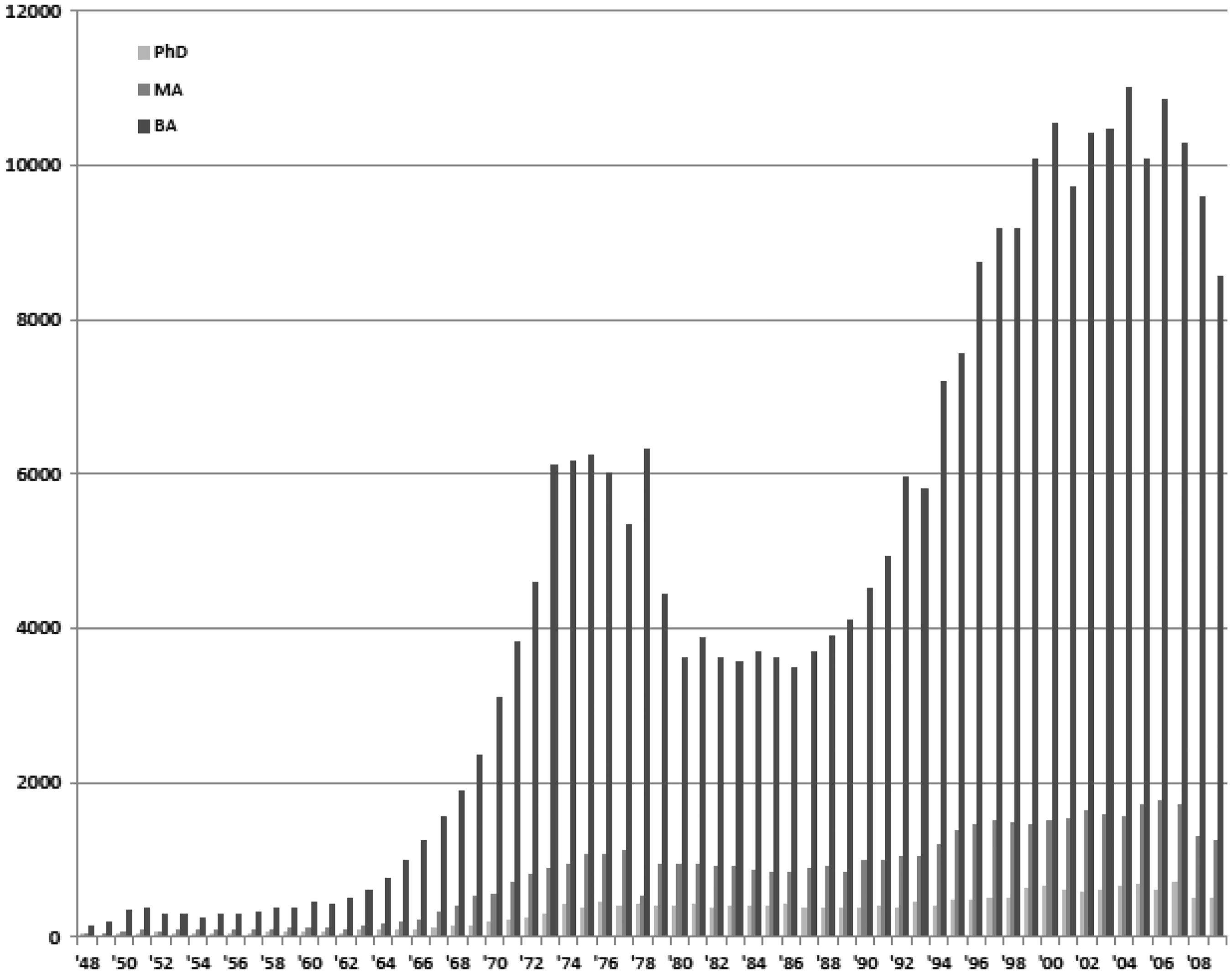
When we compare the AAA data with data recorded by the Survey of Earned Doctorates (SED), the increase in anthropology PhDs over the last several decades is shown to follow a national trend in US universities for roughly the same period. The Doctorate Recipients from US Universities: 2009 reports an average growth of 3.6 percent since 1958, with the most recent period of fast growth ending in 2007.
The slight decrease of the last three years at the national level may or may not be reflected locally. For example, undergraduate anthropology degrees, a combination of BAs and BSs,
3
at UCLA have continued to steadily increase (see Figure 2 – the graduating class went from 35 BAs in 1980–1 to 248 in 2010). The number of graduate students, on the other hand, has fluctuated within a small range: from eight PhDs in 1980–1 to 11 in 2009–10, with some occasional peaks (19 in 1984–5, 20 in 1993–4, 15 in 2007–8), probably due to a policy adopted by the department in the mid-1990s to provide full support to all incoming graduate students for at least four years. These data include students from all subfields.
Degrees in Anthropology at UCLA, 1980–2010.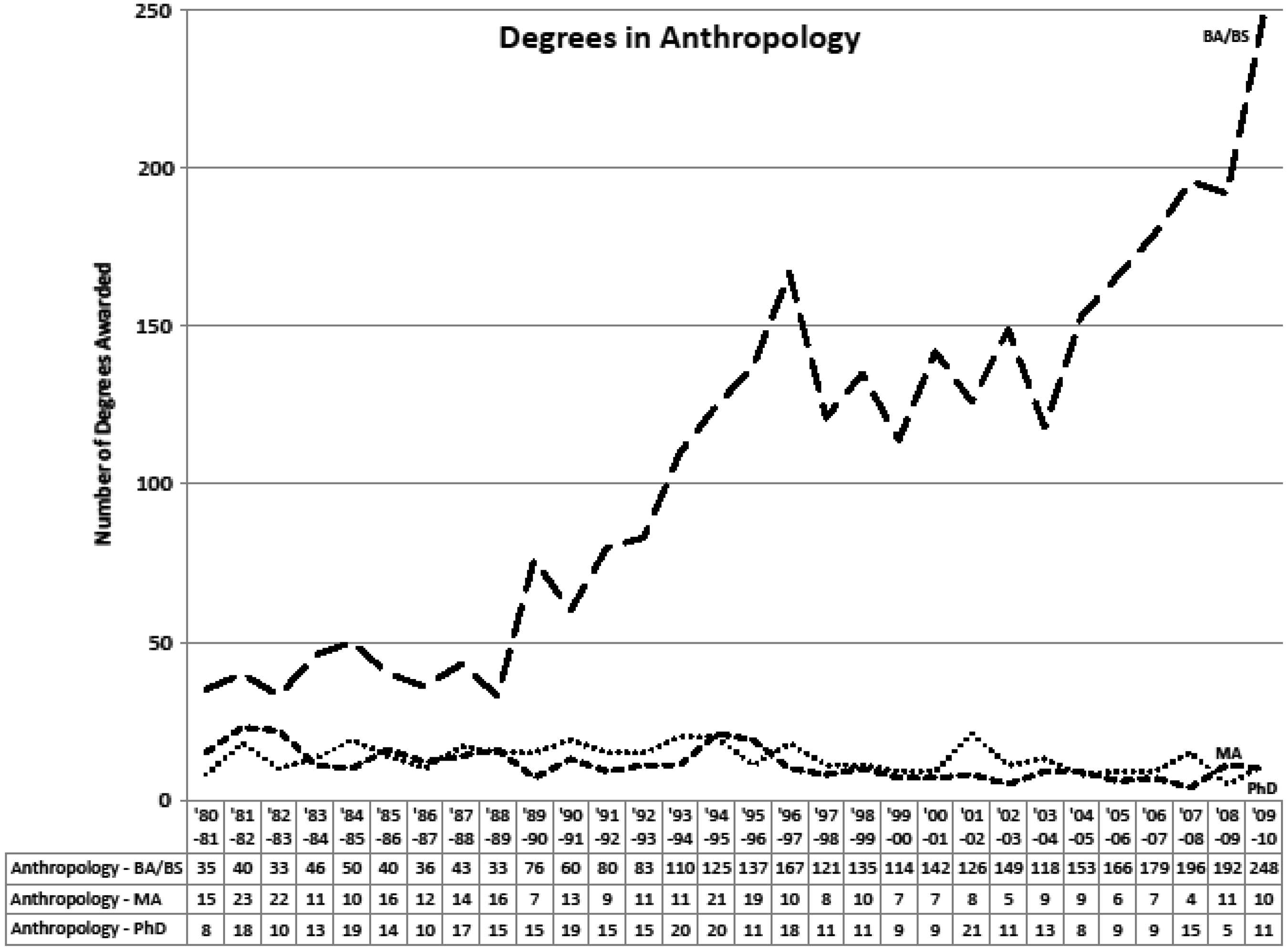
Departments may also experience pressure to continue to have a higher number of graduate students than what can be absorbed by the job market because graduate students are needed as teaching assistants (TAs) in the increasingly larger undergraduate classes. Menand (2010: 152) portrayed this situation as a disincentive toward reducing the number of years required to obtain a PhD, especially in the humanities.
The same argument could be easily made for PhDs in anthropology, where the national median time-to-degree, excluding the time for fieldwork (for a student entering with a BA), in 2006 was 9.6 years (the national median for the social sciences as a whole for the same period was 7.6 years; see NSF Science Resource Statistics 2006: Time to Degree of U.S. Doctoral Recipients).
The ‘corporate turn’
Many inside and outside of academia see changes in public support as part of a more general neoliberal trend in which a new corporate logic, traditionally foreign to scholarly enterprises, is affecting – and, for some, infecting – the ways in which our academic institutions are run (cf. Bok 2003; Canaan and Shumar 2008; Donoghue 2008; Menand 2010; Nussbaum 2010; Schuster and Finkelstein 2006; Slaughter and Rhoades 2004; Strathern 2000; Taylor 2010; Washburn 2006). In the case of universities, recent decisions by local and state political leaders to dramatically reduce support for public universities and colleges have created a climate of distrust toward the good faith of government officials that easily transfers to university administrators. The national trend, for example, to cut expenses by increasing the number of adjunct and temporary faculty at the expense of the number of tenure-track positions has co-occurred with the sometimes implicit and other times explicit questioning of the value or feasibility of the tenure system (Taylor 2010), which has been de facto eliminated in countries like the UK and Australia (for some critical remarks on this trend see Donoghue 2008: ch. 3; Washburn 2006: 203–5). These trends have, in turn, fed anxiety even in those institutions that continue to engage in hiring and retention of tenure-track faculty and whose academic programs have managed to maintain their high quality and ranking both nationally and internationally.
A combination of traditional principles of academic evaluation with a cost-and-benefit-oriented approach – what Slaughter and Rhodes (2004) called ‘academic capitalism’ – has in some cases made academic units more fiscally responsible. In other cases, however, this trend has negatively affected morale by introducing principles that most faculty see as threatening the intellectual and educational foundations of liberal arts education in the US. These changes are visible in current academic discourse where we can find traces of a previously alien vocabulary that includes terms like ‘service’, ‘customers’, ‘student satisfaction’ – the latter echoing ‘customer satisfaction’ (see Collini 2003) – and concepts such as ‘excellence’, ‘leadership’ and ‘stakeholders’, which have been unreflectively adopted by faculty and staff (Urciuoli 2003).
This is the ‘audit culture’ that social anthropologist Marilyn Strathern (2000) and others have been writing about since the 1990s in the context of political reforms in the UK, first introduced by the Thatcher government before strictly financial considerations were a factor. This is a culture that is said to be full of ‘rituals of verification’ (Power 2003), which are meant to justify the audit and, at the same time, are perceived by insiders as betraying ethical standards (Strathern 2000: 5). Some of the criticism of the audit culture has been based on its alleged consequences in some non-academic institutions. For example, in their study of medical organizations, Exworthy and Halford (1999) argued that the changes in accountability methods resulted in a ‘loss of collegiality and new power hierarchies among doctors’ (cited by Shore and Wright 2000: 63). Borrowing from Michel Foucault, Shore and Wright argued that ‘[t]he audit culture is intended to be stressful’ and it has ‘damaging effects on trust’ (2000: 63).
Can we say that something similar is happening in US academia? At least at first sight, some aspects of what our colleagues in the UK call the ‘audit culture’ are not so unfamiliar to US academics. The differences between the US and other countries are not in kind but in degree of ‘measuring’ of academic production. Thus, in US academia it is taken for granted that the products of professors’ labor should be evaluated on a regular basis. Regardless of who is eventually responsible for a change in salary (e.g. a committee, an administrator, a combination of several individuals and/or groups), in the US colleagues routinely evaluate each other for the purposes of deciding promotions and salary raises. A faculty member’s publications, teaching, and service to the university in terms of committee work and other activities are the three standard areas that are subject to periodical and partly anonymous 4 peer evaluation. This means that in the US we are and have been part of an ‘audit culture’ for a long time if by ‘audit culture’ we mean a routine accounting exercise at the end of which some people end up being rewarded financially or otherwise (e.g. by getting reductions in teaching or committee work) more than others.
Academic politics
By ‘academic politics’ here I mean a wide spectrum of activities and attitudes, including the projected and perceived goals of anthropology within academia, the relationship among the different specializations or sub-fields, the internal and external critique of existing theories and methods, the involvement of anthropologists in public debates, political movements, or community projects, the participation of anthropologists in gathering information and advising federal agencies about groups that are considered a threat to the US government or to ordinary citizens (e.g. counterterrorism).
The 1980s saw some major paradigm shifts in anthropological theory and methods. For example, the documentation of our ‘contemporary ancestors’ (e.g. hunters-gatherers in Australia or Africa) lost its appeal for a number of practitioners and even the use of the term ‘culture’ became questionable (e.g. Abu-Lughod 1991; Kuper 1999). This partly coincided with a critical assessment of fieldwork (e.g. Fabian 1983; Fox 1991; Clifford 1983; Clifford and Marcus 1986), the history of the discipline of anthropology (e.g. Marcus and Fisher 1986; Barth et al. 2005; Stocking 1983), and a rethinking of cross-cultural comparison (e.g. Gingrich and Fox 2002). At the same time, there have been calls for and debates about an ‘anthropology of the contemporary’ (e.g. Rabinow 2003, 2008; Rabinow and Marcus 2008), a ‘militant anthropology’ (e.g. D’Andrade 1995; Robins 1996; Scheper-Hughes 1992), and a ‘moral anthropology’ (e.g. Faubion 2011; Fassin 2008; Lambek 2010; Murphy and Throop 2010; Throop 2010; Zigon 2008). An important change has been the experience and the conceptualization of the Other in the era of globalization. It has become more difficult to think that the people anthropologists used to study and to some extent still study are or can be imagined as isolated from the economies in industrialized countries and from the effects of gradual or rapid transformations initiated somewhere else, including by warfare (e.g. Abélès 2010; Appadurai 1996; Fabian 1983).
In addition to theoretical debates, politically charged or politically engaging agendas continue to capture the interest of some anthropologists. The most frequently mentioned issues include changes in our natural and lived environment (e.g. pollution, destruction of natural resources, energy crisis), international financial markets and their implications for small communities around the world, inter-ethnic conflict, international terrorism and its consequences for racial profiling and social discrimination, immigration laws and treatment of new immigrants, and the widening gap between rich and poor.
These new foci of research, together with changes in sources of financial support for anthropological research and a more competitive job market, have seen more anthropologists carry out their research in urban environments and sometimes even in towns or neighborhoods that are a driving distance from their campus or their home. But these changes have not been universally accepted or understood within and outside of anthropology departments. There is still an expectation among professional anthropologists, other social scientists, and the public at large that anthropologists are experts of cultural differences. Thus, students who carry out their research in the US might have to also demonstrate that they can do it ‘the traditional way’, e.g. by starting a second project somewhere else in the world or expanding their study to have a cross-cultural component.
There is also a long history of national and international politics at the Annual Meetings of the AAA. For example, in 1971, a statement on ‘Principles of Professional Responsibility’ included a ban on secret research or secret reports. In 2007, AAA members presented a motion against secret scholarship and another against any covert or overt US military action against Iran (Chronicle of HE, 1 December 2007). Most recently, there has been considerable controversy over the employment of anthropologists in war zones, and the AAA has issued warnings against the US military’s Human Terrain System (HTS). This preoccupation with the ethics of fieldwork has been with anthropology since its inception. In 1919, Franz Boas wrote a letter to The Nation accusing some anthropologists of being spies in Mexico. For this he was censured by the American Anthropological Association Council (Darnell 2002b: 35).
AAA documents such as the 1999 Declaration on Anthropology and Human Rights drafted by the Committee for Human Rights are the result of a difficult balancing act between the dominant cultural relativism of most anthropologists, phrased as ‘respect for concrete human differences’, and international laws and agreements.
One issue is whether these statements have an effect on the public at large (Shweder 2007). In an article entitled ‘Culture Wars, Anthropology, and the Palin Effect’, written during the 2008 presidential campaign, John L. Jackson, Jr. (2008) wrote that ‘In the era of Franz Boas and Margaret Mead, anthropologists were accepted as decidedly public intellectuals. But… now, anthropologists have a truncated role in public debates and ‘culture wars’. 5
In summary, anthropologists continue to be politically engaged in two directions: internally, through a political interpretation of their own theories and practices and through debates about the possibility of a ‘science’ of human coexistence, and externally, through a discussion of the political consequences of their involvement or lack thereof in the social issues of the world outside of academia, including the world of the people studied by anthropologists (Lamphere 2003).
Growth and popularity of anthropology
Members of the AAA, 1984–2011.

When we compare the numbers in Table 1 with those in Figure 1, we see that the increase in AAA membership seems to roughly correspond to the increase in numbers of anthropology PhDs granted: from 403 in the year 1984 to 699 in 2007, and then back down to 503 in 2009. The number of undergraduates also went up (and down): it peaked in 1976 (6008) then went down, as low as 3490 in 1986, and then went up again very steadily until 2005 (11,002 BAs), and then down again to 8561 BAs in 2009.
One of the major changes in the profession of anthropology over the last three decades has been the increase in the number of specializations and their recognition within the American Anthropological Association. Currently there are 38 sections and 22 journals, in addition to the flagship American Anthropologist, which comes with the basic level of membership.
I would argue that the long list of research interests and specializations that make up the membership of the AAA is not necessarily the defeat of the traditional four-field approach but its transformation and growth. 6 Not only does anthropology continue to be a field where incommensurable theories and methods can cohabit (Brenneis 2004: 585), but the current complexity of anthropological research and teaching creates opportunities for new collaborations with other fields (e.g. medicine, psychology, education, museum studies, environmental studies, public policy, work and labor, the arts) and for innovative thinking about societal issues and a broader spectrum of job opportunities. These new forms of inter- and multi-disciplinarity have contributed to the renewal of the discipline and its increasing attraction for students.
Concluding remarks and some recommendations
Universities are complex institutions where individuals, groups, and units of various kinds (e.g. academic departments, research centers and institutes, professional schools, support and external relations staff, administrators) compete for resources both inside and outside of their organizational domain while simultaneously trying to coordinate with or at least not intrude on one another. Looking inside of any one academic field allows us to get a sense of both the specific challenges that the field in question is facing and the more general issues faced by the academic institution within which the field is taught and supported. With this goal in mind, I have briefly reviewed the history and current state of four areas of engagement for anthropology within the larger context of higher education in the US:
success and challenges in fundraising; training and placing of students; the so-called ‘corporate turn’ and its alleged effects on current evaluation measures; and the popularity of anthropology among college students in the context of a highly self-critical discourse – which I see as part of the ‘politics of anthropology’ – through which past and current anthropological theories and methods are routinely questioned against a background in which continuity and certitude are expected and rewarded by the public, government agencies, and the media.
I have pointed out that fundraising varies across schools (or ‘divisions’) within universities (e.g. health sciences vs. social sciences), across departments, and across subfields. With respect to anthropology, I gave the example of the importance of the study of material culture in the funding of the anthropology department at Berkeley in the first decade of the 20th century and at UCLA today. Regardless of whether these examples extend to other campuses in the US, the fact that there is variation in fundraising across subfields in anthropology works in favor of maintaining a holistic view of the field, where specializations, theories, and methods co-exist and can, in principle, if not always in practice, draw upon each other’s intellectual as well as financial strengths.
The data on job opportunities for social scientists in general and anthropologists in particular present a challenging situation. There is, however, much to learn from the existing surveys and studies. Rather than being passive victims of the current job market, anthropology faculty should be actively redesigning curricula and introducing educational practices that can help students at all levels acquire skills that are valuable both within and outside of academia, meeting the demand for problem-solving skills, clarity of exposition, collaborative work practices, and international experience that are in demand in the workplace (Hersch 1997). Given that the length of graduate training does not guarantee an academic job, Menand (2010) and others (Nerad 2008; Rudd et al. 2008; Taylor 2010) advocate shorter programs with a broader range of skills and a flexible curriculum that expose students to multiple disciplines within and outside of the social sciences. To be employable within and outside of academia, the PhDs of the future will need to be able to quickly learn new skills and be ready to shift focus of research (Biagioli 2009). Anthropologists are not new to intellectual trading and academic migrating, as shown by the fact that they are hired in a variety of departments and programs. For example, at UCLA, faculty with an anthropology PhD are found in the following departments: anthropology, Asian American studies, ethnomusicology, geography, history, information studies, sociology, gender studies, and world arts and cultures. If only 50 to 60 percent of PhDs get a tenure-track job and only after five or more years, academic programs should also prepare students for such a reality both psychologically and practically. Since almost every PhD recipient eventually does get a job, although not necessarily in academia, a more diversified curriculum with a broader horizon of possible employment opportunities should be a goal of all programs.
Of course, such a rethinking of the goals and working practices of academic programs is not easy. Objective institutional barriers and historically constituted subjective dispositions make it difficult for most university professors to critically assess the implications and outcomes of their own academic practices and the relation of such practices to the functioning of the institutions of which they are simultaneously agents and beneficiaries. As shown by continuous discussions of ‘general education’ requirements (see Menand 2010), it is always difficult to change any aspects of curricula that are perceived by faculty as constitutive and distinctive of a US liberal arts college education. It is even more challenging to learn how to interact with non-academic organizations, institutions, and corporations in constructive ways. These challenges, however, must be met if we want to have an active role in the shaping of the university of the future.
In reviewing the so-called ‘corporate turn’ in academia I have pointed out that something similar to the ‘audit culture’ has been going on for quite some time in US colleges and universities, even though it is not applied in the same way as it has been implemented in the UK and other countries that have more recently introduced ‘rituals of verification’. The issue should not be evaluation, which is something that all academic researchers are used to through their experience in submitting grant proposals or articles for publication in refereed journals, but the criteria by which individual faculty and also units (e.g. departments, research centers) are compensated or rewarded. One problem is the tension between strict meritocracy, which must be sensitive to the specific standards of each field or subdiscipline, and market value, which is a variable imposed from the outside and creates a type of disparity that can create resentment and an un-collegial work climate. Anthropologists, for example, tend to have lower salaries than their colleagues in other disciplines, e.g. sociologists, political scientists, and economists. Equally problematic is the current model of evaluation. So-called ‘excellence’ is typically assessed in terms of success in research, publication, and research grants. But for a department or university to function, we also need high levels of creativity, productivity, and expertise in journal editing, curricular reforms, teaching evaluation and innovation, fundraising, public speaking on behalf of the institution, relationships with local and global communities, planning the future, and running units in efficient and effective ways that provide incentive and guidance for high achievement in all of the above areas.
One side of what has been called the ‘corporate turn’ is the hiring of outside consultants or permanent staff who are asked to play the role that faculty are not interested in or able to perform. An influx of business-minded, budget-savvy people is often necessary in the current landscape where very rarely faculty have the skills or interest in running the university or overseeing their finances. At the same time, business people and consultants work best when they can collaborate with faculty who are willing to have a conversation with them as peers. For this to happen, some changes are necessary in the way in which students are trained and faculty are recruited and compensated. In addition to being trained to carry out research, collaborate with others, and publish (before completing their degree and going on the job market), students should be given opportunities to (a) participate in research with more senior researchers, (b) learn how to be successful at grant-writing and publishing, and (c) understand how universities work and faculty are rewarded. They should also be mentored so that they can be just as creative in teaching as they are expected to be in research. The goal of higher education should not be one type of scholar but a well-functioning and creative team whose members can collectively address the research and educational needs of one or more communities. An entrepreneurial spirit is already present in any successful researcher who has to convince a funding agency that what he or she wants to be financed for is original and promising (Lo 2012). The challenge is how to create a context where such an entrepreneurial spirit can also be applied to research, teaching, and all other necessary dimensions of higher education.
Finally, in terms of the politics of academic discourse and academic practices, anthropologists need to understand better the implications of their own words and actions for their future ability to support the intellectual and financial growth of their discipline. A non-defensive attitude is necessary for all practitioners to be engaged with one another and to be able to hear what others have to say or contribute, all the way from the most critical appraisal of past and current practices to the embracing of methods and data that come from other disciplines and at first may seem alien to anthropology. For this to happen, more emphasis should be placed on problem-oriented research. Unfortunately, however, any discussion that starts from a ‘problem’ tends to evoke ‘applied research’, which has a negative connotation for many scholars. This is unfortunate given that anthropologists, like all social scientists, have a great deal to offer to the social world they inhabit.
We should also not forget that the future of any discipline ultimately depends on public support. The term ‘public’ can and should be interpreted as referring to a wide range of constituents, including the state, the federal government, private foundations in search of a project to fund, students who want to be educated, parents who need to assess what they can afford for their children, employers who want their employees to learn something new, philanthropists in search of something or someone to support, or alumni who want to give back to the institution where they expanded their intellectual horizons while transitioning into adulthood.
Ultimately, any attempt to predict the future must turn into an exercise in assessing the ways we might be able to control it. I have suggested that an understanding of the challenges currently faced by institutions of higher education and the history of anthropology as an academic discipline in the US can help us imagine and implement new ways of engaging with each other, our students, our institutions, the media, the government, and the public at large.
Footnotes
Acknowledgements
This article is a much revised version of a paper delivered in March 2011 at the Weatherhead Center for International Affairs at Harvard, which was, in turn, a revision and expansion of a set of comments presented in October 2010 at the conference ‘Essere contemporanei: musei, patrimonio, antropologia’ in Matera, Italy. I thank the organizers of the two events (Vincenzo Padiglione in Italy, and Dimitrios Yatromanolakis and Panagiotis Roilos in the US) for their hospitality and the participants in those events for their questions and comments. Several colleagues provided feedback on one or more drafts, including, Mario Biagioli, Tom Boellstorff, Don Brenneis, Pietro Clemente, Rachel George, Sarah Meacham, Mariella Pandolfi, and Dorothy Louse Zinn. A number of people generously helped me gather relevant information. I thank Bill Davis, former Executive Director of the American Anthropological Association (AAA), and members of the AAA staff Elaine Lynch and Jason Watkins, for the information about anthropology degrees and AAA membership; Kyle McJunkin and Lucy Blackmar for the data on UCLA graduates; Megan Kissinger for data on fundraising at UCLA; and Linda Escobar for turning numbers into tables. Any remaining errors or misrepresentations remain, of course, my own.