



Abstract
Are calls for civility necessarily elitist, serving to reproduce existing hierarchies of social and political power? Or, can they work to clear a space in which citizenship can be reimagined and new political demands can emerge? This article explores the contradictory politics of civility in pre-conflict Aleppo. Notions of incivility and disorder allowed Aleppo’s commercial middle classes to reimagine what citizenship might mean by expressing discontent with lethargic and repressive systems of government. However, the same language they mobilised to criticise the state also associated civility and order with a specifically bourgeois habitus, which was deployed to preserve existing domains of urban privilege and to entrench the social precedence of urban propertied elites over the dislocated rural poor. Calls for civility may be simultaneously elitist and emancipatory, envisaging new forms of citizenship and public life, while drawing their energy from sources that are implicated in other forms of hierarchy and exclusion. The article considers the implications of this analysis in relation to the outbreak of the Syrian uprising in 2011.
The politics of civility
Are calls for civility necessarily elitist, serving to reproduce existing hierarchies of social and political power? Or, can they work to clear a space in which new forms of contestation and new political demands can emerge? This article takes up the invitation of the editors to address these questions by describing the complex ways in which middle-class claims of civility were related to the contestation of citizenship and structures of inequality in Aleppo in 2009, just over a year before the start of Syria’s civil uprising. As Thiranagama et al. point out in the introduction to this special issue, many anthropological accounts of civility draw attention to its ‘uneasy history’ of repressing dissent and distributing citizenship rights in ways that disadvantage those who are already socially and economically marginalised (Holston, 2010; Keane, 1998; Sparks, 1997). Yet, ideals of civility and charges of incivility can also be deployed in progressive and dissenting ways to hold power to account and to envisage transformative change. In this respect, the editors (Thiranagama et al., this issue) cite the US civil rights movement (Garrow, 1978), Dalit political movements (Waghmore, 2013) and Balibar’s (2002, 2015) theorisations of emancipatory, bottom-up movements that seek to clear a space for the marginalised.
Accounts of civility as dissenting and progressive thus emerge from movements concerned with the emancipation of oppressed groups that are by definition non-elite (see Thiranagama et al., this issue). By contrast, those accounts that stress the conservative and repressive potential of civility (Elias, 2000; Kasson, 1990; Staeheli and Mitchell, 2006) often point to the fact that liberal ideals of civility emerged in European bourgeois societies, and so were bound up with ethnic and class privilege from the start. The account that I present here of notions of civility, as deployed within the Syrian middle classes, is something of an anomaly within this schema: they were members of a bourgeoisie voicing an emancipatory discourse. Among my interlocutors, the language of civility could be deployed as a form of political dissent, seeking to clear a ‘shared space’ where individuals could have ‘their place’ as citizens (Balibar, 2002: 33). Laments about everyday incivility merged into broader discontent about the absence of accountability in the public realm and, in some cases, referenced the pervasiveness of corruption in the public sector. These narratives often used spatial idioms, complaining about the mistreatment of public space to express a sense of the terrain of citizenship being distorted. My interlocutors noticed and experienced this distortion in the unruly and chaotic ways in which they and others navigated public space and bureaucratic institutions in Syria.
However, if my interlocutors were politically and civically disenfranchised, they were, nevertheless, economically and culturally speaking, a relatively well-positioned group. The very notions of order, culture and cleanliness, which they deployed to critique the absence of a desired civil space, suggest a bourgeois habitus cultivated through the ownership and management of private and commercial property. In addition, the same discourse of order and civility could be harnessed in other contexts in harshly exclusionary ways to stigmatise the poor as out of place in affluent spaces of the city, silencing their demands (e.g. for credit) by casting them as uncivil (see Connolly, 1999). Far from creating a civic space of mutual respect, ‘civility’ in these cases deprived the socially and economically marginalised of equal consideration and placed them outside the bounds of urban citizenship (see Risor, this issue). Thus, the idiom of civility worked across the different vignettes in complex and sometimes contradictory ways both as the grounds for envisaging an alternative space in which to live as citizens and as a discourse seeking to police urban space. These contradictory dynamics correspond in some ways to the ambivalent status of Syria’s middle-class urban bourgeoisie: politically disenfranchised but economically relatively well positioned.
In my analysis, ‘middle class’ comprised two distinct strata (see Figure 1). The first was an upper-middle-class stratum of small commercial, industrial and merchant capitalists, as well as professionals, such as engineers, lawyers, accountants and senior managers. Members of this stratum disposed of enough capital to participate in manufacturing, wholesale trade and real estate speculation, or they had acquired educational and professional qualifications that enabled them to mix with and, in some cases, marry into this stratum. The second group was a petty bourgeois stratum of small urban shopkeepers who identified as middle class. This group comprised both shop owners, and store managers and operators who had a minor stake in the business either directly or through family membership. Although members of this group had some claim to ownership of commercial property, they included junior partners dependent on the investment of wealthier relatives and associates, and who enjoyed less financial independence and social prestige compared to the upper-middle-class stratum.
Map of Aleppo’s middle classes in relation to neighbouring strata, 2008–2009. Key:
Yellow signifies an independent commercial bourgeoisie, distinct from the state-dependent bourgeoisie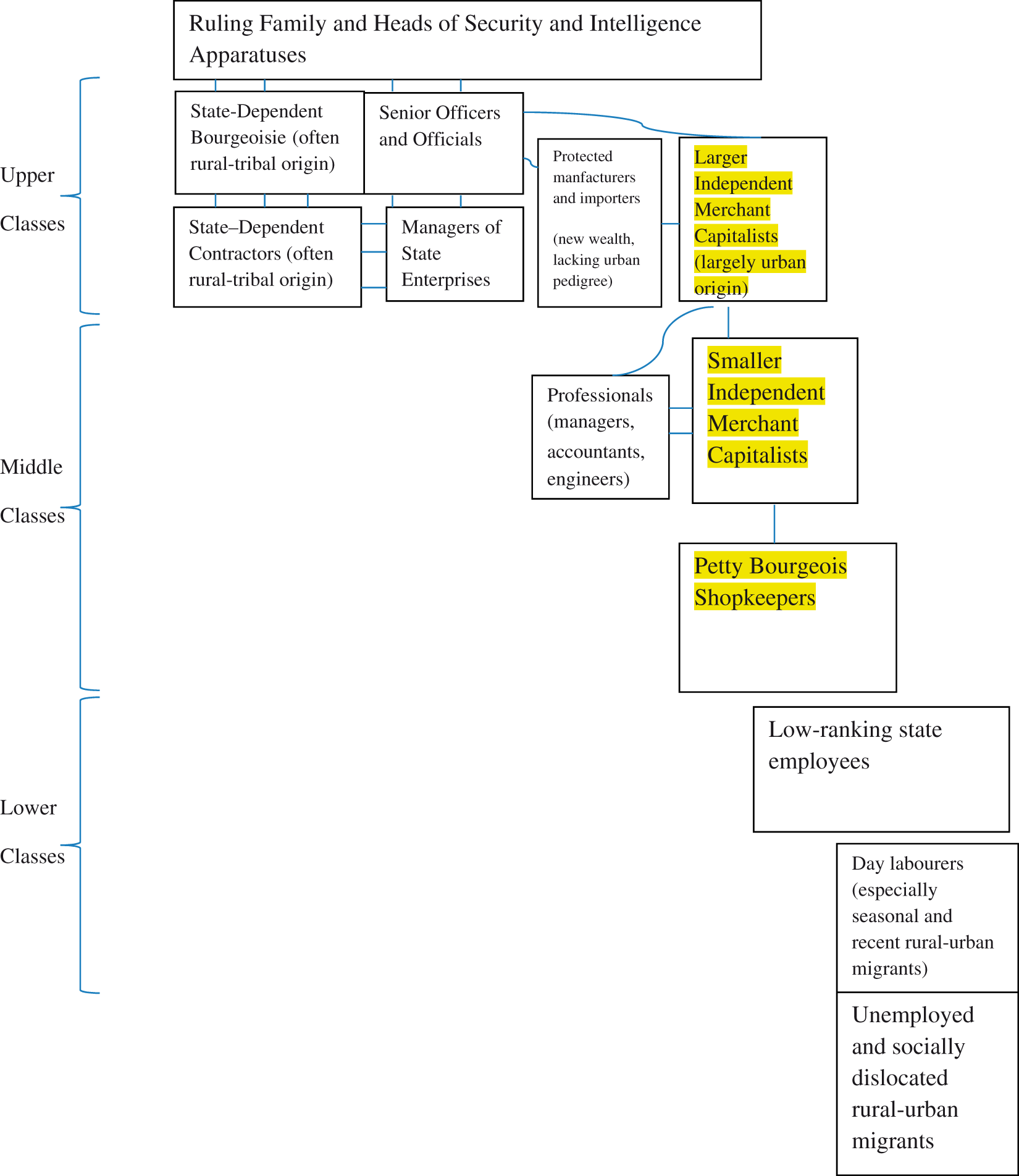
These two strata had both invested in a discourse of civility and, together, they formed an urban middle class that is the focus of my analysis. Below them, a lower class encompassed lower-ranking employees, who depended for their livelihood on their wages and who often had to supplement them by moonlighting, as well as even more precariously placed day labourers, whose lower economic position was often reinforced by their stigmatised status as recent or seasonal rural-to-urban migrants. Above the middle class, an upper class comprised merchants and industrialists, who because of the extent of their capital investments were recognised as important players in the markets in which they operated; this class included industrialists employing over 20 individuals. This upper class can be further divided into a largely urban ‘commercial bourgeoisie’, who operated in competitive markets, and a ‘state bourgeoisie’ (Haddad, 2012a), who enjoyed political and economic monopolistic power in a given field as clients of the ruling family or of its networks of high-ranking security and intelligence personnel.
I argue that middle-class sensibilities in relation to civility responded to a sense of being subjected to a set of governance arrangements through which access to political and, often, economic power had been monopolised. At the same time, urban middle-class discourses of civility served to reinforce the basis of my interlocutors’ precedence over the lower classes, particularly those from rural backgrounds, and to delegitimise their presence in urban and, by extension, political space. This article, therefore, takes up the questions the editors (Thiranagama et al.) raise in the introduction to this special issue: under what conditions did these calls for civility and charges of incivility become powerful moral and political claims? Two conditions are pertinent here: first, the ambivalent position of the middle-class commercial bourgeoisie in the Syrian polity. Whereas larger merchant capitalists were deposed from political leadership by the accession of the Baathist leadership in 1963, smaller independent merchants were afforded varying degrees of space in which to accumulate wealth but not political power (Hinnebusch, 2008). As the regime in the 1990s permitted the expansion of the commercial bourgeoisie to generate wealth, demands for political representation increased, but were met by coopting the largest merchants into monopolistic economic networks rather than by an institutionalised system of representation (Heydemann, 2007a). It was under such conditions – of bourgeois economic power and political exclusion – that criticism of the chaos and incivility in the public realm could be heard as a ‘signifier of discontent’ (Smith, 2007) with the regime’s structures of governance, and as a call to reinstitute bourgeois forms of order, civility and representation as the basis for civil and political life.
The second condition concerns the history and politics of urban–rural relations in Aleppo and in Syria more generally. The claims of order and civility voiced by petty bourgeois shopkeepers in this article cite rural incomers as the source of socio-moral decline in the city, reflecting a discourse that was also prevalent among wealthier merchant families in Aleppo. In part, this reflected a dissatisfaction with the policies of a regime that was understood to have rural roots and which had challenged the urban elites’ monopoly on power (Salamandra, 2004). Although market reforms in the 1970s and again in the 1990s and 2000s had benefited some sections of Syria’s commercial bourgeoisie, in Aleppo, the regime had also cultivated and often given priority to rival elites of rural and tribal origin by incorporating them into its own monopolistic economic networks (Haddad, 2004; see Figure 1) and, importantly, its coercive structures. From the late 1990s onwards, as land in some of the city’s suburbs and on its periphery was zoned for industrial use and property prices rose, some landowners became richer and were able to engage in manufacturing and commerce. Many profited either as importers or as manufacturers through developing strategic partnerships with state officials that afforded them privileged access to profit opportunities (Haddad, 2012a: 234). This group did not constitute a rurally rooted ‘state bourgeoisie’, nor did its members hail from Aleppo’s prestigious Sunni trading families or claim an urban connection going back several generations. As Aleppo’s longer-established commercial bourgeoisie faced new forms of competition and challenge, ‘authentic’ urbanity became a marker of prestige, and civility an important way to lay to claim to it. Yet, this discourse also served to mark poor rural incomers, who sought employment as manual labourers, as out of place in the city. In Aleppo, as Hromadzic (this issue) describes with regard to Bosnia, the claims of civility could transcend ethnic and religious divides, but reinforce urban–rural ones, and the perception that the rural was dominant over the urban gave these claims of civility their particular force.
This article is based on fieldwork carried out in and around Aleppo over 15 months during 2008–2009. Data were gathered through daily participant observation, open-ended interviews and conversations, and some formal interviews with merchants and shopkeepers and their social circles. I developed long-term relations and held repeated in-depth conversations with 35 informants, around half of whom worked in Aleppo’s central bazaars, and half in shops, offices and factories across the city. This group was roughly evenly split between manufacturers, wholesalers, retailers and professional roles, such as brokers, accountants, managers and lawyers, although many were active in more than one of these domains. Most owned or ran small partnerships or family businesses with between 0 and 8 employees, although 5 of my key interlocutors employed more than 50, and 4 were employees. All conversations presented in this article were conducted in Arabic.
Civility as a critique of the state: Seeing unruly mobilities as a regime of disorder
Salam, a merchant from Aleppo, had taken me and a friend of his, Abdurrahman, another businessman in his 40s, on a weekend trip to the seaside. It was 2009. We were staying with more friends of his, a charming couple who owned a chalet near the Turkish border, right on the beach. She was a middle-aged architect called Amani and he was a sugar merchant, well read and cultured. We relaxed on the veranda looking at the sun starting to set. Before long, the conversation turned to politics. Amani said that life in Syria is hard; they were clearly comfortably off, but, as she said, there is no personal freedom, you cannot talk about certain things, such as politics, to be frank. I hate the system of bribes which I am forced to accept in my work, and which means I am corrupt; I hate having to deal with public bureaucracy. You have to adapt to the system, you change despite yourself. You could not live in Europe as a chaotic person (fawdawi), you will end up excluding yourself, isolating yourself, not feeling right. It is the same living here, you have to become a chaotic person, corrupt. The only place you find cleanliness is inside the house. I can’t be at ease here (irtah)
1
in this country. There is rubbish on the streets and the beaches, flies everywhere, people driving chaotically, using the horn all the time. I am not used to it and cannot get used to it. in this country, people don’t care, and they are afraid. Judges are corrupt (ta‘banin – literally, tired). Corruption (al-fasad) and bribing is a system, it is built into the public sector, it is not an exception or a private sector phenomenon like in Europe. There is high inflation. People can’t afford houses, then there is marriage, and providing for children. The lack of care is intentional (madrus): people living in situations like this, worrying about getting bread, the basics of life, don’t think about anything else [like politics].
Other speakers explicitly asserted a link between everyday incivilities and structures of uncivil governance. Mohannad, another businessman friend of Salam’s from Aleppo, also in his mid-40s, said, the problem is the state, which doesn’t hold the wrongdoer to account (hasib al-mukhti’) or reward the person who does good. So people get away with bribes, and other things. You see this in the way people drive, they don’t drive straight, respect red lights, wait in queues they use the horn when there is no need, they throw litter out of windows, in the dirty streets and lots of other ways. The worst thing is that they don’t know it is wrong. There is not the culture that says it is wrong!
The markedly negative tone of these references to ‘chaotic’ ways of operating is in striking contrast to other accounts of erratic mobility that have cast it in a more positive light. Urban dwellers elsewhere in the region have celebrated their unruly ways of moving through the city. Monroe (2011) has observed that among Beirutis, a capacity for successfully navigating chaotic traffic and public space was seen in a positive light as a valuable form of shrewdness and defiance of public authority, and was prized as a Lebanese national skill. The social theorist Michel de Certeau (1984) has also construed unruly mobility in positive terms, seeing it as a way in which ordinary people defy the constraints of an elite order. He conceptualised elites as the proprietary powers – those in possession of a base or fixed position within a given field of power, which is marked off from an exterior and from which it becomes possible to plan, strategise and deploy forces.
Non-elites, lacking a base and a visible locus in that field of power, seek to achieve their purposes in a radically different way according to De Certeau. Non-elite ways of operating are ‘tactical’ as opposed to ‘strategic’: rather than confronting the proprietary powers head-on, non-elites seek to ‘make use of the cracks that particular conjunctions open in the surveillance of the proprietary powers’, acting quickly, idiosyncratically and opportunistically to turn configurations and circumstances to their own purposes (1984: 36–37). Rather than confronting, they seek to deflect, rather than planning, they seize opportunities ‘on the wing’ (1984: 36–37) and rather than following the order and logic of the proprietary powers, they cut across them in transverse and unexpected ways. Such tactical ways of operating, De Certeau reminds us, derive from the condition of being without a base in the field of power to which they might retreat safely and in which they might accumulate any advantages that they win (1984: 36–37).
However, there is an important respect in which Amani’s, Abdurrahman’s and Mohannad’s experiences did not quite fit within De Certeau’s frame of analysis. Although he writes about transverse tactics in a celebratory tone as the defiance of an elite order, my informants lamented these as the mark of socio-political degradation and the absence of a desired civil order. In their view, the degraded socio-political environment forced them to contend with and even embody themselves in a chaotic habitus expressed in inconsiderate and uncitizenly behaviours. This state of incivility, which they felt themselves subjected to in public and bureaucratic space, was not so much a resistance to an elite order that they sought to turn to their own advantage, but a regime of disorder that they had to endure and even reluctantly embrace themselves. It was a condition in which there seemed to be no room left to act like a citizen, to ‘speak as one wants’ – or to act in ‘ordered’ (civil) ways. It was what was left when the space of citizenship and civility had been dissolved. My informants sensed themselves to be without locus in public and bureaucratic space, ill at ease, and forced to move and to conduct transactions in transverse ways. Abdurrahman even understood this as an intentional mode of governing, as something ‘deliberate’.
De Certeau’s model of practice assumes a binary opposition between an elite and the ordinary people: the ‘proprietary powers’ or ‘producers of culture’ (1984: xvii) seek to impose their own vision of socio-cultural order, whereas the ‘dominated element in society’ (1984: xi–xii) seek to resist by manoeuvring craftily and turning ‘order’ to their own advantage. Yet, the class profile in Syria was more complex than this model allows. Bashar al-Assad’s regime had cultivated a state bourgeoisie of importers and industrialists dependent on regime finance and patronage (Haddad, 2004, 2012b). By contrast, my informants belonged to an independent urban bourgeoisie. This comprised shopkeepers, merchant capitalists of varying sizes and associated professionals. Although the regime had sought to coopt the largest of the independent merchant capitalists, the middle strata were often more ambivalent about the regime’s legitimacy. They were comfortably off compared to the urban and rural poor, but they were conscious of being outside the political elite and the ‘networks of privilege’ (Haddad, 2004) that connected regime echelons to its state-dependent bourgeoisie. Viewed from the perspective of economic class, they could be seen in De Certeau’s terms as ‘proprietary powers’ rather than the ‘dominated element in society’. However, from the perspective of citizenship, they were conscious of their disenfranchisement and their need to manoeuvre within a potentially hostile environment.
So, in one sense, the forms of unruly mobility described by Amani, Abdurrahman and Mohannad did exemplify De Certeau’s tactical mode of operating, characterised as it is by unexpected moves and transverse mobilities. If bureaucratic and public space in Syria was a field of power, then the fact that these speakers conceived of their mode of operating as tactical (or ‘chaotic’ in Amani’s words) can be attributed to their lacking a ‘base’ of constitutional citizenship. Since 1963, Syria has been governed by a military regime that often invokes emergency laws to suspend the Constitution, and in which the application of laws, many of which are incompatible with each other, has often been understood to be arbitrary from the point of view of the citizen-subject. The sense of lacking a locus in the field of state power, and thus having to adopt erratic modes of operating, can be seen in the following middle-class account of interactions with the security state.
Hana was a 31-year-old woman who managed the administration of a research institute in Aleppo. She described her everyday mode of operating as like a cat-and-mouse game. We use proxy servers to access [internet social media] sites. It is forbidden at the official level. But they know we do it and let us. Every so often they come and shut it down, and we like mice scamper around and sit behind their tail and find another server.
Thus, my interlocutors did not see the fact that they needed to manoeuvre in De Certeau’s terms as creative resistance to an overarching order. Instead, they saw it as evidence of the incivility – both everyday rudeness and the absence of substantive citizenship – that they sought to oppose. The observation that in their everyday experiences of public and bureaucratic space middle-class Syrians confronted a ‘regime of disorder’ provides an ethnographic counterpart to what Heydemann, a political scientist writing about Syria, has called the ‘patterned disorganisation of political life’ (2007b). By this, he means the unpredictability and arbitrariness of people’s encounters with the state or public sector. He argues that by constituting the state as an array of different networks, 2 the authoritarian regime aimed to create opportunities for bargaining and accommodation, and to preserve its flexibility to incorporate or exclude different social actors according to the needs of the moment. This strategy allowed the regime flexibility in managing its support base and, thus, contributed to its ‘resilience’. However, the range of different networks and institutions defied any single rationality or logic, creating multiple and proliferating ‘rules of the game’ (see also Haddad, 2009). This generated ‘constant background noise about the viability of the system’ (Heydemann, 2007b), which is one way of describing the laments that I document here: Amani, for example, lamented the ‘chaos’ of having to operate and participate in a system of bribery; Abdurrahman decried the systemic nature of corruption and the chaotic public bureaucracy; and Mohannad critiqued the absence of formal structures of accountability that might render the public realm more civil.
So, these Syrian middle-class narratives described a generalised state of incivility that could require the authors, too, to navigate public space and institutions in uncitizenly ways. Their complaints about ‘chaos’ can be read as a critique of the uncivil state. The ideal of civility –‘order’ in the local idiom – may even be seen as the basis for an emancipatory call to liberate a space for citizenship. However, as the editors of this special issue note, the ideal of civility is fraught with contradictions. In its liberal formulations, civility is presented as a universal ideal – the call for a space in which all may be equal citizens, liberated and empowered vis-a-vis feudal or dictatorial power. In practice, however, these ideals have specific bourgeois roots, often anchored in the urban societies of post-Enlightenment Europe. Similarly, the ideals of civility/order and the laments about disorder documented here had specific bourgeois roots. These speakers belonged to or were associated with Syria’s middle-class commercial bourgeoisie: Abdurrahman owned and managed successful business in Aleppo exporting foodstuffs to Europe; Amani was married to an importer and wholesaler of sugar; Mohannad had for several years worked as a senior manager for one of Aleppo’s largest textile manufacturers before establishing himself as an independent exporter of curtain fabrics; and Salam, who introduced me to them all, was an independent businessman who imported industrial machinery and consumer goods from China into Syria, and brokered large textile deals.
The ordered, cultured self: Civility as class privilege among Aleppo’s commercial bourgeoisie
Within middle-class bourgeois circles, managing property and the propertied self provided important sources of knowledge about civility and the ideal order envisaged by these speakers. Salam and other merchants emphasised the importance of keeping ‘ordered’ accounts of their business activities, seeing this as the basis for being an ‘ordered’ (mratteb, nizami) person themselves. One merchant who worked as a wholesaler and retailer of kitchenware in Aleppo said that he kept neat and precise accounts ‘not because I have a business partner, but just to be ordered (nizami)’. Another merchant in the bazaar showed off his account book to a visiting credit card agent with the words ‘see how ordered (mratteb) it is’, and a textile manufacturer who exported to Russia and central Asia told me that the neatness of a customer’s account book, as well as whether he was ‘cultured’ and academic, were factors in assessing trustworthiness. Order (nizam) was the habitus that these merchants sought to cultivate as they ran their businesses, managing both property and the entrepreneurial ‘ordered’ self. It may be, therefore, that in middle-class bourgeois circles, criticisms of public and bureaucratic space as disordered and not properly governed proceeded from a domain of private property – particularly the commercial enterprise with its account book – in which order had already been established as a governing principle. The habitus underpinning this circle’s discomfort with unruly modes of operation was formed through the regulation and ownership of private property.
This particular circle was also affiliated with a middle class defined by its claim to ‘culture’ (al-thaqafa) and ‘civility’ (al-ruqi). I first met Salam, the businessman who introduced me to Amani, Abdurrahman and Mohannad, in the French research institute where I was based in Aleppo during 2008–2009, and where he knew several of the Syrian researchers and sometimes attended lectures. 3 The first question he asked when I introduced him to my research on Aleppo’s traders was, ‘are the merchants you have met cultured (mthaqqafin) or not?’ Salam asserted his own culture and learning by quoting Arabic literature and poetry, as well as showing his knowledge of European literature and world history in gatherings with other merchants and industrialists. The other speakers documented above could also claim the status of being ‘cultured’ or intellectual. As an engineer (muhandisa) and qualified architect, Amani had a high educational and professional status. She and her husband took a keen interest in culture, buying ‘every book’ by modern Arab intellectuals, and were familiar with a local cultural festival patronised by Syrian artists and intellectuals, including those identified with the ‘opposition’. Abdurrahman, too, had a high professional status as an engineer and lawyer. He also ran a reasonably successful export business and lived in a suburb of Aleppo that was home to the residences of several grand bourgeoisie families and was often described as raqi (civilised or sophisticated), the adjective that corresponds to al-ruqi. Mohannad was also at a high educational and social level: he had gained several higher degrees and had now accumulated enough capital as an exporter to live in a raqi suburb of Aleppo.
Among the middle-class commercial bourgeoisie, the ideal of being cultured and civilised was associated with a habitus of ordered modes of moving and transacting. The civilised merchant was said to be far from the world of ‘swerving and turning’ (laff wa dauran), the depiction of unruly mobility that signified sharp practice. A small industrialist in Aleppo who owned a weaving business promised to introduce me to ‘the whole range of merchants in Aleppo – to the trader who is civilised (al-raqi) and the one who can open his eyes in oil (al-mfattah bi’l-mazut)’. A merchant who could claim to be raqi thus distanced himself from negative stereotypes of ‘the trader’, and confirmed and legitimised his trajectory of upward social mobility. The claim was made through a language of moral qualities: to be raqi meant being ‘respectable’ (muhtaram), ‘sincere’ (sadiq) and ‘not deceiving’ (la yghish). By contrast, an ability to ‘open one’s eyes in oil’ denoted cunning and an ability to survive and swim in murky environments, using trickery (al-khada’) and deception where necessary. Among merchants who wished to confirm and legitimise their upward social mobility, a common way of distancing themselves from sharp practice or deceit was by gesturing with their right hand like a fish swimming from side to side around obstacles. This signified a mode of operating that was cunning and that might involve overcharging. The same merchant could reinforce his own claim to be honest by holding his right forearm and wrist rigid and straight and making a firm karate chop movement downwards, saying, ‘we are like this, ordered’ (nahnu haik, nizamiyyin).
These gestures symbolised two distinct habitus. One, a habitus of civility, was lived through modes of operating and by conducting transactions in everyday life characterised by order, honesty and respect, and articulated in an aesthetic idiom of straight lines or rows (al-tartib) and ‘ordered’ (mratteb) behaviour. 4 The contrasting habitus implied by these gestures was characterised by quick, unpredictable or circuitous manoeuvres, swerving and turning, and twisted tactics (asalib multawiyyeh), in which intentions or methods were concealed or ‘not revealed’ (ghayr makshufeh). This mode of operating could attract a variety of evaluations, from admiration (shatara – cleverness) through a sense of ambiguity (sa‘dana – cunning) to outright condemnation (wisikh – dirty). The fact that some valorised unruliness was viewed as an admirable skill or cleverness shows that not all Syrian traders had an equal stake in bourgeois notions of order or civility (see Zerubavel, 2002). Marsden (this issue) gives a different account of how international Afghan traders conceived of civility, that is, as mediating the relationship between cleverness and honesty. Among Syrian traders in Aleppo, however, expressing distaste for the pretence of ‘clever’ modes of operating was one way of laying claim to the status of cultured civility. According to the local dichotomy of cunning versus civilised, a trader described as mfattah was skilled from birth in unruly modes of operating, whereas one who was raqi was ill at ease with such ‘disordered’ ways of navigating his environment.
These habitus were also often associated with different class positions. On the face of it, the raqi person was simply distinguished by his/her ‘morals’ and ‘honest’ and ‘respectful’ interaction. In practice, however, some classes of people had a prior claim to this quality. Ruqi was also associated with possession of economic and cultural class: residence in a ‘sophisticated’ neighbourhood (Meier, 2014) and a culture of reading and professional or educational attainment. Amani, Abdurrahman and Mohannad could each claim to embody civility through such prestigious forms of learning and residence. This is another way in which De Certeau’s model of ordinary people resisting the order imposed by a dominant class of ‘producers of culture’ does not capture the class dynamics at play. My informants critiqued the overarching regime of disorder from a platform of civility, which implied possession of the bases of economic and cultural class. The fact that they were persons of economic and cultural standing helps us to understand why they construed ‘tactical’ modes of operating so negatively. In the field of bureaucratic and public space, they were excluded from proprietary power without the locus of citizenship and constrained to manoeuvre in tactical ways. However, they were able to criticise this field as chaotic, using an idiom of (absent) order, because they were at the same time used to embodying a habitus of proprietary order. They were persons simultaneously with and without locus: they had a base in the field of economic, property-owning power, in which they cultivated a habitus of order, but not in public and bureaucratic space. They experienced and criticised the latter as ‘chaotic’, speaking from the privileged position of those with a base in the field of propertied power relations.
Exclusionary civility and urbanity: Performing the shop as a besieged spatio-moral order
In order to explore further the connections between property ownership and the claims of civility, I turn now to laments about unruly and uncivil modes of behaviour voiced by shop owners, members of what I am characterising as a petty bourgeois class in Aleppo. Each spoke from and in reference to a clearly defined locus in the field of bourgeois-propertied power relations: a shop. In these cases, we see a slippage between the ideal of civility as civic behaviour and ‘order’, and civility as possession of materially grounded forms of privilege – in this case, shops located in ‘civilised’ suburbs. The claims of civility voiced in these contexts drew on notions of urbanity and sought to reproduce local hierarchies involving the rural and the urban. In these laments, the thresholds of shops became sites that symbolised for the shopkeeper the boundaries of an civil and urban sensibility, and the meeting point between a domain of proprietary order and a domain of disorder imagined to have rural roots.
Hani, an Aleppine man in his early 30s, ran a small high street shop retailing coffee beans. This shop was on the border of an upper-class district that was home to the historic residences of grand bourgeois families, and the neighbourhood was itself generally regarded as a sophisticated quarter. He had invested in a modernist décor: an all-glass frontage, with mirrored walls inside. Hani and his younger brother, Mustafa, embodied a regime of order and precision within the shop. Showing me the storeroom above the shop, Mustafa invited me to appreciate how ‘ordered’ (mratteb) it was with its neat arrangements of sacks of coffee and containers of milk powder. When he took an order from a customer, he would reach down to scoop up the beans from the glass-fronted display on to the weighing scales. After each scoop he paused to consider the weight, carefully adding increments until the desired quantity was reached. He displayed equal care over the packaging, sealing it up with measure and poise ‘out of respect for the customer’ (ihtiraman li’l-zabun). The deliberate rhythms of weighing and packing showed a desire for exactness, consistency and propriety.
Hani stocked Brazilian, Indian and Colombian beans, and flattered his customers when they could discriminate between his stock and lower-quality beans: ‘it is a sign of your taste that you can distinguish the difference’. The shop was a site where class distinctions were reproduced through consumption patterns and through associated judgements about taste (Bourdieu, 1984). It was also a site where notions of civility were deployed to discriminate between customers. One day, a man in his 30s, with a thick moustache and rough, unshaven cheeks, appeared at the door and entered the shop. He said that Badrus from over the road had sent him and asked for four cups of coffee on credit from the machine in the shop. Hani refused, firmly, then sat mutely in his chair without looking at the customer. The man asked again, and said he was a neighbour after all. Hani did not budge. The customer looked frustrated and after a few moments said, ‘keep your favours for yourself then’ and walked out. When he had gone, Hani was bristling with indignation: Aleppo used to be the height of civility (qimmat al-ruqi). But it has become dirty. Do you know when? When the villagers moved in. When Aleppo became mixed. That man who just walked in, I knew from the moment I saw him that he was a vagabond. He confirmed this to me by his behaviour … A true Aleppine (Halabi asli) would never have done what he did. I’ve never seen him before. He says that Badrus sent him; I don’t know if that is true. He asks for the coffees on credit; I said we don’t give credit. That is the order (nizam) of the shop! No credit, not for him, not for anyone. That is our order here … I am the owner of the shop! It is for me to set the order.
The affective judgement that Hani made involved a slippage between notions of civility and urbanity. For Hani, to be civil meant to be authentically Aleppine, that is, not an immigrant from the countryside. In Aleppo, the term ‘villager’ (min ahl al-day‘a or ibn al-rif) could imply someone of Kurdish or even Alawite ethnicity, but also simply anyone – including a Sunni Arab – of obscure rural background who could claim neither an urban history nor a tribal one. Hani said ‘some time ago the villagers entered the city, people whose name no-one knows. When they came to the city, they destroyed its level of interaction. They are entirely different from Aleppines – in their thinking, their morals (akhlaq), their appearance.’
Urban–rural politics in pre-conflict Aleppo
What were the circumstances and historical conditions that made this discourse of urban–rural hierarchy pertinent? Syria’s commercial bourgeoisie had been deposed and largely excluded from political leadership in 1963 by a new rural-based state. From 1970 onwards, the regime allowed small, urban, independent merchants some freedom to operate in the economic domain, but then fostered a rival economic base, often consisting of people hailing from humble and rural social backgrounds, by giving it privileged access to import opportunities and, therefore, to social mobility (Bahout, 1994; Heydemann, 2004; Perthes, 1997). Much as Salamandra (2004) describes in relation to Damascus, the larger commercial bourgeoisie in Aleppo felt a historic resentment towards the government for undermining their domination of politics and commerce. These tensions were exacerbated in Aleppo by the mode in which the regime sought to govern the region. Although the regime’s policies of market liberalisation in the 1990s and free trade agreements pursued in the 2000s broadly benefited the commercial bourgeoisie in Aleppo, the regime also strengthened its coercive presence in the city by coopting a number of Aleppo’s ‘tribes’, allowing them to develop close ties with its security and intelligence infrastructure and to control certain forms of smuggling (Dukhan, 2014).
There were also other dynamics that brought rival elites of rural origin into the city. Since the 1990s, renewed market liberalisation had led to an expansion of the textile economy in Aleppo, and by the 2000s the accumulation of merchant capital had enabled the establishment of significant new industrial enterprises in and beyond the periphery of the city (David and Boissiere, 2014). As rural locations at the edge of the city were transformed into sites of medium-scale industrial production, smallholders living in Aleppo’s satellite villages acquired sudden wealth by selling land to urban industrialists. The inflation of land prices driven by industrial expansion led to rural incomers settling in the city, where many established commercial and industrial enterprises. In response, the older-established families sought to display their distinction by emphasising their ‘authentic urbanity’ vis-a-vis the rural incomers. Like many petty bourgeois shopkeepers, Hani could not make a claim to authentic urbanity through genealogy or ‘noble origin’ (asl wa fasl) because he did not belong to one of Aleppo’s well-known merchant families (Rabo, 2005). However, another way in which he could claim authentic urbanity was by performing discomfort with the incivility and disorder displayed by rural incomers, thus marking his own civility as a sign of distinction (Elias, 2000). In the encounter described above and the commentary immediately afterwards, he operated his shop as a besieged urban domain of civility and order, and gave substance both to his own urbanity and to the distinction between the urban and the rural.
I now turn to another site nearby where a similar discourse of urban refinement and rural backwardness could be observed. The outskirts of Aleppo, like Damascus, had long been a place where rural migrants, impoverished and dislocated from their homes across the hinterlands, had settled in informal areas or ‘haphazard districts’ (David and Boissiere, 2014). Seeking employment as day labourers in construction or manual work in the raqi areas of the city, these men could easily face charges of infringing the order and civility of the urban domain. Half a mile away from Hani’s shop, in an adjacent raqi suburb of Aleppo, Abu Markus expressed similar concerns about the noise and incivility looming just beyond the threshold of his office. He ran an employment agency, and like Hani’s shop, his office was glass fronted and opened directly on to the local high street. He had been born in one of Syria’s central governorates and moved to Aleppo as a young man; nevertheless, he too invoked an urban identity vis-a-vis rural incomers. One afternoon, he had been irritated by the dust created by some workers digging up the road nearby: ‘The most important thing in my life is cleanliness. In Europe, your streets are cleaner than my office. Here, people don’t care about other people’s peace (rahat al-bashar). They make noise, dirt, they use the horn.’
At this point he broke off to shout to the person advertising boxes of tissues via a loudspeaker: ‘Keep it down a bit! There are ill people here, people are sleeping!’ He continued talking to me, You have outstanding cleanliness (nadhafa fazi‘a) [in Europe]. Here, the streets are dirty, and even though we clean the office five times a day, it is still dirty, because of the dust. The dust comes from diesel heaters at home, and from trucks, and from people digging up the streets. They came to dig up the street and then they stopped when they made a big hole. I told them to cover it up because of the dust, but they just stopped! Hassake is cleaner, even though it is a second-class place [economically]. Tartus is very clean. Lattakieh is cleaner than Aleppo. Aleppo is the second governorate, it should be clean. We pay cleanliness taxes – 10 dollars a year for the house and 150 dollars a year for the shop. It should be kept clean, but it isn’t. The country gets 1 billion lira a month
5
for cleanliness, but still it is not clean. With that kind of money, we should be cleaner than any other country in Europe or the world. The main streets should be cleaner than the secondary streets, but they aren’t. In the summer, there are flies and insects and so on by the rubbish dump. These are our ‘customs and traditions!’ … The problem is that the villager (ibn al-rif) has entered into the city – we have learned dirty ways from the villager, and become dirty too.
These two cases show that Hani and Abu Markus understood their shops to be domains of spatio-moral order, in which a properly urban sensibility could be cultivated. In these domains, interactions were governed by a regime of order and civility, asserted against a regime of incivility that lay beyond the threshold. Their understanding of their shops as domains of spatio-moral order complemented Amani and Abdurrahman’s understandings of public and bureaucratic space as a regime of disorder. It also makes clear the middle-class bourgeois influence on their notion of civility as order: the order that Hani and Abu Markus asserted was a proprietary one, deriving from the claim of a property owner that he is able to regulate his own environment and from the claim of a tax-paying property owner that he is able to assert a stake in his surroundings.
Hani’s and Abu Markus’ cases also highlight the connection between their understandings of civility and urbanity: they deploy the idea of civility in order to police the boundary between the urban and the rural. At a time when new elites from rural backgrounds, empowered by the state, were emerging in the city and challenging the old dominance of a longer-established independent commercial bourgeoisie, suburban high street shops and offices could become sites for laying claim to a distinctly urban prestige and sensibility. This happened by cultivating consumption practices and discriminating tastes, but also by performing discomfort with the disorder and incivility that appeared to constantly intrude on these domains of middle-class bourgeois propriety. These petty bourgeois shopkeepers deployed notions of civility and order in order to assert a boundary between the rural and the urban that recent demographic changes had seen fit to question. In practice, these boundaries could be invoked in ways that worked to exclude impoverished rural incomers and day labourers from being considered equal citizens.
Civility and the Syrian uprisings
The discontent and notions of civility described in this article shed light on the dynamics of the subsequent uprising in Syria in two significant ways. The fact that discourses of civility were mobilised against rural incomers suggests that rural–urban tensions were an important fracture line in the increasing socio-economic polarisation of the country. Since the 1980s, the Syrian regime had increasingly shifted its alliances and subsidies ‘from labour to business’, and in the decade preceding the uprisings had channelled resources away from the countryside and into the cities (Haddad, 2012b: 119). The resulting economic polarisation, exacerbated by severe droughts, had encouraged intense rural-to-urban migration, creating social dislocation and poverty in provincial cities, and on the peripheries and in the hinterlands of wealthier Aleppo and Damascus (De Elvira and Zintl, 2014). It was under these conditions that social forces emerged – impoverished urban dwellers and rural-to-urban migrants – that sustained the initial thrust of the protest movements, first in the provincial cities and later on the peripheries and in the depressed suburbs of the major cities.
In Aleppo and Damascus, there was some middle-class support for the protest movement, but this discontent did not automatically translate into active and sustained opposition; particularly after the conflict became militarised, the risk of confronting the regime was for many too great (Azmeh, 2014). However, the middle-class discontent documented in this article and expressed in 2008–2009 was not unrelated to the conditions that shaped the uprising in 2011. The critique that ‘there is no order here’ drew attention to the absence of accountability and avenues of redress in the public realm and, in some cases, to the increasing cost of living, and to the degrading effects of all of these things on moral and civic subjecthood. Although it is true that the Syrian uprisings were not driven by the property-owning middle classes, the post-2011 movements did articulate similar kinds of discontent to these earlier critiques: they directed themselves against some unaccountable alliances of political and economic elites (Haddad, 2012b), whose capture of policy and resources had accelerated socio-economic polarisation, weakened a sense of mutual obligation between government and governed, and undermined for many the conditions for leading a dignified life.
Yet, although middle-class discontent can be read as a cause of some of the conditions that precipitated the uprisings in Syria, this is not to say that the middle classes led a movement for political change. In the two years prior to the uprising, some business people and professionals in Aleppo used a language of ‘chaos’ to articulate their discontent with public authorities and institutions that they saw as unaccountable and unreliable in holding others to account. However, they imagined the solution in terms of civility (ruqi) and order (nizam), which were far from inclusive. The ‘order’ that Aleppo’s middle-class bourgeoisie found lacking in the public realm was produced in private spaces through commercial interactions and practices such as book-keeping. In doing so, they enacted ideals of accountability, moral rectitude and mutual obligation, but also associated these with a middle-class habitus that construed ‘civility’ (al-ruqi) as sophistication and ‘culture’. This notion of order had specifically bourgeois roots; it envisaged a regime in public and bureaucratic space that already existed in the private, property-owning domain, and which reflected the aesthetics of affluent ‘civilised’ (raqi) neighbourhoods. Such a language of social critique and reform was unlikely to form the basis of a larger movement of contestation, especially given the socio-economic polarisation that was fuelling discontent in Aleppo’s poorer suburbs and hinterland. Such a vision of society as civil and ordered could even be used to delegitimise the forces behind the rebellion. The concepts of ‘chaos’ and ‘incivility’ were used by the middle classes prior to 2011 to exclude the dislocated rural poor from the ambit of urban citizenship and from access to respect and consideration. In addition, notions of chaos, and taking advantage of the absence of civil actors, were methods deployed after 2011 to justify the regime’s military campaign in rebel areas of Aleppo, quarters that had previously housed urban lower classes and absorbed rural-to-urban migrants.
Notions of civility, then, were deployed in pre-conflict Syria in seemingly contradictory ways: as a critique of the state, and as a guarantee of urban and class privilege. This is because the middle-class strata considered here – import–export merchants and associated professionals, and petty bourgeois shopkeepers – occupied an ambivalent position in Syria’s political economy: they were in a privileged position in relation to the rural and urban poor, but subordinated to a political elite and its dependent monopolistic networks. Although it was only the shopkeepers who deployed the charge of incivility against rural incomers, we might be tempted to explain away reactionary deployments of civility as a petty bourgeois outlook and to see ‘emancipatory’ civility as the preserve of an intellectually more ‘cultured’ bourgeoisie. However, I find such a reading problematic because it disregards the way that civility can be caught in its own contradictions, as something simultaneously ‘exclusionary and inclusive, restraining and violent’ (Introduction, this issue). As the editors note, Balibar (2002, 2015) has addressed these contradictory dynamics, acknowledging that the same emancipatory forms of identification that seek to open up spaces for politics can also ‘fall prey to forms of violence’ (Introduction, this issue). A similar contradiction appeared within the cases presented here, although in relation to a liberal rather than a left-wing political stance: the same language that criticised corruption and the absence of accountability in the state also excluded from recognition those who fell outside of an urban property-owning class. This suggests that theories such as Balibar’s that celebrate civility as a political virtue may be ill equipped to criticise its stake in systems and imaginaries of citizenship that leave wider sections of society without access to equal consideration and the resources necessary for a peaceful life.
Footnotes
Acknowledgments
I wish to thank the organisers of the conference, Tobias Kelly and Sharika Thiranagama, for instigating and hosting a stimulating two days of discussion and debate at the conference, ‘Civility: Trust, Recognition and Co-existence’ on 17–18 April 2015 at the University of Stanford. I am grateful to Nina Glick Schiller, Carlos Forment and two anonymous Anthropological Theory reviewers for insightful critical comments on the manuscript, and to Tobias Kelly, Sharika Thiranagama and the other participants at the conference for their help in clarifying the argument.
Declaration of Conflicting Interests
The author(s) declared no potential conflicts of interest with respect to the research, authorship, and/or publication of this article.
Funding
The author(s) disclosed receipt of the following financial support for the research, authorship, and/or publication of this article: The author is grateful for the Centre for Advanced Study of the Arab World (CASAW) at the University of Edinburgh for financially supporting the fieldwork which led to this publication.