Abstract
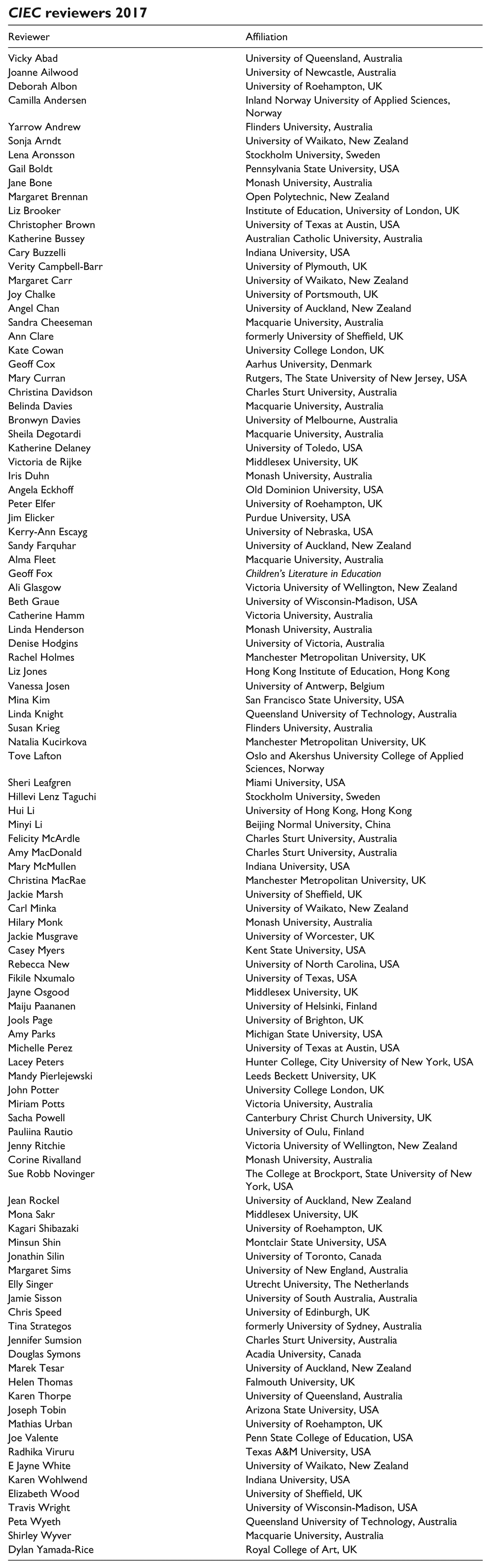
In this first issue of 2018, we begin by thanking the band of dedicated editorial board members and reviewers who continue to support Contemporary Issues in Early Childhood (CIEC). The quality of the journal is directly dependent on the quality of the reviewing and editorial processes that are used as part of publishing. We recognise and thank those who have contributed by reviewing articles during 2017 with a list of the reviewers’ names, which appears at the end of this editorial.
This issue begins with an article (‘Encounters with a pedagogista’) inspired by the work of pedagogistas in preschools in the Reggio Emilia area of northern Italy. The approaches used in these preschools have provoked countless pedagogical challenges for early childhood educators across the globe. Christina Vintimilla is a pedagogista at a children’s centre located at a university in Canada. She documents some of her initial work with a group of early childhood educators where she invoked a double movement of being-in-question and putting-into-question, which troubles familiar and unquestioned everyday occurrences through maintaining an estrangement to the accepted or routine. This work has a reconceptualist bent and is aimed, in Vintimilla’s words, at making ‘education and curriculum into something more than the mere organization of materials and activities for children, or the programmatic application of a particular pedagogical approach’. Readers experience some of the challenges for both Vintimilla and the educators as they work towards this aim.
The second article, ‘Unruly affect in the kindergarten classroom: A critical analysis of social-emotional learning’, suggests that there are alternative approaches to affective classroom life. Using three vignettes from one classroom in the USA, Clio Stearns critiques socio-emotional learning programs using specific aspects of Melanie Klein’s approach to psychoanalysis. She argues that socio-emotional learning programs do ‘not allow for ambivalence or exploration of disappointment’, and asks how these programs deal with ‘unruly feelings, affects and … behaviors’. Stearns points out that in addition to making a space for negative affect, psychoanalytic theory and practice consider aggression and children’s bodies as important areas for learning in educational settings.
Zuzsa Millei and Kirsi Pauliina Kallio challenge readers by contending that early childhood settings are sites of mundane political practice in their article ‘Recognizing politics in the nursery: Early childhood education institutions as sites of mundane politics’. They highlight two types of politics and attend to the second in the article, which they explain as ‘everyday politics unfolding in communities that involve people as political subjects from birth till death’ – that is, they claim that children can be seen as political subjects in the same way as adults. They make a case that critical pedagogies can be used to involve children in thinking and acting in their daily ‘political realities’, and that this is preferable to using the political experiences and understandings of the adults working with them. Millei and Kallio call for further research in this area and the development of pedagogies that support children as agentic in their everyday political lives.
In ‘The family–centre partnership disconnect: Creating reciprocity’, Fay Hadley and Liz Rouse investigate an enduring facet of early childhood education: the relationships among educators, families and communities. They use a comparative case study analysis and draw on data from four studies in two Australian states to show a disconnect in relationships between centre staff and families. National policy requires the establishment of collaborative partnerships with families and communities. However, Hadley and Rouse claim that while educators understood the concept of ‘reciprocal partnerships’, relationships in the four studies were ‘driven by the needs of the educators’. They point to the language used in policy documents, and encourage educators to question the current rhetoric and attend to creating ‘genuine reciprocal partnerships’.
Jacques Rancière is a theorist who may not be well known to early childhood educators. In their article titled ‘Symmetry and equality: Bringing Rancière into the classroom’, Ove Skarpenes and Ane Malene Sæverot explain Rancière’s critique of critical theory, in which he brings together pedagogy, art and policy in an attempt to create a new understanding of emancipation and equality. They suggest applying this to early childhood education and are motivated by increasing inequalities that characterise not only Norwegian society, but many Western societies. While much of the article discusses Rancière’s approach to equality, Skarpenes and Sæverot apply some of his ideas by providing suggestions about pedagogical approaches, including seeing performance as emancipation and a way of contributing to making the social order more democratic.
Much has been written about pedagogical documentation. In the final article for this issue, Karin Alnervik discusses ‘Systematic documentation: Structures and tools in a practice of communicative documentation’. The intention is to identify the contradiction for Swedish preschool teachers between documentation requirements, where knowledge is viewed as objective and neutral, and pedagogical documentation, which is conceptualised as a critique of the quality agenda of the 1990s and enacted as a meaning-making discourse. To do this, Alnervik problematises the meaning of ‘systematic’ and uses statements from preschool teachers to show how new tools and practices were created to work with documentation requirements in a systematic yet dynamic way. Alnervik argues that while teachers reflect on the work they do with children, they also need to reflect on the way they document their work with children.
The colloquium is written by Elizabeth A Morphis and titled ‘The power of one-to-one coaching: Preparing pre-service teachers for the early childhood literacy classroom’. Morphis relates an experience of supporting initial teacher education students to become more skilled when using running records while undertaking professional placements in elementary schools.
Thanks to Julie Perskey from Texas A&M University who reviewed the book Children’s Literature and the Posthuman: Animal, Environment, Cyborg.
Publishing CIEC with SAGE has brought some changes, one of which is using an electronic system called ScholarOne to manage all facets of the journal from submission to publication. This means that our treasured CIEC editorial assistant, Lynn Wilss, will not be involved in the process any more. Lynn has provided outstanding service to authors and the journal over many years, and we are sorry that we are unable to continue to benefit from her many talents and skills. Her personal, responsive and attentive style has been an exceptional part of the operation of the journal, and we thank her sincerely for what she has brought to CIEC.
As mentioned in the opening paragraph, we express our sincere thanks to those in the list below who reviewed articles for CIEC during 2017.
Enjoy reading this issue!
CIEC reviewers 2017