




Abstract
On 7 August 2009, Sarah Palin posted two words to her Facebook page that would come to define a summer of discord around health care reform. This study examines how traditional media reported on the ‘death panels’ claim that was immediately debunked by several fact-checking organizations. Our content analysis of over 700 newspaper and television stories shows that, to a significant degree, journalists stepped outside the bounds of procedural objectivity to label the ‘death panels’ claim as false, often without attribution. Many stories, however, simultaneously covered the claim in typical ‘he said/she said’ fashion, thus perhaps extending some legitimacy to the claim. Our study illustrates the challenges to fact-based public deliberation in the contemporary media environment, and suggests that competing practices of objectivity undercut the ability of mainstream media to help the public separate truth from fiction.
Introduction
On Friday 7 August 2009 ex-Alaska governor and former vice-presidential candidate Sarah Palin posted the following to her blog on Facebook:
The America I know and love is not one in which my parents or my baby with Down Syndrome will have to stand in front of Obama’s ‘death panel’ so his bureaucrats can decide … whether they are worthy of health care. Such a system is downright evil. (Palin, 2009)
Just three days after Palin first posted her ‘death panels’ remark, PolitiFact, a fact-checking organization of the St Petersburg Times, declared, ‘There is no panel in any version of the health care bills’ (Holan, 2009; PolitiFact, 2009), and rated the claim ‘Pants on Fire!’ – the website’s most damning ruling against the veracity of a claim. Similarly, on 14 August, FactCheck.org, a project of the Annenberg Public Policy Center, determined that ‘The phrase “death panel” does not appear in the health care bill that passed House committees last month. And Palin’s post did not make entirely clear what she might interpret as a “death panel”’ (Bank, 2009). Later, over 60 percent of those polled in PolitiFact’s ‘Lie of the Year’ contest voted for ‘death panels’ (Holan, 2009). 1
That the claim was singled out for this dubious honor reflects the impact it nevertheless had on public discourse about health care reform. The Project for Excellence in Journalism’s analysis of coverage of the debate by over 50 mainstream news outlets in 2009 found that ‘rationing health care’ – the specific fear the ‘death panels’ claim evoked – was the third most prominent specific message opposing health care reform in news coverage, and that ‘government takeover’ of health care – the fear the claim evoked more broadly – was by far the predominant message about health care reform in the news overall. As the Project for Excellence in Journalism (PEJ) reports, Palin’s ‘death panels’ claim ‘crystallized’ the notion of ‘government encouraged euthanasia’ in mainstream news (2010). 2
As we demonstrate, a substantial number of stories flatly labeled the claim false, often without attribution. At the same time, it was often simultaneously covered as a matter of differing opinions, in classic ‘he said/she said’ fashion – even within stories that debunked the claim. Our study thus goes to the heart of a contemporary dilemma in journalism: the increasing power of ‘new’ media broadly defined, including cable news, talk radio, and digital and social media, to set the agenda and circulate information makes the mainstream media’s role as arbiter of factuality more crucial than ever, even as their capacity to effectively set the record straight for the mass public is diminished. Meanwhile, as we demonstrate in this article, the prevailing norms of the profession make arbitrating factuality challenging.
Literature review
Beyond gatekeeping: Contemporary challenges to journalism
The importance of an informed citizenry to democracy has been widely accepted among scholars, though they debate the amount of information the public can process and the amount necessary to the conduct of representative democracy (Bartels, 1996; Graber, 2001; Milner, 2002). According to Delli Carpini and Keeter, ‘Political information is to democratic politics what money is to economics: it is the currency of citizenship’ (1996: 8) – to which Kuklinski et al. reply, ‘If facts are the currency of citizenship, then the American polity is in a chronically impecunious state’ (2000: 791).
The rise of ‘new media’ has promised both to improve and to worsen the public’s store of knowledge. While exponentially increasing the sheer amount of readily available information, people use online communications unevenly and selectively, often in ways that reinforce their political predispositions (Stroud, 2010) – a pattern ever more likely in an increasingly polarized political/media environment (Bennett and Iyengar, 2008). Meanwhile, new media tools such as social networking offer powerful means for political actors and advocates to target their messaging to receptive audiences. These developments have placed mainstream news in a crucial but precarious position. Mainstream journalists today ‘stand sentinel at a gate with no fence surrounding it’ (Kovach and Rosenstiel, 2010: 171).
In this study we examine newspaper and broadcast television coverage of the ‘death panels’ claim, an approach that might seem anachronistic in the new media age, particularly since the claim was popularized via Sarah Palin’s Facebook page and circulated via cable news, talk radio, and various online networks. But examining mainstream media coverage of this controversy remains important for several reasons. First, recent data show that most news consumers still depend heavily on content produced by traditional media outlets like newspapers, even when they find that content online (Kovach and Rosenstiel, 2010: 174), and that most newspapers’ online content does not vary significantly from their paper content (Van der Wurff and Lauf, 2005). Indeed, the audiences for mainstream news outlets still far outnumber those who exclusively seek non-mainstream content such as cable news opinion shows or websites unconnected to major news organizations (Pew, 2010b). Moreover, mainstream news outlets still provide the bulk of actual news content that is available online (Pew, 2010a, 2010c), and a great deal of online content in blogs and other opinion websites is closely linked to – indeed, highly dependent upon – mainstream media content (Lee, 2007; McCombs, 2005; Pew, 2010a). 3 Given these prevailing news consumption and production patterns, it is a good bet that many Americans learned about the ‘death panels’ claim from mainstream media outlets, even if they encountered that information indirectly online.
The question of how the traditional media covered the ‘death panels’ controversy is therefore important empirically, not only because mainstream news still reaches large audiences, though now through a greater variety of platforms and filters, but also because mainstream journalism in the United States is still shaped by the expectation of objectivity. This expectation puts mainstream outlets in a unique and precarious situation with regard to questionable claims launched via non-mainstream outlets. Thus, the question of how mainstream news handled the ‘death panels’ claim is important as a case study in how the traditional media help (or fail to help) the public to navigate an increasingly complicated information environment.
Kovach and Rosenstiel argue that to remain relevant and prosperous in the new world of information overload, journalism must verify ‘what facts are true and reliable ….sorting out what is believable and accurate amid the growing array of arguments coming at us from all sides’ (2010: 175). This normatively appealing model faces a complex reality, however. In the increasingly symbiotic relationship between ‘old’ and ‘new’ media, Facebook posts and Twitter feeds become the fodder for mainstream news, which in turn amplifies and popularizes ideas that originate on the web. Mainstream media therefore may end up aiding and abetting the efforts of various political operatives to set the agenda, prime particular public attitudes, and frame issues. As one recent study observes, ‘Agent provocateurs … now have a bevy of available platforms from the multitude of cable networks to the thriving blogosphere’ from which to lob bombs into public discourse (Sobieraj and Berry, 2011: 22). To borrow a phrase from Jenkins, the ‘logic of convergence politics’ is that citizens can ‘use grassroots media to mobilize and mainstream media to publicize’ (2006: 220). Now that more and more political actors are employing social media to garner self-selecting crowds of followers, the mainstream media’s power and willingness to arbitrate claims launched from those sites becomes an important political and journalistic question.
Objectivity rituals and ‘quasi-legitimate’ sources
How the press arbitrates such claims hinges in part on the journalistic norm of objectivity, variously described as the striving for balance, fairness, or neutrality. While many scholars and practitioners today question its achievability, the ideal of even-handed news ‘continues to have a powerful pull on journalists and remains a defining norm of mainstream journalism in the USA (Cook, 2005: 5; see also Bennett et al., 2007; Hallin and Mancini, 2004).
In terms of providing factual information to the public, research shows the objectivity norm can cut both ways. While encouraging journalists to report more than one point of view on contentious issues, and in theory licensing them to hard-headedly pursue facts, it also allows for superficial ‘fairness’ in which reporters simply report what spokespeople from either side of the political aisle are saying without clarifying for the public the veracity of those statements – what Tuchman (1978) called a ‘strategic ritual’ that ostensibly protects reporters from critics.
Truth, therefore, is not necessarily inherent in objective reporting. American reporters:
… often resort to ‘he said/she said’ reporting, in which even when two sides make directly contradictory claims about a verifiable factual question, the reporter leaves it as an exercise for the reader to do the additional homework necessary to resolve the dispute. (Pingree, 2011: 22)
In service to this style of objectivity, reporters often hesitate to ‘adjudicate factual disputes’ (Jamieson and Waldman, 2003). This formulaic reporting reflects the reality that, in daily journalism, claims in public discourse can be ‘bureaucratically’ justified as news regardless of their veracity (Ettema and Glasser, 1998).
This ritualized objectivity – what we label ‘procedural’ objectivity – leaves journalists and the public more vulnerable to the efforts of powerful industries or ill-informed activists to ‘manufacture uncertainty’ about science, for example (Michaels and Monforton, 2005; see also Mooney, 2004). As Joanne Rodgers of Hearst Newspapers has argued, ‘Reporters attempt to balance information “on the one hand” with information “on the other hand.” For the novice science writer … there is security and comfort in this formula. It provides at least a patina of “fairness”’ (quoted in Friedman et al., 1986: 107). The formula does not apply only to novice reporters. Even among experienced reporters, ‘the fear seems to be that going deeper – checking out the facts behind the posturing and trying to sort out who’s right and who’s wrong – is somehow not “objective,” not “straight down the middle”’ (Rieder, 2007: 4).
Procedural objectivity may not only obscure the issues, it can frustrate political accountability, as reporters ‘balance’ the charges and countercharges of political opponents to the detriment of public understanding (Sparrow, 1999). It may also contribute, as one recent study suggests, to declining ‘epistemic political efficacy’ (Pingree, 2011), a diminished confidence among citizens in their ability to separate truth from fiction.
An important question therefore becomes, under what conditions will the news go beyond reflexively reporting what key political actors say to engage in verifying the accuracy of those claims for their readers or viewers – what we call substantive objectivity? Several variables seem to condition those decisions.
One is the political context in which a claim is made. Claims made by candidates in presidential elections are often more readily fact-checked than claims made by the commander in chief regarding matters of national security (Lawrence, 2010). Domestic policy debates like the one over health care reform may occupy a middle ground in which neither routine fact-checking nor ready deference to authorities predominate, though the increasing prevalence of ‘fact-checking’ organizations and partnerships, such as PolitiFact and FactCheck.org, may be making policy debates more fertile fact-checking territory. Another factor that conditions how reporters treat a claim is the nature of the claim itself. Some claims lend themselves more easily to fact-checking because they offer falsifiable propositions that can be checked against available documents and other authoritative resources.
Another key factor is who makes the claim. Highly placed elected officials are assumed to be legitimate sources of newsworthy information (Bennett et al., 2007; Cook, 2005), while less well-placed sources may be treated with greater skepticism because to report their claims may seem less ‘objective’. 4 Tuchman’s observation in the 1970s remains true of mainstream news today: for reporters and editors, ‘the right of an elected or appointed official to make news’ is rarely challenged. Rather, ‘the assumption is that the holder of a legitimated status speaks for the government’ (1978: 92) – and, by extension, for the public that elected them (Bennett, 1990). Tuchman argued that these ‘working distinctions among legitimate newsmakers [and] quasi-legitimate newsmakers … imply gradations in whose truth-claims may be reported and framed as fact’ (Tuchman, 1978: 92). Thus, while officials enter the news steadily, the appearance of other claims-makers is more variable, and their claims subject to greater reportorial scrutiny (Lawrence, 2000; Wolfsfeld, 1997).
One key question in media coverage of the ‘death panels’ controversy thus becomes the liminal position of Sarah Palin in the current political environment. As a former governor of Alaska and a recent vice-presidential candidate, Palin might be counted as an official of sorts, though she currently holds no elected office, having left the governor’s office prematurely to focus on ‘effecting positive change as a citizen without a title’, as she stated in her resignation speech. Yet she remains a political force to be reckoned with, having garnered a highly energized base of supporters and assuming high-profile roles as a commentator on Fox News, favorite speaker and endorser for the Tea Party movement, and as a potential 2012 presidential candidate. Overall, Palin has attained a semi-permanent place on the political stage quite apart from conventional political accomplishments. In this regard, she seems unlike the ‘legitimate’ political newsmakers theorized by conventional scholarship: a perennially newsworthy figure whom reporters themselves aren’t always sure how to cover.
The discussion above would lead us to expect two possible modes of coverage of ‘death panels’. The fact that the claim concerned a matter of domestic policy rather than national security may have made it relatively more attractive material for verification. And because the ‘death panels’ claim addressed proposed legislation whose language was publicly available, and various non-partisan fact-checking organizations immediately debunked the claim, reporters could draw on authoritative sources to render judgment. Unlike some political claims that are difficult to disprove, the ‘death panels’ claim rather easily lent itself to verification. And the fact that it was popularized primarily by ‘quasi-legitimate’ sources like Sarah Palin (though other commentators, including a few members of Congress, were also making the claim; Nyhan, 2010) might lead reporters and editors to treat it more skeptically.
On the other hand, Palin’s celebrity status and her potent political constituency could have earned her the more deferential treatment often given to fully ‘legitimate’ news sources. And even if Palin herself invited more scrutiny, once other ‘legitimate’ news sources like the President and prominent members of Congress began to react to Palin’s claim, it became more likely to be reported in the he said/she said terms of procedural objectivity.
Research questions
Our research questions regarding how broadcast and print journalists reported on the ‘death panels’ claim thus are:
RQ1: To what extent did journalists practice substantive objectivity – the journalism of ‘verification’ – as they amplified Palin’s ‘death panels’ claim? RQ2: To what extent did mainstream news handle the ‘death panels’ claim in terms of procedural objectivity by presenting ‘both sides’ of the death panels argument?
Methods
To answer these questions, we content analyzed newspaper articles gathered from the LexisNexis database’s top 50 most circulated newspapers in the United States using the search term ‘death panel’. The sample begins on 8 August 2009, the day after Palin’s Facebook post, and ends 13 September 2009, the day of the last national poll examining public opinion about ‘death panels’. Initially, 984 results were returned; after removing repeat articles, foreign news articles, and articles that were fewer than 100 words, 749 newspaper articles, opinion pieces, and letters to the editor remained. Using LexisNexis we also collected 19 transcripts from the nightly news programs of ABC, CBS, and NBC that mentioned ‘death panels’, yielding a total sample size of 768 stories. Our unit of analysis was the entire article or story. Because we are particularly interested in how news reporters treated the claim, most of the data reported below are based on the 292 news articles (as opposed to editorial page items) in our sample.
There are several ways in which the news could engage in substantive objectivity regarding the ‘death panels’ claim. Thus, we coded several possible modes of verification. First, we coded each item for whether the reporter in his or her own words labeled the ‘death panels’ claim false (including a broad array of cognate terms, such as ‘incorrect’, ‘misinformation’), labeled it true, or abstained from making such a determination. We also coded whether reporters included clarifying information that explained the end-of-life counseling provisions of the proposed legislation, HR 3200, on which the claim was presumably based. We distinguished between articles that contained no such clarifying information, articles that included such information but did not offer it as a way of supporting the reporters’ own labeling of the claim, and articles that included such information as support for their claim.
Second, we coded each source cited in each article, noting the type of source (political actors, fact-checking organizations, advocacy organizations, medical professionals, and others) and whether these sources described the claim as true or false. These data offer tests of both substantive and procedural objectivity. When reporters cited the judgments of non-partisan fact-checking organizations regarding the claim, we treat this as a measure of substantive objectivity; when stories offered only sources who called it false, we treat this as a less direct form of substantive objectivity.
We constructed two specific measures of procedural objectivity. First, we coded each article for debate specifically about the veracity of the ‘death panels’ claim, noting how many and what kinds of sources were cited in each story either defending or attacking that particular claim. Second, we coded each article for the presence or absence of general debate regarding the effect the health care bill would have on end-of-life decisions. Thus, we can distinguish between an article in which a single political actor was cited labeling the ‘death panel’ claim false, with no language from opposing political actors, and an article in which multiple political actors with competing views on the claim were presented.
One graduate student unfamiliar with our research questions coded the entirety of the sample (n = 768). A second graduate student coded all variables in a random sample of 10 percent of the stories (n = 76). Intercoder agreement prior to any discussion across all variables was 93.3 % initial reliability using Cohen’s kappa for the ‘Author Claim’ variable was 0.82, for whether the author used clarification 0.71, and for claims by political actors 0.74. Coders then examined the disagreements and resolved them where possible as coder error or as misunderstandings about how to categorize members of group (e.g. advocacy organizations). After resolving disputes to the degree possible, intercoder reliability for ‘Author Claim’ remained unchanged at 0.82, while for the ‘Political Actor Claim’ it improved to 0.83, and for ‘Author Clarification’ improved to 0.84.
Findings
RQ1: Evidence of substantive objectivity
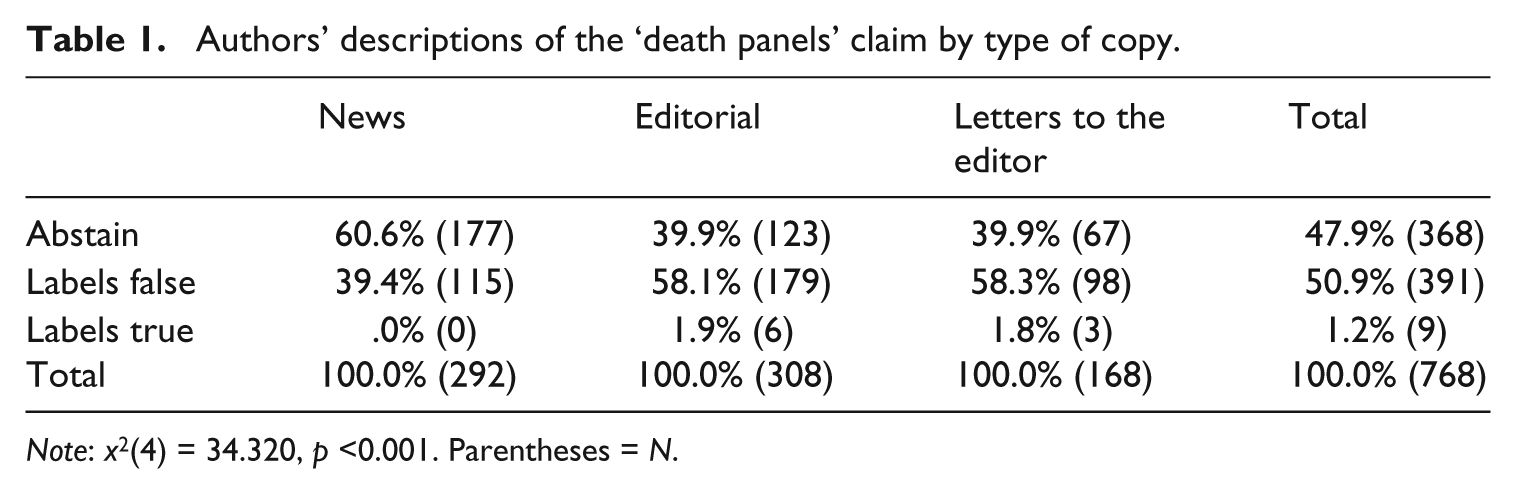
Research Question 1 asks to what degree the press verified or debunked the ‘death panels’ claim. Our first test of that question is the language reporters themselves used to describe the claim. While the remainder of the data we present focuses exclusively on straight news, it is useful to begin by examining the overall tenor of coverage. Table 1 shows how the journalists or authors of all 768 items in our sample, including editorials and letters to the editor, treated the ‘death panels’ claim.
Authors’ descriptions of the ‘death panels’ claim by type of copy.
Note: x2(4) = 34.320, p <0.001. Parentheses = N.
Looking at news stories in particular, column 2 shows that in no news articles in our sample did a reporter call the claim true. In 39 percent of news stories, the reporter labeled the claim ‘false’ or used some cognate description. In almost two-thirds of news stories, reporters abstained from using any evaluative term assessing the truthfulness of the ‘death panels’ claim. Meanwhile, the editorial pages tilted strongly against the ‘death panels’ claim, with 58 percent of editorialists and letter writers calling the claim false and less than 2 percent defending it.
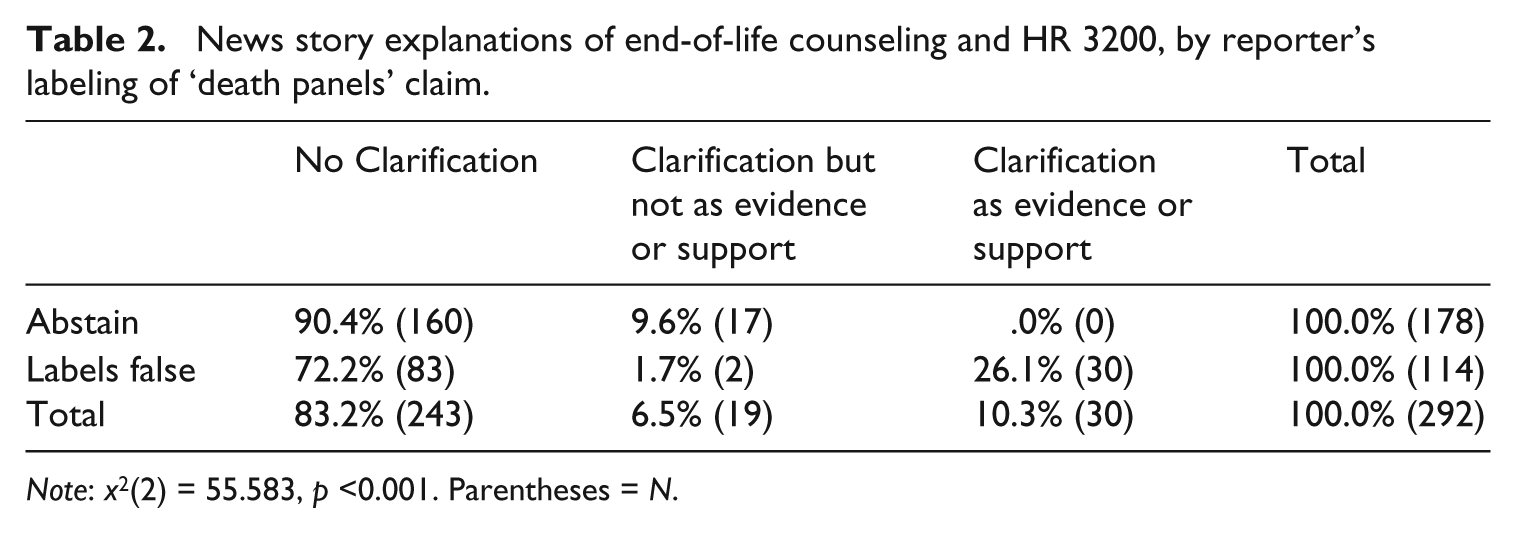
Our second indicator of substantive objectivity is the extent to which reporters explained provisions of the proposed health care reform legislation on which the ‘death panels’ claim was presumably based. Table 2 shows that 83 percent of news stories in our sample did not do so. 5 Of the 17 percent of stories that did offer some explanation of the legislation, 7 percent did not do so in conjunction with a ‘false’ label by the reporter, leaving 10 percent (30 stories out of 292) in which the reporter labeled the claim false and explained to readers the actual provisions of HR 3200. In 72 percent of cases (82 stories) the reporter labeled the claim false but did so without offering clarification from the legislative language.
News story explanations of end-of-life counseling and HR 3200, by reporter’s labeling of ‘death panels’ claim.
Note: x2(2) = 55.583, p <0.001. Parentheses = N.
A closer look at the stories in our sample shows that no more than a handful delved in any detail into the medical and financial questions underlying the debate, and that not all that did so used that information to question the ‘death panels’ claim. For example, one AP story picked up by the Boston Globe on 19 August (but not by other papers in our sample) and headlined ‘Getting Counsel Helps the Dying’ explained a study published in the Journal of the American Medical Association demonstrating improved quality of life among terminal cancer patients who received end-of-life counseling. However, this reporter did not take a position on the veracity of the ‘death panels’ claim; rather, the story simply reported that while ‘some conservatives have called end-of-life counseling … “death panels” and a step toward euthanasia’, President Obama had called the claim ‘dishonest’ (Johnson, 2009).
A third way reporters might have practiced substantive objectivity was to cite the work of non-partisan fact-checking organizations. Our data indicate that very few news stories (282 of 292) mentioned non-partisan fact-checking sources like PolitiFact and FactCheck.org, and the bulk of these were from PolitiFact’s home newspaper, the St Petersburg Times (not necessarily a surprising finding to the degree that other outlets see PolitiFact as the competition). 6 Interestingly, even in stories that used PolitiFact, reporters did not necessarily call the claim false. Thus, only three news stories out of 292, other than stories carried in the St Petersburg Times, included both a fact-checking organization’s determination that the ‘death panels’ claim was false and a similar label by the outlet’s own reporter.
In contrast, in a number of news stories, journalists flatly labeled the claim false without citing any external source to buttress that claim. In 53 stories − 20.7 percent of news stories overall and 46 percent of stories in which journalist labeled it false – the reporter offered no evidence from fact-checkers to back up their labeling of the ‘death panels’ claim. For example, a Tribune Newspapers story that appeared in the Baltimore Sun and the Los Angeles Times on 12 August reported on the President’s town hall meeting in Portsmouth, NH, the day before. The story observed that:
Obama took an easy shot Tuesday at correcting the record, addressing former Alaska Gov. Sarah Palin’s claim that Obama’s plan would create ‘death panels’ to decide who gets to live and die. There are no such measures in any of the bills under consideration. (Parsons and Hook, 2009, emphasis added)
The story did not cite a source to back up that assessment, other than the President himself. As discussed later, this pattern in which reporters called the claim false without attribution to a non-partisan source may represent a less rigorous form of substantive objectivity, or may be problematic in its own right.
A less direct form of debunking occurred in stories that exclusively reported the views of sources challenging the claim without ‘balancing’ that challenge with supporters of the claim. In this approach, reporters avoided the convention of ‘reporting both sides’ while also avoiding evaluative language of their own. Nine percent (33) of news stories from our sample exhibited this pattern, suggesting that this was not a prevalent form of debunking.
RQ2: Evidence of procedural objectivity
By comparison, 41 stories (14%) were conventionally ‘balanced’ stories in which the reporter did not label the claim true or false and included at least one source from each side of the debate over the veracity of the claim.
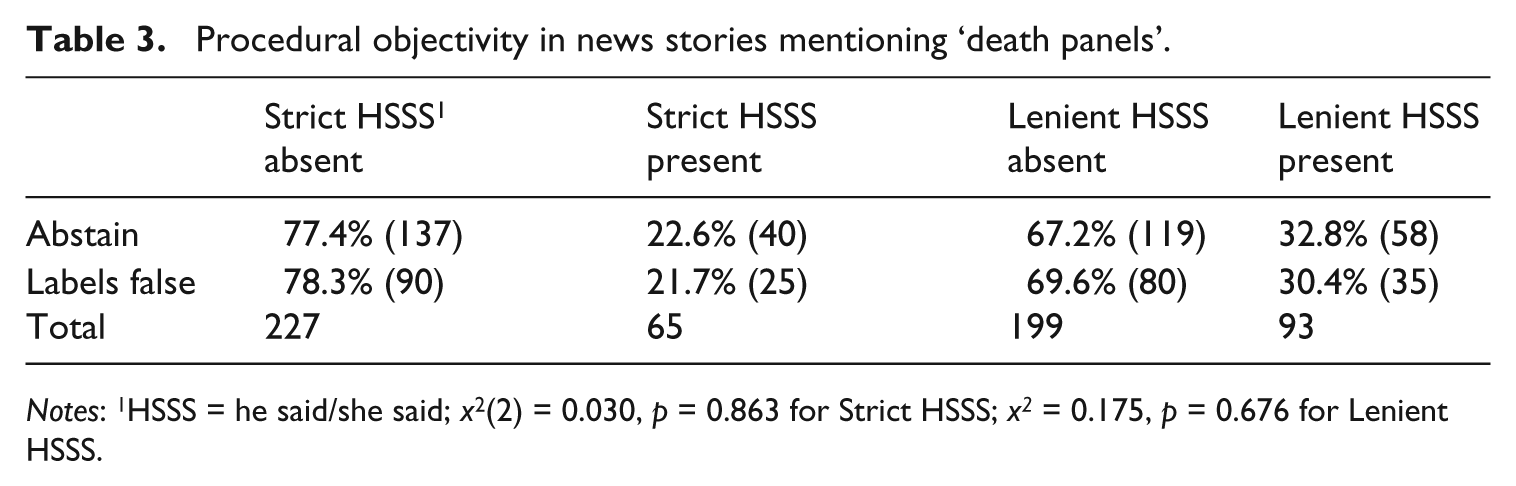
As described, we employed additional measures for detecting the ‘he said/she said’ style of reporting, one more stringent that applied specifically to debate about the veracity of the claim itself, and one more lenient that applied to more general discussions about how the proposed health care reform legislation would likely affect end-of-life care. The strict measure shows that 22 percent of news stories (65 out of 292) included sources claiming that the claim was true and that it was false; the more lenient measure shows that 32 percent of news stories (93 out of 292) included sources both affirming and denying that the proposed health care reforms would create coerced euthanasia (Table 3). These data indicate that between two-fifths and two-thirds of news stories in our sample treated ‘death panels’ as an open question.
Procedural objectivity in news stories mentioning ‘death panels’.
Notes: 1HSSS = he said/she said; x2(2) = 0.030, p = 0.863 for Strict HSSS; x2 = 0.175, p = 0.676 for Lenient HSSS.
Logic would seem to dictate that stories in which the reporter labeled the claim false in his or her own words would be unlikely to contain this kind of he said/she said reporting – that is, if procedural and substantive objectivity are mutually exclusive modes of reporting. Our data indicate, however, that they are not. As Table 3 shows, there appears to be no relationship between whether a reporter labeled the ‘death panels’ false in his or her own words and whether that same reporter reported ‘both sides’ of the debate. In fact, the percentage of stories employing procedural objectivity is virtually identical whether or not the reporter labeled the claim false; labeling the claim false did not, it seems, merit departing from standard rituals of objectivity. A front-page article on 16 August by Paul West of the Baltimore Sun (2009) illustrates this type of journalistic limbo:
In fact, there is no such [end-of-life counseling] requirement … But Republican National Chairman Michael Steele, defending Palin’s claim last week on Fox News, said ‘it is within the context of what people are seeing in some of the legislation …’
Discussion
The answer to our first research question is that mainstream media (including the editorial pages) often debunked the ‘death panels’ claim in a variety of ways and with varying degrees of rigor, but did not do so consistently. The answer to our second research question is that while substantive objectivity was evident in the news pages, it was to some degree offset by, or operated independently of, procedural objectivity.
There are several noteworthy patterns in our findings. One is the relatively large number of cases in which reporters labeled the claim false without attribution – a striking finding given the prime place of attribution in mainstream journalism education and norms (Hamilton and Lawrence, 2010; Jones, 2009). Many reporters and their editors evidently saw no need to tell the public how they knew the claim was false. This finding raises an interesting question not just about good journalistic practice but also about how the public makes sense of news. Did readers and viewers accept that the claim was as self-evidently false as many news reports implicitly suggested? The public opinion data discussed below suggests not. Future research should determine if claims presented without attribution have different effects on news audiences than attributed or otherwise supported claims; future research should also strive to compare the findings in this case with reporting on claims that are less easily debunked (e.g. claims not aimed at existing pieces of legislation).
While a full exploration of the reasons for these findings is beyond the scope of this article, one reason for the relative prevalence of ‘false’ labels may have been the fact that several leading media outlets debunked the claim early, making it easier, as intermedia agenda setting studies would suggest, for other less prominent news organizations to do the same (Gilbert et al., 1980). In the five days following the claim’s appearance online, NBC Nightly News, ABC World News, the New York Times, the Los Angeles Times, and the Washington Post all called the ‘death panels’ claim false. Moreover, the text of HR 3200, to which the ‘death panels’ claim implicitly pointed, was readily available, so some reporters presumably checked the fine print for themselves.
Yet, while many news stories did label Palin’s claim false, a greater percentage overall did not, either simply mentioning the claim without passing judgment, or treating it as a matter of debate. This finding is striking considering that, as the data in Table 1 indicate, the prevailing climate of opinion reflected in the news and editorial pages combined was tilted strongly against the ‘death panels’ claim.
One reason for this hesitance to directly adjudicate factual disputes may be, as Jamieson and Waldman have observed, ‘the fear of appearing biased’, which leads to a formulaic ‘balancing’ of opposing political positions (2003: 168–169). While charges of bias against the media have a long history, they have gained force in the new media era, driven by talk radio, cable news, and multitudinous blogs and other online outlets. Since mainstream journalism’s claim to relevance and expertise still resides in the notion of non-partisan objectivity, reporters and editors still ‘may bend over backward to present conflicts in even-handed terms’ (2003: 170).
Moving from empirical to normative questions, how to judge press performance in the ‘death panels’ controversy is not a straightforward matter. For example, by our measure, almost 40 percent of news stories, and around 58 percent of editorials, flatly labeled the claim false. Is 40 percent a ‘high’ number, given the usual constraints of ‘straight down the middle’ objectivity? Or is it low, given that such an evaluation was well supported by the factual record? Moreover, how do we assess the fact that almost half of the stories calling the claim false did not cite any source to buttress that claim?
Conclusion: Truth, journalism, and democracy
Objectivity and verification
Kovach and Rosenstiel (2010) contend that the continued relevance of the mainstream media depends in part on how they arbitrate the factuality of competing claims about public affairs, including those claims lobbed into the public square from new media platforms. Other leading journalists and educators seem to agree that the mainstream media’s job of separating factual wheat from fallacious chaff is more important in the new media era. Brooks Jackson, editor of Factcheck.org, for example, has argued that:
The ‘news’ that is not fit to print gets through to people anyway these days, through 24-hour cable gasbags, partisan talk radio hosts and chain e-mails, blogs and Web sites … What readers need now … are honest referees who can help ordinary readers sort out fact from fiction. (Stelter, 2010)
What is less certain is how mainstream journalism can take on that challenge. One problem illuminated in our study is that between competing practices of ‘objectivity’, only one (the road generally less taken) licenses journalists to forego reporting ‘both sides’.
Journalism educator and critic Jay Rosen has argued that ‘neutrality and objectivity carry no instructions for how to react’ to the rise of false but popular claims (The Economist, 2010). We contend that the story is more complicated: mainstream journalists’ ‘instruction manual’ contains contradictory rules for arbitrating the validity of claims. Indeed, the active journalism of verification advocated by Kovach and Rosenstiel faces a significant hurdle those authors do not discuss: American journalism’s predominant norm mandates that ‘objective’ reporters include the views of ‘both sides’. Refusing to play by this rule would require a conscious determination that once a claim has been convincingly refuted by non-partisan sources, it no longer merits news attention – a decision easier to imagine than to execute, particularly when those claims continue to resonate with the public and to provoke official response.
Journalism and public opinion
A significant portion of the public saw the ‘death panels’ claim as valid or at least plausible. According to available public opinion polls, public belief in government panels deciding when people would be denied health care was significant and, by some measures, actually increased throughout August 2009. A Pew Research Center poll released on 20 August reported that 30 percent believed that proposed health care legislation would ‘create death panels’ (Pew, 2009). In a more broadly worded question in a 15–17 August NBC/Wall Street Journal poll (2009), 45 percent of people believed that government was likely to make decisions about when to stop providing care to the elderly, 19 percent more than in a similarly worded question in a 10–13 August Daily Kos/Research 2000 poll (cited in Nyhan, 2009). Belief in this extreme type of government rationing of health care remained impressively high (41%) into mid-September (CNN/ORC, 2009).
More troublingly, the same Pew Center survey found that the percentage calling the claim true (39%) among those who said they were paying very close attention to the health care debate was significantly higher than among those reporting they were following the debate fairly closely (23%) or not too closely (18%). It is clear that some of these death panel believers followed the debate most closely through partisan and opinion outlets unexamined in this study, and that there was a strong correlation between watching Fox News regularly, for example, and belief in death panels. 7 But it also seems clear that coverage in the mainstream media did less to clarify the situation than we might assume – echoing the findings of Jerit and Barabas (2006) regarding widely circulated inaccurate claims about Social Security that were believed most among those following the debate most closely. In fact, the Pew Center found that the difference in belief in ‘death panels’ among newspaper readers versus non-newspaper readers was relatively small: 55 percent of people who read a newspaper regularly said the claim was not true, versus 46 percent of non-newspaper readers – a statistically insignificant difference. 8
Thus, we arrive at a question posed by Kuklinski et al. (2000) over a decade ago: ‘Are there any forms of … media reporting that could better convey accurate beliefs about politics and policy and correct false … beliefs when they arise?’ Conceivably, the resilience of the ‘death panels’ claim may be evidence that the new media have lessened the mainstream media’s influence. Indeed, fallacious claims find more places to ‘stick’ in an increasingly fragmented and politicized media system, in which political predispositions are readily reinforced, less agreement on policy realities is possible, and publics become more manipulable (Bennett and Iyengar, 2008; Katz, 1996; Manjoo, 2008; Nie et al., 2010; Nyhan, 2010; Stroud, 2010; Sunstein, 2001). For example, the conservative media ‘echo chamber’ comprised of outlets such as Fox News provides attitudinal resources that strengthen pre-existing beliefs and encourage active rejection of mainstream media reports (Jamieson and Cappella, 2009). 9 Similarly, many online communities tend to cultivate shared conceptions of the world at odds with those of mainstream news (Jones, 2009). Together, these developments in the media system are rather perfectly suited to the social psychological mechanisms of selective exposure (Zillmann and Bryant, 1985: 533–567) and motivated reasoning (Kunda, 1990; Prasad et al., 2009; Redlawsk, 2002), allowing audiences ever greater ability to screen out uncongenial information, and hold on tightly to predispositions.
Alternatively, the ‘death panels’ controversy may also demonstrate that the mainstream media themselves bore some responsibility for the claim’s persistence. The claim resembles what one author has called a ‘rumor bomb’: a strategic catchphrase intentionally designed to undermine serious public deliberation by playing on public uncertainty or fear (Harsin, 2008). Because such claims are not defined with any degree of specificity, he argues, they present a ‘crisis of verification’ in which ‘the reporter is unable to verify the claim through … other reliable sources, in accordance with professional rules of reporting and codes of ethics’, yet because such rumors make for interesting news they are disseminated anyway, thus accomplishing their goal (2008: 165). Indeed, Palin’s Facebook post that popularized the ‘death panel’ catchphrase said nothing about any specific legislative provision. News outlets and fact-checkers could examine the language of currently debated bills to debunk the claim – and some did, as our data demonstrate. Nevertheless, it appears, when examining the Pew data reported here, that the nebulous ‘death panel bomb’ reached its target in part because the mainstream media so often repeated it.