




Abstract
Processes of media answerability are important for the professional conduct of media organizations and their analysis allows a better understanding of the negotiation among public actors over journalistic practices perceived as deviant. By intersecting public criticism over perceived deviant political interviews with Israeli ombudsmen’s responses to these complaints, our aims are to (1) characterize processes of media answerability within the institution of the ombudsman and in the open public arena; (2) identify diversions between the public and the ombudsmen perspectives regarding perceived deviating practices (over-aggressive and over-deferent style of interviewing) and their causes (political bias and violations of interpersonal codes of behavior); (3) pinpoint the outcomes of media answerability processes. Our findings suggest that while a disrespectful attitude toward public figures bothers the public more than an overly deferential approach, the ombudsmen tend to reject both types of complaint. At the causal level, while citizens point to interviewers’ ideological bias as the main explanation for all types of deviations, the ombudsmen tend to accept complaints regarding violations of interpersonal codes of behavior and reject claims of political bias. In conclusion, we point to the advantages and limitations of a media answerability process.
Introduction: Media answerability as a discursive process
Issues of media accountability have become central in the field of communication recently. Studies on the subject have focused on a variety of ethical aspects of media accountability, including the role of the ombudsman, newspapers’ correction policies and the initiation of paradigmatic repair following severe journalistic transgressions, among others (Berkowitz, 2000; Bertrand, 2000; Hindman, 2005; Maier, 2007; Pritchard, 2000; Starck and Eisele, 1999). These studies share the view that media accountability is mainly a process of making claims by the audience against a journalist or media organization for some perceived transgression, the response of media organizations to the allegations and ‘any ensuing procedure for reconciling the two’ (McQuail, 2003: 15). According to McQuail, two tracks of media accountability which are not mutually exclusive may be initiated following a journalistic transgression: liability and answerability. Liability is the legal and forced track conducted by judicial institutions following suits against perceived transgressions causing harm. As scholars of journalism and law warrant, this avenue may threaten the freedom of journalism as it creates a ‘chilling effect’ on journalistic professional conduct (Freedman, 2008). Answerability, on the other hand, is the voluntary and moral track which may be initiated even in cases in which no formal rules were transgressed. In contrast to the liability track, answerability operates ‘in an area where an exchange of information and ideas takes the place of threats on freedom to publish’ (McQuail, 2003: 202). It is assessed positively because of its cooperative form of communication apparent in the dialogic process unfolding among three institutions: the media, the public and the political establishment. When a transgression in journalistic conduct is pointed out by politicians, citizens or by colleagues, media organizations are called upon to issue a feasible explanation, or, in cases where the complaint is justified, to take measures to amend the failure. Both criticism of the media and steps taken by media actors to make amends indicate a recognition by all parties that red lines, beyond which journalistic practices are perceived as unacceptable, have been crossed (Winch, 1997). The answerability trajectory is also appreciated due to its outcome: a voluntary reaffirmation by media actors of ‘various norms relevant to the wider responsibilities of the media in society’ (McQuail, 2003: 204).
This article focuses on the discursive construction of media answerability within the Israeli media institutions and the mediated public arena. Our questions are designed to shed light on the ways in which media answerability processes unfold. By juxtaposing public actors’ complaints with media actors’ responses we ask:
What do citizen complainers perceive as deviant journalistic practices and what are the causes they suggest for the deviations?
What do media actors perceive as deviant, and how do ombudsmen attempt to counter journalists’ misconduct?
There are several advantages in comparing audiences’ perception of journalistic misconduct with those held by ombudsmen. The first lies in the novelty of the comparison. A large amount of research has focused, on the one hand, on public perceptions of journalistic conduct (Gronke and Cook, 2001; Pew Research Center, 2009) and, on the other hand, on the role of ombudsmen in maintaining and protecting professional norms (Ettema and Glasser, 1987; Starck and Eisele, 1999). Only a very few studies, thus far, juxtapose the perspectives of the public and of media institutions, pointing out gaps between their perspectives (Braman, 1998; Tsfati et al., 2006). Second, analyzing cases in which a complaint about journalists’ misconduct initiated a public debate allows us to identify the perceptions of various actors of what is regarded as professional journalism for a specific time, society, media system and genre. Moreover, these cases allow us to track the ongoing negotiation regarding the professional boundaries of journalism, beyond which practices and conducts are perceived as offensive by public actors. Finally, we are able to identify the kind of complaint, in a particular context which is doomed to fail or which alternatively may lead to a change in journalistic conduct and to a possible reshaping of relationships among the media, the government and the public.
In order to understand the construction of media answerability processes and their implications, we focus on the case of political interviews perceived as deviant. Political interviews have been studied extensively over recent decades, in a range of cultural contexts (Ekstrom and Patrona, 2011), mainly because of their central role in the public sphere, one in which journalists ‘do their job’ by holding politicians accountable for their actions (Clayman and Heritage, 2002; Ekstrom, 2001). Political interviews serve as a meeting point for members of three institutions: the journalist as interviewer, the politician as interviewee and viewers/listeners as critical, active citizens, who analyze texts and send their critiques to the news editor or to the ombudsman. 1 This allows us to take a close look at how public and the media actors negotiate over interviews perceived as deviant and at the measures taken by ombudsmen to amend the failing in justified cases. Moreover, analyzing deviant political interviews opens up the possibility of pinning down various examples of journalistic misconduct, ranging from political bias (manifested at the level of content) to inappropriate behavior during the interpersonal interaction (manifested at the performance level).
The question that arises in regard to answerability processes following political interviews is how public and media actors respond to the deviating practices of over-aggressiveness or exaggerated deference toward political interviewees. In what follows we elaborate on how to identify deviance in political interviews.
What constitutes a deviant political interview?
As an institutional genre (though unscripted and therefore somewhat unpredictable), political interviews are practiced according to a tacit set of social conventions. They are conducted in the form of a dispute; their agendas are in part institutionally predetermined; they foreground public figures; they unfold dialogically; they have a high level of tolerance for equivocal talk; and they allocate different interactional rights and obligations to interlocutors (Clayman and Heritage, 2002; Montgomery, 2007; Weizman, 2008).
News interviews are also subjected to formal, ethical codes, formulated by the media organization. In the Israeli context, the first, still relevant, ethical guide, unofficially titled ‘the Nakdi Document’ (1972), adopts the principles of the BBC’s editorial guidelines. First applied in the public channel (IBA), it was later also adopted, at least in spirit, by the Second Authority for Television and Radio. Section 24 deals specifically with the proper way to conduct news interviews. The document instructs the interviewer not to flatter the interviewee, not to create intimacy and not to encourage evasive answers. At the same time, it instructs interviewers not to be rude or to harass interviewees and not to sacrifice politeness in the name of truth and justice.
These rules impact the dynamic of the interview and, if followed, the interviewer may be regarded as treating the politician within what Hallin (1986) calls the ‘sphere of legitimate controversy’. 2 In this sphere journalists use challenges as a discursive means of eliciting accountability from their interviewees, while adhering to principles of objectivity and neutrality (Clayman, 1992). Other spheres identified by Hallin, ‘consensus’ and ‘deviance’, may be regarded as inappropriate in the context of routine political interviews.
An overly deferential interview might be positioned in the sphere of consensus, in which journalists depart from the norms of objectivity to evoke a sense of solidarity. This mode of interviewing is expected during festive events, specific types of media events, but certainly not on other, more ordinary occasions. This type of violation is also mentioned in the Israeli ethical guide to broadcasting, instructing the interviewer not to be overly deferential at the level of interaction. An overly aggressive interview, on the other hand, might be positioned in the sphere of deviance. In this sphere journalists use undermining strategies, by treating their interviewee as peripheral, dangerous or ludicrous. Accordingly, the ethical guide instructs interviewers not to humiliate their interviewees.
Current literature on political interviews suggests that the genre is evolving in directions that may contradict the spirit of the ethical guides. For example, the ‘conversationalization’ of news formats (Tolson, 2006) and the growing degree of symmetry between interviewers and interviewees (Weizman, 2008) may lead to perceptions of political interactions as too collegial. On the other hand, the gradual commercialization of news, and with it the trend of journalists themselves being seen as news-celebrities, may encourage interviewers to display hostility, assuming that dramatic, emotional and confrontational interaction sells (Kampf and Daskal, 2011). Against the backdrop of this discrepancy between traditional modes of political interviewing and ongoing developments in the genre, it is interesting to examine how public and media actors react to these changes.
Data and method
The study is based on three complementary methods of analysis, triangulated in order to produce a thick description of two parallel discursive trajectories of media answerability in the wake of political interviews. The first evolves within the institution of the ombudsman, the second in the open, mediated public arena.
Our main method focuses on the institutional process, as initiated by citizens who take on the role of media critic, analyzing media contents and identifying errors, flaws or bias in journalistic conduct. Citizens’ criticism takes the form of complaints, focusing the attention of the recipient on what the complainer perceives as a socially unacceptable act (Olshtain and Weinbach, 1993). The letters of complaint are sent to the ombudsman where they are processed in order to decide whether an ethical code has indeed been violated. The ombudsman’s response to public criticism varies, ranging from rejection of the claims, via partial acceptance, to full approval of the complainer’s claim. At the discursive level, the responses include utterances such as disclaimers, justifications, excuses and apologies. At the practical level, corrective actions may be regarded as a way of reinforcing professional and socio-political norms regarding the appropriate mode for treating politicians.
With regard to the practical level, we undertook content analysis of 284 complaints (including letters, emails and faxes) submitted to the ombudsmen of Israel’s public and commercial broadcasting authorities 3 between 1992 and 2009, referring to 230 interviews perceived by the public as too aggressive or too deferential. The complainers accuse interviewers of violating normative modes of interacting with politicians, sometimes pinpointing specific transgressions: controversial content, uneven allocation of turns and turns’ length or explicit manifestation of the interviewer’s bias by supporting or challenging keying and/or gestures.
We categorize cases in which the complainer explicitly attributed the problematic practice to the interviewer’s political bias as violation of ideological neutrality. Other cases in which the complainer explicitly connected the perceived deviant interview practice to the interviewer’s (im)polite behavior (see Culpeper, 2011), or cases in which no connection was made between the deviation and an interviewer’s political bias, were categorized as violation of interpersonal codes of behavior. It is important to note that both political bias and (im)politeness are related to the ethics of interviewing and are distinguished here in order to identify explicit causes of violations suggested by the complainers. Following this procedure, we analyzed the ombudsmen’s responses to these complaints, ranging from (1) no comment, (2) ungrounded complaint (justifying the interviewers’ conduct), (3) refreshment of existing professional policy within the media organization, (4) symbolic, public correction (apologies with various levels of responsibility; see Kampf, 2009), to (5) initiation of a paradigmatic repair process (an actual change in the format of the show or in the media organization). In order to corroborate our findings we interviewed three ombudsmen from the commercial and public broadcasting authorities (Giora Rosen, Elisha Shpiegelman and Amos Goren).
The second, discursive process of media answerability is initiated by complaints made by citizens, politicians or media commentators, published in genres dedicated to media criticism (editorials, letters to the editor, etc.). The public identification of a journalistic violation may turn, in extreme cases, into a scandal, compelling news organizations to undertake corrective actions in the form of explanations or apologies, or, alternately, to initiate a process of paradigmatic repair. In order to understand processes of media answerability in the open public sphere, we identified two interviews considered in Israeli public discourse to be salient, extreme examples of excessive aggressiveness and excessive deference. For each case, we analyzed the mediated public discourse that followed the interview.
In what follows we distinguish between the two types of deviation under scrutiny: over-aggressiveness and over-deference. For each deviation we demonstrate, first, the process of media answerability in the public arena by presenting one paradigmatic case of deviation and the public debate that followed. Later, we focus on the institutional process of media answerability by analyzing citizens’ complaints regarding deviant practices and the ombudsmen’s responses.
What is perceived as an overly hostile interview?
Over-aggressiveness is regarded as a violation of the public’s expectations by journalists. Such interviews may influence public attitudes toward journalists and politicians, as demonstrated in the case of the Rather–Bush interview in 1988 (Clayman and Whalen, 1988). 4 An interview with the then Israeli Prime Minister Ehud Barak the day before the 2001 elections is probably the most infamous interview in the Israeli political arena. From the outset, the interview was conducted in a highly confrontational mode. During the 148 turns of talk the interlocutors incessantly overlapped and interrupted each other, raised their voices and exchanged insults. The interviewer, Ilana Dayan, tried to draw Barak to talk about the polls (which he did poorly) and to express his view of her own prediction according to which he would end up as the biggest loser ever in direct elections of a Prime Minister. Barak, for his part, refused to discuss speculations about election results. Toward the end of the interview, when Dayan tried repeatedly to get an answer from Barak about his impending failure, asking Barak if he had already prepared a farewell speech, he finally lost his temper.
Ilana Dayan interviewing PM Ehud Barak (Channel 2, 5 February 2001) 5
After being interrupted by Dayan in turn 120 (with Dayan implying that he was going to lose), Barak challenged her, suggesting that she should improve her ‘way of interviewing people’ (121). In response Dayan made a move, perceived scandalous after the fact, using the structural procedures of the show, and her role as an interviewer, as a way of opting out, that is of avoiding Barak’s challenge. Whereas Barak continued to protest, suggesting that she should treat her interviewees politely (123–133), Dayan overlapped his next five turns, insisting on completing her announcement of the show to follow (Zinzana, an Israeli prison drama) while scolding Barak, instructing him ‘don’t shout, don’t shout’ (126). This aggressive dual ended only when Barak managed to complete his rebuke, allowing Dayan to complete her announcement (136). Barak then spoke his last words, challenging her again on the disrespectful practice of promoting a popular show whilst the Prime Minister was speaking (137). Dayan thanked him sarcastically on the next turn (138), and moved on to her next question.
The interview elicited a range of public reactions which evolved into a scandal, ending with a public, live apology by Ilana Dayan. The interview was defined by audiences, the regulator’s representative, peer journalists and media critics as ‘humiliating’ (Globes, 6 February 2002), ‘rude’ (Haaretz, 7 February 2001), ‘a horror show’ (Ha-ayin Hashvi’it, March 2001), and ‘a lynch’ (Yediot Ahronot, 9 February 2001). Evidence for the crossing of red lines beyond which journalistic practices are perceived as unacceptable can be found in the reaction of the channel’s regulators who pointed to this interview as a landmark in the deteriorating relationship between journalists and politicians.
The decision to condemn [Dayan], was accepted unanimously, because we felt that we are facing a trend in which interviewers treat their interviewees aggressively, and that this interview simply went too far … two days ago it was Ilana Daya … and who knows how far it might go. (Yediot Aharonot, 12 February 2001)
In light of the ensuing scandal, Dayan admitted maltreating Barak. She told reporters after the show that: … in the heat of the broadcast I felt I was sliding to over-aggressiveness. I am sorry if someone thought that I wished to insult the Prime Minister. This is not true. In my view, as this event was aired live, the apology should also be expressed live, and this is what I plan to do on my next show. (Yediot Aharonot, 8 February 2001, p. 9)
Indeed, one week later, Dayan’s live, voluntary apology did grant closure to the episode. In her show Uvda (fact), aired on Channel 2 (12 February 2001), Dayan admitted to ‘an aggressive and unnecessary response’. In addition, her apology consisted of an observation on the way in which an interviewer should conduct a proper interview, ‘to ask difficult questions … in a respectful, professional and humane manner’. In apologizing, Dayan redrew the lines beyond which journalistic practices are perceived as unacceptable, in the hope of restoring public trust.
Citizens’ criticism of perceived overly hostile interviews
Analysis of 181 complaints between the years 1992 and 2009 yielded 144 interviews perceived as too hostile. The complainers expressed two types of dissatisfaction, defining the interviewer’s behavior as either politically biased or personally rude. Interestingly, as shown in what follows, the majority of complainers were more disturbed by the way the interviewers conducted the interactions, than their perceived political bias.
Complaints about the violation of ideological neutrality. From the public point of view, in 36 percent (N = 62) of complaints in which interviewers were perceived as hostile, excessive aggression was seen as violating the journalistic ethos. For example, Motti Kirshenbaum, a highly respected, veteran journalist, conducted an interview with Minister Silvan Shalom regarding the peace process with Syria (15 November 2009). During the interview, Kirshenbaum manifested his disagreement by scolding his interviewee. In a letter to the commercial authority, a complainer argued: ‘The man simply expressed his political opinion in an outstanding and irrational way. … he violated every possible rule by expressing his political opinion throughout the interview.’
Complaints about violating interpersonal codes of behavior. In 64 percent (N = 110) of complaints about interviews seen as hostile, the complainers perceived the journalists’ behavior as rude. 6 For example, following an interview conducted by Geula Even with the Israeli Minister of Education, Yuli Tamir (30 November 2007), a complaint sent to the public authority’s ombudsman rebuked Even’s behavior: ‘Even reached a peak by being unpleasant, not allowing the minister to complete a sentence, constantly interfering and arguing with her.’
The ombudsmen’s responses to citizens’ criticism
Most of the complaints (77%; N = 140) were responded to by the ombudsmen of the commercial and the public broadcasting authorities. We found indications in 1997 of a more systematic attempt to cope with over-aggressiveness by involving professionals – editors and interviewers – in the process. One example of the increasing importance of this issue at that time was found in a letter sent by the ombudsman, Victor Grayevsky, to the director of the TV news department in 1997, in which he declared ‘we are combating the impoliteness of reporters and interviewers’. Amos Goren, the ombudsman who replaced Grayevsky, admitted that during his time in the job the trend became a ‘flood’.
In 57 percent (N = 80) of the responses, the ombudsmen rejected the complaints, arguing that they were ungrounded. In 43 percent (N = 60) of the complaints, the ombudsmen admitted the occurrence of a violation and took action beyond the mere admission of fault. These consisted of demands (1) to refresh existing codes by passing the complaints on to the offending interviewer and/or to the editor, with a request to avoid such a behavior in the future (24%; 34); (2) to express an apology from the interviewer at fault (16%; 22); and (3) to initiate a process of paradigmatic repair (3%; 4). In these cases, the ombudsmen brought the complaints to the attention of the chairman of the broadcasting authority and recommended changing the structure of the specific show. However, from the interviews we conducted with the three ombudsmen, no process of change in fact took place following their recommendations.
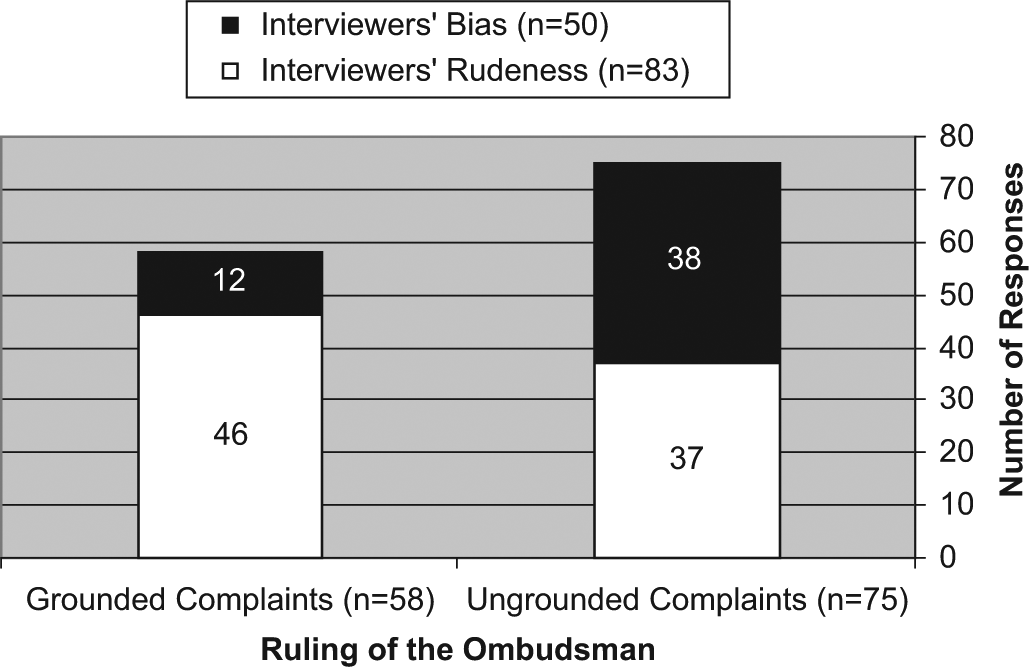
The ombudsman’s responses to complaints about interviews perceived as too aggressive, 1992–2009 (N = 133 letters of response).
Interestingly, 79 percent (N = 46 responses) of the complaints thought to be well grounded referred to interviewers’ inappropriate behavior at the interpersonal level. In contrast, 51 percent (N = 38) of the complaints felt to be ungrounded referred to interviewers’ perceived political biases. According to these findings, the ombudsmen tend to reject complaints about interviewers’ political bias. This may be explained by the ombudsmen’s desire to protect interviewers’ professional freedom, as well as to maintain the legitimate boundaries of journalistic work. Elisha Spiegelman, the Public Broadcasting Authority ombudsman, confessed his concern that the more the interviewers allow themselves to express their own opinions, the less the viewers trust in news broadcasts. He believes that interviewers’ political bias is perceived as a crucial factor in a news organization’s commitment to the public. Any admission of fault regarding these types of violation may therefore threaten the organization’s professional, trustworthy image. In contrast, the finding suggests that the ombudsmen tend to accept and process complaints about interviewers’ rudeness, probably motivated by a desire to set a standard for what they perceive as appropriate public discourse. At the practical level, this type of violation would seem to be less threatening to the news organization’s professional image.
What is perceived as an overly deferent interview?
Deference is expected in specific circumstances (such as public ceremonies and holidays, in interviews with celebrities or ordinary people), but in routine political interviews it is seen as a transgression. From a normative perspective, such a practice is much more problematic than over-aggressiveness as it undermines the perceived professionalism of the journalist. Whereas the metaphor of a ‘barking dog’ is widespread in challenging interviews, a ‘biting dog’ may be useful in illustrating the practice of hostility, and a ‘purring puppy’ to the practice of over-deference.
A paradigmatic case in the Israeli public arena was an interview conducted by the Channel 2 correspondent Erez Rotem with then President Moshe Katzav, following the decision to charge him with sexual harassment in 2007. Against the backdrop of the Katzav sex scandal, the following interview was perceived as a journalistic effort to exonerate the president and to reposition him in the sphere of consensus. Deviance from the normative mode of interviewing was already apparent in the setting. Katzav and his wife were standing in the flourishing garden of the official presidential residence, answering questions to do with their long-term suffering. In line with the domestic environment formed by the setting, interviewer Rotem conducted the interview in an experiential mode, a sub-genre of news interviews which is usually reserved for ordinary people, eye-witnesses to disasters, or the victims of such events (Montgomery, 2007). Interviewers in such exchanges make a point of showing empathy and of avoiding challenging questions. However, none of the preconditions of experiential interviews were pertinent to this case. Katzav was still acting president at the time of the interview, and was about to stand trial accused of rape (of which he was later found guilty). Yet, the interviewer made a point of focusing almost exclusively on feelings, thereby strongly supporting the positioning of Katzav solely as a victim with no mention of his possibly being the perpetrator of a sex crime.
Erez Rotem interviewing President Moshe Katzav (Channel 2, 3 July 2007)
There are several indices of overly deferential strategies in the Katzav interview, positioning Rotem as having a close relationship with his interviewees. These are (1) the repeated use of deferential address (sir, Madam, turns 1, 7 and 15), (2) the polite phrasing of the questions (turn 3: Could you please share your feelings), and (3), as mentioned above, the physical setting of the interview. Rotem occasionally reverts to familiarity in his choice of words (‘you know’ in turn 11) and in his repeated focus on emotions. He asks Katzav to ‘share his feelings’ (turn 3), to tell him if he ‘feels any relief’, tell us what his family ‘went through’ (11), goes on to disclose his own feelings: ‘I got the feeling’, in turn 13 and to attribute feelings of ‘relief’ to Katzav’s family. By repeating the term ‘relief’ 13 times during the interview Rotem indirectly accepts Katzav’s claim of victimization.
Indicators of passivity can be found in the dynamics of the interview (the turn-taking system) as well as in its contents. In sharp contrast to the Barak–Dayan exchange, not a single overlap is detected here. Katzav is given the floor to enumerate his accusations and turns them occasionally into mini-monologues (the answer to question 5, for instance, lasts 2.40 minutes). Also noticeable is the absence of two other typical features of accountability interviews: there are no reformulations and only one follow-up question. Except for turn 9, all the questions mark a shift in topic, indicating that all responses are satisfactory. As a result, Katzav’s accusations go unchallenged; he can fearlessly attack the media (turn 4) or the legal system (turn 6) while the interviewer nods in agreement.
The interview was condemned by audiences, peer journalists and media critics alike: ‘Propaganda a-la Fidel Castro’ (Ynet, 31 August 2007); ‘The shame of Channel 2’, ‘exclusive disgrace’, ‘journalistic bankruptcy’ (Yediot Aharonot, 4 July 2007); ‘Interview? Disgrace!’ (Globes, 4 July 2007); ‘A black stain on channel 2’ (Walla, 4 July 2007), etc. Media critics implied that the Chief Executive Officer of Channel 2, Avi Weiss, closed a deal with Katzav in which he would give an exclusive interview and in exchange for a commitment to avoid difficult questions. Criticism was aimed also at the Channel 2 anchor, Gadi Sukenik, for cooperating with the deal and defining the relationship between the president and his victim as a ‘love affair’ (Globes, 4 July 2007). The interviewer, Erez Rotem, was criticized for ‘not asking relevant questions’ and for being ‘obsequious’ (Globes, 4 July 2007). The CEO of the news division was also criticized by his own staff who reported to The Marker that although the ratings were high (21.7%), ‘professional values crashed’. They accused Weiss of crossing all red lines in order to impress his employers, with the hope of receiving tenure (Walla, 4 July 2007), a position which he did eventually achieve.
Against the backdrop of the evolving scandal, the authority’s ombudsman, Giora Rosen, responded as following to letters of complaint sent by citizens. From his point of view, in the light of the open public debate over an alleged professional violation, extensively covered by the media, there was no need to refresh the professional procedures within the organization: The subject has been discussed widely in the media. The CEO of Channel 2 news company received criticism regarding this interview and the chairman of the Second Authority, Mrs. Nurit Dabush conducted an inquiry about it with the CEO of the news company, Mr. Avi Weiss. In light of this, I conclude that there is no need for my criticism as well.
The meeting between the regulator (Nurit Dabush) and the CEO (Avi Weiss) was defined in the newspapers as a ‘reprimand’. The CEO was rebuked for ordering that a scene in which Katzav responded angrily to what he considered an inappropriate question made by Rotem be cut. Moreover, Dabush’s principle claim was that Weiss should have informed the public in advance regarding his promise to avoid ‘difficult questions’ (Yediot Aharonot, 6 July 2007). In accepting the idea that deals between interviewers and interviewees are legitimate, Dabush, the main actor in the liability track of media accountability, redefined the ethical norms governing political interviews. Her statement can be understood as doing paradigmatic damage (as opposed to paradigmatic repair), as it signals the erosion of professional norms.
Citizens’ criticism over interviews perceived to be overly deferential
Analysis of 103 complaints against the broadcasting authorities yielded 86 interviews perceived as too deferential. More complainers expressed their dissatisfaction over the interviewers’ political bias than over impolite modes of interviewing, in contrast to complaints about interviews perceived as too aggressive.
Complaints about the violation of ideological neutrality. In 89 percent (N = 85) of complaints about interviews seen as too deferent, the complainers perceived the interviewers’ behavior as violating the journalistic ethos. An example of this type of complaint is a letter regarding an interview conducted by Shelly Yechimovitch and Razi Barkai with the former Prime Minister Ehud Barak (4 January 2003). The complainers argued that the interviewers were politically biased in favor of Barak: What a cheek! Today in ‘Meet the Press‘ two self-declared leftists! interviewed Ehud Barak, the former PM in an exceptionally long and biased program … I see it as a very severe, disgusting and horrific use of public means to achieve specific and preplanned aims on the eve of election propaganda.
Complaints about violating interpersonal codes of behavior. A reverential attitude was considered a violation in only 11 percent of the complaints over interviews perceived as too deferent. 7 These types of complaints can be divided into two sub-categories: passivity and familiarity. Passivity refers to the violation of the journalists’ obligation to have an objectively critical view. Viewers complained about interviewers giving extended turns to the interviewees, not formulating challenging questions or follow-up questions, and not responding to controversial comments made by the interviewee. One example of an allegation of an interviewer’s passivity is a letter regarding an interview conducted by two journalists, Rina Matzliach and Shelly Yechimovitch, with Education Minister Yuli Tamir (20 December 2003). The complainer lamented that ‘the interviewers’ attempt not to challenge the interviewee reached the point of being pathetic’ and that the conduct of this interview may be entitled ‘the silence of the lambs’.
Familiarity refers to violating the journalistic obligation of emotional impassivity and maintenance of formality. Viewers complained about interviewers using deferential forms of address, expressing empathy, and presenting questions about emotions, feelings and difficulties endured by the interviewee. In a letter regarding an interview conducted by Menashe Raz and Yoav Limor with Minister of Defense Shaul Mofaz (2 October 2005), the complainer argued that the way the interviewer conducted the exchange was ‘on the verge of scandal, in terms of professionalism’. The complainer added that ‘the atmosphere of the interview was joyful’ and that ‘throughout the interview, the interviewers and the interviewee exchanged jokes and flippant remarks’.
The ombudsmen’s responses to citizens’ criticism
Out of 103 complaints about perceived overly deferential interviewing in the commercial and the public broadcasting channels, 73 percent (N = 75) were responded to by the ombudsmen. Only 37 percent (N = 28) of the complaints receiving a response were found to be grounded. In these cases the ombudsmen ordered that existing codes within the organization be reviewed and upheld. We did not find any demand that the interviewer at fault express an apology. However, in one case a process of paradigmatic repair was initiated but did not eventually materialize.
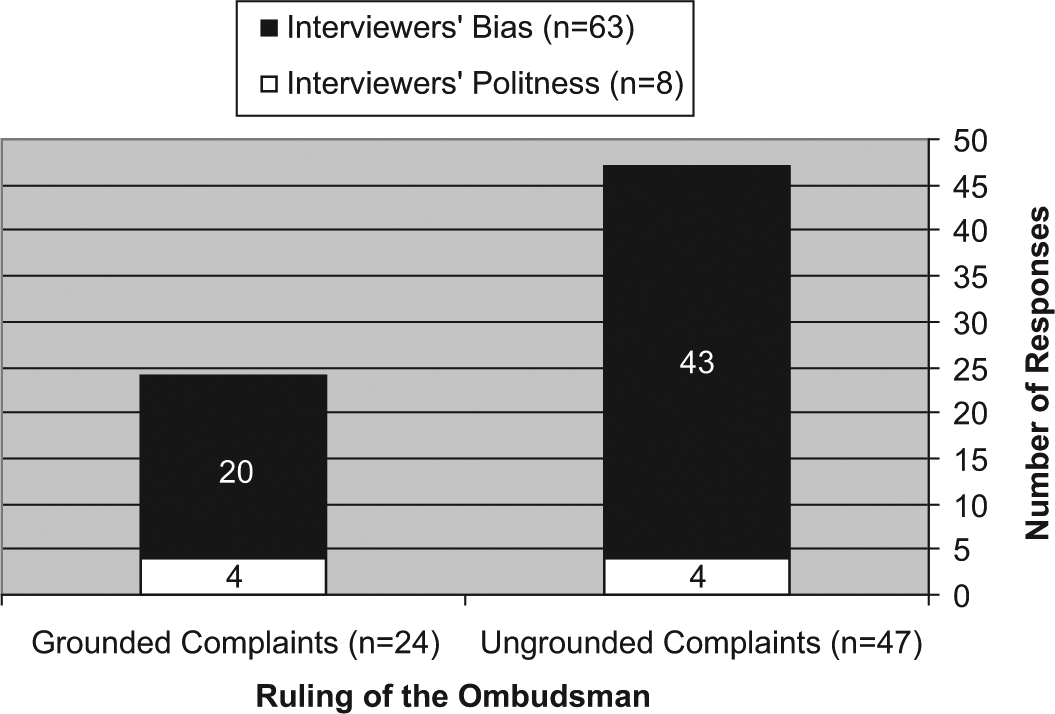
The ombudsman’s responses to complaints about interviews perceived as too deferential, 1992–2009 (N = 71 letters of response).
As mentioned above, the majority of the complainers referred to a violation of ideological neutrality (89%). This finding may be explained by the tendency of complainers to conflate over-deference and political bias. The ombudsmen found only 37 percent (N = 28) of the complaints to be justified (compared to 43% of complaints regarding interviews perceived as too hostile). As in the case of over-aggressiveness, the ombudsmen aim to secure the professional freedom of interviewers as well as the trustworthy image of the news organizations. However, no correlation between the type of violation and the ombudsmen’s decisions was found.
Processes of media answerability: Concluding remarks
Our analysis of processes of media answerability following political interviews allows us to characterize its stages, pinpoint the relations among them and to draw conclusions regarding perceptions of interviewers’ professionalism by public and media actors. The process of media answerability consists of four interactional junctures: (1) journalist as interviewer with politician as interviewee, and citizen as viewer or listener; (2) citizen as an amateur or a professional critic who formulates a letter of complaint addressed to the ombudsman or to a newspaper; (3) the ombudsman as arbitrator between interviewers and editors; and (4) between media professionals and the concerned citizens and the public at large. These interactional junctures allow us to identify discrepancies and overlaps among public and media actors over what they perceive as deviant interviewing practices (over-aggressiveness or over-deference) and their causes (political bias or (im)politeness).
Taking a broad perspective on the discrepancies between the public and ombudsmen’s standpoints, our finding suggests that in 59 percent of cases the ombudsmen reject citizens’ criticism about interviewers’ misconduct, regardless of the type of deviation and its cause. In what follows we summarize and explain our findings regarding (1) types of deviance and (2) the causes of the deviance. In each section, we first point to the public perception and later intersect it with the ombudsmen’s responses.
Types of deviance: Looking at the perceived deviant interviews, the findings indicate that a disrespectful attitude toward public figures (N = 181 complaints of over-aggressiveness) bothers the public more than giving them too much respect (N = 103 complaints of over-deference). This finding may have two alternative explanations. First, a realist view of complaints arising from actual transgressions of journalistic norms would explain viewers’ discomfort concerning spectacles of over-aggressiveness as public reaction to the growing trend of aggressive journalism (Clayman and Heritage, 2002; Clayman et al., 2010). An alternative view would focus on the tendency to complain more over hostile interviews as an outcome of the ‘hostile media phenomenon’ whereby partisan viewers perceive the same media content as biased against their favorite party (Vallone et al., 1985). Accordingly, viewers feel discomfort when an interviewer threatens their preferred politician. Although the hostile media phenomenon may also explain complaints about interviews perceived as too deferent, it seems that it explains better why an interviewer’s disrespectful stance elicits more complaints from partisan viewers. A tough style of questioning may cause direct harm to the complainer’s favorite politician, in contrast to a soft style of questioning which may cause indirect damage (from the complainer’s point of view), as it reinforces the image of the interviewee’s political opponent.
As aforementioned, our finding suggests that the ombudsmen tend to reject the allegations (59%). Although there is an agreement among all ombudsmen interviewed that there is a growing trend of aggressiveness over the last two decades, their decisions to reject audiences’ complaints demonstrate their diversion from the public in the understanding of the phenomenon and its manifestation. In cases of agreement with the complainers, the conventional way of handling complaints seen to be well grounded is by refreshing existing codes of behavior (70%). Other means of making amends for an interviewer’s misconduct were much less frequent. Apologies were made only in cases of over-aggressiveness (25%). This finding may be explained by the efficiency of apologies in alleviating emotional damage (Kampf, 2008). We found an initiation of a process of paradigmatic repair only in only 5 percent of all ombudsmen corrective actions following both deviant practices.
Cause of the deviance: In line with the hostile media phenomenon, the causes suggested by citizens for both over-aggressiveness and over-deference point to interviewers’ ideological bias as the main explanation for the violation (55%) compared to interviewers’ style of questioning (45%). This trend is evident in overly deferential interviews in which more complainers expressed their dissatisfaction over what they perceived as the interviewers’ political bias (89%). The trend reverses in interviews perceived to be aggressive, in which the majority of complainers (64%) were more disturbed by the interviewers’ style than by their perceived political bias.
When we look at the institutional response to citizens’ criticism we find that the ombudsmen also tend to diverge from the complainers’ judgment of the causes of violations (see also Braman, 1988). The ombudsmen tend to accept more complaints regarding violation of interpersonal codes of behavior (61% of the grounded complaints) than violation of ideological neutrality (39%). This trend is especially evident in reactions to over-aggressiveness in which the ombudsmen reject most complaints about interviewers’ political bias. As mentioned above, this practice may be explained by a desire to protect the interviewers’ professional freedom, and the legitimate boundaries of journalistic work. Moreover, political bias may be balanced by other programs in the course of the broadcasting schedule, while rudeness, as a personal trait, has to be rebuked in a specific case and with regard to a specific person. Indeed, the findings suggest that the ombudsmen do tend to accept and process complaints over interviewers’ rude behavior, probably motivated by a desire to regulate the relationship between journalists and politicians as a mean of setting a standard for civilized public discourse. This means that from the ombudsmen’s perspective, civility is at least as important as ideological neutrality. In interviews perceived as too deferent, however, no correlation was found between the type of the violation identified by the public and the ombudsmen’s decision. This finding may be explained by the lack of a need to make amends for emotional hurt (in contrast to over-aggressiveness) and a desire to protect the interviewers’ professional freedom (as in the case of over-aggressiveness).
In a broader view, the complainers’ tendency to manifest their dissatisfaction with perceived political bias and over-aggressiveness may be understood as a rejection of recent developments in the genre of political interview, identified in the last decade (Hamo et al., 2010; Montgomery, 2007). Letters to the ombudsmen may be interpreted as expressions of a wish to restore traditional journalistic practices of neutrality and respect. The ombudsmen, for their part, tend to accept and process claims over interviewers’ aggressiveness but to reject claims over ideological bias. This partial agreement concerning interviewers’ misconduct, and dissatisfaction over the growing trend of aggressiveness manifested by the three ombudsmen interviewed, may indicate that institutional media comptrollers are unhappy about recent changes in the genre. However, the findings indicate that neither citizens’ nor ombudsmen’s dissatisfaction with regard to the eroding norms of political interviews have held these processes back. This conclusion coincides with McQuail’s observation concerning the decreased efficiency of media answerability processes in producing organizational changes.
Although media answerability may not restore traditional norms, our analysis reaffirms McQuail’s (2003) claim regarding the relative advantages of answerability over liability. The importance of the various tracks of media answerability is apparent in the negotiation among public actors about what is perceived as ethical, and in the reinforcement of norms in specific cases. Such a dialogic process emerged following Dayan’s interview with Barak; Dayan’s voluntary, public apology reaffirmed professional norms of interviewing. In contrast, the regulator’s statement following Rotem’s interview with Katzav brought about a paradigmatic damage, in which an agreement between journalist and politician prior to the interview was accepted as legitimate. The advantages of the answerability track were also acknowledged by all three ombudsmen we interviewed. Moreover, as we learn from the public response of the ombudsman of the commercial broadcasting authority to the complainers about the Rothem–Katzav interview, an open public debate about deviant journalistic practices renders the regulatory process redundant to some extent.
The analysis of media answerability processes promotes our understanding of the phenomenon of deviant journalistic practices, public reactions to them and the ombudsmen’s responses. Future studies may examine both tracks of the answerability process in diachronic and spatial contexts. An understanding of the changes over time in perceived deviation in political interviews and their aftermath, may serve as an indicator of changes in specific political cultures. At the spatial level, cross-cultural studies of the discursive processes of answerability would contribute to our understanding of the differences in public perception of journalistic deviance, as well as the configuration of different media systems.
Footnotes
Acknowledgements
This study was supported by the Israel Science Foundation (Grant No. 517/09).