




Abstract
Newspaper journalism is said to increasingly depend on PR sources and news agencies. However, news production evolves in several phases. There may be considerable source dependency in the news discovery phase, but sources may be less prominent in the later phases of news gathering and news writing. This study concentrates on the last two phases and analyzes how Dutch journalists rework product launch press releases into newspaper reports. Forty-nine pairs of releases and news reports were analyzed sentence by sentence. Compared to press releases, news reports provide less product or company information and more contextual information, provide less positive and more negative evaluations, and more often attribute information to sources. Overall, less than half of the information in the reports originates from the releases. A framing analysis learns that while releases adopt an advertising frame focused on selling the product, reports offer two kinds of reframing: they regularly recontextualize the release information by adding consumer information and occasionally reconceptualize the launch as a business move. Both the distancing operations and the reframings enhance the report’s usability to news consumers. However, radical transformations are rare: most reframings occur later on in the report and the primary frame of the source text is often left in place.
Keywords
Introduction
Many organizations use press releases (or ‘news releases’) to provide their version of information that is deemed to be of interest to the general public, in the hope that journalists will pass it on. Although journalists have mixed feelings about these ‘information subsidies’ (Curtin, 1998), releases do actually influence what reporters write. Studies such as Hong (2008), Morton and Warren (1992a, 1992b), Turk (1985) and Walters and Walters (1992) report that reporters use between 36 percent and 86 percent of the releases they receive.
However, the source dependence of print journalists has become an object of concern. As more and more news consumers turn to the internet, advertising revenues go down, and resources to be spent on ‘real journalism’ are dwindling. According to Davies (2008), journalists have become passive processors of secondhand material generated by the PR industry and wire agencies, a practice Davies refers to as churnalism. Similar worries are voiced by Russell (2008: 1), who calls journalists’ dependence on press releases ‘a dirty little secret of journalism’. Lewis et al. (2008) report that 70 percent of the articles published in UK print journalism rely wholly or partially on press releases and press agency copy, a claim based on keyword-based content analyses of 2207 newspaper stories. Similarly, an interview study by Reich (2010) finds that 73 percent of news items in an Israeli newspaper are partially or wholly based on PR material.
Still, we need to be careful in assessing journalistic dependency on PR materials. Reich (2006) points out that while sources may often be leading the dance in the news discovery phase, journalists dominate later phases of the news production process. His study focuses on what he calls the ‘news gathering’ process, in which it is mainly the journalist who decides how to expand the data base for the story. But besides news discovery and news gathering there is a third area of journalistic agency: the final news production stage in which the report is actually composed. In this news writing phase, the journalist decides what makes it into the story and what doesn’t, and chooses the framing and the wording of the story. So, without denying that PR sources have considerable impact on the news, we may find different degrees of source dependency in different stages of news production. While topical overlaps between input and output texts provide a window on the news discovery phase, more needs to be known about how input texts are actually used, especially in the crucial news writing phase.
A number of studies indicate that journalists may resist or modify the news event definitions offered to them by the news actors themselves. For instance, they may include oppositional voices (Tuchman, 1972) or highlight angles that the primary news sources tend to ignore (Shehata, 2010; Zaller, 1998). According to Castelló and Montagut (2010: 3), ‘reframing (…) is, in itself, a defining function of journalism’. Much of the studies mentioned so far are concerned with political communication, in which journalists tend to display a critical distance to their sources. In contrast, studies on medical science communication (Brechman et al., 2011; Woloshin and Schwartz, 2002) show that new reports tend to remove qualifications and restrictions in the original sources and end up making stronger claims than are warranted, possibly exaggerating the report’s newsworthiness (Weigold, 2001).
This article addresses these issues in the context of corporate communication; more specifically, it examines how newspaper journalists use product launch press releases. The genre is an important one from a corporate viewpoint: a study by Whysall (2004) indicates that one-fifth of grocery retailers’ press releases were about new products and services, and we may expect that this share is even larger for innovative industrial companies. Given that journalists are wary of promotion (Curtin, 1998), we would expect journalists to distance themselves from the company perspective to some degree; that is, we certainly expect product claims to be dealt with more critically than research results. At the same time, the mere existence of news reports on new products indicates that certain genres of journalism address readers as potential consumers looking for news they can use, not as citizens that need to be informed to fulfill their democratic duties (Underwood, 2001).
This study is not about whether journalists use the releases or not, but about how they use them in their stories, under the assumption that product news needs to be valuable, or made valuable, to their readers. As it only uses reports based mainly on releases, the study ignores the news discovery stage and is confined to news gathering and news writing. Even though some researchers continue to speak of newspapers ‘publishing’ releases (e.g. Seletzky and Lehman-Wilzig, 2010), we suggest that using releases for newspaper reports involves multiple operations, such as selecting, expanding and transforming information. Uncovering these operations requires a fine-grained textual analysis. That this approach may be informative is already apparent from a glance at some sentence-by-sentence comparisons between corporate releases (a-versions of fragments 1 to 4) and news reports based on them (b-versions; Dutch originals for all examples in this article can be requested from the author): (1a) For the mobile text phone the BlackBerry of KPN was chosen because this offers all possibilities in one device: a handy qwerty-keyboard, a vibrate function, a large battery capacity, email, chat, text messaging, internet, phone and now also text phone. (1b) KPN uses BlackBerry phones for the test, which have a keyboard. (2a) ‘To keep serving our customers as well as possible, we have to constantly introduce product innovations that offer them extra service and convenience’, says Jac Verhaegen, Board Member of Rabobank Nederland: ‘TPG Post has proved to be a reliable partner for distributing mail, also in the digital channel. By joining our expertise and experience with that of TPG we can offer even more service to companies and consumers.’ (2b) Rabobank says that providing service to consumers is the main reason for joining forces with TPG Post. (3a) MobielTV offers 10 channels and a high video and audio quality. Even subtitles are readable on the screen. (3b) The tennis balls at Roland Garros are barely visible on the tiny screen of the cell phones which KPN will use to broadcast ten television channels as of July 5. (4a) (heading) NS and KPN continue development of travel information, television and internet on trains In the coming months, NS and KPN will continue the joint preparations for the large scale introduction of travel information, television and wireless internet for train travelers. (4b) (heading) The end of the train as a place for quiet reading? The Dutch reader is a threatened species. (…) One of the last oases of reading peace seems to be disappearing. Beginning next year, Nederlandse Spoorwegen (Dutch Railways) and KPN want to equip all intercity trains with televisions and internet.
In both (1) and (2), the transformations substantially reduce larger stretches of release text, but they do more than that. In (1), most product features are thrown out, as is the promotional adjective accompanying the remaining detail. In (2), the extensive ‘pseudo-quotations’ (Sleurs et al., 2003) in the release are reduced to a detached indirect speech report giving a condensed version of only one of the purported motives for introducing the new product.
Fragments (3) and (4) exemplify the substitution of positive by negative information. In (3), this concerns a rather different view on product quality, while in (4) the news event’s conceptualization is radically changed from ‘product introduction’ to ‘a further threat for an already threatened species’.
These few examples already demonstrate that besides distancing themselves from the evaluations in the press release, journalists may also introduce new information and new frames, resulting in new construals of the news event.
The research method chosen in this study needs an explanation. So far, the relations between media texts and PR inputs have been studied in two very different ways. On the one hand, we find quantitative analyses of large samples of journalistic messages (e.g. Hong, 2008; Lewis et al., 2008; Reich, 2010), in which each message constitutes one observation. The message is categorized, not analyzed. These studies focus on the news discovery phase and tend to find substantial PR influences on the news. On the other hand, there are detailed case studies of the production process of single messages, which focus on the news gathering and news writing phases and highlight how journalists produce news text in a process that is routinized and creative at the same time (e.g. Van Hout, 2010; Van Hout et al., 2011; see Catenaccio et al., 2011 for a general justification of this approach). While acknowledging the value of micro-analysis for the study of news writing, the present work combines it with quantification in order to generalize beyond individual cases. Second, we feel that textual analysis may provide valuable insights, even in the absence of production process data, as it makes sense to ‘evaluate media content in its own right as a creative moment in the circuit of culture beyond the intentions of actual producers’ (Fürsich, 2009: 244). That is, leaving aside the particular production circumstances when looking at a collection of media texts may reveal commonalities that would otherwise escape us. In researching news gathering and news writing operations, it will help to combine richly contextualized case studies and text analytic corpus studies.
Conceptual background and research questions
Differences between press releases and news reports regarding purpose and information types
In order to maximize the chance of a release being taken up by journalists, and to exert the utmost control on how they are used, release writers imitate a number of news report conventions (see Jacobs, 1999); that is, they anticipate the use that is to be made of the release. For instance, they adopt a third person perspective on the events they are involved in themselves, and use past tenses when writing about events that have not yet taken place at the moment of writing. At the same time, releases still bear the marks of being designed within the organization responsible for them. Releases typically focus on the doings of the company, disregarding wider contexts for the news. Moreover, they tend to tell good news (especially about new products), or at least present their information as favorably as possible from the corporate viewpoint (Bhatia, 2004; Catenaccio, 2008; McLaren and Gurǎu, 2005).
So while the relation between releases and news reports may appear to be one of genre mixing (Bhatia, 2004), in actual fact the two discourse genres may be involved in a genre conflict in the sense that they obey partly incompatible constraints (Lentz and Pander Maat, 2004). The actual incompatibilities between releases and reports can be studied by examining the transformations taking place when going from one to the other.
Earlier studies of the differences between releases and news reports (Pander Maat, 2007, 2008) find that journalists perform neutralizing operations that reduce or eliminate the self-promotion that is pervasive in release inputs. While ‘independence’ and ‘objectivity’ are clearly ideological notions, the orientation on these notions seems to be quite real (Peterson, 2001; Thomson et al., 2008). This orientation may refer to:
the factuality of the statements in some message (i.e. providing facts versus evaluations);
impartiality in the sense that it is more objective to have the text present several views by several participants rather than a single view by a single participant;
the absence of bias in the selection of the particular aspects of events deemed to be newsworthy; for instance, releases are focused on company-related information, while news reports may also offer context information on the product.
This section leads us to our first three research questions and hypotheses: RQ1 How do press releases and news reports differ in the types of information they provide on new products? We expect news reports to offer more contextual information about events outside the company. RQ2 How do press releases and news reports differ in the evaluations they provide on new products? We expect news reports to reduce the number of positive evaluations and to introduce negative information (demonstrating impartiality). RQ3 How much evaluative information is provided? We expect reports to have a larger share of non-evaluative information, because of their factual orientation.
So far, our account has concentrated on journalistic resistance to the self-interested overtones in release texts. But we need to recognize that journalists may serve their own interests as well, in that they need to sell (product) news. In order to do so, they need to add news user value to the release information. The neutralizing, distancing operations dealt with so far may already make the report more valuable, but a more positive account of what makes news usable for readers involves the notion of news frames.
News frames, reconceptualizations and recontextualization
News framing studies have shown that despite its objectivity claims, news is inherently biased, simply because it cannot avoid using news frames. Entman (1993: 92) tells us: To frame is to select some aspects of a perceived reality and make them more salient in a communicating text, in such a way as to promote a particular problem definition, causal interpretation, moral evaluation, and/or treatment recommendation for the item described.
The bias introduced by news framing is not to be seen as a flaw. Instead, news frames suggest certain uses of the news, making it relevant to the reader, as shown in the following examples. In a study of news stories about the introduction of the euro, Valkenburg et al. (1999) use ‘conflict’, ‘human interest’, ‘responsibility attribution’ and ‘economic consequences’ frames. Van Gorp (2005) discerns ‘victim’ and ‘intruder’ frames in news reports on immigrants. And in a diachronic analysis of the debate on obesity, Lawrence (2004) distinguishes between framing obesity as an individual behavior, as a biological disorder and as an environmental issue (e.g. relating it to fast food). In each case, different frames suggest different uses of the information, and different strategies to deal with the problem.
In this article, we study texts based on earlier texts. Hence we are dealing with both framing (in the release) and potential reframing (in the report). Our analysis emphasizes the second process, and proposes a distinction between reframings of different strengths, depending on their textual prominence. Weak reframings offer recontextualizations of an entity. They accept the news event definition of the source text, but introduce new bodies of information concerning participants, or causal, social, temporal or spatial contexts. In contrast, strong reframings consist of reconceptualizing an entity or event; that is, contesting its definition and making a new statement about its nature.
News framing studies that take the report as their unit of analysis suggest that news texts are characterized by a single frame, or at most two frames (Castelló, 2010). But a more fine-grained analysis may reveal a collection of frames: the news event may be construed in various ways through the text. One of the frames is paramount in that the text’s newsworthiness claim hinges on it. This is the frame proposed by the headline and the lead paragraph, which introduces the event and by necessity proposes a certain conceptualization of it (Thomson et al., 2008). Hence a report offering a new headline or lead frame will also offer a reconceptualization, i.e. a strong reframing of the event. Later in the report we may find weak reframings that do not replace the lead frame but add contextualizations. Note that here textual order is taken as an indication of frame prominence (see also Khalil, 2001).
Given their commercial background, we expect our releases to adopt an advertising frame, approaching the new product as something to be bought by customers. What kinds of reframings (if any) will be offered in the reports remains to be seen. A case study of a Belgian journalist reworking a press release by Van Hout et al. (2011) has shown several reframings in this single instance: an ‘innovation’ reframing (conceptualizing the new product as a historical breakthrough), a ‘user evaluation’ reframing (discussing strengths and limitations of the new product from the point of view of potential consumers) and a ‘company strategy’ reframing (discussing the new product as a business move). It remains to be seen to what extent these transformations can be generalized.
All this leads us to the following explorative research questions regarding framing and reframing: RQ4 What kinds of news frames (advertising and others) are offered in releases and reports? RQ5 Do the news frames newly introduced in the reports merely recontextualize the news event or do they reconceptualize it in the report headline or and lead?
Attribution and modes of speech representation
Another feature we look at in the transformation from release to report concerns source attributions, indicating that the journalist may not be held responsible for a statement. This epistemic distancing is associated with journalistic objectivity (Tuchman, 1972) and is heightened by introducing new sources, voicing different views on the event. Earlier work has already shown that journalists use attribution as a distancing operation when reworking PR inputs (Pander Maat, 2008; Van Hout et al., 2011). However, attribution can be done in more and less favorable ways for the represented participants. From their point of view, direct speech seems preferable, since it preserves their words to a larger degree than indirect speech (De Oliveira and Pagano, 2006). Moreover, directly quoted statements persuade readers more than indirect speech does (Gibson and Zillman, 1993, 1998). Therefore, we examine the uses of direct and indirect speech in our news reports.
Our questions and hypotheses regarding attributions are: RQ6 What kind of third person sources are introduced in press releases and news reports? We expect releases to only quote company representatives and reports to introduce other participants’ comments, among them critical ones. RQ7 How is evaluative information attributed? Because of their factual orientation, reports should attribute evaluations to third person sources more often than releases. RQ8 What determines the choice for direct and indirect speech representation? We expect reports to use indirect modes more often than releases. RQ9 Interestingly, most releases already offer attributions (pseudo-quotations, see Jacobs, 1999; Sleurs et al., 2003). Do journalists accept these ready-mades or do they prefer so-called ‘fresh’ quotes?
Sourcing analysis of report information items
Finally, we analyze the relations between source text and news report in a more direct way. For each information item in a report we coded whether or not it has been taken from the corresponding release. Our two questions are: RQ10 To what extent does the release information reappear (or ‘survive’) in the report? RQ11 To what extent does the news report depend on the release for its information?
The answers to these questions will not only offer a window on the source dependency of news reports, but also on the success of the releases in dominating news texts.
Corpus and coding
Corpus
Our corpus contains 38 releases and 49 corresponding news reports (some releases were reworked more than once). All releases announce launches of products or services for the Dutch consumer market. Most of our releases have been issued by companies in four economic sectors: telecommunications (e.g. T-Mobile, Vodafone, E-plus; 13 releases, 14 reports), industry (e.g. Heineken, Samsung; nine releases, nine reports), transport (e.g. KLM, NS; five releases, nine reports) and finance (e.g. ABN AMRO, Rabobank; five releases, 10 reports). All the news reports appeared within days after the releases in either national (45 reports) or regional newspapers (four reports). Since there were no hypotheses regarding the role of economic sector or newspaper type, we made no attempt to control for these variables in corpus collection.
Only news reports that take their main event directly from a product launch release were selected. A few very short reports (two reports had fewer than 150 words) were removed from the corpus to guarantee that all reports have room for elaborative, contextualizing material on the product launch. This does not mean the sample was biased so as to include reports containing additional material supplied by the journalist. As our press releases are about 50 percent longer (M = 403 words, SD = 191) than the reports (M = 268 words, SD = 117), virtually all reports could have been produced on the sole basis of elaborative information already present in the release.
When additional information was present in the report, it could be of two kinds: either (1) fresh quotes, presented without details on the context of delivery (generally, these are collected by telephone; reports mentioning press conferences or interview situations were excluded); or (2) background information stemming from desk research by the journalist.
To sum up, we confined ourselves to reports based predominantly on single releases, excluding product news in other genres such as feature articles and interviews.
The text pairs were collected by searching the internet in two ways. Either the search started by locating potentially relevant releases on company websites and then proceeded to look for matching news reports in a newspaper database, or the search started in the comprehensive Dutch newspaper database Lexis/Nexis, using keywords such as ‘new product’ and ‘product launch’, and then proceeded to look for releases corresponding to these news reports. The second route turned out to be much more productive than the first. The search was finalized in January 2009 and was restricted to five years (2004–2008). Our sampling procedure does not aim at representativeness in terms of the releases included; for instance, we suspect that releases by larger companies are overrepresented, since newspaper journalists may attach more news value to new initiatives from leading companies. However, our internet search does randomly sample product news items as they appear in Dutch newspapers – with the restriction that the items should be predominantly based on a single release. A sample size of around 50 text pairs was deemed sufficient, given that our research questions focus on detailed informational and textual comparisons within text pairs and not on categorical variables pertaining to the pair as a whole. Moreover, we are studying genre differences between releases and reports, not differences within genres; and such genre differences, if actually present, may be expected to yield statistical effects of substantial sizes.
Some releases have more than one corresponding report in the corpus. We have included every text pair in this analysis, so that releases reworked twice are counted twice. However, removing all second reports from the data does not affect any of the significant findings presented here.
Coding information types
The coding units were sentences, except when different clauses within a complex sentence represented different information types. In our 38 releases we coded 917 units, of which 44 were clauses. For the 49 news reports, these numbers were 928 and 52 respectively. From this point on, however, we speak of sentences instead of coding units.
All sentences were analyzed for topic type and evaluation. The first topic type on our list was the actual launch announcement, most often realized in the first sentence of both releases and reports. Three kinds of elaborations of the launch event were distinguished: product information, organization information and context information. In order to investigate framing and reframing choices, we constructed a fine-grained 37-part topic coding scheme by working our way through the corpus.
Every topic code was given an evaluation value: positive, neutral or negative. Statements were coded as neutral when they were not explicitly evaluative. Some of our topic codes had a fixed evaluation value. For instance, all announcements were made in non-evaluative terms. The same goes for the topic ‘how does the product work’. In contrast, information about ‘the distinctive or innovative character of the product’ was always positively phrased. Some codes were assigned to the positive group because of their inherent assumptions, not because of their phrasing. For instance, the topic ‘where is the product available?’ was also assigned to the positive group, since it presupposes a positive interest in the product. Similarly, statements about restrictions of the product (what it cannot do) were assigned to the negative group. A number of topics could have more than one evaluative value and hence were split into variants. Distinguishing evaluative values within codes added 10 labels to our initial 37.
To sum up, the top level of our coding scheme contained 10 information groups: the announcement group and the nine groups yielded by crossing three information groups with three evaluation values. These 10 groups contain the 47 codes given in Table 1 (translated corpus examples for all codes can be requested from the author):
Information types and information groups used to code releases and reports.

The entire corpus was coded by the two authors; differences were resolved in discussion. Coding reliability was determined for a sample of 198 sentences. On the level of the 47 codes, Cohen’s Kappa was 0.63; on the level of the tenfold classification, Cohen’s Kappa was 0.74.
Coding attribution, speech representation and sourcing
Besides content, we coded all sentences in both releases and reports for attribution (yes or no) and mode of speech representation (direct or indirect). When a single attribution covers five sentences, all these sentences count as attributed. Attributed statements were coded as direct when wholly or partially placed between quotation marks. Release statements can only be attributed to a company source; report statements may be attributed to sources both within and outside the company.
For the reports, we coded not only explicit attributions but also implicit relations to the source text. That is, in our sourcing analysis we coded whether the information in a sentence can be traced back to the release or has been added by the journalist.
All this resulted in a set of eight values; only the first three of these were used in coding releases.
Release information or release-based information in the report
Non-attributed information (1)
Information attributed to a company source
Direct speech (2)
Indirect speech (3)
Report information added by the journalist
Non-attributed information (4)
Information attributed to a company source
Direct speech (5)
Indirect speech (6)
Information attributed to another source
Direct speech (7)
Indirect speech (8)
Results
Information groups (questions and hypotheses 1–3)
Since sentence length also differs within and between genres, we defined the prominence of information groups not in terms of sentences but in terms of the mean proportion of words dedicated to the group. Thus we also eliminated differences in length between texts, so that every release and every report is weighted equally in the analysis. Table 2 presents the results of paired samples t-tests on the word proportions for our 10 information groups; in Table 3 we distinguish between product or company information on the one hand (i.e. ‘internal’ information) and context (external) information on the other hand; Table 4 splits the results by the three evaluation values.
Information groups in releases and reports.
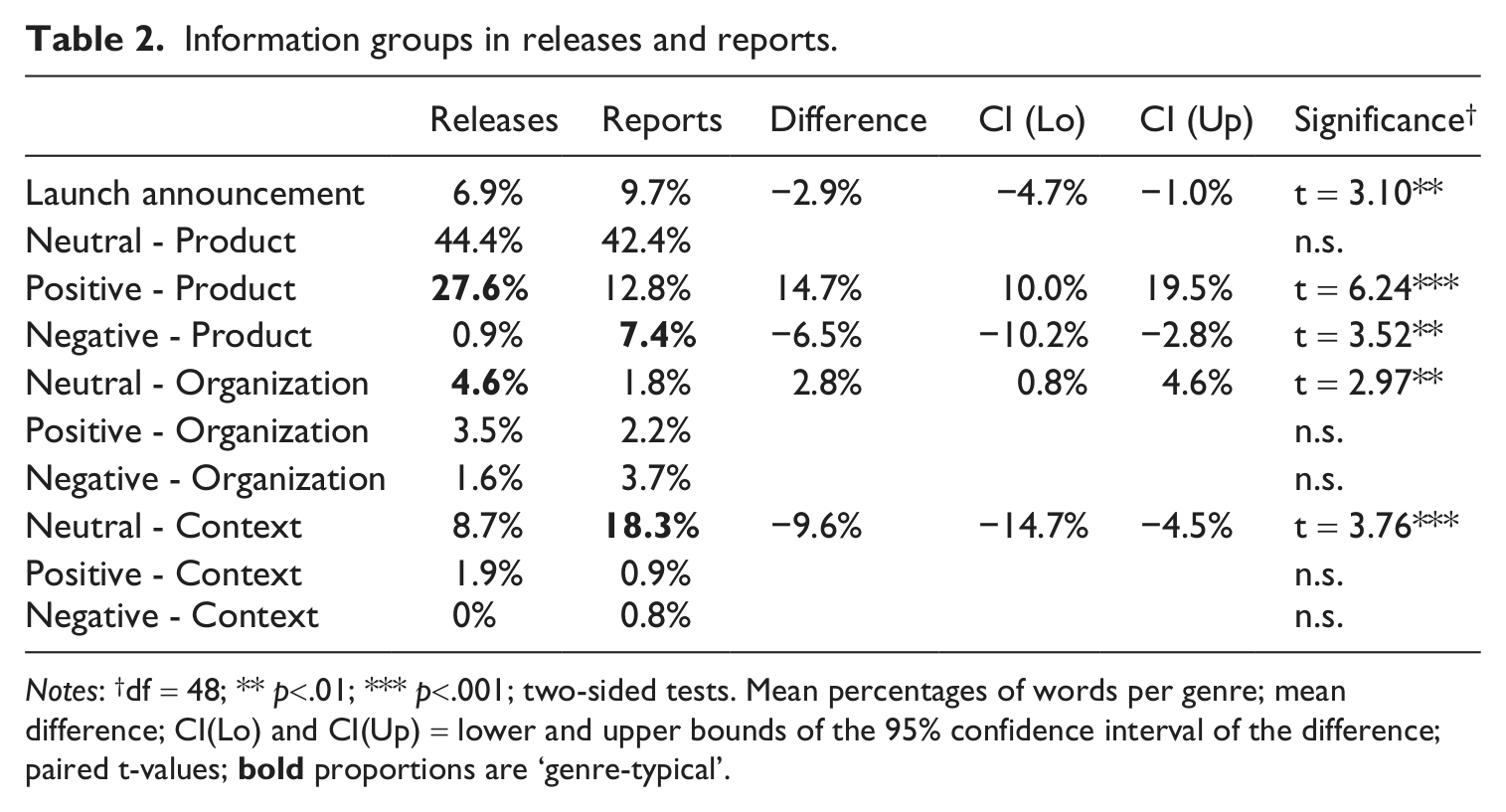
Notes: †df = 48; ** p<.01; *** p<.001; two-sided tests. Mean percentages of words per genre; mean difference; CI(Lo) and CI(Up) = lower and upper bounds of the 95% confidence interval of the difference; paired t-values;
Internal vs. context information in releases and reports.
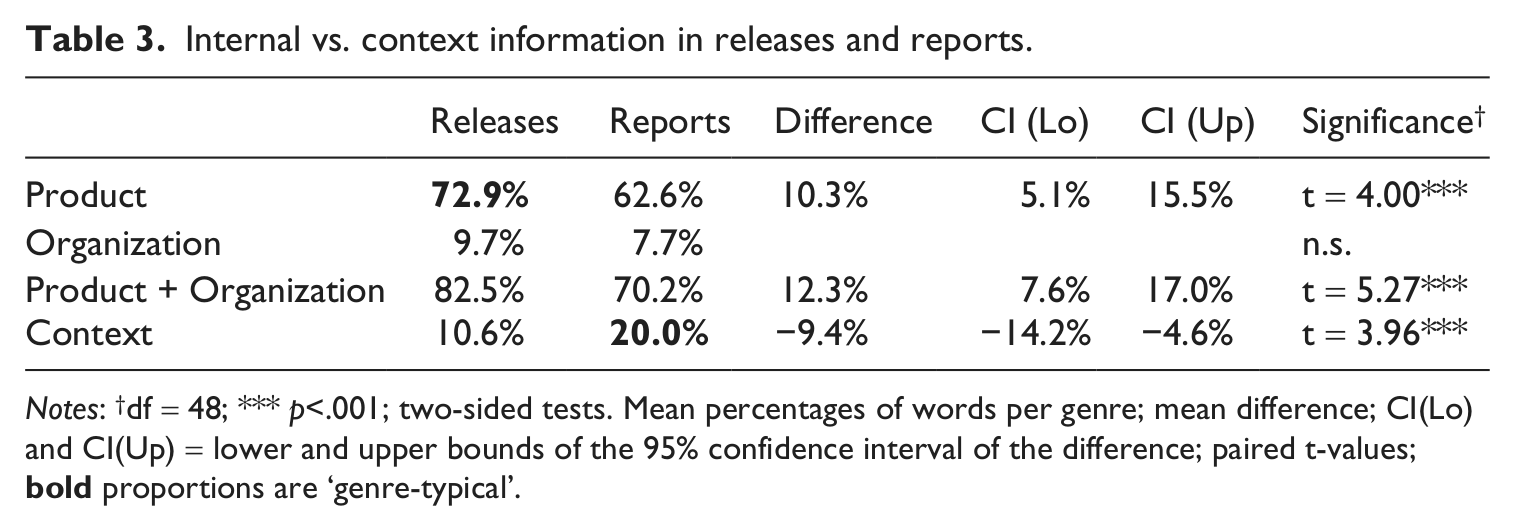
Notes: †df = 48; *** p<.001; two-sided tests. Mean percentages of words per genre; mean difference; CI(Lo) and CI(Up) = lower and upper bounds of the 95% confidence interval of the difference; paired t-values;
Evaluation values in releases and reports.
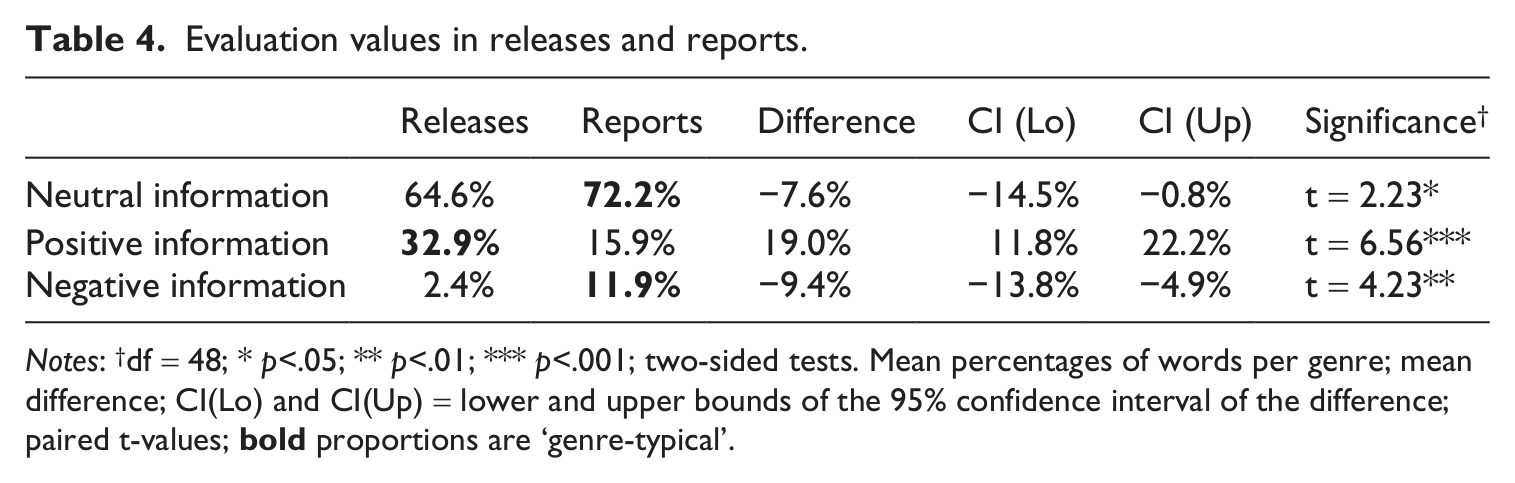
Notes: †df = 48; * p<.05; ** p<.01; *** p<.001; two-sided tests. Mean percentages of words per genre; mean difference; CI(Lo) and CI(Up) = lower and upper bounds of the 95% confidence interval of the difference; paired t-values;
These results support our first three hypotheses:
Reports provide more context information than releases (Table 3; almost all context information is neutral, see Table 2); reports provide less product information (Table 3).
Releases contain virtually no negative information. Reports contain less positive and more negative evaluations than releases (Table 4). Most of the reports’ extra negative information and the releases’ extra positive information is on products (see Table 2); examples of this positive-negative difference between releases and reports are fragments 3 and 4 in the introduction.
Reports present more neutral information than releases (Table 4).
Topics, framings and reframings (question 4)
In order to shed light on framing differences between releases and reports (research question 4), we identified the topic codes that show significant genre differences (Table 5). We ignored the difference in word proportions for announcements (see Table 2), since this seems to be an artefact of text length differences (release texts are longer, hence announcement sentences tend to take a smaller word proportion in releases).
Topics discriminating between releases and reports.
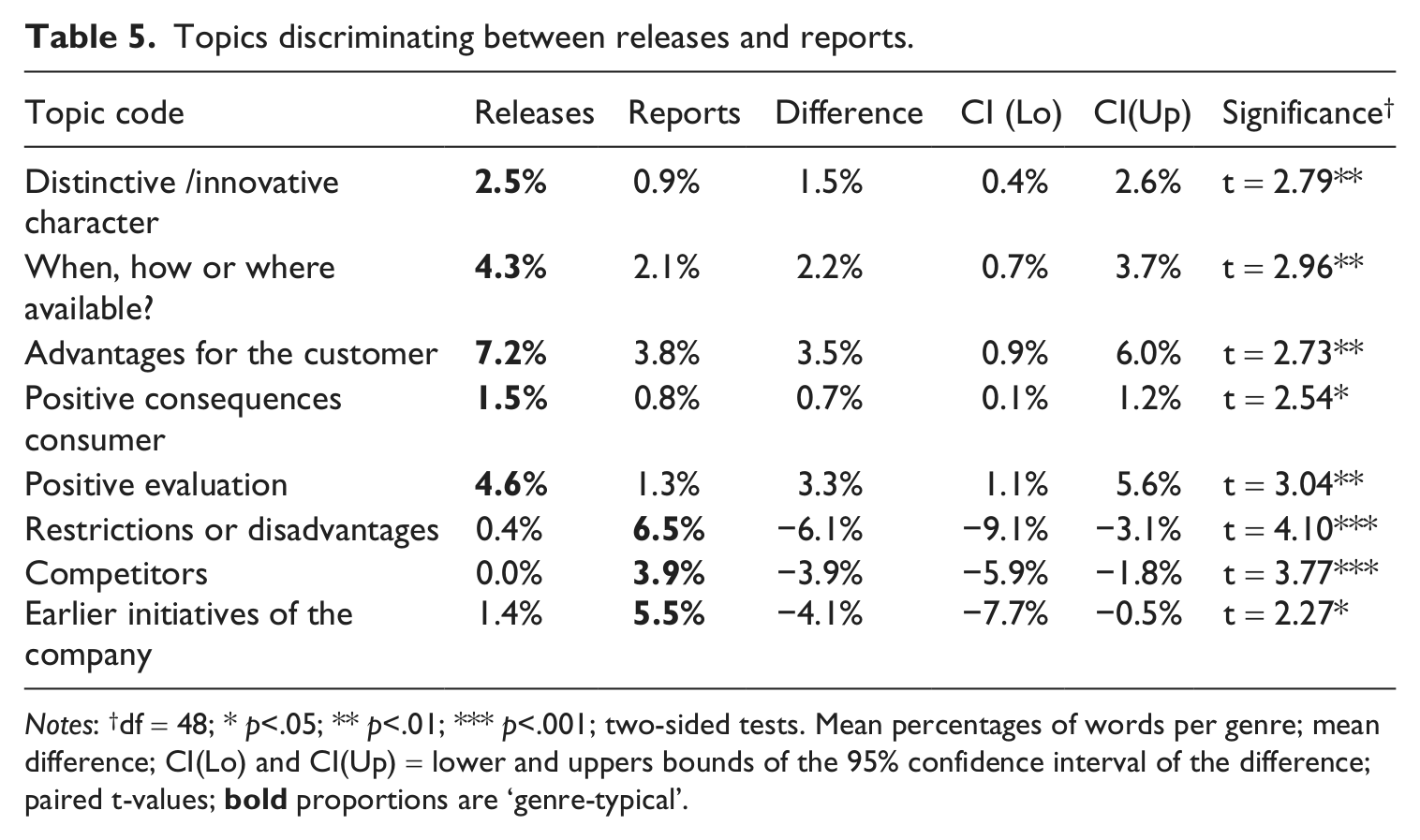
Notes: †df = 48; * p<.05; ** p<.01; *** p<.001; two-sided tests. Mean percentages of words per genre; mean difference; CI(Lo) and CI(Up) = lower and uppers bounds of the 95% confidence interval of the difference; paired t-values;
The topics standing out in releases are the distinctive features and advantages of the product, its availability and positive evaluations of it as in, for instance, the following fragments:
Distinctive character of the product
(5) That a dairy company in the Netherlands creates such a large separate line of dairy products is unprecedented. (6) KPN is the first operator in the Netherlands to provide unlimited use of UMTS and GPRS with the KPN Mobile Connect Card for a single fixed rate of €75 per month.
Availability of the product
(7) After the test phase, the 4 million customers can ask for the service to be installed. (8) As of September 19 customers may order T-Mobile Home on our website.
Advantages of the product
(9) Chris Vogelzang, Board Member ABN AMRO Nederland: ‘Speech recognition is fast, easy and above all safe’. (10) No complicated connections via boxes to the internet are needed any more, nor complicated triple or multiplay packages.
Positive consequences of the product for customers
(11) Banking by phone will be a lot simpler for the ABN AMRO-customer from early 2007 onwards. (12) After the introduction of T-Mobile Home, many people will have no reason any more to use an ordinary phone besides their cell phone.
Positive evaluation of the product
(13) Samsung innovations tickle all the senses in the living room. (14) To sum up: milk is milk, but Campina milk is different.
Statements such as these are indications of the advertising frame.
The news reports introduce three topics virtually ignored in the release: restrictions of the product (what it cannot do), competitors offering a similar product and earlier initiatives of the company in the same field. Some examples:
Restriction or disadvantage
(15) Because the UMTS poles reach only 30 percent of the Netherlands, KPN fills the holes in its network with the outdated GPRS network that is six times slower. (16) The poles do not yet give the prices of the next three or four gas stations, something that has been asked for by Dutch Parliament representatives.
Competitors
(17) In the Netherlands, the oil company Argos has been selling bio fuel since November. (18) The ‘fixed network’ rates of T-Mobile are not identical to those of KPN, but are pretty close to them.
Earlier initiatives in the same field
(19) Each of the mobile providers paid a lot of money for a 3G-license some years ago. (20) (From a report on a gadget for soccer supporters introduced by a beer company) At the last championship the company had problems with a similar gadget: fans with a hat carrying the brand name had to leave the hat at the gate of the stadium.
We propose to capture these topical differences in terms of two report frames. The first is consumer information. Consumers need to know about the pros and the cons of the product (unlike prospective customers, who need to be told how the product will help them). Besides, consumers will also be interested in competitors offering similar products. The reports’ emphasis on consumer information is also apparent from the fact that they offer the same proportion of non-evaluative product information as releases (e.g. the operation of the product, its technical features, its price and the intended customer group).
The second new frame contextualizes the new product as a business move, meant to further the interests of the company. This frame motivates journalists to mention earlier initiatives in the same field. A closer analysis of this type of context information reveals that the organization itself is often a player in this context: 61 percent of the earlier events concern earlier business ventures and products of the same company, and 39 percent are events instigated by other actors, most often governments issuing regulations for certain products. The difference between releases and reports is entirely due to the first subclass: earlier business moves by the same company, many of them not entirely successful. Thus, the new product often appears as just another attempt to achieve certain aims, whereas the release stresses the novelty of the product.
The second topic related to the business move frame is again the information about competitors. Besides offering consumer information, the competitor topic works together with information on the earlier company initiatives in showing how the new product fits into a competitive strategy, i.e. as a move meant to further the interests of the company. This framing is of course diametrically opposed to the advertising frame, which suggests that the product is there to help the customer.
Attributions (questions and hypotheses 6–9)
Since attribution is a sentence-level decision, the attributions are counted in sentence units, not in word proportions.
First, reports more often attribute statements than do releases. More specifically:
Reports contain statements attributed to company sources (23.2%; N = 928) more often than releases (15.7%; N = 917; Standardized Residual (SR) = 2.6).
Hypothesis 6 is supported in that reports contain statements by non-company sources (6.6%; N = 928; SR = 5.5), a type of statement that is lacking in releases. These statements particularly concern neutral product features (26.2%), negative product features (31.1%) and context (24.6%). That is, they are often used to temper the optimism and company-centeredness of the release.
News report attributions are often coupled with evaluations. In support of hypothesis 7, reports attribute evaluative product information (N = 117) to company sources (52.1%; SR = 2.9) or other sources (5.1%; SR = 3.7) more often than releases; only 30.6 percent of the evaluative release statements (N = 273) is attributed to company sources, and other sources do not occur (χ2 = 39.24, df = 2, p<.001). This tendency to attribute evaluative information also holds for negative product information; the reports attribute 56.6 percent of its negative evaluations (N = 83) to either company sources (33.7%) or other sources such as domain experts (22.9%).
The epistemic distancing tendency in the report can even be seen in the form the attributed statements take. While the releases use direct speech in a large majority of cases (86.1%; N = 144), the reports (N = 215) use both direct (47.9%) and indirect representations (52.1%) for the company source statements (χ2 = 54.14, df = 1, p<.001), thus supporting hypothesis 8.
The attributed information in reports may be drawn from the release, or may be collected as a fresh quote by the journalist. Interestingly, fresh quotes are presented in direct form (59.8%; N = 132) more often than the pseudo-quotations drawn from the releases (28.9%; N = 83; χ2 = 19.54, df = 1, p<.001); fragment 2b above illustrates this tendency to use indirect speech for pseudo-quotations. Regarding research question 9 above, we find that the release pseudo-quotations are not very successful at being reproduced in reports. Only 24 direct speech utterances in the reports (23.3%; N = 103) were drawn from a release statement, while 161 quotations were offered in the releases.
Sourcing analysis: release information versus new information in the reports (questions 10–11)
Our analysis of input-output relations between release and report aims at answering research questions 10 and 11. First, how many sentences does a release offer for a particular information group and how much release information is actually used in the report? Note that we did not code whether a particular release statement re-appears in the report, but we did code whether a report statement can be traced back to release information. Accepting the simplifying assumption that every release statement might lead to a report statement, we have defined the mean chance of re-appearance for a type of release information as follows: for each information group and for each text pair, we divide the number of report sentences drawing on release information by the total number of sentences offered in the release. We refer to this proportion as the survival ratio. For instance, a particular release offers 12 sentences with positive product information, while the report contains six positive product information sentences drawing on the release. This gives a survival ratio for positive product information for this text pair of 50 percent.
Second, how many of the report sentences concerning a particular category are taken from the release and how many of them are added by the journalist? We refer to this proportion as the release dependency ratio for the text pair; it is calculated for a certain class of information by dividing the number of report sentences taken from the release by the total number of sentences in the report. For instance, suppose that the report just mentioned contains eight positive product information sentences, of which (as we have seen) six are based on release information; this gives a release dependency ratio of 75 percent.
Of course we could have calculated these ratios by collapsing all sentences. For instance, of all our 928 report sentences, 415 are based on release information, providing us with a dependency ratio of 45 percent. This overall ratio may be misleading however, as longer releases and reports make larger contributions to it. In order to equally weight each text pair, the ratios were analyzed at text pair level and averaged. As not every text contains instances of all information groups, the number of ratio observations differs. For instance, as only two releases offer negative product information, only two survival ratios for this information group could be calculated. In order not to capitalize on a small number of text pairs, Table 6 only provides the mean survival and dependency ratios for information groups having 10 or more observations. Our question is whether information groups in releases reliably differ in their survival ratios, and whether report information groups differ in their dependency ratios.
Survival and dependency ratios.
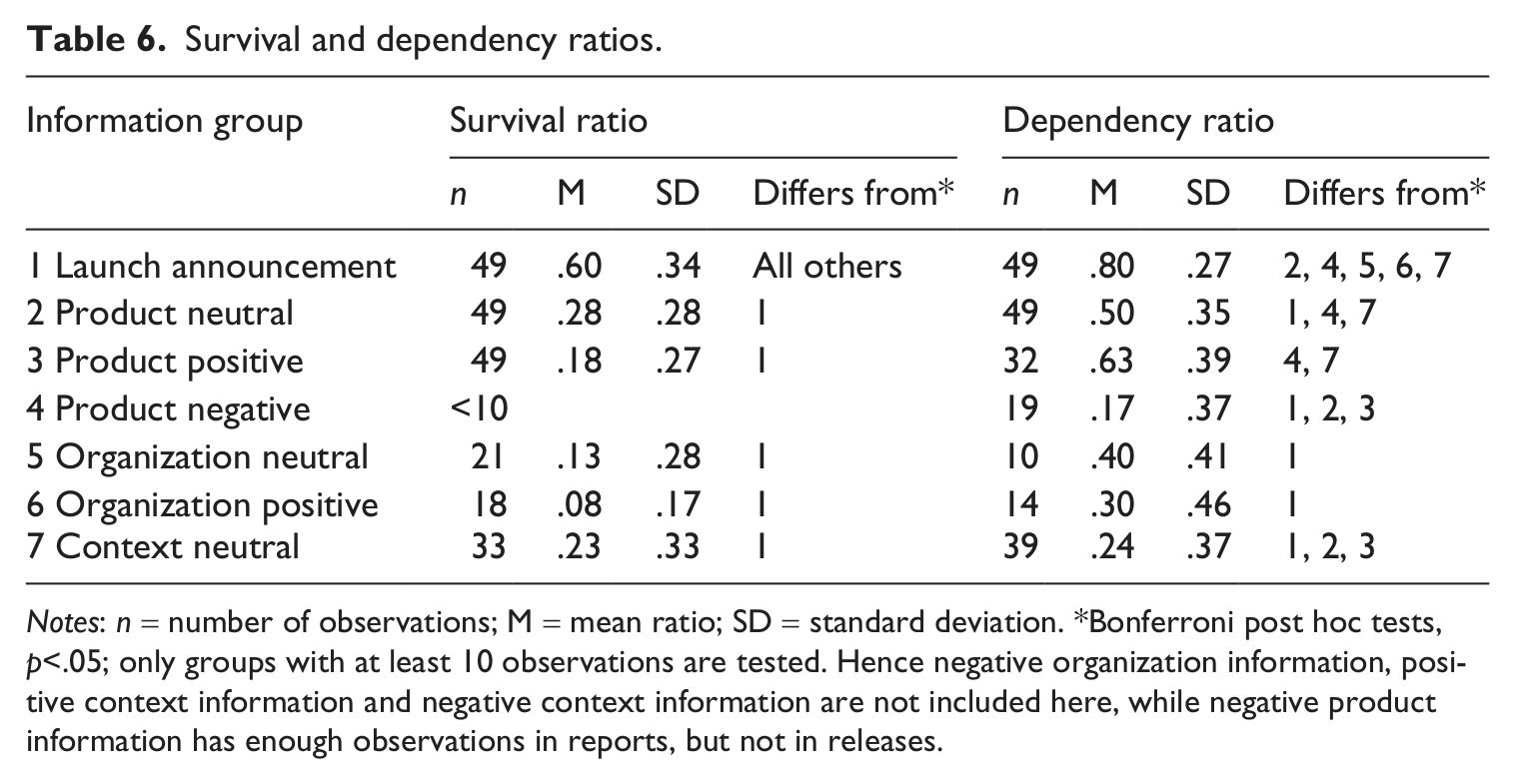
Notes: n = number of observations; M = mean ratio; SD = standard deviation. *Bonferroni post hoc tests, p<.05; only groups with at least 10 observations are tested. Hence negative organization information, positive context information and negative context information are not included here, while negative product information has enough observations in reports, but not in releases.
The survival ratios in Table 6 clearly indicate that journalists are quite critical in using release information. While they often use the announcement information, they are significantly less likely to use other information types, including neutral information.
The dependency ratios show that announcement information is typically based on the release. Likewise, product information is regularly taken from the release. The significantly lower dependency ratios for negative product information and neutral context information indicate that these kinds of information are typically added by journalists. This is not to say that added information is written from scratch by the journalist. Van Hout (2010) shows that in reworking releases, journalists routinely draw on additional sources such as news agency feeds, press conference slides, internet sources and telephone calls. Our point is that the release may be the impetus for producing the report, but is not its most important source of information, except for the announcement itself.
Weak and strong reframings in releases (question 5)
We have seen that journalists reworking releases reduce positive evaluations, introduce negative ones, and introduce context information such as competitors and events preceding the launch (especially business steps by the same company). More generally, releases emphasize topics corresponding to an advertising frame, while reports introduce consumer information and business move frames.
So far, our analysis has treated texts as unstructured ‘bags of sentences’. However, research question 5 concerns the impact of journalistic reframings, defined in terms of the textual prominence of the newly introduced topics. Most negative and contextual information introduced by journalists is confined to later sections. Headlines and leads generally focus on the launch announcement: 95 percent of the headlines and 55 percent of the lead sentences contain announcements, as opposed to only 2 percent of the body text. Likewise, only 20 percent of the headlines and 26 percent of the lead sentences contain added information, while this proportion is 63 percent for the body text sentences. Thus, much of the journalistic interventions concern the contextualization of the main event, in the sense of deciding to what other information it is to be related. In this case, consumer information frame may supplement the advertising frame, not replace it. When, however, negative or contextual information enters the main event section, it affects not only the contextualization but also the conceptualization of the main event.
To identify such major interventions, we did a qualitative analysis of reports containing headline and lead sentences which either presented new information or presented other topics than the announcement topic that normally occupies the first report section. We found such ‘intrusion’ sentences in 27 of our 49 reports. In nine of these, the journalist only added details on the main event (for instance the release date of the new product) without changing its interpretation. In two further reports the journalist provides a new qualification of the product without adding information. For instance, a new speech recognition device is presented as something ‘that seems copied from a science fiction movie’. Such qualifications are themselves not elaborated on in the rest of the text, neither do they seem to determine further contextualizations.
This leaves 16 reports containing actual reconceptualizations. In four of them, the journalist uses secondary information from the release as the new main event. This may be done in a neutral way, for instance when a telecom company’s new antenna is introduced in the headline by saying that it helps cutting costs. However, the same procedure may produce explicit negative evaluations, for instance when the report on a new paying system for KLM customers focuses entirely on the additional cost incurred by Economy Class travelers using the new system, and explains it as an attempt to let the customers cover the credit card administration costs formerly paid by KLM itself.
In another three reports, the added information is used to relate the new product to the company’s strategy. For instance, a department store’s decision to install cash dispensers is reconceptualized in the headline as ‘recycling money’ within the store and explained as an attempt to attract new customers.
In five reports, the new product is related to the market situation by mentioning a competitor of the company. For instance, a new application for phone calls via the internet is announced in the headline as ‘Tele2 introduces its own Skype’.
So far, these reconceptualizations introduce the business move frame. The last four reports relate the new product to well-known everyday problems that they either may help solve or may worsen. For example, a news report about the introduction of internet in trains reconceptualizes this as the disappearance of ‘one of the last oases of reading peace’ (see fragment 4b above). We hesitate to postulate an additional frame on such scanty evidence, but clearly these last four reports add human interest to the product’s description.
This analysis learns that only one of the two new frames offered in reports is used in strong reframings, reconceptualizing the news event: we found 12 cases of business move reconceptualizations. In contrast, the consumer information frame is typically added to reports that adopt the unmarked conceptualization of the launch event as being just this: a product launch.
Conclusions
This study has provided a contrastive analysis of product press releases and the news reports based on them. The results regarding information groups, attribution and sourcing were as follows.
First, releases and reports differ in the types of information they provide. News reports offer 10 percent less product information and 10 percent more contextual information. Second, releases and news reports differ in the evaluations they provide on new products. Releases have virtually no negative information, whereas reports contain both positive and negative evaluation, thus demonstrating a degree of impartiality. Besides, reports present more non-evaluative information than releases, displaying factuality. Third, reports quote company representatives and also introduce other participants’ comments, more than half of which contain context information and product criticisms. The factuality orientation also manifests itself in that reports attribute evaluations to third person sources more often than releases. And reports distance themselves more subtly from company sources by using indirect speech more often. Fourth, reports are quite critical in their use of release information. While they generally use the announcement information, they often avoid using the elaborations offered in the release. Information types that are typically added are negative product information and context information.
So far the results show how newspaper reports systematically seek to distance themselves from the company perspective prevalent in releases. In order to show what they add to the understanding of the product introduction, we explored the news frames offered in releases and reports. This was done by an analysis of the specific topic codes that are differentially present in the two genres. Releases have higher frequencies for statements that sell the product by pointing out its innovative character and its advantages. These statements indicate the presence of the advertising frame in releases. Reports add two other frames. The consumer information frame is characterized by restrictions and disadvantages of the product and competitors offering similar products. The business move frame emphasizes how the product launch may further the goals of company. It explains the product in terms of competitive strategies and in terms of earlier business moves preparing the present one, or failed initiatives necessitating the present move. Most of these reframings appear later on in the report and hence merely recontextualize the product launch. A qualitative analysis of the 16 radical reconceptualizations learns that 75 percent of them adopt the business move frame.
Theoretical and practical implications
The main methodological contributions of this study are its combination of qualitative and quantitative analyses and its focus on fine-grained textual analysis. Our bottom-up text analytical approach may complement the insights yielded by studies coding entire media reports in predefined categories. Text analysis is needed to gain more insight in the later phases of the news production process: news gathering and news writing. It also adds to what we know from case studies on the news production process. For instance, two of the three reframings demonstrated in the case study by Van Hout et al. (2011) were found to be regular occurrences; their ‘innovation’ reframing, however, was not attested in our data.
Conceptually, the distinction between contextualization and conceptualization adds to our understanding of news framing. The two main reframings in our news reports were shown to differ in their textual prominence. While the consumer information frame is restricted to contextualizations, the business move frame may characterize the report from the lead or even the headline on. Importantly, the two reframings add news user value for different reader groups: consumers and business news readers.
How does this study speak to the debate about the source dependency of newspaper journalism? As pointed out in the introduction, the balance of power between source and journalist shifts in the course of the news production process. While sources appear to be leading in the discovery phase, the reporter gains influence in the news gathering phase, and achieves nearly total control in the news writing phase. This study is confined to the last two phases, and focuses primarily on the last phase (since we only examined reports primarily based on product press releases, thus excluding feature articles, interviews and other more ambitious news gathering projects). Given this focus, our study is bound to highlight journalistic agency. Besides displaying journalistic independence in ‘formal’ ways such as attributing evaluations to third parties, the news writing phase adds frames to the advertising frame proposed by the release, or replaces this frame altogether.
These operations seem field-dependent in that they are specifically targeted at the corporate bias in product launch releases. Studies of newspaper reports based on press releases about scientific research have shown that these are dealt with in a considerably less detached manner (Brechman et al., 2011). The reframing operations found in product launch reports, especially those adopting the business move frame, have more in common with the use of the ‘strategy frame’ in political reporting (Lawrence, 2000), in which the ‘why’ of politicians’ proposals is emphasized at the expense of the ‘what’.
Of course, we should not exaggerate the distance between reports and releases. First, two-thirds of the reports do not show radical reframings. And second, by writing about the product launch at all, the report adheres to the corporate definition of what counts as a news event in the first place. Still, we insist that news writing is a process which combines reproduction and transformation. Even when the release is the leading news source, the news writer decides what is used and what isn’t (as shown by the different dependency and survival ratios for different kinds of information) and how the information is staged.
What are the implications of this study for the other two parties involved in media coverage of product news – corporations and (news) consumers? Corporate communication officers tend to produce releases that read like long-copy advertisements. This leads journalists to recontextualize and reconceptualize the launch on their own account. One could of course argue that corporations should consider any publicity as good publicity. But as report frames actually affect reader responses (Valkenburg et al., 1999), corporations should be interested in how their news is covered. On the basis of this study, the hypothesis would be that information from more balanced product press releases stands a better chance of reappearing in news reports.
For newspaper readers, the division of labor between news sources (advertising their products and/or views) and journalists (reframing this information) has some merit (for a comparable view see Zaller, 1998: 115). Reports in a distanced style combined with consumer information and business move reframings do make the product launch information more usable for news readers. If you want to assess a new product, you need to distinguish factual from evaluative information, and you need to know about the product’s limitations and the corporate strategy behind it. This means that both independence markers and reframings add value to the product news provided by the underlying release.
Adding user value to news reports may be seen as market-oriented journalism (Underwood, 2001), in the general sense that news is required to demonstrate its relevance to the news consumer. When market-oriented journalism is taken to refer more specifically to the rise of consumer news (at the cost of political news, for instance), we must say that this study does not allow an assessment of such trends, as it concentrates on product news. It does show that product news items not only address readers as consumers, but as economically interested readers as well. Of course, their economic interests may derive from their investments, which also obey a market logic, albeit of a different kind.
However, most reports preserve the product launch news angle, so their added user value mostly remains modest. It also needs to be noted that reframing press release information is a relatively inexpensive way of news production, especially for experienced reporters drawing on extensive prior knowledge. News consumers will look at more ambitious journalistic contributions in their papers when considering whether or not to prolong their subscriptions.