



Abstract
This article examines the amateur photographer as a common figure in contemporary news photographs, focusing on how the amateur’s gestures signify in journalism’s coverage of media events. Drawing on theories of photography as performance and ritual, I argue that the presence of the non-professional in the news photograph destabilizes journalistic discourse by challenging the role of the professional photographer and by redefining the event and its meanings. This is especially critical in coverage of catastrophic events, when the amateur’s gestures become a form of witnessing from a participant’s perspective, carrying both private and collective meanings for how the event will be understood in the future, and undermining the authority of journalism.
Keywords
Today journalistic photographs often include people taking their own pictures of the event. Over the past decade, the camera in the hands of the amateur has become a common attribute of the news photograph. The gestures associated with amateur digital photography have in turn gained meanings that alter the situations, places and settings where they are used. The argument I develop in this article is that the image of the amateur photographer, documenting events as they unfold, signifies in specific ways that have become constitutive of media events. Further, I argue that the presence of the non-professional in the news photograph shifts and destabilizes journalistic discourse, first as a challenge to the authority of the professional photographer, and second as a comment on and possible redefinition of the event and its significance. 1
The focus here is on the gestures of amateur photography, as they appear in the reporting of media events in the daily press. The media event, itself a gesture that actively creates realities (Dayan, 2010: 26), was the concept initially developed by Dayan and Katz (1992) for their analysis of ceremonies that interrupt the routines of daily television programming, binding together the audience in the live common experience of an historic, preplanned event. 2 Katz and Liebes (2010) later modified the concept to include major news events – disasters and tragedies – that interrupt daily broadcasts for live coverage from distant places, riveting audiences to their screens. Their aim was to gain insights into an important distinction between these two kinds of events. Whereas the former genre (the ceremony) is ‘integrative’, the latter is ‘disruptive’ and traumatic, breaking into established routines with news of tragedy, terror and disaster. Whereas media events of the ceremonial kind are essentially co-produced by broadcast organizations and the event organizers (Olympic Committee, FIFA, the Crown, in the case of a royal wedding), the ongoing live coverage of disaster appears to lack this collaborative control of the unfolding event.
However, when coverage of disasters and traumatic events includes images of ordinary people taking pictures, this may no longer be accurate. The gestures of the amateur have become themselves integrated into the vernacular understandings of daily life to such an extent that they carry an integrative meaning into events – however chaotic and disruptive. Immediately identifiable and easy to identify with, the gesture of the raised camera freezing the historical moment frames the event and provides the viewer entry into the event as participant. My central argument is that these meta-pictures of amateurs performing photography contribute to the ritualization of the event as part of a symbolic world in which viewers become witnesses and participants (see Rothenbuhler, 2010: 64–65). This makes the professional photojournalist’s pictures of the amateur particularly intriguing as a case where we can see a restructuring and renegotiation of how the public and the private are constituted, a performance involving the photojournalist as public chronicler and the amateur as the professional’s ‘binary opposite’ (Frosh, 2001: 47), enacting a private domestic representation of a public media event.
Understanding photography as a cultural performance is critical to the ways the image of the non-professional photographer signifies in a photograph of a news event. The press photographs under discussion here rely on internalized knowledge of photography’s representational power, and what ‘photographic acts are conventionally known and shown to do’ within the context of the media event (Frosh, 2001: 44–45). Within media studies, the concept of performance shows up frequently in the literature on media rituals, but is rarely defined or interrogated. Here, I use the concept as it has been developed within anthropology and folklore studies, to address questions of identity and social action as complex systems of symbolic and meaningful behaviour that contribute to an ordered understanding of the social world (Geertz, 1973). From this perspective, cultural performance is an active and creative precondition for social life (Hughes-Freeland, 1998, 2001). Photography is, then, not only a technology of visual representation, but more profoundly, following Frosh (2001: 43), ‘a constitutive type of (visible action) within the social world’. Taking pictures becomes a ‘performance of representation’, an enactment of social knowledge of photographic practices and of the networks of power and play that arise within the nexus of photographers, viewers, and those who are photographed. Photography is in this sense ‘a manifest performance of the power to make visible’ (Frosh, 2001:43).
Gestures of photography are analysed here with reference to two quite different sorts of empirical material. The first is a selection of photographs from the daily mainstream press, where photographic devices – cameras and cell phones – appear as attributes in the hands of non-professionals. These examples, gathered somewhat unsystematically over many years, are used to interrogate how these increasingly common ‘meta-pictures’ of photographic practice have come to signify in representations of news, and the specific news angles that the figure of the active amateur photographer inserts into event coverage. The second body of material looks at specific media settings where these gestures arise, based on field observations in public viewing areas during planned media events. Here the focus is on the interaction between professional media practitioners and amateurs that emerges in the highly mediatized spaces established for such celebratory events as the football World Cup in 2010 and two royal weddings, one in Stockholm in 2010 and the second in London the following year. 3 Following earlier research and theory on contemporary media events as secular rituals (Becker, 1995; Cottle, 2006; Couldry, 2003; Dayan and Katz, 1992; Durham, 2008), I examine how the performance of photography is mutually constructed through a dynamic interplay involving professionals and amateurs, a performance that is in turn woven into the journalistic framing of the event. Together this empirical material opens up an examination of specific arenas of public life where individuals’ private acts of photography are transformed into collective experience. Convinced by Frosh’s (2001: 44–45) argument that photography’s ‘spectacular power is central to the structuring and negotiation of the public and the private as experiential categories in a society where publicness and visibility are closely interwoven’, I examine how journalism uses the image of the amateur photographer to re-negotiate its own position and visually construct the public and collective significance of contemporary media events.
Meta-pictures of amateurs
Meta-pictures, as ‘second-order reflections on the practices of pictorial representation’ (Mitchell, 1994: 9), can take many forms, from the words that explain how an image was made, to more complex ways that certain pictures reflect on themselves, establishing a pictorial meta-language (Mitchell, 1994). Analysing ‘what pictures tell us when they theorize (or depict) themselves’, Mitchell identifies several distinct types of meta-pictures in which the subject itself is a first-order discourse on the practice of visual representation. Extending his discussion to news photography, the photograph that includes one or more people taking pictures can be analysed as a self-reflexive inquiry into the practice of photography within journalism (Becker, 1996). The image of the amateur draws on meanings that are embedded in the cultural knowledge of private domestic photography and its rituals. These include the ways amateur photographs are used, what they typically document and their place in memory, both individual and collective. Belief in a photograph’s authenticity may be enhanced when it is known to be the work of an amateur (Andén-Papadopoulos and Pantti, 2011). This is especially true when the photograph portrays a traumatic event, and the photographer lacks the professional experience that can shield against trauma in order to ‘compose’ an image. The amateur image is understood as raw and direct. Examples include photographs taken by Allied soldiers involved in the liberation of the death camps at the end of the Second World War. As Zelizer (1998: 133) has discussed, the amateur documentation of the piles of bodies provided ‘both proof of the horrors and testament to the liberators’ presence in the camps’. Recent research has found that both readers and journalists value amateur images for their authenticity, and for the ‘intimacy’ of a closer, insider point of view (journalists), with its ‘added realism’ (audiences) (Williams et al., 2011: 211). The amateur is understood to be photographing what is there to be seen, without artifice. These qualities are woven into meta-pictorial news photographs that show amateur photographers at the scene.
These meta-picture must be distinguished from eyewitness reports by ordinary citizens and ‘citizen journalists’ (Allan and Thorsen, 2009) that are included in the news, for example, when professional images and reports are lacking or inadequate. In the photographs under discussion here, photographers are shown as they produce their own testimony of the event. They are depicted in the act of performing photography, enacting what appears to be a form of ‘media witnessing’ (Frosh and Pinchevski, 2009; Rentschler, 2004; Zelizer, 2002). Yet, we cannot include every amateur’s photographic performance as an act of witnessing. Although the gestures of photography may be identical, they do not carry the same meanings when documenting a terrorist attack, a football World Cup final, a royal wedding, the aftermath of an earthquake, destructive riots in a Paris suburb, a mass demonstration in Cairo’s Tahrir Square or the death of a dictator, to take examples where amateur photographers have appeared in the news. Ashuri and Pinchevski’s (2009) discussion that casts witnessing as a tripartite field, contingent on the specific parameters of the event itself, is useful here to clarify how the amateur signifies differently in photographs of markedly different kinds of events. Adapting their framework to the present analysis means taking account of (a) the amateur photographer as ‘agent bearing witness’, (b) the ‘utterance of the text itself’, in this case the professional news photograph of the amateur, and (c) the audience who is looking at the photograph as a report from the specific event (Ashuri and Pinchevski, 2009: 136).
As these authors note, a problem in the vast literature on media witnessing is that it rarely takes into account the competing forces, resources and agents involved. They make a distinction, useful here, between witnessing treated in the literature as a position one simply ‘inhabits’, and witnessing as a position that must be ‘obtained’, one subject to contest and struggle (Ashuri and Pinchevski, 2009: 135–136). Applying this distinction to the photograph of the amateur in the news, we can see on the one hand the way this figure bears cultural significance as an individual enacting the ritual of private domestic photography. In this capacity, the amateur inhabits a position attributed to him (or her) through shared cultural knowledge about the uses of photography in private settings, a received position that applies across the range of media events. When we introduce the specificity of the media event, on the other hand, we can see how the amateur photographer obtains the status of a witness. During events of greater historical significance and trauma, and where taking pictures may place the photographer at risk, greater weight and even responsibility are attributed to the amateur’s photographic acts of witnessing.
Gestures of seeing
The gesture of the raised camera has become universally recognized as a signifier, an annunciation of the event’s significance. The ‘Hail Mary shot’ (Van Riper, 2003) with the camera held up at arms’ length, long used by professional photographers when working in crowds, is now common among amateurs. The gesture of holding up a digital device to take a group self-portrait is enacted and recognized all across the world. The same is true of raising the camera to take a picture of a screen, now common during historic ceremonies and sporting events that are broadcast to public viewing areas. The gesture itself points to the moment as significant: a winning goal during the football World Cup in 2010, the newlywed royals’ first kiss, Obama’s presidential oath at the 2009 inaugural. With the widespread use of digital imagery, these performances of photography – photographing the self, the event, and the event on screen – have become central to commemorative and celebrative media events.
Examining these gestures as they appear in news stories is consistent with moves in performance studies toward analysis of cultural ‘enactments’ and ‘speech events’, a term applied to different modes of communication, and the emergent dimensions of their multi-semiotic modes of meaning. Such enactments involve a public; in folklorist Richard Bauman’s (1977: 11) definition, performance entails the ‘responsibility to an audience for a display of communicative competence’ (see also Becker, 2001: 83; Kapchan, 1995: 482). The performance can thus be seen as a bounded arena where the participants’ relations to each other and to the performance involve a qualitative assessment that takes into account previous performances. By directing its inquiry into interactions among participants, the performance situates participants (including the audience) in time and space and also structures individual and group identities (Becker, 2001: 84; Kapchan, 1995: 479; Kirshenblatt-Gimblett, 1998: 75). Reflexivity, as a component of cultural performance, is critical to understanding its relationship to the everyday. Compared with the discourses and material practices that compose everyday life, performances are stylized and self-reflexive enactments, commenting on and transforming that which is taken for granted, and making it visible and available for reflection (Becker, 1995: 84–85).
Although the gesture of the raised camera may be unreflective and purely functional – a practical means of getting a picture when standing in the middle of a crowd, for example – when the gesture appears in a photograph, it transforms the image to a meta-picture, and the gesture points to the event as significant. The picture of the photographic act shows a ‘moment’ being selected from the ongoing flow of daily life, as participants pause to document it. The physical display of taking pictures marks specific aspects of an event as significant, whether for the personal or the public record.
The news photograph that shows amateurs taking pictures thus refers to the significance and meanings of a photograph that the reader cannot see. It incorporates the attributes of amateur photographs, as pictures that are authentic and without artifice, valued for their ‘intimacy’ and that offer a closer, insider point of view (Williams et al., 2011: 211). This suggests that news photographs that document such pictures in the making acknowledge these qualities (Pantti and Bakker, 2009: 482–483; Puustinen and Seppännen, 2011). The professional photograph of the amateur’s gesture rests on the assumption that readers share the knowledge necessary to understand the performance; seeing the snapshot itself is not necessary to grasp the significance of the moment it captures.
Creating a visual record does not appear to be the primary purpose of these gestures. 4 The performance of photography is not in the first instance visual, but physical and multisensory, as a way of situating one’s self in the world. Photography here is not about looking. Rather it provides haptic connection to another space. It is important to note how this rejects ‘common sense’ knowledge about photography. Flusser’s (2011) discussion of gesture is to the point here: he identifies the movements of the photographer, not with seeing but with the thought process involved in the period between reflection and moments of action. These ‘gestures of seeing’ (Roth, 2011: 281) are repeated by participants throughout the event, as they ‘annunciate’ key moments by raising their cameras. The audience or viewer, in turn, is being asked to acknowledge and reflect upon these gestures as part of the news.
Media logics of performance
By far the most common photographs of amateurs in the press show them taking pictures during the same events as the photojournalist. Simply the prevalence of digital photographic devices – cameras and cell phones – in society at large may account for their presence in the hands of people at all kinds of news and media events. The photographic acts of amateurs have become so ordinary, so much a part of the visual vernacular of daily life, one would expect that they would frequently turn up in journalistic photographs.
Yet this convergence of the professional and amateur photographer at the news scene points to a shift in the relationship between, on the one hand, institutional logics of mass-mediated visibility, including news photography and the editing and gatekeeping functions of editorial practice and, on the other hand, the more diffused networked logics associated with the digital practices of uploading and sharing images. The institutional logic, following Altheide and Snow’s (1979) early work, would include journalism’s ongoing quest for a different angle on the news, and for pictures that show ‘something happening’, i.e. action. During a 2005 visit by US Secretary of Defense Donald Rumsfeld to an Iraq airbase, for example, one newspaper chose an AP photograph that excluded Rumsfeld, showing instead the audience of uniformed soldiers, many of whom were holding up cameras and cell phones to take pictures. 5 Following this media logic, a news photograph of soldiers taking their own pictures is a welcome contrast to the more passive portrait of the speaker standing at a podium; and besides, readers already know what Rumsfeld looks like. In another example, following riots that shook the immigrant-dominated suburbs of Paris in 2005, a Swedish newspaper illustrated a news article with a photograph of a boy from Clichy-sous-Bois photographing a burned-down school (Figure 1). A photograph of a neighbourhood boy taking pictures is more interesting and engaging than the smoking remains of the school, and follows the media logic that affords participants agency in the event. Here, there is an added news angle, since the unidentified boy may actually be documenting the ruins of the school he attended and/or the aftermath of an event that he had a hand in. Is he performing as a witness and participant in the riots? The text does not address the issue, but the photograph suggests that he is taking pictures in order to have his own testimony of the events and their effect on his life.
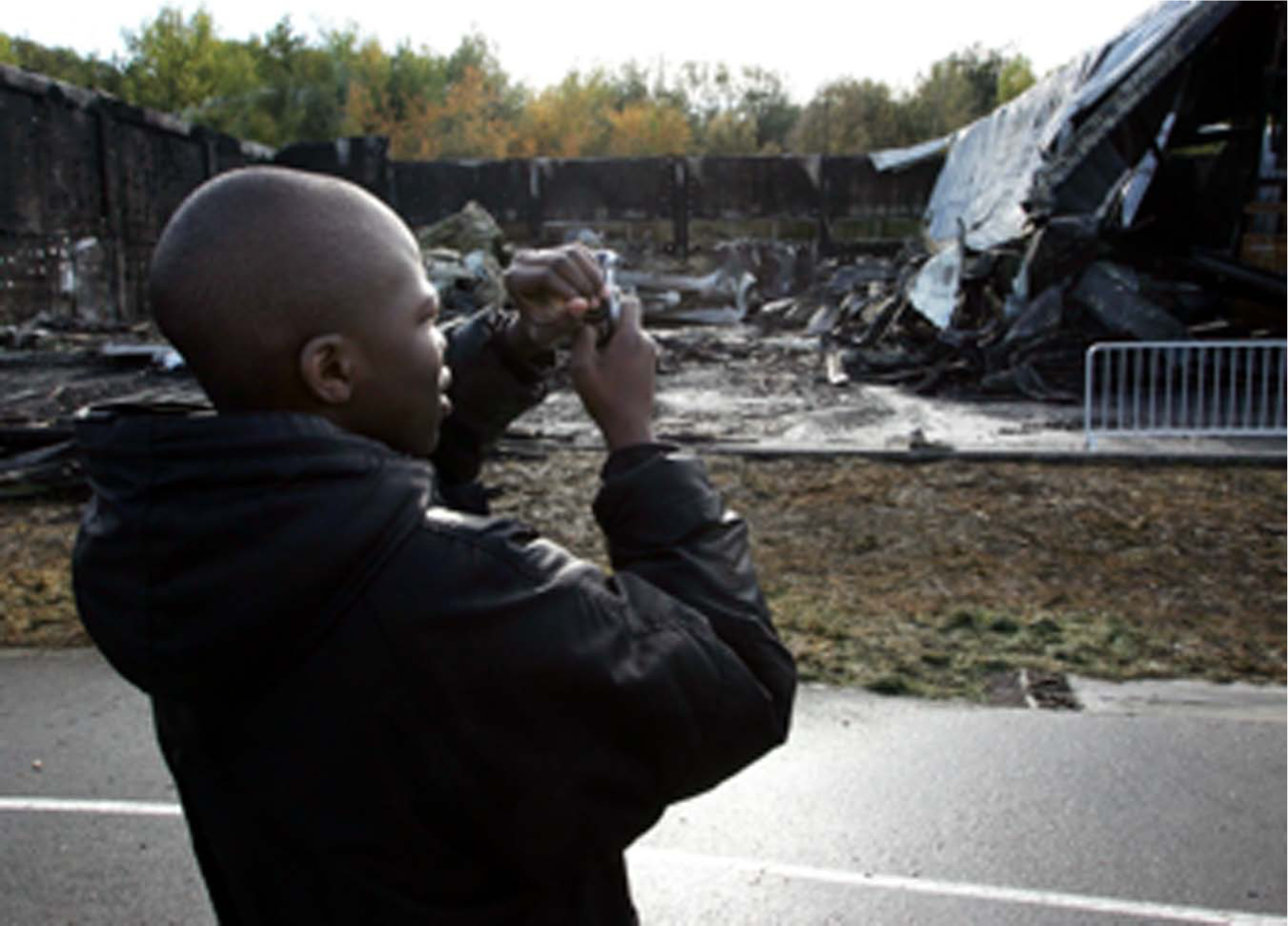
An unidentified boy photographs the ruins of a school during riots in the Paris suburb Clichy-sous-Bois, early November 2005. Photographer: Thomas Coex/AFP.
The media logic of photojournalism has certain parallels among non-professionals, and one can identify how the profession provides a template for amateur practice. Over the past decade people have increasingly used their own photographic devices to document historic occasions and events. Like the boy from Clichy-sous-Bois, non-professionals take pictures today as a way of being present in a historical moment, even from a distance, as attested to by the many individuals from around the world who circulated photographs of where they were in the days following the terrorist attacks on New York’s World Trade Center in 2001, or during Obama’s inaugural in 2009. They take their own pictures despite the vastly increased distribution and availability of professionals’ images from these same events. They insert themselves as eyewitnesses, on the authority of their own experience. To account for this we need to go beyond the institutional media logics and take a closer look at the meanings of amateur images within the context of the more diffused networked logics associated with digital practices.
The fact that many people are likely to have a photographic device on their person coincides, first, with the expanded awareness of the possibilities for sharing and distributing vernacular imagery on the internet and, equally important, a growing appreciation for the documentary and aesthetic value of photographs by non-professionals. The rise of this ‘participatory [visual] culture’ (Jenkins, 2006) as media have become increasingly diverse and multiple, has had an impact on image practices and, in particular, the dismantling of a professional photography’s ‘scopic regime’ (Jay, 1988) as a neutral bearer of factual evidence. The official record and the journalistic coverage, no matter how extensive, cannot satisfy the desire for a record of one’s own presence in the moment. Following the media logic of the amateur, photographing has become a way of being there.
A somewhat different case involves photographers who are neither photojournalists nor ordinary citizens, yet are taking pictures as they work at the site of a news event. Examples include firefighters at Ground Zero in New York, poll-watchers monitoring an election in Kabul or rescue workers following an earthquake in Turkey (Figure 2): key participants whose photographic acts become part of the news image. Here again, the ease, portability and widespread utility of digital photography have paved the way for its entry into a range of situations where visual evidence is needed. These are photographers with the job of providing evidence – a neutral, informed form of witnessing – of a scene where strong emotions and political positions are often being played out. News photographs that include photographers in uniform or wearing hardhats implicitly acknowledge the existence of an insider or participant perspective that in effect doubles and alternates the journalistic representation of the event. Paraphrasing Mitchell (1994: 57), these ‘other’ professionals would seem ‘to call into question the self-understanding’ of the photojournalist as privileged observer by pointing toward other discourses and institutions where photographs provide an authoritative record.
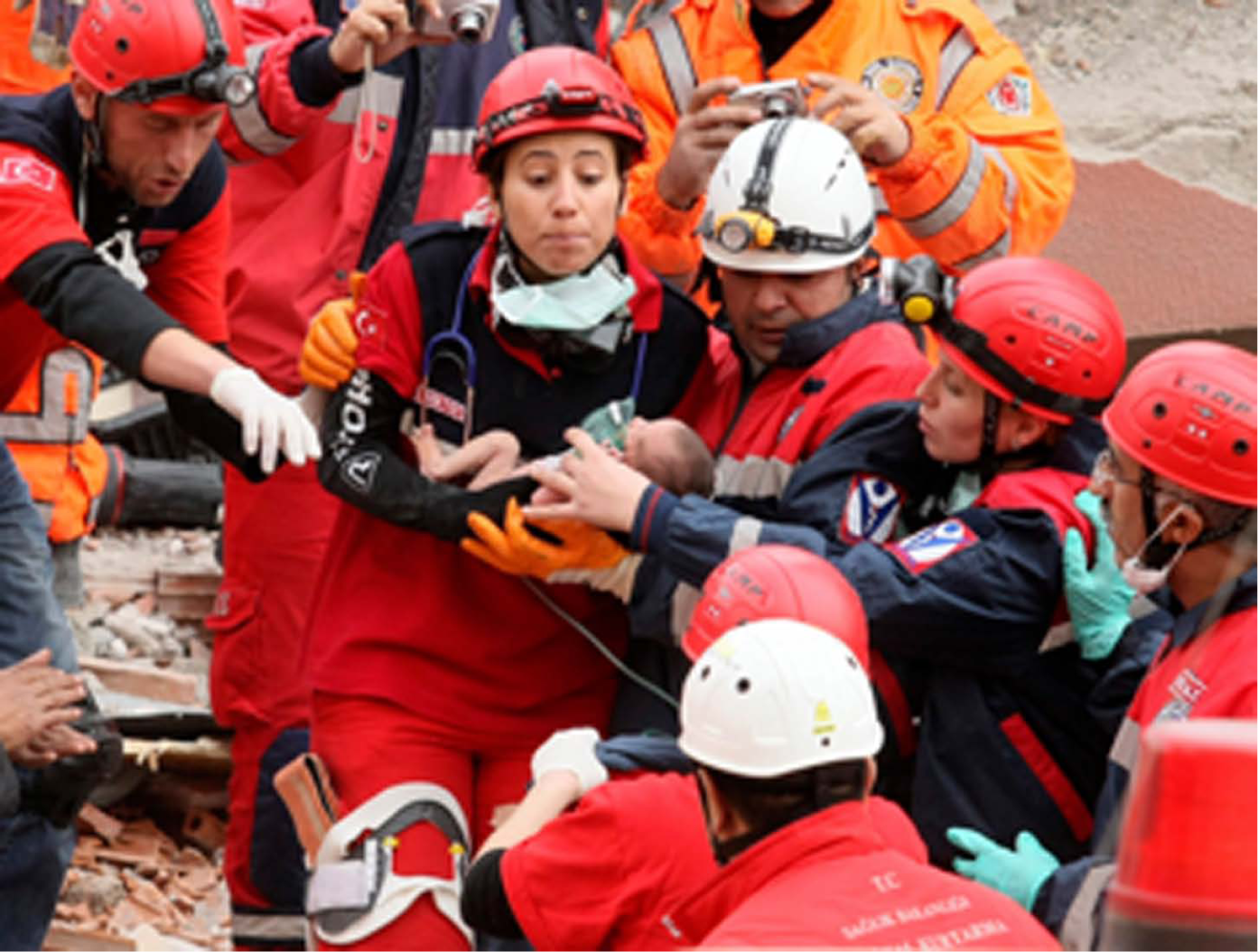
‘Saved’. Rescue workers photograph a two-week-old baby they have located in the rubble following an earthquake in Turkey in October 2011.
Who wields the camera?
The evidentiary power attributed to photographs carries over to the camera itself as a powerful object. As the above discussion suggests, who holds the camera also has a bearing on how we interpret the photographic act. Within weeks following the terrorist attack on the World Trade Center, President George W Bush had signed the USA Patriot Act of 2001, allowing sweeping anti-terrorism legislation and broadening the authority of intelligence and law enforcement agencies. Press photographs from the bill’s signing show the President surrounded by a group of smiling men that includes Vice President Dick Cheney holding a digital camera over the President’s shoulder. 6 The camera’s presence points toward a visual report from a participant’s perspective that is inaccessible to the press, signifying a vernacular representation from ‘inside’ the event. The camera in the hands of the Vice President, even if only incidental to the image, transforms the photograph to a meta-pictorial comment on the event as both personal and public history. 7 A curious tension arises around the camera and how it is being used by the public figure. The private picture, ostensibly for his own domestic use, is nevertheless invested with a public interest because of the person taking it. It refers simultaneously to the private vernacular and to the public and political spheres of visual history and memory.
Less common, but also indicative of the power relationships portrayed in these acts of photography, are cases when the press photograph depicts a subject ‘photographing back’ at the press corps, usually during a press conference. The complex intersection of gazes in these ‘meta-meta-pictures’ raises the question: who is looking at whom? And who is the spectator? An example is a press conference in August 2005 where the Swedish Prime Minister Göran Persson, surrounded by members of his cabinet, is presenting the government’s latest budget proposals (Svenska dagbladet, 2005). The Prime Minster is peering through a small camera pointed at the assembled journalists, and the cabinet members are smiling at Persson’s turning of the tables on the press. Although not mentioned in the article (which focuses on budget allocations) the caption states that the Prime Minister is ‘capturing’ the press corps in ‘5 million pixels’. With his powerful new toy, he is shown transforming the meeting with the gathered press into a game of duelling cameras, while maintaining his position as the centre of attention (and power). 8
The image of the amateur photographing back at the press is an explicit metaphor for alternative and possibly more accurate accounts of the event. The visual trope of the self-referencing photographer often appears alongside articles that discuss press ethics or debate press coverage of a specific incident. An example from the protests that erupted in violence during the EU summit in Gothenburg, Sweden, in June 2001 frames a protester with a line of riot police behind him, as he points his camera directly at the photojournalist taking the picture. The photograph appeared a year later over the headline ‘Different eyes, different pictures’ together with a critical review of the conflicting reports on the protest and the violence that tore the city apart (Dagens nyheter, 2002). The photograph and headline together refer, not to photojournalism, but to a ‘different’ perspective and alternative visual representations. Drawing again on Mitchell’s analysis (1994) of the meta-picture, this is not a totally self-referential photograph; the photojournalist who is being photographed by the protester is absent from the frame. The photograph does not therefore include ‘the entire cycle of representation’, as Foucault (1973: 11) describes in his essay on Velázquez’ self-referential masterpiece Las Meninas. But the viewer/audience is implicated, or at least implied by the image on the protestor’s viewfinder (that we cannot see), a parallel to the artist’s canvas in Velázquez’ work, where the audience’s presence is acknowledged, but not visible. Such photographs are representations of representation, destabilizing the authority of the photojournalist’s version and thereby the viewer’s position as audience and spectator of the scene.
Visual reflection and self-criticism pre-date the emergence of the amateur photographer as a figure in press photographs. Meta-pictures that reveal journalists’ flock behaviour have been used at least since the early 1990s as a commentary on the institution of journalism, particularly when journalists are accused of violating professional guidelines in pursuit of their story (Becker, 1996). Examples include journalists’ behaviour toward victims of the genocide in Rwanda in 1994 and the press’ harassment of Princess Diana, up to her death in 1995 in a car accident that many thought was brought on by journalists in pursuit. Criticism of the excesses that arise when journalists are investigating a public official caught up in a public scandal can include photographs depicting the official besieged by journalists wielding cameras and microphones. In these earlier cases, however, the cameras are held by professionals and the debate centres on their professional practice. In the present moment, the amateur has taken the position of the photographer, challenging journalism on the visual authority of a vernacular perspective. The amateur becomes a figure in the news in the decade of digital photography’s breakthrough, a period that coincides with key historical events where professionals’ access was inadequate to the task of reporting them. The events of 11 September 2001 clearly emerge as the tipping point in the rise of the amateur in the news, which brings us to the image of the amateur as witness during traumatic media events.
The amateur as public witness
In the days following the attack on the World Trade Center in New York in 2001, attempts were made to prohibit the people who were thronging to Ground Zero from taking pictures. ‘Put your cameras away! Show some respect!’ yelled a policemen, as visiting Professor Marianne Hirsch walked around the site. Yet everyone had a camera. Taking pictures, Hirsch (2002: B11– B12) postulates, was a response to the gulf separating ‘the before from the after’ of this cataclysmic event.
For journalists, the crowds who flocked to Ground Zero and the ways photographs were being used – to help locate the missing and to mourn those who had died – were all part of the event and its aftermath. Photojournalists’ work from those days also includes countless photographs of people taking pictures. On 12 October, the front-page photograph of the Swedish morning paper Dagens nyheter was a close-up of a couple in the crowd; she with a face mask to keep out the stench, and he with a small digital camera raised to take a picture (Figure 3). The figure of the amateur, photographing the empty space where the towers had stood, was used to convey the ongoing significance of the event, ‘one month after the attack’. 9 Firefighters, emergency medical personnel and other rescue workers, both professionals and volunteers, also took scores of photographs of the site itself and of each other as they worked, and they in turn were photographed by photojournalists (Zelizer, 2002: 705). In one such image police officers from Homestead, Florida, who had come to work as volunteers, were depicted photographing each other against the New York skyline (Ung and Hill (2001), cited in Zelizer (2002: 708)). Photography as both a public and private practice, by both professionals and amateurs, was a way for participants to bear witness to the magnitude of this tragedy and the fact that they were there. As Hirsch (2002: B11) notes, although photojournalists had immediate access to the site and had recorded events ‘much better and more accurately’ than the amateurs, their photographs could not fill the gap that had opened up in the wake of the towers’ fall.
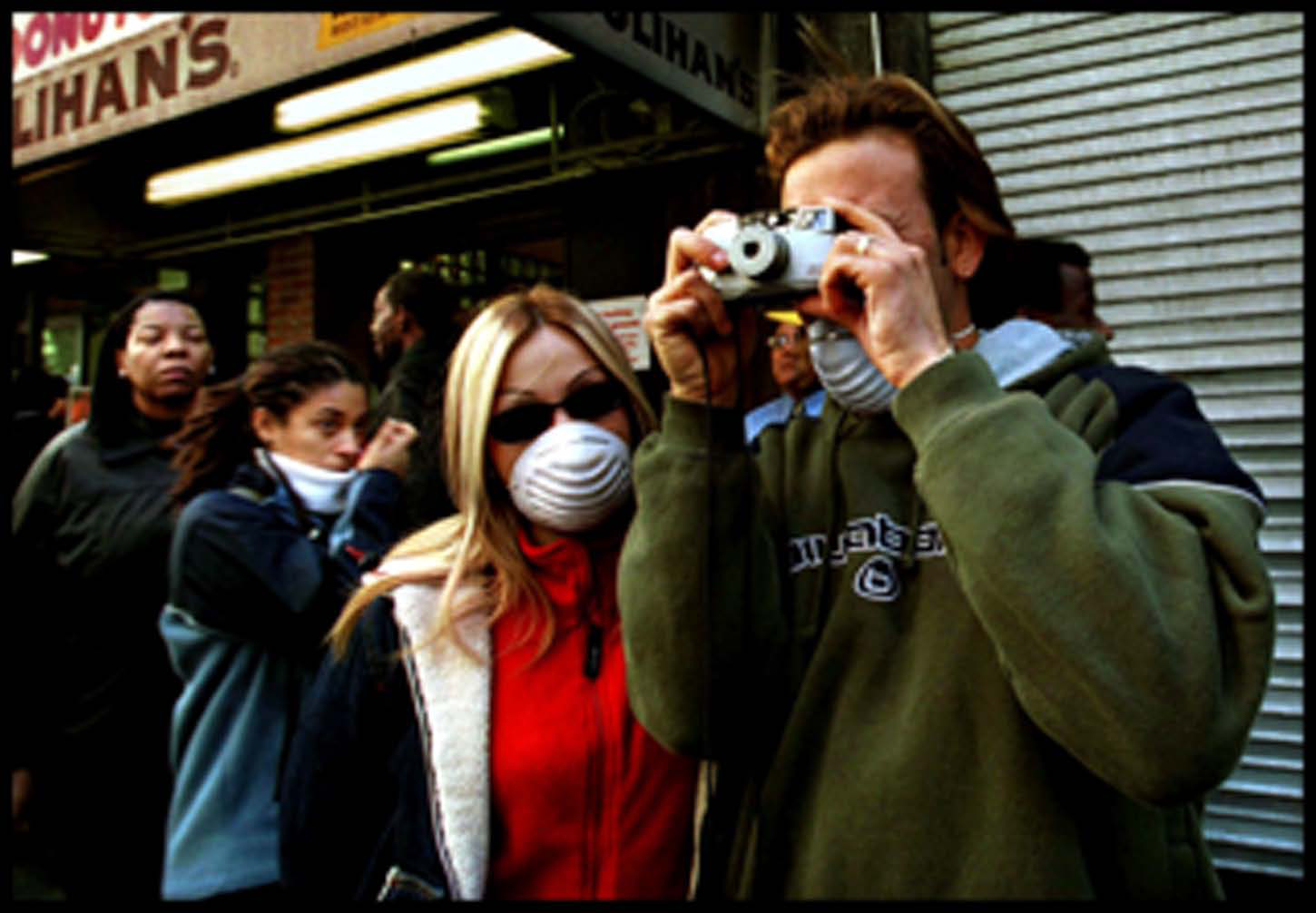
‘One month after the attack’ at Ground Zero by freelance photographer Martina Hüber.
During the months that followed, southern Manhattan was the site of a continuously unfolding media event, where the practices of media professionals and amateurs reverberated in ongoing collaborative constructions of the meanings of this tragedy, and where the amateur’s photographs gained authority as authentic representations of participants’ experience. 10 At Ground Zero it became apparent that amateur media practices would have an ongoing impact on how professional media document and report on such events. The ease and portability of digital visual media, concomitant shifts toward participatory media cultures, and an increasing value attributed to the aesthetics and authenticity of vernacular imagery, had coalesced around an historical media event. Digital photography and its associated practices represent media innovations that, following Rothenbuhler’s (2010) discussion of ritual and the media, have positioned both media organisations and their audiences in new, unfamiliar situations that require new communication models. Rothenbuhler uses the example (following Scannell, 1991; Scannell and Cardiff, 1991) of early radio talk as a new form of conversation in the studio, arguing that ‘conditions of its success developed simultaneously’ among broadcasters who learned different ways of talking, and the audience at home learning different ways of listening, as the new genre evolved. The rise of digital photography together with the new situations and events where it has been used has introduced into news formats different ways of looking and vernacular ways of seeing, in effect ‘organizing a new form of relation around a new form of communication’ (Rothenbuhler, 2010: 65–67), one that during this period became ritualized around the amateur photographer as agent and witness in representations of news events.
The media’s ritualization of the amateur as witness builds in turn on two distinct yet interrelated additional forms of ritual practice: on the one hand, the rituals of domestic photography as private yet culturally shared practice and, on the other, public occasions of celebration, commemoration and trauma where photography is interwoven into the rituals of observing, interpreting and giving meaning to these events. It is often difficult to distinguish between these; domestic photography and the commemoration of public occasions have in fact been linked since the early years of the medium. And, as Zelizer (1998, 2002) clearly established in her study of the liberation of the death camps at the end of the Second World War, amateur photographers and their acts of documentation have been critical to the collective process of bearing witness to traumatic events. Examining specifically how photography was used at Ground Zero (Zelizer, 2002), she identifies a patterned response to the experience of public trauma. She argues that during cataclysmic events, when the boundaries of the collective appear to be shattered, photography as a ritual practice helps to reinstate the collective. The private person, in this case the amateur photographer, is engaged in making and using images, two critical activities that together become ‘a recognized means of storage’ of visual memory. Taking pictures of the event, of other participants and of themselves at the site is a performance of witnessing that can help to re-establish a sense of identity and moral accountability in the face of the inexplicable. The connection between the individual and collective is critical, with the photographer serving as a ‘lynchpin’ in re-establishing shared meanings. By ‘bearing witness’ the individual photographer adopts a public stance, becoming part of the collective working through trauma together (Zelizer, 2002: 698–700). In the present context, journalistic photographs of these acts of ‘bearing witness’ join the private, cultural rituals of domestic photography to the public, collective visualization of the event that will be referred to again and again.
Revolution and victory
Since 2001, these gestures have become familiar in reports from natural disasters, terrorist attacks and political uprisings, all events where non-professional photographers have an increasingly active presence. In these situations, returning to Ashuri and Pinchevski’s (2009) discussion of bearing witness, the non-professional ‘inhabits’ not only the conventional amateur’s role and practice of photographing for personal significance and domestic use, but is seen documenting an event that involves violence, conflict and even death, circumstances that violate and disrupt the social fabric. When we see an amateur who may be at personal risk by taking pictures, we attribute a greater power to the act of witnessing. Following Ashuri and Pinchevski, this is a position that must be ‘obtained’, one that is subject to contest and struggle. In these potentially dangerous situations, the amateur photographer has become the eyes of the collective, documenting scenes that are significant for future recollections of what took place and how ‘we’, the public, will remember the event.
When journalism includes amateurs taking pictures during a traumatic event, they are depicted as ‘bearing witness’ in this broader collective sense, even as they make their own personal documents. Taking pictures, Zelizer points out, can be the first step in an active re-working of trauma. As such, these news photographs depict participants engaged in capturing these scenes, in a first attempt to comprehend what has taken place, knowing that people will look back on it and try to understand what it meant for the future. Recent examples range from rescue workers photographing the miraculous recovery of an infant being lifted out of the rubble following the earthquake in Turkey in late October 2011 (See Figure 2), through countless images of amateurs photographing the events during the citizen uprisings that began in Egypt in 2011 and swept across the Middle East during the ‘Arab spring’. The amateur’s gestures as seen, for example, in a hand holding up a camera through the roof of a car in Benghazi, Libya during the final turbulent days of the Gaddafi regime (Figure 4), or during the Syrian referendum held in early 2012, of young Syrians with raised cameras, telephones and hand-painted signs during demonstrations, signify as acts of bearing witness during these unfolding events. Another example is the photograph of men gathered around Gaddafi’s body, taking pictures with their cameras and cell phones, as one of them makes the sign of a ‘V’ over the dead leader’s head. 11 The photojournalist who, in the earlier example, photographed a boy taking pictures of a burned-down school in a Paris suburb (see Figure 1) was also depicting a participant documenting a scene of trauma. Within the specific parameters of these historical events, where the consequences are far-reaching and as yet unknown, the amateur photographer becomes ‘an agent bearing witness’ to a shared trauma of personal, social and often political disruption. The amateurs’ photographs stand as ‘externalized memory’, with an authority that exceeds the ‘personalized, internal memories of individuals’ (Zelizer, 2002: 705). The press photographer’s image of the amateur refers to the authority of these visualized memories, even though we cannot see the amateur’s pictures. The figure of the amateur bearing witness links the individual act of photography to the reinstatement of shared meanings and understandings of the event for the future.
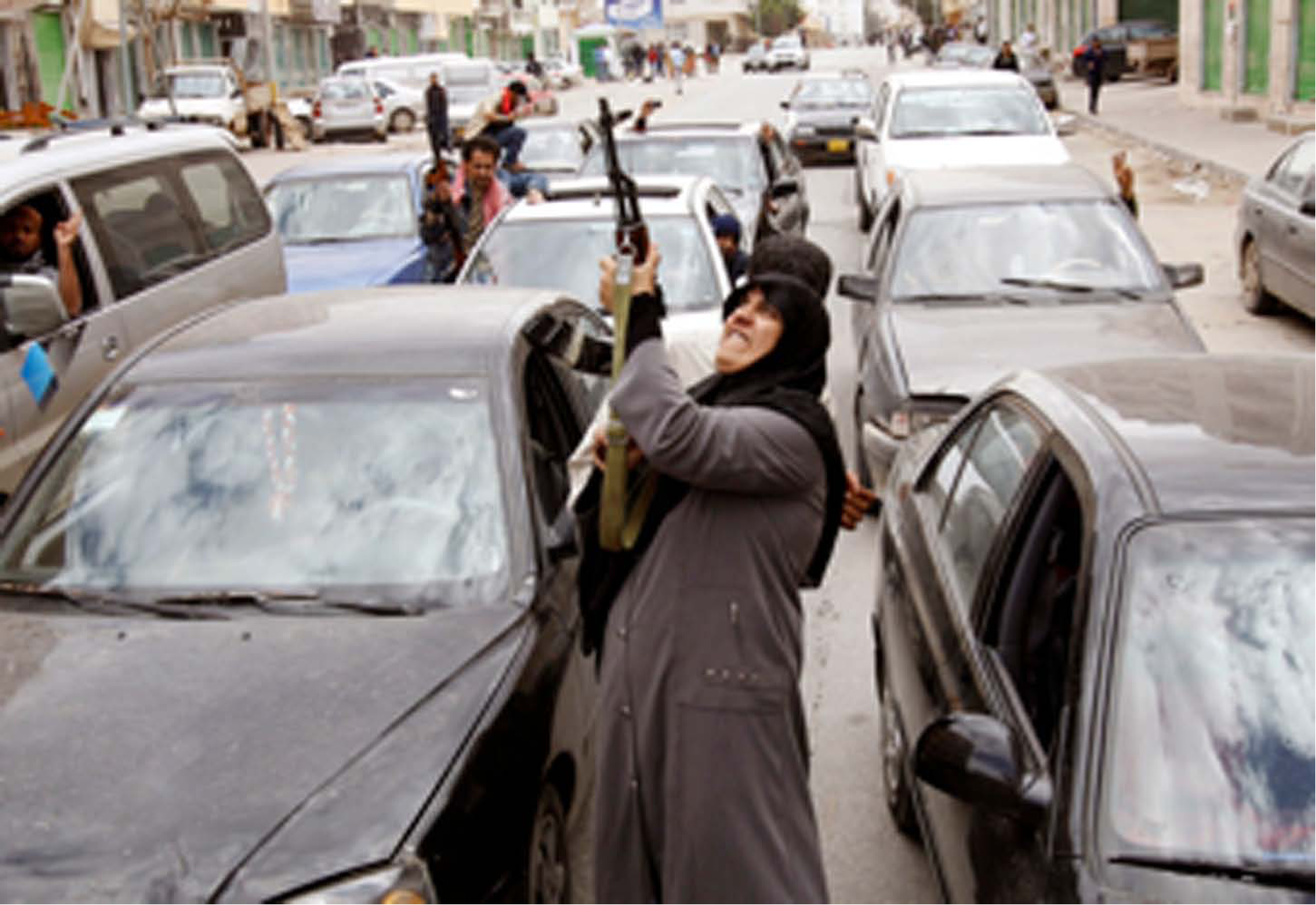
‘The armed opposition in Benghazi’ in the tumultuous days preceding Gaddafi’s fall, as photographed by Göran Tomasevic/AP. For a professional photojournalist, the camera held up through the car roof is a significant detail to include.
These forms of witnessing gain the character of ritual, through their repetition and in the symbolic meanings that accrue to them, both within the unfolding of specific events as well as across widely dispersed events in different parts of the world. As the performance of amateur photography occurs again and again in journalistic photographs, it is recognized and used to interpret and explain events. In an era of participatory media practices these performances of photography are now part of a symbolic world where viewers are addressed as witnesses and participants. An earth-shaking event calls forth forms of action and accountability among those who witness it that are event-specific; yet moments of unity and celebrations of victory occur even within disruptive and traumatizing events. These moments of celebration also contribute to ritualizing the event, not least because of the ways they are photographed. The men who made the sign of the V as they are photographed with Gaddafi’s body, or the man photographing a woman and soldier posing jubilantly together in front a tank in Tunis following the overthrow of the dictator (Figure 5) are commemorating an historical moment. Through the presence of the press, they are sharing their victory with the world.
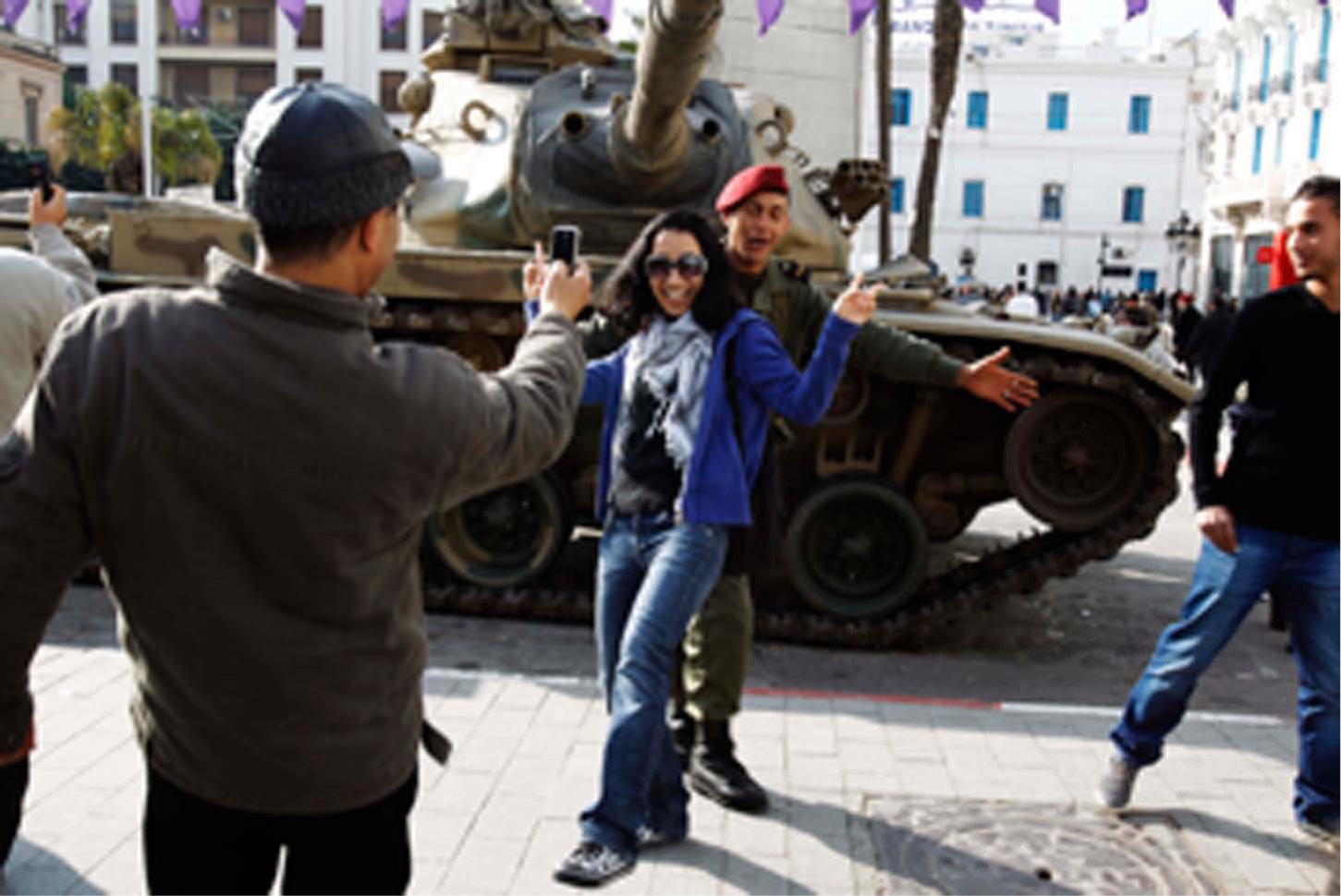
According to the caption, this was ‘a common sight in the capital city of Tunis after the revolution’ in Tunisia, here by Reuters photographer Fimber O’Reilly.
Conclusions
Discussions over the impact of ‘citizen journalists’ on the reporting of news, have emphasized how photographs and reports by these participants impact on journalistic practices and news content (e.g. Allan and Thorsen, 2009; Andén-Papadopoulos and Pantti, 2011; Outing, 2005; Robinson, 2009; Tilley and Cokley, 2008; Zelizer, 2007). The appeal to authenticity from first-person accounts by non-professionals is widely seen as a threat to the professional authority and standards of journalistic practice. In its strongest terms, the critique asserts that journalism is abdicating its role as witness to the amateur. Images of the ordinary people taking pictures would appear to support this critique, as journalism provides a visual confirmation of the power and significance of the amateur’s place in the reporting of news. How are we to understand this paradox? What does it mean when journalism includes these photographing ‘others’ in coverage of news and media events?
In the first place, the image of the amateur is a meta-picture, a self reflection on the practices of representation, destablizing the viewers’ point of view by authenticating a multiplicity of perspectives. By displaying these performative acts of photography in the news, journalism acknowledges the existence of other, alternative points of view on the event. The news photograph of the amateur’s gestures includes a performance of the ‘power to make visible’ a significant moment. As shown in the examples above, this applies, too, when rescue workers or other professionals on the scene are shown taking pictures as part of their work. Even the confrontational images of an amateur photographing ‘back’ at the press corps fit into a framework that acknowledges alternative viewpoints on the event. It is difficult to see this pluralistic recognition of digitized visual culture as directly undermining journalism’s authority.
Yet, as the magnitude of the event and its news value increase, these acts of witnessing on the part of amateurs start to intervene more critically in the institutional logics of mass-mediated visibility. In order to interrogate this intervention, I return to Ashuri and Pincheviski’s (2009) distinction between ‘inhabiting’ and ‘obtaining’ witnessing with regard to different aspects of the media event. In photographs that depict amateurs documenting celebratory moments, such as the victory pose of the couple in Tunis (Figure 5), journalism acknowledges the rituals of amateur photography as signifying this aspect of the event. Amateurs are shown performing acts of witnessing that they ‘inhabit’, enacting familiar practices of private domestic photography. Showing people engaged in their own commemoration of an historic moment, the press photograph suggests that their pictures are for their own use in the private sphere. During disruptive and traumatic events where taking pictures involves personal risk, the meta-picture of the amateur in the news works differently. Particularly when the meanings of the event are contested and it carries far-reaching consequences for the social and political structure, tension arises between private, individual interpretations of the event, and its public, historical significance. Where taking pictures is restricted or prohibited, as was initially the case following 9/11, or for the men allowed in to photograph Gaddafi’s body, the amateur ‘obtains’ the status of witness, as the photographic gestures create a bridge between the individual and the collective meanings of the event. The same can be said for cases where the amateur’s camera seems to be an inadvertent artefact in an image of chaos and violence, as in Figure 4. The news photograph is no longer only of people performing the private ritual of documenting events they want to remember; it links the shared cultural significance of that private act to the public enactment of witnessing, typically the professional’s domain. The amateur’s participant perspective is valued for its representation of experience from inside the event as it unfolds, and the possibility it offers to understand, explain and reinterpret its consequences for the future.
When journalism includes meta-pictures of amateurs in its repertoire of images from disasters and other traumatic events, as representations of eyewitnessing, it in effect abdicates the authority of its own presence, offering in its place a second-order account that disregards the power resonating from the participant’s camera. This suggests a shift in the concept of eyewitnessing within journalism, deflecting its meaning away from what journalists do when they cover events, and toward the actions and experience of participants. Tracing eyewitnessing as a keyword in news reporting, Zelizer (2007) found that the term often rests on strategic and uncritical references to technological advances and non-professionals, used to invoke journalism’s on-site presence and authority. ‘[C]ontemporary eyewitnessing no longer requires recognized journalistic stylistic features of the presence of reporters to claim eyewitness status’ (Zelizer, 2007: 424). With the widespread vernacular practices of image-making and distribution that are intrinsic to participatory media culture, journalism has included the amateur photographer as a ‘stylistic feature’ in its routines and, in the case of the traumatic event, into professional rituals for providing ‘eyewitness’ coverage of such events, with apparent disregard for the how the authority of the amateur undercuts the status of the institutional record. The amateurs’gestures point to the formation of a visual record that reflects proximity and experience from within the event, what it was like for participants. The reader is, in effect, ‘shown seeing’. Although not visible to the reader, the record to which these gestures attest eclipses the authority of the professional and the authenticity of the institutional account. When the ‘eyewitness’ to the trauma and its aftermath is an amateur photographer, journalism is levelling a critique against the value and authority of its own practice. The reflexive power of these meta-pictures privileges the status of the non-professional as eyewitness and the authority of the vernacular as a visual record that will shape how the event will be understood, including by future generations.
Footnotes
Acknowledgements
I am grateful for helpful comments from the anonymous reviewers and from colleagues Kari Andén-Papadopoulos, Anette Göthlund, John Kimmick, Eva Kingsepp, Alexa Robertson, Marja Salo, Tytti Soila, and Trond Waage.
Funding
Portions of the research on which this article is based were carried out with support from grant 2009-29680-64897-65 from the Swedish Research Council.