



Abstract
Scientific knowledge in the area of journalism has been predominantly a reflection of research on journalists from elite publications rather than journalists from smaller publications. This research seeks to create a foundation for future research through a web survey of online community journalists in the USA. This study measured the extent to which their perceptions and publications reflect organizational traits such as a reliance on routine sources, income derived from publication and employment of news staff. This descriptive research also found that most online community journalists had a degree, but not a degree in journalism and communication. Suggestions are put forth to further theory and research on community journalists.
In recent history, the product of news has predominantly reflected values, routines and norms of professionally trained journalists from larger organizations, which means that most scientific knowledge reflects this category of journalists (Tuchman, 1978). Traditional journalists are being challenged as the authority of what is considered journalism (Stearns, 2011). However, only a few studies have looked at the behavior, content and perceptions of community journalists from smaller publications (e.g. Atton and Wickenden, 2005; Carpenter, 2010; Eliasoph, 1988; Lowrey et al., 2011; Robinson and DeShano, 2011). This research seeks to partially fill that gap through a survey of US online community journalists. In this particular study, the study addressed the extent to which US community journalists are trained in journalism and mass communication fields and whether their work reflects indicators of organizational behavior. Theoretical suggestions are also put forth as to how to organize research on community journalists and to conceptually define them.
Literature review
Conceptual definition
Community journalists are a disconnected group, which makes it challenging to precisely understand their attitudes, behavior or impact on society and to develop an all-encompassing label to represent this subset of journalists. One theoretical challenge with this line of research is the diversity of labels applied by researchers. Rural, black, Hispanic, neighborhood, weekly, urban, country, rural, civilian, citizen, blog, hometown, underground, advocacy and dissident publications can be classified as community journalism publications (Byerly, 1961; Carpenter, 2008; Donahue et al., 1972; Duncan, 1952; Gladney, 1990; Hindman, 1998; Janowitz, 1952; Kessler, 1984; Lewes, 2000, 2001; Lowrey et al., 2011; Reader, 2006; Waisbord, 2009; Ward and Gaziano, 1976). In literature related to the study of online providers, these people have been referred to as participatory individuals, community journalists, citizen journalists, pro-ams, bloggers, non-profit journalists, alternative journalists, user-generated participants and producers (Bruns and Jacobs, 2006; Carpenter, 2010; Deuze et al., 2007; Friedland and Kim, 2009; Harcup, 2011; Lewis et al., 2010; Meadows, 2013; Nah, 2008; Reich, 2008; Robinson and DeShano, 2011; Singer, 2010).
Despite the diversity of labels used by researchers, these publication types and the people working for them do have several attributes in common. Community journalists tend to focus on gathering and creating engaging content less regularly for a smaller, more homogenized group of people (Carpenter, 2008; Fico et al., 2013; Forde, 1997; Johnstone et al., 1976; Reader, 2012; Tichenor et al., 1980; Weaver et al., 2007). One cannot practice community journalism without recognizing the importance of relationships to them (Meadows, 2013; Reader, 2012; Weaver et al., 2007). Their strength and weakness is their more intimate association with their self-identified community (Reader, 2012). Another common thread appearing in research on smaller publication reporters is the perception that their content is filling informational and representative gaps left by traditional news media (Atton, 2002; Forde, 1997; Knight Community News Network (KCNN), 2007; Lewes, 2000; Robinson and DeShano, 2011; Project for Excellence in Journalism, 2011; Stearns, 2011). This form of journalism may be a response to the need for a journalism that more precisely reflects the public’s desire for a more perceived meaningful understanding of issues (Stearns, 2011).
Journalists tend to serve specific communities, and technology facilitates collaboration by providing a platform to publish information that can link people together enabling the formation of community. Lowrey et al. (2008: 275) argued community news media should ‘facilitate the process of negotiating meaning about community and reveal or ensure understanding of community structure.’ Overall, communities reflect active involvement and shared values. Journalistic information functions to safeguard the existence of democracy; it does this by encouraging people to act as a collective. The duty of the journalist is to serve people – that includes both people who make up the masses and people who belong to smaller subgroups. Thus, journalists work to serve specific communities varying in size. Typically, these journalists are a member or seek membership into a community, and they use publishing platforms to interact with the public (Lewes, 2000). To encourage a sense of place and belonging, community journalists express themselves and contribute civically by publishing information about a community. Information published on a semi-regular basis creates a connective fiber among all members and visitors.
Community has historically been included in definitions related to journalism focused on smaller audiences (Reader, 2012). For example, Bleyer (1918: xiii) said, ‘News is anything timely which is significant to newspaper readers in their relation to the community, the state and the nation.’ Since the 1950s, the label of community journalists has been used for journalists working within smaller newsrooms (Byerly, 1961; Reader, 2012). The concept of community, including the reach of journalism, has received a more critical look thanks to the advent of virtual communities. In the past, researchers mostly referred to community as a physical location (Lowrey et al., 2008). A community can refer to a geographic area or refer to a group of people with similar interests (Christensen and Levinson, 2003). Kurpius (2000: 340) stated that a community is ‘the interconnected relationships among people who share a common goal, neighborhood and/or relationship.’ Hillery’s (1982) analysis of 94 definitions of community found most include social interaction, common ties and physical location. Jones (1995) found the construct of community included an emphasis on social involvement and interaction. The internet enables interaction with people with diverse or similar interests. But Deuze (2007) argues simply that, in most cases, a community represents the ‘absence of difference.’
Since the definitions of community highlight the importance of social cohesion and relationships among niche groups, we support other authors’ arguments that smaller publication content providers should be called community journalists for precision and historical reasons (Meadows, 2013; Reader, 2012) rather than alternative or citizen journalists – two of the most often used labels. Both authors argued that community media more precisely emphasizes the relational intentions of their content. Alternative journalism is a subset of community journalism. Publications with the label of alternative tend to focus on the production of change and opposition. The term alternative suggests that journalists are opposite to another category such as traditional journalists. However, research has found that community journalism can complement traditional news media in their coverage (Fico et al., 2013). As long as there is a movement, the publication exists (Atton, 2002; Lewes, 2001). Often, media outlets define themselves in contrast to traditional media (Lewes, 2000). Thus, this type of journalist can only carry this label if they behave contradictory to the way traditional journalists behave. Citizen journalists have been defined as people who do not receive an income from mainstream news organizations (Robinson and DeShano, 2011). In recent history, researchers have used this label extensively, but the appropriateness of label has not been fully examined. Citizen journalist was not used because the label includes all people who are citizens and excludes people who are not citizens. And it has been criticized for its narrowness and utility (Meadows, 2013; Reader, 2012).
We also argue that many online community journalists, or what some researchers and writers have referred to as citizen or alternative journalists, are journalists. Studies found community journalists, along with news audiences, value the roles that community journalists play in local communities (Chung and Nah, 2012; Nah and Chung, 2009, 2012). One survey found the majority (79%) of online community journalists argued they produce journalism (KCNN, 2007). As further evidence showed, some traditional news media organizations employ online community journalists. And many entrepreneurial and laid-off journalists are launching their own online publications. For example, Project for Excellence in Journalism (2009) researchers found two-thirds of people interviewed associated with citizen journalism sites had backgrounds in paid journalism averaging 14 years in professional experience. Open-ended responses from this sample show several respondents have a decade or more of experience working at US newspapers before deciding to launch their own community publication. Meadows (2013) argued the differences in content creators lie in levels of engagement with the audience rather than professional history. In this research, we define a community journalist as an individual who intends to publish information that is meant to benefit and engage community. And for the purposes of this investigation, traditional news media organizations are defined as commercial news organizations that have historically focused on the daily delivery of information concerning a geographic (e.g. local, state, national, international) area in either a textual, audial or visual format offline (Carpenter, 2008).
Journalist training
Shoemaker and Reese’s Hierarchal Model of Influences (1996) visually demonstrates the behavior of journalists is related to several hierarchal factors. The model helps explain the factors that affect media content. The five proposed layers are individual, routine, organization, extra-media and ideological.
At the individual level of their model, attitudes and values are first transmitted to journalists as undergraduate students and interns. Universities are encouraged to train students for the journalism field, which includes socializing them into the routines and values of a journalist (Breed, 1955; Reese, 2001). Many non-journalistic entities do not consider journalism to be a profession because there are no licensing requirements that require journalists to follow guidelines on how to select, construct and disseminate information (Johnstone et al., 1976; Kovach and Rosenstiel, 2001). Thus, people do not have to earn a degree to publish information. However, a college degree has become an expected credential of newly hired traditional journalists. Research in 2002 showed the majority of newly hired traditional journalists (76%) earned an undergraduate degree in journalism or mass communication, while most (89%) possessed a college degree. In addition, a 2006 study showed 83% of US journalists earned a university degree (Quandt et al., 2006). Weaver and colleagues (2007) argued educational diversity is decreasing among journalists, and predicted that their professional values and ethics will likely become more homogeneous. This research assessed the educational diversity of online community journalists not working for a traditional news media company.
Even if information providers have a degree, they may still need additional training in niche areas. To work in a competitive and changing environment, people seek additional training. The instability of the labor market has encouraged people to be more flexible and diversified in their skills (Deuze, 2007). Several professional organizations offer workshops and conference sessions to fill informational voids. This research asked respondents if they have sought additional training in areas related to journalism.
Organizational traits
One measure of organizational behavior is to examine the extent to which online community journalists rely on routine sources for news discovery. Routines are a reflection that a group is behaving more like an organization. Shoemaker and Reese (1996: 105) define routines as ‘those patterned, routinized, repeated practices, and forms that media workers use to do their jobs.’ To cope with deadlines and stress, routines evolve within organizations. A sign that community media are behaving as an organization is their adherence to media routines.
Most research focuses on the content, rather than story idea generation routines. Traditional news people often get their facts from official sources, rather than investing time in conducting primary research using a diversity of people and documents (Fishman, 1980). Gans (2011: 4) accused journalists of being ‘stenographers for public officials.’ Journalists seek credibility and legitimacy by citing official sources (Gans, 2011; Tuchman, 1978).
Research on source reliance is less clear for online community journalists, however they do have greater production freedom in story generation and selection. Size and organization type are influential characteristics that affect editorial freedom (Weaver et al., 2007) and source access (Reich, 2008), which in return influences story ideas. Research has shown community journalists may not be relying on traditional types of sources, but rather sources such as traditional news media reports, first-hand personal experience and hyperlinks to external content (Atton and Wickenden, 2005; Carpenter, 2008; Lowrey, 2006; Reich, 2008; Robinson, 2006; Singer, 2005; Project for Excellence in Journalism, 2009).
Research is mixed as to whether community journalists follow routines similar to traditional journalists. Eliasoph (1988) conducted a case study on an alternative radio newsroom finding reporters used the same routines as mainstream journalists. She argued economic and organizational factors affected news content more than routines. For example, the organization hired directors they liked and respected, which led reporters to feel compelled to align with the station’s political philosophy because they controlled access to the airwaves. In comparative content analytic research on US daily newspapers and citizen news sites, it was found online citizen journalists used a fewer number of sources, more unofficial sources, more public relations items and used their own personal experiences in articles more often (Carpenter, 2008).
In comparative interviews of journalists from one Isareli community website and three mainstream sites, Reich (2008) discovered community journalists tend to rely more often on personal contacts and personal experience in the news discovery and gathering phases. Traditional journalists were more likely to rely on routine sources, such as senior sources and public relations professionals. In a case study of an UK activist weekly newspaper, Atton and Wickenden (2005) found alternative journalists tend to cite protestors and activists. These individuals used their space to share their interpretations of actions by people in power. In that study, the authors argued that alternative journalists see themselves as writers rather than journalists. They said, the ‘source and writer become one’ (p. 349).
Research questions
We wanted to identify characteristics of participants and their publication including their story generation routines. These goals were accomplished via a web survey of US online community journalists administered during 2011.
RQ1: What proportion of online community journalists have been trained in journalism and communication?
RQ2: To what extent do online community journalists rely on routine and non-routine sources for story ideas?
Research has shown A-list bloggers have begun to behave more like organizations. They are adopting policies and rules, seeking revenue, codes of ethics, hiring staff and disseminating information on a regular basis (Lowrey et al., 2011).
RQ3: To what extent do online community journalists and their behaviors reflect organizational behavior?
Method
Design
The data for this quantitative survey of community journalists came from three sources because there is no single complete list. We attempted to gather a comprehensive list of active journalists. In sampling, we first referred to the list available at the Knight Community News Network (www.kcnn.org). This website is likely the most comprehensive list of community media sites, which included a list of about 1047 sites in spring 2011. We excluded sites that were inactive within a three-month time period, affiliated with traditional news media and university sites, aggregators, advertisements, duplicate sites, online community forums, internationally-focused, non-geographical or multiple sites listing the same staff members. We also used the citizen media lists aggregated by Cyberjournalist.net (2006) and SourceWatch.com (2011), which have been used in previous studies on online journalism (Carpenter, 2008). Cyberjournalist.net is a site that is dedicated to examining how technology affects the news media. In spring of 2011, Cyberjournalist.net listed 81 US ‘citizen media initiatives.’ SourceWatch, a list of 25 sites at the time, is a web directory of people and organizations affecting the public agenda. We attempted to include the Placeblogger.com list; however, the maintenance of that list was discontinued according to the owner Lisa Williams (2011, personal communication). We were permitted to scrape their data if we had access to a programmer, however we did not have access to one at the time.
Based on observations, the community journalism sites varied in several ways: geographical focus (west/east/south/Midwest); community and audience size; business model (profit vs. nonprofit); composition of the contributors (solely journalists, combination of journalists and community members); frequency of update; layout and topics covered (general news sites (including politics) or specialized news sites such as a focus on arts).
Community journalists were recruited through online survey solicitations addressed to the editor or creator of the website. Web surveys were chosen because this national sample was most likely accessible via the internet, which made this methodological approach most suitable (Dillman, 2007; Greenlaw and Brown-Welty, 2009). And many of the sites did not provide mail addresses, telephone numbers or even names, limiting the ability of the researchers to conduct a mixed-mode paper and web survey. The researchers attempted to retrieve the full name of one editor or the creator for each site including a personalized email address to increase the response rate (Dillman, 2007; Heerwegh, 2007; Joinson and Reips, 2007). We requested their contact information via comments, contact forms and social media channels because many sites did not post this information. We were able to obtain 332 names and email addresses from people who operated a functioning site at the time. Based on observations, most often website operators preferred offering interactive opportunities with the site operators via content forms or article comment forums.
The Tailored Design Method internet survey methodology (Dillman, 2007) was followed to conduct the survey using Qualtrics. A pre-notice email message was sent. After three days, an online questionnaire was sent. On the second and the fifth weeks, additional emails were sent to nonresponsive subjects. The online survey was active for approximately two months in July to September 2011. The survey was sent to 322 people, which resulted in a 34.2% response rate and 26.3% completion rate. The response rate reflects more than the rate of 1–30%, which is commonly achieved in web surveys in the area of mass communication (Wimmer and Dominick, 2006). Web survey response rates of journalists have been found to range from 19.5 to 29.7% (Cassidy, 2007, 2008; Dailey et al., 2005; Lee, 2005; Reinardy, 2009; Smith et al., 2007).
Questionnaire
Respondents received an online questionnaire. The email body contained an introduction informing the respondents of the purpose of the study that included an embedded link to the online questionnaire and a welcome page. The majority of the questions were based upon a five-point Likert-type scale with the exception of a small number of short-answer fill-in-the-blank and demographic questions toward the end of the questionnaire.
Operational measures
Journalist training
Respondents were asked, ‘If you have a bachelor’s degree, what is your primary degree field?’ The degree field options were based on Weaver et al.’s (2007) study of American journalists. The journalism and communication options included Journalism, Mass Communication, Radio, Television, Photography, Communication, Advertising, Public Relations, Marketing and Telecommunication. Outside degree fields included English, Creative Writing, Literature, Computer Science, Programming, Political Science, Government, History, Law, Business, Physical or Biological Sciences, Economics or Other.
Story generation routines
Items were created based on previous media routines literature to operationalize story idea resources. Items were rated on five-point scales ranging from never (scored 1) to always (scored 5). Routine sources measured were public relations spokespeople, press conferences or press releases; city, county or state government officials; school officials; local business leaders; traditional news media; news wire and law enforcement. Nonroutine sources included friends, family, activists, online sites (e.g. blogs, online-only publication), non-profit organizations, church leaders or members, personal experiences and reader contributions.
Organizational characteristics
Respondents were asked a series of questions tapping into whether their sites reflected characteristics of organizations. They were presented with questions asking how often they published content, how long they had been publishing content on their site, number of employees, income derived from publication, reliance on advertising and whether they published information from an office space or home.
Results
Of those who responded to demographic questions, 60.0% were male and 83.5% were white. More than half of all responding participants classified their site as a blog (55.3%). Overall, the sites averaged 58,373 unique visits per month. Most participants were very or extremely satisfied (50.6%) with their community. The primary focus of their content was covering local issues (76.4%), followed by state (16.5%) and national (5.9%) issues. Most of the online community journalists perceived that they had freedom from editorial control; the majority (71.8%) of them always or usually felt free to publish on any topic.
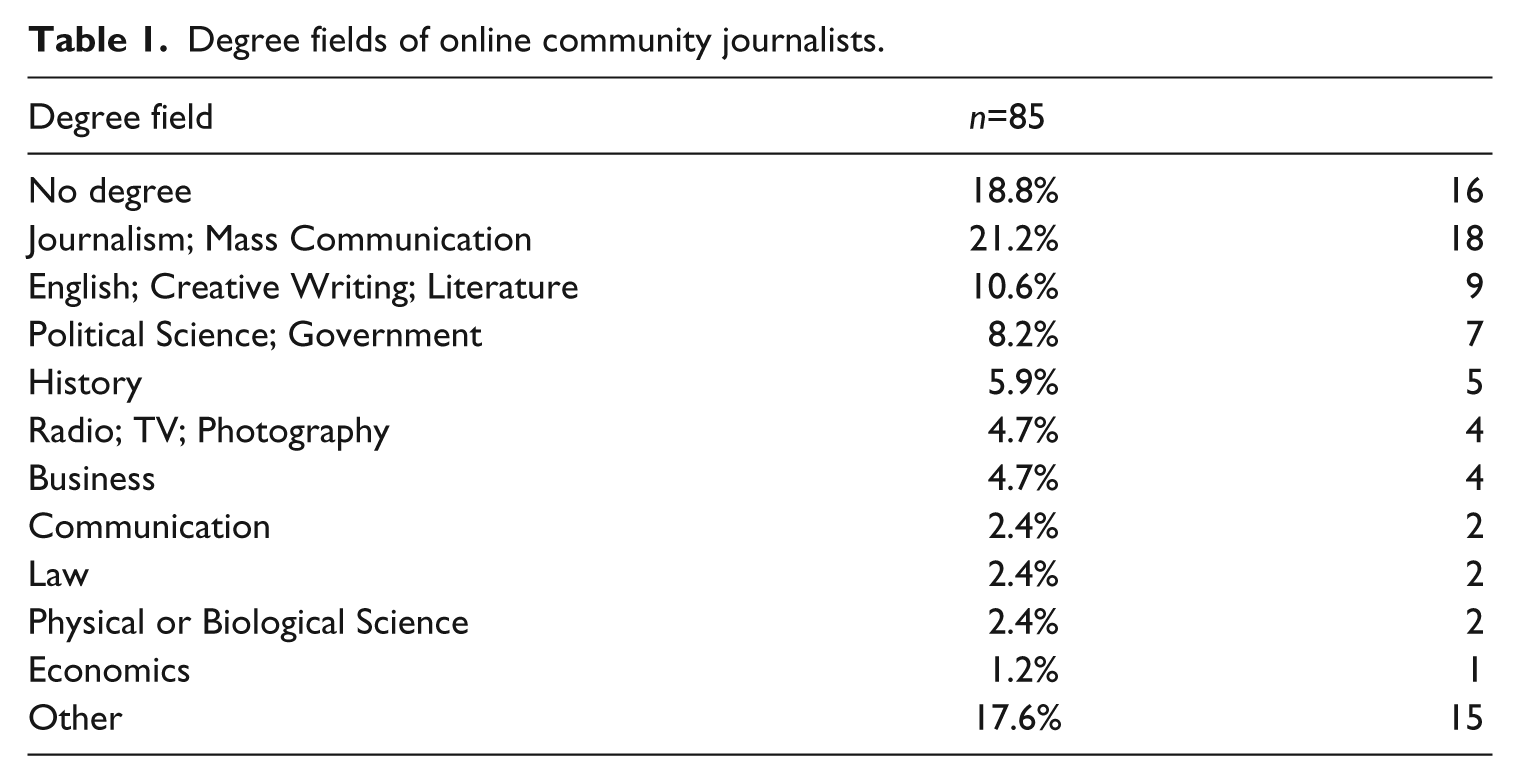
RQ1 asked to what extent community journalists had training in journalism and communication. Overall, most journalist participants possessed a degree. Most possessed a bachelor’s (47.1%) or a master’s (28.2%) degree. More than one-quarter (28.3%) earned a bachelor’s degree in journalism and communication fields and more than half (52.9%) had a degree in an outside field. And 18.8% of the respondents did not have a degree (see Table 1). Participants who contributed to the ‘other’ fill-in-the-blank degree category included the following responses: urban planning, sociology, psychology, education, mathematics, fine arts, classics (Latin and Ancient Greek), American studies, architecture, engineering and social work. A notable proportion (45.9%) of participants cited professional training classes or experience including American Press Institute classes, Knight Foundation classes, working at a newspaper and conference seminars.
Degree fields of online community journalists.
To answer RQ2, this research shows that they rely on a mix of routine and non-routine sources. They are more inclined to use personal experiences, government sources and online-only publications to find story ideas (see Table 2).
Story idea resources of online community journalists.

sd = standard deviation.
Routine sources (1=never, 2=rarely, 3=sometimes, 4=usually, 5=always).
RQ3 was concerned with understanding whether these individuals and their publications were likely to reflect the traits of an organization. Results show they behaved like an organization in some ways. Most of the respondents publish content at least once (30.6%) or many times (28.2%) per day. Most have published for an average of 4.5 years and they paid an average of 1.7 employees. A notable proportion (49.4%) of the respondents earns money from advertising. However, most community journalists do not make much money from their publications. Most participants (82.4%) earned an income of US$35,000 or more, but their publication was not their primary source of income (76.5%). This data show most participants choose to work from home (69.4%) rather than an office (28.2%).
Discussion
Weaver et al. (2007) argued journalists are increasingly becoming less educationally diverse. However, these results show a slightly different picture. If future survey research includes nontraditional journalists, it may likely show a notable proportion possesses degrees in fields outside of journalism and communication. The amount of education has been shown to be influential in whether journalists seek to challenge the status quo of society versus behaving as neutral observers (Johnstone et al., 1972–1973). It would be of interest to measure the extent to which degree variations relate to their perceptions and content. And the people writing may be people with specialized expertise on a subject matter rather than people such as many traditional journalists with little knowledge about the subject material they cover (Stray, 2011).
Online community journalists and their sites exhibit some organization-like traits. This research showed online community journalists relied on both a diversity of informal and formal source materials for story ideas. As time progresses, community journalists may develop more routine procedures (Sutcliffe and McNamara, 2001). But what is needed in research is a reevaluation of how we operationalize sources. Participants who answered the other category included reliance on items such as added targeted RSS feeds, Google alerts, government databases, public records, town conversations, anonymous letters, Twitter chatter, investigative research and health officials. The web is a major component in story generation, and future research should more precisely determine how and to what extent journalists rely on such sources.
Interestingly, many online community journalists use people not connected to the organization for story ideas, but they are less inclined to publish content from people not working for the organization. Additional descriptive results show online community journalists never (21.2%), rarely (15.3%), sometimes (30.6%), usually (17.6%) and always (14.1%) use content produced by people not associated with the publication. Online community journalists may seek to be plugged into online community conversations to increase the accuracy of their content, but they may feel strongly that content needs to be vetted through a personal and professional lens prior to publication. Research on traditional journalists has found a similar trend. Traditional journalists have been vocally dismissive of the value of citizen journalism content (Lewis et al., 2010; Nah and Chung, 2009; Robinson and DeShano, 2011; Singer, 2010), yet they use this content to inform their stories and refer to alternative journalism sources on their own sites (Farrell and Drezne, 2008; Lowrey and Mackay, 2008; Singer, 2010). Newsroom leaders may require employees to connect with people via social media and comments out of perceived need to survive, but it is questionable whether there is a genuine desire to include them in the process. In Robinson’s (2011) study of a Madison, WI newsroom in the US, she found journalists are connecting with readers, but they are hesitant in developing relationships on a deeper level. The process of verifying information from outside sources takes time. For future research, it would be of interest to see if online community journalists are more likely to rely on a greater diversity of sources for story ideas in comparison to other online content providers including traditional media. That research may find that online community journalists may be more web savvy, rely more on networks due to resource limitations and/or the desire to get to know their community through a diversity of perspectives. Another important theoretical step is to operationalize community journalism. Suggestions include measuring the community-focus of content, interactions with community members, staff size and norms (Reader, 2012). Perhaps, the measurement of mobilizing information, community-related frames, relational perceptions with readers and staff interactions with the public could be included as well. And the creation of categories of community journalists would help organize research efforts.
Community organizations are in short supply of staff and resources (KCNN, 2007). It is common for online community news organizations to work with limited resources (Reich, 2008; Schaffer, 2010). In a study of 46 active non-profit news sites in the USA, Project for Excellence in Journalism (2011) researchers found many online community journalists did not publish on a consistent basis and several employed a small number of people. This means many community publishers must play multiple roles such as editor, salesperson and supervisor (Johnstone, 1976). People working in online media are most likely to classify themselves as an editor (Carpenter, 2009). The majority (90.6%) of respondents said they had the job responsibility of editor and 36.5% said they were responsible for sales. Open-ended responses revealed a diversity of other job responsibilities and titles. Some included community manager, publisher, writer, owner, founder and content manager.
Conclusion
This research on online community journalists helps to begin to identify areas that need to be addressed about them as a group, and can be used as a foundation for future survey research. In open-ended responses, several respondents shared with us that they had several years of professional newspaper experience; thus, it is problematic to classify them as a non-journalist or alternative journalist. Factors that may influence their content are resource limitations and a lesser degree of managerial and editorial influence.
Several reasons exist as to why research is conducted less often on online community journalists. Data show most participants choose to work from home rather than from an office, and their publication is not the primary source of household income. These obstacles make them a less attractive group to study in comparison to research on traditional news media. Traditional news workers tend to work under one roof, which makes it easier to conduct participant observations, surveys and interviews. Researchers are limited in their ability to access such a disconnected group. This is a problem researchers in other academic fields must face as fewer people are working under organizational umbrellas. Deuze (2007) argue media work will increasingly reflect the efforts of people who are loosely connected, and media work will increasingly take place at the individual rather than organizational level. This is a methodological obstacle when a quality qualitative newsroom observation study can take as long as seven weeks (Shoemaker and Vos, 2009). To address methodological limitations, telephone interviews, focus groups or content analysis would be fruitful in assessing their content, perceptions and behaviors.
Master lists of community journalists are needed to increase the validity of data concerning this group. The majority of sites on existing lists were discontinued, which means that they no longer published media content. Lists are helpful in expanding research beyond that of elite news publications. Convenience is a major factor that encourages research. Researchers often choose easier lists over more challenging ones (Babbie, 2013). Thus, the existence of newspaper and television news station lists means that they are more likely to be researched. And no maintained list of online community journalists equates to less research. Lists, or what is referred to as sampling frames in research, also allow researchers to apply inferential statistics to generalize findings to the list. Once a sampling frame is established, researchers can then select a sample for research purposes. Sampling protects researchers from their biases and helps to ensure statistics are accurate. Sampling bias is removed when all members get an equal chance of being selected from a list. And if the sampling frame is not representative of the population, statistics applied are less meaningful.
To administer mixed-mode email and paper mail surveys, a mail address is needed. However, few community journalists published their contact information. During the aggregation of providers for the list, several publishers were not transparent in their identities. Some did not provide a mail address, email address, full name or phone number. The reason may be that they perceive themselves to be transparent to their community, and need not be as transparent on the web. To encourage future research, it would be helpful if this information was published because the path to precise knowledge is partially blocked if both researchers and the researched do not address these access issues.
Footnotes
Funding
This research received no specific grant from any funding agency in the public, commercial, or not-for-profit sectors.