




Abstract
Evolving from a small room at the heart of the printing house to a large, mobile open office, the newsroom is a concept that allows us to contemplate the changes that have transformed journalism over the past century. This article proposes a preliminary analysis of a corpus of photographs of media newsrooms in France, Canada, and Belgium at various points in history (from the end of the 19th century up to today). The analysis of newsroom photographs is necessarily multidimensional. It allows us to conduct a socio-historical study of how workplaces are created and structured and how information is produced. It paves the way for an analysis of the media’s modes of representation within the logic of external communication (to establish and promote its brand image through videos or pictures). It also permits us to make inferences while analyzing the organizational and managerial aspects of a company, and reveals the value of examining the objects used by journalists in their trade. Our goal is to clarify the various indicators and avenues for research that emerge from this corpus. This step will allow us to defend a specific approach to analyzing the material dimension of journalism.
The newsroom is a symbol, but also the physical space that gives birth to the production of information. Evolving from a small room at the heart of the printing house to a large, mobile open office, the newsroom is an important notion that allows scholars to contemplate the changes that have transformed journalism over the last century. Concentrating on the ‘newsroom’ can enable us to analyze the history of at least three shifting elements: the location of the newsroom, the spatial organization of the newsroom, and the objects within the newsroom. The first element refers to the advent of the very notion of a ‘newsroom’ and its location (Lévrier, 2011). The emphasis placed on the installation of newsrooms by media owners allows us to consider not only their placement next to the printing workshop, above the rotary presses or in a media center, but also their address, their position in the city, in what kind of buildings they can be found. The location of newsrooms is informative as it reveals the successive economic and editorial strategies of media entrepreneurs. Our second focus is on spatial organization, which allows us to observe how the workplace of journalists (Monjaret, 2002) has evolved over the years, bringing with it a shift in professional and hierarchical relationships. As Tuchman (1978) showed, physical space is more important in organizing networks of journalists than dividing them into topical areas. We must thus focus our attention on how workspaces are organized, where editors-in-chief are located within these configurations, where meetings take place, and so on. Finally, the third dimension of our analysis examines all the objects present in the newsroom (the typewriters, pens, computers, telephones, and smartphones). Changes in the presence of these tools in newsrooms can teach us about the material conditions of media production, but also about the more or less rapid transformation of journalists’ daily use of tools.
The approach defended here begins from socio-historical perspective and studies the visual representations of the workplaces of journalism, defined as a collective place belonging to a media company. Visual representations include photographs of newsrooms and buildings, architectural plans, birthday albums of the media companies, drawing of the newsroom made by journalists or researchers themselves. Methodologically, the article draws from a corpus of photographs of media newsrooms in France, Canada, and Belgium at various points in history (from the end of the 19th century up to today). Pictures are both sources and histories in themselves (Osmond, 2008). Here we are in keeping with the perspective adopted by Brennen and Hardt (2002), who argued that ‘photographs representing aspects of newswork may offer especially appropriate insights into the understanding of the professional self under specific social and institutional circumstances within media organisations’ (p. 12).
This article explains how the organization of physical workspace, called the newsroom, 1 is important to an understanding of the constraints and flexibilities that journalists had been forced to live with during their daily work lives, as well as how the spatial environment of journalism has been imagined by others and contains ideological underpinnings. A few researchers have examined the newsroom as an object in its own right. Recently, Akhteruz Zaman (2013) has interviewed journalists about how they, as news workers, describe the newsroom, opening up the possibility of thinking about the newsroom as a real and at the same time an ideal space.
By reintegrating (in the first part of the article) this perspective into the tradition of studies on industrial photography, and in the tradition of ‘historiophoty’ (White, 1988), we seek to explain, in a second part, the heuristic scope of this approach and elaborate upon the methodological difficulties encountered in both assembling and analyzing the required corpus. Finally, the third part of this article will present the results of the cross-case analysis of the photographs as a whole. Our goal is to clarify the various indicators and avenues for research that emerge from this corpus. This step will allow us to defend a specific approach to analyzing the material dimension of journalism.
A new approach: Analyzing media companies through photography
The study of changes in the world of journalism has often taken the form of analyses of contemporary transformations (multi-platform production, the use of social networks, evolving media coverage, new relationships with the public, etc.), or of historical evolution (the transformation of professional identities, the development of production and media coverage processes, shifts in the labor market, relationships to the public or original sources). This article takes a different look at the dialectics of continuity and change within journalism (Le Cam and Ruellan, 2014), thanks to the analysis of newsrooms photographs. This perspective has rarely been adopted in studies of media and journalism. Brennen and Hardt used a newsroom photograph from the 1930s to illustrate the value of photographic analyses of workplaces. And yet, journalism studies have rarely considered the visual representation of how work is organized, as evidence of this world’s transformations, both material and symbolic. Where they are taken into account, photographs of newsrooms appear as ‘visual facts’, ‘apparently bearing no relation to the written word and bundled together at the center of a book for what seems to be purposes of light relief’ as noted about photographs in sport history (Bale, 1998, quoted by Osmond, 2008).
Our work is not directly rooted in visual anthropology or visual analysis. Instead, we have attempted to establish a connection with the more limited domain of the analysis of industrial photography and what White (1988) has called historiophoty, as the ‘representation of history and our thought about it in visual images and filmic discourse’ (p. 1193). We consider then pictures as the material vestige of their subject (Sontag, 1982, quoted by Osmond, 2008). Imagistic helps to understand
the way things may have appeared to the agents acting on a given historical scene. Imagistic (and especially photographic and cinematic) evidence provides a basis for a reproduction of the scenes and atmosphere of past events much more accurate than any derived from verbal testimony alone. (White, 1988: 1194)
Studies in industrial photography have used pictures to gain access to a type of reality relating to the organization of workspaces. Through analysis, studies of industrial photography have managed to describe and examine working conditions, organizational configurations, and the role of ‘objects’, ‘machines’, and people in professional environments. These studies have been useful for our work, as images of newsrooms share many traits with industrial photographs. In large part, they illustrate the ‘machinery’ of journalism that defines individuals as part of an industrial process (Brennen and Hardt, 2002: 26).
Following in the footsteps of Dewerpe’s (1987) work on industrial photography at the beginning of the 20th century in Italy’s Ansaldo engineering company, here we have chosen to consider photographic documents as primary sources for our research. We collect these pictures as traces of the history of the media. It is only during a second stage that these images are connected with a number of explanatory texts. These photographs are considered as the nodal point of our research, in order to save them from being solely archival resources or the mere ‘residue’ of written texts (Dewerpe, 1987: 1079). The debate still rages about the following question: ‘Can photography or film be at the heart of an investigation, or will they always be relegated to a marginal, secondary function as mere illustration?’ (Rémy, 2007: 89). Lurking behind this question is also an ethno-methodological approach that uses photography as a means for analysis: a researcher takes photographs himself, which he then uses as his raw material. In writings on industrial photography, authors do not generally adopt this perspective. They use images as the trace of a certain reality, albeit an imperfect and biased one, and these images constitute the source documents of their work.
These still images, created in factories, industries, and the business world, grant us access to a representation fixed in time and consequently reveal the tangible configuration of work, locations, tools, and often anonymous individuals. Assembled into a historical corpus, such images allow us to measure the scope of changes within a given company and consequently, to analyze the material and symbolic transformations of physical workspaces, organizational configurations, the objects used, and so on. Photographs have been widely used in cultural history, where they succeeded in revealing entire swathes of society (the world of agriculture, representations of immigration, etc.) to the public at large. However, they have to a large extent overlooked by media studies (Brennen and Hardt, 2002).
Nonetheless, photography is not a technique that merely represents the real. Studies on photography of workplaces have adopted a two-fold perspective: on the one hand, photographs give us access to the tangible, material organization of sites of production, but on the other, they are also simultaneously the images offered up by a company, its attempt at presenting and representing itself to the outside world. Dewerpe (1987) also reminds us of the duality of the system of representation conveyed by photographs, which connects the constructed image (the manifest image – which is a strategy of self-representation, in particular for companies), and the proffered image of industrial work portraying the representation of labor, and thus processes in the making (p. 1080). In visual representations of factories from the beginning of the 20th century, photography seems to function as a form of ‘cultural coherence’. ‘For industrial and financial tycoons, these representations simultaneously ratified their visionary talent and the validity of their economic beliefs […] They reassured citizens with regard to the social, sanitary and moral quality of their society’ (Aubert, 2001: 38). As is the case in studies of the automobile industry, photographs can also symbolically represent an entire nation and depict this industrial sector as one of its ‘vital and venerable organs’ (Lannoy, 2010: 115). In the world of media, some photographs are also used to this end: to portray the media’s power, its productivity, and its importance for society. Such photographs are especially potent when they are assembled into albums 2 or special issues commemorating media events. Nevertheless, not all photographs are disseminated to the public. Many images, especially those involving the editorial process, are conserved internally. In such cases, these images are thus perhaps indicative of a desire to follow the news organization’s evolution, to depict organizational changes (a new office, a new technical object), or to conserve an internal record of media history. These pictures are official, as they have been taken by someone ‘from’ the news organization, and archived as traces of the evolution of the news organization. We don’t know if the photograph had a permission or not, if he was the official photographer or not.
With regard to the corpus assembled, our hypothesis here opens up photographic representation to something other than a mere depiction of businesses, brands, and reputations. We argue that photographs also attest to production processes and the organization of labor, which possess as many repeatable levels in the image. The messages conveyed by photographs reveal the different ways in which industrial labor is codified, thus also illustrating the specific discourse that an industry uses with regard to itself and its environment. According to Dewerpe (1987), there are three different types of discourses (p. 1080). First of all, photographs reveal technical processes: the machines, the stages of production, and the production cycle. They also illustrate factory landscapes and the environment’s topography: the surrounding areas, how much the factory stands out, the fencing off of the factory’s perimeter, the buildings’ morphology and aesthetics, the visibility of the name, and so on. Finally, photographs also allude to the social reality of labor (Dewerpe, 1987), as they expose the specific levels of discourse and representation involved. Certain formal traits are specific to particular work environments and their representation. A work environment may be ‘visible’ (in which case it serves as a pretext for something else), contingent (it appears in a photograph but is not the main subject of representation), or real (the photograph represents it in a direct fashion; Rouillé, 1984: 32).
Scholars like those mentioned above worked off a series of photographs, which allowed them to classify the representation of workplace environments. In our study on newsrooms, photographs are first used as evidence of the organization of the workplace and organizational changes in the world of journalism. Our cross-case analysis of all the photographs in our corpus tries to identify the indicators of change and continuity, as revealed by the material traces the photographs allow to shine through.
Examining these photographs naturally requires us to address several traditional aspects of visual analysis, which is a matter of describing techniques, styles, and themes. Photography can be viewed as a form of historical recontextualization, and interpreting it must take into account its dual meaning, both as conveyed by the photographer and as contained in our ultimate interpretation. However, due to the very nature of newsroom photographs, we are dealing with a specific kind of photographical discursivity (Véron, 1994). These images are not fine art photographs, family snapshots, or personal artifacts. They belong to a particular ‘social discursivity’ that seeks to show the process of labor, a company, its organization, and its employees. Consequently, they constitute a serial discourse (composed of specific entities) which must be linked in our analysis, and which permits a cross-case study of the discourses portrayed by photography. This research into newsrooms thus does not attempt to conduct a visual analysis of photographic composition, but rather to examine the social discursivities of journalists, journalism, and the news organization as revealed by photographs.
Composing a corpus of newsroom photographs
One could compose a corpus of newsroom photographs in a variety of ways. First of all, one could gather together photographs of buildings, which would allow for an analysis of the outside appearance of media companies, their place in the city landscape, and their architectural and physical integration into neighborhoods. The façade of buildings can be seen as the public image that a media company wishes to portray, an expression of the place it hopes to occupy within the urban landscape. Moving office buildings, renovating the outside and changing configurations are all instances of a media establishment trying to alter its public brand image and to integrate in its own territory. A second possibility would be to compose a corpus of photographs of all the workspaces of a given newspaper company: editorial offices, advertising and marketing departments, production studios (rotary presses, assembly sites, sound stages), documentation units, studios, newsrooms, and so on. This perspective would allow for an understanding of the general organization of the media world, the successive configurations of production spaces, media diffusion, and marketing. Analyzing how floors, offices, partitions, departments, and units are divided or grouped together tells us about how the media perceives and structures its general organization and about the strategies it wishes to implement. Finally, the third possibility is the one we have adopted in this study: focusing on a collection of photographs depicting the particularly meaningful space of newsrooms. Here we share the same perspective as Brennen and Hardt (2002), who stated that
although [the photograph of a newsroom] projects the presence of a variety of discernible individuals and objects and their physical relations as a ‘slice of time,’ it also produces a specific worldview. The photograph is not a conventional image of an editorial staff but rather a distinct visual statement about the newsroom as a symbolic space of human labor. (pp. 25–26)
Starting with an analysis of newsrooms gives us access to the depiction of the materiality of labor organization, production processes, and working conditions. The snapshot of a single instant is thus fixed in time. Multiplying these static images and not concentrating on a single photograph, but considering them instead as part of a series, allows us to conceive of the newsroom as the material ‘object’ in which journalism is produced, practiced, and experienced. In this sense, composing a corpus means elaborating a kind of photo-ethnographical narrative, presented as a series of ‘photographs, in relationship with each other and which compose a sequence of visual information’ (Achutti, 2007: 112).
The first step of the research is constituting a corpus. With regard to photographs of newsrooms, this is not always an easy task. Not all media companies have systematically archived internal photographs such as these. Some images were meticulously conserved because they were used in supplements or commemorative issues. Others are still subject to copyright. The scattering of photographs across time and space presents an obstacle toward assembling a corpus. We must negotiate access to the full corpus of photographs, not simply those pre-selected by the company in question. Some pictures are not captioned; others do not even mention the date of the shooting or the name of the photographer. At this stage, the first phase of on-going research, the corpus of photographs collected comprises a patchwork of photographs of newsrooms, mainly from three territories: France, Canada, and Belgium. This collection is based in the research in databases (Gallica, for example, for France), on the search engines and contacts with journalists or managers of newsrooms. The latter entrance is very promising, because the images of workplaces may also have been taken by the employees themselves on various occasions. Asking for photographs of individual journalists opens a new avenue: the collection of memorial traces taken all along the path of the journalist, who can comment the shot and the context.
Our research used three different types of images. On the one hand, photographs can represent a media company, on a given day, at a particular time. They may belong to a group of images dating from a specific era, offering a sort of panoramic view (this is the case below with the Journal de Roubaix, a daily French newspaper). These collections illustrate a time, T, within a given company, featuring its various components and units in a synchronic way. On the other hand, our corpus was also assembled thanks to a more systematic organization of historical series. We conducted our work in collaboration with media staff, in particular company documentation services. The goal here is to establish a sizeable historical corpus of newsroom photographs, in order to obtain the most complete archive possible, as is the case with the on-going assembly of corpuses for the daily Belgian newspaper Le Soir, the Belgian press agency Belga, the regional French newspaper Le Télégramme, and Radio-Canada, a French-speaking Canadian television and radio broadcasting company. For example, 41 photographs dating from 1897 to 2013 thus comprise the historical series of photographs of the daily Le Soir.
This approach corresponds to two methodological needs: in order to analyze the historical vestiges of change, our corpus must be presented as a diachronic series (a historical study of the media), but it may also be composed as a number of synchronic series (an in-depth analysis of media photography at a given point in history).
As an example of the nature of the corpus – these images will be analyzed in Part 3 of the article – these three photographs from the Journal de Roubaix (see Figures 1 to 3), a regional daily paper in France, allow us to develop a synchronic series. The eight images gathered together show all the production spaces of the newspaper in 1910: the engraving, folding and binding studios, the linotype machines, the newsroom, and so on. This series is highly valuable, as it gives us detail about the newspaper’s production and creation, just as Dewerpe’s industrial images showed us the tangible configuration of work in Italy’s Ansalmo factory. It is the synchronic vestige of the materiality of newspaper production during that era.
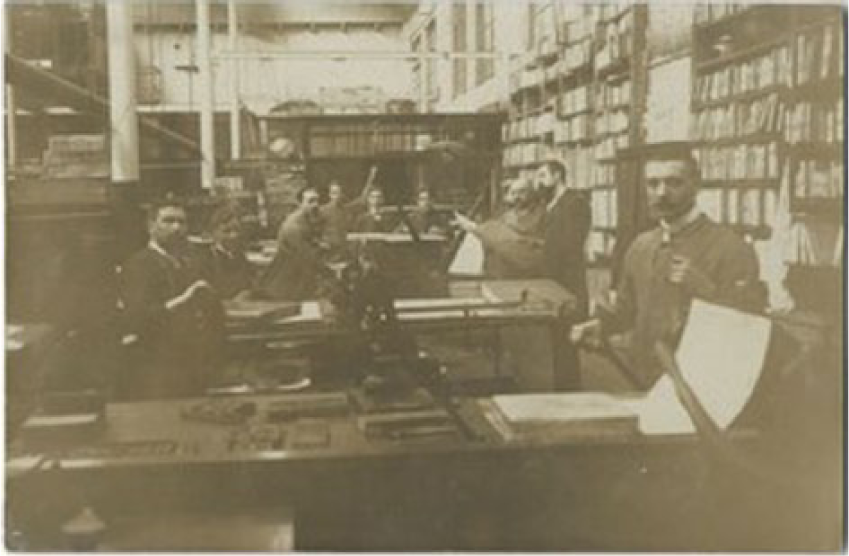
Journal de Roubaix, bindery (1910), Mairie de Rouaix, site des archives municipales.

Journal de Roubaix, workshop (1910) Mairie de Rouaix, site des archives municipales.

Journal de Roubaix, linotype room (1910) Mairie de Rouaix, site des archives municipales.
A second example of the nature of the corpus refers back to the development of diachronic series. These series require the collaboration of media documentation services. They allow as large a historical corpus as possible to be assembled which can visually represent newsrooms. The diachronic series is the manifest illustration of the material transformations that occurred in the workspace over the years. Thanks to these images, both transformations and consistencies may become evident to the researcher. The next four pictures below (Figures 4 to 7) belong to the corpus analyzing the Belgian daily paper Le Soir, and range from the end of the 19th century to 2013. They show how the physical workplace has changed from a small but collective office to an organized newsroom with structured sections. They also illustrate the continuous appropriation of technologies and tools by the media.
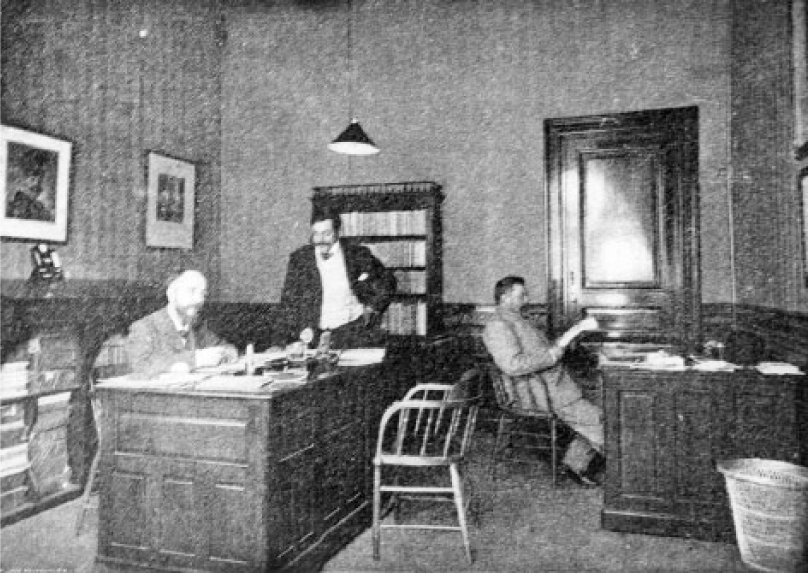
Le Soir 1902, Le Soir archives.
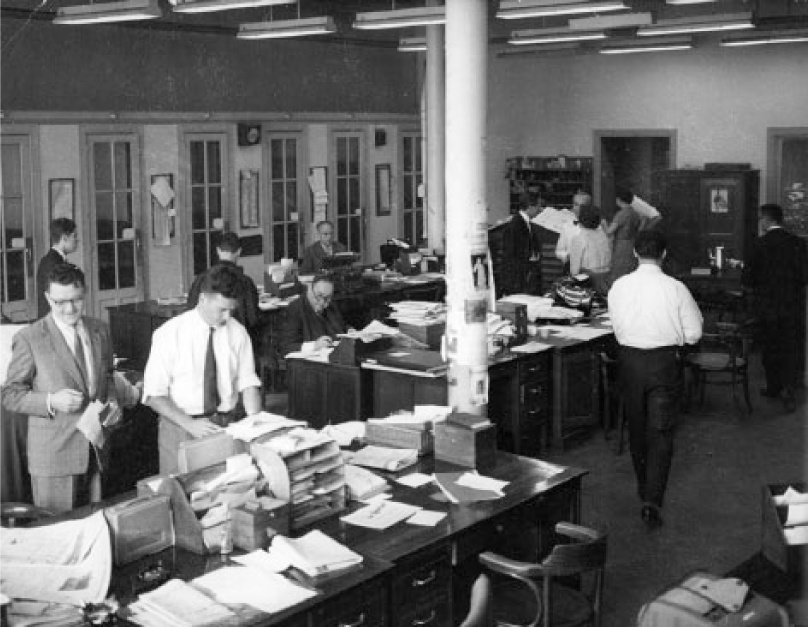
Le Soir 1958, Le Soir archives.

Le Soir 1959, Le Soir archives.
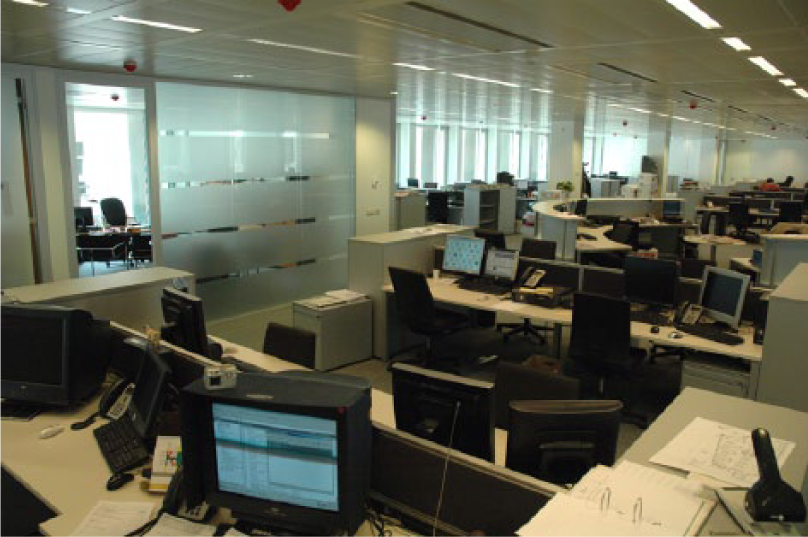
Le Soir 2007, Le Soir archives.
Using both diachronic and synchronic series, as well as isolated photographs, we can not only analyze the evolution of the media, but also establish comparisons between different series. To this end, addressing continuities and changes must not only rely on longitudinal studies (the analysis of a single media company), but also on the study of the convergences between labor organization configurations and the physical and organizational changes occurring in newsrooms. Comparing photographs from different newsrooms, taken at the same time, offers a view on the circulation of organizational models and their uses by media companies.
Evidently, the difficulties associated with such an analysis are numerous. It is not easy to infer the intentions of a photographer during his or her shoot. Was the photographer commissioned by the company to portray a specific image of the newsroom’s organization? Was the space rearranged for the photo shoot? Moreover, it is difficult to analyze photographs without any context or explanation. Where did that door in the back left-hand side lead to? What about that stairwell on the right-hand side? Two tools can be quite useful to address such questions. On the one hand, analyses should concentrate on series (and not insist on any one detail); on the other, the study of photographs should simultaneously rely on a collection of historical documents that were contemporary with the media enterprise itself. By contrasting texts about newsrooms (which are very rare) with journalists’ scattered descriptions of their workplaces (more frequent) and historical media studies (somewhat random in frequency, depending on the company and research interests), our study can become more precise and open up new possibilities for comprehending the material vestiges revealed by these visual documents.
Gathering together this corpus inevitably involved a complete analysis of all the photographs. This cross-case approach allows us to propose new avenues for research and also, to nuance a number of sub-problems. What can we see in newsroom photographs that can help us to analyze the evolution of their material nature?
The visibility of journalism’s organization: What should we see in these photographs?
The study of the whole corpus is the indispensable first step for an analysis of a photographic series. The cross-case analysis of the photographs produced several avenues for research. Consequently, newsroom photographs allow us: (a) to examine the emergence of the newsroom; (b) to consider the representation of itself that the media seeks to portray; (c) to contemplate the space of the newsroom, its structural and managerial organization; and finally (d) to study the objects used by journalists.
The emergence of the newsroom in French-speaking countries
The 19th century photographs, drawings, and engravings show a highly specific organization of workplaces. It is very difficult to ascertain the date when the workplace called a ‘newsroom’ appeared. It seems that this word (‘salle de rédaction’ in French) did not appear in French texts during the 18th century. At that time, many newspapers were still edited by a single individual. Those in charge of newspapers even sometimes went so far as to erase all traces of the editorial process and production, especially when the latter was collective (Lévrier, 2011). Collective editorial and production spaces took a very long time to arise. Prior to these, the senior editor would work with the publisher or printer. Sometimes, he would even correct the galley proofs onsite in the production space (usually the printing studio); other editors would also occasionally contribute to the corrections. When journalism became a professional occupation during the 19th century, working conditions and changes in the frequency of diffusion made collective work necessary (Ruellan, 1993). But for a significant period of time, the newsroom still remained ‘a dark place’ (Pinson, 2013: 26).
For example, the oldest photographs in our corpus show the workplace of the daily paper Le Soir, located at 42 rue d’Isabelle, in Brussels. The newspaper’s owner, Emile Rossel, is leaning against the doorframe of the case room; he seems to be checking the proofs. This scene depicting how the newspaper gets made is thus clearly associated with the concrete, physical space of its production. Historical texts about Le Soir discussed the first few years following its creation. On rue d’Isabelle, a
printer rented several rooms to draft and compose a new paper. […] Le Soir’s first offices were incredibly humble. The typographers worked in the attic and the plate-makers in the cellar […]. As for the two editors, they each had a table and a telephone. This attested to a certain attempt at modernity, once we realize that at the time, there were only 4,674 phone lines in all of Belgium. (Hereng, 2003: 11–12)
A photograph of Le Soir’s offices from 1902 already shows transformations in the newspaper’s representation and practical organization (Figure 8).
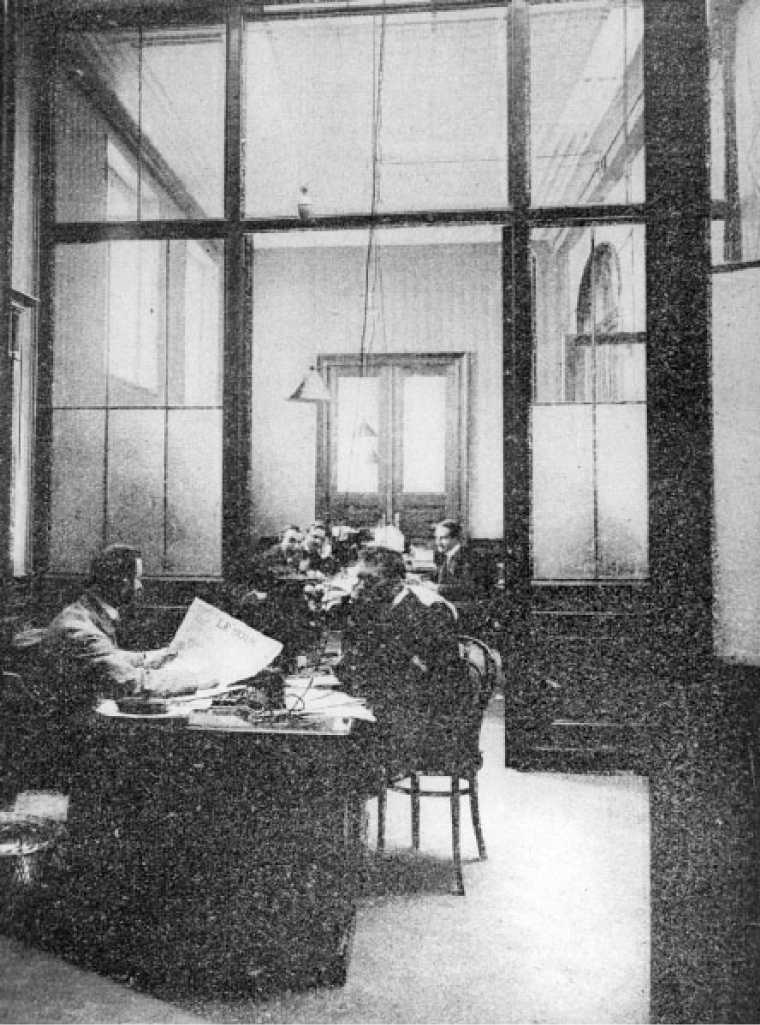
Le Soir, 1902, Le Soir archives.
This photograph is markedly different from the previous one representing Emile Rossel leaning against the doorframe. It shows the implementation of collective editorial (and not just layout or composition) workspaces. It is not the owner who stands out, but the editor-in-chief. In the background, we can see the other editors, all working on a communal table.
This first line of investigation paves the way for an analysis, via visual representations, of the historical structuring of newspaper production spaces. When did ‘newspaper offices’ (Pinson, 2013) become collective rooms full of ‘professionals’? How were these workspaces pragmatically organized? What kind of spatial representation can we observe?
The image of itself that the media seeks to convey
Many photographs stand out because of their static, frozen appearance. As Dewerpe (1987: 1098) has stressed, photographs communicate ideologies and perform a sort of doubling of the company’s strategies of presence. Factories have their name splashed on every wall, both inside and out. On the other hand, this trend is much less visible with media companies, where the company name may appear on the exterior of the building, but is largely absent from the newsroom itself. The only obvious traces can be found indirectly, thanks to the newspaper issues left behind on desks, or perhaps the backdrops of television sets. Nonetheless, what we do find in photographs of newsrooms is not only a picture of the productive tools the company seeks to emphasize (the presence of rotary presses, innovative tools – many photographs show the first computers available in newsrooms, for example), as a form of functional order. The other order, which stems from the representation system inferred by the photograph, reveals the company’s stated aesthetic (Dewerpe, 1987: 1099).
The next two photographs (from L’Auto, a specialized French newspaper, and Belga, the Belgium Press Agency – Figures 9 and 10) illustrate such ideological expressions. The choice of perspective, angle, luminosity, and subject (the editor-in-chief and the reception area) belong to a functional – and especially aesthetic – order. The locations are elegant and rather uncanny; in each different era, a certain air of modernity and control pervades the space and informs the aesthetic.
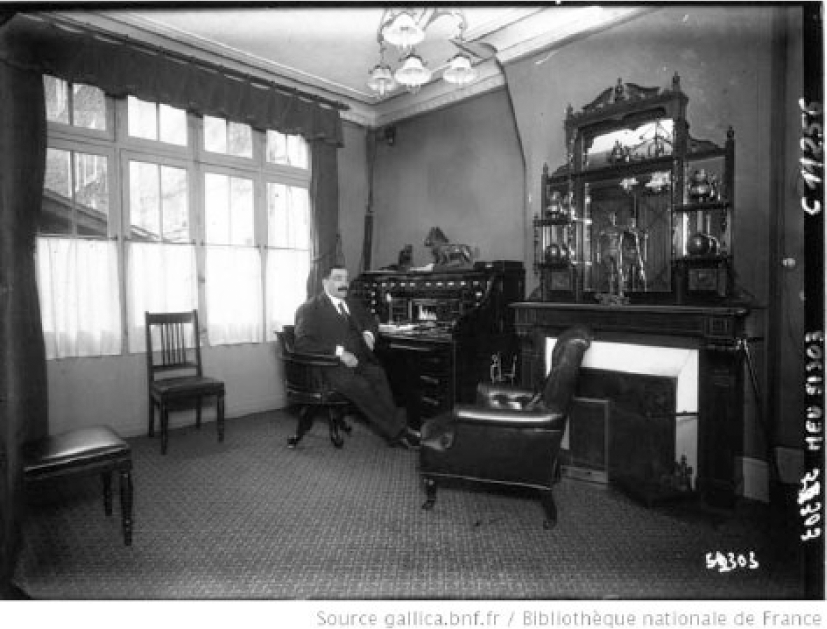
L’auto 1914, Free of rights.
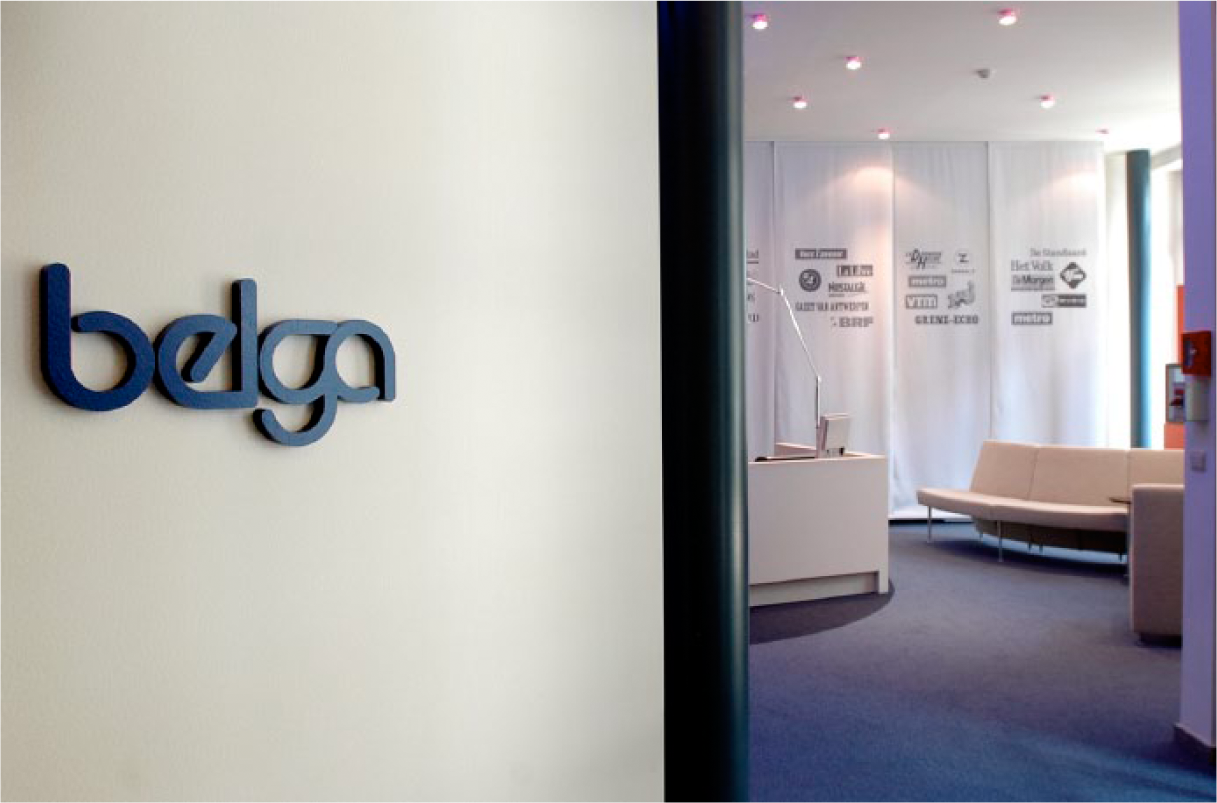
At Belga, the Belgian press agency, this photograph stages the agency’s new offices.
This second approach would orient our research toward an aesthetic analysis of the media company’s staging, examining the values that emanate from its organization within the city and neighborhood, from its buildings and office. How do the buildings belonging to a media company represent its role in society and its relationship with the outside world?
Contemplating the space of the newsroom, its structural and managerial organization
These photographs give us information about the size of the editorial staff (and possibly the total number of journalists), its socio-demographic distribution (thanks to the presence of certain profiles, the staging of social genres, and generations), its hierarchical structure (where the editor-in-chief’s desk is located, how the offices are arranged), and its place within the entire organization (proximity to printing studios, specialized offices, in a circle around a central desk …).
Some of these photographs are also extremely helpful for understanding the collective nature of the editorial staff. For example, the picture of L’Illustration Nouvelle’s staff from 1938 to 1939 (Figure 11) tells the story of a collaborative and collective endeavor, looking much like a portrait taken during a family reunion. The photograph shows the presence of two women (were they the editors’ wives? journalists themselves? secretaries?) and the intermingling of different generations; its staging around the dinner table likewise suggests the existence of social interactions that went beyond the merely professional.
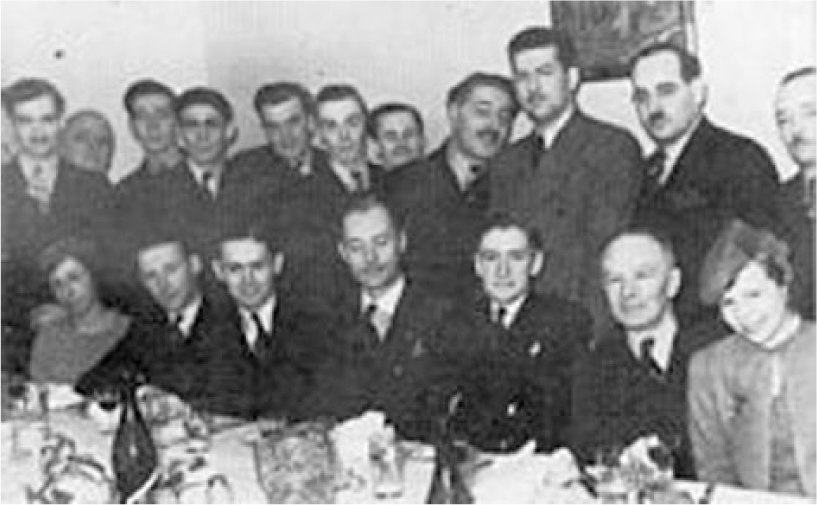
L’Illustration Nouvelle, editorial staff, 1938–1939. Free of rights.
These images are also meaningful with regard to the position of the editor/journalist/reporter within the workspace. The practical organization of desks and offices (in the offices of Montreal’s L’Illustration in 1934–1935 – Figure 12) shows us how the desks were arranged in rows, one behind another, all facing a central desk. The desks themselves (they appear to be made of wood, though that would soon change), the posture of the editors, the presence of an attendant who seems to be distributing the news, are all helpful details for our analysis.

L’Illustration, Montreal 1934–1935, Free of rights.
Visual representations such as these also allow us to infer distinctions between the various statuses and roles in the company. The various paths of travel between offices are visible and can sometimes even be mapped out. These paths can illustrate the social relations within the company, the breaking off of smaller collective groups, and the thematic divisions inherent to information production, as well as the creation of new departments and the disappearance of others. The room for circulation between desks is also particularly important: It points to the ‘paths’ or ‘routes’ embedded in the workspace. Some images represent the spaces allotted for sociability, where journalists would gather around the newspaper or television set, or share a cup of coffee. This tells us about the daily life of these employees.
These pictures also show how the places belonging to individuals become internalized territories. One’s worktable or desk could be personalized (books and personal effects could illustrate the fact that the desk was not only a place for work – Monjaret, 2002), but it could also remain impersonal, at times perhaps exhibiting the fleeting traces of various individuals sharing a desk.
Some types of workspaces seem to have been favored during specific eras. Meeting rooms are visible. Some photographs let us see the spaces where employees work together, but also how these spaces can be almost entirely controlled. This control stems from the physical arrangement of the space: open space offices, present very early only in some editorial environments, mean that everyone can see each other’s professional activity and productivity. Open space arrangements also give managers and supervisors a panoptic view of the entire staff. Various photographs show the editor-in-chief’s desk outside of the newsroom properly speaking (journalists can access it via a little staircase and must open a closed door). Others show the editor-in-chief sitting in a specific section of the newsroom from where she/he can observe the entire newsroom. Finally, a number of other images show the editor-in-chief sitting in a glass office cell, from which she/he can see and be seen.
Despite their silent nature, photographs paradoxically tell us about the sounds present in the newsroom. Visually, they sometimes insist on typewriters, computers, telex machines, telephones – at times displaying the movements of various employees coming and going on television screens, and so on. These images evoke the soundscape of the newsroom and tell us about the evolution of noise within this environment. Evolving from the cacophony of typewriters and printing presses in the basement, the newsroom seems to have become increasingly silent, now simply home to the vibrations of cell phones and the soft clicking of computer keys.
Examining the objects used by journalists
Our corpus very clearly portrays the objects used by journalists in their work and their evolution: paper, uploading tools, scissors, computers, telex machines, the Internet, phone booths, and smartphones. This global view of objects allows us to study the practical circumstances behind information production (paper scattered across the top of a desk, two computers being used simultaneously …), and to evaluate the material changes that have affected the practice of journalism, consequently requiring those employed in its service to constantly adapt.
Analyzing these objects also paves the way for an investigation into how journalists relate to their sources: The places where information is acquired and exchanged have been transformed (for example, telephones used to be in booths) and the timeframe of source gathering has also been radically altered, as we can tell from these photographs.
Hypotheses regarding these objects are numerous. One theory leads us to consider the importance that the company grants to the staging of its work tools. Demonstrating a sort of technological quasi-determinism, the photographs contained in our diachronic series all emphasize the acquisition of ‘innovative’ tools and materials (innovative for the era, naturally). Consequently, these two photographs (one from Belga, the other from Le Soir – Figures 13 and 14) illustrate the technical organization and thus the strength of the company with regard to information technology. The processes of information production and branding are thus strengthened by the air of modernity that these images evoke.

Belga archives.

Le Soir, Le Soir archives.
But the most interesting hypothesis with regard to journalism’s objects such as they are represented in photography refers to the object’s role within its environment (by sociologizing Paveau’s (2012) perspective). The journalist also acts via the object she/he uses, the latter offering him or her a discursive framework in which to operate. Identifying the objects in the daily life of journalists (as photographed) lets us glimpse the traces of concrete materialization. This materialization allows us to reconstruct a kind of ‘dialogue’ (Bakhtin, via Todorov, 1981) between the different media eras and among different media by era. These forms of dialogism emphasize the fact that all practices and all objects carry within them the trace of previous uses, and of the practical and ideological configurations which caused them to emerge and thanks to which they were appropriated. These photographs embody the relationship that the media and journalists have developed – and continue to develop – with regard to their environment and the objects that ‘populate’ their work. Materiality as it is presented in these images thus becomes the space of mediation paving the way for an analysis of the changes and continuities of the processes of information production, journalists’ working conditions, and the structural organization of media companies. Once photographed, the object itself tells a story, and it can be used as the tangible mark of a discourse of and about journalism.
Conclusion
This article is only the first phase of on-going research. It seeks to emphasize not only the importance of visual analysis in the domain of research on journalism and journalists, but also put forward a few different possibilities for future research, based on this photographic source material. The analysis of newsroom photographs is necessarily multidimensional. It allows us to conduct a socio-historical study of how workplaces are created and structured and how information is produced. It paves the way for an analysis of the media’s modes of representation within the logic of external communication (to establish and promote its brand image through videos or pictures). It also permits us to make inferences while analyzing the organizational and managerial aspects of a company, and reveals the value of examining the objects used by journalists in their trade. We could think about how this visual analysis could be part of a more general study of a spatial ethnography of labor (Chari and Gidwani, 2005) in journalism. Trying to appropriate all these methodological issues, the next step will focus on a corpus made up of a series of photographs from the prestige newspaper Le Soir from the end of the 19th century up to today, and also of various successive architectural plans of the building and the newsroom that have drawn the spatial territory of the media organization, Le Soir. These visual representations are crossed with an analysis of discourses from the media itself and its journalists (through books about the media, articles, or biographies of journalists). Our next phase or research will narrow, in other words.
Nevertheless, working with a corpus of photographs could also lead us to broaden our scope. Incorporating the short films of media communication campaigns, proposing comparisons between different workplaces (for example, how has rhetoric on industrialization and the organizational changes in the industry influenced the physical configuration of work in media companies?), analyzing fictional representations of newsrooms (films about journalism, television series, comic books, literature, painting …): These are all possibilities which would allow us to address the concept of the newsroom as a potentially rich subject that has until now been overlooked by studies on journalism.
Footnotes
Acknowledgements
The author wishes to thank Anne Thomaes from Le Soir and Philippe De Camps from Belga for making available the photographs of their newsrooms.
Funding
This research received no specific grant from any funding agency in the public, commercial, or not-for-profit sectors.