




Abstract
The drone war in Pakistan poses humanitarian, legal, ethical and political challenges. The tactic is controversial and has been condemned by the United Nations’ special rapporteur on extrajudicial killings. Yet, polls have shown high support for the tactic in the United States (and to a lesser degree in the United Kingdom). Much of this has to do with the media reporting on the war, which consistently underestimates its human toll. Dubious statistics have sustained the image of a surgical war with little collateral damage. But as this article shows, there are reasons to doubt these numbers. The article argues that two interrelated factors have contributed to a flawed accounting of the war’s human toll: (1) rituals of objectivity that privilege ‘official sources’ and (2) fetishizing of statistics as hard facts without regard for the underlying data. The coverage has also been distorted by news values that downplay or ignore deaths in distant places unless they cross an inordinately high threshold.
Introduction
During US president Barack Obama’s first term in office, an internal debate between proponents of counterinsurgency, with its demand for large-scale troop commitments, and counterterrorism, with its reliance on Special Forces and precision weapons, was resolved in favour of the latter (Woodward, 2010). The unmanned aerial vehicle (UAV), commonly known as the ‘drone’, emerged as a staple of this policy. By 2013, its use was so extensive that in a speech, Obama confessed that he had come ‘to view drone strikes as a cure-all for terrorism’ (Obama, 2013).
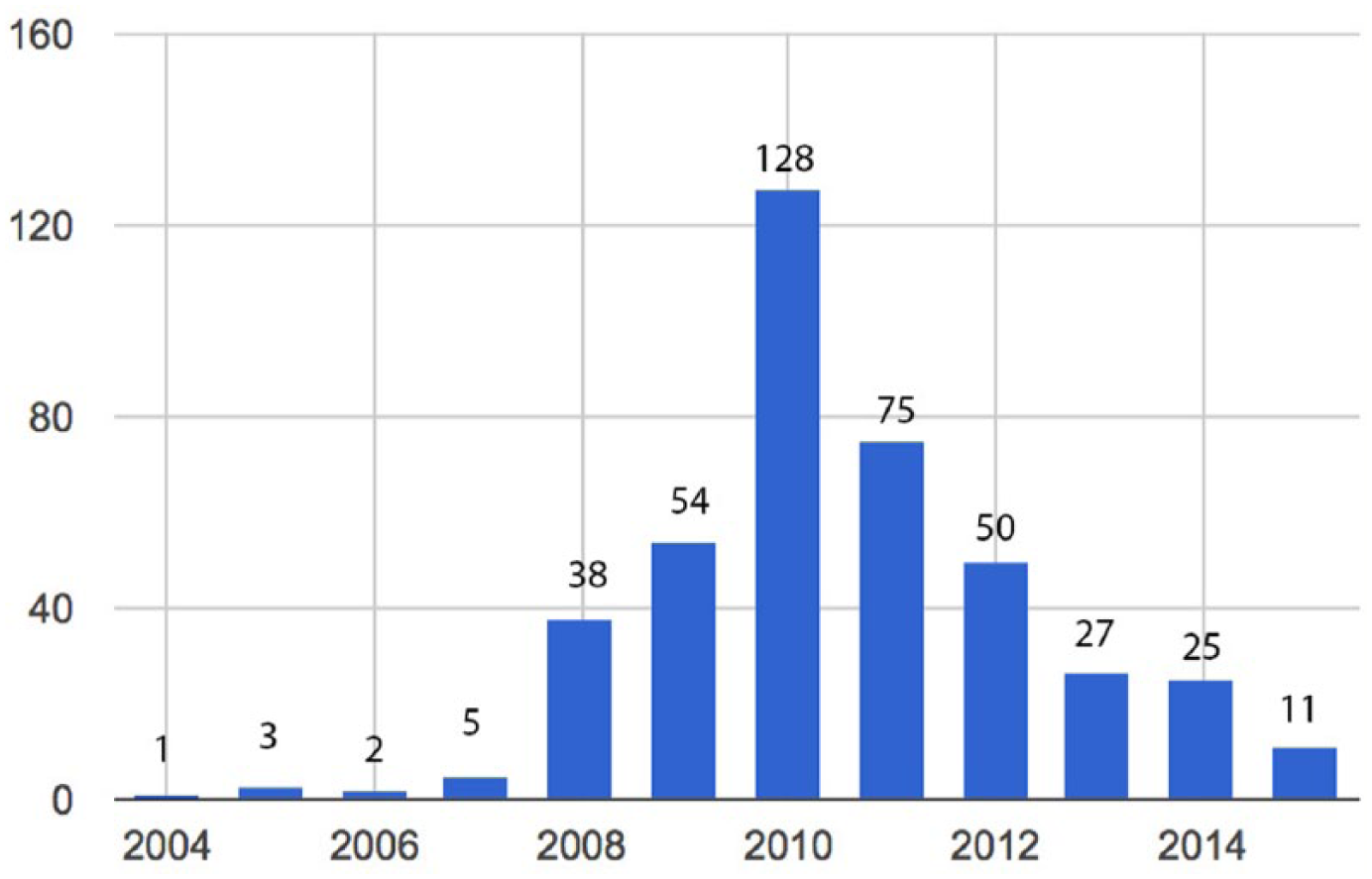
Total drone strikes in Pakistan from June 2004-June 2015 (Graph adapted from the Bureau of Investigative Journalism’s data).
In the 11 years between June 2004 and June 2015, the United States used drones to launch 419 missile strikes in Pakistan. According to the Bureau of Investigative Journalism (BIJ), the strikes have reportedly killed 2,467-3,976 people, including at least 423-965 civilians and 172-207 children. Fewer than 4 per cent of those killed have been identified as members of Al-Qaeda (Serle, 2014); only 2 per cent as ‘high value targets’ (HVTs) (Kaag and Kreps, 2014). The identity of the majority remains unknown. Despite the highly permissive criteria used by the United States in selecting its targets, the media has accepted official claims regarding the status of those killed. The statistics about the drone war had by and large eluded scrutiny until June 2011, when this writer wrote a series of articles casting doubt on them (see Ahmad, 2011). Soon afterward, the BIJ’s drones project was launched, which has evolved into a most comprehensive—and relatively more reliable—database of information on the attacks.
The drone war has been precedent-setting. Its implications for the international order are immense (Boyle, 2013; Kaag and Kreps, 2014). The technology is relatively inexpensive and easily replicable. By November 2013, 87 states (and even some non-state actors) were in possession of drone technology (Taylor, 2013). The capacity to deploy them offensively across international borders will not long remain exclusive.
Through credulity and neglect, the media have indirectly allowed things to come this far. A reckoning is necessary. This article is a contribution to that end. It critically appraises the media’s coverage of the drone war, focusing on the statistics that have been used to assess the success or failure of this policy. This article aims to show the limitations of such numbers and the challenges of compiling them. It identifies two interrelated factors that have contributed to the mostly uncritical media coverage and, consequently, to the relatively muted public response:
Rituals of objectivity that mask credulity; and
Fetishizing statistics as facts, regardless of the integrity of underlying data
This has consequences. As Galtung and Ruge (1965) note, prevailing news values place an inordinately high threshold on the number of deaths in a distant event for the story to merit coverage. The lowballing of civilian deaths by official sources in the initial reports and their aggregation into seemingly authoritative statistics by institutions like the New America Foundation (NAF) relegate the issue and deny the public an opportunity to fully assess its humanitarian and ethical implications.
To illustrate the point, this article analyses the reportage of two leading liberal dailies, The New York Times and The Guardian, for the first quarter of 2010, the year with the highest number of drone strikes. It shows that (1) in most cases, the media accept casualty figures from unnamed official sources, disregarding possible conflicts of interest and (2) that the coverage is selective. This in turn informs the statistics that rely on these media reports. The article assesses the figures produced by the three main tracking agencies – the NAF, the Long War Journal (LWJ) and the BIJ – and argues that by uncritically accepting the initial claims, the NAF and the LWJ – the two most cited sources in the United States (Stanford-New York University (NYU), 2012) – have contributed to a serious undercounting of the war’s human toll and created a misleading perception of the war as precise, surgical and discriminating. Indeed, this has allowed the Obama administration to confidently assert that the ‘drone strikes are legal, they are ethical, and they are wise’ (Jay Carney quoted in Kaag and Kreps, 2014). Obama has personally justified the attacks on the ground that they are ‘effective’ and ‘legal’ (Obama, 2013).
The aim of this article is not to dismiss media coverage in toto. Its subject is only a particular mode of coverage. The initial reports on drones have to deal with the scarcity of information and lack of access: they are necessarily tentative. Subsequent reports that have parsed and corroborated information are often more substantive. Indeed, the two newspapers analysed here have also produced some of the most insightful reporting on the drone war. Less excusable, however, are the methods of the data aggregators who, with the exception of BIJ, continue to rely on initial reports alone.
In Gabriel Garcia Marquez’s magical realist masterpiece One Hundred Years of Solitude, a deceased gypsy named Melquiades returns to life because he can no longer bear the tedium of death. Similar resurrections have also happened in the drone war when so-called ‘high value targets’ have been found living long after the media had reported them dead in drone strikes. Garcia Marquez said that he owed his style – a combination of fantastic scenarios with painstaking detail – partly to his grandmother who would tell the most improbable stories with a perfect deadpan. The same approach seems to have been used in the production of drone statistics where the apparent rigour of method obscures a fantastical underlying reality.
The numbers game
Statistics are an authoritative way of describing the scope of a social or political problem. Numbers convey a sense of precision. We live in ‘a hyper-numeric world preoccupied with quantification’: ‘in practical political terms’, argue Andreas and Greenhill (2010), ‘if something is not measured it does not exist … if there are no “data”, an issue or problem will not be recognized, defined, prioritized, put on the agenda, and debated’ (p. 1). Statistics, writes Best (2001), can ‘become weapons in political struggles over social problems and social policy’ (p. 10). ‘The creation, selection, promotion, and proliferation of numbers are thus the stuff of politics’ (Andreas and Greenhill, 2010: 2).
Statistics are not always neutral: they are inscribed with the interests of their producers. Supporters and opponents of policies will inflate or underestimate numbers based on what best serves their preferred policy (Best, 2001: 10). ‘Because quantification is politically consequential, it can also be highly contentious’, write Andreas and Greenhill (2010): ‘Both proponents and opponents of any given policy will marshal reams of data to bolster their position and to weaken support for rival positions’ (p. 2).
Statistics can have concrete policy consequences. Because they ‘shape both public and closed-door policy debates’, they ‘serve to legitimize some positions and undercut others’ (Andreas and Greenhill, 2010: 135). Data are often politicized. For the powerful, it can become a tool for maintaining the status quo, for the activist, a potential instrument of change. This becomes particularly significant in the case of conflicts as ‘prevailing estimates of the scale of violence, its complexion, and its measurable consequences undeniably play a role in shaping policy priorities and objectives’ (Andreas and Greenhill, 2010). Statistics, therefore, can potentially prolong or end a conflict. If politicians or their publics have a distorted view of a war’s progress—an inevitability since inflating success and downplaying setbacks become a state imperative to maintain military morale and public support—it pre-empts any reappraisal of the policy.
The US government has made confident claims for the extraordinary precision of its robotic weapons. In 2011, US president Obama’s chief counterterrorism adviser John Brennan insisted that in the drone war, ‘nearly for the past year there hasn’t been a single collateral death’. Obama also vouched for drone’s accuracy. ‘Drones have not caused a huge number of civilian casualties’, he claimed: ‘This is a targeted, focused effort at people who are on a list of active terrorists trying to go in and harm Americans’. It is possible that Obama believes these claims. It will not be the first time that the details of a covert operation are withheld from a president to guard against possible perjury. Ronald Reagan’s advisers had done the same during the Iran-Contra affair. But media reporting has likely reinforced Obama’s beliefs.
In accepting claims from the prosecutors of the war, the media overlooks potential conflicts of interests. Official claims, by virtue of being official, are deemed more credible. For Tuchman (1972), this dispensation has to do with a certain notion of ‘objectivity’ that privileges form over content. ‘Objectivity’ in this reading comprises strategic rituals that protect journalists from flak or libel. All journalists are pressed by deadlines, and when an official makes a claim, a journalist might not have the time to ‘locate adequate information with which to assess the extent to which the claims is a “fact”’. But under such circumstances, Tuchman (1972) notes, ‘newspapermen regard the statement “X said A” as a “fact”, even if “A” is false’. Outcomes become secondary to the process.
The reliance on official sources gives journalists cover; but it also allows officials to potentially abuse secrecy privileges. Where information is unavailable, controlled, suppressed or otherwise scarce, those with exclusive claim to it assume greater authority. The limited supply of information inflates its value, and concerns about its quality are deferred. This allows prosecutors of secretive campaigns to shape narratives and elude scrutiny. Their claims of success face no immediate challenge. By the time they are refuted, the news cycle has moved on. If failure is reported at all, it is relegated to the back pages. ‘Falsehood flies’, wrote Swift (1710), ‘and the Truth comes limping after it; so that when Men come to be undeceived, it is too late; the Jest is over, and the Tale has had its Effect’.
Reality is further distorted when this defective reportage becomes the basis for measuring a policy’s impact. By passing through the legitimizing process of ‘calculative practices’, bad data are laundered into ostensibly credible numbers; and, regardless of a statistician’s good faith, the outcome deceives. For the media, statistics represent ‘hard facts’ – regardless of their provenance. They are used as a measure of the scale of a problem – social, political or economic (Best, 2001: 17–18). When organizations like NAF and LWJ compile these unverified ‘facts’ into elaborate statistics that systematically undercount casualties, they distort perceptions and influence public attitudes.
Galtung and Ruge (1965) note that when it comes to foreign conflicts, an incident is considered newsworthy only if it crosses a certain fatality threshold. Although the participation of the United States has made the drone story relevant to the US public, the deaths occur on a small enough scale to let them escape the scrutiny that they might cumulatively merit. (It bears noting that the US public is considerably more sceptical of the drones being deployed at home (Kaag and Kreps, 2014).) Instead of a big violation, the campaign is a prolonged drip of comparatively small infractions that keeps it simmering below the opprobrious threshold.
The attacks also occur at a steady enough frequency that they have lost the element of the unexpected – a factor that earlier brought them some attention. A fascination with the technology remains, but this focuses on its presumed efficacy and precision – notions that are reinforced by the low casualty figures. The human cost is occasionally broached but often as a public relations problem. As a consequence, the drone war for the most part has failed in the United States to rise to the level of a public issue. It only entered the national debate after a leaked Justice Department document revealed that the Obama administration has legalized killing Americans abroad if they ‘present an imminent threat to national security’ (Isikoff, 2013).
Since 2012, the policy has been significantly rolled back. This is in part a response to the growing anger worldwide where American official claims have less purchase. In the United States, the propaganda has succeeded. Polls show a majority of Americans supporting the drone war (Fuller, 2014); but polls are often themselves part of the propaganda Kreps (2014). The fact that this war is cheaper and that its human and political costs borne by others have no doubt helped. So perhaps has the presumed surgical nature of the war.
For the public, the seeming precision of statistics bears the semblance of hard facts – a semblance that is aided by ‘widespread confusion about basic mathematical ideas’ (Best, 2001: 19–20). A consequence of this innumeracy, writes Best (2001), is that ‘many statistical claims about social problems don’t get the critical attention they deserve’. Instead, he writes, ‘we tend to regard statistics as though they are magical, as though they are more than mere numbers’: We use statistics to convert complicated social problems into more easily understood estimates, percentages, and rates. Statistics direct our concern; they show us what we ought to worry about how much we ought to worry. In a sense, the social problem becomes the statistic and, because we treat statistics as true and incontrovertible, they achieve a fetishlike, magical control over how we view social problems. We think of statistics as facts that we discover, not as numbers we create. (Best, 2001: 160)
Statistics, in this sense, are a social product. They often reflect the culture, structure and practices of the organizations producing them (Best, 2001: 25–26). Even when produced by experts – which they often are – they involve myriad choices that shape the final outcome. They are necessarily a simplification – and, sometimes, they can contribute to a simplified, even superficial, understanding of complex political realities (Best, 2001: 161). This is particularly true for the drone war. If society uses statistics as a measure of the magnitude of a problem, then a systematic undercount of the human cost of the strategy has forestalled adverse public reaction by engendering passivity and political inertia. This has helped prolong a precedent-setting policy with dangerous global consequences.
The rituals of objectivity
In 2002, when the United States launched its first drone strike in Yemen, the press reported it as a Yemeni operation (Mazzetti, 2013). Likewise on 24 June 2004, when the first US drone strike was launched in Pakistan, the press ascribed the attack to the Pakistani military (Mazzetti, 2013). In both cases, the media relayed what was in effect a cover story. But the drone war was in inception and the media had little cause for doubt. This state of affairs prevailed well into 2007. By 2008, however, the drone operations were no longer a secret. With presidential candidates openly speaking about them, the existence of the campaign could no longer be denied (Woodward, 2010). However, little changed when it came to reporting the effects of the bombings. With Federally Administered Tribal Areas (FATA) out of bounds, the press relied almost exclusively on official sources for casualty figures. Most of these were Pakistani, some of them American, all of them anonymous. The media appeared unfazed by the apparent conflict of interests. Nor did it question the targeting criteria.
This pattern is consistent across the news media. In the aftermath of each attack, journalists follow certain strategic rituals that allow them to report where verifiable information is scare. Since the strike zones are off-bounds to international journalists, the effects of the bombings are impossible to verify – at least in the short term. However, there are always officials available to volunteer information about the strikes and their purported targets. In the absence of other details, this appears useful. In some cases, the official claims are reported as fact; in others, the only fact reported is that an official claim was made. The officials are invariably anonymous. Their credibility might be impossible to establish but, by virtue of their governmental affiliation, they sound more credible than unaffiliated witness. To be sure, some journalists make an effort to highlight the doubtful nature of the information. Some use conspicuous quotation marks to emphasize the subjective nature of the information. The effect, however, is the same since, once in print, the claims become the basis for statistics about the conflict.
It is instructive in this regard to consider the reporting of two of the world’s leading dailies, The New York Times and The Guardian. Both papers have a liberal orientation, and it is not unreasonable to assume that their coverage of the drone war will be as critical, if not more, than their right of centre counterparts. The sample is taken from the first quarter of 2010, the year in which the highest number of drone strikes was launched. The aim of this exercise is not to present an exhaustive list of the sources that the media uses in its reportage – that would be tedious and unnecessary. The aim is to show a consistent pattern that is generalizable to the media’s wider coverage of drones. The sample makes clear that in reporting drone deaths, anonymous official sources predominate.
In the period under study, 69 stories were published that mentioned drone strikes in Pakistan, with The New York Times publishing twice as many (46) as The Guardian (23). But most of these were stories that merely discussed drone attacks; only 14 reported a drone strike as news:
According to the BIJ, there were 30 drone strikes in this quarter. But The New York Times covered 12 and The Guardian only 1. The stories are primarily attributed to unnamed officials; only two are corroborated by additional sources. Most of the officials cited are Pakistani.
Regardless of their shortcomings, these claims feed into the statistics produced by data aggregators. In an analysis of NAF’s datasets for 2012, a Stanford-NYU study found that anonymous officials are cited as a source for the allegation of the number of ‘militants’ killed in 88% of articles referenced by New America Foundation, and are the only source of this information in 74% of the articles … This heavy reliance on anonymous officials is troubling given the demonstrated unreliability of official reporting. (Stanford-NYU, 2012)
The study also addressed the related question of identification. Neither the US nor the Pakistani government has a mechanism for verifying the identity of those killed in drone strikes. Under the expanded authority granted by Barack Obama, drone strikes aren’t confined only to HVTs; anyone suspected of being a militant based on ‘pattern of life’ analysis, collected through aerial surveillance, can be killed in what are known as ‘signature strikes’ (Boyle, 2013). In the tribal areas, where traditionally most adult males carry guns and ammunition, this has made everyone a potential target (Cloud, 2010). A year before Osama bin Laden was killed, a Central Intelligence Agency (CIA) officer told Jane Mayer of The New Yorker that because of the drone surveillance, ‘no tall man with a beard is safe anywhere in Southwest Asia’ (Mayer, 2009).
This permissive atmosphere has created a mentality in which the targets are seen as nothing more than insects to be quashed. The CIA uses the term ‘bug splat’ to estimate the blast radius of its Hellfire missiles (Mackey, 2014). For the drone operators too, the war has a remote quality. Indeed, the military has essayed to recruit gamers as potential drone operators (Schei et al., 2015). The similarities are not lost on the operators. ‘It’s like a video game’, one young drone operator told Singer (2009), ‘It can get a little bloodthirsty. But it’s fucking cool’.
The respected Pakistani journalist Rahimullah Yusufzai told this author that it is no longer possible for foreign journalists to travel to the tribal region and, as a result, most of the reporting comes from a handful of stringers based in Miranshah and Mir Ali, the FATA region’s two main cities. Even journalists based in FATA have to call up the military’s press office for information on strikes that occur outside the main towns. Noor Behram, a local journalist, is an exception. He managed to photograph the aftermath of 27 drone attacks in North and South Waziristan between 29 November 2008 and 15 June 2011. The picture he paints is at odds with the rosier one presented in the western media. ‘For every ten to 15 people killed’, he told The Guardian, ‘maybe [the drones] get one militant’ (Shah and Beaumont, 2011).
The reliance on Pakistani officials is particularly problematic. The Pakistani government is an active partner in the drone campaign that the Pakistani public overwhelmingly opposes (Mazzetti, 2013). As a result, the government is reluctant to acknowledge civilian casualties lest it further inflame public opinion. This eagerness to declare all those killed ‘militants’ is acknowledged in The New York Times report on the 16 January strike: ‘American officials have been more cautious than their Pakistani counterparts in declaring that American drone strikes had killed militants’ (see Note 1). This is a rare disclaimer. In most cases, claims from unnamed officials are reported as fact. Nor are they interrogated on what constitutes a ‘militant’.
Definitions are important, writes Best (2001), they ‘specify what will be counted’ (pp. 44–45). In this case, they also specify what isn’t counted. If ‘militant’ is defined expansively, then the space for being counted as a civilian shrinks. This was made dramatically clear in The New York Times’ revelation that the US President Barack Obama had ‘embraced a disputed method for counting civilian casualties’ that according to several administration officials ‘in effect counts all military-age males in a strike zone as combatants … unless there is explicit intelligence posthumously proving them innocent’ (Becker and Shane, 2012).
Even among combatants, International Humanitarian Law (IHL) prescribes discrimination. The International Committee of the Red Cross’ (ICRC) Interpretive Guidance on the Notion of Direct Participation in Hostilities under IHL draws a distinction between ‘direct and indirect participation in hostilities and between legal and illegal targets’. It stresses that ‘direct causation should be understood as meaning that the harm in question must be brought about in one causal step’ (quoted in Kaag and Kreps, 2014). However, as Kaag and Kreps note, most of the ‘militants’ killed in Pakistan are ‘lower-level foot soldiers … who are “neither presently aggressing nor temporally about to aggress”’. Consequently, they argue, the drone war satisfies neither the jus ad bellum (right to war) nor jus in bello (conduct in war) principles of a just war. The administration’s claims to the drone war’s legality are therefore void (a view confirmed by the UN’s Rapporteur on Extra Judicial Killings, Ben Emmerson QC).
The administration has tried to circumvent legal barriers by adopting a definition of ‘imminent’ that is as expansive as its definition of a ‘militant’. The aforementioned leaked Justice Department memo reveals that for a threat to be deemed imminent, it ‘does not require the United States to have clear evidence that a specific attack on U.S. persons and interests will take place in the immediate future’ (Isikoff, 2013).
The vicious circle
The first attempt at measuring the drones’ human toll wasn’t made until the autumn of 2009 when in an article for the Pakistani daily The News, a journalist estimated that between 14 January 2006 and 8 April 2009, 60 drone attacks had killed 701 people of whom only 14 were on the US ‘high value target’ list (Mir, 2009). Based on this, the journalist concluded that all the rest – 98 per cent of those killed – were civilians. The estimate was given credence when two respected figures from the US security establishment – the former Ranger Andrew Exum and General David Petraeus’ counterinsurgency advisor David Kilcullen (Kilcullen and Exum, 2009) – repeated it in an article for The New York Times. The figures were challenged. Although the United States had identified only 14 known militants among the 701 people killed in Pakistan, critics argued this was not sufficient to assume that everyone else was a civilian (Fair, 2010).
On 1 October 2009, in response to Exum and Kilcullen, an analysis was published by LWJ, an initiative of the Foundation for Defense of Democracies, a neoconservative think tank founded 2 days after 9/11 to promote the ‘global war on terror’. By ‘adding up the number of civilians reported killed from the media accounts of each attack’, it concluded, ‘only 9.6% of the casualties reported have been identified as civilians’. Nonetheless, it admitted that the numbers were ‘undoubtedly a low estimate’ (Roggio and Mayer, 2009). This analysis was followed the same month by NAF, a Washington-based liberal think tank, which, using a similar method, determined civilian deaths since 2006 to be ‘in the range of 250 to 320, or between 31 and 33%’ (Bergen and Tiedemann, 2009).
Both organizations maintain constantly updated databases, and it has become di rigueur for journalists to cite their estimates in discussions of the drone war. Both employ a seemingly rigorous method, and the apparent precision of the numbers lends the estimates an air of credibility. Little attention is paid to the fact that the estimates rely entirely on media reports whose own credibility – as noted earlier – is often in doubt.
The reliance on media reports is problematic because initial claims have frequently proved false. Consider the following:
In the first quarter of 2010 (the sample analysed earlier), The New York Times and The Guardian published several articles speculating that Hakimullah Mehsud, the leader of the Pakistani Taliban (TTP), had been killed in two separate strikes. He would be pronounced dead again on 12 January 2012. Mehsud, in fact, would go on to elude drones until 1 November 2013, when one would finally kill him.
In September 2009, the CIA claimed that it had killed the Pakistani Taliban leader Ilyas Kashmiri along with two other senior leaders in North Waziristan. Kashmiri wasn’t killed until 3 June 2011.
Baitullah Mehsud, the former commander of the TTP, was reported dead in drone strikes on 16 different occasions before his actual death on 5 August 2009.
Mullah Sangeen also resurrected twice. The 23 June 2009 attack on a funeral procession that killed Sangeen was supposed to have killed Baitullah Mehsud. It killed 83 people; Mehsud wasn’t one of them (see Ahmad, 2011). 4
In 2010, a case-by-case analysis of nine attacks by the Campaign for Innocent Victims in Conflict (CIVIC) uncovered 30 previously unreported civilian deaths, including 14 women and children (Rogers, 2010).
This has done little to encourage caution among the tracking agencies. As the following examples show, their methods are less than rigorous. On 13 January 2006, a drone struck the village of Damadola in Bajaur, killing 18 villagers, mainly women and children. Pakistani and US officials claimed that four ‘al-Qaeda terrorists’ were among the dead. The claim was later retracted (Whitlock, 2007). But the NAF continued to list all 18 as ‘militants’. On 30 October, another drone hit a seminary in Chenagai, also in Bajaur, killing 82 people, including 69 children (Lamb, 2006). But the NAF recorded ‘up to 80’ militants killed in the strike with no civilian casualties. (NAF would not correct this until August 2012, after it had been challenged both by this author and the BIJ.)
A Stanford-NYU (2012) study found more instances of NAF overlooking known civilian casualties. A 31 October 2011 strike killed 16-year-old Tariq Aziz and his cousin Waheed Khan – a fact widely reported in Western and Pakistani media. But the NAF entry for the attack mentioned no civilian casualties. A 15 June 2011 attack killed four civilians, but the NAF entry lists all the dead as ‘militants’. Likewise, no civilian casualties are recorded for a 14 August 2010 attack in which an Associated Press (AP) investigation had confirmed at least seven civilian deaths. More interestingly, until the autumn of 2012, the NAF database showed that drones had killed no civilians that year. But in a 24 May 2012 strike alone, Pakistan’s main English daily The News and United Kingdom’s Channel 4 had reported three to eight civilian deaths based on the testimony of named eyewitnesses. NAF partially corrected its record only after being challenged by the BIJ and the Stanford-NYU team.
There were more known civilian deaths that the NAF has yet to acknowledge:
An Amnesty International report revealed that on 6 July 2012, a drone strike in the remote village of Zowi Sidgi killed 18 male labourers, including one child (Amnesty, 2013). The attack followed what the CIA calls a ‘double tap’ policy, with a follow-up strike killing eight rescuers who had gathered to help those targeted in the initial strike. The NAF database lists all those killed as ‘militants’.
On 23 July 2012, another drone struck a group of five Talibans, but with a ‘double tap’, the drone also killed six civilian rescuers. The NAF lists all those killed as ‘militants’.
On 24 October 2012, a drone strike killed the 68-year-old grandmother Mamana Bibi and injured several members of her family in the village of Ghundi Kala. Although the NAF database mentions one civilian death, it also lists zero to four ‘militants’ killed. A detailed Amnesty investigation found nine injured children but no militants. (One of the children, 8-year-old Nabeela, would later testify before the US congress.)
The same pattern is observed in NAF’s coverage of 2011. It lists 57–65 civilians killed for that year. But an extensive study by the Columbia Law School’s Human Rights Clinic found that according to available reports, the actual number was between 72 and 155 (Columbia, 2012).
Mindful of NAF’s shortcomings, in the latter half of 2011, the London-based BIJ launched a more expansive investigation into the drone war. Like NAF and LWJ, BIJ also relies primarily on media reports; but unlike them, it does not confine itself to initial reports alone – it also analyses stories written days, weeks, even months after the initial incident. The BIJ also works with journalists, researchers and lawyers representing the affected civilians to develop a more rigorous accounting of those being killed. It has also distinguished itself from its predecessors in terms of the categories it uses for its analysis. While the LWJ uses a simple distinction between ‘militant’ and ‘civilian’, the NAF database for its first few years had no category for ‘civilian’ – only ‘militant’ and ‘others’. (It refined its categories to ‘militant’, ‘civilians’ and ‘unknown’ sometime after this author drew attention to it in an Al Jazeera article.) By contrast, the BIJ tries to accurately establish the actual number of drone strikes, the total number of people killed, the confirmed number of civilians among them and how many of those are children (all are undercounted by LWJ and NAF).
The BIJ, however, admits that its figures for civilian casualties are a ‘conservative estimate’. It only counts as a civilian someone whose status it can confirm through multiple sources. In most cases, this is impossible since access to the affected region is controlled by the Pakistani military, which is party to the ‘global war on terror’. The BIJ is further hampered by an expansive definition of the label ‘militant’ that requires that all military-age males be treated as combatants until proven innocent. What the BIJ provides is therefore little more than a baseline estimate of the civilians killed. Yet, this hasn’t prevented the Obama administration from accusing the BIJ of wanting ‘nothing more than to malign these efforts and help Al Qaeda succeed’ (Shane, 2012).
The Obama administration and its Pakistani counterparts have gone out of their way to obscure realities on the ground. Collecting data under these circumstances is a challenge. The three projects – the BIJ more so than the NAF and LWJ – have been useful in giving a broad picture of an otherwise shadowy war. But because of fallible methodology, structural constraints and ideological limitations, these statistics present only a partial picture. All three projects acknowledge the limitations of their method. But when the media reports these without the necessary qualifiers, it misinforms the public and forestalls challenges to the policy. 5
Conclusion: A moral hazard
Polls in the United States have consistently registered high levels of support for the drone policy (Fuller, 2014). But polls may or may not reflect the actual strength of feeling. Kaag and Kreps (2014) have shown that poll results have been decisively skewed by the way pollsters frame questions. For example, A typical formulation is the following from a Yougov/Economist poll: ‘Do you approve or disapprove of the Obama Administration using drones to kill high-level terrorism suspects overseas?’ Or another (Gallup): ‘Do you think the US government should or should not use drones to … launch airstrikes in other countries against suspected terrorists?’ And the NBC/Wall Street Journal version: ‘Do you favor or oppose the use of unmanned aircraft, also known as drones, to kill suspected members of Al Qaeda and other terrorists?’ (Kaag and Kreps, 2014)
None of these questions acknowledge the disputed status of the targets. Might the answers be different if the respondents knew that only 2 per cent of those killed were HVTs?
Potential outrage appears to have been attenuated by the media’s adherence to a notion of objectivity that confuses credulity for impartiality. Professionalism does not trump public service responsibilities. The public will be denied a fuller picture of the war until the media shifts the onus onto its prosecutors. One way to hold the administration accountable would be to assume all those killed innocent until the administration is able to prove otherwise. The media could demand fuller explanation for each strike and its intended targets. It can also insist on demanding legal justifications for the strikes under IHL. Individual journalists must also be held to account but without forgetting the constraints they work under. They work to deadlines and, with a fast moving news cycle, they cannot all be expected to find multiple sources for events happening in remote regions. But editors can ensure accuracy by systematically adding caveats to all official claims until they have been corroborated by independent sources.
This article is not an indictment of the media in general or the technology in particular. The focus is specific malpractices. There is little doubt that targeting technologies have improved immensely over the past century. During WWII, a B-17 had to drop an average of 9000 bombs to hit a target; in Korea and Vietnam, an F-104 had to drop 176 ‘guided bombs’ to score a hit; during the Gulf War (1991), an F117 could hit 8 out of the 10 targets with precision-guided munitions. A Reaper drone by comparison can hit its target with a single laser-guided Hellfire missile (Kaplan, 2008). The technology is flawless; it is the human judgment that is fallible. Supporters of the drone war argue that each strike is a product of meticulous planning among lawyers, intelligence officers, and others who scrupulously and independently confirm information about potential enemies, working to establish a rigorous ‘pattern of life’ to minimize the deaths of innocents. Others in the Air Force, using a classified algorithm, estimate the potential for civilian casualties based upon a variety of local data inputs. (Fair, 2010)
However, the practice of drone operations has proved far more sanguinary. A study conducted by the human rights group Reprieve has shown that in specifically targeting 24 individuals in Pakistan, drones caused a total of 874 deaths, with many of the targets reported dead on multiple occasions (Ackerman, 2014). But this toll has caused little discomfort among decision makers. With a secretive policy and docile press, and without the fear of body bags to inflame domestic opinion, democratic checks have been eroded. This, Kaag and Kreps (2014) argue, has created a ‘moral hazard’ by ‘shielding US citizens, politicians, and soldiers from the risks associated with targeted killings’. The myth of precision and the absence of risk make it immensely attractive for politicians to seek military solutions to political problems. Citizens are distanced from the wars fought in their names, and leaders are encouraged to use force where they otherwise might exercise caution. There are no risks to incur or onerous legislative demands to meet. Success is rewarded but failure carries no sanction. Ethical concerns go out the window. In two important investigations into the deliberations behind the administration’s use of lethal force, Klaidman (2012) and Mazzetti (2013) report that officials have repeatedly resolved the legal and political dilemmas of detaining terrorism suspects by having them killed instead. Drones may be successful in eliminating terrorists; but Kaag and Kreps (2014) argue that ‘the strategic ineffectiveness of drones outweighs their high tactical success rate’. This high tactical success rate, as we’ve noted, is a myth. The media has an obligation to dispel these myths. Only thus might the democratic checks be restored. For now, the coverage remains trapped in a vicious circle. The media underreports civilian deaths by relying on self-serving official claims; the tracking agencies aggregate these undercounts into authoritative statistics; and journalists in turn cite these statistics as a measure of the tactic’s success. The public is thus kept in the dark and political reckoning is deferred.
Footnotes
Declaration of Conflicting Interests
The author(s) declared no potential conflicts of interest with respect to the research, authorship, and/or publication of this article.
Funding
The author(s) received no financial support for the research, authorship, and/or publication of this article.