




Abstract
This research is an attempt to discover diachronic trends in the presentation of Greek non-governmental organizations in two of the most influential contemporary hard-news newspapers in Greece, Kathimerini and To Vima. Drawing heavily on theories of media coverage and their relation to the non-governmental organizations, this article combines quantitative content analysis and critical discourse analysis so as to designate the crucial role of the media to the presentation of the non-governmental organizations in Greece. The research covers a wide period of 10 years (2004–2014), including several years before and during the financial crisis. Which are the main characteristics of the non-governmental organizations’ representations by the Press? Which alterations has the crisis context brought to these representations? What new forms of voluntarism has the crisis created? How does the Press ‘react’ toward the ‘insurgents’ of the non-governmental organizations field? These are some of the questions seeking answers in an under constant transformation media field.
Introduction
Since the 1990s, non-governmental organizations (NGOs) have become an important issue of debate for the mass media in Greece. Following the decision of former Prime Minister George Papandreou in 1999, being Minister of Foreign Affairs at that time, to finance the work of Greek NGOs in the developing world, as well as the encouragement of voluntarism, particularly during the Olympic Games of Athens in 2004, support for the activities of NGOs was not only endorsed by the media but also linked with the need to rejuvenate the political system. By 2014, however, NGOs were represented by the media as organizations that are associated with corruption and clientelism.
Bearing that in mind, the article attempts to examine and discover diachronic trends in the presentation of Greek NGOs in the Press. Drawing heavily on theories of media coverage and their relation to NGOs, the article deploys quantitative content analysis so as to designate the crucial role of the media to the presentation of NGOs. The research covers a wide period of 10 years (2004–2014), including several years before and during the financial crisis. The main questions, stemming from our literature review, that this research seeks to address are as follows: Which are the main characteristics of NGOs representations by the Press? Which alterations has the crisis brought to these representations? How are these representations influenced by the failure of the political system to create a regulatory and accountability framework for the operation of NGOs? How has this reality contributed to an indisputable negative conclusion for the NGO sector as a whole by the media?
The media–NGO relationship in Greece
Seeking news coverage is central to advancing the goals of NGOs. They strive for media publicity, to frame public debates and advance their causes (Cottle and Nolan, 2007; Koopmans, 2004). The mass media on the other hand operate with a commercial rationale and the need to increase their readership/viewing (Waisbord, 2011). Their resonance with the public is directly connected to their financial survival and journalistic interest in dramatic, conflict-driven, sensationalist, event-centered, and celebrity news (Djupsund and Carlson, 1998; Postman, 2005). In Greece, as Lionarakis (2002) has shown, the media prioritize information generated mainly from the government, large business, entertainment, and sports. Journalists are assigned to key government ministries in order to ensure a predictable and regular flow of information, and no correspondents are assigned to NGOs. The organization of news work is lopsided against NGOs.
Greek NGOs, therefore, have to modify their goals and adapt their communication strategy to the infotainment logic of the medium, and especially television (Panagiotopoulou, 2007: 171–172). They participate in ‘attractive’ and ‘loud’ activities/events that ‘sell’ and are ‘topical’. A characteristic example is the tsunami that hit Indonesia in 2004. This disaster was overly projected by the Greek Media, and especially television, contributing not only to high levels of public sensitivity but also to large amounts of donations to humanitarian NGOs. According to the ‘Doctors without Borders Greece’, the donations of the public exceeded the goal of the organization, obliging them to communicate with the donors in order to use their money in other projects (Georgiadi, 2007: 72).
Greek NGOs need the media to gain visibility/recognizability. Motivated by their best intentions they believe that this will serve to the promotion of their goals. Rather, as Fenton (2010) would argue, we have the phenomenon of ‘News Cloning’, with the NGOs providing news that matches the requirements of news agendas. NGOs may be getting more publicity, but the nature of that publicity remains firmly within pre-established journalistic norms, leaving little space for substantive analysis of the reasons behind economic and social problems. This becomes all more important when considering that 75 percent of Greek citizens resort for their information mainly to television, 29 percent to newspapers, and 19 percent to radio (VPRC, 2012).
In this context, the recognizability of NGOs inevitably is directed by the mass media. The media afford limited space to the projection of NGOs, which benefit mainly from favorable projection of their activities during emotionally charged periods (Christmas, Easter, physical disasters, and humanitarian tragedies). At the same time and when considering that most Greek NGOs are dependent upon state financing and grants (see below), they are also projected as mongers of public money (Panagiotopoulou, 2007: 171–172). This is particularly important in times of economic crisis, when the volatile position of the media 1 further facilitates the dramatization of news by treating NGOs as forces of clientelism/corruption. This contradictory logic, of ‘good’ but at the same time ‘bad’ NGOs, has the following results.
First, when projecting the ‘good’ side of NGOs, the media limit their coverage to non-controversial ‘non-political’ and ‘soft’ issues, presenting them in a de-institutionalized and heavily personalized rationale, such as humanitarian aid, support to people in need, and abandoned children. ‘Hard’ institution–focused issues, such as security, defense, or the economy, are not touched. These issues, it is felt, are dealt with by the state and the political parties, and not by NGOs (Panagiotopoulou, 2007: 190–191). As a result, and as a recent research has indicated, the most popular NGOs in Greece are those engaged with social work, and in particular those working for the protection and rights of children, such as the ‘Smile of the Child’ and ‘Action Aid’ (VPRC and MEDA, 2013). Second in line are organizations dealing with the environment and climate change (Greenpeace, WWF) as well as organizations working in the provision of medical health and care in developing countries (Doctors without Borders, Doctors of the World, VPRC, 2011).
Second, when projecting the ‘bad’ side of NGOs, the media facilitate a generalized suspiciousness of their role. In fact, when irregularities regarding some NGOs are exposed, journalists without enough information on the case reported, as well as enough knowledge of the Greek NGO sector, develop a negative image for the NGO sector as a whole. A prominent talk show, ‘Subversion’, devoted on 24 February 2014 almost 2 hours to the ‘NGO problem’, their corruption, and participation in games of money laundering with political parties. Allegations were made but the show provided no room to the NGOs themselves to express their position. In fact, in a panel of almost 10 guests, there was only one representative of the NGO sector, who was the recipient of the immense criticism without having the adequate time to respond (Valvis, 2014: 15).
Such coverage creates ambiguity and inconsistency on the image and role of Greek NGOs. In the 1990s, as well as in the first decade of the 21st century, it was felt that NGOs could contribute to voluntarism and question the dominant role of the political parties in a country which demonstrates generally low levels of social trust and social networking. With the Olympic Games of 2004, in particular, voluntary service seemed to gain a whole new image. According to the statistics provided by the Organizational Committee of ‘Athens 2004’, 160,000 applications were received by the volunteer committee, of which 43 percent were young people up to the age of 24 years. Research also indicates that the number of NGOs operating in Greece increased from 1200 in the early 1980s to 2400 by the end of the 1990s (Panagiotidou, 2002; Stasinopoulou, 1997).
The factors which contributed to this development were as follows: first, the increasing number of refugees/immigrants. This is indicated with the presence of annex organizations of large international NGOs (‘Doctors without Borders’ and ‘Doctors of the World’), as well with the development of Greek NGOs such as ‘Scale’, ‘Praksis’, and the Hellenic League of Human Rights (Sotiropoulos, 2014: 18). Second, the spontaneous response of citizens to the Athens earthquake of September 1999, when around 700 NGOs rushed in to offer food, clothes and health care. Their mobilization was effective, without any structural support by or consultation or coordination by state authorities (Sotiropoulos, 2004: 15). Third is the activism and work of NGOs on issues of environmental degradation. In the summer of 2007, in response to a destructive forest fire in Parnitha’s National Park, near Athens, thousands of citizens and many NGOs, and with the use technology (social media), demonstrated asking for tougher legislation (Botetzagias, 2011; Karamichas, 2007; Theocharis, 2011). Among the environmental NGOs, one finds small voluntary associations and annexes of large international NGOs, such as the WWF and Greenpeace. Most of these NGOs are located in Athens and Thessaloniki. However, some very active environmental organizations are based in small islands and mountainous (Sotiropoulos, 2014: 18).
Today, however, and especially during the financial crisis, the pressing need to re-evaluate public expenditure has increased the negative arguments against NGOs. In addition, various judicial investigations that were ordered since 2010 after allegations about financial mismanagement have also generated public suspicion and mistrust for their work. Thus, despite the work of the abovementioned organizations, NGOs are characterized by the majority of the media as ‘uncontrolled’ and ‘unrepresentative’, which enjoy privileged access to funding, not because of their effectiveness, but because of their relationship with political and economic centers. The Greek media have constructed an immoral and corrupted image of the NGO sector as a whole. They argue that behind the façade of NGOs doing good for society there are other motives, as represented by the following newspapers’ titles such as ‘Waste and Opacity in Non-Governmental Organizations’, ‘Orgy of Waste with NGOs’, and ‘NGOs: The Color of Money’ (Valvis, 2014).
While the Media exacerbate the problem, it cannot be neglected that it is actually there. Until the mid-1990s, most organizations of civil society operated as pressure groups on specific issues (feminism, ecology, philanthropy, and culture) connected to political parties. Since 1997, though, when Greece became an official member of the Development Assistance Committee of the Organisation for Economic Cooperation and Development (OECD) and when Hellenic Aid was established in the Ministry of Foreign Affairs in 1999, many of these organizations were transformed to NGOs, while several new comers emerged, covering a wide range of activities. Thus, the appearance of such organizations in Greece was largely the result of the decisions made by the state itself. This set and determined the scope and limits of their participation, as NGOs were created after specific top-down political decisions and not by a down-up pressure (Huliaras, 2014: 17).
Volunteering has not been widely promoted or accepted in Greek society, as family and networks of relatives have always created the basic framework of mutual aid/solidarity. Indicative are the results of the World Giving Index in 2011, according to which only 5 percent of the Greeks donated money to charities. Such performance put Greece close to the bottom of the list of 146 surveyed countries (World Giving Index, 2012: 59). In addition, the existence of a clientelistic and antagonistic political party system does not allow for the growth of an autonomous civil society. The polarization of the political debate as well as the dominant role of the state in the economy have not only turned politics into a struggle for office but also significantly reduced the space for the development of civil society (Diamandouros, 1991; Lyrintzis, 2002; Mavrogordatos, 1993; Mouzelis and Pagoulatos, 2005). Parties have acquired a dominant role, with trade unions and student associations developing close relations with them. As Sotiropoulos and Karamagioli (2006: 23) underline, political parties ‘absorb’ social demands and are so successful in mobilizing citizens that even civil society organizations are highly dependent on them for personnel, infrastructure, and other resources. In fact, public indifference for party membership in the late 1990s led Greece’s dominant parties to search for new constituencies through NGOs. They supported well-known NGO activists to seek positions in the parliament and the state. Indicative, as noted above, is the decision of former Prime Minister George Papandreou, to create in 1999, when he was the Minister of Foreign Affairs, a new agency, ‘Hellenic Aid’, in the Ministry of Foreign Affairs exclusively devoted to funding Greek NGO projects in less developed countries or in countries in transition.
Thus, Greek NGOs, although active in many sectors, never managed to become modern formal organizations: self-governing and enjoying an institutional structure with voluntary participation in the conduct and management of their work (Vakil, 1997). As a result, up until today, the governing parties have not developed a clear set of rules to organize the relationship between the NGOs and the state. Instead, various ministries have developed their own mechanisms and administrative arrangements depending on their needs and areas of responsibility. Perhaps one of the oddest characteristics of the Greek case is the lack of an official NGO registry. According to Sotiropoulos (2014), ‘estimates of the number of NGOs vary between 800 and 30,000’ (p. 12). In addition, current legislation does not foresee special provisions for the establishment and operation of NGOs. Therefore,
an NGO can be set up under the current provisions of the Civil Code as a non-profit private legal entity (i.e. a union of persons, a civil non-profit company, an association, a foundation of public benefit etc.) The simplest way to set up a civic movement is that of a union of persons that does not require extensive legal preparations. Relatively effortless also is the process of setting up a civil non-profit company that requires only two people. (Valvis, 2014: 13)
The term ‘NGO’ was first introduced in the Greek legislature with the Law for the development of the National System for Social Care (Law 2646/1998) and reiterated in the Law for development assistance a year later (Law 2731/1999). Yet, a concrete definition is missing, and it is up to the interested organizations to determine whether they would prefer to be considered as non-governmental or not. Thus, it is almost impossible to craft a reliable, solid picture of the size of the NGO sector. An attempt to do so was made by the government at the end of 2014, which proposed legislation on issues regarding the relations of NGOs with the state, their formation, their evaluation, as well as the transparency of their finances. However, and despite the public deliberation on these issues, intergovernmental differences led to the withdrawal of the proposed bill.
This reality sets limits to the process of developing autonomous forms of political expression and action for NGOs. As Afouxenidis (2014) indicates, NGOs have become very closely attached to the party system and the state in order to secure funds. This is clear at three levels: first, the majority of NGOs have established and positioned themselves in the center, both in geographical terms (with 90% in Athens) and in terms of establishing an even closer relationship with the dominant institutional framework (with 70% situated and operating in areas close to governmental offices and the Parliament). Second, the majority of NGOs function under the guiding principle of small group mentality governed by self-perpetuating boards, without proper oversight on their activities, and more importantly on their finances. Third is the growing number of scandals regarding the allocation and management of state funds by NGOs. A typical example is the Hellenic Aid Agency, where in the years 2000–2010, it is estimated that 600 NGOs managed approximately 135 million euro of state money, under a virtually non-existent institutional and supervisory framework (Sakellariou, 2014: 1), with very little evidence whether this huge amount of money brought any specific outcomes.
This is not to argue that all Greek NGOs are tied to state finance. There are, as noted, many NGOs which have done a lot of work. Yet, when considering the significant role of the state in their emergence and financing, NGOs have undermined their autonomy. This reality is also inevitably influenced by the media which thrives on the negative publicity that clientelistic networks between a few NGOs and state agencies create. Negative reporting of NGOs, however, has a broad impact on the Greek public space and often becomes viral in a variety of online spaces such as blogs, news portals, and social media, triggering debate which enhances negative stereotypes about the whole sector. According to the results of recent research, 52.4 percent of Greek citizens do not donate to NGOs, as they would like to be guaranteed that their donations would be correctly used (VPRC, 2011). In addition, 78.2 percent of Greek citizens do not trust NGOs for the progress of Greece (Kapa Research, 2012).
Indicative is also the more critical view of the citizens toward formal NGOs. Informal social networks that have emerged in the exchange and distribution of goods and services (health care, education, food, shelter, and protection) as a result of the crisis seek alternative forms of social organization (Garefi and Kalemaki, 2013). They state their distrust toward NGOs explicitly and dissociate themselves from the latter’s patronage-based relations with the state. They are more flexible and more familiar with the needs of the people they tend to. These kinds of bottom-up civic networks make up for a new way of solving the problems created by the crisis. Citizens move away from traditional, representative, recognized forms of citizen organization toward citizen-led, anti-hierarchical, horizontal networks (Pantazidou, 2013). Additionally, they seem to enjoy the support and trust of the Greek people, for they are seen as more direct – being founded on volunteerism ethics – and not burdened by a legacy of social and political failures or corruption scandals as the NGOs engaged in state funding (Sotiropoulos and Bourikos, 2014: 22).
Dealing, therefore, more seriously with issues of transparency and effectiveness becomes of paramount importance for Greek NGOs. An important development in that direction was the decision of the Greek government in 2012 to freeze state funds for NGOs. This policy has, inadvertently, severed the links between the state and the NGOs. NGOs, realizing that the state financing of their activities is curtailed, began recruiting volunteers, adopted a more efficient division of labor, and sought funding from non-state actors, such as Greek and international charity organizations. In addition, they have sought to increase inter-organization cooperation on the basis of a wider political and social agenda. Indicative is the establishment of the Network on Fighting Poverty and Social Exclusion and the Network on the Right to a Roof and a Home. Although NGOs function in parallel with these informal networks, the latter argue that NGOs are not radical enough, whereas NGOs complain that informal networks do not possess the necessary expertise to successfully carry out the tasks required. Hence, the financial crisis has also raised the important question on whether does the future of civil society in Greece lies with formal and institutionalized NGOs or less formal types of organizations and networks (Clarke et al., 2015).
Main research question – Research hypotheses
With the above in mind, our main research question is as follows:
RQ. In which way have two of the most important Greek hard-news newspapers, Kathimerini and To Vima, 2 been reporting NGOs, and in particular their role and work between 2004 and 2014?
Based on our main research question, we state and analyze the following research hypotheses:
H1. We expect a positive presentation of NGOs during 2004 and the first few years after the Olympic Games of Athens, compared to the more recent years, when the ‘Olympic memories’ have faded out and the financial crisis has ‘hit’ Greece.
H2. Similarly, we expect a more negative presentation of NGOs during the crisis years, from 2010 onward, due to their connection with issues of non-transparent funding and clientelism.
H3. In addition, we expect the reporting of NGOs to be dominated by those dealing with ‘soft’ issues compared to those working on ‘hard’ issues.
H4. Given the fact that the positive, negative, or neutral reporting and presentation of NGOs does not seem, according to our theory, to differ significantly between Greek newspapers of different ideological orientation, we expect that both To Vima and Kathimerini present NGOs in a similar way, in terms of the positive or negative assessment of their work and their role in society.
H5. Given the rationale of state funding, we expect that in the cases of the negative presentation of NGOs, the coverage and reports will mainly focus on overwhelming expenses, clientelism, and interests hidden behind the NGOs under scrutiny.
H6. Within the financial crisis context, we expect that coverage referring to NGOs will include new forms of informal networks, such as self-organized communities and voluntary citizens’ groups, which will be presented in much more positive way compared to official NGOs.
Research methods
Our research is conducted through the use of quantitative content analysis. Content analysis transforms content of mostly qualitative nature into a form of data with either qualitative or quantitative form. It can be briefly defined as the systematic, based on scientific criteria, quantitative or qualitative analysis of the characteristics of various messages (Berelson, 1971; Neuendorf, 2002: 1). It constitutes a systematic, reproducible technique of transforming the words of a text 3 into fewer categories of meaning, based on specific codification rules (Miller and Brewer, 2003; Stemler, 2001), allowing researchers to examine big amounts of data through a systematic methodology.
Quantitative content analysis is conducted with the use of a coding protocol and aims at the production of quantitative data out of a specific sample. The development of the coding frame was the result of a combined approach to developing an organizing system for the data (Tesch, 1990). Since the nature of the research question and research hypotheses was guiding in what was intended to extract from the data, a tentative coding frame was developed based on a priori established ideas from the literature review.
Sample and coding
Our sample consists of 393 articles (276 from Kathimerini and 117 from To Vima). Out of a total of circa 860,000 articles of the two newspapers since 2004, we filtered 1131 using the key phrase Non-Governmental Organizations. Out of these 1131 articles, we finally chose 393, using random systematic sampling and examining at the same time the extent to which each article referred to NGOs. In this way, articles with single reference to NGOs, without any further elaboration on their work and structure, were excluded. This sampling method provided us with a high sample of 34.5 percent among the NGOs’ relevant articles (393/1131). Concerning the limitations of this research, there is a lack of a newspaper representative of the ‘left’ in Greece. The main reason behind this deficiency is mainly a practical one, since Eleftherotypia, the most significant center-left newspaper, had to close down temporarily from mid-November 2011 to mid-January 2013, leaving a gap of more than 1 year, during a very crucial period for the public debate on the role of the NGOs in Greece.
The coding unit is the article. Articles were coded for
the newspaper of the publication,
the year of the publication,
whether the publication was made before or during the crisis,
the name(s) of the mentioned NGO(s),
whether NGOs are Greek or non-Greek,
whether they deal with ‘soft’ or ‘hard’ issues,
whether the work of the NGOs is being presented in the article,
whether the presentation of the NGOs is positive, negative, or neutral. A positive presentation of an NGO or its work will be implied by the use of discourse underlining the contribution of the specific NGO or action to the general good, whereas the negative presentation will be related to negative parameters such as corruption, clientelism, ineffectiveness, serving of specific interests, or overwhelming expenditures. The sheer reference to an NGO’s work, without any immediate or intermediate positive or negative comments, will be counted as neutral.
The data entry and production of quantitative results were conducted with SPSS 22. We have to mention at this point that the statistical significance of the cross tabulations conducted was tested through the chi-square statistic test with a confidence interval of 95 percent. Hence, our critical significance value (sig.) is 0.05. Below this value, the relationship between the dependent and the independent variable is statistically significant, and above that value, the same relationship can be characterized as statistically non-significant.
Results
As shown in Graph 1, back in 2004, there is a very high positivism surrounding NGOs (76.7%), which follows a steadily declining course over the next years, to reach its lowest level, round 17 percent in the years 2009 and 2010, right at the beginning of the financial crisis. The increase in the positive views on NGOs in 2013 is due to the significant contribution of specific NGOs to the treatment of the socio-economic consequences of the crisis. Another thing to observe is the rather steady increase in negative views on NGOs from 2009 onward, a fact closely connected to the outburst of the crisis and the top-down structure of many NGOs in Greece.

Positive, negative, or neutral presentation of NGOs per year (sig. = 0.000).
If we divided the 10-year period of our research into two different periods, before (2004–2009) and during the crisis (2010–2014), we would observe that the mean percentage of positive views is reduced from 36.8 to 30.7 percent, whereas on the contrary, the negative views on the NGOs rose up to almost 30 percent during the crisis years compared to 12.4 percent before the crisis (Graph 2).
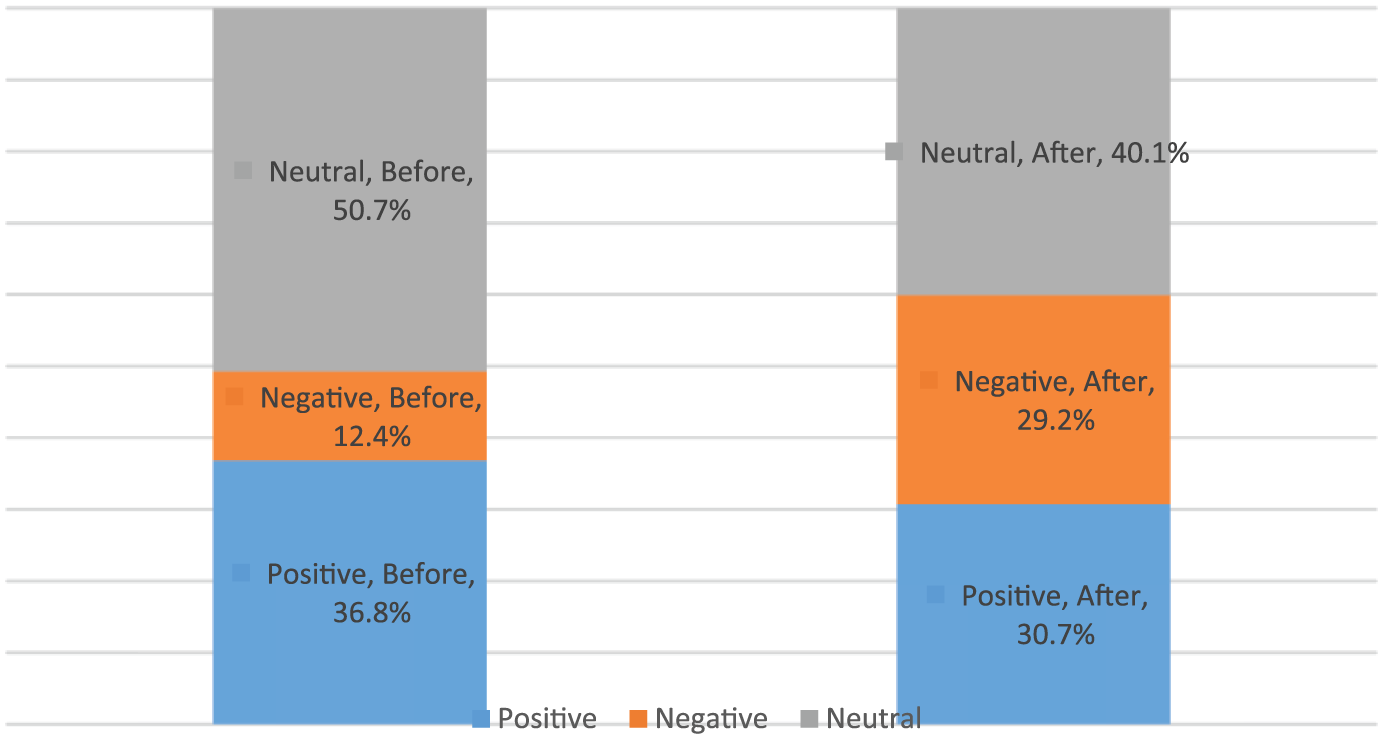
Positive, negative, or neutral presentation of NGOs before and during the crisis (sig. = 0.000).
The abovementioned quantitative results are verified by characteristic extracts from the articles of the first years of our research. During 2004, NGOs constituted ‘an ideological expression of an open and free society, which rejects the partizanisation of the state’ (Kostas Karamanlis, Kathimerini, 27 February 2004). In addition, George Papandreou 4 promised ‘a wide promotion of the work of NGOs through TV and significant tax reductions’, so as to encourage them to contribute to the development of the civil society (Kathimerini, 3 March 2004). The same perspective is presented in To Vima, according to which NGOs will have a specific role to play within society, that of the ‘vehicle’ for the participation of people in issues of common interest (To Vima, 15 February 2004 and 7 March 2004).
Even in the aftermath of the Olympic Games, the general tendency appears to be significantly in favor of NGOs, since according to a public research presented in Kathimerini on 10 December 2004, NGOs are considered ‘among the least corrupted institutions’. A similar result is reported on 24 June 2005. Worth mentioning is the fact that a constant contribution to the positive views regarding the NGOs are the reports concerning famous international NGOs (e.g. Greenpeace, Doctors without Borders, Doctors of the World) and their efforts on environmental issues, humanitarian crises, natural disasters, and so on. As shown in Graph 3, the non-Greek NGOs receive far less negative comments compared to the Greek ones. In addition, whenever an article refers to the cooperation of both Greek and non-Greek NGOs, it does that in a highly positive way (54.8%).

Positive, negative, or neutral presentation of NGOs per nationality of the NGO (sig. = 0.004).
A rather significant turnaround in the positive views concerning NGOs can be observed from 2010 onward. There are two main factors enhancing the negative views toward NGOs: first, the diachronic lack of a concrete framework to regulate their relationship with the state and society, and, therefore, the ‘chaotic’ situation of the NGO sector, and, second, the financial crisis that hit Greece in 2010. Given the crisis, public funding of NGOs not only is being re-evaluated, but expenditure on NGOs is also significantly reduced. Thus, Kathimerini writes about the ‘controversial management of the funding received by the NGOs’ (19 August 2010), even to the point of characterizing NGOs as ‘money-thirsty’ organizations (11 September 2010). The same newspaper in 20 February 2011 talks about ‘the “dark world” of NGOs in Greece, where “millions of euros allocated for help in humanitarian crises, or to implement development programmes, was not adequately spent”’. To Vima reports on the prosecutions against specific NGOs (Patmos’s Circle and International Mine Initiative) and the excessive funding they had received (14 April 2012) and underlines ‘the party of millions, namely the huge funding given by three ministries (Culture, Health and Foreign Affairs) to dozens of NGOs for “unknown” activities’ (To Vima, 9 September 2012). As an exception to the negative reports concerning NGOs stand several articles praising the contribution of specific NGOs, along with other formal and informal networks, to the relief of poor or impoverished, because of the crisis, people. To Vima dedicates an article to Doctors of the World, reporting and presenting their work in downtown Athens in favor of poor and homeless people (30 May 2013), while Kathimerini stresses that ‘some NGOs, citizens’ groups and the church try to make up for the failures of state bureaucracy in the times of crisis’ (17 December 2013).
Focusing on the critique regarding NGOs, it is important to underline that the negative comments published usually do not refer to specific NGOs, but to the whole NGO sector in a generic way. As shown in Graph 4, the negative articles are three times more when there is a general reference to the NGOs sector compared to the cases naming specific NGOs. This differentiation in the expression of positive and negative comments might generate a rather negative perception of the NGO sector as a whole, within which only a minority of organizations function in a way promotes the ideals of civil society. Based on the abovementioned quantitative and qualitative evidence, we accept our first and second research hypotheses.
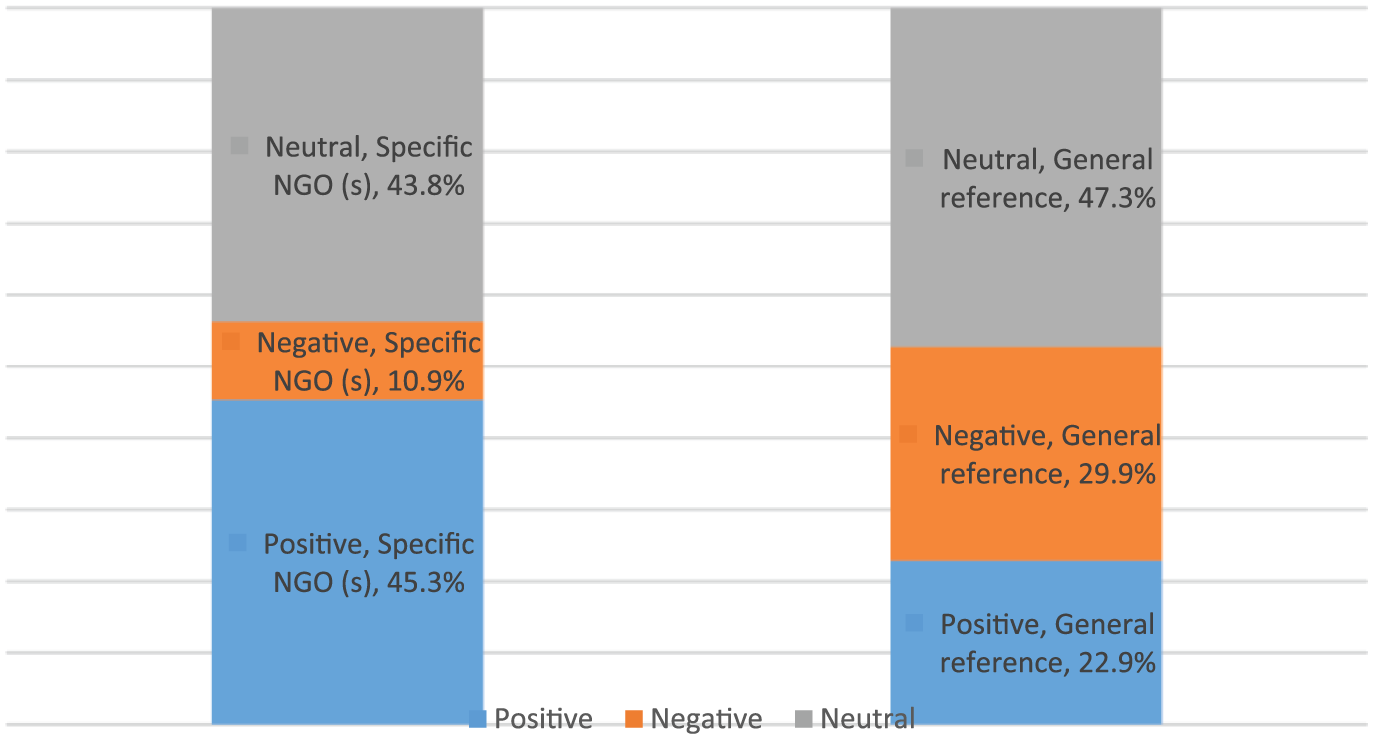
Positive, negative, or neutral presentation of NGOs per general or specific reference to NGOs (sig. = 0.000).
Our third research hypothesis deals with the focus of the Press on ‘soft’ rather than ‘hard’ issues. As mentioned above, the media limit their coverage to non-controversial ‘non-political’ and ‘soft’ issues, since ‘hard’ issues are, according to the media, dealt with by the state and the political parties, and not by NGOs. According to Graph 5, this focus of media on ‘soft’ issues regarding NGOs is confirmed. In both newspapers, the vast majority of the articles, more than 9 out of 10, referring to NGOs, focus on ‘soft’ issues, rather than ‘hard’ ones. However, and as noted in our theoretical background, it is also important to underline that ‘soft’ issues, such as humanitarian crises and natural disasters, are usually unexpected and thus allow the media to focus on human suffering and provide their news with dramatization. Therefore, the overwhelming focus of media on ‘soft’ and mostly humanitarian issues is not only a consequence of the media considering ‘hard’ issues the privileged field of politicians but also because of the dramatization offered by ‘soft’ issues such as disasters, crises, and poverty. Characteristic examples are trafficking, which was thoroughly presented in various articles during 2004 and 2005, the tsunami of 2004 in Indonesia, as well as Greece’s participation in the international effort to provide relief to the people hit by the earthquake in Haiti in 2010 (which attracted the worldwide interest of media and NGOs).

Reference to ‘hard’ or ‘soft’ issues NGOs per newspaper.
Our fourth hypothesis assumes the unanimous stance of the media, independent from their ideological orientation, toward the NGO’s. According to Graph 6, both newspapers appear to report NGOs in a similar way in terms of the positive, negative, or neutral presentation of their structure and actions. Kathimerini appears to be slightly more positive toward the NGOs compared to the To Vima, but our chi-square statistic test shows that this small difference cannot be considered statistically significant. This finding makes us accept our fourth research hypothesis.
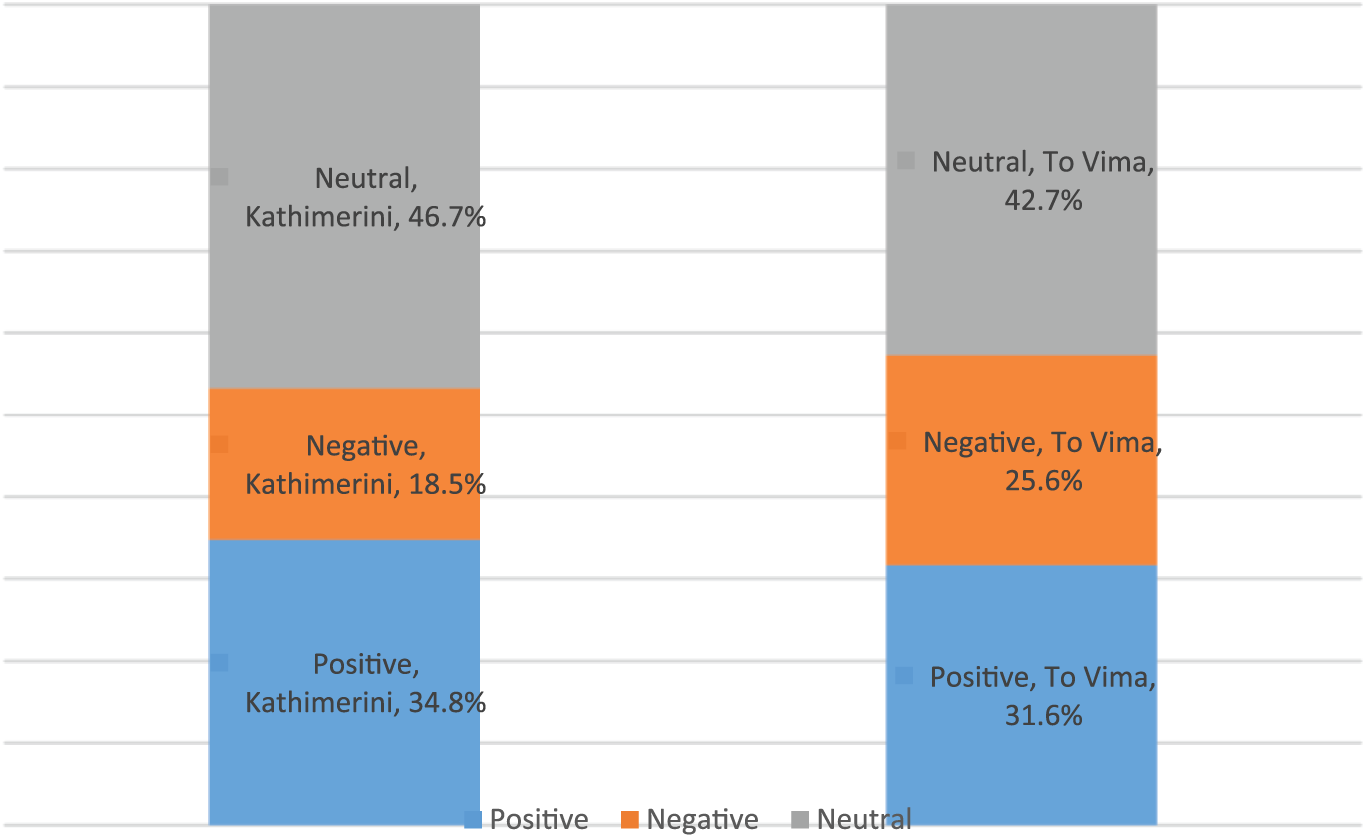
Positive, negative, or neutral presentation of NGOs per newspaper (sig. = 0.276).
The articles that focus on the negative aspects of the NGOs focus mainly on the expenditure of public money (29.6%) and the lack of transparency in funding (23.9%), followed by ineffectiveness, the serving of interests, and clientelism (Graph 7).
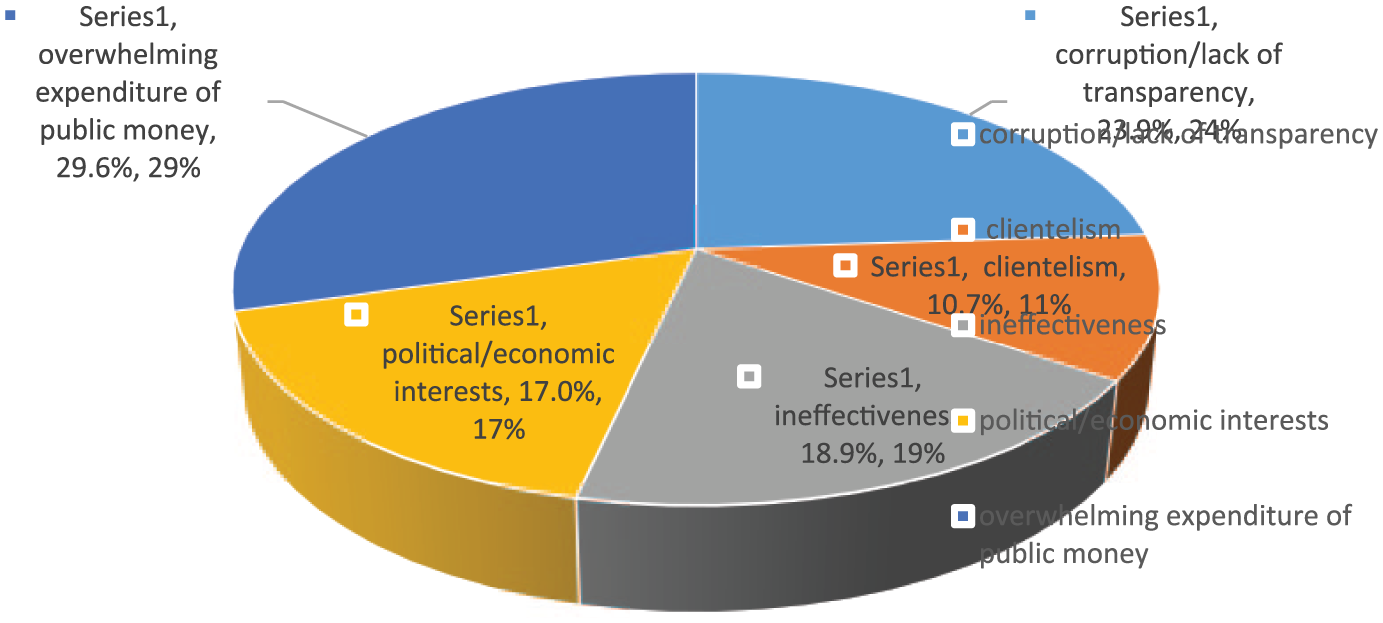
Characteristics of the negative presentation of the NGOs.
To get a more detailed image of the negative characteristics attributed to the NGOs in terms of the different media of our research, both newspapers focus primarily on the overwhelming expenditure of public money by several NGOs (32% and 28.4%) and afterward to corruption/lack of transparency (25.7%) in the case of Kathimerini and interests (22%) in To Vima (Graph 8). In both Graphs 7 and 8, one can observe the rather low percentage of the attribution of clientelism to NGOs, even though the specific phenomenon has been theoretically described among the most characteristic ones of the Greek political sphere. This has to do with the political affiliation of the examined newspapers, since Kathimerini is politically close to the conservative governments of New Democracy, whereas To Vima is sympathetic to the social democrats of PASOK. These two parties, with minor exceptions (1989–1990, 2012–2013), were the only ones to have governed Greece since the return of constitutional rule in 1974 and until January 2015.
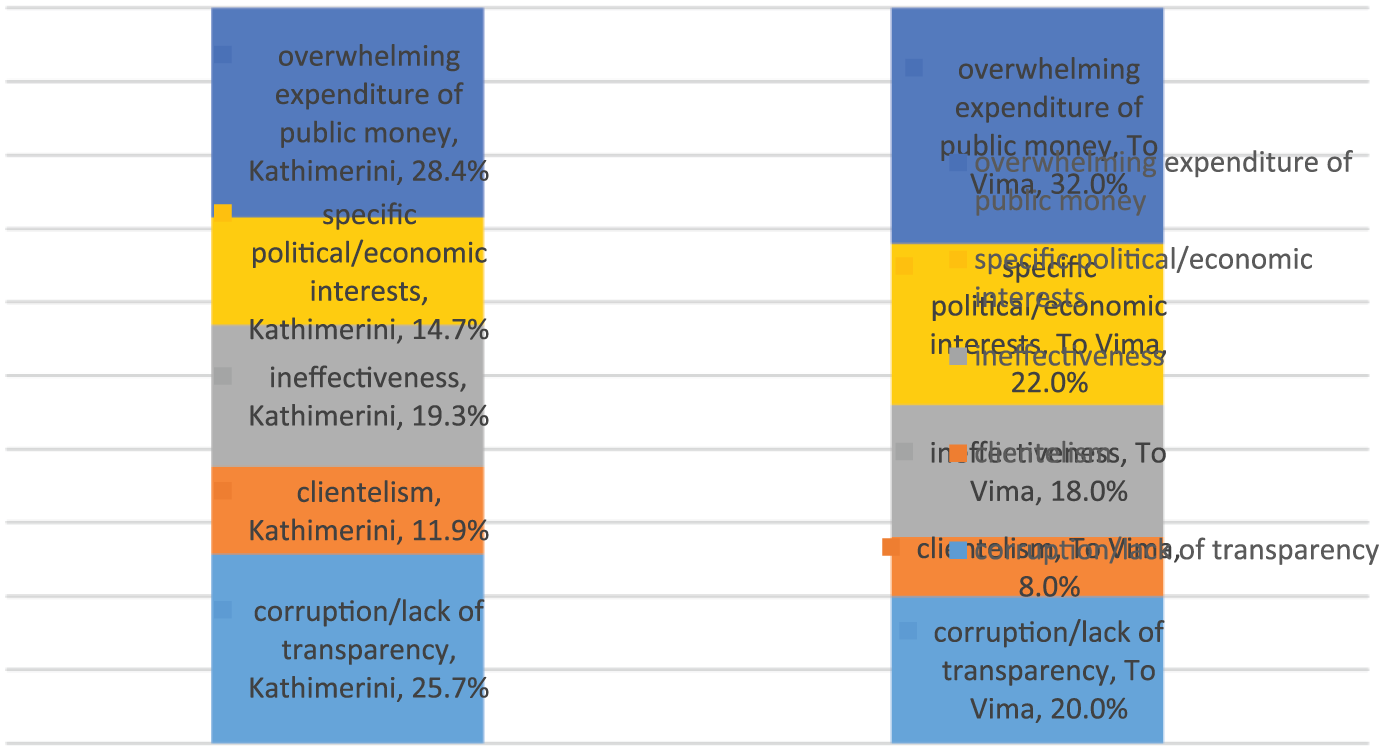
Reference to negative characteristics of the NGOs per newspaper.
The overwhelming expenditure of public money and the non-transparent way of funding NGOs have been further stressed out in the articles following the emergence of the financial crisis. As shown in Graph 9, the lack of transparency in the funding of NGOs is almost twice as much presented during the crisis (27.6%) compared to the articles until the emergence of the crisis (14%). This fact designates transparency as the most important issue in the public debate. In addition, the diachronically high percentage on the overwhelming expenditure of public money reveals that this parameter stands as a benchmark in the public discussion concerning NGOs. Moreover, the focus on political interest until the crisis (30.2%) has been ‘replaced’ by the references to corruption/lack of transparency (27.6%) in times of crisis.
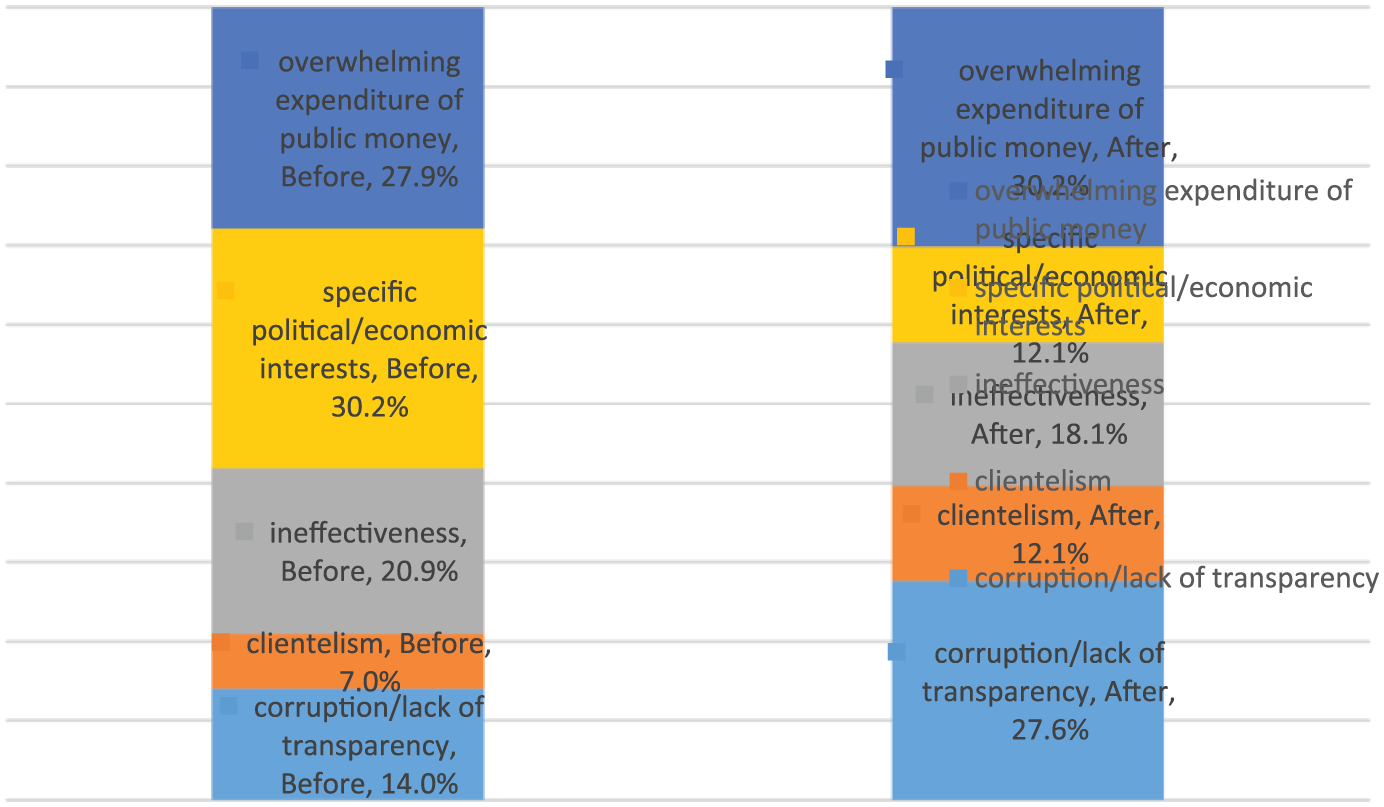
Reference to negative characteristics of the NGOs before or during the crisis.
Even though this critique is deterministic, due to its ‘generic’ character, there are several articles that stress that not all Greek NGOs are corrupt and that there are NGOs which have done a lot of work. As we have seen in Graph 4, there are 22.9% of articles with general reference to NGOs, which evaluate the NGOs domain in a positive way: ‘Justice should conduct an in-depth research and establish strong control mechanisms for the NGOs funded by the state. In no case though, should we disdain the work of many NGOs that have significantly contributed to society’ (Kathimerini, 22 February 2014). Similarly, in To Vima, ‘what we need to do, is not to disdain the action of organizations offering social services and implement the idea of the civil society. What is needed is a set of rules, which will contribute to financial transparency’ (24 February 2014).
The financial crisis in Greece has, as noted, resulted in the enhancement of social solidarity due to the severe reduction in living standards. This situation has contributed to the formation of various forms of informal collectivities to deal with social and economic problems. As the work of such formations cannot be neglected, the newspapers have dedicated several articles referring, along with specific NGOs, to informal self-organized efforts. These efforts are characterized as
a miracle accomplished by NGOs, civil unions that are self-organized and proved to be much more effective than welfare state structures in helping those in need. (Kathimerini, 8 March 2013) The only positive thing coming out of the crisis that actually revealed the hidden incapacity of state structures, is that all collective organizations, such as municipalities, NGOs, the church, citizen groups, decided to ‘patch up’ – as far as they can – the huge gaps that state bureaucracy cannot even see. Civil society reacts and gets organized to confront the emerging crisis. (Kathimerini, 17 December 2013) The welfare state was caught totally unprepared against the crisis. The self-organization of citizens and their private initiative saved anything that could be saved out of this situation. (Kathimerini, 1 October 2013) The previously puny civil society, the weakest throughout Europe, has abandoned the shell of individualism. More and more citizens become active and work for their fellow citizens. (To Vima, 6 November 2011)
Although these quotes might seem overoptimistic, these articles describe in a more or less enthusiastic way the new rise of the notion of civil society, a notion that has been ‘buried’ under individualism since the aftermath of the Olympic Games back in 2004. This positive presentation includes NGOs, at least the ones which struggle with any means they have against the crisis. Under this rationale, we partly accept our sixth research hypothesis, regarding the positive presentation of the new civil society formations.
Discussion
In conclusion, one could argue that the presentation of NGOs varies depending on the period we are focusing on and the nature of the NGO itself. The Olympic Games era boosted a significantly positive context regarding the function and capabilities of NGOs as pylons of civil society. In the years to come through, the deficiencies of NGOs that hit the surface and were exposed during the period of the crisis increased the skepticism expressed by the media regarding their transparency and effectiveness.
Our results demonstrate that the factors contributing to the negative perceptions of the NGO sector in Greece can be divided into two categories. First, the structural factors regarding the existence and function of NGOs. The fact that many Greek NGOs are organized in a top-down rationale, receiving funding, at least until the onset of the crisis in 2010, by the state in a non-transparent way, along with the absence of a specific framework to regulate their activities, has led to the generic presentation of the NGO sector in a negative way.
The second is the wider social context. The Olympic era acted as a nutshell within which positive perceptions of NGOs were nurtured. NGOs were considered to be the antidote to the overgrown state and Greece’s weak civil society. The years to come have disproven these expectations, mainly due to their structural deficiencies. In addition, during the crisis, the control over public expenditure has not only become stricter, but the media have focused on suspicious cases of state funding, demanding transparence, reflecting the common, and in many cases justified, feeling among Greek society that a significant factor behind the crisis is the non-transparent diachronic expenditure of public money.
Within these ‘dystopic’ social and structural conditions, a new era of the civil society sprung up. The severe consequences of the crisis on society have ‘forced’ citizens to create informal bottom-up collectivities. These new networks, along with the well-established NGOs, receive positive comments and appear as the purest expression of civil society in contemporary Greece. What needs to be proven, though, is whether these new efforts will appear strong enough to reflate the notion of NGOs, encouraging citizens to form and participate in new bottom-up forms of voluntarism.
Footnotes
Declaration of Conflicting Interests
The author(s) declared no potential conflicts of interest with respect to the research, authorship, and/or publication of this article.
Funding
The author(s) disclosed receipt of the following financial support for the research, authorship, and/or publication of this article: This work has been supported by the European Union (European Social Fund – ESF) and Greek national funds through the Operational Program ‘Education and Lifelong Learning’ of the National Strategic Reference Framework (NSRF) – Research Funding Program: THALES ‘Investing in knowledge society through the European Social Fund’.
Notes
Author biographies
 .
.