




Abstract
Travel journalists cannot know each traveller for whom they write, so they must imagine what a reader wants. The subsequent journalism influences how tourists travel and engage with a foreign country and its inhabitants. This article uses an independent/connected framework of tourist behaviour to identify how travel journalists imagine their readers’ interests. Through content analysis of texts in newspapers from Asia and the West, we find that the reader is more often imagined as independent and adventurous than connected and concerned with tourist sights. However, the latter were more common in Asia, which suggests that travel writers across the globe imagine readers differently. It suggests that in an increasingly globalised world, the post-colonial power dynamic that has been a stalwart of scholarly thought on travel writing may be outdated and could be more usefully replaced by one that considers the financial privilege of tourism, seen in texts from both hemispheres.
Imagination is a mixed blessing in journalism, but in one area it is essential: as journalists do not personally know their audience, they must imagine them. So when travel journalists go overseas, they carry a mental picture of the reader to whom they cater – an ‘imaginary traveller’. Litt (2012) calls such an imagined audience ‘the mental conceptualization of the people with whom we are communicating’ (p. 331), while acknowledging that it is hard to measure. Fürsich (2002b) refers to them as ‘preferred travellers’ and observes that the audience of a travel TV show ‘is not openly stated but needs to be located by interrogating the assumptions of the text’ (p. 209). This article attempts to extrapolate imagined audiences from the themes, topics and tropes that are used to address them. Such imagined audiences can range from individuals (Marwick and boyd, 2010) to regions (Cocking, 2009) and entire nations (Anderson, [1983] 1991). They have a geographical counterpart in ‘tourist imaginaries’ (Forsey and Low, 2014; Salazar, 2012), the image of a place held by the people who go there.
Imagining an audience affects how a journalist represents a destination. People adapt their behaviour depending on how they imagine the audience (Schlenker, 1980) and an imagined audience can influence a journalist as much as a real one (Fridlund, 1991). Imaginary travellers matter because journalists write for them, guide them and suggest what to see and do when overseas, setting an agenda for how foreign cultures are viewed (Cocking, 2009; Fürsich and Kavoori, 2001; Hanusch, 2010; Hanusch and Fürsich, 2014; Spurr, 1993). The manner in which journalists imagine their readers influences what they write. Furthermore, the implicit behaviour, attitudes, activities, aspirations and dispositions of readers as represented in the texts indicate expected behaviour and so on for future travellers. A writer’s imaginary traveller can influence a real traveller to behave like the imaginary one.
Subsequently, the framework used by the journalist to interpret a destination will influence the opinion a traveller has of that place (McCombs and Shaw, 1972) and ‘the media not only can be successful in telling us what to think about, they also can be successful in telling us how to think about it’ (McCombs, 2006: 546; his italics). Media help create what becomes the subject of the ‘tourist gaze’ (Bender et al., 2013; Ljundberg, 2012; Urry, 1990). This in turn impacts travellers’ behaviour (Nielsen, 2001; Plog, 2001; Santos, 2004), and ‘the media, as one of the most important information sources for tourists (Bieger and Laesser, 2004), can affect people’s cognitive and affective responses and influence their behavioural intentions’ (Hsu and Song, 2013: 254).
One aspect of this behaviour is intercultural interaction between traveller and host, which echoes across history. Pratt’s (1992) comment about Victorian travel writers ‘writing in … “contact zones,” social spaces where disparate cultures meet, clash, and grapple with each other, often in highly asymmetrical relations of domination and subordination’ (p. 4) resounds through travel journalism today. This is not to say that the relationship is comparable to coloniser and colonised. Instead, the tourist–host relationship is based on commerce and service. The economically privileged traveller has money and variously expects to be served, entertained, enlightened and made to feel they are encountering something special. The inhabitant of the host nation expects to receive money for performing – and initiating through tourism boards and tour operators – roles associated with the traveller’s expectations (Forsey and Low, 2014). Far from being passive or unwilling recipients of these expectations as was the case for the colonised, local people may actively encourage, develop and contribute to the lifestyle that the traveller has come to enjoy. Nevertheless, tourism evokes ‘power asymmetry’ (Fürsich, 2002b). To imagine a traveller’s behaviour and interests is to imagine a relationship of power with the destination. Travel journalists’ texts and the way that they imagine their audiences travel reflect these ideas of server and served, host and guest.
This is significant, particularly as the tourism industry expands to accommodate travellers from newly developed countries, and tourism grows as a major point of interaction between people of other nationalities (Hanusch and Fürsich, 2014). This demands a new, comparative approach to analysis of travel and travel journalism. Tourism scholarship (and the industry) has been based on the idea of ‘the West visiting the rest’. Today, the rest are visiting the West in their millions. Travel scholarship predicated on Europeans visiting Thailand can scarcely do justice to the modern reality of Thais visiting Europe. Besides, travel journalism makes scant distinction between East–West and North–South dichotomies, and Corderio (2011) notes that even developed Europe still has ‘exotic savages’ such as agricultural labourers and fishermen, while Australia has both ‘primitives’ in the shape of Aboriginals and ‘pre-industrial man’ in the shape of the Crocodile Dundee bushman stereotypes (Forsey and Low, 2014: 160).
For the people from each hemisphere, their styles of travel are as different as they are. Western cultures have been described as individualistic or idiocentric, while Asian cultures have been described as collectivist or allocentric (Triandis et al., 1988a). To make a swift and necessarily reductivist description, in the former, individuals define their place in society by markers of distinctiveness from that society; in the latter, by roles and relationships within that society. Triandis (2001) explained the distinction thus:
People in collectivist cultures, compared to people in individualist cultures, are likely to define themselves as aspects of groups, to give priority to in-group goals … to pay less attention to internal than to external processes as determinants of social behavior, to define most relationships with ingroup members as communal, to make more situational attributions, and tend to be self-effacing. (p. 908)
It may be expected, therefore, that readers of Anglosphere newspapers will be imagined differently from readers of (even Anglophone) Asian newspapers, giving grounds for a cross-cultural study. This coincides with a recent turn in journalism scholarship, which moves away from normative, Western liberal-centric studies towards idiographic, positivist, context-based studies (Curran and Park, 2000; Josephi, 2005; Thussu, 2013; Wasserman and De Beer, 2009).
Travel and its associated texts are also valid loci to examine intercultural assumptions. As international reporting declines and entertainment-based journalism grows (Hanusch, 2013; Hanusch and Fürsich, 2014; Santos, 2004), travel journalism offers an insight into ideological assumptions shared by writer and reader: ‘What might appear to be an innocent form of nonfiction entertainment … can be analysed with regard to its discourse of the foreign and the familiar as it is inflected by the material conditions of power’ (Fürsich, 2002b: 205).
To study this, we examine tropes in travel journalism, where a trope is a significant or recurring motif in a text that suggests how travellers, their interests, behaviour and style of travel are imagined by journalists. We define travel journalism as primarily factual writing about leisure travel, appearing on a credible, gatekeepered platform, written for a specific audience, and designed to entertain and guide. Texts for analysis were taken from four English-language national newspapers from different parts of the globe: the New York Times from the United States, The Times from the United Kingdom, the Straits Times from Singapore and the New Straits Times from Malaysia. Limiting the source of articles to newspapers may appear old-fashioned, but was done because the four newspapers are leading titles in their countries with circulations in the hundreds of thousands, so their influence on travellers is more apparent than for unaudited online travel content. In addition, while online travel writing such as blogs may appear solipsistic and self-indulgent, professional travel journalists must consider their readers if they are to succeed.
Perspectives: The imaginary traveller
Given the impossibility of knowing the audience, journalists imagine them and write what they consider suitable: ‘the less an actual audience is known, the more individuals become dependent on their imagination’ (Litt, 2012: 331). Previous studies have looked at imagined audiences through content analysis of what people say (Berkenkotter, 1981). However, Litt warns against assuming that texts represent imaginings or that imaginings necessarily represent reality. Even so, these imaginary travellers are not irrelevant as they represent real people (Baldwin and Holmes, 1987; Fridlund, 1991). Past studies have suggested that newspapers have only a scant picture of their audiences (Gans, 1979; McQuail, 1994; Min, 2004), but with increased interactivity and market research, this holds less true.
In addition, an imagined audience may be based on the solid foundation of writers’ and editors’ knowledge of their reader (Ang, 1991; Espinosa, 1982). Travel journalists consciously align what they write to be in tune with the needs of their audiences and their publication (McWha et al., 2014). The authors recognise that, alongside the presumed interests of the imagined audience, there are many influences on what the travel journalist writes, including their publication’s agenda and the demands of advertisers. However, to unpack this web of influences would require a paper in its own right, and as a result, this study instead considers only the texts the travel journalists produce. Another, post-rationalised argument is that if a publication does not deliver what readers want, it will fail; therefore, those publications that succeed must imagine their audience accurately. Thus, travel journalism is considered a fair representation of imaginary travellers.
Perspectives: Post/modernist travellers
We take two paradigms from tourism studies – the modernist and the post-modernist tourist – and apply them to travel journalism. To our knowledge, this is the first study to apply these two classic tourism paradigms to travel journalism, and to do so, we built on them to develop a coding manual to analyse tropes.
MacCannell (1976) introduced modernity as a defining marker of tourism and tourism as a prime example of modernity. According to him, modernism is based upon differentiation. Tourists seek something different from the routine. To be a tourist is to be modern in the sense of searching for naturalness, authenticity and nostalgia that are no longer found in the everyday world. This separation of non-modern from modern finds echoes in other tourism binaries: work/leisure, home/away, traveller/tourist. Modernity involves difference. We operationalised MacCannell’s traveller’s preoccupation with difference and departure from the quotidian as a desire for adventure or challenge (not found in the everyday); a journey with a single theme such as food, hiking or culture (distinct from the variety of run-of-the-mill activities); the discovery of new sights or real life (the desire for authenticity or nostalgia); and a personal experience (a form of authenticity as well as an individualised reaction to a place). Travel articles were analysed for tropes referring to these.
If the modernist paradigm emphasises the individual reaction to a place, the post-modern emphasises a shared and reproducible response. Here, the tourist is less concerned with authenticity of something beyond tourism; authenticity of touristic activity as touristic activity is adequate. Urry (1990: 85) describes tourism as post-modernist based upon dedifferentiation, arguing that post-modernist tourism is characterised by a breakdown of distinctiveness within cultural spheres (such as art, architecture, TV and travel) so that high and low forms of each merge – not claiming to be unique, but reproducible. According to Urry, distinctions between reality and its representation diminish until ‘what is fake seems more real than what is real’. Such a tourist gaze is socially constructed and part of a wider society which shares ideas about what a place should signify (Urry, 1990; Urry and Larsen, 2011). Urry also cites Feifer’s (1985) writings on post-tourists who enjoy the inauthenticity of tourism, delight in playing the ‘tourist game’ and want a variety to activities to suit whatever mood they are in. We operationalised Urry’s traveller’s tropes as a desire for comfort and relaxation (not too different from home life, although often better); a variety of activities in a destination (as per Feifer); an interest in well-known sights (following socially constructed preconceptions); and offering suggestions for others to follow (co-creating a socially constructed idea of destination).
As the terms ‘modernist’ and ‘post-modernist’ are overburdened with scholarly baggage, they were not used to describe alternative forms of imaginary traveller. Instead we referred to one kind of imaginary traveller as ‘independent’, which relates but does not equate to MacCannell’s modernist traveller, and the other as ‘connected’, which has a similar relationship with the post-modernist tourist described by Urry. The two forms, described below, are not oppositional; they merely reflect alternative imaginings of how people travel. For this, we are indebted to Good’s (2013) study of the New York Times Why We Travel section, which suggested a comparable distinction between ‘enduring’ and ‘emergent’ themes in user-generated travel photography.
Journalists in any country will write according to expectations of their audience. The Asian newspapers in this study are aimed at the cosmopolitan, wealthy middle classes of their countries, as suggested by the use of the English language. Similarly, the Western or Anglosphere newspapers both target the better-educated, higher strata of society and assume a global outlook of their readers. Equally importantly, the wealth of these audiences makes them attractive to advertisers, who would wish to target such lifestyle-oriented, wealthy cosmopolitans, and the texts will have been written with this in mind.
Socially, the readers may be comparable; yet, we anticipated a distinction between Asian and Western travel journalism, based on historical, economic and cultural factors. Economically, Asia has seen the growth of mass tourism only recently, which may be expected to be associated with group rather than independent tourism, and as a result, travel journalism can appear ‘package-tourist’ to Western tastes. Culturally, Asian societies have been seen as more allocentric, collective and motivated by the norms of the group, as opposed to the idiocentric Western individualism in which motivation comes from personal desires (Hofstede, 1980; Triandis, 2001; Triandis et al., 1988a). As a result, to Asian tastes, Western travel journalism can seem curiously preoccupied with the thoughts of the traveller, their personal reaction to a place and their idiosyncratic determination to do something others have not.
This literature review led to three research questions. First, what are the most common tropes that appear in travel journalism? Second, how do travel journalists imagine their readers as travellers based on MacCannell’s and Urry’s interpretations? And third, what differences can be seen between Asian and Western travel journalism?
Method
Content analysis can be used to unveil the human experiences manifested within texts and to reveal sociological or psychological realities (Schilling, 2006). Strohm (1983) also suggested that content analysis could be used to gather a sense of who a writer was writing for. Thus, it was considered that such analysis could indicate the writers’ assumptions about their audiences. We chose content analysis as being at the heart of communications scholarship (Lombard et al., 2002), following the definition that it is ‘an observational research method that is used to systematically evaluate the symbolic content’ of texts (Kolbe and Burnett, 1991).
Altogether, 376 articles were downloaded from the four newspapers in November 2014, for a representative cross-section of each newspaper’s website. They were written between 2010 and 2014. Following Cohen and Cohen’s (2012) call for research into travel that goes beyond Western assumptions and considers the rising powerhouses of Asia, we compared Asian and Western travel journalism (see also Winter, 2009). The two Western newspapers were the New York Times and The Times of London, as representatives of a long-standing tradition of both travel and travel journalism as well as cultural and economic engagement in other countries. The two Asian newspapers were the Straits Times (Singapore) and the New Straits Times (Malaysia), as representatives of emerging economic and cultural influence, but with no long heritage of either travel or travel journalism. Newspaper selection was limited by the requirement to have English-language texts so that they could be compared.
As Western articles were often twice as long as Asian, analysing the same number of articles would have resulted in an imbalance. Instead, around 200,000 words were selected from each hemisphere. Articles were all one person’s account of time in a destination, and we looked at how they represented ‘away’ for a ‘home’ audience as a means to observe how they imagined the travelling behaviour of that audience.
MacCannell’s perspective of tourism as differentiation from everyday life – labelled ‘independent’ – and Urry’s perspective of a more tourist-centric ‘gaze’ – labelled ‘connected’ – were sought in 10 tropes in travel journalism articles. The recurrence of a trope is taken as an indicator of how the journalist sees and wants the reader to see the destination, as tropes are ‘sense-making imagery used to describe, prescribe and circumscribe social reality … and in the process they also project, constitute and theorize particular constructions of those realities’ (Oswick et al., 2004: 106):
IND1 Adventure/challenge CON1 Comfort/relaxation
IND2 Discover new sights CON2 Visit well-known sights
IND3 First-person experience CON3 Suggestions for other tourists
IND4 Philosophical, what to feel CON4 Pragmatic, what to do
IND5 Singular themed journey CON5 Varied activities
To counter the risks of researcher bias (Babbie, 2011), the texts were read by the two authors, one from Europe and one from Asia. Each analysed half the text from each newspaper. Initially, following discussion of the coding manual, 50,000 words of text were analysed which yielded an inter-coder reliability of 80.7 per cent using Holsti’s method (Lombard et al., 2002; Riffe et al., 2005). While acknowledging the limitations of simple percentages, it was considered acceptable given the large number of categories (10) coded. The unit of analysis for IND1-4 and CON1-4 was a paragraph, and paragraphs could have multiple codes; for IND5 and CON5, it was the entire article, which could only be coded as one or the other. The intention was to compare among tropes, rather than simply seeing how often each occurred (Maxwell, 1998). How each of these tropes was operationalised, with an example of each, is presented below.
The ‘independent’ traveller
These travellers are characterised by a separation of different spheres of life and activity, compartmentalising life to give it meaning and authenticity that comes out of opposition (MacCannell, 1976). For this study, MacCannell’s modernist view is termed an ‘independent’ form of travel, concerned with first-person experience and the self (as opposed to the other), on doing something new (separate from the usual) and finding authenticity in personal experience and reaction (philosophical/emotional). Independent travel follows a singular theme as this is what distinguishes it from the variety of the everyday world.
IND1 Adventure/challenge
Travel is exciting, difficult, dangerous and challenging. This is often linked to the destination or the activity which the writer undertakes: ‘We headed off towards a crossroads, and straight into a manic stream of motor scooters, paying no heed to traffic lights. The traffic must have parted, since I was alive when I reopened my eyes’ (The Times, United Kingdom).
IND2 Discover new sights/off the beaten track
The traveller knows what the standard tourist sights are, but may choose to visit somewhere less touristy as a marker of independence. This is often associated with a ‘preferable’ form of travelling in which the writer connects with a more authentic (i.e. non-touristic) aspect of the destination. Some travellers may consider the sight/activity well known, but it is still presented as non-touristic: ‘Fez is now a faded dream, a city in limbo when compared to the commercial bustle of Casablanca and the tourist mayhem of Marrakesh’ (The Times, United Kingdom).
IND3 First-person experience
This trope involves use of the first person ‘I’ and writing about lived experience. It offers authenticity of experience and an implied guarantee that the report has credibility because it truly happened. This overcomes one of the problems travel journalism faces, and all travellers’ tales take part of their power from their truth-claims (Campbell, 1991; Ljundberg, 2012; Smith and Watson, 2012):
In a week exploring the city, from the windswept, near-deserted ramparts to the teeming labyrinthine passageways of the Mandayi Bazaar, I never once felt threatened. To the contrary, I was welcomed everywhere by Afghans eager to show me their country. (New York Times, United States)
IND4 Philosophical, what to feel
The writer reacts to what is seen or experienced, or notes their expectations and imaginings of the place, to show how independent-minded they are as a traveller. This trope was uncommon and may have been considered self-indulgent by the writer; reporting activity may have value for the reader as it is transferrable, while reporting the reaction may be less so: ‘As evening came on, I was feeling contented, relieved and smug in equal measure, because this hadn’t happened by accident. I’d researched the perfect place for our holiday’ (The Times, United Kingdom).
IND5 Singular themed journey
Most of the activities revolve around a theme, such as a wine-tasting tour of the Rhine Valley, a safari in Botswana or a personal pilgrimage to reconnect with Jewish culture in Jerusalem. In each case, the destination is a locus for an activity, rather than being the focus in its own right. This has a dual emphasis on difference from the quotidian: everyday life where there are multiple demands made on time and attention does not often permit such a single focus, and the activity often cannot be done at home.
The ‘connected’ tourist
Urry (1990) calls them ‘collective travellers’. They accept that authenticity is not possible in the modernist sense and instead seek ‘authentic tourism’ or travel which is true to the principles of tourism and which has been created and recreated by tourists and their shared experiences. For this study, they are termed as ‘connected’, being concerned with the collective identity of tourists and their common or shared tourist activities; to achieve this, the text often has recommendations for others rather than focus on the self, and as a result, travel writing is based on what tourists do in a destination so that the experience is shared.
CON1 Comfort/relaxation
This trope included references to travellers who go abroad to relax or for enjoyment, or to treat themselves. Often their goal is a more intensely pleasurable life than at home. Hotels and resorts offer a brief taste of a lifestyle which travellers cannot afford most of the year. The activities they undertake are more luxurious and more comfortable than home:
A French film-maker and his Colombian wife have transformed La Passion into an elegant boutique hotel. There was a courtyard of palms and divans … The surprise was on the roof – a gorgeous swimming pool with a view of the cathedral. (The Times, United Kingdom)
CON2 Visit well-known sights
Tourists do not always look for something new; often the intention is to see a well-known sight so that they can share their experience with others or gain status by having seen something renowned. They depend on the group to define what is worth seeing and doing. Equally, the attitude may be that if a sight is famous, it must be so for a reason and is therefore worth a visit. This trope often included a direct reference to tourists: ‘Little wonder that whale watching has become a favourite activity for tourists to Australia who will make their way down to Hervey Bay for an unforgettable experience’ (Straits Times, Singapore).
CON3 Suggestions for other tourists
This trope was likely to involve second-person writing offering ideas for travellers. Having depended on others’ recommendations, they subsequently contribute to the group. The emphasis was on shared touristic experiences that could be replicated by others, rather than individual adventures:
Besides Langkawi, the State of Kedah has other attractions to delight visitors. The Sedim Recreation Park offers the longest canopy walk in the world. Visitors traversing the treetop walk can enjoy a magnificent view of the foliage teeming with life. (Straits Times, Singapore)
CON4 Pragmatic, what to do
While most travel articles have a ‘fact box’ at the end, this trope was operationalised as references within the text giving advice on travel. This can be specific instructions on which road to take to get to a place or more generalised suggestions of how to do a certain form of travel:
If you don’t want to do any of these, then just sit back and enjoy the breeze and solitude with friends and family. With no television or mobile phone coverage to distract you, it’s the best opportunity to enjoy nature at its glorious best. (Straits Times, Singapore)
CON5 Series of varied activities
Often a destination will offer several activities or a tourist circuit such as the Taj Mahal/Lake Palace/Red Fort triangle in Rajasthan. Online, these are popularly presented as ‘10 things to do in …’ lists. In travel journalism, they take the form of a report on the different activities the writer did during their stay in a place, and articles were also coded for this trope.
Results and analysis
Across 376 articles containing 406,152 words, 6576 examples of the 10 tropes were coded. The first research question asked what the most common tropes were (Table 1), while the second asked whether tourists are more often imagined according to MacCannell’s or Urry’s interpretations. The most common trope was writing about first-person experience (IND3), which appeared 2424 times and was equally common in both hemispheres. Offering advice and guidance was the second most frequently coded trope (CON3: 1027 times). Third was writing about well-known sights on the tourist trail (CON2: 631 times). The least common trope imagined the audience as being concerned with how the writer felt about the place (IND4: 323 times), which was also equally divided between the two hemispheres. In simple frequencies, statements which imagined that reader as a traveller in the independent paradigm were more common (3760; 57.2%) than connected tropes (2816; 42.8%).
Frequencies of 10 tropes imagining audiences of four newspapers.
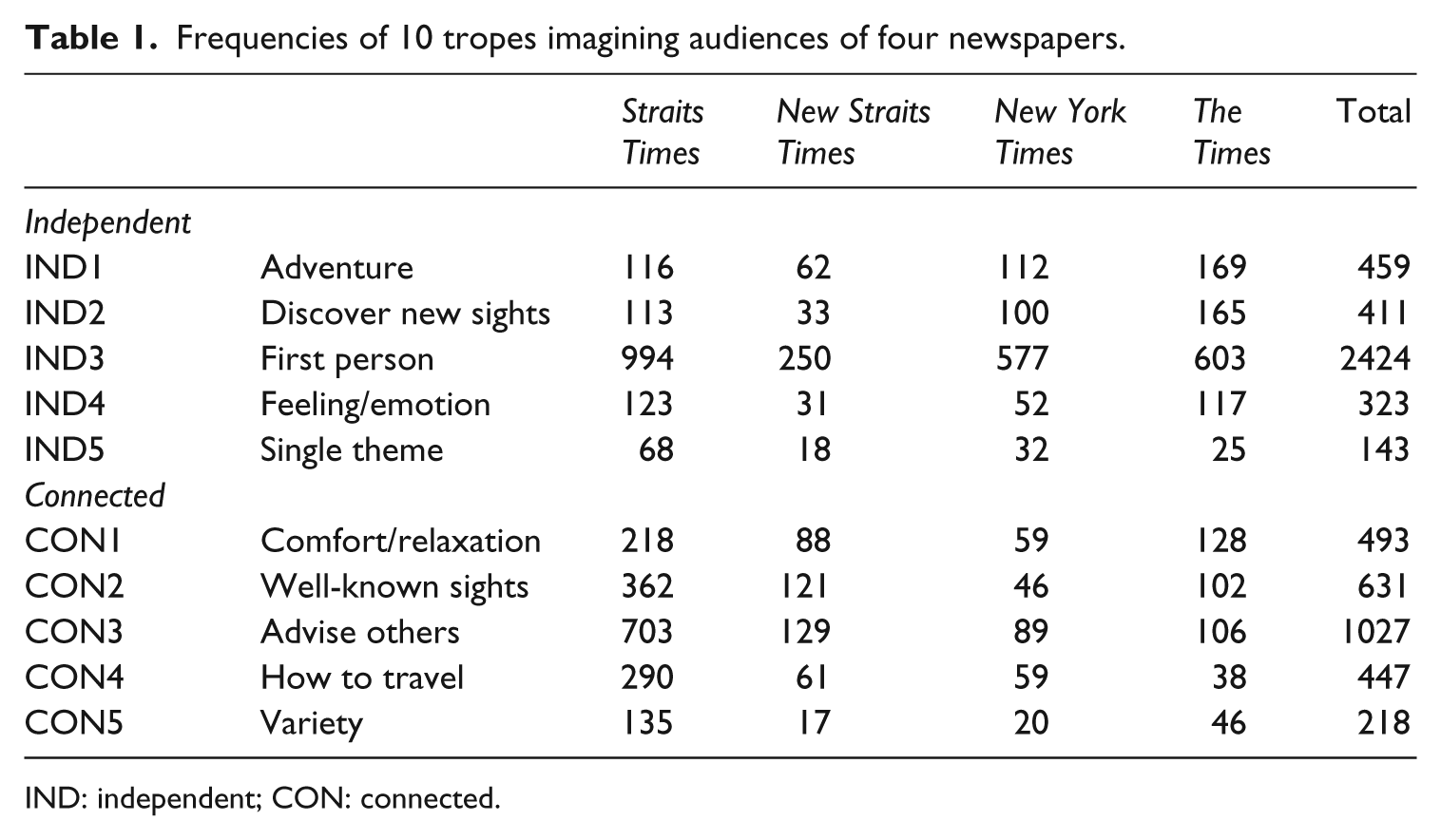
IND: independent; CON: connected.
At first sight, these indicate significant differences between imaginings of the audience as independent or connected travellers. Independence was more frequent, suggesting that travel journalists imagine that their audience are adventurous and want to go off the beaten track and prefer to travel with a particular theme. This is the model of the independent traveller rather than the package-tourist. This may be because the former are more likely to read travel journalism for inspiration for autonomous travel, while the latter are more interested in value for money and a more guided holiday.
Yet, it may not be as clear-cut as that. Travel journalism in the independent vein dominated largely due to the number of first-person experience tropes. If that is seen as a literary device, or something demanded by travel editors to boost credibility (Ljundberg, 2012; Smith and Watson, 2012; Duffy, 2014), and first-person writing and its connected counterpart, advising others, are removed, the frequencies are reversed. Connected travelling in the Urry mould becomes more prevalent (57.2% of tropes) and independence fades (42.8% of tropes). Travellers are imagined as more concerned with comfort than adventure, more attuned to well-known sights than exploring for something new, more in need of guidance than inspiration and more interested in variety than a themed journey.
The third research question concerned differences between Asian and Western imaginary travellers. Independent tropes were spread evenly between Asian (48.0%) and Western (52.0%) texts. The difference was more marked, however, when it came to connected tropes which were more prevalent in Asian (75.4%) than in Western texts (24.6%). While this suggested that Asian travellers are imagined more according to Urry’s paradigm, this picture changed when frequencies were calculated for Asian and Western journalism separately. In Asia, independent and connected tropes were relatively equal (46.0% and 54.0%, respectively), while in the West they showed a great disparity (73.8% and 26.2%, respectively). Thus, Asia is moderately inclined towards Urry’s imaginary traveller, while the West is strongly inclined towards MacCannell’s paradigm. The final measurement was whether the articles reported connected, touristy multiple-activity travel (IND5: 58.0%) or independent travel arranged along a single theme (CON5: 38.0%) – or neither (4%).
While the hemispheres coincided on the most and least popular tropes, they showed significant differences for the others. Offering advice and guidance for other travellers was four times more common in Asian than in Western texts. Writing about well-known sights on the tourist trail was three times more likely to occur in the Asian than in Western texts. Comfort and familiarity (DEP1: 493 times) were twice as prevalent in Asian as in Western writing. By contrast, adventure (IND1: 459 times) was twice as prevalent in Western as in Asian writing. Giving advice on how to do travel (DEP3: 447 times) was over three times more likely to appear in Asian articles. And the trope of discovery of new places and sights (IND1: 411 times) was twice as likely to be seen in Western as in Asian articles. In Asia, travellers were more strongly imagined as having Urry’s attitude in which comfort and relaxation, sticking to the tourist trail and a variety of activities were valued. In the West, by contrast, they were imagined along MacCannell’s lines as travellers who wanted adventures, something other than the usual sights, and themed their trip around a certain activity.
For a secondary level of analysis, Pearson’s product moment coefficient (r) showed several weak but significant results (Table 2). First, there was clear correlation among independent and among connected tropes, implying a valid distinction between the two. Second, there was no correlation between the gender of the authors and the occurrence of any of the tropes, so this was not considered a confounding variable. Third, the most common trope of writing about first-person experience, mentioned only slightly less than all the other tropes put together, is revealing. It was associated with adventure (r = .28, p < .001) and feelings (r = .18, p < .001), but had a negative correlation with guiding others (r = −.31, p < .001) and giving advice on how to travel (r = −.12, p < .001). Adventures are for the individual, not the mass of tourists; the masses, meanwhile, are imagined as wanting guidance rather than tales of personal experience.
Pearson’s r for major variables.

IND: independent; CON: connected.
Furthermore, differences were observed between how Asian and Western travellers were imagined. Adventure and challenge were positively correlated with Western writing and negatively correlated with Asian (r = −.31, p < .001), as was going off the beaten track (r = −.37, p < .001). This suggests that Asian travellers are imagined as wanting comfort, relaxation and sightseeing rather than exploration. Writing about personal experience (r = −.31, p < .001) and describing one’s feelings (r = −23, p < .001) were also positively correlated with Western writing and negatively correlated with Asian writing, while describing opportunities for the readers (r = .26, p < .001) and giving practical advice (r = .16, p < .001) were both correlated with Asian writing. Taken together, this implies that Asian travellers are imagined as being less concerned with what the writer did and how he or she felt about it, but are more interested in being guided on where to go and how to get there. To return to Triandis (2001), Asian travel journalists ‘pay less attention to internal than to external processes as determinants of social behavior’ (p. 908). Western travellers are imagined to be concerned with personal reaction to a place, while Asian travellers are more imagined as wanting to join other tourists in experiencing the place.
The East–West dichotomy was also evident among correlations. Reporting feelings was primarily Western (r = .23, p < .001) and associated with adventure (r = .17, p < .001), going off the beaten track (r = .18, p < .001) and first-person experience (r = .16, p < .001). By contrast, describing travel not as a first-person experience but rather as opportunities for other people correlated with Asian texts (r = .26, p < .001), but going off the beaten track (r = .15, p < .001) and one’s own experience (r = .31, p < .001) did not. MacCannell’s modernist, independent, romantic tourist gaze is associated with Western reader/ travellers, while the Asian reader is imagined as gazing in Urry’s post-modernist, connected, collective way.
Discussion and conclusion
This study describes the imagining of independent and connected forms of tourism as observed in travel journalism from four countries in two hemispheres and interprets what they imply for journalism and for tourist interaction with foreign destinations. The dominant imagining of tourist activity conforms to MacCannell’s paradigm of travellers’ desires and interests as independent-minded. Such a paradigm is based on differentiations between home and away and between work and leisure, for example. This picture changes somewhat when looking at Asian and Western travel journalism. Among the former, travel is imagined along the lines of Urry’s paradigm of tourism qua tourism, distinct from any other sphere. Tourists are imagined as going to a destination in order to engage in touristic activities, which are reproduced for them and reproducible for future travellers.
Here, the limitation on perception of a foreign country is that the tourist looks for icons and activities that conform to their socialised touristic preconceptions of the place: In New York, they might be drawn towards the Empire State Building, a bagel for lunch and a walk in Central Park, for example. This is significant because independent travellers (such as backpackers) have more direct contact with inhabitants of the host nation than mass tourists do, with resulting opportunities for greater understanding between the two groups (Luo et al., 2015).
It can be argued that the dominance/subordination of the visitor–host relationship is thus continued, but equally, that it is limited to just tourism rather than a broader concept of what New York is. This demands further research to see whether Asian (and other) visitors do indeed make a distinction between the touristic attributes of a country and its political or economic existence. For example, does a Chinese visitor to the vineyards of Bordeaux think of them in terms of a nostalgically rural view, the domain of quaint craftspeople, a retail opportunity, an industry with global reach, an icon of French national identity or a combination of all these? Each suggests a different relationship of power between guest and host. Similarly, whether travellers are imagined as adventurous explorers or the comfort-seeking crowd, it would be helpful to see how accurate a portrayal these are of real behaviour. Equally, the writers’ imagining of the traveller may be closer to that traveller’s self-imagining than to observed behaviour, and future studies may explore this.
If the independent imaginary traveller is concerned with first-person experience and the self, it is salient to ask what exactly the self does. It likes to feel that it is adventurous, although it rarely goes in search of new sights; indeed, writing about first-person experience was equally associated with enjoying comfort as with going off the beaten track. It shows no concern for telling others what to do, and instead sees its role as inspirational. The journalist in the independent paradigm might be summed up as ‘I have done this (and so can you)’, where the personal experience is manifest and the transference (in parenthesis) of that experience to the reader is latent.
Equally, if the connected traveller is concerned with others and a shared experience, how is that characterised? The first is not to go off the beaten track, as this takes the traveller away from the collective experience. The second is that their individual feelings and reactions to a sight or destination are not important. The connected paradigm becomes ‘You might enjoy doing this (and I know because I have done it)’, where the personal experience is parenthetically in the background as an implicit marker of credibility. Significantly, in both cases, the destination itself is not the focus.
A sustained drip-feed of journalism about foreign places contributes to ideas about those countries (Lowe, 2000; Wanta et al., 2004) and particularly affects opinions of countries that travellers rarely go to. Journalists are among the ‘professional experts who help to construct and develop our gaze as tourists’ (Urry, 1990: 1). Travel here is revealed as primarily about first-person experience, rather than of cultural understanding, of ‘us’ rather than of ‘them’. Having a personal adventure and concern with one’s own feelings about a place were negatively correlated with advising others, suggesting a committed self-interest.
Independent travellers are centred around first-person experience and their personal reaction to a place rather than the place itself. This may be the prevalent attitude of the tourist; but it is not one that leads to sensitive intercultural encounters and an awareness and acceptance of ‘otherness’ (Fürsich, 2002a; Triandis et al., 1988b). The potential to change this lies with the journalist and the publication. Since people adapt their behaviour based on how they imagine an audience (Schlenker, 1980) and tourists are influenced by travel media (Nielsen, 2001; Santos, 2004), there is the opportunity to destabilise rather than perpetuate existing power dynamics. This suggests that regular calls for travel journalism to challenge rather than to replicate these relations (Fürsich and Kavoori, 2001; Holland and Huggan, 2000) continue to fall on deaf ears among travel journalists. However, as travel journalism has strong commercial links (Fürsich, 2002b) and may be said to exist to service the tourism industry (Hanusch and Fürsich, 2014) rather than to build international, intercultural understanding, such a change is unlikely.
Similarly, this analysis calls into question the issues of relations of power (Hofstede, 1980). The independent traveller imagined here still maintains a power distance and is concerned with personal experience, finding something new and more intimate/backstage, which maintains the barriers between ‘us’ and ‘them’. Good (2013) noted that many American tourists’ photographs of Asians and Africans portrayed them ‘as if frozen in pre-industrial times’ (p. 301). Yet to judge by the texts analysed for this study, the connected, Asian tourist is more accepting of equality of roles, and they operate within and rely on the tourism bubble provided by local tourism workers: ‘tourists and locals are connected to each other, from their economic relationship at the tourist site to their shared dependence on modern technology and consumption of global brands’ (Good, 2013: 308).
The implied power dynamic between traveller and host nation does not fall into post-colonial West and previously colonised East. Instead, a new power dynamic was evident in writing from both hemispheres, as a preoccupation with relaxation and luxury indicates that the implicit power that accompanies the privilege of leisure travel is a factor. The agenda of wealth and success among the emerging economies of Asia in the late 20th and early 21st centuries is reflected in the texts examined here.
One limitation of this article is that it looks only at English-language texts, and different results might be observed in, for instance, Japanese or Korean travel journalism. While this article set out to look at travel journalists’ imaginings of independent versus connected tourists, one significant finding was the role of culture and geography. Independent travel is not uniquely seen in Western journalism, but connected tourism tropes were primarily observed in Asian travel journalism. This finding conforms to the ideas of allocentric and idiocentric cultures (Hofstede, 1980; Triandis et al., 1988a). In this case, the ‘connected’ tourist is less concerned with their own experience as being unique to them and more concerned with it conforming to a replicable tourist experience that can be shared. This offers a new understanding of what tourism – and travel journalism – is, as tourist figures from Asia to the West are growing and China is now the leading tourism source market (UNWTO, 2014), and the number of Asian visitors within Asia increases (Sofield, 2000).
Travel journalists now compete with travel bloggers, posts on Facebook and online user review sites (OURS) such as TripAdvisor, along with other, usually free, sources of information and inspiration. Their need to connect with the reader, which means imagining them correctly, becomes more important. As travel journalism is essentially consumerist and often created to attract advertising (Hanusch and Fürsich, 2014), there is a commercial imperative for the imaginary traveller to be true to life. Fortunately, the traveller is increasingly visible in online user-generated content, and analysis of blogs and reviews on OURS written by travellers from the publication’s target audience can illuminate what real – as opposed to imaginary – travellers want and do. This is a rich area for future research. As journalism leaves its geographical limitations of print and ventures onto a global stage provided by the Internet where readers may no longer be as homogeneous as in the days of national media, journalism may want to reimagine its travellers.
Footnotes
Declaration of Conflicting Interests
The author(s) declared no potential conflicts of interest with respect to the research, authorship, and/or publication of this article.
Funding
The author(s) disclosed receipt of the following financial support for the research, authorship, and/or publication of this article: This study was funded by a Start-Up Grant from Nanyang Technological University.