



Abstract
This article is about the unique word–image relations as these appear in international news production. This is achieved by analysing the labour of a particular team – the keyword team – in the news picture production routine at the powerful Thomson Reuters international news agency. By analysing the daily work of keyworders at Thomson Reuters, I explore how the word–image problem is demonstrated, and settled, in international news production. Similar to the picture categorising mechanisms in the stock business, I argue that word and image relations in news media can also be productive, serving as a cultural practice that helps extending the shelf-life of archived pictures, thus increasing news picture sales worldwide.
Introduction
The press photo has gone through major shifts during its existence: from the time of its invention in the early 19th century to the challenges it faced in order to become a legitimate field of newswork in the 1930s and 1940s, the years in which it flourished in the 1960s and its digital form from the early 1990s onwards; it has played an important role in our daily experience of world events (Newton, 2001; Zelizer, 1995). Yet, there is a significant lacuna in scholarly work on press photos’ production, particularly from an industrial point of view. Such a scholarly vacuum goes hand in hand with the emergence of rather materialistic approaches to photographic meaning from the 1970s, calling for an inspection of the different social institutions that need to be taken into account alongside semiotic approaches (Burgin, 1982). Similarly, scholars of photography were directed to industries and institutions ‘that traditionally have had little to do with the study of photography’ just a few years ago (Rubinstein and Sluis, 2008: 9).
However, the challenge remains. There is still very little work available on press photos’ production which, unfortunately, is mainly focused on photojournalists, their confrontations and daily routines (Bock, 2008; Newton, 2001; Rosenblum, 1978) and has very little to do with the press photography labour of other picture professionals inside the news organisation. Even when the press photo was already seen as an extraordinary document that also gains its powers from the news organisation back in the 1970s (Barthes, 1977b; Hall, 1973), it was not until a few years later that research slowly shifted inside the newsroom (see, for example, Evans, 1997; Kobre, 2000 for the input of insiders). The emergence of new digital technology, and its implications for the work of professional photographers and picture editors alike, also became a common ground for researchers in the field (Becker, 1991; Mäenpää, 2014; Ritchin, 1990; Tirohl, 2000). Only recently were press photos’ production studies taken more seriously in the newsroom, as an ethnographic eye was focused on the production routines of news pictures in international news agencies (Gürsel, 2007; Ilan, 2012). However, this field of inquiry still suffers very much from a scholarly drought, partly since access to the newsroom that is required for such work is becoming more and more difficult to gain today (Ilan, 2014).
In such scholarly absence lies the question of image–word relations in photojournalism, which have mostly been considered, until now, in regard to the news image text, and not to work (Barthes, 1977b; Caple, 2013). This absence greatly impedes our understanding of news pictures’ production processes, for despite this scholarly neglect there are particular work forces that have actually been developed by news organisations to manage these relations. The labour invested in these relations is thus almost entirely absent from previous studies, even though, as will be demonstrated later, it greatly contributes to the overall meaning of news pictures.
This work draws from semiotics and visual culture to explore the long debated issue of word–image relations as these appear in news media production, and it is based on findings from extensive ethnographic work on news picture production. 1 At the heart of this article is the labour invested in these unique relations as part of the overall production processes of news pictures at one of today’s biggest international news organisations.
News and word–image relations
Word and image relations cut across disciplines and experiences, dividing the ‘seeable and the sayable, display and discourse, showing and telling’ (Mitchell, 2003: 51. See also Deleuze, 1988/1986; Foucault, 1982; Mitchell, 1994). These relations have set the ground for the pictorial turn and the study of visual culture, drawing from the ‘anxiety’ of speech against the visual (Mitchell, 1994, 2002) and have played an important part in the field of electronic and digital media (Frosh, 2003b).
Dialectic is in play when focusing on the connection of visual representation to language. Words are not sufficient to represent the visual; they cannot do the job of the ‘natural sign’ as they are arbitrary signs in their own right (Krieger, 1998: 3). Time is the province of the word user – the poet – whereas co-existence in space is that of the image maker – the artist (Cheeke, 2008; Lessing, 1874). Images obtain certain features that are independent of language, their figural aspects – their ‘being-as-image’ (Bryson, 1981: 6). The image thus cannot ‘rely’ entirely on text; its understanding should come from within representation itself, ‘… to be found in the vernaculars of representational practices’ (Mitchell, 1994: 14–15). There appears to be something that exceeds the text in the image; an ‘obtuse meaning’ that is ‘outside language’, one that is ‘… ‘over the shoulder’ or ‘on the back’ of articulated language … what, in the image, is purely image’ (Barthes, 1977c: 61). Further, the relationship between images and texts can never be assessed from an external point of view, since it is always described in words in academic research. In their commercial form, words are also usually juxtaposed to images and are thus necessary for their interpretation (Frosh, 2003b).
A similar struggle resides in what is known as ekphrasis, the verbal representation of visual representation; a rhetorical term used to describe objects by early Greek scholars to ‘bring them before the eye’, and, later, as a rhetorical figure used by writers to capture artwork (Heffernan, 1993; Robillard and Jongeneel, 1998: ix). The ‘problematic that is ekphrasis’, writes Krieger (1998: 3), lies in two opposing forces: words can, or cannot, or only to some extent, represent images (any visual images). 2 Images can or cannot, or only to some level, be ‘put’ into words; ‘to be understood or half-understood, sometimes even to be misunderstood’ (Cheeke, 2008: 20). Ekphrasis, then, is a constant relation of war and peace between words and images, as the ekphrastic ambition is an assignment given to language to ‘represent the literally unrepresentable’ (Krieger, 1998: 4–5).
Word–image relations are found in news media in the forms of television (TV) news items and photos. Television news items, for example, are often accompanied with text in various forms (e.g. graphic illustrations, subtitles or narrated voice-overs) in order to ‘clarify’ the moving image. Griffin (1992) notes how TV news videographers can rarely record events as they occur, and so, in many cases, visual coverage is highly structured by scripted verbal reports. Moreover, in TV news, the primary function of the visual image is often to confirm and support verbal statements, that is an impression is created in televised news materials whereby ‘the images verify the text …’ (Griffin, 1992: 135). Such relations also come into play when international news agencies often supply a script to accompany raw video footage to their clients. The script comprises a short synopsis of the news story, the order of shots, restrictions on footage and an English translation of speakers in the footage – among other things. This is done, in part, to make the agencies’ news materials international in appeal, as they tailor their products to local demands (Ilan, 2012; Robertson, 1995).
News pictures are often accompanied by captions. These may offer a ‘correct’ reading of an expression, ‘rationalising’ or decomposing the image (Barthes, 1977b; Foucault, 1982; Hall, 1973). Captions can anchor the image (Barthes, 1977a), having photographs ‘explained or falsified by their captions’ (Sontag, 2002: 2). The image can frame the word and serve to reassure the reader, while an intertextual relation between images and words is formed (Werner, 2004). When the news image represents a ‘strange’ event, not one that is an ‘easy read’ through its visual elements alone, its caption may become inseparable from its decoding process as though it were a comic strip (Abbott, 1986). The picture and the caption may thus become a combined system of visual and textual signs requiring an integrated reading – an inseparable synthesis of word and image (Barthes, 1977b; Holtzman, 1997; Werner, 2004).
In addition, the newspaper photo also speaks in the context of a complex set of messages, such as the text, the title, the caption, and even the paper’s name (Barthes, 1977b; Caple, 2013). What is more, as news photos end up in newspapers or websites, their meaning is also subjected to the complex reading of the layout of a newspaper or webpage. Barthes (1977b) showed how the paper’s name affects the reading of the photographic message and adds to (or even sometimes completely changes) the photograph’s meaning. Kress and Van Leeuwen (1998) presented a descriptive framework for the analysis of layout using newspaper front pages as their examples. The written text, they say, is structured ‘visually, through layout, through the spatial arrangement of blocks of text, of pictures and other graphic elements on the page’ (Kress and Van Leeuwen, 1998: 187). A newspaper’s front is thus a complex ‘large’ sign that requires a detailed and specific reading – as a complex system of signs, whereby, for example, the appearance of the pictures and text on the pages (left or right, top or bottom) adds additional meanings to its reading.
Frosh (2003a) adds an important contribution to the study of ekphrasis from an industrial cultural production point of departure. He discusses how the word–image relationship is productive in practice, while focusing on the commercial photography industry. Frosh (2003a) considers the word–image relationship through semiotics and cultural theory, exploring the industrial systematic deployment of words and images in commercial photography production. Discussing how words are used in the process of rationalising the interpretative frames for stock images, Frosh (2003a) addresses the archival orders that make sense for most stock agencies as taxonomic, based on ‘subject’ and ‘concept’, as ‘ways of rendering the “content” or “meaning” of an image into verbal category labels’ (p. 249).
Yet no attempts have been made to unveil the problem that is ekphrasis in the work invested in the making and selling of news pictures, and exactly how word–image relations come across in news pictures’ production remains a mystery. The case becomes even more alarming when international news agencies and their production apparatuses are questioned. Many local news organisations struggle in today’s economy and can hardly commission photo shoots alone; they have maybe become more dependent on international news organisations than ever before, as international news organisations play a significant role in the international news arena and are perhaps the largest suppliers of news pictures worldwide daily.
Here, I seek to fill the gap in the study of news photos’ production and to explore these unique word–image relations as they come across in the making of news pictures, and as they are shown in international news production under the scope of ‘industrial ekphrasis’ (Frosh, 2003a). More specifically, this article is about the labour of a particular team – the Keyword Team – in the news pictures’ production routine at the powerful Thomson Reuters international news agency. By analysing the daily work of keyworders at Thomson Reuters, and based on findings from participant-observation and in-depth interviews conducted with Reuters’ pictures professionals at their global pictures desk in Singapore, I explore how the word–image problem is demonstrated, and settled, in international news production in a business that aims to represent one reality and to produce another (Carey, 1989). Similar to the picture categorising mechanisms in the stock business, I argue that word–image relations in the news media can also be productive, serving as a cultural practice that helps to extend the shelf-life of archived pictures and thus to increase news picture sales worldwide.
Reuters pictures and the keyword desk
Among major international news suppliers, the Thomson Reuters international multimedia news agency is perhaps the most powerful news organisation operating today. Just a few years ago, it was worth about $30 billion with annual revenues estimated at $13.2 billion (60% flowing from financial information operations), and an estimated profit of $1.5 billion annually. It has about 53,000 employees in 93 countries, operating about 500,000 financial terminals worldwide daily, and is mostly controlled by the Thomson family, holding about 55 percent of the total shares (Ilan, 2012).
The Reuters picture service was established in 1985, and in the decade 2000–2009, the agency became one of the largest international news picture suppliers worldwide, circulating 43,000 pictures per month to clients in 2007, and 60,000 by 2009. It has 25,000–30,000 clients from various platforms worldwide – from online news clients to charity organisations. These are served by picture professionals working in 105–110 picture bureaus worldwide. Its main image competitors today are the stock agency, Getty Images plc and the American international news agency, The Associated Press (AP) (Ilan, 2012).
The company’s picture service is highly structured and systematised, even though it is spread across many countries: Reuters pictures are usually first processed by picture editors working at local picture desks, or sometimes by photographers in the field, while most pictures end up at the global pictures’ desk in Singapore, before being distributed to clients around the world. The global pictures’ desk has only been fully operational since 2005, although a smaller version has been in operation since the 1990s and was in charge of Asia after the Hong Kong desk was handed over to China; another desk was operated in Washington, and the main hub was in London. The original idea for the three desks was to bridge the time zone gap based on Reuters’ organisational structure, but this was also possible as, during the early 1990s, the daily picture volume was not high. With the digital era, however, things changed, when ‘… everyone went bananas … with the big memory cards everybody started to shoot like crazy …’. 3
Soon the London desk was unable to handle the huge flood of pictures, and lots of good pictures were lost, as the Deputy Editor at the global pictures’ desk explains, ‘They were spiking pictures because they were busy, and I think this was hurting us big time, because we had award winning pictures being spiked …’. 4 Singapore was attractive due to the low cost of staffing and maintenance, English as a spoken language, and a highly educated workforce, and so the three desks were finally absorbed into one global pictures’ desk, which became fully operational in 2005.
Operating as the final stop for the worldwide traffic of Reuters pictures before they are sent to clients, the global pictures’ desk in Singapore can handle a daily work flow of 1700 pictures a day (and up to 2000 on a busy one), and works around the clock. The desk is operated by several sub-editors, senior sub-editors and Editors In-Charge (EICs). The pictures desk is managed by the Deputy Editor, alongside the Asia Editor, with additional picture units, such as the Magazine Desk, the Keyword Team and Graphics, all sharing the same open space alongside Asia’s TV and Text. This is the ‘physical space’ where the production of visual news information is born (Le Cam, 2015: 135) (Figure 1).
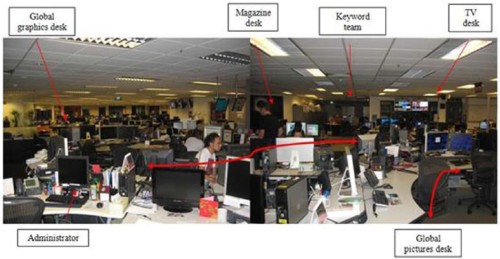
Reuters’ Global Pictures Desk (Singapore 2010, courtesy of Thomson Reuters).
The Keyword Desk is operated in a small, separate and slightly hidden circle of three open cubicles located near the Magazine Desk. On the Keyword Desk, a team of five (there were seven before the 2008 financial crisis) works in two shifts from 8:00–16:00 and from 16:00–24:00; three often work on the desk during the morning shift, considered the busiest. Unlike the work on the global pictures’ desk, keyword stations are not staffed during the night, and speed is far less important on this desk compared to quality and accuracy; ‘… no ups and downs here, it’s always the same’. 5
Even though the work is very much related to the Magazine Desk, the Keyword Team is a separate unit reporting directly to the magazine personnel in Paris. It was, at the time of this fieldwork, mostly managed by Hamish Crooks, a former ‘Magnum’ manager, who established the team in 2006 when it was clear that the search engine for pictures in the archive should be more accessible to clients, apart from allowing its users to simply trace pictures by their packages. He also created the keyword ‘tree’. Crooks was positioned in London but received full reports, and he was informed on the daily work of the team at least twice a month via video conferences, when he constantly offered ways to improve the service – informing the team of popular keywords that were often used by clients searching for pictures, for instance, thus encouraging the desk editors to make use of these words throughout the keywording process. While keyword searches were denounced, for example, by a powerful stock agency such as ‘Comstock’, putting ‘visual thinking’ as the focus of its archival system centre (Frosh, 2003b), Thomson Reuters’ keyword force has actually proved itself highly valuable to the success of the company’s pictures’ operation. Even though it requires a lot of resources to cover the costs of the editors operating daily on the desk, and training new keyworders takes time, sales have increased since the team has been operating.
Keyword team: the work
During a shift, a keyword editor volunteers to divide the work between the sub-editors into three main categories: keywording packages flowing in from the Magazine Desk, ‘Top pix’ (i.e. top pictures), selected by Paris, and a sample selected from the daily picture flow running through the global pictures’ desk; ‘leftovers’ from the day before are also dealt with.
Working on packages is considered to be a small part of the daily routine. Going over their e-mails, keyword editors often receive links to picture packages created by the Magazine Desk, and they work on their keywords (although only for packages, not for pictures in them), and they also help to correct captions if the Magazine Desk is under pressing circumstances. 6
‘Top pix’ are one of the desk’s main daily tasks. Each day, editors on the Paris desk select 50–70 pictures; these are categorised as ‘The best of the 24 hours’ or ‘The best of the week/month’ and will end up on galleries at the Reuters pictures’ webpage. Some ‘Top pix’ do not require keywords, since they often carry a very specific news value from a particular day, and will probably not be used by clients in the future, and this is also why pictures selected daily from the File by a Singapore keyworder are often different from those selected in Paris. 7 Keyword editors usually go for pictures which might be reused by clients in 6 months’ time, and that are not ‘too obvious’; ‘… We like to pick society pictures … daily life … pictures that can be used over and over again … pictures with a long shelf life’. 8
Keywording a sample of pictures selected from the File is also an important task. Each day, the team’s leader reviews the pictures received by the global desk in the last 24 hours. In all, 50–120 pictures are then selected and stored in a ‘Keywording images’ folder. All in all, and whenever the daily work flow consists of keywording alone, a single editor ‘hits’ about 60 pictures a day (an experienced editor in the team had probably keyworded about 50,000 pictures in approximately 4 years). Even though the keyword process itself is relatively simple, it requires a great deal of experience. It takes about 6 months of training until a new keyword editor is qualified enough to select pictures from the File and to keyword these on his/her own.
How does the keyword process work? Quite simply, the process begins when a keyworder looks at a picture, ‘studies’ it visually and reads its caption. By looking at a picture of, say, protestors in Sweden, the keyword editor would first try to understand what is depicted in the picture. With the caption’s help, and while realising that it is the image of protestors demonstrating against the potential bankruptcy of the Swedish ‘Saab’ car company, the keyword editor then tries to think of words that do not appear in the caption to describe the event – the word ‘Placard’, for instance, which appears to be that thing that some of the protestors are holding (Figure 2).

Keyword entry: protestors in Sweden (Singapore 2010, courtesy of Thomson Reuters).
Sometimes keyword editors think of the words that most ‘describe’ the picture by thinking whether they would be able to locate the picture if they searched the archive using a particular word (‘Redundancy’ for example), but they will try to avoid using details that are ‘too specific’. Then words, such as ‘Swedish’ (as the word ‘Sweden’ is already attached to the picture’s metadata), ‘People’ and ‘View from above’, are also added. Some keywords, for example ‘Car factory worker’, will be re-checked, only to see whether they are part of the keyword ‘tree’ at all, and, if so, the editor will pick its ‘lowest’ possible category (always aiming at the ‘lowest’ level of the keyword ‘tree’) and add them too.
The keyword ‘tree’, where keywords are ‘linked’ to images, is highly structured, based on a ‘Grandparents’, ‘Parents’ and ‘Children’ categorising system (as the keyword editors describe it). In a way, this is similar to the category tree used to create packages for the archive by the Magazine Editors, where ‘Super categories’ (such as ‘Sport’ or ‘Conflict’) are seen as ‘Grandparents’; underneath are the ‘parents’ (for example an ‘Iraq Conflict’ under ‘Conflict’), and then the ‘Children’ (e.g. ‘Bombing in Baghdad’). Certain keywords, much like certain categories in the archive, can also be linked to other ‘Parents’ (e.g. the ‘Bombing in Baghdad’ category in the archive is linked both to the ‘Iraq Conflict’ and the ‘News from Iraq’ categories). However, on the keyword desk, the ‘golden rule’ is to create the ‘Children’ category as ‘low’ as one can get, so that clients will be able to locate pictures with a single search that is based on keywords that are as close as possible to ‘representing’ the required image.
Keywords are clearly based on captions, although certain words that do not appear in the captions are also used as keywords; ‘I teach the new keyworders to tell a story by the keywords … a slightly different story from the captions’. 9 There is also no specific limit to the number of keywords to attach to pictures, and editors use a large number of keywords if it is found to be necessary. Advertising clients are those who are most often in the minds of keyword editors during the process (although newspaper editors who like to write commentaries and illustrate their stories are another audience considered). In the past, editors could also print a report with figures of specific words and data on how often these were used by clients searching the archive, and these were occasionally analysed to improve the process, as there are many images to enhance in order for clients to select them.
International news pictures’ production and industrial ekphrasis
Reuters keywords are clearly used to make life easier for the clients who search the picture archive; to perfectly ‘describe’ images, and thus to direct clients to the ‘right’ image as quickly as possible. In so doing, they increase the chances of a Reuters’ picture being picked from a vast store of pictures, thus making a profit. So at the most basic level, and similar to how things are done in the stock business, Reuters keyword editors are engaged in the delicate art of anticipation and interpretation (Frosh, 2003a): They need to base their keyword decisions and selections – from image to word – on a reverse process that will be executed by picture editors at the client’s end as they search for archive images – from word to image.
Similar to stock image editing, the order that makes sense in the keyword process at Reuters is also based on ‘subjects’ and ‘concepts’ (Heron, 2001). On the first level, however, Reuters’ keywords are clearly a matter of ‘subjects’, as they refer to the ‘ostensive referent of an image, its depicted “content”’ (Frosh, 2003a: 253. See also Heron, 2001). The keyword process thus begins by simply looking at a picture, ‘studying’ it visually and reading its caption. Note, for example, some of the keyworders’ commandments: ‘Man, woman, boy, girl, teenager, etc?’; ‘What is it?’; ‘Who is it? What sex are they? What do they do …?’; ‘What are they wearing?’; ‘How many people or subjects are in the picture’, etc. The keyword editor must, first, begin by ‘capturing’ the image at its most basic informative level; that, in the example of the image from Sweden, immediately generates several keywords such as ‘People’, ‘Placards’ or ‘View from above’. Keyword editors must also obey the team’s ‘golden rule’ and so think of keywords at the ‘lowest’ level of the category ‘tree’ – the ‘lower’ a keyword gets, the more visually it depicts (Figure 3)

The keywords’ commandments: from image to text (Singapore 2010, courtesy of Thomson Reuters).
However, the complete reading of images that will eventually be keyworded is only possible with the help of captions. So, with the help of the caption, the editor realises that those people depicted in the picture are, in fact, protestors demonstrating against the potential bankruptcy of the Swedish ‘Saab’ car company. Then, a few additional keywords are added, which cannot in any way be thought of only from the visual elements of the image: keywords such as ‘Protestors’, ‘Swedish’, ‘Redundancy’ and ‘Car factory worker’. Two ‘simultaneous semantic exchanges’ (Frosh, 2003b: 101) are then performed: Words anchor the image to the connotations of certain keywords (‘Swedish’, ‘Protestors’, ‘Car factory worker’). These connotations can also be seen as part of what Azoulay (2008) calls an ‘album of planted pictures’ (those which cannot be escaped and thus play an important role as part of the construction of our social experiences (See Azoulay, 2008: 13)). However, at the same time, those same keywords are also naturalised, as they are now visually verified: this is how ‘Swedish’, ‘Protestors’, and ‘Car factory workers’ look (Frosh, 2003a). Since what is ‘naturally’ depicted by the image is, in itself, a sophisticated system of connotations, we might say that Reuters keywords (here performed as ‘subjects’) come from ‘outside’ the image, and yet they are strongly attached to what is within it (Frosh, 2003a). 10
Of course, keywords are used to enhance picture sales and are therefore, in a way, also conceptually oriented. To start, editors on the Keyword Desk will go for pictures that will be used by clients in 6 months’ time, as mentioned above, and ignore pictures which often carry a very specific news value for a particular day. Quite similar to stock images, those images that are eventually keyworded are thus those which can easily be stripped from their context, so they can be used by various clients for different purposes, time and time again, as pointed out by a senior editor on the Magazine Desk:
Illustrated pictures can be used on more than the obvious level. They are usually very powerfully graphic images. They may not be easy to categorise and they also have multiple uses. This is obviously our first swing at stock photography.
11
These images should carry certain vagueness in them, but just enough that they can still count as ‘worthy’ news images and so can be reused by clients. Concepts take the form of words (Frosh, 2003a), and so the selected images will also be attached to keywords that are more conceptual than subjectual, such as ‘Redundancy’, or ‘Swedish’. Similarly, some keyword commandments will point a keyword editor to rather conceptual keywords: ‘Is their social class important?’; ‘Prevalent sociological or ideological background?’; ‘Travel picture?’ and so on. In that sense, Reuters photographers, keyword editors and picture editors at the client’s end are what Heron (2001) describes as ‘visual translators’, as they can find ‘the symbols inherent in the subject’ and finally end up ‘with the expression of a concept’ (Heron, 2001: 28). Keywords at Reuters, in their rather conceptual form, are therefore similar to the use of ‘concepts’ in stock; they are ‘both the particular keys to highly charged connotative domains and yet felicitously vague’ (Frosh, 2003b: 251).
Mitchell’s observation in his ‘Ekphrastic and the other’ (1994) supplies an additional layer to the analysis, as he observes three moments in the realisation of ekphrasis: an ekphrastic impossibility, where words can never represent an object in the way an image can; an ekphrastic hope, where a certain ‘sense’ in language that can make us ‘see’ is found in imagination and metaphor; and an ekphrastic fear, when the difference between the verbal and the visual may collapse and the visual is then realised ‘literally and actually’ (Mitchell, 1994: 152–154).
In the Reuters keyword process, it thus appears that both the moments of ekphrastic impossibility and hope are performed at various levels in the production line, where the gap between image and text is constantly fought against, and settled, by the editors’ daily practices and routines. To begin with, keywords’ most basic role in the process, then, is to ‘perfectly’ represent images; to make a client ‘see them through’ – an ekphrastic hope. As such, they acquire a unique status within the arsenal of language and play a key role. They are thus required to fulfil a particular duty: they need to represent, to reflect (but can words reflect the image? And can they reflect at all?), in which case keyworders are told to comply with a ‘golden rule’ of categorising. At the same time, however, keyworders are told to avoid an ‘exact’ representation of the image; to ensure their keywords are not ‘too specific’. Keywords should therefore ‘keep a certain distance’ from their visual subjects (but can words be close or far from the image? And is it simply a question of distance that is between them?), so the same keywords may also represent other images.
Yet, no special textual features can be assigned to ekphrasis that distinguish between paintings, sculptures, images and other objects. Put simply, there are no more or less valuable words, semiologically speaking, in terms of their representational value, even when they are, much like keywords, used for description. When the head of the team describes how he asks his editors to ‘tell a story’ with keywords, an ekphrasis impossibility is then in play – narration instead of description. Similarly, ‘popular’ words that appear to pop up in the analysis of data searching by the head of the department are therefore preferred, as these facilitate searching with little consideration for their descriptive values.
Finally, the keywords process also demonstrates a unique aspect of the ekphrastic encounter, as keywords are thus used at Reuters to ‘clarify’ images, but, eventually, to help sell them to clients. In that sense, they are signs that are used ‘to lie’ (Eco, 1975: 6). 12 Their production processes therefore involve a unique relationship between the speaker and the audience of the ekphrasis: The keyword editor (the poet) stands between the image and the client (the listening subject), who will be made to ‘see’ the object (the image) through the medium of the editor’s voice (words). 13 During the keyword process, ekphrasis is placed between what Mitchell (1994) calls two “othernesses” and two forms of (apparently) impossible translation and exchange: the image is first converted by the editor into a verbal representation in the form of keywords. Then, if keywords are successfully selected (as is ekphrastically hoped for), the reader (the picture editor at the client’s end) will search for an image using these keywords and reconvert the verbal representation back into an image.
The images that may be selected for the keyword process are frozen; a sense of death by their very nature (Barthes, 1981), but also since they may be buried in the archive, given their low news value, they may never ‘see the (market’s) light of day’ were it not for keywords. Given their profit potential, it is therefore up to the keyword editor to keep those images from becoming dead (that is to say, unsaleable). 14 It is the keyword editor who gives the photograph (market) life and the photograph which makes the spectator (in this case, the picture editor at the client’s end) animated and thus alive (Zelizer, 2010), as a sense of ‘sight’ is created (Cheeke, 2008). While photographers in the world are, in a sense, ‘agents of death’ (Barthes, 1981: 92), keyword editors are in fact agents of life: of the images they work on; the keyword department and its necessity; the picture service and finally of the agency as a whole.
The ‘tree’ of categories is intriguing in itself and it works, on the first level, under a similar categorising system that is also based on concepts and subjects, even though keywords aim to attract particular images and are thus put to work with a smaller corpus of images than the categories in a catalogue. So, the same inevitable semantic exchanges, and the unavoidable deceptiveness of subjects that was discussed earlier, also allow Magazine Editors to play with categories, and, in a similar way, allow keyword editors to juggle with keywords. Magazine Editors can therefore easily create a hierarchal ‘tree’ of categories with generic subjects as ‘Super-topics’, such as ‘Sport’ or ‘Conflict’, and sub-categories, such as ‘Bombing in Baghdad’, even though these are, by no means, at higher or lower levels of importance in the real world. Similarly, keyword editors can create a ‘tree’ of keywords and classify these as having high or low representational values, even though they do not possess higher or lower representational values and are semiologically equal. As things are done on the Magazine Desk, so too can keyworders treat certain keywords as ‘Grandparents’, ‘Parents’ or ‘Children’, as though they are somehow ‘blood related’, simply on the basis of what appears to be their descriptive equivalence, and thus they maintain the entire keywording classification system within a greater archive – that of social order and the organisational practices of social experience (in this case, the ‘family’). The same keywords can, therefore, be used to represent different images in the same way that pictures can be crossed and thus ‘belong’ to different categories simultaneously in the archive (under ‘Conflict in Iraq’ and ‘Bombing in Baghdad’, for example).
Finally, when keywords are used to represent pictures that are catalogued by the most powerful international news agency, they have other effects. Much as the images they represent, Reuters keywords aim to depict real occurrences for an international audience, as is required from a prestigious international news agency and its code of newsworthiness by the international market that it serves. Produced as the means to attract clients internationally, English is therefore favoured on the global pictures’ desk for keywords, as it is for captions. This is done since most (but not all) of Reuters pictures’ major clients are located in the West, where mass culture was said to have been centred, and it ‘… always speaks English’ (Hall in Maynard and Tian, 2004: 287).
Such pursuit of the documentation of the ‘true’ nature of things by an international news picture service and its code of newsworthiness also coincides with the documenting authority that is attributed to the photographic image, its realist properties and the ontological relation of photography to reality (Barthes, 1981; Bazin, 2005/1967; Sontag, 1977). As they are mostly embraced by news professionals, news pictures also connect to the idea of journalistic objectivity and the pursuit of factuality, as ‘journalists normally work with materials that real people and real events provide’ (Schudson, 2003: 2). As the referent ‘sticks’ to the image in photography (Barthes, 1981), so does reality to journalism. In other words, if photography is ‘that most “visual” of media’ (Frosh, 2003a: 246), then news photography is clearly that most (or, at the very least, one of the most) ‘visual’ of photography, and Reuters’ keywords are the most ‘visual’ of words.
Yet, at the Reuters keywords’ desk, images that are initially preferred for the process are the ‘least’ news valuable. These are pictures which may be reused by clients in 6 months’ time, having ‘… a long shelf life’. At the same time, while captions are used in the keywording process, the editors on the team are taught to tell a ‘story’, a ‘slightly different story from the captions’, fiction rather than fact. A dialectic process is therefore in play: on the one hand, Reuters’ keywords are required to have a high representational value under the codes of newsworthiness, but also to be tools at the service of a powerful international news organisation and its prestigious brand (Thomson Reuters) which puts them to work. On the other, they are aimed to attract clients, so that the images they represent will be easy to get to and thus may be used by clients time and again, and they are thus also evaluated by their popularity and their potential to make profit (and thus take part in news construction).
It is a delicate act: Reuters’ keywords are aimed at images that have the potential to be resold, but which are also produced by a prestigious international news organisation and are thus required to comply with its high news standards. As a result, Reuters’ keywords are required to be as close a representation as possible – a textual ‘reflection’ of the image, so they will be linked to particular images, and at the same time be popular so they will be widely used by clients searching for a variety of images. Those keywords are therefore extraordinary specimens, original, and yet versatile and always accessible to a diverse circle of users. Much as the classification systems that put them in order, once they are used as keywords by the desk editors, they become fixed (as words, as news) and yet flexible, ‘similar, but not the same’ (Leong, 2009: 251), to enable ‘… sufficient sensitivity within generalizations to allow for practical application and repeated production of the new’ (Frosh, 2003b: 105). 15 When keywords are put to work by the Reuters’ picture service, they are the problem and the solution: they are tools aimed at the extraordinary task of representing and selling images, at the service of a powerful news organisation that is dedicated to a perfect representation of reality and the production of another (Carey, 1989).
Conclusion
This article tackles word–image relations as they appear in the news media, by exploring the particular work invested in the international production of news pictures – the daily routine of the Keyword Team at the Thomson Reuters international news agency. By making Reuters’ keywords ‘open up’ (Deleuze, 1988/1986: 53) and by exploring the work routines of the Reuters’ Keyword Team, the findings in this article demonstrate, in a way, how questions of agency and power are as central to the way images work as they are to the way words work on images (Mitchell, 1994): 16 Reuters’ keywords are given the complicated task of representing the unrepresentable and of producing the unproduceable. They are attached to particular archived news images made by a news organisation dedicated to the coverage of real occurrences. However, it is also a business that thrives on making profit, so these specific images are designed in such a way that they will be used time and again, by a diverse circle of clients, and thus their shelf-life is extended. This is done through a process where keywords appear in the form of subjects and concepts and constantly hover between narration and description, fiction and fact and image and text, as they propel the problem that is ekphrasis into a cultural practice.
By investigating the production routines of the Keyword Team in a powerful international news agency, this article also suggests that there is a stronger connection between news pictures’ production and the stock industry than had been perceived in the past (see, for example, Rosenblum, 1978), as photography genres intermesh in their production. Certain archived news pictures at Reuters are therefore set to compete with stock images, as they are designed to distance themselves from spot news images so they can be used in 6 months’ time. The Keyword Team as a whole is an example of how international news organisations dedicate particular work forces to such a purpose.
Finally, this article adds valuable insights to the meaning of the news image at large, as a ‘real unreality’ (Barthes, 1977a: 44), an extraordinary document made in an industrial system of production; a unique, one-of-a-kind, visual document, that is also designed for multiple consumption over time. As such, it supports the idea of news as a ‘cultural product’ (Schudson, 1995: 3), and the process of news-making as a fascinating cultural process of production.
Footnotes
Declaration of Conflicting Interests
The author(s) declared no potential conflicts of interest with respect to the research, authorship, and/or publication of this article.
Funding
The author(s) received no financial support for the research, authorship, and/or publication of this article.