




Abstract
This study examines how repetitive news publishing on the Internet has changed evaluations of the credibility of the press and news aggregators. The temporal and spatial characteristics of the Internet have facilitated repetitive publishing of almost identical news content by the same news companies. The mechanism of repetitive news is based on the interplay between journalistic and algorithmic curations, which coexist on news aggregation sites. Based on a nationwide survey in South Korea, we found that the repetitive-news block was the strongest (and negative) predictor of the credibility of both the press and news aggregators. The more frequently people are exposed to repetitive news and the more they perceive it as being problematic, the less likely they are to regard the press and news aggregators as credible. These results have implications for online news flow and credibility research.
Nowadays, the Internet is a major channel that people use to obtain news and information. The Internet has contributed to the change in news content production, distribution, and consumption. From a production aspect, news can be updated and modified anytime and anywhere, and the news value is likely to be determined by the number of clicks or the news aggregators’ algorithm. From a distribution aspect, the press is not a sole content distributor in an online news environment. While, in an offline environment, news companies produce and also distribute newspapers, in an online environment, news content produced by news companies is mostly remediated by news aggregators (Lim, 2006). The press has become a news content provider, and news aggregators have become a major news content distributor. From the aspect of consumption, people can selectively expose themselves to news content that fits their predispositions or interests; significantly, as a result of the plethora of information available through the Internet, people’s attention has become a scarce resource (Lanham, 2006), and it is now more difficult for news companies to draw people’s attention to their news content.
Given this online news environment, the phenomenon of repetitive news has arisen. Repetitive news can be easily found on news aggregation sites. The formation of repetitive news can be due to different news companies publishing similar news articles or the same news companies publishing (almost) the same news articles. We label the former as a horizontal form of repetitive news and the latter as a vertical form of repetitive news. 1 In this study, we focus on the latter. Hereafter, repetitive news is defined as (almost) identical news published by the same news companies. Sometimes, the headlines of identical news articles are changed to appear as if they contain new information, given that, on news aggregation sites, the news content can be checked only after clicking the headlines. In South Korea (where the data for this study were gathered), one can easily find news content that covers a romantic date between a sports star and an idol singer, which is published many times within 1 or 2 days by a single news company (see Figure 1). Some of these articles add minor updates, which are peripheral, negligible information (e.g. the brand of the sports star’s car that he drove on the date or the shop where he bought flowers for his girlfriend). However, the content of the news articles is almost the same.

An example of repetitive news published by M-TV on Naver.com on 30 July 2014.
Repetitive news publishing itself is not a phenomenon that is unique to the Internet. This trend has emerged on 24-hour news channels and the radio. However, it has been much more accelerated on the Internet, exploiting its temporal and spatial affordance. Temporally, the online news environment allows the constant updating and modification of news reports, which has been described as a ‘news cyclone’ (Klinenberg, 2005). Spatially, it separates news headlines from its content. These technological characteristics make possible for ‘numerous updates without real updates’ and ‘changes of headlines without significant changes of content’ to take place.
Observing this phenomenon, this study questions whether repetitive news in the online news environment has affected our perception of the press and furthermore the perception of news aggregators that convey this news. Specifically, is repetitive news in the online environment perceived as problematic? What effect does repetitive news have on the evaluation of the press credibility? Does repetitive news have any influence on the credibility of news aggregators that convey redundant news articles?
The repetitive news phenomenon merits scholarly attention, considering that it relates to the three key players of the mediated public sphere: online news platforms, content providers, and users. It affects the flow of news on the Internet and influences the quality of public discussions. This study makes a contribution by exploring the repetitive news phenomenon for the first time (to our knowledge) and suggesting a current illustration of the online news flow. More theoretically, this study may enhance our understanding of credibility, an important traditional concept in media and communication studies. We factored in a specific news practice (i.e. repetitive news publishing) to explain credibility evaluation, advancing from the previous credibility research that has primarily considered media reliance, motives, content types, and demographics.
Literature review
In this section, we review the literature of news aggregation, discuss repetitive news, and pose research questions about the influence of the exposure to and perception of repetitive news on the credibility of the press and news aggregators.
News aggregation
News aggregation sites, such as Google News and Yahoo News, distribute news content produced by news companies. News aggregators select news articles from different news companies (either via humans or machines), organize those articles (in an order set by the aggregators themselves), and display them in the form of headline lists (with a few introductory lines, the names of the publishers, and time stamps).
Nowadays, the impact of news aggregation services is important in online news ecology. News aggregation sites tend to be at the forefront of online news users’ minds as a primary venue for news (Hargittai et al., 2010; Sundar, 2008)—rather than the homepages of individual news companies. With the growing market power of news aggregators, their conflict with news companies has increased (Lee and Chyi, 2015). From the news consumers’ perspective, news aggregators enhance accessibility to diverse news sources, whereas, from the news companies’ perspective, they have been accused of profiteering news content that they did not produce. 2
The rise of news aggregators and their impact on journalism have drawn some scholarly attention, but not much. Among a few studies, Weber and Monge (2011) examined the flow of online news through bylines and hyperlinks that acknowledged contributions from other sources or partners. They found that the flow of online news follows the source (e.g. Associated Press, Reuters)–authority (e.g. Los Angeles Times, New York Times)–hub (e.g. Yahoo News, Google News) model. This model indicates that online news generally flows from news agencies to news companies to news aggregators. This finding empirically demonstrates the importance of news aggregators in the overall pattern of online news flow.
The influence of news aggregators on traditional journalistic roles was also examined by making a contrast between these aggregators and traditional journalism, the former as access and the latter as order (Carlson, 2007). Carlson emphasized the editorial decision of legacy news media (such as the size and position of news articles) and the diverse access to different news sites provided by news aggregators. He explained that news aggregators normatively increase the exposure to diverse viewpoints, which, he acknowledged, might not be true in reality. However, Carlson did not fully explore how news aggregation services are practicing and furthermore how journalism interacts with these services.
Recently, the discussion has moved to explore how to promote news articles and be more visible in online news flow, including news aggregation sites. Pearson and Kosicki (2016) argue that ‘way-finding’ becomes more important than gatekeeping (the traditional function of journalism). People are increasingly consuming news on the Internet as a form of individual news items rather than reading the newspaper as a form of compiled news sets. It has become important for news companies to curate and promote each news article to draw the attention of readers. This change means that the way to find how an individual news article navigates through a sea of information and draws attention from online news users is more important than the editorial decision of which news should be kept in or let out of the gate. The journalistic paradigm is changing from whether or not to publish to how to promote.
This perspective is shared by Thorson and Wells (2015). They characterized the contemporary information environment into five types of curation: personal, strategic, social, journalistic, and algorithmic. In this broad layout of information curation, online news flow pertains to the last two curations. Journalistic curation means making news articles more visible among the flood of news and information, and algorithmic curation means selecting and distributing information through machine-based algorithms. The mix between these two becomes more apparent in the online news ecology. The term ‘networked interactions’ appeared to describe the socio-technical interactions of expertise between journalists and machines (Lewis and Westlund, 2015: 9). News aggregation sites are the place where the algorithmic curation of news aggregators and the journalistic curation of news companies co-exist.
Repetitive news on the Internet
The interplay between algorithmic and journalistic curations is related to the rise of repetitive news. Given that news search results are influenced by how recent the news article is, some news companies tend to update news articles many times a day, although there are actually no significant updates. In addition, the algorithm of news aggregators rarely filters almost identical news published by the same news companies at the time of writing this manuscript. Furthermore, the trending search keywords provided by news aggregators are used to publish repetitive news articles that include said keywords (Choi and Kim, 2014). Repetitive news can be regarded as one of the strategies employed by ‘content farms’ or ‘digital sweat shops’ which “produce articles on subjects that are expected to end up high in searches and generate traffic to the websites catered by these services” (i.e. news aggregation services) (Bakker, 2012: 634).
The repetitive news phenomenon relates to the concept of ‘immediacy’. Immediacy is one of the values of journalism ideology including public service, objectivity, autonomy, and ethics (Deuze, 2005). Immediacy is an inherent characteristic of news to be ‘news’, the novelty of information. The concept of immediacy is gaining attention from scholars who examine online news (e.g. Allan, 2006; Karlsson and Strömbäck, 2010; Mitchelstein and Boczkowski, 2009), but the connotation of immediacy is different from what it has been. In a traditional sense, the term ‘immediacy’ means reporting breaking news to rapidly inform people; in an online environment, however, it means constantly updating and modifying news reports.
According to Karlsson (2011), studies examining the immediacy of news reports have focused on the following aspects: communication, consequences, and implementation. In regard to the communication of immediacy, studies have examined the extent of immediacy by conducting a content analysis on the publication times and the breaking news signs on news websites (e.g. Bucy, 2004; Paulussen, 2004). In regard to the consequences of immediacy, the research has primarily focused on the conflict between accuracy and speed in news reports (e.g. Scott, 2005), although empirical research has rarely been done (Karlsson, 2011). In regard to the implementation of immediacy, previous studies have examined how frequently news reports are updated on the Internet (e.g. Kutz and Herring, 2005).
Research on the communication, consequences, and implementation of online news immediacy has contributed to enhancing our understanding of the online news environment. Based on these discussions, it is time to examine the exploitation of immediacy, which has yet to be investigated. Some studies have acknowledged the side effects of immediately updating online news, such as the meaningless speed battle among news companies and the sensationalizing of online news (e.g. Phillips, 2009). In this study, we address the exploitation of immediacy by examining the repetitive news phenomenon.
Given that this phenomenon has not been addressed in the literature, we explore its relationship with the two most fundamental variables in media and communication research: demographics and the media uses of news aggregation service users. We examine whether these variables are associated with the exposure to repetitive news as well as the perception of repetitive news. In regard to demographics, we focus on gender, age, and education; these factors were found to be significant predictors of the use of news aggregators (Lee and Chyi, 2015). In regard to media uses, we focus on the types of content consumed and the reliance on news aggregators. The repetitive news phenomenon appears to occur in relation to soft news such as entertainment, sports, and sensational social issues (such as crime and accidents) based on our observation, which calls for more empirical evidence. In addition, the reliance on news aggregators is measured by the relative amount of time spent on news aggregation sites compared to other news media. The time spent on a certain media has been an important variable in explaining audience behavior (e.g. Webster, 2005), media competition (e.g. Althaus and Tewksbury, 2000), and perception (e.g. Gerbner et al., 1980), to name a few. Overall, we examine the influence of demographic (gender, age, and education) and media use (content type and reliance on news aggregators) variables on the exposure to and the perception of repetitive news.
Furthermore, the relationship between the exposure to and the perception of repetitive news is examined. Frequent exposure to this practice might not necessarily lead to perceiving it as problematic, since it is possible that some may perceive it as a natural phenomenon—inherent to the temporal and spatial characteristics of an online news environment and therefore non-problematic.
These discussions are formulated into the following research questions:
RQ1. What relationship does the exposure to repetitive news have with demographics and media use variables?
RQ2. What relationship does the perception of repetitive news have with demographics and media use variables?
RQ3. What relationship does the exposure to repetitive news have with the perception of repetitive news?
Credibility and the Internet
Credibility is an important concept in communication research. It is regarded as being similar to believability (Johnson and Kaye, 1998; Menchen-Trevino and Hargittai, 2011) and as having multifaceted dimensions of expertness and trustworthiness (Hovland and Weiss, 1951). Credibility is critical to the existence of the press, as people are less likely to pay attention to news and information that they believe to be unreliable. Many previous studies have examined the credibility of news, the credibility of the media, and the comparison of credibility between new and existing media (e.g. Bucy, 2003; Chung et al., 2012; Johnson et al., 2007; Johnson and Kaye, 2004; Miller and Kurpius, 2010). However, research has rarely been done about the influence of a certain news practice on credibility. In this study, we attempt to examine the influence of repetitive news on the credibility of the press and news aggregators that convey news in the online environment.
For content farms, repetitive news has become a cost-efficient way to obtain online traffic and generate profits. Repetitive news did not stem from the pursuit of journalistic values, such as producing newsworthy and accurate information. Moreover, from the perspective of users, this practice can be deceptive: It sometimes presents different news headlines to entice users’ clicks, but actually provides similar news content. Considering these circumstances, we can speculate that the more people are exposed to repetitive news and the more they perceive it as being problematic, the less likely they are to regard the press or news aggregators as credible. This study examines whether this relationship is statistically significant, even after controlling for variables that were found to influence credibility.
Previous studies have measured credibility, mostly based on the scales developed by Gaziano and McGrath (1986), Meyer (1988), or a variation of them 3 —this also pertains to the online news context. Tsfati (2010) measured skepticism about online news sites and online bulletin boards containing news information by surveying to what extent they are ‘fair, accurate, unbiased, tell the whole story, and can be trusted’. Johnson and Kaye (1998, 2014) used ‘believability, fairness, accuracy, and depth of information’ to measure the credibility of online news media and political websites. Kiousis (2001) employed factuality, financial motivation, concern about privacy, concern about community, and trustability as a measure of the credibility of news media. Through factor analysis, Sundar (1999) found that bias, fairness, and objectivity constitute the credibility of online news. Based on a review of credibility literature, this study adopts commonly used measures of credibility: objectivity, fairness, accuracy, non-sensationalism, consideration of readers’ interests, pursuit of commercial profits, concern about public interest, and trustability.
In the relevant literature, several factors have been found that influence credibility in the online environment: demographics, the motives of media use, information processing, media use (e.g. the frequency of using the media and the amount of time spent using it), media reliance, and the types of news content (i.e. soft or hard news).
Regarding demographics, their directionality and statistical significance in relation to credibility evaluation were different by site context whether it be online newspapers, social network sites, blogs, or the overall Internet in previous studies (Flanagin and Metzger, 2003; Johnson et al., 2007; Johnson and Kaye, 1998, 2004, 2014; Metzger et al., 2003). However, they commonly found the statistical significance of gender, age, and education in explaining credibility assessment.
In addition, previous research has, although rarely, addressed motivation construct in predicting credibility. Johnson et al. (2007) found that motives for using blogs—information seeking, convenience, political surveillance, personal fulfillment, and social surveillance—were all statistically significant predictors of blog credibility. Among them, information seeking was the strongest predictor. Considering the association between motivational construct and credibility judgment, this study addresses four motives that previous studies commonly found for using the Internet and aggregators for news: information seeking, entertainment, social utility, and habit (Diddi and LaRose, 2006; You et al., 2013).
Activeness in news consumption can also affect credibility considering the literature on information processing and its influence on credibility. In Trumbo and McComas’ study (2003), the relationship between credibility and information processing was found to be statistically significant. They assumed the directionality of the relationship to be ‘credibility affecting the processing’, but acknowledged that this assumption has yet to be tested. Based on focus group interviews, Metzger et al. (2010) explained the influence of cognitive heuristics (e.g. recognizability, endorsement by known entities, cross-validation by other websites, and the appearance and layouts of websites) on evaluating the credibility of online information. Considering that heuristic or systematic processing can affect credibility judgments, we attempted to incorporate this processing by examining the degree of activeness in news consumption. In the context of news consumption, systematic processing and heuristic processing may correspond to the active and passive reading of online news, respectively, as acknowledged in previous studies (Shin and Kweon, 2013): The higher the degree of activeness in news consumption, the more cognitive effort is invested. This relationship, guided by the literature, is likely to influence credibility assessment.
Another factor that can affect credibility is reliance on media. Johnson and Kaye (1998) found that the reliance on the Web, rather than the amount of time spent using the Web, was associated with the perception of online newspapers’ credibility: The more people relied on the Web, the more credible they perceive the online newspapers to be. Tsfati (2010) also found that time spent surfing news websites was not statistically significant in predicting skepticism toward online news after controlling for demographics and political ideology. Johnson and Kaye (2014) also showed that reliance on social network sites is a predictor of credibility. Newspaper journalists’ perception of the credibility of online news was also influenced by their reliance on the Internet (Cassidy, 2007). Based on these findings, we consider media reliance rather than the time spent using that media to be a factor that influences credibility.
Finally, the types of content (i.e. hard news and soft news) can influence credibility. Shah et al. (2001) found that using newspaper hard news was statistically significant in enhancing interpersonal trust. In their study, trust pertains to relationships between people, but it also suggests the potential presence of a relationship between using hard news and trusting the media. This relationship can also be inferred from Miller and Kurpius’ study (2010). They found that television viewers trust hard news more than soft news and further explained that an increase in soft news may decrease the credibility of a news outlet. In line with these findings, we consider the influence of content types on credibility in regard to the online news environment.
Overall, the following have been addressed in the literature as having relationships with the assessment of credibility: demographics, motives for using news aggregators, activeness in news consumption, reliance on news aggregators, and types of news content consumed. The latter three can be grouped into behavioral constructs, considering that they are based on users’ behavior. After controlling for demographic, motivational, and behavioral variables, this study examines whether online news users’ exposure to and perception of repetitive news affects their judgment about the credibility of the press and news aggregators, based on the following research question and related hypotheses:
RQ4. Do the exposure to and the perception of repetitive news explain the credibility of the press and the news aggregators?
H4-1. Exposure to repetitive news predicts the credibility of the press after controlling for demographic, motivational, and behavioral variables.
H4-2. Exposure to repetitive news predicts the credibility of the news aggregators after controlling for demographic, motivational, and behavioral variables.
H4-3. The perception of repetitive news predicts the credibility of the press after controlling for demographic, motivational, and behavioral variables.
H4-4. The perception of repetitive news predicts the credibility of the news aggregators after controlling for demographic, motivational, and behavioral variables.
Method
Data collection
We conducted a nationwide, online survey of 1000 people aged 20 years or older in South Korea. South Korea is renowned for its high Internet subscriptions and heavy reliance on online news provided by news aggregators. 4 All respondents had visited news aggregators in the week prior to the survey. The big three news aggregators in South Korea are Naver.com, Daum.net, and Nate.com. However, Naver.com dominates the news search market in terms of the share of unique visitors: according to Shin (2014), 76.4 percent of users went to Naver, 18.4 percent went to Daum, and 9.8 percent went to Nate. The way the news is presented does not distinguishably vary across these news aggregators. People whose family members or close relatives work for news companies, news aggregators, advertising agencies, or other related entities were excluded from the survey. Our stratified sampling is proportionate to the demographics of South Korean Internet users provided by the Korea Internet and Security Agency. 5 The survey took place between 19 and 26 August 2014. Hankook Research, a market and opinion research company in South Korea, assisted with the implementation of the survey. The online survey system did not allow the respondents to go backwards and change their responses.
Measurement
Dependent variable
The credibility of the press and news aggregators is measured by eight items based on previous studies (e.g. Chung et al., 2012; Gaziano and McGrath, 1986; Johnson and Kaye, 2014; Meyer, 1988; Tsfati, 2010). Based on the previous experience of obtaining news via news aggregators, respondents were asked to answer the extent to which they think the press or news aggregators are objective, fair, accurate, non-sensational, considerate of the readers’ interest, not seeking commercial profits, care about the public interest, and can be trusted. These responses were made in a 5-point scale. We created a composite index of credibility by averaging the responses to the eight items. This index ranges from 1 (not at all credible) to 5 (very credible) (Cronbach’s α = .878 for press credibility and .854 for news aggregator credibility).
Independent variable
Demographic variables included gender, age, and education. Men accounted for 53 percent of the respondents, and women accounted for 47 percent. A total of 20.8 percent of respondents were aged in their 20s, 25.3 percent in their 30s, 26.3 percent in their 40s, 19.2 percent in their 50s, and 8.4 percent in their 60s. There were no respondents who graduated from elementary school or lower. A total of 22.9 percent graduated from high school or lower, and 65.5 percent graduated from college or university. A total of 11.6 percent of respondents held a graduate degree or an ABD (all but dissertation) status. Age and education variables were dummy-coded. The reference category for age is the group in their 20s and that for education is the group of people who graduated from high school or lower.
The motives for using news aggregators were measured using a 5-point Likert scale with 12 items constructed based on previous studies (e.g. Diddi and LaRose, 2006; You et al., 2013). We conducted a factor analysis with these 12 items, using a principal component analysis as an extraction method and a varimax with Kaiser normalization as a rotation method. During this procedure, we requested four factors to be extracted, since previous studies suggested the following four motives for using the Internet for news or news aggregators: information seeking, entertainment, social utility, and habits. This factor analysis met the requirements of the Kaiser–Meyer–Olkin measurement of sampling adequacy (.796) and Bartlett’s test of sphericity (χ2(36) = 2422.539, p < .001). As a result of this analysis, nine items were constructed, and they were clearly classified into the aforementioned four motives. These four factors explained 73.5 percent of total variance. The items related to the information seeking motive were ‘to learn more about certain issues’ and ‘to obtain new information and learn about different perspectives’. Those related to the entertainment motive are ‘to be entertained’ and ‘to read exciting and provocative news stories’. In regard to the social utility motive, the items were ‘to obtain knowledge to partake in conversations’, ‘to find subjects for conversation’, and ‘because many others use news aggregators’. In regard to the habit motive, the items were ‘daily routine’ and ‘habitually’.
To measure the degree of activeness in news consumption, we constructed nine items with a 5-point Likert scale based on previous studies (Shin and Kweon, 2013; Trumbo and McComas, 2003). We conducted a factor analysis with these nine items, using principal component analysis as an extraction method and varimax with Kaiser normalization as a rotation method. Guided by the literature about information processing that is bifurcated into systematic and heuristic processing, we requested that two factors be extracted during the procedure of factor analysis: active reading and passive reading. This analysis met the requirements of the Kaiser–Meyer–Olkin measurement of sampling adequacy (.849) and Bartlett’s test of sphericity (χ2(36) = 2080.719, p < .001). All nine items were clearly reduced to two factors, which explained 52.4 percent of the total variance. Items related to active reading were ‘I read news by intentionally entering the news category of portal sites’, ‘I find and read news related to the news that I previously read’, ‘I check the press or the reporter who released the news’, and ‘when I find a news of interest, I focus on its follow-up news’. Items related to passive reading were ‘I read news that is the most popular among users’, ‘I read news that is linked to the trending search keywords’, ‘I read news pieces if their headlines are bolded or enlarged’, ‘I read news that appears at the top of the computer screen’, and ‘I read news if it is exciting and provocative, irrespective of my personal interests’.
Regarding the variable of reliance on news aggregators, we asked respondents how often they normally access offline newspapers, television news, news websites (e.g. nytimes.com), news aggregation sites (e.g. yahoo.com), and others in a 5-point scale. Based on the responses, we calculated the ratio of the frequency of using news aggregators to the average frequency of using newspapers, television news, news websites, and others. If the result is greater than one, it indicates that news aggregators are more frequently used than other media, and thus, the respondent is reliant on news aggregators. The higher the number, the more reliant one is on news aggregators.
Regarding the types of news content, we asked respondents which type of news they most consume. News content about social issues, entertainment, sports, and lifestyle/culture was classified as soft news, and news content about politics, economy, information technology/science, and international affairs was classified as non-soft news.
The exposure to repetitive news was measured by responding to this item: ‘I encountered almost identical news articles published by the same news company’. A 5-point scale was used, with an additional response option for ‘never’. The scale ranged from 0 (never) to 5 (very frequently).
Regarding the perception of repetitive news, we measured how serious respondents consider repetitive news to be with a 7-point semantic differential scale. Four items were provided: problematic/non-problematic, positive/negative, natural given the Internet’s technological characteristics/unnatural irrespective of the Internet’s technological characteristics, and beneficial/not beneficial. A composite index was created by averaging the responses to the four items, which can range from 1 (not at all serious) to 7 (very serious) (Cronbach’s α = .879).
We used SPSS 23 (IBM Corp, 2014) for the statistical analyses of survey results.
Results
Variables associated with repetitive news
The first research question examines the association of repetitive news exposure with demographics, reliance on news aggregators, and types of news content consumed. The mean score of exposure to repetitive news (in a 5-point scale with an additional response option for ‘never’) was 3.2 (standard deviation (SD) = 1.07), which indicates that many people were frequently exposed to repetitive news. Notably, less than 2.4 percent of respondents had never experienced repetitive news. More than 40 percent of respondents frequently or very frequently encountered this practice on news aggregation sites. By performing correlation analyses, we found that education had a statistically significant association with repetitive news exposure, but the strength of association was very weak (see Table 1).
Correlation coefficients of repetitive news exposure/perception.
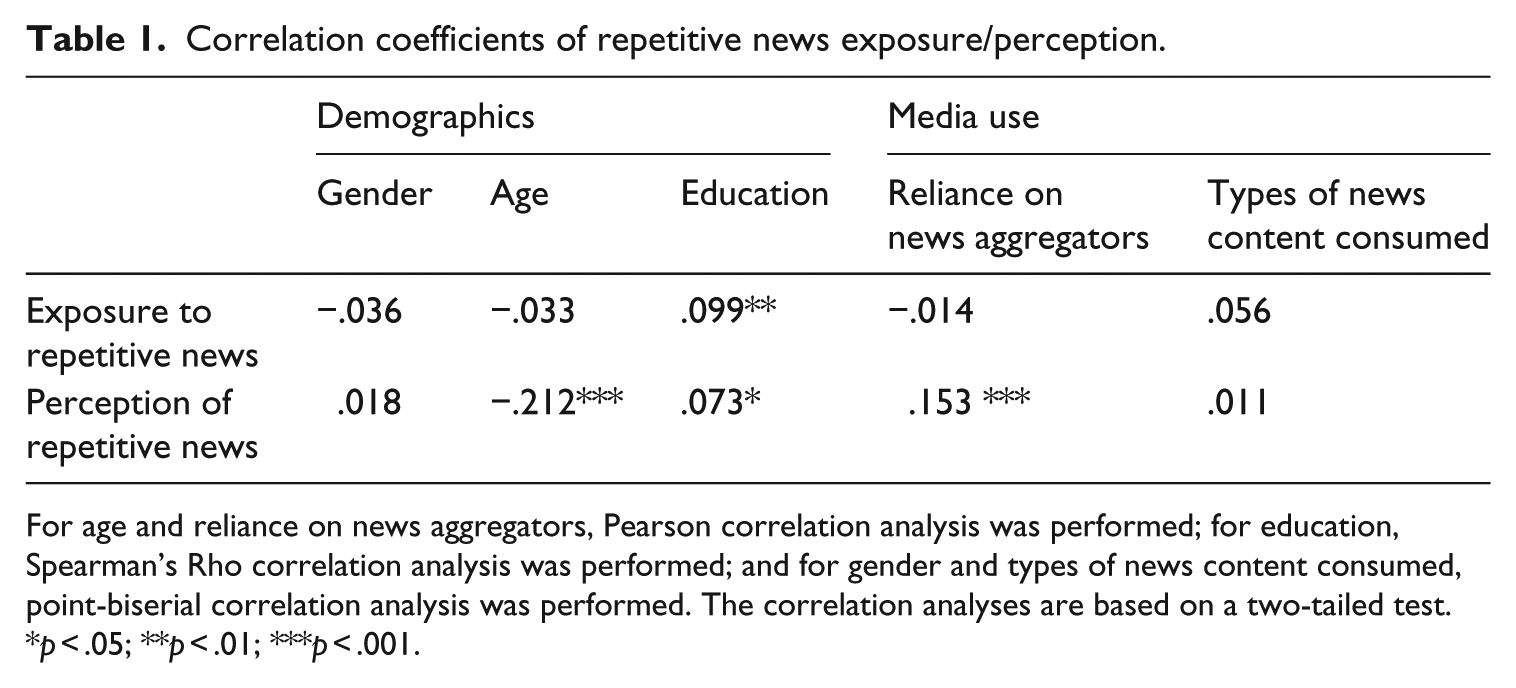
For age and reliance on news aggregators, Pearson correlation analysis was performed; for education, Spearman’s Rho correlation analysis was performed; and for gender and types of news content consumed, point-biserial correlation analysis was performed. The correlation analyses are based on a two-tailed test.
p < .05; **p < .01; ***p < .001.
In regard to the second research question, we found that the perception of repetitive news was significantly associated with age, education, and reliance on news aggregators. The mean score of the perception of repetitive news (in a 7-point scale) was 4.99 (SD = 1.20). This implies that, on average, respondents perceived repetitive news as problematic. Specifically, younger and better-educated people were likely to perceive repetitive news as more problematic than older and less-educated people. People with a heavier reliance on news aggregators had a tendency (although weak) to perceive repetitive news as more problematic. This means that if news aggregators were the primary source of news and information, people were likely to regard the redundancy of similar news content as a serious problem that requires a solution. Contrary to our expectation, the types of news content consumed did not have a significant relationship with both the exposure to and the perception of repetitive news. By referring to the raw data, we confirmed that no significant difference exists between people who usually consumed soft news and those who usually used non-soft news in terms of their exposure to and perception of repetitive news. This could be interpreted that online news users, whether or not they mainly consumed soft news, were aware of repetitive news.
To solve the third research question, we examined the relationship between the exposure to repetitive news and the perception of repetitive news. The result of the Pearson correlation analysis demonstrates that the two variables have a positive association (r = .157, p < .001). This means that the more frequently one is exposed to repetitive news, the more likely one perceives it as a serious problem.
Hierarchical regression analyses
We conducted two hierarchical regression analyses predicting the credibility of the press and news aggregators with several predictor blocks, such as demographics, motivational construct, behavioral construct, and repetitive news. Outliers (that existed outside the range of −3 to 3 SDs) and missing values were eliminated from the dataset. As a consequence, the dataset for the press included 961 cases, and the dataset for news aggregators included 967 cases. The assumptions of linear regression such as linearity, normality, homoscedasticity, and independence were checked. As the hierarchical regression predicting credibility of the press did not meet the constant variance assumption, we used the White standard errors for this analysis. The problem of multicollinearity did not exist.
Table 2 shows the hierarchical regression results predicting press credibility (M = 2.66, SD = .53). After controlling for demographics, the variance in the credibility of the press was still accounted for by a motivational construct block, a behavioral construct block, and a repetitive news block. In the repetitive news block, both the exposure to and the perception of repetitive news variables were negative predictors of press credibility. In particular, the perception of repetitive news had the greatest impact on press credibility. After controlling for the variables that were previously found to influence credibility, we discovered that the more frequently people were exposed to repetitive news and the more seriously they perceived repetitive news as being problematic, the less likely they trust the press. Thus, H4-1 and H4-3 are supported.
Hierarchical regression results predicting press credibility.

ABD: all but dissertation .
Numbers in parentheses indicate standard errors. Age and education variables are dummy coded. We used the White standard errors for this analysis.
p < .05; **p < .01; ***p < .001.
In regard to the age variable, older people tended to regard the press as more credible in the present analysis, despite the positive association between age and media skepticism in the literature (Metzger et al., 2003). This result might be due to the fact that younger people perceived repetitive news as more problematic than older people, as found in the previous correlation analysis, and thus might have regarded the press as less trustable. In regard to the motivational construct block, social utility and entertainment needs had a greater impact on press credibility than information seeking needs. Those who use news aggregators as a daily routine had a tendency to perceive the press as less credible. In regard to the behavioral construct block, the activeness of news consumption had a significantly negative association with credibility. The more actively one is engaged in news reading via news aggregators, the less likely one perceives the press as credible. The full model explained 31.5 percent of total variance.
As seen in Table 3, after controlling for demographics, the variance in the credibility of news aggregators (M = 2.72, SD = .54) was still accounted for by a motivational construct block, a behavioral construct block, and a repetitive news block. The perception of repetitive news had the greatest impact on news aggregator credibility. The variables of the exposure to and the perception of repetitive news negatively predicted news aggregator credibility, as was in the prediction of the press credibility. This result demonstrates that repetitive news exerts influence not only on the credibility of the press itself but also on the credibility of news aggregators that convey the news. Thus, H4-2 and H4-4 are supported.
Hierarchical regression results predicting news aggregator credibility.
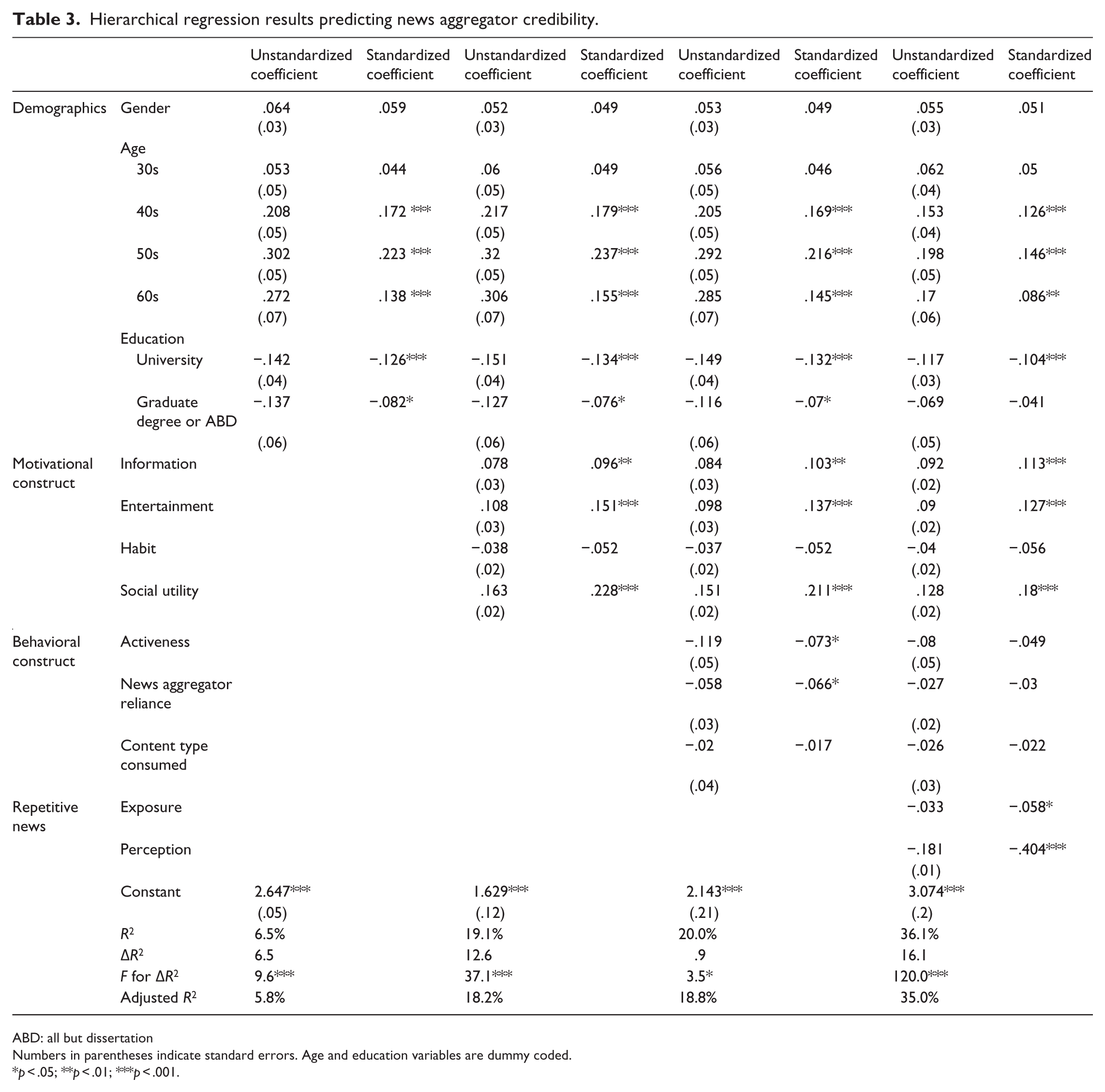
ABD: all but dissertation
Numbers in parentheses indicate standard errors. Age and education variables are dummy coded.
p < .05; **p < .01; ***p < .001.
In regard to the age variable, older people tended to assess news aggregators as being more credible, and better-educated respondents tended to assess news aggregators as being less credible, although this tendency is somewhat attenuated after inserting the repetitive news block into the model. In regard to motives, people who obtained news for social utility purposes via news aggregators were likely to perceive news aggregators as more credible than those whose motives were to seek information or to entertain. Habitual needs were not statistically significant in predicting the credibility of news aggregators.
In addition, the reliance on news aggregators and the activeness in news consumption had a significantly negative association with the credibility of news aggregators, prior to the insertion of the repetitive news block in the regression model. However, these relationships were no longer statistically significant after the insertion of the repetitive news block. The full model explained 35.0 percent of total variance.
Discussion and conclusion
The phenomenon of repetitive news has been facilitated by the technological characteristics of the Internet, which allows for the immediate, constant update and modification of news content and offers a spatial separation between news content and headlines. With this temporal and spatial affordance, repetitive news arises out of the interplay between journalistic and algorithmic curations. It is a kind of strategies employed by content farms, which has raised concerns for their negative impact on our society (Bakker, 2012). This study attempted to find the influence of repetitive news on the credibility of the press and news aggregators.
The present results suggest that repetitive news can actually undermine the credibility—the ground on which both the press and news aggregators fundamentally stand. This finding is notable in the sense that the exposure to and the perception of repetitive news negatively predicted the credibility of the press and news aggregators, even after controlling for variables that are expected to or found to affect the evaluation of credibility. Furthermore, the repetitive news block had the greatest impact on credibility than other motivational/behavioral constructs and demographics. This finding clearly demonstrates the presence of the negative consequence of the repetitive news phenomenon.
The present findings also have implications for credibility research. We empirically examined and found the influence of a news practice on credibility, which has been conceptually discussed but rarely tested. Moreover, the present results suggest that a news practice or a certain condition of the media environment can moderate the association of credibility with age and media reliance. We had contrary results to what we can predict from previous findings (Johnson et al., 2007; Johnson and Kaye, 1998, 2014; Metzger et al., 2003). In the present results, younger people who are savvy users of online news tended to perceive repetitive news as more problematic, which lessened their credibility of the press and news aggregators. Those who were more reliant on news aggregators (i.e. those who spent relatively more amount of time on news aggregators than other news media) tended to trust news aggregators less. While appearing to be unreasonable, this finding makes sense after considering that news aggregators frequently conveyed repetitive news and this negative association disappeared when the repetitive news block was inserted into the model. In addition, we suggest the inclusion of a motivational construct in a credibility model. In previous studies, the relationship between motives and credibility has rarely been examined, as acknowledged by Johnson et al. (2007). However, we found that for what purpose people use the media can affect how credibly they regard the media.
Furthermore, this study may contribute to a better understanding of online news. By examining the recent phenomenon of repetitive news, we come up to the questions about what news has to be to still be called ‘news’—and ultimately whether the concept of ‘immediacy’ still has its traditional meaning in an online news environment. In a traditional context, immediacy is related to a judgment about the value of news, such as how important and influential the news is. However, in an online context, immediacy is irrelevant to the value of news. Irrespective of whether it is hard or soft news, or how important it is, all news can be immediately reported online. Lim (2006) has used the term ‘temporariness’ rather than ‘immediacy’ to explain that online news is not fixed and unchangeable, but temporary and modifiable.
As an extension of this discussion, we introduce the concept of ‘currency’ to explain the nature of constant updates and modifications in an online news environment. We chose this term to emphasize the seamless updating and uploading (even without updates) of online news, as the term ‘immediacy’ cannot fully capture it. In online journalism, it is more important to be current and report what is happening now, in order to be selected by news aggregators and to be searched by news consumers—nowness becomes as valuable as newness. Repetitive news can be an example of maximizing currency, although in a negative way. This study opens up further inquiries such as how repetitively publishing news articles countless times can deter the flow of news and how issues that are not repetitively published are pushed out of the online news flow and fail to garner public attention.
The negative association between repetitive news and credibility also provides practical implications. Not only the news companies but also the news aggregators that distribute repetitive news should recognize that the repetitive news phenomenon can undermine credibility. One way to address the phenomenon of repetitive news might be to algorithmically filter out identical news articles that are published by the same companies. However, this solution is not perfect in and of itself because a problem still remains: deciding how far identical the news articles should be to be removed from news aggregators. The ultimate solution might be that the news companies should be more prepared for digitization and attempt to gain traffic by providing high-quality news products and that the news aggregators’ algorithm should be improved to make those news products more visible. Given that the practices of content farms (including repetitive news) emerge from the interplay between journalistic and algorithmic curation, the solution needs to be contrived by both sides.
Despite these implications, this study is not without limitations. As an exploratory study of a relatively novel phenomenon, we focused on whether repetitive news practices affect online news users’ credibility of the press and news aggregators. This study was not able to fully explain the psychological link between the exposure to repetitive news and the credibility of the press and news aggregators. A focus group interview might be a next step to explore this issue.
We hope the present research sheds light on the flow of online news and suggests one possible direction of the online journalism research to investigate how the flow of online news is shaped by journalistic curation (news companies), algorithmic curation (news aggregators), and furthermore by social curation (news consumers). In addition, as acknowledged by Carlson (2007), ‘the idea of what is “journalism” is not fixed or unmoving’ (p. 1027). We suggest reconsidering the traditional conception of journalistic values including what ‘news’ means and how news is promoted.
Footnotes
Declaration of Conflicting Interests
The author(s) declared no potential conflicts of interest with respect to the research, authorship, and/or publication of this article.
Funding
The author(s) disclosed receipt of the following financial support for the research, authorship, and/or publication of this article: This study was financially supported by the Korea Press Foundation (KPF2014-19), and its initial version was published by the Korea Press Foundation as a report entitled “‘News Abusing’ and its Improvement Plans in an Online Environment” in 2014. In addition, the Institutional Review Board (IRB) at Kookmin University, South Korea, approved this study as exempt from review (KMU-201407-HR-026).