




Abstract
Cross-national comparative studies of journalists generally focus on the demographic characteristics and/or the values and role-perception of journalists. Systematic studies of journalistic skills have been rare, however. This article reports the findings from a comparative study of journalists from Britain, Estonia, Germany, Italy, Poland, and Sweden. Based on an email survey of 2238 news professionals, journalistic skills can be grouped into three distinctive dimensions: reporting, editing, and networking skills. The data also show a number of similarities, but also important differences regarding the importance journalists give to different professional skills in different European countries.
Introduction
This study analyzes how different journalistic skills are valued among news professionals in six European countries: Britain, Estonia, Germany, Italy, Poland, and Sweden. The data come from an email survey with a total of 2238 respondents across the six countries (see Methodology). In this survey, skill was one of several other areas examined. This article focuses on a section of the survey where respondents were asked to rank the value/importance of different journalistic skills. The descriptive purpose of the article is to chart cross-national differences and similarities in the importance assigned to different skills. Theoretically, the purpose is to see what views on skills can tell us about professional roles and professional practices compared cross-nationally. Is journalism viewed as a ‘field’ occupation where the key skills have to do with information gathering outside the newsroom? Is it viewed as a ‘desk’ occupation where the key skills have to do with editing, curating, packaging, and presenting information? Or is it viewed as something else entirely – some scholars have, for example, suggested the rise of a view of journalism as process-oriented and collaborative, a view that mixes ‘field’ and ‘desk’ aspects of the job and adds additional dimensions of audience interactivity as well (Heinrich, 2011; Lewis, 2012; Robinson, 2011, 2013)?.
Comparatively studying valued skills and skill sets among journalists is compelling for at least two reasons. One is that the concept of skill is at the center of a set of linked debates and issues in contemporary journalism: it is widely acknowledged among scholars and practitioners alike that journalists today need to be multi-skilled, that is, proficient in a wide variety of production techniques and media forms (Avilés et al., 2004; Chung, 2007; Deuze, 2007; Duhe et al., 2004; Örnebring, 2013; Singer, 2003, 2004), as well as in skill sets associated with entrepreneurship (Baines and Kennedy, 2010; Briggs, 2011; Gynnild, 2005; Ryan, 2009). At the same time, there is a concern among scholars and professionals that these ‘new’ skill demands edge out ‘traditional’ journalistic skills and therefore lower the quality of journalism (Bromley, 1997; Liu, 2006; Nygren, 2008). ‘New’ skills and skill demands are often perceived as linked to new forms of technological production, but also to changing industry and labor market conditions in general, for example, skills that deal with personal marketing and branding as well as with soliciting/adapting/managing user generated content (as noted by e.g. Heinrich, 2011; Marwick, 2011; Usher, 2014). Also, in contrasting ‘new’ skills with ‘old’ it is rarely made explicit exactly what the ‘old’ skills of journalism are or how they should be theorized.
Another reason for paying closer attention to journalistic skills is that comparative journalism research has so far been dominated by the so-called role-perception research, that is studying how journalists in different countries view their societal role (Donsbach and Patterson, 2004; Hanitzsch et al., 2011; Köcher, 1986; Mellado et al., 2012; Patterson and Donsbach, 1996), on the assumption that role perceptions will influence the end product of journalism, that is, content/texts (Donsbach, 2008; Shoemaker and Reese, 1996). However, there is actually relatively little evidence to support that assumption (Mellado and Van Dalen, 2014; Vos, 2002; Weaver and Wilhoit, 1996), and so comparatively analyzing valued skills and skill sets might be a way to get closer to the actual practice of journalism – skills may well be more closely associated with journalistic practice than role perceptions, which often have a strong idealistic/normative aspect to them.
Finally, and in the interests of full disclosure, we must also provide a few words on the age of the data. The data were gathered in 2008–2009 and thus in some sense this study is already a historical one. At the time of the study, real-time Web metrics, multi-platform content management systems, and search engine optimization were the key technological innovations and changes news organizations were coping with. Social media and social networking sites were not yet on the agenda for many news organizations, or at least they were much lower down on the agenda than they are today (in a qualitative part of the same overall study, this is demonstrated very clearly, see Örnebring, 2013). As such, this study can only offer a snapshot of the state of skill demands at a particular point in time – it is indeed the case that all studies of journalistic skills and changes in skill demands are time-sensitive and context-dependent. A case in point is Lowery and Becker’s (2001) study, which found that skill with Web presentation software was the strongest predictor of success for journalism/communication graduates applying for jobs (in the United States), more important than all other aspects of their education. In hindsight, this says a lot about the changes taking place in journalism at that time, and how they were interpreted/acted upon by employers. Presumably, skill with Web presentation software and HTML programming would not be as important a predictor of job application success in 2015–2016. In the context of this study, real-time Web metrics and search engine optimization have not become less important in the years that have passed since the data were gathered; in fact, the use such technologies are now entirely naturalized in many news organizations. The analysis presented here still cumulatively provides relevant and important insights into how journalistic skill demands and views of what constitutes core skills change (or do not change) over time.
The skills of journalism: Existing perspectives and historical views
The issue of what should be considered the core skills of journalism has to date mostly been a concern of employers, educators, and accreditation bodies rather than a topic of academic study and sustained theoretical and empirical analysis. There is, for example, a long-standing debate on whether the university, with its focus on theory and critical analysis, is really the right place for journalism education, which is often considered to be more about the acquisition of particular practical skills (Carey, 2000; Mensing, 2010; Reese, 1999). This contradiction is of course a simplification and not reflective of empirical reality as universities today are the de facto main provider of journalism education in most countries. Still, the tension between (theoretical) knowledge and (practical) skills remains constant in debates over journalism education (Cushion, 2007; Frith and Meech, 2007).
Scholars have of course noted that the skill demands of journalism are changing, often encapsulated in the term multi-skilling (see Introduction). Studies of multi-skilling have to date largely been qualitative in nature and rests on journalists’ own accounts of how ‘new’ skill demands edge out ‘traditional’ or ‘core’ skills, frequently on the assumption that everyone would know and agree on which these ‘core’ skills are. However, controversies and discussions around curriculum changes in journalism education (Donsbach and Fiedler, 2008; Hanna and Sanders, 2007) demonstrate that agreement on core skills is not a given, at least not from a theoretical–normative perspective (e.g. should entrepreneurship, however defined, be considered a ‘core’ skill for journalists in the contemporary media landscape?).
Accreditation bodies have to have a very clear and explicit view on what the core skills of journalism should be. For example, the US Accrediting Council on Education in Journalism and Mass Communications (ACEJMC) has a list of 12 core ‘values and competencies’ that educational programs must provide to their graduates if they want to be accredited which range from writing skills (number 9) and numeracy skills (number 11) to understanding of and commitment to values of diversity and tolerance (numbers 3 and 4) (Accrediting Council on Education in Journalism and Mass Communications (ACEJMC), 2014: 14–15). The explicit link between values and skills in the US accreditation guidelines is in contrast to the much more strongly skill-focused UK accreditation program National Council for the Training of Journalists (NCTJ), which focuses on imparting skills in news interviewing, reporting (both with a strong emphasis on facticity, attribution, and source checking), media law, and reflexive practice (National Council for the Training of Journalists (NCTJ), 2015: 5–7). In Italy, where accrediation and provision of journalism courses are regulated in law, the regulation of provision of continuing education for journalists explicitly outline what types of skill and knowledge training are allowed: general journalistic skills (e.g. writing, various forms of technical production skills), general media development, current affairs with relevance to journalism, journalism history, media/journalistic ethics (ethics education is in fact mentioned as central also in the first paragraph of the regulatory text), and skills and knowledge related to union activities (e.g. welfare law and employment law) (ODG, 2015: 1, 4). Germany, Poland, and Estonia do not have this type of formal accreditation system and thus this overview is not meant to be exhaustive, merely indicative of the fact that there does seem to be national differences in what is considered ‘important’/‘core’ journalistic skills (e.g. perhaps more linked to norms and values in the United States; more craft oriented in the United Kingdom and stronger focus on ethics and the general context of journalism in Italy). The perspective of accreditation bodies likely mirrors views on the professional role of journalism that already exist in the professional collective and thus supports our contention that the value placed on particular skills can tell us something about the perceived professional role(s) of journalists.
The perspective of the educator remains strong in existing studies about journalistic skills (for natural reasons). The studies of skills and skill demands in a recent themed journal issue (d’Haenens et al., 2013) all mostly focus on the perceptions of journalism students and the role of journalism educations. Watson and Flintham’s (2008) study of skill needs and importance of different skills was an industry-based survey funded by Skillset, a UK quasi-governmental council set up to coordinate the various industry training councils in the creative industries. This survey asked journalists to rate the importance of various skills, and presented strongly media-specific skills like radio presentation alongside more generic skills like writing (Watson and Flintham, 2008: 15). Unsurprisingly, the study found that radio presentation was ranked as more important among journalists who work in radio, and that feature writing was considered more important by magazine journalists (Watson and Flintham, 2008: 5). Fahmy’s (2008) study of current and future skill needs related to online journalism (based on a survey of online journalists) distinguished between ‘traditional’ skills, ‘digital journalism’ skills and ‘Web-coding’ skills (p. 31) and found that ‘digital journalism’ skills (which included multimedia delivery, capturing audio/video, digital photography and image production, graphics and layout, and animation/flash and podcasting) were perceived as of increasing importance, but ‘traditional’ skills (e.g. ‘writing’, ‘spelling’, ‘interviewing’, and ‘research’) were still considered the most important and the more technical skills of coding were considered very important right now but likely of decreasing importance (Fahmy, 2008: 31–32).
Our aim with this study is two-fold: to go beyond the trivial observation that there are media-specific skills (e.g. radio presentation for radio journalists) or that there are specific area skills associated with being a specialist correspondent (a sports journalist could be expected to have detailed knowledge about sports, a political journalist about politics, a crime reporter about law, etc.), and also to go beyond the highly normative discourse surrounding journalistic competencies and skills. Our interest is primarily theoretical and analytical.
We are first of all interested in what we would call generic journalistic skills, that is, skills that would potentially be considered important no matter what medium the journalist works in or what kind of specialism the journalist has – like, for example, writing, interviewing, editing, or research techniques (the ‘traditional’ skills as suggested by Fahmy, 2008). Second, we are interested in whether it is possible to find groups of skills that in journalists’ minds ‘go together’ – skill profiles or skill packages associated with more broad categories of journalistic work. Such groups of skills, if they exist, could highlight how journalists see the different dimensions of their job and thus, by extension, how they view their professional role in a more practical (rather than normative) way. Third, we are interested in determining whether there are salient cross-national differences in how these dimensions are viewed; in order to provide the framework for such possible differences in the functional differentiation within journalism, it is necessary to adopt a historical perspective and look at how journalism as an activity has been viewed in different parts of Europe.
Journalistic skills and functional roles of journalism: A historical view
Many scholars have written about the shift in focus in journalism that begun in the era of the mass press (i.e. in the late 19th/early 20th centuries), in particular in Britain and the United States: a gradual shift from a view of journalism as (political) commentary, analysis, debate, and opinion-formation to a view of journalism as primarily being about the timely, factual, and neutral reporting of news (Chalaby, 1996, 1998; Elliott, 1978; Hampton, 2004; Örnebring, 2007; Schudson, 1978; Wiener, 1988).
This change was linked to institutional changes in the press: the rise of a commercial, advertising-funded mass press (as opposed to a political opinion press subsidized by its elite readers and supporters) led to a demand for more news-led journalism, which was also easier to standardize along industrial production lines, with a concomitant emergence of the ‘reporter’ (i.e. newsgatherer) as a specialized professional group (Lee, 1976; Smythe, 1980).
This was a change in the de facto functional role and practice of journalists: an ‘old’ functional role associated with the editor and/or commentator gave way to, but also co-existed with, a ‘new’ functional role associated primarily with newsgathering/reporting. We could call these functional roles the journalist-as-editor and the journalist-as-reporter. In the former conception, journalism is primarily about organizing the material of others and commenting on the affairs of the day, often from a partisan vantage point. In the latter conception, journalism is primarily about gathering material independently and presenting it to audiences in an accessible and speedy fashion. These two conceptions have different skill demands associated with them – several of the studies cited previously highlight that writing to a particular genre, in this case the genre of news, was seen as an increasingly important skill that was not necessarily related to other types of writing (King and Plunkett, 2004; Örnebring, 2007).
There is thus historical evidence for at least two dimensions of journalistic work that require somewhat different skills. This picture, however, is further complicated when we adopt a comparative perspective. As noted, the division between two functional types of journalist (and the further subdivision between editors, subeditors/rewriters, and other types of production journalists) is to a great extent an Anglo-American phenomenon. As Esser points out in his comparative study of the organization of newswork in the United Kingdom and Germany (Esser 1998a, 1998b), in Germany the generic word for ‘journalist’ is Redakteur, which most closely translates into English as ‘editor’. In German news organizations, the editor role of journalists has been the norm rather than the reporter role, as German journalists would normally edit their own texts and had much greater autonomy when it came to placing it in the newspaper and taking it through the production cycle. In other countries, notably in Southern Europe, the literary and political roots of journalism have historically been stronger and more dominant than the Anglo-American focus on journalism-as-newsgathering (Hallin and Mancini, 2004: 90f), something that has also led to a greater emphasis on editing and providing (often partisan) commentary in the functional role of the journalist.
From this brief and admittedly simplified historical overview of the different functional roles of journalists, we can see that cross-country differences in the area of skills may reasonably be expected. Our study thus has two overarching research questions:
RQ1. What are the main dimensions of journalistic skills that emerge from journalists’ self-perceptions in these six European countries?
RQ2. To what extent are these journalistic skills different or similar across countries?
Methodology
The data reported in this article come from an email survey sent to journalists in six European countries: Britain, Estonia, Germany, Italy, Poland, and Sweden. The survey was translated into the language of the respective nations, thus all respondents could take the survey in their native language. Each translation was double-checked by a native-speaker academic who were all also specialists in the field of media and journalism research.
Sampling issues are a particular problem when studying journalists, mainly because of the difficulties associated with finding out what the total population is like. Few countries have publicly available lists or registers of all the journalists in the country. For example, there has to date been no representative-sample survey of UK journalists because of the difficulties involved in getting an accurate count of the total population. In Italy, all journalists are required to be members of the journalists’ ‘guild’, Ordine dei Giornalisti, but the membership list of this organization is not considered an accurate representation of the total population. The Ordine currently has around 110,000 members but only about 24,600 of them work more or less full-time as journalists (Conte, 2011).
Even in a country like Sweden, where several academic surveys of journalists have been made over time, union membership lists are used as a sampling frame rather than the researchers themselves attempting to generate a comprehensive list of the total population (Asp, 2007). This has been considered acceptable as the unionization rate among Swedish journalists has traditionally been high and widespread among the population, though recent studies have found that the unionization rate has been dropping rapidly, particularly among younger journalists (Nygren, 2011) – raising questions about the appropriateness of this strategy. Using a similar sample frame in the United Kingdom (i.e. union membership lists) and many other countries (particularly in former Eastern bloc countries) would not be a viable strategy as unionization rates are much lower.
One notable exception to this general lack of knowledge about the total population of journalists in a given country is a recent survey of German journalists, where the researchers built up a list of the total population by getting access to staff lists from most German news organizations (75% of organizations responded) as well as compiling lists of freelancers using internal news organization data, and then following up each individual entry to ascertain whether that person still worked in journalism (Weischenberg et al., 2006) – a method described by the scholars themselves as time-consuming, costly, and reliant on extensive cooperation from a large number of news organizations (Malik, 2005). Scholars in most other countries could not count on this level of cooperation from media organizations, let alone on getting the time and the resources it would take to compile a population from which a representative sample could be drawn.
This study thus used a different strategy and sampling frame, buying access to commercially available contact lists of journalists from a company that specializes in such services – Cision, a Swedish-based company operating across Europe, North America, and Asia, and Medias.it, an Italian company providing a similar service.
Using published lists as a sampling frame is considered a viable alternative in cases where getting an accurate count of the total population is very difficult (Richie et al., 2003: 77–108). The Cision list has been considered a ‘fairly’ representative of the journalist population as a whole (Nel, 2010), and it has been used for academic research previously (most notably the annual Social Journalism Survey conducted by Canterbury Christ Church University and Cision, see Gulyás, 2011; Stephens et al., 2012). Still, the limitations of the sample will be further discussed in the conclusions and suggestions for further research.
The survey was piloted on a smaller sample first, and the full survey was launched 20 July and was in the field until 15 September (8 weeks) of 2009. Despite the Cision lists being fairly extensive (particularly for Britain, Italy, and Germany), the overall reply rate was low. In total, 52,397 journalists were emailed the survey and 2238 responded, for a total average reply rate of 4.3 percent (reply rates and total n numbers varied considerably from country to country, see Table 1).
Sampling and response rate by country.
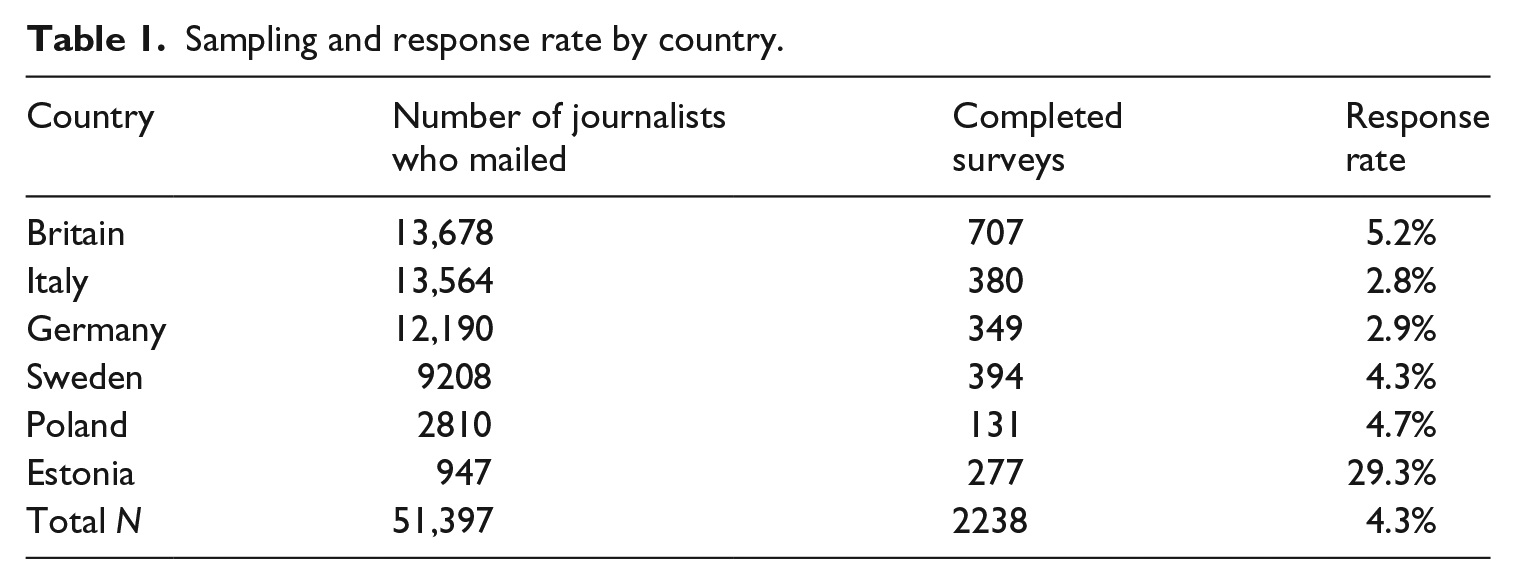
The analyses of the data were conducted using Mplus and SPSS softwares. Table 2 highlights some basic characteristics of the sample of 2238 journalists who responded to the survey.
Sample basic characteristics.

The survey tool: Journalistic skills
In the survey, journalists were asked the following question: ‘In order to be a good journalist, how important would you say the following skills are? Please provide each with a score out of 7, where 7 = absolutely essential and = not required’. The respondents were asked to rate 12 skills: writing, editing/subediting, interviewing, research techniques, multimedia production skills, design/layout skills, time management skills, knowledge of law, networking skills, teamwork skills, management skills, and ability to work independently. The items were designed based on screening the literature and on a qualitative assessment. The goal of this list of skills was to be as generic as possible and ask journalists to grade only skills that (presumably) are important to any and all journalists, regardless of which medium they work in, what beat they cover, or what organizational role they have.
Some of these categories require a bit of further explanation. Multimedia production skills mainly refer to skill in producing content for multiple technological platforms as well as integrating different media forms on the same platform (e.g. video and sound on the Web; this was how the concept ‘multimedia production’ was mainly used around 2008–2009 in all of the studied countries). Design/layout skills are related to graphic design and visual design and mainly involve the presentation of content on a page (printed or Web). Time management skill refers to the ability to plan your work to fit in with deadlines and the allotted work time. Networking skills refer mainly to interpersonal skills related to interacting with and cultivating sources, but also cultivating a professional network that may aid your career, provide advice, and provide future employment opportunities (in post-2008–2009 literature, ‘Network journalism’ is sometimes used to refer to both the converged nature of news production, and the increased role of social and other online networks in the production and dissemination of news – as in Beckett, 2010, or Van der Haak et al., 2012, e.g. – but this is not the sense in which we use the word ‘networking’ here). Finally, management skills refer to the skill set required to lead others and manage people and processes in the workplace setting.
‘Management skills’ may be considered more specific (i.e. specific to an organizational position), but as it is a common career path for journalists to proceed from reporter/writer to editor – and because of the historical division between editing functions and reporter functions – it was considered relevant to include as a general skill. ‘Design/layout skills’ may have been a more position-specific skill 10–15 years ago (McKercher, 2002), but newer studies indicate that all journalists more and more have to be proficient in basic graphic design and presentation skills (Nygren, 2008).
Findings
Skill dimensions in six European countries
Table 3 presents the comparative mean (M) values (and standard deviations (SDs)) for all six studied nations and provides a descriptive overview of how the different skills are valued in the different countries; this table shows the importance (in real terms) assigned to each skill on the 1–7 point Likert scale for each country and is provided here to give a basic comparative sense on how the countries differ on the individual items before we go on to the analysis of skill dimensionality.
Importance given to journalistic skills across countries (comparative M values and SDs). The survey question was: ‘In order to be a good journalist, how important would you say the following skills are? Please provide each with a score out of 7, where 7 = absolutely essential and 1 = required’.

ANOVA: analysis of variance; M: mean; SD: standard deviation.
0.001; **0.01; significance testing is one-way ANOVA.
The main point that emerges from this overview is that ‘Writing’ is ranked as the most important skill across all countries, and that country differences are so small so as to be not significant. In the case of all other skills, the country differences found are significant, even if in some cases small.
With the aim of exploring the dimensionality of the measures – that is the number and structure of the underlying factors associated with journalistic skills, the exploratory factor analysis (EFA) technique was used. The data were analyzed using maximum likelihood (ML) as an estimation method, as well as Geomin as a rotation method. Of the original 12 items, the item ‘knowledge of law’ was excluded from the final analysis because it failed to meet the minimum criterion of having a primary factor loading of 0.4 or above. Specifically, three EFAs were adjusted based on the collected data, only differentiated by the number of factors to be extracted (one, two, and three).
Taking as the criteria accepted standards in Structural Equation Modeling (SEM) and Confirmatory Factor Analysis (CFA) (Schreiber et al., 2006), the fit indices suggest that a three factors solution best described the data, with satisfactory model fit indices (Comparative Fit Index (CFI) and Tucker-Lewis Index (TLI) greater than 0.95 and root mean square error of approximation (RMSEA) less than 0.05). The model’s unidimensional and bidimensional fit indices show a worse adjustment when using these same criteria (Table 4).
Model fit indices – EFA.

EFA: exploratory factor analysis; df: degrees of freedom; RMSEA: root mean square error of approximation; RMSR: root mean square residual.
The rotated factor loadings matrix provides information on the association between factors and indicators. In general terms, a simple solution can be observed, in which each item is explained by only one latent variable. The final three factors show acceptable internal reliability (values for Cronbach’s α ranging from 0.66 to 0.78).
The first and second factors demonstrate the historical and therefore expected differentiation between the journalist-as-reporter and the journalist-as-editor. The four skills that were loaded in the first factor – writing, interviewing, research techniques, and ability to work independently – can be called reporting skills. This is the ‘field reporter’ skill package. This dimension clearly resembles the functions of a traditional newsgatherer who leaves the newsroom to find things out, and who needs to be functionally independent from the newsroom as he/she spends a lot of time away from it.
The second factor represents editing skills, and has four components – editing/subediting, multimedia production skills, design/layout skills, and management skills. This dimension focuses on characteristics that describe a typical ‘desk reporter’ (also sometimes called ‘production journalist’, see Ursell, 2004). This dimension captures the functions of a journalist who is more involved with processing/packaging what other people write and/or having a managerial role.
Reporting and editing skills factors represent ‘old’ or ‘traditional’ journalist functions, in the sense that the division between field reporters/news gatherers and desk reporters (editors, analysts, commentators, etc.) has existed for a long time, as noted in the previous theoretical overview section. The final factor is the more unexpected finding as it demonstrates the existence of a ‘new’ skill package or skill dimension that could be labeled networking skills. It includes networking, teamwork, and time management skills. Journalists who score high on this factor could be said to be more oriented toward group work and the social aspects of journalism, something that is historically new: both the journalist-as-reporter and journalist-as-editor have a long-standing occupational mythology placing great value on the journalist as a loner, a bohemian, as someone who does not fit well into a traditional organizational hierarchy (Aldridge, 1998; Aldridge and Evetts, 2003). Journalism has of course always taken place in a group context (as indicated by most so-called newsroom studies), but the main mode of working among journalists has in general been very individualized and not focused on group work.
These ‘new’ networking journalists are more attuned to ways of working that have originated in other organizational settings than the newsroom, that is, different forms of project-based work often done in contingent, flexible small groups. Such forms of group/project work are becoming increasingly common in newsrooms, especially in areas that deal with the development and provision of various online and mobile journalistic services (Kunelius and Ruusunoksa, 2008; Westlund, 2011). We also note that while time management is important for all journalists, the fact that our model links time management to teamwork and networking may mean that ‘time management’ is understood by some journalists as having to do more with organizing group or project work in an optimal way, rather than with meeting particular news deadlines in their individual work (deadlines that are becoming less fixed anyway with the move to 24/7 news production and rolling deadlines).
In order to assess if the dimensional structure of the data was the same across groups, the three factors solution was also replicated by country. The analysis found that items had the same factor structure for each country, and similar factor loadings across groups on the items that compose the reporting and editing skills factors, although there were some important differences in factor loadings on the items that compose the networking skills dimension.
Valued skills among journalists: Differences and similarities
The significance of differences among countries regarding the importance given to the three skills dimensions emerging from the EFA was determined through ANOVA. Eta-squared values were included in the analysis as a measure of the variance caused by differences across countries. We decided to center the country mean scores for each of the three skills dimensions, as acquiescence bias presents a challenge for comparative research due to cultural differences (Fischer, 2004). Mean scores were centered by calculating the overall mean score across all dimensions for every country and then subtracting the overall mean from the raw country mean scores. The resulting scores show the relative importance of journalistic skills in each country (Table 5).
EFA: factor loadings for a three-factor solution.

EFA: exploratory factor analysis.
Random subsamples were generated based on the important differences in the group sizes when comparing journalists from the six countries in order to control for the effect that the group sizes could have on the results; however, no differences were found in the direction of the findings.
Centered mean scores: values indicate the importance of the role in relation to the overall country mean across all roles. Original scores ranges between 1 = ‘not required’ and 7 = ‘absolutely essential’.
Broadly in line with what we could expect based on the historical factors discussed previously, the data show that, overall, journalists from these six countries give the greatest support to the reporting group of skills (M = 6.26; SD = 0.70), followed by the networking skills (M = 5.60; SD = 0.99).
Although in general editing skills tend to find less support among journalists than the other two dimensions under study (M = 4.25; SD = 1.11), we found significant effects of the national context on the extent to which journalists agree on the importance given to this set of functions (F = 6.703, df = 5, p < 0.001). The effect size, nevertheless, was small (η2 = 0.015). Editing skills were considered significantly more important by journalists in Germany and Italy and Poland (see Table 6). These are the three countries where the journalist-as-editor role has had a stronger position during the 20th century and where journalism’s roots lie in the political and literary traditions (Bajomi-Lazar et al., 2011; Curry, 1990; Hadamik, 2005). We would also expect that the importance given to reporting skills would vary substantially across the nations under study, being more common where the ‘field reporter’/news gatherer has historically been the model for the journalist. Results strongly support our expectations (F = 17.824, df = 5, p < 0.001). Although journalists from the six countries under study give greatest importance to the reporting group of skills, we found highly significant effects of the national context on the extent to which respondents support them. Reporting skills were considered significantly more important by journalists in the United Kingdom and Sweden than in the rest of the countries under study. Effect sizes for the importance given to reporting skills were small (η2 = 0.040), but larger than for editing skills. The inclusion of Sweden in an Anglo-American tradition of journalism-as-reporting may seem surprising to some but in fact the Swedish press history consensus is that during the 20th century in particular, Sweden has been much more influenced by, and sought influences from, the United Kingdom and the United States rather than continental Europe (Gustafsson and Rydén, 2002). A recent survey also found very strong support for ‘Anglo-American’ values (e.g. watchdog journalism and objective/neutral reporting) among Swedish journalists (Wiik, 2007).
Relative importance of journalistic skills dimensions by country.
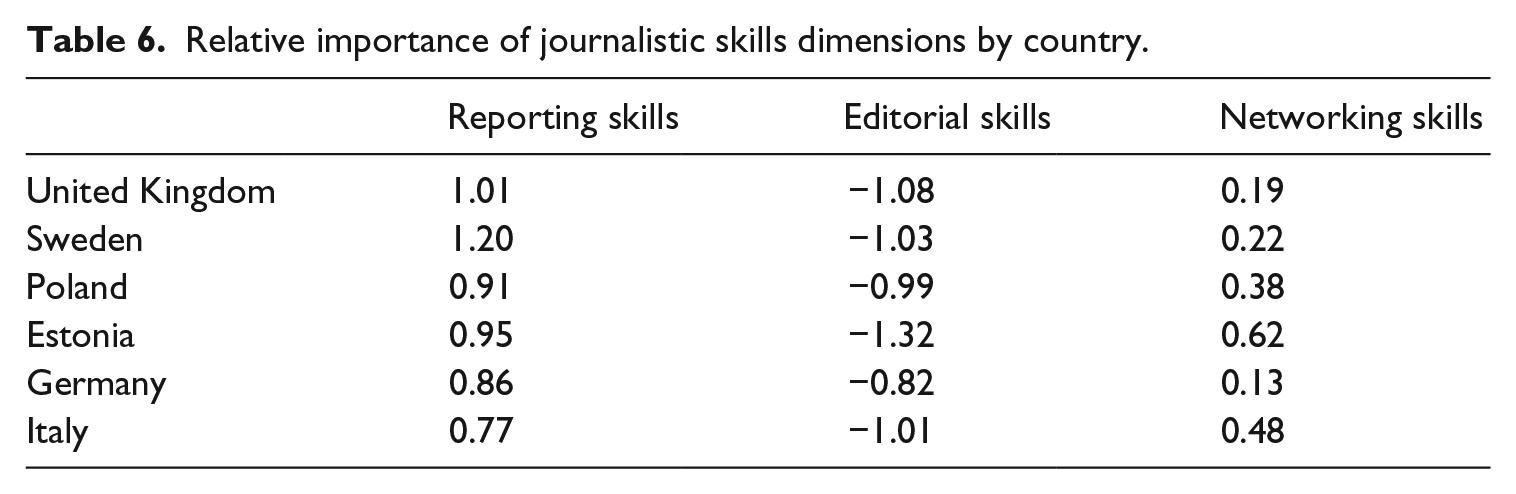
As for networking skills, journalists in general consider them more important than editing skills (M = 5.60; SD = .99) with German, British, and Swedish journalists assigning the least importance to networking skills among the studied countries. The difference was highly significant at p < 0.001 (F = 13.094, df = 5, p < 0.001), and the effect small, but not trivial (η2 = 0.029). In this case, our historical framework for interpretation neither provides an explanation for why German journalists are in fact the least positive to networking skills nor does it help us interpret why it is the Estonian journalists who place the highest value on networking skills among the six nations, while at the same time placing the least value on editing skills.
Overall, we find it interesting that the networking skill dimension is given, relatively speaking, more support than the editing skill dimension, despite the fact that journalists with editorial responsibilities seem to be somewhat over-represented in the sample. It is also interesting to note that journalists who have editorial responsibilities give significantly more importance to networking skills than journalists who do not have responsibilities (t = −4.653, df = 2167, p < 0.001).
In light of the fact that the editing dimension is the ‘oldest’ and the networking dimension in all likelihood the ‘newest’, we wonder to what extent the rise of the networking dimension indicates a decisive generational shift among journalists, regardless of country. Controlling for countries, we found that journalists under 30 years of age give significantly more importance to this skill dimension than journalists over 50 (F = 3.810, df = 29, p < 0.001). However, the importance given to networking skills by journalists between 30 and 49 is not significantly different from the rest. Likewise, effect sizes tend to be non-substantial (η2 = 0.007).
Conclusion and avenues for further research
The results of this study provide a greater understanding of the ways in which European journalists understand and value the professional skills they need to do their job. This article has shown that journalistic skills views can be grouped in three broad categories: reporting, editorial, and networking skills. The findings also indicate that there are important differences at the country level, regarding the importance journalists give to these skills.
First of all, the results are consistent with work that suggests a historical homogenization of journalism along Anglo-American lines (Hallin and Mancini, 2004). Reporting skills are considered the most important everywhere, pointing to the overall cross-national dominance of the reporter ideal among journalists: being out in the field, talking to people, doing research, and working independently (alone). There are, however, also clear differences that we attribute to the different historical roots of journalism in different countries: editing skills are considered more important in countries where the editor has been the dominant journalistic model, in particular Germany, but also Italy and Poland (these are also, conversely, the countries where reporting skills are considered comparatively less important). Estonia, interestingly, places somewhat closer to the Anglo-American model in this regard, with relatively speaking the weakest support for editing skills and a relatively high support for reporting skills. This may not be surprising considering that the post-1991 political system in Estonia has been dominated by strongly liberal economic policies emphasizing market liberalism, resulting in a very competitive media landscape dominated by the national press, just like in Britain (Örnebring, 2011). But Estonian journalists also value networking skills higher than journalists in any of the other countries, suggesting that in Estonia, the possible antipathy between a ‘traditional’ reporting role and a ‘new’ networking role is not as strong.
There also seems to be a cross-national generation shift going on in journalism, where younger journalists across nations place more value on networking skills than older journalists. We also note the small but significant effect of having editorial responsibilities on valuing network skills: one interpretation is that the classic ‘editorial’ role is also changing to incorporate new styles of leadership and work focusing on managing teams and project work (Kunelius and Ruusunoksa, 2008). The reporting role, still considered the core of journalism, is not changing in the same way – but are we perhaps moving toward a future where the ‘reporter’ ideal will gradually become less important (as the ‘editor’ ideal went from being the dominant to the subordinate one) and the ‘networking’ ideal more important?
There are of course important limitations of this study that we would like to acknowledge. The obtained sample shows non-trivial problems: it essentially focuses on journalists in the commercial print sector, while journalists from the public sector as well as TV and news agencies are under-represented. Likewise, although we surveyed an important number of journalists, the response rate obtained is very low, and varied considerably among countries, ranging from 3 percent to 30 percent. Finally, we also acknowledge the over-representation of Western Europe over Eastern Europe. All of these factors may well have influenced the empirical findings. Future efforts should thus be directed toward obtaining statistically representative samples and testing the generalizability of the findings.
There are several ways in which this initial exploratory study can be further developed. For example, we need more finely grained instruments for measuring valued skills. Is ‘writing’ one skill or many different ones, for example? And what did the respondents in the survey actually take ‘networking skills’ to mean? We of course made every effort to ensure that survey questions would be interpreted in a similar fashion across countries, but it may well be that things like ‘networking’ carries more positive connotations in some countries and more negative connotations in others. We see this present study as the first step toward a better understanding of how journalists value different skills and what this might mean for journalism as a whole, rather than the final word. Another urgent task would be to consider the possible linkages between skill dimensions and role conceptions. As many authors have found, role conceptions may not fully correspond to the real practice of journalism (Benson and Neveu, 2005; Mellado and Van Dalen, 2014; Vos, 2002). Thus, linking the study of professional skills and professional roles would be an obvious next step, analyzing both how different skills relate to different roles, and how different skills can reflect the different functions of journalism in the society.
Footnotes
Declaration of Conflicting Interests
The author(s) declared no potential conflicts of interest with respect to the research, authorship, and/or publication of this article.
Funding
The author(s) disclosed receipt of the following financial support for the research, authorship, and/or publication of this article: Data gathering and work on this article were supported by a generous grant made by the Axess Foundation, Sweden, to the Reuters Institute for the Study of Journalism, University of Oxford.