




Abstract
This article presents a study of what affects professional knowledge creation when journalism students have their periods of internship in legacy, yet highly digitized newsrooms. A total of 16 Norwegian j-students are interviewed and 30 internship reports analysed in order to detect the different actors – both humans and non-humans – that matter when students learn through practice in such newsrooms. Through this analysis, this article aims at understanding some of the tensions between legacy and digital culture that many newsrooms today are marked by and how these tensions affect professional knowledge creations for the journalists of tomorrow. The study is framed by sociomaterial perspectives on learning and journalistic practice and argues that two types of materiality are especially important for j-students’ professional knowledge creation during periods of internship: the structure and layout of the newsroom and the software applications in use at the newsroom.
Introduction
Things matter. The artefacts that surround us are not separate entities we can choose to either put to use or leave untouched. As objects get ‘smart’, they reach far beyond their material boundaries. They become intertwined with other artefacts and with the actions of humans in ways that make their range of operation unbound by their physical appearance and original purpose. Think of the phone: once a single-purpose physical object bound by its hardware materiality; today, a multi-purpose, customizable and personalized artefact defined not by the limits of its material boundaries but by what its software allows it to connect to. We are getting accustomed to the idea that objects think and that their modi operandi are limitless. Artefacts – and the software code they increasingly embed – achieve agency far beyond what was possible when they were tied only to mechanical systems (Berry, 2011: 2). Consequently, it is becoming difficult to separate objects from subjects, materiality from immateriality and the material from the social.
This new reality of object/subject, material/social complexity has given rise to new understandings of the interplay between humans and artefacts and between structure and agency in social theory. Such new understandings are commonly referred to as ‘the practice turn’, in which the social is understood as ‘a field of embodied, materially interwoven practices centrally organized around shared practical understandings’ (Schatzki, 2001: 12). The practice turn has greatly influenced the social sciences in recent years, including educational studies, the study of professions and the studies of specific professions, such as journalism. In journalism studies, the practice turn has implied (1) a renewed interest in ethnographic studies of professional practice and (2) a ‘material turn’ (Boczkowski, 2015) influenced by perspectives from Science and Technology Studies (STS). These perspectives highlight interactions among objects, technologies and various human actors and analyse how these interactions shape journalism as a discursive practice, that is, the production, distribution and consumption of journalism.
This article combines sociomaterial perspectives from educational studies and journalism studies to investigate the material aspects of learning and knowledge creation when j-students do their periods of internship in newsrooms marked by both legacy and digital cultures. A sociomaterial approach highlights interactions among objects, technologies and various human actors and analyses how these interactions affect the news production culture and the way in which journalists in the making create professional knowledge. The newsrooms in which the students did their periods of internship were all marked by conventional ways of organizing news work, while producing content for digital-only platforms. The students’ experiences with professional knowledge creation in these newsrooms are, therefore, a fruitful empirical basis for understanding how negotiations between legacy and digital culture shape contemporary news work.
The research is guided by the following research questions: What role does materiality play to the learning outcome of journalism students during periods of internship in newsrooms, and what can this role of materiality tell us about how newsroom culture and journalistic practice are transforming?
The aim of the research is in other words twofold. First, I wish to analyse the materialities that play a role in a learning-through-practice situation for journalists in the making. Second, by foregrounding the material aspects of journalistic learning-through-practice, I wish to highlight the specific and time-bound sociomaterial relations that shape contemporary journalistic professional practice and newsroom culture.
A third aim is to bring sociomaterial perspectives from educational studies and journalism studies together in order to better understand what affects learning-through-practice for j-students. The first half of this article is, therefore, dedicated to introducing sociomateriality as a theoretical perspective and its application in educational studies and journalism studies. In the second half of this article, the methodology for the empirical study is presented and discussed, before findings are presented and analysed in line with the two main themes that arouse from the data: (1) the importance of the newsroom as a physical space and the students’ ability to manage that space and (2) the agency of software applications.
This article ends with some reflections on how sociomaterial perspectives help us understand both contemporary newsrooms and j-students learning-through-practice better and with some advice to j-schools on how to prepare the students better for future professional work.
Sociomateriality and learning
In educational studies and the study of professions, perspectives of sociomateriality are increasingly adopted in order to ‘de-centre the human being in conceptions of learning, activity and agency’ (Fenwick et al., 2012: 7). Such holistic approaches, in which no hierarchies of power between humans and non-humans are presupposed, are becoming important to understand how professional knowledge is distributed and negotiated in ‘communities of practice’ (CoP; Wenger, 1998) and what influence and shape professional practices and learning. Professional knowledge is no longer understood as something that is acquired by the individual to be stored in that individual’s mind. Rather, professional knowledge is understood as ‘distributed, material and relational’ (Fenwick et al., 2012: 5).
Sociomaterial thinking often stems from a feeling of discomfort with other perspectives’ foregrounding of the social, cultural or discursive. As Barad (2003: 801) so eloquently phrases it, ‘Langauge matters. Discourse matters. Culture matters. There is an important sense in which the only thing that does not seem to matter anymore is matter’.
The main contribution of sociomaterial theories is, therefore, to make matter matter and investigate the relationship between materiality and the social. Materiality is commonly understood as both artefacts (physical and non-physical) and humans. Therefore, materiality include physical, organic and visible things such as chairs, desks, computers, documents, buildings, bodies, phones, windows, grass, water and food, and it includes the non- or less physical things, such as infrastructure, software, electricity, temperature, air conditioning, networks and so forth. Sociomaterial perspectives do not say that all such artefacts do matter for whatever action, situation or phenomena the researcher investigates. Sociomateriality is neither techno-centric nor human-centric (Orlikowski, 2007), but it highlights the importance of not leaving anything that might matter out. Sociomaterial approaches are, therefore, not deterministic – they do not imply a material bias. Instead, these perspectives argue against all other kinds of determinism, be it social, cultural, discursive or technological.
Leonardi (2012: 34) explains the relationship between the material and the social in the following manner: ‘whereas materiality might be a property of a technology, sociomateriality represents that enactment of a particular set of activities that meld materiality with institutions, norms, discourses, and all other phenomena we typically define as “social”’. This definition highlights the interplay and complex relationships between objects and subjects, structure and agency and the physical and non-physical. Materiality does not exist outside the social, and social action is always based on some kind of materiality. Embedded in such an understanding of sociomateriality is also the understanding that text, language and discourse are part of the equation. When, for instance, journalists interact with technology in the social activity of news production, such interactions are discursive in the sense that the technology in question has no meaning outside the discursive practice. All kinds of materialities, both artefacts and humans, only gain meaning through discourse related to social activities. However, sociomaterial theories emphasize that not only humans but also artefacts may perform agency. The human is not seen as the a priori centre of social activity. Hence, sociomaterial approaches aim at understanding professional practice beyond the decision-making of individuals, stable communities and given knowledge (Fenwick et al., 2012: 3).
An early, influential work within educational studies that emphasized the importance of the material to processes of learning and professional knowledge creating was Lave and Wenger’s book Situated Learning (1991), in which they argued that learning is not something that goes on in an individual’s mind but is rather the result of coparticipation between activity, agents, tools and community. Building on these insights, the same researchers developed the concept ‘communities of practice’ (Wenger, 1998), which became widely adopted and promoted an understanding of learning as a social, participatory practice within both institutional and everyday communities.
However, even though learning through this line of thinking was linked to situated practices in which tools and other artefacts were considered important, the process of learning was still burdened with a human bias, according to Fenwick et al. (2012), who argue that such a bias limits our understanding of what both practice and participation entails. What is needed, according to these researchers, is an emphasis on practice and participation in relation to learning that does not imply any preconceived ideas on who or what matter the most, be it humans, artefacts, text, discourse, norms, values and so on, and what role the social has in relation to the technical and natural. Such a stance points towards the more radical notions of sociomateriality found in Actor–Network Theory (ANT), where an important point is to avoid social determinism (Latour, 2005). To Latour (2005), the social is not a ‘force’ that is ‘available to “explain” the residual features other domains cannot account for’ (p. 4). The social and society is not context that frames everything else, rather it is one of the many elements that connects and circulates ‘inside tidy conduits’ (Latour, 2005: 5). This does not mean that the social in ANT is a thing among other things. The social is not material; it is ‘a type of connection between other things that are not themselves social’ (Latour, 2005: 5, original emphasis). Analysing such connections between different materialities (or ‘agents’ and ‘actants’ in the ANT vocabulary) is, therefore, important in order for the researcher to find out what makes a difference in the course of some other agent’s action.
Fenwick et al. (2011) argue that sociomaterial approaches such as ANT bring three important insights to educational studies: First, educational studies have been human-centric even though education is centrally material. Second, sociomaterial approaches can help make visible ‘the minute dynamics and connections that are continuously enacting the taken-for-granted in educational events’ (Fenwick et al., 2011: vii). Taken-for-granted artefacts such as desks, bubble gum, electricity, computers and what have you interact with each other and with humans to distribute – and obscure – knowledge.
Third, sociomaterial approaches question established dichotomies such as theory/practice, knower/known, doing/reflecting and meaning/matter and instead trace the dynamics and processes that produce knowledge. Learning and education is, therefore, not seen as solely social or personal processes – something that occurs within the human mind as a result of interactions with other human. Instead, sociomaterial perspectives on education insist upon attending to the material that is entangled with the social, technical and human in processes of learning (Fenwick et al., 2011: 3).
Sociomateriality and journalism
As is the case with educational studies, journalism studies have in recent years been marked by an increased interest in both practice and materiality. A seminal work in this respect is Boczkowski’s Digitizing the News (2004), which inspired a wave of ethnographic newsroom studies interested in the interplay between digital technologies and journalistic practice. Boczkowski (2004) argued that neither technology nor the social was determining the developments of journalism, but that journalism developed due to ‘the mutual shaping of technological and social change’ (pp. 10–11). Boczkowski’s position is in other words a typical sociomaterial one, in which no determinism is accepted.
Although such sociomaterial perspectives have been adopted in journalism studies in recent years, understandings of materiality are often reduced to mean elements of technology. Boczkowski himself was preoccupied with the interplay between technology, social change and practice, as were so many other later digital newsroom ethnographers (see, for instance, the two volumes edited by Domingo and Paterson, 2011; Paterson and Domingo, 2008). The field of software studies has also in recent years had some influence on understandings of the agency of technology related to journalism (see, for instance, Anderson, 2013; Lewis and Usher, 2013; Rodgers, 2015). One paradoxical consequence of this increased emphasis on technology is that even though a core aim of sociomaterial-inspired research is to avoid technological determinism, much of the research still implicitly argue a kind of technological determinism because it unwillingly promote technology over any other ‘matter’.
Another potential bias with this strand of sociomaterial-inspired research has been its preoccupation with established institutions of journalism, such as the traditional newsroom. Several researchers have highlighted how practices and cultures of journalism affect and are affected by the newsroom as a physical space (see, for instance, Nerone and Barnhurst, 2003; Robinson, 2011; Usher, 2015; Wall 2015; Zaman, 2013). However, as the established media institutions lose control over news production, distribution and consumption and as news is found ‘everywhere’ (Picone et al., 2015) – mainly due to the diffusion of social media – the preoccupation with the traditional newsroom might become problematic if one aims at understanding contemporary news flows and practices of journalism. Anderson argues that journalism researchers must open ‘both newsrooms and our imaginations to the larger journalistic “ecosystem” that is emerging and coalescing outside these newsrooms walls’ (Anderson, 2011: 152). This insight leads Anderson, and other researchers, to view journalistic practices as networked rather than institutionalized within the boundaries of the newsroom (Anderson, 2010; Beckett and Mansell, 2008; Heinrich, 2011; Russell, 2013; Singer, 2011).
Embedded within this understanding of journalism as networked, both as practice and as institution, is the blurring of the many previously quite clear-cut boundaries that used to define journalism. News is today produced, distributed and consumed in ways that make it difficult to assess who – and what – does what. Contemporary theorizations of journalism, therefore, tend to move ‘beyond the traditional institutions and understandings of journalism’ (Steensen and Ahva, 2015: 1) and into directions inspired by more radical sociomaterial approaches, such as ANT, in which nothing is taken for granted. The who and what does what within a journalistic discursive practice is today an empirical question with no predefined answers, argue Primo and Zago (2015). Domingo et al. (2015) propose a research strategy for tracing the digital news networks by ‘patiently following the actants to reconstruct how news is produced, circulated and used in a specific context’ (p. 63).
It goes (almost) without saying that the methodological challenges with such a research strategy are overwhelming. It is difficult to investigate journalism if you are to have no preconceived ideas on what your object of inquiry is and who produces, distributes and consumes it. Journalism is in itself a concept enmeshed in a web of cultural, social, symbolic, political and discursive meanings, which are difficult, if not impossible, to get rid of. A more pragmatic, and alas, more methodologically feasible, solution is put forward by Lewis and Westlund (2015), who argue that we can assume that certain actors, actants, audiences and activities matter to practices of journalism. They argue that certain activities related to news production are routinized across time and space to such an extent that even though they are not static, they still hold value as a structuring principle for the analysis of journalistic practices. Based on this presupposition, they propose a matrix by which one can analyse the actors, actants and audiences related to those activities.
The research presented in this article takes a similar approach as it is based on some preconceived ideas related to how legacy and digital culture create friction in the newsrooms in question and what matters for journalism students during their periods of internship. These preconceived ideas are related to (1) the researcher’s previous experience with assessing student-written internship reports and being a contact person for students during their periods of internships, (2) knowledge on the types of artefacts and humans that the student are likely to encounter during their periods of internship and (3) knowledge on how the newsrooms in question have transformed their focus of practice from mainly analogue media to mainly digital media during the recent decade and that this transformation has some consequences for the newsroom culture and journalistic practice.
These preconceived ideas imply some assumptions concerning what awaits the students when they enter the newsrooms. These assumptions, for instance, include the following:
The students will be surrounded by people who have a professional identity as journalists and who adhere to a typical newsroom hierarchy with designated roles and functions such as beat reporters, editors and sub-editors.
The students will work in a space, which for long has been defined as a newsroom and, therefore, bears cultural and symbolic meaning related to that concept.
The students will need to master certain practices (find stories, contact sources, write stories, etc.), technologies (content management systems (CMSs), editing applications, etc.) and so forth.
The research to be presented is, therefore, not based on the kind of apriorism and anti-determinism promoted by ANT and similar radical sociomaterial perspectives, but it is sociomaterial in the sense that it looks specifically at the role of different kinds of materialities to the students’ learning-through-practice. Furthermore, the fact that some materialities are presupposed as important does not mean that other materialities (humans and/or artefacts) may not occur as significant during the empirical inquiry.
Before presenting and discussing the findings of the study, I will provide some additional methodological reflections and an account of the methodological procedures that were undertaken.
Notes on method
Doing sociomaterial research poses several methodological challenges. One challenge is related to how you study the agency of artefacts when you, for obvious reasons, cannot interview artefacts. Any claims made by the researcher that artefacts have agency will always rest on human interpretation. The researcher, being human, has a natural ‘human bias’ and always runs the risk of ‘humanizing’ artefacts. Furthermore, doing sociomaterial research implies – as do all other research strategies – some kind of human intervention. An important question is, therefore, how to avoid the ‘inevitable pre-conceptions’ (Fenwick and Landri, 2012: 5) we as humans have?
A possible answer to this dilemma is to not investigate the artefacts as such but to analyse them as part of the discursive practice in question. A research strategy that takes this into account would imply that the researcher investigates how artefacts matter as part of discourse, for example, through interviews with humans who are surrounded by artefacts in their practice. This is the strategy adopted here. The difficulty with this strategy is that the practice in question might be perceived as more human centric than it really is, so the researcher needs to retain a sensibility towards the significance of non-human materiality. How this was achieved will be discussed further below.
To answer the research question, 16 journalism students where interviewed half way through their periods of internship. These students were all enrolled with the journalism programme at Oslo and Akershus University College of Applied Sciences in Norway. They all simultaneously went through a period of internship from October to December 2014 as an obligatory part of the second year of the bachelor programme. All 16 students had chosen online journalism as their specialization and were thus located in online or cross-media newsrooms. These newsrooms were scattered across the country and ranged from large national online newspapers to public broadcasters and local media.
All interviews were semi-structured in the sense that they were structured around a few main questions, but they took different directions due to differences in follow-up questions. The interviews were conducted via phone during November 2014 while the students were at work and lasted on average about 30 minutes. Interviewing them at work gave the data an ethnographic touch, as the students could describe their immediate surroundings and the tasks they were currently involved in. However, this strategy also had a drawback. Some students felt uncomfortable with talking freely because others could hear them. When that was the case, I had the student move to a place within the newsroom where they could talk more freely, or I re-scheduled the interview to after work hours.
The students were first asked to reflect on how satisfied or dissatisfied they were with their internship so far and what had caused their satisfaction or dissatisfaction. They were asked to describe the tasks they typically preformed, if they found a particulate task difficult and if so for what reason. They were then asked to reflect on the learning outcome so far and what they thought had affected their learning. The purpose of this line of questioning was to map the different kinds of materialities that had an effect on how the students performed their role in the various newsrooms they were located. The questions were phrased to avoid directing the students’ attention to specific artefacts or other materialities, so that the matter that mattered arose from their narratives and was further investigated through follow-up questions.
Based on this mapping, additional questions related to specific materialities were asked, if the students had not mentioned them already. This was done to ensure the kind of research sensibility to materiality discussed above. For instance, most students did not themselves think of the role that the physical layout of the newsroom – and where and how they were situated within that space – might play for their internship experience. When asked to describe the newsroom and their place within it, it quite often became clear that this was indeed important to their experience. Similarly, the students would often take things such as computers, cameras and certain types of software applications for granted, and additional questions were, therefore, needed to assess the importance of such artefacts.
In addition to the interviews, 30 internship reports were analysed. These reports were obligatory, written assignments handed in upon completion of the students’ periods of internship. As such, the reports were not written for the purpose of this study. In these reports, the students were asked to describe and assess their periods of internship in general, what kind of training and supervision they got (the newsrooms that take part in the internship arrangement are obliged to provide an in-house supervisor for every student), what the learning outcome of the internship period had been and any problems they had encountered.
The reports analysed were written by the same 16 students who were interviewed. The additional 14 reports were written by students in the same class who specialized in broadcast (TV) journalism and consequently had their periods of internship in broadcast media newsrooms, which also had gone through processes of digitization in recent years. The reports were analysed for any additional clues as to what kinds of materialities influenced the students’ experience and learning.
It should be noted that I had been the students’ teacher in a course they all took prior to their periods of internship. If this affected the research in any way, it was more of an advantage than a disadvantage, as the students felt comfortable discussing their experiences with someone they knew. All students gave their informed consent to be part of this study.
Findings
Out of the 16 students interviewed, only 3 had any prior experience with working in a newsroom. The newsroom as an arena for both journalistic and learning practices was, therefore, new to most of them. The students’ narratives circled around all kinds of materialities that shaped their experiences and learning outcome. Many students had unique experiences with specific artefacts or humans that in some way or the other affected their learning. These experiences could be related to human actors outside the journalistic profession, for example, marketing people, technicians, administrative staff or even construction workers. Or they could be related to artefacts that did not have any direct relation to journalistic practice, such as money and having or not having a driver licence.
However, two main themes arose from the data: (1) the role of the physical layout of the newsroom and the way the students found their place within that space and (2) the role of software applications, partly related to the degree of training given. Almost all the students interviewed had experiences related to these two themes, and they were also mentioned in most of the reports analysed. I will, therefore, limit the discussion of findings to these two themes, also because they provide new knowledge to the already existing body of sociomaterial-inspired research on the structure and importance of the newsroom as a physical space and related to the agency of software.
Settlers and nomads in the newsroom
Most of the students were extremely newsroom bound. They rarely left the building and did almost all their reporting and training within the walls of the newsrooms. Their ‘material world’ was, therefore, tied to the practices that unfolded within that space. The newsroom – both as a physical building and as space that shapes CoP – was, therefore, the most significant material artefact to the students’ internship experiences and learning outcome.
This finding stands in stark contrast to the alleged blurring of boundaries between the newsroom and other spaces and practices discussed above, and it may serve as a useful reminder of the ever-still significance of the newsroom to practices of journalism. The newsroom as a material space has always played a crucial role in news production. As argued by Nerone and Barnhurst (2003), newsrooms contain complex and high-speed work, which make the space focus inward, as opposed to other business offices, which tend to focus on exterior windows.
Several of the students expressed wishes to do more out-of-the-building reporting but felt restrained by what they perceived to be customary practices within the newsroom. As one of the students expressed it, ‘I would love to do more reportage, but it is not that common to do that here’ (interview with student 3). A possible implication of this is that the digitized newsroom, with its emphasis on rapid publication and thus less out-of-newsroom reporting, has become an even more inward-looking, and thus contained, cultural space in which influence from other cultures is reduced.
Reflecting this significance of the newsroom, one common theme that arose from the students’ narratives about their internship experiences concerned the way the newsroom was laid out and what place the students were able to occupy within that space. All but one of the students interviewed described the newsroom they were working in as an open-planned office space in which journalists, editors, sub-editors and sometimes technicians and marketing people were clustered together in desk hubs with typically 3–8 workstations.
Some of the students had their own desk hub workstation that they used throughout the whole internship period, while others had to move around. The difference between these two groups, which will be referred to as the ‘settlers’ and the ‘nomads’ in the following, proved vital to the students’ learning experience and the ways in which they engaged with newsroom culture and professional knowledge. The settlers, that is, those who had their own workstation from the very beginning and, therefore, found their place in the newsroom with relative ease, quickly felt as if they were part of the newsroom and found it easy to get the help they needed in order to enhance their learning experience. One of these students, who shared a desk hub with six of the regular journalists, explained the importance of this arrangement in the following manner:
It has been decisive for my learning. I was thrown right into it [journalistic work], which made me totally depended on asking people all the time for help. It had been much more difficult if I sat by myself or sat in different places from day to day. (Interview with student 4)
To be able to ask people for help was important for all the students in order for them to master everything from software applications to the newsroom culture, for example, what kind of stories were considered good or bad, how to find the right story ideas to work with and how the local culture of communication was. The settlers had the opportunity to quickly get to know the people they sat next to and to reach out for their help, which made their process of assimilation fast and easy. They quickly got a sense of belonging.
The nomads, however – that is, those who had to move around – found it much harder to reach the same level of both cultural and practical understanding of the newsroom practices. One of these students was promised a permanent workstation, but the newsroom was short of desks due to a delayed delivery of new workstation furniture. As a result, he had to move around: ‘Every morning I have to find a new spot wherever there is one available. This has made it hard for me to get to know people, since I have to relate to new people all the time’ (interview with student 1). People from the purchasing department, and the furniture delivery logistics, thereby became actors in his learning experience. However, this student found a strategy to overcome this problem. He started to shout out whenever he encountered a problem he needed help with and then someone would come over and help him. He also made it clear that he preferred moving around in the open-plan office to being placed, for instance, in a more remote office: ‘Then I would have been forced to figure out things on my own, and I would have used much more time to learn the things I need to learn’ (interview with student 1).
The agency of software
The other common theme to arise from the students’ narratives about their internship experiences concerned how they connected to the software applications that were important for the newsroom practices and how these connections were affected by the degree of training provided by other actors. The students had to relate to a substantial amount of software applications, some of which were familiar to them, others not. Table 1 displays all the software applications that were unfamiliar to some or all of the students. Applications that are ‘common knowledge’, such as text editors, email applications, web browsers, social media applications and so forth, are omitted from this table.
Software applications the 16 students had to relate to.
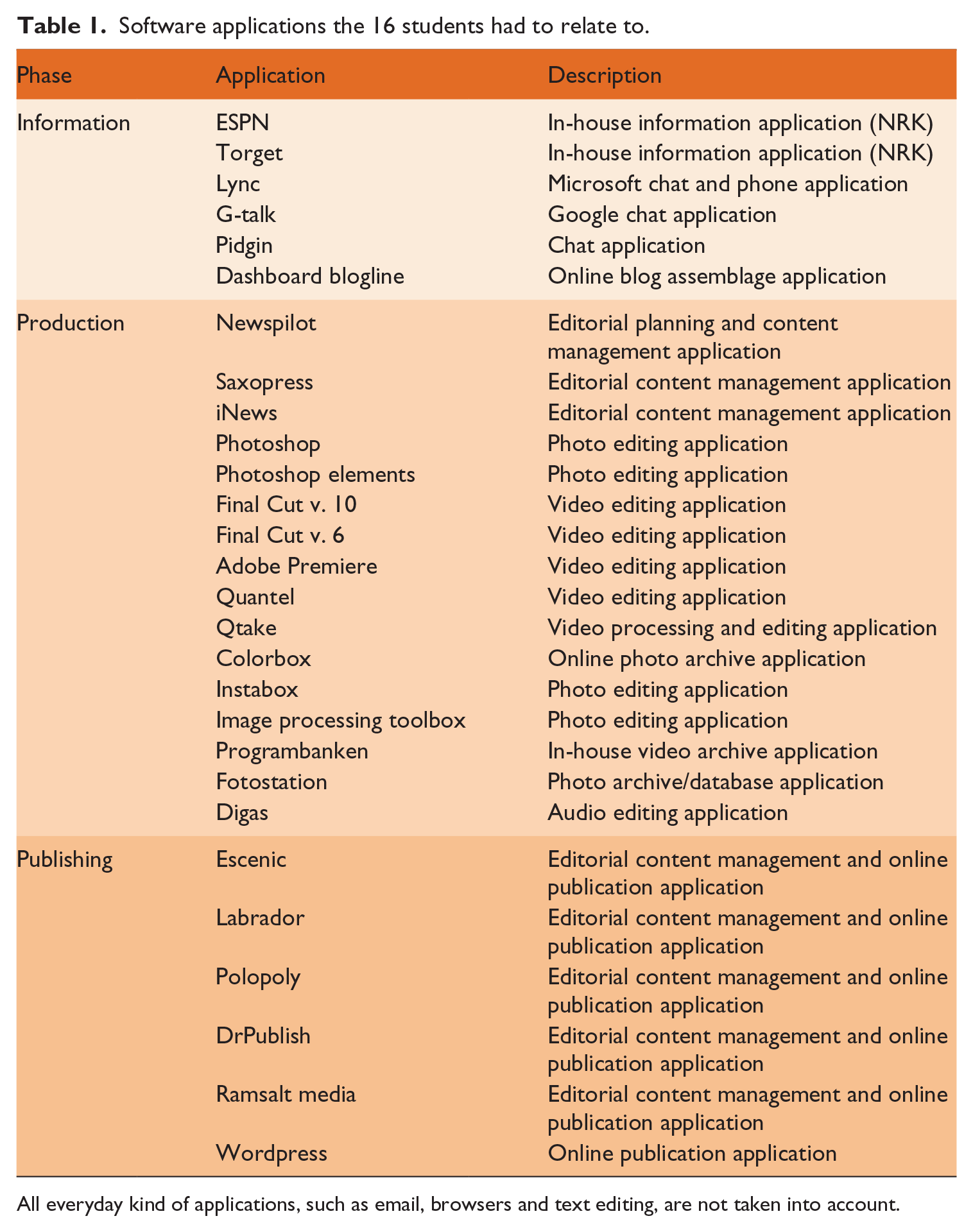
All everyday kind of applications, such as email, browsers and text editing, are not taken into account.
All newsrooms use specialized applications to (1) communicate and diffuse information about workflows and in-house activities; (2) gather, edit and assemble content; and (3) publish content online. However, since there are no standardized ways of producing and distributing news, different newsrooms use different software application to perform the same tasks. Some newsrooms even create their own applications, such as the CMS ‘Labrador’, which is developed by the newspaper Dagbladet.
The students had prior experiences with using software applications for all three purposes outlined in Table 1, but only some of them had used the applications that were in use at the newsroom they worked. Furthermore, the same applications might have been customized differently in different newsrooms. As Rodgers (2015) points out, software has a tendency to mutate in relation to the context it is used in. So, even if the students had prior experiences with the software that were in use at their newsroom, they would still need training to understand how those applications were customized.
The similarities found in how the newsrooms were organized and laid out were in other words not paralleled by how software applications were adapted to the practices and cultures of the same newsrooms. This points to the variability of digital culture (Manovich, 2001) and the ways in which digital materiality lacks fixation in time and space. Unlike hardware, software lacks material boundaries. Berry (2011) compares software to a tangle or a knot, which ‘ties together the physical and the ephemeral, the material and the ethereal’ (p. 3). The vast amount of software applications the students had to relate to points to how software increasingly structures our world. Yet, the students found it difficult to pinpoint how software mattered to their learning experiences. It was only when asked directly about the software they used and how it affected their work and learning they were able to point to the actions of software. This points to Mackenzie’s (2006: 8) argument of how software is seen as possessing ‘secondary agency’ that only supports the agency of other actors, such as the students. Software has a tendency to become withdrawn, taken for granted and difficult to focus on. To better grasp the agency software actually performs, Berry (2011: 4) argues that we need to pay more attention to the ontology of software (what it is), where it comes from and what it actually does.
Based on the interviews and internship reports, those students who were exposed to many software applications, which they had no prior knowledge of, were more likely to highlight the role of software applications to their learning experience. This, in turn, was closely tied to the degree of training they were given in software application use at the start of their internship periods. Some students had one full week of training before they were exposed to more regular newsroom work, some had a day or two of training, while others got no training at all and had to figure things out on their own, through practice. For this latter group, the software applications could turn into significant obstructers of learning. One student lamented, ‘The first two weeks were really hard because I didn’t get any training and I wasn’t familiar with the applications. I googled for answers to avoid nagging. I felt stupid’ (interview with student 6).
This student had a hard time finding the right balance between getting the help she needed from the people around her, on one hand, and not being perceived as benighted, on the other hand. She tried to connect to several actors, both human and non-human, in her pursuit of knowledge but experienced difficulties with getting help from any online actors through Google searches. As a result, the software applications she needed to master became actors who influenced her learning in a negative way.
Another student who also was unfamiliar with and did not get any training in the newsroom software applications applied a different strategy. She did not try to get help but instead tried to avoid the applications altogether. She simply wrote her stories in Microsoft Word and emailed them to the editor. This strategy affected the way she wrote her stories and consequently her ability to adapt to the newsroom’s understanding of journalistic practice: ‘It affects the way I write. It gets messy with links and pictures, so I don’t add that many. And I don’t pay much attention to how I write the different leads we use’ (interview with student 16).
With ‘different leads’, she refers to leads for front page, section page, story page and leads used in social media. If she were to use the CMS, she would typically be prompted to write these different leads by the way the system was customized. By choosing to use Word instead of the CMS, she did not learn that much about how these different leads function in practice, and she also missed out on the interactive and multimedia aspects of the journalistic practice since Word is not optimized for hyperlink and image integration. This student’s experience, therefore, illustrates the type of agency applications such as a CMS performs, concerning both learning and professional practice. Also, it illustrates how digital culture transforms the legacy practice of writing news stories, especially leads.
Furthermore, the different approaches the newsrooms had to providing software training to the students might be an example of how the newsrooms struggle with understanding what is new to the newsroom culture, and, therefore, must be learned, and what is already assimilated into the culture and, therefore, has become common or tacit knowledge. The newsrooms that provided insufficient software training to the students failed to recognize the agency of software and how software has a capacity to render ‘humans as its objects by encouraging forms of “computational thinking”’ (Rodgers, 2015: 12). This failure to recognize the ontology of software and the kind of agency it performs had a stark effect on the students’ learning outcome. Similarly, the students who thought they could get by without acknowledging what software is and what it does had a much less satisfying learning experience during their internship period.
Discussion and conclusion
The findings presented above reveal that the journalists of tomorrow must connect to a wide and unpredictable range of different materialities – predominantly connected to the newsroom as a sociomaterial space and the ontology and agency of software – when trying to understand and master the culture of a modern, digitized newsroom. How the j-students managed to connect to these different materialities was pivotal to their learning-through-practice experience and, therefore, also to their sense of belonging within the newsroom in particular and with contemporary journalism at large.
The findings also make visible how newsrooms of today are transforming. Digitization transforms journalism as a discursive practice, for example, how news is produced, distributed and consumed, and these discursive transformations are visible as ‘material traces’ in the newsroom (De Maeyer and Le Cam, 2015). The magnitude and variety of software applications the students in this study were exposed to is one example of such material traces. Although performing many of the same tasks, the different applications have slightly different affordances that may render certain aspects of the discursive practice more important than others. How this might affect newsroom culture became apparent for the student who opted out from using the many software applications that were in use in the newsroom she worked at. She was left unaware of how the genres of news were transforming due to the many ways in which news stories were distributed and consumed. The student did not take part in the negotiations going on in the newsroom between traditional journalistic genre production and digital genre production – negotiations that are vital to take part in, in order to understand how newsroom culture and the discursive practice of journalism are transforming. Consequently, her learning experience suffered, as she did not manage to connect to important actants. This student’s experience is a good example of how the ‘withdrawn’ agency of software operates (Berry, 2011: 4).
Another example of the material traces of newsroom transformations due to digitization is the constant reconstruction of the newsroom as a physical space. The findings of this study suggest, as do other studies (Usher, 2015; Wall, 2015), that newsrooms of today are fluid and marked by material messiness. New hardware, new software, new furniture, new organizational structures due to changes in ownership and new ways of organizing news work due to new roles related to new elements of the discursive practice; all these changes require new ways of organizing the newsroom as a physical space. The newsroom becomes a place in motion, not only due to changes to already existing newsrooms but also because many newsrooms are abandoned and build up elsewhere to better accommodate the downscaling of editorial staff due to financial cutbacks (Usher, 2015). People move around, construction workers and tech people come and go and new professional groups, such as programmers and social media curators, become integrated in the work flow and hence the newsroom as a physical space. As pointed to above, several of the students experienced how the instability of the newsroom as a physical space affected their ability to understand and be part of the newsroom culture. Those who were lucky enough to be part of a newsroom that (at least for the moment) was relatively stable – the ones labelled ‘the settlers’ above – did not have their learning experience obstructed by the material messiness of newsrooms undergoing physical transformations.
The different levels of situatedness in the newsroom point to the importance of having control of the social, understood in the Latourean way as connectors between different materialities. Zaman (2013) has shown how journalists often describe newsrooms as battlegrounds and spaces marked by chaos. Newsrooms are in other words spaces in which having social control is extremely difficult. Nevertheless, the settlers managed to have social control, at least to some degree. By limiting the space they had to relate to, they were able to establish meaningful connections to different actants and actors much more so than the nomads, who constantly had to re-connect with new artefacts and humans in order to experience learning. Lack of social control, therefore, to some extent obstructed learning and forced the nomads to find alternative ways of connecting with whom and whatever they needed in order to enhance learning.
An interesting paradox related to this finding is that what constituted an ideal learning situation for the students – being settlers – is the exact opposite of what has been found to be the ideal way of relating to space in modern, cross-media newsrooms. Cross-media newsrooms encourage ‘movement between the units, and those most mobile […] will rise in the organization’, according to Nerone and Barnhurst (2003: 448). Based on her analysis of relationships between works spaces and journalists in converged newsrooms, Robinson (2011) made similar conclusions: reporters who were unable to cope with the cross-media mindset became physically and culturally isolated in the newsroom and thereby lost power. Being a nomad is in other words important to be professionally successful in modern newsrooms, but as the findings of this study demonstrates, it is not the best way of learning the trade. However, given the unstable state of contemporary newsrooms, students are in the long run probably better equipped if they manage to adapt to a more nomadic way of work life, in which newsrooms could ‘pop up’ everywhere (Wall, 2015).
All in all, the findings of this study suggest that the negotiations between legacy and digital cultures in contemporary newsrooms and the learning-through-practice that take place in them are deeply material and therefore can be studied by following material traces. By taking a sociomaterial perspective on developments in journalism, researchers can avoid human, technological and social biases and instead focus on how connections between different materialities – both human and non-human – make certain types of matter matter more than other matter. J-schools should take into account the fluidity and material messiness of contemporary newsrooms when preparing students not only for periods of internships but also for their post-graduate efforts to enter the profession. This implies that j-schools need to have knowledge about and sensibility for the various kinds of materialities that play a role in the newsroom, especially related to the magnitude and variability of software applications in use, how newsrooms are constantly reconstructed as physical spaces, how the professional culture changes due to the entry of new professional groups into the newsroom and how new media and new tools affect genre development.
Footnotes
Declaration of Conflicting Interests
The author(s) declared no potential conflicts of interest with respect to the research, authorship, and/or publication of this article.
Funding
The author(s) received no financial support for the research, authorship and/or publication of this article.