




Abstract
The powerful and interesting mixture of Vice Media Inc. – youth, (cool) lifestyles, and journalism within a diversified global media company – has, naturally, attracted a considerable amount of both hopeful and critical journalistic commentary. Vice Media Inc. has, however, attracted little scholarly attention. This article seeks to address this through a contextual reading of Vice News’ coverage of the events in Ferguson (from 12 August to 28 September 2014). This coverage largely alternates between minute-by-minute, long-form video coverage and incensed, media-reflexive analysis and thus mixes amateur aesthetics, immersive approaches, and ethics of witnessing with commentary. This mixture, it will be argued, in certain ways mirrors the collaborative flow found on social media. The article employs an analytical framework that revolves around aspects of hybridity – from the systemic to the textual – and also draws on notions of cosmopolitanism in relation to the global audience of Vice.
Youth, lifestyle, and news – and notions of hybridity
In focusing, quite literally minute by minute, on the streets of Ferguson, we risk a form of solidarity sullied with cognitive dissonance: We treat the situation there as unique (the sole focus of attention) … [as just the latest in the annals of young black men killed by our impunity-soaked police state]. (Lennard, 2014c) Just tell me anything. What’s on your mind right now? … How are you feeling right now? Come on, look at me! I am twenty-nine years old, I’m a journalist – just someone tell me anything. (In Speri and Ward, 2014) The US has in recent decades picked enemies unconfined by geography or border; little wonder, then, that the war zone crept home. (Lennard, 2014a)
The three excerpts above encapsulate Vice News’ coverage of the incidents in Ferguson following the police shooting of Michael Brown on 9 August 2014 in its alternation between incensed, media-reflexive commentary with an international outlook and minute-by-minute coverage following things closely and, perhaps, naively on the ground. Common to both approaches – as will be shown and discussed in more detail below – is a certain youthful address and sensibility linked to Vice’s self-description as the ‘voice of global youth culture’ with ‘over 15 million unique readers a month’ of which 78 percent are aged between 18 and 34 years (Vice Digital Media Kit, 2014; Vice Media Kit, 2013).
Vice started as a free youth magazine in Montreal in 1994 founded by Suroosh Alvi, Gavin McInnes, and Shane Smith, who is the current CEO. The magazine was freely available in, for instance, cafes and clothing stores and was soon distributed internationally. Its focus was mainly on music, fashion, and other aspects of youth culture (e.g. drugs, graffiti, and sex), and it had a distinct visual identity that combined photography, texts, and graphic layout in new ways. The magazine relocated to Brooklyn in 1999, up through the noughts gradually expanding into what is now (according to Bloomberg Businessweek, 2014) a ‘global youth media company, [which] engages in print, event, music, online, television (TV), and feature film business activities in the United States and internationally’. In 2013, Vice News was launched as a separate entity.
This article attempts to situate and understand the journalism of Vice News – through a contextual reading of 50 news items under the heading of Ferguson (from 12 August to 28 September) – in relation to developments within digital journalism, emerging global media markets, and youth cultures. The coverage of Ferguson has been chosen for two main reasons. First, Vice News has largely become known for its coverage of highly visible international issues; a closer look at the coverage of Ferguson puts into perspective how Vice situates itself in relation to the divides between domestic, international, and global news. Second, Vice News structures much of its news coverage under current and running topics (the topic of Ferguson was later subsumed under the topic ‘police killings’); looking at a specific topic over time thus offers a window into how Vice unfolds its coverage of an on-going event. While the coverage of the crisis in Ukraine, for instance, showed a similar unfolding, this is not to say that the coverage of all events follows a similar pattern. What is significant, however, is that much of Vice’s running coverage – as will be shown – combines commentary and video.
The analysis will be based on and organized around the concept of hybridity, which here is initially taken to mean the bringing together of seemingly contradictory elements. This analytical choice springs partly from the media and market discourses surrounding Vice Inc. as well as from its somewhat contradictory combination of youth cultures and international crisis reporting. Before progressing it needs to be noted, however, that the analytical productivity of the notion of hybridity is contested (see Chadwick, 2013; Kraidy, 2005; Stross, 1999 and many others) in the sense that it raises questions of purity and mixture that are difficult to sustain within the field of culture. If every cultural form is always already a mixture, hybridity simply becomes a matter of degree. Such degrees may, however, be worth pursuing for heuristic reasons as Stross (1999: 260) writes in a different context: ‘Seeking origins and reconstructing the evolution of forms has, after all major heuristic and even explanatory value’. In pursuing such a heuristic value, I wholly agree with Kraidy (2005), who argues,
Indeed we learn very little when we repeat glibly that every culture is hybrid or, as happens too often, when fragments of discourse or data are cobbled together and called hybridity … It is therefore imperative to situate every analysis of hybridity in a specific context where the conditions that shape hybridities are addressed. (p. vi)
The context in which Vice has developed its journalism, as will be discussed in more detail below, is the emergent global and digital media landscape and its various repercussions for news media. The success of Vice in getting a young global audience interested in news has consequently caught the interest of legacy news organizations, commentators, and investors. An article headlined ‘Rupert Murdoch firm dips into hipsters’ bible with $70m stake in Vice’ (Quinn, 2013) opens thus:
Vice Media, the multi-platform purveyor of music, fashion and quixotic journalism from international trouble spots, has sold a 5% stake to Rupert Murdoch’s 21st Century Fox. Fox, which was spun off from News Corp earlier this year, confirmed the $70m (£45m) deal, which marks the latest stage in the evolution of Vice from an off-beat Canadian magazine into a global brand frequently dubbed the hipsters’ bible.
Retaining the link or parallel to the world of youth culture and popular music, as indeed much of the journalistic commentary on Vice does, one may read Vice as what is called a crossover success, described by Taylor (1997: 15) in Global Pop as the result of ‘bringing … contradictory strands of discourses together’. Such a bringing together is precisely a hybrid if we follow Hall (1991: 38–39), who argues that ‘[a]ll the most explosive modern musics are crossovers’ and that the ‘aesthetics of modern poplar music [therefore] is the aesthetic of the hybrid, the aesthetics of the crossover’. The crossover and/or hybrid is, however – as Taylor and Hall point toward – not simply a mixture but a potentially potent combination of contradictory elements that invoke notions of impurity and transgression. That those ‘who have grown up with a traditional concept of what constitutes quality news’, according to Küng (2015: 3–4), ‘have problems categorising organisations like BuzzFeed and Vice as news providers’ may thus be linked to the argument that ‘hybridity is effected whenever two or more historically separate realms [in this instance journalism and youth culture come together in any degree that challenges their socially constructed autonomy’ (Kapchan and Strong, 1999: 243). Internally, hybridization may thus be seen as ‘a process of simultaneous integration and fragmentation’ in which ‘[c]ompeting and contradictory elements may constitute a meaningful whole, but their meaning is never reducible to, nor fully resolved by, the whole’ (Chadwick, 2013: 15). ‘Vice Media is’, says Küng (2015: 75), ‘hard to define – even for itself (it describes itself as “an ever expanding nebula …)”’.
The concept of hybridity was dislocated ‘from the biological domain of miscegenation to the cultural field of power’ (Kraidy, 2005: 46) as an attempt to turn the cultural affront to miscegenation and impurity into a cultural and political weapon. Within the sphere of culture, the term thus retains this duality of promise and affront or – to put it more starkly – a tension between evolution and degeneration, or, as is evident within the sustained journalistic commentary, whether Vice News is a promising rethinking of journalism or a sign of its debasement. This schism arguably underlies the positioning in the (in-)famous and oft-quoted exchange between the late The New York Times columnist David Carr and Vice founder Shane Smith in the 2011 documentary Page one: A Year Inside The New Times, where Carr says,
Just a sec, time out. Before you ever went there, we’ve had reporters there reporting on genocide after genocide. Just because you put on a fucking safari helmet and looked at some poop doesn’t give you the right to insult what we do. So continue. (Cited in Yuan, 2011)
Judging by the heavy circulation of this highly quotable excerpt, it somehow became a shorthand for the legacy attitude toward Vice. Carr (2014), however, later wrote in relation to the news work of Vice, ‘I’m just glad that someone’s willing to do the important work of bearing witness, the kind that can get you killed if something goes wrong’. The landscape of news is highly differentiated, Carr implies, and Vice has a complementary value. Shane Smith obviously agrees, as is apparent from an interview in The Observer:
I always say: if Vice has become a primary news source, then the world is completely fucked! I mean, we are still talking half the time about rare denim and sneakers! (Adams, 2013)
Such public discussions are closely tied to the positioning and intensified boundary making (see Carlson and Lewis, 2015) within the emergent landscape of journalism, a landscape that Vice seems apt at navigating. The overall aim of the following is – through the notion of hybridity – to begin to understand Vice’s journalism and positioning rather than determine whether they are good for journalism per se. This is not to endorse Vice but rather to acknowledge (like Carr and Smith) that in an increasingly fragmented landscape of journalism many elements are mixed in various ways and that such new forms (e.g. Twitter, Facebook, BuzzFeed, Vice, and digitally transformed legacy news media) interact and complement each other rather than compete as the new form of journalism. What makes Vice special in this connection is that Vice and BuzzFeed are what Küng (2015: 4) calls ‘reverse entrants’ in the sense that they ‘“discovered” news while focusing on other strategic agendas’.
In understanding this context in relation to hybridity, I draw elements from Stross’ (1999: 256) ‘paradigmatic model of hybridity concerns’ and focus on the ‘relations of hybrid and environment’ and the ‘hybrid itself’. In the following, I will thus develop the notion of hybridity with regard to Vice’s relations to its environment (the contemporary media and journalism landscape), its overall online presence and – finally – in relation to a specific journalistic coverage. Based on the premise that these levels of hybridity are intertwined, the progress is thus from the environment or the systemic to the overall textual framework and, finally, to the textual characteristics of specific journalistic texts.
Relations of the hybrid and its environment: Vice Media Inc. and the emerging (global) media system
In the ‘early twenty-first century the media system is’, argues Chadwick (2013: 21), ‘a fluid and contested place’, and this partly so because in the ‘era of digital media that are best understood as forms of communication and organization … the structures … may be relatively loose, spontaneous, and supple, and continually adapted and readapted according to the goals being pursued’ (p. 18; emphasis in the original). This has caused many media institutions to undertake various strategies of diversification in terms of content and/or platforms. Many news organizations have thus been trying to expand their range of content and services around their core of news and journalism. Vice, as a ‘reverse entrant’ (Küng, 2015: 4), is perhaps rather an ‘audience-building machine’, as one consultant expresses it (Martin, 2013), that has built a large audience through the expansion of different and relatively cheaply produced content upon which a business is developed by adding more ‘professional’ content – news, in Vice’s case – that is marketable both directly to its audience and also through agreement with other institutions, for example, YouTube, CNN, and HBO.
This may, if we follow Chadwick, be understood as ‘evolving interrelationships among older and newer media logics’ in what Chadwick (2013) terms a ‘hybrid media system’. With regard to Vice, this may be understood as the evolving relationships between its established identity as a magazine based on somewhat well-defined audiences and lifestyles, its diversifying range of content and platforms, as well as its closer ties to established news institutions. Such a ‘multi-platform distribution strategy’ (Doyle, 2015: 299) in which ‘new ideas for content are considered in the context of a wide range of distribution possibilities’ is precisely, if we follow Doyle, a significant element of the logic of the emerging media system. A related element of this is that new technologies make possible competition on wider markets and that this ‘has served to blur the boundary lines surrounding and separating different sorts of media products and markets’ (Doyle, 2015: 299).
A part of the emerging media systems is, as Doyle points out, its changed relations to geography; all media institutions are thus – potentially – global and there is, as Doyle points toward, an inherent connection between globalization and hybridity (as hinted at with the example of crossover success of world music above). Much global culture and markets are, if we follow Kraidy (2005: 45), ‘hybrid[s], mixing heterogeneous elements into recombinant forms’, and the aspect of hybridity is here emerging from an intricate set of relations between products/content and market/audience constellations. Before getting to the former, it is important to point out that Vice did not – as most conventional news institutions – develop its news coverage from within a specific location and/or community. While Vice magazine started in Montreal, it was from the beginning linked more to lifestyle than place. This trait, which is more characteristic of magazines rather than of newspapers, is something that Vice has retained in its approach to news (which I will return to). The community-journalism articulation is for Vice rather linked to a global assemblage of youth and lifestyle. The ‘over-all goal’, according to CEO Shane Smith, ‘is to be the largest network for young people in the world’ (Widdicombe, 2013: 61). This is why Vice, in order to expand its global reach, has teamed up with CNN rather than more geographically defined news institutions, while CNN, in turn, wishes (if we follow Carr, 2010) to ‘capitalize on Vice’s brand of hipster insouciance’.
This combination of a global youth and lifestyle audience and journalism creates what Chadwick (2013: 22) in a different context calls ‘alternative and competing sources of authenticity and audience familiarity … outside of those that were dominant in the era of mass broadcasting’. As more tied to lifestyle than geography, the issues that Vice covers are naturally tailored to this, which means that – contrary to a newspaper – Vice does not cover every development seemingly relevant for citizens within a specific community. This is thus far from The New York Times motto: ‘All the news that’s fit to print’. The more limited approach is, however, gaining ground within established news institutions. In a recent study, Schlesinger and Doyle (2015) write,
Company strategists think the key to future success is to ensure that a small cluster of daily stories – between three to five – will carry and define the brand. To the extent that this is implemented in the near future, this will steadily take The Telegraph away from the comprehensive conception of broadsheet news prevalent only a few years ago to one of highlighting a few main stories in a way that are much more prevalent of broadcast news. (p. 319)
Following this, Vice may thus be seen as a hybrid between broadcast news and a magazine in the sense that it only covers a few issues and those that it covers are tailored specifically to its target group. The broadcast element is, however, not only linked to the range of stories but also to a vast amount of both long- and short-form video, which Vice News increasingly is making in collaboration with or for established TV channels (e.g. CNN and HBO). It is arguably this emphasis on documenting events through video and/or photography coupled with youthful boldness that caused Widdicombe (2013: 62) to say that a specific issue reads ‘like a combination of National Geographic, High Times [a website on all things cannabis] and Penthouse Forum’, which is a more journalistic version of the main Penthouse title. While the naming of specific ancestors in this hybrid certainly is open to discussion, the combination of traits from magazines and broadcast news – ‘a zine come to life’ (Widdicombe, 2013: 66) – seems to bring a certain vitality, which may, if we push the metaphor, be a prime example of ‘hybrid vigor’ (Stross, 1999: 257). In relation to this, Stross (1999) writes,
The hybrid forms that fill new niches in the environment are usually designed, and certainly selected for or against, on the basis of their exhibited characteristics of either ‘parent’ … This is why hybrid vigor … can be seen to fit both literally in the biological domain and metaphorically in the cultural domain. (p. 261)
What this looks like at the textual level is the focus of the remainder of this article.
The hybrid frame: Vice.com
At first sight, Vice Media Inc.’s main website – with its somewhat bewildering conglomeration of various brands, sections, themes, and countries – seems an apt representation of the media logic of diversification discussed above. The systemic hybridity (for want of a better word) is here manifested as the ‘syntactical’ relations between ‘the textual elements which in a strict sense constitute the website as textual phenomenon’ (Brügger, 2010: 13).
A significant characteristic in relation to this is the different sites or ‘channels’ (as they are called) that appear under ‘The Vice Channels’ in the top right-hand corner (next to country) and which all have a specific logo or visual identity (see Figure 1).

The roll-down menu of Vice ‘channels’.
The bringing together of typographically and semantically very different elements in the same roll-down menu points toward the inbuilt tensions within hybridization, that is, the ‘simultaneous integration and fragmentation’ introduced above. Although some relations exist between Vice News and, for instance, the company’s ‘take on … [the] ever-evolving culture’ of mixed martial arts in the ‘channel’ FIGHTLAND, there seems to be an unsolved tension within the relations of the textual elements on the site. This is heightened by the fact that – as in the roll-down menu of ‘channels’ – the site seems to prioritize news in the sense that the layout of the site resembles a news site with a masthead, a horizontal line of sections, and a main column (out of two) consisting of ‘newsbites’ (Knox, 2014: 442).
The main navigation zone of Vice.com consists of a horizontal line of sections, which appear under the masthead in the top left corner. On 29 September 2014, there were 11 sections (appearing after HOME): VIDEO, News, MUSIC, FASHION, PHOTO, TRAVEL, SPORTS, TECH, STUFF, NSFW, and DOS & DON’TS. Although these sections, apart from the last two or three, may appear to be conventional news sections, it is significant that ‘News’ is not an overarching category but rather one that appears next to and on the same level as MUSIC and FASHION. In that sense, one can almost sense that news here – as pointed out above – is an adjunct or, at least, that it is not privileged and exists in some undetermined relation to the other elements.
Such tensions also appear from the content available in the main content section of the site where – at first sight – news seems privileged over other types of content. Yet, on closer inspection it becomes clear that ‘News’ is one category appearing among many others. The featured (changing) top story is always a news story, for example (on 29 September 2015), a (video) story called ‘The Canadian Jihadist’. This is followed by a story entitled ‘Music Genres Are a Joke That You’re Not In On’, which is from the music section. Stories are thus not categorized in columns (as, for instance, on the site of The Guardian) but rather mixed together and identifiable by a tag that signals what section they are from. In that way, the Vice site resembles a site from a tabloid newspaper (as, for instance, The Sun) although it is less messy. What they share is that somewhat established hierarchies of the (news) content deliberately are not fixed. This is, however, different on the sub-site dedicated to news.
Vice News has its own homepage with a range of newsbites in the main content area. The left column has from the top CONNECT (i.e. different sharing opportunities), DOS & DON’TS (small photos that can be enlarged and appear with a caption in the DOS & DON’TS section), and MOST POPULAR (a list of most read stories). This layout is the same on all the homepages of the sections. Clicking on a news story either takes you to a story page within the section News or to Vice News, which is a different homepage (news.Vice.com) that has more features in relation to news. This is, it says in the upper left corner, a ‘beta’ version.
The news.Vice.com site (see Figure 2) has a masthead that says Vice News followed by roll-down menus (WATCH, SECTIONS, and REGIONS) and featured topics. The top of the page (on 29 September 2014) can be seen below (with the SECTIONS roll-down menu appearing).
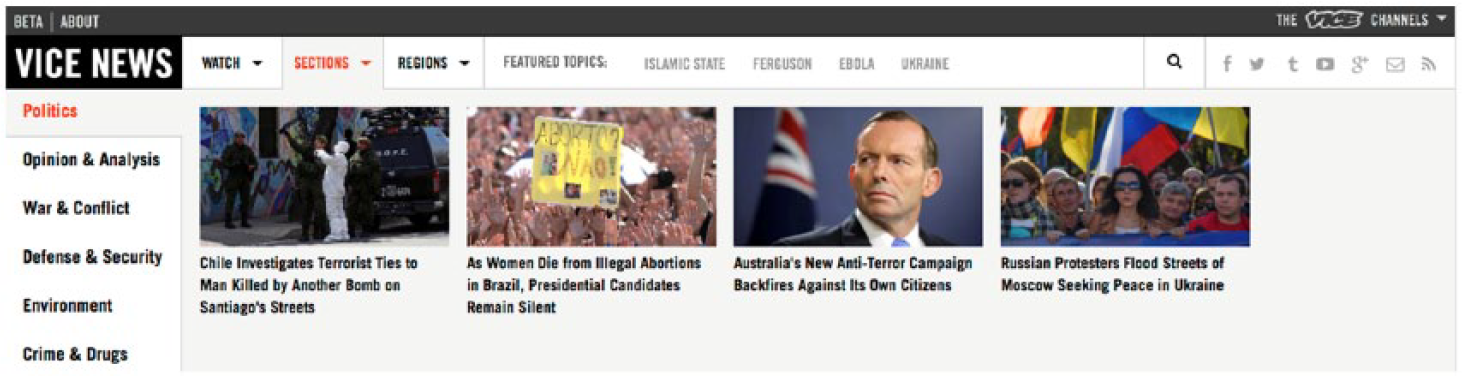
The top of the Vice News site.
The news sections, appearing on the left, signal – in addition to ‘Opinion & Analysis’ – a focus on border-spanning or global issues: ‘War & Conflict’, ‘Defense & Security’, ‘Environment’, and ‘Crime & Drugs’. Within or in relation to these issues, the top line lists a number of ‘featured topics’. On 29 September 2014 these were ISLAMIC STATE, FERGUSON, EBOLA, and UKRAINE. Running the cursor over one of these gives you a roll-down menu with the most recent four stories on that topic. Clicking on, for instance, FERGUSON gives you a list of all the news items (video and written articles) on that topic with the most recent items appearing first. In this instance, the latest story is from 28 September 2014 and the first is from 12 August 2014 (a total of 50 items).
Hybrid journalism: Vice News
Like the other ‘featured topics’ on Vice News, Ferguson is a contemporary issue that is unfolding by the almost daily adding of news items. The following analysis is focused on uncovering how the unfolding of the coverage implicitly and/or explicitly is partaking in an internal and/or external dialogue with how other journalists/publications are covering the same event. Such a positioning is clear right from the beginning in the sense that Vice is not a place to go for breaking news. As the quotes opening this article suggest, such are not very prominent. The coverage of Ferguson is rather an alternation between commentary, updates, and detailed monitoring in long-form video. The first item, which appears on 12 August (3 days after the shooting of Michael Brown), is a commentary by Natasha Lennard entitled ‘The Ferguson Riots Are Not a Shift Away from Peace, They’re a Challenge to Violence’ that argues, ‘There is no peace there [in Ferguson], nor anywhere where deaths like Brown’s are even possible’. This view is also dominant in the other pieces by Lennard (2014), for example, ‘There Was a State of Emergency in Ferguson Long Before Saturday’. This piece is in an open dialogue not only with the ‘Raw coverage on the ground’ but also with clearly expressed political views on society and history that are brought in support of a specific interpretation. This, coupled with an attention to concepts – ‘[i]t seems relevant here that the word “emergency” derives from the Latin, emergere, to arise or bring to light’ – makes the piece read almost as an impassioned student or academic paper.
What is attempted here, as in many of the other commentaries (by Lennard and others), is to contextualize the incidents as symptoms of a deeper structural inequality, a stance that is very much constructed in opposition to large parts of the press in which, as Lennard (2014b) says in the opening piece, ‘[t]abloid ink ran sticky with panic and racist, classist allusions to roaming packs of hooligans’. Since this is the first piece in the coverage, any more detailed renderings of the unfolding of the story appears as links to, among others, CNN, MSNBC, LATimes, St. Louis Public Radio, Salon, and St. Louis Post Dispatch. This can partly be explained by the fact that, as will be discussed in more detail below, Vice situates it coverage both ‘below’ (seemingly unedited live footage in close proximity to the unfolding events) and ‘above’ (commentary at a critical distance) the coverage to which they link. Vice thus wraps its coverage around the existing coverage that documents events at a middle distance, a coverage Vice seemingly does not see itself in direct competition with (which partly also can be explained by different audiences).
The next article – ‘Tension Is Mounting in Ferguson as More People Are Shot’ by Alice Speri (2014b) – is a somewhat more conventional news piece delineating the unfolding of events with references to the official statement of the Ferguson Police, Obama, the Malcolm X Grassroots movement, and local ‘residents [who] compared the militarized police presence in the streets of their neighbourhood to an “occupation”’. This article also has a range of external links to other news institutions; it ends by confirming the overall reading of the opening commentary to which it links. And so does the next article, which is more a collection of photos and live images taken by Alice Speri (2014a), whose prior article is also linked to. Amid the photos is a snapshot of one of her tweets reading, ‘Officer literally just asked me if I want to get shot (for taking a photo of all things …) No thanks for asking, I’ll pass’ (#Ferguson 5:33 AM – 14 August 2014). This points to the importance – in general and for Vice in particular – of Twitter for supplementing the news coverage as well as for building audiences. The way the articles about Ferguson on Vice News establishes a certain rhythm as a vacillation between distance and immersion, or commentary, facts, and ‘raw footage’ from the ground, is thus partly intertwined with underlying Twitter streams ‘around’ the journalists. What is significant when looking at the website is that the facts are added – and/or linked to – on top of the commentary, not the other way around. A significant element is here the ‘raw footage’, which will be discussed in more detail by taking a closer look at Alice Speri and Claire Ward’s ‘Ferguson – Highlights from Vice News Live Coverage’, which is a 34-minute long video edited out of more than 4 hours that ran on the evening of 18 August.
‘Raw footage’
At the height of the unrest, Vice News was live from Ferguson every night for 3–4 hours. Live streaming is a form that is closely linked to activist and/or citizen strategies, which clearly is visible in Vice’s live coverage in which the journalists again and again bump into locals monitoring the events with their mobile phones. This common form is partly, if we follow Papacharissi (2015), a result of the nature of the event: ‘Crises, breaking news situations, and in general, instances when news changes too quickly for mainstream media to develop a coherent and fully sourced narrative bring ambient, always-on news platforms to the fore of news reporting’ (p. 31). But the similarity with citizen approaches is also the result of somewhat shared tactics in the sense that Vice also seems to see this as ‘[c]orrecting for mainstream media representations’ (Jeppesen et al., 2014: 31). This comes out on numerous occasions in the video.
The arch of the 34 minutes edited from much longer live streaming depicts a movement of Speri and Ward from being among local residents facing a line of police to the journalist approaching the police line, them being escorted away from the confrontation toward the ‘command post’ and then leaving this again to try to get closer to the events. Throughout the walk with the policemen back toward the ‘command post’, the journalists are constantly trying to get the officers so that they can say something about how they have experienced the events: ‘We are from Vice News and we want to show your side of the story’ to which the answer is, ‘that’s being coordinated through our media relations’; and ‘[a]ll media go back to the command post, okay’; we actually have like specific individuals that you are supposed to go talk to about with these questions; besides, I am not a very articulate person; I mumble a lot and I stutter so I don’t think I’m the guy you want to talk to (24:30).
Finally, back at the ‘command post’, Speri says to the camera,
This is where most of the media spend all night, which is where we probably would have ended up as well if we didn’t find out ways to sneak through the back alleys. I’m going to take this off [her scarf] since I am hopefully not going to get tear-gassed here. (25:49)
This positioning in relation to the ‘media circus’, which – Speri (2014c) later writes – ‘has mostly moved its tents elsewhere’ is part branding strategy and part attempts to actually produce a different type of coverage. This positioning in opposition to the conventional news media partly happens through invocations of age. Speri’s frustration of not being able to get the policemen to say anything on the walk to the command post results in one of the quotes opening this article: ‘Just tell me anything. What’s on your mind right now? … How are you feeling right now? Come on, look at me!’ ‘I am twenty-nine years old, I’m a journalist – just tell me anything’ (12:56) ‘Where are you from’, one of the policemen asks; Canada, is the answer, which is met with ‘Do you like hockey?’ What is portrayed is a frustration of being young and not able to engage with the established institution of the police through the – perhaps naïve – attempt to bypass the established lines of communication. What is portrayed is arguably a kind of deliberate positioning or staged un-professionalism through which the only thing separating the audience and the journalist is simply the title – ‘Come on, look at me!’ ‘I am twenty-nine years old, I’m a journalist – just tell me anything’.
Being young, on the ground and with light equipment, situates Speri – along with her audiences – among the citizens of Ferguson, and her presence there is somehow authenticated by age and lifestyle. If this particular example is not quite ‘gonzo journalism’, it is a good example of another label applied to Vice News’ journalism, that of ‘immersionism’, which links up quite nicely with CEO Shane Smith’s wish to be the ‘Time Warner of the Streets’ (Widdicombe, 2013: 63, 60).
The positioning discussed above is also evident in the style that Carr (2014) called a ‘guerrilla aesthetic’ and Sutcliffe, head of programming [in the] EU for Vice News (cited in Riordan, 2014: 54), called a ‘DIY aesthetic’. This is precisely the label that was put on punk’s onslaught on the increasing formalization of rock music up through the 1970s (see, for instance, Moran, 2010), and the discussion then was somehow reminiscent of the contemporary discussion about a new amateur aesthetics in journalism and its complicated links to emerging notions of authenticity. Some of the elements in focus here are, among others, ‘the pixilated and blurry quality of the mobile footage’, its (apparently) ‘unedited’ character, as well as the ‘mobility’ of the imagery, which is ‘not only about the camera movements but also about the moving photographer, which physically follows people running, hiding, getting hurt’ (Pantti, 2013: 206, 209).
A significant focus within journalism studies has been some of the implications of present and future professional journalists using ‘citizen journalism as a tool or source’ (Blaagaard, 2013: 1084). While Vice News does that sometimes, the raw footage from Ferguson rather shows how they have appropriated – or co-opted – key elements of such amateur aesthetics in their attempts to situate themselves as a news provider in opposition to more distanced modes of reporting. The style used thus underscores the more explicit attempts cited above in which Speri and Ward very deliberately distance themselves from the media willingly waiting for official police statements at the command post. In combination, this is undoubtedly an attempt to tap into the ‘raw emotionality of amateur footage’ (Pantti, 2013: 207), which is linked to what Wahl-Jorgensen et al. (2010: 182) in relation to an audience study of the perception of amateur images refer to as an ‘imprint of authenticity’. While many established outlets increasingly employ amateur footage and/or aim to mirror such in their coverage, Vice does this to a much greater extent.
A cosmopolitan disposition
This linkage between new amateur imagery and modes of perception has led to a wider discussion of the interrelations between emerging modes of cosmopolitanism and new media, that is, their capacity ‘to bring “home” distant realities and to inspire a sense of care and responsibility beyond our communities of belonging’ (Chouliaraki and Blaagaard, 2013: 150). The nexus between globalization and cosmopolitanism is precisely linked to the ability of global media, like Vice, to cultivate what Lindell (2014: 38) refers to as a ‘cosmopolitan disposition’ and which he describes (ideally) ‘as a worldly openness across moral, political, and cultural dimensions in outlook at practices’ (p. 42). While we cannot know whether the coverage of Ferguson actually fosters such a disposition or sensibility, there are elements in the coverage that could be termed ‘potential cosmopolitan affordances’ (Lindell, 2015: 203).
On one level, this is linked to an effort to inscribe within the political system an attitude that sides Ferguson with places outside formal US jurisdiction and civil rights. ‘The US has’, says Natasha Lennard (2014a) in one of the commentary pieces quoted at the beginning of this article, ‘in recent decades picked enemies unconfined by geography or border; little wonder, then, that the war zone crept home’. This is a partial reversal of what Ong (2014) has argued in relation to the widespread ascription of
witness [not only] being situated in ‘the west’, but in a West that is assumed to be socially and culturally distant from both the conditions and cultural contexts of non-Western others, and estranged from the experience of suffering itself. (p. 189)
In terms of Vice News’ coverage of Ferguson, this is somehow both true and untrue. While a majority of the audiences witnessing the mediated suffering in what is repeatedly referred to as a ‘war zone’ of Ferguson probably are ‘estranged’ from such situations, a substantial part may arguably know such deprived communities from the inside.
While the witnessing undoubtedly moved some people to action, there is another but related construction of cosmopolitanism at stake, and this is aligned with what Beck and Beck-Gernsheim (2009: 26), in a different context, call a ‘global generation’ which is a generation that may be globalized but which ‘simultaneously [is] characterised by sharp dividing lines and conflict’ but for ‘which cosmopolitan experiences and events … have become the key to the space of expectation of the up and coming generation’ (p. 33; emphasis in the original); in terms of cosmopolitanism, this is linked to the notion of a worldly ‘disposition’ cited above and which they see as related to ‘the spreading of norms and expectations’ that are not only conceived in relation to the nation state. The ‘stimuli for that’, they argue, ‘are to be found … at four levels’: the ‘post-colonial discourse of equality’, which has ‘divested … assumptions [of superiority] of any legitimation’; a breakdown of ‘the nation state dualism of human rights and civil rights’; the ‘spread of transnational ways of life’; and, finally, ‘new communications media and transport technologies’ (Beck and Beck-Gernsheim, 2009: 27).
The Vice coverage of Ferguson is ideally a global platform that allows a transnational generation to position itself in relation to questions of equality, human, and civil rights. This is, as will be evident below, partly a product of the staged dialogue that mirrors social media news feeds and partly testified by the many comments to the coverage. A cursory look at these clearly shows that this ‘transnational generation’ is not a unified generation but rather, as Beck and Beck-Gernsheim (2009: 26) argue, ‘characterized by sharp dividing lines and conflicts’; they are, however, largely connected to a mediated and globalized ‘sphere of experience’. It is such a ‘sphere’ that the coverage arguably attempts to mirror and construct through amateur aesthetics and incensed commentary that point in the direction of what has been theorized as ‘global journalism’ (Berglez, 2013: 35) and which is linked to ‘a multifaceted geography in which journalism interrelates processes and practices simultaneously occurring in separate places worldwide’. This comes out on an overall level in the news issue brought together on the website as well as in commentary pieces as evidenced by the quote from Lennard above about the ‘war zone’ creeping home. Accompanying the ‘immersionism’ of the live footage, this is – as was the case with the new journalism that preceded it – a ‘more subjective and involved style’ (Berglez, 2013: 53) in opposition to the ‘voice-of-God tone many correspondents use’ (p. 54) as Riordan (2014) says in a Reuters Institute for the Study of Journalism report ‘How legacy media and digital natives approach standards in the digital age’.
News coverage as collaborative flow
Understanding the two adjacent news items from Vice News’ coverage of Ferguson briefly discussed above in relation to notions of hybridity brings out some important issues. First, the live coverage may be seen as a hybrid between amateur aesthetics and institutionalized journalism, and second, the commentary may be seen as a hybrid between academic analysis and journalistic commentary. What is arguably more important, however, is the specific rhythm and interrelation that these types of coverage constitute as they unfold in relation to each other. Established news sites are, of course, increasingly aware of such mechanisms as an executive from the Financial Times point out in Schlesinger and Doyle (2015: 314): ‘more on this story, more about this topic … So it’s generally not about the core story. It is the stuff around it that makes it come to life’. What makes the unfolding of the Ferguson coverage specific in this regard is the highly explicit level of interlinking and/or dialogue between the different types of news coverage, which is partly linked by a ‘sensibility that is adolescent’ (Widdicombe, 2013: 62). In the items discussed above, this is noticeable in the very confident and bold ‘academic’ paper, in Speri’s outburst ‘I am twenty-nine years old … just tell me anything’ and, finally, in the simple fact that live streaming is something that requires a fair amount of free time to follow.
This makes the assembled coverage come across as a more collaborative effort or, in the words of Papacharissi (2015: 28), as a ‘space’ of ‘storytelling’ that is ‘assembled and attained relationally’. Although Papacharissi (2015) is focusing on aspects related to how audiences become part of such new spaces, there are aspects of her argumentation that are relevant in relation to the unfolding of news items in Vice News since this somehow mirrors ‘“prodused” feeds of storytelling [that] emerge out of user-led collaborative content creation’ (p. 29), and it does so partly by the alteration outlined above but also by infusing its coverage – both the commentary and the on-the-ground filming – with amateur-inspired modes of address and aesthetics, which attempts (in the words of Sutcliffe, head of programming EU for Vice News) to create ‘an emotional connection between the reporter and the people who are consuming it’ (cited in Riordan, 2014: 53). This is linked to what Papacharissi (2015: 28) in a different context calls a ‘historically specific variety of affective news streams’. An element of this, which this article has not developed, is how Speri, Ward, and Lennard used Twitter to generate ‘news streams that blend cursory references to news with deeply personal and mostly affective reactions to how this news is covered’ (Papacharissi, 2015: 31) – which the tweet from Speri cited above is a good example of. A fuller understanding of Vice News’ coverage as an ‘affective news stream’ would require a more thorough analysis of the Twitter streams intertwined with the online coverage. For now, it must suffice to underline that the hybridity of Vice News is partly grounded in the unfolding of news in a manner that mirrors social media news feeds, that is, a stream vacillating between visual documentation and related commentary, within a composite website that contains a whole range of other content and modes of engagement. An important part of this is the very explicit interlinking between the various news items, as pointed out above, but also the high level of external links which point at what might be called a horizontal mode of reading that may be closer to how one reads social media news feeds than to how one reads a journalistic publication.
Conclusion
The above discussion has drawn out some of the ways in which Vice may be understood in relation to the notion of hybridity with regard to its position and strategies within the contemporary (global) media system, its main Internet portal, its news site, and – not least – its actual journalism in relation to a specific issue. And, the aim has partly been to show how these levels, the systemic, the syntactical, and the morphological (Brügger, 2010), are interlinked. While this is not a novel insight, it does help to highlight how the digital landscape allows for the construction of hybridities in which boundaries and levels are in motion in complex ways. A significant part of this, with regard to Vice Media Inc., are the skillful ways in which commentary and links are continuously used to signal the brand’s ‘set of relationships with other publications [institutions] in order that it can be situated within the broader market place’ (Mussell, 2012: 29). While any outlet obviously has to position itself somehow, the mixture of the original Vice magazine, that is, drug-related youth cultures, fashion, and features, was built around a sensibility rather than a media form, which makes Vice media Inc. especially agile. In relation to this, Bob Giles (cited in Riordan, 2014: 54) from the BBC says,
In a terrible way, we are prisoners of our form … By the time we have finally got the permission to get the money and get the commission, [Vice News] have gone out and done it anyway and put it out in a completely new form in a completely new landscape … In many ways the digital fragmentation is what is scaring legacy media.
Vice Media Inc. is not threatened by ‘digital fragmentation’; rather, this has allowed for the engagement of its sensibility in a myriad of diverse forms (as evidenced by the presentation of the website above). Vice has precisely ‘continually adapted and readapted [its structures] according to the goals being pursued’, which, as Chadwick (2013: 18) argues, is a significant trait within the emerging media system. In one sense, then, hybridity has been and is a built-in trait of the Vice brand. This means, as I have attempted to outline in this article, that we need to see hybridity on the level of the discrete text or genre as only one aspect of the intertwining levels on which Vice combines various residual, contemporary, and emerging impulses. Fully understanding this requires a complex reading that combines theoretical insights from media systems analysis, website analysis, and journalism studies as well as a more critical engagement with the identified practices. This article is a first attempt at such an analysis.
Footnotes
Acknowledgements
The author wishes to thank Professor Will Straw (McGill University, Montreal) as well as the two anonymous referees for insightful and very valuable comments.
Declaration of Conflicting Interests
The author declared no potential conflicts of interest with respect to the research, authorship, and/or publication of this article.
Funding
The author received no financial support for the research, authorship, and/or publication of this article.