



Abstract
This study disentangles national and transnational influences on international journalism by distinguishing convergent issue framing from nationally specific narrative in news texts. In a comparative quantitative content analysis of the newspaper coverage in five democratic countries (Brazil, Germany, India, South Africa, and United States) during four United Nations climate change conferences from 2010 to 2013, both textual-visual framing and narrative features were studied simultaneously for the first time. The narrative dimension consisted of variables that gauge (1) the degree of narrativity in an article, (2) the type of narrative (i.e. stories of catastrophe, conflict, success etc.), and (3) narrative roles of victims, villains, and heroes. Hierarchical cluster analysis was used to identify both the prevailing issue frame in an article and its dominant narrative. Results show that issue frames converge more strongly across countries while narratives are more closely related to the cultural context and political particularities of each country. Investigating issue frames and narratives concurrently helps to reveal country-specific patterns of narrative coloring even for the same issue frame.
The development of journalism is closely connected to the political and cultural reality in which it is rooted. To describe the concrete shapes that journalistic systems acquire, the term ‘journalism cultures’ is frequently used (Hanitzsch, 2007). It includes the journalistic practices, professional standards, and ethical aspects that have traveled along different historical trajectories in different countries over time (Esser and Umbricht, 2014; Zelizer, 2010).
However, on the level of journalists’ professional culture, Mancini (2008) also notices a (global) trend of homogenization. Reese (2008) recognizes a convergence of professional identification within journalism that is expressed in shared norms and values, in order to ‘adapt to the needs of a more globalized system’ (p. 241). Research on journalism culture, therefore, needs to carefully disentangle transnationalizing and (re)nationalizing tendencies as they play out in journalistic practice and products in order to better understand ongoing developments of global diffusion and interdependences in journalism (see Hanitzsch, 2007).
The research presented in this article aims at contributing to this effort by detecting and explaining similarities and differences in the media coverage of climate change, one of the pressing issues of our times, across culturally diverse countries. The easiest way to distinguish convergent features of news coverage from cultural particularities is to study media coverage of the same globally accessible event in vastly divergent contexts (e.g. Krøvel, 2011; Kunelius and Eide, 2012). We do this by comparing newspaper coverage in democratic countries on each of the five major continents (Brazil, Germany, India, South Africa, and the United States) about the United Nations (UN) Climate Change Conference (Conferences of the Parties – COPs) held annually under the auspices of the United Nations Framework Convention on Climate Change (UNFCCC). Our approach to the issue of cross-national convergence versus national particularities contrasts the issue frames conveyed in this coverage with the narratives in which this coverage is embedded. We argue that issue frames may be more similar across countries than narratives. While the former are likely to be shaped by the global governance setting of the COPs and the onsite co-production of messages by journalists and spokespeople (Lück et al., 2015), we expect narrative features of news items to tap into larger, culturally resonant meta-narratives prevalent in the respective national context of a newspaper.
In doing so, we follow Shen et al. (2014) who argue, ‘While news frames are the central organizing ideas that serve to provide meanings on issues and events, narratives in the news can be viewed as the rhetorical structures or stylistic devices that allow newsmakers to effectively communicate the frames’ (p. 100). Tenenboim-Weinblatt et al. (2015: 3) view narratives as the higher discursive concept which combines and connects frames. Krøvel (2011: 92) shows what it is in particular that narratives add to framing: ‘Journalists tend to embed their stories within culturally bound narratives, recognizable to the audience, so that new information is formulated as new episodes in a longer and familiar story’. This implies that narratives within the journalistic texts are more closely connected to their respective cultural backgrounds than frames, especially in the coverage of such global political media events like the COPs. Our article aims at providing an empirical analysis to test these considerations after spelling out the theoretical argument further and elucidating characteristics of narratives and frames and clarifying the relation of these two communicative modes. Our investigations will also provide more detailed explorative and interpretative insights about the use of narrative elements and frames within the news coverage of climate change.
Characterizing journalistic narratives
We propose to characterize journalistic news narratives according to three dimensions: the degree of narrativity, the type of story being told, and the constellation of narrative roles such as victims, villains, and heroes.
The degree of narrativity can be gauged by registering four narrative characteristics that a news text may contain. These refer to the particular form that is decisive for narratives, for example, a sequential arrangement (Hinyard and Kreuter, 2007), or a plot that consists of a series of events and actions around a moment of conflict (McComas and Shanahan, 1999). Zerba (2008) distinguishes narratives in the journalistic context from factual news by highlighting the former’s sequence-of-events plot and contrasting it to the traditional inverted pyramid style of the classical news story that presents the most important facts first, adding less important details and background information afterwards. Glaser et al. (2009) also emphasize that narratives are characterized by the convention of a story grammar that connects events in a dramatic account (dramatization). Beyond that, they highlight the presentation of events in an emotional way (emotionalization), a plot that focuses on agents (mostly humans) causing events (personalization), and the inclusion of fictional or hypothetical episodes (fictionalization) as important formal characteristics of narratives. We acknowledge these four characteristics as important attributes for distinguishing narrative news from other forms but, following Wolf (2002), we also suggest the narrative concept to be understood as gradual, especially against the background of the diversity of possible formats within newspapers (editorial, op-ed, feature, interview, etc.). In practice, this means for us that the four narrative elements can be more or less distinctive within an article, which, therefore, can have a smaller or greater degree of narrativity depending on the actual appearance of these elements. Articles can, for example, feature sequential paragraphs presenting the action and motives of an actor, but otherwise follow the inverted pyramid style. Emotions may be displayed or not in an article that otherwise focuses around an actor causing events. The more such formal elements are manifested in a news story, the higher is its degree of narrativity as they would add up to one another.
Moving to the content level, we can characterize news narratives by their story type, that is, the kind of story that is actually told. Following Roeh (1989), storytelling is actually the essence of journalism even if many journalists would probably spontaneously reject this notion because of an underlying assumption that storytelling contradicts the common norm of ‘objectivity’ (p. 608). Schudson (2012) pursues a quite similar approach by stating, ‘A news story is both news and a story’ (p. 171). What kind of story is told in particular can be revealed with the help of narrative genre theory (Schwarze, 2006). The overall theme, the general tone, and the outcome envisioned for the story combine in determining the ideal-typical story types, for example, comedy or tragedy or other, more hybrid forms.
We also want to stress that personalization is particularly decisive for narratives (Barthes and Duisit, 1975). Franzosi (2010) highlights the connection between events, actions, and characters, for there has to be some kind of action for an event to take place and ‘without characters there can be no action’ (p. 21). Most commonly, such agents within narratives are displayed in specific narrative roles, typically in a constellation of victim, villain, and hero (Schwarze, 2006; Smith, 1997), that can ‘provide culturally familiar templates and can generate dramatic effect’ (Higgins and Brush, 2006: 700). For the purpose of determining the narratives that are told in the news coverage, it is, therefore, necessary to identify those actors that are decisive for the story to unfold.
Delimiting framing in relation to narration
Since both narration and framing are central communicative modes in news discourse, we need to distinguish them from each other conceptually for analytical purposes (Wozniak et al., 2014). Framing analysis emphasizes selectivity of information and implies more or less conscious communication strategies by ‘frame sponsors’ (Gamson and Modigliani, 1989). Framing entails an interpretative moment because it organizes and structures discrete elements in order to make sense of relevant events and to suggest what the issue at hand actually means (Gamson and Modigliani, 1989: 3). That makes frames ‘patterns of interpretations’ (Brüggemann, 2014: 63). More specifically, Entman (1993) defines four layers or elements of a frame: ‘a particular problem definition, causal interpretation, moral evaluation, and/or treatment recommendation for the item described’ (p. 52), which also facilitates the operationalization and intersubjective coding of the concept in media content analyses (Matthes and Kohring, 2008).
Our understanding of framing also includes visual elements that accompany a text in the media coverage (Wozniak et al., 2014, 2016). Here again, certain objects are chosen for depiction while others are left out, which contributes to the overall framing found in an article.
Focusing on selectivity does not yet clarify how all these pieces of information given through the framing of an article are (formally) connected to each other. Information can be ordered in different ways. It can be presented in the style of an inverted pyramid or in sequential order as in a classic narrative. 1 It may or may not contain other narrative elements such as the presentation of emotions or narrative personalization which would make an article more or less narrative in its form. For Tenenboim-Weinblatt et al. (2015), this is what makes frames ‘less accommodating than narratives’ (p. 2). While frames provide the information for a basic interpretative framework, narratives add complexity and reveal the temporal order of events (Tenenboim-Weinblatt et al., 2015). This argument is supported by the considerations made by Shen et al. (2014) regarding the relationship between narratives and framing. By and large, the authors emphasize the unique criterion for narratives to be complete stories consisting of characters, a plot, and causal relationships. While the concept of framing concentrates more on the argumentative elements, narrations provide for the cultural resonance and meaning perception.
At the content level, frame elements are used as pieces to tell a certain story, such as a comedy or a drama. The story that is told in this way also influences the frame elements that are chosen to be communicated. A story told as a tragedy certainly emphasizes other elements of an event than a satire. However, (more or less the) same pieces of information (frame elements) could also be used for different narrations, for example, when the story of climate change (with frame elements that emphasize rising temperature, human responsibility, and several consequences) is told as an apocalyptic scenario with no hope or as a struggle that can collectively be fought and won. The construction of framing and narration within a news text is nevertheless not one-sidedly determining. Instead, one should consider the relationship between framing and narration as dynamic and non-deterministic. Neither in production nor in reception is there a preset chronology that would define the frame first and then choose the form and storyline in which the frame elements are presented. Instead, a particular narrative can inflect the framing since the narrative needs particular informational elements rather than others to function as a story.
Diverse levels of influence on framing and narratives
In this article, we aim at identifying and explaining characteristic combinations of frames and narratives in the coverage of the global climate change conferences. It is unclear, however, to what degree such combinations are uniform across the very different countries we study here. Global trends as well as culturally specific influences shape the coverage in a country.
Trends of homogenization in journalism are mainly pushed by technological developments and common trends of professionalization. Reese (2008) identifies a global news arena in which journalists need to navigate and to which they adapt: ‘In these settings, operating with the same equipment, access, and need for instantaneous transmission, technology has unified news routines even across organizations operating out of widely different national contexts’ (p. 245). Hanitzsch (2008: 205) points to some similarities in the journalistic orientation and practices that become manifest in a universal transnational layer of journalism culture characterized by diffusion and interdependences. The Anglo-American journalism ideal of objectivity has continuously gained influence in journalism all over the world (Hanitzsch, 2007; Kaplan, 2012) and is closely connected to the rise of the inverted pyramid style of newswriting (Ytreberg, 2001). Beyond such tends, Curran et al. (2015) convincingly demonstrate that foreign news can converge across different countries due to the dominance of a small number of news agencies, the hegemony of market liberal convictions, and a shared belief system in historically associated countries.
On the other hand, journalism cultures are also characterized by the sum total of the adjustments that journalists and media producers make (and have made historically) to the social and political systems they operate in. Both trends, global convergence and national particularities, can be analyzed together in a transcultural approach to comparing journalism practice and output in order to avoid imagining cultural and social processes as self-contained processes within national ‘containers’ (Hepp, 2008).
In order to sort out global as well as culturally specific developments, we analyze narratives and frames concurrently. The COPs are important occasions with a global news value at which journalists from around the world share the same reference point and mainly work in the same settings (i.e. having access to the same official information and people, to press conferences, and events onsite the conference). Within this setting, journalists are confronted with actors and interest groups that all try to communicate their particular interpretations and gain public attention. It seems very likely that media framing converges to a certain extent in this setting and that there are common framing patterns that can be observed across countries. At the same time, we assume that cultural adaptation of such transnational framing is facilitated through the use of particular types of stories in order to connect with the respective audience in a way that fits into their cultural perception. We, therefore, hypothesize:
H1. The narrative story types used in COP coverage will be more distinct between countries than the issue frames applied.
H2. A particular issue frame will be combined with different story types in different countries, reflecting country-specific patterns of narrative coloring even for the same issue frame.
Research design
We applied a comparative research design and conducted a quantitative content analysis of the media coverage in five countries about the UN climate change conferences. The countries in our sample – Brazil, Germany, India, South Africa, and the United States – were chosen because they represent important democratic countries and influential economic players (Germany and United States as major Western economies, Brazil, India, and South Africa as important emerging countries, which also engage in the BRICS (Brazil, Russia, India, China, and South Africa)-alliance) in each of the major continents. They do not only act on the international political stage but also ensure basic rights at the domestic level that are necessary for a free media discourse. All five countries actively engage in the climate change conferences representing different interests and positions. Beyond that, these five countries exhibit diverse historical backgrounds, stages of economic development, and cultural traditions. We, therefore, expect culturally sensitive news narrative to vary substantially across our country sample.
For our media sample, we selected nationally distributed and widely read daily newspapers 2 from Brazil (Folha de São Paulo, O Globo), Germany (Süddeutsche Zeitung, Frankfurter Allgemeine Zeitung), India (Times of India, The Hindu), South Africa (Daily Sun, The Star), and the United States (The New York Times, The Washington Post). Our sampling periods comprised 22 November to 19 December 2010 for the climate change conference in Cancún, Mexico (COP 16), 28 November to 14 December 2011 for Durban, South Africa (COP 17), 19 November to 4 December 2012 for Doha, Qatar (COP 18), and 4 November to 30 November 2013 for Warsaw, Poland (COP 19).
An extensive coding instrument was developed that covers textual and visual framing elements as well as narrative characteristics. 3 A more detailed theoretical derivation and description of all operationalizations as well as a complete presentation of pretest results for all variables and all countries separately was published in Wozniak et al. (2014). 4
Our complete media sample contained 1311 articles. The main unit of analysis is the single article, which was coded for formal categories and for narrative characteristics. 5 Visual elements were coded separately because an article could carry more than one visual or none at all. Below the level of the article, we coded all actor-statements (including statements of the article’s authors, mostly journalists) for the presence or absence of a predefined set of text-based climate-change-related frame elements (n = 5561). Frame elements were coded according to Entman (1993) 6 on the dimensions of problem definition (here, consequences of climate change, such as increases in temperature, melting ice/glaciers), identification of causes (e.g. greenhouse gas emissions, deforestation), and treatment recommendations (remedies, such as clean energy, financial assistance to disadvantaged countries). 7
Elements within the visual material were coded on a denotative level. We recorded depictions of different types of actors relevant to the climate debate; if possible, we also coded their origin and the activity that was displayed. Further variables recorded displays of environments, flora and fauna, technological objects or infrastructure, as well as public relations (PR) stunt installations by environmental non-governmental organizations (NGOs).
Narrative elements were coded on the three dimensions mentioned earlier: degree of narrativity, story type, and narrative roles. To account for the idea of narrativity as a gradual concept, the degree of narrativity was operationalized as an additive index which consists of four variables that were coded for their presence or absence at article level: dramatization, referring to a structure that is more sequential rather than inverted pyramid style, emotion, where emotions were explicitly expressed in the text, narrative personalization, referring to actors that cause actions or are affected by the actions of others, and fictionalization, referring to anecdotal or speculative details added to the text. The story type dimension consisted of three variables: overall theme (failure after struggle, social/political conflict, triumph over adversity, struggle over destiny, or everyday business), tone (optimistic, pessimistic, fatalistic, unexcited/neutral, or passionate), and outcome (conflict fixed, conflict not fixed, or no conceivable outcome). For the narrative roles, it was possible to code one hero, one victim, and one villain per article and define the type of actor (individual, organizational, or institutional), the name as stated in the text, as well as the type of action attributed to the actor. 8
Results
Degree of narrativity
The degree of narrativity was calculated as an additive index from the four binary variables capturing narrative text features (dramatization, narrative personalization, emotion, and fictionalization). The index ranges from 0 = no narrativity to 4 = strong narrativity. A mean comparison between countries shows noteworthy differences (F(4,1271) = 12.38 9 ) with Brazil having the highest degree of narrativity (M = 1.72; standard deviation (SD) = 1.17) followed by Germany (M = 1.34; SD = 1.08), the United States (M = 1.31; SD = 0.99), South Africa (M = 1.22; SD = 0.94), and India (M = 1.15; SD = 0.97). This seems plausible with respect to journalistic cultures. Brazilian journalism has long been influenced by the French writing style, which traditionally features essayistic and literary elements (Esser and Umbricht, 2014; Herscovitz, 2004). Even under the increasing influence of US journalism ideals during the 20th century, Brazilian journalism developed its very own style and culture that connects the different traditions of essayistic storytelling and detached observation with a peculiar relationship to political power and interventionism (De Albuquerque and Da Silva, 2009). German journalism culture also shares a rather continental European tradition (Hartsock, 2011; Stöber, 2014) that differs to certain degrees from the Anglo-American ideals of unbiased/objective and fact-based journalism 10 that probably were also influential in the Indian and South African contexts due to their British colonial history.
Story types
In order to further characterize the stories that are actually told in the COP coverage, we conducted a hierarchical cluster analysis as proposed by Matthes and Kohring (2008) using the narrative variables ‘overall theme’, ‘tone’, and ‘outcome’. All three variables were recoded, transforming their original nominal values into dummy variables with a binary code (‘0 = not present’ and ‘1 = present’). All resulting variables were present in more than 5 percent of the articles and could, therefore, be included in the cluster analysis that was conducted using the Ward method and binary Euclidic distance. Five distinct story-type clusters were identified through the use of the elbow criterion. 11 The clusters are cross-tabulated with all variables included in the cluster analysis to be able to describe the narrative content of each group (Table 1). The high Lambda values on several variables show that the clusters do differ substantially on the type of narrative genres they instantiate. Names for the clusters were found in group discussions of the research team. This interpretative process required deep knowledge of the media material as well as context knowledge that researchers have gained throughout the years of the project. 12
Distribution of narrative elements across clusters (all articles; column percentages within each variable).

Dark gray : elements decisive for cluster interpretation with a frequency of at least 35 percent of the articles in the cluster; light gray: element subordinate for cluster interpretation with a frequency of at least 20 percent of articles in the cluster.
The most frequent narrative (32.4% of all articles) is the one we call ‘Ongoing Conflict’, followed by the ‘Catastrophe’ narrative (20.9%), the ‘Hopeful Struggle’ narrative (17.8%), the ‘Business as Usual’ narrative (14%), and the ‘Stories of Success’ narrative (13%). 13
Political or social conflicts dominate the theme variable in the ‘Ongoing Conflict’ narrative. This narrative tells the story of ongoing efforts to come to political decisions at the COPs where different interests clash. The tone used to tell this story is mostly unexcited/neutral but also sometimes passionate which reflects the considerate and exerted efforts as well as the emotional appeals that come from certain actors at the conferences who try to draw attention to their dramatic situation and the urgency to act. However, in these stories, the conflict presented is not fixed in the end which represents the ongoing efforts of the climate change negotiations where only few actual results were achieved before COP 21 in Paris in December 2015.
The ‘Catastrophe’ narrative is the most dramatic and less hopeful story about climate change and climate policy. The theme variables ‘failure after struggle’ and ‘struggle over destiny’ highlight both the drama and the profound sense of loss transpiring from these stories. The tone is pessimistic in almost 100 percent of the articles in this cluster as there seems to be no viable solution to effectively mitigate climate change. Fittingly, the conflicts depicted are not solved in the end despite the urgency.
The ‘Hopeful Struggle’ narrative marks a contrast to the catastrophic narrative. ‘Struggle over destiny’ is the dominant theme, again highlighting the urgency of the situation. However, the tone is unexcited/neutral, which points to a rather confident handling of the challenges, as well as optimistic or even passionate, which both represent the hope to be able to mitigate climate change with the right actions. In this narrative, the conflict is fixed in the end, which can either mean that negotiation partners have come to some compromise that allows for action or that measures taken are even seen as effective to reach climate policy goals.
Articles in the cluster of the ‘Business as Usual’ narrative tell the story of climate change and climate policy as a routine business and recurrent event. The excitement level is low since there is not much new – politicians are negotiating, civil society is protesting, and science announces the newest results that underline what is usually already known. The unexcited/neutral tone corresponds to this theme in most of the cases. There is no conceivable outcome since these stories are pieces in the puzzle of a long-term story of sustained efforts.
The last narrative cluster offers the most distinct storyline: ‘Success Stories’ that talk about a smaller or larger triumph in the struggle against climate change. These stories are a hundred percent optimistic and the conflict is portrayed as being resolved in the end. These are stories about results and compromises in the negotiations but also individual success stories about people with outstanding ideas and projects that fight climate change effectively.
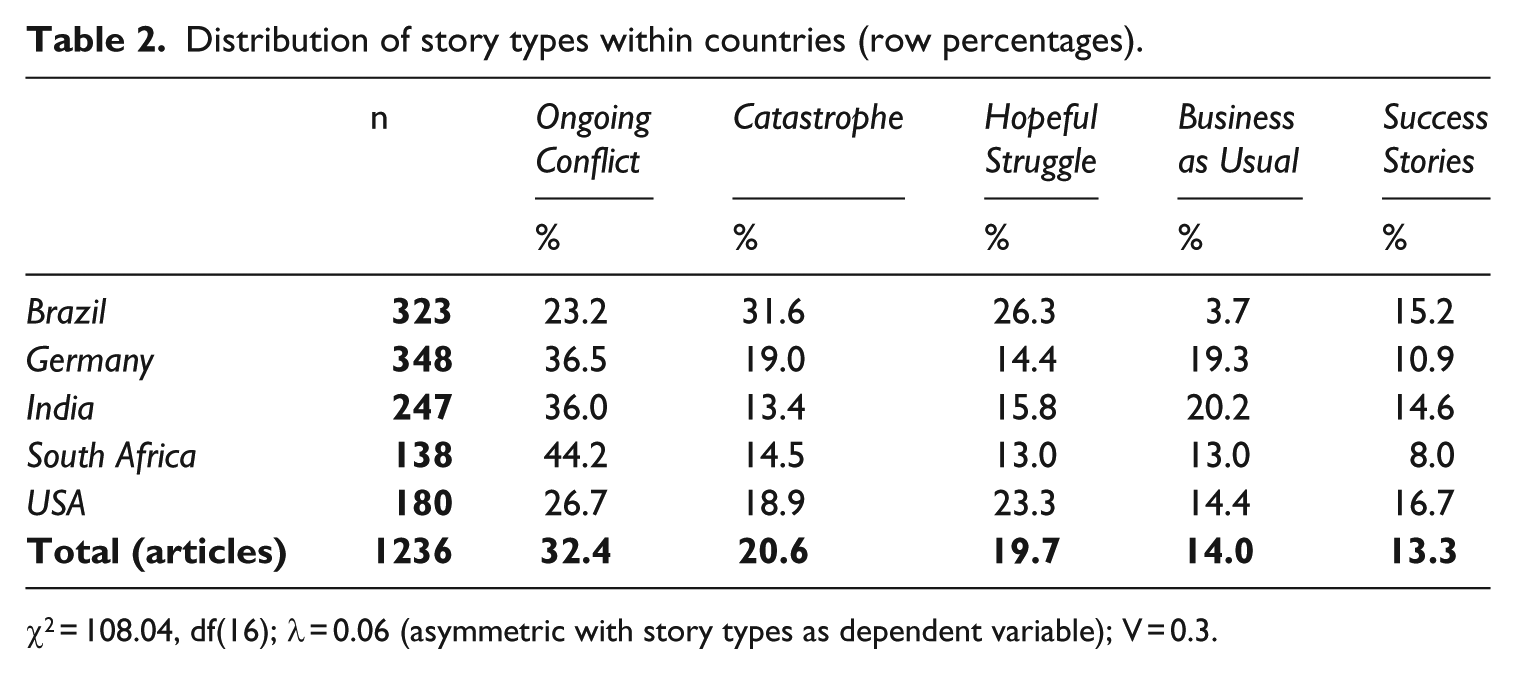
These five story types represent different interpretative patterns of climate change in the newspaper coverage across five countries. They reveal basic meaning construction and vividly characterize how climate change and climate policy processes are viewed and understood in the mediated debate. In the next step, we look at the prevalence of these story types in the five countries studied in order to reveal country-specific particularities as well as similarities (Table 2).
Distribution of story types within countries (row percentages).
χ2 = 108.04, df(16); λ = 0.06 (asymmetric with story types as dependent variable); V = 0.3.
The ‘Ongoing Conflict’ narrative is dominant in all countries but Brazil where, in turn, the ‘Catastrophe’ narrative is the one most often told, followed by ‘Hopeful Struggle’, which points to a certain inconclusiveness about the issue. In Brazil, climate change seems to be everything but business as usual. By contrast, climate change and climate policy are clearly stories of conflict in the other countries. A closer look reveals subtle differences that should not be ignored and can tell us a lot about the countries’ mainstream media’s views on the issue. In South Africa, the ‘Ongoing Conflict’ narrative is most often used (44.2% of all narratives) while the second most frequent narrative is used less than half as often (20.2% for ‘Hopeful Struggle’). In India, the ‘Catastrophe’ narrative is not salient at all; with a share of only 13.4 percent, it is the narrative least often used. ‘Success Stories’ are most often told in the US newspapers’ coverage and least often in South Africa. The values for Lambda and Cramer’s V also suggest that there is a relation between the country and the distribution of story types.
Narrative roles
To further characterize the stories told in the five countries studied, we analyze the narrative roles, that is, to which individuals or collectives the roles of victim, villain, or hero are assigned in climate change coverage. To reduce complexity and maximize contrast, we concentrate on the two story types in which the distribution of narrative roles is most distinctive: the Success Story and the Catastrophe.
Looking at the victim–villain–hero constellations, we mainly find two patterns in these two story types. In the cases of Germany and the United States, victims of climate change (and climate change politics) are ‘other’, more or less specifically defined groups such as the developing countries, poor countries, small island states and so forth. The ones responsible for the misery, the villains in the stories on climate change and climate change politics, are also ‘others’ – responsibility is generally assigned to someone else but the own country. Oftentimes, villains are unspecified such as ‘humankind’ or ‘past generations’, but sometimes villains are named specifically. German coverage assigns responsibility also to other industrialized countries such as the United States, Canada, and Japan, but also to a few emerging countries such as China or Bolivia which have all displayed strong opposition at one point in the negotiations during the years before COP 21 in Paris. In the US coverage, emerging countries such as India and China are displayed frequently as villains, which reflects a long lasting conflict in which the United States refused to commit to any binding agreements as long as this would exclude emerging countries from mitigation responsibility (Boykoff and Boykoff, 2007). The ones solving the problems, the heroes of these stories, however, are the countries of the West or individuals in these countries.
On the other side, South African, Indian, and Brazilian newspaper coverage sees their respective home countries clearly both as victims (partly subsumed under more comprehensive collectivities such as all developing nations) and as heroes that oppose the prevalent circumstances. Picturing the villains is also unambiguous: rich and developing countries are deemed responsible for the problems at hand.
Investigating these role constellations in the coverage of the different countries clearly reveals that there is a country-specific structure of victim–villain–hero constellation and that this is used in the national coverage to particularly define the own role on the political stage.
Identifying multimodal issue frames
In order to characterize the framing, 14 we performed another hierarchical cluster analysis on the frame element data, as proposed by Matthes and Kohring (2008). Since textual frame elements were coded on the statement level and visual frame elements at the visual level, all frame elements had to be aggregated to the same article level by using dummy variables (0 = frame element absent, 1 = frame element present) before running the cluster analysis. We used a lower threshold of 2 percent for visual elements to be present in the sample since only 37 percent of all articles contained images at all and so visual variables had a lower probability of showing up in the entire dataset. The frequency analysis then resulted in 34 variables including 22 text-basedco and 12 visual frame elements to be used for the hierarchical cluster analysis (again using the Ward method and binary Euclidic distance). Four clusters emerged using the ‘elbow criterion’, which each represent an issue frame. To better understand the structural composition of these frames, we cross-tabulate the cluster affiliations of all articles with the individual frame elements. 15 The four frames were named ‘Global Warming Victims’ frame, ‘Political Dispute’ frame, ‘Sustainable Energy’ frame, and ‘Common Sense’ frame.
The ‘Global Warming Victims’ frame emphasizes the consequences of global warming. Almost 73 percent of these articles mention the increase of temperature, and 50 percent point to extreme weather conditions and societal consequences. These are connected with fossil fuels as the cause most often emphasized. The cluster does not deal with remedies much, but connects consequences at the textual level with landscape objects or ordinary citizens at the visual level, which makes it apparent for what and whom these consequences are most relevant.
While the ‘Political Dispute’ frame mentions consequences and causes of climate change, this frame is remarkable for examining a range of different remedies discussed in the negotiation process of the COPs. It is not surprising that there are fewer visual elements here, and if there are, politicians are shown at least more often than others.
The ‘Sustainable Energy’ frame focuses less on consequences but names fossil fuels in 50 percent of its articles as the cause of climate change. The emphasis in this frame lies more on the remedies, especially on clean energy. The textual elements in this frame are supported by a few common visual elements that, for example, show urban or natural landscape, but most remarkably PR stunts and NGO activists.
The ‘Common Sense’ frame is less distinctive. The elements that appear most often here are standard items such as increase of temperature as a consequence, fossil fuels as the cause and clean energy as the remedy. These elements are probably the least contentious ones in the mainstream climate change discourse and present widespread basic and common sense knowledge. 16 Articles in this frame are shorter (less than 400 words on average compared to about 480 to 580 words in the other clusters). Only about 27 percent of these articles contain visual elements. One should think of the articles in this cluster as short notifications rather than as substantial reports. They are still important elements in newspaper coverage as they present pieces of information that are needed to keep track of the issue.
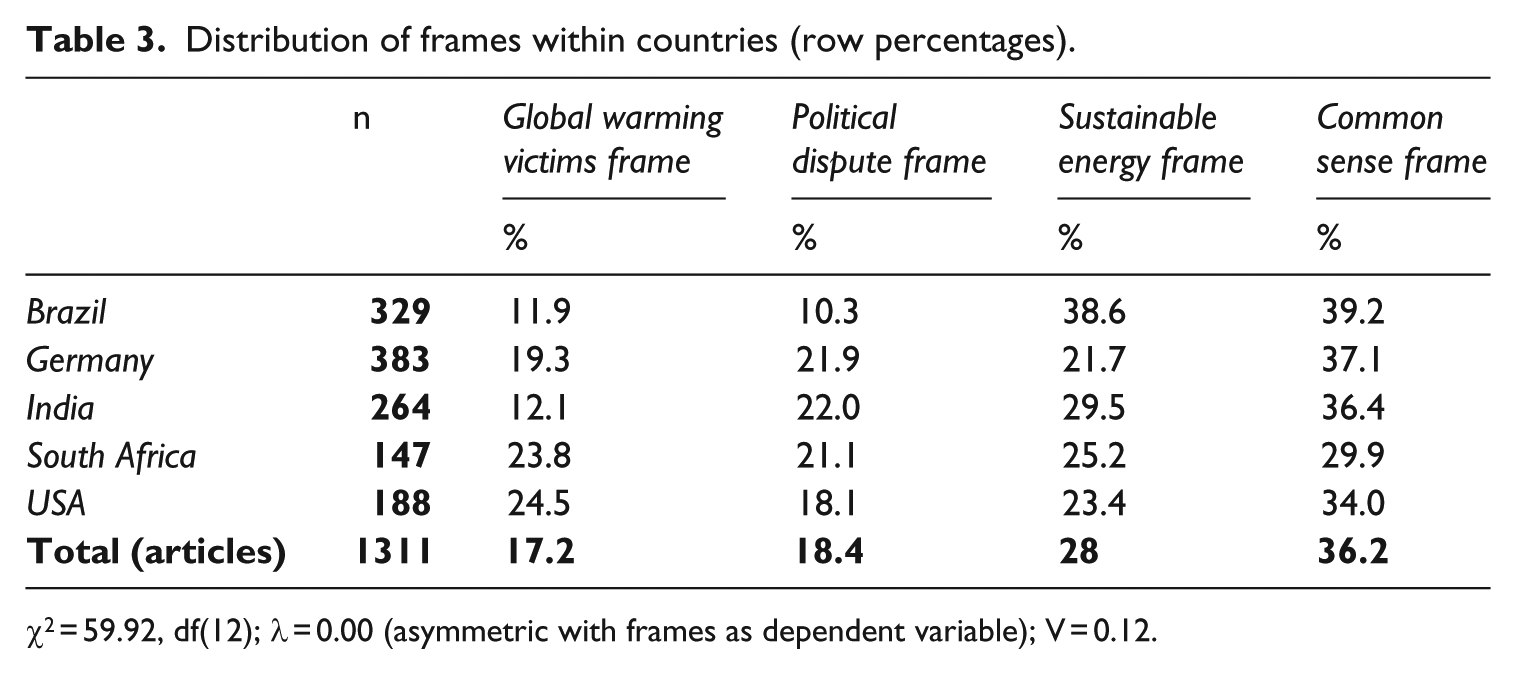
In line with our expectations, we do not find striking differences in frame occurrence between the five countries (Table 3). This is also suggested by the very low values of Lambda and Cramer’s V. The only remarkable exception is Brazil where the ‘Sustainable Energy’ frame is very strong while the ‘Political Dispute’ frame as well as the ‘Global Warming Victims’ frame are weak compared to the other countries. But overall, Hypothesis 1, according to which country differences in framing should be smaller than differences in story types used, is well supported.
Distribution of frames within countries (row percentages).
χ2 = 59.92, df(12); λ = 0.00 (asymmetric with frames as dependent variable); V = 0.12.
Combining story types and frames
We have seen in Tables 2 and 3 that countries differ in their use of story types whereas the usage of frames is more uniform across countries. In our last analytical step, we cross frames and narratives in order to find out whether frames are combined with different narratives in the countries under study. When comparing countries according to their use of story types within each issue frame, as shown in Figure 1, different patterns emerge.
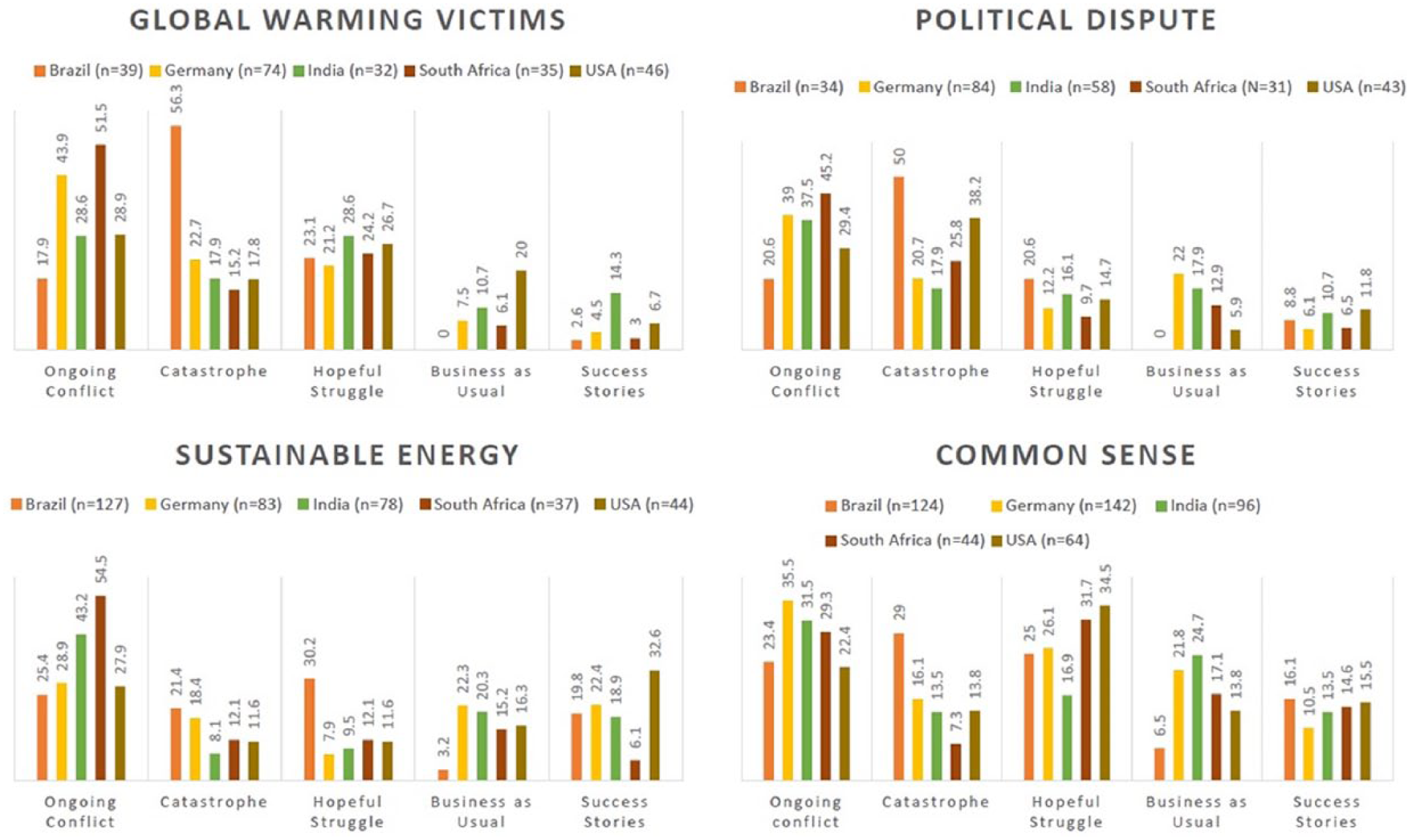
Combinations of frames and story types (country comparison).
Global warming victims frame
The ‘Ongoing Conflict’ narrative is most often used with the ‘Global Warming Victims’ frame (35.1% of the articles containing this frame). However, not all countries use this narrative within the victims frame to the same extent. In South Africa as well as Germany, the ‘Ongoing Conflict’ narrative is especially strong compared to the other countries. This combination emphasizes the political side of the problems that victims face and reflects a general understanding of the connection between political conflict (e.g. with its lack of ambitious action in the negotiation process) and the effects on people and countries.
The use of the ‘Catastrophe’ narrative is also marked by a distinct country difference: this narrative is used as a major narrative for dealing with global warming victims only in Brazil; the other countries do not prioritize this narrative in such a remarkable way. A total of 56.3 percent of the Brazilian articles within the victims frame belong to the ‘Catastrophe’ narrative with its fatalistic connotations. One might find a hint for an explanation in the Global Climate Risk Index (Kreft et al., 2016) which calculates the vulnerability of countries due to climate change. In the 20-year period from 1995 to 2014, Brazil takes place 82 on average in the country list. Compared to the other countries in our sample, this indicates a low risk (with Germany on place 18, the United States on place 25, India on place 16, and only South Africa with a lower vulnerability at rank 90). However, during the last years, the risk seems to have increased as Brazil moves up the risk ladder to rank 36 in 2013 and rank 21 in 2014. It may be that this increasing vulnerability is reflected in the media coverage through the ‘Catastrophe’ narrative. Another argument may account for the strength of the global warming victim frame and the ‘Catastrophe’ narrative in Brazil. During past climate change conferences, Brazil developed an outgoing and professional communication strategy to represent the country and its struggles with and efforts against climate change (Adolphsen, 2014). Together with the other BASIC countries (South Africa, India, and China), Brazil raises a certain demand of representing the Global South. This may also be reflected in the domestic media coverage in which the extent of the Brazilian struggle is depicted as a representation of the general struggle of the Global South.
Within the three other narratives, country differences are not as distinct. The ‘Hopeful Struggle’ narrative is used by all countries almost to the same extent. Within the ‘Business as Usual’ narrative, it is striking that we do not find this narrative used within the ‘Global Warming Victims’ frame in Brazil at all. The absence of this rather technical and unexcited narrative supports the explanation above and highlights the urgency with which the issue is handled in Brazil.
Understandably, success stories are rarely combined with the victims frame. Only India sticks out slightly compared to the other countries. This might be explained with some context knowledge that we gained from the identification of narrative roles. In the Indian coverage, the country is oftentimes presented as victim of climate change as well as hero who solves problems. Combining success stories and the victim frame reflects the positive image India is given in the coverage for their attempts to propose solutions (even though these are often not easily merged with other countries’ demands).
Political dispute frame
Within the ‘Political Dispute Frame’, again, the ‘Ongoing Conflict’ narrative is the most frequent one (35.4% of the articles in this frame cluster). However, differences in the use of the ‘Ongoing Conflict’ narrative are not as obvious as in the ‘Global Warming Victims’ frame. The narrative is strong in Germany, India, and South Africa. It is less often used in the United States and least often in Brazil.
Regarding the ‘Catastrophe’ narrative, we see the reverse picture. The United States and Brazil use the ‘Catastrophe’ narrative more often than the other countries. This adds a certain amount of urgency to that frame but also depicts a certain reluctance toward the political process which apparently does often not seem to be effective.
Sustainable energy frame
The ‘Ongoing Conflict’ narrative is also the most often used narrative within articles with the sustainable energy frame (33%). Germany, India, and South Africa combine sustainable energy more often with the conflict narrative than with one of the other narratives. For Germany, having to face the ongoing challenge of the ‘Energiewende’ (energy turnaround), issues of sustainable energy are still a matter of political conflict; skeptics have to be convinced continuously and solutions for practical problems in the transitional process have to be found. For South Africa and India, on the other hand, it seems likely that, as emerging countries, they link sustainable energy with an ongoing conflict since the installation of renewable energy is associated with high costs and perceived risks for economic development.
Within the ‘Hopeful Struggle’ narrative, we detect that Brazil uses this narrative more often than other countries which might be surprising due to the overall dominance of the ‘Catastrophe’ narrative in Brazil. Finally, US newspapers link the sustainable energy frame with ‘Success Stories’ more often than the other countries.
Common sense frame
Within the biggest frame cluster, it is more difficult to detect peculiarities. Again, the ‘Ongoing Conflict’ narrative is the one most dominant across countries but with a share of 28.9 percent less prevalent overall. This less distinct framing obviously leaves room for a more even distribution of different kinds of narratives.
Considering the other three frames, however, Hypothesis 2 (‘A particular issue frame will be combined with different story types in different countries, reflecting country-specific patterns of narrative coloring even for the same issue frame’) was supported to a considerable degree.
Conclusion
This article pursued three main goals: (1) to theoretically and conceptually distinguish the two communicative modes, framing and narration, (2) to characterize the specific narratives and issue frames within the news coverage on climate change and climate policy across countries, and (3) to sort out the influences of global trends of homogenization in journalism as well as cultural particularities on newspaper coverage. Within the transnational setting of the climate change conferences, we expected that different levels of influence would determine the constitution of the coverage in each country. While differences in the degree of narrativity can be explained with a country’s journalistic tradition, the dominance of a specific story type more likely reflects certain mainstream national views on climate change and climate politics. Narrative roles on the other hand rather mirror a country’s strategic position in global climate politics, that is, its perceived relationship to other countries, economic status, and historic role as a causal agent of climate change (whether, for example, it sees itself as a victim of climate change with no historic responsibility). We have also seen that framing travels more easily across borders. It transcends cultural borders especially in cases like the COPs that are focal points for global attention to an issue and provide comparable working conditions and a similar access to information for journalists.
Our results are in line with theoretical considerations about global homogenization processes at the professional level as expressed in the journalistic product (e.g. Mancini, 2008; Reese, 2008). Transnational events such as the climate change conferences are especially fertile grounds for such homogenizing developments. This study, therefore, contributes to comparative research that tries to understand journalistic work and products within an increasingly interconnected world. By simultaneously regarding both narratives and issue frames in the media coverage of culturally distinct countries for the first time, we find the two different levels of culture that Mancini (2008) emphasizes at work: the (globalized) professional culture in which we can observe a trend toward homogenization in content production on the one hand, and the more distinct national cultures in which most journalists still operate on the other. We find the level of professional culture reflected in the convergence of the issue framing that results from a similar access to the global event and the information made available. The specific use of narratives, however, reflects more clearly national particularities in news reporting with which information is made culturally resonant for a specific audience.
Our quantitative instrument allowed us to investigate the complex concepts of media framing and narration concurrently and in relation to each other. The cluster analyses we employed on both communicative modes admittedly reduce complexity quite heavily. More delicate cultural differences could probably be revealed by adding a qualitative analysis of typical stories in each country. However, for the purpose of relating both concepts and comparing them in five different countries and over the time frame of four climate change conferences, our approach proved to be both suitable and insightful. For future research, our results indicate that the combined investigation of different communicative modes can serve to reveal different levels of influence on the media coverage.
Footnotes
Funding
The article presents results from the project ‘Sustainable media events? Production and discursive effects of staged global political media events in the area of climate change’ which was funded by the German Research Foundation (DFG, Deutsche Forschungsgemeinschaft) under grants no. WE 2888/5-1 and WE 2888/5-2.