



Abstract
This mixed-methods study using a national, random sample of journalism students explores their motivations for majoring in journalism and conceptions of the roles of journalists. It showed many similarities among students today and yesterday and some differences between students and professionals. Students’ ranking of the importance of roles compared to professionals showed no significant correlation. They still recognize the same four main roles of journalists, but rank them in a different order and define them differently. These future journalists see ‘soft news’ as being on equal footing, if not more important, than traditional ‘hard news’. They consider it fair game for journalists to join the conversation about important issues of the day. They see citizen journalists as not only taking over more of the adversarial duties of journalists but also increasing the amount of information and opinion that people have access to, making the interpretive role of journalists more necessary as someone needs to sift through all this information and let people know what is valid. Suggestions for educators are discussed.
Keywords
The Daily Beast (2012) named journalism one of the 13 most useless degrees in America in the same year that print newsrooms had shrunk to one-third the staffing of 2000, with employment at its lowest since 1978 (Edmonds, 2013). While the job market improved for most recent college graduates, journalism was the only group to post increasingly higher unemployment rates (Carnevale and Cheah, 2015). The job market rebounded slightly in 2012 and then stalled in 2013 (Becker et al., 2014), prompting the insight that journalism and mass communication are ‘clearly not a growth segment’ (Becker et al., 2012: 16).
Yet student interest in journalism hasn’t plummeted at the same rate. The number of journalism and mass communication majors in 2012 was only 2.9 percent lower than the previous year (Vlad et al., 2013). In 2013, the most recent available enrollment was down another 1 percent for undergraduates and 1.2 percent for graduate students (Becker et al., 2014).
At a time when job competition is great, audiences shrinking, and compensation low, this mixed-methods study uses focus groups and a national, random sample survey to uncover motivations of US students to major in journalism, a field which seemingly cannot provide them jobs or an attractive salary. It analyzes the demographics that predict each of the motivation factors and explores students’ conceptions of the role of journalists in a democratic society. Additionally, it compares students’ role conceptions with those of professional journalists from a large-scale random sample (Weaver et al., 2007). It is unique in that it employs a national random sample of US journalism students rather than the typical convenience samples, giving us more confidence in its generalizability.
There is endless interest in determining the motivations of budding journalists around the globe, with studies in Spain (Humanes and Roses, 2014), Poland, Russia, and the Nordic countries (Bjørnsen et al., 2007; Hopmann et al., 2010; Nygren and Degtereva, 2012; Nygren and Stigbrand, 2014), Great Britain (Hanna and Sanders, 2007, 2012; Sanders et al., 2008), and China (Wu, 2000; Wu and Weaver, 1998; Yang and Arant, 2014), among others. Comparative studies find important differences between US students and those in other countries (Hanusch et al., 2015), 1 yet student motivation research has languished in the United States. Comparative studies confirm that journalistic cultures vary across countries and explain differences in professional roles (Mellado et al., 2016), yet less is known about role conceptions of US future journalists than those in most other countries.
Further compounding the problem, recent studies of US journalism majors have used convenience samples (Clark and Monserrate, 2011; Crawford et al., 2013) or are confined to print majors (Adams et al., 2008), or one school (Starck and Soloski, 1977; Tandoc, 2014; Wiltse, 2006), thus limiting our ability to generalize. Likewise, research on role conceptions of US journalism students is not large-scale or generalizable (Tandoc, 2014). No studies in the last 20 years could be found that used a random, national sample, explored more than one motive for choosing journalism as a major, or looked at role conceptions. 2 Journalism curricula should not be grounded in ideas and functions from other media systems or political frameworks (Rodny-Gumede, 2015), and that is as true for the United States as for other countries. The study reported here is unique because it employs a random sample survey of journalism schools nationwide to provide up-to-date information on why US students continue to major in journalism, what demographics best predict their motivations, and whether their role conceptions match those of professional journalists (Weaver et al., 2007). 3
Knowing their motivations would help US educators better understand their students and shape a pedagogical approach to match expectations with industry realities. Because no large-scale random sample of US journalism students exploring motives and role conceptions has been conducted since 1995 (Becker and Graf), it is unknown whether the motives in previous studies still move students in the United States, especially given the enormous changes in technology and their increased interest in seeking fame (Kohut et al., 2010). Nor do we have any generalizable, updated information about whether their role conceptions have changed or how they compare with professional journalists. This study will update knowledge about today’s US J-school students and help elucidate why many hope to join this industry.
Literature
Debunking the myth of All The President’s Men as inspiration for future journalists (Becker and Graf, 1995), Bowers’ (1974) study of University of North Carolina students found students wanted to be journalists for the profession’s ‘interesting’ and ‘creative work’, and they perceived themselves as competent in writing (Adams et al., 2008; Clark and Monserrate, 2011; Fischman et al., 2004). In general, past research indicates that American journalism students wanted to write, be creative, and meet new people (Smith, 1987).
Another common finding is that US students have little interest in material success (Bowers, 1974; Endres and Wearden, 1990; Smith, 1987). In a convenience sample survey, US journalism majors placed more emphasis on altruism, while strategic communication majors emphasized financial gain (Crawford et al., 2013). Although low pay did not originally deter journalism students, poor salary is one of the main reasons why journalists leave their profession (Weaver et al., 2007).
Having worked on a high school newspaper or yearbook has consistently been one of the top reasons for majoring in journalism (Adams et al., 2008; Becker and Park, 1993; Becker et al., 2014; Brinkman and Jugenheimer, 1977; Dvorak and Choi, 2009).
Because American research is out of date and not generalizable, it is unknown whether these factors still motivate students in the United States. Thus, this study asks the first research question, to be answered by focus groups and a national survey:
RQ1. What are the motivations of today’s US students to become journalists?
The typical American journalist is White, protestant, and male, with a third (36%) having majored in journalism (Weaver et al., 2007). Women have made small increases in the workforce, but the industry remains largely male (Splichal and Sparks, 1994; Weaver et al., 2007). In 2007, one-third of full-time US journalists were women – roughly the same since 1982 (Weaver et al., 2007). Yet more American women have chosen to major in journalism since the 1970s, and gender was a significant predictor of wanting to be a journalist (Becker and Graf, 1995; Bowers, 1974).
Technology and generational differences mark today’s US college students, who are considered a part of the ‘Look at Me’ generation (Kohut et al., 2010). Social media sites like Facebook or Twitter let them post personal profiles and updates, and garner friends and followers. When asked about their goals, about 80 percent say they hope to be famous (Kohut et al., 2010). This motivation of the youngest generation in general contradicts the motivations of past US journalism students (Bowers, 1974), indicating a need to determine in a generalizable way if and how motivations have changed.
Unlike other media, broadcasting offers the potential for fame. Local and national reporters often achieve celebrity status; thus, students who are interested in broadcasting may have different motivations than students interested in print or online journalism. Motivations for fame may include self-glorification, recognition, and generativity – the idea of passing knowledge and experience on to future generations (Giles and Mrowicki, 2005). But little is known of how these might have changed motivations. Thus we ask the next question:
RQ2. How are student motivations predicted by demographic factors, including gender, major, and race?
There is compelling research on how journalists conceive of their roles, most notably the long-running American Journalist survey series by Weaver et al. (2007). For decades, they have identified how US journalists regard their professional duties by using four broad categories: the interpretive/investigative function includes analyzing and interpreting complex issues, discussing national policy, and investigating government claims; the disseminator is marked by quickly getting information to a broad audience and providing entertainment; the adversarial consists of being skeptical of actions by public officials and businesses; and the populist mobilizer is charged with setting the political agenda and developing intellectual and cultural interests but also includes giving voice to average people, motivating them to get involved in discussions. In 1982, more journalists embraced the interpretative and disseminator role than the adversarial function despite the post-Watergate era. By 1992, the adversarial role received only modest support, with the disseminator and interpretive/investigative functions more prevalent. Populist mobilizer was added, although it received the least support. In 2002, in the midst of a seismic geopolitical climate, the interpretive function was the most popular. Five years later, it remained the top role (Weaver et al., 2007).
Another line of inquiry involves the relationship between how journalists see their roles and the content they produce, called role performance (Mellado et al., 2016). Because role conceptions define journalists’ identities, there is the expectation that these attitudes will affect their behavior and how they implement the objectivity norm (Skovsgaard et al., 2013). Some studies have shown a relationship, including one on US students (Starck and Soloski, 1977). But other research with professionals has not borne this out (Hellmueller and Mellado, 2015; Mellado and Van Dalen, 2013; Tandoc et al., 2013).
Additional research has shown that citizen journalists view their roles similarly to professional journalists (Chung and Nah, 2013) and that there is little difference in role conceptions between men and women journalists (Cassidy, 2008), but online and print journalists differ (Cassidy, 2005).
Except for one older study (Starck and Soloski, 1977), all this research was conducted on professional journalists. The only recent work we could find that explored role conceptions of journalism students was a convenience sample of students at one school in two sections of a particular class (Tandoc, 2014).
We find a dearth of work that compares the role conceptions of students to those of professionals in more than a cursory fashion. For example, Tandoc (2014) notes that the students in his convenience sample and professionals (Weaver and Wilhoit, 1986, 1996) said the same function was most important, but no statistical analysis was done. In contrast, this study uses data from the latest study in the American Journalist series (Weaver et al., 2007) and our own data on students from a random sample of journalism schools and performs rank-order correlations; thus, we have more than a general sense of the similarities and differences in role conceptions held by the two groups. This information is important because these journalism students will be the US professionals of the future; if they hold significantly different beliefs about the role of journalists in US society, that will likely be reflected in the changing news media ecosystem. New standards by which the media are evaluated may be formed. Thus, US educators might enlighten students on the importance of other duties journalists perform that they may not consider or take for granted.
Our final research question, answered with both methods used in this study, is as follows:
RQ3. How do US students’ conceptualization of journalistic roles correlate with those of working journalists?
Methods – Focus groups
This mixed-methods study began with focus groups at a large Accrediting Council on Education in Journalism and Mass Communications (ACEJMC)-accredited journalism school in the Southwest, which was used to inform a nationwide random sample survey. As this study was interested in understanding the shared norms of a group (McCracken, 1988), rather than in documenting individual experiences (Saint-Germain et al., 1993), focus groups were most appropriate. We used saturation (Corbin and Strauss, 2008) to determine the sample size, concluding saturation was reached when the categories had been fully developed and well explained with no new concepts or explanations emerging. This was achieved after three groups of 4– 8 students each, for a total of 19 participants. None of the participants were students of the focus group facilitators (two of the authors). Groups were held outside the educational setting and were served pizza.
Methods – Survey
Following the methods of Becker et al. (2013), we used a probability sample of schools so that those chosen represent the population of schools listed by the ACEJMC. We randomly sampled 10 percent, stratified by region, and ended up with 11 schools, including one historically Black university and a Top 10 school from the latest U.S. News & World Report rankings.
We obtained email lists of journalism students from each school. The census consisted of 6009 email addresses. We determined we needed to send the survey to 70 percent of the population in order to have approximately 400 responses (assuming a 10% response rate). However, we knew we would have to eliminate some students who were not journalism majors (advertising, public relations (PR), etc.), so we decided to oversample, using 80 percent, which should net us 480 respondents and allow us to purge some without going below 400. Because we were using random sampling, the respondents should represent the population at the 95-percent confidence level with a margin of error of 5 percent, regardless of the percentage sampled. We sent invitations to 4807 emails across four mailings (Becker et al., 2013). Incentive was a drawing for 50 US$10 gift cards at a coffee chain. We received 678 responses for a rate of 14 percent, which is low but fairly normal for online surveys in journalism (Kopp and Schönhagen, 2008). Some recent studies have even had 4.3 percent (Ornebring and Mellado, 2016) to 1 percent response rates (Frohlich et al., 2012). Because our questions pertained specifically to journalism, majors in advertising, PR, and other affiliated fields might not have completed the questionnaire because it did not apply to them, but we had no way to know how many fit this category in order to eliminate them initially.
Response rates are steadily declining, especially in email surveys (Cook et al., 2000). However, there is little relation between response rates and nonresponse errors, which have been shown to produce less error than other kinds of bias such as measurement and sampling error (Keeter et al., 2000). Response rate alone is not a good predictor of bias, and low response does not mean bias will automatically occur; in fact, many question the value of response rates (American Association for Public Opinion Research (AAPOR), 2016). Factors that make us more confident in these results despite the response rate are several features known to produce less bias, including surveys of specific populations, such as this one of journalism majors (Groves and Peytcheva, 2008). Another way to evaluate the potential for nonresponse bias is to compare respondents to other, similar data (AAPOR, 2016). We used the most recently available annual survey of journalism and mass communication enrollments (Becker et al., 2013), whose response rate was also low at 19.8 percent. Our survey respondents were 80 percent female, compared to 73.3 percent in theirs; our sample was 20 percent minorities, and theirs was 20.6 percent. Thus, the demographics we could compare were similar. In addition, their survey included a question on why students studied journalism. As with our findings, the top reason was a love of writing, and the least cited reason was the same as ours, interest in a particular specialization (Becker et al., 2013). While these similarities give us more confidence that the response rate does not invalidate this study, these results should still be interpreted with caution.
Questions
To measure the motivations for pursuing a journalism degree for RQ1, we used questions from the literature and the focus groups that began, ‘How much do you agree with the following as to why you chose journalism’. All questions’ response set was 1 to 7 (strongly disagree to strongly agree) (Table 1).
Factor loadings of US students’ motivations for becoming a journalist.
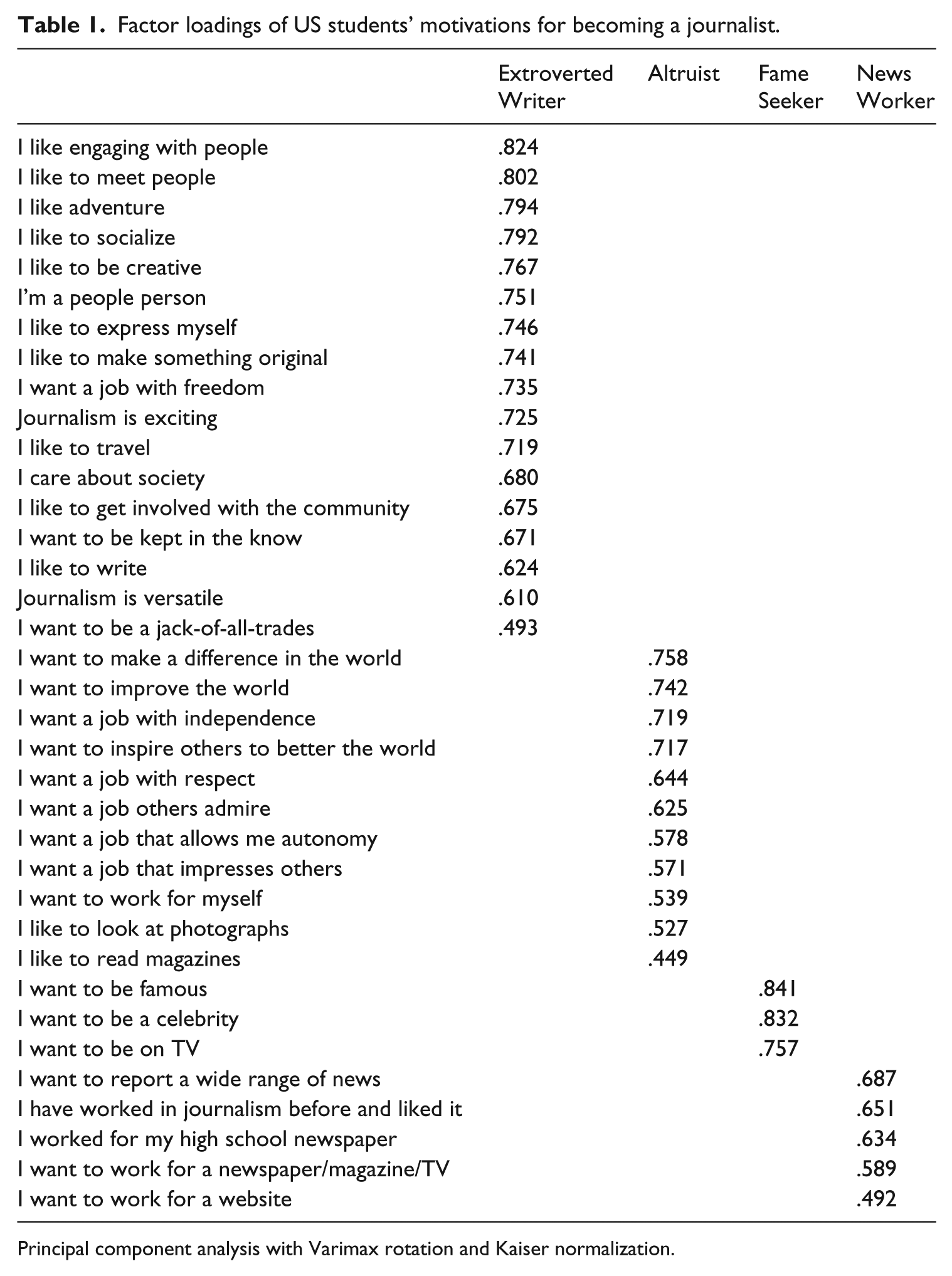
Principal component analysis with Varimax rotation and Kaiser normalization.
To answer RQ2, about how demographics predict motivations, we asked gender, race (White, Black, Asian, American Indian, Pacific Islander, Other), and major (journalism, print, photojournalism, TV/radio/broadcast, multimedia, communication/mass communication; advertising, PR; and other; the last three were purged) as predictors in a regression with the four motivations factors.
To answer RQ3, how students’ role conceptions compare with those of working journalists, we used the questions from the American Journalist survey (Weaver et al., 2007). Disseminator (α = .705): Get information to the public quickly, Provide entertainment and relaxation, Analysis and interpretation of international developments, Avoid stories where factual content cannot be verified, Concentrate on news that’s of interest to the widest possible audience; Interpretive/Investigative (α = .744): Provide analysis and interpretation of complex problems, Investigate claims and statements by the government, Discuss national policy while it is being developed; Populist Mobilizer (α = .806): Develop intellectual and cultural interests of the public, Set the political agenda, Give ordinary people a chance to express their views, Motivate people to get involved in public discussions, Point people toward possible solutions to problems; and the Adversarial (α = .953): Be an adversary of public officials, and businesses.
We compared students’ with professionals’ role conceptions by using Spearman’s rank-order correlation.
Results
This national random sample of accredited journalism schools, stratified by region, resulted in responses from 678 students, 80 percent women and 20 percent men. Whites made up 80 percent of the sample, with 6 percent Hispanic, 4 percent each African American and Asian American, 1.6 percent Native American, and 0.2 percent Pacific Islanders. Seniors made up 34 percent of the sample, juniors 31 percent, sophomores 22 percent, and 13 percent were freshmen. Majors in journalism or mass communication made up 54 percent, advertising 17 percent, PR 25 percent, and others 5 percent, which were excluded. The three focus groups consisted of 4–8 students each, for total of 19 participants. Of these, 13 were women and 6 were men; 10 were White and 9 were of another ethnicity including Hispanic, Asian American, or another nationality.
To answer RQ1, regarding the motivations of today’s American students, we conducted factor analysis with Varimax rotation on the survey sample, which resulted in four factors accounting for 57 percent of the variance. These were named the Extroverted Writer, the Altruist, the Fame Seeker, and the News Worker. The Extroverted Writer, 17 items, mirrored Bowers’ (1974) primary reason that students were interested in journalism – they were outgoing, social, creative, liked freedom, adventure and excitement, and writing. The Altruist, 11 items, was similar to Crawford et al.’s (2013) altruistic journalist, wanting to make a difference in the world but also seeking respect and autonomy. The Fame motive – three variables, wanting to be famous, to be a celebrity, and to be on TV (Kohut et al., 2010) – has been increasing with time (Bowers, 1974). The News Worker consisted of, 5 items, wanting to do news work, work for various types of media (newspaper, website, TV, magazine), and having worked in news before or had an early experience with journalism (Table 1). Statements about pay and financial concerns did not load highly onto any of the factors.
The focus group students echoed these motivations, adding the importance of soft news, and also gave us some insights into their reasons behind them. They listed personal interests as their main reason. Almost all said they liked writing. Several had gotten involved in journalism at an early age in school. One recalled having made a ‘magazine’ as a child on paper that was stapled together. Many grew up reading newspapers and magazines and watching news on TV. For broadcast students, being in plays and theater in high school was another common denominator:
After the experience I had with the crew (in high school media) … even at a young age, I thought this is fun.
A number said they liked journalism for its intrinsic and societal values:
I really enjoy – as corny as it sounds – making a difference for people, even with the smallest stories and I feel that that’s really fulfilling.
The pay was mentioned, but most said it did not dissuade them:
I think that as long as you’re passionate and you work hard at it and you’re persistent then everything will fall into place, including finances.
If they were concerned about the pay, they typically expressed ways to earn more while still doing journalism; for example, some broadcast majors said they considered producing jobs. For some, it was their parents who were worried about the pay.
One motive that was frequently mentioned was their love for entertainment or softer news:
I’ve always really enjoyed a lifestyle or entertainment kind of show, like a morning show, I’d love to be on the show or be a producer for that because, after doing reporting and stuff I just realized it can get a little bit, I don’t know, dark.
Another echoed that ‘dark’ sentiment:
(Hard news) is just very stressful and kind of depressing sometimes. I think that with lifestyle shows, for me I like it because it’s more creative and I like the stories a little bit more, they’re a little bit more uplifting.
They expressed concern that more classes were not focused on soft news:
Part of the disappointment the first few years of being in this school is where they’re telling you to write crime stories, write court stories. And you know they have a specific option for sports journalists, so I feel like that’s the only area of journalism where you get to say that’s what I want to do.
Most of the comments mirrored motivations that had already been reported in other studies; the exception were the comments about soft news.
Analysis for RQ2, which looked at how the demographics of gender, race, and major predict student motivations, used only the survey data and consisted of hierarchical regressions for each motivation factor. Gender (1 = male) was entered in the first block and dummy variables for Black, Asian American, White, and Hispanic races in the second. Dummy codes for majors (print, photo, broadcast, multimedia, communication/mass communication) were entered in the third block.
There were no significant predictors for the Extroverted Writer. The Altruist was significantly predicted by White students being less likely to be motivated by this than students of other races (Adj. R2 = .041; Beta = −.198, p < .05). The Fame Seeker was predicted by broadcasting and gender (Adj. R2 = .127). Men were significantly more likely to seek fame (Beta = .111, p < .05), as were broadcast majors (Beta = .317, p < .001). The News Worker motive was predicted by gender and four of the five majors (Adj. R2 = .067): print (Beta = .184, p < .01), photojournalism (Beta = .125, p < .05), and broadcast (Beta = .193, p < .01) were positively related to this factor; mass communication was a negative predictor (Beta = −.138, p < .05). Multimedia was the only major that was not significant. Women were more motivated by this than men (Beta = −.118, p < .05) (Table 2).
Hierarchical regression of gender, race, and major on four motivation factors.
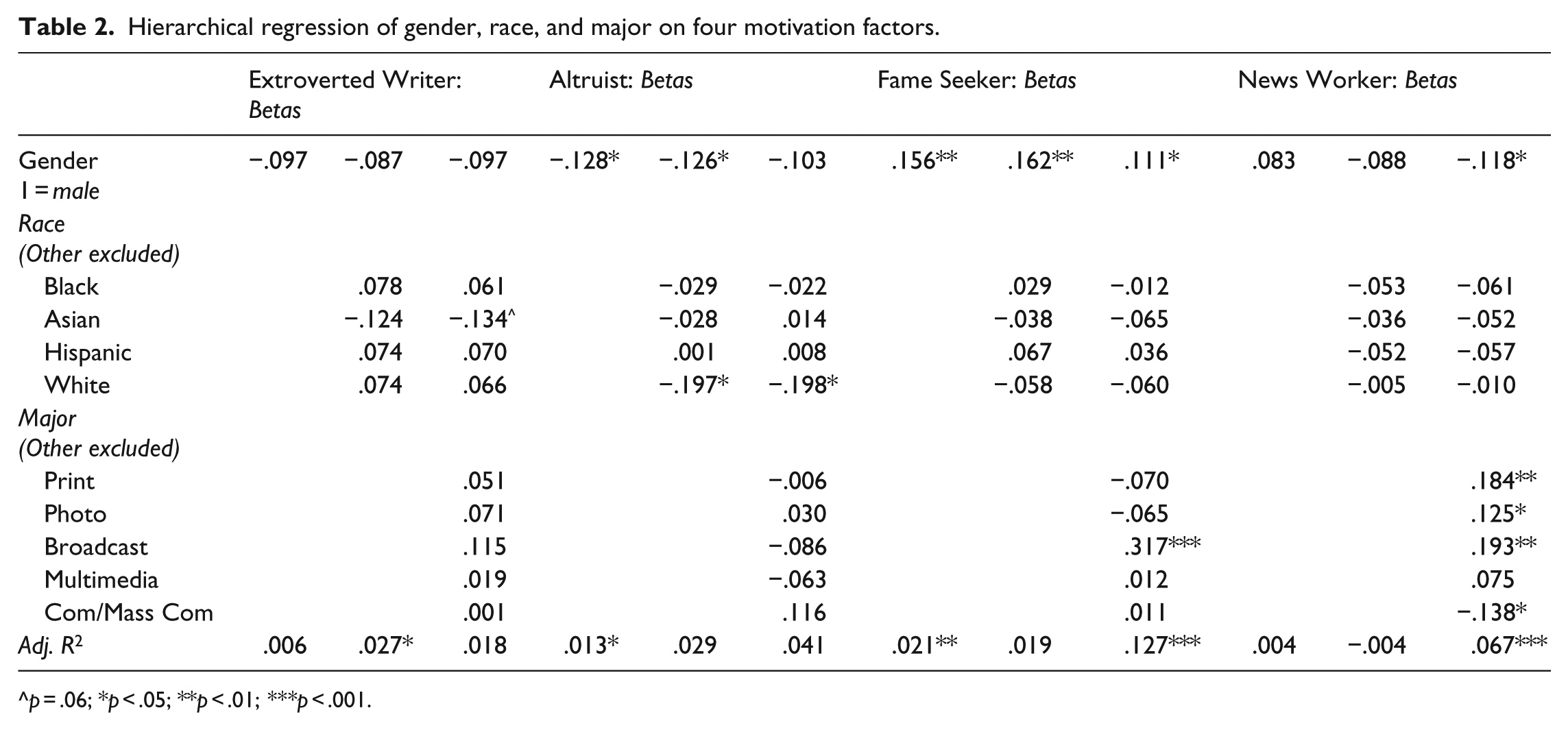
p = .06; *p < .05; **p < .01; ***p < .001.
In answer to RQ3, about the role conceptions of student journalists, all four roles from the Weaver et al. (2007) studies emerged in both survey data and focus groups. To answer this question with the survey data, we used the items from Weaver and colleagues (2007). The four role conceptions were ranked according to the percentage of professionals (Weaver et al., 2007) and the surveyed students who said each function was extremely important, and Spearman’s rho was calculated. There was no significant correlation between students and professionals in their rankings of the importance of the functions (rho = .40, p = .60). Both professional journalists and students ranked the Interpretive/Investigative as most important, but assessments diverged from there. Professionals ranked as second most important the Adversarial, followed by the Disseminator, with the Populist Mobilizer last. Students said the Disseminator was second most important, Populist Mobilizer third, and Adversarial last (Table 3).
Percentage of professional journalists and journalism students rating and ranking four journalist functions.
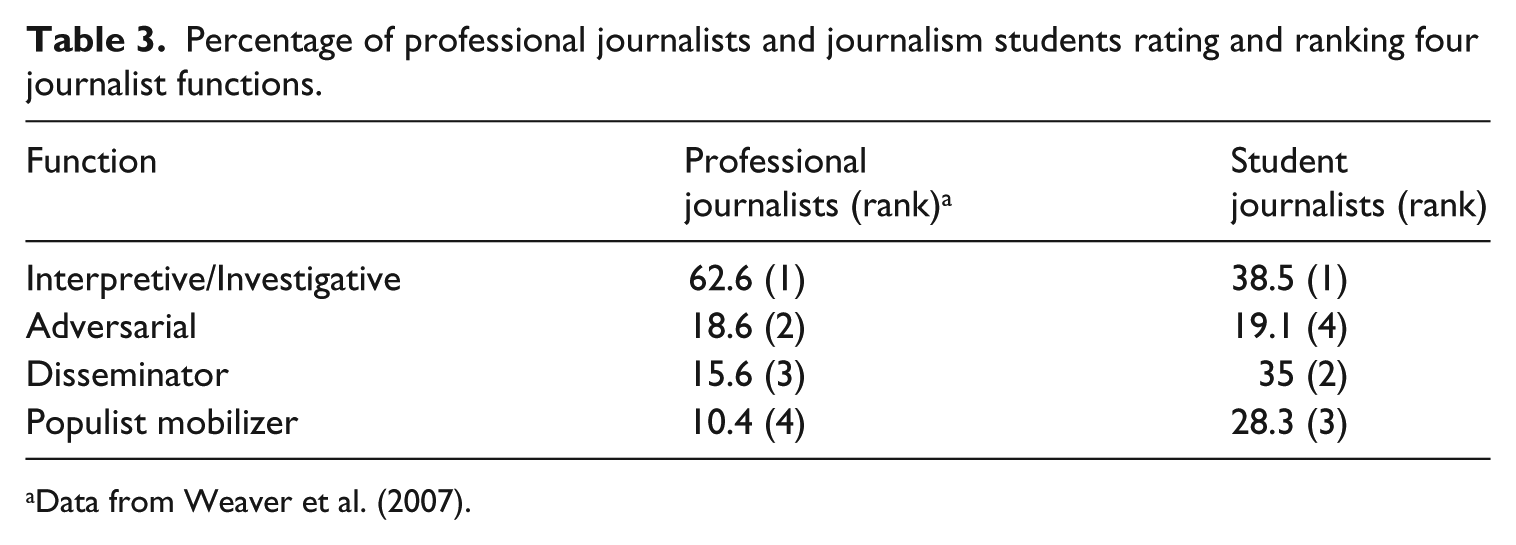
Data from Weaver et al. (2007).
Students in the focus groups also said the main role of journalists is to provide information about the world based on facts, be a watchdog over government and business, set the public’s agenda of important issues, facilitate interpersonal discussions on issues, and entertain, mirroring the Disseminator function. These students also gave us some insights into why they believed these roles were important or not and included entertainment journalism as equally important. For example, the entertainment aspect of the Disseminator function was frequently mentioned, with students saying that entertaining people was becoming just as important as informing them:
There’s no one size fits all for journalists. If you say the role of journalism is to report the facts, and then (someone else) said it’s to entertain, both are right. … The role of fashion journalism is completely different than the role of political journalism – and it should be. I think they have kind of become intermixed with political and the hard-hitting news moving toward the entertainment side and I think that’s gotten away from what the old definition of journalism is. I like lifestyle a lot because it’s kind of newsy – like, you know, you learn things about the newest gadgets, like, you know, iPhone 5 is coming out and I think that would be really cool to write stories like that.
The rise of citizen journalists and bloggers was linked with the Interpretive/Investigative function:
(A journalist is) anyone who can credibly present a perspective based on actual investigation and talking to people, not just who will blog about it. I think journalism now has the role of pointing people to which voice to listen to, because there are so many voices out there and many of them are just full of garbage.
Students not only echoed the ideas of the Populist Mobilizer but also included the act of journalists interacting with audiences, something that was not a part of the original role:
It’s a two-way street. You are not only just there and telling stuff to citizens, but you’re also interacting. It’s not so much just journalists telling the news, it’s more of a conversation and dialogue now.
When it came to the Adversarial role, few students mentioned it as being important, and one even called it ‘old, outdated journalism’. We found little evidence of the Adversarial function in the focus groups, unless it was that this role was in decline or being taken over by citizen journalists:
I think (citizen journalism) has changed the role of the journalist. In one way, citizen journalism kind of acts as like watchdog journalism for professional journalists because they might call us out on something that we didn’t fill in the gaps or the holes or the facts are wrong.
Discussion
This mixed-methods study of the motivations and role conceptions of US journalism students in this sample has shown many similarities with past students while also revealing some important differences in the role conceptions between these students and professionals. Motivations to be famous are on the rise, as is the importance of entertaining.
Motivations
Our main question was about motivations to major in journalism and what demographics predict them. It has been a little over 20 years since a large, national study has been conducted (Becker and Graf, 1995). Despite the possibility that young people have changed dramatically in two decades, we didn’t find that the largest motivators of today’s college students in this sample were very different. They still want a career that is interesting, creative, altruistic, and speaks to their love of writing. They are still not motivated by money.
The main motivation factor, Extroverted Writer, describes students interested in self-fulfillment and maximizing their own talents. Most college students are still focused on themselves and satisfying their own desires for self-realization.
In contrast, the factor that explained the second most variance in this sample focuses on others. The Altruist factor is composed of those who want to improve the world and have a job that others respect and admire. White students in this study were significantly less likely to be motivated by altruism than students of other ethnicities. Minority students in this sample, who might have personally experienced discrimination, poverty, or injustice or known those who have, were frequently motivated to improve conditions for their own people and all of society. They may be looking for a profession like journalism because it provides information people can use to identify problems in society and improve them.
The Fame Seeker was predicted by being male and majoring in broadcasting. Today’s students, dubbed the ‘Look at Me Generation’, have increasingly been shown to seek fame (Kohut et al., 2010) and that includes journalism majors. The growth of social media sites has either encouraged or made more apparent this desire, with its emphasis on amassing ‘followers’ and ‘friends’ as signs of success.
The News Worker factor was made up of students who had some experience with journalism early in life – working on the school yearbook, newspaper, or TV station. They wanted to work for a specific type of organization – TV, magazines, or online outlets. This organizational focus was, not surprisingly, predicted by their choice of major – print, broadcast, and photo. It reveals a type of person more interested in the product itself than in the gratifications they derive from it; it is not primarily autonomy, adventure, or writing that attracts these students but the organization and its product.
Role conceptions
Our second goal was to determine how these US journalism students conceive of their role in society, and compare it with professional journalists. The four roles – Disseminator, Adversarial, Populist Mobilizer, and Interpretive/Investigative – appeared with strong validity. However, the ranking of their importance was somewhat different for these students than the professionals studied by Weaver et al. (2007). There was no significant correlation between these students and professionals in their ranking of the importance of the functions. Both these students and professionals ranked the Investigative/Interpretive role most important. Students in our sample overwhelmingly agreed that the role of journalists was to analyze and interpret information. Students in the focus groups shed light on this, saying that with the amount of information on the Internet from citizen journalists and bloggers, professionals were needed to sift through it all and let people know what was important. From there, these students parted ways with the professionals. For students, the Disseminator function was second most important, compared with professionals who said it was the Adversarial function; that ranked last in these students’ minds. The Disseminator function is focused mainly on providing information, with some interpretation and analysis. This also includes the role of entertainment and giving audiences what they find interesting. From the focus groups, the importance of entertainment and lifestyle news arose as being just as important as the traditional ‘hard’ news of politics, crime, and the economy. Many mentioned that journalism was moving away from hard news and more toward entertainment, and few bemoaned that fact. More defended the trend, saying that stories about new technology, how to protect oneself from identity theft, music, movies, and ‘news you could use’ were just as important as stories about crimes, murders, and fires. They called the traditional concept of journalism as hard news ‘outdated’.
The Adversarial function, which represents the hardest of hard-hitting journalism, was called outdated by even more focus group students. They said that this function was being taken over by citizen journalists. The Populist Mobilizer function was slightly more important to these students, who ranked it third, than to professionals, who ranked it fourth. One twist to this role that we gleaned from the focus groups was that the public discussion function meant journalists interacting with the public, not just motivating people to start discussions among themselves. A key insight from the focus groups was that because journalists were now expected to blog, they were becoming part of the conversations.
Conclusion
The findings present some important insights about how these future journalists see their profession, how it is likely to change as they enter the workforce, and how to move them to enter journalism in the first place. Future journalists in this study see ‘soft news’ as being on equal footing with traditional ‘hard news’. They consider it fair game for journalists to join conversations about issues, and not just to spark conversation and bow out. Citizen journalists are both positive and negative – not only taking over more of the adversarial duties of journalists but also increasing the amount of information and opinion, making the interpretive role of journalists more necessary. Student journalists in this sample still recognize the same four roles of journalists, but rank their importance in a quite different order and define them differently.
Today’s US student journalists in this sample are still motivated to enter the profession for the same reasons as yesterday’s – self-realization and improving the world – but more are motivated by fame than before.
The take-away for college administrators and educators is to appeal to students’ sense of self-realization, altruism, and desire to leave a lasting impression. Classes should emphasize the good that journalism can do in the world. The potential for being on TV to confer some type of celebrity status is likely to motivate some to major in broadcasting; however, we caution that a healthy dose of reality tempered with fostering altruism and an understanding of the proper function of the press in a democracy is warranted. A fourth type of student can be motivated to go into journalism by having early experiences with it; thus, it may pay for journalism schools to perform outreach to K-12 schools, especially among underrepresented populations. Even a 1-day open house that lets young people experience the thrills of seeing their name in print, blogging, taking photos and video, or being on the ‘evening news’ can leave a positive impression of journalism as a career. None of these factors included expectations of financial fortune, and none are likely forthcoming with most journalism careers.
Finally, schools should acknowledge the updated role conceptions of these up-and-coming journalists, incorporating blogging and social media into all classes, and providing ethical guidance for navigating the new territory of becoming an equal partner in conversations about issues. More classes in lifestyle and arts journalism should be added, and students should be taught to write about these topics as credible news, not ‘puff’ pieces.
Theoretically, we note that while the role conceptions literature has not identified entertainment as a separate factor, role performance research does, with an ‘infotainment’ role (Mellado et al., 2016). We suggest a theoretical advance provided by this research is that role conceptions theory should incorporate role performance factors, which measures journalistic roles through explicit indicators in manifest content, rather than relying on journalists’ self-reports alone. As these US students enter the profession, the Disseminator function may diverge into two roles, with a separate Infotainment function.
With this study, we have updated the knowledge on motivations for students to major in journalism and gone beyond it by using qualitative and quantitative methods to discover what kinds of things predict each of the major motivations. While this study was a large, national sample, randomly stratified at the school level, one limitation was our response rate. We do not believe this invalidates the importance of our findings as low response rates are not as much a threat to validity as other kinds of error. However, we have taken pains to avoid generalizing to the population in our discussions above.
Future studies should incorporate more questions on entertainment journalism into research on role conceptions, such as the American Journalist series. Furthermore, until now research on students’ motivations on a national scale in the United States had not been conducted in almost 20 years; we recommend more consistent research on both of these populations. In addition, our analysis of predictors for the motivations is unique; more should be done to not only document and describe students’ motivations for entering journalism but should also seek to help us explain why and predict who might be moved by certain factors. More consistent research with both populations on these topics will not only help scholars develop theory around media sociology but also help educators better prepare their charges to deal with a rapidly changing media environment.
Footnotes
Acknowledgements
The authors wish to thank Glenn Frankel, former director of the University of Texas School of Journalism, for funding this research from his endowed chair as the G.B. Dealey Regents Professor.
Funding
The author(s) received no financial support for the research, authorship, and/or publication of this article.