



Abstract
Online audience engagement, such as rating or sharing news, commenting or creating content, can enhance users’ loyalty toward online news brands. Yet recently, uncertainties have been discussed within journalism research and practice concerning the handling of online comment sections and potential negative influences – caused through comment reading – on news brands. From a brand management perspective, audience engagement and comment reading can affect a brand’s equity. This study investigates the value of audience engagement and comment reading for the customer-based brand equity of online news outlets. An online survey with n = 313 users of the digital native cohort revealed that comment reading is neither directly beneficial nor harmful for online news brands. However, for brands providing hard news comment reading seems more likely to have negative than positive relations with CBBE than for brands with other content. Sharing and liking news are associated with a stronger perceived brand quality, loyalty, and associations. User-generated content creation including commenting does not enhance customer-based brand equity. Overall, serious content proved to be a stronger driver of news brand value than any form of audience engagement.
Introduction
Especially younger online audiences enjoy engaging with online news through rating or sharing articles, commenting, or creating personal profiles (Kirk et al., 2015). Online engagement is of high interest for news organizations; it builds trust and loyalty toward online news brands (Chung and Nah, 2009) and grows readership (Mersey et al., 2010). Jönsson and Örnebring (2011) expect that user-generated content (UGC) ‘may increase the brand capital for both the offline and online versions’ (p. 141) and therefore has a positive effect on the struggling newspaper business.
However, user engagement could also be a potential threat to news quality. Practitioners and scholars argue that inadequate comments harm the news brand (e.g. Canter, 2013; Ots and Karlsson, 2012). Additionally, the share of the online audience that participates in creating online content is low (Karlsson et al., 2015). Yet, online audience participation adds to societal and democratic functions of news (e.g. Curran, 2005; Engesser, 2013), such as providing public space for debates. Comment reading can provide readers with additional information to form opinions (Marchionni, 2015; Springer et al., 2015). Although the overall importance of audience engagement has increased, the actual value for news brands remains unclear. Yet it is of high interest for news organizations to know which value user comments and other forms of engagement create for news brands.
To assess the potential value of engagement for news brands, customer-based brand equity (CBBE) is a suitable concept that investigates the readers’ relationship to a news brand. It complements ‘hard’ success measures, such as circulation, with ‘soft’ measures, such as loyalty. The CBBE concept has been applied to TV news (e.g. Oyedeji, 2007, 2010) and increasingly gains relevance within media brand research (Krebs and Siegert, 2015). However, there is a lack of research relating audience engagement to brand equity of news brands.
Therefore, we ask the research question: how are audience engagement and comment reading, besides traditional success factors, related to CBBE of online news brands? The goals of this study are to assess (1) whether various forms of audience engagement can enhance the brand capital more strongly than traditional success factors, such as content and (2) whether the comment section is beneficial for, or harmful to, online news brands.
This study revolves around three analytical frameworks (see Figure 1): (1) usage motivations, for example, discuss with others; (2a) higher- and lower-level online audience engagement, for example, commenting and rating or sharing articles, respectively, as well as creating customized profiles (e.g. Nah et al., 2015); (2b) passive comment reading (Ksiazek et al., 2016); (3a) CBBE, that is, loyalty toward a news outlet; and (3b) news outlet features, that is, content.

Analytical Framework.
We conduct an online survey of n = 313 young adult users of online news outlets in Switzerland. Young adults participate more actively online (Hargittai and Walejko, 2008), which also holds true for Switzerland (Latzer et al., 2015: 34). Additionally, online news use of the Swiss population (68% in 2014) is above average compared to the EU-28 countries (52%) (Bundesamt für Statistik, 2015). Higher- and lower-level audience engagement and passive news consumption (26%, 23%, and 50%, respectively) was almost, on average, for Swiss online news users compared to other European countries in 2015 (Newman et al., 2016: 100). Therefore, we regard Switzerland as a good example for studying user engagement.
From motivations for online audience engagement to CBBE
Motivations for online audience engagement
This section combines (1) usage motivation with (2a) higher- and lower-level audience engagement and (2b) comment reading (see Figure 1).
According to the uses and gratifications approach (Katz et al., 1974), assumed gratifications motivate news usage. Gratifications refer to the perceived needs of audience members that are being satisfied. Specifically, motivations for using online news are information seeking, entertainment, pastime, and socialization (Kaye and Johnson, 2002).
Kang et al. (2013) highlight that news sharing or commenting can enhance users’ social status. Users who show off their eruditeness do this by interactive behaviors. Users generate online content because they want to fulfill recognition and social needs (Leung, 2010). Users comment on articles because they want to express a personal opinion and discuss matters of personal interest with others (e.g. Brake, 2014; Canter, 2013).
Overall, audience engagement derives from socialization motives, which are one in about four motive sets for using online news. We assume the following hypothesis in line with previous research, combining the analytical frameworks (1) and (2a):
H1. Higher the level of social-interactive usage motivation, higher is the frequency of audience engagement.
Since it is not clear whether information seeking, entertainment, and pastime enhance audience engagement, we ask the following questions:
RQ1. Which role does information seeking, entertainment, and pastime play for audience engagement?
Resulting from engagement, audience members can read comments written by others. According to Springer et al. (2015), entertainment and cognitive-informative motives are related to comment reading but social-integrative motives are not. Therefore, we suggest the following hypotheses, combining the analytical frameworks (1) and (2b):
H2. Higher the level of cognitive-informative motives, higher is the frequency of comment reading.
H3. Higher the level of entertainment motives, higher is the frequency of comment reading.
Attitudinal effects of user engagement
This section combines (2a) higher- and lower-level audience engagement with (3a) CBBE dimensions (Figure 1).
Fulfilling gratifications has positive effects on attitudes and loyalty toward news outlets. Chung and Nah (2009) show that content creation increases the satisfaction with news brands and makes journalism more meaningful to users. According to Yoo (2011), interactivity improves the attitude toward a newspaper through obtained gratifications, which in turn enhances revisit intention. Larsson (2011) shows that newspaper websites offering interactive features are visited significantly more often. Lischka and Messerli (2015) find that sharing slightly increases satisfaction with news outlets, which enhances loyalty. In addition, Barnes (2014) argues that fan-like behaviors and emotional engagement are related to news consumption and participation. Hence, in CBBE terms, engagement affects attitudinal brand associations and loyalty.
The concept of CBBE represents an attitudinal, consumer-based view of brand equity (Aaker, 1991; Keller, 1993; Yoo and Donthu, 2001). The conceptualization of CBBE is based on Aaker (1991) and has been complemented. CBBE is divided into four dimensions: brand loyalty signalizes the attachment of users to a brand. According to Keller (1993), brand loyalty is strong if positive attitudes toward the brand manifest in recurrent use of the brand. Brand awareness is the capability to recognize and recall a brand. Awareness is vital for the customers’ decision-making processes. A brand with a higher awareness is more likely to be a part of the customers’ consideration set (e.g. Keller, 1993), which is important for news brands facing growing competition. Perceived quality of the brand is the perceived superiority of a brand compared to its alternatives (Oyedeji, 2007), relevant for newspapers positioning themselves as ‘quality brand’. Brand associations are traits linked to the users’ memory about the brand (e.g. Oyedeji, 2007).
When connecting the research state on user engagement to CBBE, we propose the following hypotheses:
H4. Higher the user engagement, stronger is the brand loyalty of an online news brand.
H5. Higher the user engagement, stronger is the brand awareness of an online news brand.
H6. Higher the user engagement, stronger is the perceived quality of an online news brand.
H7. Higher the user engagement, stronger is the brand associations of an online news brand.
Attitudinal effects of comment reading
This section combines (2b) comment reading with (3a) CBBE (Figure 1).
Due to its popularity (Ziegele et al., 2013), the investigation of potential negative effects of comment reading on the brand is of great importance. Canter (2013) warns that non-moderated comments may harm the news brand, especially when comments include defamation (e.g. Reich, 2011; Santana, 2014). Springer et al. (2015) suggest that a low standard of comments decreases the satisfaction of lurkers, that is, comment readers, who read because of cognitive and entertainment motivations.
Prochazka et al. (2015) show that the mere presence of comments has a negative effect on perceived article quality, independent from the comments’ civility or reasoning. A negative effect of comment reading would be more relevant and sustainable when the passive audience prevails (Groot Kormelink and Costera Meijer, 2014; Karlsson et al., 2015). In contrast, Bergström and Wadbring (2015) report that the majority of Swedes have no or a supportive opinion on comments. Marchionni (2015) demonstrates that article and website credibility do not differ according to stories with or without comments but remains rather high. In addition, studies show that lightweight news are predominantly viewed but hard news predominantly commented upon (Almgren and Olsson, 2015; Tenenboim and Cohen, 2015). Therefore, news brands focusing on hard news may suffer more from critical reactions to comments than news brands focusing on soft news. We ask the following questions:
RQ2. How is comment reading related to the CBBE dimensions?
RQ3. How is comment reading related to news brands focusing on hard versus soft news?
News outlet features as success factors for CBBE
This section combines (3a) CBBE with (3b) news outlet features (Figure 1).
Engagement is not the only determinant of CBBE. Within the extensive research on success of newspapers, several factors were highlighted. The content of newspapers is repeatedly found to influence success. Here, topic- as well as quality-related aspects can be identified (Kim and Meyer, 2005; Schönbach, 2004). For example, focusing on local news can be a successful strategy (Hansen and Hansen, 2011) while also additional background information was highly important for young readers (Raeymaeckers, 2004). Seriousness of content (Schönbach, 2004), and design and layout (Schönbach and Lauf, 2002) can promote success of newspapers. Furthermore, the price influences success (Habann et al., 2008). Recently, the adaption of new technology was identified as crucial (Van Eimeren, 2013). We ask the following questions:
RQ4. How important is user engagement for CBBE compared to the features content, design and layout, price, and the adaption of new technology?
Study
Measurement
Usage motives
Items for information seeking, socialization, pastime, and entertainment stem from existing studies (Chung and Yoo, 2008; Papacharissi and Rubin, 2000) and are measured on a five-point Likert scale from 1 = ‘strongly disagree’ to 5 = ‘strongly agree’. A principal component analysis (PCA) with varimax rotation 1 detected three components of usage motives: (1) social interactive, (2) entertainment/pastime, and (3) information seeking (Table 1). Hence, pastime is not a distinct motivation dimension according to our results but rather related to entertainment.
Usage motivation dimensions for news use of the favorite news outlet.
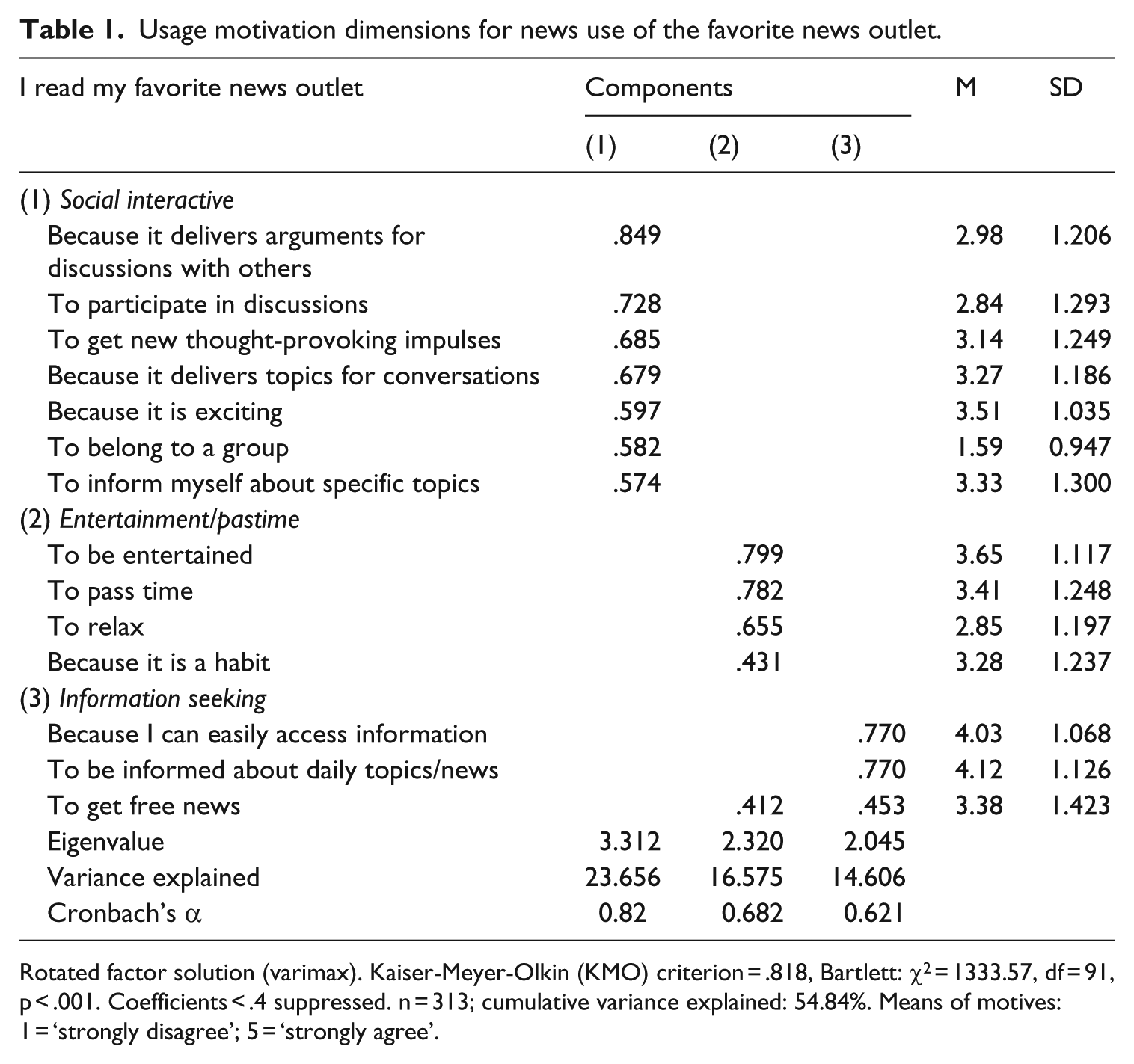
Rotated factor solution (varimax). Kaiser-Meyer-Olkin (KMO) criterion = .818, Bartlett: χ2 = 1333.57, df = 91, p < .001. Coefficients < .4 suppressed. n = 313; cumulative variance explained: 54.84%. Means of motives: 1 = ‘strongly disagree’; 5 = ‘strongly agree’.
Audience engagement and comment reading
Participants rated the frequency of usage of 10 different forms of audience engagement based on Domingo et al. (2009) and Örnebring (2009) on a five-point scale from 1 = ‘never’ to 5 = ‘very often’ and referred to each participant’s favorite news brand. PCA with varimax rotation detected three components of engagement frequency reflecting active to reactive steps of the ‘ladder of participation’ (cf. Green and Jenkins, 2011): (1) higher-level participation, relating to a high extent of user independence and creativity exerted; (2) lower-level participation, relating to a lower extent of user creativity exerted; and (3) customization (details in Table 2). In addition to passive comment reading (M = 3.22, SD = 1.312), these dimensions are used for analysis. Furthermore, we asked eight statements on a five-point Likert scale about how strongly participants agreed with negative effects of the commenting function and published comments on loyalty, perceived quality, image, credibility, likability, and willingness to recommend their favorite news outlet (Table 6).
Audience engagement dimensions for news use of the favorite news outlet.
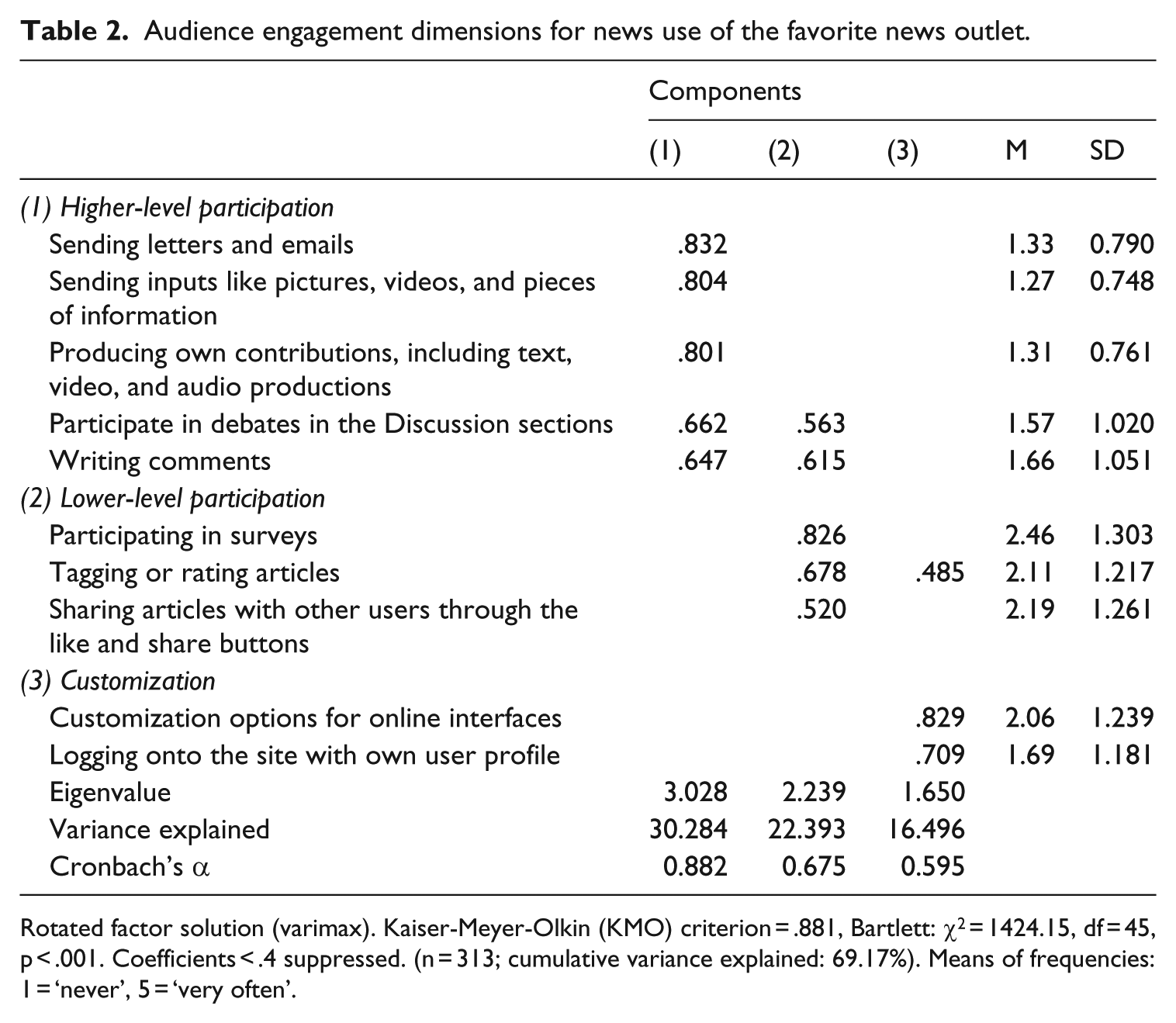
Rotated factor solution (varimax). Kaiser-Meyer-Olkin (KMO) criterion = .881, Bartlett: χ2 = 1424.15, df = 45, p < .001. Coefficients < .4 suppressed. (n = 313; cumulative variance explained: 69.17%). Means of frequencies: 1 = ‘never’, 5 = ‘very often’.
CBBE
We refer to Yoo and Donthu’s (2001) CBBE conceptualization and adapt items from Pappu et al. (2005). Participants rated 19 statements on a five-point Likert scale from 1 = ‘strongly disagree’ to 5 = ‘strongly agree’. A PCA with varimax rotation detected four CBBE components: (1) perceived quality, (2) brand loyalty, (3) brand associations, and (4) brand awareness (Table 3). The items do not identically distribute across the factors according to the theoretical assumed four CBBE dimensions. However, the overall characteristics (quality, loyalty, associations, awareness) remain.
CBBE dimensions for the favorite news outlet.
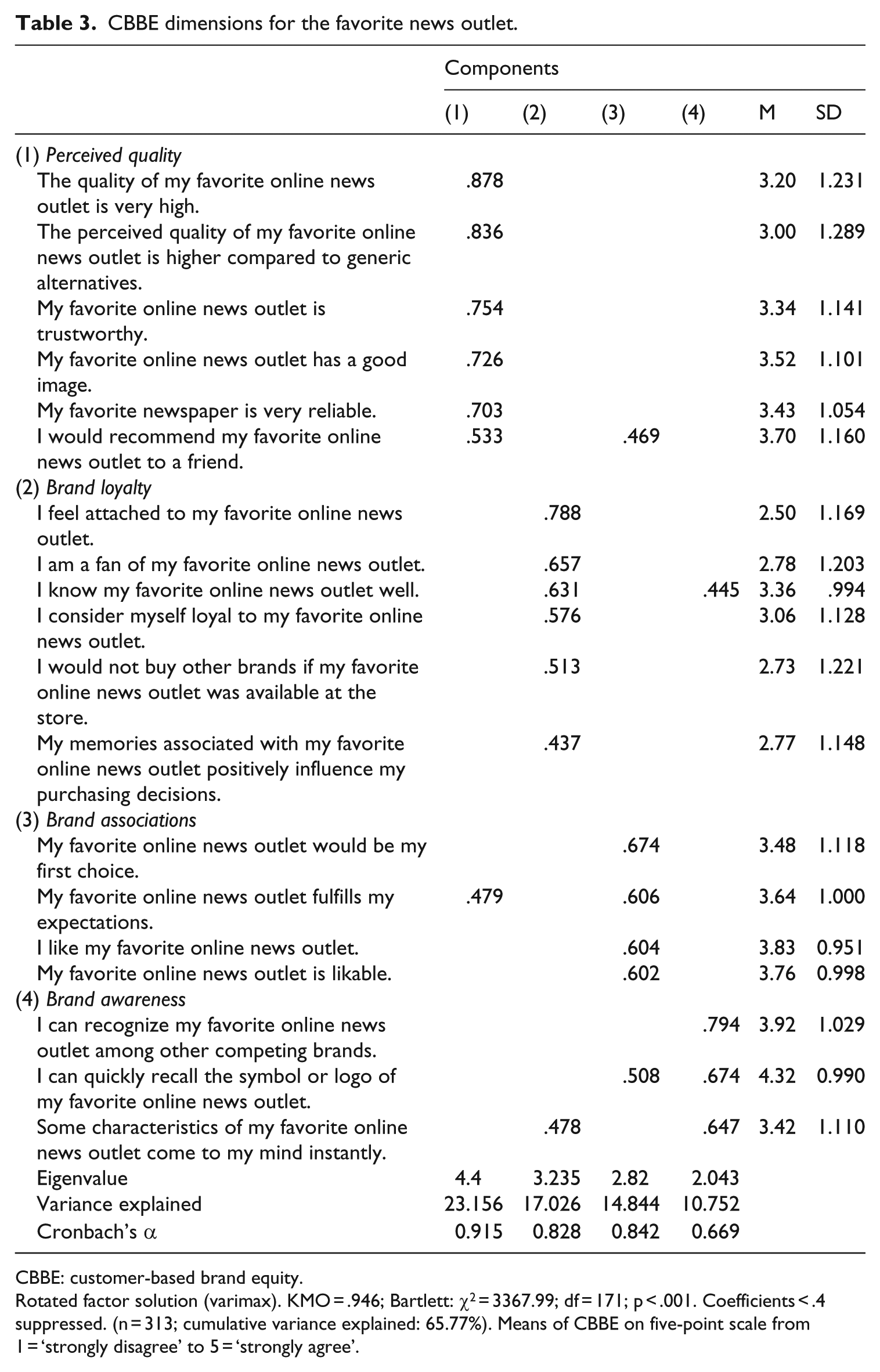
CBBE: customer-based brand equity.
Rotated factor solution (varimax). KMO = .946; Bartlett: χ2 = 3367.99; df = 171; p < .001. Coefficients < .4 suppressed. (n = 313; cumulative variance explained: 65.77%). Means of CBBE on five-point scale from 1 = ‘strongly disagree’ to 5 = ‘strongly agree’.
News outlet features
Participants rated the importance of the following newspaper features on a five-point Likert scale from 1 = ‘not important’ to 5 = ‘very important’: seriousness of content, design and layout, price, and the adaption of new technological developments.
News brands
We categorized the respondents’ favorite news brands as follows: (1) quality news brands, (2) boulevard news brands, and (3) pure players, based on the hard-news scores measured for Swiss news outlets in fög – Forschungsinstitut Öffentlichkeit (2015). The score represents shares of articles relating to politics, economics, and culture (hard news) and sports and human interest (soft news). We ascribed n = 96 cases to quality news brands focusing on hard news, n = 123 cases to boulevard news brands focusing on soft news, and n = 61 cases to pure players that often focus on hard as well as entertaining and soft news (fög – Forschungsinstitut Öffentlichkeit, 2015).
Control variables
Brake (2014) shows that younger, better educated, and male audience members are more active in sharing or producing online content. Age is measured in years. Education is measured in seven ordinal categories (1 = ‘none’, 2 = ‘primary’, 3 = ‘lower/intermediate secondary’, 4 = ‘apprenticeship’, 5 = ‘higher secondary’, 6 = ‘technical college’, and 7 = ‘university degree’). Gender is measured as 1 = ‘male’ and 2 = ‘female’.
Procedure and sample
An online survey with Swiss young adults was conducted during a 3-week period in February 2016. According to Kirk et al. (2015), young adults, which belong to the cohort of ‘digital natives’, evaluate interactivity, such as two-way communication, more positively than ‘digital immigrants’. Thus, our sample may more likely reveal positive relations between engagement and CBBE than a sample including older audience members.
The questionnaire was distributed by a student newsletter reaching about 993 enrolled mass communication students, of which 313 completed the survey. Therefore, the sample comprises a convenience sample of well-educated young adults who are more news affine than their peers of other degree programs (Grijalva Verdugo and Izaguirre Fierro, 2014) – 57 percent of the respondents consume news on a daily basis. The average age of the 313 respondents was 24 years (SD = 7.47). A majority of respondents were young females (66%), who were found to use the Internet slightly less intensely than male users of the same age group in Switzerland (Latzer et al., 2015). Compared to the general Swiss population (BFS, 2016), our participants are highly educated, that is, 63 percent had a high school and 21 percent a university degree.
We related all questions to the individual favorite news brand of each participant to keep external validity high.
Results
Frequencies of audience engagement and comment reading
Concerning higher-level participation, 7 percent write comments (very) often; 6 percent participate in debates in the discussion sections; 3 percent send letters and emails to the editors; 2 percent send pictures, videos, and pieces of information (very) often; and 2 percent produce their own texts, videos, or audio (very) often. Regarding lower-level participation, 20 percent participate in surveys (very) often; 16 percent share; 13 percent (very) often tag or rate articles; 14 percent use customization options; and 9 percent log in to the site with their own user profiles (very) often. Finally, 40 percent read comments of other users.
Relation between usage motivations and audience engagement
In order to test H1 to H3 and to answer RQ1 and RQ2, we regress the three dimensions of usage motivations on audience engagement, customization, and comment reading (Table 4). We use bootstrapping to arrive at robust estimates of the standard errors and confidence intervals despite non-normally distributed variables (e.g. Hayes, 2005). A higher social-interactive usage motivation is positively related to a higher audience engagement and customization frequency. Therefore, we accept H1. Concerning RQ1, entertainment and pastime are positively associated with lower-level engagement and customization frequencies. Yet, information seeking is not related to audience engagement or customization. In addition, the higher audience members are educated, the less likely they engage online. Age and gender do not affect audience engagement or customization.
Relations between usage motivations, audience engagement, and comment reading.
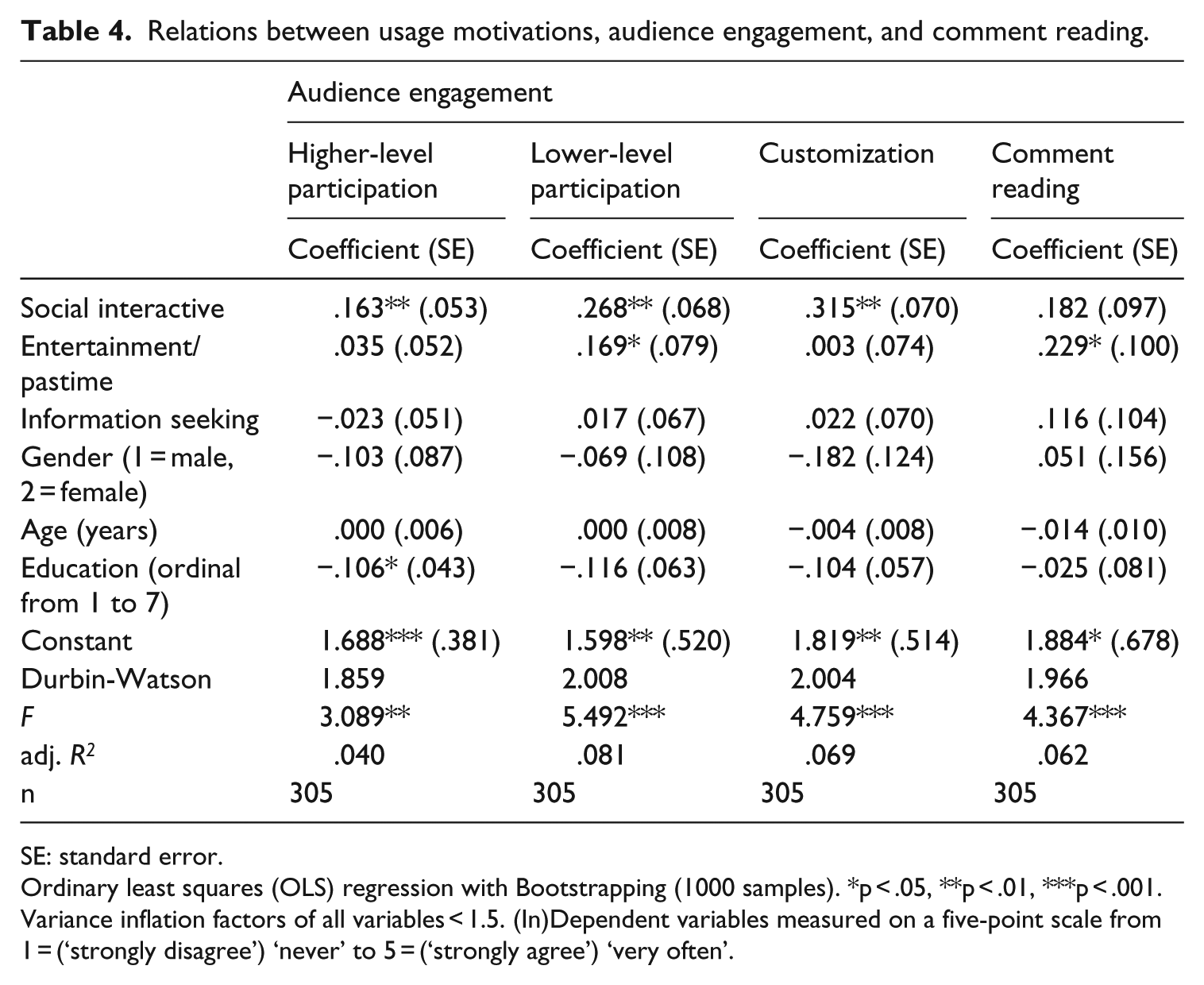
SE: standard error.
Ordinary least squares (OLS) regression with Bootstrapping (1000 samples). *p < .05, **p < .01, ***p < .001. Variance inflation factors of all variables < 1.5. (In)Dependent variables measured on a five-point scale from 1 = (‘strongly disagree’) ‘never’ to 5 = (‘strongly agree’) ‘very often’.
Entertainment and pastime usage motivation are positively linked to comment reading. However, information seeking has no relation with comment reading. We accept H3 but dismiss H2.
Relation between audience engagement and CBBE
Overall, respondents most strongly agreed with brand awareness statements (M = 3.89, SD = 81), followed by brand associations (M = 3.57, SD = .81), perceived quality (M = 3.37, SD = .98), and loyalty (M = 2.95, SD = .81). Quality, loyalty, and associations differ across news brand types according to Bonferroni-corrected T-tests. Users ascribe a significantly higher (p < .05) quality to hard-news brands (M = 4.14, SD = .74) than to pure players (M = 3.5, SD = .68) and boulevard brands (M = 2.76, SD = .79). In addition, brand loyalty is stronger (p < .05) for hard-news brands (M = 3.21, SD = .85) than for boulevard brands (M = 2.75, SD = .74) but on a similar level as for pure players (M = 3.0, SD = .70). Brand associations are stronger (p < .05) for hard-news brands (M = 3.84, SD = .75) and pure players (M = 3.73, SD = .60) than for boulevard brands (M = 3.38, SD = .81). That is, hard-news and online-only brands hold a stronger CBBE than boulevard brands, due to higher quality evaluations and stronger brand associations.
To test H4 to H7, we estimate the relations of audience engagement frequency and importance of further success factors on the CBBE dimensions (Table 5). Higher-level participation does not enhance any of the CBBE dimensions. Lower-level participation, including sharing and liking, is positively related to brand loyalty. A more frequent use of customization enhances perceived quality and brand loyalty. We therefore accept H4 and H6 for lower-level audience engagement, but dismiss both hypotheses for higher-level audience engagement. Yet any form of audience engagement does not affect brand associations and awareness. Hence, we dismiss H5 and H7.
Relations between audience engagement, comment reading, news outlet features, and CBBE.
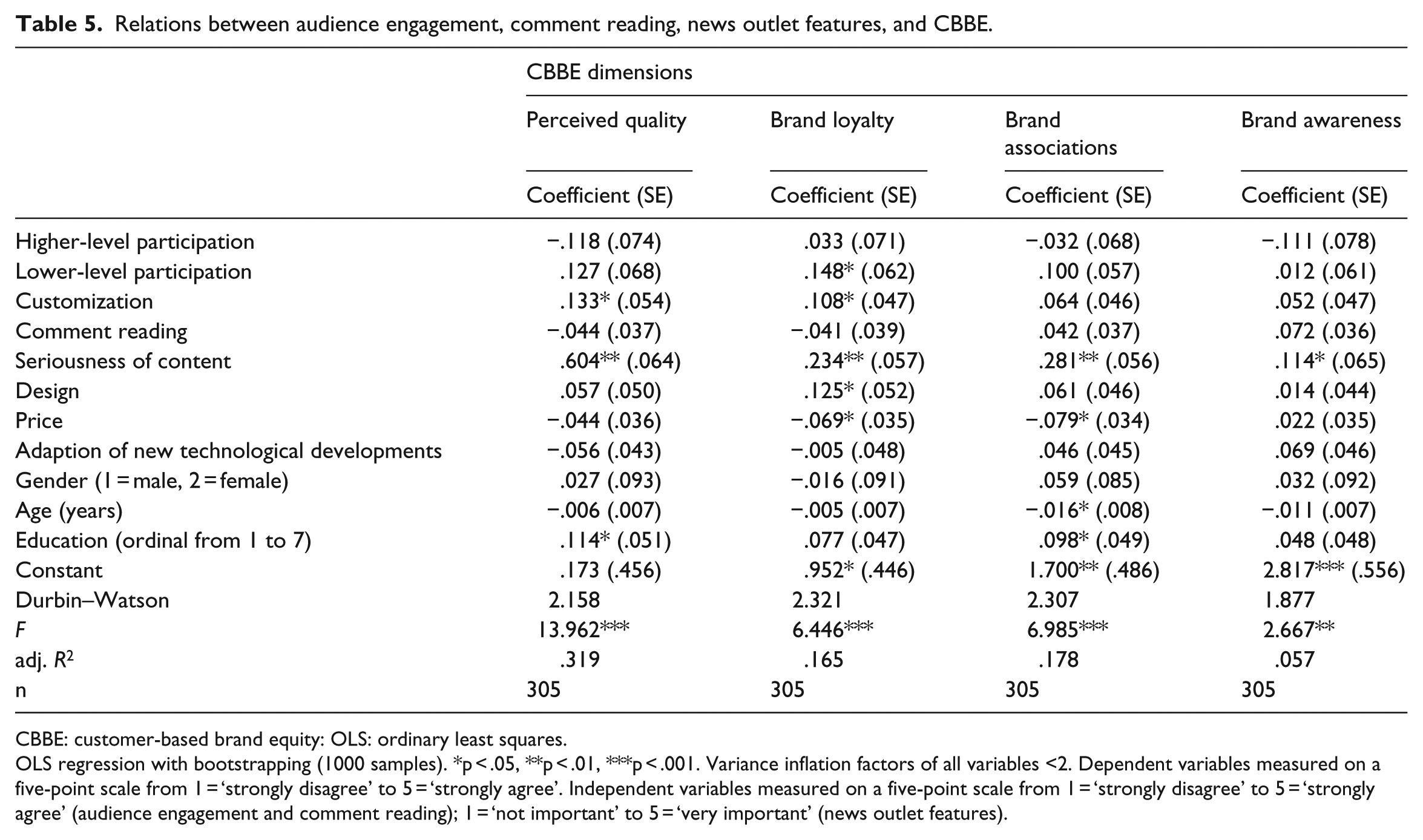
CBBE: customer-based brand equity: OLS: ordinary least squares.
OLS regression with bootstrapping (1000 samples). *p < .05, **p < .01, ***p < .001. Variance inflation factors of all variables <2. Dependent variables measured on a five-point scale from 1 = ‘strongly disagree’ to 5 = ‘strongly agree’. Independent variables measured on a five-point scale from 1 = ‘strongly disagree’ to 5 = ‘strongly agree’ (audience engagement and comment reading); 1 = ‘not important’ to 5 = ‘very important’ (news outlet features).
Relations between comment reading and CBBE
Concerning RQ2, comment reading has no relation with any CBBE dimension and thus neither enhances nor decreases perceived quality, brand loyalty, associations, or awareness (Table 5).
In order to answer RQ3, we compare comment-reading evaluations across users of quality, boulevard, and online-only news brands (Table 6). All comment-reading groups disagree, on average, that comments deteriorate their willingness for recommendation, loyalty, image, likability, perceived quality, and credibility assessments toward the news brand. Overall, participants agree most to ‘The quality of the news outlet suffers from published comments’ and ‘Comments that do not conform to the stance of the news outlet harm its image’. Yet values still reveal disagreement toward the statements on the scale. Comment readers of boulevard brands evaluate a negative effect of comments on credibility, image, and quality as less severe than comment readers of hard-news and online-only news brands. Thus, there could be sporadic negative effects of comment reading on evaluations toward news brands that differ across news brands with hard-news and soft-news focus.
Evaluation of comment effects of comment readers per news brand type.
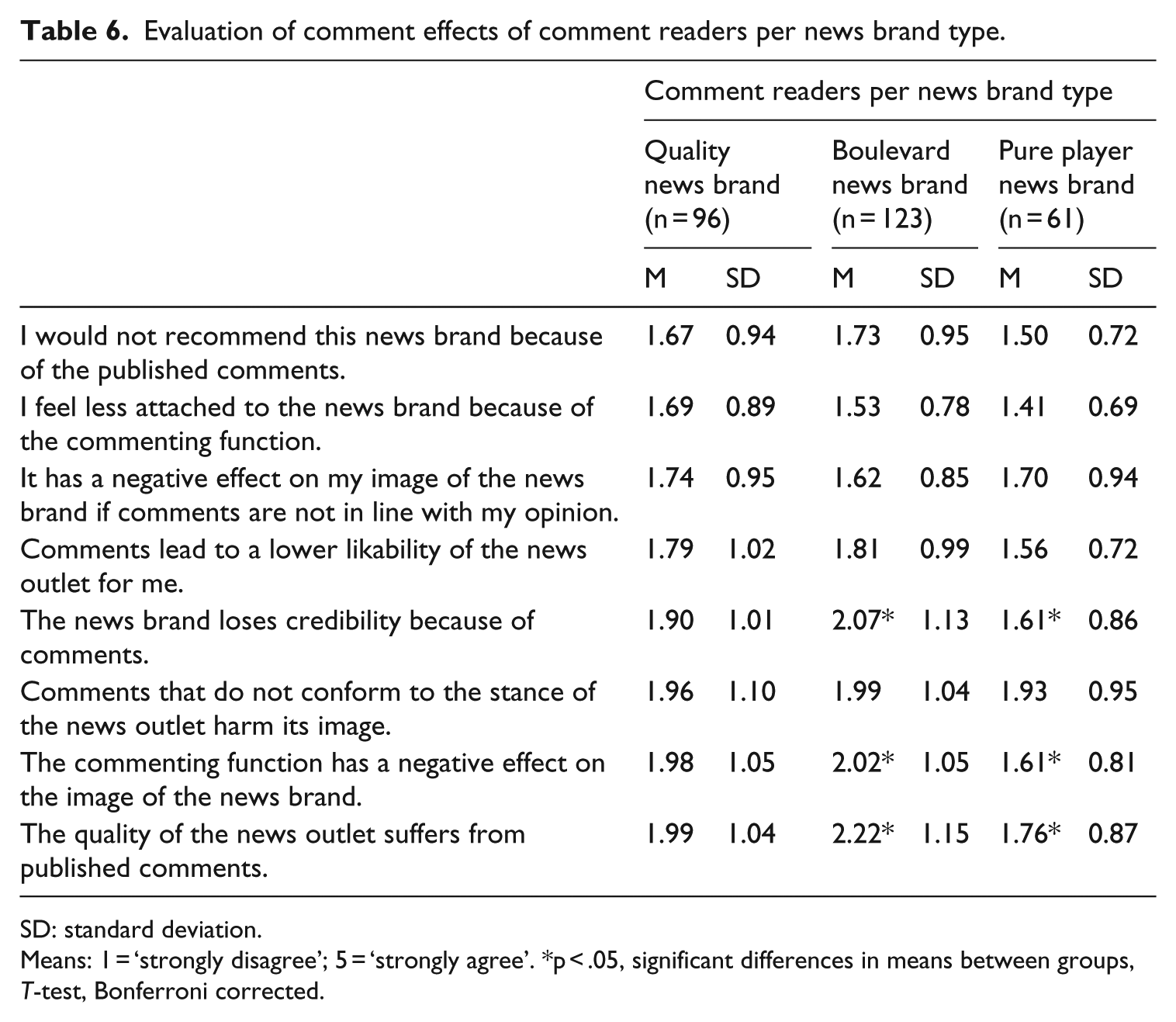
SD: standard deviation.
Means: 1 = ‘strongly disagree’; 5 = ‘strongly agree’. *p < .05, significant differences in means between groups, T-test, Bonferroni corrected.
Relations between news outlet features and CBBE
Relating to RQ4, seriousness of content enhances all CBBE dimensions but especially strongly the perceived quality of the news brand (Table 5). The more important the design and layout, the slightly higher is brand loyalty. The more important the price, the slightly lower audience members are loyal and have less strong brand associations with their favorite news brand. The more important the adaption of new technology (e.g. mobile apps), the slightly stronger are brand associations and awareness by tendency. Thus, seriousness of content is the strongest success factor for CBBE, followed by engagement.
Discussion
Comment reading is by far the most frequent activity compared to higher- or lower-level audience engagement activities for young adults. The proportions are in line with results of previous studies (e.g. Busemann and Gscheidle, 2011). Thus, audiences mostly remain passive readers and rarely become active contributors (e.g. Karlsson et al., 2015). Contrary to previous research (Brake, 2014), our results do not reveal gender differences or strong age differences in audience engagement frequencies, which is most likely due to our homogeneous sample of well-educated, young adults.
All forms of audience engagement are driven by social-interactive motives, partly by entertainment and pastime motives, and not by information seeking (see relations between (1) and (2) in Figure 1). That is, users who want to participate in discussions or have provoking impulses and topics for conversations are more likely to become active contributors. Users who want to be entertained or pass time read comments and engage on a lower level. Information seeking is not related to engagement or comment reading. Thus, previously detected usage motivations (e.g. Yoo, 2011) do not similarly motivate engagement or comment reading. Social-interactive motives are the strongest drivers for audience engagement and entertainment and pastime for comment reading.
Not all forms of audience engagement enhance CBBE (see relations between (2) and (3a) in Figure 1). Lower-level engagement positively corresponds to loyalty. That is, audience members who take part in surveys on the website or who share articles feel more attached to the brand. Customization is positively related to perceived quality and loyalty. Users who customize or log on with their profile ascribe a higher quality and feel more attached to the news site. Both lower-level engagement and customization add value to the news brand since it prevents users from switching. These results are similar to Kirk et al. (2015) who find positive effects of participation on attitudes toward digital information products. Yet no positive influence of higher-level engagement was detected, which contradicts Jönsson and Örnebring’s (2011) assumptions. Higher-level engagement is less strongly driven by social-interactive motives than lower-level engagement or customization. Therefore, the obtained gratifications may be lower, resulting in the absence of CBBE effects.
However, seriousness of the content is in stronger correspondence to CBBE than engaging or customizing. The perceived quality is especially strongly affected by serious content. That is, the more important the serious content is to users, the higher they perceive brand quality. The importance of content for news brand success is in line with previous research (e.g. Hansen and Hansen, 2011; Raeymaeckers, 2004). A higher price sensitivity is negatively linked to loyalty and associations. McDowell (2015) states, ‘the branded news source must offer exceptional value’ (p. 151) for users to be willing to pay for content. Offering unique content may therefore help to counterbalance price sensitivity and to enhance loyalty.
Comment reading as a popular form of passive consumption has no clear positive or negative effects on CBBE. Thus, although the presence of comments may have a negative effect on article evaluation (Prochazka et al., 2015), it does not affect the overall evaluation of the news brand. This is in line with Marchionni (2015), who shows that website credibility does not differ depending on articles with or without comments. Although, overall, comment readers did not rate comments as problematic, online comments could more strongly harm hard-news brands and pure players than boulevard news brands, through a loss of credibility, declining image, and lower perceived quality. If comment reading has an effect on audience-based evaluations of news brands by young adults, it is more likely negative than positive.
Conclusion
By applying CBBE, our study adds to previous research on online audience engagement. Results confirm that online news brands mostly face a passive audience. Rare higher-level engagement for content creation is caused by social-interactive motives but does not enhance CBBE. Lower-level engagement and customization are more strongly related to social-interactive motives, and positively associated with brand loyalty and perceived quality. In comparison to the importance of serious content, audience engagement has a lower importance for CBBE than news content. Thus, content remains essential for a news brand, and lower-level audience participation is secondarily relevant. Overall, the results show that content is highly important for young news readers and more influential than user engagement for the value of news brands. Especially for hard news, the quality of the content can be seen as a core element of the brands’ identity (Siegert et al., 2011) and plays a vital part in enhancing CBBE.
Comment reading is neither directly beneficial nor harmful for online news brands. Therefore, the comment section neither harms nor helps news brands to build customer-based brand capital. But comment reading may have rather negative than positive effects on hard-news and pure player brands. The comment section may act as a hygiene factor for users, which they may not want to miss. The comment section therefore can add value to the brand – if not directly in terms of CBBE, then concerning reader gratification and the fulfillment of democratic functions of news.
Although audience participation is less important to online news consumption than initially assumed, we argue that forms of higher- and lower-level engagement, including the comment section, is a normatively positive behavior signaling more active citizenship. According to Marchionni (2013), ‘online newspaper audiences are increasingly accepting and even appreciative of the role they play’ (p. 267) in participatory journalism. The ability to comment or share may be perceived as a sign of appreciation by readers and has become an industry standard (Stroud et al., 2015). By delivering comment sections, news provide normatively needed space for exchange of opinions.
Yet because content is important to young adults, news brands (1) should emphasize journalistic core skills and focus on quality content and (2) can enable customer integration more selectively as indicated by Santana (2014). Further investigations have to show whether the risks of comments to brand image, for example, due to mismatching comments to the brands’ identity and positioning, are higher than the positive effects of user engagement. This would imply that investments to the production of image-conforming content, which reflects certain quality standards, could potentially be more beneficial in terms of the brands’ CBBE than a focus on user engagement.
Future research should also investigate whether comment reading affects the quality perception, loyalty, and brand associations of the parent news brand and assess how strongly parent news brands are affected by engagement experiences. If audiences have higher quality expectations of newspapers than online sites, news brands producing online content differing in quality to the parent brand may cause a disenchantment of audiences’ quality expectations.
Major limitations of this study are related to the convenience sample of mostly university students. Hence, the results are not generalizable to a broader audience group. Furthermore, we used self-reports of audience members on their engagement behavior frequency. A measure of actual audience integration frequency may provide more accurate estimations. Further limitations concern the influence of commenting. Here, we did not include topic-related questions and therefore did not integrate the influence of controversial debates, where most likely negative effects of comment reading would be enforced.
Footnotes
Funding
The author(s) received no financial support for the research, authorship, and/or publication of this article.