



Abstract
Guided by field theory and the concept of journalistic boundary work, this study seeks to examine whether BuzzFeed, a new agent in the journalistic field, is participating in the preservation or transformation of the journalistic field. This is carried out by comparing its news outputs with those of The New York Times based on the markers – or boundaries – that defined traditional journalistic practice, particularly news values, topics, sources, formats, and norms. The analysis found that while news articles produced by BuzzFeed are exhibiting some departures from traditional journalistic practice, in general, BuzzFeed is playing by the rules, which might explain its legitimation as a recognized agent in the field.
Introduction
When social media giant Facebook decided to start directly hosting news articles on its news feed, it made sense that it first negotiated partnerships with the most well-known news organizations in the United States, such as The New York Times and NBC News (Goel and Somaiya, 2015). Also included in that list was BuzzFeed, a 9-year-old website, that rose to Internet stardom through its viral cat videos and listicles (Ellis, 2014). When Facebook started paying video creators for Facebook Live, BuzzFeed got the most lucrative contract (Perlberg and Seetharaman, 2016). Facebook agreed to pay BuzzFeed some US$3.05 million for a year’s worth of videos, a sum of money slightly higher than the US$3.03 million Facebook agreed to pay The New York Times. Such juxtaposition with legacy news companies, including what is often considered as the United States’ newspaper of record (Zelizer et al., 2002), seems to mark, to some extent, BuzzFeed’s formal legitimation as having permeated the journalistic field, only less than 4 years after it started a section devoted to news.
BuzzFeed’s high-profile entry into journalism highlights how the field is evolving (Rieder, 2015). While many traditional news organizations are losing advertising revenues, BuzzFeed is thriving with its own model of native advertising (Beaujon, 2013). The company was estimated to be worth US$1.5 billion in 2015, a year after Disney reportedly tried to buy it for US$1 billion (Byers, 2016; Kung, 2015). While many legacy news outlets are seeing a steadily shrinking audience base, BuzzFeed has been drawing an average of 200 million viewers per month (BuzzFeed, 2016). Only a few years after it was founded, BuzzFeed became among the 10 most visited ‘news and information sites’ in the United States (Saba, 2014). Such substantial accumulation of economic capital understandably confers BuzzFeed significant influence as a new entrant into the journalistic field (Rieder, 2015).
Seen through the framework of field theory (Bourdieu, 1993, 1998a, 1998b, 2005), new entrants in any field take the spotlight as they start to participate in the struggle to either transform or preserve the field (Benson, 1999). New agents ‘can only establish themselves by marking their difference with those already in the field’ (Benson, 1999: 468). In doing so, they participate in either transformation or preservation (Tandoc and Jenkins, 2015). This discourse about new agents marking their difference is parallel to the discourse of boundary work (Gieryn, 1983). In a field such as journalism, where membership requirements are neither clear nor specified, boundary work is paramount as members distinguish themselves from non-members (Carlson, 2015; Lewis, 2012).
How does BuzzFeed, as a new entrant to the journalistic field, participate in the field’s transformation or preservation? Guided by the framework of field theory and the concept of boundary work in journalism, this study focuses on the boundary performance of BuzzFeed through a content analysis of its news articles – its outputs as a new agent in the journalistic field. This analysis will compare BuzzFeed’s news outputs with those of The New York Times, whose journalistic practice has long been considered by many as the gold standard in traditional American journalism (Ehrlich, 2016; Zelizer et al., 2002).
Literature review
Founded in 1851, The New York Times has a long and glorious history and ‘has unevenly maintained its status as a newspaper of record’ in the United States (Zelizer et al., 2002: 284). It ‘stands for excellence in writing, serious journalism, and serious investment in journalism’ (Kung, 2015: 28), and is considered rather consistently ‘as a purveyor of serious news’ (Ehrlich, 2016: 367). It has won the most number of Pulitzer Prizes and ranks as the third largest national newspaper in the United States based on circulation (Kung, 2015). But just like other newspapers in the United States, The New York Times has seen its circulation rates and advertising revenues plummet. Staying true to its reputation as a news innovator, the news organization has launched several digital initiatives to spread its journalistic dominance online, a sphere where BuzzFeed currently reigns supreme (Kung, 2015).
While The New York Times claims to have some 78.1 million unique online visitors to its website each month, BuzzFeed puts its numbers at 200 million (BuzzFeed, 2016; The New York Times, 2016). Founded in 2006 by Jonah Peretti, who had earlier co-founded Huffington Post, BuzzFeed rose to online stardom as an aggregator of popular and funny content from social media (Ellis, 2014). It experimented with different non-traditional content and formats, and later became widely known for its lists, short articles, and quizzes (Lafrance, 2012). BuzzFeed perfected the art of going viral (Ellis, 2014; Isaac, 2014) and draws some 75 percent of its traffic from social media (Saba, 2014). Soon, BuzzFeed’s popularity translated into financial success: Venture capital firm Andreessen Horowitz poured some US$50 million in investments to BuzzFeed in 2014, followed by a US$200 million investment from NBCUniversal in 2015 (Byers, 2016; Ellis, 2014; Isaac, 2014; Miller, 2014).
BuzzFeed’s official entry into the journalistic field started when it hired Ben Smith, a reporter for the online political site Politico, as its editor-in-chief in December 2011 (Garber, 2011). Smith hired a set of news reporters and soon started a Washington DC bureau to cover the US federal government full-time (Lafrance, 2012). BuzzFeed’s news operations continued to expand. It also started hiring correspondents in other countries and launched BuzzFeed World in 2013 (Ellis, 2014; O’Donovan, 2014). BuzzFeed also established bureaus in other countries, including the United Kingdom, Brazil, Germany, and Japan. In a memorandum to his team that was also publicly released, founder Jonah Peretti said, ‘We, of course, still don’t have the trust the traditional news brands have won over the past 100 years, but we are working hard to earn it, and it won’t take us 100 years to get there’ (Peretti, 2013: para. 10). BuzzFeed is now considered a ‘news and entertainment website that mixes original reporting, user-generated work, and aggregation’ (Ellis, 2014: para. 1). News websites have also started to adopt the listicles and memes that have made BuzzFeed a phenomenal hit (Sonderman, 2012), a testament to its increasing influence as a new entrant in the journalistic field (Tandoc and Jenkins, 2015).
Faced with a shrinking audience base, many traditional news organizations, such as The New York Times, which are known for their serious journalistic outputs, are now experimenting with different writing styles, reporting formats, and range of content, putting, to some extent, their journalistic reputation into question. BuzzFeed, however, comes from a different historical trajectory: It became an Internet powerhouse based on hilarious content and informal writing styles. But entering the journalistic field also means being confronted by norms and routines that have defined, sustained, and legitimized the field (Tandoc and Jenkins, 2015). Is BuzzFeed playing by the rules? Or is it challenging the status quo one viral post at a time?
Field theory and boundary work
Traditional journalism is struggling, confronted by economic and technological shocks. Traditional newsrooms are shrinking (Edmonds, 2013) as younger generations now get their news from alternative sources, such as social media (Beaujon, 2012). Traditional journalists are being challenged by bloggers and citizen journalists (Hermida, 2011; Vos et al., 2011) that defining who a journalist is has become less straightforward (Peters and Tandoc, 2013; Ugland and Henderson, 2007). It becomes clear, then, that ‘struggles over journalism are often struggles over boundaries’ (Carlson, 2015: 2). Initially conceptualized to understand how scientists demarcate the scientific field to distinguish themselves from non-scientists (Gieryn, 1983), the idea of boundary work has been applied to understand journalists as members of an interpretive community (Zelizer, 1993, 2010), engaged in making sense of the conventions that define the boundaries of journalistic practice. This is especially so because journalism ‘lacks the trappings of a classical profession’ (Lewis, 2012: 843). For example, journalism does not require any specific training or license for anyone to claim professional membership. In the absence of a specific authority to decide who a journalist is and who is not, agents within the journalistic field are constrained to engage in repeated ‘symbolic contests in which different actors vie for definitional control to apply or remove the label of journalism’ (Carlson, 2015: 2).
Boundary work refers to ‘demarcating, defending, expanding and contesting the limits of legitimate journalism in order to consolidate and protect authority and the economic, political and personal benefits it confers’ (Fakazis, 2006: 6). This idea of boundary work is consistent with conceptualizing journalism as a field. A field is a field of forces which agents struggle to either transform or preserve (Bourdieu, 1985, 2005). Conceptualized as a field, journalism can be considered as a ‘microcosm with its own laws, defined by its own position in the world at large and by the attractions and repulsions to which it is subject from other such microcosms’ (Bourdieu, 1998a: 39). Similar to the idea of boundary work, to exist in a field is ‘to differentiate oneself’ (Bourdieu, 2005: 39). This is especially salient for journalism, whose power is also sought after by other forces, many of which are external to the field, such as those from the economic and political fields. Thus, Champagne (2005) observed that
The history of journalism could well be in large part the story of an impossible autonomy – or, to put it in the least pessimistic way, the unending story of an autonomy that must be re-won because it is always threatened. (p. 50)
However, new agents can also engage in a process of de-differentiation, or when they subscribe instead to the dominant logic of the field and lose their autonomy, instead of transforming it (Bourdieu, 2005).
The framework of field theory is used not only to examine a field in relation to other fields but also to examine the relationships among agents within a specific field (Sallaz and Zavisca, 2007; Tandoc, 2014). Journalism, for example, is understood as a field torn between heteronomous and autonomous poles (Benson and Neveu, 2005a). The heteronomous pole refers to forces external to the field, such as the influence of advertisers or the state. The autonomous pole refers to journalism’s endemic resources that differentiate it from other fields and therefore protect its autonomy. But at the same time, the journalistic field is also internally ‘structured around the opposition between the “old” and the “new”’ (Benson, 1999: 467).
This opposition is more pronounced in this age when citizen journalists, social media platforms, and even previously entertainment-only sites, such as BuzzFeed, have started engaging in acts of journalism, presenting themselves as new agents existing alongside legacy news organizations that have long dominated the field. New agents, however, do not necessarily bring new rules. They might not only differentiate themselves from old agents but they might also engage in de-differentiation as they start submitting to, instead of transforming, the internal logic of the field. In other words, ‘A rapid influx of new agents into the field can serve both as a force for transformation and for conservation’ (Benson, 1999: 468). Monitoring either transformation or conservation by new entrants to the field depends, in part, on the assessment of the field’s boundaries to begin with. What are journalism’s boundaries?
Boundaries and the journalistic doxa
Field theory is built upon four key concepts: field, capital, habitus, and doxa. The concept of a field has been used in numerous studies, conceptualizing as fields’ various domains, such as politics, the arts (Bourdieu, 2005), organizations (Emirbayer and Johnson, 2008), sports (Stempel, 2005), and journalism (Benson, 2006; Bourdieu, 1998a, 2005; Handley and Rutigliano, 2012). Capital refers to ‘the specific forms of agency and prestige within a given field’ (Sterne, 2003: 375). It refers to various forms of resources that enable agents within the field to participate in the struggle for transformation or preservation (Handley and Rutigliano, 2012). Field theory refers to two main forms of capital: economic and cultural (Benson, 2006; Benson and Neveu, 2005b). Economic capital refers to money or assets that can be transformed into money. In the journalistic field, economic capital can come in the form of circulation rates, advertising revenues, or audience size (Benson, 2006; Benson and Neveu, 2005b). Cultural capital refers to ‘such things as educational credentials, technical expertise, general knowledge, verbal abilities, and artistic sensibilities’ (Benson, 2006: 190). Translated into the journalistic field, cultural capital can come in the form of journalistic excellence as recognized by professional or academic groups, such as the Pulitzer Prizes in the United States (Benson, 2006; Benson and Neveu, 2005b).
The concept of habitus links the field to its agents and refers to dispositions, accumulated through an agent’s experience over time, that generate ‘practices and perceptions’ (Johnson, 1993: 5). It ‘implies understanding the journalistic game’ which allows an individual to master the rules of the game (Willig, 2013: 8). In other words, it refers to an agent’s ‘historical trajectory, a collection of personal and professional experiences accumulated from social positions that produces knowledge and understanding of the game’ (Tandoc, 2014: 562). But what differentiates a field from other fields is its endemic system of rules. This is called the doxa, which refers to a ‘universe of tacit presuppositions that organize action within the field’ (Benson and Neveu, 2005b: 3). It refers to the rules of the game – those ‘deeply rooted tacit understandings of the world which are difficult to express in words, or the everyday circumstances that are so naturalized that we do not see them’ (Willig, 2013: 6). Forming part of the ‘norms of journalistic practice’ (Schultz, 2007), journalistic doxa outlines the rules that members must submit themselves in order to participate in the struggle. In the language of boundary work, journalistic doxa can be conceptualized as operationalizing the boundaries of journalism.
Studies have operationalized journalistic doxa in a number of ways, but many of them have focused on news values and journalistic standards that have dominated journalism practice. For example, Willig (2013) referred to the dominant news criteria for Danish news media – timeliness, relevance, identification, conflict, and sensation – as an example of a specific set of doxa. These news values are ‘highly institutionalized and formalized norms of the journalistic field’ having been reproduced in journalism textbooks and taught in journalism schools (Willig, 2013: 6). News routines have also been conceptualized as another manifestation of journalistic doxa. The typification of news by journalists, such as categorizing stories into hard or soft news, for example, has not only made the complex task of news construction manageable (Tuchman, 1972, 1978) but also propagated and communicated normative editorial judgment, so that hard news, such as those about politics and government issues, is often privileged and idealized over soft news, such as sports and entertainment news (Schultz, 2007). The use of particular news sources has also been thoroughly studied, as sources also exert significant influence on journalists (Gans, 1979; Van Hout and Jacobs, 2008). The use of establishment sources, such as politicians and their press releases, for example, has long dominated traditional journalism (Shoemaker and Reese, 2014; Tuchman, 1978; Van Hout and Jacobs, 2008).
Thomson et al. (2008) also focused on journalistic style in comparing journalism across four countries, operationalizing the journalistic doxa into the inverted pyramid style that has dominated news writing, as well as into the concept of neutrality embedded in the dominant journalistic standard of objectivity. ‘It is frequently held that authorial neutrality and the inverted pyramid structure are key factors in the distinctiveness and uniqueness of the modern hard news report as a text type’ (Thomson et al., 2008: 212). In an analysis of the discourse around the libel suit filed against The New Yorker writer Janet Malcolm for alleged fabrication of quotes, Fakazis (2006) also found that many journalists drew the boundary lines between objective reporting and subjectivity in narratives. Specifically, ‘The discourse of objectivity proved particularly powerful because it has long been used to ground journalism’s authority’ (Fakazis, 2006: 20).
This current study focuses on these boundary markers defined by previous studies in understanding the boundary performance of BuzzFeed, a new entrant asserting its place in the field. By comparing BuzzFeed’s news outputs with those of The New York Times, considered ‘a byword for quality journalism’ (Kung, 2015: 27), this study seeks to analyze BuzzFeed’s performance based on journalism’s traditional rules.
Theoretical synthesis
Different studies have identified different components of the journalistic doxa that demarcate practice within the journalistic field from those of other fields. Some of these boundaries that have been investigated include news values or the criteria that journalists use to determine newsworthiness (Willig, 2013); news typologies, such as the classification of hard news and soft news based on news topics and sources (Schultz, 2007); news formats, specifically the dominance of the inverted pyramid style where pieces of information are presented in descending order of importance (Thomson et al., 2008); and journalistic standards, particularly the problematic but still dominant standard of objectivity in news reporting (Fakazis, 2006). This current study will focus on these markers in assessing the boundary performance of BuzzFeed in comparison with that of The New York Times. Thus, guided by field theory and the concept of boundary work, and by previous studies that have outlined markers of traditional journalism, this study compares BuzzFeed and The New York Times based on
Dominant news values;
Frequently reported topics;
Frequently cited news sources;
Commonly employed news formats;
Objectivity in news reporting.
Method
This study is based on a content analysis of news articles published by BuzzFeed and The New York Times between 1 April 2015 and 31 May 2015. Coming from two different historical trajectories, which Bourdieu (1998b) referred to as habitus, these two publications are among the most read news sources online, enjoying high levels of economic capital.
BuzzFeed’s homepage mixes posts from its different sections, such as news, buzz (which includes the funny articles that made the site popular), and life (which includes articles about food, travel, and home), posted chronologically (Kung, 2015). It devotes a vertical – or a separate page – for news. A random sample of 10 articles per day was selected from the news vertical, which represents BuzzFeed’s own designation of what it considers news. Some articles were excluded for technical reasons, such as links that were recorded wrongly (N = 580). BuzzFeed uploaded 15,683 posts during the time period studied, with 2379 of those categorized as news or about 15 percent of the website content.
Sampling for The New York Times was conducted via the online database Factiva, which indexes content from different print and online publications. Similar to the sampling strategy for BuzzFeed, a sample of 10 news articles per day was randomly selected using a random digit generator. Articles randomly selected from Factiva were cross-checked with The New York Times’ online archive for verification of their designation as news articles (e.g. New York, World). Non-news articles were excluded from the final sample (N = 466). Based on the Factiva database, The New York Times published 5739 news articles online during the 2-month period specified for data collection.
Variables
Three undergraduate students were trained as coders. They underwent several sessions of training in using a content analysis manual developed based on the literature. The coding manual underwent some revisions following initial training, such as merging categories of related news topics. The actual coding commenced only after acceptable intercoder reliability values were achieved. Since all the measures used in the coding was nominal, percentage agreement was calculated. The articles in the sample were coded for the following categories, which the literature identified as markers of traditional journalism, thereby constituting, in Bourdieu’s (1998) field theory, the journalistic field’s doxa:
News values
The articles were coded for the presence or absence of six news values that were common across the news value typologies found in the journalism research literature and textbooks (e.g. Caple and Bednarek, 2015; Harcup and O’Neill, 2001, 2016; Rogers, 2004; ). Negativity referred to whether or not the article focused on the negative aspects of the issue or event. Timeliness referred to whether or not the article was about something recent, timely, or seasonal. Proximity referred to whether or not the article was about an issue or event that was geographically or culturally close to the United States. Impact referred to whether or not the article focused on something that has significant consequences or affects a lot of people. Finally, novelty referred to whether or not the article focused on something new or unexpected. The percentage agreement between the coders ranged from 70 percent (prominence and impact) to 100 percent (negativity and proximity). One category – the news value of personalization – was dropped from the analysis because of low intercoder reliability.
News topic
The articles were coded for their main story topic, guided by previous studies that argued for the role of story topic or event in the classification of hard or soft news (e.g. Scott and Gobetz, 1992; Tuchman, 1973). Stories were coded if the main story topic was about government and politics; crime or terrorism; economy and business; education; environment and energy; accidents and disasters; science, health, and technology; religion; social problems and human rights; human interest; or news aggregation. The coders achieved perfect agreement for this category.
News source
The articles were also coded for their dominant source. Since an article can include multiple sources, dominance was inferred based on the angle of the story and which source was mentioned first. Focusing on the dominant source allowed a parsimonious and straightforward comparison of the articles from the two online publications. Stories were coded if the dominant news source was a government official, law enforcer, or politician; business person; civil society member; sports figure, entertainer, or artist; an academic or expert; an ordinary citizen; or another media outlet. The coders achieved a 90 percent agreement for this category.
News formats
The articles were coded for their format or how the story was written or presented. It could be any of these formats, as deduced from the literature: inverted pyramid, listicle, chronology, reversed chronology, narrative, or a question and answer (Q&A) format usually used to publish actual interviews or interview excerpts (Rogers, 2004; Sonderman, 2012). The coders achieved a 90 percent agreement for this category.
Objectivity
Finally, the articles were coded for the presence or absence of the journalist’s personal opinion on the subject matter or issue. The coding manual specified that for an article to be coded as having the personal opinion of the journalist, the inclusion of personal opinion must be explicit (Tandoc and Oh, 2015). Implicit inclusion of opinion, such as the choice of particular sources over others, is therefore not captured in this variable. The coders achieved an 80 percent agreement for this category.
Results
This study sought to compare BuzzFeed and The New York Times based on five areas that characterize the boundaries of traditional journalism. This was aimed at evaluating whether BuzzFeed, as a new entrant in the journalistic field, is playing by traditional rules, and therefore contributing to the preservation of the field’s internal logic. The first area of comparison is the set of news values that mark traditional journalism: negativity, timeliness, proximity, prominence, novelty, and impact. Significant associations were found across all the news values studied and the type of publication. More news articles from BuzzFeed included timeliness, proximity, prominence, and novelty than from The New York Times (see Table 1). In contrast, The New York Times had more articles with impact and negativity than BuzzFeed had (see Table 1). The difference in the news value of negativity is most pronounced. While only 31.9 percent of BuzzFeed news articles focused on negative aspects, 74.5 percent of news articles from The New York Times did.
Presence of news values.
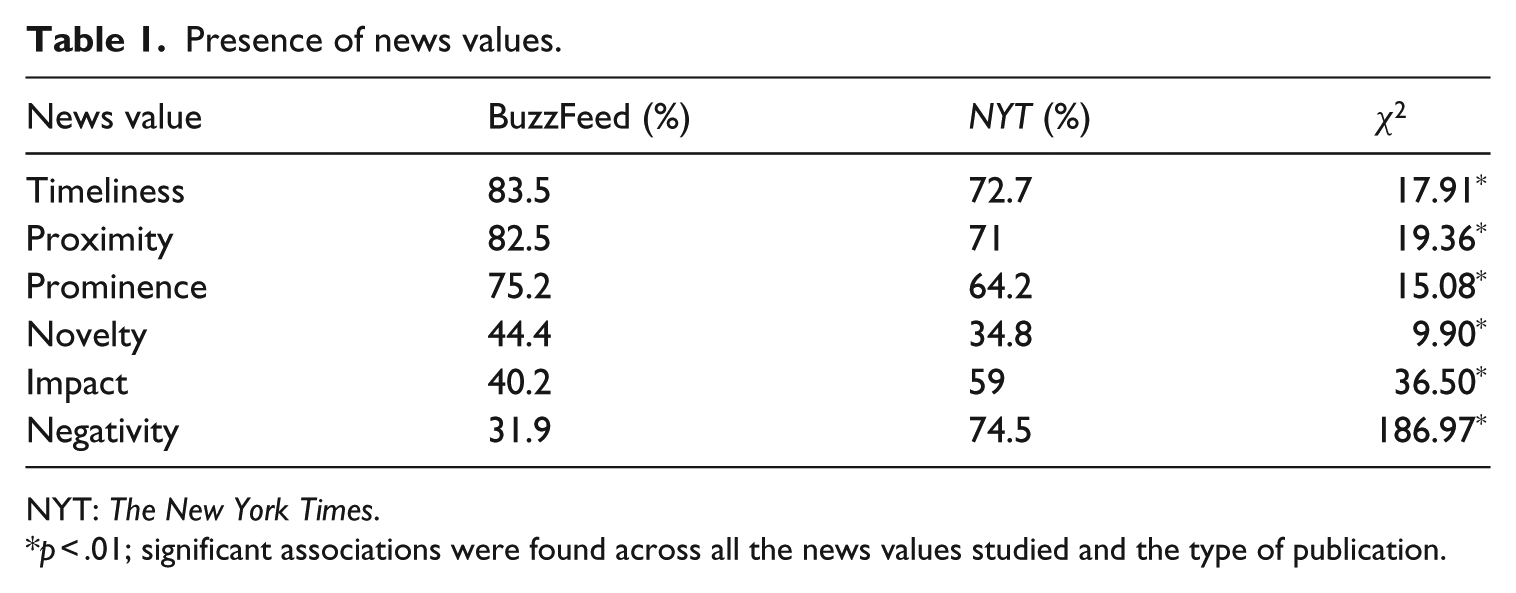
NYT: The New York Times.
p < .01; significant associations were found across all the news values studied and the type of publication.
A way to further tease this out is to analyze the frequency of topics reported about. The analysis found a significant association between publication and story topic, χ2(11) = 72.63, p < .001 (see Table 2). The most frequently reported topics for The New York Times were government and politics (31.6%); crime and terrorism (27.1%); social problems and protests (8.2%); and science, health, and technology (8.2%). Similarly, the most frequently reported topics for BuzzFeed were government and politics (25.5%); social problems and protests (17.8%); crime and terrorism (15.5%); and science, health, and technology (10.5%). However, BuzzFeed reported about social problems and protests more frequently than The New York Times did. A potential explanation for this is BuzzFeed’s focus on controversial social issues as news beats. For example, BuzzFeed has reporters and editors focused on lesbian, gay, bisexual, or transgender (LGBT) issues. The New York Times reported about crime and terrorism more frequently than BuzzFeed did. A potential explanation for this is the newspaper’s New York City section, which often includes news about crimes. In contrast, BuzzFeed does not have local sections for specific cities.
Main story topic.
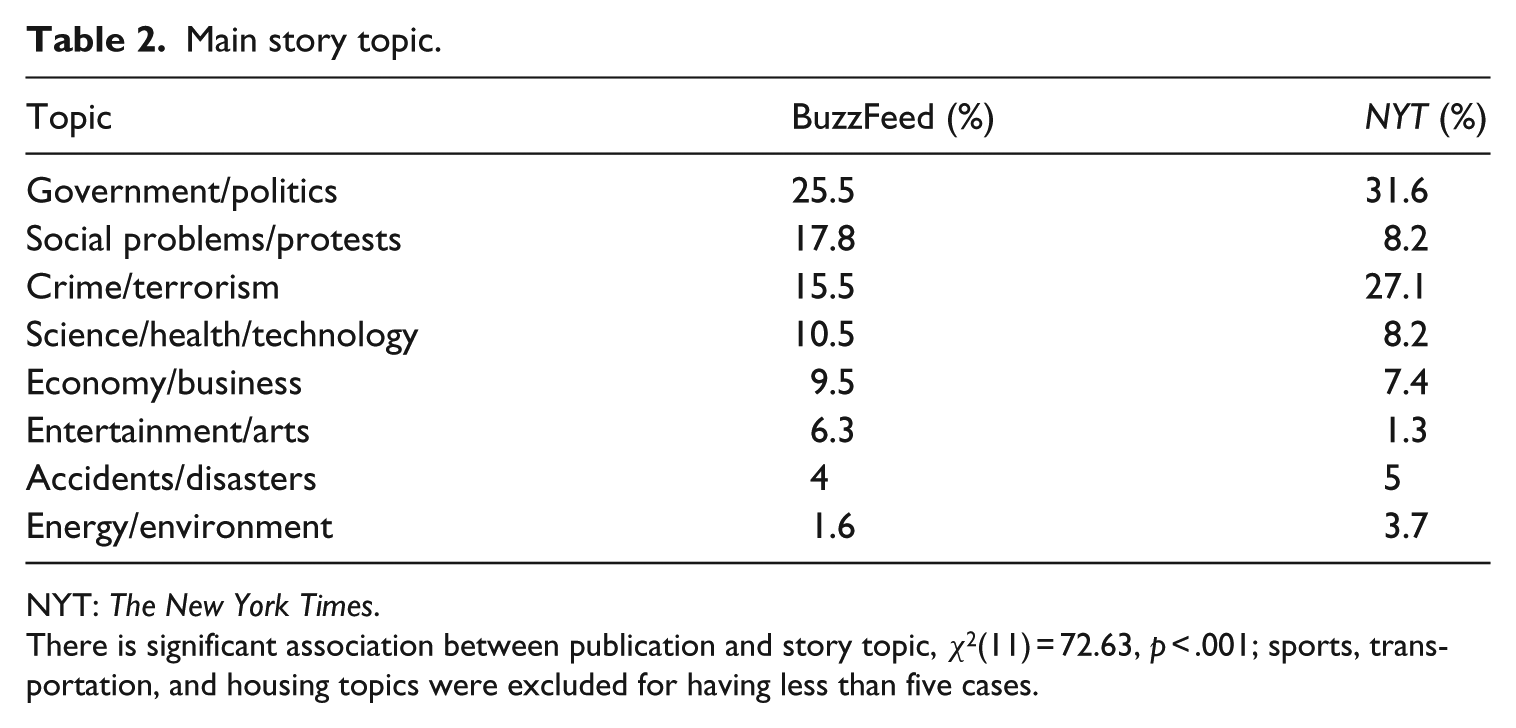
NYT: The New York Times.
There is significant association between publication and story topic, χ2(11) = 72.63, p < .001; sports, transportation, and housing topics were excluded for having less than five cases.
Such reporting patterns can also explain why the news value of negativity is more pronounced in The New York Times than in BuzzFeed. A comparison of how the two publications covered the three most common topics – government and politics, crime and terrorism, and social problems – found that The New York Times’ coverage was, in general, more negative than that of BuzzFeed. Specifically, The New York Times tends to include the news value of negativity when covering government and politics (68.5%), crime and terrorism (91.2%), and social problems (89.5%). In contrast, when BuzzFeed reports about these topics, the coverage is less likely to include negativity: Only 22.8 percent of articles about government and politics, 50 percent of articles about crime and terrorism, and 48.5 percent of articles about social problems included the news value of negativity.
The next area of comparison focused on sourcing patterns. The analysis also found a significant association between publication and dominant source used, χ2(7) = 87.99, p < .001. The most frequently cited sources for The New York Times were government officials, politicians, and law enforcement (51.7%); no human source (12.4%); and ordinary people (11.7%). In contrast, the most frequently cited sources for BuzzFeed were government officials, politicians, and law enforcement (39.1%); ordinary people (15.7%); and business people (13.3%). While establishment sources dominated sourcing patterns for both publications, government sources were quoted more often in The New York Times than in BuzzFeed (see Table 3). In contrast, ordinary people were quoted more often in BuzzFeed than in The New York Times. This can be explained by BuzzFeed’s practice of embedding tweets from users in their posts about online reactions to particular issues.
Dominant source.
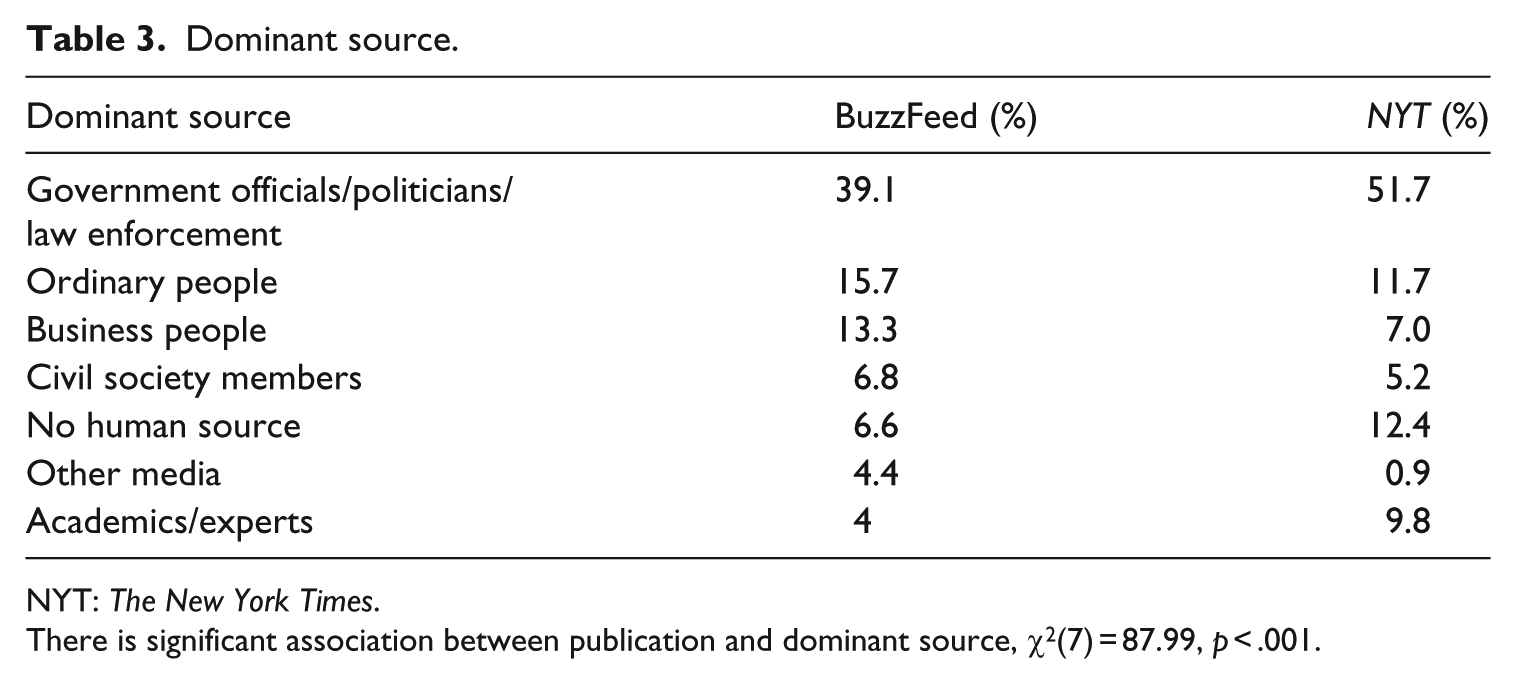
NYT: The New York Times.
There is significant association between publication and dominant source, χ2(7) = 87.99, p < .001.
The next area of comparison is story format. Similarly, the analysis found a significant association between publication and story format, χ2(3) = 46.17, p < .001 (see Table 4). The most common story format for both BuzzFeed (82.4%) and The New York Times (70.8%) was the inverted pyramid, a hallmark of traditional journalism. The second most frequently used format was the narrative approach, although it was more common for The New York Times (24.8%) than for BuzzFeed (9.9%). Surprisingly, news articles from BuzzFeed (4.8%) rarely used the listicle format for which it became popular. The format was also rarely used in The New York Times (1.5%).
Story format.
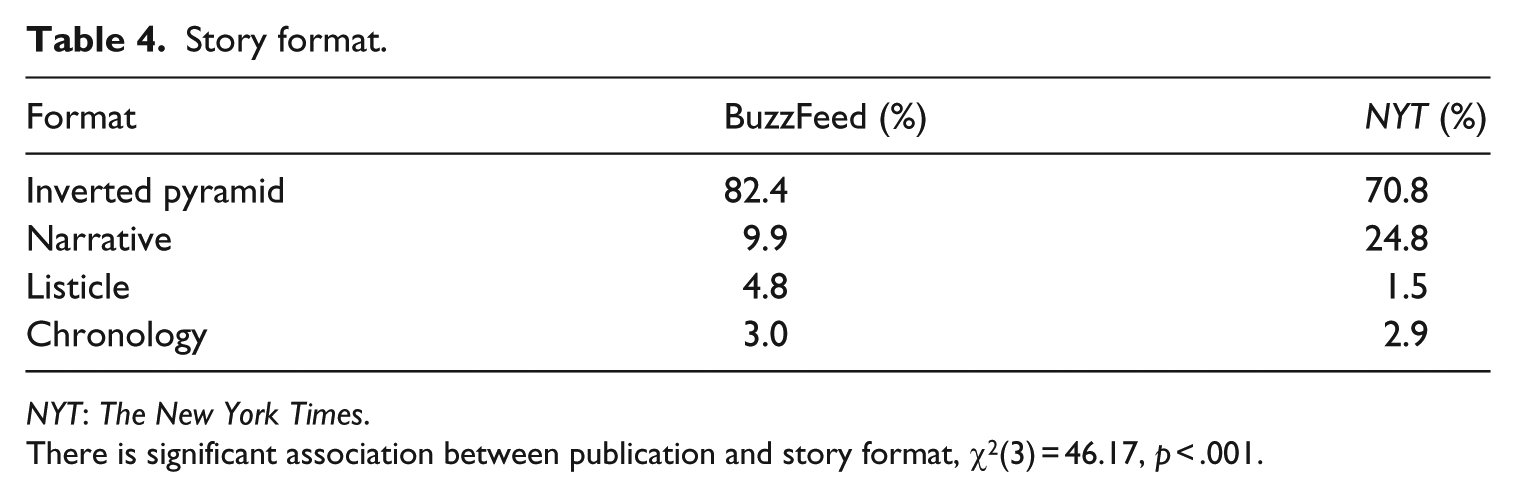
NYT: The New York Times.
There is significant association between publication and story format, χ2(3) = 46.17, p < .001.
Finally, the articles were also coded for the presence or absence of the journalist’s opinion. This was considered as a measure of objectivity for this study. The analysis also found a significant association between publication and objectivity, χ2(1) = 21.32, p < .001 (see Table 5). Opinion was absent in most of the articles, although such absence was a bit more pronounced among articles from BuzzFeed (86.8%) than from The New York Times (75.8%).
Presence of journalist’s opinion.
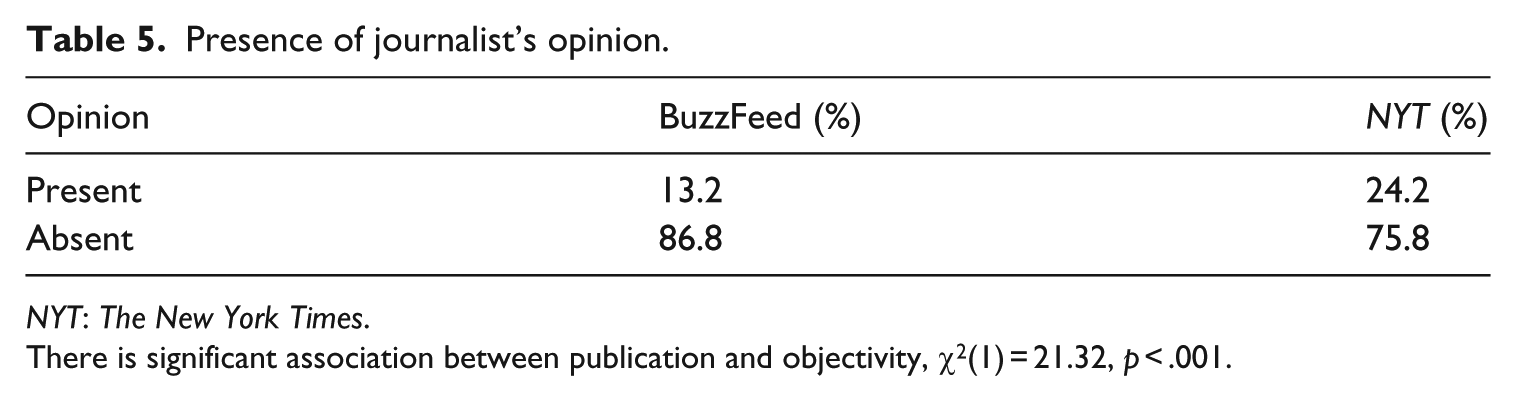
NYT: The New York Times.
There is significant association between publication and objectivity, χ2(1) = 21.32, p < .001.
Discussion and conclusion
Guided by field theory and the concept of journalistic boundary work (Bourdieu, 1998a, 2005; Carlson, 2015), this study sought to examine whether BuzzFeed, a new agent in the journalistic field, is participating in the preservation or transformation of the field. This was carried out by analyzing its news outputs based on the markers – or boundaries – that defined traditional journalistic practice, such as news values, topics, sources, formats, and norms (Schultz, 2007; Willig, 2013), and by comparing BuzzFeed’s outputs with those of The New York Times, considered as the standard of traditional journalism in the United States (Kung, 2015; Zelizer et al., 2002). The analysis found that while news articles produced by BuzzFeed are exhibiting some departures from traditional journalistic practice, in general, BuzzFeed is playing by the rules, which might explain its legitimation as a recognized agent in the field.
BuzzFeed entered the journalistic field carrying a significant amount of economic capital. It had steadily attracted millions of clicks and earned decent revenues from its own brand of native advertising even before it started producing news (Byers, 2016; Ellis, 2014; Isaac, 2014; Miller, 2014). This partly explains the privileged position it occupies despite being a new entrant. But part of the explanation also relies on the cultural capital it possesses. Sure, it has perfected the art of going viral by coming up with listicles and quizzes, but its entry into the field was also marked by high-profile hires involving online journalists who had earned solid reputation for investigative journalism and political reporting prior to joining BuzzFeed (Rieder, 2015; Stelter, 2011, 2012; USA Today, 2014). Thus, it also demonstrated a significant cultural capital that is aligned to the logic of the field. It should not come as a surprise to find, therefore, as this analysis did, that BuzzFeed has been mostly playing by the rules.
BuzzFeed’s news articles are marked by timeliness and proximity, news values that are considered fundamental in traditional news writing, even in how it is taught in schools (Harcup and O’Neill, 2001; Rogers, 2004). The adherence to these news values is even more pronounced than what was found for the case of The New York Times. BuzzFeed’s news coverage also depends largely on establishment sources, such as politicians and government officials. Most of its news articles were written using an inverted pyramid structure, a basic rule of news writing (Rogers, 2004). The majority of its news articles also excluded journalists’ opinions – a ritual of objectivity (Tuchman, 1973, 1978). These are all markers of traditional journalism. It appears that BuzzFeed has been complying with the logic of the field, perhaps in an effort to seek legitimation, and also as a logical offshoot of the habitus of the journalists it hired to run its newsroom. While BuzzFeed has been known, if not frowned upon, for its listicles that marked its viral and funny posts, it appears that it has so far insulated its newsroom from such non-traditional story-telling practices.
However, BuzzFeed is also differentiating itself in some aspects. First, it devotes a lot of space to social issues, much more than The New York Times. This finding is consistent with the fact that BuzzFeed had designated social issues often neglected or lumped into other larger assignments by mainstream news organizations as separate news beats that merited having their own assigned reporters. For example, BuzzFeed considers LGBT issues as a separate beat (Rieder, 2015). Second, BuzzFeed also quotes ordinary citizens more often than The New York Times does, and this is facilitated by new communication technologies, as users post their opinions and even their own breaking news on social media sites, such as Facebook. Third, in terms of news values, it seems to focus less on negativity. The analysis found that BuzzFeed had far fewer articles focusing on negative aspects of an issue or event than The New York Times. While this can be partly explained by The New York Times’ devoting a section focused on New York City, which includes reports on local crimes, another potential explanation is how BuzzFeed might be differentiating itself from other traditional news organizations. It is also likely that BuzzFeed News is trying to appeal to the subset of online readers that made it a popular site during its infancy – readers who look for funny, light-hearted, or inspiring stories instead of negative ones. Thus, while it seeks legitimation in the field by playing by the rules, BuzzFeed also appears to be instituting some of its rules. As it moves into a more influential position in the journalistic field, it will be interesting to see if these new rules can affect or change the current logic dominating the field.
The findings presented in this study should be examined within the boundaries imposed by some limitations. First, the analysis depends solely on content, and while this is enlightening given the study’s framework and research question, it will be equally useful and illuminating to determine how BuzzFeed and its journalists see themselves as players in the field. Future studies can match the findings presented here with interviews with BuzzFeed’s staff members. Second, the markers of traditional journalism enumerated here are based on the literature, and yet the boundaries of journalism extend beyond these factors. Future studies should also examine how BuzzFeed figures into these other aspects of boundary work. Third, the process of transformation and preservation within the journalistic field is dynamic, and while analyzing content in a particular period provides a snapshot of how BuzzFeed and The New York Times are complying or challenging the rules, it is arguably, at best, a static description. Future studies can build on the findings presented here to continue monitoring and examining such boundary performances from new and old players across time. Finally, a comparison of BuzzFeed’s content with that of other traditional news outlets can provide a more nuanced analysis of BuzzFeed’s position in the struggle for preservation or conservation. While the comparison with The New York Times was enlightening and useful, others can argue that the standards of The New York Times are more ideal than routine. For example, it might be equally illuminating to compare BuzzFeed with news outlets that target similar audiences, considering that others have described BuzzFeed and other sites such as Gawker as ‘tabloid descendants’ (Uberti, 2014: para. 11). Such comparative analysis can confirm if the trends observed in this current study are endemic within BuzzFeed or symbolic of the actual and larger shifts that might be ongoing within the journalistic field.
Despite these limitations, this study hopes to contribute not only in understanding BuzzFeed’s interesting place in the evolving news ecosystem but also in providing a framework to analyze new entrants to the journalistic field. The results of this study are consistent with the dual assumption of field theory that while existing in a field means differentiating oneself from other players, new entrants do not always seek to transform the field as they can also engage in de-differentiation and submit to the prevailing rules that dominate the field (Benson, 1999; Bourdieu, 1998a, 2005). This exploratory study focusing on BuzzFeed’s performance as a new player in the journalistic field demonstrates that such processes of differentiation and de-differentiation can occur simultaneously, motivated by a new entrant’s aim to claim a place in the field, which can only be possible after a process of legitimation that comes from being recognized by existing agents. A path to such recognition is through submission to the rules that have sustained, dominated, and legitimized the field. BuzzFeed seems to have followed this path and has consequently been legitimized. What happens next, however, is something that will be interesting and worthwhile to follow.
Footnotes
Acknowledgements
The author wishes to thank Teh Zi Tao, Ng Yan Xiang, and Er Qi Jian for their help in coding the news articles. They were all students at the Wee Kim Wee School of Communication and Information at Nanyang Technological University in Singapore when the content analysis was conducted.
Funding
The author(s) disclosed receipt of the following financial support for the research, authorship, and/or publication of this article: This study was supported by the Association for Education in Journalism and Mass Communication’s (AEJMC) Emerging Scholar Award, which was awarded to the author in 2015.